

BLOCK BEST
17.4k Posts

BLOCK BEST
 Square Verified
Report
Block User
Open Trade
High-Frequency Trader
1.1 Years
413 Following
34.3K+ Followers
31.1K+ Liked
Posts
Portfolio
All
Videos
Live
·
--
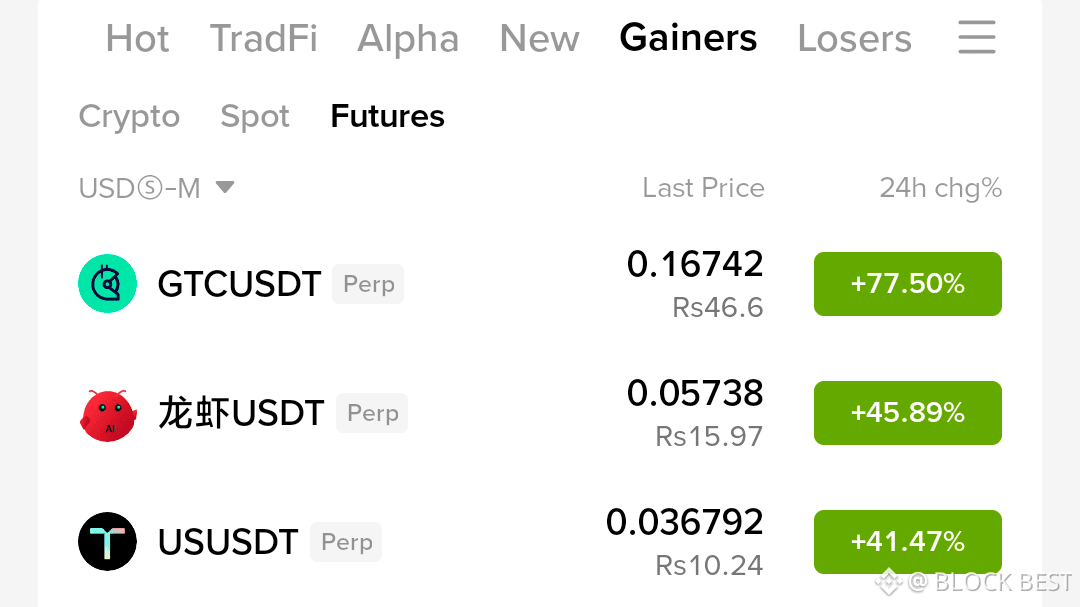
**$GTC$ $LOBSTER$ $US$ – THE FUTURES BOARD JUST LIT UP**
Three names just tore the USD-M gainers list apart while the rest of the market slept.
$GTC $ ripped +77.50% to $0.16742 in a vertical move that left no room for hesitation. Liquidity was pulled, stops were hunted, and the order book flipped from thin to aggressive bid within minutes. This is not a quiet grind – this is a full-scale momentum expansion.
{spot}(GTCUSDT)
Right behind it,TER$ ($龙虾 ) exploded +45.89% to $0.05738. The Chinese-ticker meme coin is doing what pure narrative plays do best: catching fire when attention is already elevated. Volume is loud, the chart is clean, and late buyers are still chasing.
{future}(龙虾USDT)
And $US $ refuses to cool off – up another +41.47% to $0.036792 after yesterday’s violent range. Talus is printing higher highs while the broader AI sector stays quiet. Smart money is rotating, not exiting.
{future}(USUSDT)
These three are moving together for a reason. When the top of the futures gainers board is dominated by high-beta names with real volume, the session usually belongs to the bold. Volatility is elevated, spreads are tight, and the next leg will decide who keeps the profits and who gets shaken out.
Watch the levels. Respect the speed. The board is speaking.
**$GTC $ $LOBSTER$ $US $ – THE FUTURES BOARD JUST LIT UP**
Three names just tore the USD-M gainers list apart while the rest of the market slept.
$GTC $ ripped +77.50% to $0.16742 in a vertical move that left no room for hesitation. Liquidity was pulled, stops were hunted, and the order book flipped from thin to aggressive bid within minutes. This is not a quiet grind – this is a full-scale momentum expansion.
Right behind it,TER$ ($龙虾 ) exploded +45.89% to $0.05738. The Chinese-ticker meme coin is doing what pure narrative plays do best: catching fire when attention is already elevated. Volume is loud, the chart is clean, and late buyers are still chasing.
And $US $ refuses to cool off – up another +41.47% to $0.036792 after yesterday’s violent range. Talus is printing higher highs while the broader AI sector stays quiet. Smart money is rotating, not exiting.
These three are moving together for a reason. When the top of the futures gainers board is dominated by high-beta names with real volume, the session usually belongs to the bold. Volatility is elevated, spreads are tight, and the next leg will decide who keeps the profits and who gets shaken out.
Watch the levels. Respect the speed. The board is speaking.
Three names just tore the USD-M gainers list apart while the rest of the market slept.
$GTC $ ripped +77.50% to $0.16742 in a vertical move that left no room for hesitation. Liquidity was pulled, stops were hunted, and the order book flipped from thin to aggressive bid within minutes. This is not a quiet grind – this is a full-scale momentum expansion.
Right behind it,TER$ ($龙虾 ) exploded +45.89% to $0.05738. The Chinese-ticker meme coin is doing what pure narrative plays do best: catching fire when attention is already elevated. Volume is loud, the chart is clean, and late buyers are still chasing.
And $US $ refuses to cool off – up another +41.47% to $0.036792 after yesterday’s violent range. Talus is printing higher highs while the broader AI sector stays quiet. Smart money is rotating, not exiting.
These three are moving together for a reason. When the top of the futures gainers board is dominated by high-beta names with real volume, the session usually belongs to the bold. Volatility is elevated, spreads are tight, and the next leg will decide who keeps the profits and who gets shaken out.
Watch the levels. Respect the speed. The board is speaking.
325
·
--
$1000000BOB
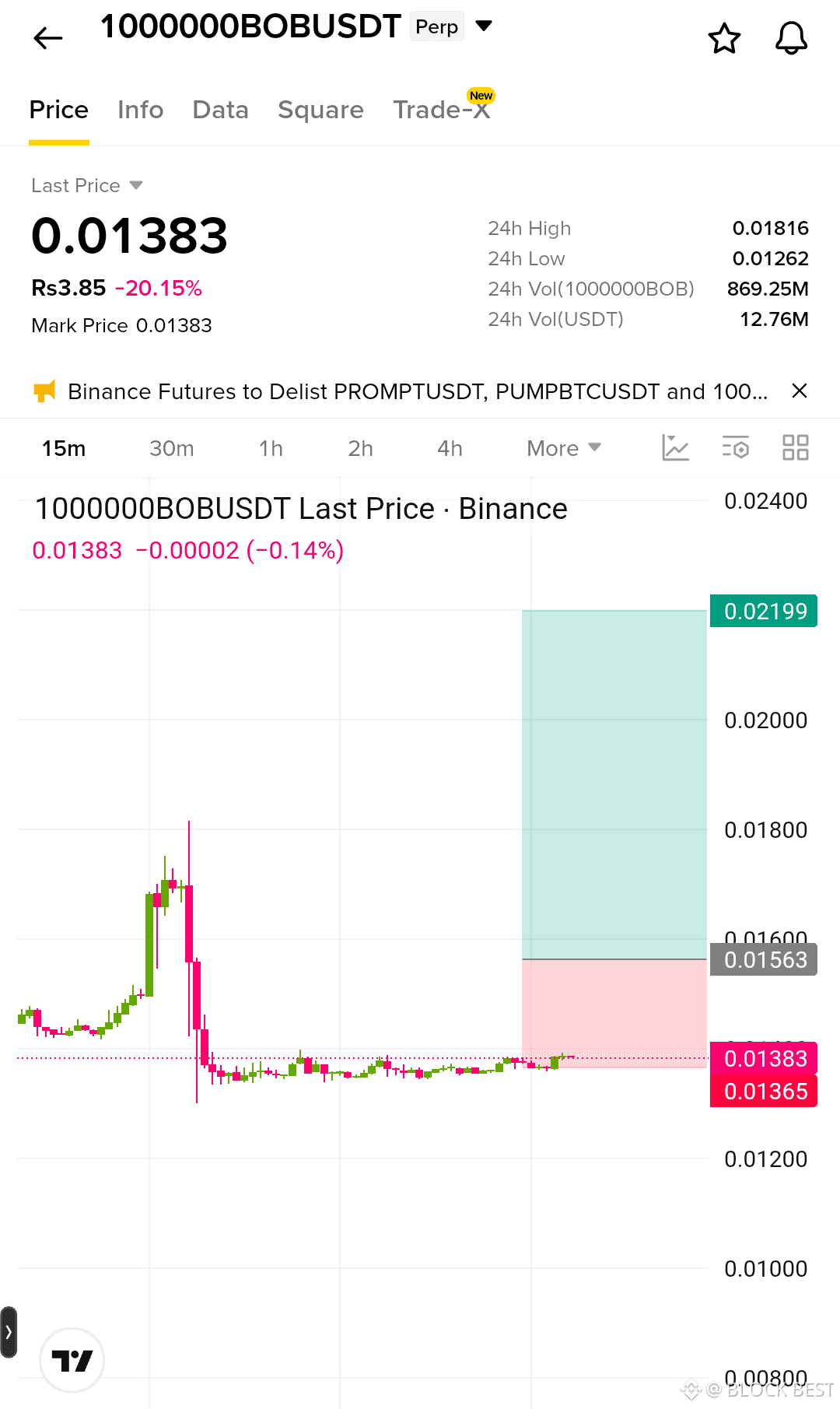
Price action on $1000000BOB$ has transitioned into a tight consolidation after the sharp rejection from $0.01816. The impulsive sell-off flushed liquidity into the $0.01262 region and price is now coiling just above that low, unable to reclaim the $0.01563 midpoint with any conviction. Structure remains lower-high after the distribution spike, with the impending delisting acting as a persistent overhead weight.
EP: $0.01390 – $0.01420
TP1: $0.01300
TP2: $0.01240
TP3: $0.01150
SL: $0.01500
Trend strength is bearish on the intermediate timeframe. Momentum has flattened inside the post-dump range, yet every attempt to push higher is met with immediate supply, confirming sellers remain active. Price is positioned to probe the lower liquidity pools because the unresolved delisting catalyst and the failure to hold above $0.01563 keep the path of least resistance downward until the $0.01262 support is fully tested or broken.
$1000000BOB
{future}(1000000BOBUSDT)
$1000000BOB
Price action on $1000000BOB $ has transitioned into a tight consolidation after the sharp rejection from $0.01816. The impulsive sell-off flushed liquidity into the $0.01262 region and price is now coiling just above that low, unable to reclaim the $0.01563 midpoint with any conviction. Structure remains lower-high after the distribution spike, with the impending delisting acting as a persistent overhead weight.
EP: $0.01390 – $0.01420
TP1: $0.01300
TP2: $0.01240
TP3: $0.01150
SL: $0.01500
Trend strength is bearish on the intermediate timeframe. Momentum has flattened inside the post-dump range, yet every attempt to push higher is met with immediate supply, confirming sellers remain active. Price is positioned to probe the lower liquidity pools because the unresolved delisting catalyst and the failure to hold above $0.01563 keep the path of least resistance downward until the $0.01262 support is fully tested or broken.
$1000000BOB
Price action on $1000000BOB $ has transitioned into a tight consolidation after the sharp rejection from $0.01816. The impulsive sell-off flushed liquidity into the $0.01262 region and price is now coiling just above that low, unable to reclaim the $0.01563 midpoint with any conviction. Structure remains lower-high after the distribution spike, with the impending delisting acting as a persistent overhead weight.
EP: $0.01390 – $0.01420
TP1: $0.01300
TP2: $0.01240
TP3: $0.01150
SL: $0.01500
Trend strength is bearish on the intermediate timeframe. Momentum has flattened inside the post-dump range, yet every attempt to push higher is met with immediate supply, confirming sellers remain active. Price is positioned to probe the lower liquidity pools because the unresolved delisting catalyst and the failure to hold above $0.01563 keep the path of least resistance downward until the $0.01262 support is fully tested or broken.
$1000000BOB
40
·
--
$PUMPBTC
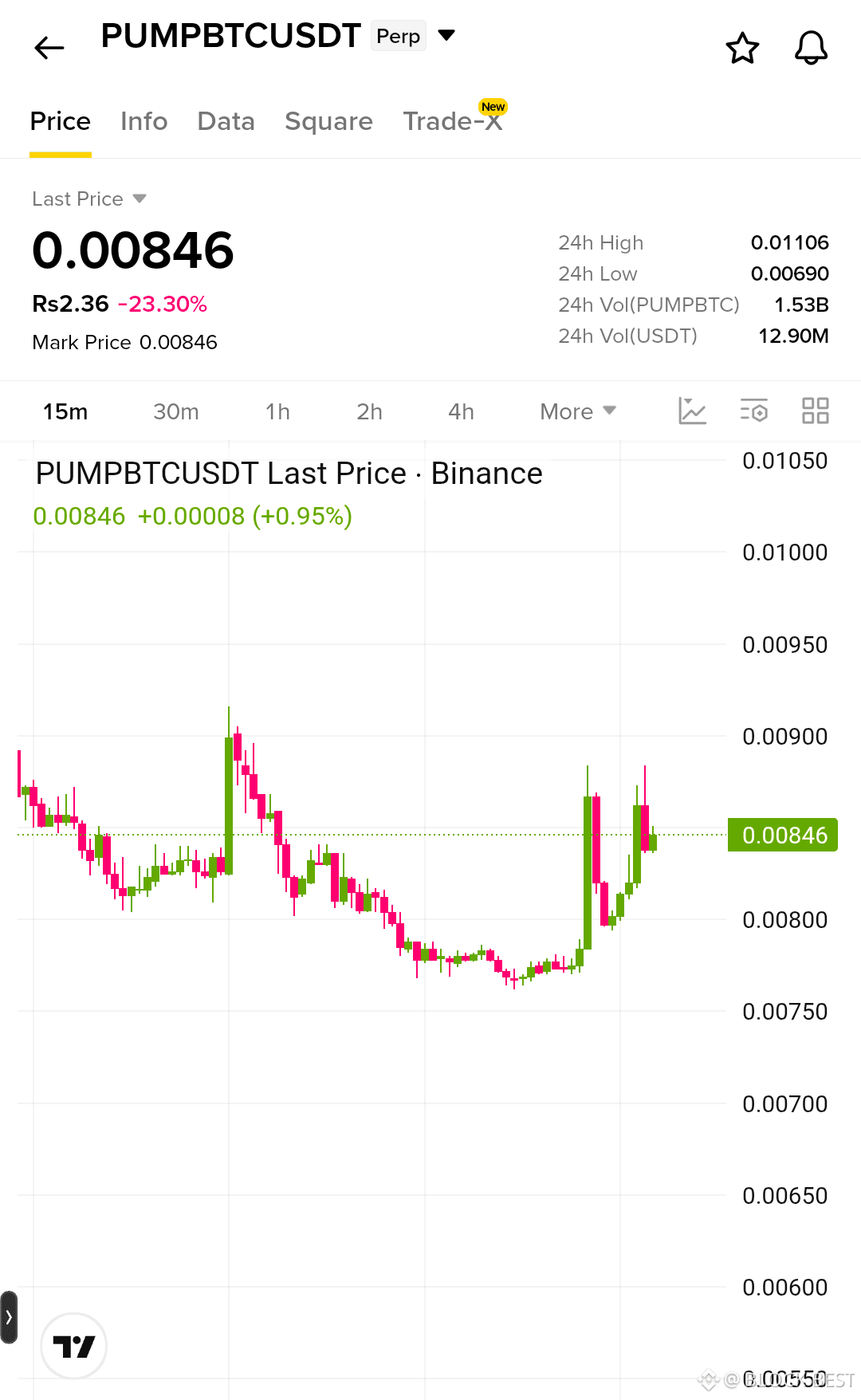
Price action on $PUMPBTC$ shows a clear lower-high structure after the rejection from $0.01106. The recent bounce from the $0.00690–$0.00770 demand zone has stalled beneath prior supply, leaving the market in a corrective recovery within a broader downtrend. Volume remains elevated while price struggles to reclaim the $0.00900 midpoint, confirming sellers retain control of the intermediate structure.
EP: $0.00850 – $0.00870
TP1: $0.00770
TP2: $0.00700
TP3: $0.00650
SL: $0.00920
Trend strength remains decisively bearish on the higher timeframe. Momentum has shifted back to the downside after the failed breakout attempt, with each rally producing diminishing follow-through and clear distribution. Price is likely to move toward the lower liquidity pools because the impending delisting pressure and unresolved supply overhead continue to suppress any sustained bid, keeping the path of least resistance lower until the $0.00690 zone is fully tested.
$PUMPBTC
{future}(PUMPBTCUSDT)
$PUMPBTC
Price action on $PUMPBTC $ shows a clear lower-high structure after the rejection from $0.01106. The recent bounce from the $0.00690–$0.00770 demand zone has stalled beneath prior supply, leaving the market in a corrective recovery within a broader downtrend. Volume remains elevated while price struggles to reclaim the $0.00900 midpoint, confirming sellers retain control of the intermediate structure.
EP: $0.00850 – $0.00870
TP1: $0.00770
TP2: $0.00700
TP3: $0.00650
SL: $0.00920
Trend strength remains decisively bearish on the higher timeframe. Momentum has shifted back to the downside after the failed breakout attempt, with each rally producing diminishing follow-through and clear distribution. Price is likely to move toward the lower liquidity pools because the impending delisting pressure and unresolved supply overhead continue to suppress any sustained bid, keeping the path of least resistance lower until the $0.00690 zone is fully tested.
$PUMPBTC
Price action on $PUMPBTC $ shows a clear lower-high structure after the rejection from $0.01106. The recent bounce from the $0.00690–$0.00770 demand zone has stalled beneath prior supply, leaving the market in a corrective recovery within a broader downtrend. Volume remains elevated while price struggles to reclaim the $0.00900 midpoint, confirming sellers retain control of the intermediate structure.
EP: $0.00850 – $0.00870
TP1: $0.00770
TP2: $0.00700
TP3: $0.00650
SL: $0.00920
Trend strength remains decisively bearish on the higher timeframe. Momentum has shifted back to the downside after the failed breakout attempt, with each rally producing diminishing follow-through and clear distribution. Price is likely to move toward the lower liquidity pools because the impending delisting pressure and unresolved supply overhead continue to suppress any sustained bid, keeping the path of least resistance lower until the $0.00690 zone is fully tested.
$PUMPBTC
45
·
--
$US
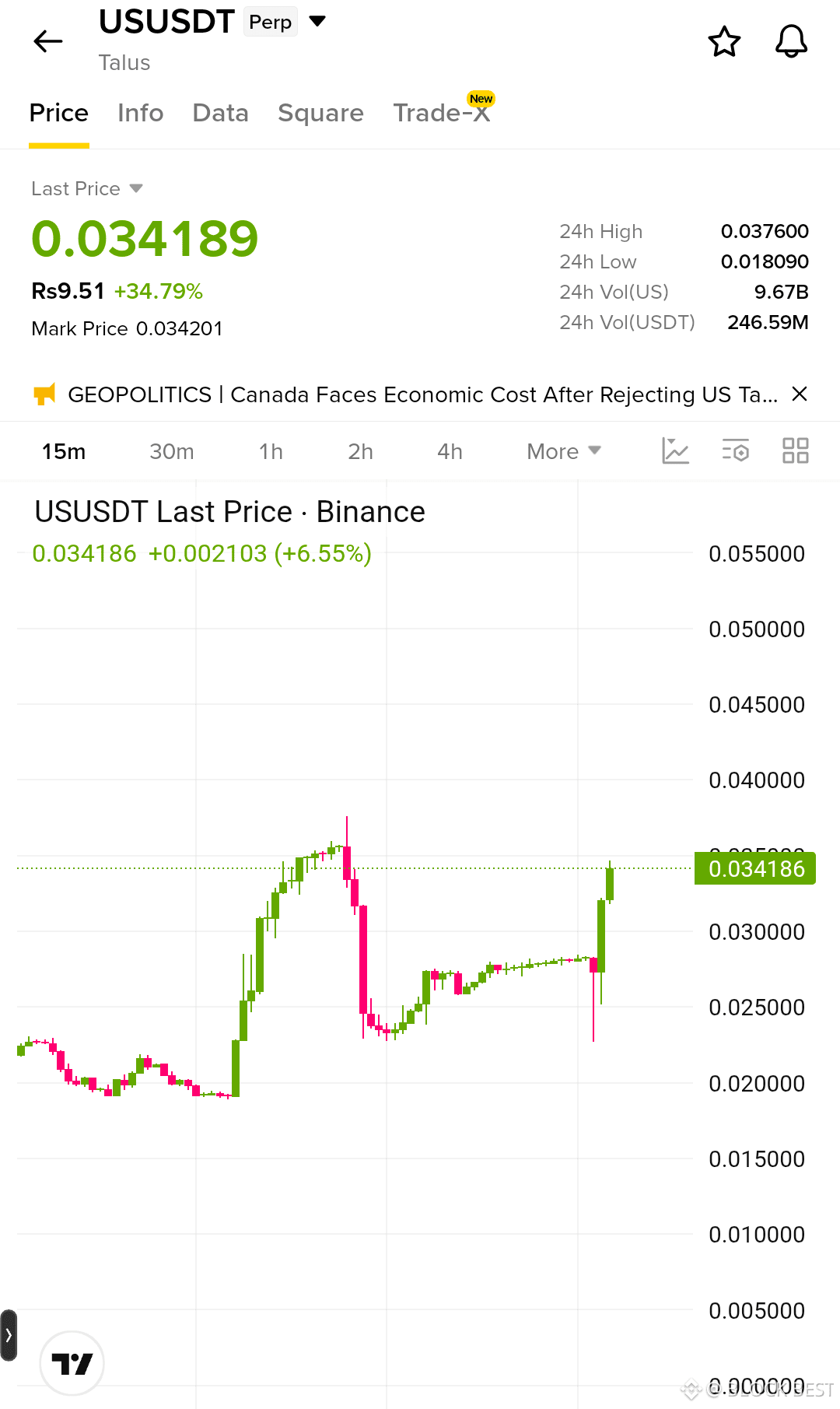
Market structure on $US$ remains firmly bullish after the sharp recovery from the $0.018090 liquidity sweep. Price has printed a clear sequence of higher lows and is currently trading near $0.034189, holding above the prior consolidation shelf and pressing into the upper range defined by the $0.037600 session high.
EP: $0.033800 – $0.034400
TP1: $0.037600
TP2: $0.041500
TP3: $0.045000
SL: $0.030800
Trend strength is elevated. The impulsive leg off the lows, combined with sustained volume, confirms buyers remain in control of the higher timeframe structure. Momentum continues to favor the upside as each pullback has been shallow and absorbed quickly, leaving the market in a clean bullish continuation bias. Price is positioned to target the next liquidity pools above $0.037600 because the recent breakout has invalidated the prior supply zone and shifted the balance of power toward further expansion.
$US
{future}(USUSDT)
$US
Market structure on $US $ remains firmly bullish after the sharp recovery from the $0.018090 liquidity sweep. Price has printed a clear sequence of higher lows and is currently trading near $0.034189, holding above the prior consolidation shelf and pressing into the upper range defined by the $0.037600 session high.
EP: $0.033800 – $0.034400
TP1: $0.037600
TP2: $0.041500
TP3: $0.045000
SL: $0.030800
Trend strength is elevated. The impulsive leg off the lows, combined with sustained volume, confirms buyers remain in control of the higher timeframe structure. Momentum continues to favor the upside as each pullback has been shallow and absorbed quickly, leaving the market in a clean bullish continuation bias. Price is positioned to target the next liquidity pools above $0.037600 because the recent breakout has invalidated the prior supply zone and shifted the balance of power toward further expansion.
$US
Market structure on $US $ remains firmly bullish after the sharp recovery from the $0.018090 liquidity sweep. Price has printed a clear sequence of higher lows and is currently trading near $0.034189, holding above the prior consolidation shelf and pressing into the upper range defined by the $0.037600 session high.
EP: $0.033800 – $0.034400
TP1: $0.037600
TP2: $0.041500
TP3: $0.045000
SL: $0.030800
Trend strength is elevated. The impulsive leg off the lows, combined with sustained volume, confirms buyers remain in control of the higher timeframe structure. Momentum continues to favor the upside as each pullback has been shallow and absorbed quickly, leaving the market in a clean bullish continuation bias. Price is positioned to target the next liquidity pools above $0.037600 because the recent breakout has invalidated the prior supply zone and shifted the balance of power toward further expansion.
$US
93
·
--
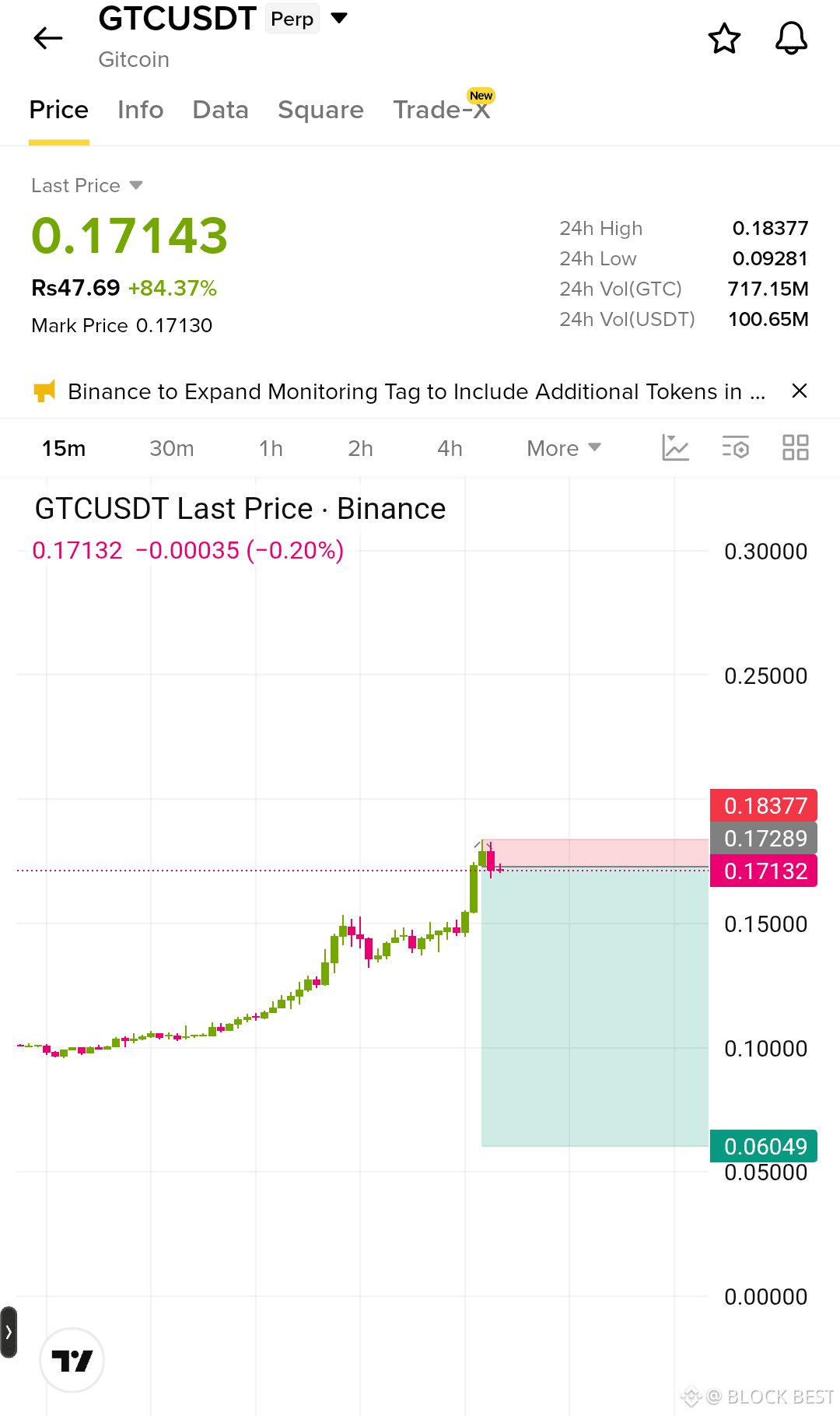
$GTC is printing a clean bullish structure after a sharp expansion from the lower range.
Price has reacted strongly from the demand zone near the 0.09–0.10 area and buyers have clearly taken control, driving higher highs and higher lows with aggressive green candles. Momentum remains firm, liquidity is being absorbed on every minor pullback, and the market structure continues to favor continuation as long as the recent breakout level holds.
Trade Setup
Entry: 0.1680 – 0.1725
Target 1: 0.1850
Target 2: 0.1980
Target 3: 0.2150
Stop Loss: 0.1580
How it's possible
The chart shows clear buyer dominance after price left the major demand zone and formed a series of higher lows. Volume expanded on the upward legs while the small pullbacks were shallow, confirming that sellers are not yet in control. As long as price holds above the recent support and does not close below the stop loss, the path of least resistance remains higher. Proper risk management means exiting immediately if the stop is hit so capital stays protected for the next opportunity.
Let's go and Trade now $GTC
{spot}(GTCUSDT)
$SCR
$GTC is printing a clean bullish structure after a sharp expansion from the lower range.
Price has reacted strongly from the demand zone near the 0.09–0.10 area and buyers have clearly taken control, driving higher highs and higher lows with aggressive green candles. Momentum remains firm, liquidity is being absorbed on every minor pullback, and the market structure continues to favor continuation as long as the recent breakout level holds.
Trade Setup
Entry: 0.1680 – 0.1725
Target 1: 0.1850
Target 2: 0.1980
Target 3: 0.2150
Stop Loss: 0.1580
How it's possible
The chart shows clear buyer dominance after price left the major demand zone and formed a series of higher lows. Volume expanded on the upward legs while the small pullbacks were shallow, confirming that sellers are not yet in control. As long as price holds above the recent support and does not close below the stop loss, the path of least resistance remains higher. Proper risk management means exiting immediately if the stop is hit so capital stays protected for the next opportunity.
Let's go and Trade now $GTC
$SCR
Price has reacted strongly from the demand zone near the 0.09–0.10 area and buyers have clearly taken control, driving higher highs and higher lows with aggressive green candles. Momentum remains firm, liquidity is being absorbed on every minor pullback, and the market structure continues to favor continuation as long as the recent breakout level holds.
Trade Setup
Entry: 0.1680 – 0.1725
Target 1: 0.1850
Target 2: 0.1980
Target 3: 0.2150
Stop Loss: 0.1580
How it's possible
The chart shows clear buyer dominance after price left the major demand zone and formed a series of higher lows. Volume expanded on the upward legs while the small pullbacks were shallow, confirming that sellers are not yet in control. As long as price holds above the recent support and does not close below the stop loss, the path of least resistance remains higher. Proper risk management means exiting immediately if the stop is hit so capital stays protected for the next opportunity.
Let's go and Trade now $GTC
$SCR
50
·
--
**$UAI
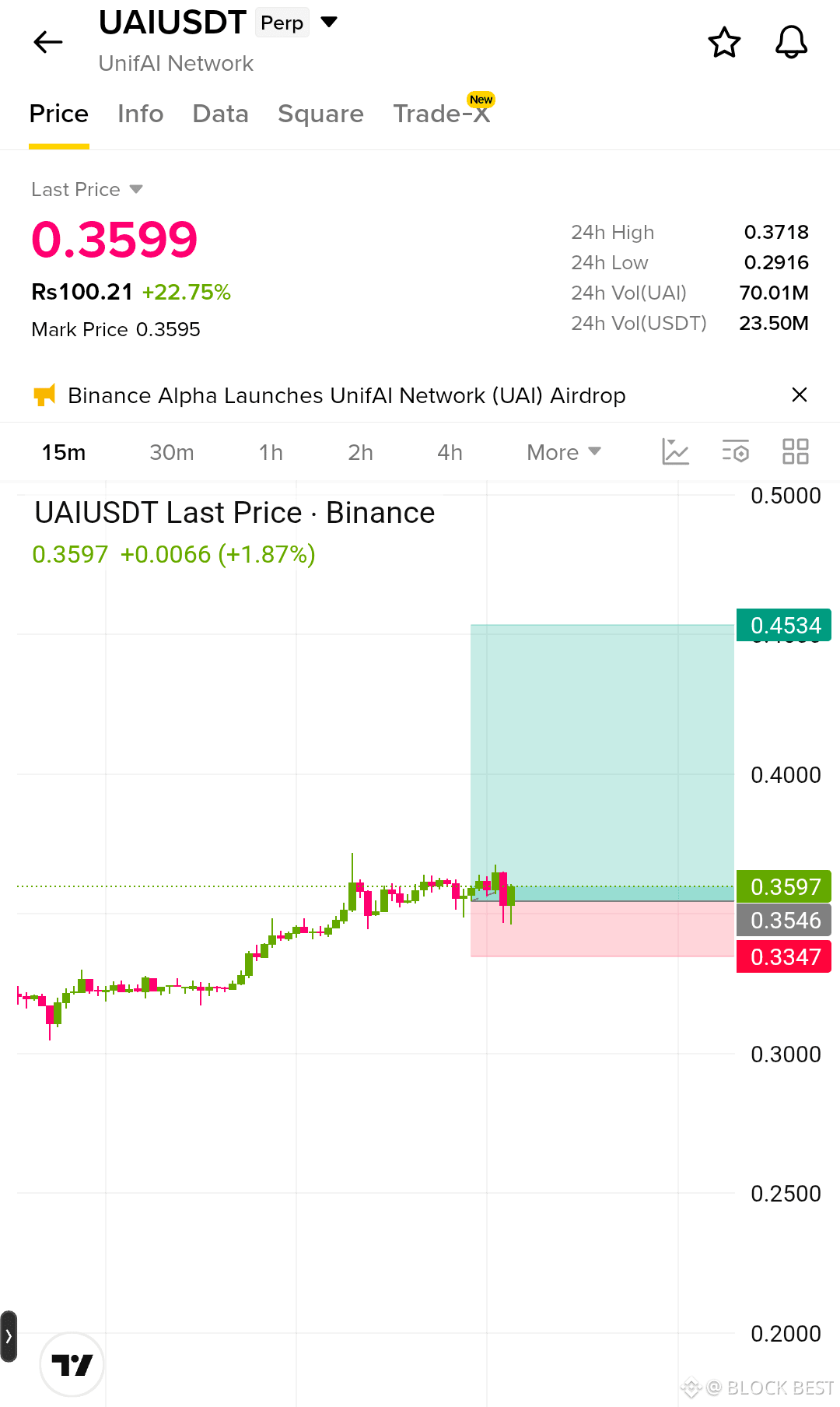
Bullish continuation remains the dominant structure after the strong 24-hour advance. Price is trading at $0.3599 following a clean sequence of higher highs and higher lows. The recent consolidation near the highs shows no structural damage and momentum continues to favor further upside.
EP: $0.3540 – $0.3600
TP1: $0.3850
TP2: $0.4150
TP3: $0.4550
SL: $0.3320
Trend strength is solid after the sustained expansion from the $0.29 base. Momentum and structure bias remain firmly bullish as price continues to respect the rising sequence of lows and has not yet printed a lower high. Liquidity above the $0.3718 high is the next logical target, supporting a measured extension into the listed levels while the higher-low structure stays intact.
**$UAI
{future}(UAIUSDT)
#MetaMaskExitsLidoValidatorsAfterSecurityIncident #KoreaProposesTokenizingStocksAndBonds #USWeeklyJoblessClaimsFallTo197000 #DollarIndexHitsHighestSinceMay2025 #AnthropicTargetsIPOAsSoonAsMidNovember
**$UAI
Bullish continuation remains the dominant structure after the strong 24-hour advance. Price is trading at $0.3599 following a clean sequence of higher highs and higher lows. The recent consolidation near the highs shows no structural damage and momentum continues to favor further upside.
EP: $0.3540 – $0.3600
TP1: $0.3850
TP2: $0.4150
TP3: $0.4550
SL: $0.3320
Trend strength is solid after the sustained expansion from the $0.29 base. Momentum and structure bias remain firmly bullish as price continues to respect the rising sequence of lows and has not yet printed a lower high. Liquidity above the $0.3718 high is the next logical target, supporting a measured extension into the listed levels while the higher-low structure stays intact.
**$UAI
#MetaMaskExitsLidoValidatorsAfterSecurityIncident #KoreaProposesTokenizingStocksAndBonds #USWeeklyJoblessClaimsFallTo197000 #DollarIndexHitsHighestSinceMay2025 #AnthropicTargetsIPOAsSoonAsMidNovember
Bullish continuation remains the dominant structure after the strong 24-hour advance. Price is trading at $0.3599 following a clean sequence of higher highs and higher lows. The recent consolidation near the highs shows no structural damage and momentum continues to favor further upside.
EP: $0.3540 – $0.3600
TP1: $0.3850
TP2: $0.4150
TP3: $0.4550
SL: $0.3320
Trend strength is solid after the sustained expansion from the $0.29 base. Momentum and structure bias remain firmly bullish as price continues to respect the rising sequence of lows and has not yet printed a lower high. Liquidity above the $0.3718 high is the next logical target, supporting a measured extension into the listed levels while the higher-low structure stays intact.
**$UAI
#MetaMaskExitsLidoValidatorsAfterSecurityIncident #KoreaProposesTokenizingStocksAndBonds #USWeeklyJoblessClaimsFallTo197000 #DollarIndexHitsHighestSinceMay2025 #AnthropicTargetsIPOAsSoonAsMidNovember
100
·
--
**$MEGA
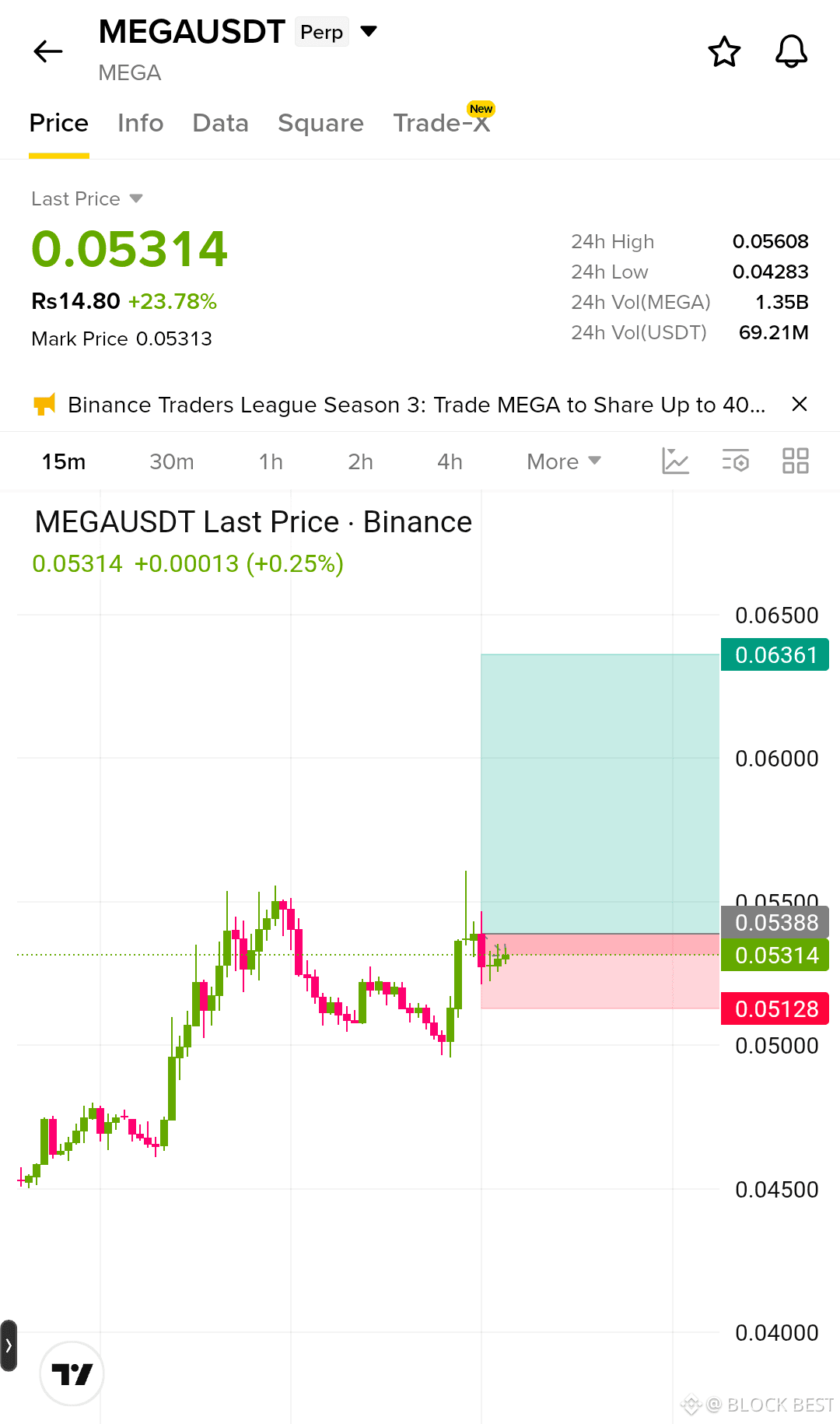
Bullish continuation remains the primary bias after the strong 24-hour advance. Price is trading at $0.05314 following a clean higher-high sequence and a successful hold above the recent pullback lows. Structure stays constructive with higher lows intact and momentum still supportive of further upside.
EP: $0.05250 – $0.05350
TP1: $0.05700
TP2: $0.06050
TP3: $0.06400
SL: $0.05080
Trend strength is solid after the sustained expansion and volume support. Momentum and structure bias remain firmly bullish as price continues to respect the rising sequence of lows and has not yet broken the higher-low pattern. Liquidity above the $0.05608 high is the next logical magnet, supporting a measured move into the listed targets while the current structure holds clean.
**$MEGA
{spot}(MEGAUSDT)
#MetaMaskExitsLidoValidatorsAfterSecurityIncident #USWeeklyJoblessClaimsFallTo197000 #DollarIndexHitsHighestSinceMay2025 #AnthropicTargetsIPOAsSoonAsMidNovember
**$MEGA
Bullish continuation remains the primary bias after the strong 24-hour advance. Price is trading at $0.05314 following a clean higher-high sequence and a successful hold above the recent pullback lows. Structure stays constructive with higher lows intact and momentum still supportive of further upside.
EP: $0.05250 – $0.05350
TP1: $0.05700
TP2: $0.06050
TP3: $0.06400
SL: $0.05080
Trend strength is solid after the sustained expansion and volume support. Momentum and structure bias remain firmly bullish as price continues to respect the rising sequence of lows and has not yet broken the higher-low pattern. Liquidity above the $0.05608 high is the next logical magnet, supporting a measured move into the listed targets while the current structure holds clean.
**$MEGA
#MetaMaskExitsLidoValidatorsAfterSecurityIncident #USWeeklyJoblessClaimsFallTo197000 #DollarIndexHitsHighestSinceMay2025 #AnthropicTargetsIPOAsSoonAsMidNovember
Bullish continuation remains the primary bias after the strong 24-hour advance. Price is trading at $0.05314 following a clean higher-high sequence and a successful hold above the recent pullback lows. Structure stays constructive with higher lows intact and momentum still supportive of further upside.
EP: $0.05250 – $0.05350
TP1: $0.05700
TP2: $0.06050
TP3: $0.06400
SL: $0.05080
Trend strength is solid after the sustained expansion and volume support. Momentum and structure bias remain firmly bullish as price continues to respect the rising sequence of lows and has not yet broken the higher-low pattern. Liquidity above the $0.05608 high is the next logical magnet, supporting a measured move into the listed targets while the current structure holds clean.
**$MEGA
#MetaMaskExitsLidoValidatorsAfterSecurityIncident #USWeeklyJoblessClaimsFallTo197000 #DollarIndexHitsHighestSinceMay2025 #AnthropicTargetsIPOAsSoonAsMidNovember
106
·
--
$SCR
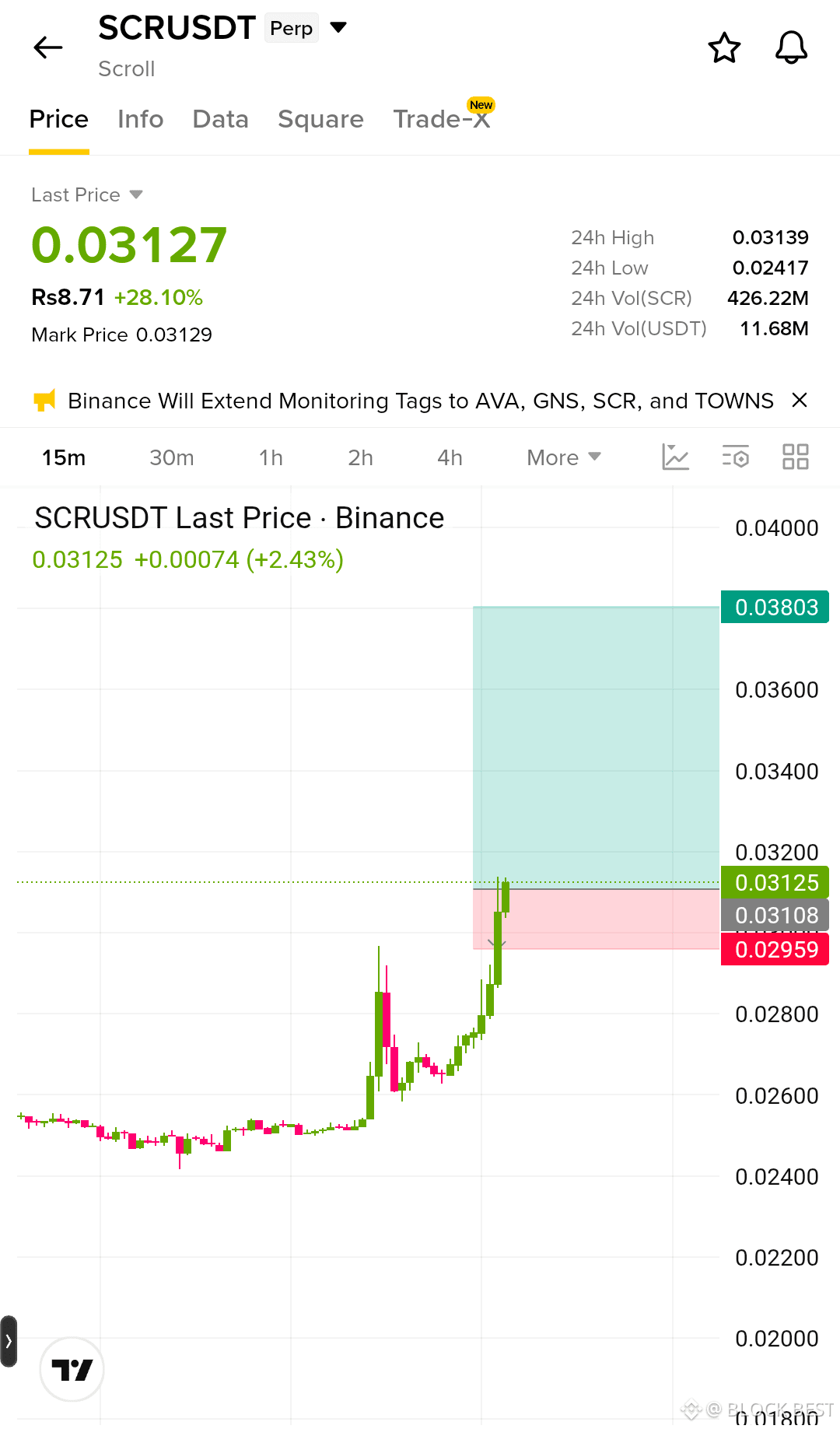
Bullish continuation remains fully intact after the renewed impulse that pushed price to $0.03127. The structure shows clean higher highs and higher lows, with the latest expansion confirming strong demand and no structural damage. Momentum is still elevated and the path of least resistance stays higher while the current sequence holds.
EP: $0.03080 – $0.03130
TP1: $0.03450
TP2: $0.03680
TP3: $0.03850
SL: $0.02940
Trend strength is high following the sustained breakout and volume surge. Momentum and structure bias remain firmly bullish as price continues to print higher lows and has not yet formed a lower high. Liquidity above the $0.03139 high is thin and the measured extension from the prior base supports further upside into the listed targets while the higher-low structure stays clean.
$SCR
{spot}(SCRUSDT)
$SCR
Bullish continuation remains fully intact after the renewed impulse that pushed price to $0.03127. The structure shows clean higher highs and higher lows, with the latest expansion confirming strong demand and no structural damage. Momentum is still elevated and the path of least resistance stays higher while the current sequence holds.
EP: $0.03080 – $0.03130
TP1: $0.03450
TP2: $0.03680
TP3: $0.03850
SL: $0.02940
Trend strength is high following the sustained breakout and volume surge. Momentum and structure bias remain firmly bullish as price continues to print higher lows and has not yet formed a lower high. Liquidity above the $0.03139 high is thin and the measured extension from the prior base supports further upside into the listed targets while the higher-low structure stays clean.
$SCR
Bullish continuation remains fully intact after the renewed impulse that pushed price to $0.03127. The structure shows clean higher highs and higher lows, with the latest expansion confirming strong demand and no structural damage. Momentum is still elevated and the path of least resistance stays higher while the current sequence holds.
EP: $0.03080 – $0.03130
TP1: $0.03450
TP2: $0.03680
TP3: $0.03850
SL: $0.02940
Trend strength is high following the sustained breakout and volume surge. Momentum and structure bias remain firmly bullish as price continues to print higher lows and has not yet formed a lower high. Liquidity above the $0.03139 high is thin and the measured extension from the prior base supports further upside into the listed targets while the higher-low structure stays clean.
$SCR
114
·
--
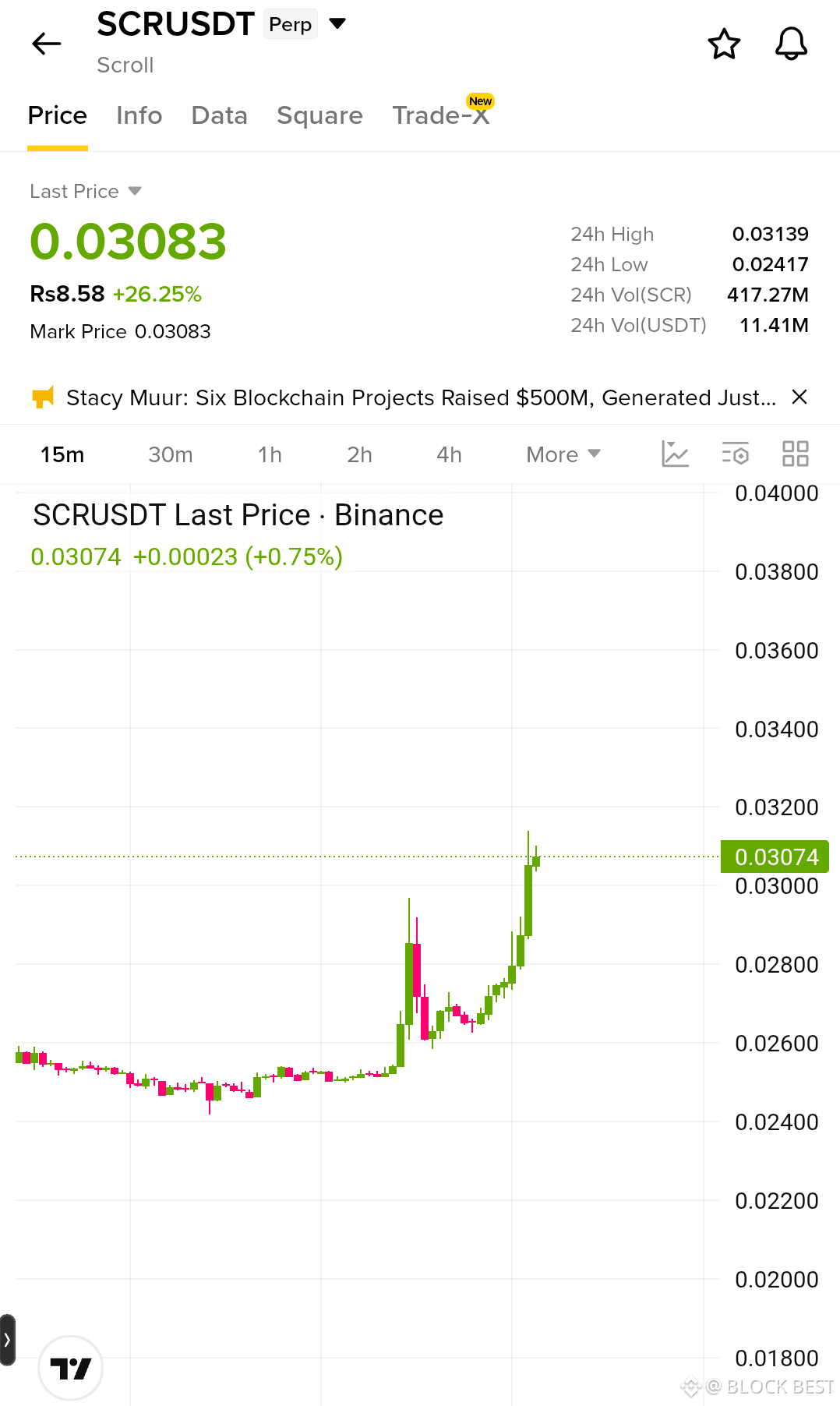
**$SCR
Strong bullish continuation remains the dominant structure after the sharp 24-hour expansion. Price is trading at $0.03083 following a clean breakout from the prior consolidation base near $0.02500–$0.02600. Higher highs and higher lows are firmly established on the lower timeframes, with the latest impulse candle confirming aggressive buying.
EP: $0.03020 – $0.03090
TP1: $0.03350
TP2: $0.03600
TP3: $0.03900
SL: $0.02780
Trend strength is high after the decisive breakout and sustained volume expansion. Momentum and structure bias remain firmly bullish as price continues to respect the rising sequence of lows and has not yet printed a meaningful lower high. Liquidity above the recent $0.03139 high is the next logical target, supporting a measured extension into the listed levels while the higher-low structure stays intact.
**$SCR
{spot}(SCRUSDT)
**$SCR
Strong bullish continuation remains the dominant structure after the sharp 24-hour expansion. Price is trading at $0.03083 following a clean breakout from the prior consolidation base near $0.02500–$0.02600. Higher highs and higher lows are firmly established on the lower timeframes, with the latest impulse candle confirming aggressive buying.
EP: $0.03020 – $0.03090
TP1: $0.03350
TP2: $0.03600
TP3: $0.03900
SL: $0.02780
Trend strength is high after the decisive breakout and sustained volume expansion. Momentum and structure bias remain firmly bullish as price continues to respect the rising sequence of lows and has not yet printed a meaningful lower high. Liquidity above the recent $0.03139 high is the next logical target, supporting a measured extension into the listed levels while the higher-low structure stays intact.
**$SCR
Strong bullish continuation remains the dominant structure after the sharp 24-hour expansion. Price is trading at $0.03083 following a clean breakout from the prior consolidation base near $0.02500–$0.02600. Higher highs and higher lows are firmly established on the lower timeframes, with the latest impulse candle confirming aggressive buying.
EP: $0.03020 – $0.03090
TP1: $0.03350
TP2: $0.03600
TP3: $0.03900
SL: $0.02780
Trend strength is high after the decisive breakout and sustained volume expansion. Momentum and structure bias remain firmly bullish as price continues to respect the rising sequence of lows and has not yet printed a meaningful lower high. Liquidity above the recent $0.03139 high is the next logical target, supporting a measured extension into the listed levels while the higher-low structure stays intact.
**$SCR
101
·
--
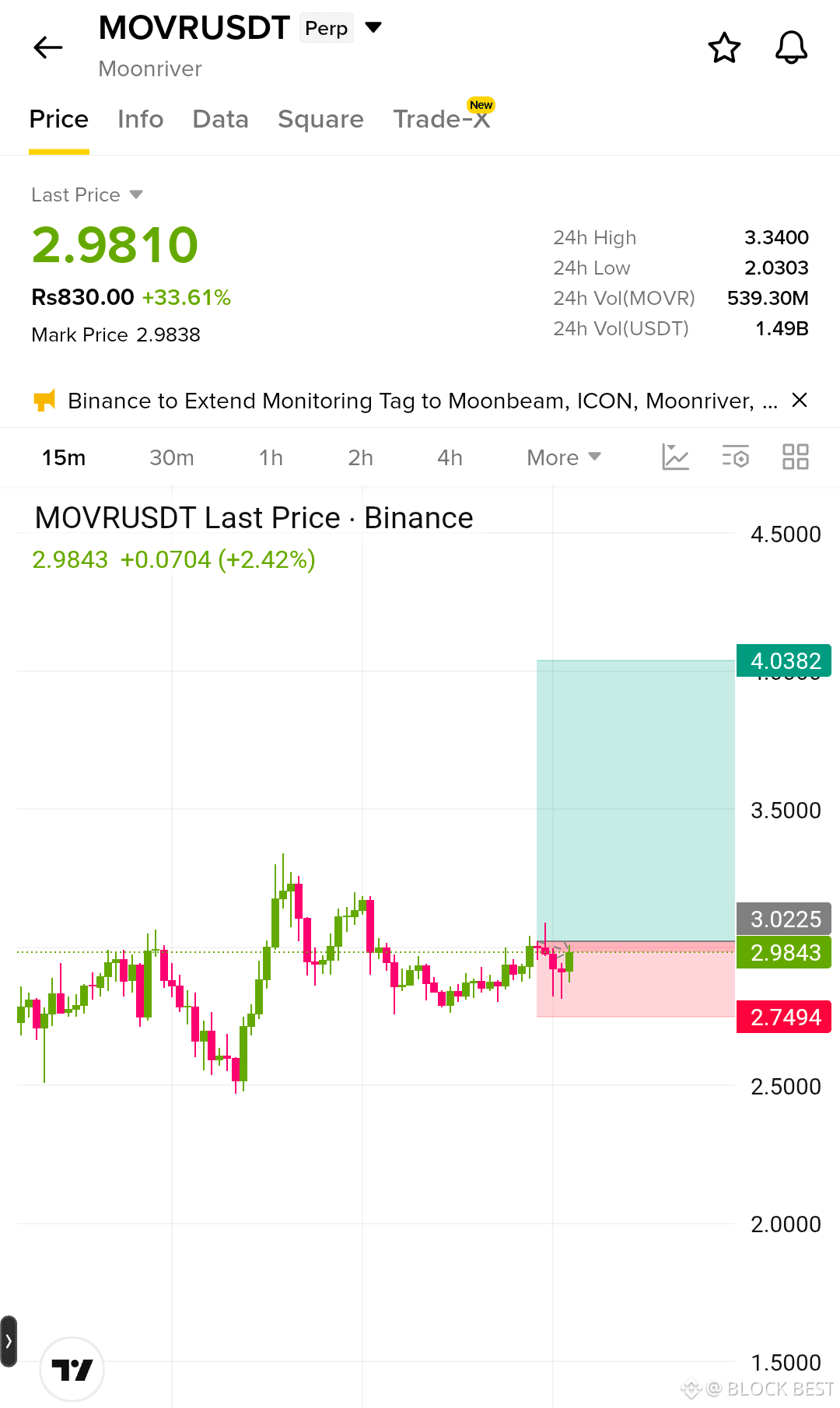
$MOVR USDT
Bullish continuation remains the primary bias after the solid 24-hour advance. Price is at $2.9236 with clean higher highs and higher lows. Momentum is constructive and structure supports further expansion as long as the recent base holds.
EP: $2.880 – $2.930
TP1: $3.150
TP2: $3.400
TP3: $3.700
SL: $2.650
Trend strength is solid with consistent buying and no structural breakdown. Momentum and structure bias stay bullish as price builds on the prior impulse. Liquidity sits above the recent swing highs, increasing the probability of a measured move into the targets while the higher-low sequence remains unbroken.
$MOVR USDT
{spot}(MOVRUSDT)
$MOVR USDT
Bullish continuation remains the primary bias after the solid 24-hour advance. Price is at $2.9236 with clean higher highs and higher lows. Momentum is constructive and structure supports further expansion as long as the recent base holds.
EP: $2.880 – $2.930
TP1: $3.150
TP2: $3.400
TP3: $3.700
SL: $2.650
Trend strength is solid with consistent buying and no structural breakdown. Momentum and structure bias stay bullish as price builds on the prior impulse. Liquidity sits above the recent swing highs, increasing the probability of a measured move into the targets while the higher-low sequence remains unbroken.
$MOVR USDT
Bullish continuation remains the primary bias after the solid 24-hour advance. Price is at $2.9236 with clean higher highs and higher lows. Momentum is constructive and structure supports further expansion as long as the recent base holds.
EP: $2.880 – $2.930
TP1: $3.150
TP2: $3.400
TP3: $3.700
SL: $2.650
Trend strength is solid with consistent buying and no structural breakdown. Momentum and structure bias stay bullish as price builds on the prior impulse. Liquidity sits above the recent swing highs, increasing the probability of a measured move into the targets while the higher-low sequence remains unbroken.
$MOVR USDT
138
·
--
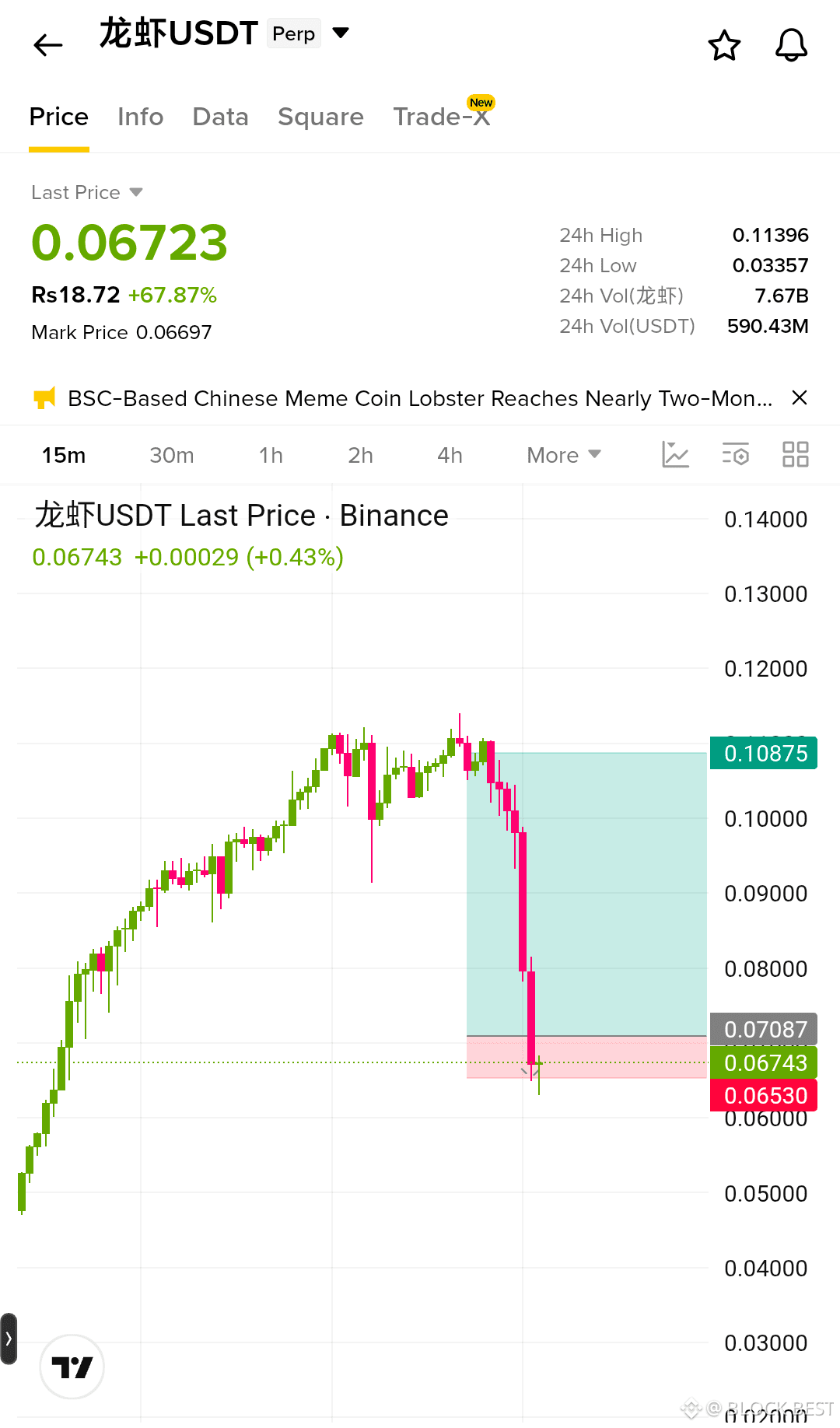
$龙虾 USDT \)
Clear bullish momentum continuation after the sharp 24-hour rally. Price sits at $0.06482 with strong expansion and sequential higher lows. Structure remains intact and favors further upside on this speculative name while volume supports the move.
EP: $0.0635 – $0.0650
TP1: $0.0720
TP2: $0.0800
TP3: $0.0900
SL: $0.0575
Trend strength is elevated following the impulsive breakout. Momentum and structure bias are bullish as price holds above the recent acceleration zone. Thin liquidity overhead and continued speculative interest make a move toward the listed targets the higher-probability path while the higher-low structure is preserved.
$龙虾 USDT
$MOVR
{spot}(MOVRUSDT)
$龙虾 USDT \)
Clear bullish momentum continuation after the sharp 24-hour rally. Price sits at $0.06482 with strong expansion and sequential higher lows. Structure remains intact and favors further upside on this speculative name while volume supports the move.
EP: $0.0635 – $0.0650
TP1: $0.0720
TP2: $0.0800
TP3: $0.0900
SL: $0.0575
Trend strength is elevated following the impulsive breakout. Momentum and structure bias are bullish as price holds above the recent acceleration zone. Thin liquidity overhead and continued speculative interest make a move toward the listed targets the higher-probability path while the higher-low structure is preserved.
$龙虾 USDT
$MOVR
Clear bullish momentum continuation after the sharp 24-hour rally. Price sits at $0.06482 with strong expansion and sequential higher lows. Structure remains intact and favors further upside on this speculative name while volume supports the move.
EP: $0.0635 – $0.0650
TP1: $0.0720
TP2: $0.0800
TP3: $0.0900
SL: $0.0575
Trend strength is elevated following the impulsive breakout. Momentum and structure bias are bullish as price holds above the recent acceleration zone. Thin liquidity overhead and continued speculative interest make a move toward the listed targets the higher-probability path while the higher-low structure is preserved.
$龙虾 USDT
$MOVR
383
·
--
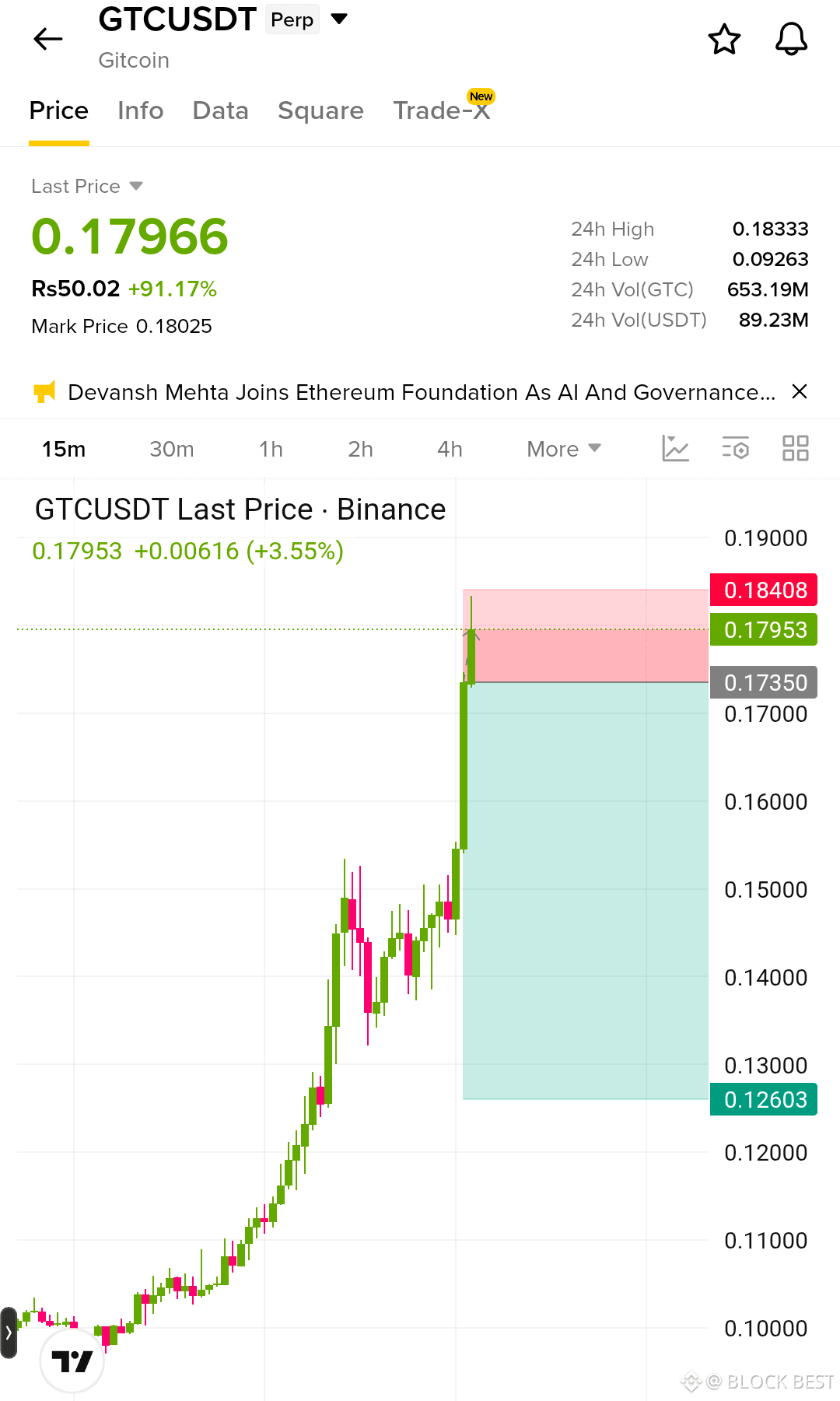
$GTC USDT
Strong bullish continuation setup remains intact after the aggressive 24-hour expansion. Price is trading at $0.17839 with clear higher highs and higher lows forming on the lower timeframes. Momentum is elevated and structure favors further upside as long as the recent impulse holds.
EP: $0.1750 – $0.1785
TP1: $0.1950
TP2: $0.2150
TP3: $0.2400
SL: $0.1620
Trend strength is high with sustained buying pressure and no meaningful lower high yet. Momentum and structure bias remain firmly bullish as price continues to expand away from the prior consolidation base. Liquidity above recent highs is thin and likely to be targeted as the move extends, supporting continuation toward the higher targets while the structure stays clean.
$MOVR
{spot}(MOVRUSDT)
{spot}(GTCUSDT)
$GTC USDT
Strong bullish continuation setup remains intact after the aggressive 24-hour expansion. Price is trading at $0.17839 with clear higher highs and higher lows forming on the lower timeframes. Momentum is elevated and structure favors further upside as long as the recent impulse holds.
EP: $0.1750 – $0.1785
TP1: $0.1950
TP2: $0.2150
TP3: $0.2400
SL: $0.1620
Trend strength is high with sustained buying pressure and no meaningful lower high yet. Momentum and structure bias remain firmly bullish as price continues to expand away from the prior consolidation base. Liquidity above recent highs is thin and likely to be targeted as the move extends, supporting continuation toward the higher targets while the structure stays clean.
$MOVR
Strong bullish continuation setup remains intact after the aggressive 24-hour expansion. Price is trading at $0.17839 with clear higher highs and higher lows forming on the lower timeframes. Momentum is elevated and structure favors further upside as long as the recent impulse holds.
EP: $0.1750 – $0.1785
TP1: $0.1950
TP2: $0.2150
TP3: $0.2400
SL: $0.1620
Trend strength is high with sustained buying pressure and no meaningful lower high yet. Momentum and structure bias remain firmly bullish as price continues to expand away from the prior consolidation base. Liquidity above recent highs is thin and likely to be targeted as the move extends, supporting continuation toward the higher targets while the structure stays clean.
$MOVR
274
·
--
$QNT
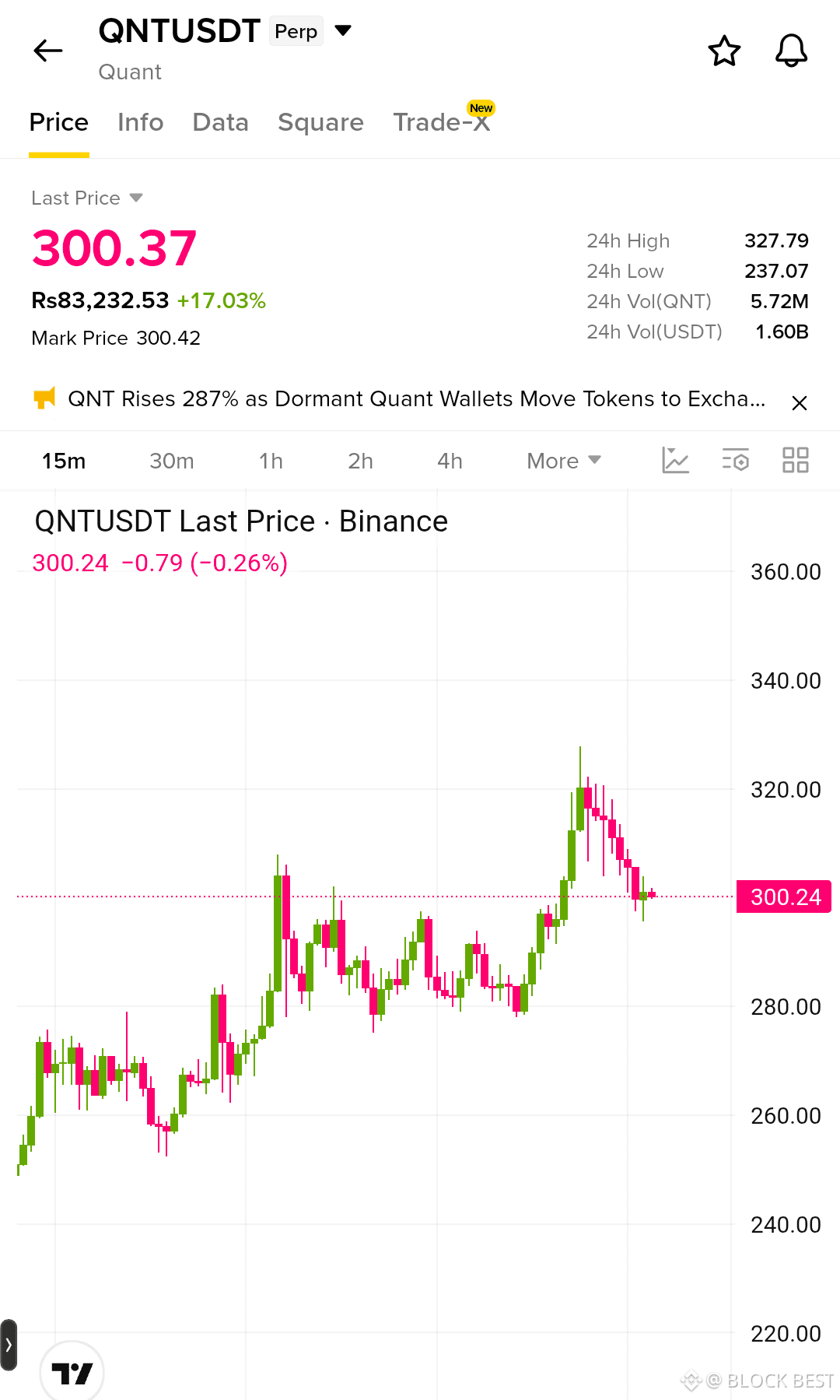
QNT is showing a bullish continuation structure on the 15m chart after breaking higher from the $280–$285 consolidation area and reaching a $327.79 24H high. Price has since pulled back toward $300, creating a potential retest of the breakout zone rather than an immediate trend reversal. The key area is $295–$300; holding this zone would keep the short-term bullish structure intact.
EP (Entry Price): $297–$302
TP1: $315
TP2: $328
TP3: $345
SL (Stop Loss): $288
The short-term trend remains bullish, but momentum has cooled after the sharp rejection from $320–$328, making the $295–$300 retest critical.
Market structure stays constructive while QNT holds above $295, with buyers positioned to defend the previous breakout area.
A reclaim of $310 followed by a break above $328 would expose higher liquidity around $315, $328 and $345; a sustained loss of $288 would invalidate the bullish continuation setup.
$QNT
{spot}(QNTUSDT)
$QNT
QNT is showing a bullish continuation structure on the 15m chart after breaking higher from the $280–$285 consolidation area and reaching a $327.79 24H high. Price has since pulled back toward $300, creating a potential retest of the breakout zone rather than an immediate trend reversal. The key area is $295–$300; holding this zone would keep the short-term bullish structure intact.
EP (Entry Price): $297–$302
TP1: $315
TP2: $328
TP3: $345
SL (Stop Loss): $288
The short-term trend remains bullish, but momentum has cooled after the sharp rejection from $320–$328, making the $295–$300 retest critical.
Market structure stays constructive while QNT holds above $295, with buyers positioned to defend the previous breakout area.
A reclaim of $310 followed by a break above $328 would expose higher liquidity around $315, $328 and $345; a sustained loss of $288 would invalidate the bullish continuation setup.
$QNT
QNT is showing a bullish continuation structure on the 15m chart after breaking higher from the $280–$285 consolidation area and reaching a $327.79 24H high. Price has since pulled back toward $300, creating a potential retest of the breakout zone rather than an immediate trend reversal. The key area is $295–$300; holding this zone would keep the short-term bullish structure intact.
EP (Entry Price): $297–$302
TP1: $315
TP2: $328
TP3: $345
SL (Stop Loss): $288
The short-term trend remains bullish, but momentum has cooled after the sharp rejection from $320–$328, making the $295–$300 retest critical.
Market structure stays constructive while QNT holds above $295, with buyers positioned to defend the previous breakout area.
A reclaim of $310 followed by a break above $328 would expose higher liquidity around $315, $328 and $345; a sustained loss of $288 would invalidate the bullish continuation setup.
$QNT
1
131
·
--
$NOM
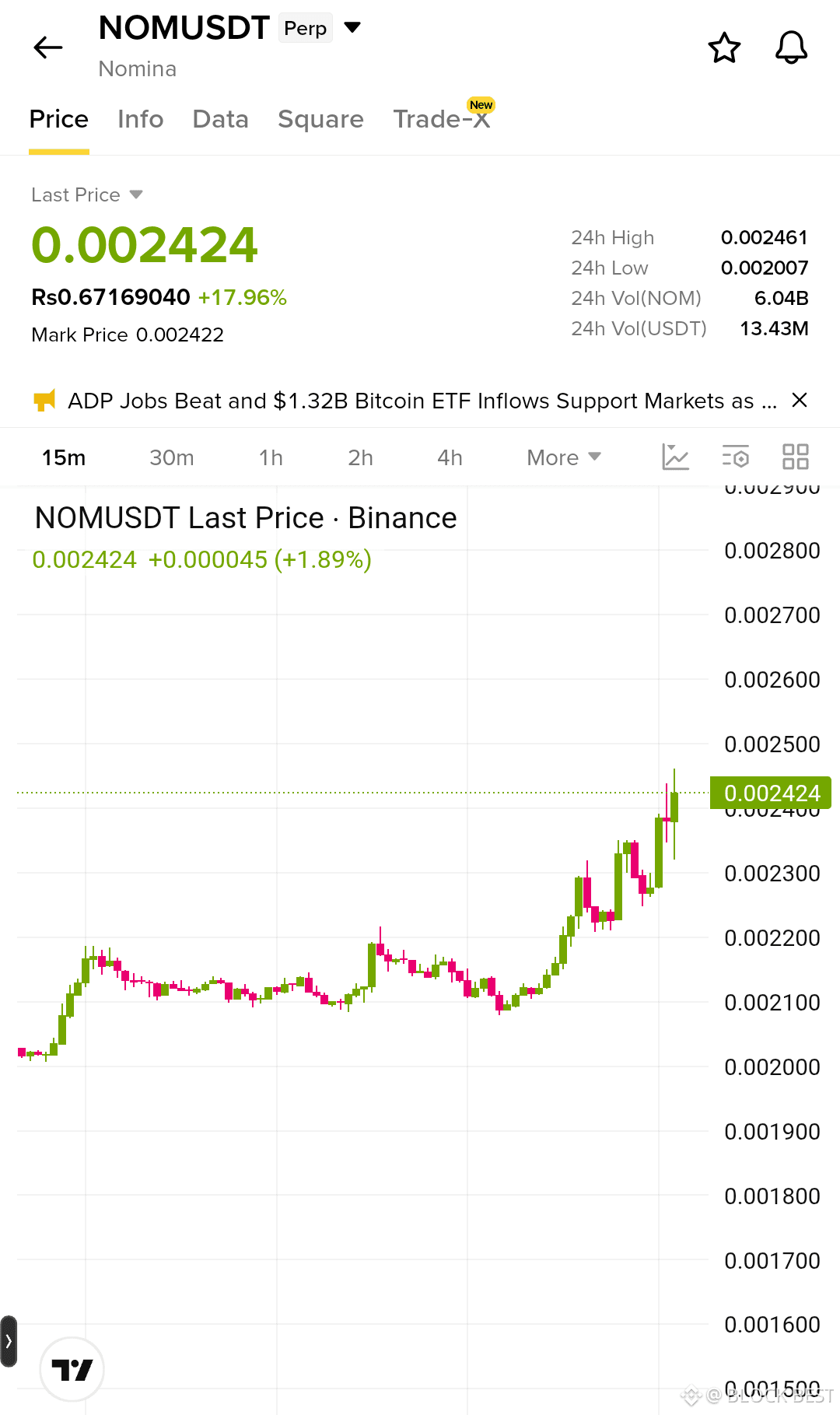
NOM is showing a clear bullish continuation structure on the 15m chart after breaking out of the $0.00210–$0.00220 consolidation range. Price has developed a sequence of higher highs and higher lows and is now pressing into the $0.00246 24H high. The latest candles show strong buying momentum, with the breakout holding above the previous resistance area.
EP (Entry Price): $0.00235–$0.00242
TP1: $0.00250
TP2: $0.00265
TP3: $0.00280
SL (Stop Loss): $0.00225
The short-term trend is strongly bullish, with market structure continuing to print higher highs and higher lows.
Momentum remains buyer-controlled while price holds above $0.00230–$0.00235, keeping the breakout structure intact.
A clean break above $0.00246 can unlock upside liquidity toward $0.00250, $0.00265 and $0.00280; a sustained move below $0.00225 would invalidate the continuation setup.
$NOM
{spot}(NOMUSDT)
$NOM
NOM is showing a clear bullish continuation structure on the 15m chart after breaking out of the $0.00210–$0.00220 consolidation range. Price has developed a sequence of higher highs and higher lows and is now pressing into the $0.00246 24H high. The latest candles show strong buying momentum, with the breakout holding above the previous resistance area.
EP (Entry Price): $0.00235–$0.00242
TP1: $0.00250
TP2: $0.00265
TP3: $0.00280
SL (Stop Loss): $0.00225
The short-term trend is strongly bullish, with market structure continuing to print higher highs and higher lows.
Momentum remains buyer-controlled while price holds above $0.00230–$0.00235, keeping the breakout structure intact.
A clean break above $0.00246 can unlock upside liquidity toward $0.00250, $0.00265 and $0.00280; a sustained move below $0.00225 would invalidate the continuation setup.
$NOM
NOM is showing a clear bullish continuation structure on the 15m chart after breaking out of the $0.00210–$0.00220 consolidation range. Price has developed a sequence of higher highs and higher lows and is now pressing into the $0.00246 24H high. The latest candles show strong buying momentum, with the breakout holding above the previous resistance area.
EP (Entry Price): $0.00235–$0.00242
TP1: $0.00250
TP2: $0.00265
TP3: $0.00280
SL (Stop Loss): $0.00225
The short-term trend is strongly bullish, with market structure continuing to print higher highs and higher lows.
Momentum remains buyer-controlled while price holds above $0.00230–$0.00235, keeping the breakout structure intact.
A clean break above $0.00246 can unlock upside liquidity toward $0.00250, $0.00265 and $0.00280; a sustained move below $0.00225 would invalidate the continuation setup.
$NOM
33
·
--
$US
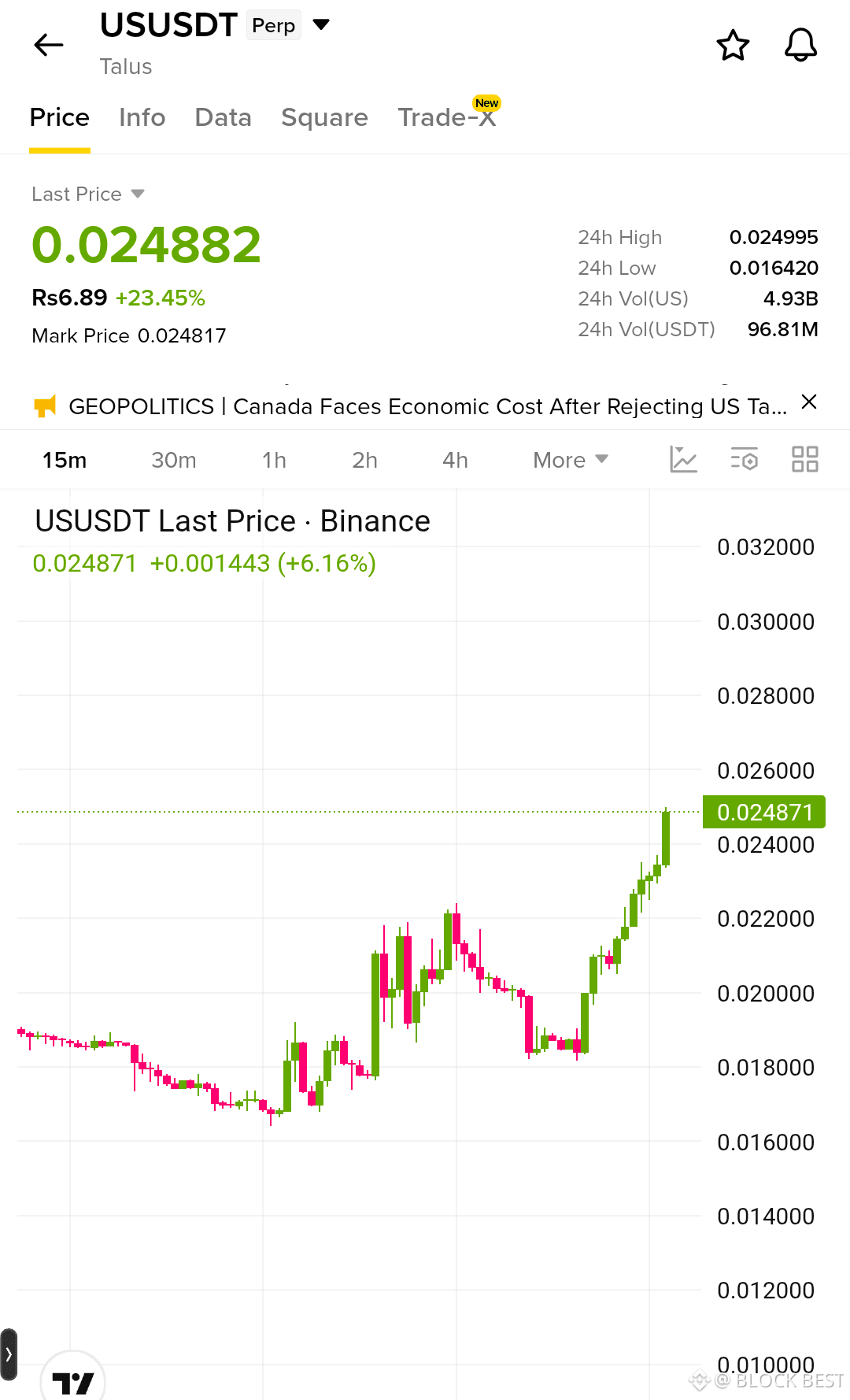
US is showing a strong bullish continuation structure on the 15m chart, with price accelerating from the $0.0180–$0.0190 area and printing a clear sequence of higher highs and higher lows. The latest breakout has pushed price to $0.0248, just below the $0.0250 resistance and current 24H high at $0.024995. Momentum is clearly favoring buyers, but the breakout zone around $0.0235–$0.0240 must hold for continuation.
Trade Setup — Bullish
EP (Entry Price): $0.0238–$0.0245
TP1: $0.0260
TP2: $0.0280
TP3: $0.0300
SL (Stop Loss): $0.0225
The short-term trend is strongly bullish, supported by consecutive higher highs and higher lows with expanding upward momentum.
Structure remains buyer-controlled while price holds above $0.0235–$0.0240, keeping the recent breakout intact.
A clean break above $0.0250 can trigger the next upside liquidity toward $0.0260, $0.0280 and $0.0300; a sustained loss of $0.0225 would weaken the bullish continuation setup.
$US
{future}(USUSDT)
$US
US is showing a strong bullish continuation structure on the 15m chart, with price accelerating from the $0.0180–$0.0190 area and printing a clear sequence of higher highs and higher lows. The latest breakout has pushed price to $0.0248, just below the $0.0250 resistance and current 24H high at $0.024995. Momentum is clearly favoring buyers, but the breakout zone around $0.0235–$0.0240 must hold for continuation.
Trade Setup — Bullish
EP (Entry Price): $0.0238–$0.0245
TP1: $0.0260
TP2: $0.0280
TP3: $0.0300
SL (Stop Loss): $0.0225
The short-term trend is strongly bullish, supported by consecutive higher highs and higher lows with expanding upward momentum.
Structure remains buyer-controlled while price holds above $0.0235–$0.0240, keeping the recent breakout intact.
A clean break above $0.0250 can trigger the next upside liquidity toward $0.0260, $0.0280 and $0.0300; a sustained loss of $0.0225 would weaken the bullish continuation setup.
$US
US is showing a strong bullish continuation structure on the 15m chart, with price accelerating from the $0.0180–$0.0190 area and printing a clear sequence of higher highs and higher lows. The latest breakout has pushed price to $0.0248, just below the $0.0250 resistance and current 24H high at $0.024995. Momentum is clearly favoring buyers, but the breakout zone around $0.0235–$0.0240 must hold for continuation.
Trade Setup — Bullish
EP (Entry Price): $0.0238–$0.0245
TP1: $0.0260
TP2: $0.0280
TP3: $0.0300
SL (Stop Loss): $0.0225
The short-term trend is strongly bullish, supported by consecutive higher highs and higher lows with expanding upward momentum.
Structure remains buyer-controlled while price holds above $0.0235–$0.0240, keeping the recent breakout intact.
A clean break above $0.0250 can trigger the next upside liquidity toward $0.0260, $0.0280 and $0.0300; a sustained loss of $0.0225 would weaken the bullish continuation setup.
$US
76
·
--
$AGT
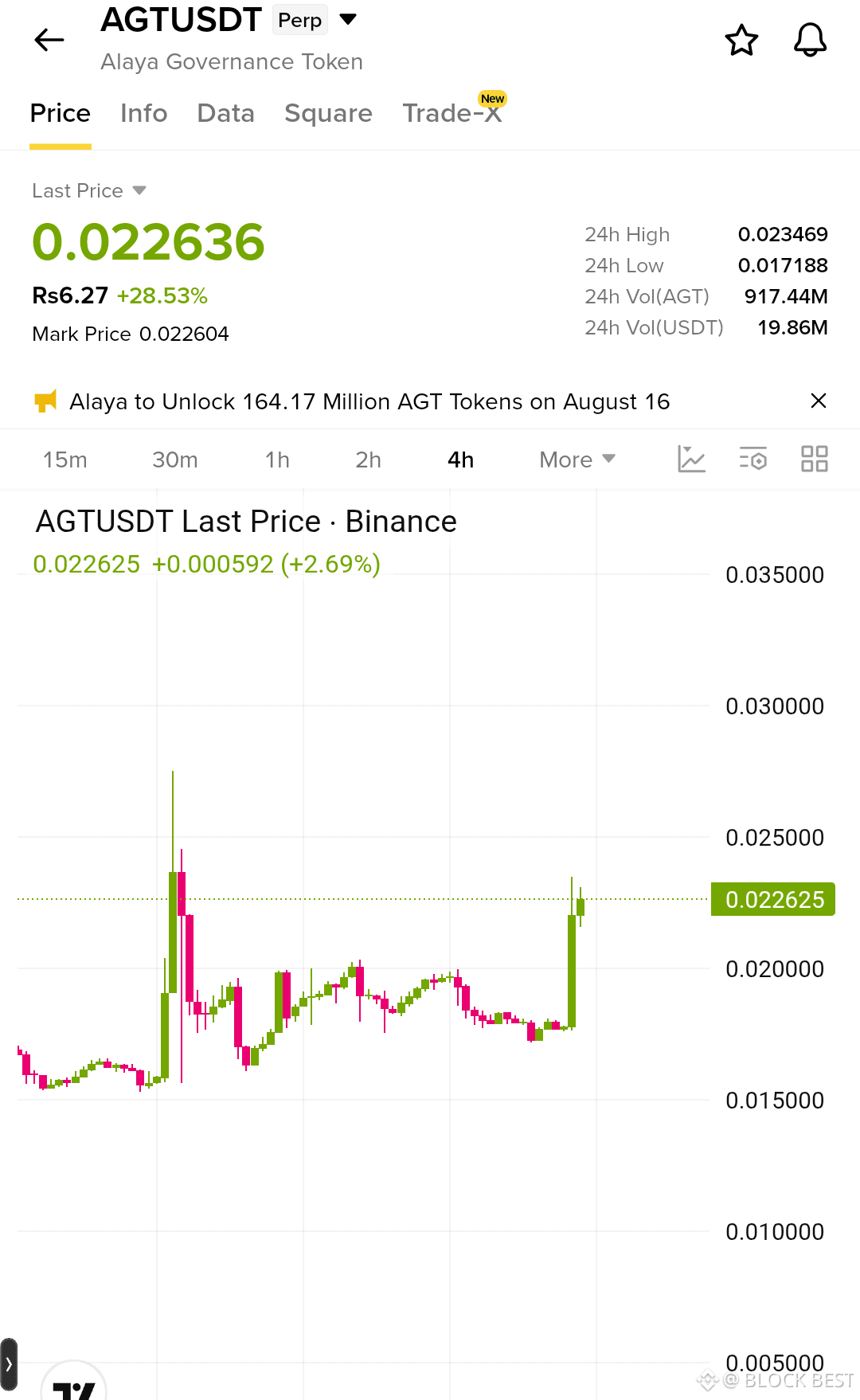
AGT is showing a strong bullish continuation structure on the 4H chart after breaking out of a long consolidation range around $0.017–$0.020. Price has expanded sharply toward the $0.0235 resistance area, with strong bullish candles confirming increased buying pressure. The breakout has shifted short-term market structure upward, but price must hold above the breakout zone to maintain continuation.
Trade Setup — Bullish
EP (Entry Price): $0.0215–$0.0225
TP1: $0.0240
TP2: $0.0260
TP3: $0.0280
SL (Stop Loss): $0.0200
The 4H trend has turned strongly bullish, with price breaking above the previous consolidation range and establishing higher highs.
Momentum and structure remain buyer-controlled while AGT holds above $0.0215–$0.0220, keeping the breakout intact.
A confirmed break above $0.0235 can release the next upside liquidity toward $0.0240, $0.0260 and potentially $0.0280; a sustained move below $0.0200 would invalidate the continuation setup.
$AGT
{future}(AGTUSDT)
$AGT
AGT is showing a strong bullish continuation structure on the 4H chart after breaking out of a long consolidation range around $0.017–$0.020. Price has expanded sharply toward the $0.0235 resistance area, with strong bullish candles confirming increased buying pressure. The breakout has shifted short-term market structure upward, but price must hold above the breakout zone to maintain continuation.
Trade Setup — Bullish
EP (Entry Price): $0.0215–$0.0225
TP1: $0.0240
TP2: $0.0260
TP3: $0.0280
SL (Stop Loss): $0.0200
The 4H trend has turned strongly bullish, with price breaking above the previous consolidation range and establishing higher highs.
Momentum and structure remain buyer-controlled while AGT holds above $0.0215–$0.0220, keeping the breakout intact.
A confirmed break above $0.0235 can release the next upside liquidity toward $0.0240, $0.0260 and potentially $0.0280; a sustained move below $0.0200 would invalidate the continuation setup.
$AGT
AGT is showing a strong bullish continuation structure on the 4H chart after breaking out of a long consolidation range around $0.017–$0.020. Price has expanded sharply toward the $0.0235 resistance area, with strong bullish candles confirming increased buying pressure. The breakout has shifted short-term market structure upward, but price must hold above the breakout zone to maintain continuation.
Trade Setup — Bullish
EP (Entry Price): $0.0215–$0.0225
TP1: $0.0240
TP2: $0.0260
TP3: $0.0280
SL (Stop Loss): $0.0200
The 4H trend has turned strongly bullish, with price breaking above the previous consolidation range and establishing higher highs.
Momentum and structure remain buyer-controlled while AGT holds above $0.0215–$0.0220, keeping the breakout intact.
A confirmed break above $0.0235 can release the next upside liquidity toward $0.0240, $0.0260 and potentially $0.0280; a sustained move below $0.0200 would invalidate the continuation setup.
$AGT
27
·
--
$ARK
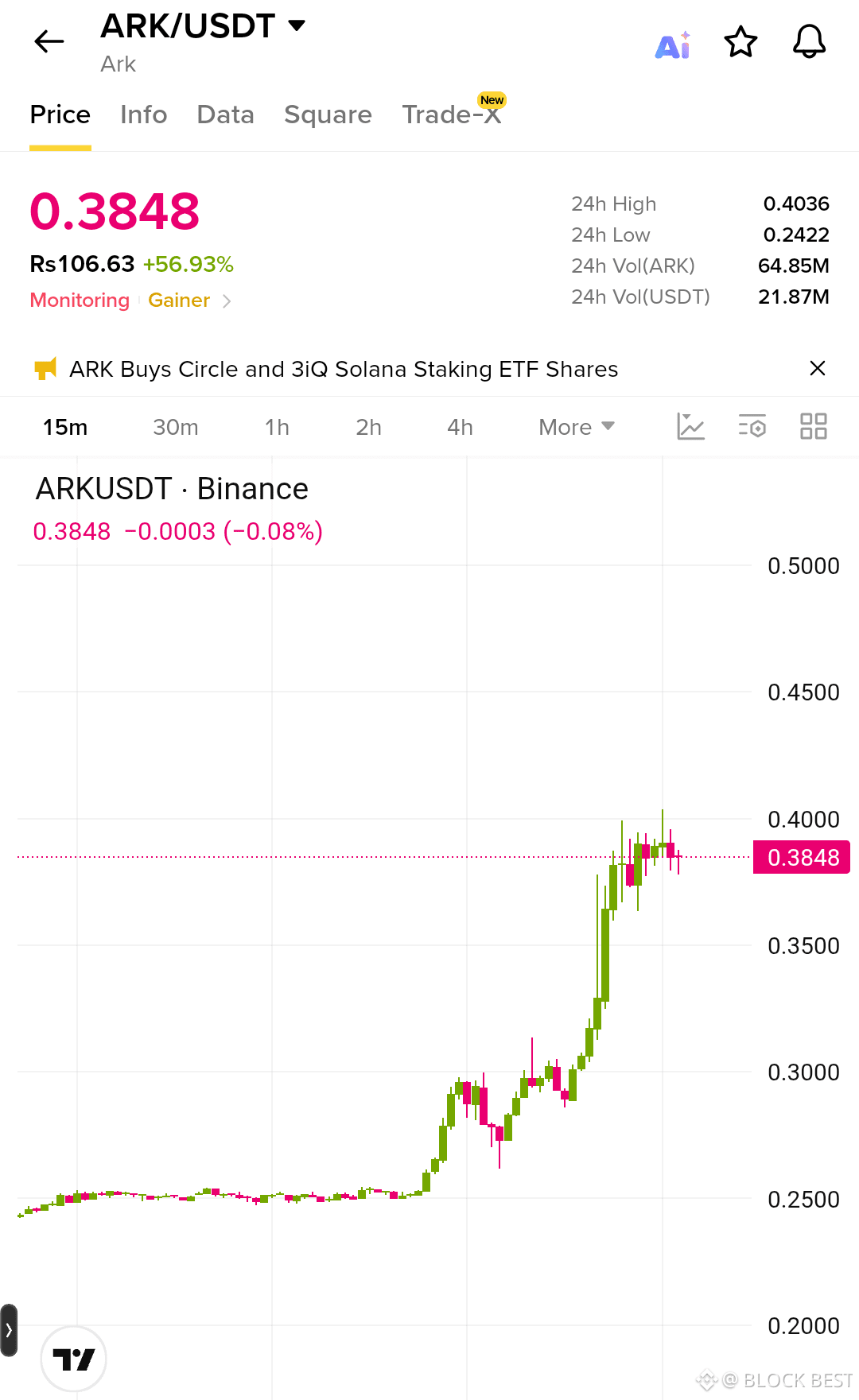
ARK is showing a strong bullish continuation structure on the 15m chart after a sharp breakout from the $0.30 area. Price has pushed aggressively toward the $0.40 psychological resistance, while the recent candles are holding near the highs instead of giving back the full move. The immediate liquidity zone sits around $0.40–$0.405, and a clean breakout above this area can open the way toward higher resistance levels.
Trade Setup — Bullish
EP (Entry Price): $0.375–$0.385
TP1: $0.405
TP2: $0.430
TP3: $0.460
SL (Stop Loss): $0.352
The short-term trend remains strongly bullish, with clear higher highs and higher lows following the breakout from the $0.30 region.
Momentum remains positive, but ARK is extended after the sharp rally, so holding $0.375–$0.380 is important for maintaining the bullish structure.
A confirmed break and hold above $0.405 would target the next liquidity areas around $0.430 and $0.460, while a loss of $0.352 would weaken the continuation setup.
$ARK
{spot}(ARKUSDT)
$ARK
ARK is showing a strong bullish continuation structure on the 15m chart after a sharp breakout from the $0.30 area. Price has pushed aggressively toward the $0.40 psychological resistance, while the recent candles are holding near the highs instead of giving back the full move. The immediate liquidity zone sits around $0.40–$0.405, and a clean breakout above this area can open the way toward higher resistance levels.
Trade Setup — Bullish
EP (Entry Price): $0.375–$0.385
TP1: $0.405
TP2: $0.430
TP3: $0.460
SL (Stop Loss): $0.352
The short-term trend remains strongly bullish, with clear higher highs and higher lows following the breakout from the $0.30 region.
Momentum remains positive, but ARK is extended after the sharp rally, so holding $0.375–$0.380 is important for maintaining the bullish structure.
A confirmed break and hold above $0.405 would target the next liquidity areas around $0.430 and $0.460, while a loss of $0.352 would weaken the continuation setup.
$ARK
ARK is showing a strong bullish continuation structure on the 15m chart after a sharp breakout from the $0.30 area. Price has pushed aggressively toward the $0.40 psychological resistance, while the recent candles are holding near the highs instead of giving back the full move. The immediate liquidity zone sits around $0.40–$0.405, and a clean breakout above this area can open the way toward higher resistance levels.
Trade Setup — Bullish
EP (Entry Price): $0.375–$0.385
TP1: $0.405
TP2: $0.430
TP3: $0.460
SL (Stop Loss): $0.352
The short-term trend remains strongly bullish, with clear higher highs and higher lows following the breakout from the $0.30 region.
Momentum remains positive, but ARK is extended after the sharp rally, so holding $0.375–$0.380 is important for maintaining the bullish structure.
A confirmed break and hold above $0.405 would target the next liquidity areas around $0.430 and $0.460, while a loss of $0.352 would weaken the continuation setup.
$ARK
52
·
--
*$MOVR is still the clear max high on the board.**
Current standout movers (Binance futures / major pairs, live as of now):
{spot}(MOVRUSDT)
- MOVR** → leading with the biggest percentage spike (still holding strong after the +50-70%+ migration-driven run). Price hovering in the $1.40–$1.70 zone depending on the exact feed.
- **$SOON ** → right behind it, +40%+ range, strong volume continuation.
{future}(SOONUSDT)
- **$GTC ** → solid +20-30% territory earlier, still elevated.
- Other notable runners: QNT, ZRO, PUMP, MEW, BERA also printing double-digit gains.
{spot}(GTCUSDT)
This is pure altcoin rotation energy. MOVR’s Base migration deadline created the catalyst, and the rest of the board is feeding off the momentum and volume spike. High-beta names are moving first and hardest.
These vertical moves rarely stay clean. Watch for rejection at the highs and sudden volume fade — that’s when the quick reversals hit. Size accordingly and keep stops tight if you’re still in.
*$MOVR is still the clear max high on the board.**
Current standout movers (Binance futures / major pairs, live as of now):
- MOVR** → leading with the biggest percentage spike (still holding strong after the +50-70%+ migration-driven run). Price hovering in the $1.40–$1.70 zone depending on the exact feed.
- **$SOON ** → right behind it, +40%+ range, strong volume continuation.
- **$GTC ** → solid +20-30% territory earlier, still elevated.
- Other notable runners: QNT, ZRO, PUMP, MEW, BERA also printing double-digit gains.
This is pure altcoin rotation energy. MOVR’s Base migration deadline created the catalyst, and the rest of the board is feeding off the momentum and volume spike. High-beta names are moving first and hardest.
These vertical moves rarely stay clean. Watch for rejection at the highs and sudden volume fade — that’s when the quick reversals hit. Size accordingly and keep stops tight if you’re still in.
Current standout movers (Binance futures / major pairs, live as of now):
- MOVR** → leading with the biggest percentage spike (still holding strong after the +50-70%+ migration-driven run). Price hovering in the $1.40–$1.70 zone depending on the exact feed.
- **$SOON ** → right behind it, +40%+ range, strong volume continuation.
- **$GTC ** → solid +20-30% territory earlier, still elevated.
- Other notable runners: QNT, ZRO, PUMP, MEW, BERA also printing double-digit gains.
This is pure altcoin rotation energy. MOVR’s Base migration deadline created the catalyst, and the rest of the board is feeding off the momentum and volume spike. High-beta names are moving first and hardest.
These vertical moves rarely stay clean. Watch for rejection at the highs and sudden volume fade — that’s when the quick reversals hit. Size accordingly and keep stops tight if you’re still in.
1️⃣ MOVR 🚀
75%
2️⃣ SOON 💥
11%
3️⃣ GTC 📈
7%
4️⃣ Another alt 👀
7%
28 votes • Voting closed
915
·
--
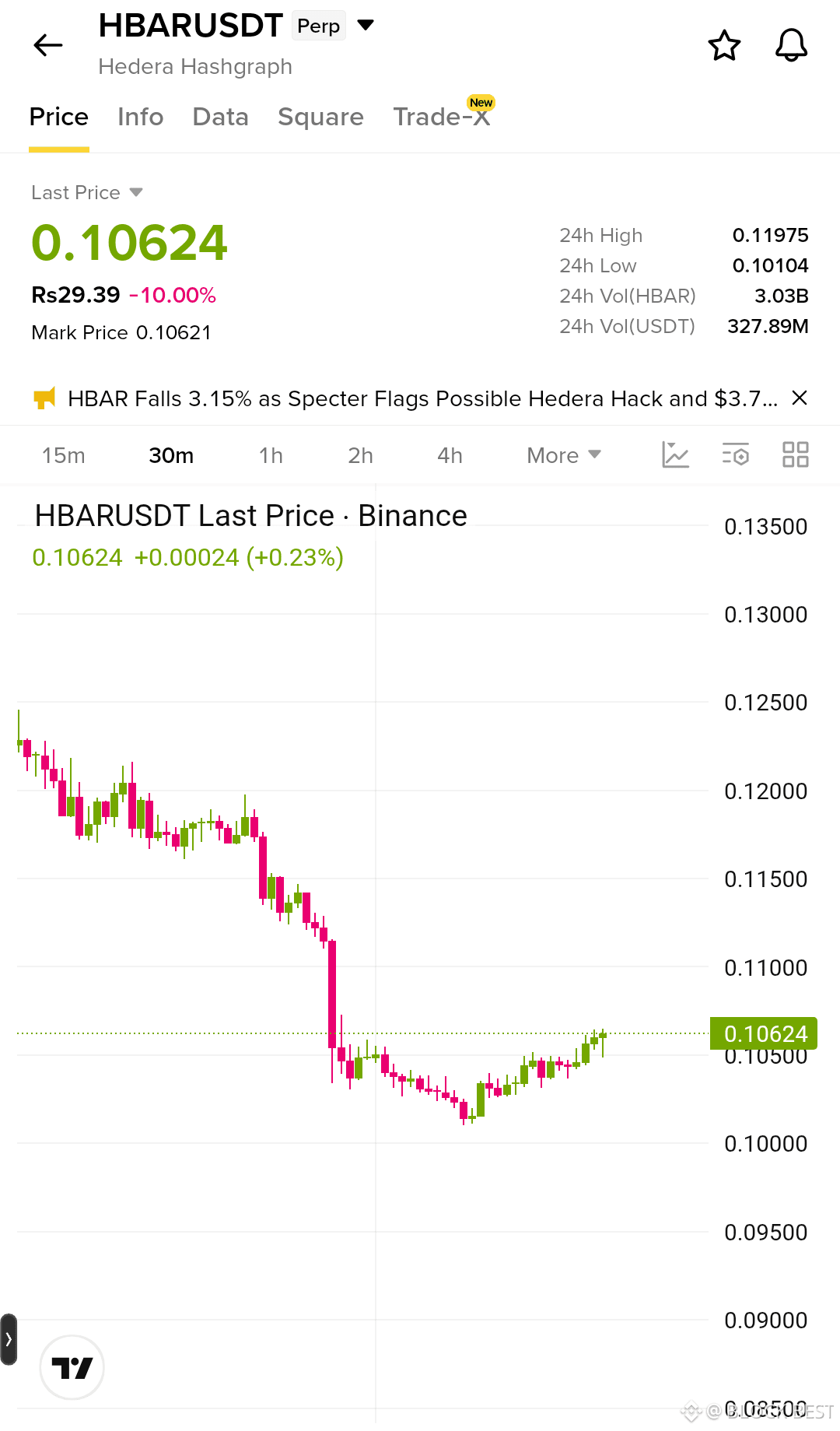
$HBAR USDT is trading near $0.105 after a sharp rejection from the $0.120 zone. The recent impulse higher was fully reversed in a high-volume selloff that drove price into the $0.101 liquidity pocket. That low has held so far, but the recovery remains shallow and corrective rather than impulsive. Structure on the lower timeframes shows clear lower highs and persistent seller control after the breakdown.
EP: $0.1045 – $0.1060
TP1: $0.1010
TP2: $0.0975
TP3: $0.0930
SL: $0.1105
Current trend strength remains firmly bearish on the short-term structure. The breakdown from the $0.115–$0.120 area has not been repaired, and every bounce has been sold into. Momentum continues to favor the downside as price struggles to reclaim the mid-range levels that previously acted as support. Liquidity remains concentrated below the recent lows, and the failed recovery attempt leaves the path of least resistance toward those lower zones. As long as price stays capped below $0.110, the bias stays with continuation lower into the next demand clusters.
$HBAR
{spot}(HBARUSDT)
$HBAR USDT is trading near $0.105 after a sharp rejection from the $0.120 zone. The recent impulse higher was fully reversed in a high-volume selloff that drove price into the $0.101 liquidity pocket. That low has held so far, but the recovery remains shallow and corrective rather than impulsive. Structure on the lower timeframes shows clear lower highs and persistent seller control after the breakdown.
EP: $0.1045 – $0.1060
TP1: $0.1010
TP2: $0.0975
TP3: $0.0930
SL: $0.1105
Current trend strength remains firmly bearish on the short-term structure. The breakdown from the $0.115–$0.120 area has not been repaired, and every bounce has been sold into. Momentum continues to favor the downside as price struggles to reclaim the mid-range levels that previously acted as support. Liquidity remains concentrated below the recent lows, and the failed recovery attempt leaves the path of least resistance toward those lower zones. As long as price stays capped below $0.110, the bias stays with continuation lower into the next demand clusters.
$HBAR
EP: $0.1045 – $0.1060
TP1: $0.1010
TP2: $0.0975
TP3: $0.0930
SL: $0.1105
Current trend strength remains firmly bearish on the short-term structure. The breakdown from the $0.115–$0.120 area has not been repaired, and every bounce has been sold into. Momentum continues to favor the downside as price struggles to reclaim the mid-range levels that previously acted as support. Liquidity remains concentrated below the recent lows, and the failed recovery attempt leaves the path of least resistance toward those lower zones. As long as price stays capped below $0.110, the bias stays with continuation lower into the next demand clusters.
$HBAR
31
·
--
$ZRO
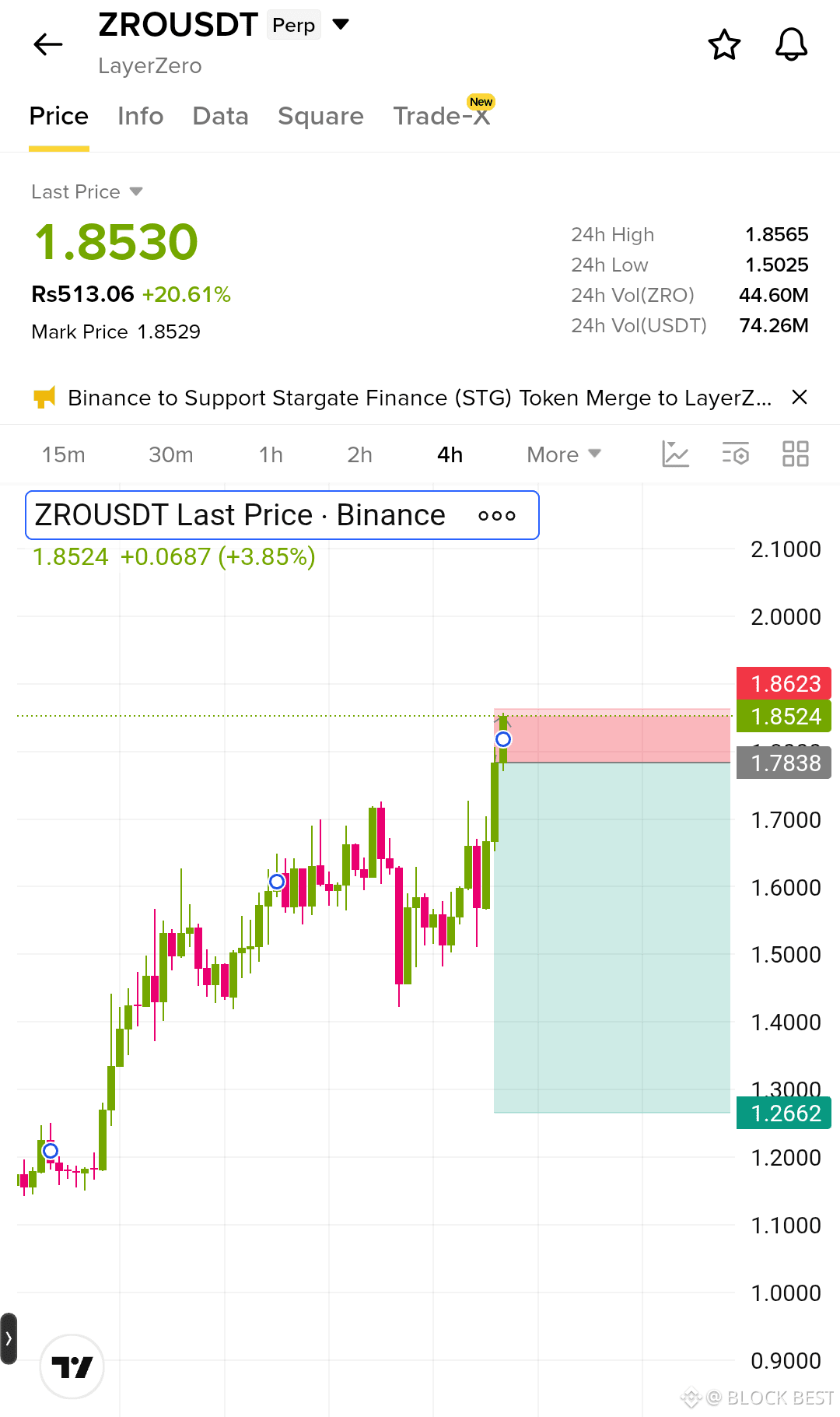
ZROUSDT is trading at fresh highs after a clean breakout from the mid-range consolidation. The 4h structure shows a sequence of higher highs and higher lows, with the latest impulse leg driving price from the $1.50 zone straight into the $1.85 area on expanding volume.
EP: $1.8300 – $1.8550
TP1: $1.9000
TP2: $2.0000
TP3: $2.1000
SL: $1.7800
Trend strength is firmly bullish on the higher timeframes, with no meaningful lower-high formation since the recovery began. Momentum remains constructive as the recent expansion candles have held their gains and price continues to respect the rising structure. Price is positioned to extend toward the targets because the $1.78–$1.83 demand zone now acts as the key support floor, and sustained acceptance above the prior high keeps liquidity targets open to the upside.
$ZRO
{spot}(ZROUSDT)
$ZRO
ZROUSDT is trading at fresh highs after a clean breakout from the mid-range consolidation. The 4h structure shows a sequence of higher highs and higher lows, with the latest impulse leg driving price from the $1.50 zone straight into the $1.85 area on expanding volume.
EP: $1.8300 – $1.8550
TP1: $1.9000
TP2: $2.0000
TP3: $2.1000
SL: $1.7800
Trend strength is firmly bullish on the higher timeframes, with no meaningful lower-high formation since the recovery began. Momentum remains constructive as the recent expansion candles have held their gains and price continues to respect the rising structure. Price is positioned to extend toward the targets because the $1.78–$1.83 demand zone now acts as the key support floor, and sustained acceptance above the prior high keeps liquidity targets open to the upside.
$ZRO
ZROUSDT is trading at fresh highs after a clean breakout from the mid-range consolidation. The 4h structure shows a sequence of higher highs and higher lows, with the latest impulse leg driving price from the $1.50 zone straight into the $1.85 area on expanding volume.
EP: $1.8300 – $1.8550
TP1: $1.9000
TP2: $2.0000
TP3: $2.1000
SL: $1.7800
Trend strength is firmly bullish on the higher timeframes, with no meaningful lower-high formation since the recovery began. Momentum remains constructive as the recent expansion candles have held their gains and price continues to respect the rising structure. Price is positioned to extend toward the targets because the $1.78–$1.83 demand zone now acts as the key support floor, and sustained acceptance above the prior high keeps liquidity targets open to the upside.
$ZRO
48
Log in to explore more content
Join global crypto users on Binance Square
⚡️ Get latest and useful information about crypto.
💬 Trusted by the world’s largest crypto exchange.
👍 Discover real insights from verified creators.
Email / Phone number