

Block Bit
2.4k Posts

Block Bit
Report
Block User
Data. Discipline. Direction.
Open Trade
Frequent Trader
8.1 Months
15 Following
3.4K+ Followers
1.6K+ Liked
Posts
Portfolio
All
Live
·
--
Bullish
Honestly, the AI stock rally leaves the rest of us scraping for scraps again.
Crypto keeps recycling the same tired stories while influencers chase the next shiny thing.
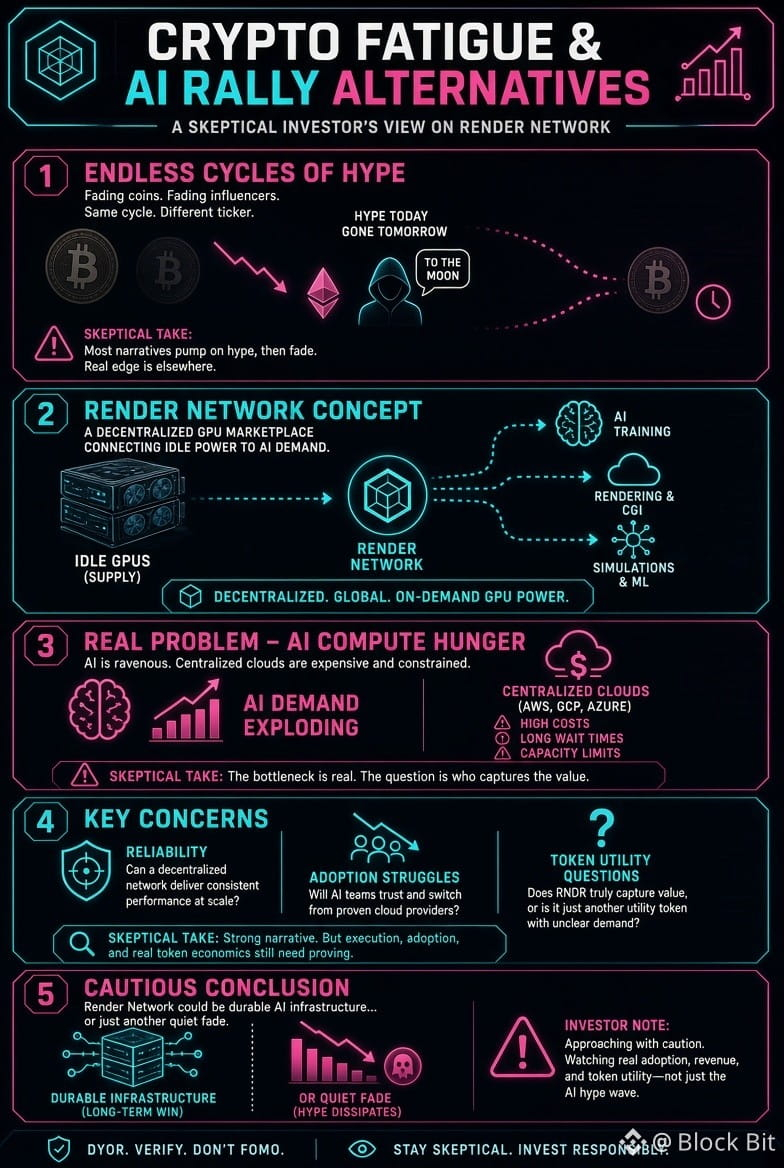
Render Network sits in that quiet corner with decentralized GPU compute—people renting idle cards for rendering and inference while the big clouds stay expensive and gated.
The problem is real enough. AI is hungry and centralized supply can’t keep up. But I’ve watched too many marketplaces look good on paper then struggle with reliability and actual users once the heat fades.
The token burns on jobs, which is cleaner than most, yet I still wonder if it needs to exist at all. Maybe it grinds on as boring infrastructure. Maybe it fades. Either way, it’s just another cautious maybe in a long line of them.
#AIStocksWhatNext
$GRVT
{future}(GRVTUSDT)
$AKE
{future}(AKEUSDT)
$BANK
{future}(BANKUSDT)
Honestly, the AI stock rally leaves the rest of us scraping for scraps again.
Crypto keeps recycling the same tired stories while influencers chase the next shiny thing.
Render Network sits in that quiet corner with decentralized GPU compute—people renting idle cards for rendering and inference while the big clouds stay expensive and gated.
The problem is real enough. AI is hungry and centralized supply can’t keep up. But I’ve watched too many marketplaces look good on paper then struggle with reliability and actual users once the heat fades.
The token burns on jobs, which is cleaner than most, yet I still wonder if it needs to exist at all. Maybe it grinds on as boring infrastructure. Maybe it fades. Either way, it’s just another cautious maybe in a long line of them.
#AIStocksWhatNext
$GRVT
$AKE
$BANK
Crypto keeps recycling the same tired stories while influencers chase the next shiny thing.
Render Network sits in that quiet corner with decentralized GPU compute—people renting idle cards for rendering and inference while the big clouds stay expensive and gated.
The problem is real enough. AI is hungry and centralized supply can’t keep up. But I’ve watched too many marketplaces look good on paper then struggle with reliability and actual users once the heat fades.
The token burns on jobs, which is cleaner than most, yet I still wonder if it needs to exist at all. Maybe it grinds on as boring infrastructure. Maybe it fades. Either way, it’s just another cautious maybe in a long line of them.
#AIStocksWhatNext
$GRVT
$AKE
$BANK
638
·
--
Bullish
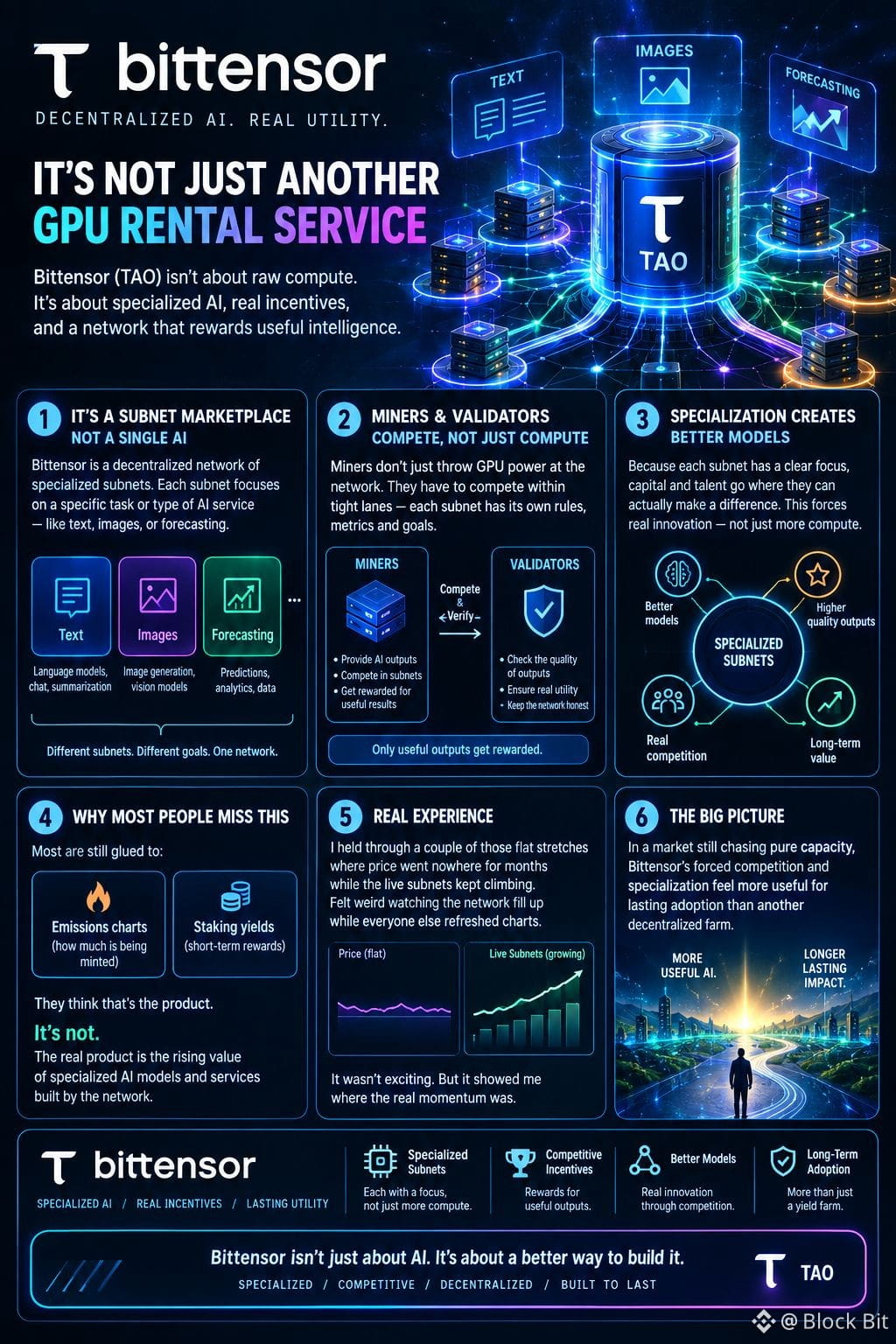
Been watching this AI stock run for weeks and half the timeline still thinks every crypto AI play is just another GPU rental service. Bittensor gets lumped in with the rest, but the real thing people skip over is how the subnet incentives actually force specialization.
Miners and validators don’t just throw compute at the wall. They have to compete inside tight lanes—text, images, forecasting—and only the outputs that prove useful get rewarded. It looks chaotic from the outside. Slow even. But that pressure is quietly selecting for better models because capital and talent actually have something to lose. Most people are still glued to emissions charts and staking yields like those are the product. They’re not.
I held through a couple of those flat stretches where price went nowhere for months while the live subnets kept climbing. Felt weird watching the network fill up while everyone else refreshed charts. In a market still chasing pure capacity, that kind of forced competition feels more useful for lasting adoption than another decentralized farm.#AIStocksWhatNext
Been watching this AI stock run for weeks and half the timeline still thinks every crypto AI play is just another GPU rental service. Bittensor gets lumped in with the rest, but the real thing people skip over is how the subnet incentives actually force specialization.
Miners and validators don’t just throw compute at the wall. They have to compete inside tight lanes—text, images, forecasting—and only the outputs that prove useful get rewarded. It looks chaotic from the outside. Slow even. But that pressure is quietly selecting for better models because capital and talent actually have something to lose. Most people are still glued to emissions charts and staking yields like those are the product. They’re not.
I held through a couple of those flat stretches where price went nowhere for months while the live subnets kept climbing. Felt weird watching the network fill up while everyone else refreshed charts. In a market still chasing pure capacity, that kind of forced competition feels more useful for lasting adoption than another decentralized farm.#AIStocksWhatNext
Miners and validators don’t just throw compute at the wall. They have to compete inside tight lanes—text, images, forecasting—and only the outputs that prove useful get rewarded. It looks chaotic from the outside. Slow even. But that pressure is quietly selecting for better models because capital and talent actually have something to lose. Most people are still glued to emissions charts and staking yields like those are the product. They’re not.
I held through a couple of those flat stretches where price went nowhere for months while the live subnets kept climbing. Felt weird watching the network fill up while everyone else refreshed charts. In a market still chasing pure capacity, that kind of forced competition feels more useful for lasting adoption than another decentralized farm.#AIStocksWhatNext
133
·
--
Bullish
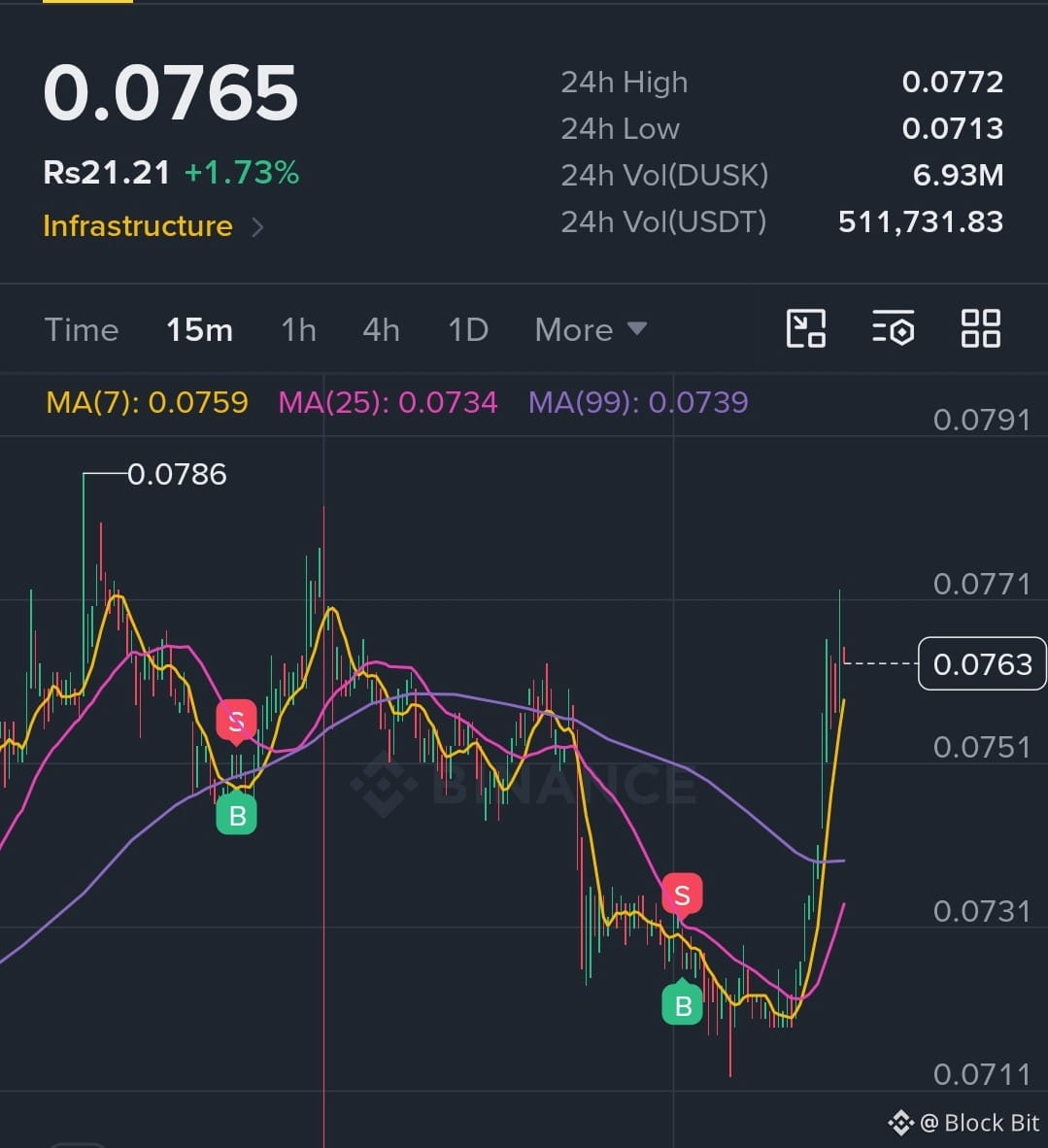
$DUSK is showing a strong short-term recovery on the 15M chart, with price trading above the 7MA and reclaiming the 25MA/99MA area.
Entry Zone: 0.0751–0.0759
TP1: 0.0771
TP2: 0.0786
TP3: 0.0791
Stop Loss: 0.0739
Bias: Bullish while price holds above the 0.0751 entry support.
The structure favors patience and trend continuation rather than chasing the current move. Watch how price reacts around each resistance level and protect the setup if support is lost.
$DUSK
$DUSK is showing a strong short-term recovery on the 15M chart, with price trading above the 7MA and reclaiming the 25MA/99MA area.
Entry Zone: 0.0751–0.0759
TP1: 0.0771
TP2: 0.0786
TP3: 0.0791
Stop Loss: 0.0739
Bias: Bullish while price holds above the 0.0751 entry support.
The structure favors patience and trend continuation rather than chasing the current move. Watch how price reacts around each resistance level and protect the setup if support is lost.
$DUSK
Entry Zone: 0.0751–0.0759
TP1: 0.0771
TP2: 0.0786
TP3: 0.0791
Stop Loss: 0.0739
Bias: Bullish while price holds above the 0.0751 entry support.
The structure favors patience and trend continuation rather than chasing the current move. Watch how price reacts around each resistance level and protect the setup if support is lost.
$DUSK
1
197
·
--
Bullish
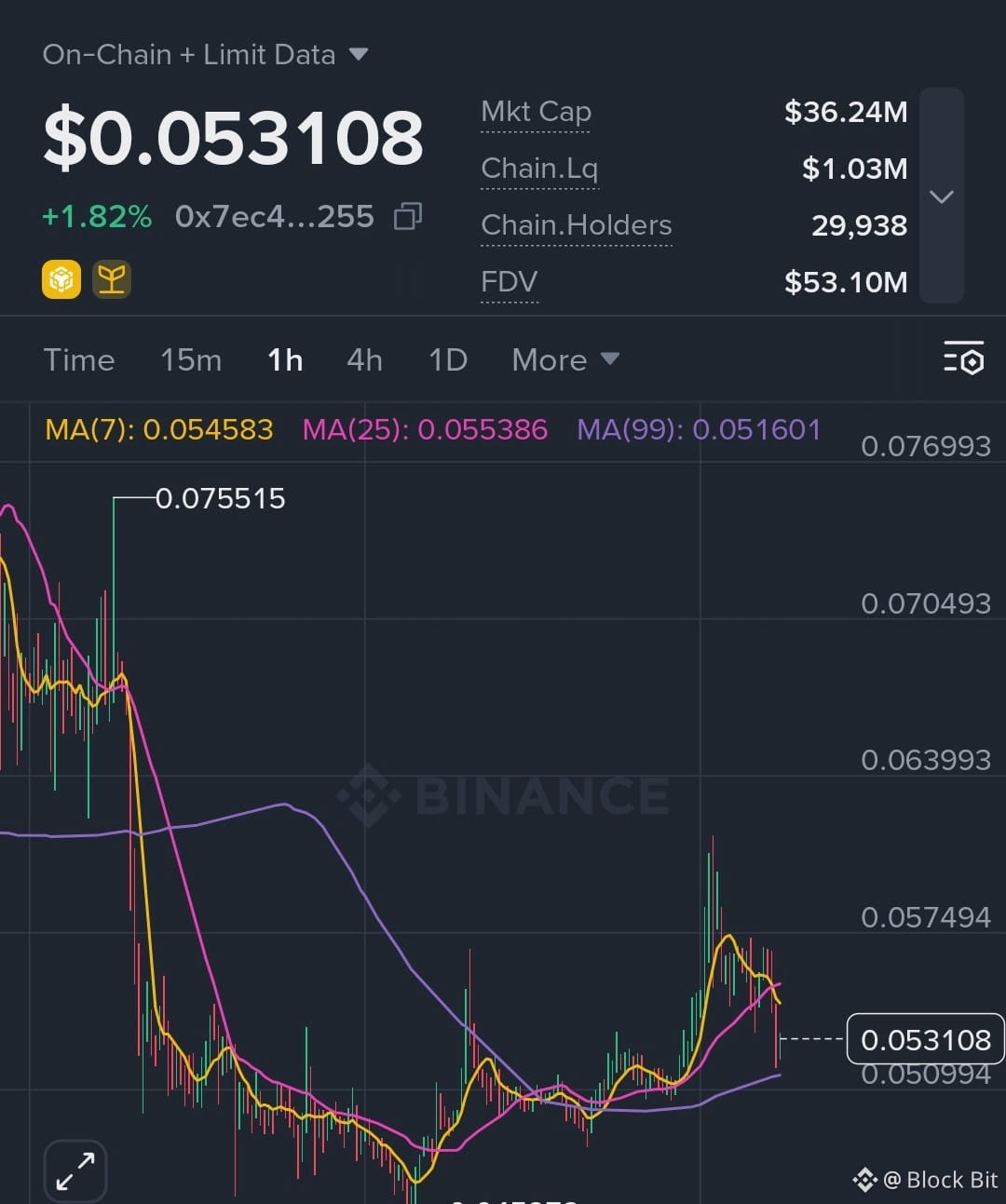
$LAB | 1H Technical Structure**
Price: $0.053108
Mkt Cap: $36.24M | FDV: $53.10M | Holders: 29,938
**Entry Zone:** $0.0516 – $0.0535 (holding above MA99 support at 0.051601)
**Targets:**
**TP1:** $0.0554 (MA25)
**TP2:** $0.0575
**TP3:** $0.0640
**Stop Loss:** Below $0.0495
Bullish bias remains valid as long as price holds above entry support.
Patience and discipline over chasing. Focus on trend continuation from the current structure rather than extending into resistance.
$LAB
{future}(LABUSDT)
$LAB | 1H Technical Structure**
Price: $0.053108
Mkt Cap: $36.24M | FDV: $53.10M | Holders: 29,938
**Entry Zone:** $0.0516 – $0.0535 (holding above MA99 support at 0.051601)
**Targets:**
**TP1:** $0.0554 (MA25)
**TP2:** $0.0575
**TP3:** $0.0640
**Stop Loss:** Below $0.0495
Bullish bias remains valid as long as price holds above entry support.
Patience and discipline over chasing. Focus on trend continuation from the current structure rather than extending into resistance.
$LAB
Price: $0.053108
Mkt Cap: $36.24M | FDV: $53.10M | Holders: 29,938
**Entry Zone:** $0.0516 – $0.0535 (holding above MA99 support at 0.051601)
**Targets:**
**TP1:** $0.0554 (MA25)
**TP2:** $0.0575
**TP3:** $0.0640
**Stop Loss:** Below $0.0495
Bullish bias remains valid as long as price holds above entry support.
Patience and discipline over chasing. Focus on trend continuation from the current structure rather than extending into resistance.
$LAB
324
·
--
Bullish
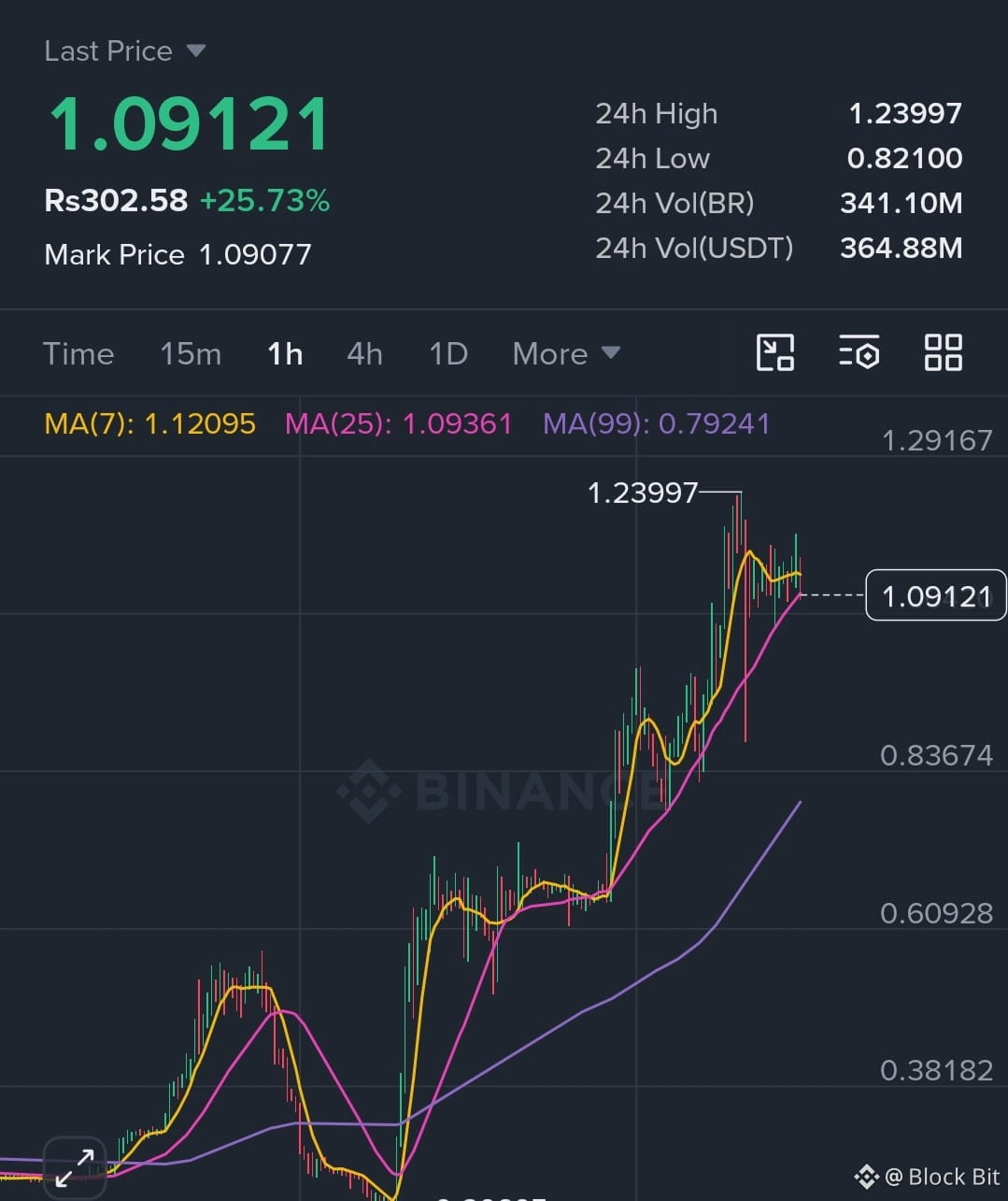
$BR USDT — Technical Long Setup
Entry Zone: 1.08–1.10
Targets: 1.12–1.24
TP1: 1.12
TP2: 1.18
TP3: 1.24
Stop Loss: 1.04
BRUSDT is holding around the 1.09 area after a strong move, with the 1H MA(25) near 1.0936 acting as an important nearby support reference. The previous high at 1.23997 remains the key upside level.
Bullish bias remains valid as long as price holds above entry support.
Stay patient and disciplined. Avoid chasing the top after an extended move; wait for controlled entries and confirmation of trend continuation.
$BR
{future}(BRUSDT)
$BR USDT — Technical Long Setup
Entry Zone: 1.08–1.10
Targets: 1.12–1.24
TP1: 1.12
TP2: 1.18
TP3: 1.24
Stop Loss: 1.04
BRUSDT is holding around the 1.09 area after a strong move, with the 1H MA(25) near 1.0936 acting as an important nearby support reference. The previous high at 1.23997 remains the key upside level.
Bullish bias remains valid as long as price holds above entry support.
Stay patient and disciplined. Avoid chasing the top after an extended move; wait for controlled entries and confirmation of trend continuation.
$BR
Entry Zone: 1.08–1.10
Targets: 1.12–1.24
TP1: 1.12
TP2: 1.18
TP3: 1.24
Stop Loss: 1.04
BRUSDT is holding around the 1.09 area after a strong move, with the 1H MA(25) near 1.0936 acting as an important nearby support reference. The previous high at 1.23997 remains the key upside level.
Bullish bias remains valid as long as price holds above entry support.
Stay patient and disciplined. Avoid chasing the top after an extended move; wait for controlled entries and confirmation of trend continuation.
$BR
271
·
--
Bullish
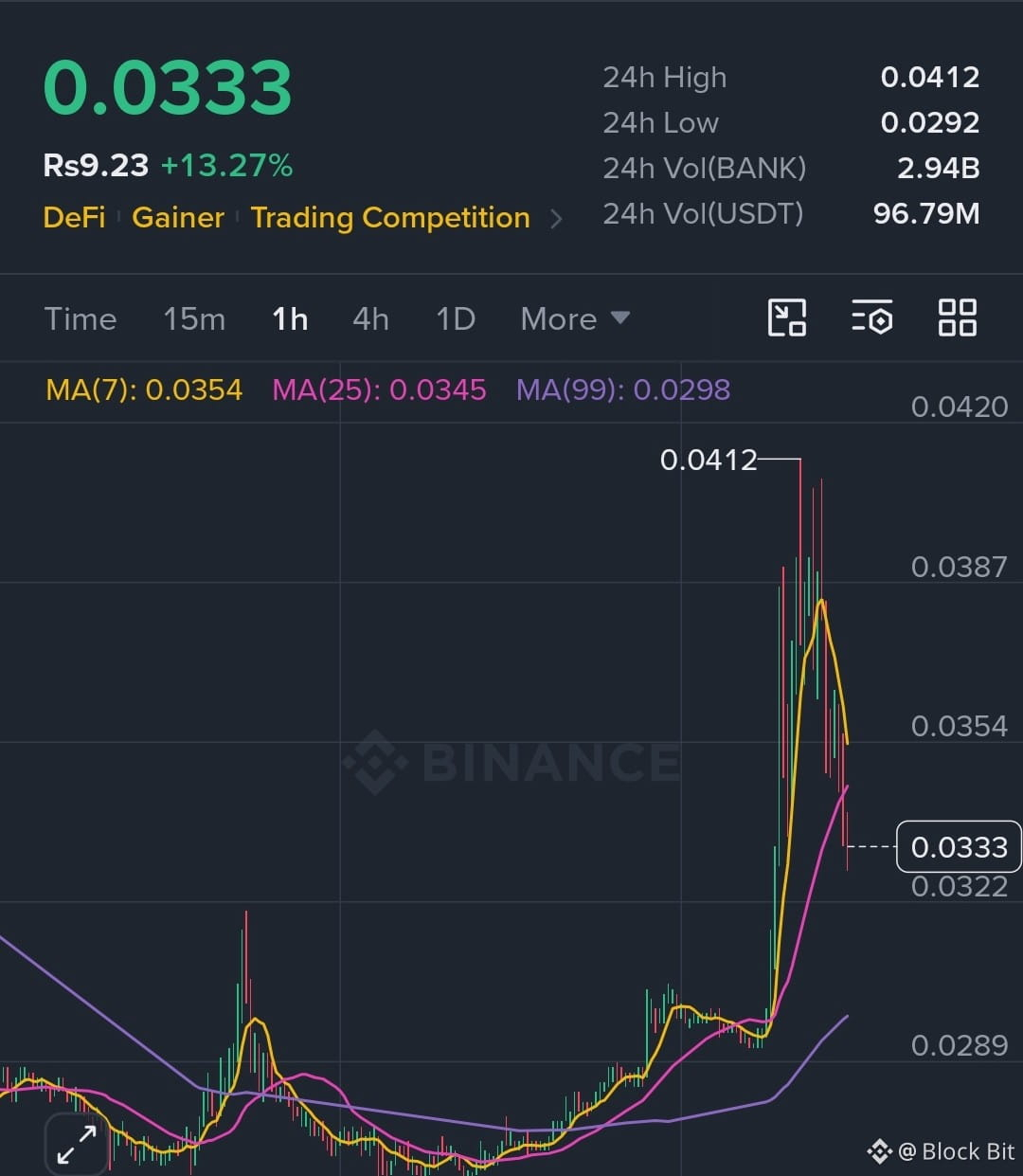
$BANK /USDT — Technical Setup
Entry Zone: 0.0328–0.0335
TP1: 0.0354
TP2: 0.0387
TP3: 0.0412
Stop Loss: 0.0322
BANK is consolidating after a strong upward move, with price currently around 0.0333. The 1H chart shows nearby support around the entry zone, while the marked resistance levels provide the next areas to watch.
Bullish bias remains valid as long as price holds above entry support.
Stay patient and disciplined. Let price confirm continuation rather than chasing the recent top.
$BANK
{future}(BANKUSDT)
$BANK /USDT — Technical Setup
Entry Zone: 0.0328–0.0335
TP1: 0.0354
TP2: 0.0387
TP3: 0.0412
Stop Loss: 0.0322
BANK is consolidating after a strong upward move, with price currently around 0.0333. The 1H chart shows nearby support around the entry zone, while the marked resistance levels provide the next areas to watch.
Bullish bias remains valid as long as price holds above entry support.
Stay patient and disciplined. Let price confirm continuation rather than chasing the recent top.
$BANK
Entry Zone: 0.0328–0.0335
TP1: 0.0354
TP2: 0.0387
TP3: 0.0412
Stop Loss: 0.0322
BANK is consolidating after a strong upward move, with price currently around 0.0333. The 1H chart shows nearby support around the entry zone, while the marked resistance levels provide the next areas to watch.
Bullish bias remains valid as long as price holds above entry support.
Stay patient and disciplined. Let price confirm continuation rather than chasing the recent top.
$BANK
256
·
--
Bullish
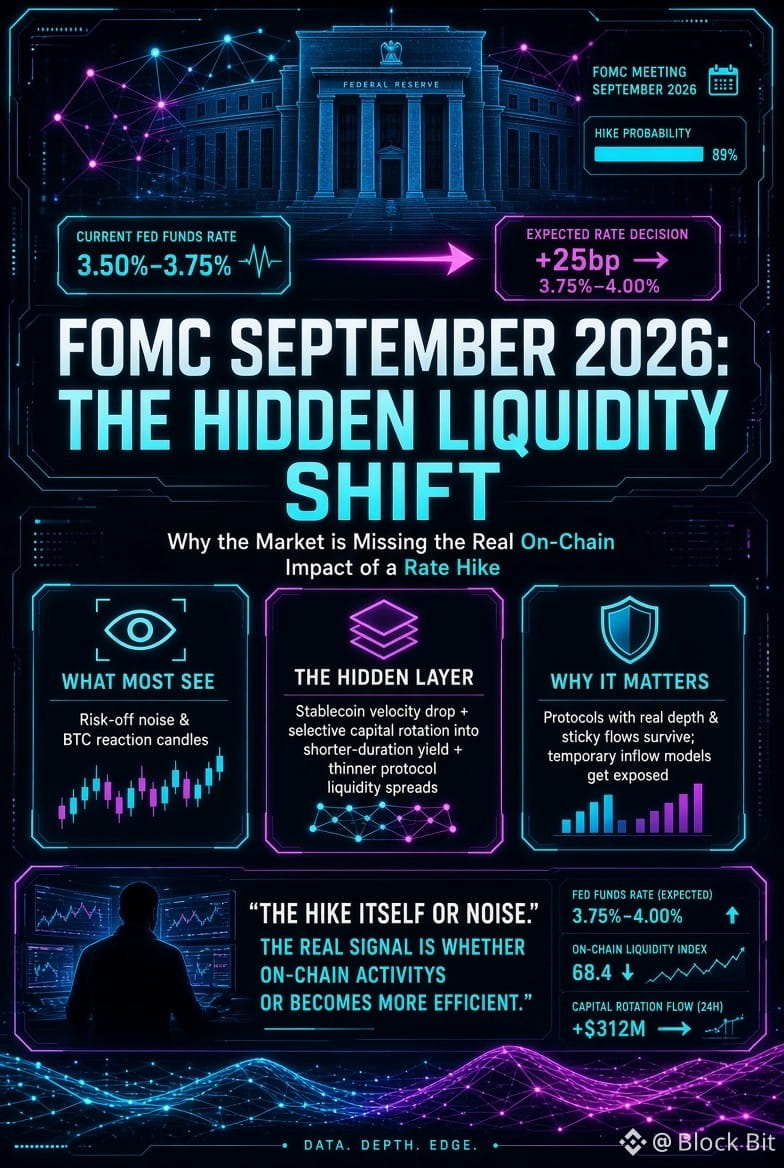
Sitting here watching the FOMC setup for tomorrow and the crypto chatter feels off. Everyone’s glued to the hike odds and what it does to risk assets, but the piece most miss is how higher rates quietly reshape on-chain liquidity behavior itself.
Traders treat a 25bp move as pure risk-off noise. What I’m seeing in the data is different.
When the front end tightens, the real shift shows up in stablecoin velocity and the way larger wallets rotate collateral across protocols.
Liquidity doesn’t just leave—it gets more selective, parking in shorter-duration yield venues and forcing thinner markets to clear at wider spreads.
That coordination friction is the part price charts never capture until it’s already priced in.
Long term that matters more than the immediate reaction candle. Protocols that built real depth and sticky user flows handle the squeeze better because their incentives stay aligned when capital gets pickier.
The ones relying on temporary inflows get exposed fast.
I’ve watched this pattern enough times that the hike itself barely moves me.
The real tell is whether on-chain activity contracts or just gets more efficient.
Right now the market still treats every Fed decision like a binary for BTC. It’s not.
#FedRateWatch
$DEXE $GRVT $DUSK
{future}(DUSKUSDT)
{future}(GRVTUSDT)
{future}(DEXEUSDT)
Sitting here watching the FOMC setup for tomorrow and the crypto chatter feels off. Everyone’s glued to the hike odds and what it does to risk assets, but the piece most miss is how higher rates quietly reshape on-chain liquidity behavior itself.
Traders treat a 25bp move as pure risk-off noise. What I’m seeing in the data is different.
When the front end tightens, the real shift shows up in stablecoin velocity and the way larger wallets rotate collateral across protocols.
Liquidity doesn’t just leave—it gets more selective, parking in shorter-duration yield venues and forcing thinner markets to clear at wider spreads.
That coordination friction is the part price charts never capture until it’s already priced in.
Long term that matters more than the immediate reaction candle. Protocols that built real depth and sticky user flows handle the squeeze better because their incentives stay aligned when capital gets pickier.
The ones relying on temporary inflows get exposed fast.
I’ve watched this pattern enough times that the hike itself barely moves me.
The real tell is whether on-chain activity contracts or just gets more efficient.
Right now the market still treats every Fed decision like a binary for BTC. It’s not.
#FedRateWatch
$DEXE $GRVT $DUSK
Traders treat a 25bp move as pure risk-off noise. What I’m seeing in the data is different.
When the front end tightens, the real shift shows up in stablecoin velocity and the way larger wallets rotate collateral across protocols.
Liquidity doesn’t just leave—it gets more selective, parking in shorter-duration yield venues and forcing thinner markets to clear at wider spreads.
That coordination friction is the part price charts never capture until it’s already priced in.
Long term that matters more than the immediate reaction candle. Protocols that built real depth and sticky user flows handle the squeeze better because their incentives stay aligned when capital gets pickier.
The ones relying on temporary inflows get exposed fast.
I’ve watched this pattern enough times that the hike itself barely moves me.
The real tell is whether on-chain activity contracts or just gets more efficient.
Right now the market still treats every Fed decision like a binary for BTC. It’s not.
#FedRateWatch
$DEXE $GRVT $DUSK
1
820
·
--
Bullish
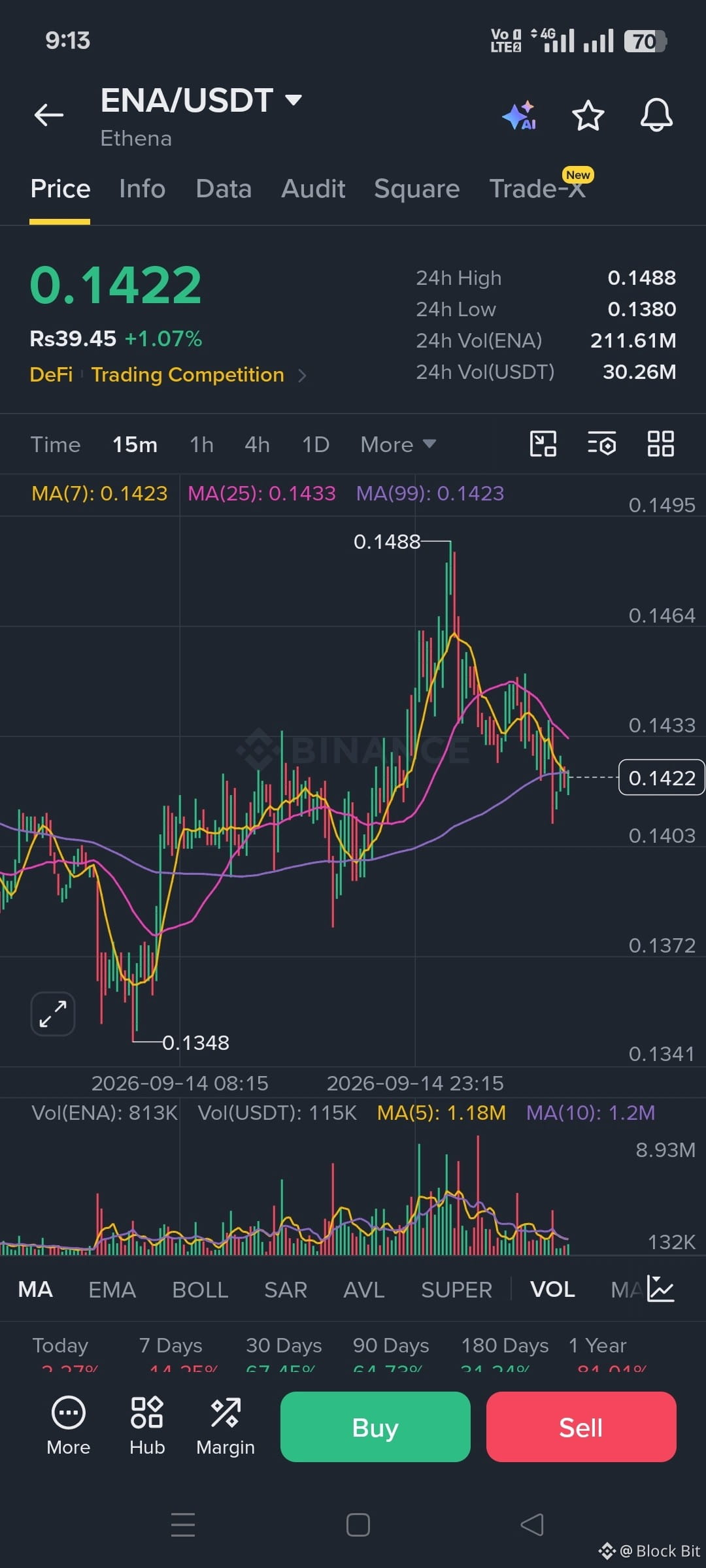
$ENA /USDT — Technical Setup 📊
Entry Zone: 0.1418 – 0.1425
Targets: 0.1433 – 0.1488
TP1: 0.1433
TP2: 0.1464
TP3: 0.1488
Stop Loss: 0.1403
Bias: Bullish continuation while price holds above the 0.1403 support area.
ENA is currently trading around 0.1422, with price near the short-term moving averages. The key focus is whether support continues to hold and allows the trend to recover toward the marked resistance levels.
Trade with patience and discipline. Avoid chasing the top—let price confirm the continuation and respect the setup.
⚠️ No guarantees. Manage risk according to your own strategy.
$ASTR $KII
{alpha}(560xeec6574eabba52bac3f0277f2cd5ac7e67197886)
{future}(ASTRUSDT)
$ENA /USDT — Technical Setup 📊
Entry Zone: 0.1418 – 0.1425
Targets: 0.1433 – 0.1488
TP1: 0.1433
TP2: 0.1464
TP3: 0.1488
Stop Loss: 0.1403
Bias: Bullish continuation while price holds above the 0.1403 support area.
ENA is currently trading around 0.1422, with price near the short-term moving averages. The key focus is whether support continues to hold and allows the trend to recover toward the marked resistance levels.
Trade with patience and discipline. Avoid chasing the top—let price confirm the continuation and respect the setup.
⚠️ No guarantees. Manage risk according to your own strategy.
$ASTR $KII
Entry Zone: 0.1418 – 0.1425
Targets: 0.1433 – 0.1488
TP1: 0.1433
TP2: 0.1464
TP3: 0.1488
Stop Loss: 0.1403
Bias: Bullish continuation while price holds above the 0.1403 support area.
ENA is currently trading around 0.1422, with price near the short-term moving averages. The key focus is whether support continues to hold and allows the trend to recover toward the marked resistance levels.
Trade with patience and discipline. Avoid chasing the top—let price confirm the continuation and respect the setup.
⚠️ No guarantees. Manage risk according to your own strategy.
$ASTR $KII
615
·
--
Bullish
$BNB is trading around 722.28 USDT, with price currently testing the MA(99) near 722.37. The recent structure shows support around the 713–719 area, while the next visible resistance levels sit higher.
Entry Zone: 719–722 USDT
Targets: 726.15 / 738.86 / 751.57
TP1: 726.15 USDT
TP2: 738.86 USDT
TP3: 751.57 USDT
Stop Loss: 712.50 USDT
Bias: Bullish while price holds above the 719 USDT entry support zone.
The setup favors patience and confirmation rather than chasing tops. Let price respect the support zone and allow the trend to continue. If support fails, the setup is invalidated at the stop-loss level.
Trade the structure, respect the risk, and stay disciplined.
$GRVT $AKE
{future}(GRVTUSDT)
{future}(BNBUSDT)
$BNB is trading around 722.28 USDT, with price currently testing the MA(99) near 722.37. The recent structure shows support around the 713–719 area, while the next visible resistance levels sit higher.
Entry Zone: 719–722 USDT
Targets: 726.15 / 738.86 / 751.57
TP1: 726.15 USDT
TP2: 738.86 USDT
TP3: 751.57 USDT
Stop Loss: 712.50 USDT
Bias: Bullish while price holds above the 719 USDT entry support zone.
The setup favors patience and confirmation rather than chasing tops. Let price respect the support zone and allow the trend to continue. If support fails, the setup is invalidated at the stop-loss level.
Trade the structure, respect the risk, and stay disciplined.
$GRVT $AKE
Entry Zone: 719–722 USDT
Targets: 726.15 / 738.86 / 751.57
TP1: 726.15 USDT
TP2: 738.86 USDT
TP3: 751.57 USDT
Stop Loss: 712.50 USDT
Bias: Bullish while price holds above the 719 USDT entry support zone.
The setup favors patience and confirmation rather than chasing tops. Let price respect the support zone and allow the trend to continue. If support fails, the setup is invalidated at the stop-loss level.
Trade the structure, respect the risk, and stay disciplined.
$GRVT $AKE
87
·
--
Bullish
Verified
I’m Block Bit, and the market is now waiting for one number that could change the Fed story.
August payrolls surprised hard, with 162K jobs added versus roughly 53K expected. Unemployment stayed at 4.1%, showing the labor market is still holding up.
Then PPI added more pressure. Producer prices rose 5.4% year-over-year in August, while energy costs jumped sharply. That pushed Fed hike expectations to around 70% heading into today’s CPI.
Now CPI is the big test.
If core inflation stays around 0.2% monthly, markets could start questioning whether a hike is really necessary.
But a hotter 0.3%+ reading could strengthen the hawkish case and put more pressure on stocks, crypto and gold.
The Fed meets September 15–16.
So what’s your call?
🔥 HOT CPI = Bearish
🚀 COOL CPI = Bullish
🤔 Or is the hike already priced in?
What are you expecting from Core CPI?
$XAU $GIGGLE $GRVT #CPIWatch
{future}(GRVTUSDT)
{future}(GIGGLEUSDT)
{future}(XAUUSDT)
I’m Block Bit, and the market is now waiting for one number that could change the Fed story.
August payrolls surprised hard, with 162K jobs added versus roughly 53K expected. Unemployment stayed at 4.1%, showing the labor market is still holding up.
Then PPI added more pressure. Producer prices rose 5.4% year-over-year in August, while energy costs jumped sharply. That pushed Fed hike expectations to around 70% heading into today’s CPI.
Now CPI is the big test.
If core inflation stays around 0.2% monthly, markets could start questioning whether a hike is really necessary.
But a hotter 0.3%+ reading could strengthen the hawkish case and put more pressure on stocks, crypto and gold.
The Fed meets September 15–16.
So what’s your call?
🔥 HOT CPI = Bearish
🚀 COOL CPI = Bullish
🤔 Or is the hike already priced in?
What are you expecting from Core CPI?
$XAU $GIGGLE $GRVT #CPIWatch
August payrolls surprised hard, with 162K jobs added versus roughly 53K expected. Unemployment stayed at 4.1%, showing the labor market is still holding up.
Then PPI added more pressure. Producer prices rose 5.4% year-over-year in August, while energy costs jumped sharply. That pushed Fed hike expectations to around 70% heading into today’s CPI.
Now CPI is the big test.
If core inflation stays around 0.2% monthly, markets could start questioning whether a hike is really necessary.
But a hotter 0.3%+ reading could strengthen the hawkish case and put more pressure on stocks, crypto and gold.
The Fed meets September 15–16.
So what’s your call?
🔥 HOT CPI = Bearish
🚀 COOL CPI = Bullish
🤔 Or is the hike already priced in?
What are you expecting from Core CPI?
$XAU $GIGGLE $GRVT #CPIWatch
23
17
4k
·
--
Bullish
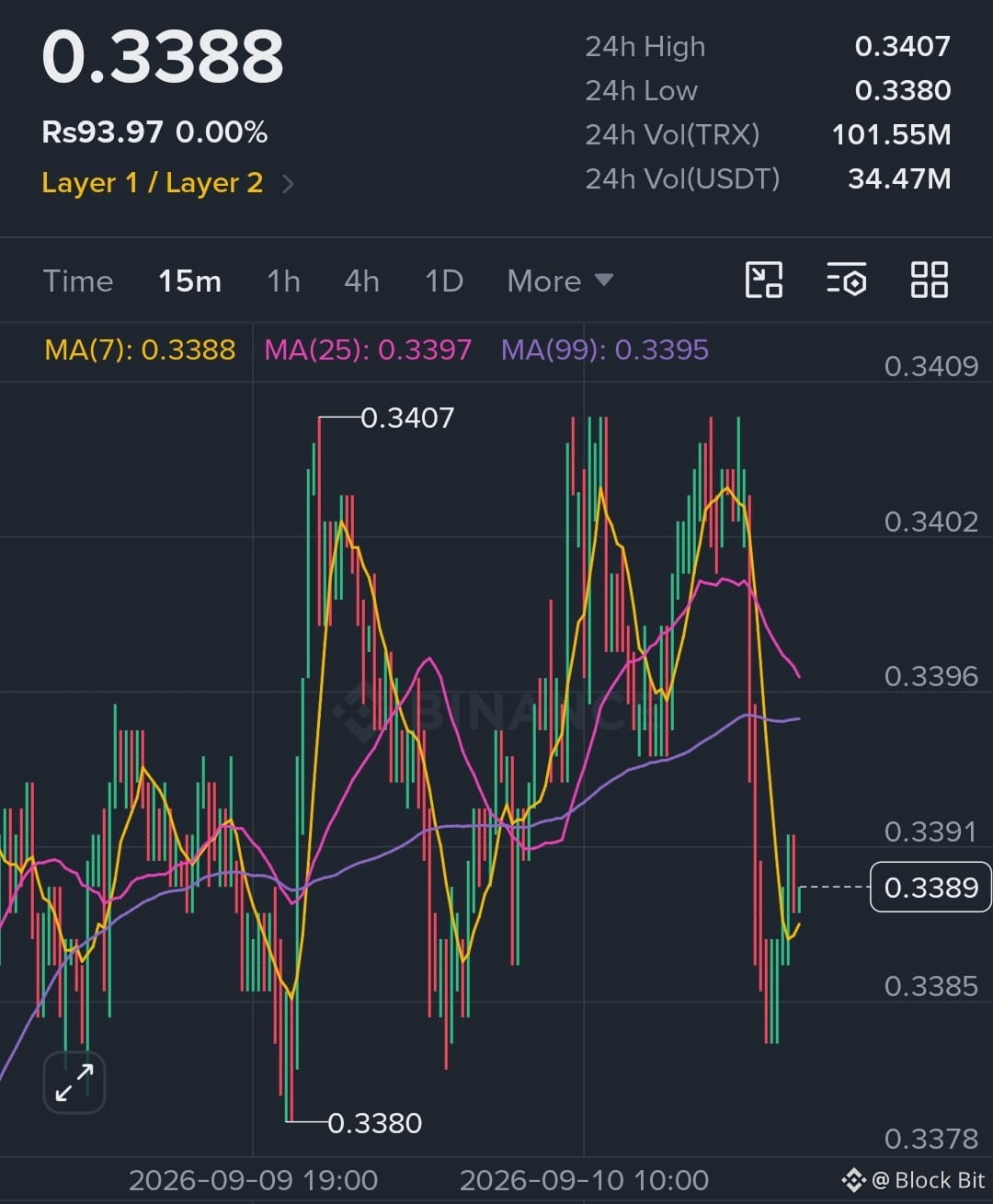
$TRX /USDT Technical Setup
Current Price: 0.3388
24h Range: 0.3380 – 0.3407
Entry Zone: 0.3380 – 0.3390
TP1: 0.3400
TP2: 0.3405
TP3: 0.3407
Stop Loss: Below 0.3380
Bullish bias remains valid as long as price holds above entry support.
Patience and disciplined execution are required. Focus on structure and trend continuation rather than chasing short-term tops.
$TRX $BR
{future}(BRUSDT)
{future}(TRXUSDT)
$TRX /USDT Technical Setup
Current Price: 0.3388
24h Range: 0.3380 – 0.3407
Entry Zone: 0.3380 – 0.3390
TP1: 0.3400
TP2: 0.3405
TP3: 0.3407
Stop Loss: Below 0.3380
Bullish bias remains valid as long as price holds above entry support.
Patience and disciplined execution are required. Focus on structure and trend continuation rather than chasing short-term tops.
$TRX $BR
Current Price: 0.3388
24h Range: 0.3380 – 0.3407
Entry Zone: 0.3380 – 0.3390
TP1: 0.3400
TP2: 0.3405
TP3: 0.3407
Stop Loss: Below 0.3380
Bullish bias remains valid as long as price holds above entry support.
Patience and disciplined execution are required. Focus on structure and trend continuation rather than chasing short-term tops.
$TRX $BR
193
·
--
Bullish
$USD1 /USDT — Technical Trade Setup 📊
Entry Zone: 0.99972 – 0.99977
Targets: 0.99986 – 1.00009
🎯 TP1: 0.99986
🎯 TP2: 0.99999
🎯 TP3: 1.00009
🛑 Stop Loss: 0.99959
Market Bias: Bullish continuation setup while price holds above the 0.99972 support area.
Price is currently consolidating around the short-term moving averages, with nearby resistance levels providing the next upside objectives. The setup favors patience and confirmation rather than chasing price at the highs.
Stay disciplined. Respect the entry zone, manage risk, and let the trend develop.
No chasing tops — wait for the structure to confirm.
$DUSK $AKE
{future}(AKEUSDT)
{future}(DUSKUSDT)
$USD1 /USDT — Technical Trade Setup 📊
Entry Zone: 0.99972 – 0.99977
Targets: 0.99986 – 1.00009
🎯 TP1: 0.99986
🎯 TP2: 0.99999
🎯 TP3: 1.00009
🛑 Stop Loss: 0.99959
Market Bias: Bullish continuation setup while price holds above the 0.99972 support area.
Price is currently consolidating around the short-term moving averages, with nearby resistance levels providing the next upside objectives. The setup favors patience and confirmation rather than chasing price at the highs.
Stay disciplined. Respect the entry zone, manage risk, and let the trend develop.
No chasing tops — wait for the structure to confirm.
$DUSK $AKE
Entry Zone: 0.99972 – 0.99977
Targets: 0.99986 – 1.00009
🎯 TP1: 0.99986
🎯 TP2: 0.99999
🎯 TP3: 1.00009
🛑 Stop Loss: 0.99959
Market Bias: Bullish continuation setup while price holds above the 0.99972 support area.
Price is currently consolidating around the short-term moving averages, with nearby resistance levels providing the next upside objectives. The setup favors patience and confirmation rather than chasing price at the highs.
Stay disciplined. Respect the entry zone, manage risk, and let the trend develop.
No chasing tops — wait for the structure to confirm.
$DUSK $AKE
365
·
--
Bullish
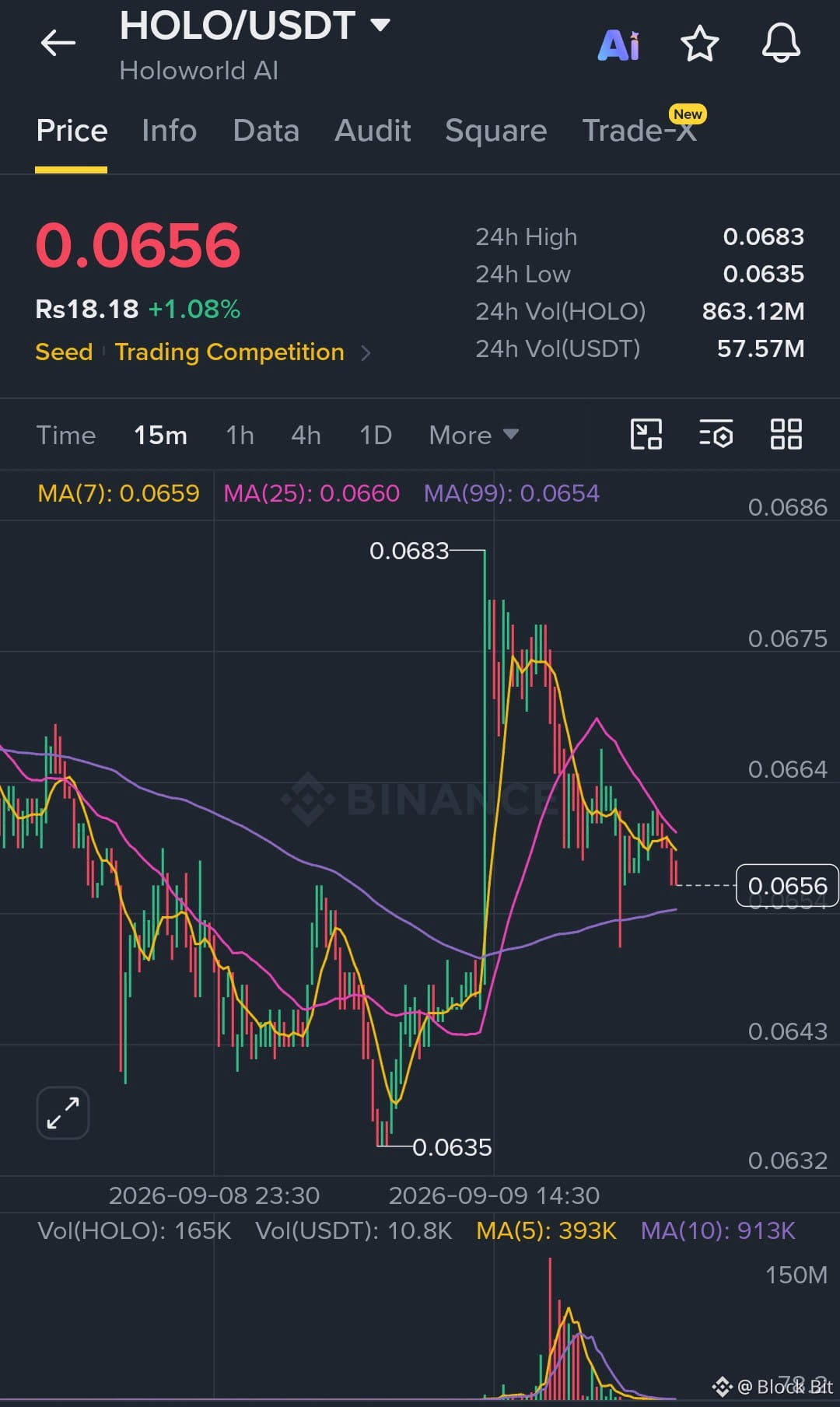
$HOLO /USDT — Technical Trade Setup 📊
Entry Zone: 0.0654 – 0.0656
TP1: 0.0664
TP2: 0.0675
TP3: 0.0683
Stop Loss: 0.0643
HOLO/USDT is holding around the 0.0654–0.0656 support area, with the chart showing potential for a continuation toward the marked resistance levels.
The bullish bias remains valid as long as price holds above the entry support zone.
Trade with patience.
Wait for confirmation rather than chasing tops, respect the stop loss, and let the trend develop toward the targets.
Technical setup only — manage risk according to your own strategy.
$HOLO #USADPWeeklyEmploymentRises12000 #RippleLobbiesToAdvanceCLARITYActVote #ChinaAugustCPIRises0.8%YoY #USStrikesTargetsNearHormuzAndJask #OilRisesToHighestSinceJuly
{future}(HOLOUSDT)
$HOLO /USDT — Technical Trade Setup 📊
Entry Zone: 0.0654 – 0.0656
TP1: 0.0664
TP2: 0.0675
TP3: 0.0683
Stop Loss: 0.0643
HOLO/USDT is holding around the 0.0654–0.0656 support area, with the chart showing potential for a continuation toward the marked resistance levels.
The bullish bias remains valid as long as price holds above the entry support zone.
Trade with patience.
Wait for confirmation rather than chasing tops, respect the stop loss, and let the trend develop toward the targets.
Technical setup only — manage risk according to your own strategy.
$HOLO #USADPWeeklyEmploymentRises12000 #RippleLobbiesToAdvanceCLARITYActVote #ChinaAugustCPIRises0.8%YoY #USStrikesTargetsNearHormuzAndJask #OilRisesToHighestSinceJuly
Entry Zone: 0.0654 – 0.0656
TP1: 0.0664
TP2: 0.0675
TP3: 0.0683
Stop Loss: 0.0643
HOLO/USDT is holding around the 0.0654–0.0656 support area, with the chart showing potential for a continuation toward the marked resistance levels.
The bullish bias remains valid as long as price holds above the entry support zone.
Trade with patience.
Wait for confirmation rather than chasing tops, respect the stop loss, and let the trend develop toward the targets.
Technical setup only — manage risk according to your own strategy.
$HOLO #USADPWeeklyEmploymentRises12000 #RippleLobbiesToAdvanceCLARITYActVote #ChinaAugustCPIRises0.8%YoY #USStrikesTargetsNearHormuzAndJask #OilRisesToHighestSinceJuly
130
·
--
Bullish
$ZKC /USDT — Technical Trade Setup
Entry Zone: 0.0492 – 0.0495
Targets: 0.0500 – 0.0504
TP1: 0.0500
TP2: 0.0502
TP3: 0.0504
Stop Loss: 0.0489
Bias: Bullish while price holds above the 0.0492–0.0495 entry support zone.
Price is currently trading around 0.0497, with the short-term MA structure supporting the upward move. The focus remains on holding support and allowing trend continuation, rather than chasing price near resistance.
Trade with patience and discipline. Let the setup come to you—protect the entry, respect the stop, and avoid chasing tops.
$XPL $KII
{alpha}(560xeec6574eabba52bac3f0277f2cd5ac7e67197886)
{spot}(XPLUSDT)
$ZKC /USDT — Technical Trade Setup
Entry Zone: 0.0492 – 0.0495
Targets: 0.0500 – 0.0504
TP1: 0.0500
TP2: 0.0502
TP3: 0.0504
Stop Loss: 0.0489
Bias: Bullish while price holds above the 0.0492–0.0495 entry support zone.
Price is currently trading around 0.0497, with the short-term MA structure supporting the upward move. The focus remains on holding support and allowing trend continuation, rather than chasing price near resistance.
Trade with patience and discipline. Let the setup come to you—protect the entry, respect the stop, and avoid chasing tops.
$XPL $KII
Entry Zone: 0.0492 – 0.0495
Targets: 0.0500 – 0.0504
TP1: 0.0500
TP2: 0.0502
TP3: 0.0504
Stop Loss: 0.0489
Bias: Bullish while price holds above the 0.0492–0.0495 entry support zone.
Price is currently trading around 0.0497, with the short-term MA structure supporting the upward move. The focus remains on holding support and allowing trend continuation, rather than chasing price near resistance.
Trade with patience and discipline. Let the setup come to you—protect the entry, respect the stop, and avoid chasing tops.
$XPL $KII
287
·
--
Article
Another Cycle of Noise and the Quiet Question of Privacy RailsMost mornings in this market I already feel behind before I even open the charts. Coins keep showing up faster than anyone can properly look at them, the stories rotate like clockwork, and the same loud voices keep acting like the last few years never happened. You sit through another wave of AI tokens that feel more like branding exercises than actual breakthroughs, another round of people yelling about institutional money that somehow never quite turns into steady daily use. After a while the whole thing starts to wear you down. Honestly, the excitement just drains out of you.
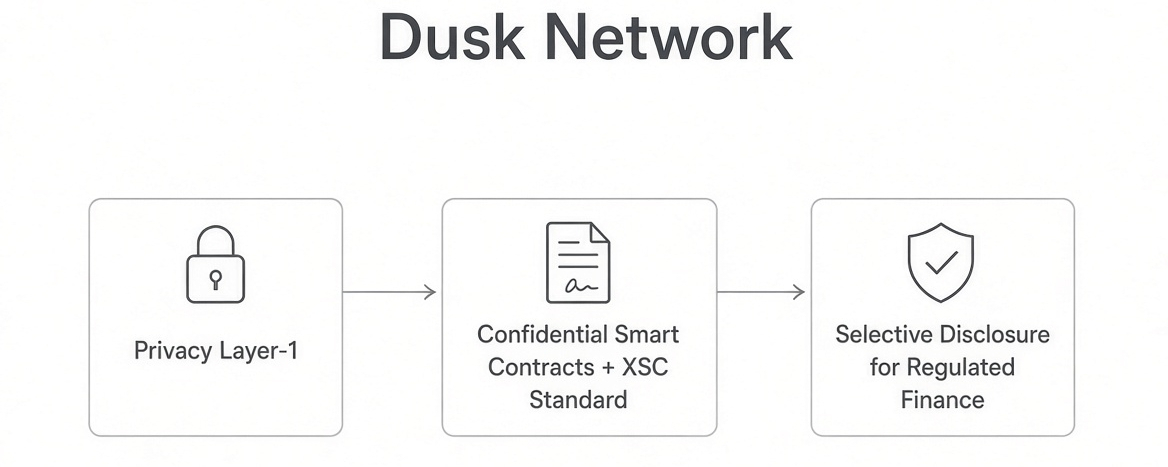
That is pretty much where my head is when Dusk Network drifts back into view. Privacy layer-1 for financial applications, confidential smart contracts, that XSC standard for security tokens. It does not shout the way most projects do, which is almost a relief in a space that rewards whoever talks the loudest. Still, the basic point underneath it is hard to ignore once you have watched enough public chains fail at ordinary financial work. Balances, positions, who is dealing with whom, the actual logic of a trade—everything sits out in the open for anyone to see. That is fine when people are just gambling with money they can afford to lose. It is not fine when real capital and real rules are involved. Institutions, regulators, regular companies that do not want their strategies or holdings turned into public data have mostly treated blockchains like experimental toys for exactly this reason. Selective disclosure—the ability to keep the sensitive stuff private by default but still prove what the right people need to see—is not some nice extra feature. It is the missing piece that keeps traditional markets from taking most of this technology seriously.
Let’s be real, the problem itself is genuine. I have seen enough attempts at private DeFi and compliant asset rails to know that adding privacy later almost never holds up under pressure. Building it into the foundation and pairing it with a contract standard meant for securities that actually have to behave like securities feels more careful than most of what gets launched. Ownership rules, eligibility checks, the boring legal machinery that stops markets from turning into free-for-alls—these are the unglamorous details that decide whether something can support real financial activity or just stays stuck in demo mode forever. The hard part is that technical seriousness does not magically create users. Institutions move slowly for reasons that have almost nothing to do with cryptography. Legal teams, risk committees, systems that already work well enough, the simple preference for what is already known and insured. A chain can look solid on paper and still sit mostly empty while the people it was built for keep running small tests that never turn into everyday work.
The token is the usual setup. DUSK pays for gas and staking, with emissions stretched out over years. On paper the utility is clear enough. Whether it ends up being more than a token for a network that still has to prove people actually want to use it is the same open question every infrastructure project faces. If activity stays thin, it is just another name on the list. If regulated flows eventually show up in real size, the numbers start looking different. Right now neither side is settled, and this market has almost no patience left for projects that need years of quiet progress before anything interesting shows up on the charts.
I keep coming back to how long the development took. Mainnet finally arrived after years of work. Patience is rare here, and projects that take the slow road often get ignored right when they finally have something real to show. Privacy mixed with compliance is a narrow path. Retail users do not care about ownership caps or selective auditor access. Most developers just want to ship fast without extra friction. The institutions that actually need those features will take their time evaluating, and time is the one resource crypto narratives rarely respect. That combination can leave a project sitting in a long quiet stretch where the technology is decent enough but the visible usage stays thin. This space has a habit of walking away from things that do not produce heat quickly, even when the original problem is still sitting there unsolved.
Maybe the mix of confidential contracts and regulated asset standards finds a real niche in tokenized securities or private institutional settlement. Maybe it stays a specialized tool that never reaches critical mass. I honestly do not know. The gap it is trying to close is real. The approach is more careful than the usual cycle of big promises and thin delivery. Whether careful is enough in a market that still rewards noise over substance is the part that keeps the curiosity low rather than excited. For now it just sits there as one more serious attempt in a crowded field, watched with the same tired attention that remains after enough cycles of disappointment. Interested in the idea, unconvinced by the timeline, and no longer willing to get loud about anything until the usage stops looking theoretical and starts looking ordinary.
$DUSK #dusk #DUSK @Dusk_Foundation $GIGGLE $GRVT
{spot}(DUSKUSDT)
Another Cycle of Noise and the Quiet Question of Privacy Rails
Most mornings in this market I already feel behind before I even open the charts. Coins keep showing up faster than anyone can properly look at them, the stories rotate like clockwork, and the same loud voices keep acting like the last few years never happened. You sit through another wave of AI tokens that feel more like branding exercises than actual breakthroughs, another round of people yelling about institutional money that somehow never quite turns into steady daily use. After a while the whole thing starts to wear you down. Honestly, the excitement just drains out of you.
That is pretty much where my head is when Dusk Network drifts back into view. Privacy layer-1 for financial applications, confidential smart contracts, that XSC standard for security tokens. It does not shout the way most projects do, which is almost a relief in a space that rewards whoever talks the loudest. Still, the basic point underneath it is hard to ignore once you have watched enough public chains fail at ordinary financial work. Balances, positions, who is dealing with whom, the actual logic of a trade—everything sits out in the open for anyone to see. That is fine when people are just gambling with money they can afford to lose. It is not fine when real capital and real rules are involved. Institutions, regulators, regular companies that do not want their strategies or holdings turned into public data have mostly treated blockchains like experimental toys for exactly this reason. Selective disclosure—the ability to keep the sensitive stuff private by default but still prove what the right people need to see—is not some nice extra feature. It is the missing piece that keeps traditional markets from taking most of this technology seriously.
Let’s be real, the problem itself is genuine. I have seen enough attempts at private DeFi and compliant asset rails to know that adding privacy later almost never holds up under pressure. Building it into the foundation and pairing it with a contract standard meant for securities that actually have to behave like securities feels more careful than most of what gets launched. Ownership rules, eligibility checks, the boring legal machinery that stops markets from turning into free-for-alls—these are the unglamorous details that decide whether something can support real financial activity or just stays stuck in demo mode forever. The hard part is that technical seriousness does not magically create users. Institutions move slowly for reasons that have almost nothing to do with cryptography. Legal teams, risk committees, systems that already work well enough, the simple preference for what is already known and insured. A chain can look solid on paper and still sit mostly empty while the people it was built for keep running small tests that never turn into everyday work.
The token is the usual setup. DUSK pays for gas and staking, with emissions stretched out over years. On paper the utility is clear enough. Whether it ends up being more than a token for a network that still has to prove people actually want to use it is the same open question every infrastructure project faces. If activity stays thin, it is just another name on the list. If regulated flows eventually show up in real size, the numbers start looking different. Right now neither side is settled, and this market has almost no patience left for projects that need years of quiet progress before anything interesting shows up on the charts.
I keep coming back to how long the development took. Mainnet finally arrived after years of work. Patience is rare here, and projects that take the slow road often get ignored right when they finally have something real to show. Privacy mixed with compliance is a narrow path. Retail users do not care about ownership caps or selective auditor access. Most developers just want to ship fast without extra friction. The institutions that actually need those features will take their time evaluating, and time is the one resource crypto narratives rarely respect. That combination can leave a project sitting in a long quiet stretch where the technology is decent enough but the visible usage stays thin. This space has a habit of walking away from things that do not produce heat quickly, even when the original problem is still sitting there unsolved.
Maybe the mix of confidential contracts and regulated asset standards finds a real niche in tokenized securities or private institutional settlement. Maybe it stays a specialized tool that never reaches critical mass. I honestly do not know. The gap it is trying to close is real. The approach is more careful than the usual cycle of big promises and thin delivery. Whether careful is enough in a market that still rewards noise over substance is the part that keeps the curiosity low rather than excited. For now it just sits there as one more serious attempt in a crowded field, watched with the same tired attention that remains after enough cycles of disappointment. Interested in the idea, unconvinced by the timeline, and no longer willing to get loud about anything until the usage stops looking theoretical and starts looking ordinary.
$DUSK #dusk #DUSK @Dusk $GIGGLE $GRVT
That is pretty much where my head is when Dusk Network drifts back into view. Privacy layer-1 for financial applications, confidential smart contracts, that XSC standard for security tokens. It does not shout the way most projects do, which is almost a relief in a space that rewards whoever talks the loudest. Still, the basic point underneath it is hard to ignore once you have watched enough public chains fail at ordinary financial work. Balances, positions, who is dealing with whom, the actual logic of a trade—everything sits out in the open for anyone to see. That is fine when people are just gambling with money they can afford to lose. It is not fine when real capital and real rules are involved. Institutions, regulators, regular companies that do not want their strategies or holdings turned into public data have mostly treated blockchains like experimental toys for exactly this reason. Selective disclosure—the ability to keep the sensitive stuff private by default but still prove what the right people need to see—is not some nice extra feature. It is the missing piece that keeps traditional markets from taking most of this technology seriously.
Let’s be real, the problem itself is genuine. I have seen enough attempts at private DeFi and compliant asset rails to know that adding privacy later almost never holds up under pressure. Building it into the foundation and pairing it with a contract standard meant for securities that actually have to behave like securities feels more careful than most of what gets launched. Ownership rules, eligibility checks, the boring legal machinery that stops markets from turning into free-for-alls—these are the unglamorous details that decide whether something can support real financial activity or just stays stuck in demo mode forever. The hard part is that technical seriousness does not magically create users. Institutions move slowly for reasons that have almost nothing to do with cryptography. Legal teams, risk committees, systems that already work well enough, the simple preference for what is already known and insured. A chain can look solid on paper and still sit mostly empty while the people it was built for keep running small tests that never turn into everyday work.
The token is the usual setup. DUSK pays for gas and staking, with emissions stretched out over years. On paper the utility is clear enough. Whether it ends up being more than a token for a network that still has to prove people actually want to use it is the same open question every infrastructure project faces. If activity stays thin, it is just another name on the list. If regulated flows eventually show up in real size, the numbers start looking different. Right now neither side is settled, and this market has almost no patience left for projects that need years of quiet progress before anything interesting shows up on the charts.
I keep coming back to how long the development took. Mainnet finally arrived after years of work. Patience is rare here, and projects that take the slow road often get ignored right when they finally have something real to show. Privacy mixed with compliance is a narrow path. Retail users do not care about ownership caps or selective auditor access. Most developers just want to ship fast without extra friction. The institutions that actually need those features will take their time evaluating, and time is the one resource crypto narratives rarely respect. That combination can leave a project sitting in a long quiet stretch where the technology is decent enough but the visible usage stays thin. This space has a habit of walking away from things that do not produce heat quickly, even when the original problem is still sitting there unsolved.
Maybe the mix of confidential contracts and regulated asset standards finds a real niche in tokenized securities or private institutional settlement. Maybe it stays a specialized tool that never reaches critical mass. I honestly do not know. The gap it is trying to close is real. The approach is more careful than the usual cycle of big promises and thin delivery. Whether careful is enough in a market that still rewards noise over substance is the part that keeps the curiosity low rather than excited. For now it just sits there as one more serious attempt in a crowded field, watched with the same tired attention that remains after enough cycles of disappointment. Interested in the idea, unconvinced by the timeline, and no longer willing to get loud about anything until the usage stops looking theoretical and starts looking ordinary.
$DUSK #dusk #DUSK @Dusk $GIGGLE $GRVT
127
·
--
Bullish
ZEC/USDT — LONG SETUP 📈
Entry Zone: 1,005 – 1,012
Targets: 1,020 – 1,050
TP1: 1,020
TP2: 1,035
TP3: 1,050
Stop Loss: 985
Technical View:
ZEC is trading around 1,011, with the short-term MAs clustered near the current price, suggesting a key decision area. The chart shows resistance around 1,020 and the recent high at 1,050.70.
Bullish bias remains valid as long as price holds above the entry support.
Stay patient and disciplined. Do not chase the top—wait for a controlled entry and confirmation, then focus on trend continuation toward the listed targets.
$CATI $TAC
{future}(TACUSDT)
{spot}(CATIUSDT)
#ZEC #Zcash #CryptoTrading #Altcoins #TradingSetup
ZEC/USDT — LONG SETUP 📈
Entry Zone: 1,005 – 1,012
Targets: 1,020 – 1,050
TP1: 1,020
TP2: 1,035
TP3: 1,050
Stop Loss: 985
Technical View:
ZEC is trading around 1,011, with the short-term MAs clustered near the current price, suggesting a key decision area. The chart shows resistance around 1,020 and the recent high at 1,050.70.
Bullish bias remains valid as long as price holds above the entry support.
Stay patient and disciplined. Do not chase the top—wait for a controlled entry and confirmation, then focus on trend continuation toward the listed targets.
$CATI $TAC
#ZEC #Zcash #CryptoTrading #Altcoins #TradingSetup
Entry Zone: 1,005 – 1,012
Targets: 1,020 – 1,050
TP1: 1,020
TP2: 1,035
TP3: 1,050
Stop Loss: 985
Technical View:
ZEC is trading around 1,011, with the short-term MAs clustered near the current price, suggesting a key decision area. The chart shows resistance around 1,020 and the recent high at 1,050.70.
Bullish bias remains valid as long as price holds above the entry support.
Stay patient and disciplined. Do not chase the top—wait for a controlled entry and confirmation, then focus on trend continuation toward the listed targets.
$CATI $TAC
#ZEC #Zcash #CryptoTrading #Altcoins #TradingSetup
506
·
--
Bullish
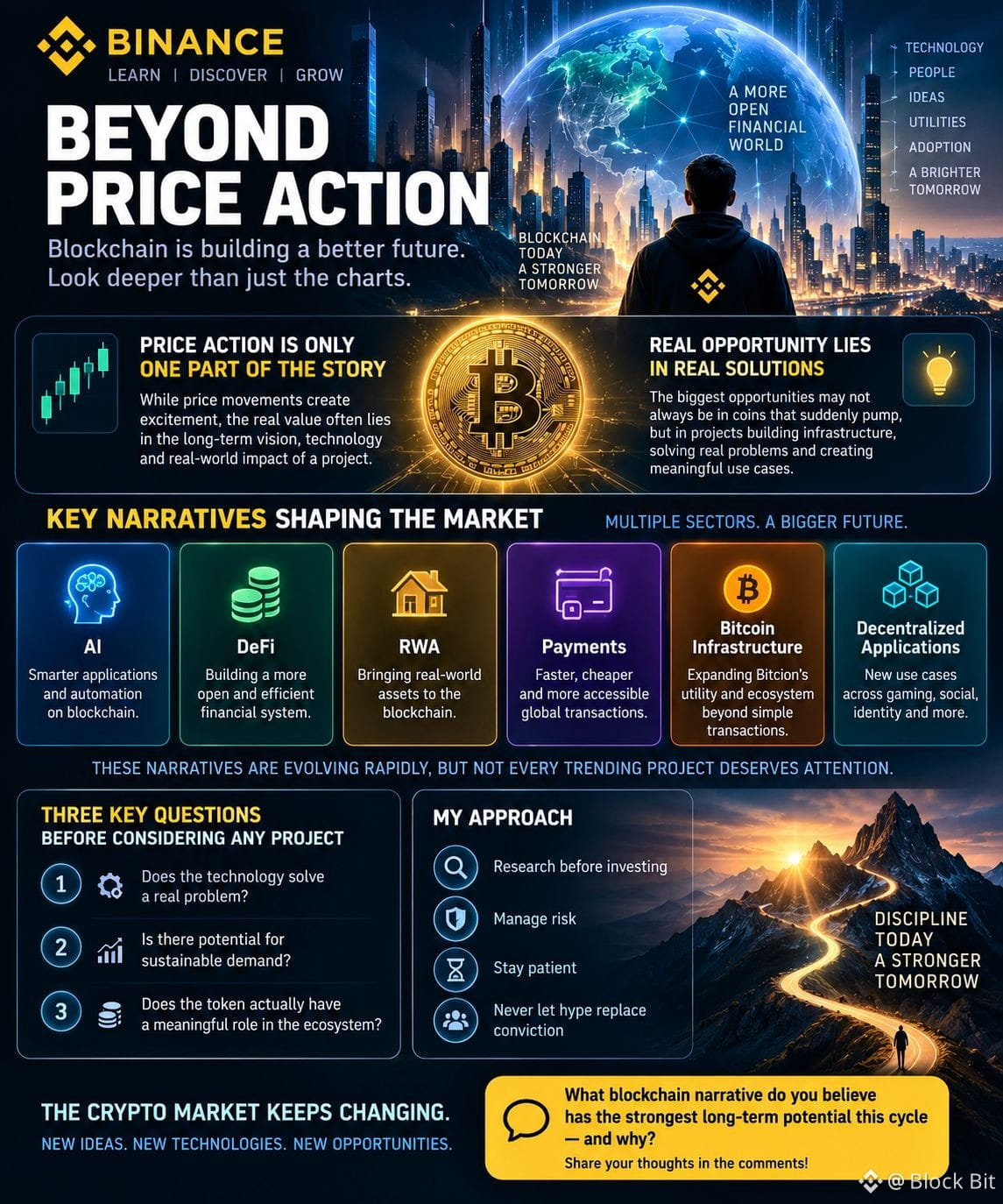
After spending considerable time studying blockchain and the crypto market, I’ve realized one thing: price action is only one part of the story.
The real opportunity may not always be in coins that suddenly pump. It can also be found in projects building infrastructure, solving real problems, and creating meaningful use cases across the blockchain ecosystem.
AI, DeFi, RWA, payments, Bitcoin infrastructure, and decentralized applications are all evolving rapidly. But not every trending project deserves attention.
Before considering any project, I like to ask three simple questions:
Does the technology solve a real problem?
Is there potential for sustainable demand?
Does the token actually have a meaningful role in the ecosystem?
For me, the best approach is simple: research before investing, manage risk, stay patient, and never let hype replace conviction.
The crypto market keeps changing.
What blockchain narrative do you believe has the strongest long-term potential this cycle—and why?
$BITCOIN $ETH $GRVT #Binance
#Crypto
#Blockchain
#DeFi
#CryptoMarket
{future}(GRVTUSDT)
{spot}(ETHUSDT)
{alpha}(10x72e4f9f808c49a2a61de9c5896298920dc4eeea9)
After spending considerable time studying blockchain and the crypto market, I’ve realized one thing: price action is only one part of the story.
The real opportunity may not always be in coins that suddenly pump. It can also be found in projects building infrastructure, solving real problems, and creating meaningful use cases across the blockchain ecosystem.
AI, DeFi, RWA, payments, Bitcoin infrastructure, and decentralized applications are all evolving rapidly. But not every trending project deserves attention.
Before considering any project, I like to ask three simple questions:
Does the technology solve a real problem?
Is there potential for sustainable demand?
Does the token actually have a meaningful role in the ecosystem?
For me, the best approach is simple: research before investing, manage risk, stay patient, and never let hype replace conviction.
The crypto market keeps changing.
What blockchain narrative do you believe has the strongest long-term potential this cycle—and why?
$BITCOIN $ETH $GRVT #Binance
#Crypto
#Blockchain
#DeFi
#CryptoMarket
The real opportunity may not always be in coins that suddenly pump. It can also be found in projects building infrastructure, solving real problems, and creating meaningful use cases across the blockchain ecosystem.
AI, DeFi, RWA, payments, Bitcoin infrastructure, and decentralized applications are all evolving rapidly. But not every trending project deserves attention.
Before considering any project, I like to ask three simple questions:
Does the technology solve a real problem?
Is there potential for sustainable demand?
Does the token actually have a meaningful role in the ecosystem?
For me, the best approach is simple: research before investing, manage risk, stay patient, and never let hype replace conviction.
The crypto market keeps changing.
What blockchain narrative do you believe has the strongest long-term potential this cycle—and why?
$BITCOIN $ETH $GRVT #Binance
#Crypto
#Blockchain
#DeFi
#CryptoMarket
414
·
--
Bullish
$ETH /USDT Technical Setup
Entry Zone: 2,450–2,462
TP1: 2,490
TP2: 2,536
TP3: 2,566
Stop Loss: 2,417
ETH is holding around the 2,450–2,460 support area, with price near the 25 and 99 MA levels. Bullish bias remains valid as long as price holds above entry support. Stay patient, respect the stop loss, and focus on trend continuation rather than chasing tops.
$XMR $ZEC
{future}(ZECUSDT)
{future}(XMRUSDT)
$ETH /USDT Technical Setup
Entry Zone: 2,450–2,462
TP1: 2,490
TP2: 2,536
TP3: 2,566
Stop Loss: 2,417
ETH is holding around the 2,450–2,460 support area, with price near the 25 and 99 MA levels. Bullish bias remains valid as long as price holds above entry support. Stay patient, respect the stop loss, and focus on trend continuation rather than chasing tops.
$XMR $ZEC
Entry Zone: 2,450–2,462
TP1: 2,490
TP2: 2,536
TP3: 2,566
Stop Loss: 2,417
ETH is holding around the 2,450–2,460 support area, with price near the 25 and 99 MA levels. Bullish bias remains valid as long as price holds above entry support. Stay patient, respect the stop loss, and focus on trend continuation rather than chasing tops.
$XMR $ZEC
190
·
--
Bullish
$BTC /USDT Technical Setup
Entry Zone: 77,000–77,300
TP1: 78,300
TP2: 78,680
TP3: 79,400
Stop Loss: 76,650
BTC is trading near 77,876, with support around 77,000 and recent swing low near 76,888. The 1H moving averages remain overhead, so patience is key.
Bullish bias remains valid as long as price holds above entry support. Focus on confirmation and trend continuation rather than chasing tops.
$SOMI $GRVT
{future}(GRVTUSDT)
{future}(SOMIUSDT)
$BTC /USDT Technical Setup
Entry Zone: 77,000–77,300
TP1: 78,300
TP2: 78,680
TP3: 79,400
Stop Loss: 76,650
BTC is trading near 77,876, with support around 77,000 and recent swing low near 76,888. The 1H moving averages remain overhead, so patience is key.
Bullish bias remains valid as long as price holds above entry support. Focus on confirmation and trend continuation rather than chasing tops.
$SOMI $GRVT
Entry Zone: 77,000–77,300
TP1: 78,300
TP2: 78,680
TP3: 79,400
Stop Loss: 76,650
BTC is trading near 77,876, with support around 77,000 and recent swing low near 76,888. The 1H moving averages remain overhead, so patience is key.
Bullish bias remains valid as long as price holds above entry support. Focus on confirmation and trend continuation rather than chasing tops.
$SOMI $GRVT
BTC
35%
SOMI
27%
GRVT
38%
34 votes • Voting closed
3.9k
Log in to explore more content
Join global crypto users on Binance Square
⚡️ Get latest and useful information about crypto.
💬 Trusted by the world’s largest crypto exchange.
👍 Discover real insights from verified creators.
Email / Phone number