
BITWU
908 Posts

BITWU
 Square Verified
Report
Block User
Crypto investor|4XLabs | BTC BNB ETH HOLDER

Macro KOL

2025 Blockchain 100 — Independent Researcher

原创之星
Open Trade

SPCXB Holder
Frequent Trader
8.9 Years
26 Following
29.7K+ Followers
6.3K+ Liked
3 Badges
Posts
Portfolio
All
Quotes
Live
·
--
📊 BITWU Data Dashboard | Afternoon Edition 11/06 (Friday)
💰 Prices (24h, CoinGecko)
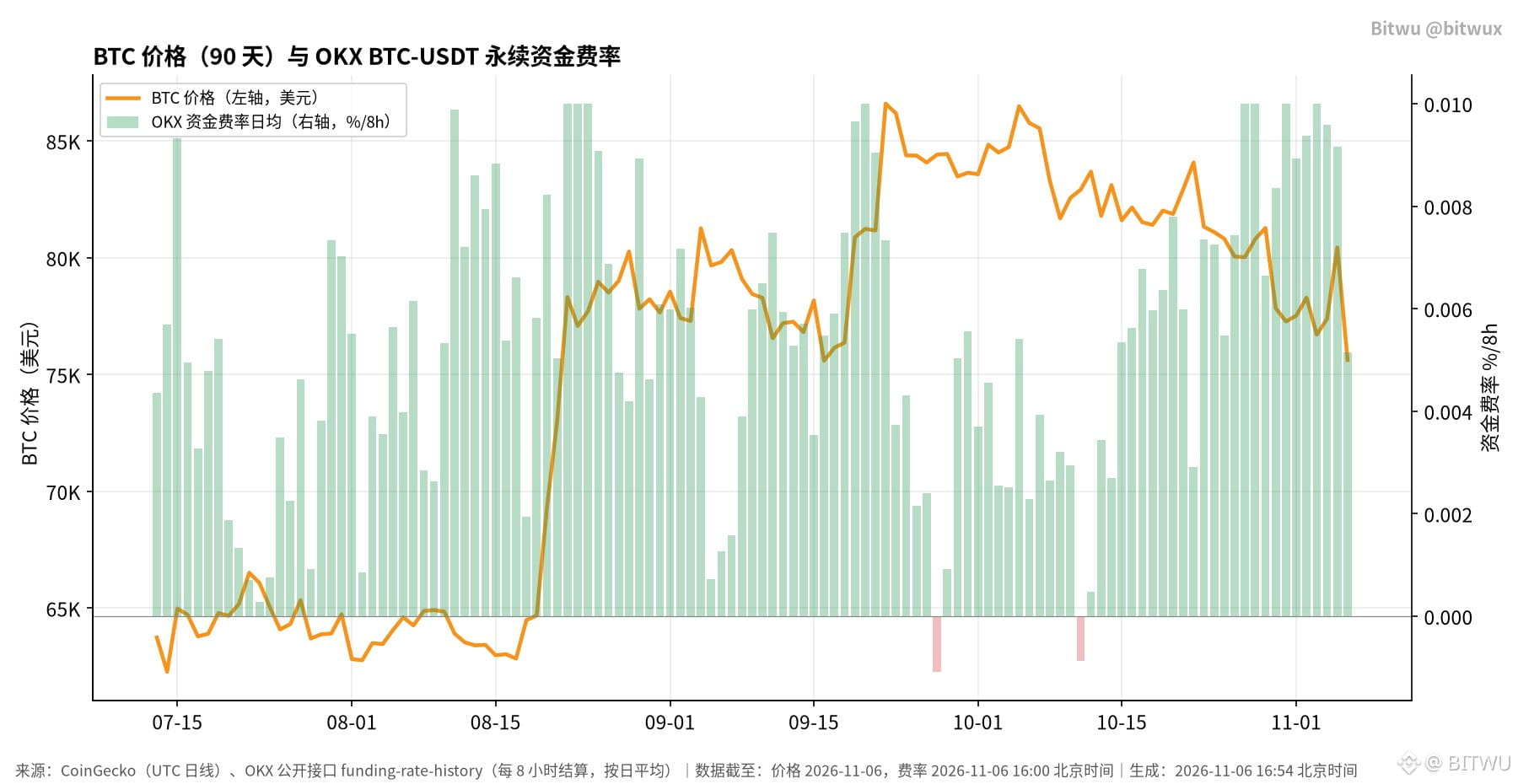
BTC $75,626 (-6.00%)|ETH $2,224.93 (-8.01%)|BNB $690.77 (-3.36%)|HYPE $77.64 (-7.37%)
🏛 Spot ETFs (Farside, U.S. trading day 11/05)
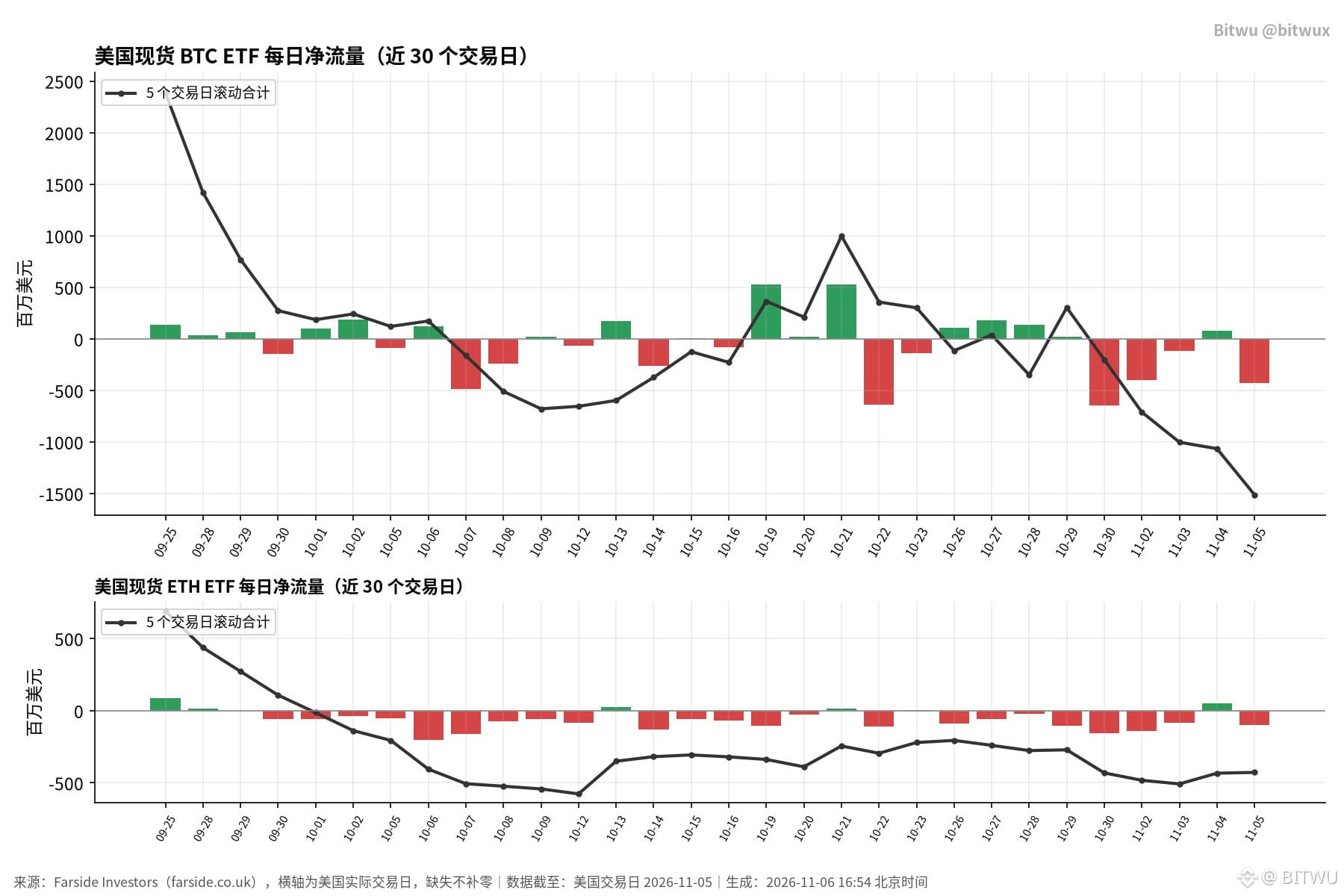
BTC: Net outflow of $430.2M (FBTC -$199.9M, IBIT -$105.0M, GBTC -$49.9M)|5-day total: -$1,513.0M
ETH: Net outflow of $99.9M (ETHA -$75.2M, ETHB -$22.0M, FETH -$2.2M)|5-day total: -$427.6M
Over the past 30 trading days: BTC inflows on 17 days / outflows on 13 days; ETH inflows on 6 days / outflows on 24 days
⚖️ Leverage (OKX BTC perpetuals)
Funding rate: +0.0027%/8h (settlement at 16:00 on 11/06; 7-day average: +0.0089%)
Total futures open interest: $3.61B (yesterday: $3.84B; 30 days ago: $3.33B)
💵 Stablecoins (DefiLlama)
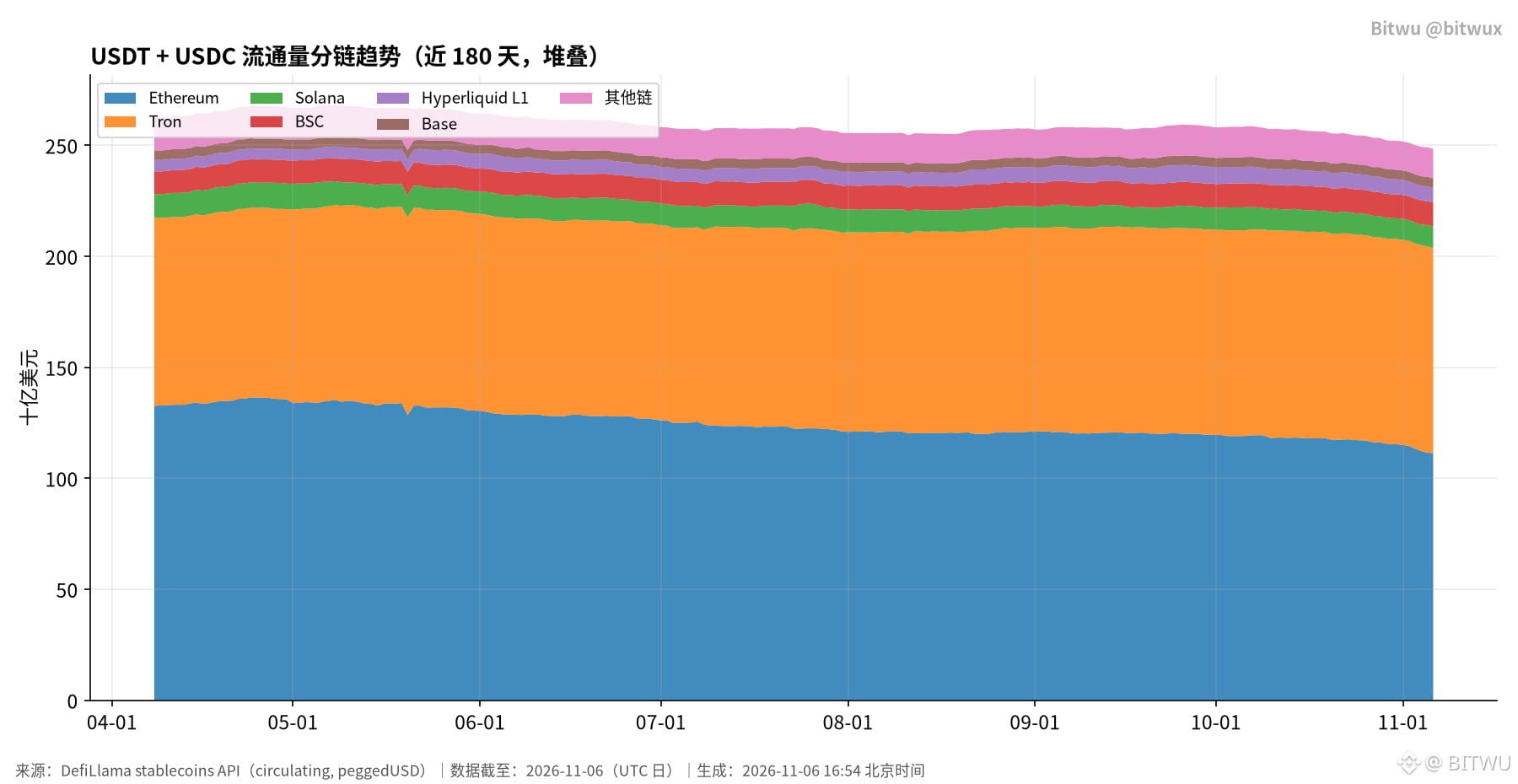
USDT + USDC total: $248.4B (down $10.1B over 30 days; down $14.0B over 180 days)
Ethereum $111.2B (down $8.1B over 30 days)|Tron $92.5B (down $0.2B over 30 days)|Solana $9.6B (down $0.5B over 30 days)
🧬 Hyperliquid (DefiLlama, 11/05)
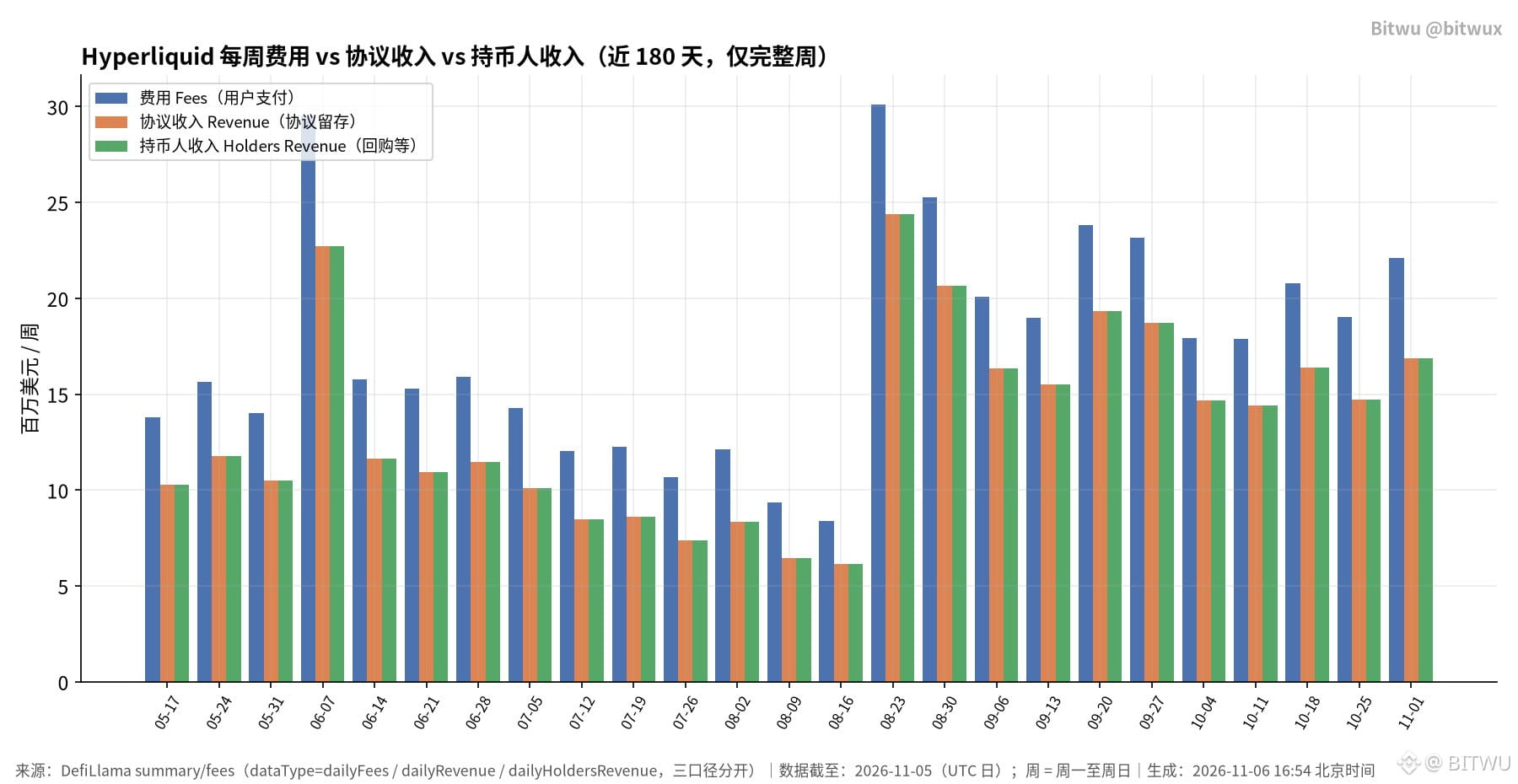
Daily fees: $3.71M|Protocol revenue: $2.72M|Holder revenue: $2.72M
30-day fees: $89M / revenue: $69M; fees in the latest full week were up 23% compared with 4 weeks earlier
🔎 In a nutshell: BTC fell back to around $75,600 (24h -6%); on 11/05 U.S. time, BTC and ETH spot ETFs saw large net outflows, with the five-day cumulative outflows deepening further; OKX BTC open interest fell from $3.84B to $3.61B in one day, while the funding rate dropped to the lower end of its 7-day range; stablecoins declined by another approximately $10.1B over 30 days.
Sources: CoinGecko / Farside / OKX / DefiLlama, as of 2026-11-06 16:54 Beijing time. For informational purposes only; not investment advice.
#BTC #ETH #ETF #稳定币 #Hyperliquid
340
·
--
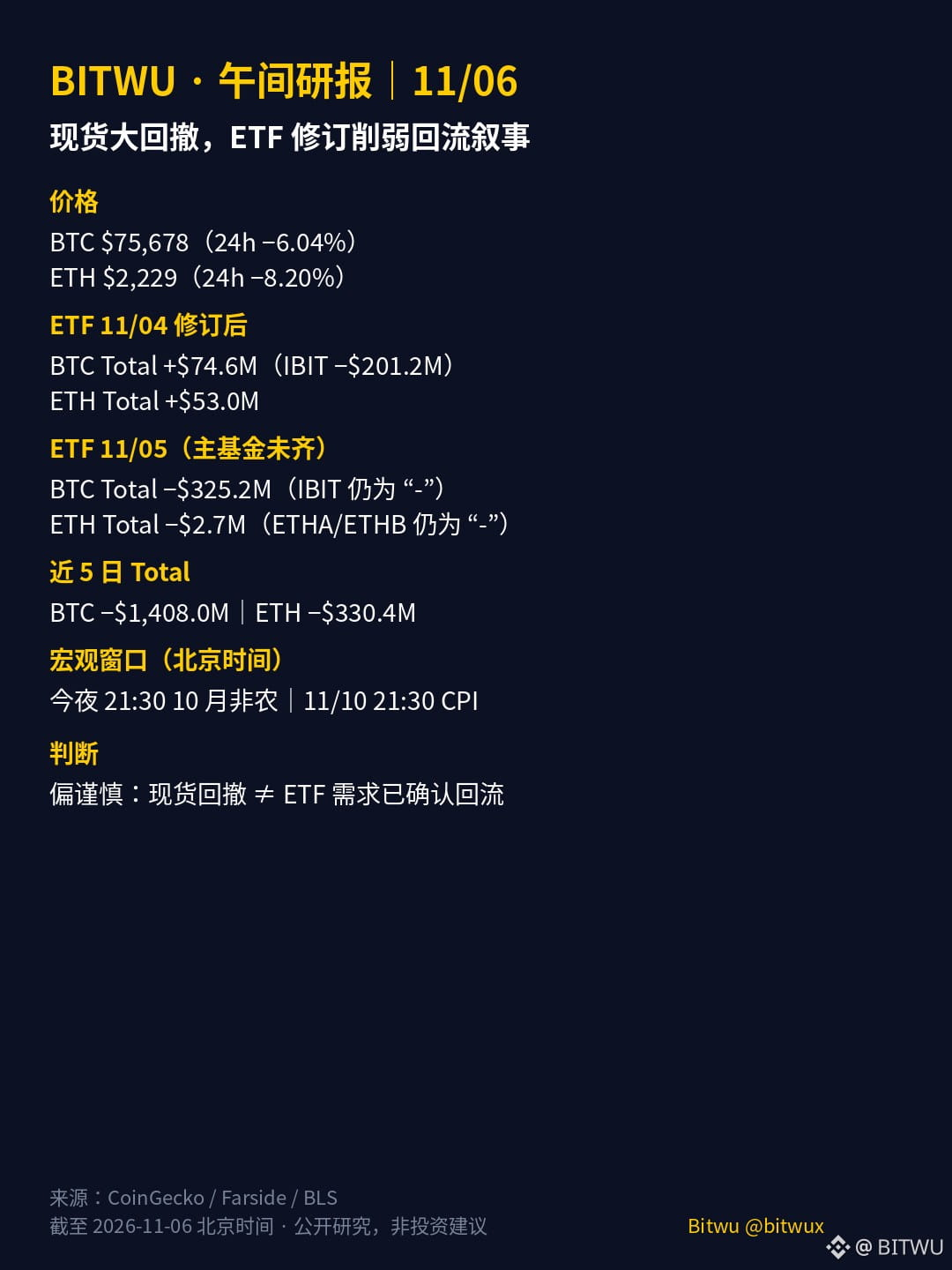
📊 BITWU Midday Research Brief | 11/06 (Friday)
Today's moves (public data)
• Spot prices pulled back sharply: BTC $75,678 (24h −6.04%), ETH $2,229 (−8.20%) (CoinGecko, 11/06 12:36 Beijing time)
• ETFs: After the main fund data for 11/04 was completed, BTC Total was revised from the observed +$275.8M to +$74.6M (IBIT −$201.2M); on 11/05, BTC Total was −$325.2M, but IBIT still shows “-”; ETH Total was −$2.7M, but ETHA/ETHB still show “-”
• Combined totals for the most recent 5 trading days with reported totals: BTC −$1,408.0M, ETH −$330.4M (Farside)
Macro calendar (Beijing time, BLS)
• Q3 preliminary productivity +3.6%, unit labor costs −0.7% (released)
• Today 21:30: October nonfarm payrolls | 11/10 21:30: October CPI
Public assessment (research brief, not investment advice)
Maintaining a cautious stance, with less favorable evidence than on 11/05: the spot rebound has failed to hold; incomplete daily totals should not be read as confirmation that demand has returned.
Fund flow snapshot
• BTC ETFs, most recent 30 days with reported totals: 17 inflow days / 13 outflow days; November-to-date total approx. −$764.8M (Farside)
• ETH ETFs, most recent 30 days: 6 inflow days / 24 outflow days; November-to-date total approx. −$174.7M
• USDT+USDC $248.4B (30 days −$10.1B; DefiLlama)
• AHR999 0.431 / MVRV 1.404 (11/05)
Sources: CoinGecko / Farside / DefiLlama / CoinMetrics / bitcoin-data / BLS / Fed, as of 2026-11-06 12:45 Beijing time. This is an information summary and does not constitute investment advice.
#BTC #ETH #ETF #非农 #Bitwu
640
·
--
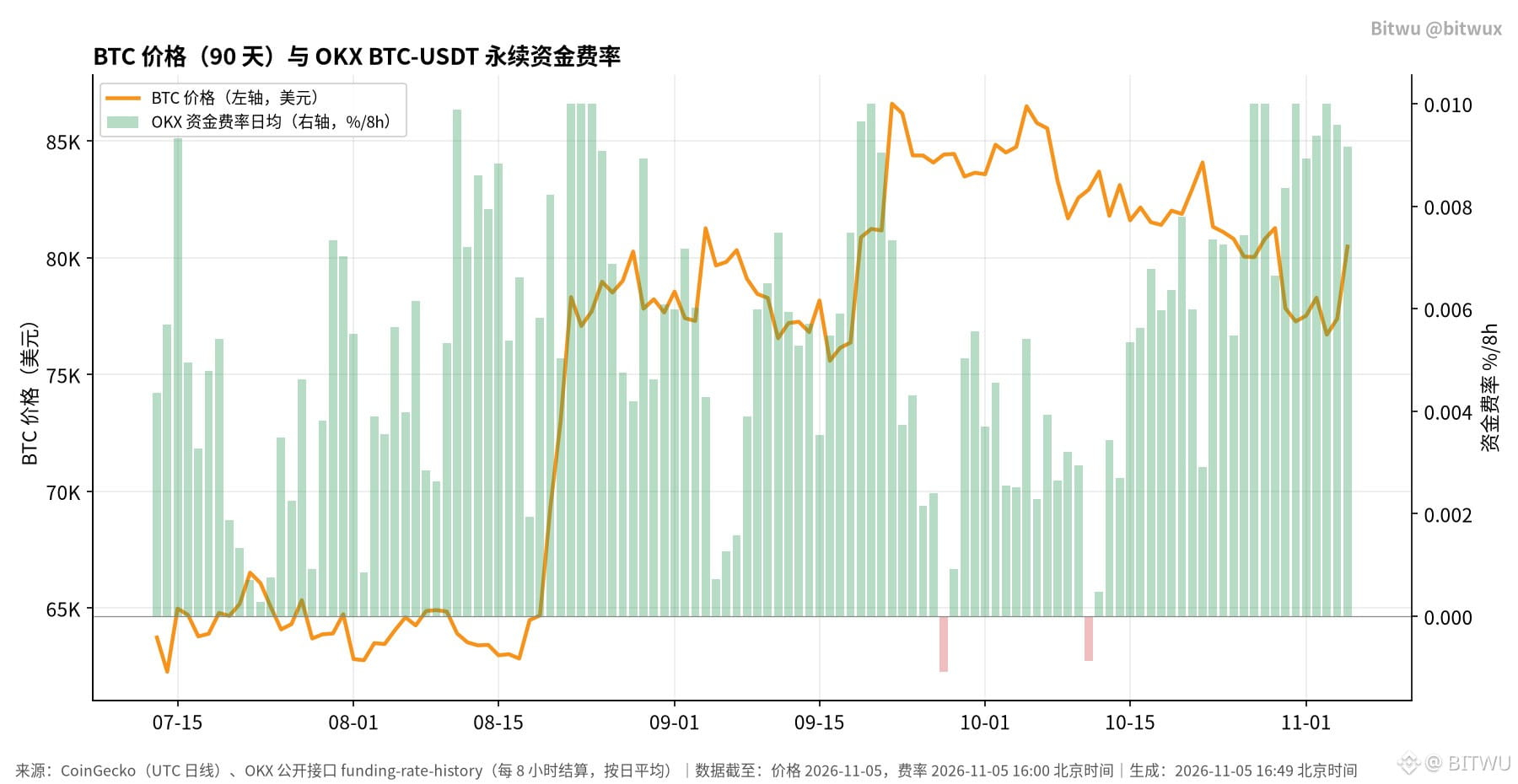
📊 BITWU Data Dashboard | Afternoon Edition 11/05 (Thursday)
💰 Prices (24h, CoinGecko)
BTC $80,480 (+2.67%)|ETH $2,419.54 (+4.10%)|BNB $714.71 (+1.78%)|HYPE $83.78 (-3.37%)
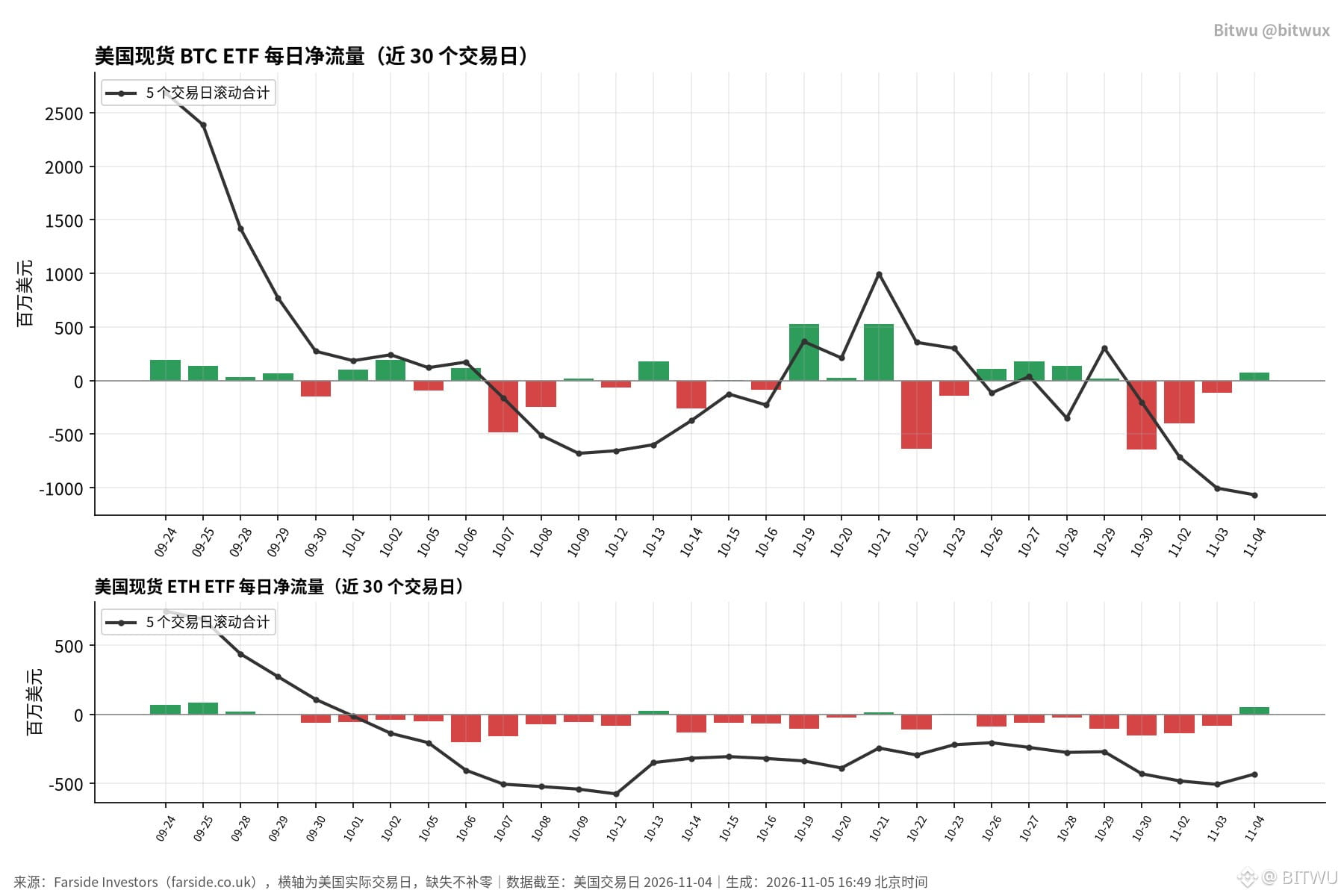
🏛 Spot ETFs (Farside, US trading day 11/04)
BTC: Net inflow +$74.6M (FBTC +$236.7M, IBIT -$201.2M)|5-day total -$1,065.6M
ETH: Net inflow +$53.0M (ETHA +$32.8M, FETH +$19.2M)|5-day total -$433.2M
Over the past 30 trading days: BTC inflows on 18 days / outflows on 12 days; ETH inflows on 7 days / outflows on 23 days
⚖️ Leverage (OKX BTC perpetuals)
Funding rate +0.0100%/8h (settles at 16:00 on 11/05; 7-day average +0.0093%)
Total contract open interest $3.84B (yesterday $3.67B; 30 days ago $3.21B)
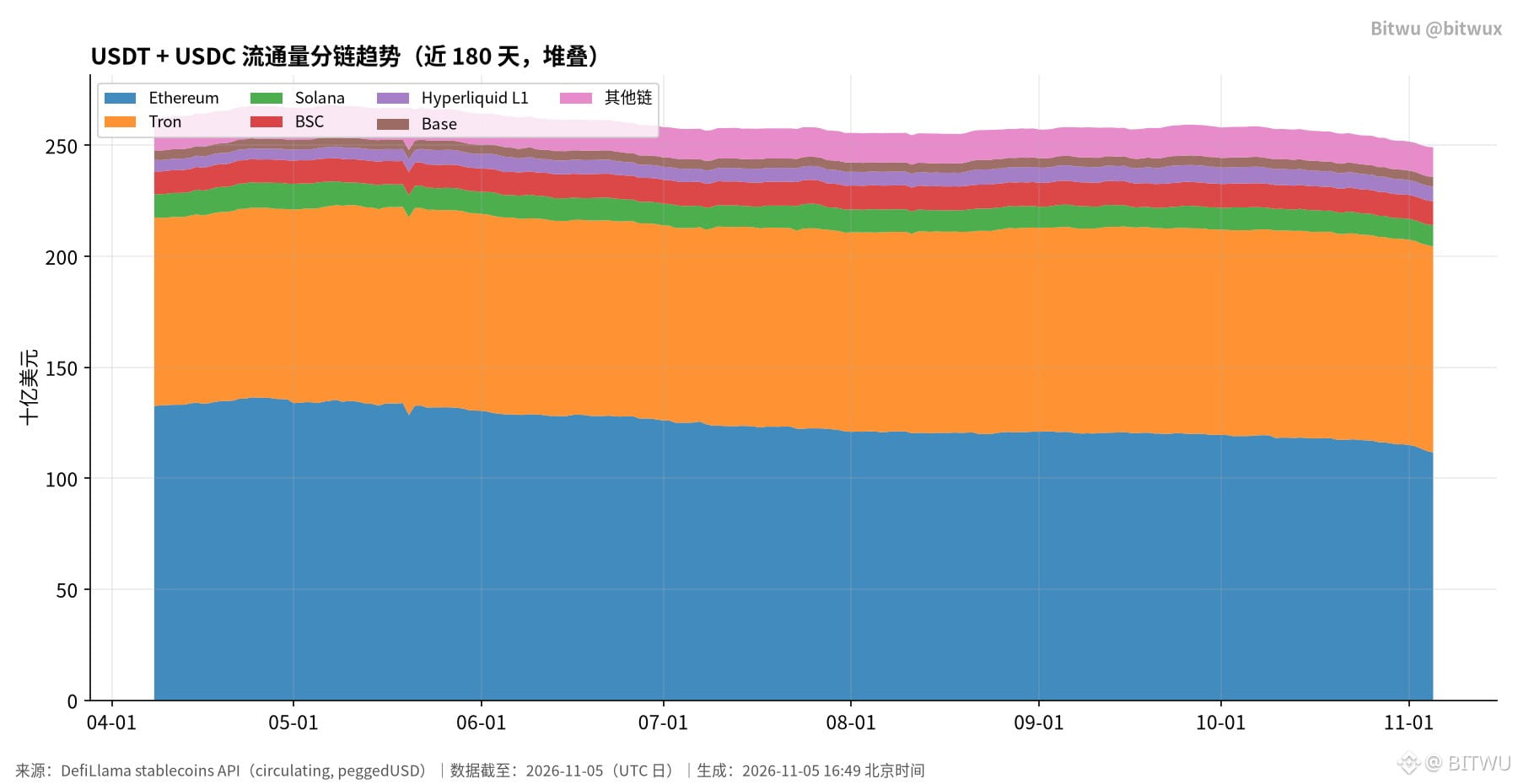
💵 Stablecoins (DefiLlama)
USDT+USDC total $249.1B (30 days: -$9.5B; 180 days: -$13.3B)
Ethereum $111.5B (30 days: -$7.5B)|Tron $92.8B (30 days: +$0.1B)|Solana $9.7B (30 days: -$0.7B)
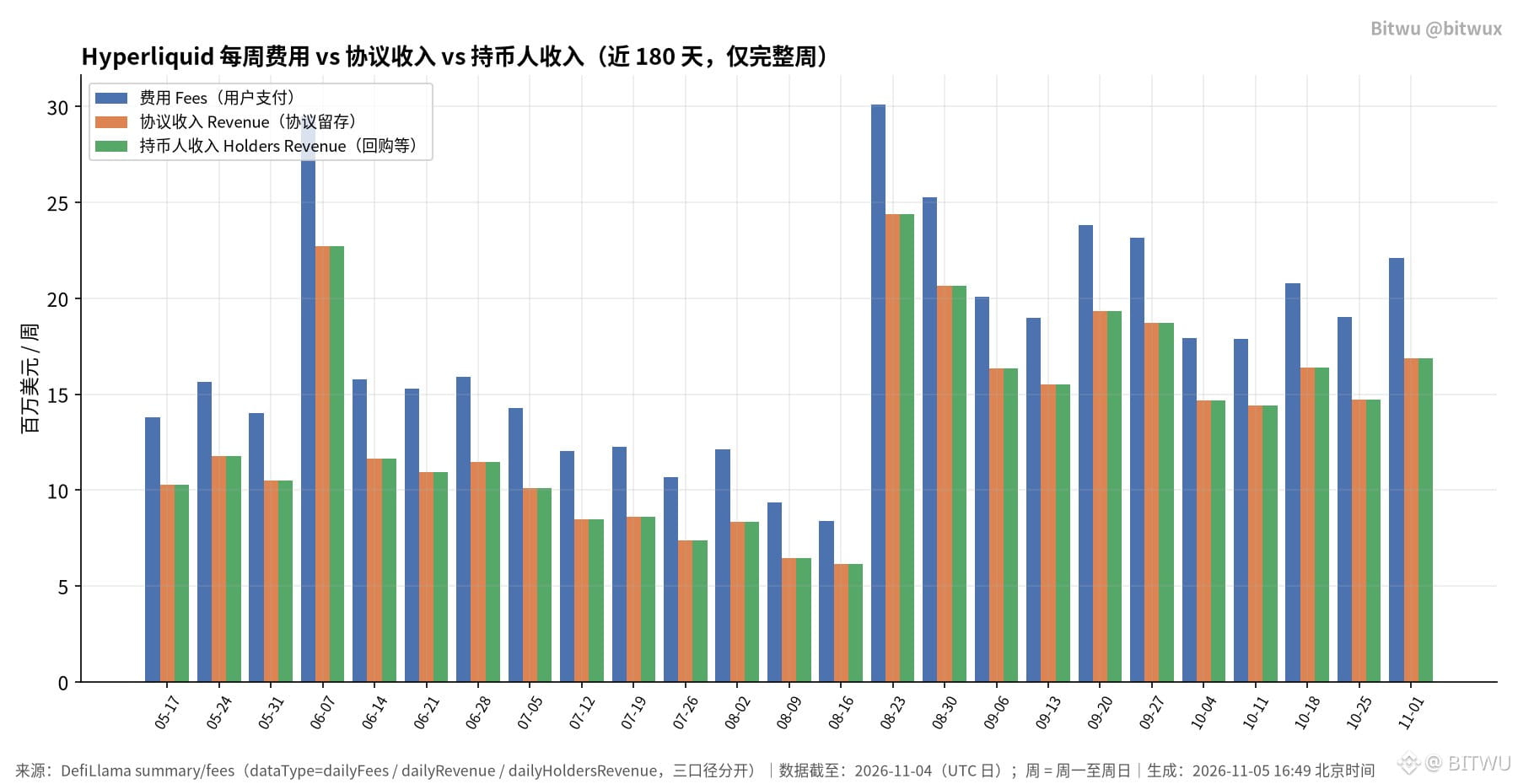
🧬 Hyperliquid (DefiLlama, 11/04)
Daily fees $4.92M|Protocol revenue $3.67M|Holder revenue $3.67M
30-day fees $88M / revenue $68M; fees in the latest full week were +23% compared with 4 weeks ago
🔎 In a nutshell: BTC is back around $80,000; on 11/04 US Eastern time, BTC and ETH spot ETFs turned to single-day net inflows, but the 5-day cumulative flows remain negative; OKX open interest rose to $3.84B in one day, as leverage returns; stablecoins fell by another approximately $9.5B over 30 days.
Sources: CoinGecko / Farside / OKX / DefiLlama, as of 2026-11-05 16:49 Beijing time. This is for informational purposes only and does not constitute investment advice.
#BTC #ETH #ETF #稳定币 #Hyperliquid
1
400
·
--
There will be more and more things you can do on CEXs in the future.
From cryptocurrencies to US stocks, ETFs, Hong Kong stocks, and then tokenized stocks, options, and perpetual contracts, the boundaries between traditional finance and crypto are gradually blurring.
In the past, we had to manage different assets on different platforms. In the future, a single Binance account may connect to multiple financial markets around the world, enabling cross-asset allocation and trading.
Behind this is a trend worth watching: CEXs are gradually evolving from cryptocurrency exchanges into comprehensive financial services platforms.
But I believe that a richer product offering is only the first step. What ultimately determines how far a platform can go is still the security of its assets, transparency, liquidity, and compliance capabilities.
Especially as more traditional assets enter crypto trading platforms, users need to pay attention not only to how convenient trading is, but also to understand exactly what they hold, what rights they have, and what risks they are taking on.
In the future, competition between exchanges may no longer be just about winning over crypto users, but about securing the gateway to the next generation of global financial markets.
Binance Campus 2026|Phu Quoc, Vietnam
#BinanceCampus #CEX #RWA #Tokenization

524
·
--
Verified
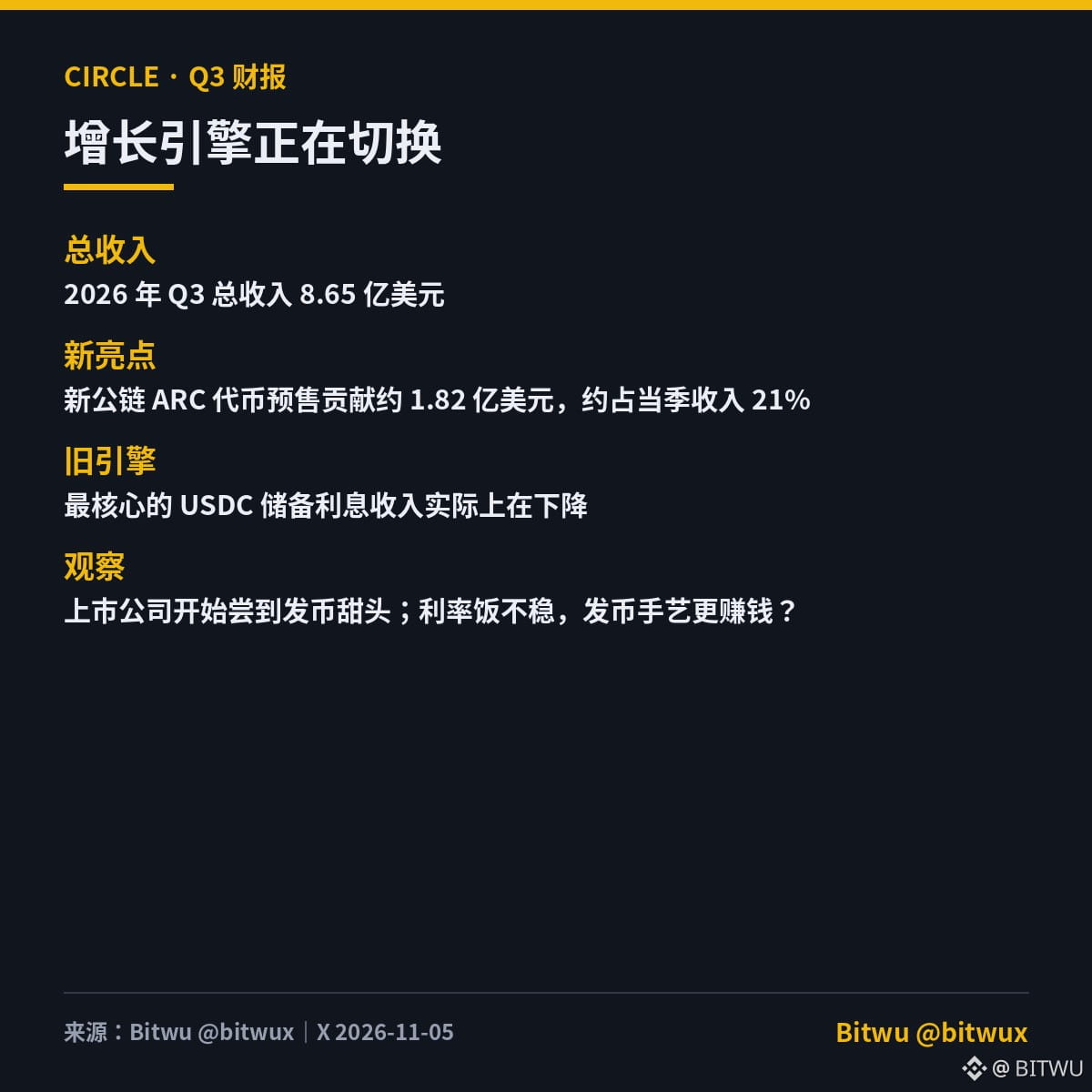
After looking at Circle’s Q3 earnings report, I’m wondering if it’s going through a very important business model transformation—
Circle’s core revenue from interest on USDC reserves is actually declining. The biggest contributor to growth, on the other hand, is the token presale for its new blockchain, ARC.
Of the $865 million in total revenue in Q3 2026, the ARC token presale contributed about $182 million, or 21% of the quarter’s total revenue.
Looks like the publicly listed company has gotten a taste of the sweet life. Relying on the Fed for income really is unstable;
In the end, it turns out that the crypto world’s age-old token-issuing game is still the most profitable!
$USDC
#Circle #USDC #ARC #stablecoin
1.8k
·
--
Partly True
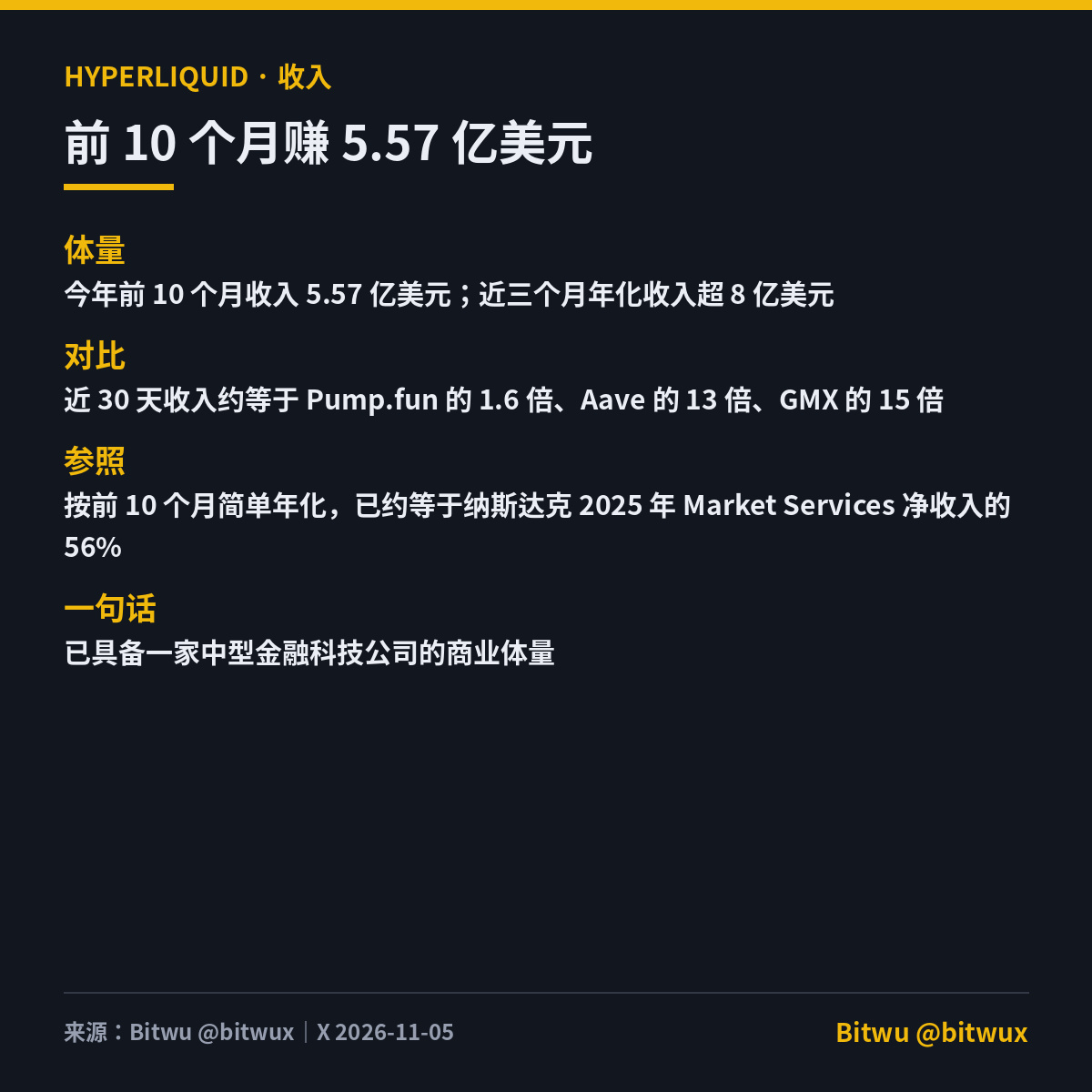
Hyperliquid’s earning power is getting a little scary! 😂
Looking at the data, Hyperliquid has already earned $557 million in the first 10 months of this year, and its annualized revenue over the past three months is even higher than $800 million.
What does that mean?
Its revenue over the past 30 days is about 1.6 times Pump.fun’s, 13 times Aave’s, and 15 times GMX’s.
In traditional financial markets, Nasdaq’s net revenue from Market Services in 2025 was about $1.2 billion. Annualized based on the first 10 months, Hyperliquid is already equivalent to 56% of that.
It’s already operating at the scale of a mid-sized fintech company!
$HYPE $BTC
#Hyperliquid #DeFi #CryptoRevenue
2
1
1.3k
·
--
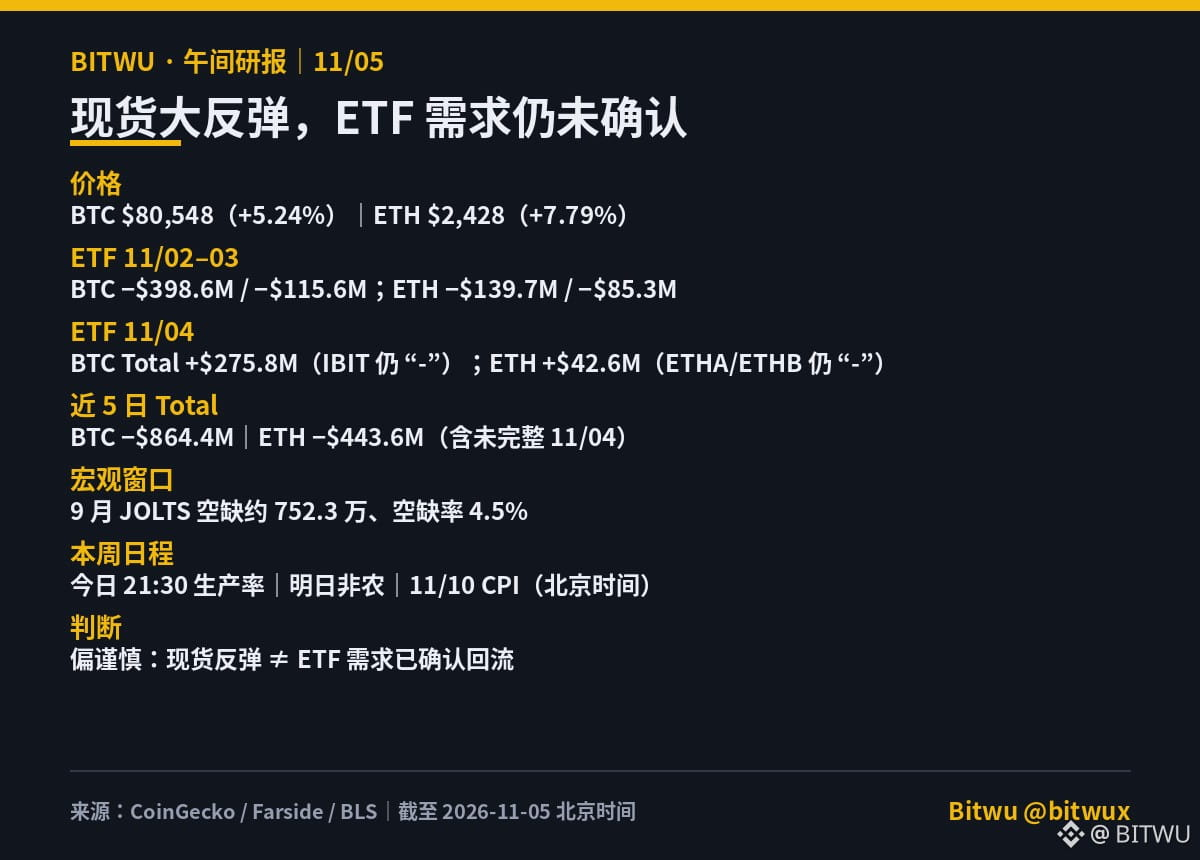
📊 BITWU Midday Research Brief|11/05 (Thursday)
Today's changes (public data)
• Prices rebounded sharply from their 11/03 lows: BTC $80,548 (24h +5.24%), ETH $2,428 (+7.79%) (CoinGecko, 11/05 12:37 Beijing time)
• Still weak after the ETF data gap was filled: Farside 11/02 BTC −$398.6M, ETH −$139.7M; 11/03 BTC −$115.6M, ETH −$85.3M. On 11/04, BTC Total was +$275.8M but IBIT was still “-”; ETH Total was +$42.6M but ETHA/ETHB were still “-”
• Combined total for the latest 5 trading days with reported totals: BTC −$864.4M, ETH −$443.6M (including incomplete 11/04 data)
Macro calendar (Beijing time, BLS)
• September JOLTS: approximately 7.523 million job openings, 4.5% vacancy rate; the official statement described little change
• Today 21:30: Q3 productivity and costs preliminary estimate|Tomorrow 21:30: October nonfarm payrolls|11/10 21:30: October CPI
Public assessment (research brief, not investment advice)
Maintain a cautious bias: the spot-market rebound has been substantial, but it should not be taken as confirmation that ETF demand has returned. In the complete trading-day data, 11/02–11/03 still saw large outflows; 11/04 Total turned positive, but the major funds' data was incomplete (IBIT / ETHA / ETHB still showed “-”). Under the rule that missing data ≠ 0, 11/04 must not be treated as a confirmed inflow day with complete major-fund data.
Flows at a glance
• BTC ETFs, latest 30 days with reported totals: 18 inflow days / 12 outflow days; November-to-date Total approximately −$238.4M (Farside)
• ETH ETFs, latest 30 days: 7 inflow days / 23 outflow days; November-to-date Total approximately −$182.4M
• USDT+USDC $249.1B (30 days −$9.5B; DefiLlama)
• AHR999 0.486 / MVRV 1.490 (11/04); latest LTH SOPR remains 0.8283 from 11/01 (\u003c1)
Sources: CoinGecko / Farside / DefiLlama / CoinMetrics / bitcoin-data / BLS / Fed, as of 2026-11-05 12:48 Beijing time. The above is for informational purposes only and does not constitute investment advice.
#BTC #ETH #ETF #非农 #Bitwu
516
·
--
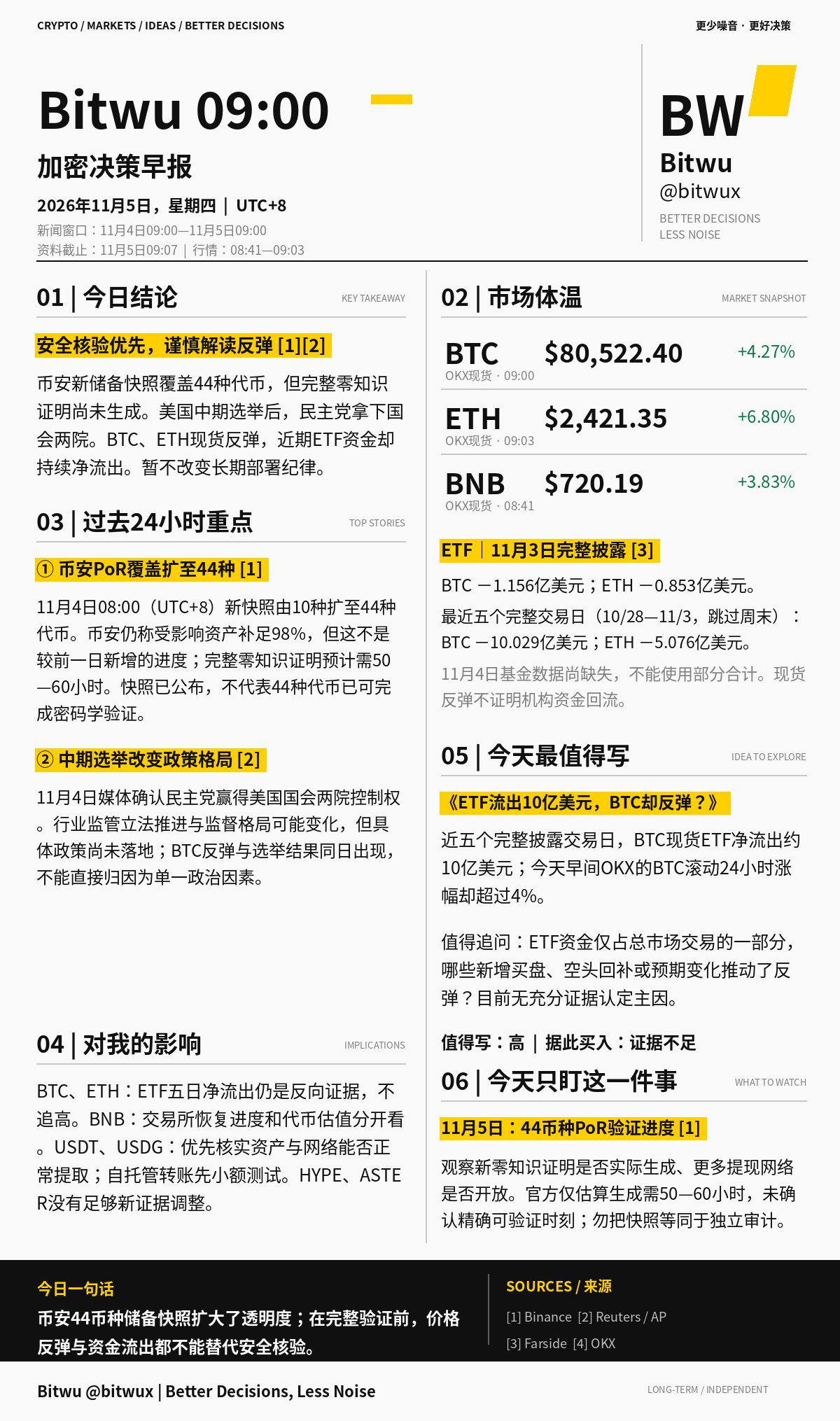
1️⃣ Binance’s new PoR snapshot expands to 44 tokens;
2️⃣ Democrats win both chambers of Congress, prompting a repricing of crypto regulatory expectations;
3️⃣ $BTC Prices rebound sharply, but ETF net outflows exceed $1 billion over five days,
1️⃣ Binance’s new PoR snapshot expands to 44 tokens;
2️⃣ Democrats win both chambers of Congress, prompting a repricing of crypto regulatory expectations;
3️⃣ $BTC Prices rebound sharply, but ETF net outflows exceed $1 billion over five days,
2️⃣ Democrats win both chambers of Congress, prompting a repricing of crypto regulatory expectations;
3️⃣ $BTC Prices rebound sharply, but ETF net outflows exceed $1 billion over five days,
990
·
--
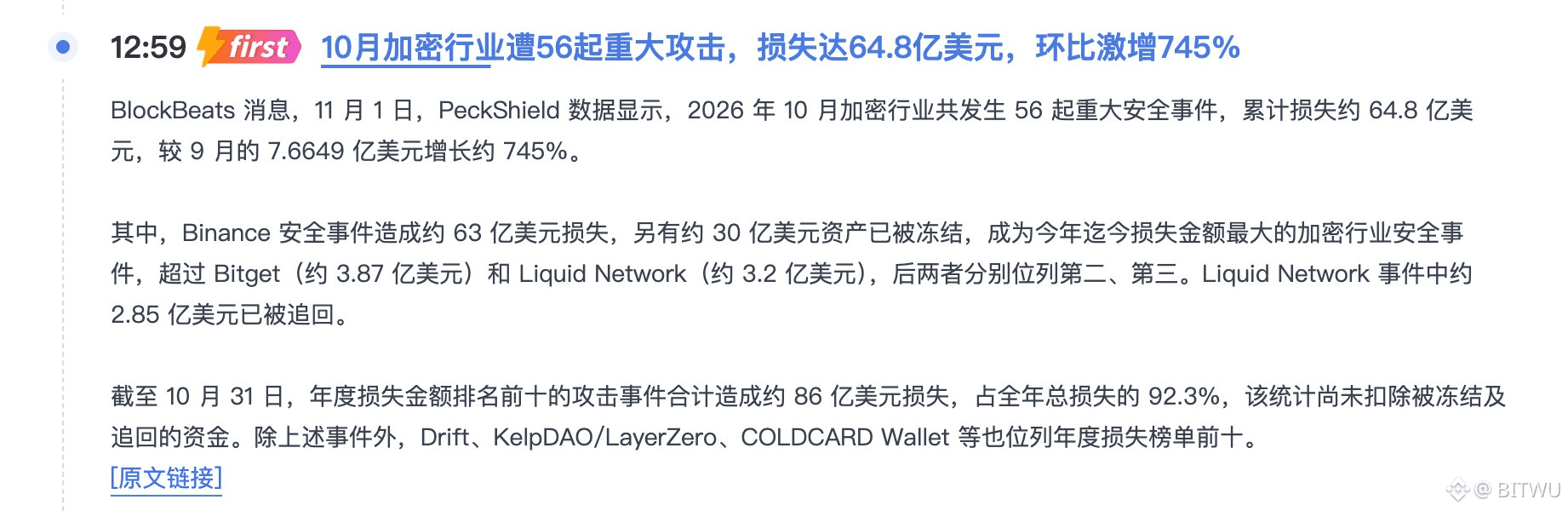
Events like this will only become more frequent, not less.
Set a few rules for yourself. They may sound like old advice, but it’s still important to stay extremely vigilant:
1️⃣ Hold core assets like BTC and ETH for the long term.
2️⃣ Use a self-custody setup that you’ve tested with small transfers and recovery checks. Minimize routine transactions, and don’t fixate on small gains.
3️⃣ Keep only the amount you actually need on exchanges, and set a maximum loss you can tolerate for each platform.
4️⃣ Use small wallets with separate recovery phrases for airdrops, trying out projects, and DeFi activities. Don’t use your main asset wallet for testing or collaboration verification.
5️⃣ Don’t assume that being prepared means nothing can go wrong. Be mentally prepared, keep learning about and updating your methods for protecting large assets, and stay vigilant.
6️⃣ Even so, keep enough emergency savings for your household outside of crypto, so an exchange suspending withdrawals won’t affect your daily life.
4
2.5k
·
--
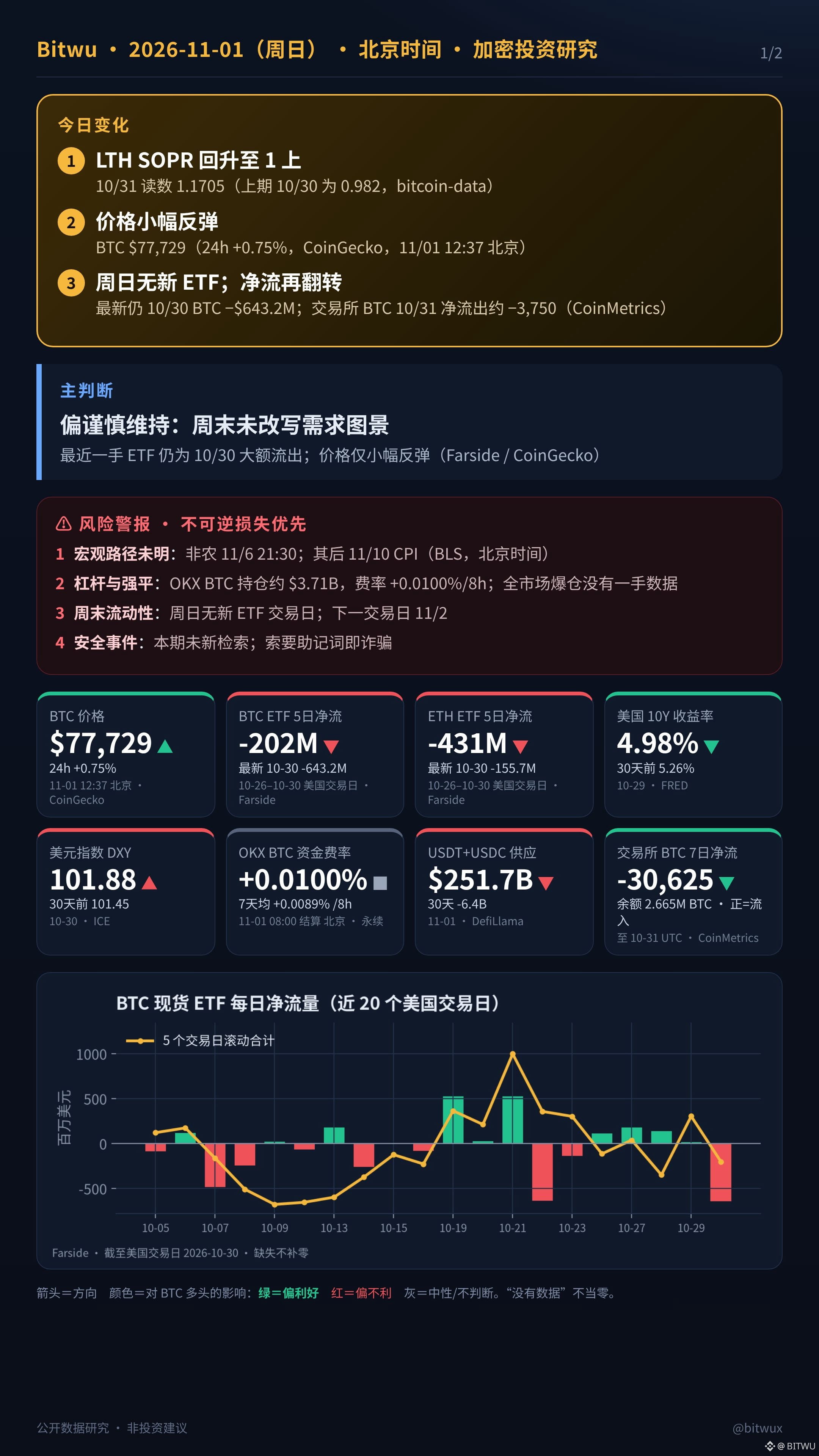
📑 Bitwu Research Brief|11/01 (Sunday)
Today's changes (public data)
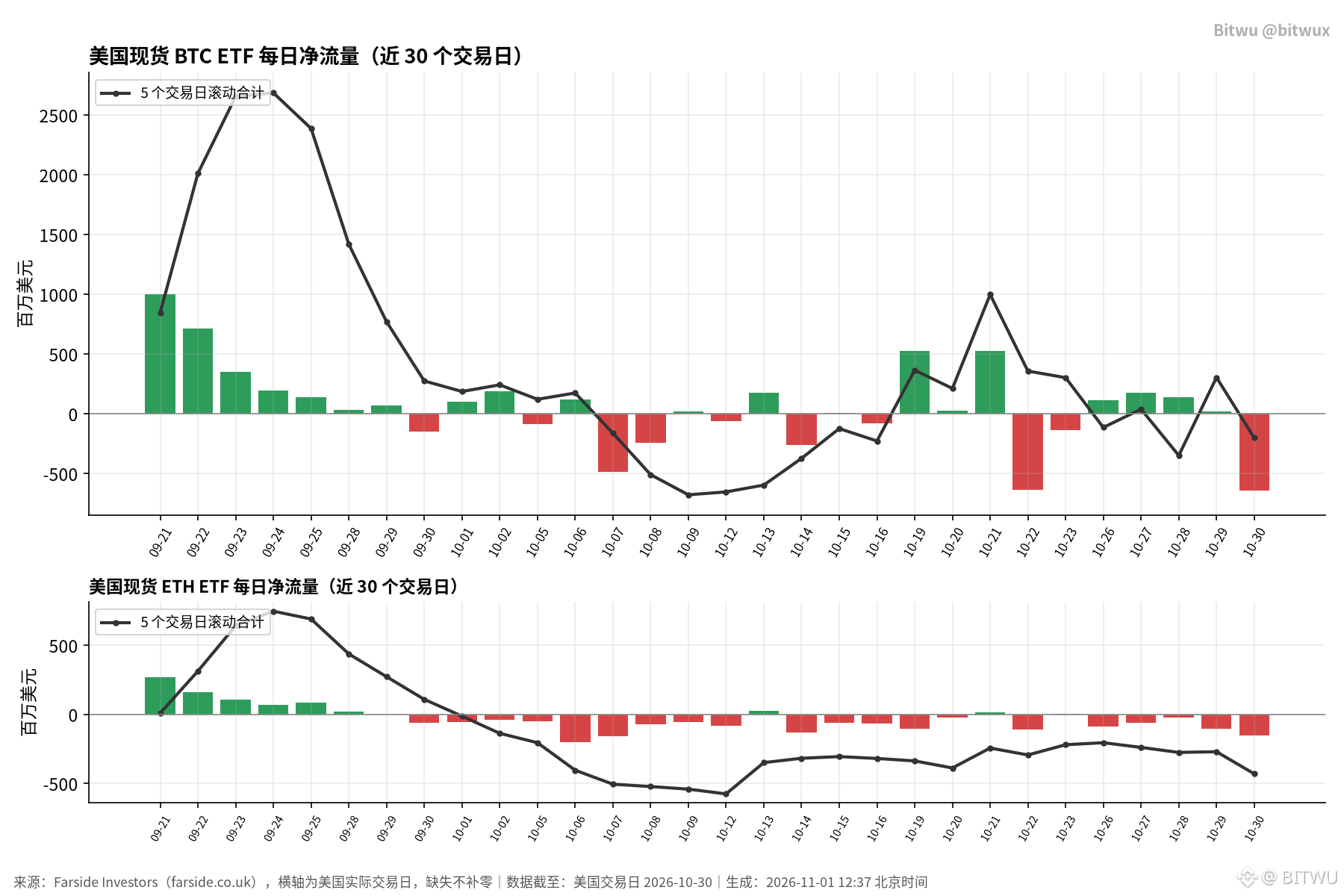
• No new U.S. ETF trading session over the weekend; Farside's latest data is still for 10/30: BTC net outflows of −$643.2M, ETH net outflows of −$155.7M.
• Total over the past 5 trading days: BTC ETF −$202.4M, ETH ETF −$431.4M; month to date in October, approximately BTC −$515.9M and ETH −$1,607M (Farside).
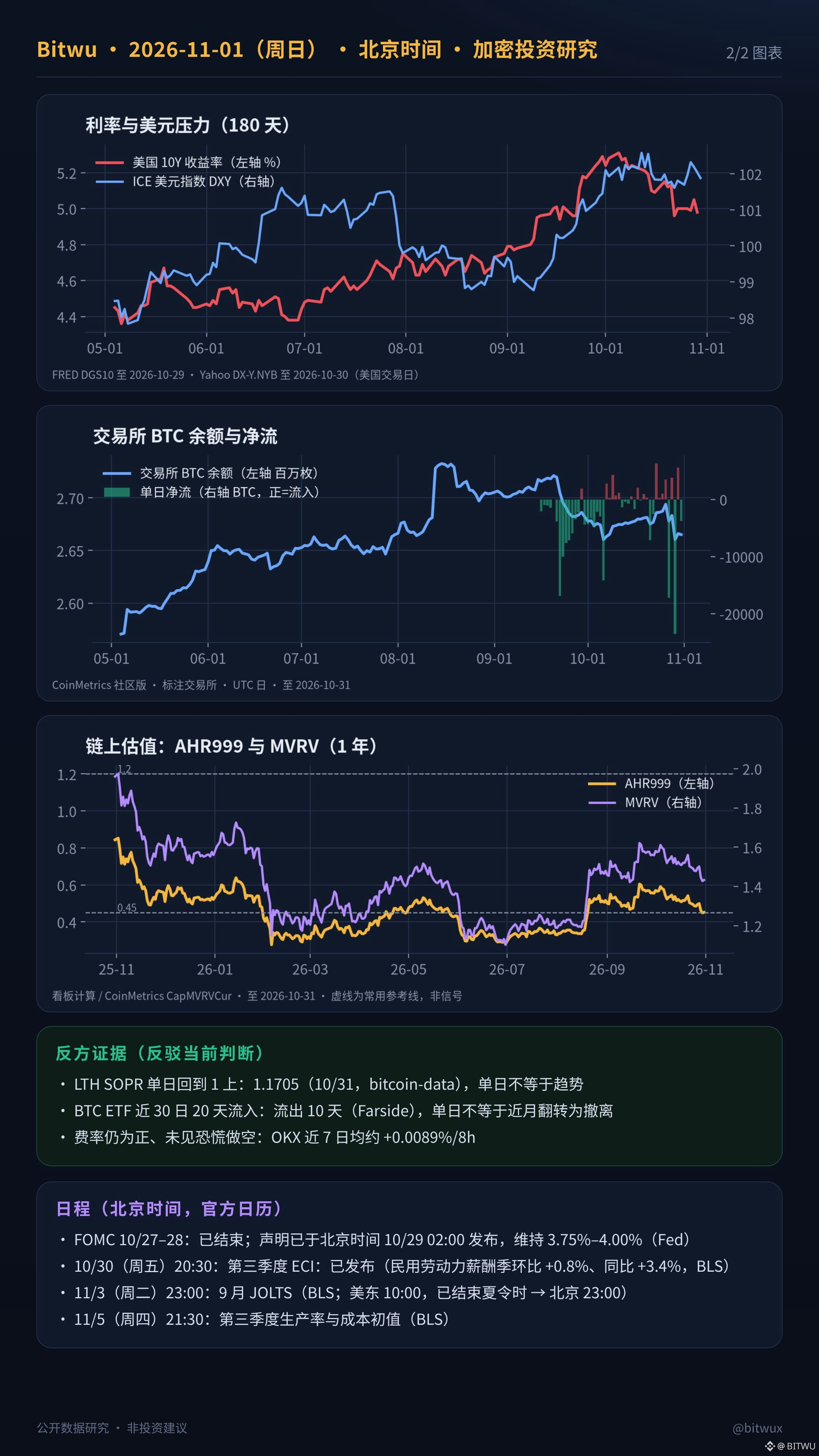
• BTC net outflows from exchanges on 10/31 were approximately −3,750 BTC (previous day, 10/30: approximately +5,594; CoinMetrics); LTH SOPR rebounded to 1.1705 on 10/31 (above 1; a single day does not indicate a trend).
Price snapshot (CoinGecko, 11/01 12:37 Beijing time)
BTC $77,729 (24h +0.75%)|ETH $2,265.83 (24h +1.31%)|HYPE $87.87 (−1.07%)
Capital and leverage (publicly available figures)
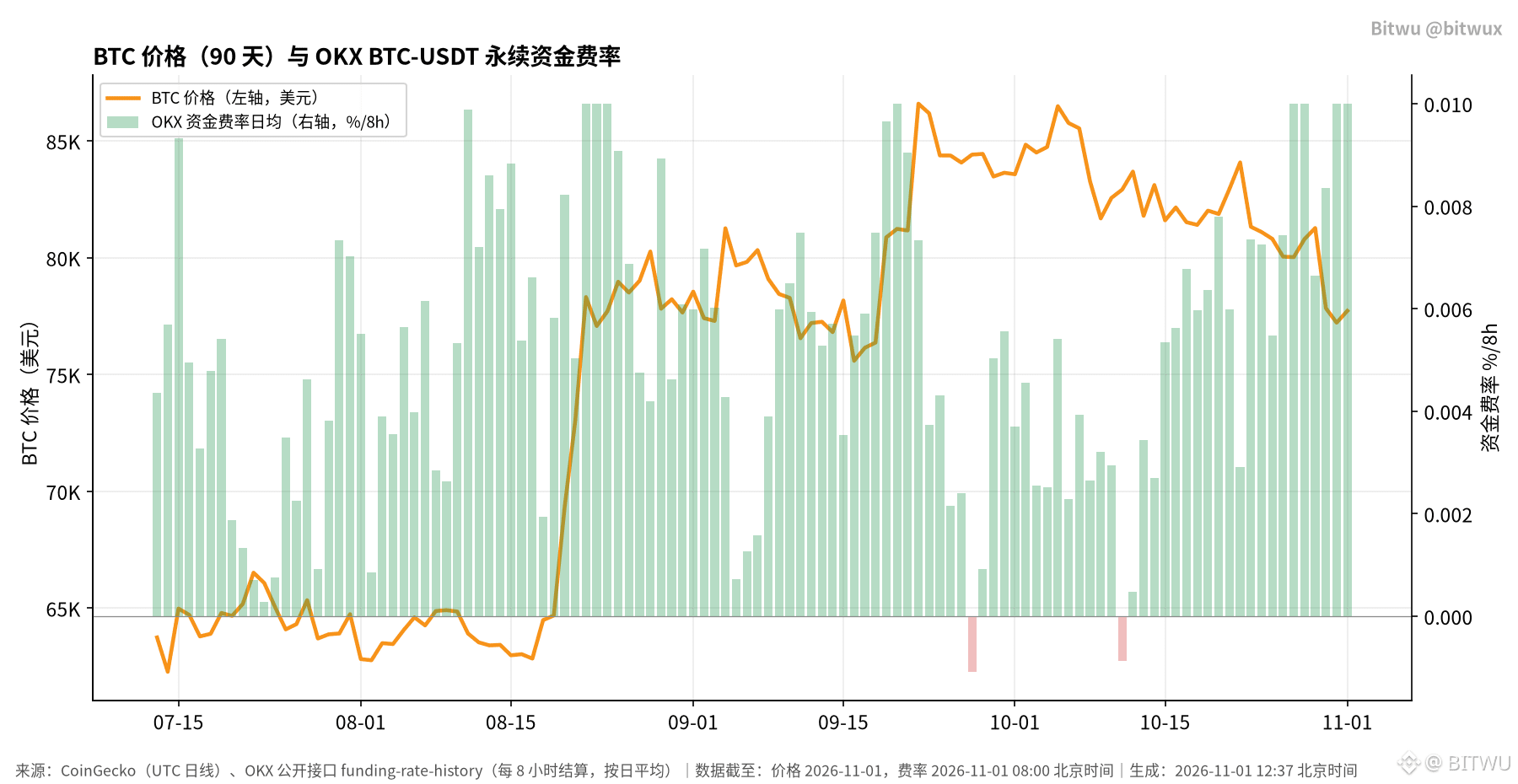
• OKX total BTC contract open interest: approximately $3.71B (11/01); funding rate +0.0100%/8h (settled 11/01 at 08:00 Beijing time); 7-day average approximately +0.0089%/8h
• USDT+USDC $251.7B (30 days: −$6.4B; DefiLlama)
• AHR999 0.452 / MVRV 1.433 (10/31, CoinMetrics)
• LTH MVRV / SOPR: 1.586 / 1.1705 (10/31, bitcoin-data)
Public assessment (research brief, not investment advice)
The assessment remains cautious; the weekend did not change the demand picture. The latest ETF data still shows large outflows on 10/30; prices have rebounded only slightly, which is not yet enough to confirm a return of demand. Leverage remains high and funding rates are still positive, but these figures are from a single platform and cannot be extrapolated to the entire market. Exchange net flows may include internal wallet adjustments, so they cannot confirm accumulation or selling pressure.
This week's schedule (Beijing time)
• 11/3 (Tuesday) 23:00: September JOLTS (BLS)
• 11/6 (Friday) 21:30: October nonfarm employment (BLS)
• Next ETF trading day: 11/2 (Monday); data will begin appearing in succession from the morning of 11/3 Beijing time
Sources: Farside / CoinGecko / OKX / DefiLlama / CoinMetrics / bitcoin-data / BLS. Data as of 2026-11-01 12:40 Beijing time. This is an informational summary and does not constitute investment advice.
#BTC #ETH #ETF #Bitwu #Research
3
657
·
--
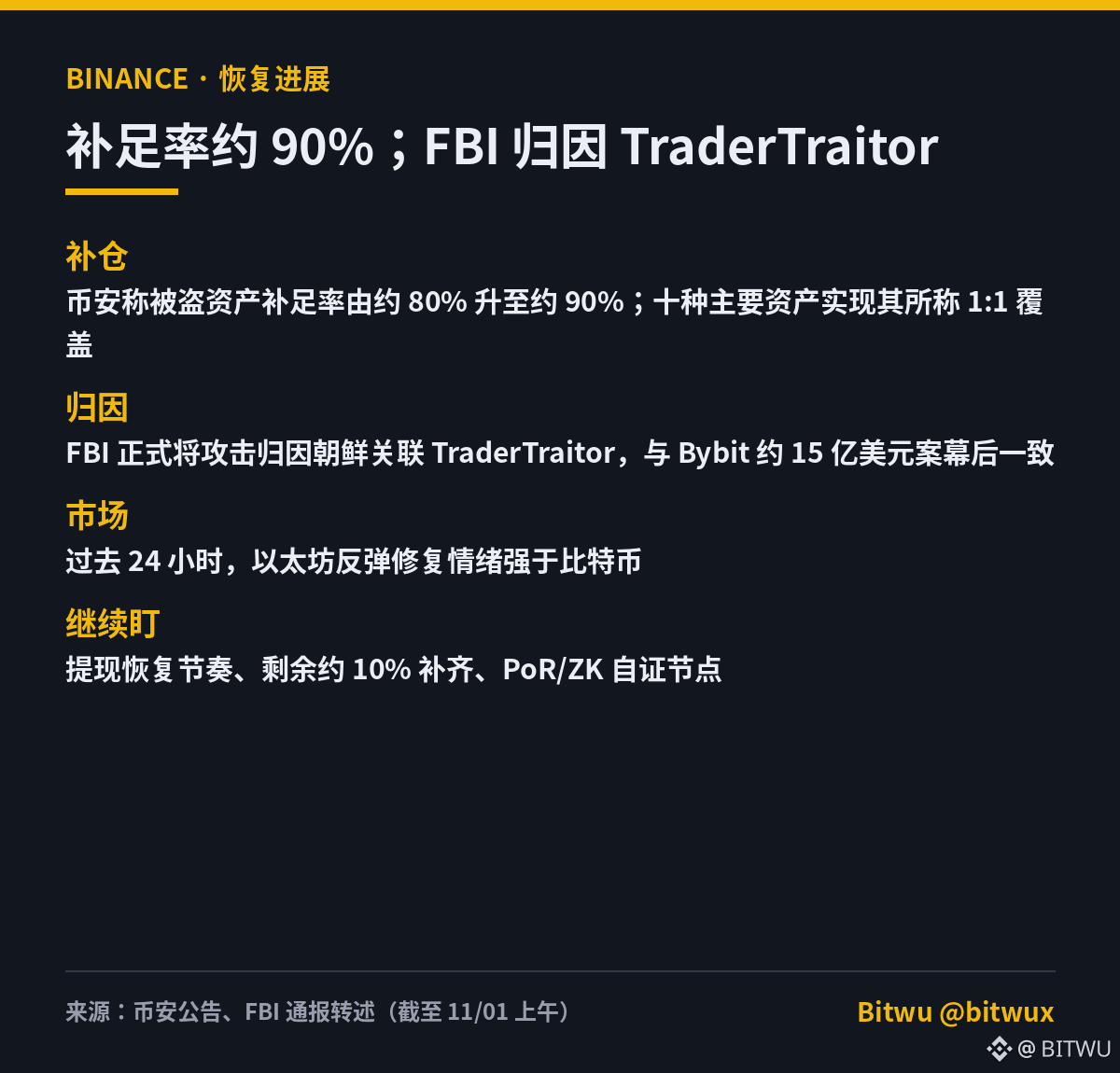
Binance’s stolen-asset coverage rate rises to about 90%; FBI officially attributes the attack
Binance’s latest announcement on October 31:
· Stolen-asset coverage increased from about 80% to about 90%;
· Ten major assets achieved what it calls 1:1 coverage.
Law enforcement:
· The FBI officially attributed the attack to North Korea-linked TraderTraitor;
· The group is also behind the approximately $1.5 billion Bybit theft.
Market observation: Over the past 24 hours, sentiment around Ethereum’s rebound and recovery has been stronger than for Bitcoin.
Keep watching: the pace of withdrawal resumption, progress toward covering the remaining approximately 10%, and PoR/ZK self-verification milestones.
$BNB $BTC $ETH
#币安 #安全事件 #FBI #TraderTraitor
1
1
753
·
--
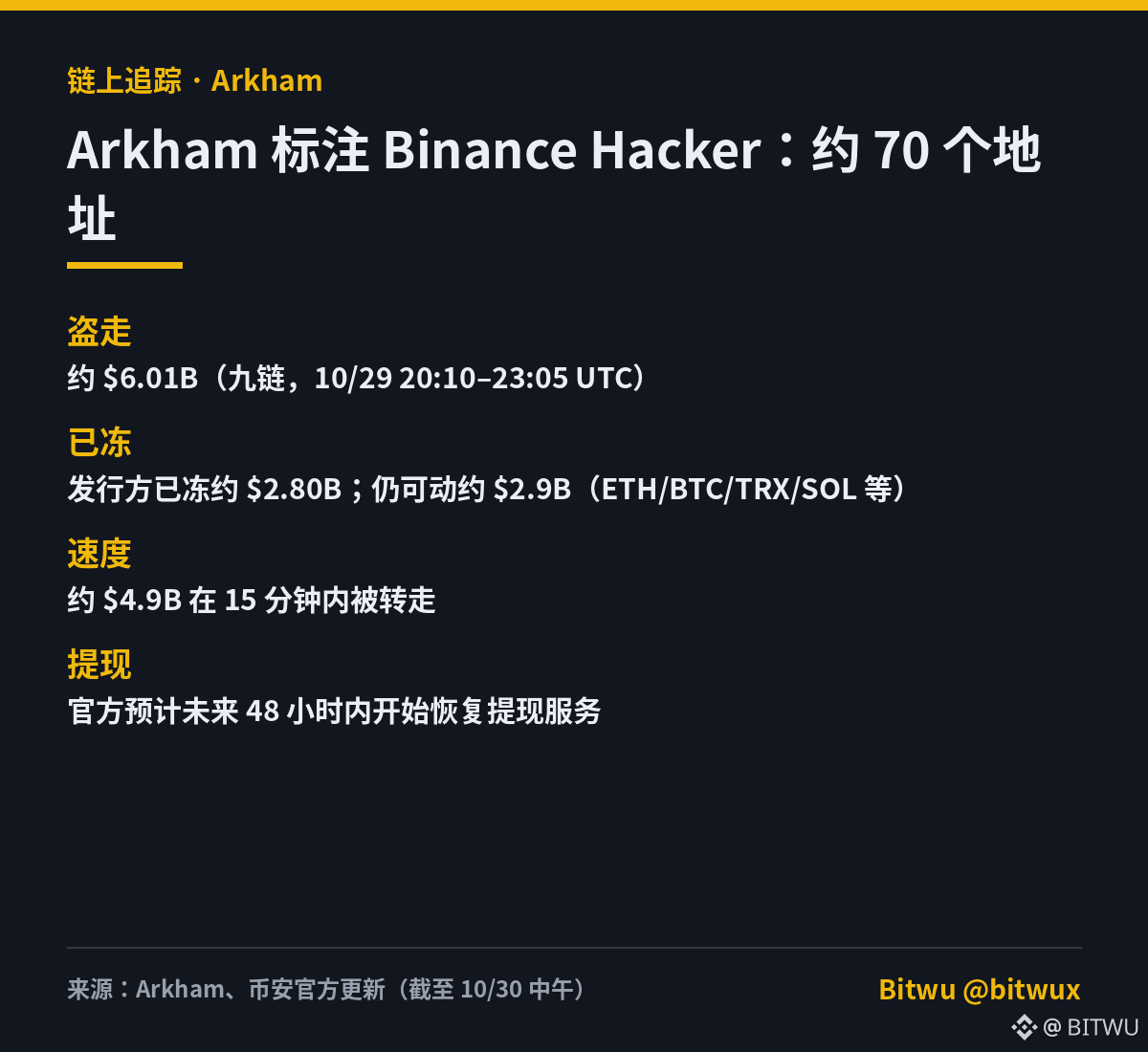
Arkham has labeled the “Binance Hacker” entity (about 70 addresses)
Public on-chain data summary:
1️⃣ Stole about $6.01B (nine chains, 10/29 20:10–23:05 UTC);
Issuers have frozen about $2.80B; about $2.9B remains movable (ETH/BTC/TRX/SOL, etc.).
2️⃣ About $4.9B was transferred within 15 minutes; details include EIP-7702 type-4, sender addresses funded by Tornado, cross-chain splitting, and swaps.
3️⃣ Official update: withdrawal services are expected to begin restoring within the next 48 hours; deposits are unaffected.
Tracking link (Arkham):
https://arkm.com/explorer/entity/binance-hacker-2
Figures may change as the investigation progresses. Continue monitoring freeze progress, movable balances, and the pace of withdrawal service restoration.
$BNB $ETH $BTC
#币安 #链上追踪 #Arkham #AssetSecurity
3
1.2k
·
--
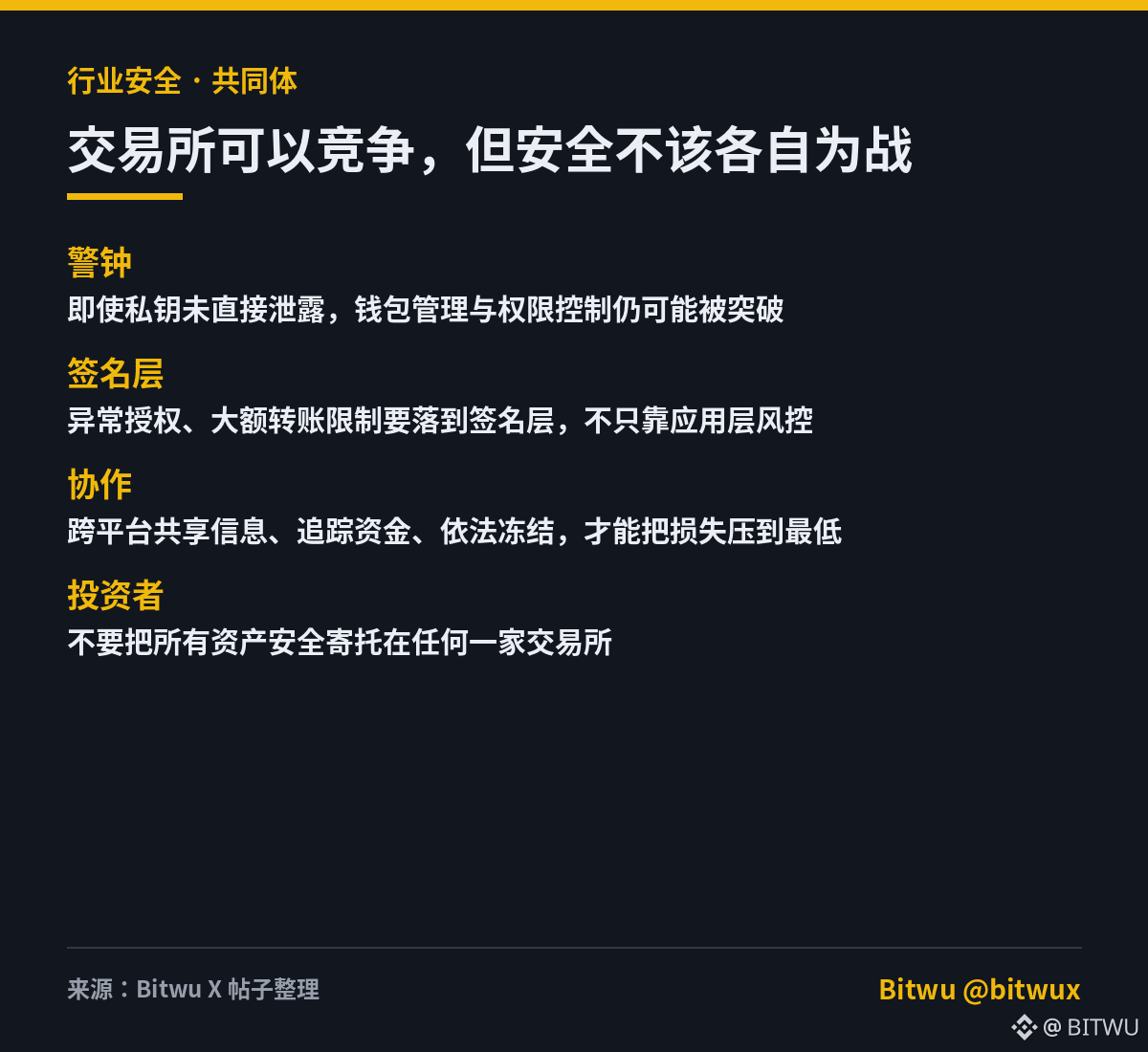
Today’s security incident at Binance is a wake-up call
To some extent, it is pushing the industry to establish broader rules: exchanges can compete over trading volume, products, and users, but they should not each have to fend for themselves when it comes to asset security.
In the past, discussions of exchange security focused mostly on private key custody, hot and cold wallet separation, and proof of reserves. This incident reminds us that even if private keys are not directly exposed, wallet management systems and access controls can still become points of entry.
One detail matters: security restrictions on abnormal authorizations and large transfers should be enforced at the signing layer, rather than relying solely on application-layer risk controls.
At the same time, the industry needs to establish cross-platform security cooperation mechanisms. When an attack occurs, exchanges, stablecoin issuers, and on-chain security organizations must be able to share information, trace funds, and take necessary freezing measures in accordance with the law as quickly as possible, in order to minimize losses.
Security is everyone’s responsibility. No single company can safeguard the future of the crypto industry alone.
I’d like to add two points:
1️⃣ Shared responsibility for industry security does not mean that individual platforms can be absolved of their own responsibility. Transparent disclosure, bearing losses, and reviewing incidents are equally important.
2️⃣ As investors, we also shouldn’t entrust the security of all our assets to any single exchange.
Market opportunities can be missed; when asset security is compromised, there may be no second chance.
$BNB
#资产安全 #交易所安全 #Industry cooperation
2
821
·
--
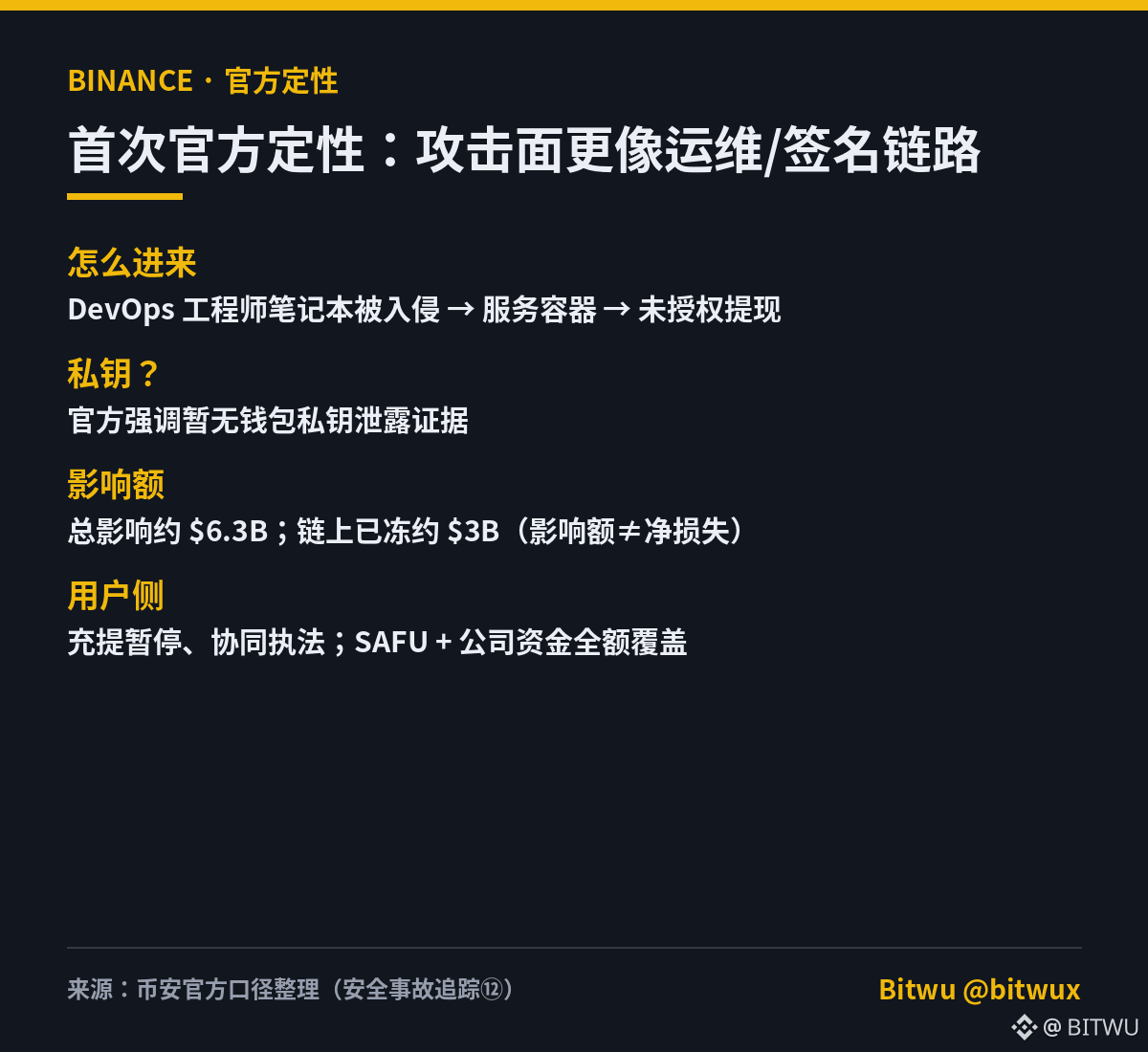
Binance’s first official characterization of the security incident: the attack vector looks more like an operations/signing pipeline
Security incident tracker ⑫ — a summary of the official position so far:
1️⃣ How they got in (initial findings)
The initial investigation points to a DevOps engineer’s laptop being compromised → service containers taken over → unauthorized withdrawals submitted.
Officials emphasized that there is currently no evidence that wallet private keys were leaked—in other words, this looks more like a breach of the operations/signing pipeline, not theft of the keys to hot or cold wallets.
2️⃣ How much was lost (official figures)
Total impact: approximately $6.3B; about $3B has been frozen on-chain.
Note: this is the “amount affected,” not the “final net loss”; the frozen amount may continue to change.
Earlier, on-chain accounts reported >$5.8B. Keep that figure alongside the official $6.3B figure—don’t conflate them into a single number.
3️⃣ Impact on users
Deposits and withdrawals are currently paused; authorizations for affected addresses have been revoked; law enforcement agencies are coordinating.
SAFU and company funds will provide full coverage; “user funds are safe.”
A technical postmortem will be published and PoR updated afterward.
$BNB
#币安 #安全事件 #官方定性 #AssetSecurity
1
2.2k
·
--
Article
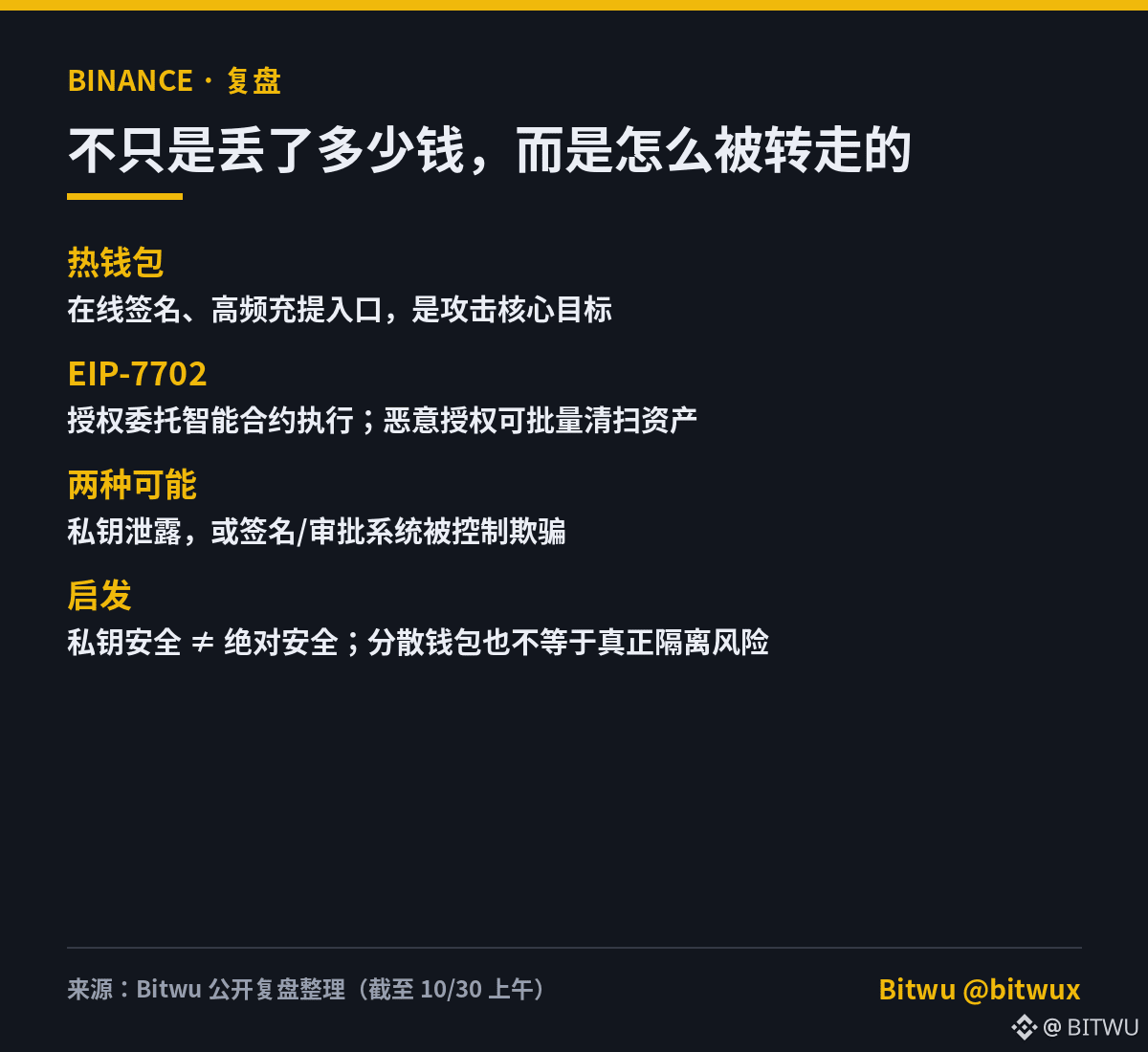
Binance Hot Wallet Security Incident: How Were Billions Transferred?Based on currently available on-chain analysis, the abnormal outflows from multiple hot wallets may total $5.5–6 billion. If confirmed, this could become the largest crypto theft in the industry's history.
First, a caveat: this figure is still a third-party estimate, not Binance's confirmed final loss. About $3 billion in related assets have so far been verified as frozen, and Binance has announced a suspension of deposits and withdrawals while it conducts a security investigation.
What matters most isn't how much money the hackers transferred, but how they managed to do it.
1️⃣ What exactly did the hackers do?
Binance Hot Wallet Security Incident: How Were Billions Transferred?
Based on currently available on-chain analysis, the abnormal outflows from multiple hot wallets may total $5.5–6 billion. If confirmed, this could become the largest crypto theft in the industry's history.
First, a caveat: this figure is still a third-party estimate, not Binance's confirmed final loss. About $3 billion in related assets have so far been verified as frozen, and Binance has announced a suspension of deposits and withdrawals while it conducts a security investigation.
What matters most isn't how much money the hackers transferred, but how they managed to do it.
1️⃣ What exactly did the hackers do?
1
1
2.8k
·
--
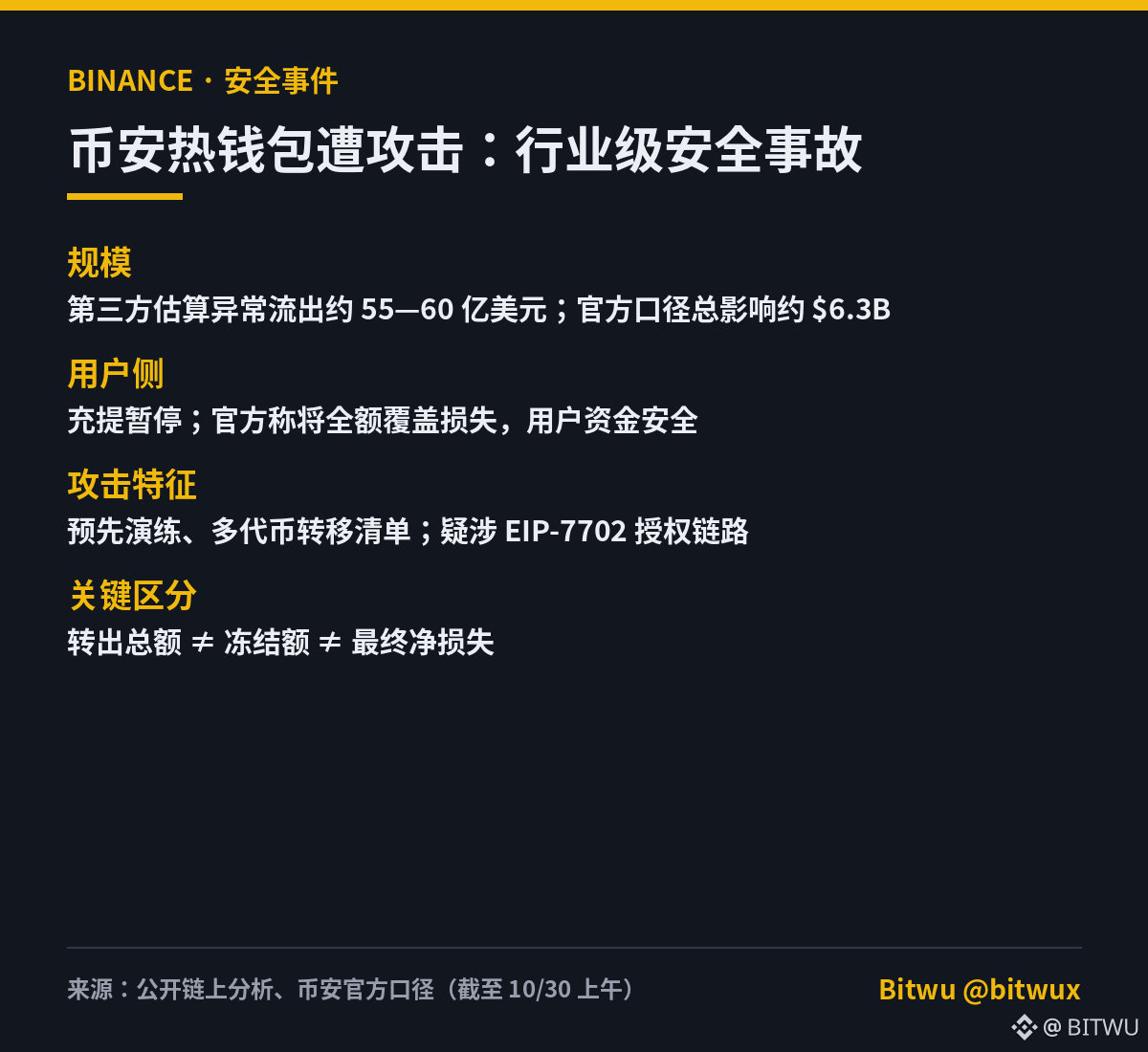
Binance hot wallets attacked: potentially the largest crypto theft in industry history
Around midnight, several Binance hot wallets saw unusual outflows. Third-party on-chain estimates put the abnormal outflows at approximately $5.5–6.0 billion; the official estimate of the total impact is approximately $6.3B. Deposits and withdrawals were temporarily suspended.
A few key pieces of public information so far:
1️⃣ Attack
· Shenyu’s post-mortem notes that the attacker conducted two rehearsals in advance and prepared a transfer list covering approximately 64 tokens;
· Subsequent analyses point to an EIP-7702 authorization flow. The initial official assessment suggests the operations/signing system was compromised; there is currently no evidence that wallet private keys were leaked.
2️⃣ Users
· Binance says user funds are safe and that losses will be fully covered by SAFU and company funds;
· The October 1 PoR snapshot showed reserve ratios above 100% for major assets including BTC, ETH, USDT, and BNB.
3️⃣ Be sure to distinguish these three figures
Funds transferred ≠ funds frozen ≠ final net loss.
Stablecoins can be frozen by their issuers; recovering native assets such as ETH and BTC varies in difficulty.
Reminder: Don’t click emails, text messages, or direct messages from unknown sources, and beware of impersonation scams posing as official communications.
$BNB $BTC $ETH
#币安 #安全事件 #黑客攻击 #AssetSecurity
1
1
2.4k
·
--
📊 BITWU Data Dashboard|Afternoon Edition 10/29 (Thursday)
💰 Prices (24h, CoinGecko)
BTC $79,909(-1.95%)|ETH $2,313.05(-2.61%)|BNB $751.99(+0.17%)|HYPE $78.96(-3.02%)
🏛 Spot ETFs (Farside, U.S. trading day 10/28)
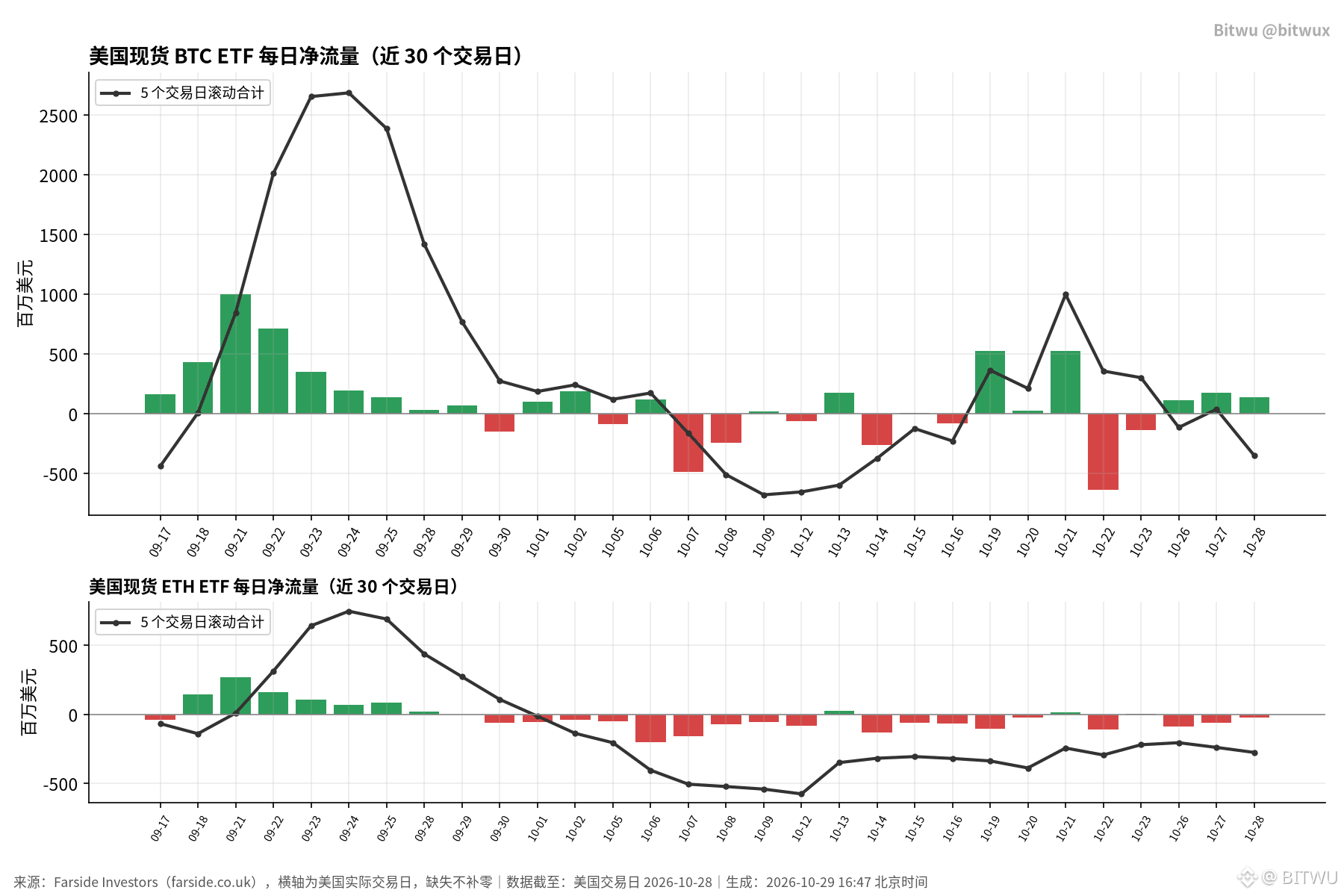
BTC: Net inflow +$137.3M|5-day total -$349.9M
ETH: Net outflow -$21.4M|5-day total -$276.4M
⚖️ Leverage (OKX BTC perpetuals)
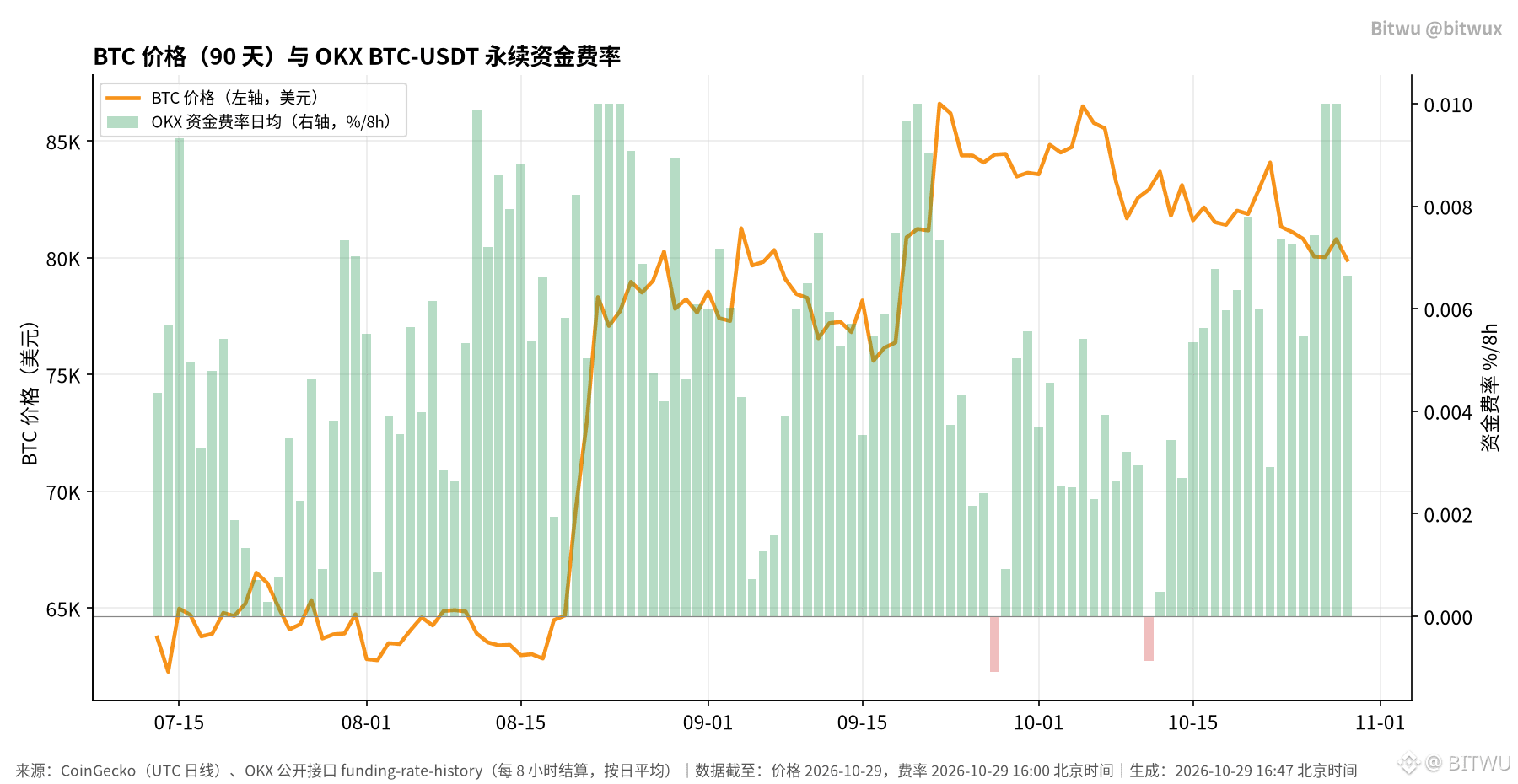
Funding rate +0.0034%/8h (settles 10/29 16:00; 7-day average +0.0077%)
Open interest across all contracts $3.47B (30 days ago: $3.15B)
💵 Stablecoins (DefiLlama)
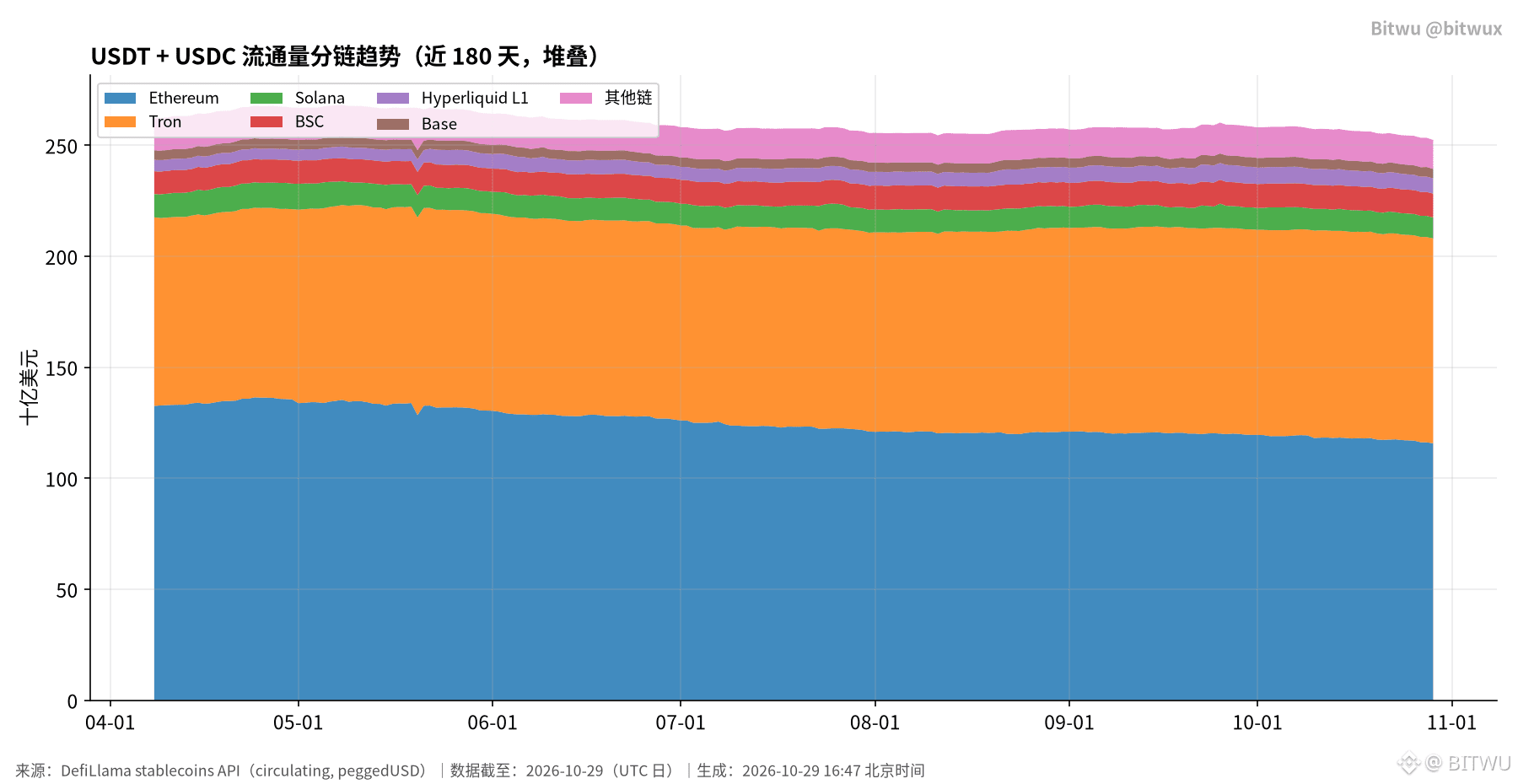
USDT+USDC combined: $252.4B (30-day change -$6.3B; 180-day change -$10.0B)
Ethereum $115.7B (30-day change -$3.9B)|Tron $92.3B (30-day change -$0.2B)|Solana $9.4B (30-day change -$0.5B)
🧬 Hyperliquid (DefiLlama, 10/28)
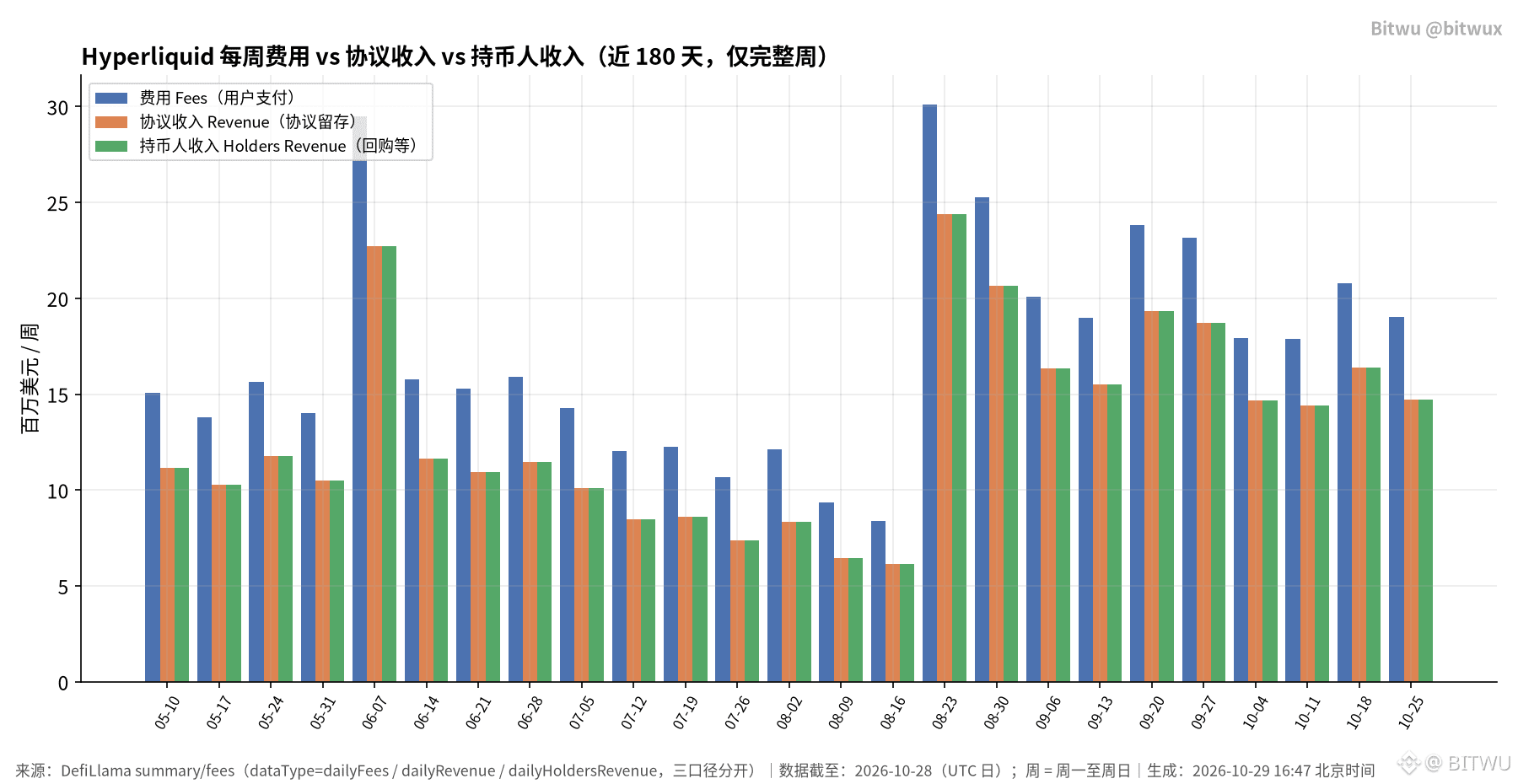
Daily fees $2.93M|Protocol revenue $2.04M|Holder revenue $2.04M
30-day fees $80M / revenue $64M; fees for the latest complete week were down 18% from 4 weeks ago
🔎 In brief: BTC has pulled back to around $79.9K. ETFs saw another inflow of +$137.3M on 10/28 (the third consecutive day), but the 5-day total remains -$349.9M; ETH ETFs continued to see outflows; funding rates are low while open interest remains high; stablecoin supply continued to decline over the past 30 days. Next, watch for PCE + GDP around 20:30 Beijing time tonight.
Sources: CoinGecko / Farside / OKX / DefiLlama. Data as of 2026-10-29 16:46 Beijing time. For informational purposes only; not investment advice.
#BTC #ETH #ETF #稳定币 #Hyperliquid
1
268
·
--
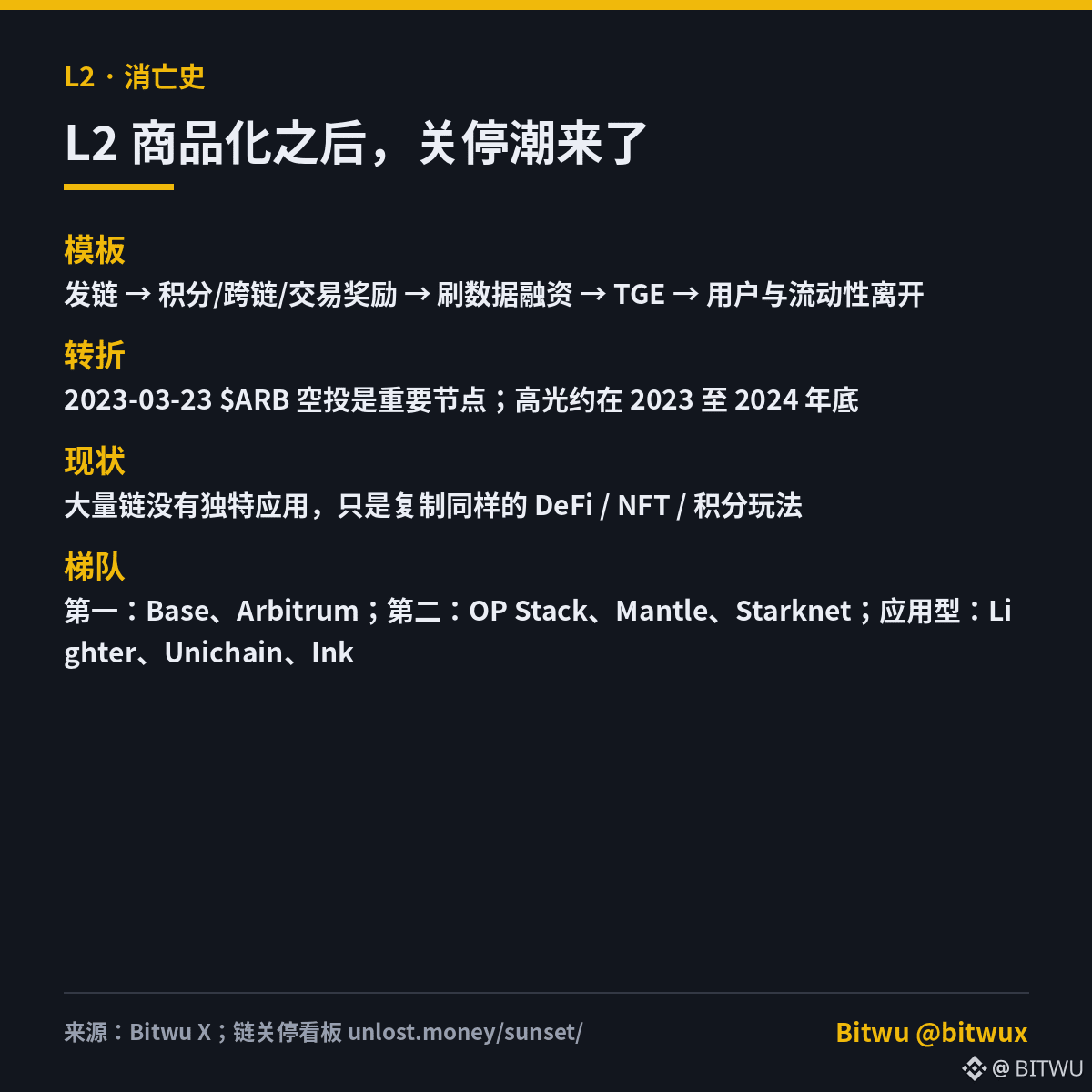
The Rise and Fall of L2s: From Points Frenzy to Shutdown Wave
The chain shutdown tracker (unlost.money/sunset/) is worth bookmarking—you could probably write a whole history of L2s disappearing someday.
L2s were at their peak from around 2023 through the end of 2024, especially around November 2024.
The $ARB airdrop on March 23, 2023 was an important turning point. After that, the market mostly followed the same playbook:
1️⃣ Launch a chain;
2️⃣ Attract airdrop farmers with points, bridging, deposits, and trading rewards;
3️⃣ Grow the metrics and raise funding;
4️⃣ TGE, everyone celebrates—and then users and liquidity quickly leave.
Once the model became commoditized, supply outstripped demand: many chains had no unique applications and simply copied the same DeFi, NFT, and points playbooks.
The L2s still standing can roughly be divided into three tiers—
· Tier 1: Base, Arbitrum
· Tier 2: OP Stack ecosystem, Mantle, Starknet
· Application-specific winners: Lighter, Unichain, Ink
If you still have assets on a chain that’s shutting down, remember to keep an eye on the withdrawal deadline.
$ARB $ETH
#L2 #Layer2 #Arbitrum #Base
976
·
--
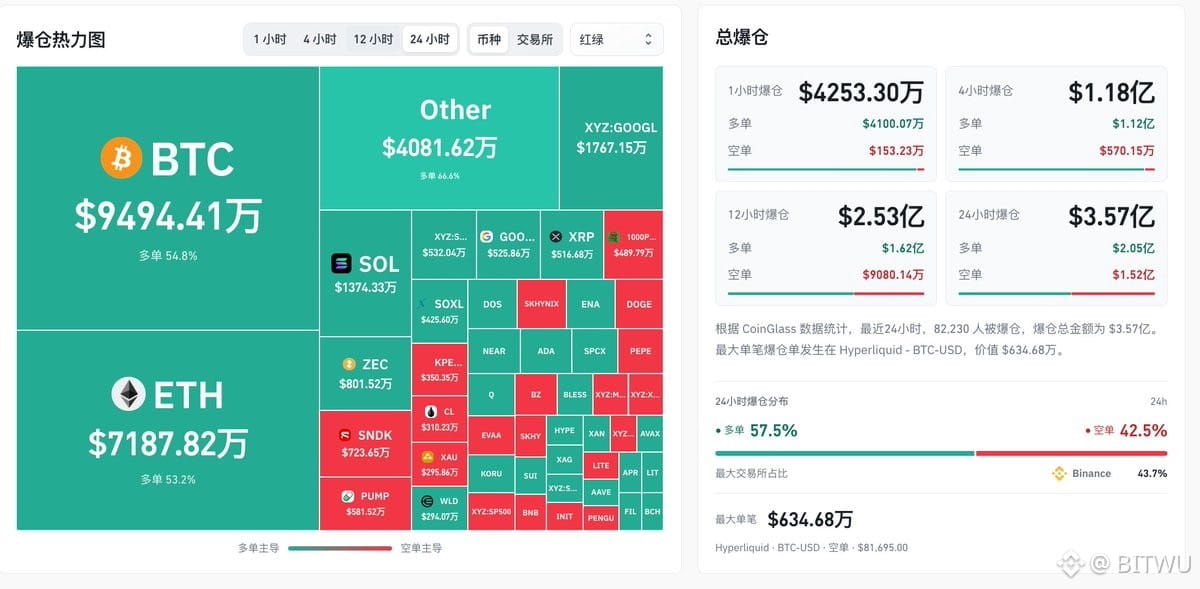
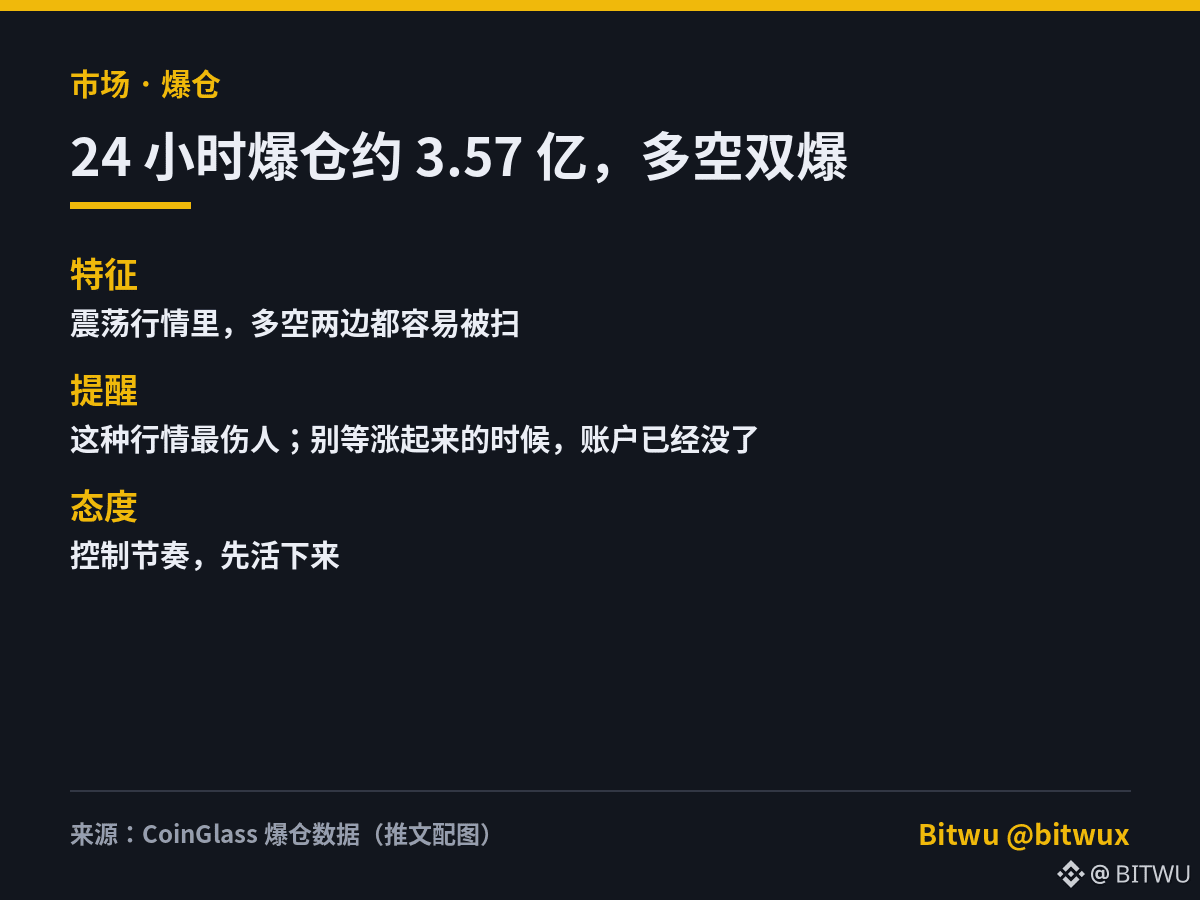
A bit brutal: about 357 million liquidated in 24 hours, wiping out both longs and shorts
Everyone, be careful.
This kind of choppy market can do the most damage—both sides can get swept out.
Don’t wait until prices rise to find your money is already gone.
Keeping your pace under control matters more than chasing every fluctuation.
$BTC $ETH
#爆仓 #市场波动 #RiskManagement
Everyone, be careful.
This kind of choppy market can do the most damage—both sides can get swept out.
Don’t wait until prices rise to find your money is already gone.
Keeping your pace under control matters more than chasing every fluctuation.
$BTC $ETH
#爆仓 #市场波动 #RiskManagement
1
1.1k
·
--
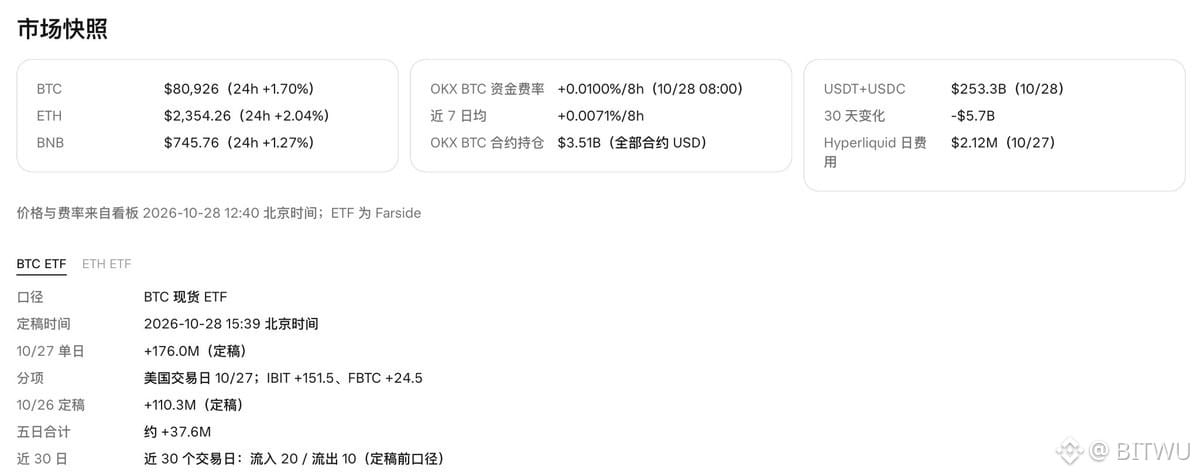
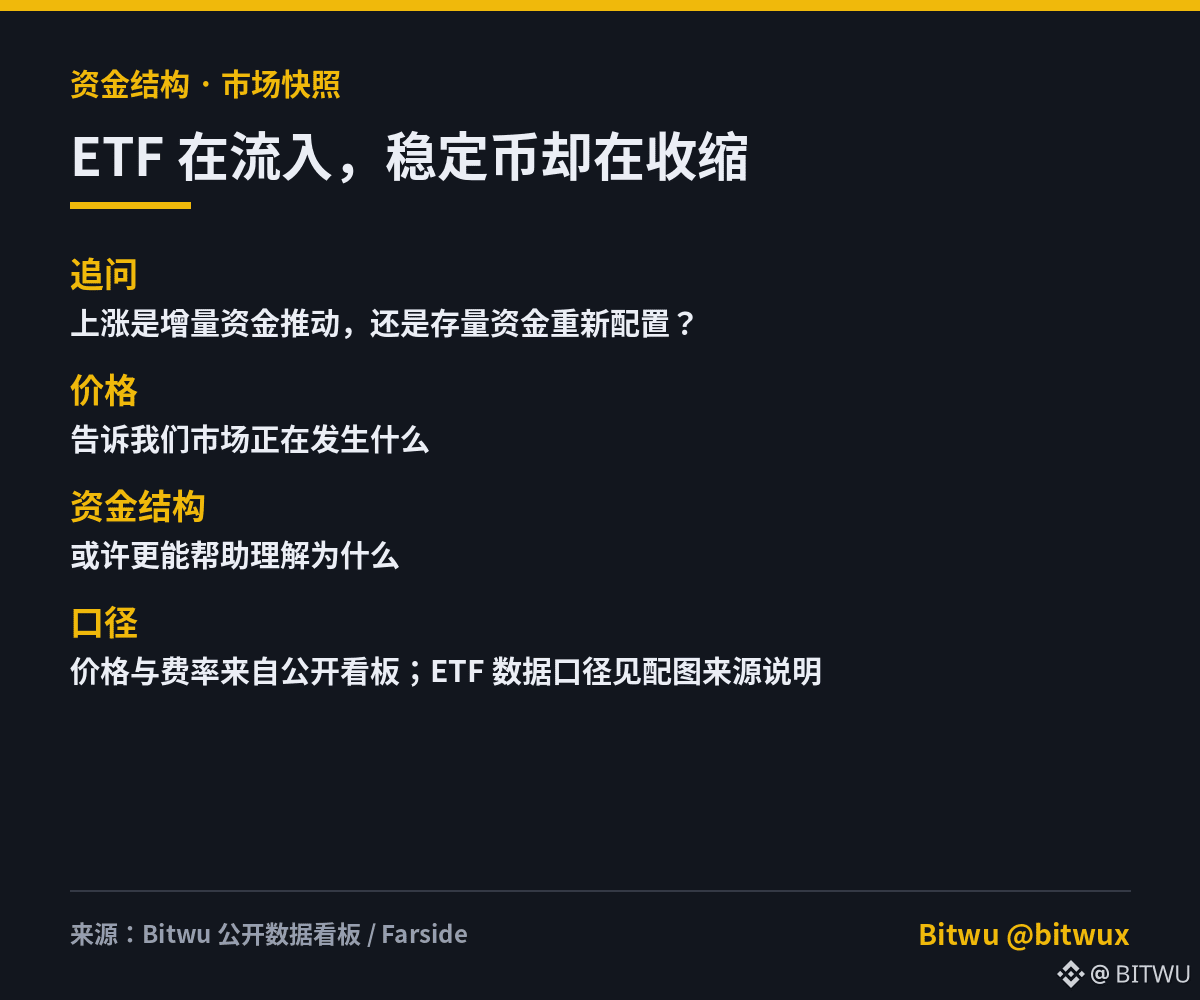
ETFs are seeing inflows, but stablecoins are shrinking—the market is rising, so where is the money coming from?
Compare two sets of public data:
· On one hand, BTC spot ETFs have recently seen net inflows;
· On the other, stablecoin market capitalization has continued to decline over the past 30 days.
This raises a question worth asking:
Is the market rising because of new capital, or because existing capital is being reallocated?
Prices tell us what is happening in the market;
the structure of capital flows may help us understand why.
$BTC $ETH
#ETF #稳定币 #资金流向 #Bitcoin
1
490
Log in to explore more content
Join global crypto users on Binance Square
⚡️ Get latest and useful information about crypto.
💬 Trusted by the world’s largest crypto exchange.
👍 Discover real insights from verified creators.
Email / Phone number
Trending Topics
CanUSStocksReboundAfterNonfarmPayrolls?
881 views
54 Discussing
US Jobs Report Preview: Economists Expect 65,000 October Payrolls as Stocks Look for Direction After AI Rebound
Binance News
·1 Likes
·217 views
BinanceReopensWithdrawalsForMoreAssets
1.1M views
6,086 Discussing
$2TWipedOutHedgeFundsFaceLiquidation
3,887 views
42 Discussing