
Bagirova
82 Posts
Bagirova
Report
Block User
Open Trade
High-Frequency Trader
6.4 Years
50 Following
61 Followers
182 Liked
Posts
Portfolio
All
Quotes
Videos
·
--
Overall, the token is very volatile. I'm trying to go long and expect a good profit.
Overall, the token is very volatile. I'm trying to go long and expect a good profit.
1
132
·
--
There is growth potential, we’ll see how it performs. Generally, wld grows well against BTC.
There is growth potential, we’ll see how it performs. Generally, wld grows well against BTC.
1
224
·
--
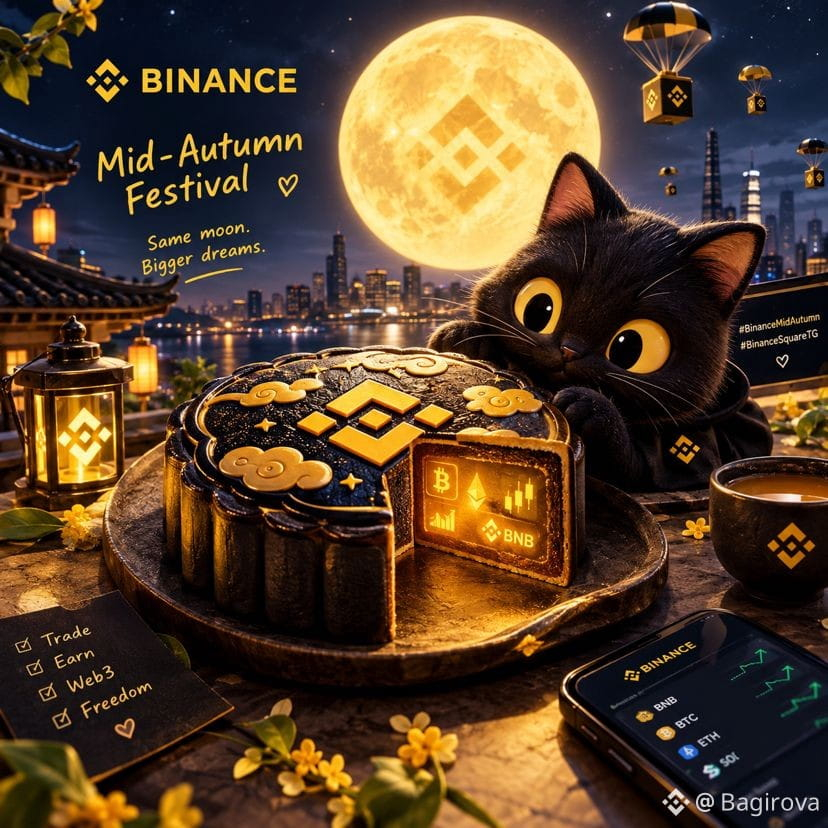
One moon. One Binance. Endless possibilities. 🌕💛
My Mid-Autumn Moon Cake is powered by BNB, Web3 and a little AI magic. ✨
#BinanceMidAutumn #BinanceSquareTG
One moon. One Binance. Endless possibilities. 🌕💛
My Mid-Autumn Moon Cake is powered by BNB, Web3 and a little AI magic. ✨
#BinanceMidAutumn #BinanceSquareTG
My Mid-Autumn Moon Cake is powered by BNB, Web3 and a little AI magic. ✨
#BinanceMidAutumn #BinanceSquareTG
1
100
·
--
Auto-Invest: what if we stopped chasing the perfect price?
In crypto, it’s easy to fall into a trap: wait for the dip, then wait for an even bigger drop… and then watch as the price has already risen.
That’s why I like the DCA idea, which you can implement via Binance Auto-Invest.
Instead of one big purchase, I can invest a fixed amount on a regular basis.
My scenario: if I’m planning to accumulate BTC long-term and I don’t want to analyze the chart every day, regular buys can become part of my strategy.
But DCA doesn’t protect you from market drops. If an asset keeps getting cheaper, the portfolio can still be in the red.
So I see Auto-Invest not as a way to guarantee profit, but as a discipline tool: I set the amount, the frequency, and the time horizon—and I don’t try to guess every bottom.
2
733
·
--
Trading Bots: when the market works 24/7 and you don’t have to sit by the chart.
The crypto market never closes for the night or weekends. But that doesn’t mean I want to constantly watch the charts. That’s why I’m interested in Binance Trading Bots—tools that automate certain trading strategies. Binance offers, in particular, Spot Grid, Futures Grid, Spot DCA, Rebalancing, and other options.
How is this different from regular trading?
Manual trading → I watch the market myself and open trades.
Grid Bot → the algorithm places a series of orders within a specified price range.
DCA Bot → buying happens in parts according to set rules.
If I expect that BTC will move within a certain range for some time, the Grid Bot can automate buying and selling at defined levels instead of doing it manually.
But a bot does not guarantee profit. If the market moves outside the specified range, the strategy may work quite differently than expected. Futures bots also carry the additional risks of leverage and liquidation.
What’s interesting is that Binance keeps expanding Trading Bots: in September 2026, Spot Grid and Spot DCA became available, including for NVDAB/USDT and QQQB/USDT.
Automation saves time. But responsibility for the strategy still remains with the trader.
1
231
·
--
Copy Trading: invest in a trader or learn their strategy?
I like one feature of Copy Trading: it lets you see, in practice, how another trader responds to the market.
Instead of opening every position yourself, you can choose a trader and automatically repeat their trades.
At first glance, everything seems very simple. But before choosing a trader, I definitely wouldn’t rely only on the profit figure. For example:
+100% profit with a huge drawdown can mean a completely different risk level than a steadier result with controlled losses.
If I want to test Copy Trading, I don’t allocate all of my trading capital to it. First, a small amount—so I can see how the strategy behaves not only during a favorable market.
The main risk is obvious: if the selected trader makes a mistake, my position can also go into the red.
That’s why I see Copy Trading not as a replacement for my own knowledge, but as an additional tool for diversification and for observing different trading approaches.
There’s no “guaranteed profit” button in trading. Even if someone else presses it.
2
7
1.3k
·
--
TradFi Futures on Binance: you can trade not only with crypto.
Previously, futures for me were mostly associated with cryptocurrencies. But Binance is expanding this approach to traditional assets: stocks, gold, silver, and other TradFi instruments. Instead of buying the asset itself, I trade its price via a futures contract. You can trade both rising and falling markets.
Spot → buy the asset and own it.
bStocks → get tokenized exposure to a stock.
TradFi Futures → trade price movement, with the possibility of using leverage.
Important inflation data comes out, and the gold market starts moving sharply. Instead of making a long-term purchase of the asset, I can use a futures instrument for a short-term trading idea. But the key here is risk. Leverage increases not only potential returns, but also losses. A sudden move against the position can lead to liquidation. That’s why, in my TradFi Futures strategy, it’s not the core of the portfolio, but a separate tool for active trading with clear risk management.
I like the concept itself: traditional markets become accessible through infrastructure that crypto traders are already used to.
But 24/7 access doesn’t mean you need to trade 24/7.
2
249
·
--
Verified
How I’m looking at autumn after the Fed.
The Fed raised the rate. The market expected it, but they didn’t say “this is the last time.” There are two more meetings before the end of the year. For me, the baseline scenario is another hike in December.
What that means in plain language: tech stocks can jump around even more, sitting only in cash on the spot is already a pity, but I won’t sell everything either.
I use three things. Regular stocks on Binance, when I want the paper and dividends. bStocks—when it’s convenient to trade even on weekends and with a small amount. Earn—as a shelf for USDT while I’m waiting for the entry point.
After September 16, I didn’t add leverage again; I slightly reduced the most sensitive tokens and put some of my cash into Earn. If they raise again in October, I’ll have a buffer. If there’s a pause, I can buy more bStocks even when the US is closed.
The risks are simple: inflation is still high, the rate could go higher, and a token isn’t a full stock with all the rights.
Right now I have it like this: part in stocks and bStocks for the medium term, part in Earn. No sharp moves until December.
Not financial advice.
5
209
·
--
It managed to catch a decent amount of activity on $LSK
It managed to catch a decent amount of activity on $LSK
2
132
·
--
ZEC overall shows a decent growth; I expect further growth.
ZEC overall shows a decent growth; I expect further growth.
1
86
·
--
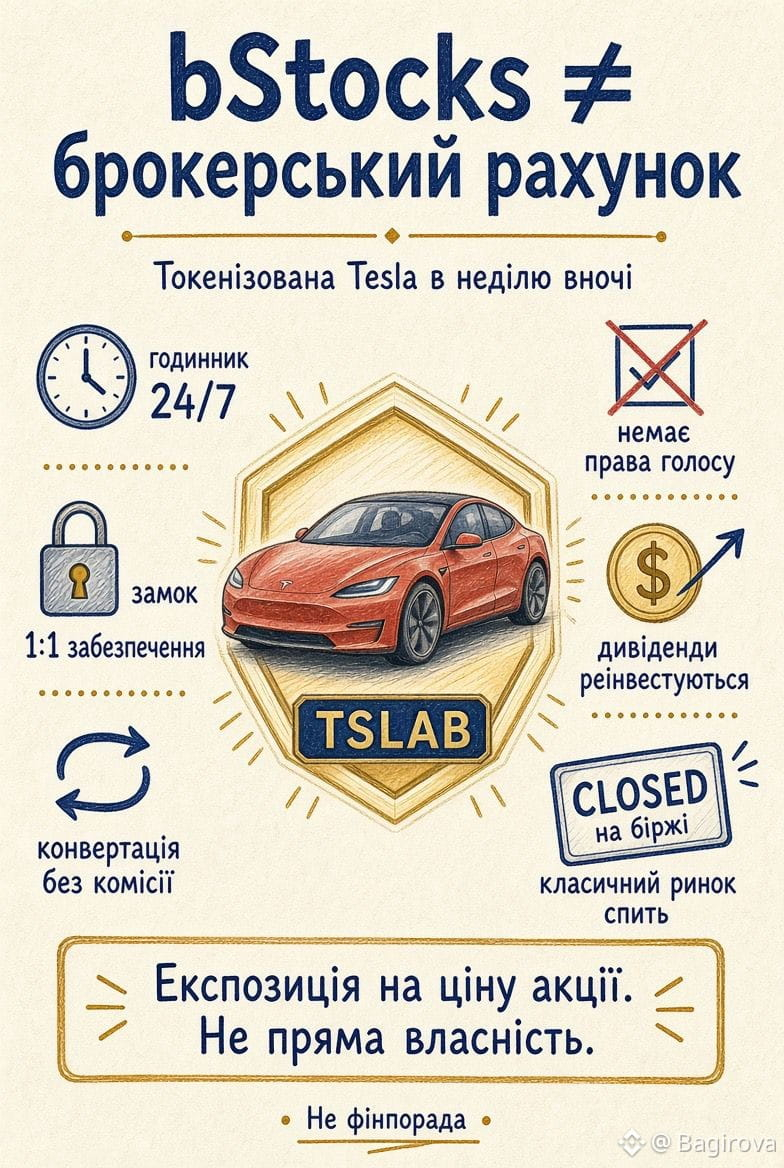
What is bStocks or how I first bought "Tesla" on a Sunday night. Binance is the first exchange where I registered and became used to the fact that the market never sleeps. U.S. stocks, on the contrary, everything is closed over the weekend. When bStocks appeared, I started researching what it is. bStocks are tokenized U.S. stocks that are backed by real shares 1:1. You don’t actually own the real share, there’s no voting right. But you get something that doesn’t exist with a classic broker: trading 24/7, 1:1 conversion into a regular stock with no commission, the ability to withdraw the token to your own wallet on the BEP-20 network, and the ability to receive dividends. You can buy starting from 5$ in USDT, which is very convenient for testing trading or investing small amounts. On Saturday evening, there were news updates about the tech sector. The classic market was already closed. So I bought a small amount of TSLAB on spot in the bStocks section. By Sunday morning, it was already possible to lock in a profit. My conclusion is simple: bStocks are convenient when you want to place emphasis on a specific company right now, without waiting for the market to open. That’s where the convenience lies, but it’s important to understand that this is not ownership of the actual share itself—shareholder rights are not available. It’s a token with the stock price. You need to know this difference for your first purchase.
What is bStocks or how I first bought "Tesla" on a Sunday night. Binance is the first exchange where I registered and became used to the fact that the market never sleeps. U.S. stocks, on the contrary, everything is closed over the weekend. When bStocks appeared, I started researching what it is. bStocks are tokenized U.S. stocks that are backed by real shares 1:1. You don’t actually own the real share, there’s no voting right. But you get something that doesn’t exist with a classic broker: trading 24/7, 1:1 conversion into a regular stock with no commission, the ability to withdraw the token to your own wallet on the BEP-20 network, and the ability to receive dividends. You can buy starting from 5$ in USDT, which is very convenient for testing trading or investing small amounts. On Saturday evening, there were news updates about the tech sector. The classic market was already closed. So I bought a small amount of TSLAB on spot in the bStocks section. By Sunday morning, it was already possible to lock in a profit. My conclusion is simple: bStocks are convenient when you want to place emphasis on a specific company right now, without waiting for the market to open. That’s where the convenience lies, but it’s important to understand that this is not ownership of the actual share itself—shareholder rights are not available. It’s a token with the stock price. You need to know this difference for your first purchase.
5
427
·
--
Earn XP on Telegram and exchange them for crypto: a new activity from Binance Ukraine
Binance Ukraine has launched a 4-week activity where you can accumulate XP and exchange them for crypto. The format is simple: complete tasks in Telegram and get points.
What you need to do:
1. Follow the official Binance Ukraine channel and the Binance Ukrainian chat on Telegram.
2. Go to the bot from the post and complete the week’s tasks.
The campaign is planned for 4 weeks, so you can log in regularly and gradually increase your XP balance. This is a convenient way to stay up to date with the exchange news while also collecting rewards without complicated requirements.
If you haven’t followed yet, do it now while the promotion is ongoing. Details and links to the bot are in the official post on the Binance Ukraine channel.
Not financial advice. Always check the terms on official sources.
#Binance #BinanceUkraine #Crypto #XP
4
133
·
--
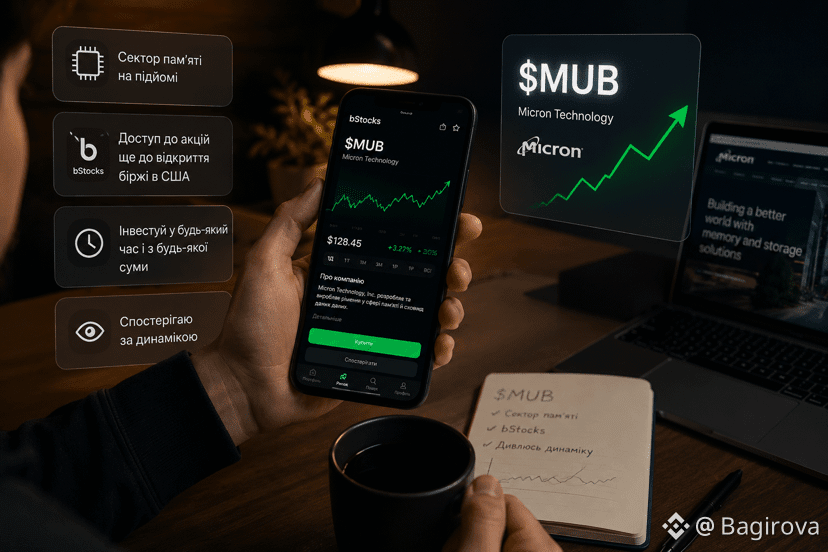
#bstockscis @BinanceCIS Lately I’ve been paying more attention to $MUB. In the memory sector there is a lot going on right now, and through bStocks you can get in even with a small amount without waiting for the U.S. exchange to open.
It’s convenient that everything is in one app and you can act at any time. For now, I’m observing the dynamics more than actively increasing my position.
It’s convenient that everything is in one app and you can act at any time. For now, I’m observing the dynamics more than actively increasing my position.
1
1
5
105
·
--
Interesting whether $TUT will go to a new high? I decided not to take the risk after all.
Interesting whether $TUT will go to a new high? I decided not to take the risk after all.
6
112
·
--
Bullish
#bstockscis @BinanceCIS
In bStocks, it is now especially clear how quickly sentiment can change. $TSLAB remains one of the most popular in terms of the number of fractional trades (previously, almost 99.65% of traders were using exactly this).
At the same time, in the memory and chips sector, names like $MUB look stronger. The ability to start from $5 and trade 24/7 makes it much easier to watch these moves.
For now, I’m looking more than actively jumping in, but the format is genuinely convenient.
1
4
102
·
--
#bstockscis @BinanceCIS
Did I understand right away what bStocks are? Of course not. But if you start studying the information in more detail, everything seems not that complicated. Where can I find trading pairs? In the spot section — bStocks. Easy, right? How much money do you need for your first trade? Surprise you — it’s enough to have $5. Every time, more and more trading pairs appear. Binance took care of all the other details—you just have to trade 24/7, without unnecessary thoughts. Share your thoughts: have you tried trading yet? For trading, many trading pairs are available, $NVDAB , $AAPLB , $MSFTB and many more.
Did I understand right away what bStocks are? Of course not. But if you start studying the information in more detail, everything seems not that complicated. Where can I find trading pairs? In the spot section — bStocks. Easy, right? How much money do you need for your first trade? Surprise you — it’s enough to have $5. Every time, more and more trading pairs appear. Binance took care of all the other details—you just have to trade 24/7, without unnecessary thoughts. Share your thoughts: have you tried trading yet? For trading, many trading pairs are available, $NVDAB , $AAPLB , $MSFTB and many more.
3
1
9
93
·
--
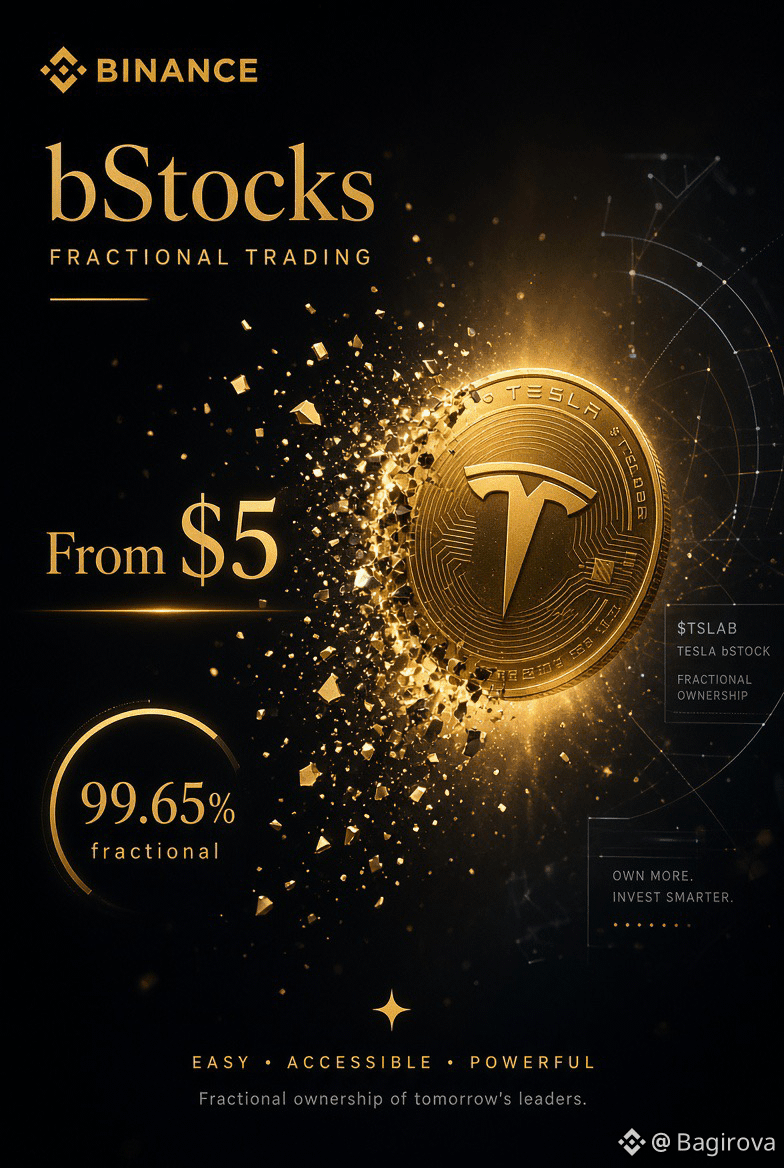
#bstockscis @BinanceCIS I’ve been thinking about why fractional trading on bStocks feels different from the usual stock experience.
With a $5 minimum, the decision becomes lighter. You’re not forcing yourself to commit to a full share of something like $TSLAB or $NVDAB. Early numbers already showed that the vast majority of $TSLAB trades by count were fractional (around 99.65%), which suggests people are treating small positions as a normal approach rather than a temporary test.
The interesting part is how little friction remains: same Binance app, USDT, and the ability to act outside regular market hours. It changes the threshold for “I’ll just look” into “I can actually try it.”
4
7
111
·
--
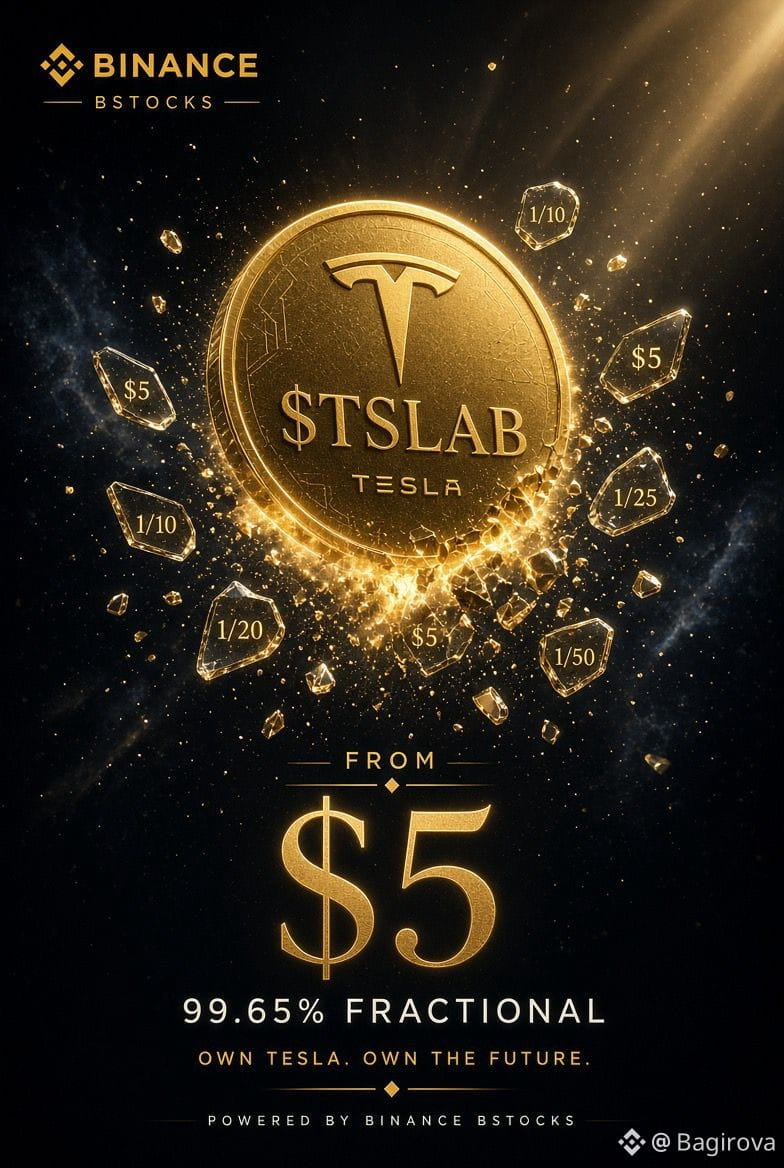
#bstockscis @BinanceCIS There’s something quietly practical about bStocks that doesn’t get enough attention.
You can start from just $5. No full share required. Early data showed that around 99.65% of Tesla ($TSLAB) trades by quantity were fractional, and fractional volume made up roughly 88.5% of total trading value. That doesn’t look like casual testing — it looks like people actually using small sizes as a normal way to participate.
What I find interesting is the absence of friction. Same app, USDT balance, 24/7 access. No separate brokerage account just to try a small position in something like $TSLAB or $NVDAB. It turns “maybe later” into “I can check this right now.”
1
1
142
Log in to explore more content
Join global crypto users on Binance Square
⚡️ Get latest and useful information about crypto.
💬 Trusted by the world’s largest crypto exchange.
👍 Discover real insights from verified creators.
Email / Phone number
Trending Topics
BTCRebounds80K
226 views
91 Discussing
Bitcoin and broader crypto markets are climbing higher as markets react to U.S. midterm election outcomes, where Democratic majorities in Congress have altered the political landscape for digital assets. Bitcoin trades near the $80,600 range after recovering from earlier dips.
🤑🤑🤑🤑$BTC
#BTCRebounds80K #USMidterms-WhatAreMarketsExpecting? #USOctoberNFP-AreRateCutsStillPossible #AMDBeatsExpectations-AINarrativeContinues #BinanceIncidentReport
JPBitSage
·1 Likes
·53 views
Binance98PercentReplenished
1,884 views
198 Discussing
USMidterms-WhatAreMarketsExpecting?
207,898 views
1,641 Discussing