
Marketbtc
2k Posts
Marketbtc
Report
Block User
5.3K+ Following
2.8K+ Followers
1.0K+ Liked
Posts
All
Quotes
Videos
Live
·
--
pa
I was thinking about why smart contracts still struggle to make decisions using historical blockchain activity.
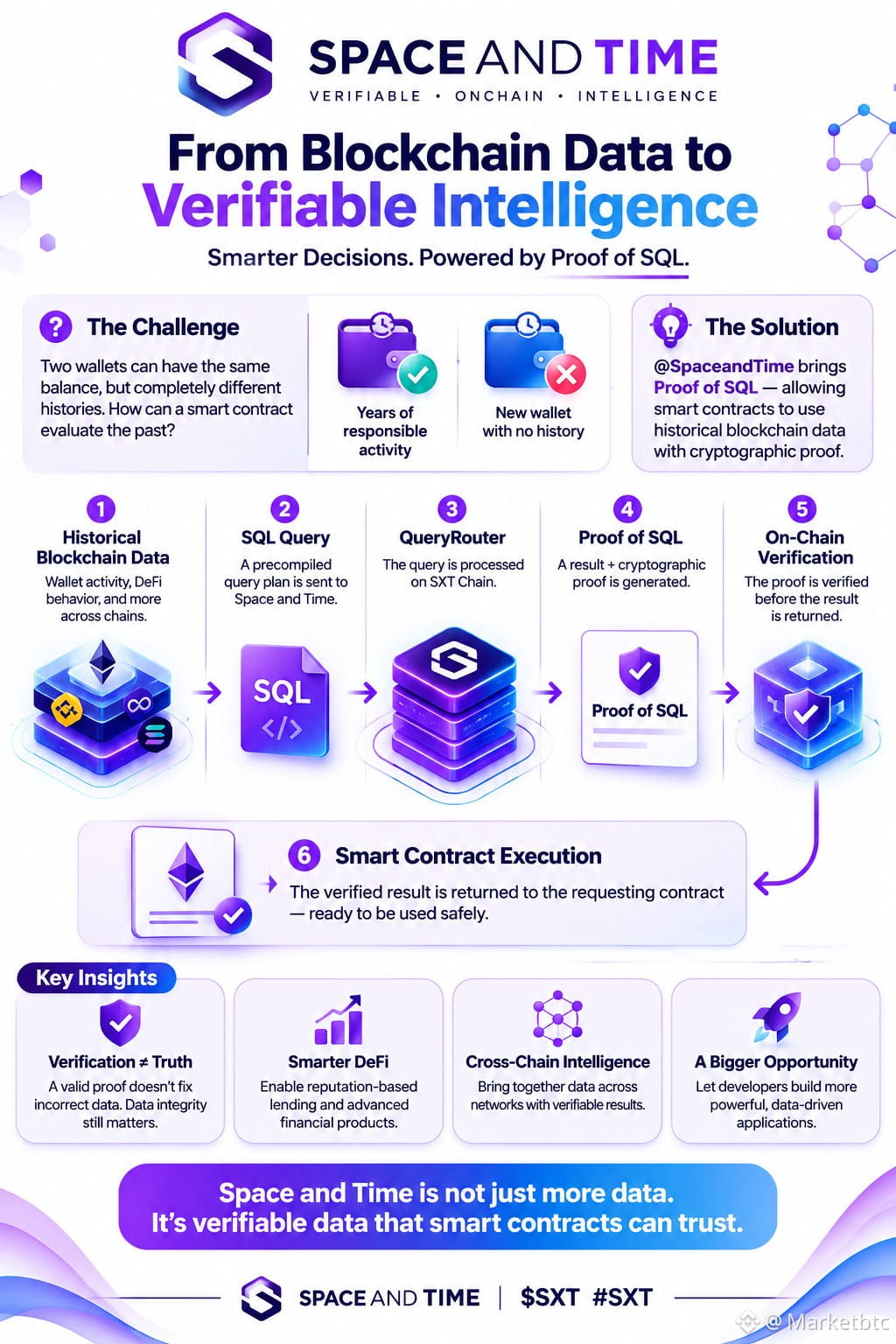
Take a lending protocol. Two wallets might have exactly the same current balance, but their histories could be completely different. One might have years of responsible borrowing and repayment, while the other was created yesterday.
The contract can see their current state. But how does it evaluate everything that happened before?
That's where I started looking more closely at @SpaceandTimeDB
What caught my attention wasn't simply that it uses Proof of SQL. It was how a smart contract actually receives a result without having to perform the database computation itself.
There is an important distinction here.
A smart contract doesn't suddenly become a database. It sends a precompiled SQL query plan to Space and Time's QueryRouter, together with a payment and a callback target.
The query is processed against tables on SXT Chain. The system generates a Proof of SQL alongside the result, and the proof is verified on-chain before the result is returned to the requesting contract.
But the callback is another interesting part.
The receiving contract needs to check that the response came from the authorized router executor, then decode the returned data before using it.
In other words, receiving data and safely acting on data are two different steps.
This changes how I think about the architecture. The heavy computation happens outside the requesting contract, while cryptographic verification allows the contract to rely on the returned result without independently processing the entire dataset. Space and Time +1
Wait, there is one more layer I don't want to overlook.
A valid proof does not automatically mean the original information was true.
If incorrect information enters a database during ingestion, proving that a SQL calculation was performed correctly against that committed data does not magically correct the original mistake. Data integrity and data accuracy are related, but they are not identical. Proof .
@SpaceandTimeDB #sxt $SXT
pa
I was thinking about why smart contracts still struggle to make decisions using historical blockchain activity.
Take a lending protocol. Two wallets might have exactly the same current balance, but their histories could be completely different. One might have years of responsible borrowing and repayment, while the other was created yesterday.
The contract can see their current state. But how does it evaluate everything that happened before?
That's where I started looking more closely at @SpaceandTime
What caught my attention wasn't simply that it uses Proof of SQL. It was how a smart contract actually receives a result without having to perform the database computation itself.
There is an important distinction here.
A smart contract doesn't suddenly become a database. It sends a precompiled SQL query plan to Space and Time's QueryRouter, together with a payment and a callback target.
The query is processed against tables on SXT Chain. The system generates a Proof of SQL alongside the result, and the proof is verified on-chain before the result is returned to the requesting contract.
But the callback is another interesting part.
The receiving contract needs to check that the response came from the authorized router executor, then decode the returned data before using it.
In other words, receiving data and safely acting on data are two different steps.
This changes how I think about the architecture. The heavy computation happens outside the requesting contract, while cryptographic verification allows the contract to rely on the returned result without independently processing the entire dataset. Space and Time +1
Wait, there is one more layer I don't want to overlook.
A valid proof does not automatically mean the original information was true.
If incorrect information enters a database during ingestion, proving that a SQL calculation was performed correctly against that committed data does not magically correct the original mistake. Data integrity and data accuracy are related, but they are not identical. Proof .
@SpaceandTime #sxt $SXT
I was thinking about why smart contracts still struggle to make decisions using historical blockchain activity.
Take a lending protocol. Two wallets might have exactly the same current balance, but their histories could be completely different. One might have years of responsible borrowing and repayment, while the other was created yesterday.
The contract can see their current state. But how does it evaluate everything that happened before?
That's where I started looking more closely at @SpaceandTime
What caught my attention wasn't simply that it uses Proof of SQL. It was how a smart contract actually receives a result without having to perform the database computation itself.
There is an important distinction here.
A smart contract doesn't suddenly become a database. It sends a precompiled SQL query plan to Space and Time's QueryRouter, together with a payment and a callback target.
The query is processed against tables on SXT Chain. The system generates a Proof of SQL alongside the result, and the proof is verified on-chain before the result is returned to the requesting contract.
But the callback is another interesting part.
The receiving contract needs to check that the response came from the authorized router executor, then decode the returned data before using it.
In other words, receiving data and safely acting on data are two different steps.
This changes how I think about the architecture. The heavy computation happens outside the requesting contract, while cryptographic verification allows the contract to rely on the returned result without independently processing the entire dataset. Space and Time +1
Wait, there is one more layer I don't want to overlook.
A valid proof does not automatically mean the original information was true.
If incorrect information enters a database during ingestion, proving that a SQL calculation was performed correctly against that committed data does not magically correct the original mistake. Data integrity and data accuracy are related, but they are not identical. Proof .
@SpaceandTime #sxt $SXT
114
·
--
Bullish
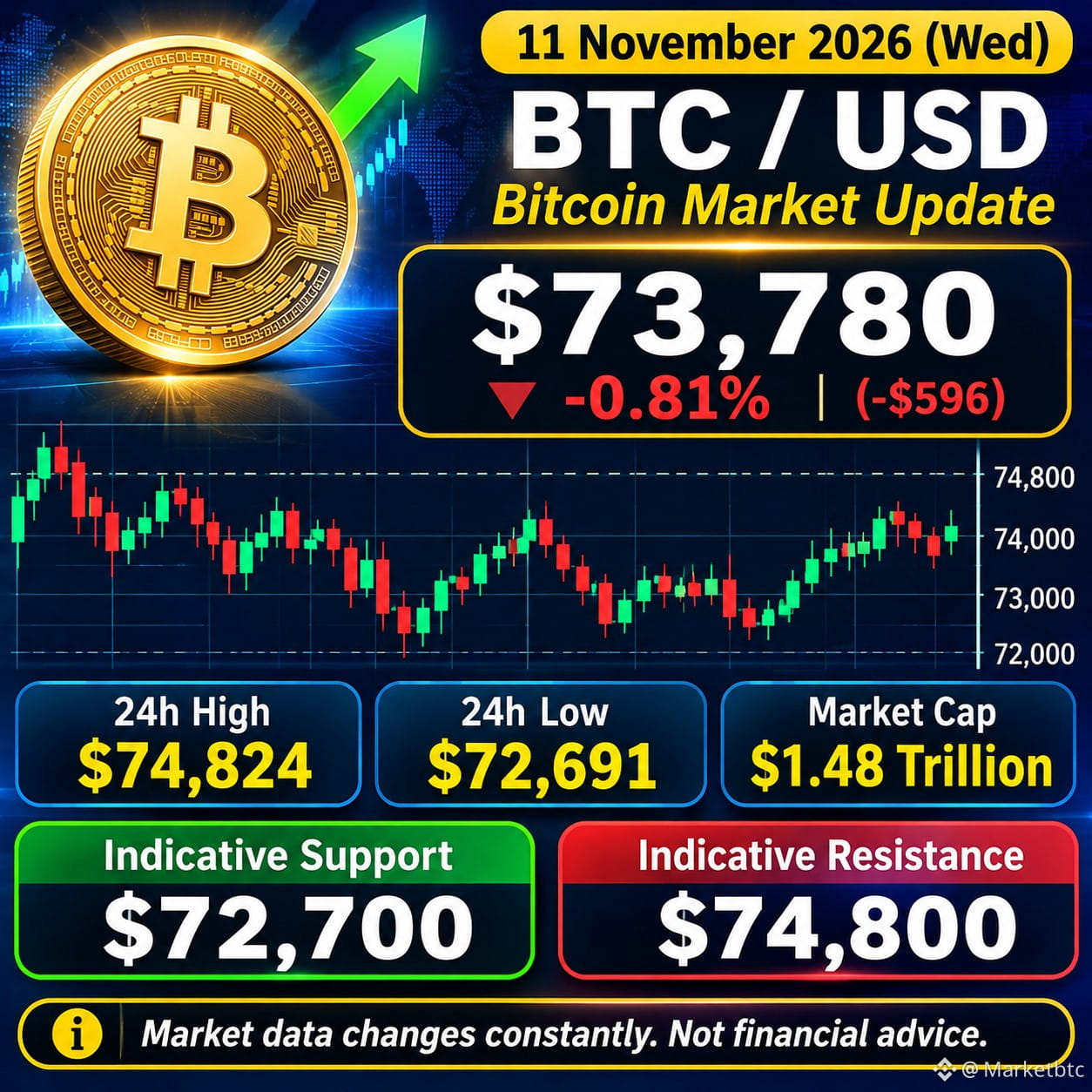
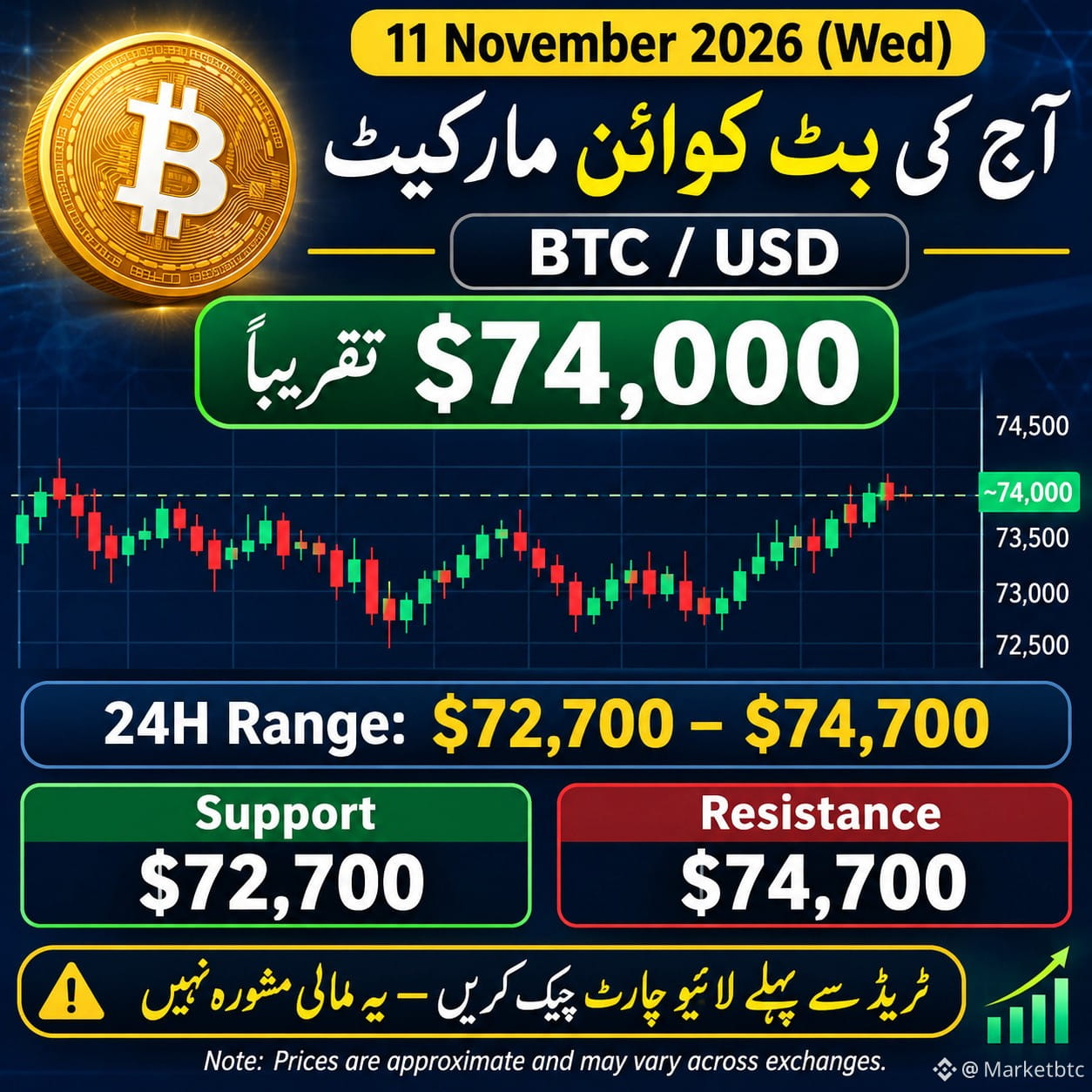
Bitcoin (BTC) Market Update –11 November 2026
According to the latest available market data:
BTC price: $72,680
24-hour change: -0.81%
24-hour high: $74,124
24-hour low: $71,691
Market cap: Approximately $1.58 trillion.
BTC price chart$BTC #CanNvidiaEarningsEaseMarketConcerns? $TSMB #@Dusk_Foundation $NVDAB
Bitcoin (BTC) Market Update –11 November 2026
According to the latest available market data:
BTC price: $72,680
24-hour change: -0.81%
24-hour high: $74,124
24-hour low: $71,691
Market cap: Approximately $1.58 trillion.
BTC price chart$BTC #CanNvidiaEarningsEaseMarketConcerns? $TSMB #@Dusk $NVDAB
According to the latest available market data:
BTC price: $72,680
24-hour change: -0.81%
24-hour high: $74,124
24-hour low: $71,691
Market cap: Approximately $1.58 trillion.
BTC price chart$BTC #CanNvidiaEarningsEaseMarketConcerns? $TSMB #@Dusk $NVDAB
93
·
--
This is a small loss, don't panic. options:
Scalp management: If you are scalping, set a tight SL at 76,380 just below that low Your loss will be ∼$0.30 max. Take profit back to *76,700 - 76,815* breakeven small profit. Risk/reward is okay.
*If you want to hold:* Your liquidation is far, but supertrend is against you. If BTC loses 76,392, it can drop quickly to 76,000 - 75,800. You can add margin if you want to hold longer, but better to cut if 15m closes below 76,490.
You entered a bit high after that big green candle at 11:00. Next time wait for pullback to supertrend or to 77,400 support.
Do you want to hold this or close? I can calculate exact SL for you.
This is a small loss, don't panic. options:
Scalp management: If you are scalping, set a tight SL at 76,380 just below that low Your loss will be ∼$0.30 max. Take profit back to *76,700 - 76,815* breakeven small profit. Risk/reward is okay.
*If you want to hold:* Your liquidation is far, but supertrend is against you. If BTC loses 76,392, it can drop quickly to 76,000 - 75,800. You can add margin if you want to hold longer, but better to cut if 15m closes below 76,490.
You entered a bit high after that big green candle at 11:00. Next time wait for pullback to supertrend or to 77,400 support.
Do you want to hold this or close? I can calculate exact SL for you.
Scalp management: If you are scalping, set a tight SL at 76,380 just below that low Your loss will be ∼$0.30 max. Take profit back to *76,700 - 76,815* breakeven small profit. Risk/reward is okay.
*If you want to hold:* Your liquidation is far, but supertrend is against you. If BTC loses 76,392, it can drop quickly to 76,000 - 75,800. You can add margin if you want to hold longer, but better to cut if 15m closes below 76,490.
You entered a bit high after that big green candle at 11:00. Next time wait for pullback to supertrend or to 77,400 support.
Do you want to hold this or close? I can calculate exact SL for you.
1
152



·
--
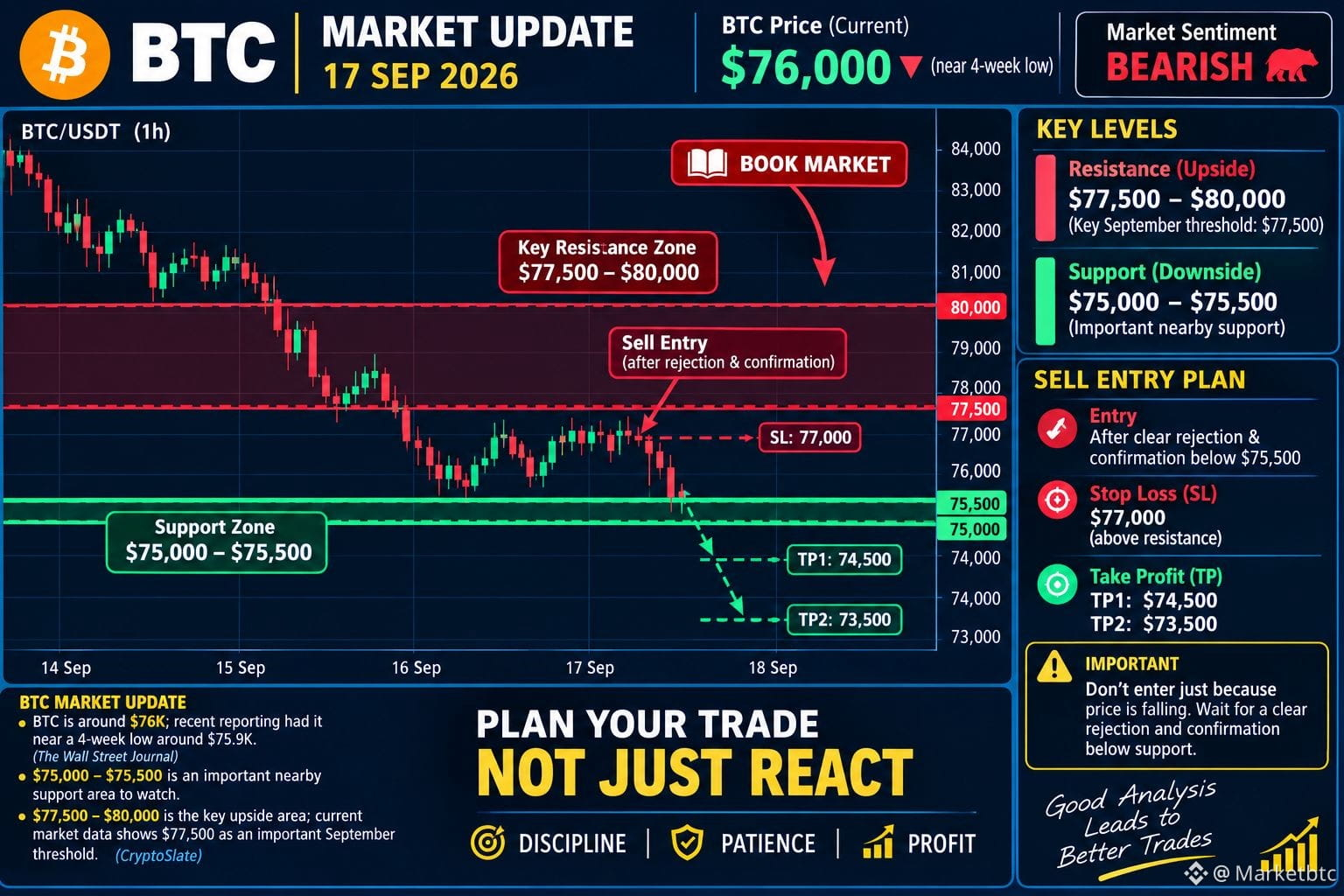
$NVDAB BTC market update 17 Sep 2026:
BTC is around $75K; recent reporting had it near a 4-week low around $79.9K.
The Wall Street Journal
$75,000–$75,500 is an important nearby support area to watch.
$79,500–$81000 is the key upside area; current market data shows $77,500 as an important September threshold.
CryptoSlate
For a SELL entry, I would avoid entering just because price is falling. Wait for a clear rejection and confirmation below support.
If you send me your BTC chart screenshot (5m/15m/1h), I can mark the sell entry, SL, and TP levels on it.$BTC #FedSEPProjects2026RateAt4.1% #SKPoliceRefer18PolymarketUsersToProsecutors #DotPlotSignalsOneMoreHikeIn2026
$NVDAB BTC market update 17 Sep 2026:
BTC is around $75K; recent reporting had it near a 4-week low around $79.9K.
The Wall Street Journal
$75,000–$75,500 is an important nearby support area to watch.
$79,500–$81000 is the key upside area; current market data shows $77,500 as an important September threshold.
CryptoSlate
For a SELL entry, I would avoid entering just because price is falling. Wait for a clear rejection and confirmation below support.
If you send me your BTC chart screenshot (5m/15m/1h), I can mark the sell entry, SL, and TP levels on it.$BTC #FedSEPProjects2026RateAt4.1% #SKPoliceRefer18PolymarketUsersToProsecutors #DotPlotSignalsOneMoreHikeIn2026
BTC is around $75K; recent reporting had it near a 4-week low around $79.9K.
The Wall Street Journal
$75,000–$75,500 is an important nearby support area to watch.
$79,500–$81000 is the key upside area; current market data shows $77,500 as an important September threshold.
CryptoSlate
For a SELL entry, I would avoid entering just because price is falling. Wait for a clear rejection and confirmation below support.
If you send me your BTC chart screenshot (5m/15m/1h), I can mark the sell entry, SL, and TP levels on it.$BTC #FedSEPProjects2026RateAt4.1% #SKPoliceRefer18PolymarketUsersToProsecutors #DotPlotSignalsOneMoreHikeIn2026
232
·
--
My safe setup for today:
Long: If a strong hold/retest is found above $77K–$77.3K then
Targets: $78.5K → $79.5K → $80K
Short: If there is a clear breakdown and retest below $76.6K then $NVDA.US
Instead of taking an immediate entry in the middle, confirmation is better.#PhiladelphiaSemiconductorIndexFalls5.9%
If you also send me a screenshot of the BTC chart on 5m or 15m, I’ll tell you the exact entry + SL + TP levels.$BTC
#SECChairUrgesCongressToAdvanceClarityAct
My safe setup for today:
Long: If a strong hold/retest is found above $77K–$77.3K then
Targets: $78.5K → $79.5K → $80K
Short: If there is a clear breakdown and retest below $76.6K then $NVDA.US
Instead of taking an immediate entry in the middle, confirmation is better.#PhiladelphiaSemiconductorIndexFalls5.9%
If you also send me a screenshot of the BTC chart on 5m or 15m, I’ll tell you the exact entry + SL + TP levels.$BTC
#SECChairUrgesCongressToAdvanceClarityAct
Long: If a strong hold/retest is found above $77K–$77.3K then
Targets: $78.5K → $79.5K → $80K
Short: If there is a clear breakdown and retest below $76.6K then $NVDA.US
Instead of taking an immediate entry in the middle, confirmation is better.#PhiladelphiaSemiconductorIndexFalls5.9%
If you also send me a screenshot of the BTC chart on 5m or 15m, I’ll tell you the exact entry + SL + TP levels.$BTC
#SECChairUrgesCongressToAdvanceClarityAct
today trading BTC
0%
today trading xrp
0%
0 votes • Voting closed
91
·
--
Jummah Mubarak! 🌙✨
Happy Friday to you too - Good Vibes, Great Day Strong Mind!4/9/2026
Peace be upon you along with the mercy of Allah and His blessings
Good morning, Jummah Mubarak
May today bring you countless blessings - Amen, O Lord of the Worlds_ 🤲
Have a blessed and amazing Friday!
Jummah Mubarak! 🌙✨
Happy Friday to you too - Good Vibes, Great Day Strong Mind!4/9/2026
Peace be upon you along with the mercy of Allah and His blessings
Good morning, Jummah Mubarak
May today bring you countless blessings - Amen, O Lord of the Worlds_ 🤲
Have a blessed and amazing Friday!
Happy Friday to you too - Good Vibes, Great Day Strong Mind!4/9/2026
Peace be upon you along with the mercy of Allah and His blessings
Good morning, Jummah Mubarak
May today bring you countless blessings - Amen, O Lord of the Worlds_ 🤲
Have a blessed and amazing Friday!

24
·
--
Bullish
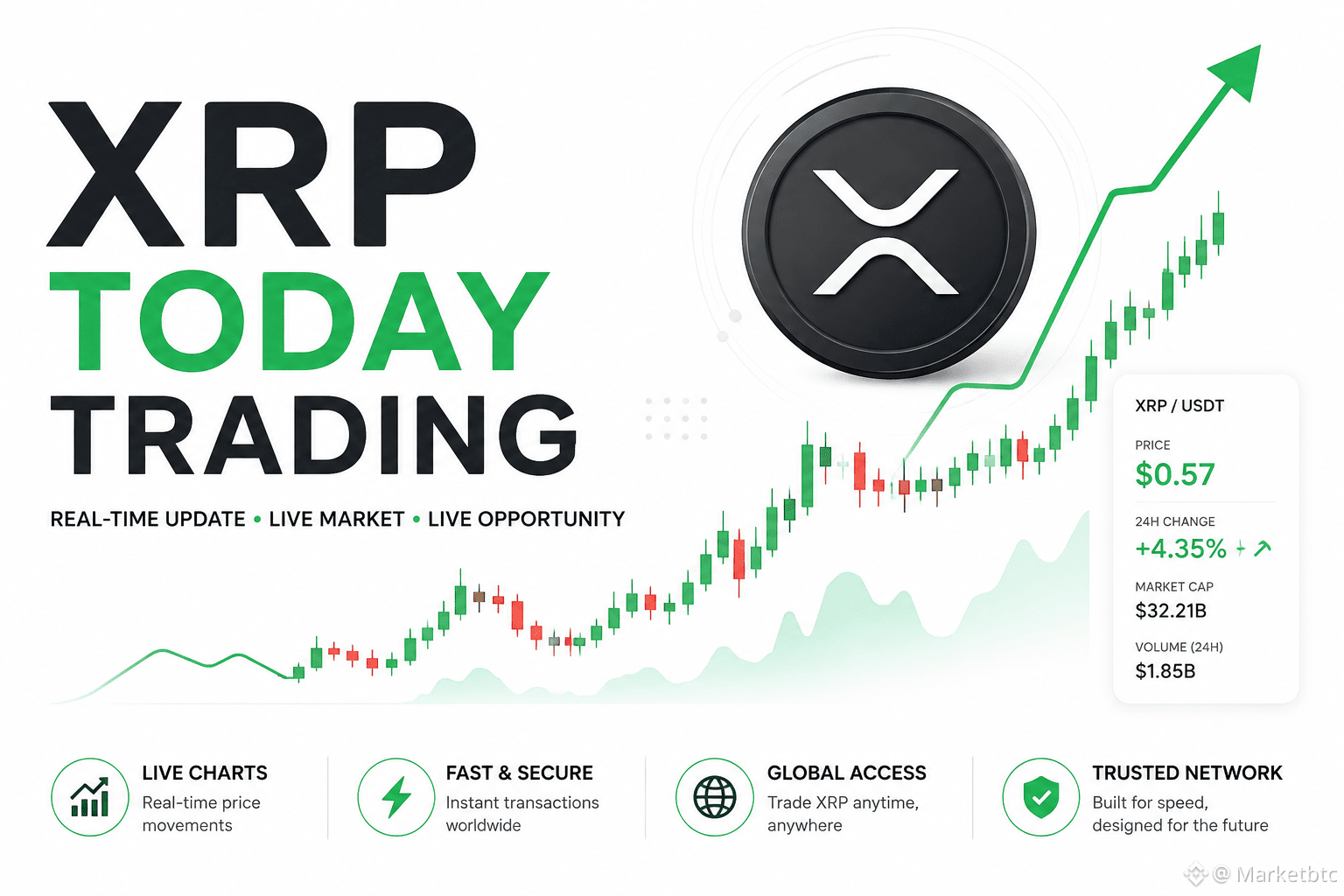
yoday high$1.59 $1.50
Volume today ~957M XRP on OKX alone.
Not financial advice. If you are trading today, watch the escrow wallet activity if Ripple relocks quickly, usually bounce. If not, short-term pressure.
You want spot or futures setup?$GOOGL.US #HangSengFalls1% $NVDA.US #USCryptoLinkedEquityIndexRises8.81%InAugust
yoday high$1.59 $1.50
Volume today ~957M XRP on OKX alone.
Not financial advice. If you are trading today, watch the escrow wallet activity if Ripple relocks quickly, usually bounce. If not, short-term pressure.
You want spot or futures setup?$GOOGL.US #HangSengFalls1% $NVDA.US #USCryptoLinkedEquityIndexRises8.81%InAugust
Volume today ~957M XRP on OKX alone.
Not financial advice. If you are trading today, watch the escrow wallet activity if Ripple relocks quickly, usually bounce. If not, short-term pressure.
You want spot or futures setup?$GOOGL.US #HangSengFalls1% $NVDA.US #USCryptoLinkedEquityIndexRises8.81%InAugust
206
·
--
Bullish
What to watch tomorrow
Support:* $78,000 -$7o,500 - this level held Friday, if it breaks we could see quick dip to $78.5k
- *Resistance:$83,300 - $81,237 - last week's 3-month high
Risk:* RSI is at 81.83 - most overbought since March 2024. Historically September is weak for BTC - traders expect choppiness. 079cea90
Trading bias for tomorrow
Slight pullback / consolidation likely before next leg. Many desks are watching $77k as buy-the-dip, and $81k-$81k as take-profit.
Not financial advice - if you're trading short term, watch ETF flow data at US open and dollar index, those have been driving price this week more than news.
$NVDA.US #KospiDrops3.6%AsSamsungSKHynixWeaken
You want a long/short setup for Binance futures or spot plan?$BTC #BTC☀️
What to watch tomorrow
Support:* $78,000 -$7o,500 - this level held Friday, if it breaks we could see quick dip to $78.5k
- *Resistance:$83,300 - $81,237 - last week's 3-month high
Risk:* RSI is at 81.83 - most overbought since March 2024. Historically September is weak for BTC - traders expect choppiness. 079cea90
Trading bias for tomorrow
Slight pullback / consolidation likely before next leg. Many desks are watching $77k as buy-the-dip, and $81k-$81k as take-profit.
Not financial advice - if you're trading short term, watch ETF flow data at US open and dollar index, those have been driving price this week more than news.
$NVDA.US #KospiDrops3.6%AsSamsungSKHynixWeaken
You want a long/short setup for Binance futures or spot plan?$BTC #BTC☀️
Support:* $78,000 -$7o,500 - this level held Friday, if it breaks we could see quick dip to $78.5k
- *Resistance:$83,300 - $81,237 - last week's 3-month high
Risk:* RSI is at 81.83 - most overbought since March 2024. Historically September is weak for BTC - traders expect choppiness. 079cea90
Trading bias for tomorrow
Slight pullback / consolidation likely before next leg. Many desks are watching $77k as buy-the-dip, and $81k-$81k as take-profit.
Not financial advice - if you're trading short term, watch ETF flow data at US open and dollar index, those have been driving price this week more than news.
$NVDA.US #KospiDrops3.6%AsSamsungSKHynixWeaken
You want a long/short setup for Binance futures or spot plan?$BTC #BTC☀️

129
·
--
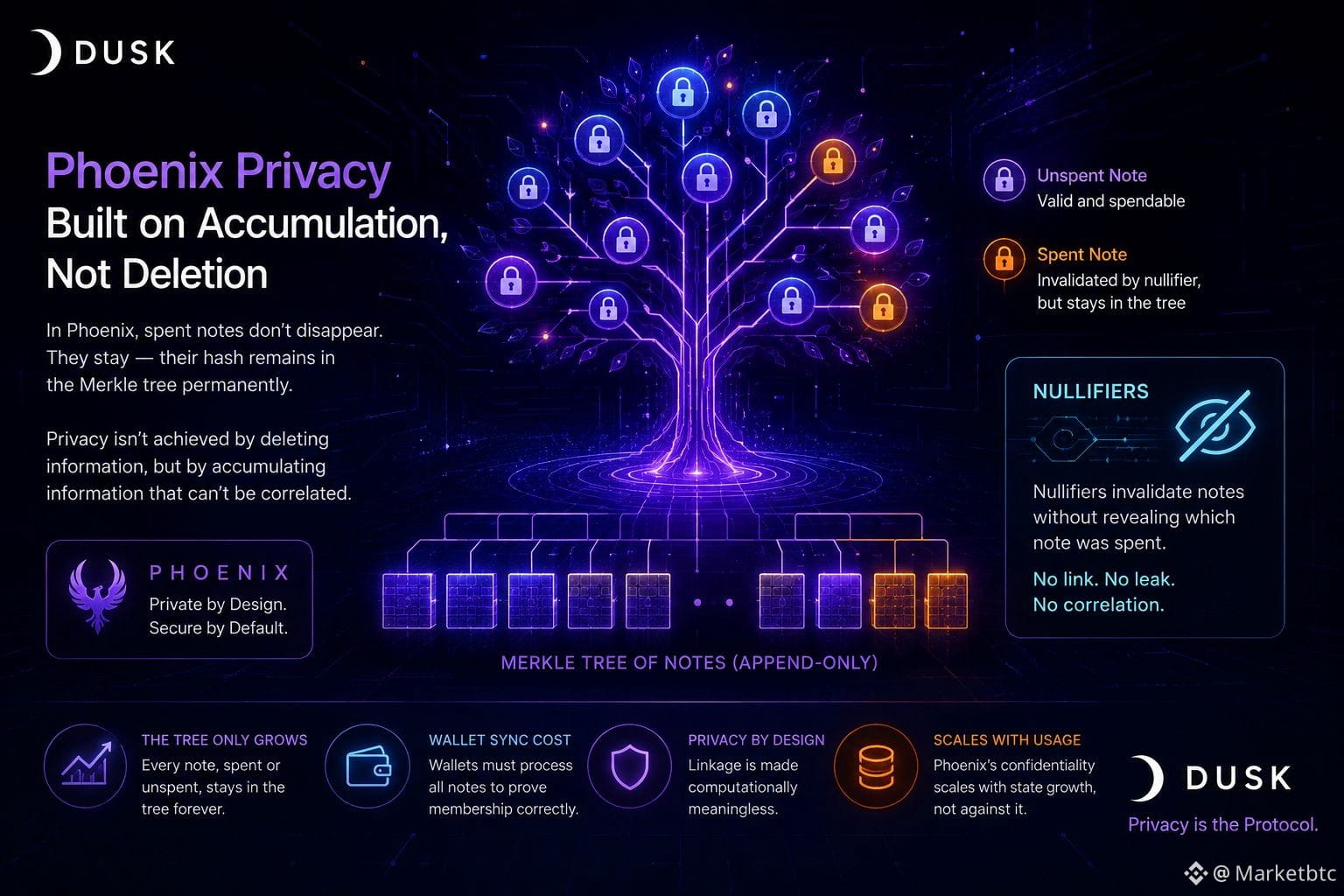
I Was looking at how Phoenix handles spent notes, expecting nullifiers to just quietly invalidate old UTXOs and move on. That's the mental model transparent chains give you: a spend happens, the record updates, old data becomes irrelevant.
But that's not quite what happens here. The old note doesn't disappear. Its hash stays in the Merkle tree of notes permanently — spent or not, the leaf is still there, because the tree is append-only and the network can't selectively prune a note without leaking which ones were real spends versus decoys. The nullifier is what invalidates the note going forward, and it's deliberately built so no observer can link a nullifier back to the note it came from.
Which made me pause: privacy here isn't achieved by deleting information, it's achieved by accumulating information that can't be correlated. The tree only grows. Every wallet syncing from scratch has to walk a note set that's larger than the actual unspent balance it cares about — spent notes are dead weight it still has to process to prove membership correctly.
That's not necessarily a flaw. It's the cost of making linkage computationally meaningless instead of legally forbidden. But it does mean Phoenix's confidentiality scales with state growth, not against it — worth watching as usage compounds. #dusk $DUSK @Dusk_Foundation
I Was looking at how Phoenix handles spent notes, expecting nullifiers to just quietly invalidate old UTXOs and move on. That's the mental model transparent chains give you: a spend happens, the record updates, old data becomes irrelevant.
But that's not quite what happens here. The old note doesn't disappear. Its hash stays in the Merkle tree of notes permanently — spent or not, the leaf is still there, because the tree is append-only and the network can't selectively prune a note without leaking which ones were real spends versus decoys. The nullifier is what invalidates the note going forward, and it's deliberately built so no observer can link a nullifier back to the note it came from.
Which made me pause: privacy here isn't achieved by deleting information, it's achieved by accumulating information that can't be correlated. The tree only grows. Every wallet syncing from scratch has to walk a note set that's larger than the actual unspent balance it cares about — spent notes are dead weight it still has to process to prove membership correctly.
That's not necessarily a flaw. It's the cost of making linkage computationally meaningless instead of legally forbidden. But it does mean Phoenix's confidentiality scales with state growth, not against it — worth watching as usage compounds. #dusk $DUSK @Dusk
But that's not quite what happens here. The old note doesn't disappear. Its hash stays in the Merkle tree of notes permanently — spent or not, the leaf is still there, because the tree is append-only and the network can't selectively prune a note without leaking which ones were real spends versus decoys. The nullifier is what invalidates the note going forward, and it's deliberately built so no observer can link a nullifier back to the note it came from.
Which made me pause: privacy here isn't achieved by deleting information, it's achieved by accumulating information that can't be correlated. The tree only grows. Every wallet syncing from scratch has to walk a note set that's larger than the actual unspent balance it cares about — spent notes are dead weight it still has to process to prove membership correctly.
That's not necessarily a flaw. It's the cost of making linkage computationally meaningless instead of legally forbidden. But it does mean Phoenix's confidentiality scales with state growth, not against it — worth watching as usage compounds. #dusk $DUSK @Dusk
67
·
--
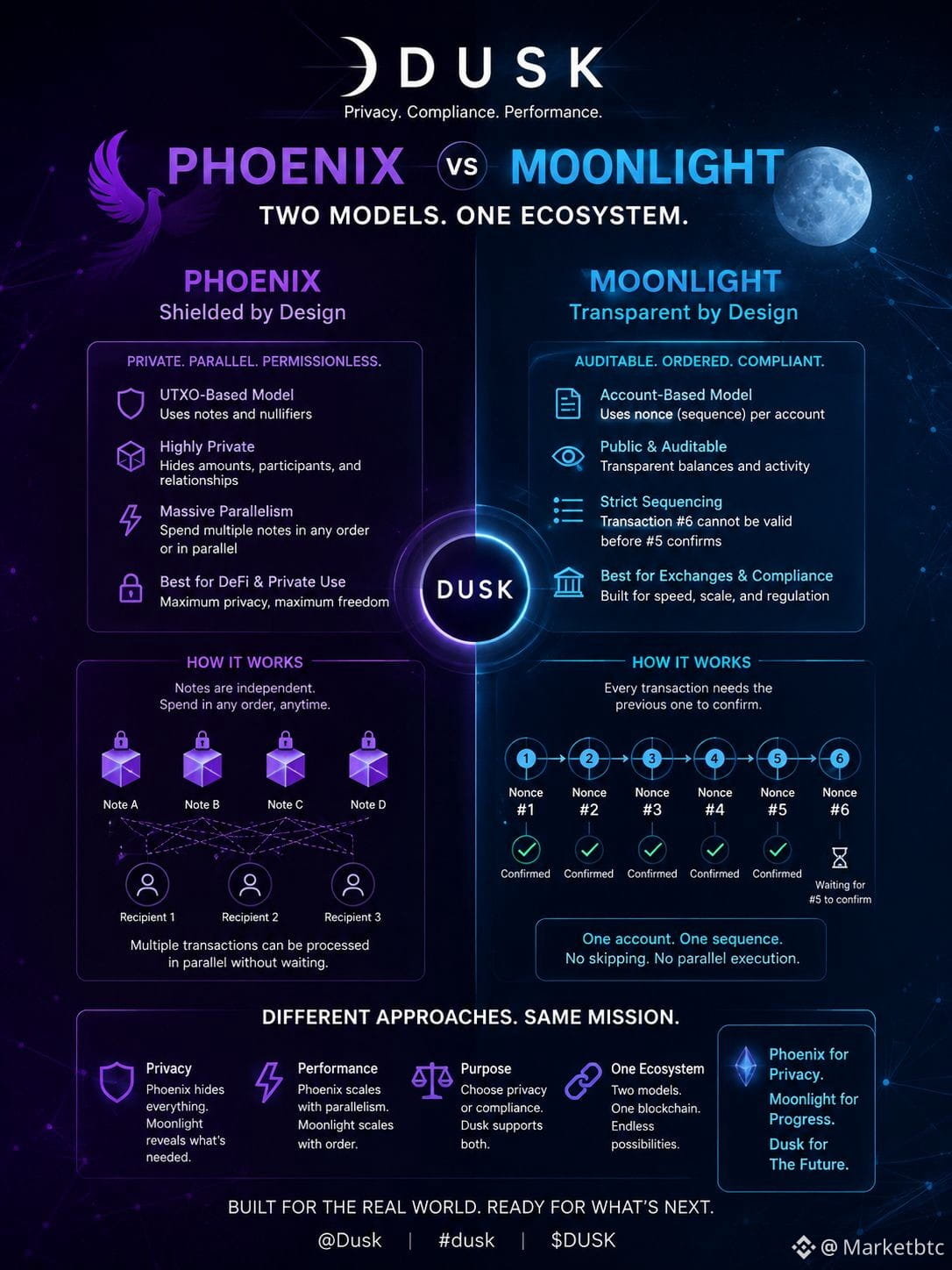
I was digging through Dusk's wallet provider docs, looking at how Moonlight transfers get submitted, and noticed the response includes a nonce alongside the hash. Small detail, but it stuck with me.
Phoenix, Dusk's shielded model, uses UTXO-style notes with nullifiers. Two notes owned by the same person are independent — you can spend them in any order, even in parallel, and the chain doesn't care which one lands first.
Moonlight breaks that. It's account-based, so every transaction increments a counter tied to your account. Wait — that means transaction #6 literally cannot be valid before #5 confirms. Not "shouldn't," can't. The protocol enforces strict sequencing.
That's where it gets interesting. Moonlight exists specifically for speed and compliance — exchange integrations, high-TPS use cases. But the thing that makes it auditable (a clean, ordered public ledger of account activity) is the same thing that makes it serially bottlenecked per account. You can't fire off five Moonlight transfers from one wallet simultaneously and expect them all through cleanly. Phoenix, ironically, has more parallelism precisely because it hides more.
I don't think this is a flaw — it's a reasonable trade for auditability. But it does mean "Moonlight = faster" isn't quite the full picture at the account level.
@Dusk_Foundation #dusk $DUSK
/Create a graphic design image background full screen
I was digging through Dusk's wallet provider docs, looking at how Moonlight transfers get submitted, and noticed the response includes a nonce alongside the hash. Small detail, but it stuck with me.
Phoenix, Dusk's shielded model, uses UTXO-style notes with nullifiers. Two notes owned by the same person are independent — you can spend them in any order, even in parallel, and the chain doesn't care which one lands first.
Moonlight breaks that. It's account-based, so every transaction increments a counter tied to your account. Wait — that means transaction #6 literally cannot be valid before #5 confirms. Not "shouldn't," can't. The protocol enforces strict sequencing.
That's where it gets interesting. Moonlight exists specifically for speed and compliance — exchange integrations, high-TPS use cases. But the thing that makes it auditable (a clean, ordered public ledger of account activity) is the same thing that makes it serially bottlenecked per account. You can't fire off five Moonlight transfers from one wallet simultaneously and expect them all through cleanly. Phoenix, ironically, has more parallelism precisely because it hides more.
I don't think this is a flaw — it's a reasonable trade for auditability. But it does mean "Moonlight = faster" isn't quite the full picture at the account level.
@Dusk #dusk $DUSK
/Create a graphic design image background full screen
Phoenix, Dusk's shielded model, uses UTXO-style notes with nullifiers. Two notes owned by the same person are independent — you can spend them in any order, even in parallel, and the chain doesn't care which one lands first.
Moonlight breaks that. It's account-based, so every transaction increments a counter tied to your account. Wait — that means transaction #6 literally cannot be valid before #5 confirms. Not "shouldn't," can't. The protocol enforces strict sequencing.
That's where it gets interesting. Moonlight exists specifically for speed and compliance — exchange integrations, high-TPS use cases. But the thing that makes it auditable (a clean, ordered public ledger of account activity) is the same thing that makes it serially bottlenecked per account. You can't fire off five Moonlight transfers from one wallet simultaneously and expect them all through cleanly. Phoenix, ironically, has more parallelism precisely because it hides more.
I don't think this is a flaw — it's a reasonable trade for auditability. But it does mean "Moonlight = faster" isn't quite the full picture at the account level.
@Dusk #dusk $DUSK
/Create a graphic design image background full screen
73
·
--
Bearish
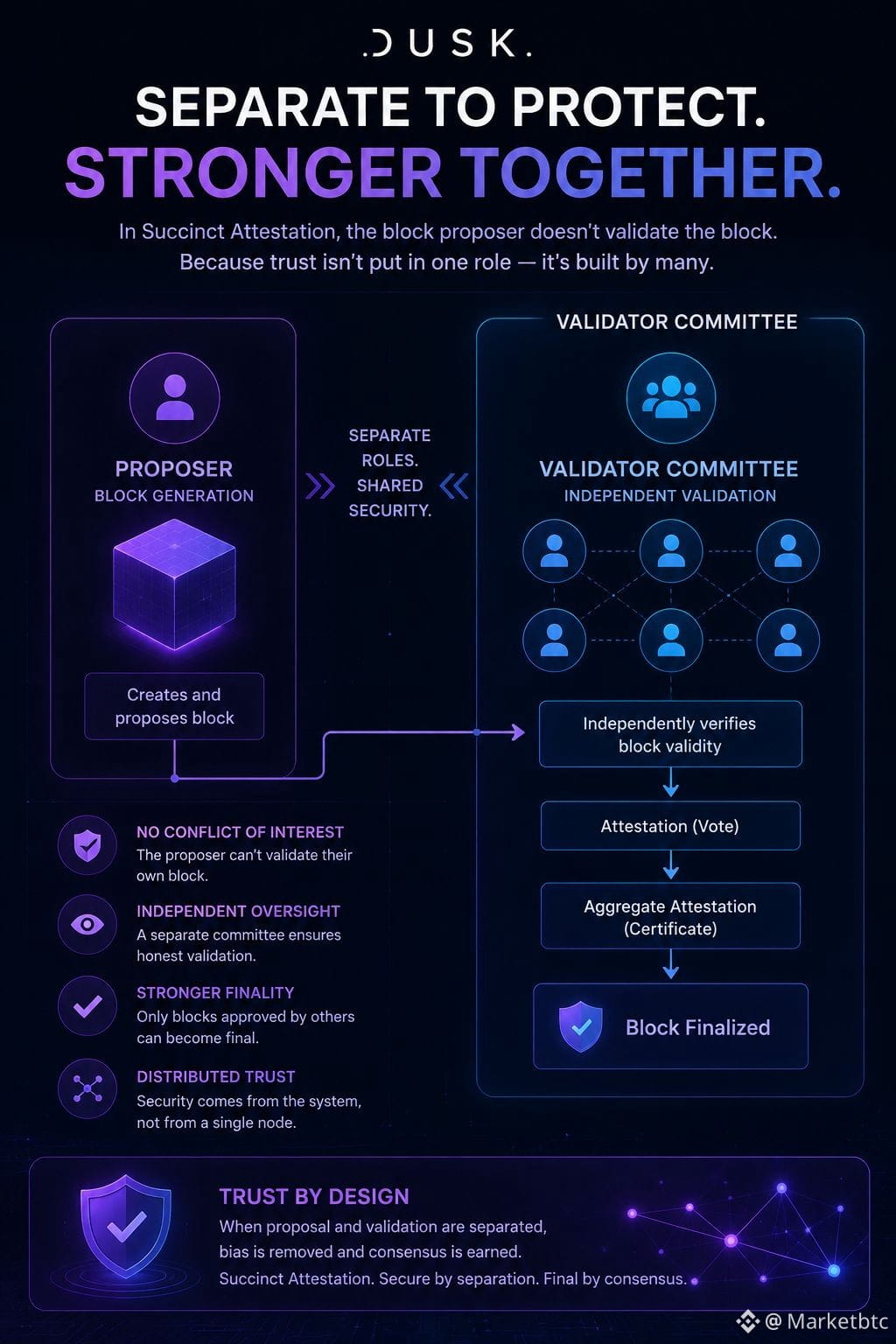
#dusk $DUSK @Dusk_Foundation I was mapping out Dusk's Succinct Attestation consensus and got stuck on something small: the provisioner who gets selected to generate the next block doesn't also cast a validation vote on it.
My first assumption was that this was just an efficiency shortcut — why make the same node do double duty. But that's not quite it. Separating generation from validation means the block's legitimacy can't rest on the same party that built it. The proposer proposes, and a separate committee has to independently agree the block is valid before it finalizes.
That's where it gets interesting. In a lot of consensus designs, we treat "who proposes" and "who confirms" as roughly interchangeable roles rotating through the same validator set. Here the separation looks deliberate — it removes a subtle conflict of interest at the exact moment a block is most vulnerable to bias, when its author still has the most information about what's inside it.
I'm not sure this changes throughput or latency meaningfully. But it does change how I think about where trust actually sits in the system — not with any single elected node, but with the requirement that proposal and agreement never collapse into the same hands.
Still working out what happens at higher validator counts. @Dusk_Foundation #dusk $DUSK
#dusk $DUSK @Dusk I was mapping out Dusk's Succinct Attestation consensus and got stuck on something small: the provisioner who gets selected to generate the next block doesn't also cast a validation vote on it.
My first assumption was that this was just an efficiency shortcut — why make the same node do double duty. But that's not quite it. Separating generation from validation means the block's legitimacy can't rest on the same party that built it. The proposer proposes, and a separate committee has to independently agree the block is valid before it finalizes.
That's where it gets interesting. In a lot of consensus designs, we treat "who proposes" and "who confirms" as roughly interchangeable roles rotating through the same validator set. Here the separation looks deliberate — it removes a subtle conflict of interest at the exact moment a block is most vulnerable to bias, when its author still has the most information about what's inside it.
I'm not sure this changes throughput or latency meaningfully. But it does change how I think about where trust actually sits in the system — not with any single elected node, but with the requirement that proposal and agreement never collapse into the same hands.
Still working out what happens at higher validator counts. @Dusk #dusk $DUSK
My first assumption was that this was just an efficiency shortcut — why make the same node do double duty. But that's not quite it. Separating generation from validation means the block's legitimacy can't rest on the same party that built it. The proposer proposes, and a separate committee has to independently agree the block is valid before it finalizes.
That's where it gets interesting. In a lot of consensus designs, we treat "who proposes" and "who confirms" as roughly interchangeable roles rotating through the same validator set. Here the separation looks deliberate — it removes a subtle conflict of interest at the exact moment a block is most vulnerable to bias, when its author still has the most information about what's inside it.
I'm not sure this changes throughput or latency meaningfully. But it does change how I think about where trust actually sits in the system — not with any single elected node, but with the requirement that proposal and agreement never collapse into the same hands.
Still working out what happens at higher validator counts. @Dusk #dusk $DUSK
100
·
--
I was tracing how Dusk actually finalizes blocks, because the marketing line is always "irreversible finality in seconds." Technically true. But the docs break block status into stages — Accepted, Confirmed, Stable, Final — and that's where it got interesting.
A block being "Accepted" just means it passed the current round's three consensus steps. It can still be reorganized. "Confirmed" means later blocks build on it. Only "Final" is the deterministically guaranteed, cryptographically irreversible state where blocks are finalized through explicit cryptographic attestations rather than probabilistic confirmations
So the gap isn't in the consensus design — Succinct Attestation genuinely avoids Nakamoto-style probabilistic settlement. The gap is in when a wallet, exchange, or integrator treats a block as settled. If a user or app reads "Accepted" as final, that's not a protocol flaw, it's a UX assumption riding on top of a protocol that was actually built to prevent exactly that mistake.
For regulated asset settlement, that distinction isn't cosmetic — it's the difference between a compliant clearing event and a premature one.
Still wondering how conservative integrators default here once transaction volume on $DUSK scales past a handful of provisioner committees per round.
@Dusk_Foundation #DUSK
I was tracing how Dusk actually finalizes blocks, because the marketing line is always "irreversible finality in seconds." Technically true. But the docs break block status into stages — Accepted, Confirmed, Stable, Final — and that's where it got interesting.
A block being "Accepted" just means it passed the current round's three consensus steps. It can still be reorganized. "Confirmed" means later blocks build on it. Only "Final" is the deterministically guaranteed, cryptographically irreversible state where blocks are finalized through explicit cryptographic attestations rather than probabilistic confirmations
So the gap isn't in the consensus design — Succinct Attestation genuinely avoids Nakamoto-style probabilistic settlement. The gap is in when a wallet, exchange, or integrator treats a block as settled. If a user or app reads "Accepted" as final, that's not a protocol flaw, it's a UX assumption riding on top of a protocol that was actually built to prevent exactly that mistake.
For regulated asset settlement, that distinction isn't cosmetic — it's the difference between a compliant clearing event and a premature one.
Still wondering how conservative integrators default here once transaction volume on $DUSK scales past a handful of provisioner committees per round.
@Dusk #DUSK
A block being "Accepted" just means it passed the current round's three consensus steps. It can still be reorganized. "Confirmed" means later blocks build on it. Only "Final" is the deterministically guaranteed, cryptographically irreversible state where blocks are finalized through explicit cryptographic attestations rather than probabilistic confirmations
So the gap isn't in the consensus design — Succinct Attestation genuinely avoids Nakamoto-style probabilistic settlement. The gap is in when a wallet, exchange, or integrator treats a block as settled. If a user or app reads "Accepted" as final, that's not a protocol flaw, it's a UX assumption riding on top of a protocol that was actually built to prevent exactly that mistake.
For regulated asset settlement, that distinction isn't cosmetic — it's the difference between a compliant clearing event and a premature one.
Still wondering how conservative integrators default here once transaction volume on $DUSK scales past a handful of provisioner committees per round.
@Dusk #DUSK
88
·
--
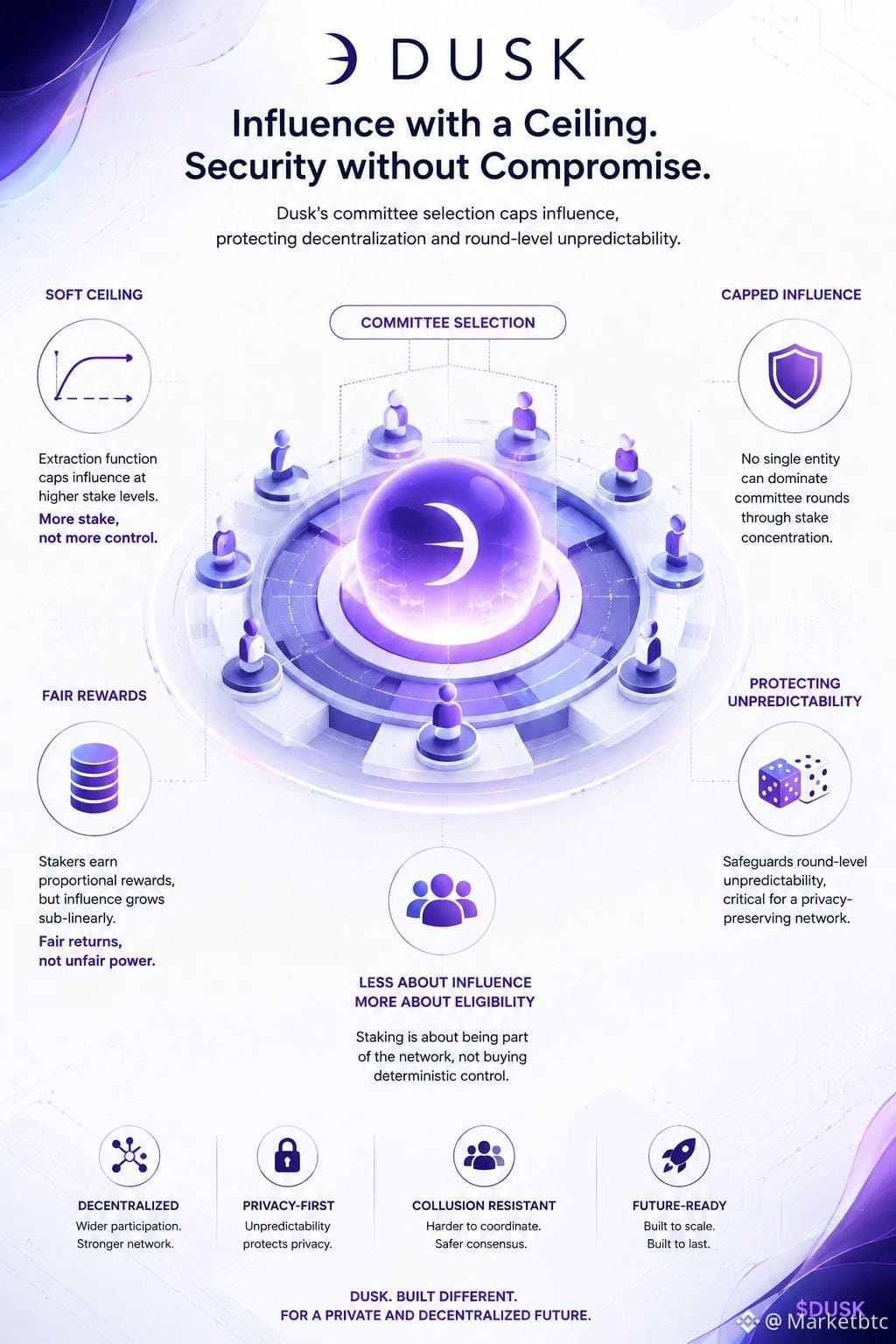
I was mapping how Dusk selects committees for block generation, expecting the usual story: stake weight in, voting power out, linear all the way. Bigger stake, bigger say.
Then I noticed the extraction function doesn't scale purely linearly once a staker's share gets large. There's a soft ceiling on how much influence any single stake position translates into for a given committee round. Wait — that's not how most PoS designs work.
Followed it further. If influence capped at the top, a whale can't just buy deterministic control over consensus rounds by concentrating stake. They still earn proportional rewards, but their probability of dominating committee selection doesn't grow at the same rate as their capital.
That's the part I hadn't considered: the mechanism isn't really about wealth redistribution, it's about protecting round-level unpredictability. Concentration risk in a privacy-preserving network is worse than in a transparent one — you can't just watch the mempool to catch collusion forming.
I'm not sure yet how this holds at 10x validator count, whether the cap becomes a bottleneck or stays a safeguard. But it reframed staking for me — less "buy influence," more "buy eligibility."
@Dusk_Foundation #dusk $DUSK
I was mapping how Dusk selects committees for block generation, expecting the usual story: stake weight in, voting power out, linear all the way. Bigger stake, bigger say.
Then I noticed the extraction function doesn't scale purely linearly once a staker's share gets large. There's a soft ceiling on how much influence any single stake position translates into for a given committee round. Wait — that's not how most PoS designs work.
Followed it further. If influence capped at the top, a whale can't just buy deterministic control over consensus rounds by concentrating stake. They still earn proportional rewards, but their probability of dominating committee selection doesn't grow at the same rate as their capital.
That's the part I hadn't considered: the mechanism isn't really about wealth redistribution, it's about protecting round-level unpredictability. Concentration risk in a privacy-preserving network is worse than in a transparent one — you can't just watch the mempool to catch collusion forming.
I'm not sure yet how this holds at 10x validator count, whether the cap becomes a bottleneck or stays a safeguard. But it reframed staking for me — less "buy influence," more "buy eligibility."
@Dusk #dusk $DUSK
Then I noticed the extraction function doesn't scale purely linearly once a staker's share gets large. There's a soft ceiling on how much influence any single stake position translates into for a given committee round. Wait — that's not how most PoS designs work.
Followed it further. If influence capped at the top, a whale can't just buy deterministic control over consensus rounds by concentrating stake. They still earn proportional rewards, but their probability of dominating committee selection doesn't grow at the same rate as their capital.
That's the part I hadn't considered: the mechanism isn't really about wealth redistribution, it's about protecting round-level unpredictability. Concentration risk in a privacy-preserving network is worse than in a transparent one — you can't just watch the mempool to catch collusion forming.
I'm not sure yet how this holds at 10x validator count, whether the cap becomes a bottleneck or stays a safeguard. But it reframed staking for me — less "buy influence," more "buy eligibility."
@Dusk #dusk $DUSK
2
1
112
·
--
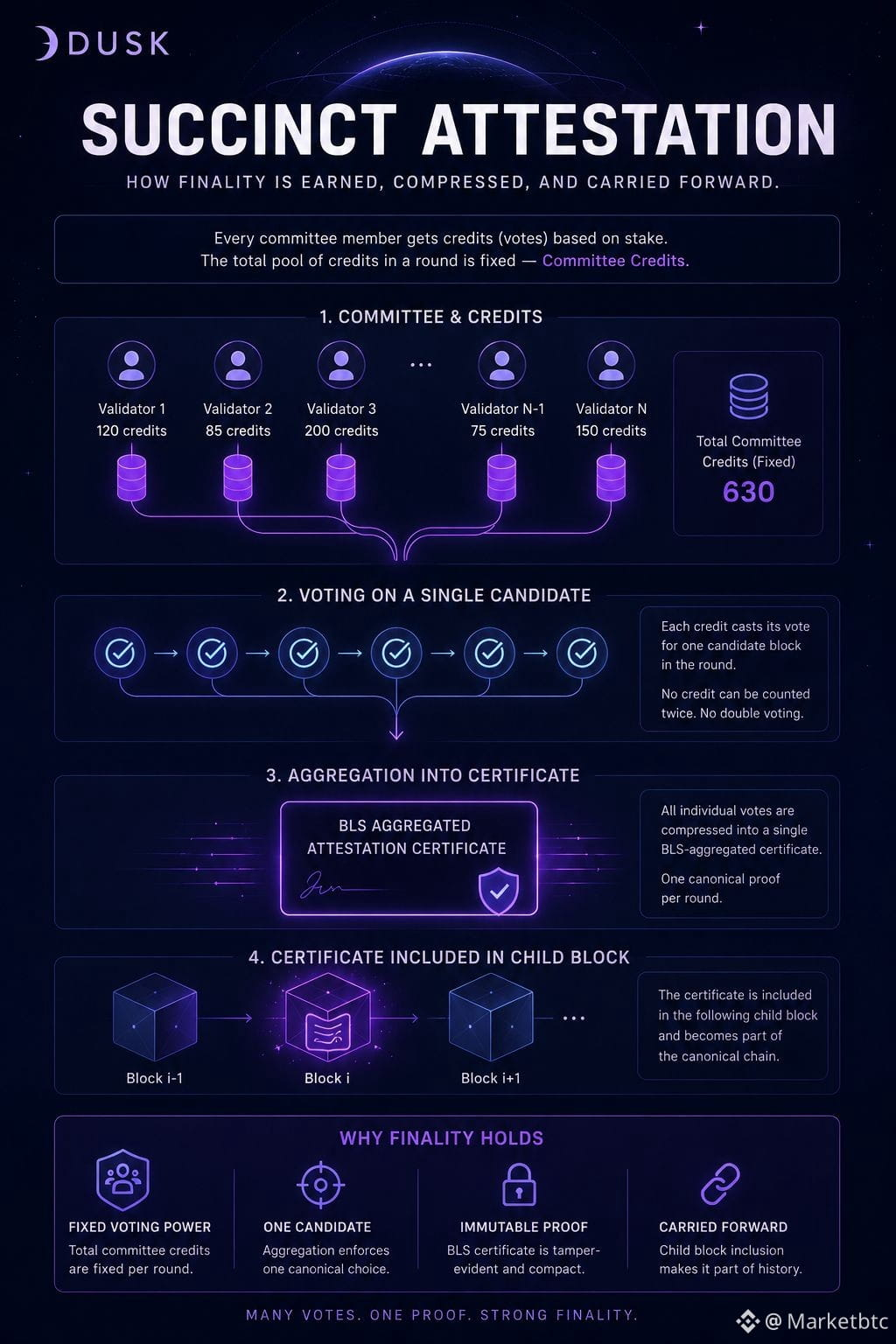
@Dusk_Foundation I was digging through Dusk's engineering updates, trying to understand how Succinct Attestation actually finalizes a block, not just the marketing line about "fast probabilistic finality." The part that stopped me: every committee member gets one or more votes, called credits, and the total pool of votes in a round is fixed the committee's votes are called Credits, and the number of votes in the committee is called Committee Credits. Fine, that's just weighted voting by stake. Not surprising.
What I hadn't considered is what happens to all those individual votes afterward. They don't just sit there as separate signatures. The block generator collects them and produces a certificate that is a valid attestation of a block, included in the following child block. So the "proof a block is legitimate" isn't one validator's word, it's every credited vote compressed into a single BLS-aggregated object, and that object is what future consensus actually references.
That's where the uniqueness problem quietly disappears. Aggregation forces every credit to point at one candidate per round. You can't have your vote counted twice, or counted for two competing blocks, because the certificate only has room for one canonical set. Not a UX feature. It's the thing making finality mean anything at all in $DUSK #dusk consensus. Still not sure how it behaves under heavy iteration timeouts though.
@Dusk I was digging through Dusk's engineering updates, trying to understand how Succinct Attestation actually finalizes a block, not just the marketing line about "fast probabilistic finality." The part that stopped me: every committee member gets one or more votes, called credits, and the total pool of votes in a round is fixed the committee's votes are called Credits, and the number of votes in the committee is called Committee Credits. Fine, that's just weighted voting by stake. Not surprising.
What I hadn't considered is what happens to all those individual votes afterward. They don't just sit there as separate signatures. The block generator collects them and produces a certificate that is a valid attestation of a block, included in the following child block. So the "proof a block is legitimate" isn't one validator's word, it's every credited vote compressed into a single BLS-aggregated object, and that object is what future consensus actually references.
That's where the uniqueness problem quietly disappears. Aggregation forces every credit to point at one candidate per round. You can't have your vote counted twice, or counted for two competing blocks, because the certificate only has room for one canonical set. Not a UX feature. It's the thing making finality mean anything at all in $DUSK #dusk consensus. Still not sure how it behaves under heavy iteration timeouts though.
What I hadn't considered is what happens to all those individual votes afterward. They don't just sit there as separate signatures. The block generator collects them and produces a certificate that is a valid attestation of a block, included in the following child block. So the "proof a block is legitimate" isn't one validator's word, it's every credited vote compressed into a single BLS-aggregated object, and that object is what future consensus actually references.
That's where the uniqueness problem quietly disappears. Aggregation forces every credit to point at one candidate per round. You can't have your vote counted twice, or counted for two competing blocks, because the certificate only has room for one canonical set. Not a UX feature. It's the thing making finality mean anything at all in $DUSK #dusk consensus. Still not sure how it behaves under heavy iteration timeouts though.
84
·
--
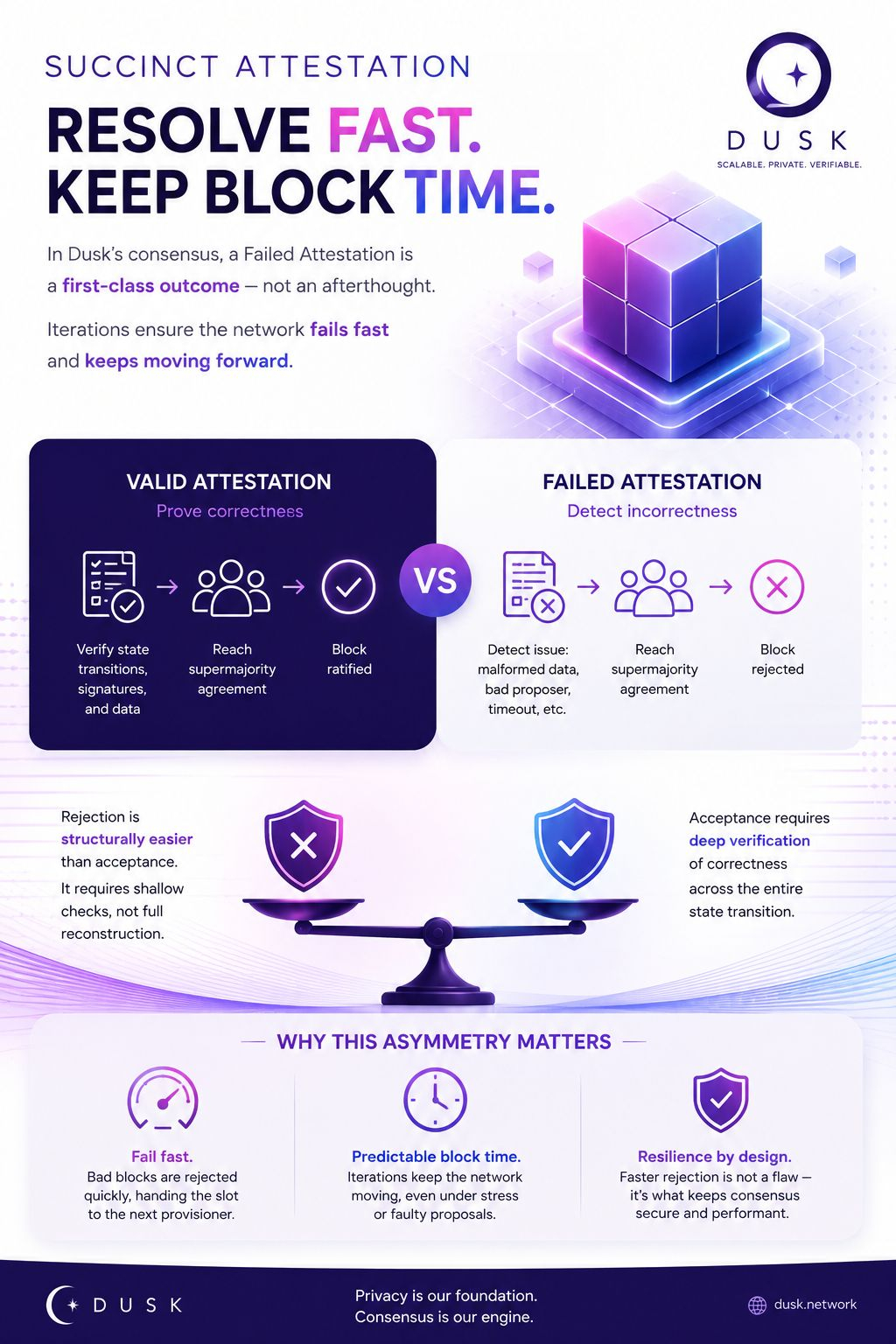
Been digging into how Succinct Attestation actually resolves an iteration, and something about the failure path kept nagging at me.
The obvious story: a committee validates a block, ratifies it, done. But Dusk's protocol doesn't just track "valid" — it tracks Attestations, and a Failed Attestation (a quorum agreeing a block is *not* valid) is a first-class outcome, not an afterthought.
Here's what I hadn't considered: rejecting is structurally easier than accepting. To ratify a valid block, the committee has to actually verify state transitions, signatures, the whole candidate. To reach a Failed Attestation, committee members just need supermajority agreement that *something* is wrong — malformed data, a bad proposer, a timeout. That's a much shallower check.
So mechanically, a bad block can clear its quorum threshold faster than a good one clears validation — not because the network favors invalid blocks, but because rejection doesn't require reconstructing correctness, just detecting its absence. That's not a flaw. It's actually why iterations exist at all: fail fast, hand the slot to the next provisioner, keep block time predictable.
Still working through what this asymmetry means once committee sizes shift with stake distribution. Does faster rejection become an attack surface, or just resilience by design?
@Dusk_Foundation #dusk $DUSK
Been digging into how Succinct Attestation actually resolves an iteration, and something about the failure path kept nagging at me.
The obvious story: a committee validates a block, ratifies it, done. But Dusk's protocol doesn't just track "valid" — it tracks Attestations, and a Failed Attestation (a quorum agreeing a block is *not* valid) is a first-class outcome, not an afterthought.
Here's what I hadn't considered: rejecting is structurally easier than accepting. To ratify a valid block, the committee has to actually verify state transitions, signatures, the whole candidate. To reach a Failed Attestation, committee members just need supermajority agreement that *something* is wrong — malformed data, a bad proposer, a timeout. That's a much shallower check.
So mechanically, a bad block can clear its quorum threshold faster than a good one clears validation — not because the network favors invalid blocks, but because rejection doesn't require reconstructing correctness, just detecting its absence. That's not a flaw. It's actually why iterations exist at all: fail fast, hand the slot to the next provisioner, keep block time predictable.
Still working through what this asymmetry means once committee sizes shift with stake distribution. Does faster rejection become an attack surface, or just resilience by design?
@Dusk #dusk $DUSK
The obvious story: a committee validates a block, ratifies it, done. But Dusk's protocol doesn't just track "valid" — it tracks Attestations, and a Failed Attestation (a quorum agreeing a block is *not* valid) is a first-class outcome, not an afterthought.
Here's what I hadn't considered: rejecting is structurally easier than accepting. To ratify a valid block, the committee has to actually verify state transitions, signatures, the whole candidate. To reach a Failed Attestation, committee members just need supermajority agreement that *something* is wrong — malformed data, a bad proposer, a timeout. That's a much shallower check.
So mechanically, a bad block can clear its quorum threshold faster than a good one clears validation — not because the network favors invalid blocks, but because rejection doesn't require reconstructing correctness, just detecting its absence. That's not a flaw. It's actually why iterations exist at all: fail fast, hand the slot to the next provisioner, keep block time predictable.
Still working through what this asymmetry means once committee sizes shift with stake distribution. Does faster rejection become an attack surface, or just resilience by design?
@Dusk #dusk $DUSK
106
·
--
I was digging into Dusk's Succinct Attestation consensus, trying to understand what actually happens when a committee fails to produce a block in a given iteration. My assumption going in: a failed iteration means something went wrong — a fault, a missed slot, a problem to route around.
That's not quite it.
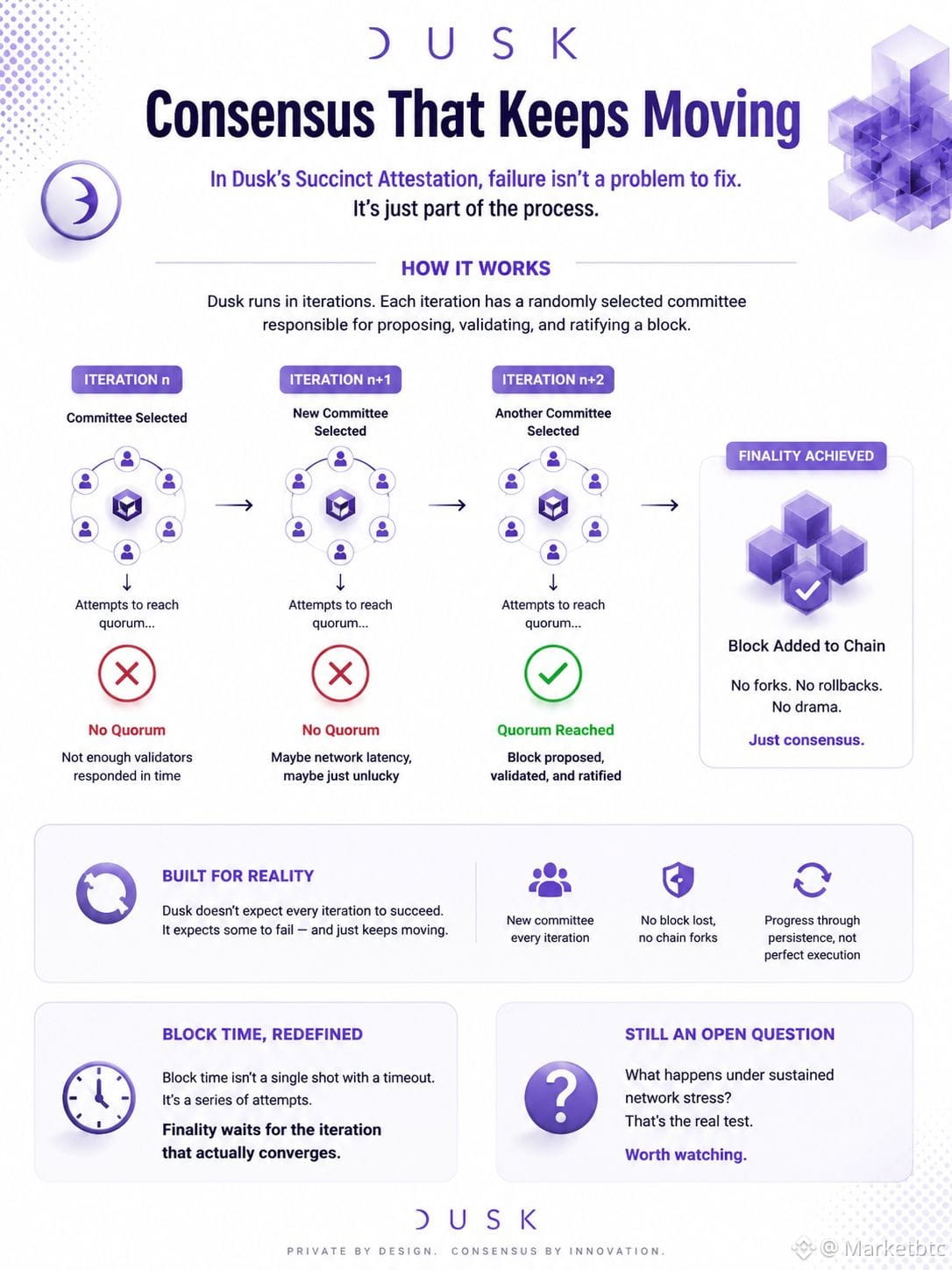
Dusk's consensus runs in iterations, each with its own randomly selected committee for proposal, validation, and ratification. If a committee doesn't reach quorum — maybe not enough validators responded in time, maybe network latency, nothing dramatic — the system doesn't treat that as a failure to patch. It just moves to the next iteration with a freshly selected committee. No block is lost, no chain forks, no rollback. The attempt simply expires and consensus tries again with different validators holding the responsibility.
What struck me is that this isn't a fallback bolted onto the design. It's the default expectation. The protocol assumes some iterations won't finalize, and builds the committee rotation around that assumption rather than around the hope that every iteration succeeds.
That changes how I read "block time" for Dusk. It's not one attempt with a timeout — it's a sequence of attempts where failure is routine, not exceptional, and finality just waits for whichever iteration actually converges.
I'm still not sure how this behaves under sustained network stress rather than isolated missed quorums. @Dusk_Foundation #dusk $DUSK
I was digging into Dusk's Succinct Attestation consensus, trying to understand what actually happens when a committee fails to produce a block in a given iteration. My assumption going in: a failed iteration means something went wrong — a fault, a missed slot, a problem to route around.
That's not quite it.
Dusk's consensus runs in iterations, each with its own randomly selected committee for proposal, validation, and ratification. If a committee doesn't reach quorum — maybe not enough validators responded in time, maybe network latency, nothing dramatic — the system doesn't treat that as a failure to patch. It just moves to the next iteration with a freshly selected committee. No block is lost, no chain forks, no rollback. The attempt simply expires and consensus tries again with different validators holding the responsibility.
What struck me is that this isn't a fallback bolted onto the design. It's the default expectation. The protocol assumes some iterations won't finalize, and builds the committee rotation around that assumption rather than around the hope that every iteration succeeds.
That changes how I read "block time" for Dusk. It's not one attempt with a timeout — it's a sequence of attempts where failure is routine, not exceptional, and finality just waits for whichever iteration actually converges.
I'm still not sure how this behaves under sustained network stress rather than isolated missed quorums. @Dusk #dusk $DUSK
That's not quite it.
Dusk's consensus runs in iterations, each with its own randomly selected committee for proposal, validation, and ratification. If a committee doesn't reach quorum — maybe not enough validators responded in time, maybe network latency, nothing dramatic — the system doesn't treat that as a failure to patch. It just moves to the next iteration with a freshly selected committee. No block is lost, no chain forks, no rollback. The attempt simply expires and consensus tries again with different validators holding the responsibility.
What struck me is that this isn't a fallback bolted onto the design. It's the default expectation. The protocol assumes some iterations won't finalize, and builds the committee rotation around that assumption rather than around the hope that every iteration succeeds.
That changes how I read "block time" for Dusk. It's not one attempt with a timeout — it's a sequence of attempts where failure is routine, not exceptional, and finality just waits for whichever iteration actually converges.
I'm still not sure how this behaves under sustained network stress rather than isolated missed quorums. @Dusk #dusk $DUSK
2
128
Log in to explore more content
Join global crypto users on Binance Square
⚡️ Get latest and useful information about crypto.
💬 Trusted by the world’s largest crypto exchange.
👍 Discover real insights from verified creators.
Email / Phone number
Trending Topics
WhatWillDriveCryptoandStocks’NextRebound?
50,006 views
698 Discussing
Bitcoin Slips Below $70,000 as Dollar Index Hits 19-Month High
Binance News
·16 Likes
·36k views
Anthropic’s6xIPODemandSignalsPotentialRecordRaise
16,274 views
340 Discussing
USCryptoETFsLose$1.48BInFiveDays
95 views
2 Discussing