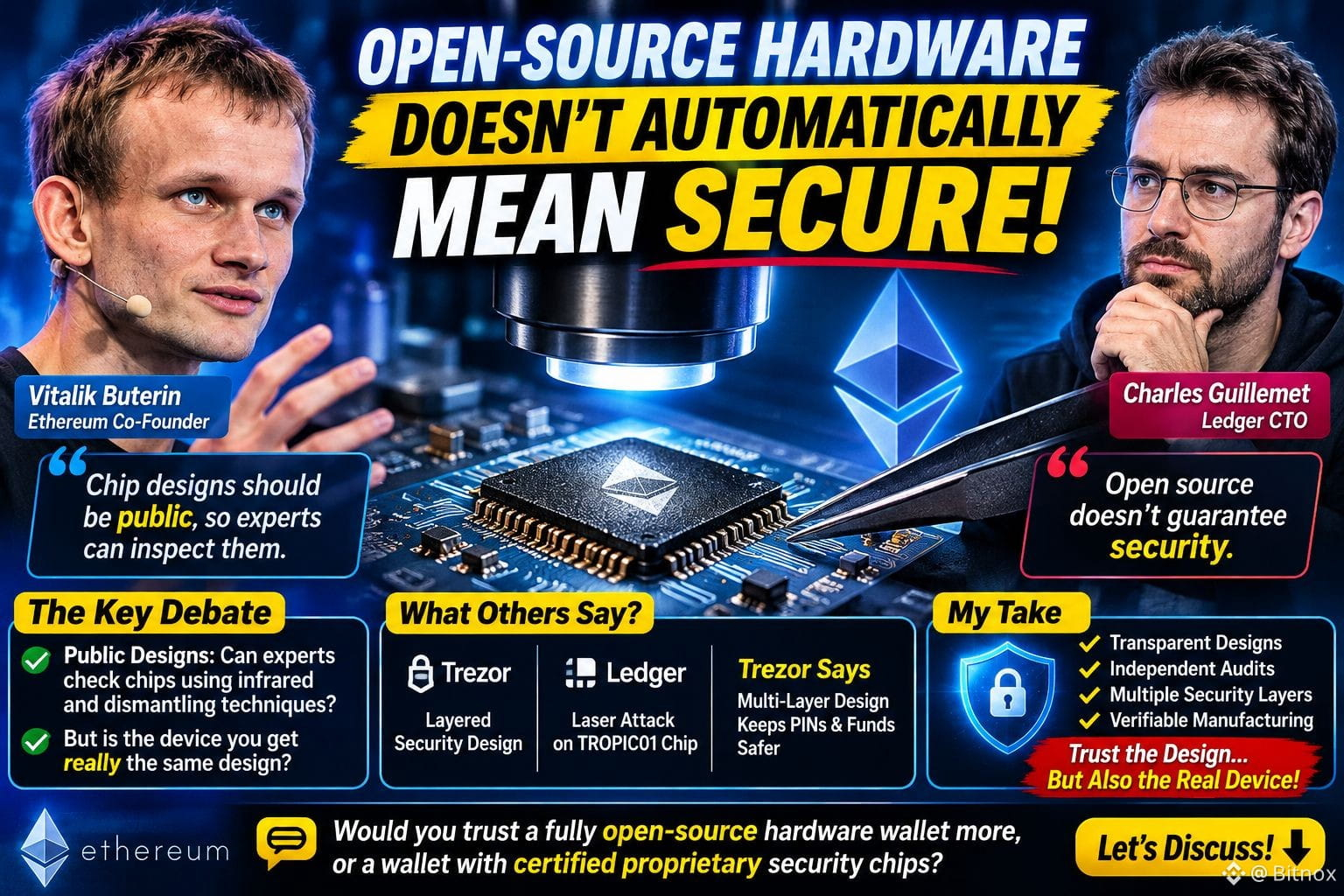
🔐 OPEN-SOURCE HARDWARE DOESN'T AUTOMATICALLY MEAN SECURE!
A new debate has emerged between Ethereum co-founder Vitalik Buterin and Ledger's CTO Charles Guillemet over the security of hardware wallets.
💡 Vitalik's Perspective: He believes hardware wallet chip designs should be publicly available, even down to factory-level drawings. Independent experts could then inspect physical chips using infrared imaging and advanced techniques to detect hidden modifications.
⚠️ Ledger's Counterargument: Charles Guillemet raises an important concern: Publishing a chip's design doesn't prove that the actual device in your hands matches those specifications.
And he's right about one thing: Open source doesn't automatically guarantee security.
🔍 The Bigger Picture:
• Trezor is experimenting with a layered security architecture. • Ledger's Donjon team previously demonstrated a laser-based attack against the TROPIC01 chip. • Trezor argues that its multi-layered architecture prevents that vulnerability alone from exposing users' PINs or funds.
🚀 My Take:
The future of crypto security shouldn't depend on trusting a single company.
We need transparent designs, independent hardware audits, multiple security layers, and verifiable manufacturing processes.
Because there's a big difference between trusting the design and trusting the actual device.
One question for the crypto community:
Would you trust a fully open-source hardware wallet more, or a wallet with certified proprietary security chips?
👇 Let's discuss!
#VitalikWantsWalletChipDesignsOpened #Ledger #Trezor #CryptoSecurity #HardwareWallet
$BTC $ETH $BNB