
Sulaiman 零号猎人
2.9k Posts

Sulaiman 零号猎人
Report
Block User
I research RWA & micro-caps and check the facts before trusting a project. Open to collabs. X : @ZeroSulaiman
Open Trade
Frequent Trader
6.3 Years
175 Following
4.1K+ Followers
3.2K+ Liked
Posts
Portfolio
All
Quotes
Live
PINNED
🔥 THE ZERO HUNTERS ARE WATCHING.
🥇 $PORTAL
🥈 $HAEDAL
🥉 $HEI
Three projects. One watchlist.
I don't chase pumps. I investigate the story before the crowd arrives.
🎁 Which project deserves the NEXT DEEP-DIVE?
PORTAL, HAEDAL or HEI?
NFA. Research first. Conviction second.
#PORTAL #HAEDAL #HEI #ZeroHunter
🥇 $PORTAL
🥈 $HAEDAL
🥉 $HEI
Three projects. One watchlist.
I don't chase pumps. I investigate the story before the crowd arrives.
🎁 Which project deserves the NEXT DEEP-DIVE?
PORTAL, HAEDAL or HEI?
NFA. Research first. Conviction second.
#PORTAL #HAEDAL #HEI #ZeroHunter

287
7
28
990
🔥 GREEN MARKET. BUT WHICH MOVERS DESERVE YOUR ATTENTION?
Three coins are standing out on this Binance Spot snapshot.
🚀 $ACE is leading the board with the strongest 24h move. Momentum is clear, but chasing a sharp move can be risky.
🌙 $NIGHT is showing solid strength. The question is whether buyers can sustain that momentum.
🤖 $SENT is also moving higher. I’m watching whether market interest turns into consistent volume and real demand.
My approach is simple:
I don't chase green candles. I watch volume, liquidity, market structure, and what happens after the initial move.
Which one deserves a closer look next?
— Sulaiman | Zero Hunter
#ZeroHunter #Binance #CryptoMarket #Altcoins
#EvolveAtBinanceBlockchainWeek

1
466
Binance Blockchain Week has a lot of talk. Here's how to tell which of it is real.
BBW Bangkok runs Nov 28–29 under the theme "Evolve." Day 1 covers capital: institutions, stablecoin payments, tokenized assets, 24/7 markets. Day 2 covers AI agents, DeFi infrastructure and pre-IPO perpetuals.
Most posts will repeat the headlines. My question is different: what will still matter in 3 months?
Context: BTC is trading near $60K, ETF flows were heavily negative in November (about $5.39B outflows), and sentiment is deep in fear. So the agenda is about where the industry is heading, while the market is still asking whether demand is returning. These are two separate stories.
📌 Save this: 5 checks to judge any conference announcement
Live or "coming soon"? A product that's already live with users beats a roadmap slide.
Is there a number? Payment volume, stablecoin flows, active users. Without data, it's just a pitch.
Who carries the risk? On AI agents especially: if an agent makes a bad trade, who is responsible, and how fast can you revoke its access?
What are the rights? For tokenized stocks and RWAs, holding a token is not always the same as owning the asset. Terms differ by jurisdiction. Read them first.
Does regulation catch up? Thailand's stablecoin rules were reportedly still in draft this week. A panel is not a license.
A conference creates headlines. Adoption shows up later in licenses, live products and on-chain activity. Event hype is not a trading signal.
Thesis: the real test of BBW is what ships in the next 3 months, not what's said on stage.
Invalidation: if announcements quickly turn into live products with visible usage, this skepticism is too cautious.
Which session are you watching, and what's the one question you'd ask the speakers?
Not financial advice. DYOR.
#ZeroHunter #Bitcoin #Stablecoins
$WLFI
{spot}(WLFIUSDT)
$ACE
{spot}(ACEUSDT)
$KAVA
{spot}(KAVAUSDT)
#evolveatbinanceblockchainweek
Binance Blockchain Week has a lot of talk. Here's how to tell which of it is real.
BBW Bangkok runs Nov 28–29 under the theme "Evolve." Day 1 covers capital: institutions, stablecoin payments, tokenized assets, 24/7 markets. Day 2 covers AI agents, DeFi infrastructure and pre-IPO perpetuals.
Most posts will repeat the headlines. My question is different: what will still matter in 3 months?
Context: BTC is trading near $60K, ETF flows were heavily negative in November (about $5.39B outflows), and sentiment is deep in fear. So the agenda is about where the industry is heading, while the market is still asking whether demand is returning. These are two separate stories.
📌 Save this: 5 checks to judge any conference announcement
Live or "coming soon"? A product that's already live with users beats a roadmap slide.
Is there a number? Payment volume, stablecoin flows, active users. Without data, it's just a pitch.
Who carries the risk? On AI agents especially: if an agent makes a bad trade, who is responsible, and how fast can you revoke its access?
What are the rights? For tokenized stocks and RWAs, holding a token is not always the same as owning the asset. Terms differ by jurisdiction. Read them first.
Does regulation catch up? Thailand's stablecoin rules were reportedly still in draft this week. A panel is not a license.
A conference creates headlines. Adoption shows up later in licenses, live products and on-chain activity. Event hype is not a trading signal.
Thesis: the real test of BBW is what ships in the next 3 months, not what's said on stage.
Invalidation: if announcements quickly turn into live products with visible usage, this skepticism is too cautious.
Which session are you watching, and what's the one question you'd ask the speakers?
Not financial advice. DYOR.
#ZeroHunter #Bitcoin #Stablecoins
$WLFI
$ACE
$KAVA
#evolveatbinanceblockchainweek

737
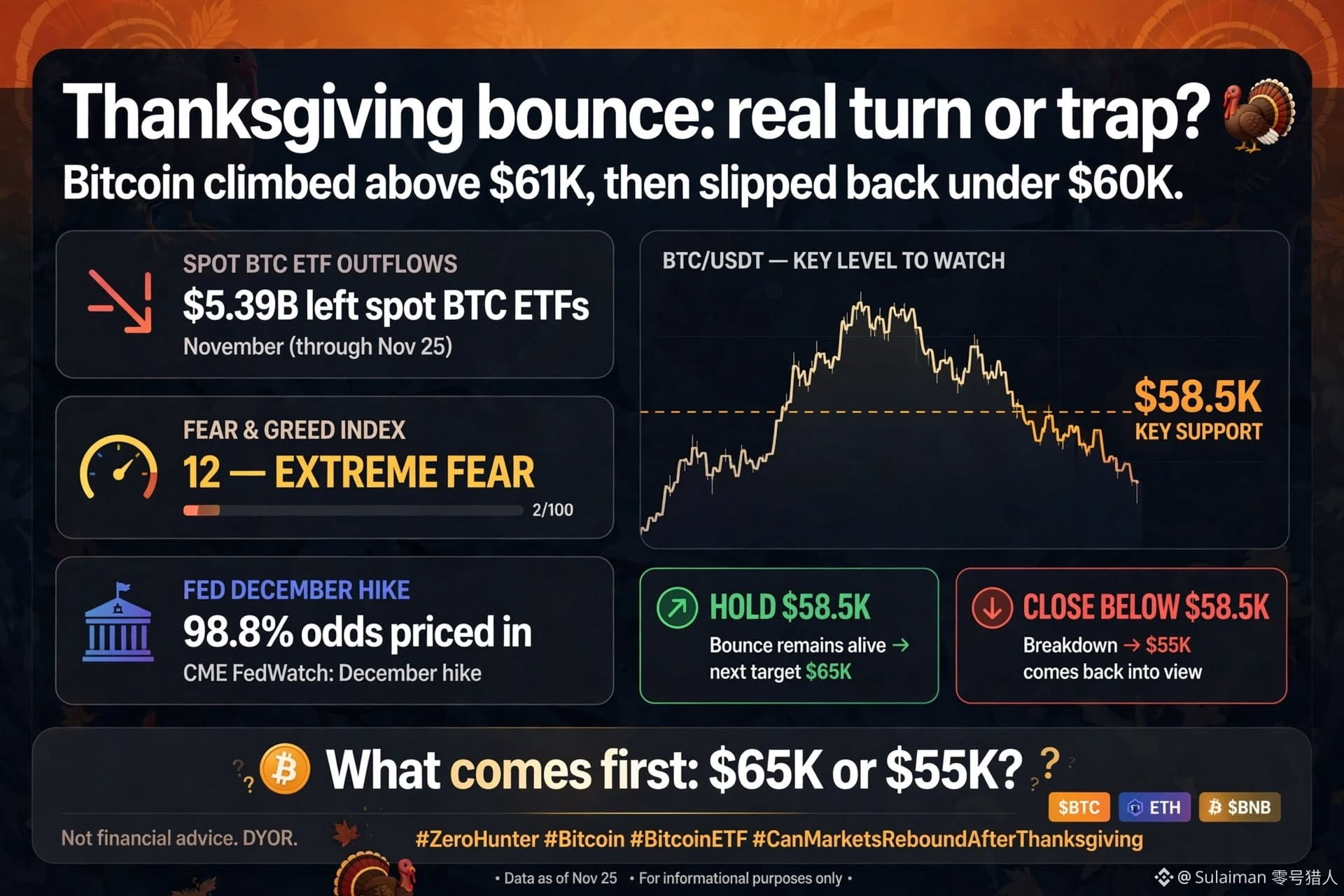
Thanksgiving bounce: real turn or trap? 🦃
Bitcoin climbed above $61K, then slipped back under $60K.
🔻 $5.39B left spot BTC ETFs in November (through Nov 25)
😨 Fear & Greed at 12
🏦 98.8% odds of a December Fed hike priced in
One level I'm watching: $58.5K.
Hold it, and the bounce is still alive. Close below it, and $55K comes back into view.
What comes first: $65K or $55K? 👇
Not financial advice. DYOR.
$BTC $ETH $XRP
#ZeroHunter #XRPLedgerVaultGets29Votes
#CanMarketsReboundAfterThanksgiving?
16
Go Now Friends $PORTAL
Go Now Friends $PORTAL

正乾--四条2
·
--
Today's news is absolutely explosive 🔥
Everyone:
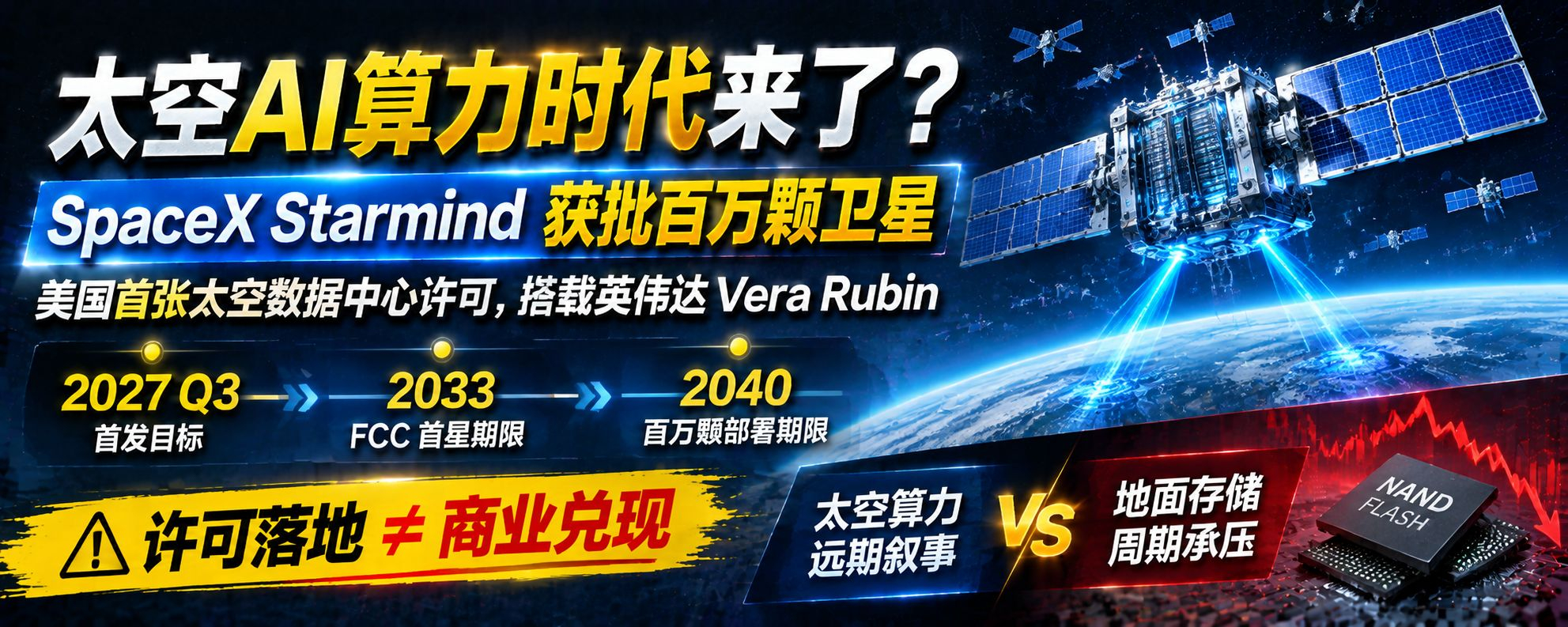
On November 25, the FCC approved SpaceX's Starmind! The first U.S. license for a space-based AI data center, with a cap of 1 million computing satellites equipped with NVIDIA Vera Rubin chips. Each satellite would deliver 120 kW, for a theoretical total of 120 GW of computing power at full capacity. While ground-based data centers are still constrained by power, cooling, and land, Musk is already targeting space-based solar-powered computing.
⚠️But be sure to pay attention to the timeline—don't get swept up in the grand vision: The FCC's compliance deadlines require the first satellite by 2033 at the latest, 100,000 satellites by 2035, and the full 1 million only by 2040. SpaceX's own targets are a first batch of launches in Q3 2027 and scaling up in 2028. The two timelines differ by a full six years. On the day of the news, SPCX fell more than 9% at one point during trading, recovering to just +1.3% by the close. It remains below its IPO price of 135. The upside is a long-term story; near-term profits simply can't be realized.
Meanwhile, on the same day, TrendForce lowered its outlook: NAND flash is expected to enter a downturn in 2027, putting pressure on memory demand. On one side is the vast potential of space-based computing; on the other, the terrestrial memory industry is already tapping the brakes.
And there's macro risk overhead: The probability of a rate hike on 12.8-9 is 95.8%, and Jensen Huang is also due to face three consecutive congressional hearings from 12.1-3. Market risk appetite is likely to shrink, and this kind of long-term narrative can easily be pushed to the back burner by investors.
The million-dollar question: Are you planning to wait until the first satellite actually reaches orbit before making a move, or are you betting now on expectations for 2027? Is this the next computing revolution, or just another trillion-dollar pipe dream?
欢迎加入正乾研习社
#AI算力 #Space #Starmind #太空算力
42
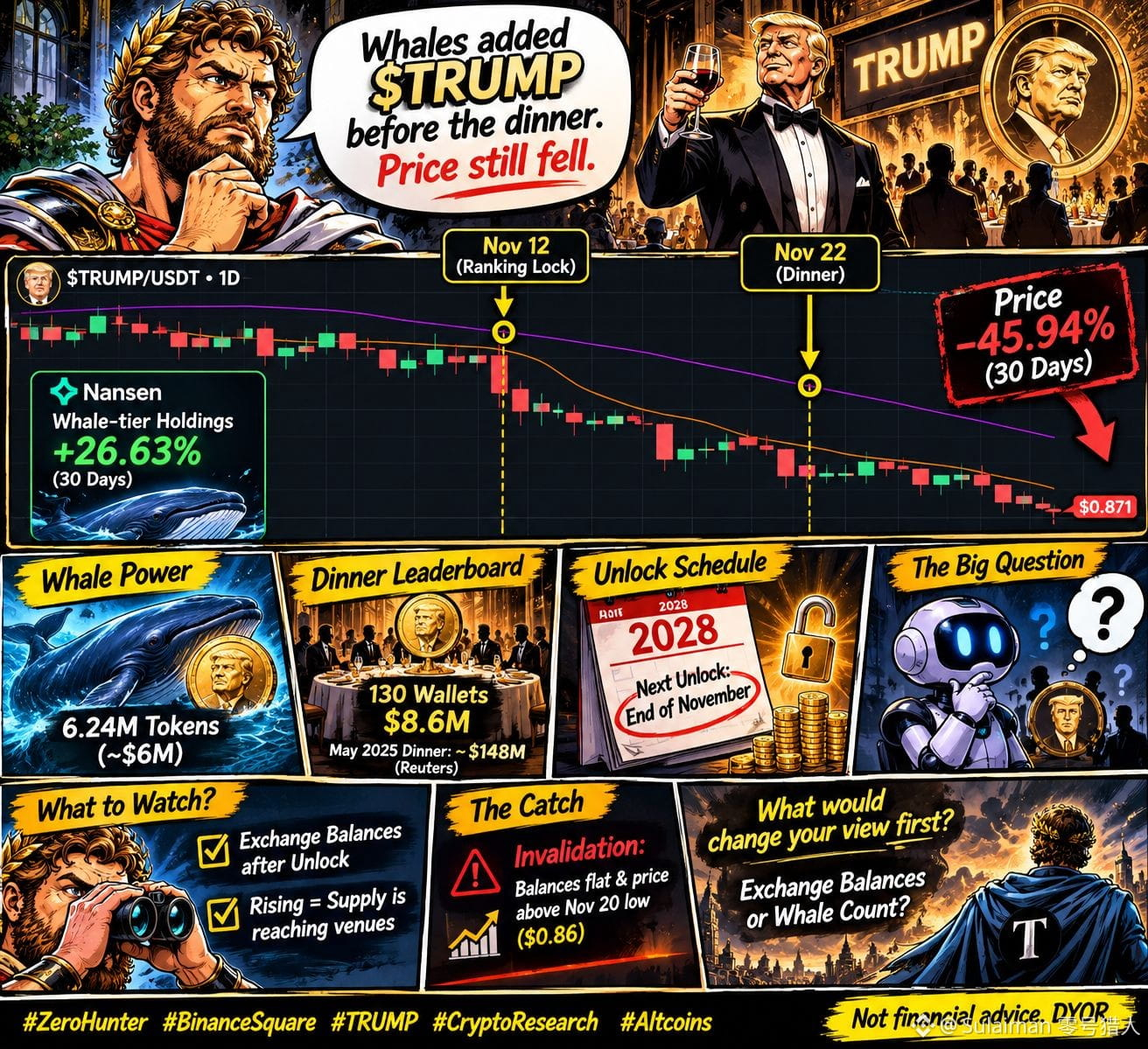
Whales added $TRUMP before the dinner. Price still fell.
Nansen: whale-tier holdings +26.63% in 30 days. Price: −45.94% over the same month.3
How? Size.
That whale tier holds about 6.24M tokens. Roughly $6M.
The dinner leaderboard: 130 wallets, $8.6M. For the May 2025 dinner, Reuters reported about $148M.
Meanwhile, unlocks run through 2028. The next batch is due at the end of November.3
I don't know the unlock size yet. That's the number I'm chasing.
Whale buying tells you who is accumulating. The unlock schedule tells you who is supplying.
What I'd watch: exchange balances after the unlock. Rising means supply is reaching venues. Flat means it isn't yet.3
Invalidation: balances flat and price holding above the Nov 20 closing low ($0.86) weakens the supply thesis.3
What would change your view first: exchange balances or whale count?
Not financial advice. DYOR.
$PORTAL
{spot}(PORTALUSDT)
$THE
{spot}(THEUSDT)
#TRUMP #TokenUnlock #OnChainData #ZeroHunter #Memecoin
Whales added $TRUMP before the dinner. Price still fell.
Nansen: whale-tier holdings +26.63% in 30 days. Price: −45.94% over the same month.3
How? Size.
That whale tier holds about 6.24M tokens. Roughly $6M.
The dinner leaderboard: 130 wallets, $8.6M. For the May 2025 dinner, Reuters reported about $148M.
Meanwhile, unlocks run through 2028. The next batch is due at the end of November.3
I don't know the unlock size yet. That's the number I'm chasing.
Whale buying tells you who is accumulating. The unlock schedule tells you who is supplying.
What I'd watch: exchange balances after the unlock. Rising means supply is reaching venues. Flat means it isn't yet.3
Invalidation: balances flat and price holding above the Nov 20 closing low ($0.86) weakens the supply thesis.3
What would change your view first: exchange balances or whale count?
Not financial advice. DYOR.
$PORTAL
$THE
#TRUMP #TokenUnlock #OnChainData #ZeroHunter #Memecoin
1
56
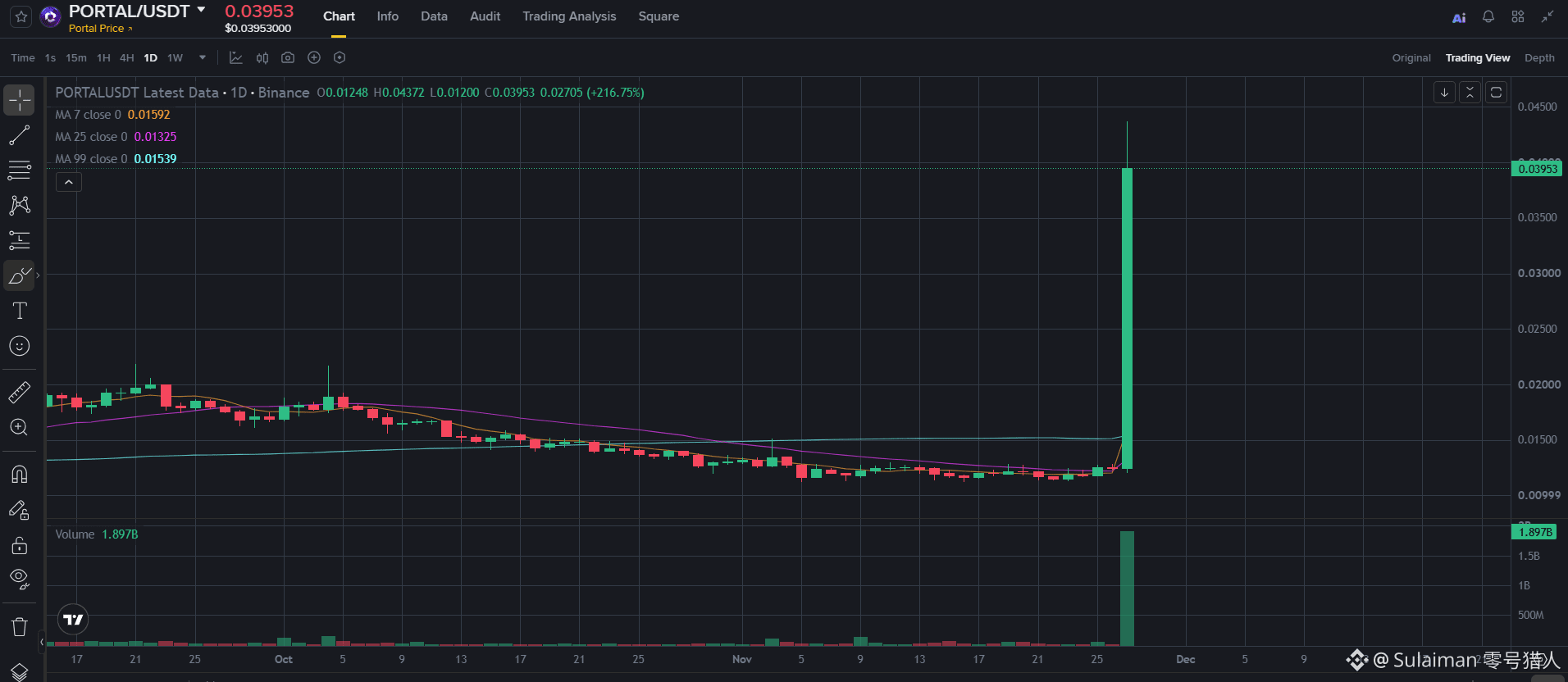
A coin up 200% in a day tells you one thing: someone paid more.
It doesn't tell you why anyone needs the token.
Before I read a pump as demand, I check three things:
Who captures value if usage grows?
How much supply unlocks soon?
Is open interest growing faster than spot volume? That's leverage, not conviction.
A thin order book can make a small buyer look like a big story.
Price shows attention. Demand shows a reason to hold.
Which of these three do you check first?
Not financial advice. DYOR.
$PORTAL
{future}(PORTALUSDT)
#ZeroHunter #PORTALUSDT
A coin up 200% in a day tells you one thing: someone paid more.
It doesn't tell you why anyone needs the token.
Before I read a pump as demand, I check three things:
Who captures value if usage grows?
How much supply unlocks soon?
Is open interest growing faster than spot volume? That's leverage, not conviction.
A thin order book can make a small buyer look like a big story.
Price shows attention. Demand shows a reason to hold.
Which of these three do you check first?
Not financial advice. DYOR.
$PORTAL
#ZeroHunter #PORTALUSDT
2
982
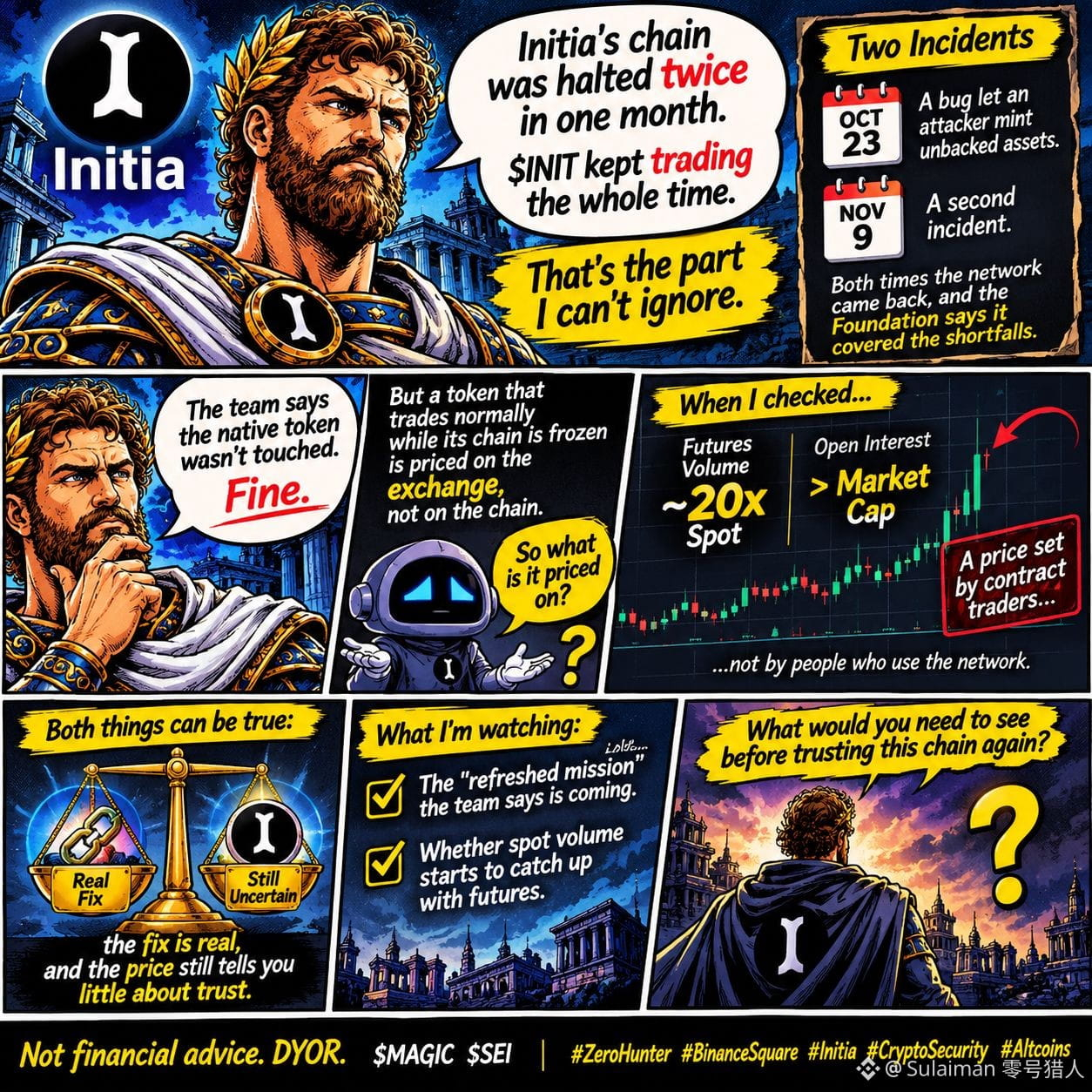
Initia's chain was halted twice in one month.
$INIT kept trading the whole time.
That's the part I can't ignore.
Oct 23: a bug let an attacker mint unbacked assets. Nov 9: a second incident. Both times the network came back, and the Foundation says it covered the shortfalls.
The team says the native token wasn't touched. Fine.
But a token that trades normally while its chain is frozen is priced on the exchange, not on the chain.
So what is it priced on?
When I checked, futures volume was roughly 20x spot, and open interest was bigger than the entire market cap.
That's a price set by people trading the contract, not by people who use the network.
Both things can be true: the fix is real, and the price still tells you little about trust.
What I'm watching: the "refreshed mission" the team says is coming, and whether spot volume starts to catch up with futures.
What would you need to see before trusting this chain again?
Not financial advice. DYOR.
$MAGIC
{spot}(MAGICUSDT)
$SEI
{spot}(SEIUSDT)
#ZeroHunter #BinanceSquare #Initia #CryptoSecurity #Altcoins
Initia's chain was halted twice in one month.
$INIT kept trading the whole time.
That's the part I can't ignore.
Oct 23: a bug let an attacker mint unbacked assets. Nov 9: a second incident. Both times the network came back, and the Foundation says it covered the shortfalls.
The team says the native token wasn't touched. Fine.
But a token that trades normally while its chain is frozen is priced on the exchange, not on the chain.
So what is it priced on?
When I checked, futures volume was roughly 20x spot, and open interest was bigger than the entire market cap.
That's a price set by people trading the contract, not by people who use the network.
Both things can be true: the fix is real, and the price still tells you little about trust.
What I'm watching: the "refreshed mission" the team says is coming, and whether spot volume starts to catch up with futures.
What would you need to see before trusting this chain again?
Not financial advice. DYOR.
$MAGIC
$SEI
#ZeroHunter #BinanceSquare #Initia #CryptoSecurity #Altcoins
3
1.2k
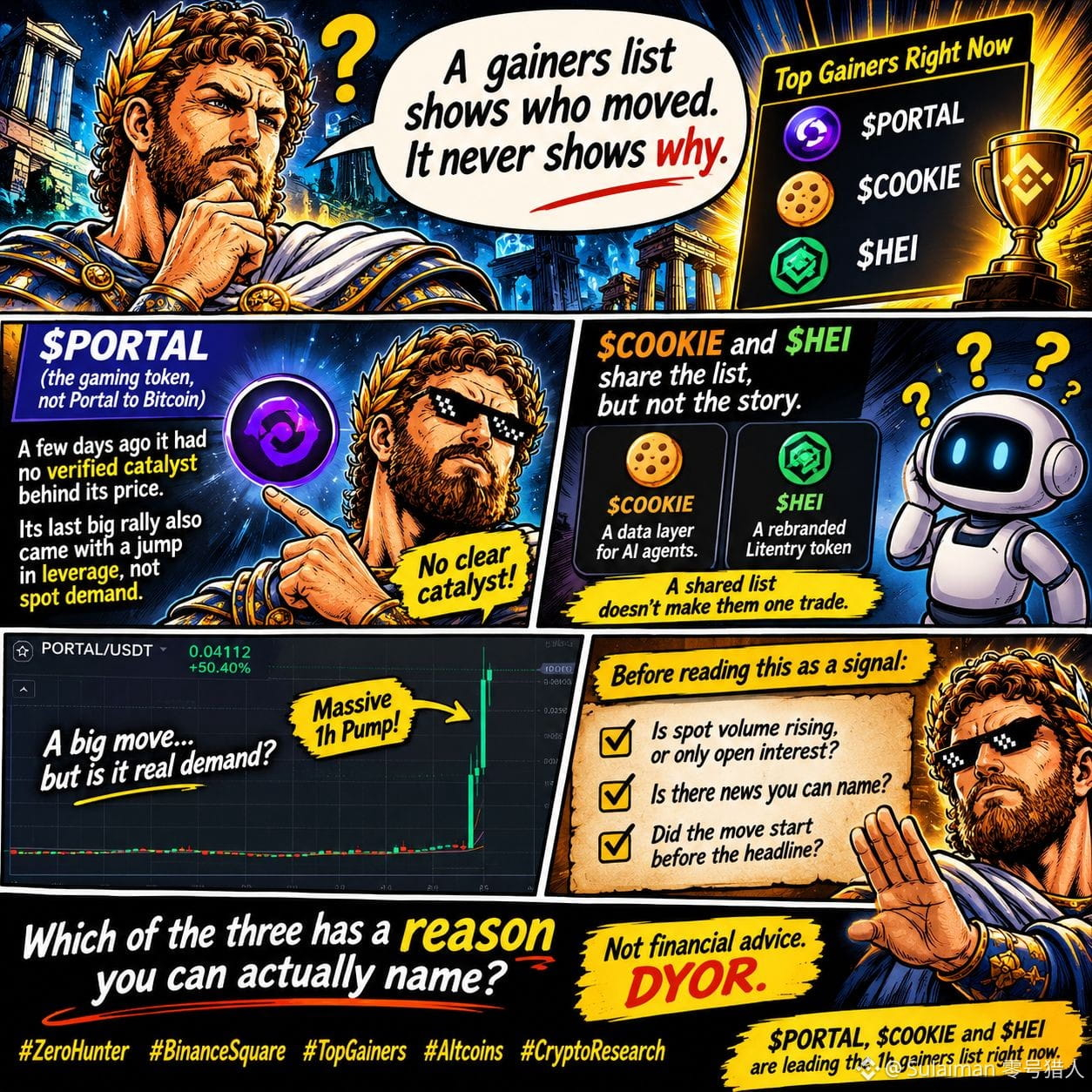
A gainers list shows who moved. It never shows why.
Start with $PORTAL (the gaming token, not Portal to Bitcoin). A few days ago it had no verified catalyst behind its price. Its last big rally also came with a jump in leverage, not spot demand.
$COOKIE and $HEI share the list, but not the story. COOKIE is a data layer for AI agents. HEI is the rebranded Litentry token. A shared list doesn't make them one trade.
Before reading this as a signal:
• Is spot volume rising, or only open interest?
• Is there news you can name?
• Did the move start before the headline?
Which of the three has a reason you can actually name?
Not financial advice. DYOR.
#ZeroHunter #BinanceSquare #TopGainers #Altcoins #CryptoResearch
3
1.9k
Go right Now $PORTAL
{future}(PORTALUSDT)
$HEI
{future}(HEIUSDT)
Go right Now $PORTAL
$HEI
$HEI


Asif Malik_01
·
--
✅️♥️claim big a rewards 💰💰💰
✅️♥️comments 🎁🎁🎁
✅️❤️Like ♥️♥️♥️
✅️repost 🧧🧧🧧
✅️♥️comments 🎁🎁🎁
✅️❤️Like ♥️♥️♥️
✅️repost 🧧🧧🧧

681
go right now
$PORTAL
{spot}(PORTALUSDT)
$COOKIE
{spot}(COOKIEUSDT)
$HEI
{spot}(HEIUSDT)
go right now
$PORTAL
$COOKIE
$HEI
$PORTAL
$COOKIE
$HEI

SankAlpha
·
--
🎁🎁🎁#PEPE 🧧🧧🧧
PEPE is one of the top pure meme coins by market cap and stands out for strong relative liquidity and recent whale interest. It sits well below the DOGE/SHIB “blue-chip” tier but ahead of most Solana and newer meme tokens. Like all meme coins, it is highly sentiment- and narrative-driven, with no fundamental utility,
Comment to claim $PEPE 💕
Please Repost 🔁 💖

458
Follow Right Now All Friends
$PORTAL
{future}(PORTALUSDT)
$HEI
{future}(HEIUSDT)
Follow Right Now All Friends
$PORTAL
$HEI
$PORTAL
$HEI

L1688
·
--
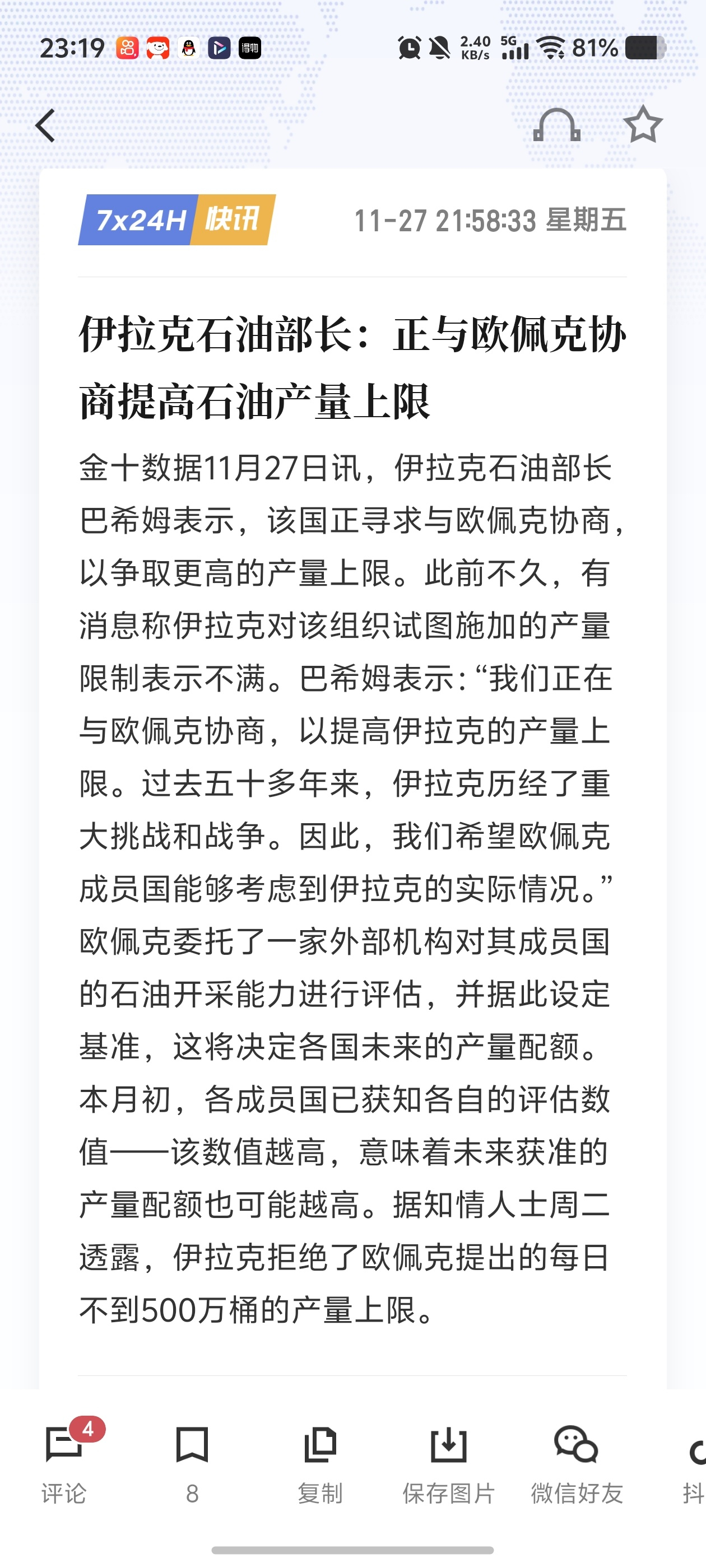
Jinshi Data, Nov. 27 — Iraq’s Oil Minister Bashim said the country is seeking talks with OPEC to secure a higher production ceiling. This comes shortly after reports that Iraq was dissatisfied with the production limits the organization was attempting to impose. Bashim said, “We are negotiating with OPEC to raise Iraq’s production ceiling. Over the past fifty-plus years, Iraq has faced major challenges and wars. Therefore, we hope OPEC member countries will take Iraq’s circumstances into account.” OPEC commissioned an external agency to assess its members’ oil production capacity and set benchmarks accordingly, which will determine each country’s future production quotas. Earlier this month, member countries were informed of their respective assessment figures—the higher the figure, the higher the production quota they may be allowed in the future. A source familiar with the matter said on Tuesday that Iraq rejected OPEC’s proposed production ceiling of less than 5 million barrels per day.$BNB
#感恩节美股休市,市场休整后能否迎来反弹?
#感恩节美股休市,市场休整后能否迎来反弹?
5
1.5k
Fabi_4043
·
--
Have a great Friday 🥰🥰
Follow, like, and share 🧧🧧
$LUNC
#CanMarketsReboundAfterThanksgiving?
Follow, like, and share 🧧🧧
$LUNC
#CanMarketsReboundAfterThanksgiving?

3
1.5k

CipherX 零号
·
--
🔴 CIPHERX BREAKING:
Trump publicly pressed Putin to pull back all military aggression across Europe, even as EU leaders remain deadlocked in Brussels over the bloc’s long-term budget and a $49B loan for Ukraine. The rift comes as Kyiv warns Moscow is preparing another large-scale strike
$BTC
$ETH
Trump publicly pressed Putin to pull back all military aggression across Europe, even as EU leaders remain deadlocked in Brussels over the bloc’s long-term budget and a $49B loan for Ukraine. The rift comes as Kyiv warns Moscow is preparing another large-scale strike
$BTC
$ETH
1
1.3k
All Friends Go For Fabi $BTC
$PORTAL
{spot}(PORTALUSDT)
{spot}(BTCUSDT)
All Friends Go For Fabi $BTC
$PORTAL
$PORTAL
Quoted content has been removed
2
391
Everyone is saying: "The Nasdaq is swinging, so BTC will swing too."
But there's one thing nobody is checking.
Look at two "fear gauges." They show how much movement the options market expects over the next 30 days.
Nasdaq-100 (VXN): 45.25 on Nov 20 → 38.5 on Nov 25
Bitcoin (DVOL): 46 on Nov 20 → 55.45 on Nov 26 (it was 38 in October)
Fear in stocks is falling. Fear in BTC is rising.
The Nasdaq's 3.8% average range is genuinely big. I'm not denying that. But the source of BTC's fear now looks more like its own positioning:
Put/call ratio of 0.89 for the expiry (0.55 in October)
About $5.39B pulled from spot ETFs in November
Thin holiday volume
📌 Save this: 3 questions before trading in high volatility
What is today's range, and does my stop sit inside it? In a wide range, tight stops get hit first.
How much leverage am I using? When swings grow, leverage does the damage first.
What is moving price: stock headlines, or BTC's own data (ETF flows, options)?
Thesis: BTC's volatility is no longer just the Nasdaq's wave. A good part of it now comes from its own market positioning.
Invalidation: if DVOL drops quickly toward 40 after the expiry, it was just an expiry spike. If a new Nasdaq shock pushes VXN back above 45, the link points back to stocks.
Before a trade, which gauge do you check first: the Nasdaq's VXN, or BTC's DVOL?
Not financial advice. DYOR.
$BTC
{spot}(BTCUSDT)
$PORTAL
{spot}(PORTALUSDT)
$ACE
{spot}(ACEUSDT)
#ZeroHunter #CanMarketsReboundAfterThanksgiving? #Bitcoin
#nasdaq100fivedayavgintradayvolatilityhits3.8%
Everyone is saying: "The Nasdaq is swinging, so BTC will swing too."
But there's one thing nobody is checking.
Look at two "fear gauges." They show how much movement the options market expects over the next 30 days.
Nasdaq-100 (VXN): 45.25 on Nov 20 → 38.5 on Nov 25
Bitcoin (DVOL): 46 on Nov 20 → 55.45 on Nov 26 (it was 38 in October)
Fear in stocks is falling. Fear in BTC is rising.
The Nasdaq's 3.8% average range is genuinely big. I'm not denying that. But the source of BTC's fear now looks more like its own positioning:
Put/call ratio of 0.89 for the expiry (0.55 in October)
About $5.39B pulled from spot ETFs in November
Thin holiday volume
📌 Save this: 3 questions before trading in high volatility
What is today's range, and does my stop sit inside it? In a wide range, tight stops get hit first.
How much leverage am I using? When swings grow, leverage does the damage first.
What is moving price: stock headlines, or BTC's own data (ETF flows, options)?
Thesis: BTC's volatility is no longer just the Nasdaq's wave. A good part of it now comes from its own market positioning.
Invalidation: if DVOL drops quickly toward 40 after the expiry, it was just an expiry spike. If a new Nasdaq shock pushes VXN back above 45, the link points back to stocks.
Before a trade, which gauge do you check first: the Nasdaq's VXN, or BTC's DVOL?
Not financial advice. DYOR.
$BTC
$PORTAL
$ACE
#ZeroHunter #CanMarketsReboundAfterThanksgiving? #Bitcoin
#nasdaq100fivedayavgintradayvolatilityhits3.8%
2
1.3k
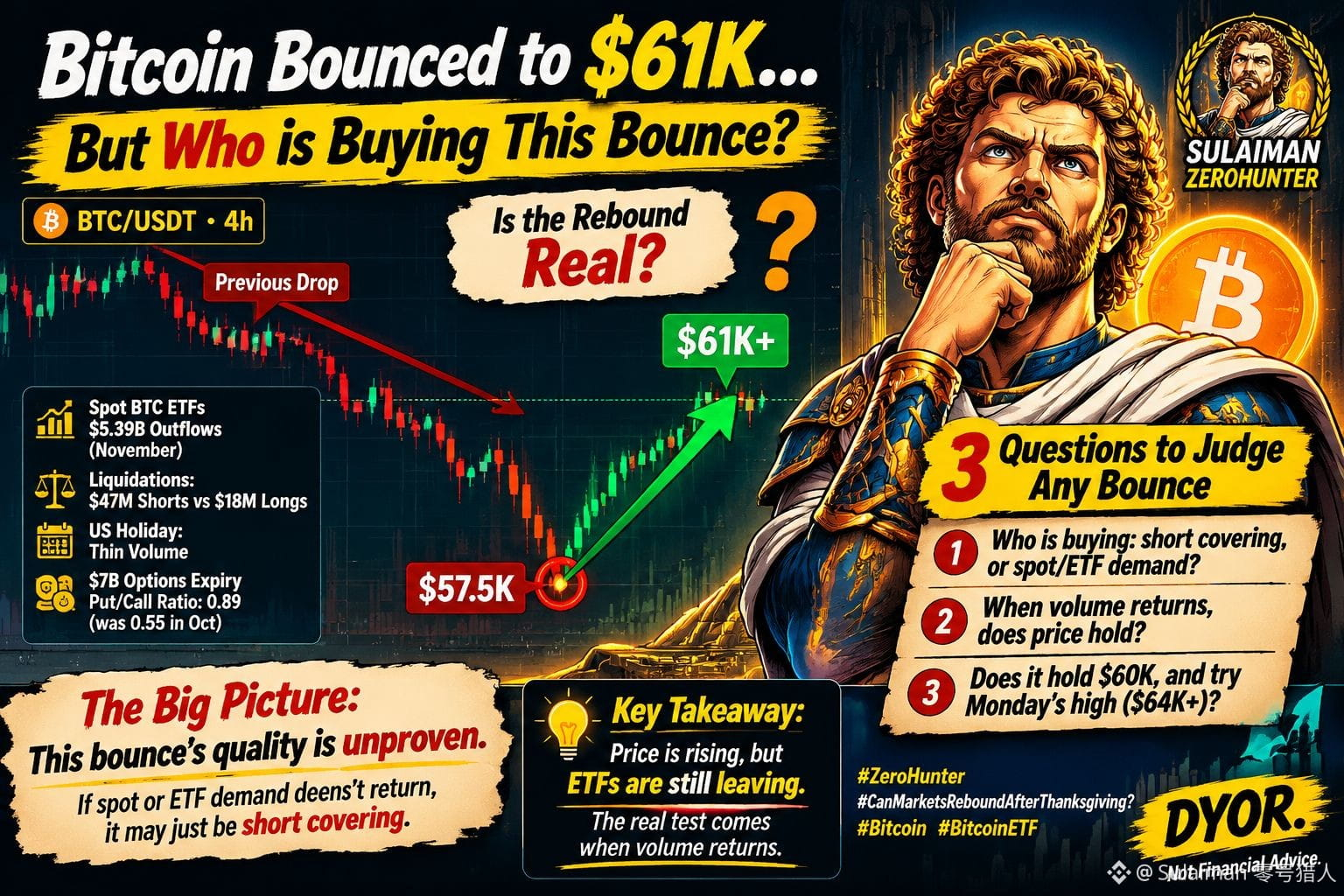
Bitcoin bounced from $57.5K to above $61K. Everyone is asking: "Is the rebound real?"
My question is different: who is buying this bounce?
What the data shows today:
Spot BTC ETFs saw about $5.39B in outflows in November
Recent liquidations skew toward shorts ($47M shorts vs $18M longs), a sign of short covering
Thin holiday volume: US markets closed Thursday, shut at 1 p.m. ET on Friday
About $7B in options expiring, with a put/call ratio of 0.89 (it was 0.55 in October)
A put is protection against a falling price. A higher ratio means traders are hedging more against downside.
In simple terms: price is rising, but one gauge of institutional demand (ETFs) is still leaving.
That doesn't mean the bounce is fake. It means that in a thin market, even short covering can push price up. The real test comes when volume returns.
📌 Save this: 3 questions to judge any bounce
Who is buying: short covering, or spot/ETF demand? (Check liquidation data and ETF flows together)
When volume returns after the holiday, does price hold?
Does it hold $60K, and does it try Monday's high ($64K+)?
Thesis: this bounce's quality is unproven. If spot or ETF demand doesn't return, it may just be short covering.
Invalidation: steady ETF inflows return and price holds on real volume, and this doubt is wrong.
Which is doing more work in this bounce: short covering, or real spot buyers?
Not financial advice. DYOR.
$BTC
{spot}(BTCUSDT)
$MMT
{spot}(MMTUSDT)
$HAEDAL
{spot}(HAEDALUSDT)
#ZeroHunter #Bitcoin #BitcoinETF
#canmarketsreboundafterthanksgiving?
Bitcoin bounced from $57.5K to above $61K. Everyone is asking: "Is the rebound real?"
My question is different: who is buying this bounce?
What the data shows today:
Spot BTC ETFs saw about $5.39B in outflows in November
Recent liquidations skew toward shorts ($47M shorts vs $18M longs), a sign of short covering
Thin holiday volume: US markets closed Thursday, shut at 1 p.m. ET on Friday
About $7B in options expiring, with a put/call ratio of 0.89 (it was 0.55 in October)
A put is protection against a falling price. A higher ratio means traders are hedging more against downside.
In simple terms: price is rising, but one gauge of institutional demand (ETFs) is still leaving.
That doesn't mean the bounce is fake. It means that in a thin market, even short covering can push price up. The real test comes when volume returns.
📌 Save this: 3 questions to judge any bounce
Who is buying: short covering, or spot/ETF demand? (Check liquidation data and ETF flows together)
When volume returns after the holiday, does price hold?
Does it hold $60K, and does it try Monday's high ($64K+)?
Thesis: this bounce's quality is unproven. If spot or ETF demand doesn't return, it may just be short covering.
Invalidation: steady ETF inflows return and price holds on real volume, and this doubt is wrong.
Which is doing more work in this bounce: short covering, or real spot buyers?
Not financial advice. DYOR.
$BTC
$MMT
$HAEDAL
#ZeroHunter #Bitcoin #BitcoinETF
#canmarketsreboundafterthanksgiving?
12
24
17.2k
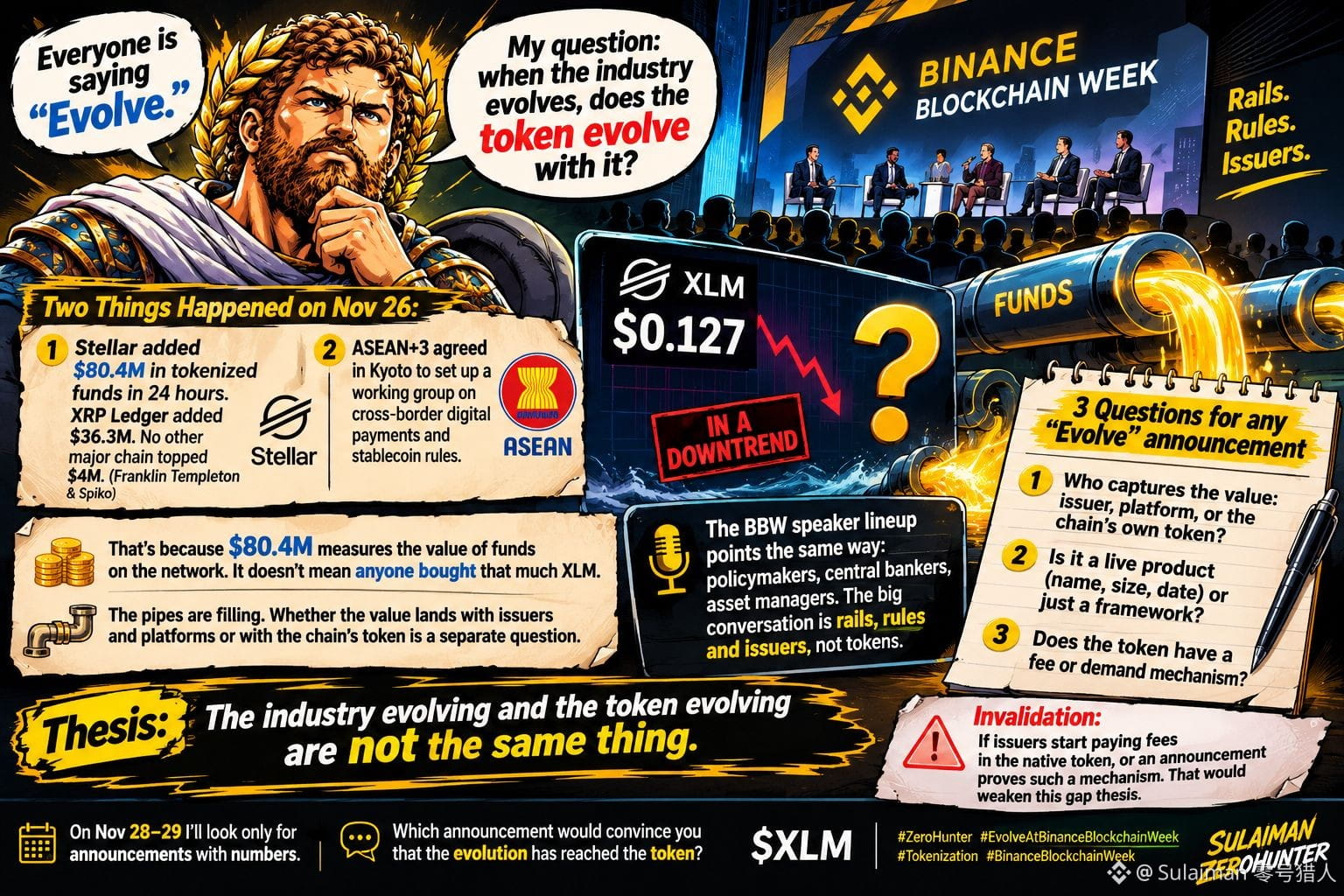
Everyone is saying "Evolve." My question: when the industry evolves, does the token evolve with it?
Two things happened on Nov 26:
Stellar added about $80.4M in tokenized funds in 24 hours. The XRP Ledger added $36.3M. No other major chain topped $4M. One report credits Franklin Templeton and Spiko.
ASEAN+3 (11 ASEAN states, China, Japan, South Korea) agreed in Kyoto to set up a working group on cross-border digital payments and stablecoin rules.
Now look at the gap. In the same window, XLM sits near $0.127, in a downtrend.
That's because $80.4M measures the value of funds on the network. It doesn't mean anyone bought that much XLM.
The pipes are filling. Whether the value lands with issuers and platforms or with the chain's token is a separate question.
The BBW speaker lineup points the same way: policymakers, central bankers, asset managers. The big conversation is rails, rules and issuers, not tokens.
📌 Save this: 3 questions for any "Evolve" announcement
Who captures the value: issuer, platform, or the chain's own token?
Is it a live product (name, size, date) or just a framework?
Does the token have a fee or demand mechanism?
Thesis: the industry evolving and the token evolving are not the same thing.
Invalidation: issuers start paying fees in the native token, or an announcement proves such a mechanism. That would weaken this gap thesis.
On Nov 28–29 I'll look only for announcements with numbers.
Which announcement would convince you that the evolution has reached the token?
Not financial advice. DYOR.
$XLM
{spot}(XLMUSDT)
$INIT
{spot}(INITUSDT)
$MMT
{spot}(MMTUSDT)
#ZeroHunter #Tokenization #BinanceBlockchainWeek
#evolveatbinanceblockchainweek
Everyone is saying "Evolve." My question: when the industry evolves, does the token evolve with it?
Two things happened on Nov 26:
Stellar added about $80.4M in tokenized funds in 24 hours. The XRP Ledger added $36.3M. No other major chain topped $4M. One report credits Franklin Templeton and Spiko.
ASEAN+3 (11 ASEAN states, China, Japan, South Korea) agreed in Kyoto to set up a working group on cross-border digital payments and stablecoin rules.
Now look at the gap. In the same window, XLM sits near $0.127, in a downtrend.
That's because $80.4M measures the value of funds on the network. It doesn't mean anyone bought that much XLM.
The pipes are filling. Whether the value lands with issuers and platforms or with the chain's token is a separate question.
The BBW speaker lineup points the same way: policymakers, central bankers, asset managers. The big conversation is rails, rules and issuers, not tokens.
📌 Save this: 3 questions for any "Evolve" announcement
Who captures the value: issuer, platform, or the chain's own token?
Is it a live product (name, size, date) or just a framework?
Does the token have a fee or demand mechanism?
Thesis: the industry evolving and the token evolving are not the same thing.
Invalidation: issuers start paying fees in the native token, or an announcement proves such a mechanism. That would weaken this gap thesis.
On Nov 28–29 I'll look only for announcements with numbers.
Which announcement would convince you that the evolution has reached the token?
Not financial advice. DYOR.
$XLM
$INIT
$MMT
#ZeroHunter #Tokenization #BinanceBlockchainWeek
#evolveatbinanceblockchainweek
2
1.1k
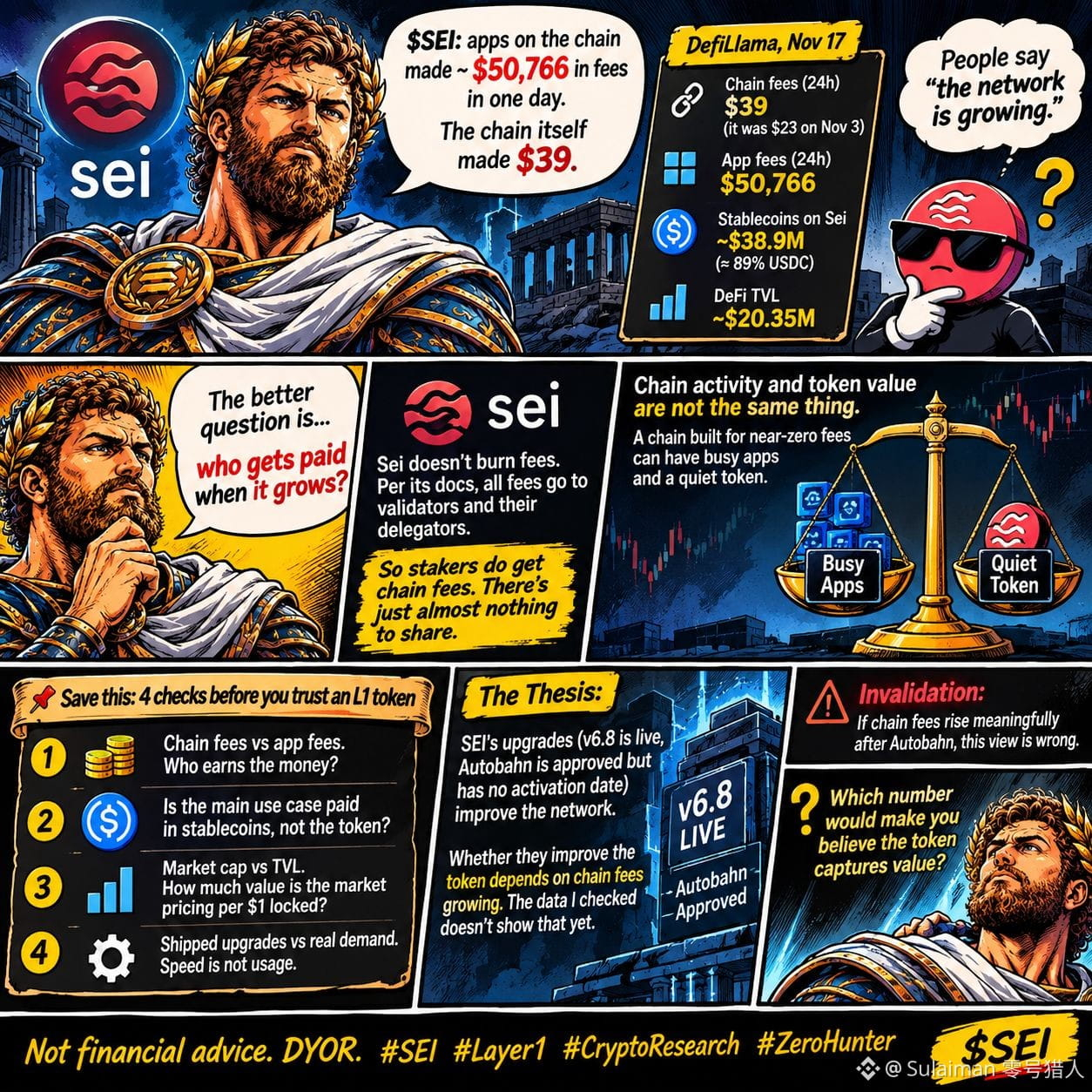
$SEI : apps on the chain made ~$50,766 in fees in one day. The chain itself made $39.
DefiLlama, Nov 17:
Chain fees (24h): $39 (it was $23 on Nov 3)
App fees (24h): $50,766
Stablecoins on Sei: ~$38.9M, about 89% USDC
DeFi TVL: ~$20.35M
SEI's market cap is ~$270M. On Nov 25 it traded just 0.31% above its all-time low.
People say "the network is growing."
The better question is who gets paid when it grows?
Sei doesn't burn fees. Per its docs, all fees go to validators and their delegators.
So stakers do get chain fees. There's just almost nothing to share.
Chain activity and token value are not the same thing. A chain built for near-zero fees can have busy apps and a quiet token.
📌 Save this: 4 checks before you trust an L1 token
Chain fees vs app fees. Who earns the money?
Is the main use case paid in stablecoins, not the token?
Market cap vs TVL. How much value is the market pricing per $1 locked?
Shipped upgrades vs real demand. Speed is not usage.
Thesis: SEI's upgrades (v6.8 is live, Autobahn is approved but has no activation date) improve the network. Whether they improve the token depends on chain fees growing. The data I checked doesn't show that yet.
Invalidation: If chain fees rise meaningfully after Autobahn, this view is wrong.
Which number would make you believe the token captures value?
Not financial advice. DYOR.
$MMT
{spot}(SEIUSDT)
$ACE
{spot}(ACEUSDT)
#SEI #Layer1 #CryptoResearch #ZeroHunter
$SEI : apps on the chain made ~$50,766 in fees in one day. The chain itself made $39.
DefiLlama, Nov 17:
Chain fees (24h): $39 (it was $23 on Nov 3)
App fees (24h): $50,766
Stablecoins on Sei: ~$38.9M, about 89% USDC
DeFi TVL: ~$20.35M
SEI's market cap is ~$270M. On Nov 25 it traded just 0.31% above its all-time low.
People say "the network is growing."
The better question is who gets paid when it grows?
Sei doesn't burn fees. Per its docs, all fees go to validators and their delegators.
So stakers do get chain fees. There's just almost nothing to share.
Chain activity and token value are not the same thing. A chain built for near-zero fees can have busy apps and a quiet token.
📌 Save this: 4 checks before you trust an L1 token
Chain fees vs app fees. Who earns the money?
Is the main use case paid in stablecoins, not the token?
Market cap vs TVL. How much value is the market pricing per $1 locked?
Shipped upgrades vs real demand. Speed is not usage.
Thesis: SEI's upgrades (v6.8 is live, Autobahn is approved but has no activation date) improve the network. Whether they improve the token depends on chain fees growing. The data I checked doesn't show that yet.
Invalidation: If chain fees rise meaningfully after Autobahn, this view is wrong.
Which number would make you believe the token captures value?
Not financial advice. DYOR.
$MMT
$ACE
#SEI #Layer1 #CryptoResearch #ZeroHunter
3
1.9k
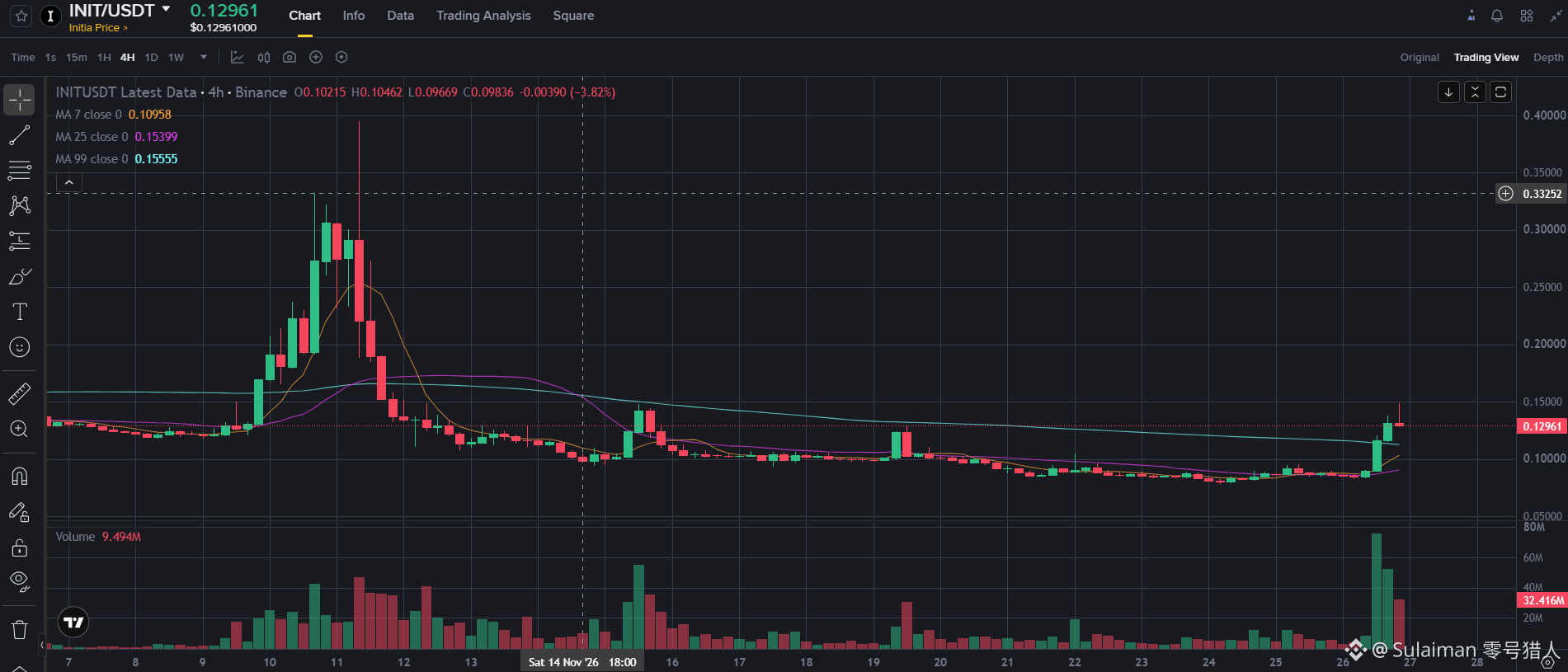
$INIT is up ~50% today. The last time it did this, it gave everything back within two weeks.
Nov 10-11: INIT ran ~2.7x in two days. By Nov 24, it was back near where it started.
Today it's trading around $0.13, after touching $0.1488. The move came on heavy volume, far above anything in the last two weeks.
Both times, the trigger wasn't a product launch. The Oct 23 and Nov 10 security incidents are verified. I found no usage news behind today's move.
Most people ask: "How high can it go?"
I'd ask: what was different about the buyers this time?
I can't answer that from a chart. Today's OI and funding would help, and I haven't checked them.
Thesis: big volume with no usage news looks like short-term flow, not new demand. That's a read, not a fact.
Invalidation: if INIT holds above the 4H MA99 (~$0.1126) while volume fades, the "fast fade" view weakens. A close back below it confirms it.
What would you need to see to trust this move?
Not financial advice. DYOR.
$INIT
{future}(INITUSDT)
$SSV
{spot}(SSVUSDT)
#ZeroHunter #INIT #CryptoResearch
$INIT is up ~50% today. The last time it did this, it gave everything back within two weeks.
Nov 10-11: INIT ran ~2.7x in two days. By Nov 24, it was back near where it started.
Today it's trading around $0.13, after touching $0.1488. The move came on heavy volume, far above anything in the last two weeks.
Both times, the trigger wasn't a product launch. The Oct 23 and Nov 10 security incidents are verified. I found no usage news behind today's move.
Most people ask: "How high can it go?"
I'd ask: what was different about the buyers this time?
I can't answer that from a chart. Today's OI and funding would help, and I haven't checked them.
Thesis: big volume with no usage news looks like short-term flow, not new demand. That's a read, not a fact.
Invalidation: if INIT holds above the 4H MA99 (~$0.1126) while volume fades, the "fast fade" view weakens. A close back below it confirms it.
What would you need to see to trust this move?
Not financial advice. DYOR.
$INIT
$SSV
#ZeroHunter #INIT #CryptoResearch
1
1.1k
Log in to explore more content
Join global crypto users on Binance Square
⚡️ Get latest and useful information about crypto.
💬 Trusted by the world’s largest crypto exchange.
👍 Discover real insights from verified creators.
Email / Phone number
Trending Topics
EvolveAtBinanceBlockchainWeek
1.7M views
17,262 Discussing
Binance Blockchain Week is officially underway! 🌍
On November 28–29, whether you’re in Bangkok or joining from afar, tune in to the livestreams and join the conversation on Binance Square!
Here’s what’s in store 👇
📺 Watch the main stage live
Tune in throughout both days as industry speakers share their perspectives on this year’s theme, “Evolve” From technological innovation to real-world applications, explore what’s next for crypto.
⚔️ Watch two trading competitions
The Aster Open Qualifier and the Binance Trading Master Tournament will both be streamed live. Tune in to follow the traders in action.
🏆 Watch The Blockchain 100 Awards Ceremony
The Blockchain 100 list was selected by the community. Join us in celebrating the creators and the ideas they share!
💬 Join the community conversation
Use #EvolveAtBinanceBlockchainWeek in a post with a photo to share what you’re looking forward to, your views on the industry, or your favorite moments from the event.
The event page is now live! Subscribe to all livestreams with one click so you don’t miss a moment 👏
Binance Blockchain Week
·406 Likes
·454.3k views
ColdcardFlawLeadsToTheftOfAtLeast1789BTC
28,261 views
299 Discussing
VitalikWantsWalletChipDesignsOpened
41,252 views
466 Discussing