

@Lorenzo Protocol There was a stretch of time when DeFi felt like it was built on a dare. Someone would post a screenshot of a four-digit APY, liquidity would rush in, and then the whole thing would unwind as soon as incentives slowed. Plenty of smart people got burned, and plenty of cautious people quietly stepped back. The lesson wasn’t that yield is bad. It was that yield built on constant volatility isn’t really yield. It’s a trade you’re pretending is a paycheck.

Lately the tone has changed. More builders and users are talking about compounding again, and not in the “farm this token until it drops” sense. They mean time-compounding yield: returns that accrue steadily, get reinvested, and don’t require you to sprint from app to app. It isn’t glamorous, but it’s durable. After a few market cycles, durability is starting to sound like the point.
If you spend time in DeFi chats today, the mood is noticeably different. People still like upside, but they want it with fewer moving parts. They ask boring questions: what’s the counterparty risk, what happens in a bad week, where does the yield come from? Those questions are progress. They’re also a response to exhaustion after several years.
Lorenzo Protocol is one of the projects riding this shift, largely because it starts with Bitcoin. BTC is still the largest pool of crypto capital, yet most of it sits idle. Lorenzo’s pitch is straightforward: keep Bitcoin as your base asset, but make it productive through a system designed for compounding rather than constant trading. On its site, Lorenzo describes enzoBTC as its wrapped BTC standard, redeemable 1:1 to Bitcoin, and frames it as “cash” inside the ecosystem. In plain terms, it tries to give you a BTC-like unit you can move and use while the yield work happens elsewhere and, ideally, compounds over time.
Once you treat the BTC leg as cash, you can start designing yield like infrastructure. One of Lorenzo’s more interesting decisions is to separate ownership of principal from ownership of yield. In its staking and restaking model, the principal side can be represented by one token (often described as an LPT), while the yield claim over a staking period is represented by another (a YAT). The YAT accrues the staking yield and can trade independently from the principal token. It sounds abstract, but it’s basically separating “my deposit” from “my earnings,” and letting markets price each one.
That separation opens up a different kind of compounding. A yield claim that’s cleanly tokenized can be rolled forward, used as collateral, or bundled into longer-dated products without forcing every user to farm, claim, and sell on a weekly cadence. It can also be priced more honestly. If a yield token trades at a discount, that discount is information about risk, liquidity, and time preference. In older DeFi, the only “price signal” was often a governance token chart, which is a loud and unreliable narrator.
The reason this idea is trending now isn’t only crypto-internal. It also lines up with what’s happening around stablecoins, tokenized cash, and on-chain collateral. When short-dated U.S. rates are meaningful, “doing nothing” becomes an expensive choice. On-chain money is evolving from a zero-yield parking spot into something people expect to earn a baseline return. McKinsey noted 2025 as a potential inflection point for stablecoins and tokenized cash, helped by improving security and a more supportive environment for experimentation. The Financial Times has also reported rapid growth in tokenised Treasury and money-market funds in 2025 as crypto capital looks for yield without taking extra directional risk. And Reuters has described stablecoin issuers as major buyers of T-bills and repos, which quietly links crypto plumbing to short-term rates.
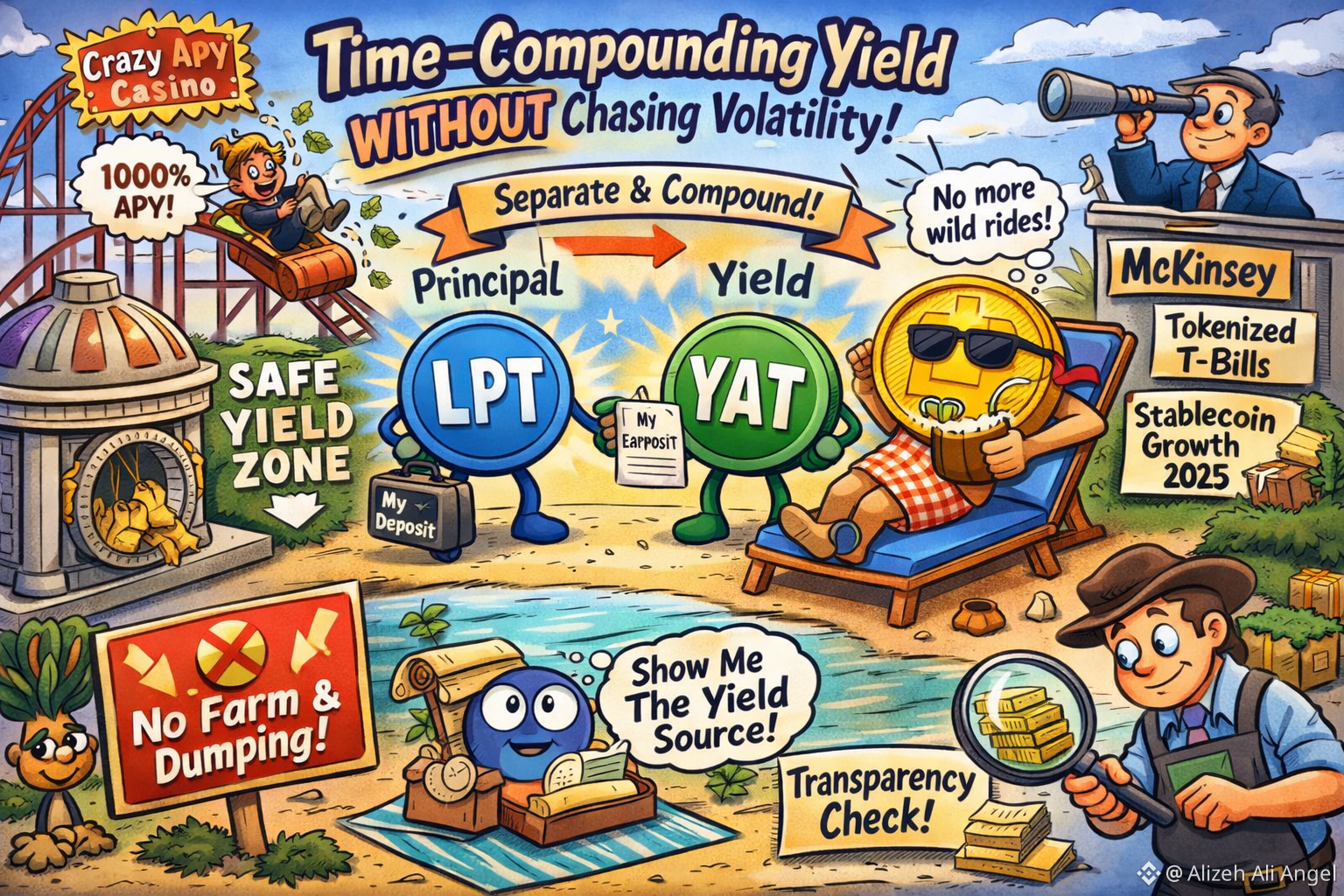
That baseline changes DeFi’s culture. When you can get a credible rate elsewhere, speculative yield has to explain itself. It has to say where the money is coming from, how it compounds, and what risks you’re taking to earn it. Tokenized real-world assets fit naturally into this story because they widen the set of believable cash flows that can move on-chain. RWAs tracks tokenized assets and shows a market measured in the tens of billions of dollars, alongside a very large stablecoin base.
None of this means Lorenzo, or any protocol, gets a free pass. Time-compounding yield can hide risk as easily as it can simplify the user experience. If the strategy layer takes on leverage, if bridges or staking agents fail, or if smart contracts have edge-case bugs, “set and forget” turns into “set and regret.” Even the principal-and-yield split, which is elegant on paper, can encourage looping strategies that amplify losses when markets move. Risk doesn’t go away, it just shifts from you to the system. That’s exactly you need visibility and guardrails, not vibes and hope.
Still, the direction of travel is worth watching. DeFi doesn’t have to win by out-gambling volatility. It can win by making yield legible and compounding it in a way that people can actually live with. Lorenzo’s Bitcoin-first framing is one attempt at that, and it’s arriving at a moment when the industry seems more ready to value patience.

