@Lorenzo Protocol Liquidity pools have become the main areas of operation for decentralized finance (DeFi) warfare. Lorenzo, however, is your covert special operations team.
Most skirmishes in decentralized finance are without noise or smell. They occur quietly and invisibly within liquidity pools where money changes hands, where incentive schemes clash, and where algorithms check for vulnerability. From afar, a pool seems peaceful, money circulates, fees get collected, prices fluctuate. However, underneath, every block is a hidden fight for dominance. Arbitrageurs, extractive strategies, and misaligned incentives are the opposing forces battling over tiny amounts of value that eventually result in a significant loss. Lorenzo Protocol is not heavy armor or blunt force by design but special operations such as being precise, adaptive, and decisive in the right places.
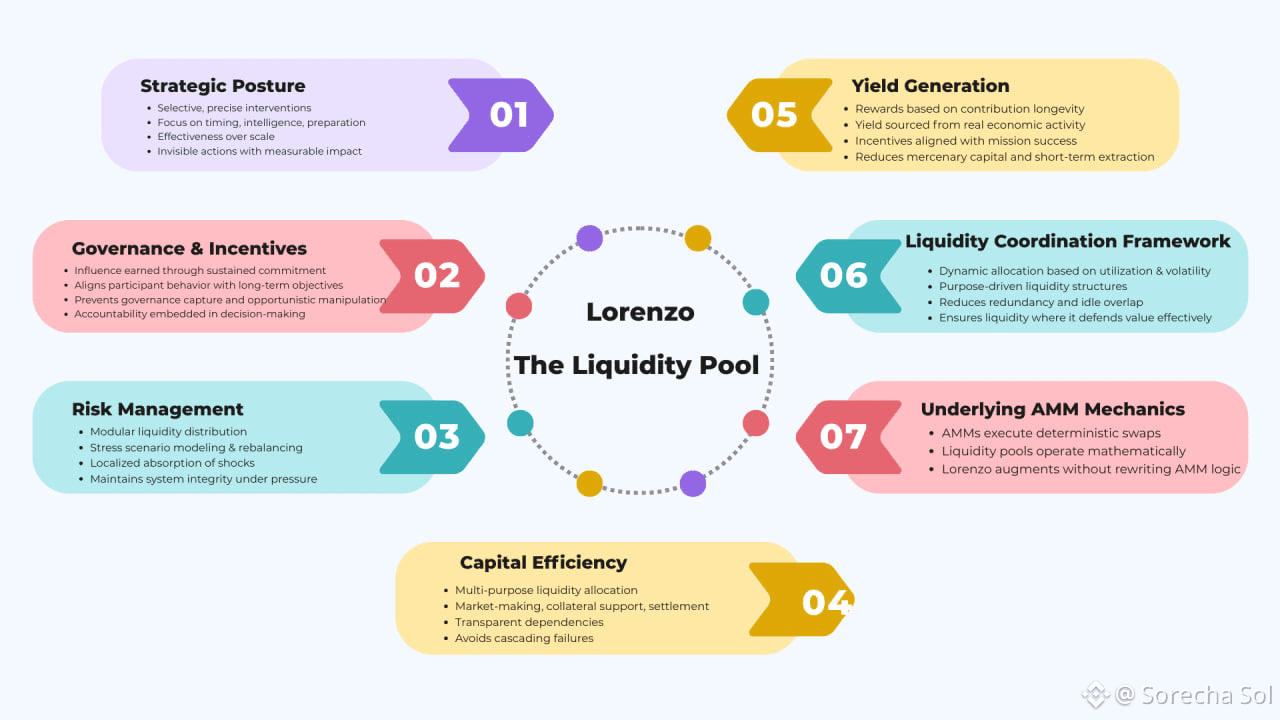
Liquidity pools have always been envisioned as neutral grounds, their conduct regulated by math rather than human judgment. Nevertheless, neutrality is not the same as safety. AMMs perform the roles they are assigned flawlessly, but without the ability to differentiate between wholesome activities and harmful practices undertaken by predators. Lorenzo doesn't change the AMM principles; it equips them with intelligence and teamwork. Its structure adds a command layer at the protocol level that coordinates, allocates, and changes liquidity according to the ambient conditions—hence, it can subtly influence the results without the necessity of tampering with the interiors of the original mechanism.
In fact and practice, Lorenzo can be thought of as the force-multiplier for liquidity pools in general. And whereas one might imagine a scenario where one part of the project is responsible for creating a new LP, and another part managing it, there is only one main LP-gathering force that drives the entire ecosystem. As a result, one can say that we are running a quietly efficient multi-headed HIT.
The operational core of Lorenzo is a liquidity coordination framework whose main function is to target maximum efficacy at specific points. Instead of dispersing capital over different, isolated pools competing for the same customers' attention, Lorenzo is pooling together separate liquidity into purpose-driven structures. The allocation of these structures is carried out based on utilization, volatility, and systemic importance and on a dynamic basis. By doing away with redundancy and idle overlap, Lorenzo does not only increase the effective depth but also does not increase total capital exposure. This is not brute-force defense; rather, it's a move - ensuring the presence of liquidity exactly where the value being guarded is highest.
The yield produced by Lorenzo is an echo of the facility's inner workings. Conventional incentive schemes pour mercenary capital into the battlefield while at the same time rewarding the one who can most rapidly escape the battlefield rather than one who shows the greatest perseverance. Lorenzo substitutes this method with the yield generated from genuine economic activities such as trading fees, structured liquidity services, and protocol-level spreads. The rewards are given on the contribution's long-running and stable basis that keeps the participant's incentives aligned with the mission success rather than short-term extraction. Capital stays with you only because it is useful and not because it has been bribed.
Lorenzo achieves capital efficiency by tactical reuse, rather than by reckless leveraging. The protocol confers on liquidity the ability to do multiple tasks - market making, collateral support, settlement liquidity - within well-defined risk limits. Each task is clear, and the dependencies are only deliberately few. This multi-layered usage hence not only increases the productivity per capital unit but also keeps cascading failures at bay. Efficiency thus becomes one of the strategic assets rather than one of the hidden vulnerabilities.
Risk management in the case of Lorenzo can be compared to the containment of threats and not their elimination. The protocol recognizes that adversarial behavior will always be there; hence its focus is on such behavior not being able to bring down system integrity. Liquidity components are modular and distributed in such a way as not to allow a single failure point to exist. The creators model the situation of stress tests already, and the embedded rebalancing mechanisms also help in situations of pressure. Instead of spreading across the system, shocks in the pool of liquidity are absorbed locally. The battlefield remains under control.
Governance and incentives operate as the rules of engagement in the case of Lorenzo. A participant's influence increases with their alignment being demonstrated through long-lasting commitment and prudent capital allocation. This keeps the governance capture and manipulation by opportunists at bay, rendering the decisions to be reflective of the long-term goals rather than the transient benefits. Power thus comes from doing, and this acts as a lever for accountability on all levels of operation to be reinforced.
Lorenzo's status as special operations is brought about by the manner of its functioning, which is not a matter of spectacle or power display. Its interventions happen to be selective, targeted, and measured. Like special forces, the secret of their success is being in their readiness, having good intelligence, and the right timing rather than having lots of forces to use. Most of the actions are so small that they are invisible to the end users, and yet, if they were not there, the users would feel immediate deterioration of the execution and increase of fragility.
At the strategic level, the Lorenzo Protocol is likened to the groundwork for a financial theater that is gradually coming of age. As decentralized liquidity is becoming the backbone of an ever more significant economic activity, the tolerance for inefficiency and uncontrolled extraction is bound to drop. Market participants will require systems that are capable of operating under constant pressure without losing coherence. Lorenzo offers this capability - not by putting DeFi on a military footing but by turning it into a professional institution.
The battlefield metaphor is not exaggeration; rather, it is an acknowledgment of the situation. In decentralized platforms, value is continuously contested whether one voluntarily acknowledges that or not. Lorenzo keeps the warfare going but on an intelligent-like basis - losses are kept at a minimum and goals untouched. When most folks are blind fighters in the liquidity pool, Lorenzo is one who always acts with intent.
Decentralized finance's progress will see the point after which the difference will be made through the operational maturity of one's sophistication rather than the mere existence of one's operation. Those protocols trapped in the reliance of their passive mechanisms will be the ones flanked and defeated by the ones having intelligence and coordination embedded in them. Lorenzo thus steps into this role of special operations - ones that are precise, resistant, and capable of making decisions quite fast - thereby not presenting a challenge to liquidity by brute force but rather by the supreme execution of superiority in the battles that matter.