

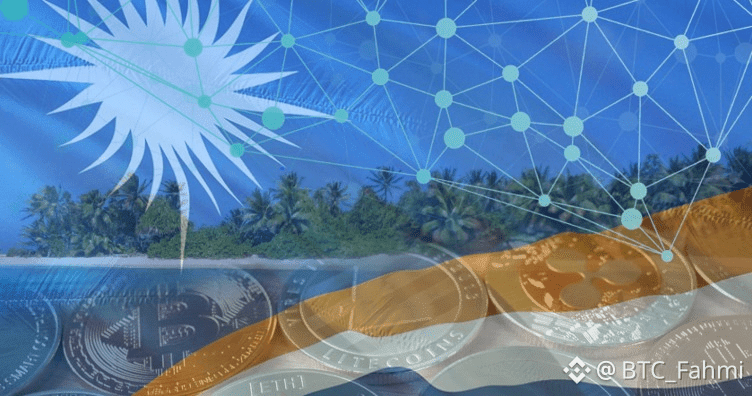
In the middle of the Pacific Ocean, far from the usual centers of global finance, a small island nation has taken a step that many larger countries have only debated. Between December 16 and 18, 2025, the Republic of the Marshall Islands quietly launched what it describes as the world’s first nationwide, blockchain-based Universal Basic Income program. The project, called ENRA, short for Economic Net Resource Allocation, is designed to send regular payments directly to citizens through a government-backed digital wallet.
At its core, the idea is simple. Eligible Marshallese citizens receive a payment every three months, not through cash or a traditional bank account, but through a digital system built on the Stellar blockchain. For a country spread across dozens of islands and atolls, where physical banking access can be limited or costly, the appeal is clear. Money moves digitally, quickly, and without the need for long trips to distant branches.
What makes ENRA unusual is not just the use of digital wallets. The funding mechanism itself is new. The Marshall Islands is using tokenized sovereign debt to support the program. In plain terms, the government has turned part of its national debt into digital tokens that can be tracked and managed on a blockchain. These tokens help finance the UBI payments, linking public debt directly to a social welfare system in a way that has not been tried before at a national scale.
For the Marshall Islands, this approach fits into a longer story. The country has been exploring digital finance for several years as a way to modernize its economy and reduce reliance on slow, expensive international banking channels. Its geography has always been a challenge. Many citizens live on remote islands, and moving money across the country can involve delays, fees, and paperwork. A digital system promises fewer barriers, especially for people who have never had easy access to banks.
Universal Basic Income itself is not a new idea. Economists and policymakers around the world have argued about it for decades. Supporters say it offers a safety net that is simple and fair, giving people cash they can use as they see fit. Critics worry about cost, inflation, and whether regular payments could reduce incentives to work. Until now, most UBI efforts have been small trials, limited to cities, regions, or short time periods. What sets ENRA apart is that it is nationwide and tied directly to a government’s financial system.
Officials in the Marshall Islands have described the program as both a social policy and a financial experiment. On the social side, the goal is to provide a steady source of income that can help families deal with rising prices, climate-related disruptions, and economic uncertainty. On the financial side, the use of blockchain allows every transaction to be recorded in a transparent way, reducing the risk of missing funds or unclear accounting.
The choice of the Stellar blockchain reflects a focus on payments rather than speculation. Stellar was designed for fast, low-cost transfers, especially across borders. For a country that relies heavily on remittances and international aid, those features matter. By using a public blockchain, the government can also show how funds move from issuance to distribution, which may help build trust among citizens and international partners.
Still, the move raises questions. Digital wallets require digital literacy, reliable internet access, and secure devices. While mobile phone use is common in the Marshall Islands, not everyone is equally comfortable with digital tools. The government has said that education and support are part of the rollout, but the real test will come as more citizens begin using the system in daily life.
There is also the issue of scale and sustainability. Tokenized debt can provide funding, but debt still needs to be managed and repaid. If economic conditions change or if the cost of the program grows, the government may face difficult choices. ENRA is not a promise that UBI is easy or cheap. Instead, it is a real-world attempt to see how modern financial tools can change how welfare is delivered.
Outside the Marshall Islands, the program is being watched closely. Many governments are curious about digital currencies and blockchain, but most remain cautious. By tying a blockchain system to something as sensitive as income support, the Marshall Islands has moved from theory to practice. Success could encourage other small nations, especially those with similar geographic challenges, to explore similar models. Failure would offer lessons just as valuable, showing where the limits lie.
For citizens receiving their first ENRA payments, the experience is likely more practical than philosophical. It means funds arriving on time, without long waits or complex forms. It means the freedom to spend that money on food, transport, school supplies, or savings. Whether this will change long-term economic behavior is still unknown, but the immediate impact is clear enough.
In a world where debates about technology and inequality often feel abstract, the Marshall Islands has chosen a direct approach. It has taken an old idea, basic income, and combined it with new tools, blockchain and tokenized debt, to address everyday needs. The country’s size makes this possible, but its choice to act makes it notable.
As ENRA moves from launch to routine use, the rest of the world will be paying attention. Not because the Marshall Islands claims to have solved poverty or reinvented finance, but because it has shown what happens when a government is willing to test new ideas in the open. Sometimes, the most important changes do not begin in large capitals, but in small places willing to try something different.
#BinanceBlockchainWeek #Marshall #cryptouniverseofficial $BTC


