
Bitcoin performed poorly today, trading sideways around $88,000 for a long time in the morning, with neither bulls nor bears showing any significant action; a quick correction occurred around noon, briefly dipping to $86,200, followed by a short rebound to $87,200, but it couldn't maintain the gains and fell back again. As of now, Bitcoin is maintaining narrow fluctuations around $86,500. Overall volatility has narrowed, and market trading momentum is clearly weak, with both bulls and bears appearing very cautious. This pattern of 'sideways - correction - weak rebound' is essentially a struggle between macro policy suppression and technical support, and the upcoming Bank of Japan decision remains the core variable to break the current deadlock.
On the macro level, the market is clearly being suffocated by the 'double tightening expectations,' which is also the main reason for suppressing Bitcoin's price. The most nerve-wracking negative factor for the market right now is the direction of the Bank of Japan's monetary policy—at the policy meeting on December 18-19, the probability of interest rate hikes has surged to 94%, with the market mostly expecting rates to rise from 0.5% to 0.75%, which would be the highest since 1995. Once this expectation emerged, concerns began to arise about the potential large-scale unwinding of yen carry trades, and since December, this factor has caused Bitcoin to drop by about 6%. More importantly, in the past three rate hikes by the Bank of Japan, Bitcoin has dropped by 20% to 30%, so the market's risk-averse sentiment remains high.
The hawkish statements from the Federal Reserve have also made the pressure more apparent. Boston Fed President Collins directly hinted that there may be a pause in rate cuts next year, and New York Fed President Williams stated that the current policy is 'in a good position,' which extinguished market expectations for a rate cut in January. As a result, Bitcoin ETF saw a net outflow of $340 million, and the liquidity of funds in the market has noticeably decreased. However, fortunately, U.S. economic data provided some buffer—November job numbers exceeded expectations, but the unemployment rate soared to 4.6%, the highest in four years. This 'slightly weak economic' signal has allowed some funds to retain a glimmer of hope for subsequent easing, preventing panic selling of Bitcoin.
After reviewing the macro environment, let’s focus on the market itself. Technically, Bitcoin’s overall weak pattern has not changed, but the new support range of $85,000-$86,000 has begun to show resilience, becoming the core of the short-term tug-of-war between bulls and bears. From the daily chart, it is still in a downward channel from the October high of $126,000, with the price consistently suppressed by various moving averages. The MACD has maintained a downward divergence after a death cross, and the RSI indicator is hovering at a neutral bearish position of 43, with no loosening of the medium-term weak trend. It is noteworthy that after a quick rebound following a pullback to $86,200 at noon, the effective support at low levels has been confirmed again, but the rebound could not stabilize above $87,200 and fell back again, exposing a serious lack of bullish momentum.
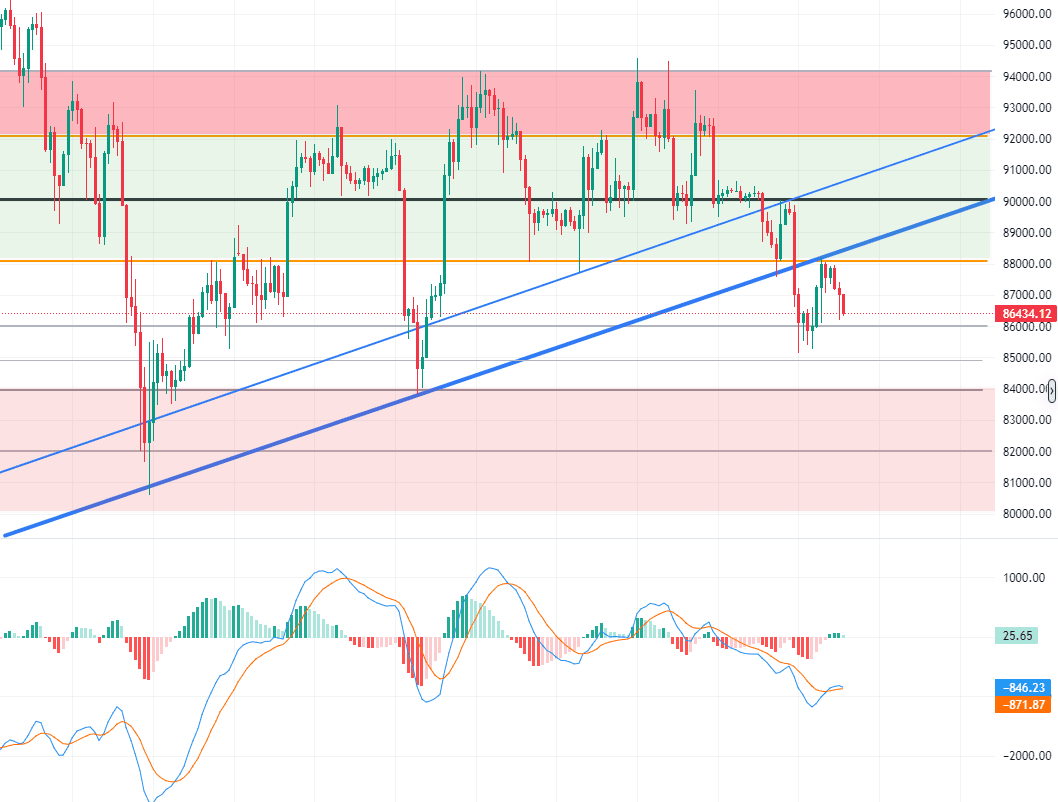
Although the support level has temporarily held, the issue of weak market momentum has become increasingly prominent. Currently, the price has tested the support near $86,000 for the third time recently. This area is both a previous low in the pullback and a key Fibonacci retracement level. On-chain data shows that there is some buying support near $85,000, and the daily RSI bullish divergence signal is still present (price is in a low-level fluctuation but RSI has not made a new low), indicating that downward momentum is indeed weakening marginally. However, the characteristics of a weak short-term rebound are more pronounced: on the 4-hour chart, even though the MACD green bars have narrowed, the trading volume during the rebound has not increased in tandem, which is characteristic of a 'low-volume rebound'; although the RSI has moved out of the oversold zone, it has remained around 40, failing to generate effective upward momentum. Furthermore, the selling pressure in the perpetual contract market has not significantly eased, leading to difficulty in sustaining each rebound.
As for the next steps, it largely depends on the outcomes of two key events. If Bitcoin can hold the crucial support at $85,000, and the Bank of Japan can make some 'soft comments' after the rate hike—such as indicating a possible pause in rate hikes, along with U.S. CPI data coming in lower than expected, reigniting some expectations for easing—then Bitcoin is likely to initiate a corrective rebound, initially targeting the resistance zone of $88,500 to $90,000. If it can break through this, it may test the descending trend line at $92,000.
However, if the support at $85,000 is effectively broken, and the Bank of Japan raises rates by 25 basis points as expected or even raises by 50 basis points beyond expectations, triggering a massive withdrawal of carry trade funds, then the price may accelerate its decline, initially dropping to the $82,000 to $80,000 range, and it may even test the support strength at the $80,000 round number.

The market has actually entered the 'bottoming phase after deleveraging.' Most high-leverage positions have been cleared out, and the current selling pressure mainly comes from normal adjustments in the spot market. However, there aren't many funds willing to step in and buy the dip, and trading volume has been consistently shrinking. For ordinary investors, it might be wise to respond according to the fluctuation range of $85,000 to $88,500 in the short term, trying to avoid blindly buying the dip or chasing highs. It's crucial to pay attention to the Bank of Japan's decision on December 18-19 and tomorrow's U.S. CPI data; waiting for clear breakout signals before taking action would be more prudent. Additionally, keep an eye out, as many institutions will want to realize profits by the end of the year, which could trigger short-term liquidity fluctuations, and this should not be taken lightly.
This article represents only personal opinions. Due to the timing of the article's publication, the above views or suggestions may not be timely and are for reference only. Investment involves risks, and entering the market requires caution; please make reasonable decisions based on your actual situation.
Written by: Jayne Crypto
