
In the winter of 2025, the cryptocurrency market did not welcome the anticipated 'Santa Claus rally'; instead, it was shrouded in a haze of tension and uncertainty. Bitcoin's price hovered around the psychological barrier of $90,000, with both bulls and bears engaging in fierce battles, and market sentiment was like walking on thin ice. The chill behind this is not due to a black swan inside the crypto world, but rather a perfect storm triggered by the starkly different monetary policy paths of the two major economies—America and Japan.
On one side, the Federal Reserve is opening the interest rate cut channel, releasing liquidity; on the other side, the Bank of Japan (BOJ) is sharpening its knives, preparing to end decades of negative interest rates. Why does this macro drama of 'ease and tightness' make cryptocurrency traders, who are used to the winds and waves, feel unprecedented tension? The answer lies in a mechanism that profoundly affects global capital flows, as well as Bitcoin's high sensitivity to global liquidity.
A Song of Ice and Fire
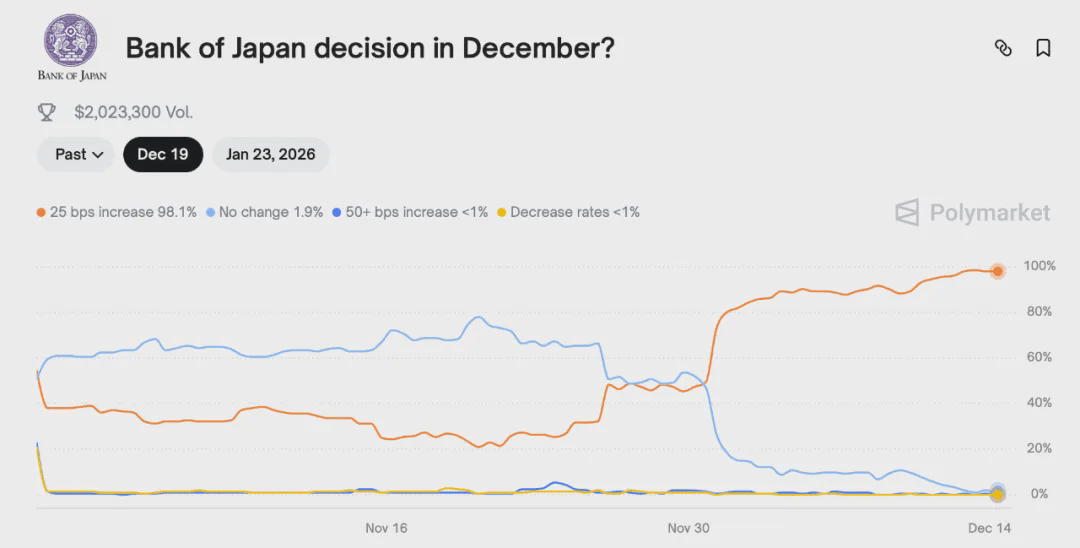
The most immediate fear in the current market stems from the Bank of Japan's upcoming policy meeting on December 19. According to data from prediction markets such as Polymarket, the market generally believes there is a 98% probability that the Bank of Japan will raise interest rates by 25 basis points, bringing its benchmark rate to 0.75%, further distancing itself from ultra-loose monetary policy.
This seemingly minor shift could potentially leverage trillions of dollars of global capital. Its core lies in a long-standing financial strategy—yen arbitrage trading.
For decades, due to the Bank of Japan maintaining extremely low or even negative interest rates, global institutional investors and hedge funds have been able to borrow yen at very low costs and then exchange this cheap capital for dollars or other currencies to invest in higher-yielding global assets, such as U.S. Treasury bonds, stocks, and of course, high-risk, high-return crypto assets like Bitcoin. This continuous influx of cheap capital has been one of the important drivers of rising prices of global risk assets over the years.
However, once the Bank of Japan raises interest rates, everything will change. The first impact will be the rise in borrowing costs, as higher interest rates mean that the cost of borrowing yen is no longer cheap, compressing the profit margins of arbitrage trading. Secondly, there are expectations for yen appreciation, as interest rate hikes typically strengthen a country's currency. Investors anticipating a stronger yen means they will need more valuable dollars or other assets to exchange for yen to repay loans in the future, leading to exchange rate losses.
Under this dual pressure, the rational choice is to 'liquidate,' i.e., unwind arbitrage trades. Investors will begin to sell off the risk assets (including Bitcoin) they previously purchased, converting the proceeds back into yen to repay debts. If this liquidation behavior becomes a wave, it will create massive selling pressure on the global market, forming a 'de-leveraging' storm.
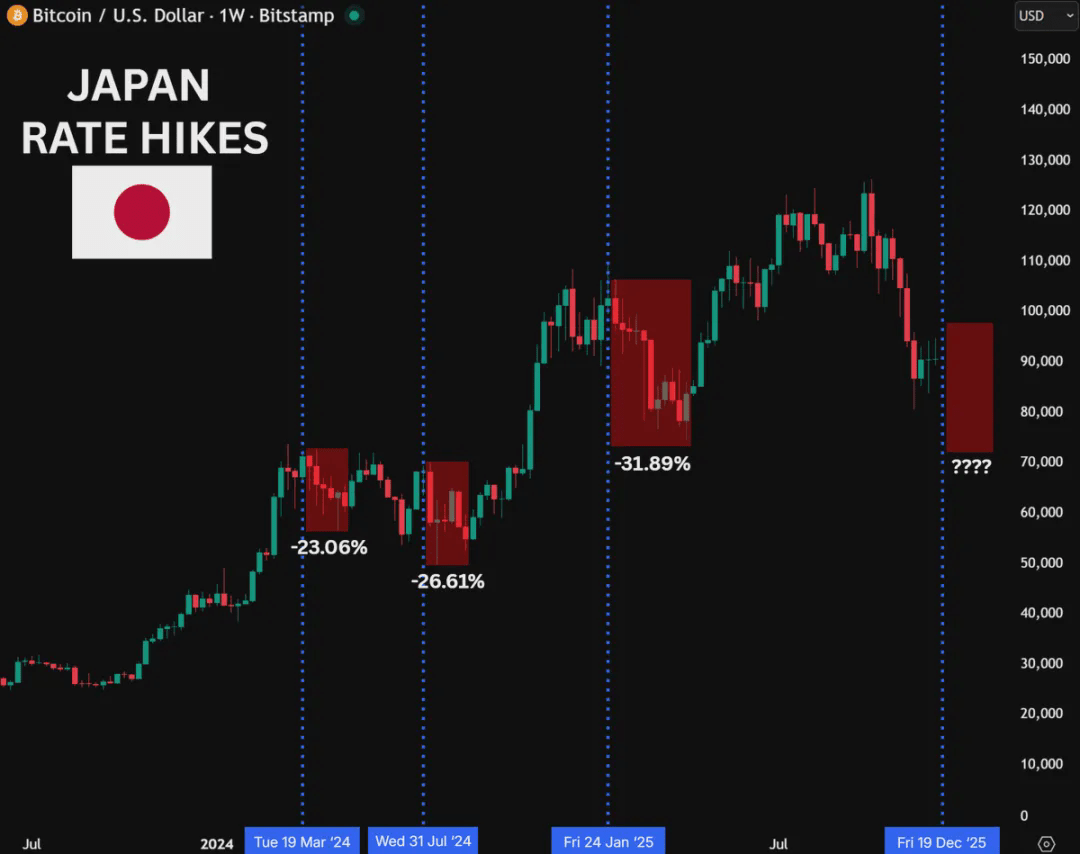
The mirror of history reflects a disturbing scene. Analysts point out that after the Bank of Japan has taken tightening stances or actually raised interest rates in the past few instances, the Bitcoin market has experienced severe corrections. For example, after rate hikes in March, July 2024, and January 2025, Bitcoin prices saw significant drops of between 20% and 30%. If history repeats, some pessimistic analysts warn that Bitcoin prices could drop from the current level of $90,000 below the support level of $75,000.
The data from the options market also reflects this concern. Options data related to December 19 (the date of the Bank of Japan's decision) shows a significant increase in demand for put options, with the 25-Delta risk reversal indicator showing negative values, indicating that top players are actively hedging against potential downside risks.
Just as the chill grows stronger in the East, the warm winds from across the ocean in the U.S. have blown in. The Federal Reserve recently cut interest rates by 25 basis points as expected and hinted at the possibility of further cuts in 2026. This is typically seen as a significant positive for risk assets.
Interest rate cuts mean increased dollar liquidity and lower funding costs, which theoretically stimulate investment and consumption, pushing funds toward assets like Bitcoin that are seen as 'digital gold.' Additionally, analysts from Coinbase have proposed the concept of 'Stealth QE,' suggesting that the process of the Federal Reserve shifting from reducing its balance sheet to net liquidity injection is itself a form of mild quantitative easing, expected to support the crypto market in the first quarter of 2026.
Moreover, key economic data such as the U.S. non-farm payroll report (NFP), initial jobless claims, and the consumer price index (CPI), which will be released this week, will also serve as important indicators influencing the future policy path of the Federal Reserve. If the data shows a cooling labor market or slowing inflation in the U.S., it will strengthen the market's expectations for further interest rate cuts by the Federal Reserve, providing upward momentum for Bitcoin, potentially challenging the resistance level of $95,000.
Thus, a divided and contradictory global macro picture presents itself: Japan's tightening policy is draining liquidity, while the U.S. easing policy is attempting to inject liquidity. Bitcoin, as one of the assets most sensitive to global liquidity, finds itself at the center of this tug-of-war.
The logic of bears is very clear: the scale of yen arbitrage trading is enormous, and the sell-off triggered by its unwinding is direct and fierce enough to overwhelm any 'stealth' liquidity released by the Federal Reserve in the short term. Historical data and technical indicators (such as the 'death cross' and 'bearish flag' formed on the daily chart) point to downside risks.
Bullish hopes are pinned on policy misalignment: they believe that the liquidity of the dollar is decisive, and as the issuer of the global reserve currency, the Federal Reserve's policy influence far exceeds that of the Bank of Japan. Moreover, Japan's interest rate hikes are gradual, while once the Federal Reserve's rate cut cycle begins, its impact will be sustained. This pattern of 'long pain' versus 'short pain' may ultimately benefit risk assets. Some analysts believe this is not a one-time liquidity shock but a 'systemic rotation' of global capital that could ultimately direct funds into cryptocurrencies with asymmetric upside potential.
Why is the market fragile?
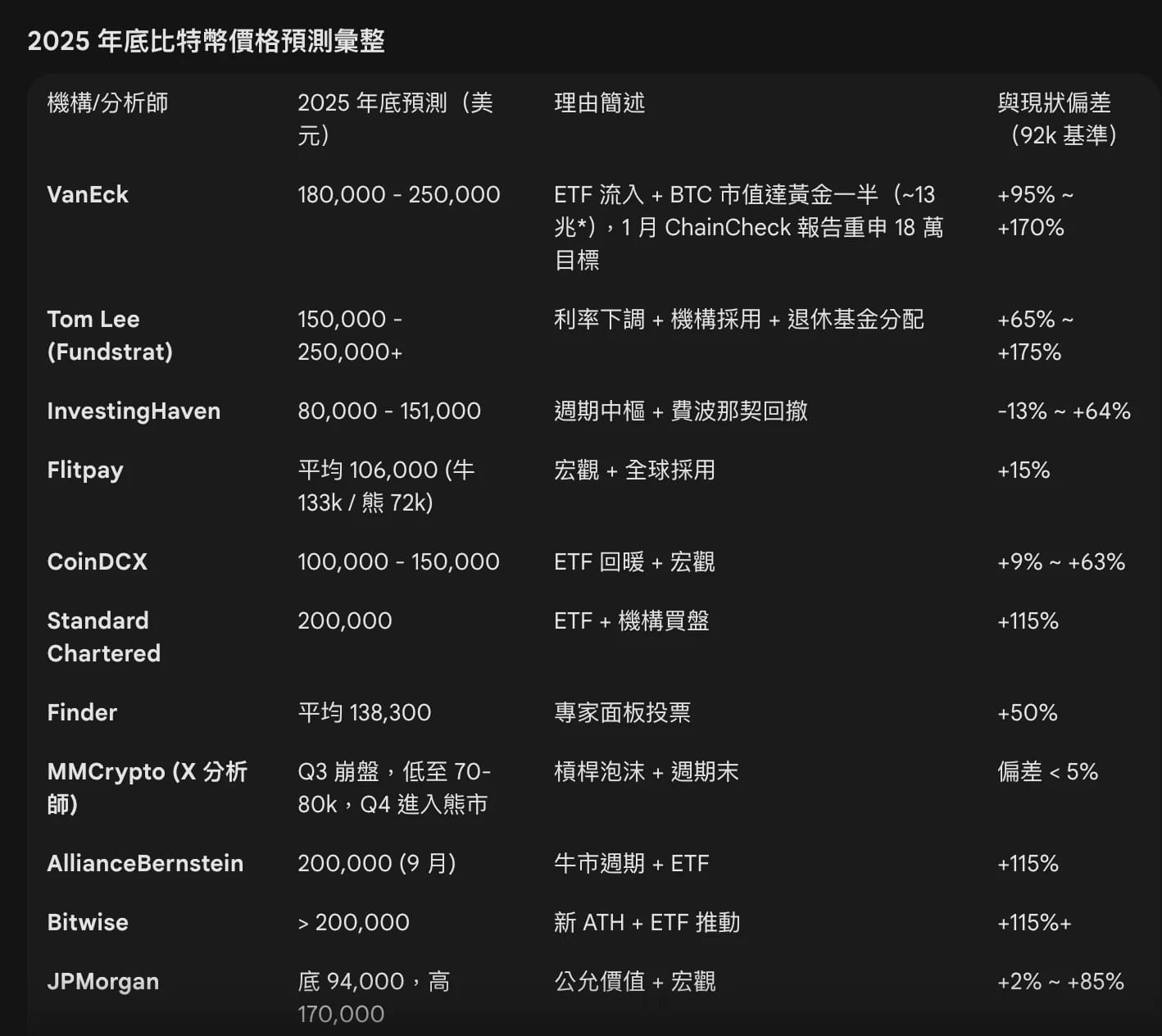
To understand the current market's tension, one must review the overall performance of the market since 2025. At the beginning of the year, supported by the 'three pillars' of Bitcoin halving, spot ETF approval, and potential friendly policies from the U.S., Wall Street institutions generally set year-end target prices above $150,000. However, the reality is that Bitcoin has been declining since peaking in October.
The lesson from this 'collective crash' is:
Good news has come to an end: the inflow of funds into ETFs has not reached the most optimistic expectations, and as a two-way channel, ETFs have accelerated fund outflows when the market turns.
Cycle models have failed: historical halving bull markets have occurred in macro environments of low interest rates or quantitative easing. The aftereffects of high global interest rates in 2025 have broken the simple repetition of historical models.
Leveraged liquidation: Recent price drops have largely been driven by the liquidation of over-leveraged long positions in the futures market, rather than fundamental sell-offs by long-term holders (HODLers). Data shows that about 30% of Bitcoin is held by long-term players like institutions and large entities, and this portion of supply is relatively stable.
This indicates that the current market structure is relatively fragile, prone to severe fluctuations triggered by macro news due to leveraged liquidation. All eyes are focused on key technical levels, such as the two-year moving average line (2YSMA) around $82,800, which has historically been an important boundary between bull and bear cycles.
In summary, the Bitcoin market is at an extremely delicate crossroads. It is no longer just an isolated market driven by technological innovation and community consensus but is deeply embedded as an important piece in the global macroeconomic chess game.
The traders' anxiety is not unfounded. They are facing a complex game: on one hand, there is the risk of a severe sell-off supported by historical data triggered by Japan's interest rate hike; on the other hand, there are liquidity benefits from the U.S. rate cuts, which align with traditional financial logic. The outcome of this confrontation between the two forces will largely determine Bitcoin's fate in the short term.
In the coming days, as the Bank of Japan's interest rate decision and key U.S. economic data are gradually released, the fog over the market may dissipate. We will witness whether Bitcoin will lose critical support in this tug-of-war over global liquidity or absorb the shocks and find opportunities for rebound in the Western winds. For all market participants, this is both a severe test and the ultimate trial of risk management and independent thinking abilities.
