
In the world of cryptocurrency, the direction of regulation is always the most critical factor that moves the market's nerves. At the end of 2025, the U.S. financial regulatory field dropped two heavy bombs, not only marking a turning point for the long-standing 'debanking' dilemma faced by the crypto industry but also opening an unprecedented door for the integration of traditional banks and digital assets.
First, the Office of the Comptroller of the Currency (OCC) confirmed the systematic exclusion of the cryptocurrency industry by large banks over the past few years; then, the OCC turned its tone and conditionally approved the national trust bank licenses for five top cryptocurrency companies, and issued an explanatory letter clarifying new pathways for banks to participate in cryptocurrency transactions.
This series of operations is like a combination of punches, leading the market to question: Does this mean that U.S. banks can really 'get involved in trading coins'? How will these five 'licensed' crypto giants stir the waters of traditional finance?
De-banking
To understand the profound significance of this transformation, one must first revisit the shadow that has loomed over the crypto industry for many years—'de-banking'.
For years, cryptocurrency companies have found it exceptionally difficult to obtain basic banking services (such as opening accounts and handling payments) in the U.S. Many operators complain that they have had their accounts closed or services refused by banks without violating any laws. This phenomenon is seen as regulatory pressure on banks, indirectly targeting industries they do not favor.
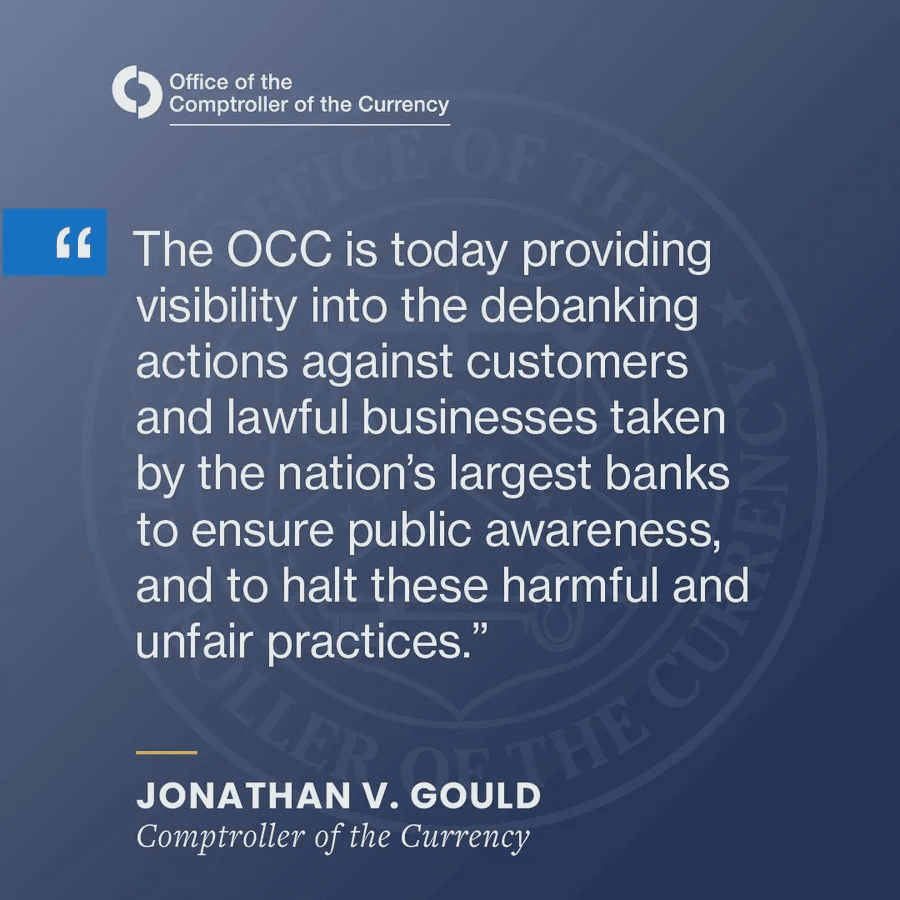
On December 11, 2025, a preliminary investigation report released by the OCC officially confirmed this phenomenon from an official level for the first time. The report named nine of the largest national banks in the U.S., including JPMorgan Chase, Bank of America, Citibank, and Wells Fargo. The report noted that between 2020 and 2023, these banks took unreasonable discriminatory actions against legitimate industries with 'political controversy' such as cryptocurrency, oil and gas, and firearms manufacturing.
They do not outright refuse but set extremely high thresholds for 'upgrade reviews', making it difficult for these companies to obtain normal financial services. OCC Director Jonathan Gould harshly pointed out that banks using their government-granted franchise rights and market power to promote harmful 'de-banking' policies is 'inappropriate'. He hinted that the OCC may submit the investigation results to the Department of Justice to pursue potential illegal behavior.
The release of this report is seen as a 'clearing' of the financial regulatory policies of the previous Biden administration by the Trump administration. The executive order signed by Trump in August of the same year explicitly called for a review of whether banks engaged in discrimination based on political or religious beliefs. The OCC's report is a direct product of this order, marking the end of an era: regulators no longer tacitly allow or even encourage banks to exclude legitimate industries based on 'reputation risk'.
However, merely clearing the past is not enough; the market needs to see a clear path to the future. And the subsequent actions of the OCC precisely provide the answer.
Federal-level identification
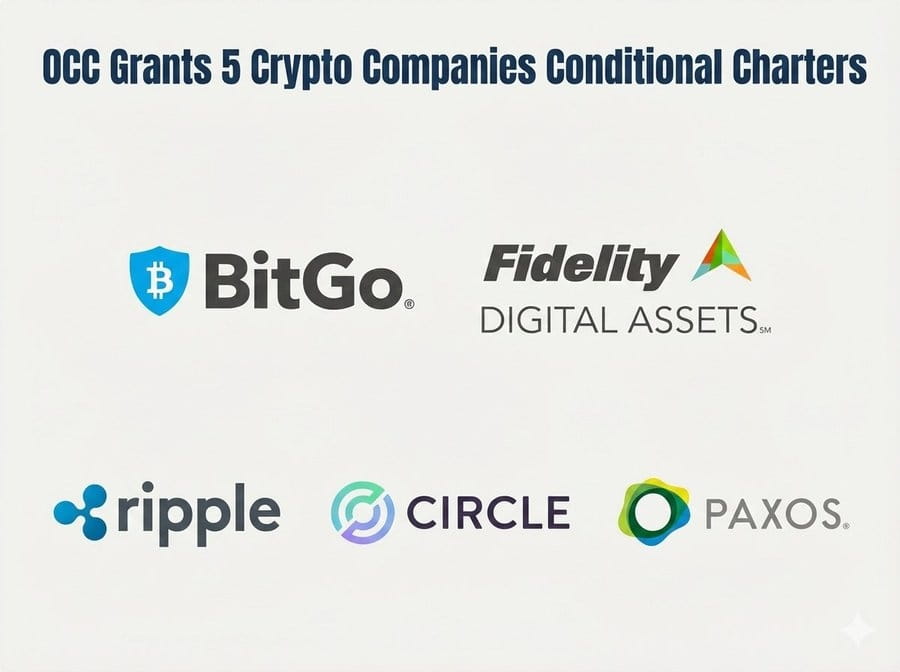
The day after revealing the 'de-banking' issue, the OCC announced a milestone decision: conditionally approving five heavyweight companies in the crypto field for national trust bank licenses. These five companies are:
Ripple: A cross-border payment giant, its Ripple National Trust Bank has been approved for establishment.
Circle: The issuer of the stablecoin USDC, its First National Digital Currency Bank has been approved for establishment.
BitGo: A well-established cryptocurrency custodian.
Paxos: Another leading custodian and stablecoin issuer.
Fidelity Digital Assets: The digital asset division of traditional financial giant Fidelity.
The last three converted their original state-level trust licenses into national-level licenses. This 'national trust bank license' is extremely valuable. It means these companies no longer need to apply for licenses in all 50 states but are directly subject to federal regulation. This not only represents a leap in operational efficiency but also serves as a 'federal endorsement' of their compliance and credibility.
Upon obtaining this license, they will have the following core powers:
Federal-level custody: As a federally regulated trustee, safely holding digital assets for institutional clients (such as ETFs and pension funds).
Payments and settlements: Providing blockchain-based payment clearing services and qualifying for access to the Federal Reserve's master account, directly connecting to the traditional financial payment highway.
National operations: Legally conducting business across the U.S. without having to deal with fragmented and potentially conflicting regulatory laws in each state.
Of course, this is not an 'all-purpose banking license'. Their business scope is strictly limited to custody and fiduciary activities and cannot accept public deposits or issue loans like commercial banks. Nevertheless, the symbolic and practical significance of this step is immense. It marks the official recognition by the highest banking regulatory authority in the U.S. that compliant crypto companies can be incorporated into the national financial system, standing at the same regulatory level as traditional banks.
Bank of America 'trading coins'
While opening the door for crypto-native companies, the OCC has also loosened another constraint for traditional banks to participate in the crypto market. This stems from its released explanatory letter No. 1188.
The core of this letter clarifies that banks can conduct 'Riskless Principal Trades'. This is a professional term, but it is not complex to understand. It means that banks can act as intermediaries to facilitate cryptocurrency transactions for clients.
Specifically, when Client A wants to buy Bitcoin, the bank can immediately find another Client B who wants to sell an equal amount of Bitcoin or buy it from the market instantly and sell it to A. Throughout the process, the bank completes a buy and a sell transaction almost simultaneously, without holding cryptocurrencies as inventory or speculative assets, thus not bearing the risk of price fluctuations. The bank earns service fees or small spreads from this.
Therefore, banks in the U.S. cannot 'trade coins' like retail investors. They cannot use their own funds to speculate on the rise and fall of cryptocurrencies. However, they can now legitimately provide brokerage services for cryptocurrency trading to their large client base.
The impact of this step should not be underestimated. Imagine in the future, wealth management clients of JPMorgan or Bank of America can directly buy and sell Bitcoin or Ethereum with one click in their bank app, without needing to register for a new cryptocurrency exchange account. Banks leverage their existing customer channels and credibility to enter the lucrative crypto trading market without bearing risks on their balance sheets.
This letter is the pinnacle of a series of regulatory relaxations in 2025. Previously, the OCC, the Federal Reserve, and the Federal Deposit Insurance Corporation (FDIC) had gradually lifted strict restrictions and 'pre-approval' requirements on banks' participation in crypto custody, stablecoin businesses, and the use of blockchain networks.
New financial landscape
Connecting the OCC's 'de-banking' investigation, the approval of the licenses for five crypto companies, and the explanatory letter that relaxed regulations for banks creates a grand picture: U.S. financial regulation is shifting from the past 'blockade and exclusion' to a brand new era of 'regulation and integration'.
For the crypto industry: This is a huge victory. 'Licensed operations' mean legitimacy, credibility, and a broader institutional market. The predicament of being shut out of the banking system is dissolving, and a fairer competitive environment is forming.
For traditional banks: This is a new growth point for business. Without increasing substantial risk, they can leverage their advantages to provide crypto services and compete with native exchanges like Coinbase and Binance.
For the entire market: This means that the deep integration of crypto finance and traditional finance is accelerating. With trillions of assets flowing within the traditional banking system, even if only a small portion enters the crypto market through compliant channels, it will bring significant incremental funds.
Of course, all of this is still in the 'conditional' preliminary stage. The licenses of the five companies must meet all additional conditions before they can take full effect, and banks must conduct new business under strict anti-money laundering (AML) and risk management frameworks.
But regardless, the wheels of history have begun to turn. This series of regulatory changes at the end of 2025 undoubtedly opens a new chapter for the development of digital finance in the U.S. and globally. The era when the crypto industry lingered outside mainstream finance is coming to an end, and a new financial paradigm that is regulated, integrated, and in the sunlight is on the horizon.


