
The Federal Reserve completed a 25 basis point rate cut last week as expected, which was thought to inject a boost into the risk asset market, but unexpectedly, the cryptocurrency market cooled at the start. In the first two trading days of this week, Bitcoin continued to weaken, oscillating around $85,000 in the morning, while Ethereum directly lost the critical $3,000 threshold, and the overall crypto market fell into a correction phase. The linked cryptocurrency concept stocks also faced pressure, with Strategy and Circle both approaching a decline of nearly 7% during the day, leading platform Coinbase dropping over 5%, while mining companies like CLSK, HUT, and WULF saw declines exceeding 10%, and panic sentiment spread throughout the market.
The seemingly sudden decline has actually been brewing for some time. From the rise in expectations for the Bank of Japan to raise interest rates to the uncertainty of the Fed's subsequent rate cut path, the adjustment in the crypto market is not accidental under the interweaving of multiple macro factors. Among them, the yet-to-be-implemented interest rate hike by the Bank of Japan is undoubtedly the core variable stirring the market—this 'domino effect' that global investors are highly alert to has already triggered a chain reaction before it is formally knocked down, with global stock markets showing panic emotions in advance, making it difficult for the cryptocurrency market to remain insulated.
1. Core Logic: Why has the yen rate hike become a 'market killer'?
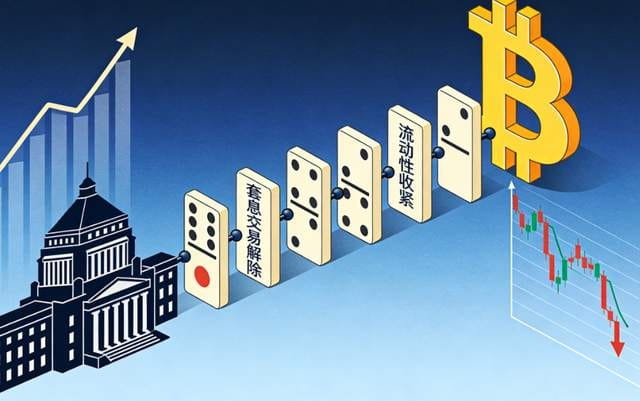
The influence of the Bank of Japan's interest rate hike stems from the global 'carry trade' system it drives. For decades, Japan has maintained ultra-low interest rates or even negative rates, making the yen the cheapest financing currency globally. International investors (from everyday housewives known as 'Mrs. Watanabe' to investment giants like Buffett) have borrowed yen at nearly zero cost, exchanged it for dollars, and invested in higher-yielding assets like Bitcoin and US stocks, forming a massive carry trade closed loop.
Now, with interest rate hike expectations soaring, this closed loop faces a risk of rupture. Bank of Japan Governor Ueda Kazuo recently stated that the policy meeting on December 19 will assess the pros and cons of rate hikes, and if the economy meets expectations, a formal rate hike will be implemented, causing market expectations of a rate hike probability to soar above 80%. Once the rate hike is implemented, the cost of yen financing will significantly increase, while also triggering expectations of yen appreciation. To avoid the dual risks of costs and exchange rates, carry traders will be forced to sell off assets like Bitcoin in large quantities to exchange for yen to repay debts—this 'liquidity drain effect' directly leads to a tightening of liquidity in the crypto market, becoming the core driver of this round of decline.
The reason why the Fed's interest rate cuts have not been able to offset the impact lies in the 'dislocation' of policy effects: on one hand, the market still has doubts about the Fed's subsequent rate cut intensity and pace, and Powell's cautious remarks have weakened the policy's boosting effect; on the other hand, the yen carry trade covers global capital, and its reversal has triggered a liquidity contraction that is global in nature, making it difficult for a single central bank's rate cut to fully offset it.
2. Historical Evidence: The strong correlation between interest rate hikes and Bitcoin corrections.
The impact of the Bank of Japan's interest rate hike on the crypto market is not due to excessive panic in the market but is supported by clear historical data. Reviewing the three interest rate hike points in recent years, Bitcoin has shown a deep correction in the following 3-6 weeks, forming a clear 'rate hike - sell-off - correction' pattern.
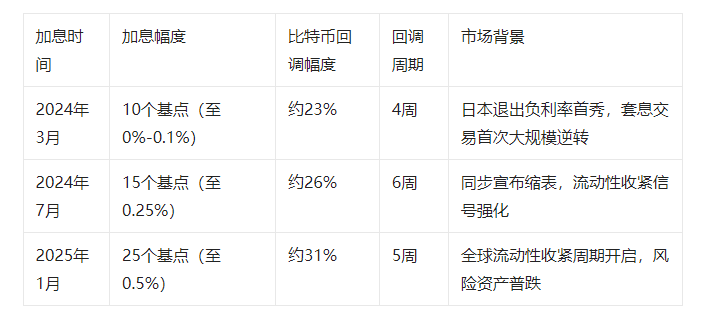
The global liquidity tightening cycle has begun, with risk assets experiencing a widespread decline.
Historical data shows that after three interest rate hikes, Bitcoin's correction has reached over 20%, and the correction cycles are concentrated within 3-6 weeks, indicating a significant regularity in the impact of interest rate hikes on the crypto market. Notably, after the rate hike in July 2024, not only did Bitcoin plummet, but the Nikkei 225 index also recorded its largest single-day drop since 1987, confirming the global influence of Japan's rate hikes as a 'domino effect'.
3. Subsequent Forecast: Analysis of the possibility of decline under multiple scenarios.
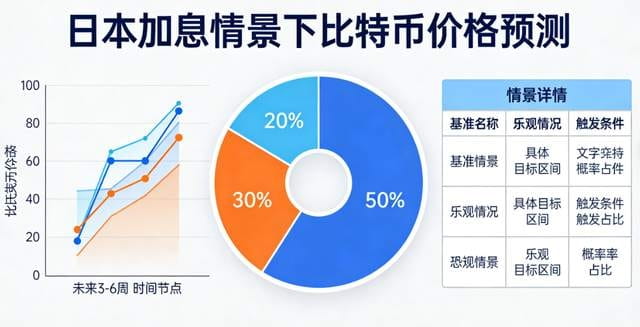
Combining historical patterns with the current market environment, if the Bank of Japan is expected to hike interest rates as scheduled this Friday (with a market probability of over 80%), the subsequent trajectory of Bitcoin can be divided into three scenarios, with differences in the magnitude of decline and target ranges under different scenarios.
1. Baseline Scenario (Probability 60%): Conventional correction in line with historical patterns.
If the interest rate is raised by 25 basis points to 0.75% (the mainstream market expectation), and the Bank of Japan's statement is neutral (not signaling further sustained rate hikes), then Bitcoin is likely to replicate historical trends, completing a 20%-25% correction within the next 3-6 weeks. Based on the current price of $85,000, the target range after the correction would be $63,750-$68,000. In this scenario, the market will gradually digest the impact of the rate hike, stabilizing in the $65,000-$70,000 range by the end of the year—after all, the current 80% rate hike expectation has already been reflected in advance, and some selling pressure has already been released in previous declines.
2. Optimistic Scenario (Probability 20%): Rate hike leads to 'bad news fully priced in'.
If the Bank of Japan only raises rates by 10 basis points or clearly states after the hike that 'subsequent rate hikes will be paused', the market may welcome a rebound after 'bad news is fully priced in'. Bitcoin could rebound after testing the key support level of $80,000, returning to around $90,000 before the end of the year. The core logic of this scenario is the 'expectation difference'—the market has priced in aggressive rate hikes in advance, and a dovish policy would trigger short covering. From a technical perspective, $80,000 is a support level where institutional funds are concentrated, and if it is not effectively broken, a rebound is expected.
3. Pessimistic Scenario (Probability 20%): Hawkish statements trigger panic selling.
If the Bank of Japan raises rates by 25 basis points and releases a hawkish signal of 'sustained rate hikes in 2026', it will completely break the wait-and-see mentality of carry traders, triggering large-scale panic selling. Coupled with seasonal factors of year-end institutional settlements and tightening liquidity, Bitcoin's decline may exceed historical extremes, reaching 30%-35%, with the first quarter of next year possibly touching the $65,000-$50,000 range. In this scenario, the declines in crypto concept stocks and mining companies may further expand, and the risk of leveraged liquidation will exacerbate market volatility—referencing the decline in early December, a scenario where over 190,000 people were liquidated in a single day, with liquidation amounts reaching $553 million may replay.
Risk Warning: Bitcoin prices are influenced by multiple factors including the Fed's rate cut pace, regulatory policies, and ETF fund inflows. Historical data is for reference only and does not constitute investment advice. The current market leverage rate is relatively high, and investors should be wary of the 'decline - liquidation - further decline' stampede cycle.
4. Conclusion: The Japanese rate hike is the main cause, but not the only variable.
Returning to the initial question: 'Japan's interest rate hikes haven't started yet, why has Bitcoin fallen like this?' The answer is clear—this is the market's early reaction to the core variable of global liquidity tightening, with the reversal of the yen carry trade being the biggest driver of this decline. From historical patterns, subsequent phase corrections are a high-probability event, but an extreme situation of falling to $50,000 requires the conditions of 'hawkish rate hikes + multiple negative factors resonating', which is relatively low in probability.
For investors, short-term focus should be on the policy statement of the Bank of Japan's decision on December 19 and the effectiveness of the $8,000 support level; in the medium to long term, if the global liquidity tightening cycle is established, the high volatility of crypto assets will become the norm. Controlling leverage and phased investments may be a more prudent choice. After all, in the financial market, history does not repeat itself simply, but always rhymes with similar cadences.


