
An oracle is the core infrastructure of decentralized finance (DeFi) and the entire blockchain ecosystem, addressing the fundamental limitation of blockchains — the inability to directly access external information.
In simple terms, an oracle is a bridge that securely and reliably brings 'off-chain data' into the 'on-chain world.'
Core Definition

The Workflow of Oracles
Oracles transmit information from the external world to smart contracts on the blockchain, typically through the following steps:
Data Request: A smart contract (such as a lending protocol or derivatives DEX) needs to know the real-time price of ETH, so it sends a request to the oracle system.
Data collection (off-chain): Oracle nodes (a group of decentralized computers) collect data from multiple off-chain sources (such as CoinGecko, CoinMarketCap, and dozens of centralized exchanges).
Data aggregation and validation: The nodes clean, aggregate, and cross-validate the collected data (e.g., by taking the median or weighted average) to filter out erroneous data or malicious price feeds.
Data transmission (on-chain): Oracles write the finalized, trusted data into the aggregated contract on the blockchain in the form of transactions.
Contract usage: Smart contracts read this price data from the aggregated contract and execute subsequent operations based on it (e.g., calculating loan collateral ratios, determining whether to liquidate).
Oracle risks and security
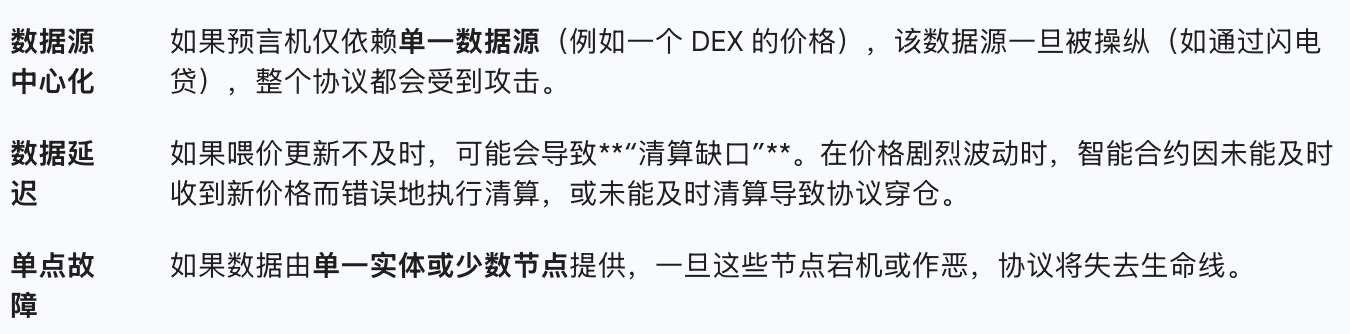
The security of oracles is crucial. If an oracle is attacked or the price feed is incorrect, it will directly lead to erroneous operations in smart contracts that rely on that data, resulting in significant asset losses. This is one of the biggest security vulnerabilities in DeFi.
Main risks of oracles
Key technologies to enhance security
To address these issues, mainstream decentralized oracles (such as Chainlink) employ various enhancement mechanisms:
Decentralized node network: Prices are provided collectively by dozens of independent, economically incentivized nodes, preventing any single node from acting maliciously.
Data aggregation: Information is extracted from hundreds of data sources and calculated into secure, stable prices through mathematical models.
Time-weighted average price (TWAP): Many protocols no longer use a single moment's price but instead use TWAP, which calculates the average price over a period of time, significantly increasing the cost of price manipulation.
Economic Security Model: Nodes need to stake assets, and if the price feed is incorrect, their staked assets will be confiscated (Slashing), thereby incentivizing honest behavior.
In summary, oracles are the lifeline of DeFi. Their security determines the reliability of all smart contracts that depend on external data.

