
In an era where Hong Kong actively embraces and regulates the wave of cryptocurrency, a milestone event is about to be recorded in history. The licensed cryptocurrency group HashKey Holdings Limited (hereinafter referred to as HashKey) has officially launched its initial public offering (IPO) on the main board of the Hong Kong Stock Exchange, aiming to become the first licensed cryptocurrency exchange to go public in Hong Kong. This listing is not only a critical step in HashKey's own development but is also seen as an important test of confidence in Hong Kong's Web3 strategy and the global capital market.
IPO Core Details
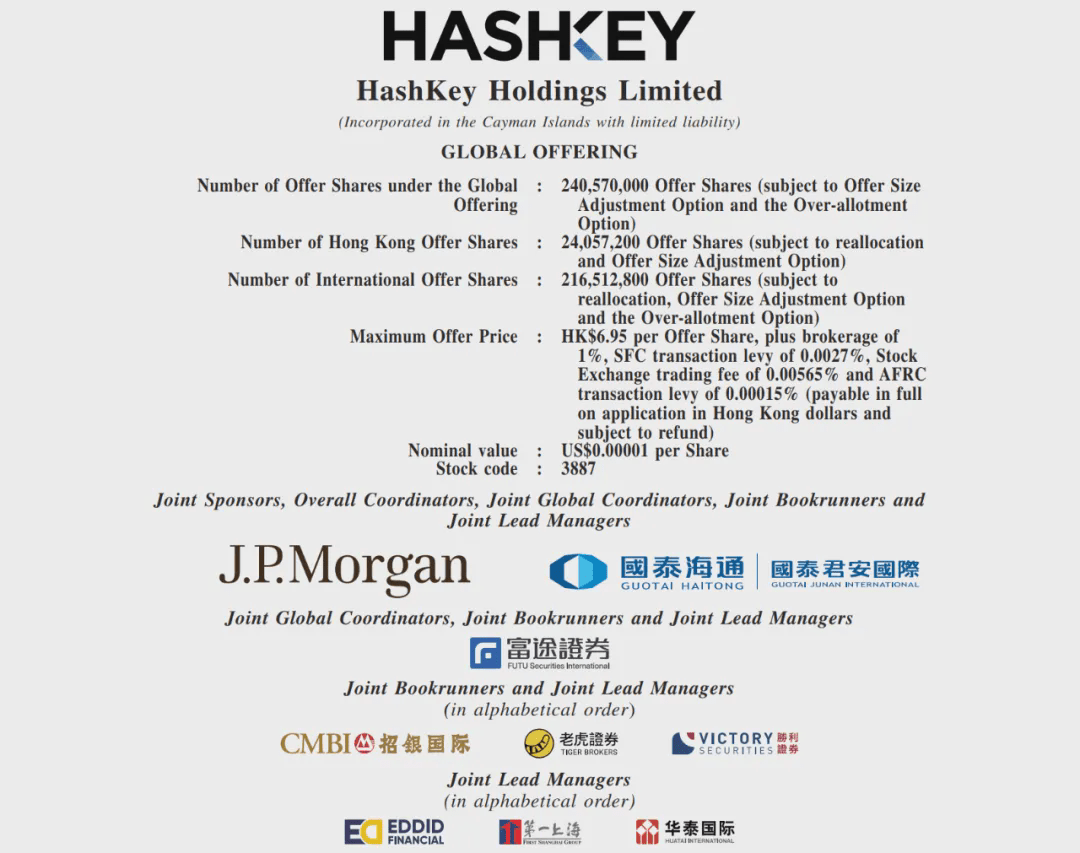
According to the prospectus disclosed by HashKey, its global offering plan aims to raise up to HK$16.7 billion (approximately US$2.15 billion). The company plans to issue approximately 240.6 million shares, with an offering price range set between HK$5.95 and HK$6.95 per share. If calculated at the highest price, HashKey's listing valuation will be close to HK$19 billion (approximately US$2.44 billion).
The subscription period for investors starts at 9:00 AM on December 9 (Hong Kong time) and lasts until noon on December 12. If everything goes smoothly, HashKey's IPO final pricing will be determined and announced on December 16, and the stock will officially start trading on December 17, 2025, with the stock code '3887'. The joint sponsors for this IPO are well-known financial institutions such as JP Morgan Chase and Guotai Junan International.
HashKey has a clear plan for the use of raised funds:
Expand regulatory licenses and operational capabilities: Seek to obtain licenses in more jurisdictions such as Japan and Bermuda, expanding the global compliance map.
Strengthen infrastructure: Invest funds to upgrade institutional-level custody and clearing infrastructure, enhancing asset security and processing efficiency.
Explore new business areas: Actively layout stablecoin infrastructure and cross-border payment markets, and continue investing in the ecosystem construction of its Layer2 network 'HashKey Chain', especially in the field of real-world asset (RWA) tokenization.
Despite the uncertainty in the crypto market, HashKey's IPO still attracts the attention of many heavyweight institutions. The most notable is its luxurious lineup of cornerstone investors. Nine institutions, including UBS Asset Management, Fidelity International, Infini Capital, and CDH Investments, have promised a total investment of USD 75 million (approximately HKD 590 million) to subscribe for HashKey’s stocks, accepting a six-month lock-up period.
This move is highly significant. The participation of cornerstone investors, especially from global top traditional financial giants like UBS and Fidelity, undoubtedly injects a shot of adrenaline into HashKey's IPO. This not only represents their recognition of the value and potential of HashKey itself but also serves as a strong endorsement of Hong Kong's cryptocurrency regulatory framework and its positioning as a 'global Web3 hub'. In an industry that urgently needs compliance and trust, this support from the mainstream financial world carries far greater symbolic significance than the funding itself.
Financial Performance
It is worth noting that when flipping through HashKey's financial statements, a complex picture of both opportunities and challenges emerges.
On one hand, the company's business growth is remarkable. Its trading volume surged from HKD 4.2 billion in 2022 to HKD 638.4 billion in 2024, an increase of over 150 times. As of September 30, 2025, the scale of staked assets managed by its platform reached HKD 29 billion, making it the largest staked service provider in Asia and the eighth largest in the world. In the RWA sector, the asset scale carried on its self-developed 'HashKey Chain' also reached HKD 1.7 billion. These figures highlight HashKey's absolute leadership in the Hong Kong market (with a market share of over 75%) and its strong capability in ecosystem building.
However, on the other hand, rapid expansion also comes with huge cost investments. The financial report shows that over the past three and a half years, HashKey has accumulated losses of nearly HKD 2.9 billion. Among them, the loss in 2022 was HKD 585 million, which expanded to HKD 1.19 billion in 2024. The company attributes the losses to significant equity incentive expenditures incurred in research and development, marketing, administration, and attracting talent.
By the time we enter 2025, the situation is expected to improve. In the first half of 2025, the company's net loss narrowed to HKD 507 million, a year-on-year decrease of about 34.8%, indicating that cost control measures are beginning to take effect. Although still in a loss state, this shift in trend, combined with its continuously growing revenue sources (transaction facilitation services account for nearly 70% of total revenue), sends a positive signal to the market: the company is on the path to profitability.
Capital Compliance Portal
The significance of HashKey's listing goes far beyond the success or failure of a single company. It is widely viewed as the first market referendum on the cryptocurrency policies vigorously promoted by the Hong Kong government since 2022. Through a series of measures, including the establishment of a clear licensing system, tightening custody requirements, and promoting stablecoin regulation, Hong Kong aims to position itself as a regulated, institution-level digital asset hub, distinctly different from the offshore 'wild growth' model. The performance of HashKey's IPO will directly reflect the global capital market's valuation and confidence in this 'Hong Kong model'.
On a deeper level, this IPO also reveals Hong Kong's unique role in the financial landscape of China. Against the backdrop of strict prohibitions on cryptocurrency trading in mainland China, Hong Kong has become a crucial and compliant 'gateway' for traditional Chinese industrial capital to enter the digital asset space. The equity structure of HashKey fully illustrates this point: Lu Weiding, chairman of Wanxiang Group, one of China's largest auto parts manufacturers, holds 43.2% of the company's shares through affiliated entities, making him the largest controlling shareholder. Founder Dr. Xiao Feng also has a strong background in China's asset management industry. It can be said that HashKey's listing is a landmark event symbolizing the large industrial capital of China officially laying out a global crypto economy through the regulated bridge of Hong Kong.
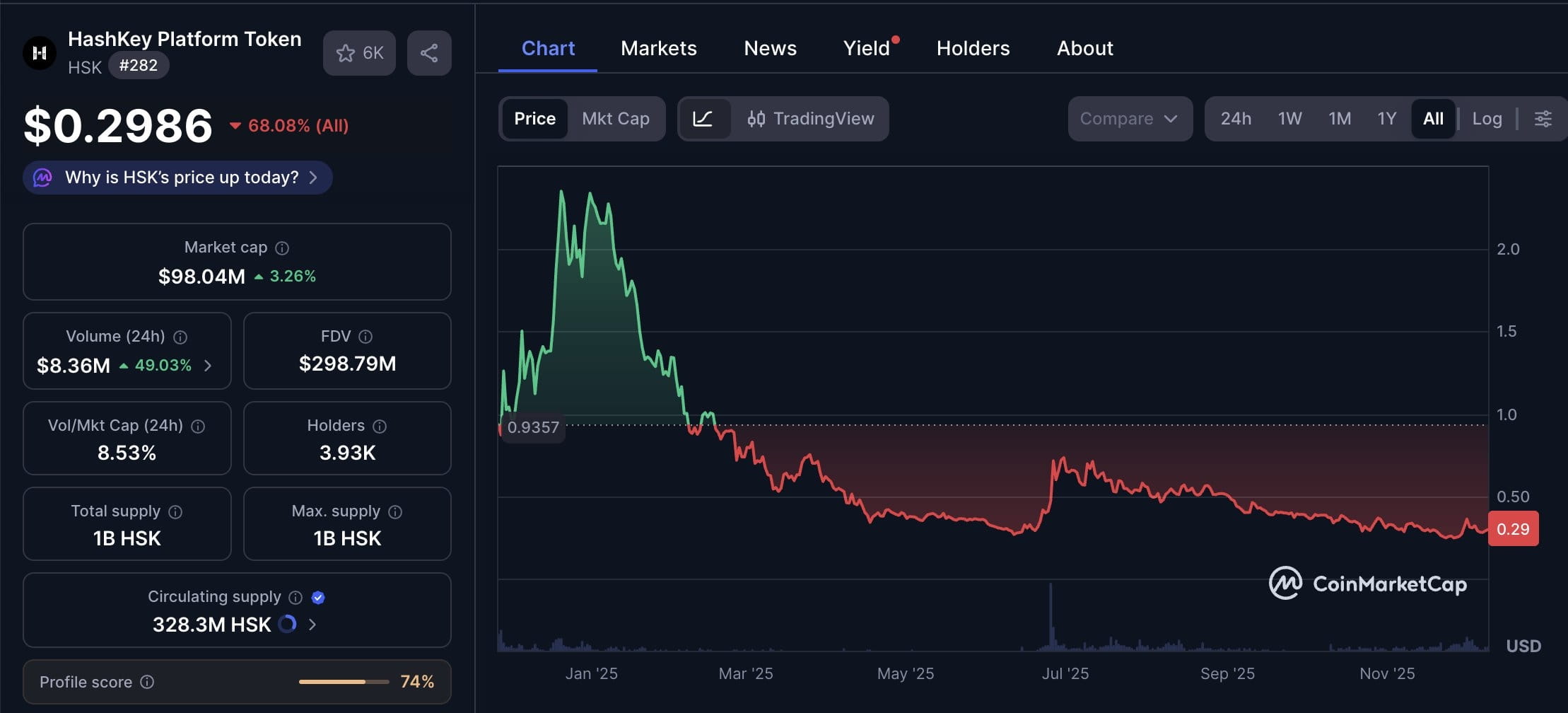
However, under the spotlight and the pursuit of capital, HashKey is not without concerns. The performance of its platform token HSK and the resulting crisis of trust within the community are becoming a shadow behind the company's glory.
Recently, a letter written by South Korean community member Xtormfrog (an open letter to Dr. Xiao Feng) has been widely circulated in both Chinese and Korean communities. In the letter, the author vehemently accuses the HashKey management of sacrificing the interests of retail investors in the pursuit of grand goals such as IPO and compliance. He points out that the HSK token was originally created to raise funds from the retail market, and many investors bought in at around 1 USD at the height of exaggeration by J (the code name of a former executive), but now the token price has plummeted by over 60%, resulting in heavy losses for investors.
The letter questions that HashKey has done almost nothing for the price of HSK and its holders, while Dr. Xiao Feng talks extensively about the future of Ethereum and RWA in major forums, but has never publicly mentioned HSK. The author compares HashKey to exchanges like Binance and OKX, which compensated users during crises, believing that HashKey is losing its most valuable 'trust asset'. The letter calls for the group to grant current South Korean market head Skylar greater power to rebuild trust with his pragmatic and community-friendly style.
This turmoil reveals a core contradiction faced by HashKey: how to satisfy regulators and traditional financial giants while also safeguarding the interests of the Web3 native community that supported it early on. This is also the ultimate test that all cryptocurrency companies attempting to 'enter the hall' must face.
Conclusion
HashKey's successful listing in Hong Kong is undoubtedly one of the most significant events in the global crypto industry in 2025. It symbolizes the shift of crypto assets from the margins to the mainstream and marks a solid step taken by Hong Kong in the global Web3 competition. Strong institutional backing, a clear compliance path, and unique advantages backed by Chinese capital paint a future full of imagination for HashKey.
However, the road ahead is not without obstacles. Ongoing financial losses, a crisis of trust from the community, and how to maintain a leading position in the increasingly fierce global competition are severe challenges facing the management. The bell-ringing ceremony on December 17 is not an end, but a brand new starting point. Whether HashKey can successfully navigate opportunities and challenges in the future will not only determine its own fate but will also significantly impact the evolution of the digital finance landscape in Hong Kong and across Asia. The world is watching.