
The discussion around the price of POL (Polygon) enters a new chapter, as analysts wonder whether the long-awaited 'super stablecoin cycle' for Polygon could be the catalyst that reverses its sluggish performance in the market. With the explosion in the adoption of stablecoins across banks, fintech platforms, sovereign entities, and trading networks, Polygon finds itself at the heart of a trillion-dollar transformation.
The main question is: can this super cycle generate enough demand, liquidity, and utility in the real world to reignite the long-term value of POL? Early signals suggest that the answer may depend on how quickly (and widely) global institutions issue tokenized money in the coming years.
Is the 'super stablecoin cycle' real? And why is it important for Polygon?
The 'super stablecoin cycle' is no longer just a marginal theory. Aishwary Gupta, Global Head of Payments and Real World Assets (RWA) at Polygon, predicts that over 100,000 stablecoins will be issued by 2030. This will not only include native cryptocurrency companies but also banks, corporates, sovereign governments, and global trade platforms. This represents a shift from speculative cryptocurrencies to a digital money infrastructure at the institutional level.
The drivers of this trend are strong: banks need to stop capital flight to higher-yielding on-chain assets. Corporates want coins with a closed-loop that retains consumer value. And nations aim to enhance their monetary systems by tokenizing their own stable units.
Gupta argues that the narrative is often misunderstood: stablecoins do not undermine monetary control, but rather enhance it, as USD-denominated stablecoins have bolstered global demand for the dollar. Banks are likely to issue their own 'deposit tokens', allowing users to transact on-chain without moving funds off their balance sheets. As competition increases and thousands of tokens emerge, the market fragments, creating a need for neutral settlement layers.
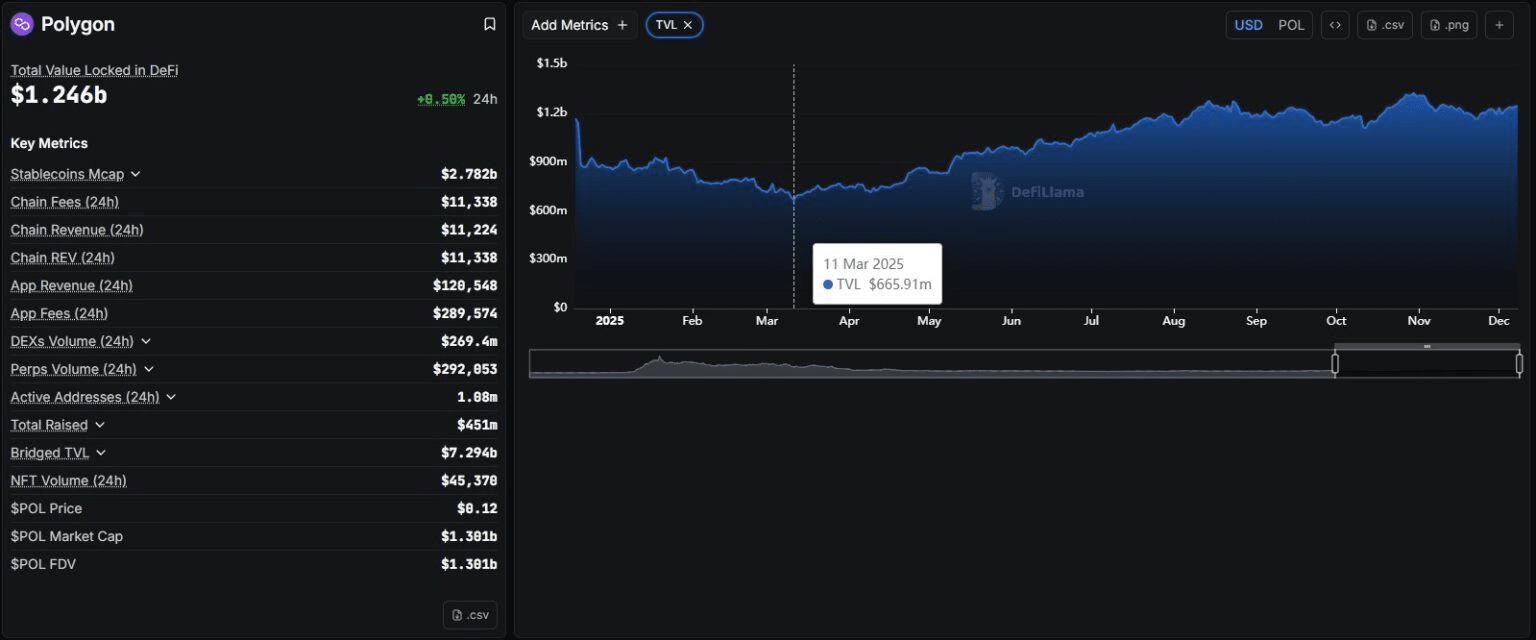
Here the role of the Polygon technology package stands out: thanks to its extremely low fees (less than $0.002), scalable productivity, and integrations with companies like Visa, Stripe, Shopify, and Revolut, Polygon already processes 3 million transactions daily and holds over $1.24 billion in stablecoins. If the super cycle becomes a reality, Polygon becomes one of the global highways for digital money.
Can Polygon capture enough of the stablecoin boom?
Polygon has quietly become the backbone of real-world payment flows. The network processed $4.3 billion in the second quarter of 2025, capturing 32% of all global USDC P2P transfers, and added nearly $700 million in new total value locked (TVL) this year. With expectations that the AggLayer system will unify liquidity across chains, Polygon could become the settlement network for thousands of interoperable stablecoins moving across apps, banks, and marketplaces.
This would significantly improve POL's economic model. Trading POL secures the network, earns fee revenues, and positions the token as a foundational asset supporting Polygon's multi-chain architecture. An increase in stablecoin velocity would directly boost fees and network activity, which are essential components for sustainable price recovery.
However, overall market sentiment remains mixed. With POL trading near $0.12, many forecasts are either negative or stagnant, pointing to competition among layer twos and migration delays. But if the super stablecoin cycle unfolds as Polygon expects, POL could be one of the biggest beneficiaries of the next wave of digital money.
POL Price Forecast: Can the Technical and Fundamental Aspects Align?
Despite its tough year, POL's price movement shows early signs of stability. On the daily time frame, POL has successfully defended the $0.12 support level, forming a potential bottom and a hidden bullish divergence since the collapse on October 10.
* The Relative Strength Index (RSI) is deep in the oversold territory but is rising, which is often a harbinger of strength returning to the market.
* The Moving Average Convergence Divergence (MACD) indicator has flipped slightly positive, suggesting that sellers are losing dominance while buyers are cautiously accumulating.
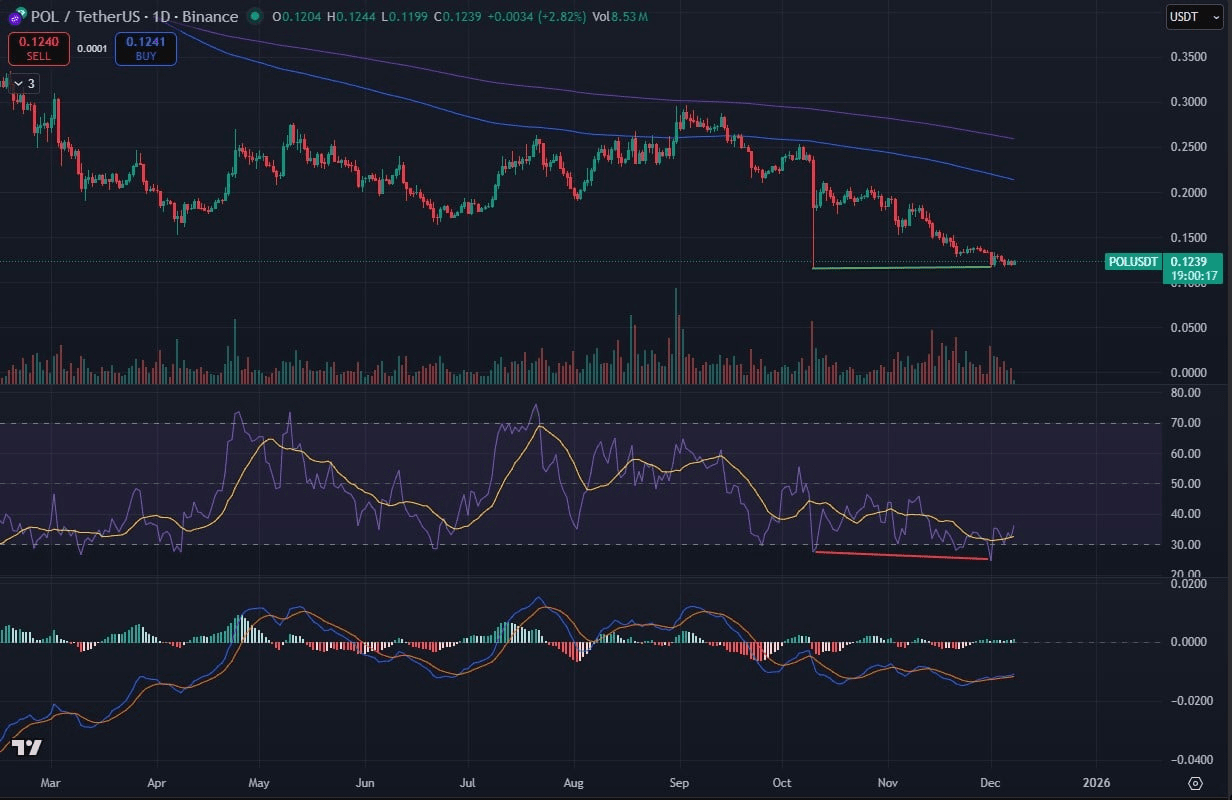
* The key upper barrier is the $0.21 level, which corresponds with the 200-day exponential moving average (200 EMA) and the lower range of the 200-day simple moving average (200 SMA) — an important technical resistance.
Focusing on shorter time frames, POL is tightly compressed under a diagonal resistance line, forming a small ascending triangle. This pattern often resolves upward, especially when coupled with overbought momentum and improving market conditions. A breakout and retest of the $0.21 area would be the strongest confirmation that a sustainable uptrend has begun.
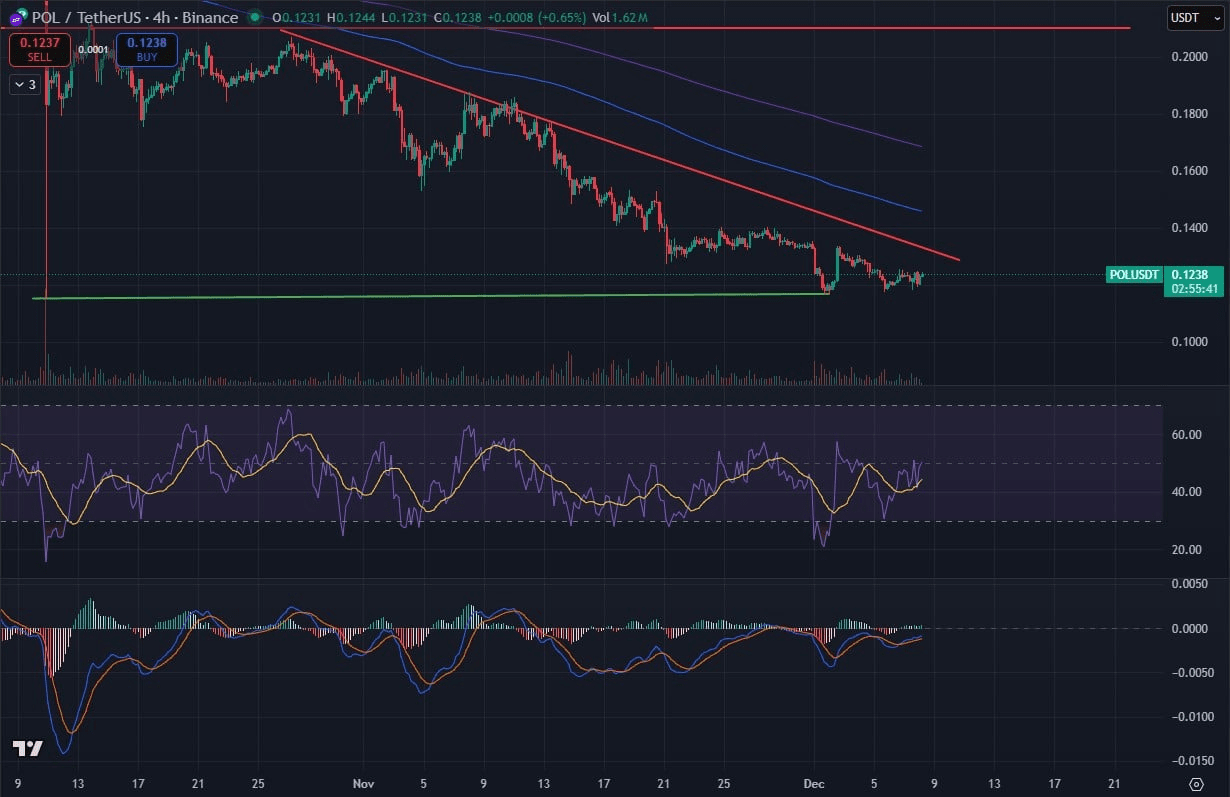
However, volume remains the missing element. If the stablecoin narrative accelerates, POL could quickly regain higher ranges faster than many expect.

