

When I first looked at APRO, it wasn’t because someone yelled “new oracle narrative” on the timeline. It was the opposite. I kept seeing the same small footprint in places that were otherwise noisy: a secondary price feed here, a “backup oracle” mention there, a documentation link tucked into an integration page. The pattern felt familiar. The projects that end up mattering in crypto rarely announce themselves as the main character. They show up underneath, like plumbing you only notice when it breaks.
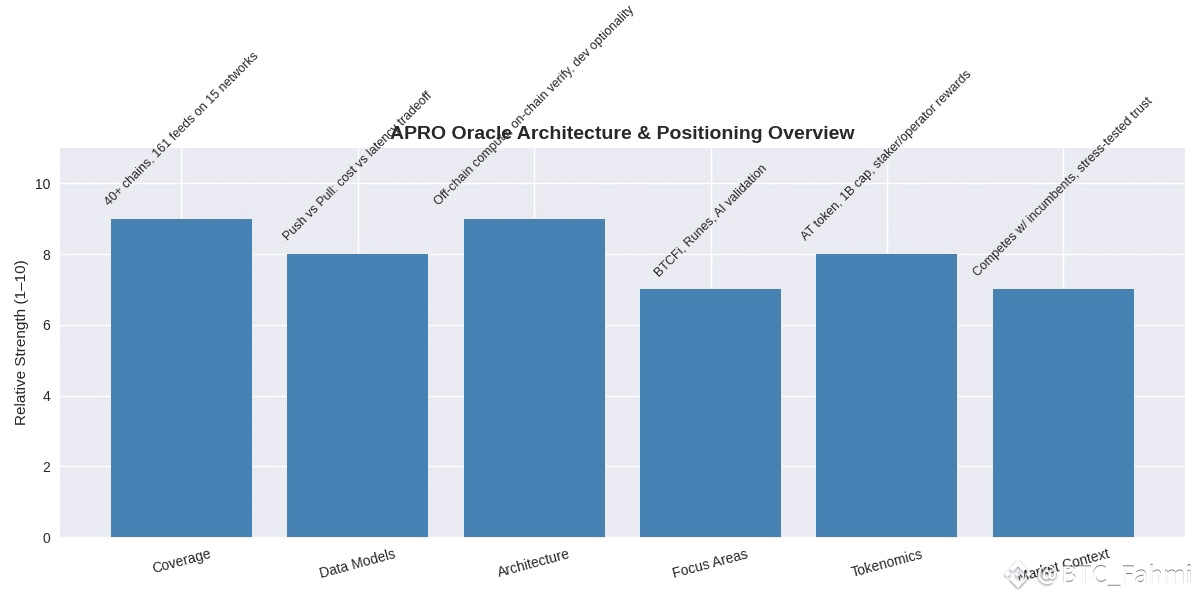
That’s what made me pay attention to APRO’s insistence on being quiet while claiming something loud: support across more than 40 blockchains. “40” can be marketing fluff in this industry, so I went looking for texture. The first thing I found wasn’t a hype deck. It was an architecture story that keeps repeating across their ecosystem pages and docs: do as much as possible off-chain, prove as much as possible on-chain, and give developers two ways to consume data depending on how their app actually behaves. That sounds abstract until you translate it into what it means on a Tuesday when a market moves 6% in an hour.
Oracles are easiest to understand as the part of a blockchain app that answers a simple question: “what is true right now outside this chain?” In DeFi, that usually means prices. In prediction markets, it means outcomes. In RWAs, it can mean valuations and attestations. If that “truth” is wrong, your protocol doesn’t just get inaccurate. It becomes exploitable. And in late 2025, exploitability is not a theoretical problem. Crypto is back in a regime where leverage returns quickly. Bitcoin trading around $91,016 and Ethereum around $3,124 tells you risk appetite is alive, but the intraday ranges also tell you how jagged it is underneath. In the same 24 hours, BTC’s low printed around $87,858 and ETH’s low around $2,935. That’s the kind of motion that turns an oracle from “infrastructure” into “attack surface.”
APRO’s answer is to treat “getting data on-chain” as a product with modes. In their docs, you see two models that seem mundane but matter a lot in practice: Data Push and Data Pull. Push is the classic pattern: independent node operators watch off-chain sources and post updates on-chain when thresholds or time intervals hit. The surface-level benefit is obvious: apps read a contract and get a current value. Underneath, the design choice is about who pays for freshness. If data is pushed constantly, you’re paying gas constantly, whether anyone needs the update or not.
Pull flips the cost profile. APRO describes its pull-based model as on-demand access that’s designed for high-frequency updates and low latency without ongoing on-chain costs. Translated: instead of broadcasting every tick to everyone, you fetch what you need when you need it, and the system is optimized for fast responses. That’s friendlier to applications that don’t need continuous updates, and it’s also friendlier to chains where gas costs or throughput constraints make “always-on pushing” feel wasteful. The risk, of course, is that pull introduces a new kind of timing game. If your protocol pulls data at a predictable cadence, sophisticated actors can try to trade around when the system asks for truth. It doesn’t make the oracle bad, it just changes where the adversarial pressure lands.
The second thing that grounded the “40 chains” claim for me was that APRO’s footprint looks less like a single monolithic feed and more like a menu. One integration guide notes 161 price feed services across 15 major blockchain networks. Those numbers are modest if you compare them to the largest incumbents, but they’re meaningful because they suggest a real operational focus: pick a set of networks, ship usable coverage, and grow outward. “161 feeds” is not a victory lap, it’s a signal that someone is doing the unglamorous work of maintaining endpoints across environments that all break differently.
That operational posture is also why APRO keeps being described as “off-chain processing with on-chain verification.” On the surface, it’s just a reliability slogan. Underneath, it’s an attempt to separate computation from finality. You do the messy work of aggregating sources, filtering noise, and validating data off-chain where it’s cheaper and faster, then you anchor the result on-chain where anyone can verify what was committed. If this holds, it’s a reasonable way to scale beyond pure price feeds into things like event verification for prediction markets or data for AI-driven strategies, where you often need more than one number from one source.
This is where the “Quiet Oracle” framing starts to make sense. Most oracle narratives try to win by being the first dependency a protocol picks. APRO’s story, at least right now, reads more like it’s trying to be the second dependency teams add when they’ve already learned how fragile one dependency can be. Binance Square posts about APRO keep circling the same idea: integrations that start small, redundancy checks, randomness modules, supplemental feeds. That isn’t as sexy as “the default oracle,” but it fits how risk is actually managed in 2025. Smart teams don’t bet the entire protocol on a single truth pipeline if they can help it.
Meanwhile, APRO is clearly leaning into two places where the incumbent mental model of oracles starts to feel thin: the Bitcoin ecosystem and “AI signals.” Their GitHub positions APRO as tailored for Bitcoin, even mentioning support for things like Runes, which hints at the broader BTCFi wave where people want DeFi-like primitives but don’t want to abandon Bitcoin’s gravity. If you want Bitcoin-native or Bitcoin-adjacent applications to behave like modern DeFi, you need data bridges that can speak in ways that fit UTXO constraints and security expectations. That’s not just a new chain integration. It’s a different set of assumptions about how you deliver proofs and how you design the trust boundary.
The AI angle is trickier. “AI verification” can mean anything from helpful anomaly detection to a black box that nobody can audit. The charitable interpretation is that APRO is using AI as one layer in a wider validation stack, not as the judge. The skeptical interpretation is that “AI-enhanced validation” becomes a convenient way to say “trust us, it’s smart.” The project’s own funding announcement frames continued investment in AI-enhanced validation and multi-chain compatibility, and it also hints at plans for more open participation modules and an open node program. That matters, because oracles don’t just fail due to bad code. They fail when economic security, operator diversity, and governance incentives don’t match the value being protected.
Tokenomics sits right in the middle of that risk. APRO’s AT token is described as having a capped supply of 1 billion. “1 billion” is a big number, but the context is what it’s for: paying and incentivizing the people and machines that keep truth fresh, and rewarding the stakers who underwrite the system’s behavior. If the incentives are too weak, operators cut corners. If they’re too strong but poorly designed, you can end up with concentrated control. If AT becomes mostly a speculative chip and not a security budget, the oracle becomes fragile exactly when the market gets most chaotic.
There’s also a very plain counterargument APRO has to live with: this is an oracle market with incumbents that have earned deep trust, plus newer networks that are already embedded in many exchanges and perpetual venues. In late 2025, “trust” in infrastructure is less about promises and more about time under stress. Chain reorganizations, major exchange outages, a liquidation cascade, a long-tail asset that goes haywire. Those are the moments that decide whether a protocol keeps its footing. APRO’s public materials suggest momentum, but momentum is not a substitute for battle scars. Remains to be seen if APRO can scale node decentralization, expand feed breadth, and stay consistent when the market is not cooperating.
Still, I keep coming back to why the project feels different in texture. Most oracles sell certainty. APRO seems to be selling optionality: push or pull, multi-chain coverage as a default, and an apparent focus on Bitcoin-adjacent design where the usual EVM playbook doesn’t quite fit. Early signs suggest it’s trying to be less of a single pipe and more of a foundation layer where different kinds of “truth delivery” can coexist, even if that makes the system more complex to reason about.
Zooming out, this is part of a broader shift I can’t unsee. Crypto is moving from “apps that do one thing on one chain” toward “systems that coordinate across chains with real-world triggers.” As soon as you do that, oracles stop being an add-on and start being the boundary between automation and regret. The more we let smart contracts, AI agents, and tokenized assets act on external signals, the more valuable boring, earned reliability becomes.
APRO’s bet is that the quiet layer underneath becomes the part nobody wants to replace.

