
 Imagine a world where your AI assistant doesn’t just respond to your commands but actually takes action for you. Imagine a system where these intelligent agents can transact, negotiate, and make decisions on their own while staying fully secure and accountable. This is not science fiction. This is Kite. Kite is creating a blockchain that transforms AI agents into real participants in the economy, giving them identity, governance, and the ability to act autonomously. It’s a bold vision that could redefine how we interact with technology, money, and services.
A New Era Begins
I’m genuinely fascinated by what Kite is building because it feels like the start of something revolutionary. Most blockchains today are made for humans. They expect you to click buttons, approve transactions, and manage your accounts. But AI agents don’t operate like humans. They need the ability to make thousands of microtransactions, coordinate with other agents, and access services in real time. Kite is built for this world, a world where AI can move, act, and transact without waiting for human input at every step.What excites me the most is how Kite merges innovation with practicality. They’re not just creating a blockchain; they’re designing an ecosystem where AI agents can truly thrive, and where humans still maintain oversight and control. This balance makes Kite feel trustworthy and forward-looking.
How Kite Works
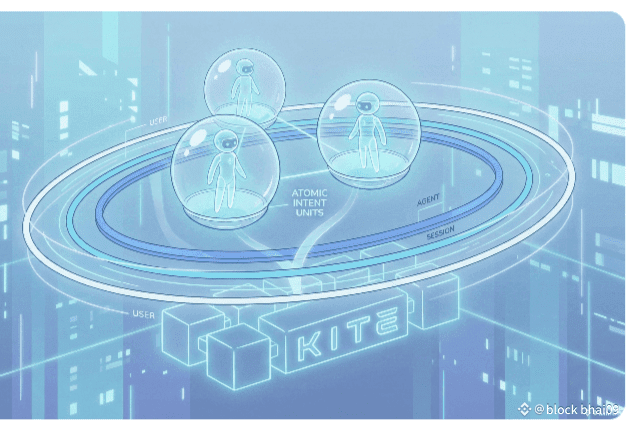
Kite is an EVM-compatible Layer-1 blockchain, which means developers can build on it as easily as they would on Ethereum. But it goes beyond simple compatibility. The platform is designed for autonomous agents, with layers for identity, payments, governance, and security.The identity system is particularly impressive. Kite separates human users, AI agents, and sessions into three distinct layers. This separation is like having a house for the human, a robot for tasks, and a temporary visitor badge for short-term access. Each layer has its own identity, which ensures transparency, security, and accountability.Kite also integrates stablecoin payments, so agents can make transactions without worrying about volatile cryptocurrency prices. Payments are fast, cheap, and almost instantaneous, even for microtransactions. This is crucial because AI agents often pay for tiny services like data access, API calls, or compute resources.
Safety and Governance
If you’re like me, one of the first questions you’d ask is about safety. What stops an agent from acting recklessly? Kite addresses this with a cryptographic “Agent Passport” and programmable rules that define what an agent can and cannot do. Every action is recorded on the blockchain, making it auditable and transparent.This level of control is reassuring. I can imagine having an agent that handles my subscriptions, buys groceries, and coordinates services, all on its own. And if something goes wrong, I can trace the problem instantly. This makes Kite feel both powerful and safe, which is a rare combination in emerging tech.
Real-Life Possibilities
The potential of Kite is enormous. Picture this: your AI agent wakes up in the morning, checks the best deals for groceries, makes purchases, organizes your schedule, and even collaborates with other agents to complete work tasks. All of this happens automatically, reliably, and efficiently.Or think about a marketplace filled with AI agents. Some provide data, some offer analysis, and others handle computation. They interact, pay each other for services instantly, and build reputations based on performance. This could create a thriving economy where machines do the heavy lifting, but humans still benefit from the outcomes.Kite also opens doors for businesses. Imagine fleets of agents managing entire workflows—collecting data, processing it, paying for services, and delivering results without human intervention. The efficiency gains could be staggering.
Momentum and Growth
Kite has already attracted significant attention and investment. With $33 million raised in funding, including $18 million in a recent round, the project has serious backing. The funds are fueling the development of Kite AIR, the infrastructure that handles identity, governance, and payments for agents.I’m particularly impressed with their integration of stablecoins, fast payment rails, and the flexibility for developers to build agentic applications. They’re not just promising the future—they’re laying the foundation for it today.
The Future of Human-AI Collaboration
If Kite succeeds, it could fundamentally change how we live and work. We might move from manually controlling every digital task to supervising fleets of intelligent agents that handle tasks, manage payments, and collaborate autonomously. Life could become more efficient, more creative, and more connected than ever before.There will be challenges, of course. Developers need to create useful agents, businesses must adopt agent payments, and users need confidence that their agents act responsibly. But the potential rewards are enormous. A world where AI agents manage tasks, payments, and workflows could redefine productivity and convenience for everyone.
Why Kite Excites Me
I’m genuinely excited about Kite because it feels like a turning point. It’s not just a blockchain; it’s the foundation of a new digital economy. AI agents can be participants, not just tools. With identity, governance, and autonomous payments, these agents could start making meaningful decisions and acting on our behalf.If Kite delivers, we could see a future where AI agents negotiate, transact, and collaborate seamlessly, freeing humans to focus on creativity, strategy, and connection. It’s a vision that’s thrilling, hopeful, and tangible—a future I’m eager to witness.


