

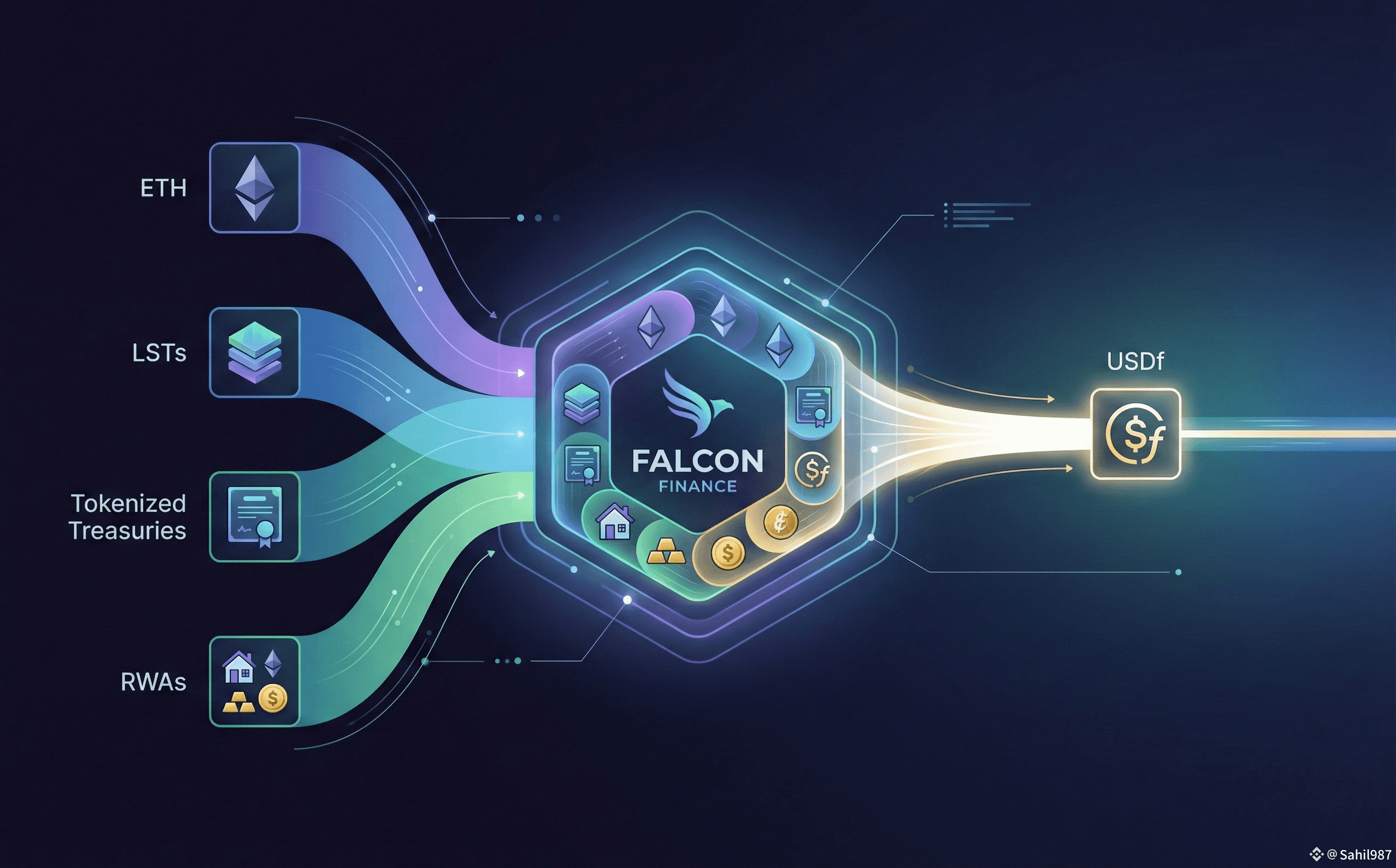
Every ecosystem eventually reaches the point where the tools it relies on stop matching the ambitions it carries. DeFi has been quietly drifting toward this moment for years. The promise of programmable money grew faster than the infrastructure needed to support it. Assets could stake, wrap, tokenize, or fragment but the moment they tried to serve as collateral, the system demanded they become still. RWAs lost their cash-flow identity. LSTs lost their validator-linked yield. Tokenized treasuries lost their maturity characteristics. Even ETH the lifeblood of on-chain finance was stripped of its expressive qualities whenever it entered a collateral framework. This was not a failure of imagination; it was a failure of architecture. Falcon Finance emerges not with the bravado of “new DeFi,” but with the quiet conviction that the architecture is finally ready to treat liquidity not as a secondary feature, but as a first-class citizen. The shift feels understated, yet its implications are enormous. Falcon isn’t redefining value; it’s recalibrating the rails through which value moves.
My initial hesitation was reflexive. Universal collateralization is a promise that has burned this industry before. Many protocols stretched their risk assumptions thin, believing the market would behave long enough to validate the design. Others ignored the idiosyncrasies of RWAs, assuming their yield would shield them from liquidity stress. Some treated LSTs as magic yield machines immune to validator fragmentation or slashing risk. But Falcon’s architecture felt different in tone less ambitious, more sober. Users deposit liquid, verifiable assets: tokenized T-bills, ETH, LSTs, yield-bearing RWAs, institutionally validated instruments. In return, they mint USDf, an overcollateralized synthetic dollar with no algorithmic illusions holding it together. No reflexive loops. No peg theatrics. No “dynamic balancing” that collapses at the first sign of market stress. Falcon is not a protocol that hopes markets will behave. It is a protocol designed for when they don’t.
The real pivot Falcon introduces is philosophical rather than mechanical. DeFi’s early categorization of assets was driven by infrastructure constraints masquerading as economic logic. Crypto-native assets were “real” collateral; RWAs were treated as administrative clutter; LSTs were isolated into sub-economies; yield-bearing instruments were treated as incompatible with borrowing. These divisions were not reflections of market reality. They were reflections of tools that couldn’t yet handle nuance. Falcon breaks the taxonomy by modeling asset behavior instead of asset type. A tokenized treasury is treated like a treasury predictable yield, redemption dynamics, low volatility, custodial considerations. An LST is treated like a validator-backed yield instrument with slashing risk, reward drift, and liquidity pathways. RWAs retain their economic identity rather than becoming opaque vault entries. Crypto assets maintain exposure with realistic volatility assumptions. Falcon does not treat assets as categories; it treats them as living financial entities. This is not universality by flattening. It is universality through understanding.
Of course, universality requires constraint. Falcon’s discipline is its credibility. Overcollateralization parameters are tuned for weather, not sunshine. Liquidation pathways are mechanical and uncompromising. RWAs undergo operational diligence that would feel familiar to institutional credit desks: custody analysis, issuer risk mapping, transparency evaluation, redemption logistics. LSTs are evaluated through validator metrics, slashing exposure, staking dynamics, and liquidity depth. Crypto assets are parameterized using painful historical drawdowns, not optimistic narratives. Falcon does not loosen rules for growth. It grows within the boundaries its rules permit. The result is a system that feels less like DeFi’s usual experimentation and more like a financial rail designed for durability.
The adoption pattern tells the truth more clearly than any technical documentation. Falcon is not spreading through retail speculation or loud campaign incentives. It’s spreading through workflows the rarest and most powerful form of adoption. Market makers mint USDf as part of liquidity buffering strategies. Treasury desks unlock capital from tokenized T-bills without interrupting yield cycles. RWA issuers prefer Falcon’s standardized collateral framework to building bespoke financing rails. LST-driven funds integrate Falcon to access liquidity without pausing validator compounding. These are users for whom reliability outweighs narrative. When professionals adopt a system because it quietly removes friction, they don’t leave it. Workflow adoption is sticky. It doesn’t trend, but it endures.
But Falcon’s deeper innovation lies in its reimagining of how liquidity works. In early DeFi, liquidity was extraction: you gave something up to get something useful. You unwound yield to borrow. You unstaked to gain stability. You froze RWAs to mobilize them. You immobilized LSTs for leverage. Falcon treats liquidity as continuity: a tokenized treasury remains a treasury while enabling liquidity; a staked ETH position retains validator yield; an RWA keeps generating cash flow; crypto assets maintain exposure. Liquidity stops being the opposite of conviction. It becomes the expression of conviction. Falcon didn’t invent this principle it restored it. In traditional finance, assets do not surrender their identity to be useful. DeFi is finally catching up.
If Falcon maintains its discipline resisting premature expansion, refusing shortcuts in asset onboarding, avoiding liquidity theatrics it will likely become the underlying collateral infrastructure for the mature phase of on-chain finance. It won’t be the protocol retail users talk about every day. It will be the protocol institutional actors rely on. The synthetic dollar with real solvency. The collateral engine beneath RWA markets. The liquidity rail for LST strategies. The quiet stabilizer that allows everything else to innovate without fear of collapse. Falcon isn’t trying to define the future. It’s trying to prepare the foundation the future will require.
In a sense, Falcon Finance is not the arrival of new DeFi. It is the correction of what DeFi always intended to be: a system where value can move without becoming something lesser in the process. A system where liquidity is not borrowed from an asset’s potential, but drawn naturally from the asset’s identity. A system where financial expression replaces financial distortion. And that shift subtle, grounded, and structurally honest is what transforms a protocol from an experiment into an indispensable part of an economy.



