

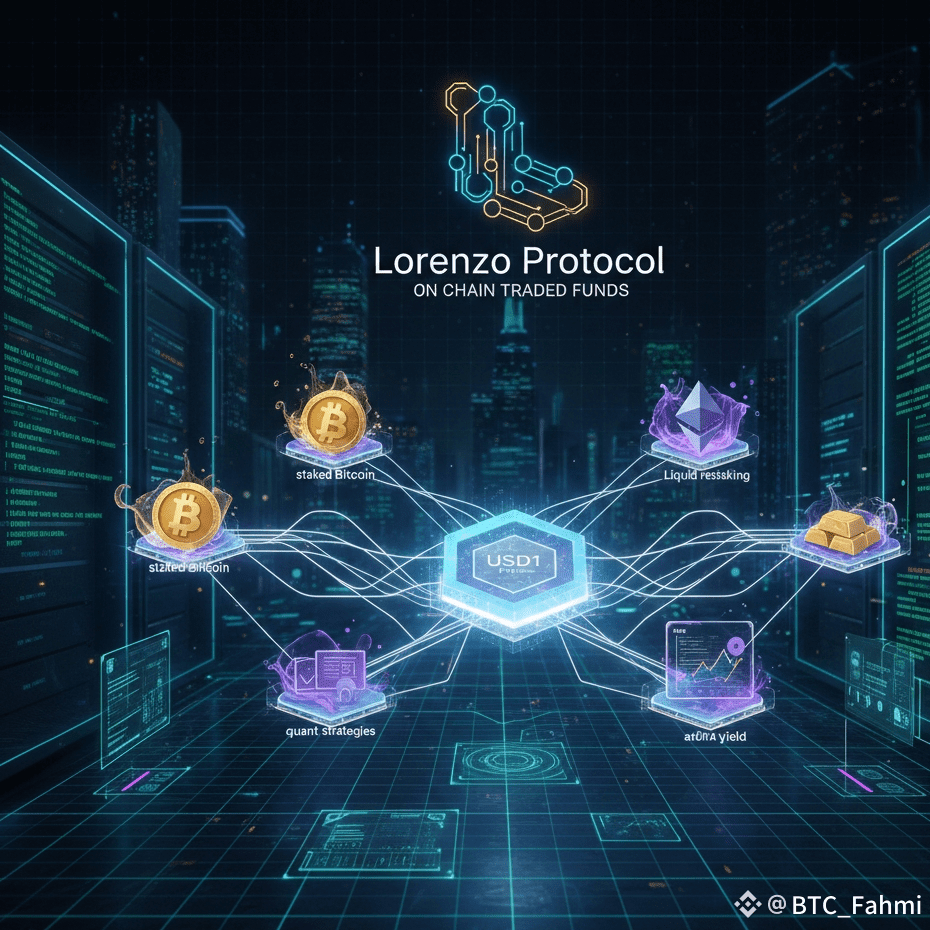
Diversification is one of those boring words traders pretend to respect but often ignore when the market feels hot. Over the last few months of 2025, Lorenzo Protocol keeps popping up in that conversation, especially around something it calls On Chain Traded Funds, or OTFs. If you trade actively or build strategies, you have probably seen the narrative about multi strategy portfolios and liquid restaking circling around Bitcoin and Ethereum. Lorenzo is sitting right in the middle of that, trying to turn portfolio construction into something you can hold as a single token, instead of a spreadsheet nightmare spread across ten protocols.
At a high level, an OTF is Lorenzo’s version of a fund that lives fully on chain. Think of it as an ETF that was designed for crypto from day one, not retrofitted into it. Technically, an OTF is a tokenized pool that follows a set of rules encoded in smart contracts. Those rules cover how capital is allocated, when the portfolio rebalances, what risks it is allowed to take, and how performance is measured. The important part is that these rules are visible on chain and executed automatically, so you are not wiring money to a black box manager and hoping their monthly PDF is honest.
The multi strategy angle is where it gets interesting for traders. Lorenzo’s architecture allows a single OTF to combine quite different yield sources. In one product, you can see tokenized treasury bills, centralized quant strategies, liquidity provision, delta neutral setups, and arbitrage style trades all living in the same structure. That mix of DeFi native yield, CeFi style strategies, and real world asset exposure is usually something only an institutional fund could assemble. Here it is wrapped into a token that you can trade or park in a wallet like any other asset.
Underneath those OTFs sits another theme that has been running hot in 2025: liquid restaking. Lorenzo started by focusing on Bitcoin DeFi, using a derivative called stBTC that lets users earn yield on staked Bitcoin while staying liquid across chains. Later, the protocol expanded into Ethereum style restaking, issuing liquid restaking tokens that represent a user’s restaked position and can be reused across DeFi. In practical terms, that means the same BTC or ETH that secures a network can also be routed into structured yield strategies inside an OTF, without forcing you to unstake every time you want to adjust exposure.
So why is this trending now instead of two years ago, when everyone was already obsessed with yield products anyway? Part of it is narrative timing. In late 2025, Binance Square posts started pushing a clear story around “Liquid Restaking plus Bitcoin Yield” as the new engine for BTC, and Lorenzo was framed as a clean entry point to that stack. At the same time, DeFi users are tired of jumping between farms and manually chasing APR screenshots on X. A product that says “hold this one token and get diversified, rule based yield from multiple sources” fits the mood of a market that has been burned by opaque farm of the week plays.
From an architecture standpoint, Lorenzo’s multi strategy portfolio is built out of smaller components. The protocol runs simple vaults that represent a single strategy, and then composed vaults that wire several of those together into a pipeline. Capital flows from one stage to another according to pre defined rules. Allocation, rebalancing, and execution are handled by smart contracts rather than a human desk. The result is that an OTF can behave like a complex fund while still giving you real time, on chain visibility into what it holds and how it is performing.
In terms of progress, this is not just a whitepaper idea any more. Through late November and early December 2025, Lorenzo related posts have outlined concrete products and integrations. One highlight for 2025 is USD1 Plus, a flagship stable yield OTF that blends RWA yield, DeFi strategies, quant signals, and liquidity positions into a single pool. In parallel, infrastructure around the protocol has started to form. Bridges, liquid staking platforms, aggregators, custodial services, and institutional interfaces are integrating its vaults, which effectively turns Lorenzo from a one off product into a piece of shared plumbing for other apps that need structured liquidity.
There is also the governance and incentive layer to think about. The BANK token, combined with vote escrow mechanics like veBANK, is designed to align long term participants with the direction of the protocol and with the economics of different OTFs. In theory, this gives traders, builders, and more passive investors a way to fight over which strategies get more weight or better rewards. In practice, as with any ve style system, it also introduces another set of gameable incentives that you need to understand before treating it as a simple yield booster.
Speaking personally, as someone who has spent too many nights rebalancing manual DeFi positions, the Lorenzo approach hits a real pain point. Having a multi strategy portfolio expressed as a single token is attractive, especially when it mixes BTC, restaked ETH, and more conservative RWA flows in one place. At the same time, I would treat these OTFs like any structured product. Smart contract risk does not disappear just because the language sounds institutional. Strategy risk is still real if quant models stop working or liquidity dries up. Liquidity and exit conditions matter too. Before sizing any position, I would check how deep the markets are for a given OTF, what the underlying assets are, and how redemptions work in different market conditions.
Looking ahead, the most interesting question to me is not whether Lorenzo wins as a brand, but whether the OTF model itself becomes a standard template for on chain funds. A programmable, multi strategy portfolio that you can plug into wallets, exchanges, and institutional interfaces feels like a natural next step for DeFi. If this design holds up through a full market cycle, we might end up treating OTFs the way TradFi treats ETFs today: as the default wrapper for strategies, not a niche experiment. Until then, these products sit in the same bucket as any new financial primitive in crypto. Useful, potentially powerful, but worth approaching with curiosity, skepticism, and position sizes you can live with if the code or the strategy behaves differently than the marketing thread suggested.
@Lorenzo Protocol #lorenzoprotocol $BANK


