
Indeed, there are some very skilled short-term traders, and the technical methods they use seem quite simple. It feels like we are only one step away from these experts; as long as we refine our mindset, it seems that "if others can do it, I should be able to do it too."
But they cannot understand that this "step" often means "a thousand miles". Beneath the ordinary methods lies an abstract understanding of price fluctuations, and the market sense honed over N years of trading, which is also the execution ability and trading discipline cultivated after countless setbacks.
Thus, many novice traders underestimate this "step" in between, dreaming of daily profits. Only those who have come through it know how many setbacks and sighs there are in this "step of a thousand miles."
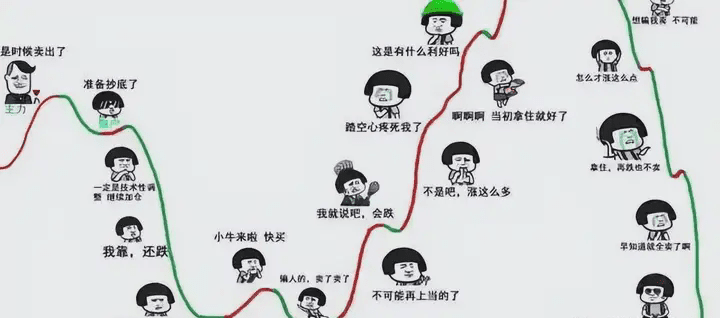 First, consider how large the judgment time window is for intraday/short-term trading?
Generally speaking, for short-term trading, the main trading cycle is often set at the 30-minute/1-hour level to observe the formation of price patterns and the generation of indicator signals.
Assuming a friend thinks that naked K false breakouts are good (counter-trend, price action trading), mainly focusing on early convergence + later false breakouts + reverse V engulfing this pattern, the risk-reward ratio and win rate are quite high.
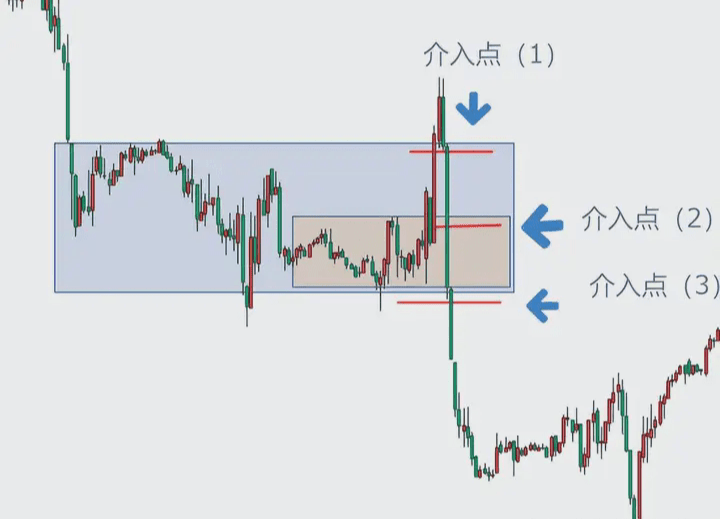 For example, the oil trend at the beginning of February had three entry points. As long as one captures a small unilateral move, profit can be made. However, during the execution, one finds that what appears to be a simple pattern is not easy to operate.
1. A reverse V is composed of a rapid upsurge and a pullback. 'Rapid' often implies suddenness and unpredictability, making it hard to forecast in advance.
This means that one must have sufficient time to watch the market to prevent missing opportunities, but being too focused can easily lead to the problem of 'over-concentration'.
Imagine that every price fluctuation is stirring your nerves, and you always feel you can understand the general trend of the market. It seems that relaxing the entry criteria can catch more opportunities. At this moment, will you be eager to act? Can you remain calm and continue to guard against the 'false breakout' that may appear at any time?
The difficulty also lies here. We cannot directly disconnect from the market while needing to maintain long-term rationality regarding short-term fluctuations and patiently wait for signals to emerge. How to maintain an appropriate distance is very challenging.
2. Confirming the candlestick pattern requires closure confirmation. A closure at the 30-minute level is too lagging. Confirming the closure before entering incurs point loss, making it hard to capture the most ideal point.
Therefore, many friends choose to observe at the 30-minute level and compress the entry judgment level to 15/5 minutes. This seems to solve the problem of point loss but extends the issue of execution ability.
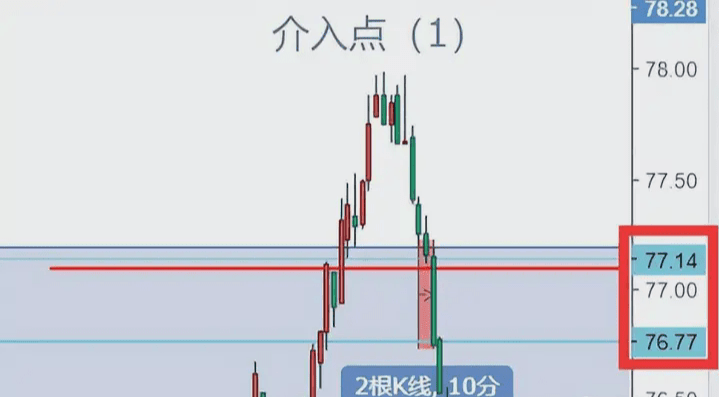 It should be noted that when this pattern appears, the volatility is generally not low (after all, good opportunities only exist in high-volatility markets), and the time left for our judgment is too short (a few minutes).
Once the mental preparation is insufficient, hesitation occurs at the critical moment, and a delay of a few minutes can result in a significant difference in entry points.
Some may think it's just a few dozen points; if you earn less, you earn less. However, they fail to realize a deeper issue: a few dozen points of misalignment directly widen the stop loss cost. A lighter loss reduces the risk-reward ratio, while a heavier loss leads to stop loss failures, resulting in more losses without gain!
Because short-term trading basically uses fixed stop losses, it constrains the entry range with a fixed stop loss range. If the price exceeds this range, it means missing the opportunity and one cannot force a trade.
If engaging in short-term trading, using subjective losses introduces even more problems.
First, short-term market conditions change too rapidly, making it hard to make accurate judgments. Secondly, many traders have weak discipline, leading to a gambling mentality, making it difficult to decisively stop losses, resulting in uncertainty in stop loss width, whether effective or ineffective, which leads to uncontrolled risks.
From a certain perspective, using fixed losses requires oneself to improve entry precision, setting demands—satisfying these demands improves trading skills unconsciously.
Conversely, when facing difficulties, we often try to be clever by expanding the stop loss to bypass the problem of entry precision, and over time, discipline disappears.
3. Overnight closing will disrupt trading logic, and the difficulty of rebuilding positions will increase because trend areas and points will suddenly change with market fluctuations.
Counter-trend trading often captures good points, but due to the trading logic overly affirming the existence of resistance, these friends find it hard to hold onto positions (expecting resistance to be effective and judging false breakouts as valid).
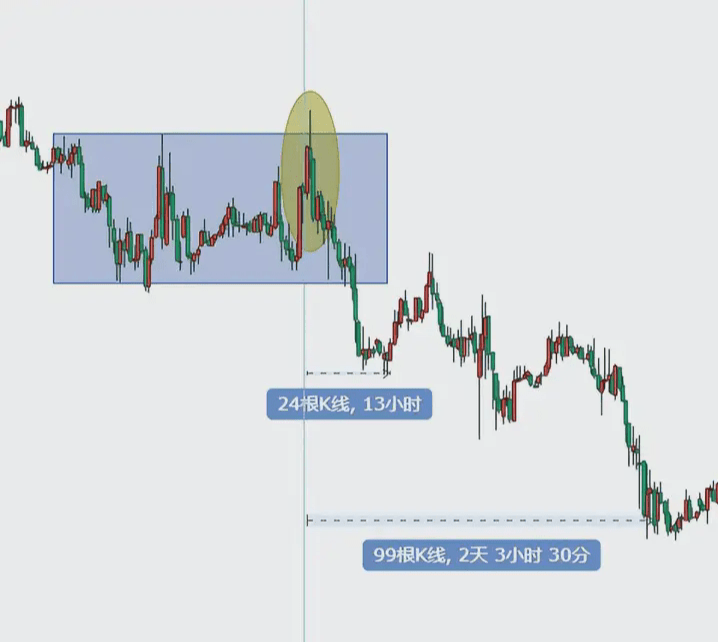 Many people who engage in short-term trading often take a unilateral position for the day and run, or close when they see support below, preparing to reverse. Closing is easy, but repeating this logic to re-enter on a new day is difficult.
In the new trend area, there may be no opportunity to brew new patterns or significant deterioration of the subsequent entry points. Originally, shorting was at a high point, but later shorting compared to a relatively low point, will your heart feel uneasy?
Therefore, the difficulty also lies in the disconnection of trading logic: overly frequent entries and exits may prevent us from replenishing positions in new areas. Without positions, it is challenging to maintain the logic of following the trend.
Once the entry point deteriorates, trading confidence is lost. In the end, one may have correctly identified the top of the entire bearish trend but earned only a small profit.
Therefore, short-term trading and intraday trading do not necessarily mean more opportunities; on the contrary, it places higher demands on our 'timing' and 'discipline' technical skills. To do well, one needs to solve the previous three problems.
1. It is essential to capture breakout points, only trade standard patterns, and establish a replicable trading model.
In my view, there are two types of breakout points: 1. Momentum breakout 2. Price breakout.
The momentum has significantly increased in a short time, and then with the momentum not weakening, a V-shaped engulfing occurs. The validity of the pattern is based on directly completing the 'bull-bear transition' and capturing advantageous points during the phase.
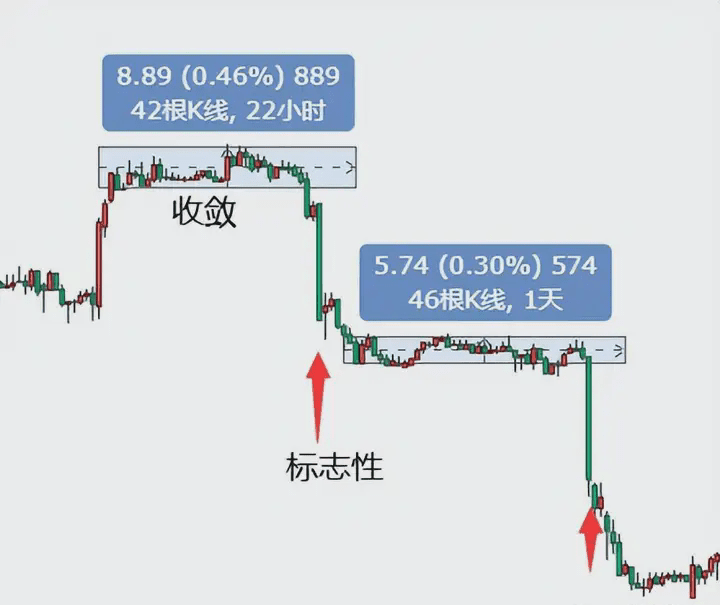 Or use low K + high combination, identify short-term convergence points, confirm the appearance of contraction points, then wait for high K (significant patterns) to capture intraday initiation points, create clear and easily recognizable patterns, and ensure that execution can be in place.
2. Exit in batches, leaving part of the position to pursue maximum profit.
Personally, closing all positions at once is not a good habit because entering is already quite challenging, let alone exiting. It is difficult for us to accurately predict the market afterward.Therefore, exiting in segments covers a broader range, allowing oneself to leave some leeway: (1) Reduce when encountering resistance, (2) Reduce when encountering resistance consolidation, (3) Clear positions during reverse retracement.
3. One must have risk awareness to protect the principal and learn to fill in the holes.
In short-term trading, protecting the principal is the top priority because the risk-reward ratio in short-term trading is not prominent. Once there are consecutive stop losses, the risk burden becomes too heavy. Even if one successfully takes a profit on one or two trades later, it cannot offset the overall loss.
Therefore, if the first trade results in a stop loss and the second trade is successful with a profit, do not be greedy. Actively reduce part of the position when encountering resistance, realize the floating profit and bring the principal back to the break-even line, and then consider the rest.
This detail is the easiest to overlook. Many friends are too focused on pursuing the larger trend and the risk-reward ratio, getting dazzled by 'cutting losses and letting profits fly', and failing to see their dwindling principal amid frequent testing of positions...
Therefore, many times, filling the holes in stop losses to pull the principal back to the starting line is very important, after all, there are too many market opportunities.
I am Xiao Fei, nice to meet everyone. Xiao Fei focuses on lurking in Ethereum contract spot, and the team also has positions quickly available, helping you become a market maker and a winner.#加密市场反弹 $ETH$BTC


