

#tokenomics
tokenomics
2.1M views
4,264 Discussing
Hot
Latest

·
--
Read Tokenomics as a SystemTokenomics is not total supply, FDV or one allocation chart. It is the system connecting supply authority, ownership, time, liquidity, demand and control.
Begin with supply. Verify what exists now, what can exist later and every path that can create more tokens. Minting, emissions, bridges, rebases, migrations and upgrades can all change effective supply.
Then inspect allocation and timing. A team share that looks small as a percentage can still be large compared with circulating supply or the token side of the main liquidity pool. A future unlock should be compared with paired liquidity, order-book depth, beneficiary cost basis and the amount already circulating.
Next, test demand quality. Staking rewards funded by new issuance can increase token balances without increasing a holder’s share of the network. Burns can look deflationary while emissions remain much larger. Utility matters when it creates recurring use, settlement, collateral, security or external revenue, not merely because the token is required to claim more of itself.
Finally, map control. Who can mint, change fees, release treasury tokens, grant roles, pause transfers or upgrade the contract? Present settings can look reasonable while one administrator retains the authority to change the economic rules later.
The complete TokenToolHub guide connects those layers into a practical research workflow and explains why FDV should never be mistaken for available exit liquidity.
Full guide:
https://tokentoolhub.com/tokenomics-guide/
#Tokenomics #CryptoResearch #blockchain #Web3 #defi
Read Tokenomics as a System
Tokenomics is not total supply, FDV or one allocation chart. It is the system connecting supply authority, ownership, time, liquidity, demand and control.
Begin with supply. Verify what exists now, what can exist later and every path that can create more tokens. Minting, emissions, bridges, rebases, migrations and upgrades can all change effective supply.
Then inspect allocation and timing. A team share that looks small as a percentage can still be large compared with circulating supply or the token side of the main liquidity pool. A future unlock should be compared with paired liquidity, order-book depth, beneficiary cost basis and the amount already circulating.
Next, test demand quality. Staking rewards funded by new issuance can increase token balances without increasing a holder’s share of the network. Burns can look deflationary while emissions remain much larger. Utility matters when it creates recurring use, settlement, collateral, security or external revenue, not merely because the token is required to claim more of itself.
Finally, map control. Who can mint, change fees, release treasury tokens, grant roles, pause transfers or upgrade the contract? Present settings can look reasonable while one administrator retains the authority to change the economic rules later.
The complete TokenToolHub guide connects those layers into a practical research workflow and explains why FDV should never be mistaken for available exit liquidity.
Full guide:
https://tokentoolhub.com/tokenomics-guide/
#Tokenomics #CryptoResearch #blockchain #Web3 #defi
Begin with supply. Verify what exists now, what can exist later and every path that can create more tokens. Minting, emissions, bridges, rebases, migrations and upgrades can all change effective supply.
Then inspect allocation and timing. A team share that looks small as a percentage can still be large compared with circulating supply or the token side of the main liquidity pool. A future unlock should be compared with paired liquidity, order-book depth, beneficiary cost basis and the amount already circulating.
Next, test demand quality. Staking rewards funded by new issuance can increase token balances without increasing a holder’s share of the network. Burns can look deflationary while emissions remain much larger. Utility matters when it creates recurring use, settlement, collateral, security or external revenue, not merely because the token is required to claim more of itself.
Finally, map control. Who can mint, change fees, release treasury tokens, grant roles, pause transfers or upgrade the contract? Present settings can look reasonable while one administrator retains the authority to change the economic rules later.
The complete TokenToolHub guide connects those layers into a practical research workflow and explains why FDV should never be mistaken for available exit liquidity.
Full guide:
https://tokentoolhub.com/tokenomics-guide/
#Tokenomics #CryptoResearch #blockchain #Web3 #defi
27

🚨 $CORE FACES UNEXPECTED TOKEN DILUTION FOLLOWING VALIDATOR ISSUANCE ANOMALY 🔍
Core DAO has confirmed an operational anomaly where validators received excess block rewards via un-scheduled minted supply. 🔍 While user funds and core consensus remain intact, an un-planned issuance event directly alters tokenomics and institutional valuation models. 📌
The critical variable now is supply neutralization — whether the protocol burns the excess supply or absorbs potential selling pressure from recipient validators. 📊 Until full transparency around the exact over-issuance figures settles, smart money will likely treat structural liquidity with heightened risk parameters. 💬 How do you expect the team to handle the excess token absorption? 👇
⚠️ Not financial advice. Always manage your risk. 🛡️
🏷️ #CORE #Tokenomics #CryptoAnalysis #Altcoins
🎯 🔍
🚨 $CORE FACES UNEXPECTED TOKEN DILUTION FOLLOWING VALIDATOR ISSUANCE ANOMALY 🔍
Core DAO has confirmed an operational anomaly where validators received excess block rewards via un-scheduled minted supply. 🔍 While user funds and core consensus remain intact, an un-planned issuance event directly alters tokenomics and institutional valuation models. 📌
The critical variable now is supply neutralization — whether the protocol burns the excess supply or absorbs potential selling pressure from recipient validators. 📊 Until full transparency around the exact over-issuance figures settles, smart money will likely treat structural liquidity with heightened risk parameters. 💬 How do you expect the team to handle the excess token absorption? 👇
⚠️ Not financial advice. Always manage your risk. 🛡️
🏷️ #CORE #Tokenomics #CryptoAnalysis #Altcoins
🎯 🔍
Core DAO has confirmed an operational anomaly where validators received excess block rewards via un-scheduled minted supply. 🔍 While user funds and core consensus remain intact, an un-planned issuance event directly alters tokenomics and institutional valuation models. 📌
The critical variable now is supply neutralization — whether the protocol burns the excess supply or absorbs potential selling pressure from recipient validators. 📊 Until full transparency around the exact over-issuance figures settles, smart money will likely treat structural liquidity with heightened risk parameters. 💬 How do you expect the team to handle the excess token absorption? 👇
⚠️ Not financial advice. Always manage your risk. 🛡️
🏷️ #CORE #Tokenomics #CryptoAnalysis #Altcoins
🎯 🔍
6
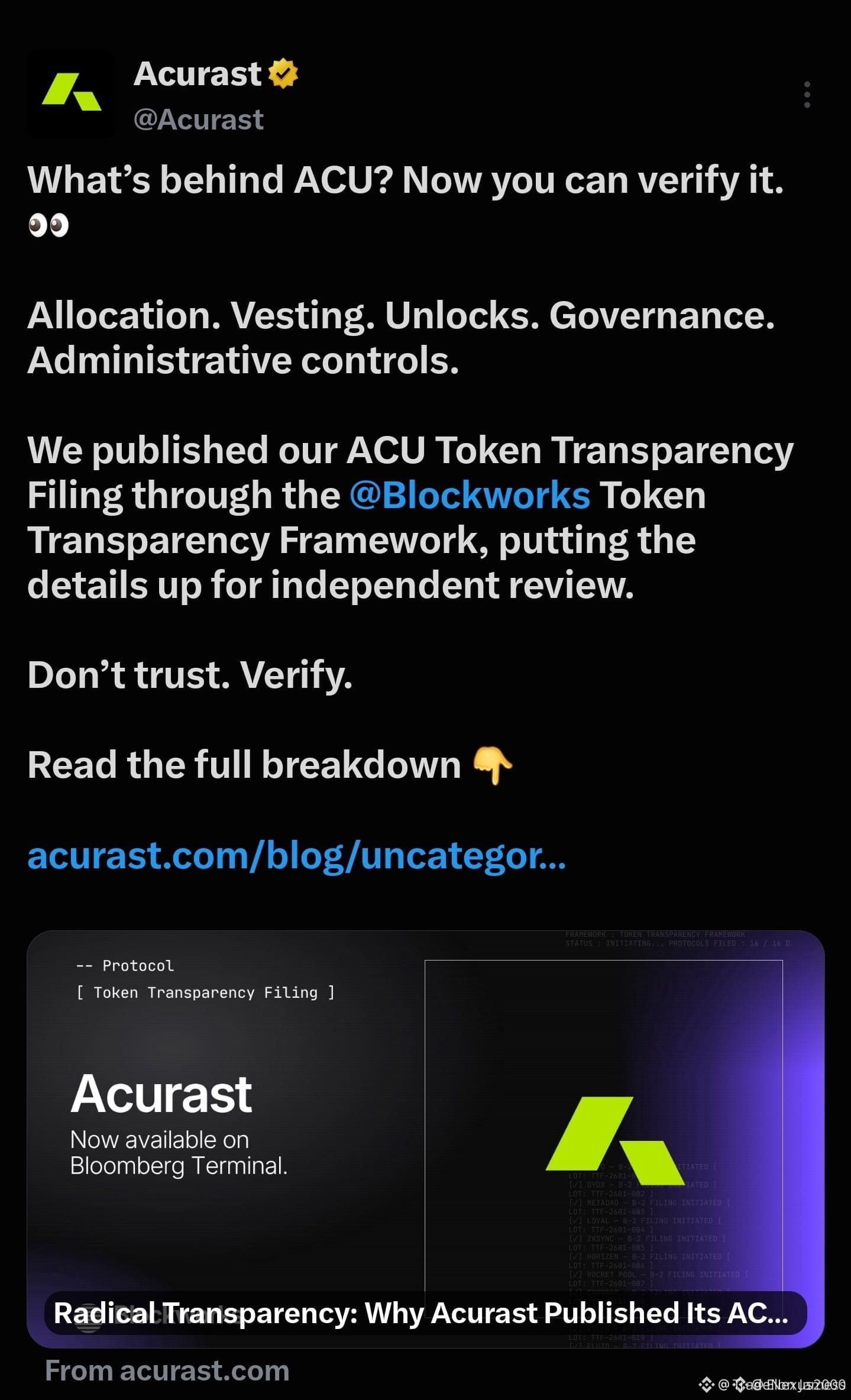
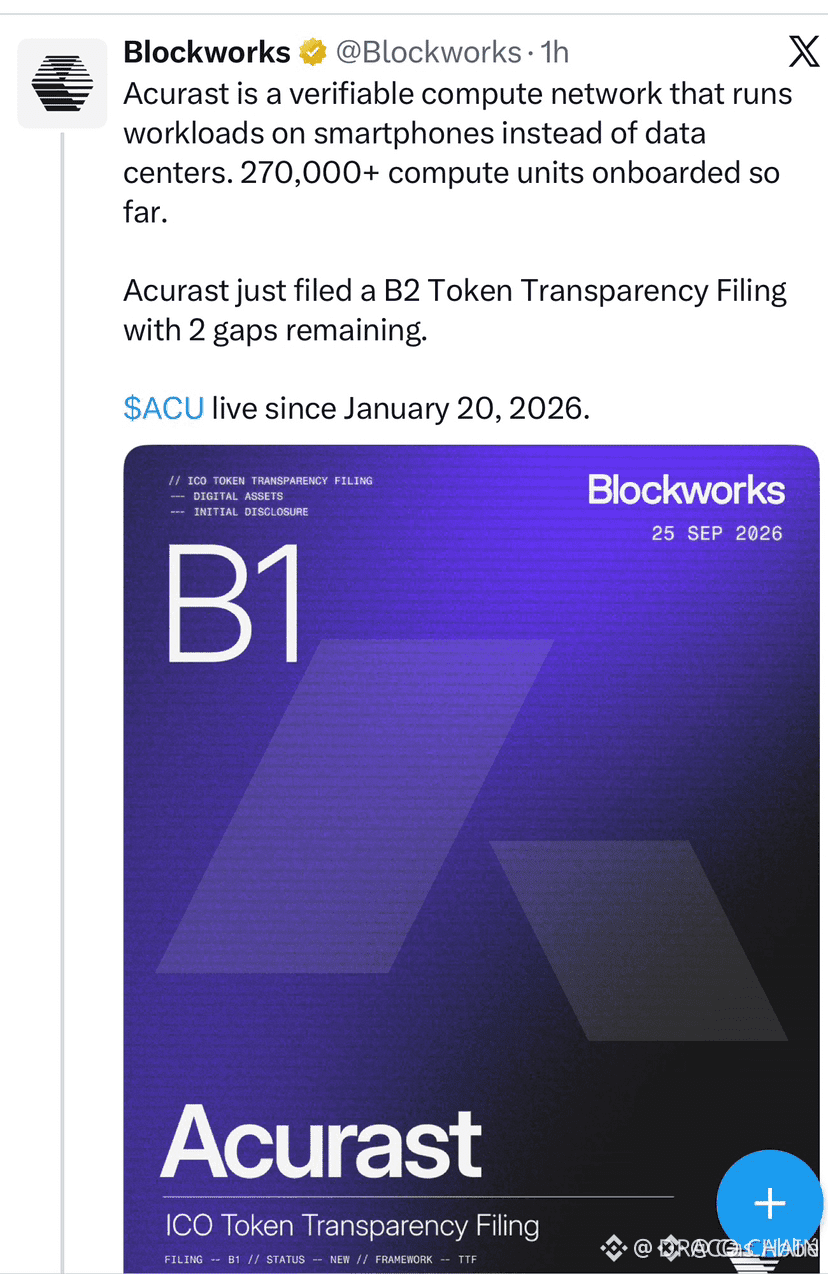
🏦 $ACU DROPS COMPLETE TOKEN TRANSPARENCY FILING TO EXPOSE VESTING AND EMISSIONS! ⚡
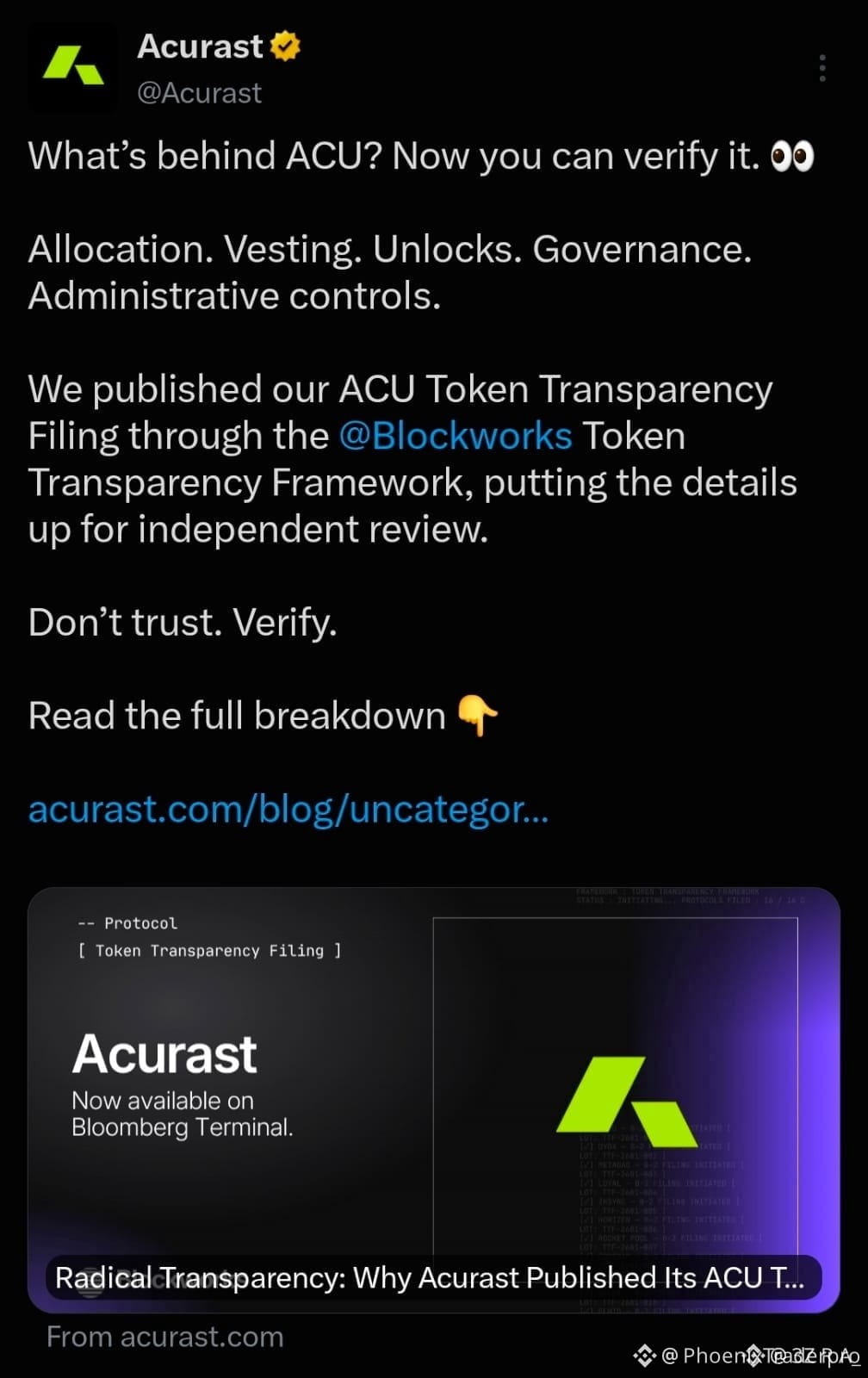
Smart money doesn't trade on blind promises; it trades on structural clarity. 🔍 $ACU just set a bold standard by laying out its full token supply, vesting cliffs, and governance controls through Blockworks for raw public verification.
Mapping out exact emissions and provider incentive flows gives us the precise data needed to spot real liquidity depth before structural moves happen. 💡 When protocols eliminate administrative blind spots, smart capital takes notice.
💬 Does verified token transparency give you higher conviction in a trade, or do you wait for raw momentum to lead? 👇
⚠️ Not financial advice. Always manage your risk. 🛡️
🏷️ #ACU #Tokenomics #Crypto #Web3
💎 ⚡
🏦 $ACU DROPS COMPLETE TOKEN TRANSPARENCY FILING TO EXPOSE VESTING AND EMISSIONS! ⚡
Smart money doesn't trade on blind promises; it trades on structural clarity. 🔍 $ACU just set a bold standard by laying out its full token supply, vesting cliffs, and governance controls through Blockworks for raw public verification.
Mapping out exact emissions and provider incentive flows gives us the precise data needed to spot real liquidity depth before structural moves happen. 💡 When protocols eliminate administrative blind spots, smart capital takes notice.
💬 Does verified token transparency give you higher conviction in a trade, or do you wait for raw momentum to lead? 👇
⚠️ Not financial advice. Always manage your risk. 🛡️
🏷️ #ACU #Tokenomics #Crypto #Web3
💎 ⚡
Smart money doesn't trade on blind promises; it trades on structural clarity. 🔍 $ACU just set a bold standard by laying out its full token supply, vesting cliffs, and governance controls through Blockworks for raw public verification.
Mapping out exact emissions and provider incentive flows gives us the precise data needed to spot real liquidity depth before structural moves happen. 💡 When protocols eliminate administrative blind spots, smart capital takes notice.
💬 Does verified token transparency give you higher conviction in a trade, or do you wait for raw momentum to lead? 👇
⚠️ Not financial advice. Always manage your risk. 🛡️
🏷️ #ACU #Tokenomics #Crypto #Web3
💎 ⚡
56
🔍 $ACU UNVEILS INSTITUTIONAL TRANSPARENCY FILING VIA BLOCKWORKS FRAMEWORK 🏦
While retail chases short-term noise, smart money tracks structural clarity. $ACU has released its formal transparency filing through Blockworks, detailing critical treasury controls, unlock schedules, and governance structures under a standardized institutional framework. 🔍
Verifiable tokenomics and clear vesting timelines eliminate supply ambiguity, allowing sophisticated market participants to properly calculate fair value. 📊 When operational transparency replaces speculative narrative, long-term positioning becomes significantly more precise. 💡 💬 Does standardized token transparency change how you evaluate fundamental allocations? 👇
⚠️ Not financial advice. Always manage your risk. 🛡️
🏷️ #ACU #Tokenomics #Crypto #FundamentalAnalysis
🎯 🦈
🔍 $ACU UNVEILS INSTITUTIONAL TRANSPARENCY FILING VIA BLOCKWORKS FRAMEWORK 🏦
While retail chases short-term noise, smart money tracks structural clarity. $ACU has released its formal transparency filing through Blockworks, detailing critical treasury controls, unlock schedules, and governance structures under a standardized institutional framework. 🔍
Verifiable tokenomics and clear vesting timelines eliminate supply ambiguity, allowing sophisticated market participants to properly calculate fair value. 📊 When operational transparency replaces speculative narrative, long-term positioning becomes significantly more precise. 💡 💬 Does standardized token transparency change how you evaluate fundamental allocations? 👇
⚠️ Not financial advice. Always manage your risk. 🛡️
🏷️ #ACU #Tokenomics #Crypto #FundamentalAnalysis
🎯 🦈
While retail chases short-term noise, smart money tracks structural clarity. $ACU has released its formal transparency filing through Blockworks, detailing critical treasury controls, unlock schedules, and governance structures under a standardized institutional framework. 🔍
Verifiable tokenomics and clear vesting timelines eliminate supply ambiguity, allowing sophisticated market participants to properly calculate fair value. 📊 When operational transparency replaces speculative narrative, long-term positioning becomes significantly more precise. 💡 💬 Does standardized token transparency change how you evaluate fundamental allocations? 👇
⚠️ Not financial advice. Always manage your risk. 🛡️
🏷️ #ACU #Tokenomics #Crypto #FundamentalAnalysis
🎯 🦈
21
·
--
Zero Fee Is Not Zero Launch CostA zero purchase fee does not make a token launch economically free.
The visible fee is only one layer. A participant may need to hold a qualifying asset during snapshots, commit stablecoins or a platform token, wait for the final allocation, keep unused capital locked until distribution and then accept a cliff or vesting schedule before most tokens become transferable.
Start with four numbers: the capital committed, the final purchase allocation, the refund and the amount unlocked at TGE.
If $5,000 is committed and the final allocation is $500, allocation efficiency is 10%. The remaining $4,500 may be returned, but it was unavailable during the commitment period. If only 20% of the purchased tokens unlock at TGE, just $100 of the $500 purchase basis becomes immediately transferable under the schedule.
Issuers face another cost stack. A launch can require commercial terms, token allocation, technical integration, legal and compliance work, liquidity, marketing, vesting infrastructure, gas and ongoing administration. When an issuer price is not published, treat it as unknown until there is a written quote. Do not turn an old forum estimate into a current fee.
The TokenToolHub guide explains how to compare direct sales, proportional subscriptions, lotteries, launchpools, refunds, vesting and distribution controls without reducing everything to one misleading percentage.
Full guide:
https://tokentoolhub.com/token-launchpad-fees/
#crypto #Tokenomics #Web3 #blockchain #defi
Zero Fee Is Not Zero Launch Cost
A zero purchase fee does not make a token launch economically free.
The visible fee is only one layer. A participant may need to hold a qualifying asset during snapshots, commit stablecoins or a platform token, wait for the final allocation, keep unused capital locked until distribution and then accept a cliff or vesting schedule before most tokens become transferable.
Start with four numbers: the capital committed, the final purchase allocation, the refund and the amount unlocked at TGE.
If $5,000 is committed and the final allocation is $500, allocation efficiency is 10%. The remaining $4,500 may be returned, but it was unavailable during the commitment period. If only 20% of the purchased tokens unlock at TGE, just $100 of the $500 purchase basis becomes immediately transferable under the schedule.
Issuers face another cost stack. A launch can require commercial terms, token allocation, technical integration, legal and compliance work, liquidity, marketing, vesting infrastructure, gas and ongoing administration. When an issuer price is not published, treat it as unknown until there is a written quote. Do not turn an old forum estimate into a current fee.
The TokenToolHub guide explains how to compare direct sales, proportional subscriptions, lotteries, launchpools, refunds, vesting and distribution controls without reducing everything to one misleading percentage.
Full guide:
https://tokentoolhub.com/token-launchpad-fees/
#crypto #Tokenomics #Web3 #blockchain #defi
The visible fee is only one layer. A participant may need to hold a qualifying asset during snapshots, commit stablecoins or a platform token, wait for the final allocation, keep unused capital locked until distribution and then accept a cliff or vesting schedule before most tokens become transferable.
Start with four numbers: the capital committed, the final purchase allocation, the refund and the amount unlocked at TGE.
If $5,000 is committed and the final allocation is $500, allocation efficiency is 10%. The remaining $4,500 may be returned, but it was unavailable during the commitment period. If only 20% of the purchased tokens unlock at TGE, just $100 of the $500 purchase basis becomes immediately transferable under the schedule.
Issuers face another cost stack. A launch can require commercial terms, token allocation, technical integration, legal and compliance work, liquidity, marketing, vesting infrastructure, gas and ongoing administration. When an issuer price is not published, treat it as unknown until there is a written quote. Do not turn an old forum estimate into a current fee.
The TokenToolHub guide explains how to compare direct sales, proportional subscriptions, lotteries, launchpools, refunds, vesting and distribution controls without reducing everything to one misleading percentage.
Full guide:
https://tokentoolhub.com/token-launchpad-fees/
#crypto #Tokenomics #Web3 #blockchain #defi
49


·
--
Bullish
#secsaysbuybacksupgradesdontmaketokensecurity
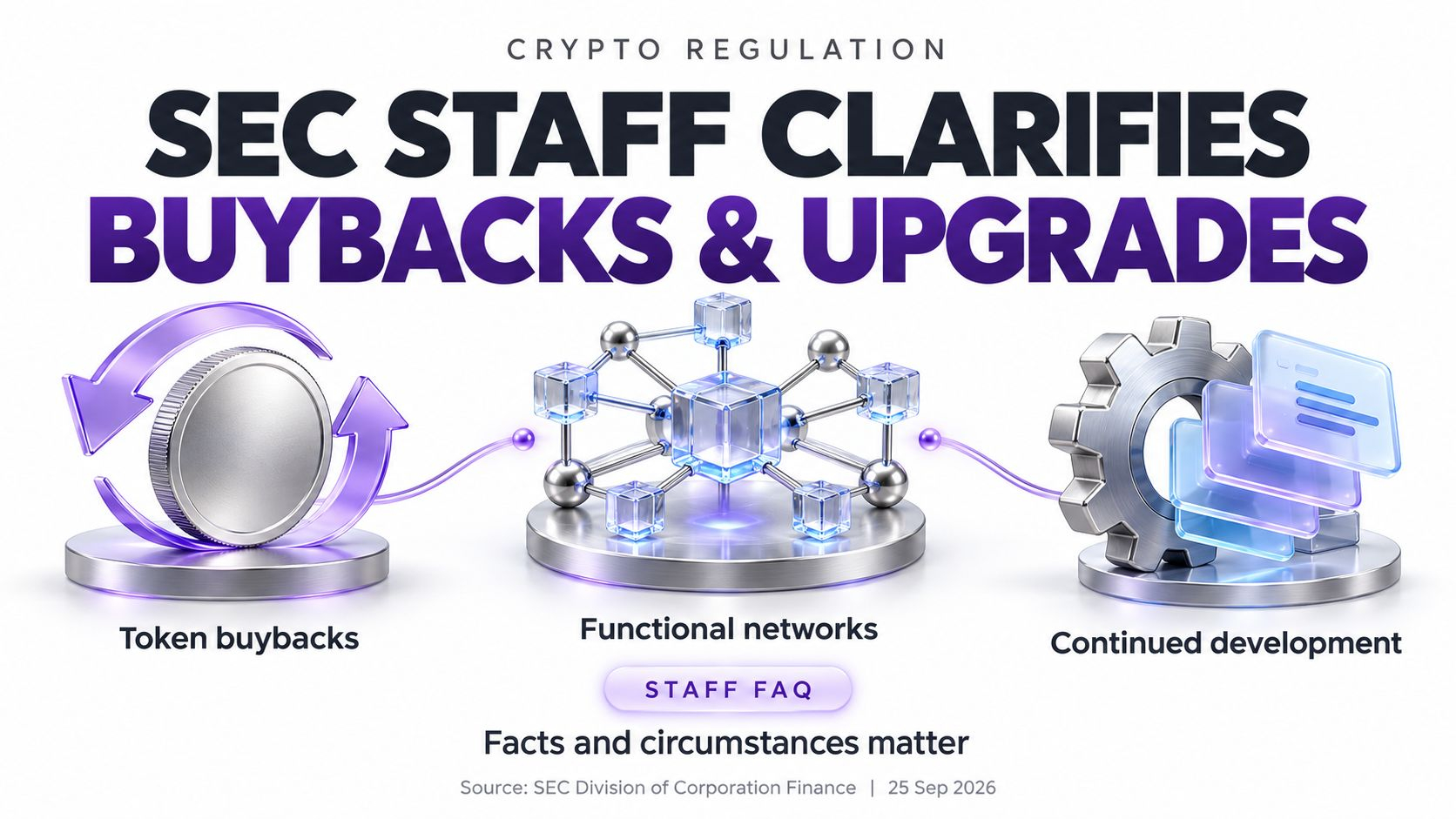
SEC Staff Clarifies Token Buybacks and Network Upgrades
A token buyback announcement is only part of the story. Whether the network is functional and how returns are promoted also matter.
On September 25, the SEC’s Division of Corporation Finance issued FAQs addressing these distinctions.
For a functional network, staff says announcing buybacks of a non-security token does not, by itself, constitute a promise of essential managerial efforts under the investment-contract analysis. Maintaining and upgrading a functional network also falls outside that category.
However, if a network is not functional and the buyback is pitched as generating returns, the analysis can change. These FAQs are nonbinding staff guidance; they do not change existing law.
My take: This could reduce uncertainty for teams continuing to improve working products. For token holders, the useful questions remain practical: where does buyback funding come from, are repurchased tokens burned or retained, and how much new supply is being issued?
I’d watch actual purchases, treasury disclosures and network usage. A buyback announcement provides limited evidence of sustainable demand or long-term value. Clearer regulatory treatment also leaves the underlying economics of each project to be assessed.
When assessing a token buyback, which matters most to you: funding transparency, supply impact or network usage?
#SECSaysBuybacksUpgradesDontMakeTokenSecurity #CryptoRegulation #Tokenomics
$PHA $ARK $MUBARAK
{future}(MUBARAKUSDT)
{future}(ARKUSDT)
{future}(PHAUSDT)
#secsaysbuybacksupgradesdontmaketokensecurity
SEC Staff Clarifies Token Buybacks and Network Upgrades
A token buyback announcement is only part of the story. Whether the network is functional and how returns are promoted also matter.
On September 25, the SEC’s Division of Corporation Finance issued FAQs addressing these distinctions.
For a functional network, staff says announcing buybacks of a non-security token does not, by itself, constitute a promise of essential managerial efforts under the investment-contract analysis. Maintaining and upgrading a functional network also falls outside that category.
However, if a network is not functional and the buyback is pitched as generating returns, the analysis can change. These FAQs are nonbinding staff guidance; they do not change existing law.
My take: This could reduce uncertainty for teams continuing to improve working products. For token holders, the useful questions remain practical: where does buyback funding come from, are repurchased tokens burned or retained, and how much new supply is being issued?
I’d watch actual purchases, treasury disclosures and network usage. A buyback announcement provides limited evidence of sustainable demand or long-term value. Clearer regulatory treatment also leaves the underlying economics of each project to be assessed.
When assessing a token buyback, which matters most to you: funding transparency, supply impact or network usage?
#SECSaysBuybacksUpgradesDontMakeTokenSecurity #CryptoRegulation #Tokenomics
$PHA $ARK $MUBARAK
SEC Staff Clarifies Token Buybacks and Network Upgrades
A token buyback announcement is only part of the story. Whether the network is functional and how returns are promoted also matter.
On September 25, the SEC’s Division of Corporation Finance issued FAQs addressing these distinctions.
For a functional network, staff says announcing buybacks of a non-security token does not, by itself, constitute a promise of essential managerial efforts under the investment-contract analysis. Maintaining and upgrading a functional network also falls outside that category.
However, if a network is not functional and the buyback is pitched as generating returns, the analysis can change. These FAQs are nonbinding staff guidance; they do not change existing law.
My take: This could reduce uncertainty for teams continuing to improve working products. For token holders, the useful questions remain practical: where does buyback funding come from, are repurchased tokens burned or retained, and how much new supply is being issued?
I’d watch actual purchases, treasury disclosures and network usage. A buyback announcement provides limited evidence of sustainable demand or long-term value. Clearer regulatory treatment also leaves the underlying economics of each project to be assessed.
When assessing a token buyback, which matters most to you: funding transparency, supply impact or network usage?
#SECSaysBuybacksUpgradesDontMakeTokenSecurity #CryptoRegulation #Tokenomics
$PHA $ARK $MUBARAK
MATRİX 1:
$OGN
1
5
11k
·
--
🚨 $PAID EXPLODES 220% AS INSTITUTIONAL BUYBACK MECHANISM FUELS 30M MARKET CAP ⚡
Solana asset $PAID printed a massive liquidity expansion today, surging over 220% to breach the $30M valuation milestone on $23.4M in volume. 📊 Smart money positioning is clearly accelerating around UsePaid's automated fee distribution architecture.
The underlying catalyst stems from institutional-grade tokenomics, routing 20% of creator fee revenue directly into continuous buyback and burn cycles. 💡 This structural supply sink creates an ongoing inefficiency sweep, tightening available sell-side liquidity as adoption scales.
With order flow swelling rapidly across DEX venues, the structural setup demands strict execution rules amidst heightened volatility. 💬 Will this fee-burn engine sustain high structural support, or are you waiting for a deeper liquidity sweep before sizing in? 👇
⚠️ Not financial advice. Always manage your risk. 🛡️
🏷️ #PAID #Solana #Tokenomics #Crypto
⚡ 💎
🚨 $PAID EXPLODES 220% AS INSTITUTIONAL BUYBACK MECHANISM FUELS 30M MARKET CAP ⚡
Solana asset $PAID printed a massive liquidity expansion today, surging over 220% to breach the $30M valuation milestone on $23.4M in volume. 📊 Smart money positioning is clearly accelerating around UsePaid's automated fee distribution architecture.
The underlying catalyst stems from institutional-grade tokenomics, routing 20% of creator fee revenue directly into continuous buyback and burn cycles. 💡 This structural supply sink creates an ongoing inefficiency sweep, tightening available sell-side liquidity as adoption scales.
With order flow swelling rapidly across DEX venues, the structural setup demands strict execution rules amidst heightened volatility. 💬 Will this fee-burn engine sustain high structural support, or are you waiting for a deeper liquidity sweep before sizing in? 👇
⚠️ Not financial advice. Always manage your risk. 🛡️
🏷️ #PAID #Solana #Tokenomics #Crypto
⚡ 💎
Solana asset $PAID printed a massive liquidity expansion today, surging over 220% to breach the $30M valuation milestone on $23.4M in volume. 📊 Smart money positioning is clearly accelerating around UsePaid's automated fee distribution architecture.
The underlying catalyst stems from institutional-grade tokenomics, routing 20% of creator fee revenue directly into continuous buyback and burn cycles. 💡 This structural supply sink creates an ongoing inefficiency sweep, tightening available sell-side liquidity as adoption scales.
With order flow swelling rapidly across DEX venues, the structural setup demands strict execution rules amidst heightened volatility. 💬 Will this fee-burn engine sustain high structural support, or are you waiting for a deeper liquidity sweep before sizing in? 👇
⚠️ Not financial advice. Always manage your risk. 🛡️
🏷️ #PAID #Solana #Tokenomics #Crypto
⚡ 💎
4

·
--
INSTITUTIONAL CLARITY ARRIVES FOR $ACU AS TOKEN TRANSPARENCY FILING GOES LIVE 🔒 🔍
Institutional capital prioritizes structural verification over speculative narratives. $ACU has officially disclosed its token allocation, vesting schedules, and governance controls via an established transparency framework, giving smart money clear line-of-sight on supply dynamics. 📊
Eliminating opaque administrative risk allows serious market participants to model long-term valuation with precision. 💡 When key supply unlocks and governance vectors are fully auditable, market structure gains genuine fundamental stability. 🔍
Does verifiable token transparency change your long-term thesis on $ACU , or do you wait for price action confirmation? 👇
⚠️ Not financial advice. Always manage your risk. 🛡️
🏷️ #ACU #Tokenomics #Crypto #Altcoins
🔍 🛡️
INSTITUTIONAL CLARITY ARRIVES FOR $ACU AS TOKEN TRANSPARENCY FILING GOES LIVE 🔒 🔍
Institutional capital prioritizes structural verification over speculative narratives. $ACU has officially disclosed its token allocation, vesting schedules, and governance controls via an established transparency framework, giving smart money clear line-of-sight on supply dynamics. 📊
Eliminating opaque administrative risk allows serious market participants to model long-term valuation with precision. 💡 When key supply unlocks and governance vectors are fully auditable, market structure gains genuine fundamental stability. 🔍
Does verifiable token transparency change your long-term thesis on $ACU , or do you wait for price action confirmation? 👇
⚠️ Not financial advice. Always manage your risk. 🛡️
🏷️ #ACU #Tokenomics #Crypto #Altcoins
🔍 🛡️
Institutional capital prioritizes structural verification over speculative narratives. $ACU has officially disclosed its token allocation, vesting schedules, and governance controls via an established transparency framework, giving smart money clear line-of-sight on supply dynamics. 📊
Eliminating opaque administrative risk allows serious market participants to model long-term valuation with precision. 💡 When key supply unlocks and governance vectors are fully auditable, market structure gains genuine fundamental stability. 🔍
Does verifiable token transparency change your long-term thesis on $ACU , or do you wait for price action confirmation? 👇
⚠️ Not financial advice. Always manage your risk. 🛡️
🏷️ #ACU #Tokenomics #Crypto #Altcoins
🔍 🛡️
150

·
--
Before you treat any burn announcement as bullish, run it through three checks — most traders skip all three and wonder why the "supply shock" never shows up in price.
Check the percentage, not the headline number. "Millions of tokens burned" means nothing against a supply in the trillions. BNB's burn works specifically because it's closing in on a hard 100M target from 117.5M already destroyed — that's a real, measurable percentage of total supply disappearing. A meme coin burning millions out of a quadrillion-token supply is burning a rounding error and calling it deflation.
Check who's actually setting the price. Price comes from order-book depth and live liquidity, not theoretical circulating supply math. Scheduled, programmatic burns — the kind announced weeks or months ahead — get priced in by algorithmic traders long before the burn actually executes. If you're buying the day of a scheduled burn expecting a pop, you're often buying after the market already adjusted.
Check whether demand exists behind the burn. This is where most burns quietly fail. $SHIB and similar high-inflation tokens run regular, community-driven burns and still trade under sustained sell pressure, because new adoption simply isn't outpacing unlocks and broader sell-offs. A burn without organic demand growth is just rearranging supply, not creating scarcity that matters.
Two competing theories explain why burns sometimes work anyway: the Supply Shock Hypothesis (less supply, same demand, price rises — true for $BNB , false for tokens with no real utility) and the Signaling Hypothesis (the burn itself builds trust in team commitment, regardless of the math). Knowing which one you're actually betting on changes what you should be checking before you buy the announcement.
Next burn headline you see — are you checking the percentage and the demand behind it, or just reacting to the word "burn"? #Tokenomics
Before you treat any burn announcement as bullish, run it through three checks — most traders skip all three and wonder why the "supply shock" never shows up in price.
Check the percentage, not the headline number. "Millions of tokens burned" means nothing against a supply in the trillions. BNB's burn works specifically because it's closing in on a hard 100M target from 117.5M already destroyed — that's a real, measurable percentage of total supply disappearing. A meme coin burning millions out of a quadrillion-token supply is burning a rounding error and calling it deflation.
Check who's actually setting the price. Price comes from order-book depth and live liquidity, not theoretical circulating supply math. Scheduled, programmatic burns — the kind announced weeks or months ahead — get priced in by algorithmic traders long before the burn actually executes. If you're buying the day of a scheduled burn expecting a pop, you're often buying after the market already adjusted.
Check whether demand exists behind the burn. This is where most burns quietly fail. $SHIB and similar high-inflation tokens run regular, community-driven burns and still trade under sustained sell pressure, because new adoption simply isn't outpacing unlocks and broader sell-offs. A burn without organic demand growth is just rearranging supply, not creating scarcity that matters.
Two competing theories explain why burns sometimes work anyway: the Supply Shock Hypothesis (less supply, same demand, price rises — true for $BNB , false for tokens with no real utility) and the Signaling Hypothesis (the burn itself builds trust in team commitment, regardless of the math). Knowing which one you're actually betting on changes what you should be checking before you buy the announcement.
Next burn headline you see — are you checking the percentage and the demand behind it, or just reacting to the word "burn"? #Tokenomics
Check the percentage, not the headline number. "Millions of tokens burned" means nothing against a supply in the trillions. BNB's burn works specifically because it's closing in on a hard 100M target from 117.5M already destroyed — that's a real, measurable percentage of total supply disappearing. A meme coin burning millions out of a quadrillion-token supply is burning a rounding error and calling it deflation.
Check who's actually setting the price. Price comes from order-book depth and live liquidity, not theoretical circulating supply math. Scheduled, programmatic burns — the kind announced weeks or months ahead — get priced in by algorithmic traders long before the burn actually executes. If you're buying the day of a scheduled burn expecting a pop, you're often buying after the market already adjusted.
Check whether demand exists behind the burn. This is where most burns quietly fail. $SHIB and similar high-inflation tokens run regular, community-driven burns and still trade under sustained sell pressure, because new adoption simply isn't outpacing unlocks and broader sell-offs. A burn without organic demand growth is just rearranging supply, not creating scarcity that matters.
Two competing theories explain why burns sometimes work anyway: the Supply Shock Hypothesis (less supply, same demand, price rises — true for $BNB , false for tokens with no real utility) and the Signaling Hypothesis (the burn itself builds trust in team commitment, regardless of the math). Knowing which one you're actually betting on changes what you should be checking before you buy the announcement.
Next burn headline you see — are you checking the percentage and the demand behind it, or just reacting to the word "burn"? #Tokenomics
89

·
--
Bullish
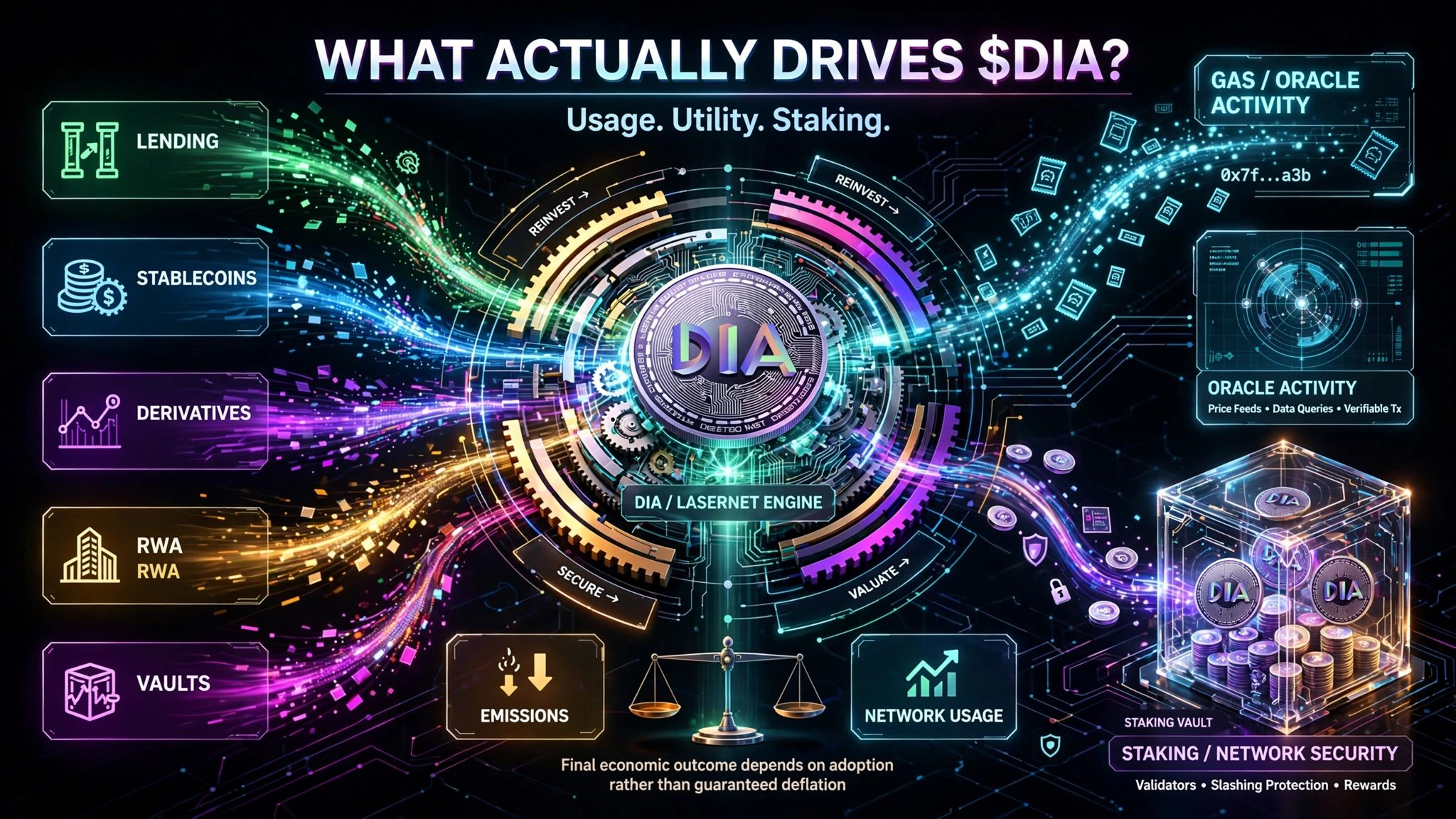
The part of $DIA
{spot}(DIAUSDT)
tokenomics I find most interesting isn't the APY. It's the utility loop.
DIA is the native gas token on Lasernet.
That means oracle computations, data submissions and verification-layer transactions use DIA.
Then staking adds another layer.
You stake wDIA to help secure oracle operations, with:
→ 1 wDIA minimum
→ Auto-compounding rewards
→ 7-day cooldown
→ Variable APY
Now imagine oracle adoption keeps expanding.
More dApps
→ more data requests
→ more oracle activity
→ more Lasernet transactions
→ more DIA utility
At the same time, staking can remove tokens from active circulation while they are securing the network.
But there’s an important distinction:
Usage does not automatically make DIA deflationary.
Staking rewards create emissions, while gas creates network demand and token consumption.
Whether usage eventually outweighs emissions is an empirical question that depends on adoption and network economics.
So I’m less interested in saying “DIA is deflationary.”
I’m more interested in whether real oracle demand can create a durable token utility loop.
That’s the tokenomics thesis worth tracking.
#DIA #DeFi #Tokenomics #Crypto
The part of $DIA
tokenomics I find most interesting isn't the APY. It's the utility loop.
DIA is the native gas token on Lasernet.
That means oracle computations, data submissions and verification-layer transactions use DIA.
Then staking adds another layer.
You stake wDIA to help secure oracle operations, with:
→ 1 wDIA minimum
→ Auto-compounding rewards
→ 7-day cooldown
→ Variable APY
Now imagine oracle adoption keeps expanding.
More dApps
→ more data requests
→ more oracle activity
→ more Lasernet transactions
→ more DIA utility
At the same time, staking can remove tokens from active circulation while they are securing the network.
But there’s an important distinction:
Usage does not automatically make DIA deflationary.
Staking rewards create emissions, while gas creates network demand and token consumption.
Whether usage eventually outweighs emissions is an empirical question that depends on adoption and network economics.
So I’m less interested in saying “DIA is deflationary.”
I’m more interested in whether real oracle demand can create a durable token utility loop.
That’s the tokenomics thesis worth tracking.
#DIA #DeFi #Tokenomics #Crypto
tokenomics I find most interesting isn't the APY. It's the utility loop.
DIA is the native gas token on Lasernet.
That means oracle computations, data submissions and verification-layer transactions use DIA.
Then staking adds another layer.
You stake wDIA to help secure oracle operations, with:
→ 1 wDIA minimum
→ Auto-compounding rewards
→ 7-day cooldown
→ Variable APY
Now imagine oracle adoption keeps expanding.
More dApps
→ more data requests
→ more oracle activity
→ more Lasernet transactions
→ more DIA utility
At the same time, staking can remove tokens from active circulation while they are securing the network.
But there’s an important distinction:
Usage does not automatically make DIA deflationary.
Staking rewards create emissions, while gas creates network demand and token consumption.
Whether usage eventually outweighs emissions is an empirical question that depends on adoption and network economics.
So I’m less interested in saying “DIA is deflationary.”
I’m more interested in whether real oracle demand can create a durable token utility loop.
That’s the tokenomics thesis worth tracking.
#DIA #DeFi #Tokenomics #Crypto
111

Today is one of the biggest unlock days of the month. Two tokens are releasing significant supply. Let's look at both.
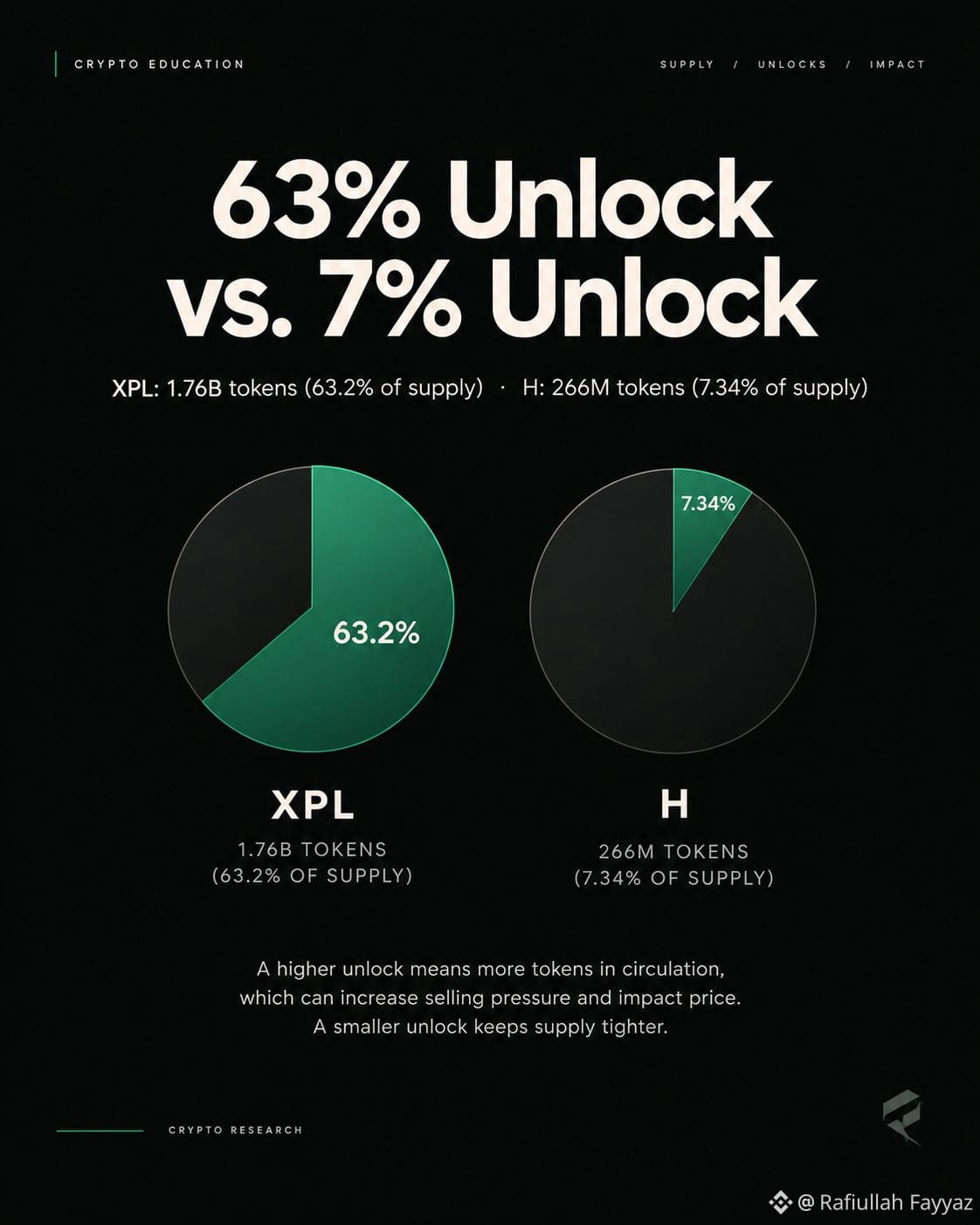
$XPL unlocks 1.76 billion tokens.
That's worth roughly $160 million. But here's the number that matters: it's 63.2% of the circulating supply. Investors and the team each receive 833.33 million tokens. The ecosystem and growth fund gets 88.89 million.
When more than 60% of a token's circulating supply unlocks at once, the supply shock is real. The market has to absorb it.
$H unlocks 266.47 million tokens.
Worth about $19.3 million — smaller in dollar terms. But it's 7.34% of circulating supply. The distribution is spread across six recipients: early contributors (79.17M), investors (55.56M), ecosystem fund (50M), identity verification rewards (42.86M), strategic reserve (26.39M), and foundation treasury (12.5M).
Two unlocks. Two very different profiles. XPL is a single massive release. H is a moderate release spread across many recipients.
The question with both is the same: will the recipients sell? Team and investor allocations tend to create selling pressure. Ecosystem and community allocations often get held or used.
Percentage first. Recipient second. That's the order that matters.
#CryptoEducation #TokenUnlocks #Tokenomics
{spot}(XPLUSDT)
Today is one of the biggest unlock days of the month. Two tokens are releasing significant supply. Let's look at both.
$XPL unlocks 1.76 billion tokens.
That's worth roughly $160 million. But here's the number that matters: it's 63.2% of the circulating supply. Investors and the team each receive 833.33 million tokens. The ecosystem and growth fund gets 88.89 million.
When more than 60% of a token's circulating supply unlocks at once, the supply shock is real. The market has to absorb it.
$H unlocks 266.47 million tokens.
Worth about $19.3 million — smaller in dollar terms. But it's 7.34% of circulating supply. The distribution is spread across six recipients: early contributors (79.17M), investors (55.56M), ecosystem fund (50M), identity verification rewards (42.86M), strategic reserve (26.39M), and foundation treasury (12.5M).
Two unlocks. Two very different profiles. XPL is a single massive release. H is a moderate release spread across many recipients.
The question with both is the same: will the recipients sell? Team and investor allocations tend to create selling pressure. Ecosystem and community allocations often get held or used.
Percentage first. Recipient second. That's the order that matters.
#CryptoEducation #TokenUnlocks #Tokenomics
$XPL unlocks 1.76 billion tokens.
That's worth roughly $160 million. But here's the number that matters: it's 63.2% of the circulating supply. Investors and the team each receive 833.33 million tokens. The ecosystem and growth fund gets 88.89 million.
When more than 60% of a token's circulating supply unlocks at once, the supply shock is real. The market has to absorb it.
$H unlocks 266.47 million tokens.
Worth about $19.3 million — smaller in dollar terms. But it's 7.34% of circulating supply. The distribution is spread across six recipients: early contributors (79.17M), investors (55.56M), ecosystem fund (50M), identity verification rewards (42.86M), strategic reserve (26.39M), and foundation treasury (12.5M).
Two unlocks. Two very different profiles. XPL is a single massive release. H is a moderate release spread across many recipients.
The question with both is the same: will the recipients sell? Team and investor allocations tend to create selling pressure. Ecosystem and community allocations often get held or used.
Percentage first. Recipient second. That's the order that matters.
#CryptoEducation #TokenUnlocks #Tokenomics
478

·
--
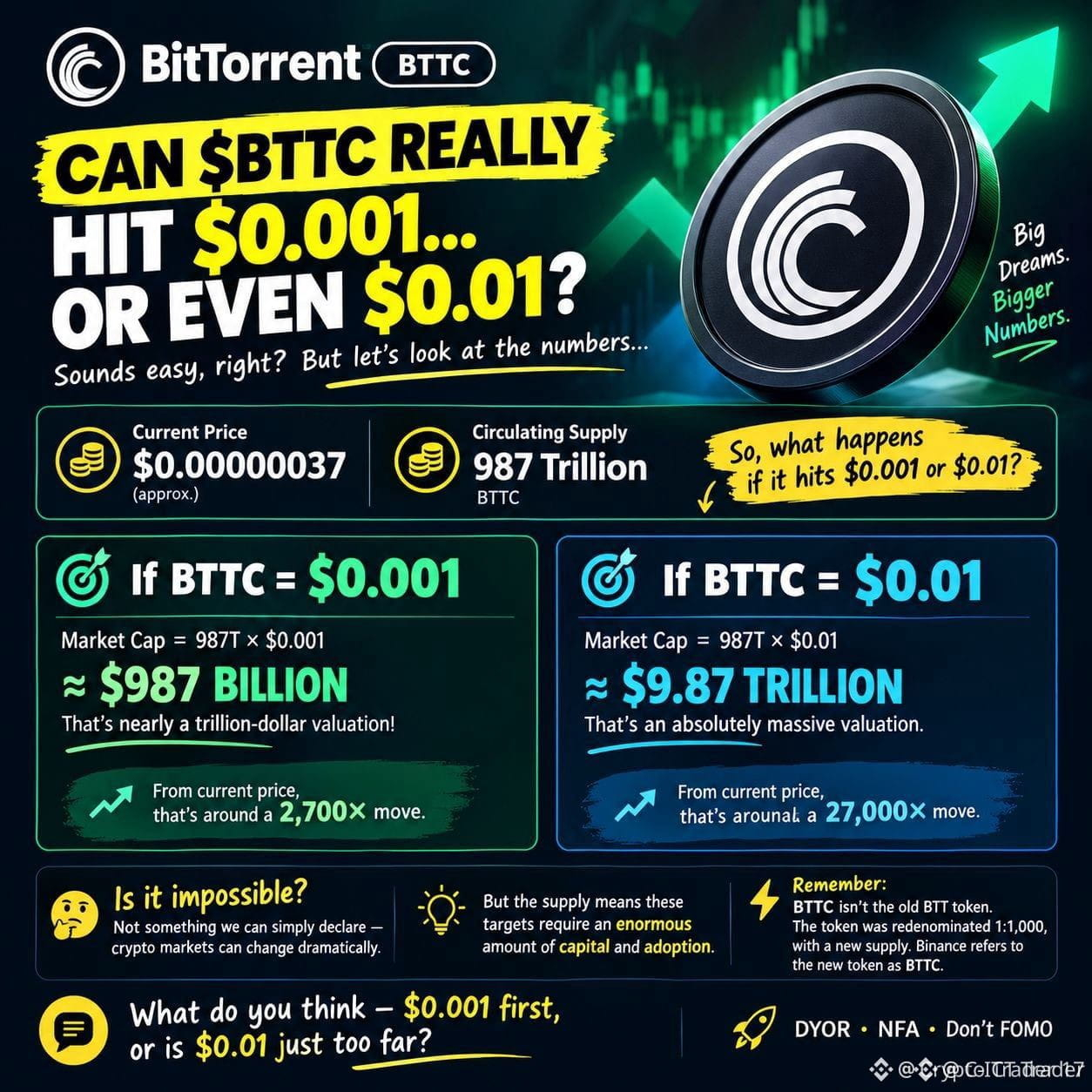
THE SUPPLY MATHEMATICS BEHIND $BTTC AND REALISTIC MARKET CAP VALUATIONS 📊 🔍
At a current price around $0.00000037, evaluating $BTTC requires looking directly at circulating supply metrics. With 987 trillion tokens following its 1:1,000 redenomination, pushing price to $0.001 demands an impressive $987 billion valuation. 📊
A stretch target of $0.01 elevates that theoretical market cap to nearly $9.87 trillion, requiring a 27,000x expansion from current levels. 🔍 Smart money always weighs structural liquidity and capital requirements over nominal token price appeal. ⚖️
Unless massive supply compression or monumental adoption sweeps the ecosystem, extreme price targets remain bounded by basic arithmetic. 💬 Do you believe aggressive burn mechanisms can alter this equation, or will circulating supply keep price anchored? 👇
⚠️ Not financial advice. Always manage your risk. 🛡️
🏷️ #BTTC #BTTCPricePrediction #Tokenomics #CryptoAnalysis
📊 🛡️
THE SUPPLY MATHEMATICS BEHIND $BTTC AND REALISTIC MARKET CAP VALUATIONS 📊 🔍
At a current price around $0.00000037, evaluating $BTTC requires looking directly at circulating supply metrics. With 987 trillion tokens following its 1:1,000 redenomination, pushing price to $0.001 demands an impressive $987 billion valuation. 📊
A stretch target of $0.01 elevates that theoretical market cap to nearly $9.87 trillion, requiring a 27,000x expansion from current levels. 🔍 Smart money always weighs structural liquidity and capital requirements over nominal token price appeal. ⚖️
Unless massive supply compression or monumental adoption sweeps the ecosystem, extreme price targets remain bounded by basic arithmetic. 💬 Do you believe aggressive burn mechanisms can alter this equation, or will circulating supply keep price anchored? 👇
⚠️ Not financial advice. Always manage your risk. 🛡️
🏷️ #BTTC #BTTCPricePrediction #Tokenomics #CryptoAnalysis
📊 🛡️
At a current price around $0.00000037, evaluating $BTTC requires looking directly at circulating supply metrics. With 987 trillion tokens following its 1:1,000 redenomination, pushing price to $0.001 demands an impressive $987 billion valuation. 📊
A stretch target of $0.01 elevates that theoretical market cap to nearly $9.87 trillion, requiring a 27,000x expansion from current levels. 🔍 Smart money always weighs structural liquidity and capital requirements over nominal token price appeal. ⚖️
Unless massive supply compression or monumental adoption sweeps the ecosystem, extreme price targets remain bounded by basic arithmetic. 💬 Do you believe aggressive burn mechanisms can alter this equation, or will circulating supply keep price anchored? 👇
⚠️ Not financial advice. Always manage your risk. 🛡️
🏷️ #BTTC #BTTCPricePrediction #Tokenomics #CryptoAnalysis
📊 🛡️
63
·
--
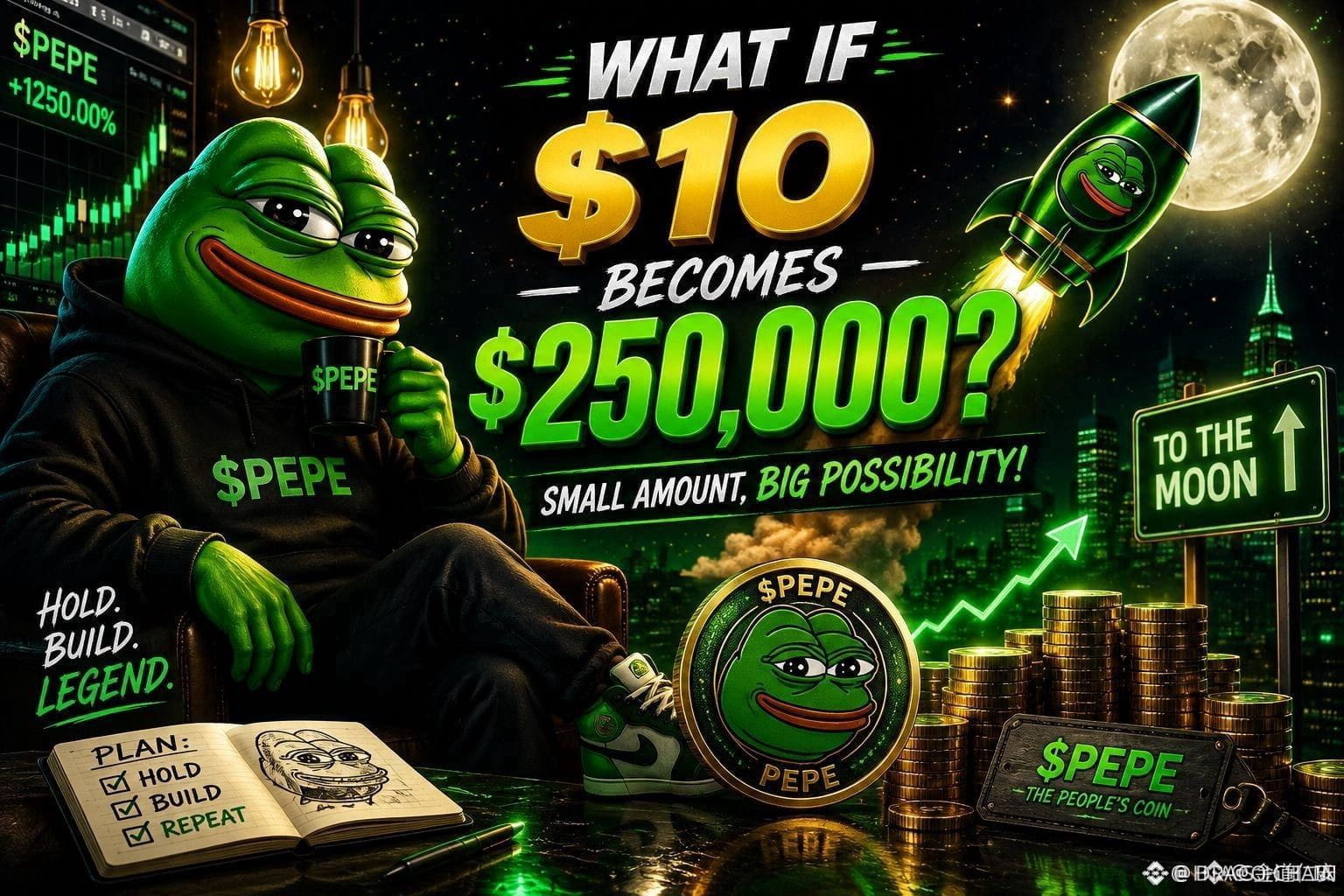
CAN $PEPE LIQUIDITY ABSORB MASSIVE EXPANSION OR ARE MARKET CAP CEILINGS THE LIMIT? 📊 🦈
A standard $10 position near $0.000004 yields 2.5 million units, making hypothetical targets like $0.001 or $0.01 look mathematically effortless on paper. 📌 However, institutional order flow logic requires examining the raw market capitalization required to sustain such structural expansion.
With an immense circulating supply, pushing price levels toward $0.01 demands astronomical capital injection and sustained market liquidity absorption that far exceeds conventional asset benchmarks. 💡 While long-term compounding sounds simple in isolation, smart money evaluates total supply overhead and valuation ceilings before assuming price expansion.
💬 Does $PEPE have the institutional liquidity backing to absorb higher supply brackets, or are these projections bound by market cap reality? 👇
⚠️ Not financial advice. Always manage your risk. 🛡️
🏷️ #PEPE #Tokenomics #MarketCap #Crypto
⚖️ 🔍
CAN $PEPE LIQUIDITY ABSORB MASSIVE EXPANSION OR ARE MARKET CAP CEILINGS THE LIMIT? 📊 🦈
A standard $10 position near $0.000004 yields 2.5 million units, making hypothetical targets like $0.001 or $0.01 look mathematically effortless on paper. 📌 However, institutional order flow logic requires examining the raw market capitalization required to sustain such structural expansion.
With an immense circulating supply, pushing price levels toward $0.01 demands astronomical capital injection and sustained market liquidity absorption that far exceeds conventional asset benchmarks. 💡 While long-term compounding sounds simple in isolation, smart money evaluates total supply overhead and valuation ceilings before assuming price expansion.
💬 Does $PEPE have the institutional liquidity backing to absorb higher supply brackets, or are these projections bound by market cap reality? 👇
⚠️ Not financial advice. Always manage your risk. 🛡️
🏷️ #PEPE #Tokenomics #MarketCap #Crypto
⚖️ 🔍
A standard $10 position near $0.000004 yields 2.5 million units, making hypothetical targets like $0.001 or $0.01 look mathematically effortless on paper. 📌 However, institutional order flow logic requires examining the raw market capitalization required to sustain such structural expansion.
With an immense circulating supply, pushing price levels toward $0.01 demands astronomical capital injection and sustained market liquidity absorption that far exceeds conventional asset benchmarks. 💡 While long-term compounding sounds simple in isolation, smart money evaluates total supply overhead and valuation ceilings before assuming price expansion.
💬 Does $PEPE have the institutional liquidity backing to absorb higher supply brackets, or are these projections bound by market cap reality? 👇
⚠️ Not financial advice. Always manage your risk. 🛡️
🏷️ #PEPE #Tokenomics #MarketCap #Crypto
⚖️ 🔍
27

·
--
🚨 $GENIUS COMMUNITY ERUPTS AS DAILY POINTS SLASHED AND UNLOCK POSTPONED! 💥
📌 Order flow and liquidity move fast, but protocol trust moves even faster. Genius Terminal has quietly updated its Season 2 documentation, slashing daily point emissions from 1.5M down to just 50K while pushing a 70 million $GENIUS token unlock out to February 2028.
💡 Management defends the decision as standard protocol adjustments reflecting lower trading volume, but traders who racked up execution fees are pushing back hard. 🔍 When incentives shift mid-game, capital usually seeks cleaner, higher-conviction opportunities elsewhere. 💬 Are you sticking through points adjustments or immediately rotating your liquidity? 👇
⚠️ Not financial advice. Always manage your risk. 🛡️
🏷️ #GENIUS #Airdrop #Tokenomics #Crypto
🔥 ⚡
🚨 $GENIUS COMMUNITY ERUPTS AS DAILY POINTS SLASHED AND UNLOCK POSTPONED! 💥
📌 Order flow and liquidity move fast, but protocol trust moves even faster. Genius Terminal has quietly updated its Season 2 documentation, slashing daily point emissions from 1.5M down to just 50K while pushing a 70 million $GENIUS token unlock out to February 2028.
💡 Management defends the decision as standard protocol adjustments reflecting lower trading volume, but traders who racked up execution fees are pushing back hard. 🔍 When incentives shift mid-game, capital usually seeks cleaner, higher-conviction opportunities elsewhere. 💬 Are you sticking through points adjustments or immediately rotating your liquidity? 👇
⚠️ Not financial advice. Always manage your risk. 🛡️
🏷️ #GENIUS #Airdrop #Tokenomics #Crypto
🔥 ⚡
📌 Order flow and liquidity move fast, but protocol trust moves even faster. Genius Terminal has quietly updated its Season 2 documentation, slashing daily point emissions from 1.5M down to just 50K while pushing a 70 million $GENIUS token unlock out to February 2028.
💡 Management defends the decision as standard protocol adjustments reflecting lower trading volume, but traders who racked up execution fees are pushing back hard. 🔍 When incentives shift mid-game, capital usually seeks cleaner, higher-conviction opportunities elsewhere. 💬 Are you sticking through points adjustments or immediately rotating your liquidity? 👇
⚠️ Not financial advice. Always manage your risk. 🛡️
🏷️ #GENIUS #Airdrop #Tokenomics #Crypto
🔥 ⚡
138

·
--
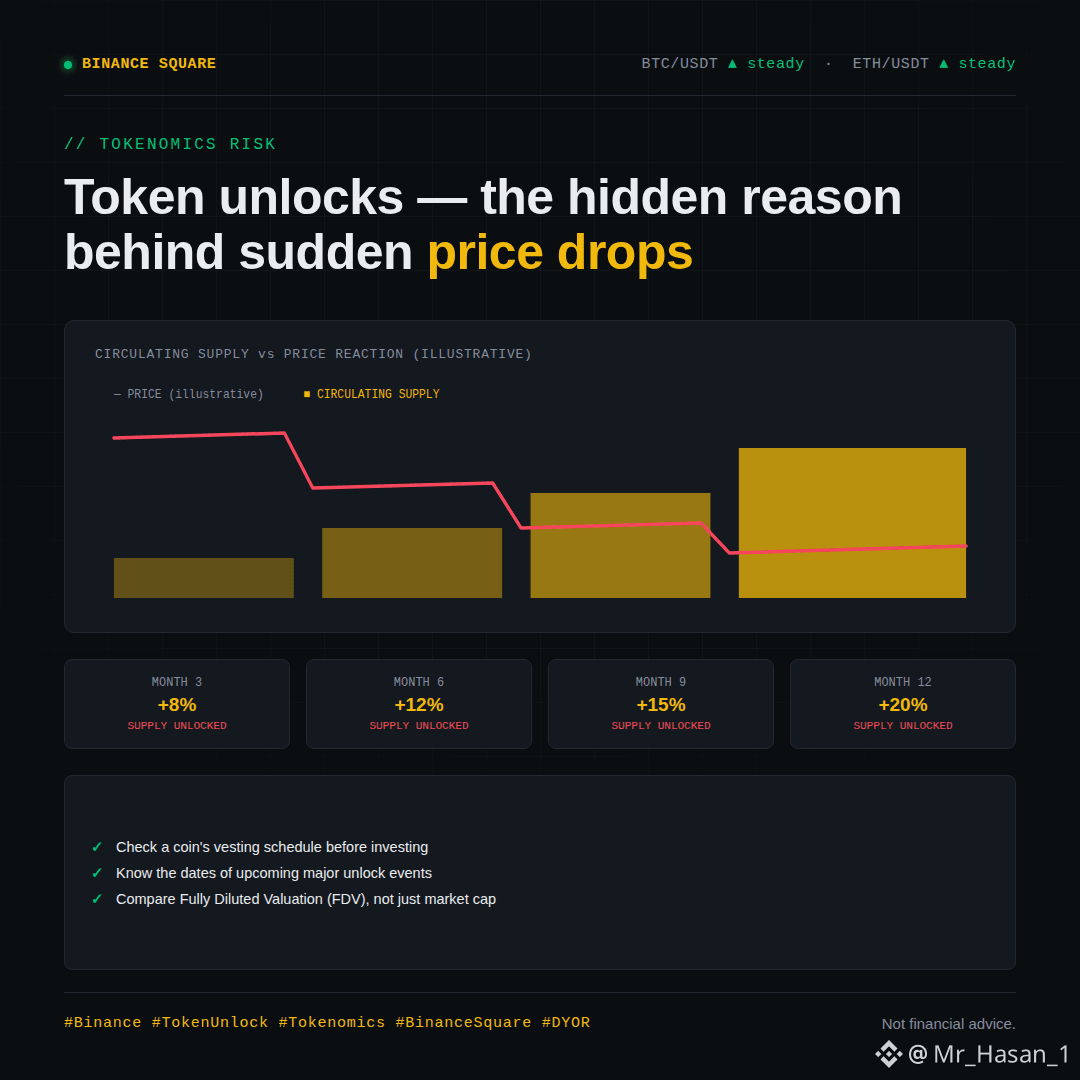
🔓 Token Unlocks: The Hidden Reason Behind Sudden Price Drops
Ever seen a coin suddenly drop hard with no bad news in sight? A "token unlock" could be the reason.
🔹 What is a vesting schedule?
When a new project launches, instead of handing the team, investors, and early backers all their tokens at once, tokens get released gradually over a set schedule (monthly or quarterly) — this is called vesting.
🔹 Why does vesting exist?
✅ Prevents the team/investors from dumping everything right at launch
✅ Encourages long-term commitment
✅ Releases supply gradually, avoiding sudden inflation
🔹 How do unlocks affect price?
📊 A large amount of tokens suddenly gets added to circulating supply
📊 Early investors/teams often start selling to lock in profits
📊 More supply with the same demand puts downward pressure on price
📊 High volatility around big unlock events is very common
🎯 How to stay ahead of it?
✅ Check a coin's vesting schedule before investing (tools like CoinGecko or Tokenomist have this data)
✅ Know the dates of upcoming major unlock events
✅ Look at "Fully Diluted Valuation (FDV)," not just circulating supply
⚠️ Remember: a big unlock doesn't guarantee a price drop — but it's a real risk factor many people forget to check.
Have you ever taken a loss because of a token unlock? Let us know in the comments 👇
#Binance #TokenUnlock #Tokenomics #BinanceSquare #DYOR
🔓 Token Unlocks: The Hidden Reason Behind Sudden Price Drops
Ever seen a coin suddenly drop hard with no bad news in sight? A "token unlock" could be the reason.
🔹 What is a vesting schedule?
When a new project launches, instead of handing the team, investors, and early backers all their tokens at once, tokens get released gradually over a set schedule (monthly or quarterly) — this is called vesting.
🔹 Why does vesting exist?
✅ Prevents the team/investors from dumping everything right at launch
✅ Encourages long-term commitment
✅ Releases supply gradually, avoiding sudden inflation
🔹 How do unlocks affect price?
📊 A large amount of tokens suddenly gets added to circulating supply
📊 Early investors/teams often start selling to lock in profits
📊 More supply with the same demand puts downward pressure on price
📊 High volatility around big unlock events is very common
🎯 How to stay ahead of it?
✅ Check a coin's vesting schedule before investing (tools like CoinGecko or Tokenomist have this data)
✅ Know the dates of upcoming major unlock events
✅ Look at "Fully Diluted Valuation (FDV)," not just circulating supply
⚠️ Remember: a big unlock doesn't guarantee a price drop — but it's a real risk factor many people forget to check.
Have you ever taken a loss because of a token unlock? Let us know in the comments 👇
#Binance #TokenUnlock #Tokenomics #BinanceSquare #DYOR
Ever seen a coin suddenly drop hard with no bad news in sight? A "token unlock" could be the reason.
🔹 What is a vesting schedule?
When a new project launches, instead of handing the team, investors, and early backers all their tokens at once, tokens get released gradually over a set schedule (monthly or quarterly) — this is called vesting.
🔹 Why does vesting exist?
✅ Prevents the team/investors from dumping everything right at launch
✅ Encourages long-term commitment
✅ Releases supply gradually, avoiding sudden inflation
🔹 How do unlocks affect price?
📊 A large amount of tokens suddenly gets added to circulating supply
📊 Early investors/teams often start selling to lock in profits
📊 More supply with the same demand puts downward pressure on price
📊 High volatility around big unlock events is very common
🎯 How to stay ahead of it?
✅ Check a coin's vesting schedule before investing (tools like CoinGecko or Tokenomist have this data)
✅ Know the dates of upcoming major unlock events
✅ Look at "Fully Diluted Valuation (FDV)," not just circulating supply
⚠️ Remember: a big unlock doesn't guarantee a price drop — but it's a real risk factor many people forget to check.
Have you ever taken a loss because of a token unlock? Let us know in the comments 👇
#Binance #TokenUnlock #Tokenomics #BinanceSquare #DYOR
114
Partly True
Token unlocks create supply pressure. But not all supply pressure is the same. Today is a good example.
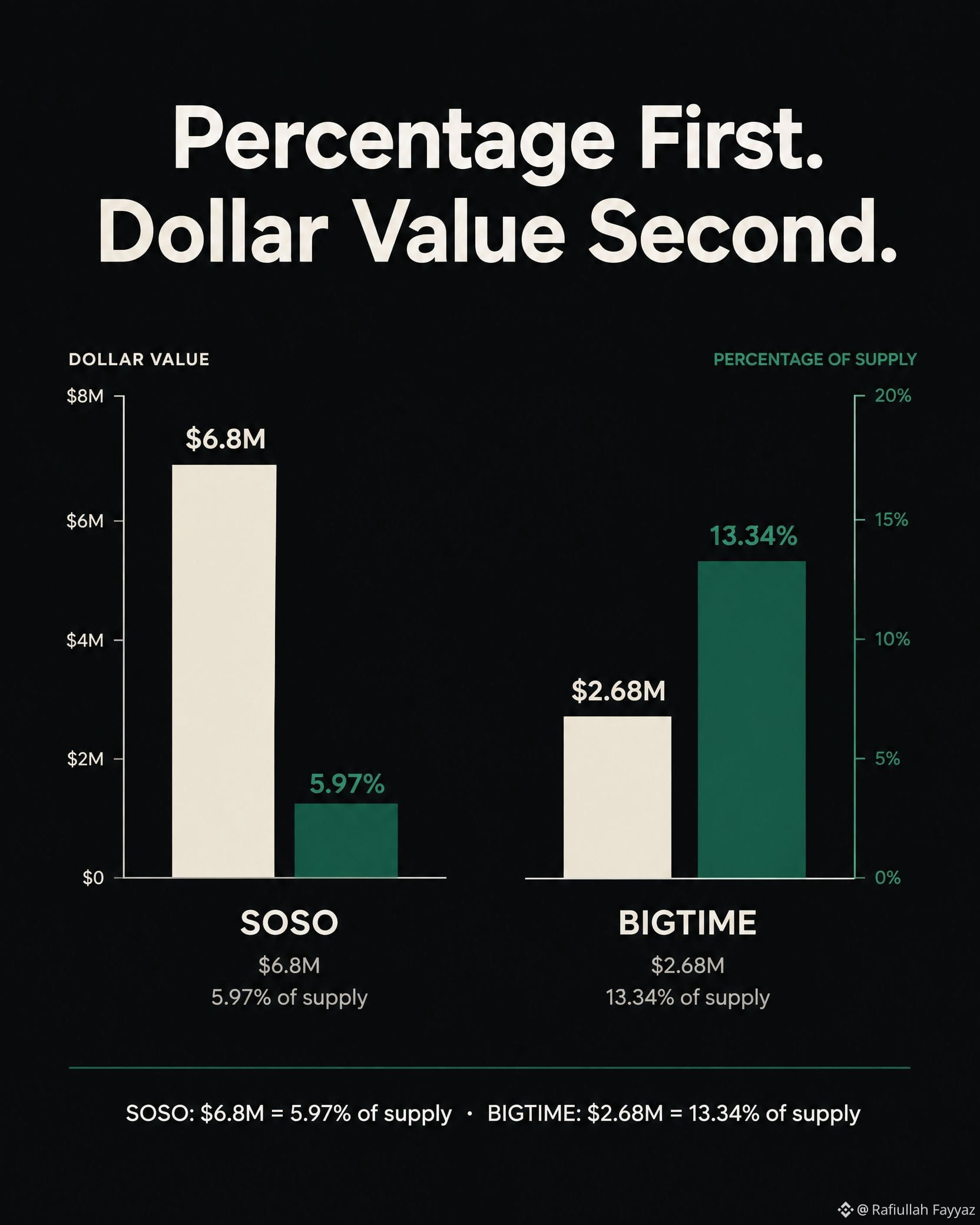
SOSO unlocked 23.46 million tokens — 5.97% of circulating supply, worth about $6.8 million. $BIGTIME unlocked a smaller dollar amount ($2.68 million) but a larger percentage — 13.34% of circulating supply.
That distinction matters.
A $6.8 million unlock sounds bigger than a $2.68 million unlock. But 13.34% of BIGTIME's circulating supply entering the market at once is a bigger relative supply shock than 5.97% of SOSO's.
Here's the simple rule I use:
Under 1% of circulating supply: noise. Ignore.
1%–5%: worth noting. Check the recipient.
5%–15%: real supply event. Watch the price reaction.
15%+: supply shock. Understand who's receiving and why.
The dollar amount tells you the headline. The percentage tells you the impact.
This week has more unlocks coming. XPL unlocks 63.2% of its supply on September 25 — worth roughly $157 million. H unlocks 7.34% the same day. STBL unlocks 77.79% on September 26.
Those percentages matter more than the dollar values.
#CryptoEducation #TokenUnlocks #Tokenomics
{spot}(BIGTIMEUSDT)
Token unlocks create supply pressure. But not all supply pressure is the same. Today is a good example.
SOSO unlocked 23.46 million tokens — 5.97% of circulating supply, worth about $6.8 million. $BIGTIME unlocked a smaller dollar amount ($2.68 million) but a larger percentage — 13.34% of circulating supply.
That distinction matters.
A $6.8 million unlock sounds bigger than a $2.68 million unlock. But 13.34% of BIGTIME's circulating supply entering the market at once is a bigger relative supply shock than 5.97% of SOSO's.
Here's the simple rule I use:
Under 1% of circulating supply: noise. Ignore.
1%–5%: worth noting. Check the recipient.
5%–15%: real supply event. Watch the price reaction.
15%+: supply shock. Understand who's receiving and why.
The dollar amount tells you the headline. The percentage tells you the impact.
This week has more unlocks coming. XPL unlocks 63.2% of its supply on September 25 — worth roughly $157 million. H unlocks 7.34% the same day. STBL unlocks 77.79% on September 26.
Those percentages matter more than the dollar values.
#CryptoEducation #TokenUnlocks #Tokenomics
SOSO unlocked 23.46 million tokens — 5.97% of circulating supply, worth about $6.8 million. $BIGTIME unlocked a smaller dollar amount ($2.68 million) but a larger percentage — 13.34% of circulating supply.
That distinction matters.
A $6.8 million unlock sounds bigger than a $2.68 million unlock. But 13.34% of BIGTIME's circulating supply entering the market at once is a bigger relative supply shock than 5.97% of SOSO's.
Here's the simple rule I use:
Under 1% of circulating supply: noise. Ignore.
1%–5%: worth noting. Check the recipient.
5%–15%: real supply event. Watch the price reaction.
15%+: supply shock. Understand who's receiving and why.
The dollar amount tells you the headline. The percentage tells you the impact.
This week has more unlocks coming. XPL unlocks 63.2% of its supply on September 25 — worth roughly $157 million. H unlocks 7.34% the same day. STBL unlocks 77.79% on September 26.
Those percentages matter more than the dollar values.
#CryptoEducation #TokenUnlocks #Tokenomics
702

·
--
Token burns are the most overrated metric in crypto.
Every chain announces one, every community celebrates it, and almost nobody asks the right question: what does the burn actually do at equilibrium?
A fee burn is a closed loop. The tokens burned come out of fees users paid, which means the burn is funded by demand, not creating it. Removing supply while demand stays flat does not build value. It just redistributes the same value across fewer tokens, and markets price that in almost instantly.
The chains where burns genuinely mattered had something else going on: demand acceleration that made the burn look like the cause. $ETH fee burns became meaningful because rollups and DeFi created real settlement demand first. The burn was the accounting, not the engine. $SOL barely burns anything relative to its fee scale, and it does not matter, because its demand engine does not need the accounting.
The reverse trap is worse: networks with weak demand that crank up aggressive burn schedules to manufacture scarcity. It works for exactly one narrative cycle, because manufactured scarcity without a demand engine just means the remaining holders own an asset nobody else wants.
Scarcity only matters when the thing itself is in demand. A burn schedule is a symptom of fee health, never a substitute for it.
Watch the demand engine, not the furnace.
#Crypto #Tokenomics #DeFi #Blockchain
Token burns are the most overrated metric in crypto.
Every chain announces one, every community celebrates it, and almost nobody asks the right question: what does the burn actually do at equilibrium?
A fee burn is a closed loop. The tokens burned come out of fees users paid, which means the burn is funded by demand, not creating it. Removing supply while demand stays flat does not build value. It just redistributes the same value across fewer tokens, and markets price that in almost instantly.
The chains where burns genuinely mattered had something else going on: demand acceleration that made the burn look like the cause. $ETH fee burns became meaningful because rollups and DeFi created real settlement demand first. The burn was the accounting, not the engine. $SOL barely burns anything relative to its fee scale, and it does not matter, because its demand engine does not need the accounting.
The reverse trap is worse: networks with weak demand that crank up aggressive burn schedules to manufacture scarcity. It works for exactly one narrative cycle, because manufactured scarcity without a demand engine just means the remaining holders own an asset nobody else wants.
Scarcity only matters when the thing itself is in demand. A burn schedule is a symptom of fee health, never a substitute for it.
Watch the demand engine, not the furnace.
#Crypto #Tokenomics #DeFi #Blockchain
Every chain announces one, every community celebrates it, and almost nobody asks the right question: what does the burn actually do at equilibrium?
A fee burn is a closed loop. The tokens burned come out of fees users paid, which means the burn is funded by demand, not creating it. Removing supply while demand stays flat does not build value. It just redistributes the same value across fewer tokens, and markets price that in almost instantly.
The chains where burns genuinely mattered had something else going on: demand acceleration that made the burn look like the cause. $ETH fee burns became meaningful because rollups and DeFi created real settlement demand first. The burn was the accounting, not the engine. $SOL barely burns anything relative to its fee scale, and it does not matter, because its demand engine does not need the accounting.
The reverse trap is worse: networks with weak demand that crank up aggressive burn schedules to manufacture scarcity. It works for exactly one narrative cycle, because manufactured scarcity without a demand engine just means the remaining holders own an asset nobody else wants.
Scarcity only matters when the thing itself is in demand. A burn schedule is a symptom of fee health, never a substitute for it.
Watch the demand engine, not the furnace.
#Crypto #Tokenomics #DeFi #Blockchain
206 Atlas:
Agreed. Burns are a liquidity sink, not a value driver. Without sustained fee volume, reduced supply is just deflationary stagnation masking weak adoption.
1
2
1.7k

·
--
$ONEA 🔒 ONEA Staking Lock Mechanism Launch|Building a Transparent Long-Term Ecosystem
A strong ecosystem requires transparent rules and long-term commitments.
Today, ONEA has completed the first phase of token lockup, establishing a foundation for future ecosystem development through an open and transparent release mechanism.
⸻
🔐 Initial Batch of Tokens Locked
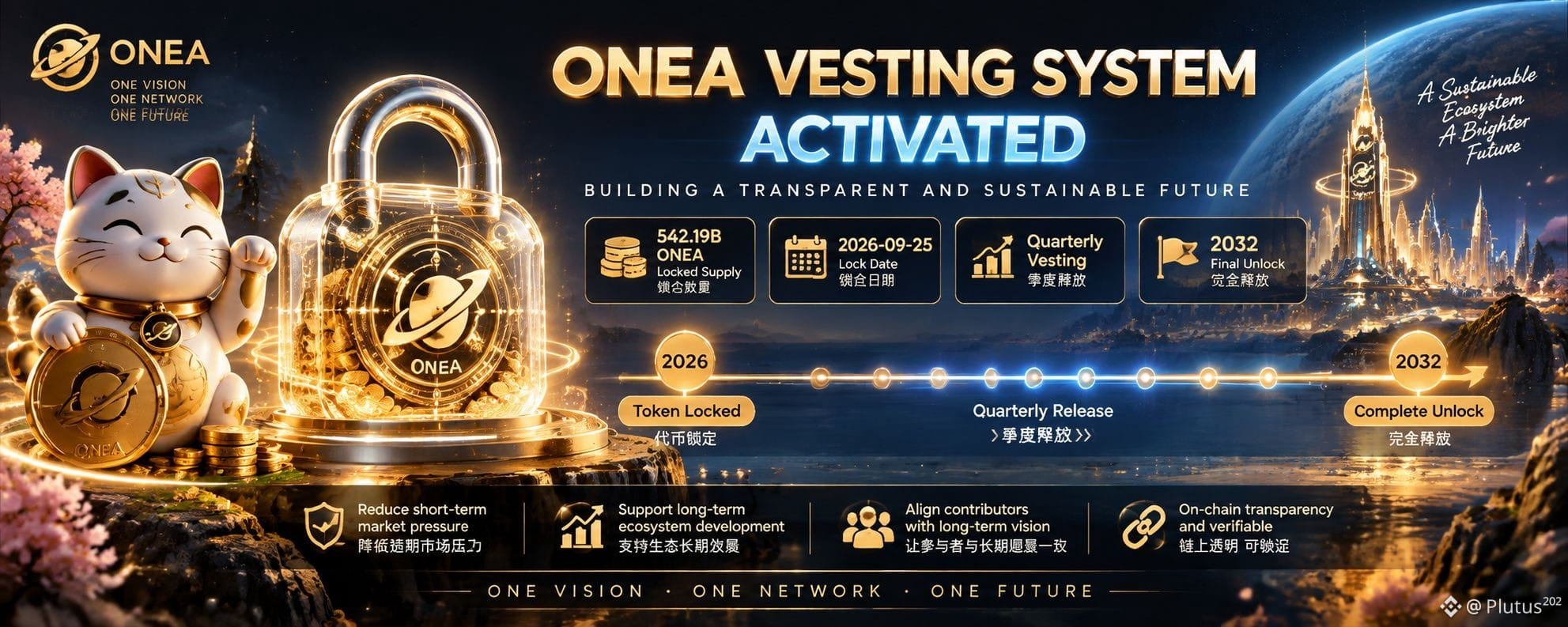
ONEA’s first batch of tokens has been locked via a publicly verifiable staking contract.
Details:
🔹 Locked Amount: 54.219 billion ONEA
🔹 Lock-up Date: September 25, 2026
🔹 Release Method: Quarterly Release
🔹 Fully Released: 2032
This mechanism ensures token releases follow a long-term plan.
⸻
🌍 Aligned with Ecosystem Development
ONEA adopts a long-term release strategy:
✨ Reduces short-term market pressure
✨ Supports ongoing ecosystem building
✨ Aligns participants with the project’s long-term goals
Token releases will be advanced progressively as the ecosystem develops.
⸻
💎 Transparency Builds Trust
Every lock-up and release plan will be publicly verifiable on-chain.
ONEA believes:
Long-term ecosystems need time to grow.
Future value requires continuous investment.
🐾 The ONEA lucky cat will continue to accompany the community as it grows together.
A vision.
A network.
A future.
🚀 ONEA Network
#ONEA #Web3 #Blockchain #Tokenomics
$ONEA 🔒 ONEA Staking Lock Mechanism Launch|Building a Transparent Long-Term Ecosystem
A strong ecosystem requires transparent rules and long-term commitments.
Today, ONEA has completed the first phase of token lockup, establishing a foundation for future ecosystem development through an open and transparent release mechanism.
⸻
🔐 Initial Batch of Tokens Locked
ONEA’s first batch of tokens has been locked via a publicly verifiable staking contract.
Details:
🔹 Locked Amount: 54.219 billion ONEA
🔹 Lock-up Date: September 25, 2026
🔹 Release Method: Quarterly Release
🔹 Fully Released: 2032
This mechanism ensures token releases follow a long-term plan.
⸻
🌍 Aligned with Ecosystem Development
ONEA adopts a long-term release strategy:
✨ Reduces short-term market pressure
✨ Supports ongoing ecosystem building
✨ Aligns participants with the project’s long-term goals
Token releases will be advanced progressively as the ecosystem develops.
⸻
💎 Transparency Builds Trust
Every lock-up and release plan will be publicly verifiable on-chain.
ONEA believes:
Long-term ecosystems need time to grow.
Future value requires continuous investment.
🐾 The ONEA lucky cat will continue to accompany the community as it grows together.
A vision.
A network.
A future.
🚀 ONEA Network
#ONEA #Web3 #Blockchain #Tokenomics
A strong ecosystem requires transparent rules and long-term commitments.
Today, ONEA has completed the first phase of token lockup, establishing a foundation for future ecosystem development through an open and transparent release mechanism.
⸻
🔐 Initial Batch of Tokens Locked
ONEA’s first batch of tokens has been locked via a publicly verifiable staking contract.
Details:
🔹 Locked Amount: 54.219 billion ONEA
🔹 Lock-up Date: September 25, 2026
🔹 Release Method: Quarterly Release
🔹 Fully Released: 2032
This mechanism ensures token releases follow a long-term plan.
⸻
🌍 Aligned with Ecosystem Development
ONEA adopts a long-term release strategy:
✨ Reduces short-term market pressure
✨ Supports ongoing ecosystem building
✨ Aligns participants with the project’s long-term goals
Token releases will be advanced progressively as the ecosystem develops.
⸻
💎 Transparency Builds Trust
Every lock-up and release plan will be publicly verifiable on-chain.
ONEA believes:
Long-term ecosystems need time to grow.
Future value requires continuous investment.
🐾 The ONEA lucky cat will continue to accompany the community as it grows together.
A vision.
A network.
A future.
🚀 ONEA Network
#ONEA #Web3 #Blockchain #Tokenomics
87
·
--
$ONEA 🔥 ONEA Dual Deflation Mechanism|Building a Long-Term Value Loop
A sustainable ecosystem requires a healthy supply model.
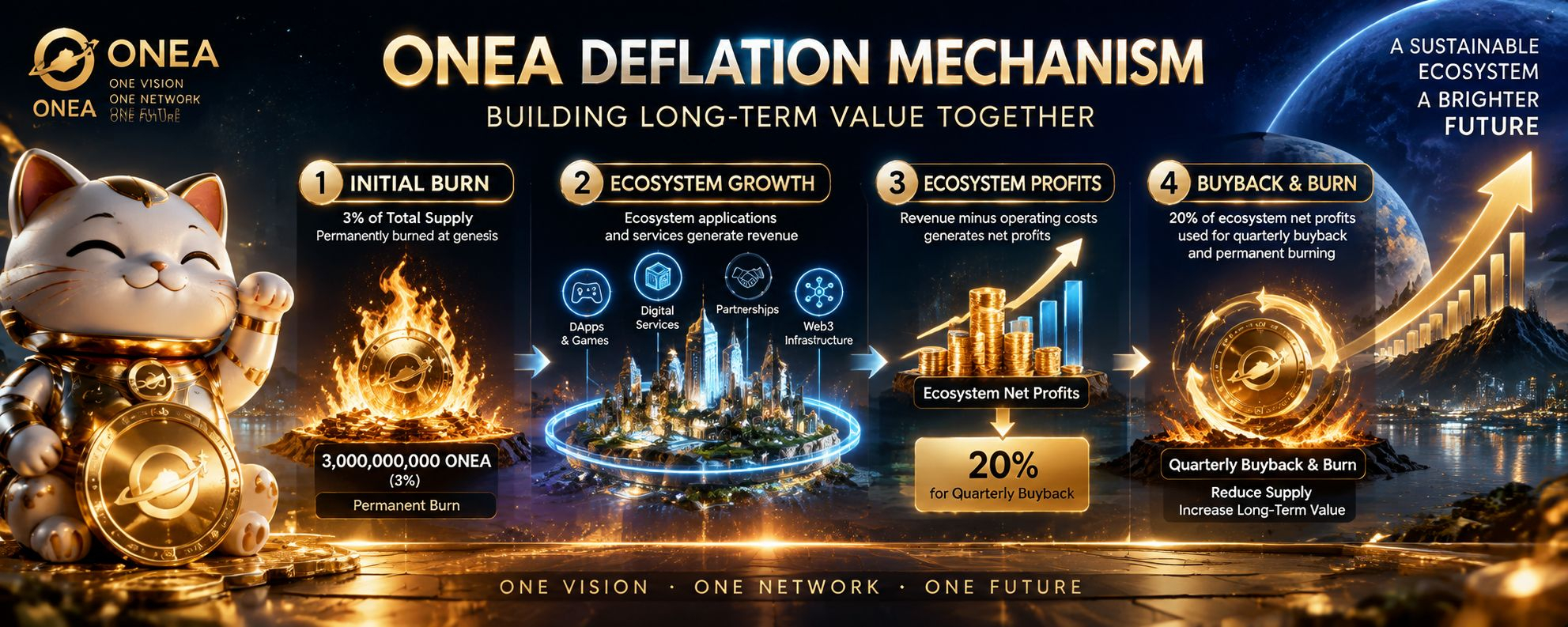
Through its “initial burn + ecosystem buyback burn” dual mechanism, ONEA establishes a long-term value loop.
⸻
🔥 Initial Permanent Burn Mechanism
During the initial launch phase of the ONEA ecosystem:
3% of the total supply will be permanently burned.
Based on:
100,000,000,000 ONEA
calculation:
🔥 3 Billion ONEA
will be sent to a black hole address for permanent destruction.
This mechanism is designed to:
✨ Reduce initial supply pressure
✨ Build a healthier Token structure
✨ Support long-term ecosystem development
⸻
💎 Quarterly Buyback & Burn Mechanism
As the ONEA ecosystem continues to grow, future ecosystem applications and services will generate revenue.
ONEA plans:
🔥 To allocate 20% of the ecosystem’s net profit each quarter
for ONEA Token buybacks and permanent destruction.
Process:
ecosystem revenue
↓
deduct operating costs
↓
form ecosystem net profit
↓
20% used for buyback
↓
permanent burn
⸻
🌍 Building a Long-Term Value Loop
ONEA combines:
🔥 Initial burn mechanism
💎 Quarterly buyback & burn mechanism
to create a transparent, sustainable Tokenomics economic model.
Ecosystem growth creates value.
Value is reinvested back into the ecosystem.
⸻
🐾 Building the Future Together
Tokenomics is not just digital design.
It’s more about connecting:
🌍 Community
🔗 Technology
💎 Ecosystem Growth
ONEA is building a digital ecosystem for long-term development.
A vision.
A network.
A future.
🚀 ONEA Network
#ONEA #Web3 #Blockchain #Tokenomics
$ONEA 🔥 ONEA Dual Deflation Mechanism|Building a Long-Term Value Loop
A sustainable ecosystem requires a healthy supply model.
Through its “initial burn + ecosystem buyback burn” dual mechanism, ONEA establishes a long-term value loop.
⸻
🔥 Initial Permanent Burn Mechanism
During the initial launch phase of the ONEA ecosystem:
3% of the total supply will be permanently burned.
Based on:
100,000,000,000 ONEA
calculation:
🔥 3 Billion ONEA
will be sent to a black hole address for permanent destruction.
This mechanism is designed to:
✨ Reduce initial supply pressure
✨ Build a healthier Token structure
✨ Support long-term ecosystem development
⸻
💎 Quarterly Buyback & Burn Mechanism
As the ONEA ecosystem continues to grow, future ecosystem applications and services will generate revenue.
ONEA plans:
🔥 To allocate 20% of the ecosystem’s net profit each quarter
for ONEA Token buybacks and permanent destruction.
Process:
ecosystem revenue
↓
deduct operating costs
↓
form ecosystem net profit
↓
20% used for buyback
↓
permanent burn
⸻
🌍 Building a Long-Term Value Loop
ONEA combines:
🔥 Initial burn mechanism
💎 Quarterly buyback & burn mechanism
to create a transparent, sustainable Tokenomics economic model.
Ecosystem growth creates value.
Value is reinvested back into the ecosystem.
⸻
🐾 Building the Future Together
Tokenomics is not just digital design.
It’s more about connecting:
🌍 Community
🔗 Technology
💎 Ecosystem Growth
ONEA is building a digital ecosystem for long-term development.
A vision.
A network.
A future.
🚀 ONEA Network
#ONEA #Web3 #Blockchain #Tokenomics
A sustainable ecosystem requires a healthy supply model.
Through its “initial burn + ecosystem buyback burn” dual mechanism, ONEA establishes a long-term value loop.
⸻
🔥 Initial Permanent Burn Mechanism
During the initial launch phase of the ONEA ecosystem:
3% of the total supply will be permanently burned.
Based on:
100,000,000,000 ONEA
calculation:
🔥 3 Billion ONEA
will be sent to a black hole address for permanent destruction.
This mechanism is designed to:
✨ Reduce initial supply pressure
✨ Build a healthier Token structure
✨ Support long-term ecosystem development
⸻
💎 Quarterly Buyback & Burn Mechanism
As the ONEA ecosystem continues to grow, future ecosystem applications and services will generate revenue.
ONEA plans:
🔥 To allocate 20% of the ecosystem’s net profit each quarter
for ONEA Token buybacks and permanent destruction.
Process:
ecosystem revenue
↓
deduct operating costs
↓
form ecosystem net profit
↓
20% used for buyback
↓
permanent burn
⸻
🌍 Building a Long-Term Value Loop
ONEA combines:
🔥 Initial burn mechanism
💎 Quarterly buyback & burn mechanism
to create a transparent, sustainable Tokenomics economic model.
Ecosystem growth creates value.
Value is reinvested back into the ecosystem.
⸻
🐾 Building the Future Together
Tokenomics is not just digital design.
It’s more about connecting:
🌍 Community
🔗 Technology
💎 Ecosystem Growth
ONEA is building a digital ecosystem for long-term development.
A vision.
A network.
A future.
🚀 ONEA Network
#ONEA #Web3 #Blockchain #Tokenomics
78
·
--
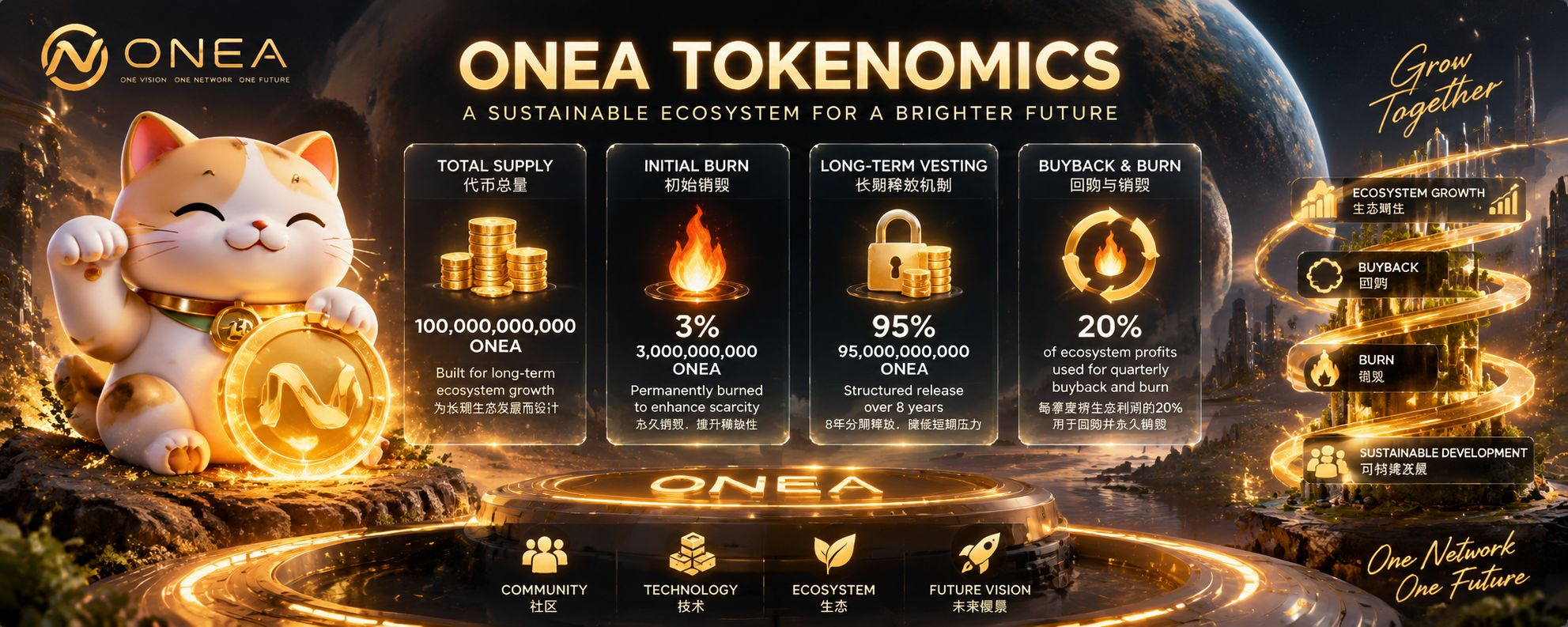
$ONEA 💎 ONEA Economic Model|Building a Long-Term, Sustainable Ecosystem
A strong ecosystem needs more than technological innovation.
It also requires a transparent, stable, and sustainable economic model for long-term development.
ONEA aims to strike a balance between community participation, ecosystem building, and long-term growth through a well-designed token structure.
⸻
🌍 Total Token Supply
ONEA total supply:
100,000,000,000 ONEA
The entire design is centered on long-term ecosystem development.
⸻
🔒 Long-Term Release Mechanism
95% of ONEA tokens will be released according to the planned schedule for long-term distribution.
With a transparent locking and release mechanism:
✨ Reduces short-term pressure
✨ Supports ecosystem development
✨ Encourages long-term participation
ONEA focuses on long-term value, not short-term volatility.
⸻
🔥 Deflationary Mechanism
ONEA establishes a long-term value circulation mechanism.
Initially:
🔥 3% of the total supply is permanently burned.
In the future:
20% of the ecosystem profit each quarter will be used to buy back and burn tokens.
This forms a:
ecosystem growth → buyback → burn → sustainable development
long-term cycle.
⸻
🐾 Future-Oriented Ecosystem Design
Tokenomics is not just numbers.
It connects:
🌍 Community
🔗 Technology
💎 Ecosystem
🚀 Future vision
ONEA is building a digital network designed for long-term growth.
One vision.
One network.
One future.
🚀 ONEA Network
#ONEA #Web3 #Blockchain #Tokenomics
$ONEA 💎 ONEA Economic Model|Building a Long-Term, Sustainable Ecosystem
A strong ecosystem needs more than technological innovation.
It also requires a transparent, stable, and sustainable economic model for long-term development.
ONEA aims to strike a balance between community participation, ecosystem building, and long-term growth through a well-designed token structure.
⸻
🌍 Total Token Supply
ONEA total supply:
100,000,000,000 ONEA
The entire design is centered on long-term ecosystem development.
⸻
🔒 Long-Term Release Mechanism
95% of ONEA tokens will be released according to the planned schedule for long-term distribution.
With a transparent locking and release mechanism:
✨ Reduces short-term pressure
✨ Supports ecosystem development
✨ Encourages long-term participation
ONEA focuses on long-term value, not short-term volatility.
⸻
🔥 Deflationary Mechanism
ONEA establishes a long-term value circulation mechanism.
Initially:
🔥 3% of the total supply is permanently burned.
In the future:
20% of the ecosystem profit each quarter will be used to buy back and burn tokens.
This forms a:
ecosystem growth → buyback → burn → sustainable development
long-term cycle.
⸻
🐾 Future-Oriented Ecosystem Design
Tokenomics is not just numbers.
It connects:
🌍 Community
🔗 Technology
💎 Ecosystem
🚀 Future vision
ONEA is building a digital network designed for long-term growth.
One vision.
One network.
One future.
🚀 ONEA Network
#ONEA #Web3 #Blockchain #Tokenomics
A strong ecosystem needs more than technological innovation.
It also requires a transparent, stable, and sustainable economic model for long-term development.
ONEA aims to strike a balance between community participation, ecosystem building, and long-term growth through a well-designed token structure.
⸻
🌍 Total Token Supply
ONEA total supply:
100,000,000,000 ONEA
The entire design is centered on long-term ecosystem development.
⸻
🔒 Long-Term Release Mechanism
95% of ONEA tokens will be released according to the planned schedule for long-term distribution.
With a transparent locking and release mechanism:
✨ Reduces short-term pressure
✨ Supports ecosystem development
✨ Encourages long-term participation
ONEA focuses on long-term value, not short-term volatility.
⸻
🔥 Deflationary Mechanism
ONEA establishes a long-term value circulation mechanism.
Initially:
🔥 3% of the total supply is permanently burned.
In the future:
20% of the ecosystem profit each quarter will be used to buy back and burn tokens.
This forms a:
ecosystem growth → buyback → burn → sustainable development
long-term cycle.
⸻
🐾 Future-Oriented Ecosystem Design
Tokenomics is not just numbers.
It connects:
🌍 Community
🔗 Technology
💎 Ecosystem
🚀 Future vision
ONEA is building a digital network designed for long-term growth.
One vision.
One network.
One future.
🚀 ONEA Network
#ONEA #Web3 #Blockchain #Tokenomics
71
Log in to explore more content
Join global crypto users on Binance Square
⚡️ Get latest and useful information about crypto.
💬 Trusted by the world’s largest crypto exchange.
👍 Discover real insights from verified creators.
Email / Phone number
Trending Topics
1
#CircleMints500MUSDCOnSolana
125,549 views
2,450 Discussing
2
#PolymarketBankFailureBetsDrawFDICConcern
114,095 views
2,046 Discussing
3
#BlackRockBuildsTokenizedPortfoliosForOndo
110,191 views
1,462 Discussing
4
#BitwiseFilesToListNEARETFOnNYSEArca
79,097 views
1,174 Discussing
5
#SECCommissionerPeirceToLeaveOct2
84,504 views
965 Discussing
6
#SECSaysBuybacksUpgradesDontMakeTokenSecurity
64,820 views
680 Discussing
7
#StrategyProposesDailyDividendsForPreferreds
16,871 views
257 Discussing
8
#CircleTetherFreezeBitgetHackerWallet
15,599 views
147 Discussing
9
#CoinMarketCapCompletesCoinglassAcquisition
17,633 views
205 Discussing
10
#QNTRises39%
130,033 views
1,753 Discussing