LUNC Is Burning Fast... But Is It Fast Enough to Matter?
I have been watching the Terra Classic burn numbers for a while now. Every time a new burn report drops, the community celebrates like a victory lap. And honestly, I get it. Seeing 923 million tokens disappear in a single Binance cycle feels significant. Three days, 630 million gone. The charts light up, Twitter buzzes, and for a moment it feels like Terra Classic is clawing its way back from the dead. But then I do the math. And that is where my excitement quietly fades. Let me give you some context first. In May 2022, the Terra ecosystem did not just crash. It collapsed in one of the most brutal ways crypto has ever seen. The algorithmic stablecoin UST lost its peg, Luna hyperinflated into trillions of tokens almost overnight, and tens of billions of dollars evaporated within days. People lost everything. That is not just market history. That is the wound Terra Classic is still trying to heal. The burn mechanism was born from that chaos. The logic is simple: reduce supply, increase scarcity, support price recovery. A 0.5% transaction tax burns tokens with every trade. Binance runs a monthly buyback and burn from trading fees. The community rallies behind every milestone. And right now, over 444 billion LUNC have been permanently removed from existence. That sounds massive. Until you realize the total supply still sits around 5.4 trillion tokens. Here is my honest problem with the narrative. At the current daily burn rate of roughly 300 to 400 million tokens, it would take decades to meaningfully dent a supply measured in trillions. The math does not lie. Even if burns doubled tomorrow, the structural gap between what is being removed and what remains is so enormous that price recovery through burns alone is practically a fantasy in the short term. I am not saying the burns are pointless. They are not. They tighten the visible float, reduce sell pressure gradually, and signal community commitment. Those things matter for sentiment. The recent 100% monthly rally proves that burn narratives move markets even when the fundamentals are still catching up. But sentiment and reality are two different conversations. What Terra Classic actually needs alongside the burns is utility. Real usage. The Cosmos SDK v0.53 upgrade and Market Module 2.0 on the roadmap look promising on paper. If those land properly, they could bring genuine developer activity and IBC connectivity that gives LUNC a reason to exist beyond speculation. The USTC re-peg initiative is a long shot but not a dead one if the community executes with discipline. Until then, the burns are doing their job within a very limited lane. They are slowing the bleeding. They are not yet reversing the damage. So when someone asks me whether LUNC is burning fast enough to matter, my honest answer is this: fast enough to keep the story alive, yes. Fast enough to change the ending on its own, not even close. The fire is real. The question is whether it will ever be big enough. $LUNC $CHIP $RAVE #EthereumFoundationSellsETHtoBitmineAgain #TrumpSaysIranConflictHasEnded
I remember when TAO was trading above $750. Then it corrected. Then it recovered to $320 in April. Then it pulled back again to $249. Now it's consolidating around $265. This chart is not a smooth uptrend story. It's a project fighting for narrative relevance in a market that moves on momentum. Daily emissions were cut from 7,200 to 3,600 TAO, reducing sell pressure by roughly $500,000 per day. With around 68% of supply already locked, available liquidity is genuinely tight. That's a real supply-side setup. But supply alone doesn't move price. Demand does. And demand right now is hanging on two things the ETF decision in August, and whether subnets can start showing sustainable revenue at scale. The subnet capacity is planned to double from 128 to 256, which could scale network utility significantly but there's no confirmed date for that upgrade yet. I'm not calling a direction. What I'm saying is this: TAO has more legitimate catalysts than 90% of altcoins right now. It also has more legitimate risks. That combination is exactly what makes it worth watching closely not blindly holding, not dismissing just watching. $TAO $CHIP $ZEC #EthereumFoundationSellsETHtoBitmineAgain
Terra Classic at a 15-Month High... What Suddenly Changed?
Thinking back to May 2022 still gives me an uneasy feeling. That week, LUNA's price fell from $119 to virtually zero. The entire crypto market was stunned. People who had put their faith in that ecosystem lost everything overnight. I couldn't figure out at the time whether this was just the death of one project, or whether the entire concept of algorithmic stablecoins was fundamentally broken. After UST lost its dollar peg, a death spiral formed. Holders panicked and started converting UST into LUNA, which caused LUNA's supply to balloon rapidly while the price hit the floor. In just a matter of days, over $60 billion in market cap turned to dust. What happened next was even stranger. Do Kwon proposed launching a new blockchain. The old chain was renamed Terra Classic, and the old LUNA token became LUNA Classic, or LUNC. Many people said at the time that this chain would never recover. But a community stayed behind. They didn't walk away. I've wondered many times what those people saw that kept them here. The answer is probably something like this: even inside failure, there's a belief that something can be fixed, if someone does the work. So What's Happening Now? In April 2026, LUNC suddenly came back into everyone's view. Over the past 30 days, the price has risen nearly 102%. The token has reached its highest price in 15 months. The first question that came to my mind when I saw this was simple: what is different this time? The answer isn't one thing. It's several things together. First, the burn mechanism. At this point, 6.43% of the total supply, over 444 billion LUNC, has been permanently burned through the 0.5% transaction tax and Binance's monthly burns. Just in the last three days, 630 million LUNC were burned. The supply is slowly contracting. That contraction is sending a signal to traders. Second, the technical upgrade. In mid-April, the Cosmos SDK 0.53 upgrade was completed. It modernized the blockchain, improved performance, and enabled full interoperability with the broader Cosmos ecosystem. In simple terms, LUNC is no longer standing alone. Cross-chain connections are being built with major networks including Ethereum and Solana. Third, regulatory clarity. The SEC settlement has been finalized, and Terraform Labs' token holdings are being burned as part of the bankruptcy process. A significant portion of the legal uncertainty has now lifted. But Some Questions Remain Before I let myself get excited about this rally, I pause for a moment. Because LUNC's history shows that this token has risen on sentiment many times before, and come back down just as fast. LUNC's daily burn rate sits around 307 million, but the total supply is in the trillions. At this pace, meaningfully reducing the supply will take a long time. That means price appreciation can't rely on burns alone. Trading volume and demand both need to hold up together. The bankruptcy administrator's lawsuit against Jane Street on behalf of Terraform Labs is still ongoing, and whichever way it goes, it could bring significant volatility. So What's the Final Word? LUNC's story is not a simple one to me. A community built around a broken project has spent four years working, upgrading, burning, and pushing forward. Many people now see April 2026 as the moment Terra Classic began a real comeback. I won't say that's certain yet. But I will say this much: this 15-month high is not just the product of speculation. There is real work behind it. Whether that work holds up is something the next few months will answer. #U.S.SenatorsBarredfromTradingonPredictionMarkets #MuskandAltmanClashOverOpenAILawsuit $LUNC $CHIP $XAUT
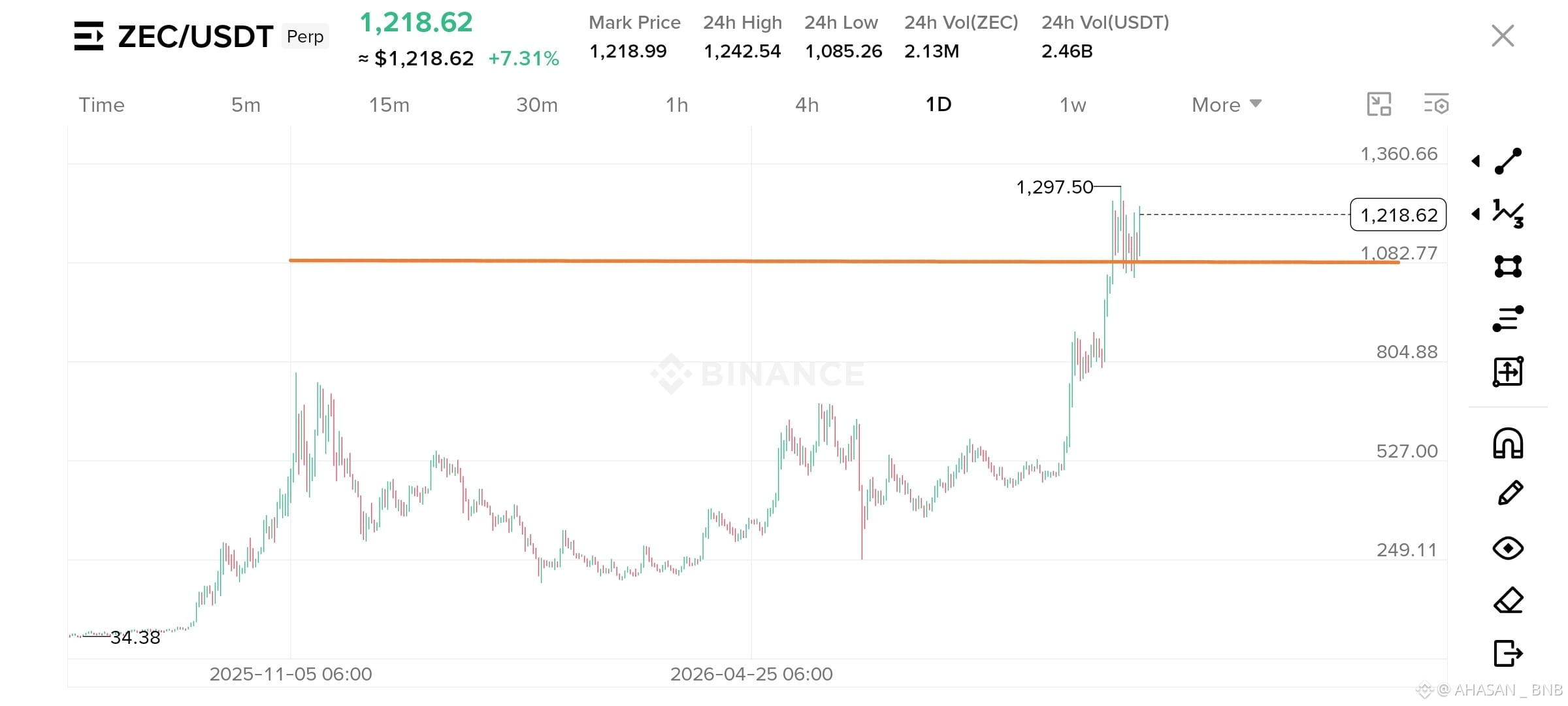
$ZEC is hovering around $350 hype or the real move?
Some coins don't die. They just wait.
$ZEC was written off as a "dead privacy coin" not too long ago. Yet this cycle it climbed from double digits all the way past $600, and now it's consolidating quietly in the $300–$350 range. I'd been watching it for a while, but the on-chain data finally made me stop scrolling.
The shielded pool now holds over 30% of circulating supply, and whales have been pulling significant amounts of ZEC off exchanges. That's not the behavior of people looking to sell.
The story isn't just "privacy coin" anymore either. With Ztarknet in development, programmable privacy and private DeFi are coming on top of the base chain. That shifts ZEC into a different valuation conversation entirely.
But the risks are real too. Regulatory uncertainty hasn't gone away, and without a clean break above $400, the momentum could stall.
Is privacy becoming infrastructure, or just a narrative trade? I don't have a definitive answer yet. Still watching. #Price-Prediction #CryptoVibes
769 Million Tokens Locked and the Price Still Won't Move. Bro, What's Actually Going On With XRP? 🧵
I've been staring at this chart for days and something just doesn't add up.
Goldman Sachs walked in and dropped $153.8 million. Five spot ETFs locked over 769 million XRP tokens in custody. April pulled in $81.63 million in net inflows, the strongest month of 2026. JPMorgan is out here calling for $4 to $8.4 billion in first year flows. On paper, this is about as bullish as it gets. 📊
But the price? Still chilling between $1.37 and $1.45 like nothing happened.
So I started digging. And here's what I found.
The first thing that hit me was the supply wall situation. Around 60% of XRP's circulating supply was bought near the $1.44 level. So every time the price approaches that zone, those holders sell to break even. The buying pressure comes in, hits that wall, and just gets absorbed. No breakout. Just sideways. It's basically an invisible ceiling that keeps resetting itself. 🧱
Then I looked at XRP's two actual price moves this year. In January, XRP pumped 25% in a single week when the MACD flipped bullish at the same time ETF inflows came in hot. On April 17, the price touched $1.50 for the first time since March, right when Ichimoku Cloud broke out alongside $55 million in weekly ETF flows. Both times, inflows alone weren't enough. There had to be a trigger on top.
Right now, that trigger just isn't there.... 👀
And here's the part that's actually lowkey funny to me. Goldman didn't yolo into one ETF. They spread $153.8 million across four different funds. Bitwise got around $40 million, Franklin Templeton $38.5 million, Grayscale $38 million, and 21Shares $36 million. That's not a trade. That's a long term institutional strategy. The big money is accumulating quietly while retail degens are losing patience. The whales are basically doing their thing while the market sleeps on it. 🐋
But the on chain data tells a different story right now. The NVT ratio hit 1,076 on April 29, the highest reading since October 2025. For context, earlier spikes this year barely crossed 700. A high NVT means the price is running ahead of actual network usage. Real transactions on the ledger aren't keeping up with the valuation. That's a yellow flag, not necessarily a red one, but something to watch.
Then there's the competition that nobody wants to talk about. SWIFT is launching a new Global Payments network with over 50 banks across 25 corridors by mid 2026. The speed and cost gap that XRP was supposed to exploit is slowly being closed by the same legacy system it was trying to replace. And stablecoins are getting more comfortable in the bridge currency role that XRP has been pitching for years. 👀
So is XRP cooked? Nah, I don't think so.
The real catalyst right now is the CLARITY Act sitting in the Senate Banking Committee. 120 crypto firms including Coinbase and Ripple wrote a letter on April 23 asking lawmakers to move. If that markup gets scheduled before the May 21 recess, all the institutional capital that's been quietly building up could finally have a reason to move price. That's the trigger the chart is waiting for.
Here's the honest take. ETF inflows don't automatically move price. The smart money is already in position. The supply wall is real. And the market needs one clean catalyst to break structure.
The box is tight. The pressure inside is building. Something has to give. ⏳
DYOR. This isn't financial advice. Just a guy who couldn't stop thinking about why the numbers don't match the chart. 🫡
Most people discover a token after the crowd already found it. I try to ask a different question why does this project exist, and does the answer actually make sense?
MegaETH is not just another L2. It's built around one obsession: real-time blockchain. We're talking 100,000 transactions per second with 1 millisecond latency. That's not a marketing number — that's a fundamental rethinking of what a blockchain should feel like to use.
Right now, most chains ask users to tolerate slowness. MegaETH is asking a different question what if the chain was fast enough that you forgot it was a blockchain at all?
That's the kind of infrastructure shift that doesn't make noise immediately. It builds quietly. And then one day the applications sitting on top of it start doing things other chains simply can't.
$MEGA is the fuel inside that engine.
I'm not here to tell you to buy anything. I'm here because I think the conversation around real-time execution is just getting started and most people aren't paying attention yet.
That gap is usually where the interesting things happen.
The condition was simple... stay within the top 500 on Binance CreatorPad. I'm sitting at rank 12.
This didn't happen overnight. Every article I wrote about Pixels and the Ronin Network came from one honest question is this just hype, or is a real economy actually being built here? That question pushed me deeper each time. I studied the Publishing Flywheel, broke down the T5 economic update, and sat with the tension between builders and gamers inside the ecosystem.
Those pieces weren't just content. They were a genuine attempt to understand something from the inside out.
And that effort is what the leaderboard is reflecting today.
For everyone creating content in the crypto space...stop chasing price predictions and viral noise. Learn the actual mechanics of what you're covering. Understand the tokenomics before you talk about the token. That depth is what separates content that disappears in 24 hours from content that actually builds your credibility over time.
The ranking is a milestone. But the real win is that the writing held up.
5.6 Million BTC Freeze Proposal... Will Satoshi's Stack Disappear Forever?
I first read this news one evening, staring at the screen, wondering if this was actually possible. Satoshi Nakamoto's more than 1 million Bitcoin, coins that have never moved, could one day be stolen by a quantum computer. Once that thought enters your head, it doesn't leave easily. But what concerns me even more than the threat itself is the proposed solution. On April 15, 2026, Jameson Lopp, CTO of Casa and one of Bitcoin's most respected developers, published a proposal called BIP-361. The core logic of this proposal is blunt. Bitcoin's "legacy" addresses, those that have already exposed their public key on-chain, are vulnerable to future quantum attacks. As of March 1, 2026, more than 34% of all circulating Bitcoin sits in these addresses. That is approximately 5.6 million BTC, dormant for over a decade, with a combined value exceeding $420 billion. Lopp's solution: freeze these coins. If holders fail to migrate to quantum-resistant wallets, these coins will be locked permanently. I paused here. Because this proposal sounds logical on the surface, but underneath it is far more complicated. First, we need to understand how real this quantum threat actually is. Google Quantum AI published research on March 31, 2026, showing that fewer than 500,000 physical qubits could be sufficient to break Bitcoin's secp256k1 curve. Previous estimates put that number in the millions. That single data point changed the entire tone of this debate. Quantum computers cannot disrupt Bitcoin mining or the blockchain ledger itself, but they could eventually break the cryptography that protects wallet ownership. Roughly 6.9 million Bitcoin, including Satoshi Nakamoto's early holdings and coins spent since the 2021 Taproot upgrade, are already exposed to future quantum attacks because their public keys are visible on-chain. There is a technical detail here that needs to be understood before the full picture becomes clear. With normal addresses, the public key only becomes visible when someone makes a transaction. But with the older Pay-to-Public-Key format, the public key is always visible. Satoshi's old addresses use this exposed format. Early miners too. It is estimated that 2 to 3 million Bitcoin lie dormant in these vulnerable formats. Now let us look at what BIP-361 actually proposes. Phase A: roughly three years after activation, the network stops accepting new transactions to vulnerable addresses, forcing migration to quantum-resistant formats. Phase B: two years after that, legacy ECDSA and Schnorr signatures are invalidated. Unmigrated coins are frozen permanently. Phase C: still under research, where holders of frozen coins could potentially recover them via zero-knowledge proofs tied to their BIP-39 seed phrase. But Cardano founder Charles Hoskinson raised a critical problem with this plan. Hoskinson argues that BIP-361's zero-knowledge recovery mechanism cannot protect approximately 1.7 million older Bitcoin, including roughly 1 million attributed to Satoshi Nakamoto, because those coins predate the introduction of BIP-39 seed phrases in 2013. If the proposal passes in its current form, those coins would remain permanently frozen regardless of whether their original owners ever attempt to migrate, because migration would require cryptographic proof they are unable to provide. This is a paradox. The very coins the proposal was designed to protect may end up being the most permanently damaged by it. The market reaction to all of this is not quiet either. One Bitcoin maximalist warned that freezing any coins would trigger an immediate repricing and would mark one of the worst single days in Bitcoin's history. Not because of a hack, but because the network would have proven its core value proposition is negotiable. All fund managers who allocated based on the censorship-resistance thesis would be forced to unwind, not by choice but by mandate, because the asset would no longer fit the risk criteria. I think about this differently though. Suppose a quantum computer actually breaks into Satoshi's wallet. What happens when 1 million BTC hits the market simultaneously? Would that crash be less devastating than BIP-361 passing? Both paths are dangerous for the market. The difference is that one is a controlled decision and the other is an uncontrolled catastrophe. Satoshi's coins represent the sharpest version of the dilemma. Freezing old formats protects the coins from theft but makes them permanently inaccessible, including to Satoshi. Leaving old formats open means those coins sit as a standing prize for whoever builds the first working quantum computer. Setting a migration deadline forces Satoshi to either move the coins, revealing ownership, or lose them forever. Every option changes Bitcoin's character in ways the network has historically refused to change it. Not everyone agrees that a preemptive freeze is the answer. Blockstream CEO Adam Back argued at Paris Blockchain Week that Bitcoin developers could respond quickly if a genuine quantum emergency materialized. "Bugs have been identified and fixed within hours. When something becomes urgent, it focuses attention and drives consensus," he said, suggesting Bitcoin's rough-consensus governance could handle an emergency without pre-scheduled freezes years in advance. A third option has also entered the conversation. BitMEX Research proposed a "canary fund" mechanism, a special Bitcoin address to which anyone can contribute as a bounty. If that address were ever spent, proving a quantum computer had broken the cryptography, an automatic freeze would kick in. No arbitrary deadlines. Just a real response to a real threat when it actually materializes. The question this entire debate raises for me is not technical. It is philosophical. Bitcoin was built on the idea that nobody can take your coins. Not a government. Not a corporation. Not a developer with a good reason. The moment a network decides that some coins can be frozen for the greater good, even if the reason is legitimate, it introduces a precedent that cannot be undone. Every future threat, real or manufactured, becomes an argument for the next freeze. One analyst put it plainly: freezing any coins, even lost ones, tells the market that all roughly 19.8 million BTC currently in circulation are conditionally owned. Institutional risk desks do not care about the reason. They care about the precedent. That sentence stayed with me. Conditional ownership is not ownership. And if Bitcoin's guarantee becomes conditional, then the entire value proposition that separated it from every other financial system in history quietly disappears, not with a hack, but with a vote among developers who believed they were doing the right thing. Whether the quantum threat is real enough to justify that trade is a question the Bitcoin community has not answered yet. What is clear is that however they answer it, nothing about Bitcoin will look quite the same afterward. #CryptoVibes #PolymarketDeniesDataBreach $NOM $SOLV $CHIP
The Farmer Who Never Leaves: What Is Pixels Really Building Inside Its Open World?
Honest thought... I almost wrote Pixels off my list completely. Last year... the GameFi space felt like a graveyard of half-finished promises, and Pixels looked like just another name on that list..... I read the usual headlines, put my phone down, and moved on. Then a few months later, I noticed the same names still active inside the game. Same wallets. Same players. Quietly, consistently farming, trading, building... without any viral moment pushing them. That pattern forced me to look again. Here is what actually pulled me back. In most GameFi projects, the moment the reward rate drops, the players disappear. It is almost mechanical. The incentive shrinks, the wallets leave, and the game becomes a ghost town within a quarter. Pixels did not follow that script. And that alone deserved a second look from me, because in this space, retention without hype is genuinely rare.👀 The title of this piece is not accidental. A farmer who never leaves is not someone chasing a seasonal harvest. That person has decided the land itself has value. That distinction matters enormously when you are trying to understand what Pixels is actually building, because the question is not just about token economics or reward structures. The deeper question is whether Pixels has managed to create a world where the land feels worth staying on. What I find genuinely interesting about Pixels is how it treats player behavior as the foundation rather than the decoration. Most blockchain games build a token model first and then wrap a game around it. Pixels seems to have gone in a different direction... where the daily loop of farming, crafting, and trading creates something closer to a functioning micro-economy. When players make decisions inside that world, they are not just chasing yields. They are managing resources, building reputations, and developing patterns of behavior that compound over time. That is not a small thing to achieve in a space where most projects struggle to hold attention past the first airdrop.....💀 But I want to be honest about where my skepticism still lives... Sustained engagement is impressive, but it is not the same as sustainable design... The question I keep returning to is whether the economic loop inside Pixels can hold its integrity as the player base scales. Small economies can feel meaningful precisely because they are small. Scarcity makes sense, decisions carry weight, and community behavior shapes outcomes. The real test for Pixels is whether that same texture survives growth... or whether scaling dilutes the very thing that made it worth staying for. There is also something worth examining about who the consistent players actually are. Every cycle teaches me something new about the difference between "genuine users"and "strategic farmers." Some retention is healthy, organic, and driven by real attachment to the game world. Some retention is purely mechanical, driven by people who have found the most efficient extraction path and will stay only until that path closes. Pixels almost certainly has both. The question is which group is actually shaping the culture of the world being built, because long term, culture is what determines whether an open world survives or slowly hollows out. What gives me cautious optimism is that Pixels appears to understand something most GameFi projects never figure out. A game is not just a reward mechanism. It is a social space where people develop habits, identities, and attachments that go beyond the financial. When someone logs in every day not because they calculated that day's yield but because they genuinely want to see what happens next on their farm, that is a different kind of engagement entirely. That is the kind of player who becomes a community anchor rather than a liquidity event.🌱 I am not ready to call Pixels a "finished success story." That would be premature and honestly a little naive given how many projects have looked promising at this stage and then unraveled. What I am willing to say is that the pattern of behavior I see inside this world is more interesting than most of what this space produces. The farmer who never leaves is not following a roadmap. That person has made a quieter, more personal decision... that the world is worth tending. Whether Pixels can honor that decision with the infrastructure it builds going forward is the only question that actually matters now. @Pixels #pixel $GPS $GIGGLE $PIXEL #CryptoPatience
I keep thinking about the line they use on their homepage... "what you build is yours to own." That sentence is doing a lot of heavy lifting.👀 In Pixels, land is tokenized on Ronin, which means ownership is verifiable and transferable. That part is real. But ownership of land and ownership of what you build on it... are two very different things, and I am not sure the distinction is being made clearly enough for new players coming in. If I spend weeks farming, crafting, and developing a plot the labor itself is not on-chain. My time, my strategy, my community reputation... none of that exists as a transferable asset. What I own is the land parcel. The building on it? That depends entirely on Pixels' own game logic, server state, and future design decisions. If the team pivots the economy, changes resource mechanics, or deprecates a feature, my "ownership" of the experience I built is exactly zero. This is not a Pixels-specific problem. It is the central tension of blockchain gaming that nobody in the industry has actually solved yet. But Pixels markets it as though the tension does not exist. The pitch is clean, the reality is layered... and players who come in believing the clean version of the pitch are the ones who end up disillusioned when the game changes under their feet.🫠 "Ownership" in Pixels is partial and conditional. That is honest enough. But calling it simply "yours" without the asterisk... is a choice, and it is a choice that tells you something about how the team thinks about its audience. @Pixels #pixel $TURTLE $PIXEL $PENGU
Pixels Claims to Set the Blockchain Gaming Standard... But Is the Market Actually Listening?
I keep coming back to this one question... In 1994, when FIFA first talked about building a "Global Standard" for football, people laughed. The infrastructure wasn't there, the money wasn't there, and honestly... the belief wasn't there either. Today, when Pixels says it wants to set the standard for blockchain gaming, I hear that same laughter echoing from a different crowd... But here's the thing I can't shake FIFA eventually proved everyone wrong...👀 So I started actually reading what Pixels is building, not just watching the price chart. And that's where it gets interesting. Pixels is not just saying "we made a fun farming game." The whitepaper lays out something more structural. They call it a "Publishing Flywheel" the idea that better games attract richer player data, richer data brings down user acquisition costs, and lower costs pull in even more games. On paper... it reads less like a gaming company and more like a data infrastructure play disguised as a farm. That distinction matters more than most people realize. The question I kept asking myself was who actually builds "standards"? Standards are not declared. They are adopted. HTTP became the standard not because someone announced it, but because enough developers built on top of it that ignoring it became impractical. Pixels seems to understand this, at least intellectually. Their Events API is designed so that a player's progress in one game carries weight in another. That's not a gimmick. That's an attempt at genuine interoperability, and very few projects in this space have even attempted it seriously. But here's where I slow down and think more carefully... Pixels hit one million daily active users at its peak. That number was real. The energy was real. Then it dropped Significantly.📉 And no amount of whitepaper language changes what that chart looks like. The "standard-setter" argument only works if people keep showing up, and right now the retention story is shaky. The staking model introduces something genuinely different though. Instead of staking to a blockchain validator, you are staking to a specific game. You are essentially voting with your tokens on which game deserves ecosystem resources. That is decentralized publishing in a way that actually makes sense conceptually. Whether it works in practice depends entirely on whether quality games arrive to justify the vote. Phase one is live. The real test is phase two, when rewards become dynamic and the market decides which games survive. There is also the "Farmer Fee" structure, which I find honest in a way that most projects are not. If you want to withdraw your PIXEL directly, you pay a heavy fee. If you reinvest through vPIXEL, you pay nothing. That is the project telling you clearly what behavior they want to incentivize. You can disagree with the design, but you cannot call it deceptive... Most projects hide their economic pressure behind complicated tokenomics. Pixels puts it on the table. What makes me cautious is the gap between the vision and the current market reality.😬 The market cap sits in single-digit millions while the ambitions sit in "industry-defining" territory. That gap is not necessarily a contradiction. Early Amazon looked nothing like what it became. But the gap does demand honest scrutiny. Pixels needs more games, more developers, and sustained daily engagement not just spikes around major updates. So where does that leave me? I think Pixels is asking the right questions. The Publishing Flywheel idea, if it works at scale, genuinely could reshape how Web3 games grow. The data-driven reward targeting is a smarter approach than anything early GameFi attempted. And the staking architecture, while still in early phases, shows real structural thinking. But claiming to set an "industry standard" and actually becoming one are separated by years of consistent execution, developer trust, and user retention. FIFA did not become FIFA in a day. The market is not saying Pixels is wrong. It is saying... "show me." That answer has not arrived yet but the question itself is more serious than most projects ever manage to ask. @Pixels #pixel $PIXEL $CHIP $XAUT #CryptoVibes
I kept coming back to that phrase: "earn rewards backed on the blockchain." It sits on their homepage like a promise. And the first time a new player reads it, I imagine they feel exactly what the marketing wants them to feel... security. Permanence. Something that does not disappear when attention moves elsewhere. Here is what I actually found when I looked closer. The blockchain records ownership. Your land token, your PIXEL balance, your in-game NFTs... that record is real, permanent, and trustless. No one can erase it. But the value sitting inside that record? That is backed by nothing except market demand and continued player activity. If Pixels loses momentum tomorrow, the blockchain still faithfully records that you own your plot. It just becomes a permanent record of something worth considerably less. That distinction is not a footnote. It is the entire argument. "Blockchain-backed" borrows the credibility of infrastructure-level permanence and quietly applies it to what is, at its core, a speculative asset inside a live-service game. That sleight of hand has burned players across dozens of projects over the past four years. I have watched it happen... repeatedly. Pixels may be building something genuinely durable. The Ronin ecosystem is solid. The team appears committed. But marketing language that obscures the difference between "permanence of record" and "permanence of value" is not a minor communication issue.🤔 New players are staking real money on this framing. Do they understand what the blockchain is actually guaranteeing and what it is not?👀🧐 @Pixels #pixel $PIXEL $AGT $AIN
I keep coming back to a simple question... if the blockchain itself is immutable and transparent, why do we still argue about "what the data means?"🤔 Part of the answer is that reading the chain correctly is harder than it looks. Pixel is trying to make that reading process as trustworthy as the chain itself.
The architecture Pixel uses distributes the work of indexing and interpreting on-chain events across many independent participants.👀 This is different from traditional indexing services where "one company makes all the decisions" about data structure and delivery.
What stands out to me is the composability angle. Because Pixel's data outputs come with verification proofs, other protocols can build on top of them without starting their own data infrastructure from scratch. That "compounding effect" is how ecosystems grow one reliable layer enabling many things above it.
I do think about governance as a potential challenge.😬 "Who decides what data schemas are supported...? Who votes on protocol upgrades that affect how data is indexed?" These questions aren't unique to Pixel, but they become critical as the network matures and different stakeholders develop competing interests...
Healthy governance is hard, and many promising protocols have fractured because of it. Pixel would benefit from establishing "clear, participatory governance structures" early rather than retrofitting them later...
Still, the core problem Pixel addresses is genuine... "Data integrity at the application layer" is a real weakness in today's Web3 stack. I'm watching how the ecosystem responds to what Pixel is building. #pixel $PIXEL $CHIP $HYPER @Pixels #CryptoVibes #decentralization
I Tried to Understand Why Pixels' Ronin Integration Actually Matters
This one caught me off guard...😅 In 2023, after the Axie Infinity collapse, most people I knew in this space had quietly written off the Ronin blockchain. And honestly... I didn't blame them. When a network's flagship game crumbles that publicly, the instinct is to move on. So when I started seeing Ronin's numbers climbing again, not because of some massive studio launch or a hyped airdrop, but because of a pixelated farming game, I had to stop and actually look at what was happening. I kept asking myself one thing. Why Ronin?🤔 Pixels didn't start there. It was on Polygon first, which is a perfectly functional chain. Moving an entire game ecosystem mid-flight is not a small decision. It means rebuilding wallet infrastructure, retraining your community, and betting that the new environment will hold the weight of your growth. That kind of move tells you something about how the team thinks. They weren't chasing hype. They were solving a specific problem... and Ronin happened to be the answer. Here's what I think people miss when they talk about blockchain gaming. The chain itself is part of the product. A gamer who has never touched crypto does not care about "decentralization" in the abstract. What they care about is whether the game loads fast, whether a transaction costs them nothing, and whether their progress actually belongs to them. Ronin was built with that logic at its core. Low fees, fast finality, and an architecture designed specifically for gaming workloads. When Pixels moved there, it wasn't a branding decision. It was a product decision. And the numbers reflected that almost immediately. Over 700% growth in Ronin's user base after Pixels settled in. More than 115,000 daily active wallets at peak.📈 These are not "crypto native" metrics. These are "gaming metrics." That distinction matters more than people acknowledge. What I find genuinely interesting, and a little surprising, is how a retro-style low-graphics game became the proof of concept that high-end studios couldn't deliver. There's something worth sitting with there. The assumption was always that Web3 gaming would take off once the visuals caught up with AAA titles. Pixels quietly made that argument irrelevant. What it offered instead was actual ownership, a functioning in-game economy, and a reason to come back every day. The Ronin integration made all of that feel accessible rather than complicated. That said, I'm not going to pretend there are no real questions here. The PIXEL token launched at over a dollar and has since dropped significantly.📉 That's a pattern anyone who's spent real time in this space has seen before. A strong network effect during a bull cycle, followed by a slow bleed when attention shifts. The question I keep returning to is whether Pixels has built something that survives that cycle... or whether the Ronin integration was simply "the right move at the right moment in the right market." My honest read is that the integration itself was structurally sound. The decision to leave Polygon, absorb the friction of migration, and commit to a chain that had already survived one brutal collapse shows a kind of strategic patience that most projects don't have. Whether the game's economy can hold long-term is a separate conversation... But the infrastructure choice? That one ages well regardless of price action. What I keep coming back to is this. Most projects pick a blockchain because of grants, because of marketing alignment, or because it's trending. Pixels picked Ronin because it made the game better. That's a different kind of reasoning... and in this space, it's rarer than it should be. I'm still watching... But I'm watching more carefully now than I was before I started digging into this. @Pixels #pixel $PIXEL #CryptoVibes $HYPER $AXS
I Thought I Was Just Playing... Pixels Was Actually Running Machine Learning on Every Action I Took
I remember the exact moment the game stopped feeling like just a game. It was not a big update or a token drop... it was when I realized my actions inside Pixels were not just moves. They were data points being fed into something much larger than I expected.
There is something quietly unsettling about the moment you realize a system knows you better than you know it...👀 I had been farming, crafting, and moving through the Pixels world for weeks before that realization landed. "I was not reading a whitepaper. I was not studying tokenomics. I was just playing." "And that, I now understand, was the entire point."
Most blockchain games make their extraction obvious. You feel the mechanism. You see the reward loop. The game essentially announces itself as a financial instrument wearing a costume. Pixels never felt that way... and for a long time I thought that was a sign of good design. Now I think it might be something more deliberate than that.
When a game records not just what you do but how you do it, the order in which you do it, and the frequency... it is no longer just entertainment infrastructure. It is a behavioral dataset with a user interface on top. Every crop I planted, every resource I moved, every small decision inside that world was being processed through a machine learning layer that was building a model of player behavior. I did not sign up for that consciously. I signed up to play. And the gap between those two things is worth sitting with for a while...🤔
This is where the analysis gets genuinely interesting rather than simply alarming. The data collection is not inherently predatory. There is a real argument that training a model on player behavior allows the game economy to become more responsive and more self-correcting. If the system understands that certain player types tend to extract value and leave while others reinvest and build... it can theoretically calibrate incentives accordingly. Most crypto games fail precisely because they cannot distinguish between genuine participants and mercenary farmers. A machine learning layer that can make that distinction has actual utility. That much is fair to acknowledge.
But the question I kept returning to was simpler and harder to answer. Who controls the model... and what does it optimize for? A well-designed system would optimize for ecosystem health, for long-term engagement, for the kind of player behavior that sustains an economy rather than drains it. A poorly designed one, or a cynically designed one, would optimize for retention metrics that serve the platform's revenue interests regardless of whether the underlying economy is actually healthy for players. Those are two very different outcomes wearing the same technical description.
A concrete example helps here...Imagine two players. "One farms resources steadily, reinvests in land, builds structures, and participates across multiple game systems." "Another logs in during high-reward periods, extracts maximum yield, and converts immediately." Without behavioral modeling, these two players look almost identical on a basic metrics dashboard. With it... the system can theoretically apply different incentive structures to each. The first player finds better long-term rewards. The second finds diminishing returns over time. That is the promise, and it is an elegant one. But elegant promises in crypto have a long history of collapsing against the friction of actual markets and actual human behavior.
This dynamic also fundamentally changes the relationship between the player and the game in a way most people never consciously register. "In traditional gaming, you play the game." "In a system like this... you are simultaneously playing the game and feeding the game." Your actions are not just outcomes inside a fictional world. They are inputs into a system that will eventually shape the rules of that world for everyone else. That is a form of participation nobody clearly consented to, and I think the crypto gaming space has not honestly grappled with what that means for the people inside it.
Most players inside Pixels do not know this system exists in the form I have described. They experience the outcomes without understanding the mechanism. That asymmetry matters more than it might seem... It is the same asymmetry that made early DeFi protocols feel extractive even when their mechanics were technically sound. When users discover they were being modeled without clear disclosure, the trust damage tends to be disproportionate to the actual harm. The Pixels team would be better served by making this infrastructure part of their public narrative rather than something users piece together through months of observation.
PIXEL as a token does not exist in isolation from this behavioral architecture either. The token's value, its velocity, its distribution patterns... all of these are downstream of how players behave inside the world. If the machine learning system is calibrated honestly, it should in theory produce a healthier token economy than one built on static reward schedules. The mechanics point in an interesting direction. Whether that direction leads somewhere genuinely sustainable or simply toward a more sophisticated version of the same extraction loop that has ended most crypto games... that question remains open in a way I cannot honestly resolve from the outside.
If behavioral machine learning becomes standard infrastructure in these games going forward, the entire genre shifts from being about token economics to being about data economics. The token becomes a secondary layer. What actually has value is the behavioral dataset underneath it. That changes what you are really investing in when you put time or money into a game ecosystem. It changes what you are actually doing when you play, even if the screen in front of you still looks like a farm.
The moment I stopped feeling like a player and started feeling like a participant in something I had not fully agreed to... was the moment the game became genuinely worth thinking about. "Pixels is asking a more serious question than most crypto games bother to ask." "It is asking whether a game economy can be made genuinely sustainable through intelligence rather than just through tokenomic structure." That is worth taking seriously. Whether their implementation answers it honestly, and whether that answer ultimately serves the people who played without knowing they were also building something else entirely... is a question that will take considerably longer to resolve. And I find myself genuinely uncertain, which after years of watching crypto narratives repeat themselves, feels like the most honest place to be. @Pixels #pixel #CryptoVibes $KAT $CHIP $PIXEL
I have beEn noticing something strange about how Pixels defines fairness and the more I read, the more the contradiction sharpens...👀 The rules say multi-accounting is allowed... You can create as many personal accounts as you want, as long as only one is active at a time. That sounds reasonable until you pair it with the botting rule, which gives Pixels the right to permanently ban accounts linked to botting "without providing any information on why." No explanation. No appeal process mentioned. No transparency.
For a game built on blockchain infrastructure a technology whose entire cultural identity is trustless verification this is a striking design choice. The on-chain layer is supposed to remove the need for trust in a central authority. But the governance layer above it runs entirely on moderator discretion. The strongest pOint in these rules is the bug reporting section. The intent is clear and the reasoning is sound. A token-backed economy genuinely cannot afford public exploit sharing. The weakest point is the permanent ban clause with no stated justification. When enforcement has no accountability structure, even fair decisions look arbitrary. And arbitrary-looking enforcement in a Web3 game creates a specific kind of reputational damage the kind that follows a project into every bear market conversation. Pixels is building something real. But real ecosystems need legible rules, not just powerful ones. @Pixels #pixel #cryptomode
I have been watching the AI crypto space quietly for a while, and the Bittensor and Render story is getting harder to ignore. While most people are still debating altcoin season, a real rotation is already happening. Bittensor is up 47% year-to-date and pulled $43 million in Q1 2026 revenue from actual AI services. Render is generating around $38 million monthly. These are not narrative plays anymore, there is genuine usage underneath. What makes TAO structurally interesting is the halving. The fourth halving hit in Q1 2026, cutting new supply in half. Meanwhile institutional access just opened up through BitGo custody and staking, and both Grayscale and Bitwise have filed for a Spot TAO ETF with a decision expected in August. That is supply compression meeting institutional demand at the same time. Render complements this differently. It connects idle GPU owners to AI model training workloads and has already become real infrastructure for AI startups outside of crypto. I will be honest though. Covenant AI's exit from the Bittensor ecosystem triggered a sharp sell-off recently, and centralization concerns are not gone. Sentiment here is still fragile. But decentralized AI infrastructure is still priced like it might not matter. I think that gap closes. August ETF decision is the next thing worth watching closely. #DeAI #Bittensor #render #zonicrypto $KAT $CHIP $SPK
What Does the Future Cost? A Peek Inside Polymarket
There is a place on the internet where you can buy a percentage of a war ending. Where peace has a price tag, and uncertainty trades at 48 cents on the dollar. That place is Polymarket, and right now it is telling us something worth paying attention to. At this moment, the Iran ceasefire market is the single most active market on the entire platform. A $51 million daily trading volume surrounds the question of when the Iran-Israel-US conflict ends with traders pricing the probability of resolution by different deadlines in real time. That number alone should make you pause. Fifty-one million dollars is not speculation in the casual sense. That is capital deployed by people who believe they know something the headlines do not. This is the core idea behind Polymarket and prediction markets in general. Every market is essentially a yes or no question. You buy shares in outcomes. If yes is trading at 48 cents, the crowd is collectively saying there is a 48 percent chance that event happens. The price is not arbitrary. It is the aggregated judgment of everyone willing to put real money behind their opinion. So what does the crowd think right now? The Iran ceasefire odds have been shifting almost daily. On April 29 the market priced resolution at 20 percent, by April 30 it moved to 23 percent, then jumped to 40 percent by May 5 and 48 percent by May 15. That trajectory is not random noise. It reflects how traders are reading diplomatic signals, back-channel negotiations, and media reports that most analysts are still processing. This is where prediction markets genuinely earn their reputation. Polymarket claims accuracy above 94 percent a full month before outcomes are known and while that figure deserves scrutiny, the mechanism behind it is sound. When people risk actual money, they tend to think more carefully than when they simply answer a poll. There is skin in the game, and skin in the game changes behavior. But here is the question worth asking: does a market with $51 million in volume actually reflect collective wisdom, or does it reflect the opinions of a relatively small group of crypto-native traders who happen to have strong geopolitical views? Polymarket's user base skews toward a particular demographic. These are not random citizens or foreign policy experts drawn from across the globe. They are largely Web3-adjacent, financially motivated, and often ideologically consistent with each other. When a crowd is too homogeneous, it stops being wisdom and starts being an echo. That criticism does not invalidate prediction markets. It contextualizes them. The Iran market is genuinely interesting data. The shifting odds tell you something real about how informed traders are processing information. But treating that number as a forecast consensus carries the same risk as treating any single data source as definitive. The market can be wrong, and it can be wrong confidently. What makes this worth watching anyway is the speed. Prices update continuously as new information, data releases, and events move trader sentiment. Traditional analysis takes days to publish. Polymarket adjusts in minutes. In a geopolitical situation as fluid as Iran, that real-time signal has genuine value even if it is imperfect. The deeper implication is this: we are entering an era where the future has a quoted price at every moment. Conflict, elections, central bank decisions, even which AI company leads the industry there are now over 1,500 active political markets and 674 geopolitics markets running simultaneously on Polymarket alone. The infrastructure for pricing uncertainty at scale now exists. Whether that infrastructure makes us smarter about the future or simply faster at being wrong together is the question no market has yet resolved.#CHIPPricePump #MarketRebound $STO $SPK $CHIP
Wait, so a gAme where farming generates real token earnings means the more people farm, the more the token's value drOps did anyone actually think this through? This circular trap is the most unresolved question at the heart of Pixels' P2E model...👀
I have been watching the Pixels economy for a while now, and I keep coming back to one uncomfortable thought: the game was built on a promise that feels mathematically fragile from the inside out.
The idea itself is genuinely interesting... You play, you farm, you earn... It souNds like a fair exchange. But here is the part that does not get enough honest attention every new player who joins and starts farming is also a new source of token supply pressure. The reward pool does not grow because more people joined. The token value, however, responds to that exact pressure. So the system is essentially rewarding participation while simultaneously punishing it.
This is not a flaw unique to Pixels. Most P2E models carry some version of this tension.... But what makes Pixels worth examining more carefully is how visible the loop is once you start looking. The farming mechanic is the core experience. It is not a side feature. Which means the economic vulnerability is not at the edges of the product it is baked into the center.
Let me put it in simple terms. If ten players farm daily and earn tokens, the token has a certain equilibrium. When that number becomes ten thousand, the earned tokens flooding the market do not carry the same purchasing power they once did. New players arrive chasing the yields that early players saw. By the time they arrive, those yields are already diminished. This is not speculation. It is a pattern that has repeated across almost every major P2E cycle.
What I find genuinely worth asking is whether Pixels has built enough of a sink mechanism to counter this. Token sinks places where players spend tokens back into the ecosystem are essentially the only structural answer to emission pressure... Land upgrades, cosmetics, governance participation, in-game services. If these sinks are deep enough and attractive enough, they can absorb some of the supply that farming constantly pushes out. But sinks only work when players actually want what they are buying. And that desire tends to be strongest early, when the token still feels valuable.
There is also a behavioral dimension here that pure tokenomics models tend to underweight. Players are not just rational economic actors. They are people who want to feel like their time inside the game was worth something... When the token they earned starts losing value faster than they can spend it, the emotional response is not to analyze the supply curve... It is to stop playing. And when enough players stop playing, the game loses the activity that made the economy feel alive in the first place.
PIXEL has been trying to navigate this through periodic updates, new content, and expanded utility. That effort is real and it matters. The question is whether it is fast enough and deep enough to keep pace with the inflationary pressure that the farming model naturally creates.
I think the most honest thing I can say is this: Pixels built something that is genuinely more thoughtful than most P2E projects at the surface level. The game has real mechanics. It has a community that cares. But caring about a project does not resolve the structural tension between emission and absorption. That tension requires either a very robust sink economy or a significant evolution in how rewards are distributed ideally both...
What I keep watching for is whether the team treats this as a design problem or a marketing problem. Projects that survive this phase tend to be the ones that look at the economic pressure directly and rebuild around it rather than announce their way through it... The ones that fail tend to discover usually too late that a great game experience and a sustainable token economy are two different challenges, and solving one does not automatically solve the other.
Pixels is at that exact crossroads right now. And I am watching carefully not because I expect it to fail, but because the answer it eventually gives to this question will say something important about what P2E can actually become...👁️ $PIXEL $CHIP $PLAY #pixel #CryptoVibes
@Pixels I noticed that when most people evaluate a blockchain project, they ask about token price, team credentials, and roadmap timelines... Rarely do they ask does this solve a problem that will still matter in five years? 🤔 With Pixel, I think the answer is yes...
The problem of verified, decentralized data access isn't going away. If anything, as more real-world assets move on-chain and more institutions engage with blockchain infrastructure, the demand for provably accurate data pipelines will intensify. Pixel is positioning itself to be the answer to that demand...
One of the things I genuinely appreciate about Pixel's approach is the focus on verifiability rather than just availability... Many data networks can deliver information quickly. Fewer can prove that the information is accurate without asking you to trust the provider. That distinction is where Pixel differentiates itself...
The challenge I see is education... The value of verified data infrastructure isn't obvious to casual observers. It requires understanding why centralized data intermediaries are a real risk and most people haven't experienced that failure dramatically enough to care yet. Pixel may need a high-profile incident elsewhere to catalyze mainstream recognition of what it's solving...
That said, building ahead of demand is often how transformative infrastructure emerges. Pixel is solving a problem that the industry hasn't fully articulated yet. When the articulation catches up, the solution will already be there.🚀 #pixel $PIXEL $RAVE $CHIP #dailycrypto #CryptoVibes