
#rls
rls
447,255 views
1,677 Discussing
Hot
Latest

·
--
Article
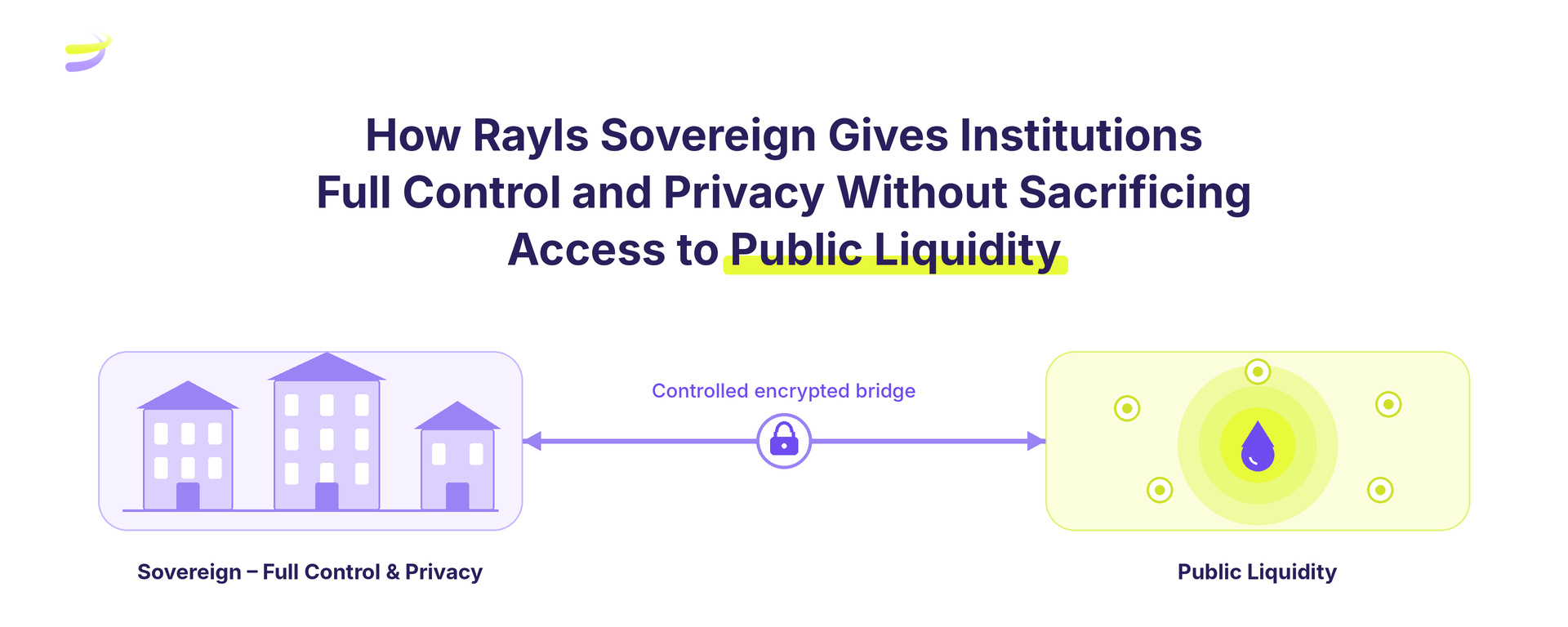
How Rayls Sovereign Gives Institutions Full Control and Privacy Without Sacrificing Access to PublicHow Rayls Sovereign Gives Institutions Full Control and Privacy Without Sacrificing Access to Public Liquidity
I’ve noticed one problem that keeps coming up whenever I talk to people from traditional finance: they understand the benefits of blockchain, but they almost always stop at the same question.
“If I use a blockchain, will my clients’ data and internal activity become public?”
It’s a fair question. On public blockchains, everything is visible. For tightly regulated banks and institutions, exposing client balances or counterparty positions is not an option. At the same time, building a completely private chain often ends up creating an isolated “island” that is cut off from liquidity and other institutions.
Rayls Sovereign is designed to address this dilemma.
What is Rayls Sovereign?
According to Rayls’ official documentation, Sovereign is a private EVM-compatible blockchain that is installed and operated by the institution itself, inside its own environment (on-premises or private cloud). Data, keys, and governance remain under the institution’s control. No external party can access its internal ledger.
In simple terms, it’s like a tokenized core banking system that still sits inside the institution’s own perimeter.
The architecture follows a hub-and-spoke model. Each institution runs its own Sovereign (previously called a Privacy Node) and connects to a Private Network Hub. Only encrypted messages leave the institution.
What can institutions do with it?
Based on the official docs, institutions can do several practical things inside Sovereign:
- Issue tokens (ERC-20, ERC-721, or ERC-1155) privately.
- Manage balances and internal transfers between divisions or clients.
- Run smart contracts to enforce business rules, such as freezing assets or locking funds.
All of this internal activity stays invisible to the outside. Institutions can also integrate Sovereign with their existing systems (core banking, ERP, etc.) through APIs.
How do they stay connected to the outside world?
This is the part I find most important. Institutions don’t have to choose between being completely closed or completely open. There are two controlled paths:
1. To other institutions via Rayls Private Networks.
Multiple Sovereigns can connect through a Private Network Hub. Messages are encrypted. The Hub only routes and verifies proofs it cannot see the content of the transactions.
2. To public liquidity via the Rayls Public Chain.
Institutions can open a connection when they need liquidity or want to interact with a broader market. Only the minimum required data leaves the Sovereign.
The institution decides when to open the door and what is allowed to leave.
Is it already in production?
According to Rayls’ official blog and website, Sovereign (previously known as the Privacy Node) has been used by more than 30 financial institutions since 2024. Some examples they highlight include:
- Núclea (one of Brazil’s largest payment market infrastructures) tokenizing corporate receivables at a rate of around 40,000 assets per month.
- XP issuing the USDXP stablecoin on Sovereign.
- Banco Central do Brasil using the infrastructure in the Drex CBDC pilot, which involved 16 major banks.
- Testing by Kinexys (J.P. Morgan) and participation in the Bank of England & BIS Innovation Hub.
I don’t treat these as definitive proof that every claim is perfect, but they do show that the approach has moved beyond pure experimentation and into real institutional environments.
Closing
What I take from the documentation and how Rayls describes Sovereign is an attempt to give institutions two things that are usually hard to combine: full control over their own data and systems, and the ability to stay connected to other institutions and public liquidity on their own terms.
For someone new to blockchain, the idea is simple. Institutions don’t have to put their entire operations into a glass room that everyone can see into. They can keep a private space of their own and open the door only when needed.
---
Sources
1. Rayls Docs – A Warm Introduction to Rayls Sovereign
https://docs.rayls.com/docs/a-warm-introduction-rayls-sovereign
2. Rayls Docs – Rayls Sovereign Architecture and Components
https://docs.rayls.com/docs/rayls-sovereign-architecture
3. Rayls Blog – Introducing Rayls Sovereign
https://www.rayls.com/blog/introducing-rayls-sovereign-the-onchain-gateway-for-institutions
4. Rayls – What is Rayls?
https://www.rayls.com/what-is-rayls
5. Rayls – Sovereign Product Page
https://www.rayls.com/products/sovereign
6. Rayls Blog – XP Launches USDXP
https://www.rayls.com/blog/xp-launches-usdxp-stablecoin-on-rayls-infrastructure
#RWA #RLS $RLS
How Rayls Sovereign Gives Institutions Full Control and Privacy Without Sacrificing Access to Public
How Rayls Sovereign Gives Institutions Full Control and Privacy Without Sacrificing Access to Public Liquidity
I’ve noticed one problem that keeps coming up whenever I talk to people from traditional finance: they understand the benefits of blockchain, but they almost always stop at the same question.
“If I use a blockchain, will my clients’ data and internal activity become public?”
It’s a fair question. On public blockchains, everything is visible. For tightly regulated banks and institutions, exposing client balances or counterparty positions is not an option. At the same time, building a completely private chain often ends up creating an isolated “island” that is cut off from liquidity and other institutions.
Rayls Sovereign is designed to address this dilemma.
What is Rayls Sovereign?
According to Rayls’ official documentation, Sovereign is a private EVM-compatible blockchain that is installed and operated by the institution itself, inside its own environment (on-premises or private cloud). Data, keys, and governance remain under the institution’s control. No external party can access its internal ledger.
In simple terms, it’s like a tokenized core banking system that still sits inside the institution’s own perimeter.
The architecture follows a hub-and-spoke model. Each institution runs its own Sovereign (previously called a Privacy Node) and connects to a Private Network Hub. Only encrypted messages leave the institution.
What can institutions do with it?
Based on the official docs, institutions can do several practical things inside Sovereign:
- Issue tokens (ERC-20, ERC-721, or ERC-1155) privately.
- Manage balances and internal transfers between divisions or clients.
- Run smart contracts to enforce business rules, such as freezing assets or locking funds.
All of this internal activity stays invisible to the outside. Institutions can also integrate Sovereign with their existing systems (core banking, ERP, etc.) through APIs.
How do they stay connected to the outside world?
This is the part I find most important. Institutions don’t have to choose between being completely closed or completely open. There are two controlled paths:
1. To other institutions via Rayls Private Networks.
Multiple Sovereigns can connect through a Private Network Hub. Messages are encrypted. The Hub only routes and verifies proofs it cannot see the content of the transactions.
2. To public liquidity via the Rayls Public Chain.
Institutions can open a connection when they need liquidity or want to interact with a broader market. Only the minimum required data leaves the Sovereign.
The institution decides when to open the door and what is allowed to leave.
Is it already in production?
According to Rayls’ official blog and website, Sovereign (previously known as the Privacy Node) has been used by more than 30 financial institutions since 2024. Some examples they highlight include:
- Núclea (one of Brazil’s largest payment market infrastructures) tokenizing corporate receivables at a rate of around 40,000 assets per month.
- XP issuing the USDXP stablecoin on Sovereign.
- Banco Central do Brasil using the infrastructure in the Drex CBDC pilot, which involved 16 major banks.
- Testing by Kinexys (J.P. Morgan) and participation in the Bank of England & BIS Innovation Hub.
I don’t treat these as definitive proof that every claim is perfect, but they do show that the approach has moved beyond pure experimentation and into real institutional environments.
Closing
What I take from the documentation and how Rayls describes Sovereign is an attempt to give institutions two things that are usually hard to combine: full control over their own data and systems, and the ability to stay connected to other institutions and public liquidity on their own terms.
For someone new to blockchain, the idea is simple. Institutions don’t have to put their entire operations into a glass room that everyone can see into. They can keep a private space of their own and open the door only when needed.
---
Sources
1. Rayls Docs – A Warm Introduction to Rayls Sovereign
https://docs.rayls.com/docs/a-warm-introduction-rayls-sovereign
2. Rayls Docs – Rayls Sovereign Architecture and Components
https://docs.rayls.com/docs/rayls-sovereign-architecture
3. Rayls Blog – Introducing Rayls Sovereign
https://www.rayls.com/blog/introducing-rayls-sovereign-the-onchain-gateway-for-institutions
4. Rayls – What is Rayls?
https://www.rayls.com/what-is-rayls
5. Rayls – Sovereign Product Page
https://www.rayls.com/products/sovereign
6. Rayls Blog – XP Launches USDXP
https://www.rayls.com/blog/xp-launches-usdxp-stablecoin-on-rayls-infrastructure
#RWA #RLS $RLS
124

·
--
$RLS +9.42% | $APR +8.46% | $FROGGIE +8.14%
#RLS on BSC nudged to $0.00243752, up +9.42% with $8.4K volume and a $5.6M market cap.
APR on BSC climbed to $0.0563, gaining +8.46% on $1.8M of trades and a $22.6M market cap.
FROGGIE on BSC rose to $0.0155, up +8.14% with $24.3K volume and a $15.5M market cap.
⚠️ With such thin daily volumes, these Alpha token spikes can evaporate as quickly as they form.
#BinanceAlpha #TopGainers #Write2Earn #Binance
28

·
--
$RLS +6.81% | $FROGGIE +6.65% | $雪球 +6.52%
#RLS on BSC nudged up to $0.00237109, gaining +6.81% with $8.1K volume and a market cap of $5.5 M.
FROGGIE on BSC rose to $0.0152, +6.65% on $20.9K traded, sitting at a $15.2 M market cap.
雪球 on BSC climbed to $0.00300896, +6.52% backed by $17.1K volume, market cap $1.6 M.
⚠️ All three tokens sit on relatively thin order books, so the upside could unwind quickly if buying pressure eases.
#BinanceAlpha #TopGainers #Write2Earn #Binance
26
·
--
$RLS +9.31% | $VINE +9.10% | $ALEO +8.79%
#RLS on BSC nudged to $0.00236894, up +9.31% with $6.5K volume and a $5.5M market cap. 📈 Its modest turnover suggests the upside could be fragile.
VINE on Solana climbed to $0.00708120, gaining +9.10% on $251.4K traded and a $7.1M market cap, showing a healthier flow than some peers.
ALEO on BSC rose to $0.0314, up +8.79% with $32.4K volume and a $48.1M market cap, indicating broader interest despite the modest trade size.
The thin $6.5K volume for RLS means the rally could reverse quickly if buying pressure fades.
#BinanceAlpha #TopGainers #Write2Earn #Binance
114

·
--
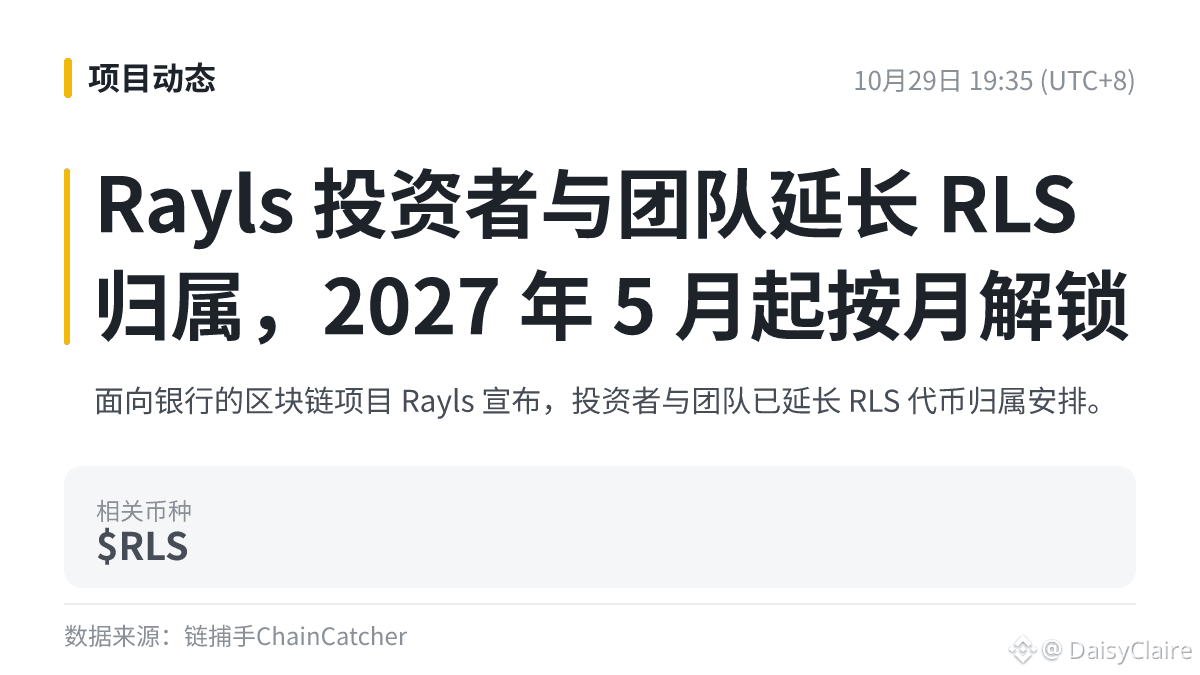
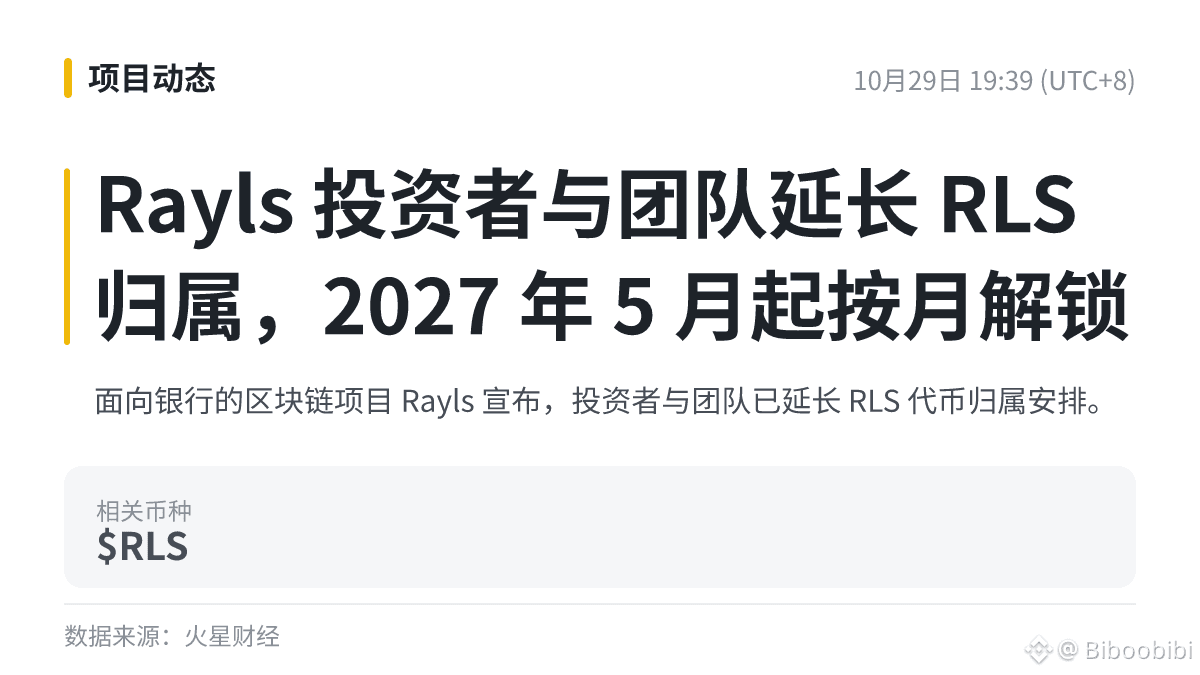
$RLS |Rayls Investors and Team Extend RLS Vesting, with Monthly Unlocks Starting in May 2027
The news belongs to everyone, but your heartbeat is your own, so I decided to calm mine down first. This may make the market more cautious, with more people sitting on the sidelines. Everyone here, did you make money and feel good today, or lose sleep?
#RLS
I get it wrong often too, so make your own judgment.
7

·
--
How will the market react?
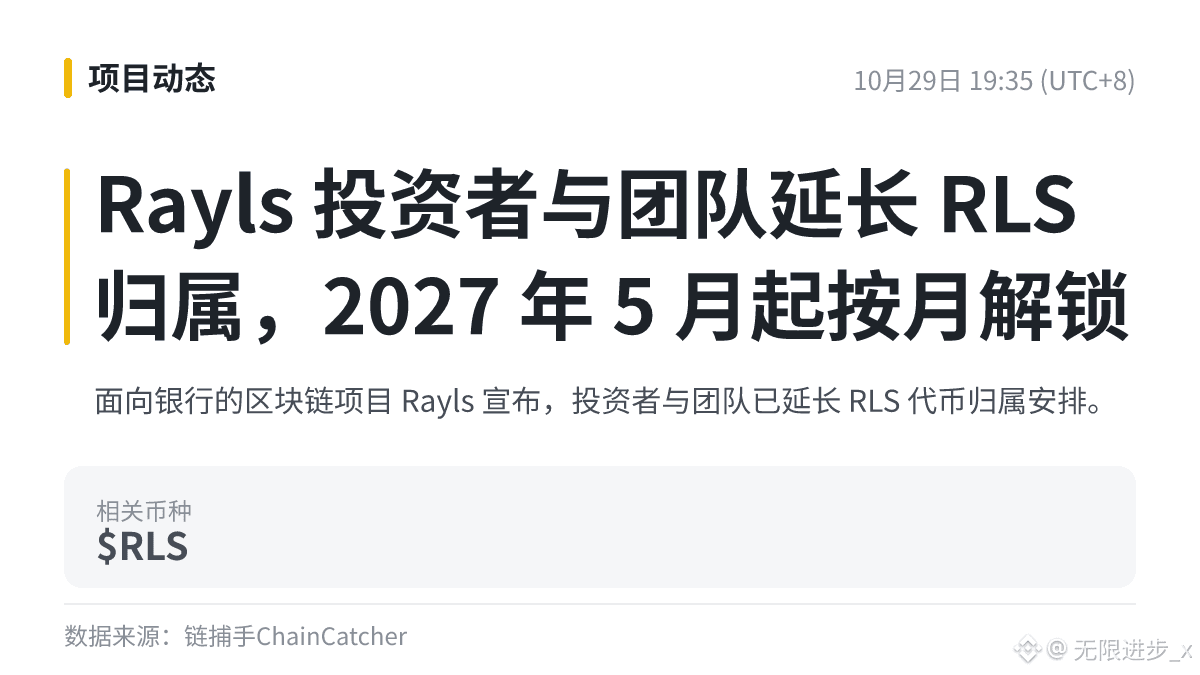
Rayls investors and team extend RLS vesting, with monthly unlocks starting in May 2027
I usually compare changes in whale holdings before and after the news—it’s much more useful than reading the comments. When bad news hits, don’t rush; check whether the price has already fallen in anticipation.
$RLS 。
#RLS
64

·
--
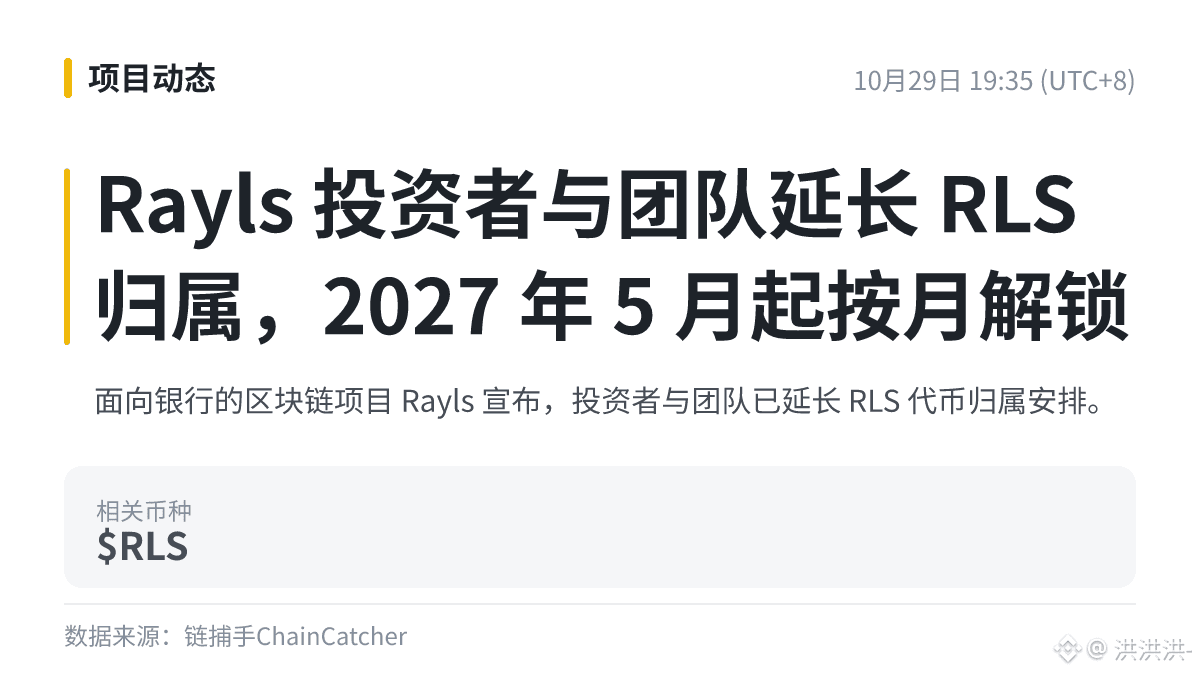
$RLS |Rayls investors and team extend RLS vesting, with monthly unlocks starting in May 2027
Whether funds are concentrating in major coins or spreading into altcoins can reveal the market’s risk appetite. As a bearish signal, watch the previous low below; if it breaks, look to the next level down.
#RLS
Volatility is high, so use leverage within your means.
Whether funds are concentrating in major coins or spreading into altcoins can reveal the market’s risk appetite. As a bearish signal, watch the previous low below; if it breaks, look to the next level down.
#RLS
Volatility is high, so use leverage within your means.
7

·
--
A post I came across at 19:40: Rayls investors and team extend RLS vesting, with monthly unlocks starting in May 2027
On the face of it, this is a negative. How much it affects the market is for the money to decide. If there’s a timeline for this, make a note of it.
$RLS .
#RLS
A post I came across at 19:40: Rayls investors and team extend RLS vesting, with monthly unlocks starting in May 2027
On the face of it, this is a negative. How much it affects the market is for the money to decide. If there’s a timeline for this, make a note of it.
$RLS .
#RLS
On the face of it, this is a negative. How much it affects the market is for the money to decide. If there’s a timeline for this, make a note of it.
$RLS .
#RLS
10

·
--
My news instincts are pretty sharp, but my order execution is a mess. Put together, that adds up to just watching the show.
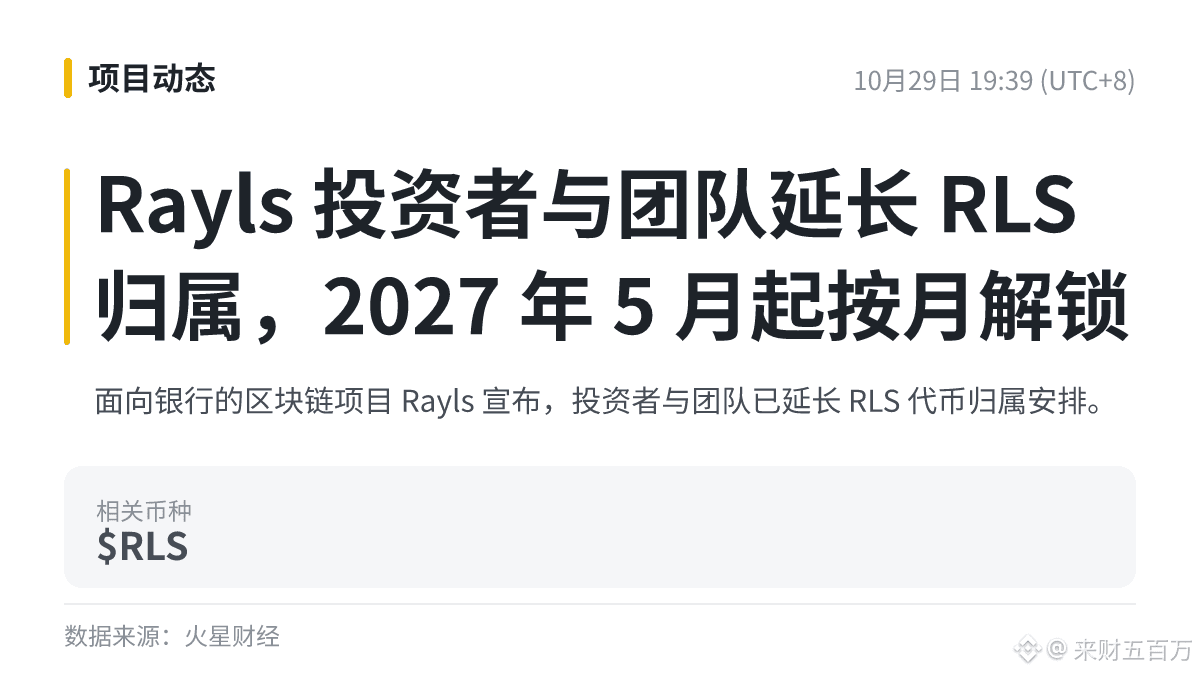
It all started with this: Rayls investors and the team extend RLS vesting, with monthly unlocks starting in May 2027.
$RLS , next I’ll watch to see whether the token price holds at the day’s opening price after the news comes out.
#RLS
Just sharing my thoughts; make your own decisions about buying and selling.
8

·
--
Everyone, take note: this is bearish, so keep your position size down!
Rayls investors and team extend RLS vesting, with monthly unlocks starting May 2027
This bearish news may lead some funds to sit on the sidelines for now. Whether they come back later depends on market action.
$RLS , stay calm for now and keep your position size light!
#RLS
Rayls investors and team extend RLS vesting, with monthly unlocks starting May 2027
This bearish news may lead some funds to sit on the sidelines for now. Whether they come back later depends on market action.
$RLS , stay calm for now and keep your position size light!
#RLS
4

·
--
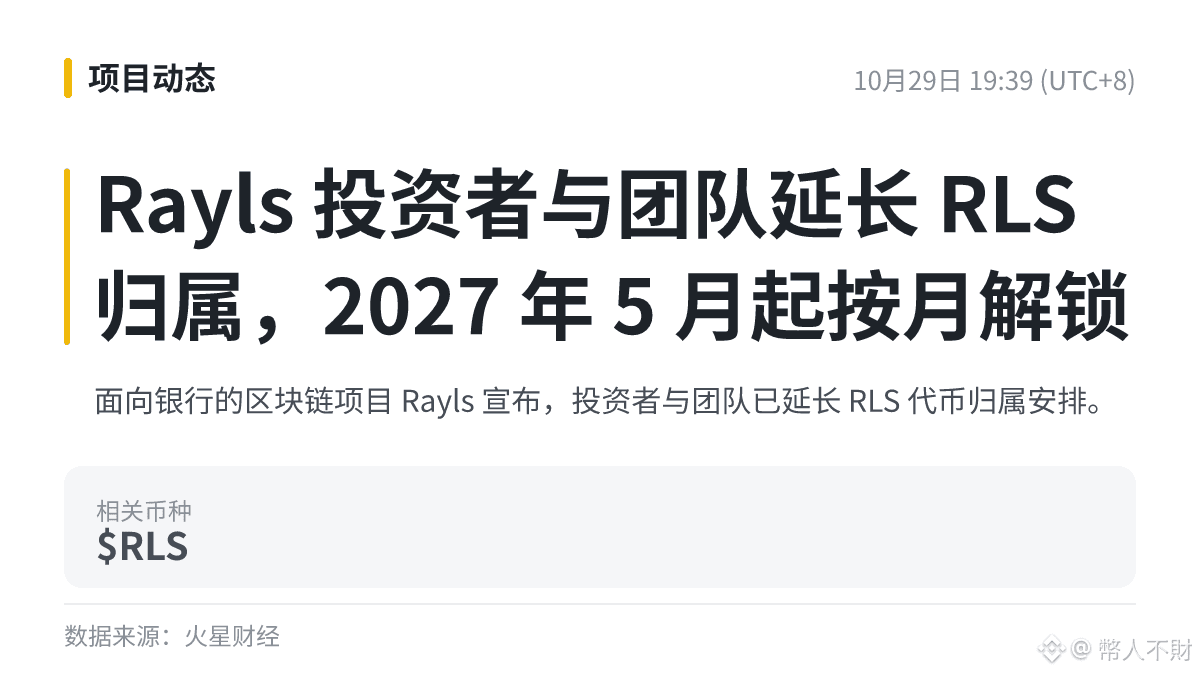
One thing I just saw: Rayls investors and the team have extended RLS vesting, with monthly unlocks starting in May 2027.
This weighs on intraday sentiment; the long-term impact will depend on what we learn next. Whenever this kind of news comes up, people around me tend to get carried away, but I’d rather wait and see.
$RLS I’ll stay on the sidelines.
#RLS
This weighs on intraday sentiment; the long-term impact will depend on what we learn next. Whenever this kind of news comes up, people around me tend to get carried away, but I’d rather wait and see.
$RLS I’ll stay on the sidelines.
#RLS
10

·
--
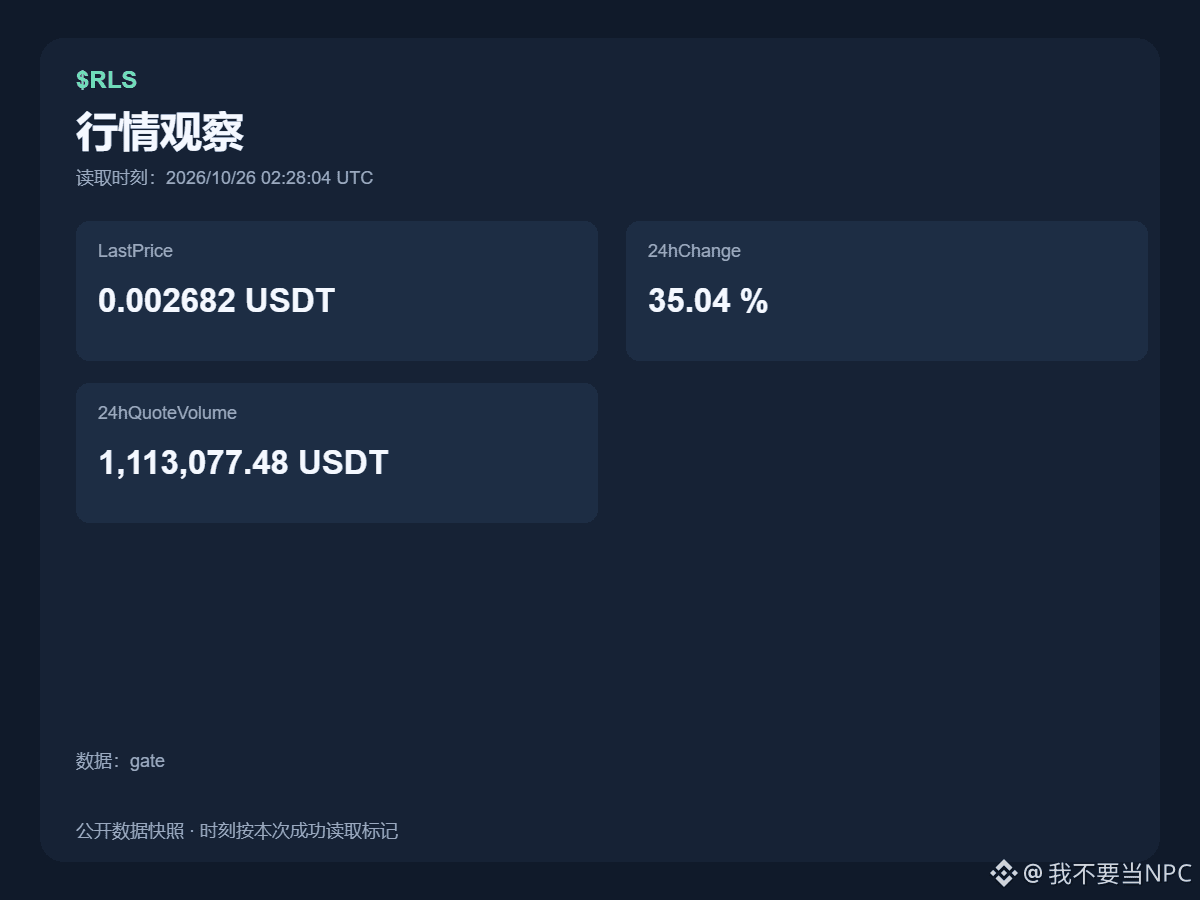
RLS was quoted at 0.002682 USDT in the spot sample, up 35.04% over 24 hours, with a trading volume of about 1.1131 million USDT over the same period. Taken together, the price increase and trading volume suggest this move is fairly significant—but that’s just one set of observations. I’m more curious whether this volume can hold up than in treating 35% as a signal of direction right away.
$RLS
#RLS
#MarketWatch
$RLS
$RLS
#RLS
#MarketWatch
$RLS
1
101
·
--
$RLS +24.92% | $TA +21.84% | $MEME +18.99%
#RLS on BSC nudged up to $0.00239128, gaining +24.92% with $184.2K of 24‑h volume and a $5.4M market cap.
TA on BSC rose to $0.0621, climbing +21.84% on a solid $971.2K volume and a $26.5M market cap.
MEME on Robinhood jumped to $0.00797745, up +18.99% with $223.1K traded and an $8.0M market cap. ⚠️ The thin liquidity means a modest sell‑off could erase today’s gains.
Watch the $971.2K volume on TA; it’s enough to sustain the rally for now, but any dip in depth could trigger a rapid reversal.
#BinanceAlpha #TopGainers #Write2Earn #Binance
11
·
--

Article
A Successful Receipt on the Sender’s Chain Does Not Always Mean the Money Has ArrivedAn Analysis of Compensating Transactions, Partial Settlement, and the Limits of Atomicity in Cross-Chain Payments
Many institutions and developers still treat a successful transaction receipt on the sender’s chain as proof that a payment is complete. In cross-chain systems, that is often not the case.
From reviewing technical documentation and observing basic behavior in controlled environments, one pattern consistently appears: the debit on the source chain can commit successfully, while the destination can still fail at a later step. When that happens, the funds do not automatically return. The system typically executes a **compensating transaction**.
Partial Atomicity
The official Rayls documentation (*Send Enygma Transactions* and *How Enygma Works*) describes the boundaries of atomicity clearly:
- The source call is atomic — the burn and the transfer request succeed or fail together.
- Each individual destination leg is atomic — the mint and any program steps on that leg succeed or fail together.
- All legs of a single payment are **not** atomic. Legs can settle independently.
The documentation states explicitly that “Failures are reversed, not rolled back.” The Hub transaction and the mint on the destination chain are separate transactions. If the mint or a program step fails on the destination, the relayer runs a compensating transaction to return the value to the sender. It is not one atomic transaction across chains.
Until the refund actually lands, the sender’s balance on the source chain remains reduced by the failed amount.
What Is a Compensating Transaction?
A compensating transaction is a **new and separate** transaction created to correct a failure. It is not a rollback of the original transaction.
According to the RaylsEnygmaHandler documentation, if any program step reverts, the entire leg (including the mint) fails. The relayer then returns the value to the sender on the source chain through a compensating mechanism. The refund appears under the **same reference ID** and is recorded as status `RECEIVED` on the source chain, rather than as a pure revert of the original debit.
A simple example consistent with the documented behavior:
- The source debits 10.
- One destination successfully receives 4.
- Another destination fails during execution.
- A separate compensating transaction returns 6 to the sender.
The final result is 4 delivered + 6 returned = 10. The original source transaction remains recorded as successful.
Diagrams
Basic flow:
Atomic vs Multi-Leg:
Partial Settlement Example:
Practical Risks Worth Noting
From the documentation and observations in controlled environments, several points are often overlooked:
1. Refunds are not instant
The Rayls documentation itself notes that until the refund lands, the sender’s balance remains reduced. Delays in the relayer or issues with proof generation can leave funds in a pending state longer than expected.
2. Reconciliation must be done per leg
A single source receipt is not enough. One must match what left the source, what arrived at each destination, what failed, and what was actually returned via the compensating transaction (typically under the same reference ID).
3. Dependence on off-chain components
Failure detection and refund initiation often rely on relayers. Even in local testing, warnings related to balance commitments or proof generation can appear. These risks are higher in production.
4. Controlled results ≠ production guarantees
Clean behavior in a lab with deliberately triggered failures does not automatically translate to production environments with concurrent load, network issues, or state inconsistencies.
Conclusion
A successful receipt on the source chain only proves that the debit committed. It does not prove that every destination received the funds, nor does it prove that any failed portion has been returned.
Successful source execution, destination settlement, and compensating refunds are related events, but they are **not the same event**. Understanding this distinction matters when designing or operating cross-chain settlement flows.
The official Rayls documentation already describes this compensating pattern openly. The important point is not to treat results from controlled environments as full proof of production reliability.
---
Disclaimer:
This article is an analysis based on publicly available Rayls documentation and technical observations in controlled environments. It is not a formal audit, investment advice, or a guarantee of any system’s behavior in production. Readers should verify details directly against the official documentation.
Sources
- Send Enygma Transactions: https://docs.rayls.com/docs/send-enygma-transactions
- How Enygma Works: https://docs.rayls.com/docs/how-enygma-works
- RaylsEnygmaHandler: https://docs.rayls.com/docs/raylsenygmahandler
#RLS $RLS
A Successful Receipt on the Sender’s Chain Does Not Always Mean the Money Has Arrived
An Analysis of Compensating Transactions, Partial Settlement, and the Limits of Atomicity in Cross-Chain Payments
Many institutions and developers still treat a successful transaction receipt on the sender’s chain as proof that a payment is complete. In cross-chain systems, that is often not the case.
From reviewing technical documentation and observing basic behavior in controlled environments, one pattern consistently appears: the debit on the source chain can commit successfully, while the destination can still fail at a later step. When that happens, the funds do not automatically return. The system typically executes a **compensating transaction**.
Partial Atomicity
The official Rayls documentation (*Send Enygma Transactions* and *How Enygma Works*) describes the boundaries of atomicity clearly:
- The source call is atomic — the burn and the transfer request succeed or fail together.
- Each individual destination leg is atomic — the mint and any program steps on that leg succeed or fail together.
- All legs of a single payment are **not** atomic. Legs can settle independently.
The documentation states explicitly that “Failures are reversed, not rolled back.” The Hub transaction and the mint on the destination chain are separate transactions. If the mint or a program step fails on the destination, the relayer runs a compensating transaction to return the value to the sender. It is not one atomic transaction across chains.
Until the refund actually lands, the sender’s balance on the source chain remains reduced by the failed amount.
What Is a Compensating Transaction?
A compensating transaction is a **new and separate** transaction created to correct a failure. It is not a rollback of the original transaction.
According to the RaylsEnygmaHandler documentation, if any program step reverts, the entire leg (including the mint) fails. The relayer then returns the value to the sender on the source chain through a compensating mechanism. The refund appears under the **same reference ID** and is recorded as status `RECEIVED` on the source chain, rather than as a pure revert of the original debit.
A simple example consistent with the documented behavior:
- The source debits 10.
- One destination successfully receives 4.
- Another destination fails during execution.
- A separate compensating transaction returns 6 to the sender.
The final result is 4 delivered + 6 returned = 10. The original source transaction remains recorded as successful.
Diagrams
Basic flow:
Atomic vs Multi-Leg:
Partial Settlement Example:
Practical Risks Worth Noting
From the documentation and observations in controlled environments, several points are often overlooked:
1. Refunds are not instant
The Rayls documentation itself notes that until the refund lands, the sender’s balance remains reduced. Delays in the relayer or issues with proof generation can leave funds in a pending state longer than expected.
2. Reconciliation must be done per leg
A single source receipt is not enough. One must match what left the source, what arrived at each destination, what failed, and what was actually returned via the compensating transaction (typically under the same reference ID).
3. Dependence on off-chain components
Failure detection and refund initiation often rely on relayers. Even in local testing, warnings related to balance commitments or proof generation can appear. These risks are higher in production.
4. Controlled results ≠ production guarantees
Clean behavior in a lab with deliberately triggered failures does not automatically translate to production environments with concurrent load, network issues, or state inconsistencies.
Conclusion
A successful receipt on the source chain only proves that the debit committed. It does not prove that every destination received the funds, nor does it prove that any failed portion has been returned.
Successful source execution, destination settlement, and compensating refunds are related events, but they are **not the same event**. Understanding this distinction matters when designing or operating cross-chain settlement flows.
The official Rayls documentation already describes this compensating pattern openly. The important point is not to treat results from controlled environments as full proof of production reliability.
---
Disclaimer:
This article is an analysis based on publicly available Rayls documentation and technical observations in controlled environments. It is not a formal audit, investment advice, or a guarantee of any system’s behavior in production. Readers should verify details directly against the official documentation.
Sources
- Send Enygma Transactions: https://docs.rayls.com/docs/send-enygma-transactions
- How Enygma Works: https://docs.rayls.com/docs/how-enygma-works
- RaylsEnygmaHandler: https://docs.rayls.com/docs/raylsenygmahandler
#RLS $RLS
330
·
--
$RLS +19.06% | $GSTOCK +18.57% | $TA +16.05%
#RLS on BSC nudged to $0.00217078, climbing +19.06% with $25.4K of 24‑hour volume and a $4.9M market cap.
GSTOCK on BSC pushed up to $0.00512387, up +18.57% on a relatively healthy $369.0K volume and a $5.1M market cap.
TA on BSC rose to $0.0576, gaining +16.05% while trading $1.5M in volume and holding a $24.6M market cap.
The RLS surge sits on thin liquidity, so a modest sell‑off could wipe out much of today’s upside.
Keep an eye on how quickly volume follows price; rapid inflows often precede the next move.
#BinanceAlpha #TopGainers #Write2Earn #Binance
18

Article
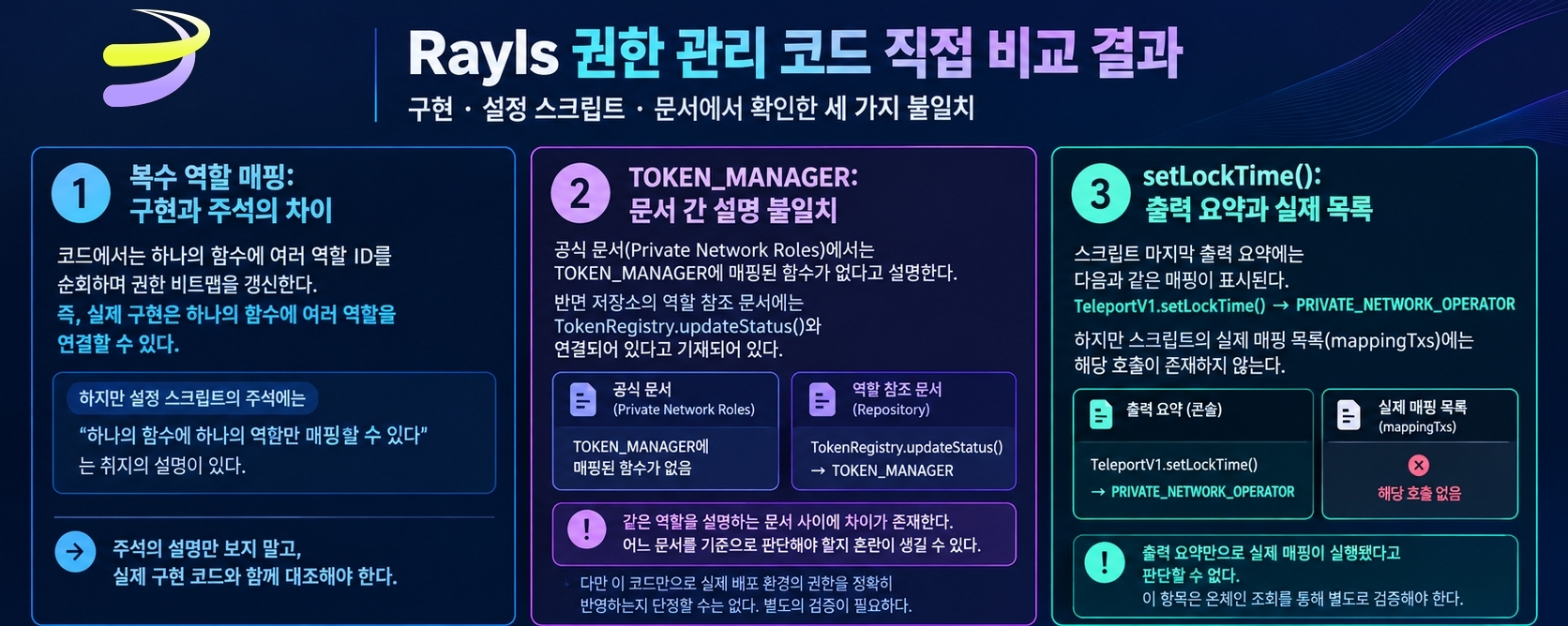
I compared Rayls’ access control code firsthand and found three inconsistenciesWhile exploring Rayls’ Sovereign Contracts repository, I reviewed the role-based permission settings for the Private Network Hub (PNH).
Rather than simply describing what each role does, I compared the implementation code, permission configuration scripts, and official documentation to see whether they aligned.
In an access control system, knowing only the role names isn’t enough. You also need to examine which permissions the code supports, what mappings the configuration scripts apply, and how the documentation describes them.
I compared Rayls’ access control code firsthand and found three inconsistencies
While exploring Rayls’ Sovereign Contracts repository, I reviewed the role-based permission settings for the Private Network Hub (PNH).
Rather than simply describing what each role does, I compared the implementation code, permission configuration scripts, and official documentation to see whether they aligned.
In an access control system, knowing only the role names isn’t enough. You also need to examine which permissions the code supports, what mappings the configuration scripts apply, and how the documentation describes them.
1
68
Article
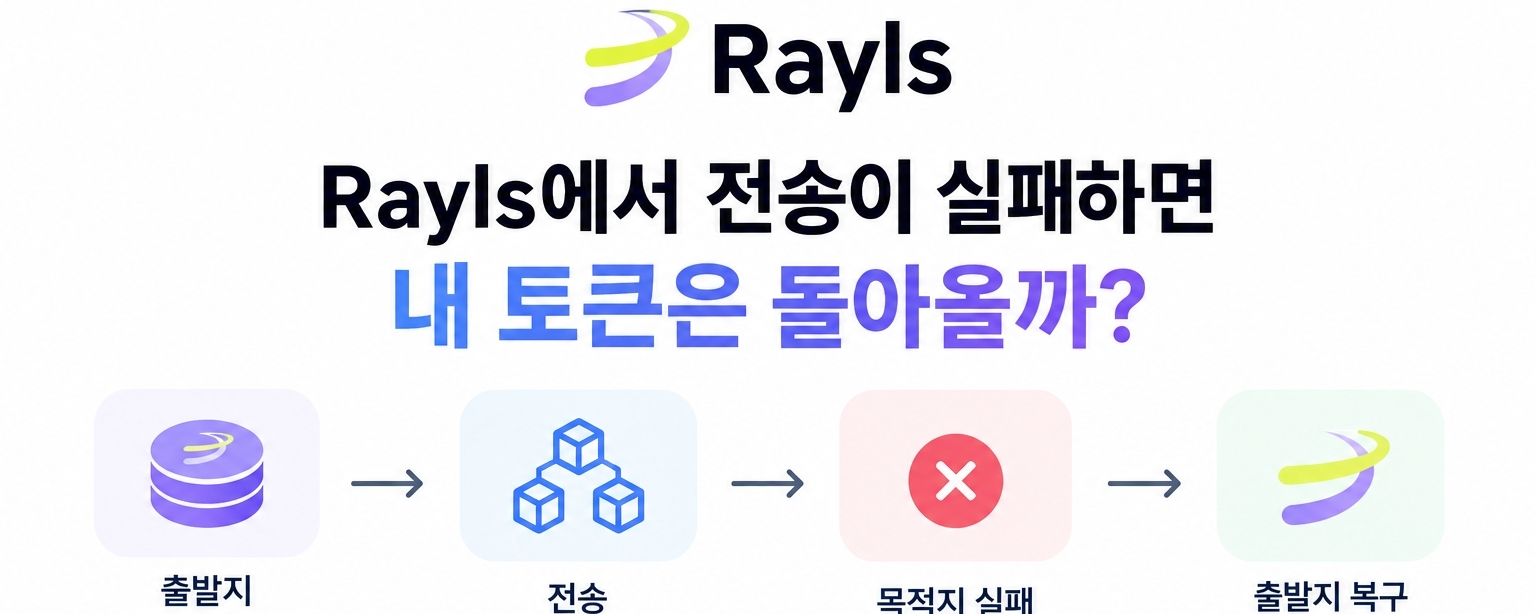
What happens to tokens processed on the source chain if the destination transaction fails during a cross-chain transfer?If a transfer fails on Rayls, will my tokens be returned?
What happens to tokens processed on the source chain if the destination transaction fails during a cross-chain transfer? $RLS
When moving tokens to another chain, assets may be locked or burned on the source chain. But if processing fails on the destination, a procedure is needed to restore the asset state.
Rayls' official documentation describes a recovery mechanism for this situation. However, examining the public code as well reveals additional points that need to be verified.
What happens to tokens processed on the source chain if the destination transaction fails during a cross-chain transfer?
If a transfer fails on Rayls, will my tokens be returned?
What happens to tokens processed on the source chain if the destination transaction fails during a cross-chain transfer? $RLS
When moving tokens to another chain, assets may be locked or burned on the source chain. But if processing fails on the destination, a procedure is needed to restore the asset state.
Rayls' official documentation describes a recovery mechanism for this situation. However, examining the public code as well reveals additional points that need to be verified.
1
103

·
--
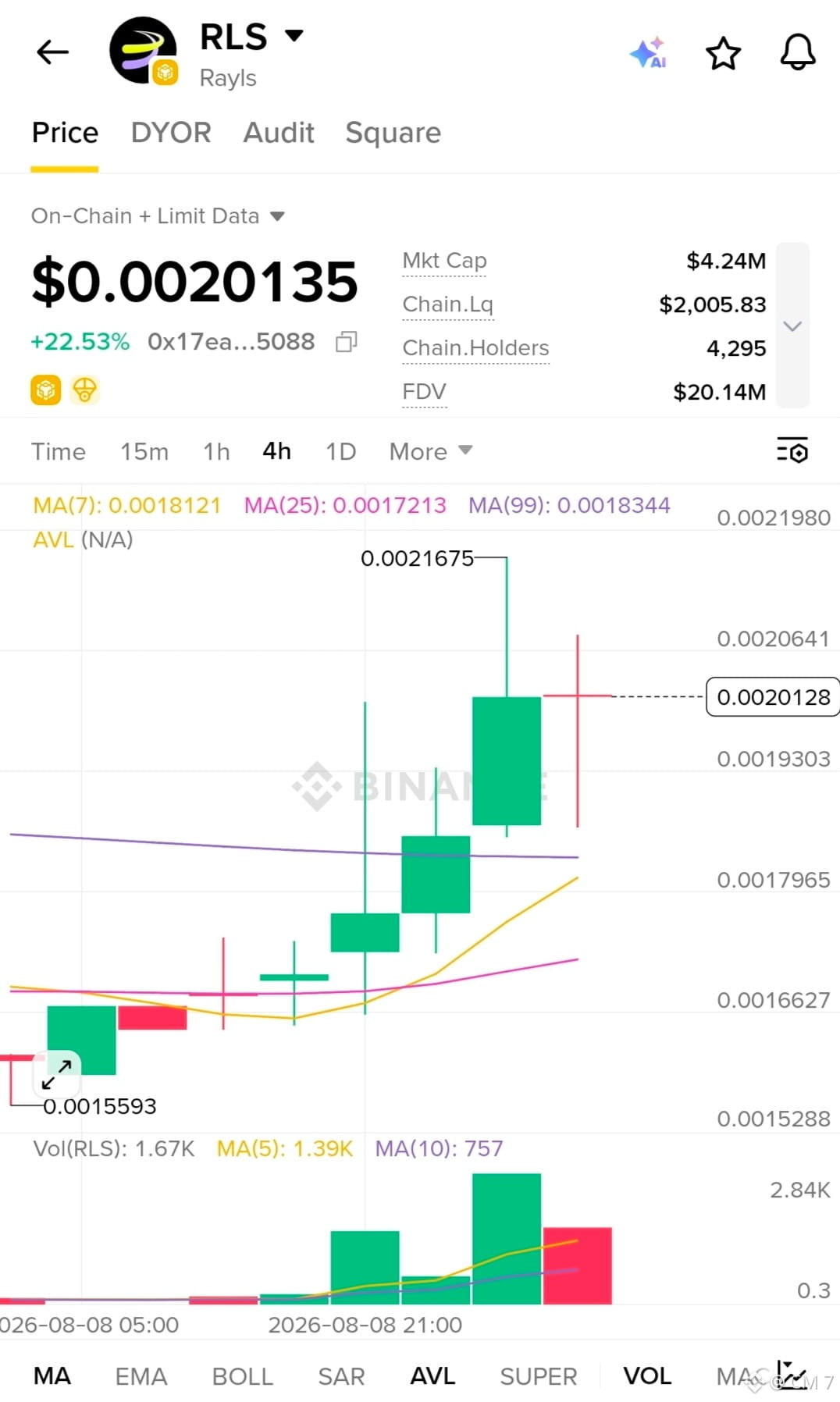
🚀 $RLS / USDT Breakout Alert! 🟢
$RLS (Rayls) is showing strong bullish momentum on the 4H chart, pumping +22.53% and breaking past key Moving Averages! 📈
Key Technicals:
Current Price: $0.0020135
24h High: $0.0021675
Support: $0.00181 (MA 7) / $0.00172 (MA 25)
Market Cap: $4.24M | FDV: $20.14M
Volume: Spike in green volume candles showing solid buying pressure.
With the price consolidating above the MA(99) line ($0.00183), bulls are eyeing another retest of the recent $0.00216 peak. Keep a close eye on the volume for potential continuation!
Are you holding or waiting for a pullback? 👇
#RLS #Rayls #CryptoAnalysis #Bullish #BinanceSquareBTC #CryptoTrading #Altcoins@Binance_Square_Official
🚀 $RLS / USDT Breakout Alert! 🟢
$RLS (Rayls) is showing strong bullish momentum on the 4H chart, pumping +22.53% and breaking past key Moving Averages! 📈
Key Technicals:
Current Price: $0.0020135
24h High: $0.0021675
Support: $0.00181 (MA 7) / $0.00172 (MA 25)
Market Cap: $4.24M | FDV: $20.14M
Volume: Spike in green volume candles showing solid buying pressure.
With the price consolidating above the MA(99) line ($0.00183), bulls are eyeing another retest of the recent $0.00216 peak. Keep a close eye on the volume for potential continuation!
Are you holding or waiting for a pullback? 👇
#RLS #Rayls #CryptoAnalysis #Bullish #BinanceSquareBTC #CryptoTrading #Altcoins@Binance Square Official
1
1
150
·
--
$BLUAI +5.44% | $RLS +5.44%
#BLUAI closes out this batch at $0.011354, up +5.44% on $758.4K volume, one of the more liquid names in the entire list.
#RLS is also up +5.44% at $0.0021998, but on just $7.2K volume, a far thinner base than BLUAI despite the identical percentage gain.
BLUAI's much deeper turnover makes it the more credible of this closing pair, a reminder that matching percentage gains can hide very different levels of conviction.
#Binance #Write2Earn
2
225
Log in to explore more content
Join global crypto users on Binance Square
⚡️ Get latest and useful information about crypto.
💬 Trusted by the world’s largest crypto exchange.
👍 Discover real insights from verified creators.
Email / Phone number
Trending Topics
1
#A Packed Week of Earnings and Data Tests Markets
33,035 views
238 Discussing
2
#AnthropicIPOTestsInvestorAppetiteForAI
38,061 views
683 Discussing
3
#BitcoinExtendsLosingStreakToSixWeeks
1,545 views
74 Discussing
4
#XRPFallsTo$0.89LowestSinceNovember2024
679 views
10 Discussing
5
#HuangReportedlyConsidersReturnToNvidia
62,843 views
780 Discussing
6
#SP500AndNasdaqFuturesHitQuarterlyLows
1 views
6 Discussing
7
#CaliforniaVotersBackProp42BarringNewCryptoTaxes
417 views
37 Discussing
8
#HKPlansDigitalAssetRegulatoryBillByYearEnd
504 views
37 Discussing
9
#MUFGSMFGMizuhoPlanYenBackedStablecoin
8,432 views
136 Discussing
10
#HKMAAndSwiftExploreTokenizedDepositInteroperability
452 views
11 Discussing