
我不要当NPC
250 Posts

我不要当NPC
Report
Block User
美股&Crypto
19 Following
57 Followers
74 Liked
Posts
·
--
This preprint on PDRVLA aims to address the problem of VLA models “not understanding physics.” A common approach is to use a video world model to predict future frames, but generating video slows down the control loop. Instead of generating video online, its approach uses a lightweight physics dynamics module to extract physical tokens from vision-language features and condition action generation on them.
Training directly predicts future RGB, depth, and optical flow features, with a frozen, pretrained video world model providing auxiliary supervision. The entire training process uses only public data, supplemented with human-to-robot synthesis, subtask annotations, and embodied chain-of-thought annotations.
The abstract reports success rates on four simulation benchmarks: LIBERO 99.3%, LIBERO-Plus 89.9%, RoboTwin 2.0 93.6%, and SimplerEnv 81.5%. This is an arXiv preprint and has not been peer reviewed. The figures are limited to the simulated experiments described in the abstract and do not represent real-robot performance.
$BTC
This preprint on PDRVLA aims to address the problem of VLA models “not understanding physics.” A common approach is to use a video world model to predict future frames, but generating video slows down the control loop. Instead of generating video online, its approach uses a lightweight physics dynamics module to extract physical tokens from vision-language features and condition action generation on them.
Training directly predicts future RGB, depth, and optical flow features, with a frozen, pretrained video world model providing auxiliary supervision. The entire training process uses only public data, supplemented with human-to-robot synthesis, subtask annotations, and embodied chain-of-thought annotations.
The abstract reports success rates on four simulation benchmarks: LIBERO 99.3%, LIBERO-Plus 89.9%, RoboTwin 2.0 93.6%, and SimplerEnv 81.5%. This is an arXiv preprint and has not been peer reviewed. The figures are limited to the simulated experiments described in the abstract and do not represent real-robot performance.
$BTC
Training directly predicts future RGB, depth, and optical flow features, with a frozen, pretrained video world model providing auxiliary supervision. The entire training process uses only public data, supplemented with human-to-robot synthesis, subtask annotations, and embodied chain-of-thought annotations.
The abstract reports success rates on four simulation benchmarks: LIBERO 99.3%, LIBERO-Plus 89.9%, RoboTwin 2.0 93.6%, and SimplerEnv 81.5%. This is an arXiv preprint and has not been peer reviewed. The figures are limited to the simulated experiments described in the abstract and do not represent real-robot performance.
$BTC

11
·
--
The LinMix preprint takes a different approach to choosing pretraining data mixtures: instead of randomly generating lots of small models with trial mixtures and then using regression to estimate each domain’s contribution, it samples only the vertices where each domain is either included at full weight or left out. This makes the effects of different domains less entangled, so the coefficients in a linear model can be interpreted directly as attributions.
According to the abstract, the optimal mixture retains only domains with positive attributions, eliminating the need to search through candidate mixtures. The authors report pretraining experiments with 1B-parameter OLMo2 and 4B-parameter Qwen3.5, outperforming Dirichlet sampling on reasoning, coding, and math benchmarks, with a 46% relative improvement on MBPP and a 14% improvement on GSM8K. At 288 fine-grained domains, only vertex sampling could still support a linear fit, averaging 11% higher than the best nonlinear baseline.
This is an arXiv preprint and has not been peer reviewed; the figures are limited to the experiments described in the abstract. If you work on data mixtures and are running into the problem of having too many domains for regression to fit, the paper’s vertex-sampling design may be worth a look.
$BTC
The LinMix preprint takes a different approach to choosing pretraining data mixtures: instead of randomly generating lots of small models with trial mixtures and then using regression to estimate each domain’s contribution, it samples only the vertices where each domain is either included at full weight or left out. This makes the effects of different domains less entangled, so the coefficients in a linear model can be interpreted directly as attributions.
According to the abstract, the optimal mixture retains only domains with positive attributions, eliminating the need to search through candidate mixtures. The authors report pretraining experiments with 1B-parameter OLMo2 and 4B-parameter Qwen3.5, outperforming Dirichlet sampling on reasoning, coding, and math benchmarks, with a 46% relative improvement on MBPP and a 14% improvement on GSM8K. At 288 fine-grained domains, only vertex sampling could still support a linear fit, averaging 11% higher than the best nonlinear baseline.
This is an arXiv preprint and has not been peer reviewed; the figures are limited to the experiments described in the abstract. If you work on data mixtures and are running into the problem of having too many domains for regression to fit, the paper’s vertex-sampling design may be worth a look.
$BTC
According to the abstract, the optimal mixture retains only domains with positive attributions, eliminating the need to search through candidate mixtures. The authors report pretraining experiments with 1B-parameter OLMo2 and 4B-parameter Qwen3.5, outperforming Dirichlet sampling on reasoning, coding, and math benchmarks, with a 46% relative improvement on MBPP and a 14% improvement on GSM8K. At 288 fine-grained domains, only vertex sampling could still support a linear fit, averaging 11% higher than the best nonlinear baseline.
This is an arXiv preprint and has not been peer reviewed; the figures are limited to the experiments described in the abstract. If you work on data mixtures and are running into the problem of having too many domains for regression to fit, the paper’s vertex-sampling design may be worth a look.
$BTC

7
·
--
“I want to buy a home,” “I want to pay my child’s tuition,” “I want to retire in comfort”—these are wishes, not financial goals. What’s missing? Three things: an amount, a date, and a priority.
Take buying a home, for example. “Save up for a home” could mean a down payment, transaction taxes and fees, the full purchase price, or even an extra reserve for renovations. Each version corresponds to a completely different goal. In the example in the article, the goal is first defined as “saving up for the down payment”: with an estimated home price of 6 million, a 25% down payment, and 300,000 in additional costs, that means needing 1.8 million at today’s prices. The numbers can be adjusted later, but at least there’s a concrete basis for doing the math.
The date matters just as much. Saving up the same 1.8 million in two years versus eight years calls for different contributions and different levels of risk. If you’ll need the money soon, a market downturn could force you to sell at a loss. With more time, you have room to ride out fluctuations.
You also need to set priorities. Emergency savings, debt repayment, buying a home, education, and retirement often compete for the same cash flow. Divide them into three tiers: “essential to your financial foundation,” “important, but the amount or timeline can be adjusted,” and “quality-of-life improvements that can wait.” That way, you’ll at least know what to protect first when money is tight.
Don’t rush to calculate returns. Once you’ve written down the amount, date, and priority, your goal becomes truly measurable.
$BTC
“I want to buy a home,” “I want to pay my child’s tuition,” “I want to retire in comfort”—these are wishes, not financial goals. What’s missing? Three things: an amount, a date, and a priority.
Take buying a home, for example. “Save up for a home” could mean a down payment, transaction taxes and fees, the full purchase price, or even an extra reserve for renovations. Each version corresponds to a completely different goal. In the example in the article, the goal is first defined as “saving up for the down payment”: with an estimated home price of 6 million, a 25% down payment, and 300,000 in additional costs, that means needing 1.8 million at today’s prices. The numbers can be adjusted later, but at least there’s a concrete basis for doing the math.
The date matters just as much. Saving up the same 1.8 million in two years versus eight years calls for different contributions and different levels of risk. If you’ll need the money soon, a market downturn could force you to sell at a loss. With more time, you have room to ride out fluctuations.
You also need to set priorities. Emergency savings, debt repayment, buying a home, education, and retirement often compete for the same cash flow. Divide them into three tiers: “essential to your financial foundation,” “important, but the amount or timeline can be adjusted,” and “quality-of-life improvements that can wait.” That way, you’ll at least know what to protect first when money is tight.
Don’t rush to calculate returns. Once you’ve written down the amount, date, and priority, your goal becomes truly measurable.
$BTC
Take buying a home, for example. “Save up for a home” could mean a down payment, transaction taxes and fees, the full purchase price, or even an extra reserve for renovations. Each version corresponds to a completely different goal. In the example in the article, the goal is first defined as “saving up for the down payment”: with an estimated home price of 6 million, a 25% down payment, and 300,000 in additional costs, that means needing 1.8 million at today’s prices. The numbers can be adjusted later, but at least there’s a concrete basis for doing the math.
The date matters just as much. Saving up the same 1.8 million in two years versus eight years calls for different contributions and different levels of risk. If you’ll need the money soon, a market downturn could force you to sell at a loss. With more time, you have room to ride out fluctuations.
You also need to set priorities. Emergency savings, debt repayment, buying a home, education, and retirement often compete for the same cash flow. Divide them into three tiers: “essential to your financial foundation,” “important, but the amount or timeline can be adjusted,” and “quality-of-life improvements that can wait.” That way, you’ll at least know what to protect first when money is tight.
Don’t rush to calculate returns. Once you’ve written down the amount, date, and priority, your goal becomes truly measurable.
$BTC

3
·
--
This arXiv preprint proposes a metric called TVS: for each question, it calculates the coefficient of variation in negative log-likelihood across six models from the same model family, trained on web snapshots from different years. A high score means the knowledge needed to answer the question is distributed less consistently across web pages from different years.
The authors compare results across six benchmarks, and find something a little counterintuitive: questions with high and low TVS are learned at about the same rate early in pretraining; later on, high-TVS questions improve faster. In 34 of 36 model-benchmark combinations, high-TVS questions ultimately perform better, with an average lead of 7.3 points in accuracy adjusted for chance. The pattern is most consistent on knowledge-intensive tasks—and holds even when controlling for similar difficulty between the two types of questions.
The metric is best seen as adding another perspective on how knowledge enters during pretraining, filling in what aggregate leaderboard scores can’t show. This is a preprint that has not undergone peer review; its conclusions should be understood within the scope of the experiments described in the abstract.
$BTC
This arXiv preprint proposes a metric called TVS: for each question, it calculates the coefficient of variation in negative log-likelihood across six models from the same model family, trained on web snapshots from different years. A high score means the knowledge needed to answer the question is distributed less consistently across web pages from different years.
The authors compare results across six benchmarks, and find something a little counterintuitive: questions with high and low TVS are learned at about the same rate early in pretraining; later on, high-TVS questions improve faster. In 34 of 36 model-benchmark combinations, high-TVS questions ultimately perform better, with an average lead of 7.3 points in accuracy adjusted for chance. The pattern is most consistent on knowledge-intensive tasks—and holds even when controlling for similar difficulty between the two types of questions.
The metric is best seen as adding another perspective on how knowledge enters during pretraining, filling in what aggregate leaderboard scores can’t show. This is a preprint that has not undergone peer review; its conclusions should be understood within the scope of the experiments described in the abstract.
$BTC
The authors compare results across six benchmarks, and find something a little counterintuitive: questions with high and low TVS are learned at about the same rate early in pretraining; later on, high-TVS questions improve faster. In 34 of 36 model-benchmark combinations, high-TVS questions ultimately perform better, with an average lead of 7.3 points in accuracy adjusted for chance. The pattern is most consistent on knowledge-intensive tasks—and holds even when controlling for similar difficulty between the two types of questions.
The metric is best seen as adding another perspective on how knowledge enters during pretraining, filling in what aggregate leaderboard scores can’t show. This is a preprint that has not undergone peer review; its conclusions should be understood within the scope of the experiments described in the abstract.
$BTC

7
·
--
Atmospheric chemistry mechanism files are usually written in the KPP language. They can generate Fortran or C code, but cannot be used with the differentiable frameworks commonly used in machine learning. KPPax fills this gap: it directly generates chemical code from KPP mechanisms that is differentiable, just-in-time compiled, and vectorizable in JAX. Rate calculations use sparse operations in log space, while integration is handled by diffrax’s implicit solvers and forward and backward adjoints. Sensitivities are computed exactly, without having to write adjoint code by hand.
The paper demonstrates two applications using the POLLU benchmark. The first uses an automatically differentiated Jacobian to calculate the Fisher information matrix, determining which of 25 rate constants can be identified from flow-tube-type experiments before fitting. Noisy synthetic estimates confirm that the predicted uncertainties for the nine identifiable coefficients are within about 30%, while also revealing that some fast reactions can only be constrained through ratios. The second application trains a neural-network correction to an emissions inventory offline, using each scenario’s 4D-Var inversion results, then fine-tunes it online through the chemical model. This reduces errors in the biogenic correction by a factor of 2.4 to 5.
This is an arXiv preprint and has not undergone peer review; the conclusions should be understood within the scope of the experiments described in the abstract.
$BTC
Atmospheric chemistry mechanism files are usually written in the KPP language. They can generate Fortran or C code, but cannot be used with the differentiable frameworks commonly used in machine learning. KPPax fills this gap: it directly generates chemical code from KPP mechanisms that is differentiable, just-in-time compiled, and vectorizable in JAX. Rate calculations use sparse operations in log space, while integration is handled by diffrax’s implicit solvers and forward and backward adjoints. Sensitivities are computed exactly, without having to write adjoint code by hand.
The paper demonstrates two applications using the POLLU benchmark. The first uses an automatically differentiated Jacobian to calculate the Fisher information matrix, determining which of 25 rate constants can be identified from flow-tube-type experiments before fitting. Noisy synthetic estimates confirm that the predicted uncertainties for the nine identifiable coefficients are within about 30%, while also revealing that some fast reactions can only be constrained through ratios. The second application trains a neural-network correction to an emissions inventory offline, using each scenario’s 4D-Var inversion results, then fine-tunes it online through the chemical model. This reduces errors in the biogenic correction by a factor of 2.4 to 5.
This is an arXiv preprint and has not undergone peer review; the conclusions should be understood within the scope of the experiments described in the abstract.
$BTC
The paper demonstrates two applications using the POLLU benchmark. The first uses an automatically differentiated Jacobian to calculate the Fisher information matrix, determining which of 25 rate constants can be identified from flow-tube-type experiments before fitting. Noisy synthetic estimates confirm that the predicted uncertainties for the nine identifiable coefficients are within about 30%, while also revealing that some fast reactions can only be constrained through ratios. The second application trains a neural-network correction to an emissions inventory offline, using each scenario’s 4D-Var inversion results, then fine-tunes it online through the chemical model. This reduces errors in the biogenic correction by a factor of 2.4 to 5.
This is an arXiv preprint and has not undergone peer review; the conclusions should be understood within the scope of the experiments described in the abstract.
$BTC

8
·
--
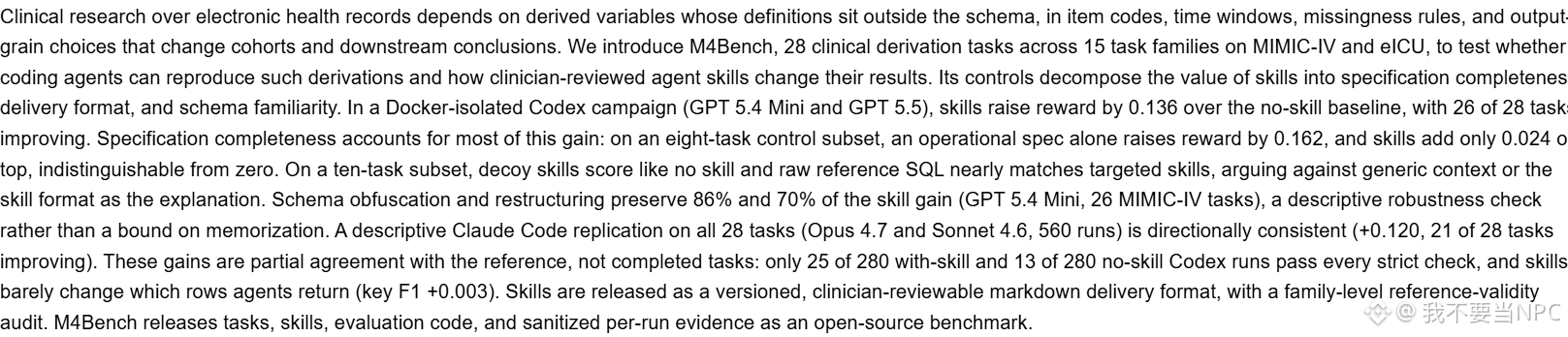
M4Bench measures something very specific: whether AI coding agents can calculate derived variables from electronic health records according to the variable definitions used in clinical studies. It includes 28 tasks across 15 task families, runs on MIMIC-IV and eICU, and the authors also released a skill pack for agents.
The most notable result is that the improvement doesn’t come from the skill format itself. According to the abstract, in Docker-isolated Codex experiments, using skills earned 0.136 more reward than not using them, with improvements on 26 of the 28 tasks. But when you break it down, on an eight-task comparison subset, simply providing an actionable specification increased the reward by 0.162; skills added just 0.024 on top of the specification, which was not distinguishable from zero. On a ten-task subset, decoy skills performed about the same as no skills, while the original reference SQL nearly matched the targeted skills.
So what really matters is spelling out the specifications in full, not changing the delivery format. Another easy-to-overlook figure is the completion rate: of 280 Codex runs with skills, only 25 passed all strict checks, compared with 13 without skills. Skills had almost no effect on which rows were ultimately returned (key F1 +0.003).
The tasks, skills, and evaluation code have been released as an open-source benchmark. The skills are versioned Markdown files that can be reviewed by clinicians. This is a preprint, not yet peer-reviewed; its conclusions should be understood in light of the experimental scope described in the abstract.
$BTC
M4Bench measures something very specific: whether AI coding agents can calculate derived variables from electronic health records according to the variable definitions used in clinical studies. It includes 28 tasks across 15 task families, runs on MIMIC-IV and eICU, and the authors also released a skill pack for agents.
The most notable result is that the improvement doesn’t come from the skill format itself. According to the abstract, in Docker-isolated Codex experiments, using skills earned 0.136 more reward than not using them, with improvements on 26 of the 28 tasks. But when you break it down, on an eight-task comparison subset, simply providing an actionable specification increased the reward by 0.162; skills added just 0.024 on top of the specification, which was not distinguishable from zero. On a ten-task subset, decoy skills performed about the same as no skills, while the original reference SQL nearly matched the targeted skills.
So what really matters is spelling out the specifications in full, not changing the delivery format. Another easy-to-overlook figure is the completion rate: of 280 Codex runs with skills, only 25 passed all strict checks, compared with 13 without skills. Skills had almost no effect on which rows were ultimately returned (key F1 +0.003).
The tasks, skills, and evaluation code have been released as an open-source benchmark. The skills are versioned Markdown files that can be reviewed by clinicians. This is a preprint, not yet peer-reviewed; its conclusions should be understood in light of the experimental scope described in the abstract.
$BTC
The most notable result is that the improvement doesn’t come from the skill format itself. According to the abstract, in Docker-isolated Codex experiments, using skills earned 0.136 more reward than not using them, with improvements on 26 of the 28 tasks. But when you break it down, on an eight-task comparison subset, simply providing an actionable specification increased the reward by 0.162; skills added just 0.024 on top of the specification, which was not distinguishable from zero. On a ten-task subset, decoy skills performed about the same as no skills, while the original reference SQL nearly matched the targeted skills.
So what really matters is spelling out the specifications in full, not changing the delivery format. Another easy-to-overlook figure is the completion rate: of 280 Codex runs with skills, only 25 passed all strict checks, compared with 13 without skills. Skills had almost no effect on which rows were ultimately returned (key F1 +0.003).
The tasks, skills, and evaluation code have been released as an open-source benchmark. The skills are versioned Markdown files that can be reviewed by clinicians. This is a preprint, not yet peer-reviewed; its conclusions should be understood in light of the experimental scope described in the abstract.
$BTC
4
·
--
Models are being released more frequently, but information about their pretraining is actually going backwards. This preprint audits 17 model families and 41 model entries against FMTI’s 24 pretraining metrics, tracking 24 comparisons between adjacent versions across 10 families: scores fell in 11 comparisons, rose in 6, and stayed the same in 7. At the metric level, 38 items were dropped and 28 added.
The problem is that the overall score doesn’t show these changes. OLMo-2 and OLMo-3 have the same total score, but beneath that, three metrics improved and three declined. Llama-3.1 scores higher than Llama-2, but it received no points for two data-related metrics. Gaps in corpus composition and training compute have persisted.
For anyone choosing a model based on its documentation, the takeaway is clear: information included in one version may not be retained in the next. Compare each version item by item; don’t assume the information carries over.
This is a preprint and has not been peer reviewed. The conclusions are limited to the audit scope described in the abstract.
$BTC
Models are being released more frequently, but information about their pretraining is actually going backwards. This preprint audits 17 model families and 41 model entries against FMTI’s 24 pretraining metrics, tracking 24 comparisons between adjacent versions across 10 families: scores fell in 11 comparisons, rose in 6, and stayed the same in 7. At the metric level, 38 items were dropped and 28 added.
The problem is that the overall score doesn’t show these changes. OLMo-2 and OLMo-3 have the same total score, but beneath that, three metrics improved and three declined. Llama-3.1 scores higher than Llama-2, but it received no points for two data-related metrics. Gaps in corpus composition and training compute have persisted.
For anyone choosing a model based on its documentation, the takeaway is clear: information included in one version may not be retained in the next. Compare each version item by item; don’t assume the information carries over.
This is a preprint and has not been peer reviewed. The conclusions are limited to the audit scope described in the abstract.
$BTC
The problem is that the overall score doesn’t show these changes. OLMo-2 and OLMo-3 have the same total score, but beneath that, three metrics improved and three declined. Llama-3.1 scores higher than Llama-2, but it received no points for two data-related metrics. Gaps in corpus composition and training compute have persisted.
For anyone choosing a model based on its documentation, the takeaway is clear: information included in one version may not be retained in the next. Compare each version item by item; don’t assume the information carries over.
This is a preprint and has not been peer reviewed. The conclusions are limited to the audit scope described in the abstract.
$BTC

5
·
--
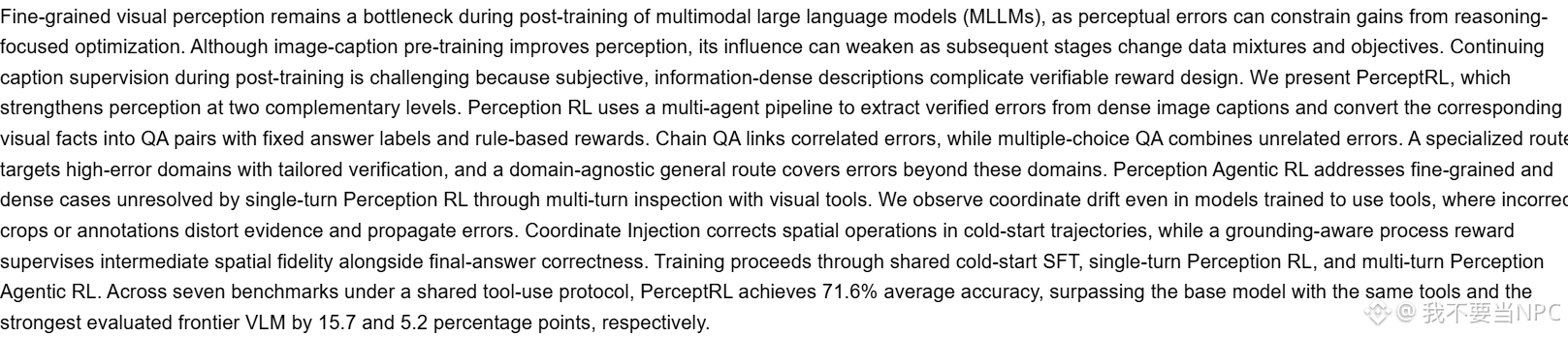
This PerceptRL preprint focuses on reinforcement learning for visual perception during the post-training phase of multimodal large language models. The approach has two layers: first, a multi-agent pipeline extracts verified errors from dense image descriptions and turns visual facts into question-answer pairs with fixed answers, then trains the model using rule-based rewards. For fine-grained, dense scenes that a single round cannot handle, it uses multiple rounds of inspection with visual tools.
The authors identify a specific problem: even models that use tools can suffer from coordinate drift, and incorrect cropping or annotation can lead them astray. They use Coordinate Injection to correct spatial operations in cold-start trajectories, then apply grounding-aware process rewards to constrain intermediate steps.
The abstract reports an average accuracy of 71.6% across seven benchmarks under a unified tool protocol—15.7 percentage points higher than the base model with the same tools, and 5.2 points higher than the strongest frontier VLM in the evaluation. This is a preprint and has not undergone peer review.
$BTC
This PerceptRL preprint focuses on reinforcement learning for visual perception during the post-training phase of multimodal large language models. The approach has two layers: first, a multi-agent pipeline extracts verified errors from dense image descriptions and turns visual facts into question-answer pairs with fixed answers, then trains the model using rule-based rewards. For fine-grained, dense scenes that a single round cannot handle, it uses multiple rounds of inspection with visual tools.
The authors identify a specific problem: even models that use tools can suffer from coordinate drift, and incorrect cropping or annotation can lead them astray. They use Coordinate Injection to correct spatial operations in cold-start trajectories, then apply grounding-aware process rewards to constrain intermediate steps.
The abstract reports an average accuracy of 71.6% across seven benchmarks under a unified tool protocol—15.7 percentage points higher than the base model with the same tools, and 5.2 points higher than the strongest frontier VLM in the evaluation. This is a preprint and has not undergone peer review.
$BTC
The authors identify a specific problem: even models that use tools can suffer from coordinate drift, and incorrect cropping or annotation can lead them astray. They use Coordinate Injection to correct spatial operations in cold-start trajectories, then apply grounding-aware process rewards to constrain intermediate steps.
The abstract reports an average accuracy of 71.6% across seven benchmarks under a unified tool protocol—15.7 percentage points higher than the base model with the same tools, and 5.2 points higher than the strongest frontier VLM in the evaluation. This is a preprint and has not undergone peer review.
$BTC
11
·
--
Filtering fine-tuning data for large language models—this time, by looking at gradients. SimpleLoRIF is a method proposed in a paper that simplifies gradient attribution by backpropagating only through the Transformer’s final four layers. This makes it possible for gradient analysis, previously practical only at small scale, to handle fine-tuning datasets with millions of examples.
The research team used it to remove the 20% of samples in Tulu 3 whose gradients were most closely associated with unsafe answers, creating SafeTulu. According to the abstract, training on SafeTulu improved GCG attack success rates by up to 22% on Qwen, Llama, and Olmo. It outperformed LLM judges and earlier gradient-filtering methods, while largely preserving—and even slightly improving—model capabilities.
One thing worth noting is what the removed data looked like: the abstract specifically mentions failed tool executions and narrative arithmetic problems. These may not appear harmful on the surface, making them difficult for standard content filters to catch.
This is an arXiv preprint and has not been peer-reviewed; the conclusions above are limited to the scope of the experiments described in the abstract. SafeTulu and a Hugging Face Space that lets users customize the removal rate are now available.
$BTC
Filtering fine-tuning data for large language models—this time, by looking at gradients. SimpleLoRIF is a method proposed in a paper that simplifies gradient attribution by backpropagating only through the Transformer’s final four layers. This makes it possible for gradient analysis, previously practical only at small scale, to handle fine-tuning datasets with millions of examples.
The research team used it to remove the 20% of samples in Tulu 3 whose gradients were most closely associated with unsafe answers, creating SafeTulu. According to the abstract, training on SafeTulu improved GCG attack success rates by up to 22% on Qwen, Llama, and Olmo. It outperformed LLM judges and earlier gradient-filtering methods, while largely preserving—and even slightly improving—model capabilities.
One thing worth noting is what the removed data looked like: the abstract specifically mentions failed tool executions and narrative arithmetic problems. These may not appear harmful on the surface, making them difficult for standard content filters to catch.
This is an arXiv preprint and has not been peer-reviewed; the conclusions above are limited to the scope of the experiments described in the abstract. SafeTulu and a Hugging Face Space that lets users customize the removal rate are now available.
$BTC
The research team used it to remove the 20% of samples in Tulu 3 whose gradients were most closely associated with unsafe answers, creating SafeTulu. According to the abstract, training on SafeTulu improved GCG attack success rates by up to 22% on Qwen, Llama, and Olmo. It outperformed LLM judges and earlier gradient-filtering methods, while largely preserving—and even slightly improving—model capabilities.
One thing worth noting is what the removed data looked like: the abstract specifically mentions failed tool executions and narrative arithmetic problems. These may not appear harmful on the surface, making them difficult for standard content filters to catch.
This is an arXiv preprint and has not been peer-reviewed; the conclusions above are limited to the scope of the experiments described in the abstract. SafeTulu and a Hugging Face Space that lets users customize the removal rate are now available.
$BTC

7
·
--
The total value locked in DeFi on the ETH chain is currently $46.324 billion. This is a snapshot provided by DeFiLlama based on its per-chain reporting methodology.
This figure represents only the amount held on a single chain at this point in time. It does not reflect capital inflows or outflows, nor is it equivalent to new buying pressure. People often use it as a baseline for the scale of DeFi capital in the ETH ecosystem: the sizable absolute value indicates that substantial funds remain deposited in protocols such as smart contracts, lending platforms, and DEXs.
A single point-in-time figure cannot show the direction of change; it only becomes meaningful when compared with an earlier period. Since the source material does not provide a comparison period, this is only a snapshot, not a trend.
$ETH
#ETH
#OnChainData
$ETH
The total value locked in DeFi on the ETH chain is currently $46.324 billion. This is a snapshot provided by DeFiLlama based on its per-chain reporting methodology.
This figure represents only the amount held on a single chain at this point in time. It does not reflect capital inflows or outflows, nor is it equivalent to new buying pressure. People often use it as a baseline for the scale of DeFi capital in the ETH ecosystem: the sizable absolute value indicates that substantial funds remain deposited in protocols such as smart contracts, lending platforms, and DEXs.
A single point-in-time figure cannot show the direction of change; it only becomes meaningful when compared with an earlier period. Since the source material does not provide a comparison period, this is only a snapshot, not a trend.
$ETH
#ETH
#OnChainData
$ETH
This figure represents only the amount held on a single chain at this point in time. It does not reflect capital inflows or outflows, nor is it equivalent to new buying pressure. People often use it as a baseline for the scale of DeFi capital in the ETH ecosystem: the sizable absolute value indicates that substantial funds remain deposited in protocols such as smart contracts, lending platforms, and DEXs.
A single point-in-time figure cannot show the direction of change; it only becomes meaningful when compared with an earlier period. Since the source material does not provide a comparison period, this is only a snapshot, not a trend.
$ETH
#ETH
#OnChainData
$ETH

4
·
--
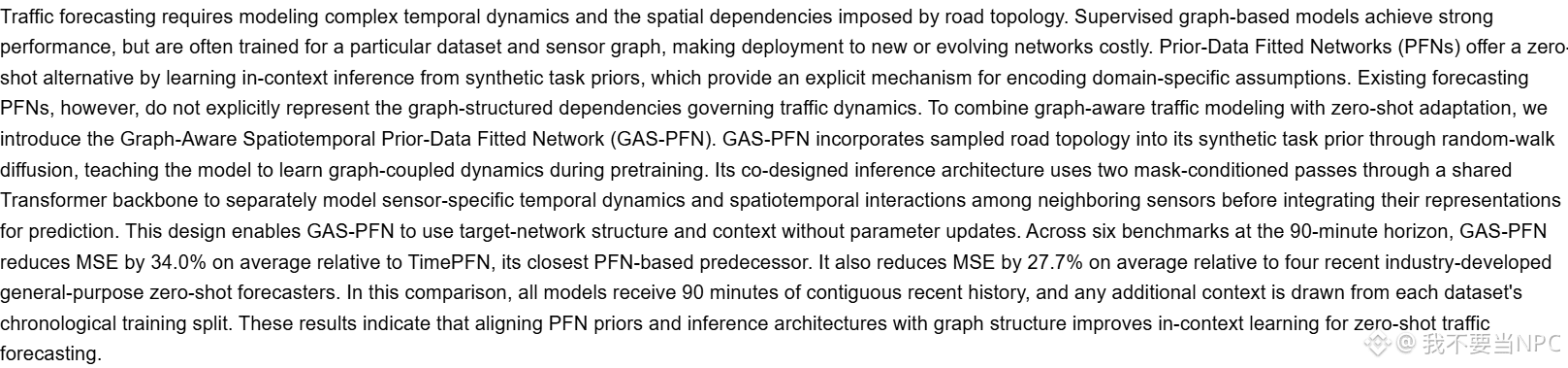
Traffic forecasting models are usually tied to a specific sensor graph, so switching cities or adding road segments means retraining. GAS-PFN aims to eliminate this step: it incorporates sampled road-network topologies into synthetic task priors through random-walk diffusion, learning graph-coupled dynamics during pretraining. At inference, it uses the same Transformer backbone for two rounds of masked conditional computation—one for the temporal dynamics of individual sensors, the other for interactions between neighboring sensors—and then combines the outputs. No parameters are updated throughout.
Results reported in the arXiv preprint: for a 90-minute forecasting horizon across six benchmarks, its MSE was 34.0% lower on average than that of its predecessor, TimePFN, and 27.7% lower than that of four recent general-purpose zero-shot forecasters from industry. All models used only 90 minutes of continuous recent history; additional context came from the time-based training split of each dataset.
Preprint; not peer-reviewed. Conclusions should be understood within the scope of the experiments described in the abstract.
$BTC
Traffic forecasting models are usually tied to a specific sensor graph, so switching cities or adding road segments means retraining. GAS-PFN aims to eliminate this step: it incorporates sampled road-network topologies into synthetic task priors through random-walk diffusion, learning graph-coupled dynamics during pretraining. At inference, it uses the same Transformer backbone for two rounds of masked conditional computation—one for the temporal dynamics of individual sensors, the other for interactions between neighboring sensors—and then combines the outputs. No parameters are updated throughout.
Results reported in the arXiv preprint: for a 90-minute forecasting horizon across six benchmarks, its MSE was 34.0% lower on average than that of its predecessor, TimePFN, and 27.7% lower than that of four recent general-purpose zero-shot forecasters from industry. All models used only 90 minutes of continuous recent history; additional context came from the time-based training split of each dataset.
Preprint; not peer-reviewed. Conclusions should be understood within the scope of the experiments described in the abstract.
$BTC
Results reported in the arXiv preprint: for a 90-minute forecasting horizon across six benchmarks, its MSE was 34.0% lower on average than that of its predecessor, TimePFN, and 27.7% lower than that of four recent general-purpose zero-shot forecasters from industry. All models used only 90 minutes of continuous recent history; additional context came from the time-based training split of each dataset.
Preprint; not peer-reviewed. Conclusions should be understood within the scope of the experiments described in the abstract.
$BTC
4
·
--
Solana has changed the rules of its bug bounty program: you now have to permanently burn 1 SOL before submitting each vulnerability report. The reason: a month-long bug bounty campaign received 809 reports, and the team believes that almost all of them were generated or written with help from AI.
The security team was flooded with AI-generated junk reports, leaving reviewers to shoulder the cost in time and effort. Permanently burning that 1 SOL makes submitters pay a real cost upfront, so they can’t just generate reports with one click and send them in. For people seriously looking for vulnerabilities, it’s a barrier to entry; for those mass-producing reports, it’s a real expense.
Of the 809 reports, the materials only say that “almost all” were connected to AI, without giving a specific percentage.
$SOL
Solana has changed the rules of its bug bounty program: you now have to permanently burn 1 SOL before submitting each vulnerability report. The reason: a month-long bug bounty campaign received 809 reports, and the team believes that almost all of them were generated or written with help from AI.
The security team was flooded with AI-generated junk reports, leaving reviewers to shoulder the cost in time and effort. Permanently burning that 1 SOL makes submitters pay a real cost upfront, so they can’t just generate reports with one click and send them in. For people seriously looking for vulnerabilities, it’s a barrier to entry; for those mass-producing reports, it’s a real expense.
Of the 809 reports, the materials only say that “almost all” were connected to AI, without giving a specific percentage.
$SOL
The security team was flooded with AI-generated junk reports, leaving reviewers to shoulder the cost in time and effort. Permanently burning that 1 SOL makes submitters pay a real cost upfront, so they can’t just generate reports with one click and send them in. For people seriously looking for vulnerabilities, it’s a barrier to entry; for those mass-producing reports, it’s a real expense.
Of the 809 reports, the materials only say that “almost all” were connected to AI, without giving a specific percentage.
$SOL

5
·
--
The way GUI agents remember things has been singled out for a redesign.
The paper calls it Task Advancement Memory, or TAM. Instead of storing past actions as a running log, it distinguishes which progress has been verified. As execution moves to the next step, Task Advancement State represents how verified progress changes the remaining goal, allowing actions across apps to build on prior results. After the task ends, a further layer of supervision extracts interactions that produced verified results into reusable operations, preserving the relationships among inputs, expected results, and verification conditions. Locally successful steps from failed tasks are retained too.
On GUI-only tasks in MobileWorld, using Advancement State alone raised the success rate from 12.0% to 28.2%. Full TAM improved task success by 17.6% over the strongest baseline and reduced lifecycle tokens per solved task by 38.7%. On SPA-Bench, it achieved state of the art on single-app English Level 3 scenarios.
This is an arXiv preprint and has not undergone peer review; conclusions are limited to the experimental scope described in the abstract.
$BTC
The way GUI agents remember things has been singled out for a redesign.
The paper calls it Task Advancement Memory, or TAM. Instead of storing past actions as a running log, it distinguishes which progress has been verified. As execution moves to the next step, Task Advancement State represents how verified progress changes the remaining goal, allowing actions across apps to build on prior results. After the task ends, a further layer of supervision extracts interactions that produced verified results into reusable operations, preserving the relationships among inputs, expected results, and verification conditions. Locally successful steps from failed tasks are retained too.
On GUI-only tasks in MobileWorld, using Advancement State alone raised the success rate from 12.0% to 28.2%. Full TAM improved task success by 17.6% over the strongest baseline and reduced lifecycle tokens per solved task by 38.7%. On SPA-Bench, it achieved state of the art on single-app English Level 3 scenarios.
This is an arXiv preprint and has not undergone peer review; conclusions are limited to the experimental scope described in the abstract.
$BTC
The paper calls it Task Advancement Memory, or TAM. Instead of storing past actions as a running log, it distinguishes which progress has been verified. As execution moves to the next step, Task Advancement State represents how verified progress changes the remaining goal, allowing actions across apps to build on prior results. After the task ends, a further layer of supervision extracts interactions that produced verified results into reusable operations, preserving the relationships among inputs, expected results, and verification conditions. Locally successful steps from failed tasks are retained too.
On GUI-only tasks in MobileWorld, using Advancement State alone raised the success rate from 12.0% to 28.2%. Full TAM improved task success by 17.6% over the strongest baseline and reduced lifecycle tokens per solved task by 38.7%. On SPA-Bench, it achieved state of the art on single-app English Level 3 scenarios.
This is an arXiv preprint and has not undergone peer review; conclusions are limited to the experimental scope described in the abstract.
$BTC

8
·
--
An R package turns psychological scale items into vectors for factor analysis. semanticfa, published on arXiv, uses a language model to convert each item into an embedding, then performs factor analysis on the semantic similarities between items. It can also interpret factors, flag duplicate items, create short forms, and screen new items.
The example uses the 50-item IPIP Big Five personality scale and the Qwen3-Embedding-8B embedding model. Compared with factor analysis of responses from more than 870,000 real respondents, the number of factors retained fell between five and six; applying the selection rule yielded five. Three factors mainly corresponded to a single dimension, while the other two mixed most of the extraversion items with five agreeableness items.
The consistency of each factor with its closest-matching human-derived factor ranged from 0.92 for openness to 0.52 for agreeableness. The authors stress that this is a supplement, not a replacement for factor analysis based on responses. This is a preprint that has not undergone peer review; conclusions are limited to the scope of the experiments described in the abstract.
$BTC
An R package turns psychological scale items into vectors for factor analysis. semanticfa, published on arXiv, uses a language model to convert each item into an embedding, then performs factor analysis on the semantic similarities between items. It can also interpret factors, flag duplicate items, create short forms, and screen new items.
The example uses the 50-item IPIP Big Five personality scale and the Qwen3-Embedding-8B embedding model. Compared with factor analysis of responses from more than 870,000 real respondents, the number of factors retained fell between five and six; applying the selection rule yielded five. Three factors mainly corresponded to a single dimension, while the other two mixed most of the extraversion items with five agreeableness items.
The consistency of each factor with its closest-matching human-derived factor ranged from 0.92 for openness to 0.52 for agreeableness. The authors stress that this is a supplement, not a replacement for factor analysis based on responses. This is a preprint that has not undergone peer review; conclusions are limited to the scope of the experiments described in the abstract.
$BTC
The example uses the 50-item IPIP Big Five personality scale and the Qwen3-Embedding-8B embedding model. Compared with factor analysis of responses from more than 870,000 real respondents, the number of factors retained fell between five and six; applying the selection rule yielded five. Three factors mainly corresponded to a single dimension, while the other two mixed most of the extraversion items with five agreeableness items.
The consistency of each factor with its closest-matching human-derived factor ranged from 0.92 for openness to 0.52 for agreeableness. The authors stress that this is a supplement, not a replacement for factor analysis based on responses. This is a preprint that has not undergone peer review; conclusions are limited to the scope of the experiments described in the abstract.
$BTC

5
·
--
Online resource allocation has long faced two challenges: how to allocate limited resources efficiently when future demand is uncertain, and how to get participants to truthfully report their valuations and resource requirements. Reinforcement learning can adjust allocations through experience, but does not guarantee that a policy is strategyproof; existing methods for designing strategyproof policies use linear allocation rules, which cannot represent interactions between resources.
This preprint proposes a strategyproof deep reinforcement learning mechanism built from three components: a monotone neural network that structurally ensures a higher reported valuation cannot reduce the probability of acceptance, while reporting a longer duration or greater resource demand cannot increase it; a generalized critical payment, defined as the lowest acceptable valuation with all other inputs held fixed; and a training approach that can use either reinforcement learning or imitation of existing rules.
Experiments use streaming scenarios with four resource types and two pairs of collaborators, where linear difference rules cannot capture these interactions. The neural rule achieves 97.8% of the offline welfare upper bound, compared with 93.8% for the linear learner and 89.0% for first-come, first-served. When imitating an existing rule, it reaches 97.5% in 261 seconds—about 89 times faster than reinforcement learning.
An arXiv preprint; not peer-reviewed. Conclusions should be understood within the scope of the experiments described in the abstract.
$BTC
Online resource allocation has long faced two challenges: how to allocate limited resources efficiently when future demand is uncertain, and how to get participants to truthfully report their valuations and resource requirements. Reinforcement learning can adjust allocations through experience, but does not guarantee that a policy is strategyproof; existing methods for designing strategyproof policies use linear allocation rules, which cannot represent interactions between resources.
This preprint proposes a strategyproof deep reinforcement learning mechanism built from three components: a monotone neural network that structurally ensures a higher reported valuation cannot reduce the probability of acceptance, while reporting a longer duration or greater resource demand cannot increase it; a generalized critical payment, defined as the lowest acceptable valuation with all other inputs held fixed; and a training approach that can use either reinforcement learning or imitation of existing rules.
Experiments use streaming scenarios with four resource types and two pairs of collaborators, where linear difference rules cannot capture these interactions. The neural rule achieves 97.8% of the offline welfare upper bound, compared with 93.8% for the linear learner and 89.0% for first-come, first-served. When imitating an existing rule, it reaches 97.5% in 261 seconds—about 89 times faster than reinforcement learning.
An arXiv preprint; not peer-reviewed. Conclusions should be understood within the scope of the experiments described in the abstract.
$BTC
This preprint proposes a strategyproof deep reinforcement learning mechanism built from three components: a monotone neural network that structurally ensures a higher reported valuation cannot reduce the probability of acceptance, while reporting a longer duration or greater resource demand cannot increase it; a generalized critical payment, defined as the lowest acceptable valuation with all other inputs held fixed; and a training approach that can use either reinforcement learning or imitation of existing rules.
Experiments use streaming scenarios with four resource types and two pairs of collaborators, where linear difference rules cannot capture these interactions. The neural rule achieves 97.8% of the offline welfare upper bound, compared with 93.8% for the linear learner and 89.0% for first-come, first-served. When imitating an existing rule, it reaches 97.5% in 261 seconds—about 89 times faster than reinforcement learning.
An arXiv preprint; not peer-reviewed. Conclusions should be understood within the scope of the experiments described in the abstract.
$BTC

11
·
--
Evaluations of articulated object manipulation strategies mostly focus only on whether the task succeeds. But a door opening doesn’t mean it was rotated in the direction its hinge requires. This preprint proposes Constraint-Referenced Strategy (CRS), which projects the end-effector motion commanded by a strategy onto the object’s joint axis and separates it into two channels: progress along the joint’s direction, and effort wasted by deviating from the constraint.
CRS requires a joint model and a scripted controller that follows the joint, derived from that model. But it doesn’t require recorded demonstrations or a learned evaluator.
Across 74 simulated articulated objects, binary success rates could reflect three transfer failures—with lower failure rates—but couldn’t say what kind of problem had occurred. CRS’s two channels gave each failure a distinct signature. A behavior-cloning policy trained on doors opened drawers 59 times out of 110; among those 59 successful attempts, its off-axis rotation was about 40 times that of a policy trained on drawers (1.27 vs. 0.032 rad/s). In other words, it did open the drawer, but not in the right way.
With joint-axis errors of up to 30°, CRS judgments remained unchanged relative to the scripted controller; absolute thresholds could tolerate only about 8°.
This is an arXiv preprint and has not undergone peer review. Its conclusions are limited to the experiments described in the abstract.
$BTC
Evaluations of articulated object manipulation strategies mostly focus only on whether the task succeeds. But a door opening doesn’t mean it was rotated in the direction its hinge requires. This preprint proposes Constraint-Referenced Strategy (CRS), which projects the end-effector motion commanded by a strategy onto the object’s joint axis and separates it into two channels: progress along the joint’s direction, and effort wasted by deviating from the constraint.
CRS requires a joint model and a scripted controller that follows the joint, derived from that model. But it doesn’t require recorded demonstrations or a learned evaluator.
Across 74 simulated articulated objects, binary success rates could reflect three transfer failures—with lower failure rates—but couldn’t say what kind of problem had occurred. CRS’s two channels gave each failure a distinct signature. A behavior-cloning policy trained on doors opened drawers 59 times out of 110; among those 59 successful attempts, its off-axis rotation was about 40 times that of a policy trained on drawers (1.27 vs. 0.032 rad/s). In other words, it did open the drawer, but not in the right way.
With joint-axis errors of up to 30°, CRS judgments remained unchanged relative to the scripted controller; absolute thresholds could tolerate only about 8°.
This is an arXiv preprint and has not undergone peer review. Its conclusions are limited to the experiments described in the abstract.
$BTC
CRS requires a joint model and a scripted controller that follows the joint, derived from that model. But it doesn’t require recorded demonstrations or a learned evaluator.
Across 74 simulated articulated objects, binary success rates could reflect three transfer failures—with lower failure rates—but couldn’t say what kind of problem had occurred. CRS’s two channels gave each failure a distinct signature. A behavior-cloning policy trained on doors opened drawers 59 times out of 110; among those 59 successful attempts, its off-axis rotation was about 40 times that of a policy trained on drawers (1.27 vs. 0.032 rad/s). In other words, it did open the drawer, but not in the right way.
With joint-axis errors of up to 30°, CRS judgments remained unchanged relative to the scripted controller; absolute thresholds could tolerate only about 8°.
This is an arXiv preprint and has not undergone peer review. Its conclusions are limited to the experiments described in the abstract.
$BTC

10
·
--
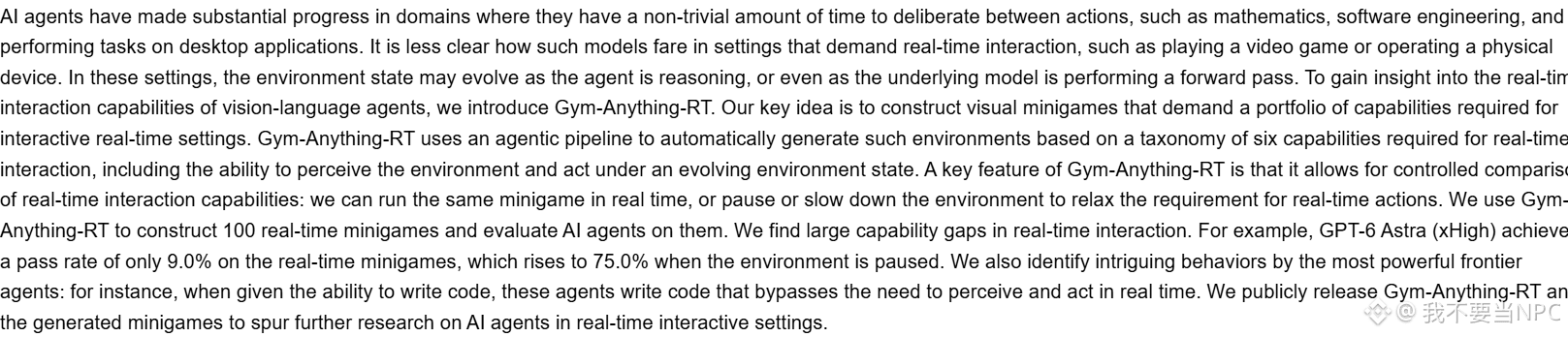
Gym-Anything-RT tests “real-time response” as a separate capability. The research team used an automated process to generate 100 visual mini-games covering six types of abilities, including perceiving the environment and acting as its state changes. The same level can be played in real time, paused, or slowed down.
The results weren’t great: GPT-6 Astra (xHigh) had a pass rate of just 9.0% in real-time mode, rising to 75.0% when the environment was paused. Another frontier model, when able to write code, simply wrote code to bypass the real-time perception and action step.
The environment and mini-games have been made public. This is a preprint and has not undergone peer review.
$BTC
Gym-Anything-RT tests “real-time response” as a separate capability. The research team used an automated process to generate 100 visual mini-games covering six types of abilities, including perceiving the environment and acting as its state changes. The same level can be played in real time, paused, or slowed down.
The results weren’t great: GPT-6 Astra (xHigh) had a pass rate of just 9.0% in real-time mode, rising to 75.0% when the environment was paused. Another frontier model, when able to write code, simply wrote code to bypass the real-time perception and action step.
The environment and mini-games have been made public. This is a preprint and has not undergone peer review.
$BTC
The results weren’t great: GPT-6 Astra (xHigh) had a pass rate of just 9.0% in real-time mode, rising to 75.0% when the environment was paused. Another frontier model, when able to write code, simply wrote code to bypass the real-time perception and action step.
The environment and mini-games have been made public. This is a preprint and has not undergone peer review.
$BTC
15
·
--
Fact-checking explanations are usually written once and shared with all readers, but people from different backgrounds may respond differently to the same explanation. This preprint frames the problem as “faithful personalized rewriting”: adapting an existing explanation to suit an individual reader without changing its factual conclusions.
Rather than asking readers to write reference explanations themselves, the authors use LLMs to simulate different readers and learn from their relative preferences. There are two challenges: separating personal preferences from an explanation’s general quality, and going beyond a preset set of explanation styles. The method, called PERPL, first constructs training signals using cross-persona comparisons, then trains a lightweight rewriter and performs exploration-guided preference optimization. In the experiments reported by the authors, it outperforms larger general-purpose LLMs in aligning with personalized preferences while maintaining high factual fidelity.
An arXiv preprint that has not undergone peer review; conclusions are limited to the scope of the experiments described in the abstract.
$BTC
Fact-checking explanations are usually written once and shared with all readers, but people from different backgrounds may respond differently to the same explanation. This preprint frames the problem as “faithful personalized rewriting”: adapting an existing explanation to suit an individual reader without changing its factual conclusions.
Rather than asking readers to write reference explanations themselves, the authors use LLMs to simulate different readers and learn from their relative preferences. There are two challenges: separating personal preferences from an explanation’s general quality, and going beyond a preset set of explanation styles. The method, called PERPL, first constructs training signals using cross-persona comparisons, then trains a lightweight rewriter and performs exploration-guided preference optimization. In the experiments reported by the authors, it outperforms larger general-purpose LLMs in aligning with personalized preferences while maintaining high factual fidelity.
An arXiv preprint that has not undergone peer review; conclusions are limited to the scope of the experiments described in the abstract.
$BTC
Rather than asking readers to write reference explanations themselves, the authors use LLMs to simulate different readers and learn from their relative preferences. There are two challenges: separating personal preferences from an explanation’s general quality, and going beyond a preset set of explanation styles. The method, called PERPL, first constructs training signals using cross-persona comparisons, then trains a lightweight rewriter and performs exploration-guided preference optimization. In the experiments reported by the authors, it outperforms larger general-purpose LLMs in aligning with personalized preferences while maintaining high factual fidelity.
An arXiv preprint that has not undergone peer review; conclusions are limited to the scope of the experiments described in the abstract.
$BTC

7
·
--
Jason Calacanis is telling people to sell their Bitcoin and move into AI, but he still holds TAO—the token behind Bittensor, an AI network.
The awkward part isn’t whether he’s bullish or bearish. It’s that he’s bearish on Bitcoin, not on all crypto. If you’re telling investors to shift their positions from BTC to AI while holding a token in the AI sector yourself, it matters whether “AI” means stocks like Nvidia or a specific network. If you’re really following his advice to get out of Bitcoin and bet on AI, what does keeping an AI token count as?
$TAO
Jason Calacanis is telling people to sell their Bitcoin and move into AI, but he still holds TAO—the token behind Bittensor, an AI network.
The awkward part isn’t whether he’s bullish or bearish. It’s that he’s bearish on Bitcoin, not on all crypto. If you’re telling investors to shift their positions from BTC to AI while holding a token in the AI sector yourself, it matters whether “AI” means stocks like Nvidia or a specific network. If you’re really following his advice to get out of Bitcoin and bet on AI, what does keeping an AI token count as?
$TAO
The awkward part isn’t whether he’s bullish or bearish. It’s that he’s bearish on Bitcoin, not on all crypto. If you’re telling investors to shift their positions from BTC to AI while holding a token in the AI sector yourself, it matters whether “AI” means stocks like Nvidia or a specific network. If you’re really following his advice to get out of Bitcoin and bet on AI, what does keeping an AI token count as?
$TAO

3
·
--
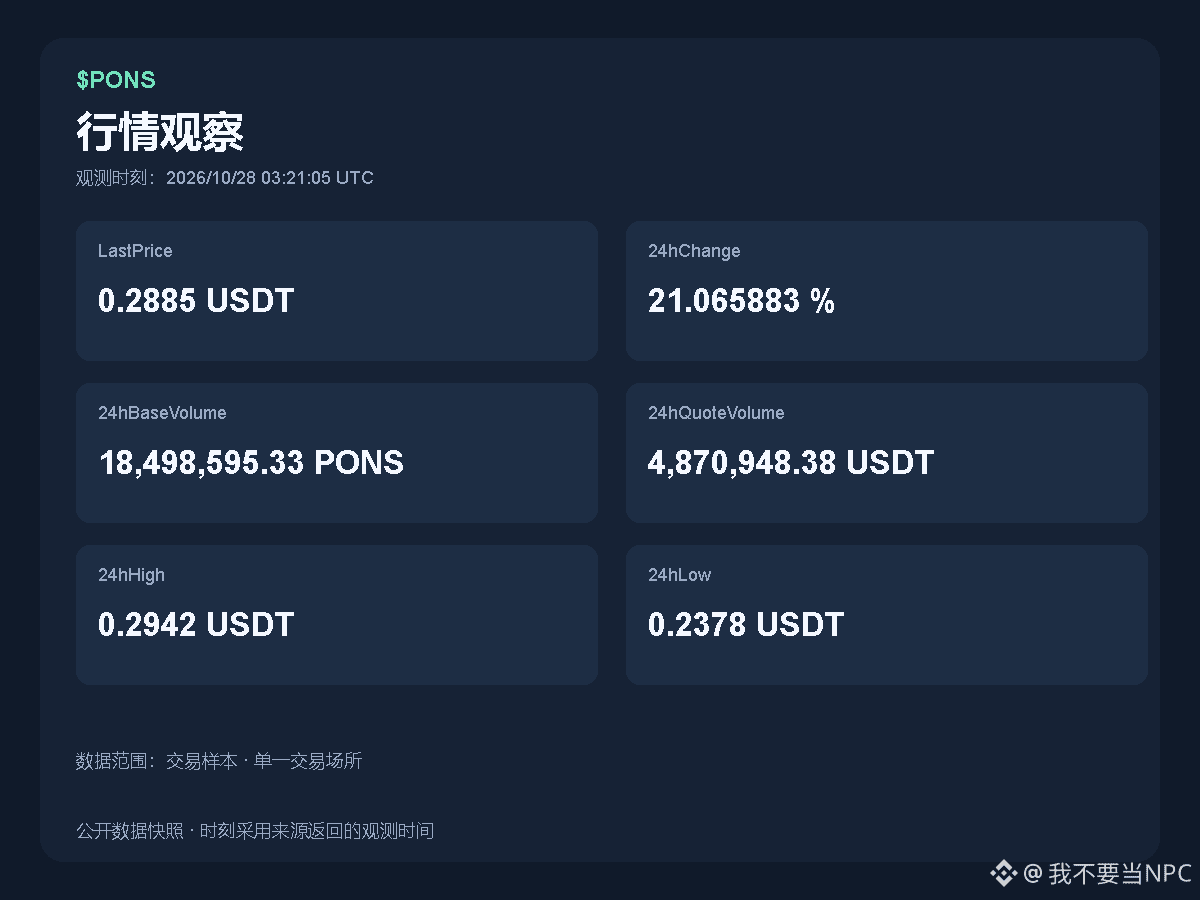
PONS rose 21.07% over 24 hours in the spot sample, reaching 0.2885 USDT. The intraday high was 0.2942 and the low was 0.2378. That’s a fairly wide range: the low was about 20% below the current price, with most of the volatility occurring within the same 24-hour period.
Trading volume during that period was 18,498,595.33 PONS, worth approximately 4.87 million USDT. A one-hour spot snapshot only reflects this set of data; whether the move continues will depend on how price and volume develop.
$PONS
#PONS
#MarketWatch
$PONS
PONS rose 21.07% over 24 hours in the spot sample, reaching 0.2885 USDT. The intraday high was 0.2942 and the low was 0.2378. That’s a fairly wide range: the low was about 20% below the current price, with most of the volatility occurring within the same 24-hour period.
Trading volume during that period was 18,498,595.33 PONS, worth approximately 4.87 million USDT. A one-hour spot snapshot only reflects this set of data; whether the move continues will depend on how price and volume develop.
$PONS
#PONS
#MarketWatch
$PONS
Trading volume during that period was 18,498,595.33 PONS, worth approximately 4.87 million USDT. A one-hour spot snapshot only reflects this set of data; whether the move continues will depend on how price and volume develop.
$PONS
#PONS
#MarketWatch
$PONS
3
Log in to explore more content
Join global crypto users on Binance Square
⚡️ Get latest and useful information about crypto.
💬 Trusted by the world’s largest crypto exchange.
👍 Discover real insights from verified creators.
Email / Phone number
Trending Topics
A Packed Week of Earnings and Data Tests Markets
33,754 views
242 Discussing
🚨🇺🇸 BIG WEEK AHEAD FOR THE MARKETS!
Markets are pricing in a Fed rate hike in December and $BTC could see some big moves next week.
Here's what's coming:
• Monday: Fed Chair Warsh speaks
• Tuesday: US Retail Sales + $NVDA earnings
• Wednesday: FOMC Minutes
• Thursday: Jobless Claims + Philly Fed Index
• Friday: Consumer Sentiment + Fed speeches
All eyes on $BTC as another important week begins.
#bitcoin
Mookie
·8 Likes
·5k views
AnthropicIPOTestsInvestorAppetiteForAI
39,432 views
697 Discussing
BitcoinExtendsLosingStreakToSixWeeks
3,025 views
99 Discussing