

#presidentialdebate
presidentialdebate
668,415 views
309 Discussing
Hot
Latest

·
--
Bullish
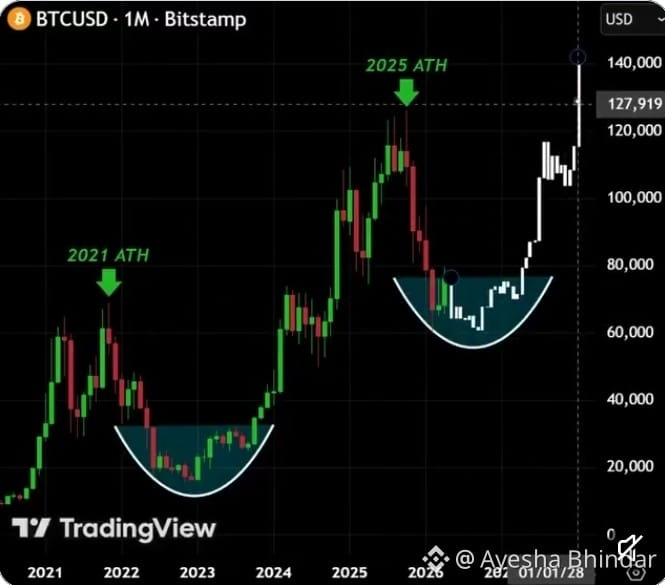
I CAN SMELL A HUGE PUMP.
$BTC ,$ETH ,$ZEC AND ALTS ABOUT TO GO PARABOLIC. 🚀
ALTCOIN SEASON IS GOING TO BE THE BIGGEST ONE YET.
#altcoins #PresidentialDebate #MicronBeatsEarningsLiftsGuidance #USCorePCEEasesTo3%InAugust #UKFCAOpensCryptoFirmAuthorization
I CAN SMELL A HUGE PUMP.
$BTC ,$ETH ,$ZEC AND ALTS ABOUT TO GO PARABOLIC. 🚀
ALTCOIN SEASON IS GOING TO BE THE BIGGEST ONE YET.
#altcoins #PresidentialDebate #MicronBeatsEarningsLiftsGuidance #USCorePCEEasesTo3%InAugust #UKFCAOpensCryptoFirmAuthorization
$BTC ,$ETH ,$ZEC AND ALTS ABOUT TO GO PARABOLIC. 🚀
ALTCOIN SEASON IS GOING TO BE THE BIGGEST ONE YET.
#altcoins #PresidentialDebate #MicronBeatsEarningsLiftsGuidance #USCorePCEEasesTo3%InAugust #UKFCAOpensCryptoFirmAuthorization
174

·
--
Another profitable trade closed! 📈 Successfully booked +13.00% profit on 1000PEPEUSDT Perpetual Short position.
• Entry Price: 0.0042584
• Close Price: 0.0041988
• Realized PNL: +0.11 USDT (+13.00%)
• Leverage: 10x
Consistent gains and strictly following the strategy. On to the next trade! 🚀💸
Hashtags (ہیش ٹیگز):
#cryptouniverseofficial #1000PEPEUSDT #BinanceSquareTalks #PresidentialDebate #tradingStrategy #CryptoProfit #Scalping #TradingLife
Another profitable trade closed! 📈 Successfully booked +13.00% profit on 1000PEPEUSDT Perpetual Short position.
• Entry Price: 0.0042584
• Close Price: 0.0041988
• Realized PNL: +0.11 USDT (+13.00%)
• Leverage: 10x
Consistent gains and strictly following the strategy. On to the next trade! 🚀💸
Hashtags (ہیش ٹیگز):
#cryptouniverseofficial #1000PEPEUSDT #BinanceSquareTalks #PresidentialDebate #tradingStrategy #CryptoProfit #Scalping #TradingLife
• Entry Price: 0.0042584
• Close Price: 0.0041988
• Realized PNL: +0.11 USDT (+13.00%)
• Leverage: 10x
Consistent gains and strictly following the strategy. On to the next trade! 🚀💸
Hashtags (ہیش ٹیگز):
#cryptouniverseofficial #1000PEPEUSDT #BinanceSquareTalks #PresidentialDebate #tradingStrategy #CryptoProfit #Scalping #TradingLife

328

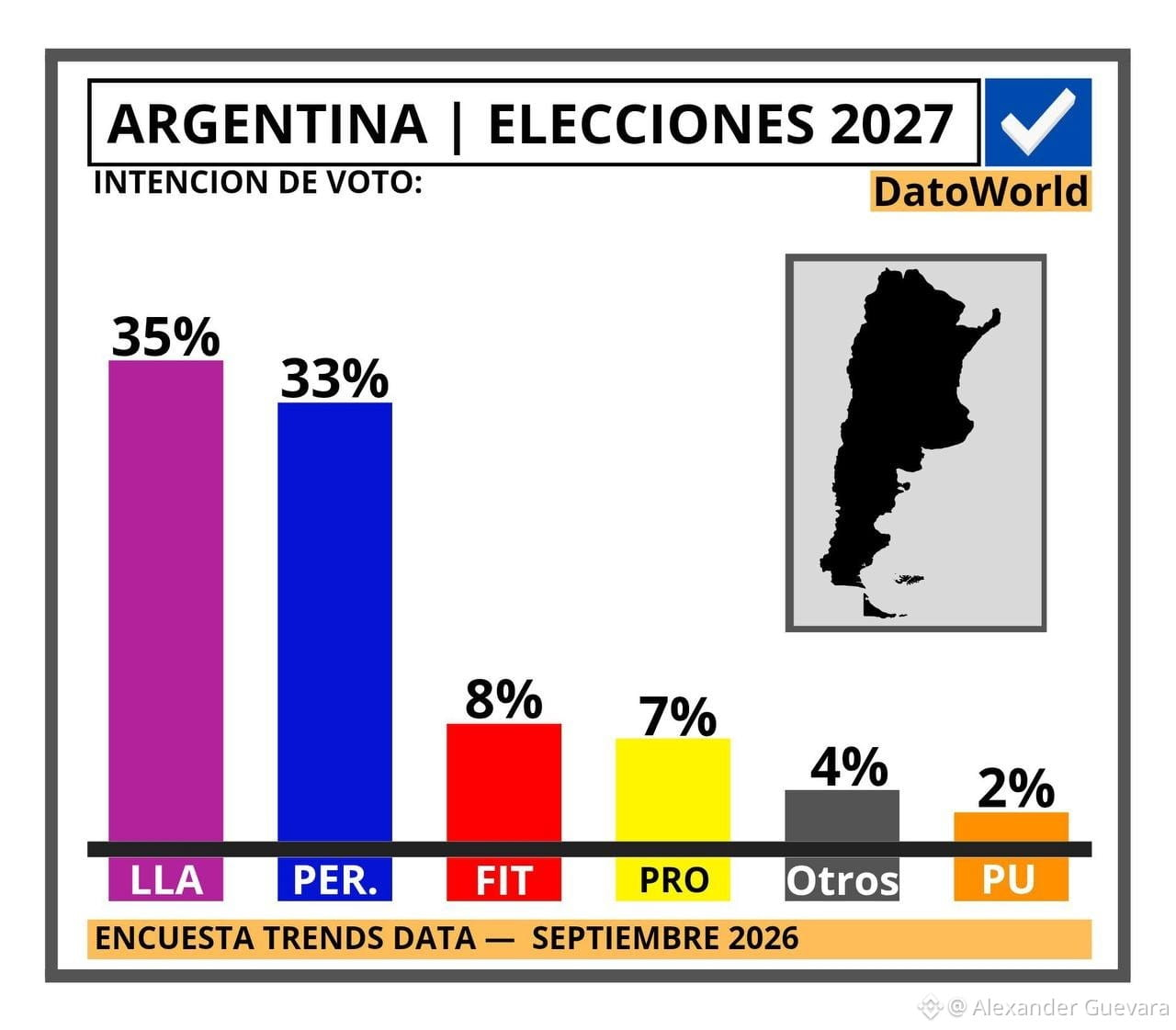
🇦🇷#argentina — Presidential Elections 2027
🟪LLA — 35%
🟦Peronism — 33%
🟥FIT — 8%
🟨PRO — 7%
Trends Data Survey — September 2026
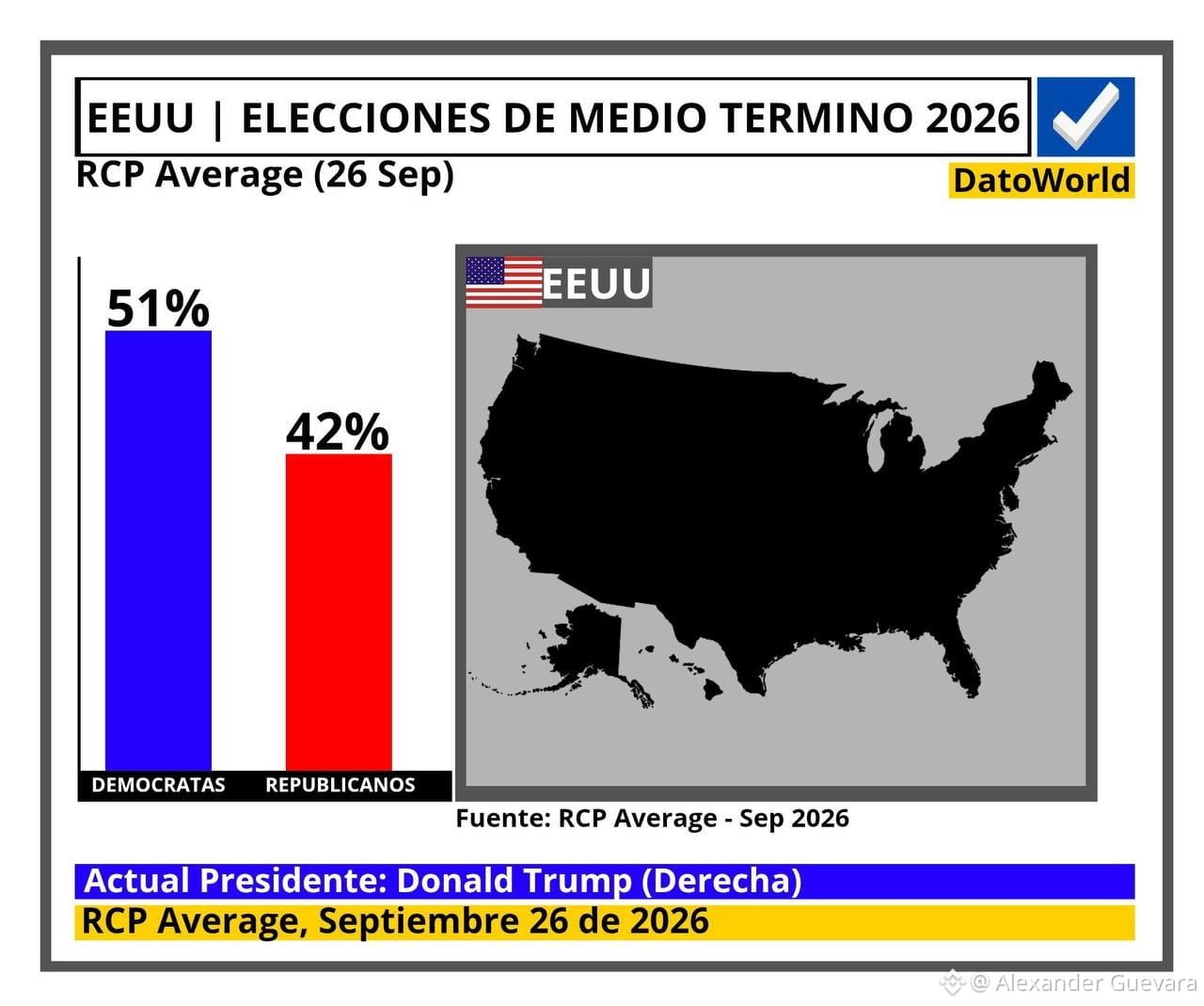
🇺🇸#EEUU - 2026 Midterm Elections
🔵Democrats — 50.6% (+8.7)
🔴Republicans — 41.9%
Average RCP - September 16/2026
#elecciones #2026 #PresidentialDebate $BTC
🇦🇷#argentina — Presidential Elections 2027
🟪LLA — 35%
🟦Peronism — 33%
🟥FIT — 8%
🟨PRO — 7%
Trends Data Survey — September 2026
🇺🇸#EEUU - 2026 Midterm Elections
🔵Democrats — 50.6% (+8.7)
🔴Republicans — 41.9%
Average RCP - September 16/2026
#elecciones #2026 #PresidentialDebate $BTC
🟪LLA — 35%
🟦Peronism — 33%
🟥FIT — 8%
🟨PRO — 7%
Trends Data Survey — September 2026
🇺🇸#EEUU - 2026 Midterm Elections
🔵Democrats — 50.6% (+8.7)
🔴Republicans — 41.9%
Average RCP - September 16/2026
#elecciones #2026 #PresidentialDebate $BTC
440

·
--
$PEPE ($PEPE): The Meme Coin Powered by Community, Culture and Liquidity$PEPE is fundamentally different from Bitcoin, Ethereum, Solana and XRP.
It is not primarily a smart-contract platform, payment network or financial settlement layer.
PEPE is a meme coin.
Its value is largely driven by community attention, internet culture, liquidity, exchange availability and broader cryptocurrency market sentiment.
That makes PEPE particularly interesting—but also particularly risky.
🐸 1. What Is PEPE?
PEPE is an ERC-20 token on Ethereum, inspired by the popular Pepe internet meme.
Unlike Ethereum or Solana, PEPE does not operate its own blockchain.
It uses Ethereum's infrastructure and benefits from Ethereum's security and liquidity.
According to CoinMarketCap's current data, PEPE has approximately:
413.77 trillion PEPE circulating413.77 trillion maximum supplyAround $1.85 billion market capitalizationAround $354 million 24-hour trading volumeMore than 610,000 holders
These figures change continuously with market conditions.
🌐 2. PEPE's Biggest Fundamental: Community
For a traditional cryptocurrency, fundamentals might include technology, revenue, network usage or monetary policy.
For PEPE, one of the most important fundamentals is community attention.
Its ecosystem is driven by:
Meme cultureSocial-media activityCommunity engagementViral trendsExchange accessibilitySpeculative demand
This means PEPE can react much more strongly to changes in online attention than many utility-focused crypto assets.
💧 3. Liquidity Is Critical
A meme coin needs sufficient liquidity for traders to enter and exit positions.
PEPE is currently traded across major centralized and decentralized exchanges, and its reported daily trading volume is substantial relative to its market capitalization.
High liquidity can help PEPE attract traders and maintain a larger market presence.
However, liquidity can also disappear quickly during a broad market sell-off.
📊 4. PEPE Tokenomics
PEPE has approximately 413.77 trillion tokens in circulation, with the same figure reported as its maximum supply.
This is important.
Because the token supply is extremely large, investors should not judge PEPE simply by its very small price per token.
For example:
A token costing $0.000004 is not necessarily "cheap."
Market capitalization is much more meaningful.
The calculation is:
Market Cap = Token Price × Circulating Supply
Therefore, PEPE's future valuation depends on how much capital the market is willing to assign to the entire supply.
🏦 5. Institutional Interest — A New Development
One of the most notable recent developments is that Canary Capital filed for a U.S. spot PEPE ETF.
This is a filing, not evidence that an ETF has been approved.
CoinMarketCap reported that the filing also highlighted significant ownership concentration: the 10 largest PEPE wallet addresses held approximately 41% of circulating supply as of January 2026.
This creates two very different implications.
Potential opportunity
A regulated investment product could potentially make PEPE accessible to a broader investor base.
Important risk
Concentrated ownership means large-wallet activity can potentially have a significant effect on liquidity and price.
🐋 6. Whale Concentration
Wallet concentration is one of the most important risks to monitor.
If a relatively small number of wallets control a significant percentage of circulating tokens, large transactions from those wallets can influence market liquidity.
The recent Canary Capital filing discussion highlighted approximately 41% concentration among the 10 largest addresses as of January 2026.
This does not mean those wallets will sell.
It simply means concentration should be considered when assessing PEPE's market structure.
🔥 7. What Actually Drives PEPE?
PEPE's price is influenced by several major forces:
🐸 Community momentum
More attention can increase trading activity.
📱 Social-media trends
Viral content can rapidly increase interest in meme coins.
💰 Liquidity
Greater trading liquidity can attract more participants.
🏦 Exchange access
Listings and broader trading availability can increase accessibility.
₿ Bitcoin's direction
Meme coins often react strongly to broader crypto-market sentiment.
🌍 Risk appetite
When traders become more willing to take speculative risk, meme coins can receive additional attention.
🚀 8. Potential Catalysts
Several developments could influence PEPE's future market activity.
ETF developments
The recent U.S. spot PEPE ETF filing is an important development to monitor, although a filing should not be confused with approval.
Increased exchange liquidity
More trading access can potentially increase participation.
Social-media momentum
Viral meme culture can rapidly change demand.
Broader crypto bull markets
Meme coins historically tend to attract more attention when speculative appetite across crypto increases.
Community expansion
A larger and more active community can strengthen PEPE's cultural relevance.
⚠️ 9. Major Risks
PEPE has significantly different risks from infrastructure-focused cryptocurrencies.
Extreme volatility
PEPE can experience very large price movements.
Whale concentration
Large holders can influence market liquidity.
Limited traditional utility
PEPE does not have the same type of smart-contract infrastructure or financial utility as Ethereum.
Meme-cycle dependency
Interest can disappear quickly when social-media attention shifts.
Competition
PEPE competes with DOGE, SHIB, BONK and many other meme coins for attention and capital.
Regulatory uncertainty
New financial products involving meme coins may face regulatory scrutiny.
Market dependence
A major Bitcoin or broader crypto-market correction can significantly affect meme-coin sentiment.
🐂 10. Constructive Scenario
A constructive environment for PEPE could involve:
Growing community activityStrong social-media momentumIncreasing trading liquidityBroader exchange accessibilityContinued meme-coin market interestProgress around institutional productsA supportive broader crypto market
These factors could increase market attention.
They do not guarantee a particular PEPE price.
🐻 11. Negative Scenario
The environment could deteriorate if:
Social attention declinesLarge holders distribute tokens aggressivelyLiquidity fallsMeme-coin demand weakensRegulatory developments restrict accessBitcoin and the broader crypto market enter a major risk-off phaseInvestors rotate toward utility-focused assets
📊 12. PEPE Fundamental Dashboard
If you're tracking PEPE seriously, watch:
MetricWhy it mattersPEPE market capOverall valuation24h volumeTrading activityHolder countCommunity growthWhale concentrationSupply riskExchange liquidityEase of buying/sellingSocial-media activityMeme momentumPEPE/ETHRelative strengthPEPE/BTCRelative market performanceEthereum activityUnderlying networkETF/regulatory developmentsInstitutional accessibility
🧠 13. PEPE vs Utility Coins
PEPE should not be evaluated using exactly the same framework as ETH or SOL.
Bitcoin
Scarcity + decentralized monetary asset
Ethereum
Smart contracts + settlement + applications
Solana
High-performance blockchain + payments + applications
XRP
Payments + liquidity + financial settlement
PEPE
Community + meme culture + liquidity + social attention
This difference is extremely important.
PEPE's fundamental value is much more dependent on culture and market psychology than on traditional blockchain utility.
🔥 Final Thoughts
PEPE is one of the clearest examples of how community and internet culture can create a major crypto asset.
Its strengths are its recognition, community, liquidity and accessibility.
Its weaknesses are equally important: high volatility, whale concentration, limited traditional utility and strong dependence on social attention.
The most useful question when analyzing PEPE is therefore not:
"Can PEPE reach $1?"
Instead ask:
"Is PEPE gaining or losing community attention, liquidity, holders and market participation?"
That is the fundamental framework that makes more sense for a meme coin.
PEPE can remain highly relevant in the crypto market, but its risk profile is fundamentally different from infrastructure-focused assets such as BTC, ETH or SOL.
Disclaimer
This article is for educational and informational purposes only. It is not financial advice or a recommendation to buy or sell PEPE. Meme coins can be extremely volatile and can lose substantial value. Always conduct your own research and consider your risk tolerance before making financial decisions.
#PEPE #PresidentialDebate
$PEPE ($PEPE): The Meme Coin Powered by Community, Culture and Liquidity
$PEPE is fundamentally different from Bitcoin, Ethereum, Solana and XRP.
It is not primarily a smart-contract platform, payment network or financial settlement layer.
PEPE is a meme coin.
Its value is largely driven by community attention, internet culture, liquidity, exchange availability and broader cryptocurrency market sentiment.
That makes PEPE particularly interesting—but also particularly risky.
🐸 1. What Is PEPE?
PEPE is an ERC-20 token on Ethereum, inspired by the popular Pepe internet meme.
Unlike Ethereum or Solana, PEPE does not operate its own blockchain.
It uses Ethereum's infrastructure and benefits from Ethereum's security and liquidity.
According to CoinMarketCap's current data, PEPE has approximately:
413.77 trillion PEPE circulating413.77 trillion maximum supplyAround $1.85 billion market capitalizationAround $354 million 24-hour trading volumeMore than 610,000 holders
These figures change continuously with market conditions.
🌐 2. PEPE's Biggest Fundamental: Community
For a traditional cryptocurrency, fundamentals might include technology, revenue, network usage or monetary policy.
For PEPE, one of the most important fundamentals is community attention.
Its ecosystem is driven by:
Meme cultureSocial-media activityCommunity engagementViral trendsExchange accessibilitySpeculative demand
This means PEPE can react much more strongly to changes in online attention than many utility-focused crypto assets.
💧 3. Liquidity Is Critical
A meme coin needs sufficient liquidity for traders to enter and exit positions.
PEPE is currently traded across major centralized and decentralized exchanges, and its reported daily trading volume is substantial relative to its market capitalization.
High liquidity can help PEPE attract traders and maintain a larger market presence.
However, liquidity can also disappear quickly during a broad market sell-off.
📊 4. PEPE Tokenomics
PEPE has approximately 413.77 trillion tokens in circulation, with the same figure reported as its maximum supply.
This is important.
Because the token supply is extremely large, investors should not judge PEPE simply by its very small price per token.
For example:
A token costing $0.000004 is not necessarily "cheap."
Market capitalization is much more meaningful.
The calculation is:
Market Cap = Token Price × Circulating Supply
Therefore, PEPE's future valuation depends on how much capital the market is willing to assign to the entire supply.
🏦 5. Institutional Interest — A New Development
One of the most notable recent developments is that Canary Capital filed for a U.S. spot PEPE ETF.
This is a filing, not evidence that an ETF has been approved.
CoinMarketCap reported that the filing also highlighted significant ownership concentration: the 10 largest PEPE wallet addresses held approximately 41% of circulating supply as of January 2026.
This creates two very different implications.
Potential opportunity
A regulated investment product could potentially make PEPE accessible to a broader investor base.
Important risk
Concentrated ownership means large-wallet activity can potentially have a significant effect on liquidity and price.
🐋 6. Whale Concentration
Wallet concentration is one of the most important risks to monitor.
If a relatively small number of wallets control a significant percentage of circulating tokens, large transactions from those wallets can influence market liquidity.
The recent Canary Capital filing discussion highlighted approximately 41% concentration among the 10 largest addresses as of January 2026.
This does not mean those wallets will sell.
It simply means concentration should be considered when assessing PEPE's market structure.
🔥 7. What Actually Drives PEPE?
PEPE's price is influenced by several major forces:
🐸 Community momentum
More attention can increase trading activity.
📱 Social-media trends
Viral content can rapidly increase interest in meme coins.
💰 Liquidity
Greater trading liquidity can attract more participants.
🏦 Exchange access
Listings and broader trading availability can increase accessibility.
₿ Bitcoin's direction
Meme coins often react strongly to broader crypto-market sentiment.
🌍 Risk appetite
When traders become more willing to take speculative risk, meme coins can receive additional attention.
🚀 8. Potential Catalysts
Several developments could influence PEPE's future market activity.
ETF developments
The recent U.S. spot PEPE ETF filing is an important development to monitor, although a filing should not be confused with approval.
Increased exchange liquidity
More trading access can potentially increase participation.
Social-media momentum
Viral meme culture can rapidly change demand.
Broader crypto bull markets
Meme coins historically tend to attract more attention when speculative appetite across crypto increases.
Community expansion
A larger and more active community can strengthen PEPE's cultural relevance.
⚠️ 9. Major Risks
PEPE has significantly different risks from infrastructure-focused cryptocurrencies.
Extreme volatility
PEPE can experience very large price movements.
Whale concentration
Large holders can influence market liquidity.
Limited traditional utility
PEPE does not have the same type of smart-contract infrastructure or financial utility as Ethereum.
Meme-cycle dependency
Interest can disappear quickly when social-media attention shifts.
Competition
PEPE competes with DOGE, SHIB, BONK and many other meme coins for attention and capital.
Regulatory uncertainty
New financial products involving meme coins may face regulatory scrutiny.
Market dependence
A major Bitcoin or broader crypto-market correction can significantly affect meme-coin sentiment.
🐂 10. Constructive Scenario
A constructive environment for PEPE could involve:
Growing community activityStrong social-media momentumIncreasing trading liquidityBroader exchange accessibilityContinued meme-coin market interestProgress around institutional productsA supportive broader crypto market
These factors could increase market attention.
They do not guarantee a particular PEPE price.
🐻 11. Negative Scenario
The environment could deteriorate if:
Social attention declinesLarge holders distribute tokens aggressivelyLiquidity fallsMeme-coin demand weakensRegulatory developments restrict accessBitcoin and the broader crypto market enter a major risk-off phaseInvestors rotate toward utility-focused assets
📊 12. PEPE Fundamental Dashboard
If you're tracking PEPE seriously, watch:
MetricWhy it mattersPEPE market capOverall valuation24h volumeTrading activityHolder countCommunity growthWhale concentrationSupply riskExchange liquidityEase of buying/sellingSocial-media activityMeme momentumPEPE/ETHRelative strengthPEPE/BTCRelative market performanceEthereum activityUnderlying networkETF/regulatory developmentsInstitutional accessibility
🧠 13. PEPE vs Utility Coins
PEPE should not be evaluated using exactly the same framework as ETH or SOL.
Bitcoin
Scarcity + decentralized monetary asset
Ethereum
Smart contracts + settlement + applications
Solana
High-performance blockchain + payments + applications
XRP
Payments + liquidity + financial settlement
PEPE
Community + meme culture + liquidity + social attention
This difference is extremely important.
PEPE's fundamental value is much more dependent on culture and market psychology than on traditional blockchain utility.
🔥 Final Thoughts
PEPE is one of the clearest examples of how community and internet culture can create a major crypto asset.
Its strengths are its recognition, community, liquidity and accessibility.
Its weaknesses are equally important: high volatility, whale concentration, limited traditional utility and strong dependence on social attention.
The most useful question when analyzing PEPE is therefore not:
"Can PEPE reach $1?"
Instead ask:
"Is PEPE gaining or losing community attention, liquidity, holders and market participation?"
That is the fundamental framework that makes more sense for a meme coin.
PEPE can remain highly relevant in the crypto market, but its risk profile is fundamentally different from infrastructure-focused assets such as BTC, ETH or SOL.
Disclaimer
This article is for educational and informational purposes only. It is not financial advice or a recommendation to buy or sell PEPE. Meme coins can be extremely volatile and can lose substantial value. Always conduct your own research and consider your risk tolerance before making financial decisions.
#PEPE #PresidentialDebate
It is not primarily a smart-contract platform, payment network or financial settlement layer.
PEPE is a meme coin.
Its value is largely driven by community attention, internet culture, liquidity, exchange availability and broader cryptocurrency market sentiment.
That makes PEPE particularly interesting—but also particularly risky.
🐸 1. What Is PEPE?
PEPE is an ERC-20 token on Ethereum, inspired by the popular Pepe internet meme.
Unlike Ethereum or Solana, PEPE does not operate its own blockchain.
It uses Ethereum's infrastructure and benefits from Ethereum's security and liquidity.
According to CoinMarketCap's current data, PEPE has approximately:
413.77 trillion PEPE circulating413.77 trillion maximum supplyAround $1.85 billion market capitalizationAround $354 million 24-hour trading volumeMore than 610,000 holders
These figures change continuously with market conditions.
🌐 2. PEPE's Biggest Fundamental: Community
For a traditional cryptocurrency, fundamentals might include technology, revenue, network usage or monetary policy.
For PEPE, one of the most important fundamentals is community attention.
Its ecosystem is driven by:
Meme cultureSocial-media activityCommunity engagementViral trendsExchange accessibilitySpeculative demand
This means PEPE can react much more strongly to changes in online attention than many utility-focused crypto assets.
💧 3. Liquidity Is Critical
A meme coin needs sufficient liquidity for traders to enter and exit positions.
PEPE is currently traded across major centralized and decentralized exchanges, and its reported daily trading volume is substantial relative to its market capitalization.
High liquidity can help PEPE attract traders and maintain a larger market presence.
However, liquidity can also disappear quickly during a broad market sell-off.
📊 4. PEPE Tokenomics
PEPE has approximately 413.77 trillion tokens in circulation, with the same figure reported as its maximum supply.
This is important.
Because the token supply is extremely large, investors should not judge PEPE simply by its very small price per token.
For example:
A token costing $0.000004 is not necessarily "cheap."
Market capitalization is much more meaningful.
The calculation is:
Market Cap = Token Price × Circulating Supply
Therefore, PEPE's future valuation depends on how much capital the market is willing to assign to the entire supply.
🏦 5. Institutional Interest — A New Development
One of the most notable recent developments is that Canary Capital filed for a U.S. spot PEPE ETF.
This is a filing, not evidence that an ETF has been approved.
CoinMarketCap reported that the filing also highlighted significant ownership concentration: the 10 largest PEPE wallet addresses held approximately 41% of circulating supply as of January 2026.
This creates two very different implications.
Potential opportunity
A regulated investment product could potentially make PEPE accessible to a broader investor base.
Important risk
Concentrated ownership means large-wallet activity can potentially have a significant effect on liquidity and price.
🐋 6. Whale Concentration
Wallet concentration is one of the most important risks to monitor.
If a relatively small number of wallets control a significant percentage of circulating tokens, large transactions from those wallets can influence market liquidity.
The recent Canary Capital filing discussion highlighted approximately 41% concentration among the 10 largest addresses as of January 2026.
This does not mean those wallets will sell.
It simply means concentration should be considered when assessing PEPE's market structure.
🔥 7. What Actually Drives PEPE?
PEPE's price is influenced by several major forces:
🐸 Community momentum
More attention can increase trading activity.
📱 Social-media trends
Viral content can rapidly increase interest in meme coins.
💰 Liquidity
Greater trading liquidity can attract more participants.
🏦 Exchange access
Listings and broader trading availability can increase accessibility.
₿ Bitcoin's direction
Meme coins often react strongly to broader crypto-market sentiment.
🌍 Risk appetite
When traders become more willing to take speculative risk, meme coins can receive additional attention.
🚀 8. Potential Catalysts
Several developments could influence PEPE's future market activity.
ETF developments
The recent U.S. spot PEPE ETF filing is an important development to monitor, although a filing should not be confused with approval.
Increased exchange liquidity
More trading access can potentially increase participation.
Social-media momentum
Viral meme culture can rapidly change demand.
Broader crypto bull markets
Meme coins historically tend to attract more attention when speculative appetite across crypto increases.
Community expansion
A larger and more active community can strengthen PEPE's cultural relevance.
⚠️ 9. Major Risks
PEPE has significantly different risks from infrastructure-focused cryptocurrencies.
Extreme volatility
PEPE can experience very large price movements.
Whale concentration
Large holders can influence market liquidity.
Limited traditional utility
PEPE does not have the same type of smart-contract infrastructure or financial utility as Ethereum.
Meme-cycle dependency
Interest can disappear quickly when social-media attention shifts.
Competition
PEPE competes with DOGE, SHIB, BONK and many other meme coins for attention and capital.
Regulatory uncertainty
New financial products involving meme coins may face regulatory scrutiny.
Market dependence
A major Bitcoin or broader crypto-market correction can significantly affect meme-coin sentiment.
🐂 10. Constructive Scenario
A constructive environment for PEPE could involve:
Growing community activityStrong social-media momentumIncreasing trading liquidityBroader exchange accessibilityContinued meme-coin market interestProgress around institutional productsA supportive broader crypto market
These factors could increase market attention.
They do not guarantee a particular PEPE price.
🐻 11. Negative Scenario
The environment could deteriorate if:
Social attention declinesLarge holders distribute tokens aggressivelyLiquidity fallsMeme-coin demand weakensRegulatory developments restrict accessBitcoin and the broader crypto market enter a major risk-off phaseInvestors rotate toward utility-focused assets
📊 12. PEPE Fundamental Dashboard
If you're tracking PEPE seriously, watch:
MetricWhy it mattersPEPE market capOverall valuation24h volumeTrading activityHolder countCommunity growthWhale concentrationSupply riskExchange liquidityEase of buying/sellingSocial-media activityMeme momentumPEPE/ETHRelative strengthPEPE/BTCRelative market performanceEthereum activityUnderlying networkETF/regulatory developmentsInstitutional accessibility
🧠 13. PEPE vs Utility Coins
PEPE should not be evaluated using exactly the same framework as ETH or SOL.
Bitcoin
Scarcity + decentralized monetary asset
Ethereum
Smart contracts + settlement + applications
Solana
High-performance blockchain + payments + applications
XRP
Payments + liquidity + financial settlement
PEPE
Community + meme culture + liquidity + social attention
This difference is extremely important.
PEPE's fundamental value is much more dependent on culture and market psychology than on traditional blockchain utility.
🔥 Final Thoughts
PEPE is one of the clearest examples of how community and internet culture can create a major crypto asset.
Its strengths are its recognition, community, liquidity and accessibility.
Its weaknesses are equally important: high volatility, whale concentration, limited traditional utility and strong dependence on social attention.
The most useful question when analyzing PEPE is therefore not:
"Can PEPE reach $1?"
Instead ask:
"Is PEPE gaining or losing community attention, liquidity, holders and market participation?"
That is the fundamental framework that makes more sense for a meme coin.
PEPE can remain highly relevant in the crypto market, but its risk profile is fundamentally different from infrastructure-focused assets such as BTC, ETH or SOL.
Disclaimer
This article is for educational and informational purposes only. It is not financial advice or a recommendation to buy or sell PEPE. Meme coins can be extremely volatile and can lose substantial value. Always conduct your own research and consider your risk tolerance before making financial decisions.
#PEPE #PresidentialDebate
74

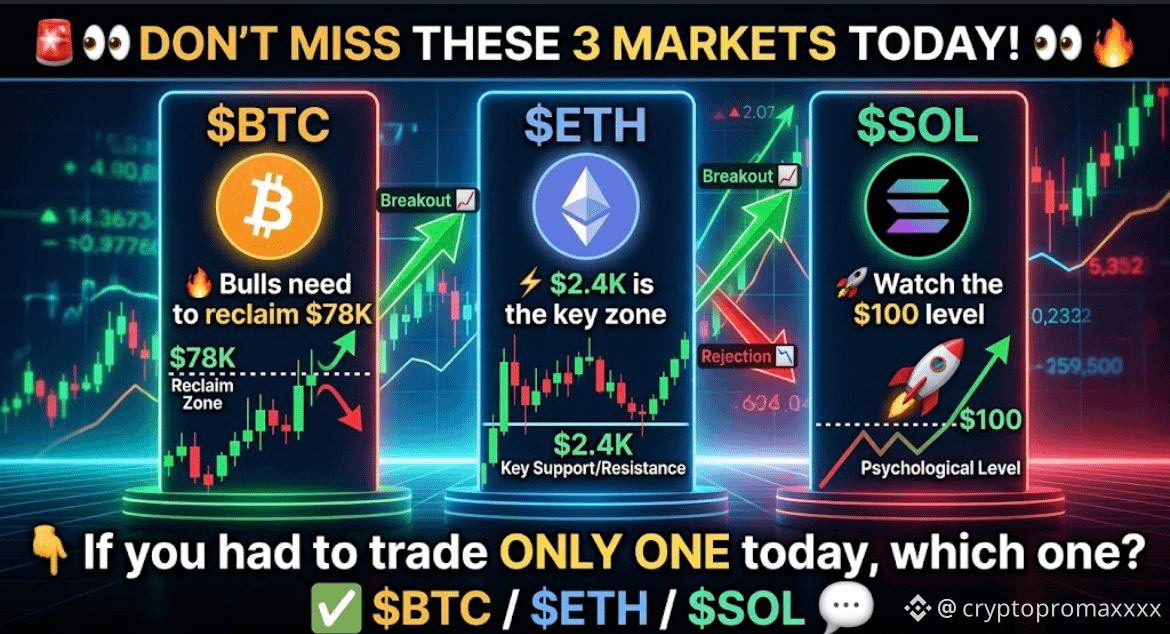
🚨 **DON’T MISS THESE 3 MARKETS TODAY!** 👀🔥
Crypto is getting volatile again… and these 3 are on my radar:
🔥 **$BTC ** — Bulls need to reclaim **$78K**
⚡ **$ETH ** — **$2.4K** is the key zone
🚀 **$SOL** — Watch the **$100** level
Breakout 📈 = momentum
Rejection 📉 = deeper pullback
I’m watching these closely. 👀
👇 **If you had to trade ONLY ONE today, which one?**
**$BTC / #ETH/ #SOL** 💬
#BitcoinETFsShed$450M #PresidentialDebate
{spot}(BTCUSDT)
{spot}(ETHUSDT)
{spot}(SOLUSDT)
🚨 **DON’T MISS THESE 3 MARKETS TODAY!** 👀🔥
Crypto is getting volatile again… and these 3 are on my radar:
🔥 **$BTC ** — Bulls need to reclaim **$78K**
⚡ **$ETH ** — **$2.4K** is the key zone
🚀 **$SOL** — Watch the **$100** level
Breakout 📈 = momentum
Rejection 📉 = deeper pullback
I’m watching these closely. 👀
👇 **If you had to trade ONLY ONE today, which one?**
**$BTC / #ETH/ #SOL** 💬
#BitcoinETFsShed$450M #PresidentialDebate
Crypto is getting volatile again… and these 3 are on my radar:
🔥 **$BTC ** — Bulls need to reclaim **$78K**
⚡ **$ETH ** — **$2.4K** is the key zone
🚀 **$SOL** — Watch the **$100** level
Breakout 📈 = momentum
Rejection 📉 = deeper pullback
I’m watching these closely. 👀
👇 **If you had to trade ONLY ONE today, which one?**
**$BTC / #ETH/ #SOL** 💬
#BitcoinETFsShed$450M #PresidentialDebate
36

·
--
$UAI There will be a massive decline due to profit-taking
Entry: 0.605–0.615
🎯 Target 1: 0.580
🎯 Target 2: 0.550
🎯 Target 3: 0.520
🛑 Stop Loss: 0.635
$AKE $ON
#etheretfsextendinflowstreakto11day #XORA #Write2Earn #PresidentialDebate #VOTEme
{future}(UAIUSDT)
{future}(AKEUSDT)
{future}(ONUSDT)
$UAI There will be a massive decline due to profit-taking
Entry: 0.605–0.615
🎯 Target 1: 0.580
🎯 Target 2: 0.550
🎯 Target 3: 0.520
🛑 Stop Loss: 0.635
$AKE $ON
#etheretfsextendinflowstreakto11day #XORA #Write2Earn #PresidentialDebate #VOTEme
Entry: 0.605–0.615
🎯 Target 1: 0.580
🎯 Target 2: 0.550
🎯 Target 3: 0.520
🛑 Stop Loss: 0.635
$AKE $ON
#etheretfsextendinflowstreakto11day #XORA #Write2Earn #PresidentialDebate #VOTEme
363
3
17
363

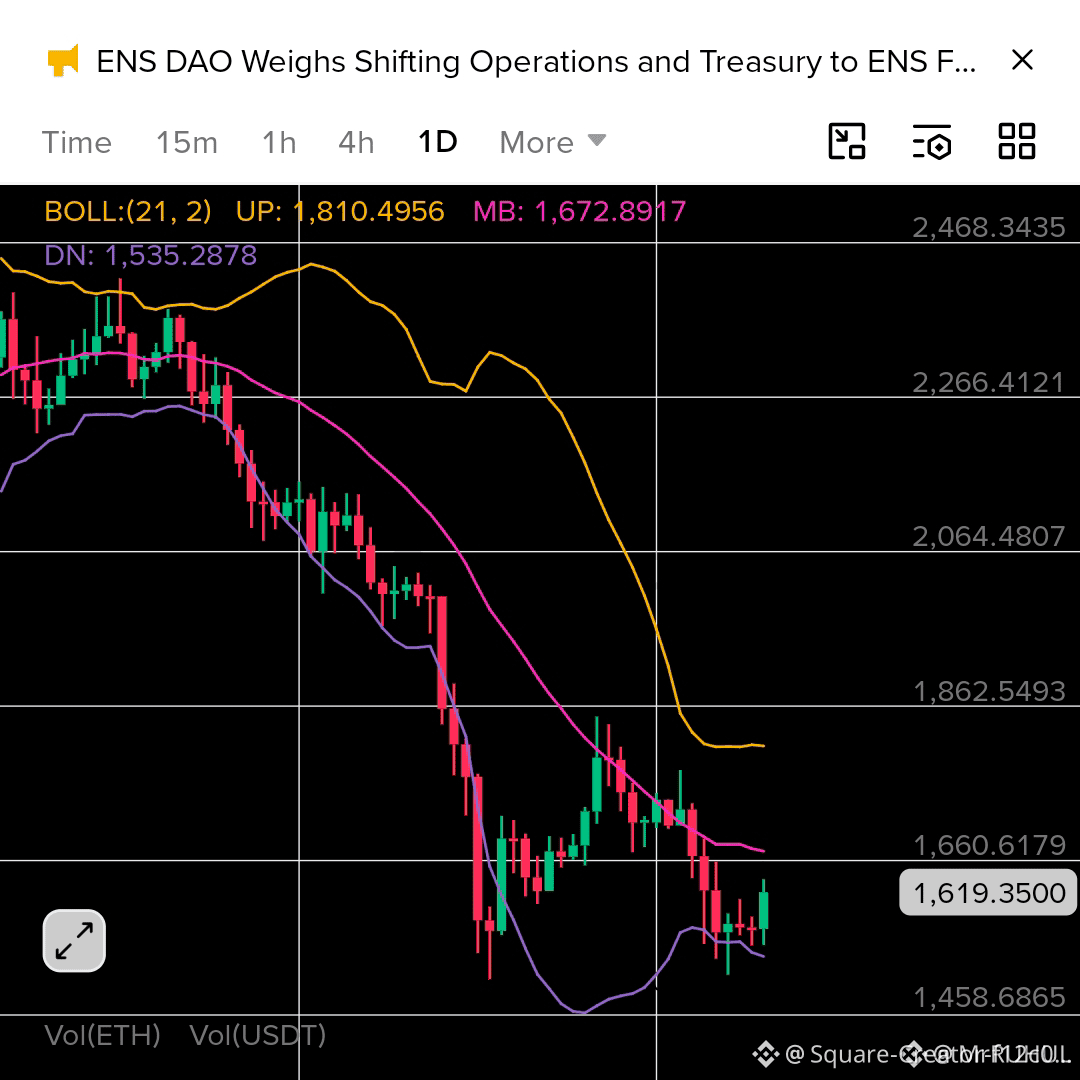
$ETH Ethereum was on a bearish trend, but it is showing some stability. The price is currently holding around 1,619. It may bounce toward 1,720–1,740 if it breaks above the 1,680 level, but if selling pressure returns, it could test lower levels near 1,520–1,540.
Buy (Long)
Entry: 1,580 – 1,640
Stop Loss (SL): 1,510
Target 1 (TP1): 1,720
Target 2 (TP2): 1,820
Press below to take the trade 👇
$ETH
{future}(ETHUSDT)
#PEPE #PresidentialDebate #PavelDurov #Polygon #play
$ETH Ethereum was on a bearish trend, but it is showing some stability. The price is currently holding around 1,619. It may bounce toward 1,720–1,740 if it breaks above the 1,680 level, but if selling pressure returns, it could test lower levels near 1,520–1,540.
Buy (Long)
Entry: 1,580 – 1,640
Stop Loss (SL): 1,510
Target 1 (TP1): 1,720
Target 2 (TP2): 1,820
Press below to take the trade 👇
$ETH
#PEPE #PresidentialDebate #PavelDurov #Polygon #play
Buy (Long)
Entry: 1,580 – 1,640
Stop Loss (SL): 1,510
Target 1 (TP1): 1,720
Target 2 (TP2): 1,820
Press below to take the trade 👇
$ETH
#PEPE #PresidentialDebate #PavelDurov #Polygon #play
1
104

·
--
Bullish
BREAKING:👇
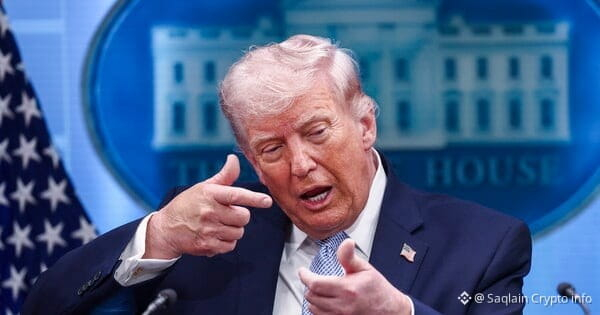
President Trump says he will punish members of NATO who didn't support the US against Iran.
$APE $SOON $pippin
{alpha}(CT_501Dfh5DzRgSvvCFDoYc2ciTkMrbDfRKybA4SoFbPmApump)
{future}(SOONUSDT)
{spot}(APEUSDT)
#PresidentialDebate #nato #DonaldTrump #news
BREAKING:👇
President Trump says he will punish members of NATO who didn't support the US against Iran.
$APE $SOON $pippin
#PresidentialDebate #nato #DonaldTrump #news
President Trump says he will punish members of NATO who didn't support the US against Iran.
$APE $SOON $pippin
#PresidentialDebate #nato #DonaldTrump #news

137

Stables CEO Says Migrant Flows Favor USDT, Driving 60% Cross-Border Dollar DemandAsia reportedly drives nearly half of global stablecoin flows, powering cross-border trade and institutional liquidity. Yet in the major banks of Singapore, Hong Kong, and Jakarta, reception to stablecoins remains distinctly cold.
While some observers attribute this to a “generational gap” or a lack of technical understanding, Bernardo Bilotta, CEO and co-founder of Stables, argues that the reality is far more calculated. According to Bilotta, the reluctance of Asian banks to embrace stablecoins is not a failure of imagination but a masterclass in institutional self-preservation.
For a commercial bank, the most critical asset on the balance sheet is not cash or property; it is the relationship with the central bank. In many Southeast Asian markets, the regulatory environment for digital assets remains a moving target.
Taking on stablecoin exposure, even just for processing, means taking on reputational risk with the regulator before the rules are fully settled,” Bilotta said. In an environment where guidance can tighten significantly from one quarter to the next with little warning, the risk of a regulatory pivot makes long-term infrastructure investment a gamble most banks are unwilling to take.
Beyond local regulators, Asian banks must answer to a global hierarchy. To facilitate international trade, these institutions rely on correspondent banking relationships with partners in New York and London.
Bilotta points out a harsh reality of the current global financial plumbing: Compliance teams in Western financial hubs are notoriously risk-averse. If a bank in Jakarta or Bangkok begins dabbling in stablecoins, it risks being flagged by its Western partners. The threat of having a correspondent relationship terminated—effectively cutting a bank off from the U.S. dollar or euro markets—is a survival logic that far outweighs the potential profits of stablecoin integration.
Even for banks willing to look past the risk, a new hurdle has emerged: regulatory fragmentation. Across Asia, jurisdictions are taking vastly different paths. Singapore, for instance, has embedded stablecoin rules into its existing Payment Services Act, while Hong Kong recently enacted a standalone Stablecoins Ordinance.
Critics argue these silos hamper growth, as a token compliant in one city may face hurdles just an hour’s flight away. However, Bilotta views this not as a roadblock but as a necessary phase of convergence.
Framing it as purely a problem misses what’s actually happening,” Bilotta said. “Singapore and Hong Kong have different approaches to the same goal: treating stablecoins as regulated payment instruments. The underlying principles—reserve backing, redemption rights, and AML compliance—are converging.”
Until the cost of inaction exceeds the cost of action, the status quo holds,” Bilotta said. The cautious stance of Asian banks isn’t irrational—it is a defensive crouch. However, as the infrastructure layer becomes more robust and local-currency tokens begin to solve the “last-mile” problem, the pressure on these institutions will only grow. The question for Asia’s banking sector is no longer whether they understand the technology but how much longer they can afford to prioritize survival over evolution.
#PresidentialDebate
#IONToken
#MantaRWA
#NOTCOİN
Stables CEO Says Migrant Flows Favor USDT, Driving 60% Cross-Border Dollar Demand
Asia reportedly drives nearly half of global stablecoin flows, powering cross-border trade and institutional liquidity. Yet in the major banks of Singapore, Hong Kong, and Jakarta, reception to stablecoins remains distinctly cold.
While some observers attribute this to a “generational gap” or a lack of technical understanding, Bernardo Bilotta, CEO and co-founder of Stables, argues that the reality is far more calculated. According to Bilotta, the reluctance of Asian banks to embrace stablecoins is not a failure of imagination but a masterclass in institutional self-preservation.
For a commercial bank, the most critical asset on the balance sheet is not cash or property; it is the relationship with the central bank. In many Southeast Asian markets, the regulatory environment for digital assets remains a moving target.
Taking on stablecoin exposure, even just for processing, means taking on reputational risk with the regulator before the rules are fully settled,” Bilotta said. In an environment where guidance can tighten significantly from one quarter to the next with little warning, the risk of a regulatory pivot makes long-term infrastructure investment a gamble most banks are unwilling to take.
Beyond local regulators, Asian banks must answer to a global hierarchy. To facilitate international trade, these institutions rely on correspondent banking relationships with partners in New York and London.
Bilotta points out a harsh reality of the current global financial plumbing: Compliance teams in Western financial hubs are notoriously risk-averse. If a bank in Jakarta or Bangkok begins dabbling in stablecoins, it risks being flagged by its Western partners. The threat of having a correspondent relationship terminated—effectively cutting a bank off from the U.S. dollar or euro markets—is a survival logic that far outweighs the potential profits of stablecoin integration.
Even for banks willing to look past the risk, a new hurdle has emerged: regulatory fragmentation. Across Asia, jurisdictions are taking vastly different paths. Singapore, for instance, has embedded stablecoin rules into its existing Payment Services Act, while Hong Kong recently enacted a standalone Stablecoins Ordinance.
Critics argue these silos hamper growth, as a token compliant in one city may face hurdles just an hour’s flight away. However, Bilotta views this not as a roadblock but as a necessary phase of convergence.
Framing it as purely a problem misses what’s actually happening,” Bilotta said. “Singapore and Hong Kong have different approaches to the same goal: treating stablecoins as regulated payment instruments. The underlying principles—reserve backing, redemption rights, and AML compliance—are converging.”
Until the cost of inaction exceeds the cost of action, the status quo holds,” Bilotta said. The cautious stance of Asian banks isn’t irrational—it is a defensive crouch. However, as the infrastructure layer becomes more robust and local-currency tokens begin to solve the “last-mile” problem, the pressure on these institutions will only grow. The question for Asia’s banking sector is no longer whether they understand the technology but how much longer they can afford to prioritize survival over evolution.
#PresidentialDebate
#IONToken
#MantaRWA
#NOTCOİN
While some observers attribute this to a “generational gap” or a lack of technical understanding, Bernardo Bilotta, CEO and co-founder of Stables, argues that the reality is far more calculated. According to Bilotta, the reluctance of Asian banks to embrace stablecoins is not a failure of imagination but a masterclass in institutional self-preservation.
For a commercial bank, the most critical asset on the balance sheet is not cash or property; it is the relationship with the central bank. In many Southeast Asian markets, the regulatory environment for digital assets remains a moving target.
Taking on stablecoin exposure, even just for processing, means taking on reputational risk with the regulator before the rules are fully settled,” Bilotta said. In an environment where guidance can tighten significantly from one quarter to the next with little warning, the risk of a regulatory pivot makes long-term infrastructure investment a gamble most banks are unwilling to take.
Beyond local regulators, Asian banks must answer to a global hierarchy. To facilitate international trade, these institutions rely on correspondent banking relationships with partners in New York and London.
Bilotta points out a harsh reality of the current global financial plumbing: Compliance teams in Western financial hubs are notoriously risk-averse. If a bank in Jakarta or Bangkok begins dabbling in stablecoins, it risks being flagged by its Western partners. The threat of having a correspondent relationship terminated—effectively cutting a bank off from the U.S. dollar or euro markets—is a survival logic that far outweighs the potential profits of stablecoin integration.
Even for banks willing to look past the risk, a new hurdle has emerged: regulatory fragmentation. Across Asia, jurisdictions are taking vastly different paths. Singapore, for instance, has embedded stablecoin rules into its existing Payment Services Act, while Hong Kong recently enacted a standalone Stablecoins Ordinance.
Critics argue these silos hamper growth, as a token compliant in one city may face hurdles just an hour’s flight away. However, Bilotta views this not as a roadblock but as a necessary phase of convergence.
Framing it as purely a problem misses what’s actually happening,” Bilotta said. “Singapore and Hong Kong have different approaches to the same goal: treating stablecoins as regulated payment instruments. The underlying principles—reserve backing, redemption rights, and AML compliance—are converging.”
Until the cost of inaction exceeds the cost of action, the status quo holds,” Bilotta said. The cautious stance of Asian banks isn’t irrational—it is a defensive crouch. However, as the infrastructure layer becomes more robust and local-currency tokens begin to solve the “last-mile” problem, the pressure on these institutions will only grow. The question for Asia’s banking sector is no longer whether they understand the technology but how much longer they can afford to prioritize survival over evolution.
#PresidentialDebate
#IONToken
#MantaRWA
#NOTCOİN
326

·
--
Bullish
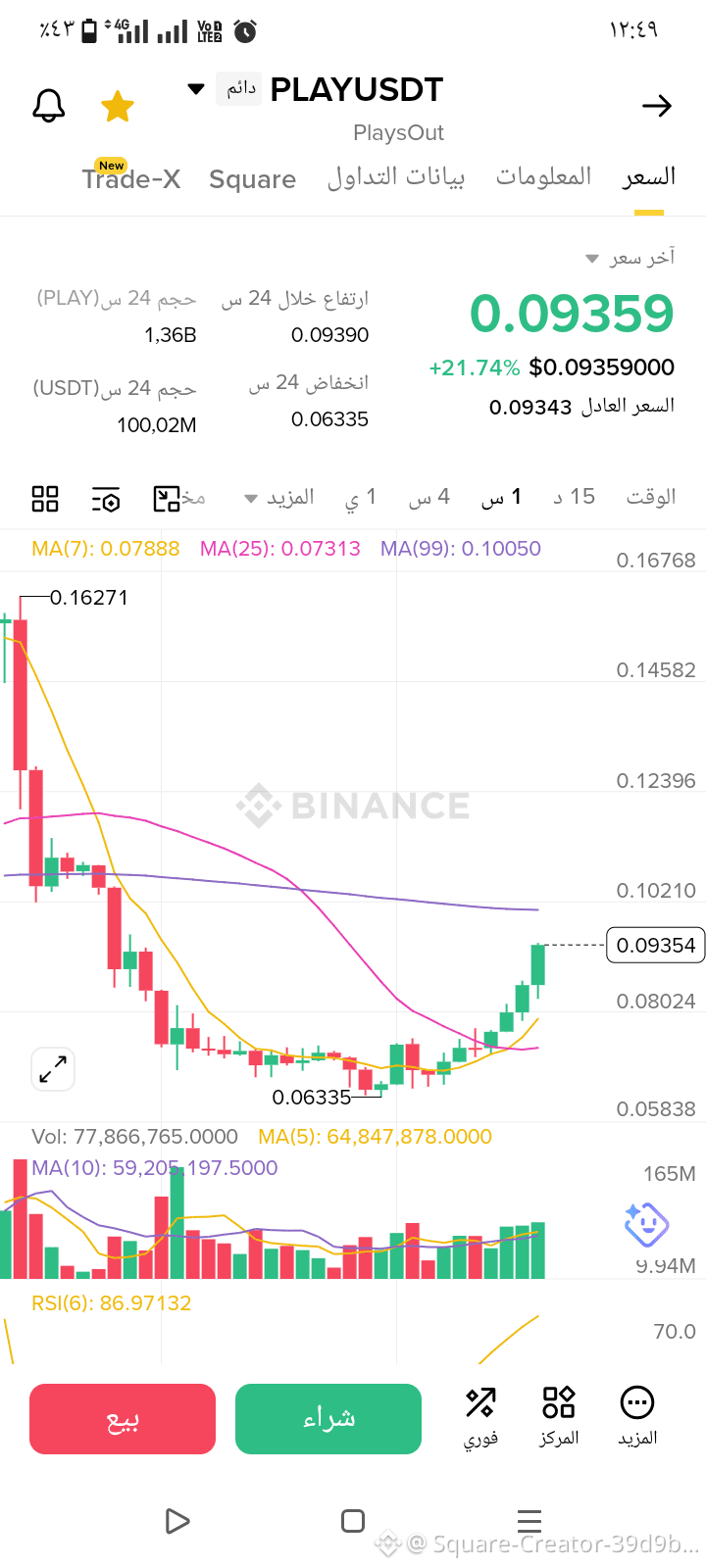
It's time for a quick buy 🚴🏃
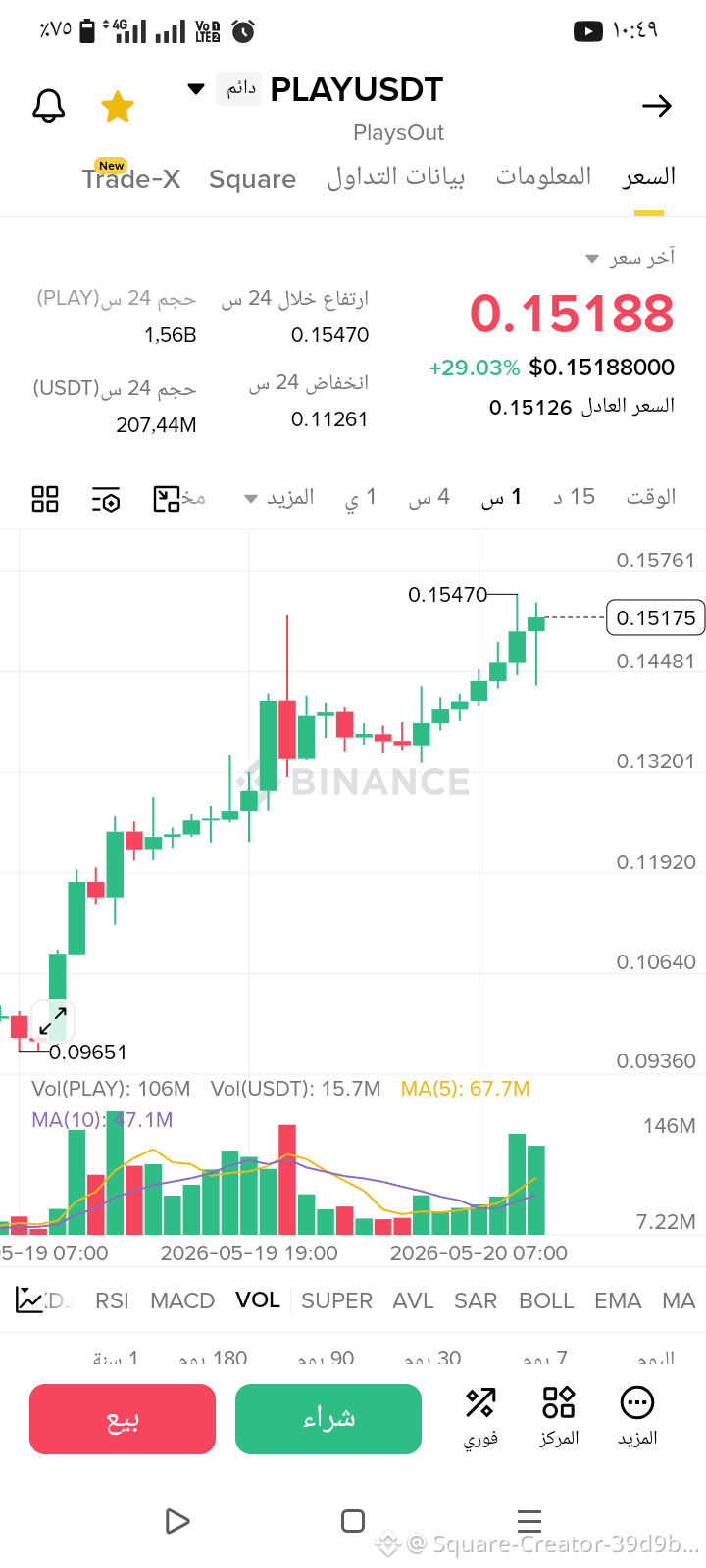
The uptrend is super strong at $PLAY 🔥😱
The momentum has come back hard and trading volume is clearly on the rise, and the market is watching for new breakouts that could push the price to higher levels soon 📈
Coinfomania +1
Seize this opportunity and jump in for a buy right now 👇
$PLAY
{future}(PLAYUSDT)
#PresidentialDebate #SECProposesIPORuleOverhaul #TruthSocialWithdrawsBitcoinETF
It's time for a quick buy 🚴🏃
The uptrend is super strong at $PLAY 🔥😱
The momentum has come back hard and trading volume is clearly on the rise, and the market is watching for new breakouts that could push the price to higher levels soon 📈
Coinfomania +1
Seize this opportunity and jump in for a buy right now 👇
$PLAY
#PresidentialDebate #SECProposesIPORuleOverhaul #TruthSocialWithdrawsBitcoinETF
The uptrend is super strong at $PLAY 🔥😱
The momentum has come back hard and trading volume is clearly on the rise, and the market is watching for new breakouts that could push the price to higher levels soon 📈
Coinfomania +1
Seize this opportunity and jump in for a buy right now 👇
$PLAY
#PresidentialDebate #SECProposesIPORuleOverhaul #TruthSocialWithdrawsBitcoinETF
1
199

·
--
🚨🛢️ OIL SURGES, MARKETS ON EDGE
Brent Crude
$BTC
$XRP
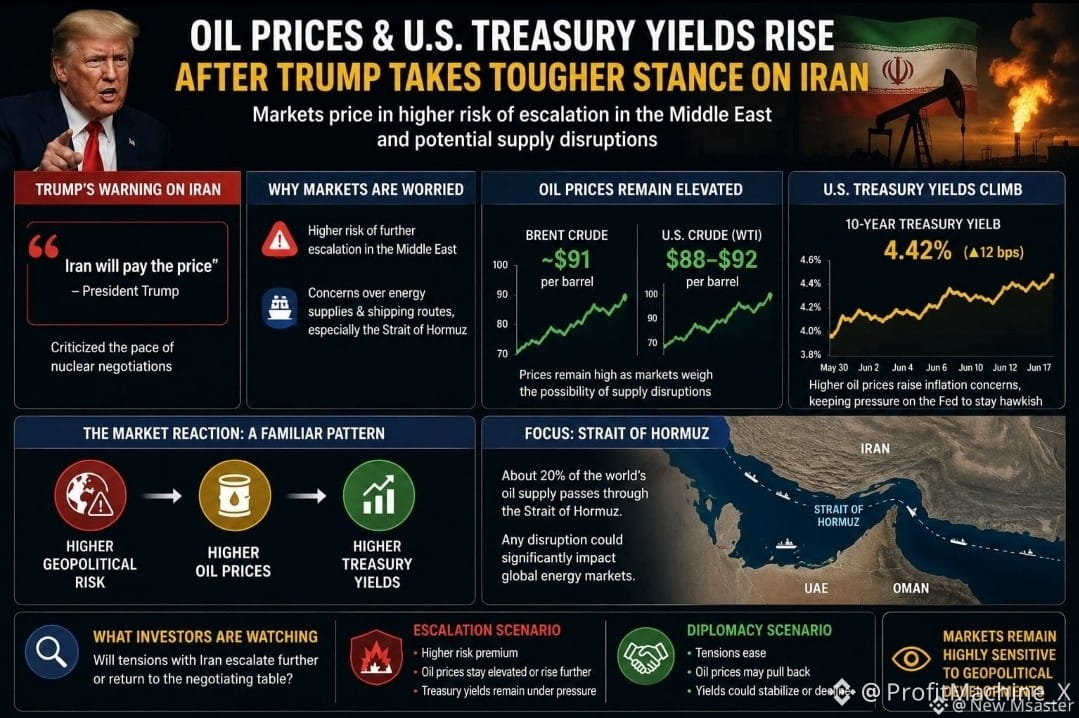
⚠️ Rising tensions with Iran are keeping markets nervous.
🛢️ Brent crude remains near $91/barrel
📈 U.S. Treasury yields move higher
🔥 Higher oil = higher inflation fears
💡 MARKET CONCERN:
• Energy costs could stay elevated
• Fed may keep rates higher for longer
• Risk assets face additional pressure
👀 WHAT TRADERS ARE WATCHING:
• Iran-related headlines
• Oil price reactions
• Federal Reserve expectations
💀 SIMPLE TRUTH:
When oil rises fast, markets start pricing in inflation before anything else.
🚨 NEXT MOVE DEPENDS ON ONE THING:
Escalation... or negotiations.
#oil #PresidentialDebate #IranIsraelConflict
🚨🛢️ OIL SURGES, MARKETS ON EDGE
Brent Crude
$BTC
$XRP
⚠️ Rising tensions with Iran are keeping markets nervous.
🛢️ Brent crude remains near $91/barrel
📈 U.S. Treasury yields move higher
🔥 Higher oil = higher inflation fears
💡 MARKET CONCERN:
• Energy costs could stay elevated
• Fed may keep rates higher for longer
• Risk assets face additional pressure
👀 WHAT TRADERS ARE WATCHING:
• Iran-related headlines
• Oil price reactions
• Federal Reserve expectations
💀 SIMPLE TRUTH:
When oil rises fast, markets start pricing in inflation before anything else.
🚨 NEXT MOVE DEPENDS ON ONE THING:
Escalation... or negotiations.
#oil #PresidentialDebate #IranIsraelConflict
Brent Crude
$BTC
$XRP
⚠️ Rising tensions with Iran are keeping markets nervous.
🛢️ Brent crude remains near $91/barrel
📈 U.S. Treasury yields move higher
🔥 Higher oil = higher inflation fears
💡 MARKET CONCERN:
• Energy costs could stay elevated
• Fed may keep rates higher for longer
• Risk assets face additional pressure
👀 WHAT TRADERS ARE WATCHING:
• Iran-related headlines
• Oil price reactions
• Federal Reserve expectations
💀 SIMPLE TRUTH:
When oil rises fast, markets start pricing in inflation before anything else.
🚨 NEXT MOVE DEPENDS ON ONE THING:
Escalation... or negotiations.
#oil #PresidentialDebate #IranIsraelConflict
145
Budget FY27: Simplified policies, digital overhaul to revamp business landscapeThrough an aggressive suite of structural reforms, the state is rolling out targeted overhauls spanning industrial licensing, tax automation, entrepreneurial incentives, and green energy deployment
For decades, navigating the regulatory labyrinth of setting up and operating a business has been a premier grievance within Bangladesh's commercial ecosystem.
Entrepreneurs seeking to establish industrial plants, expand operations, or deploy fresh capital have routinely run into a wall of multi-agency licensing requirements, opaque tax structures, and protracted administrative delays.
This cumbersome framework inflated the "hidden costs" of doing business, catalyzed systemic operational uncertainties, and consistently bottlenecked the nation’s investment potential.
Innovative technology platforms and startups will qualify for a 9-year corporate tax holiday, with additional tax incentives provided to companies that set up manufacturing bases outside Dhaka and Chattogram.
To safeguard national energy security and reduce dependence on expensive imported fossil fuels, the budget introduces substantial fiscal exemptions for green tech.
Customs duties on solar panels, inverters, and specialized industrial batteries will be dramatically reduced, backed by corporate tax exemptions on solar power generation.
Renewable energy infrastructure investments will enjoy guaranteed tax concessions extending until 2035.
Import tariffs on electric vehicles will be slashed, alongside tax breaks for entities setting up public EV-charging networks.
To release billions in corporate capital currently tied up in gridlocked tax litigation, the budget institutes strict, statutory timelines for resolving tax disputes across Appeals, Tribunals, the High Court, and Alternative Dispute Resolution (ADR) mechanisms.
Forcing swift and time-bound legal conclusions protects corporate cash lines while ensuring a predictable revenue stream for the state.
#PresidentialDebate
#InnovationAhead
#YiHeBinance
#ValentinesDay2024
#satoshiNakamato
Budget FY27: Simplified policies, digital overhaul to revamp business landscape
Through an aggressive suite of structural reforms, the state is rolling out targeted overhauls spanning industrial licensing, tax automation, entrepreneurial incentives, and green energy deployment
For decades, navigating the regulatory labyrinth of setting up and operating a business has been a premier grievance within Bangladesh's commercial ecosystem.
Entrepreneurs seeking to establish industrial plants, expand operations, or deploy fresh capital have routinely run into a wall of multi-agency licensing requirements, opaque tax structures, and protracted administrative delays.
This cumbersome framework inflated the "hidden costs" of doing business, catalyzed systemic operational uncertainties, and consistently bottlenecked the nation’s investment potential.
Innovative technology platforms and startups will qualify for a 9-year corporate tax holiday, with additional tax incentives provided to companies that set up manufacturing bases outside Dhaka and Chattogram.
To safeguard national energy security and reduce dependence on expensive imported fossil fuels, the budget introduces substantial fiscal exemptions for green tech.
Customs duties on solar panels, inverters, and specialized industrial batteries will be dramatically reduced, backed by corporate tax exemptions on solar power generation.
Renewable energy infrastructure investments will enjoy guaranteed tax concessions extending until 2035.
Import tariffs on electric vehicles will be slashed, alongside tax breaks for entities setting up public EV-charging networks.
To release billions in corporate capital currently tied up in gridlocked tax litigation, the budget institutes strict, statutory timelines for resolving tax disputes across Appeals, Tribunals, the High Court, and Alternative Dispute Resolution (ADR) mechanisms.
Forcing swift and time-bound legal conclusions protects corporate cash lines while ensuring a predictable revenue stream for the state.
#PresidentialDebate
#InnovationAhead
#YiHeBinance
#ValentinesDay2024
#satoshiNakamato
For decades, navigating the regulatory labyrinth of setting up and operating a business has been a premier grievance within Bangladesh's commercial ecosystem.
Entrepreneurs seeking to establish industrial plants, expand operations, or deploy fresh capital have routinely run into a wall of multi-agency licensing requirements, opaque tax structures, and protracted administrative delays.
This cumbersome framework inflated the "hidden costs" of doing business, catalyzed systemic operational uncertainties, and consistently bottlenecked the nation’s investment potential.
Innovative technology platforms and startups will qualify for a 9-year corporate tax holiday, with additional tax incentives provided to companies that set up manufacturing bases outside Dhaka and Chattogram.
To safeguard national energy security and reduce dependence on expensive imported fossil fuels, the budget introduces substantial fiscal exemptions for green tech.
Customs duties on solar panels, inverters, and specialized industrial batteries will be dramatically reduced, backed by corporate tax exemptions on solar power generation.
Renewable energy infrastructure investments will enjoy guaranteed tax concessions extending until 2035.
Import tariffs on electric vehicles will be slashed, alongside tax breaks for entities setting up public EV-charging networks.
To release billions in corporate capital currently tied up in gridlocked tax litigation, the budget institutes strict, statutory timelines for resolving tax disputes across Appeals, Tribunals, the High Court, and Alternative Dispute Resolution (ADR) mechanisms.
Forcing swift and time-bound legal conclusions protects corporate cash lines while ensuring a predictable revenue stream for the state.
#PresidentialDebate
#InnovationAhead
#YiHeBinance
#ValentinesDay2024
#satoshiNakamato
39
·
--
Bullish
Keep buying, the uptrend is still strong 🔥💥
Congrats to everyone who jumped into this trade from my signals 👏👏❤️
You should set a stop-loss to secure your profits 🫰
Continue from here 👇
$PLAY
{future}(PLAYUSDT)
#meme板块关注热点 #MemeWatch2024 #PresidentialDebate
Keep buying, the uptrend is still strong 🔥💥
Congrats to everyone who jumped into this trade from my signals 👏👏❤️
You should set a stop-loss to secure your profits 🫰
Continue from here 👇
$PLAY
#meme板块关注热点 #MemeWatch2024 #PresidentialDebate
Congrats to everyone who jumped into this trade from my signals 👏👏❤️
You should set a stop-loss to secure your profits 🫰
Continue from here 👇
$PLAY
#meme板块关注热点 #MemeWatch2024 #PresidentialDebate
مهندس وليد
·
--
BullishA correction has already occurred at $PLAY ‼️ It was quick
It broke the 0.067 resistance so the next target will be 0.080
Don't forget to buy $NIL
Be quick and jump in here right away 👇👇👇
$PLAY
#Jasmyusdt⚠️⚠️ #hottrendingtopics
It broke the 0.067 resistance so the next target will be 0.080
Don't forget to buy $NIL
Be quick and jump in here right away 👇👇👇
$PLAY
#Jasmyusdt⚠️⚠️ #hottrendingtopics
20
1
179
NTSB says runway safety system did not activate before fatal Air Canada Express collisionWASHINGTON, April 23 (Reuters) - The National Transportation Safety Board said Thursday a key runway safety system failed to activate before a March 22 fatal collision between an Air Canada Express jet and a fire truck that killed two pilots.
The NTSB also said in its preliminary report that red runway entrance lights that indicate when it is not safe to cross a runway were on until about three seconds before the time of the collision. The NTSB said the system is designed to turn the lights off about 2 to 3 seconds before the airplane reaches each intersection.
The Express CRJ-900 regional jet touched down roughly 2 seconds before the collision and was at 104 mph at the time of the crash.
The NTSB is leading the investigation into the fatal collision of the CRJ-900 jet operated by Air Canada's regional partner Jazz Aviation. The crash sent 39 of the 76 passengers and crew to hospital, including six with serious injuries.
The airport's ground surveillance system did not generate an alert warning of the proximity of vehicles to the runway and the fire truck that collided with the jet lacked a transponder that would have transmitted its location to air traffic control.
The turret operator in the truck involved in the collision recalled hearing the words "stop stop stop" (on the tower frequency) radio, but he did not know who that transmission was intended for and then heard "Truck 1 stop stop stop" and realized it was for their vehicle and subsequently noticed that they had entered the runway, the NTSB said.
The NTSB said the local controller who was handling the Air Canada plane had about 18 years of experience and the ground controller who was also the controller-in-charge had about 19 years of experience, and was responsible handling aircraft that were taxiing.
The Federal Aviation Administration has encouraged airports to equip fire trucks with transponders because it makes the vehicles' movements easier to track at busy airports.
#PresidentialDebate
#OopsieDaisy
#IDKwhatIamdoing
#UnlockAlert
#YourFavoriteInfluencer
NTSB says runway safety system did not activate before fatal Air Canada Express collision
WASHINGTON, April 23 (Reuters) - The National Transportation Safety Board said Thursday a key runway safety system failed to activate before a March 22 fatal collision between an Air Canada Express jet and a fire truck that killed two pilots.
The NTSB also said in its preliminary report that red runway entrance lights that indicate when it is not safe to cross a runway were on until about three seconds before the time of the collision. The NTSB said the system is designed to turn the lights off about 2 to 3 seconds before the airplane reaches each intersection.
The Express CRJ-900 regional jet touched down roughly 2 seconds before the collision and was at 104 mph at the time of the crash.
The NTSB is leading the investigation into the fatal collision of the CRJ-900 jet operated by Air Canada's regional partner Jazz Aviation. The crash sent 39 of the 76 passengers and crew to hospital, including six with serious injuries.
The airport's ground surveillance system did not generate an alert warning of the proximity of vehicles to the runway and the fire truck that collided with the jet lacked a transponder that would have transmitted its location to air traffic control.
The turret operator in the truck involved in the collision recalled hearing the words "stop stop stop" (on the tower frequency) radio, but he did not know who that transmission was intended for and then heard "Truck 1 stop stop stop" and realized it was for their vehicle and subsequently noticed that they had entered the runway, the NTSB said.
The NTSB said the local controller who was handling the Air Canada plane had about 18 years of experience and the ground controller who was also the controller-in-charge had about 19 years of experience, and was responsible handling aircraft that were taxiing.
The Federal Aviation Administration has encouraged airports to equip fire trucks with transponders because it makes the vehicles' movements easier to track at busy airports.
#PresidentialDebate
#OopsieDaisy
#IDKwhatIamdoing
#UnlockAlert
#YourFavoriteInfluencer
The NTSB also said in its preliminary report that red runway entrance lights that indicate when it is not safe to cross a runway were on until about three seconds before the time of the collision. The NTSB said the system is designed to turn the lights off about 2 to 3 seconds before the airplane reaches each intersection.
The Express CRJ-900 regional jet touched down roughly 2 seconds before the collision and was at 104 mph at the time of the crash.
The NTSB is leading the investigation into the fatal collision of the CRJ-900 jet operated by Air Canada's regional partner Jazz Aviation. The crash sent 39 of the 76 passengers and crew to hospital, including six with serious injuries.
The airport's ground surveillance system did not generate an alert warning of the proximity of vehicles to the runway and the fire truck that collided with the jet lacked a transponder that would have transmitted its location to air traffic control.
The turret operator in the truck involved in the collision recalled hearing the words "stop stop stop" (on the tower frequency) radio, but he did not know who that transmission was intended for and then heard "Truck 1 stop stop stop" and realized it was for their vehicle and subsequently noticed that they had entered the runway, the NTSB said.
The NTSB said the local controller who was handling the Air Canada plane had about 18 years of experience and the ground controller who was also the controller-in-charge had about 19 years of experience, and was responsible handling aircraft that were taxiing.
The Federal Aviation Administration has encouraged airports to equip fire trucks with transponders because it makes the vehicles' movements easier to track at busy airports.
#PresidentialDebate
#OopsieDaisy
#IDKwhatIamdoing
#UnlockAlert
#YourFavoriteInfluencer
175

·
--
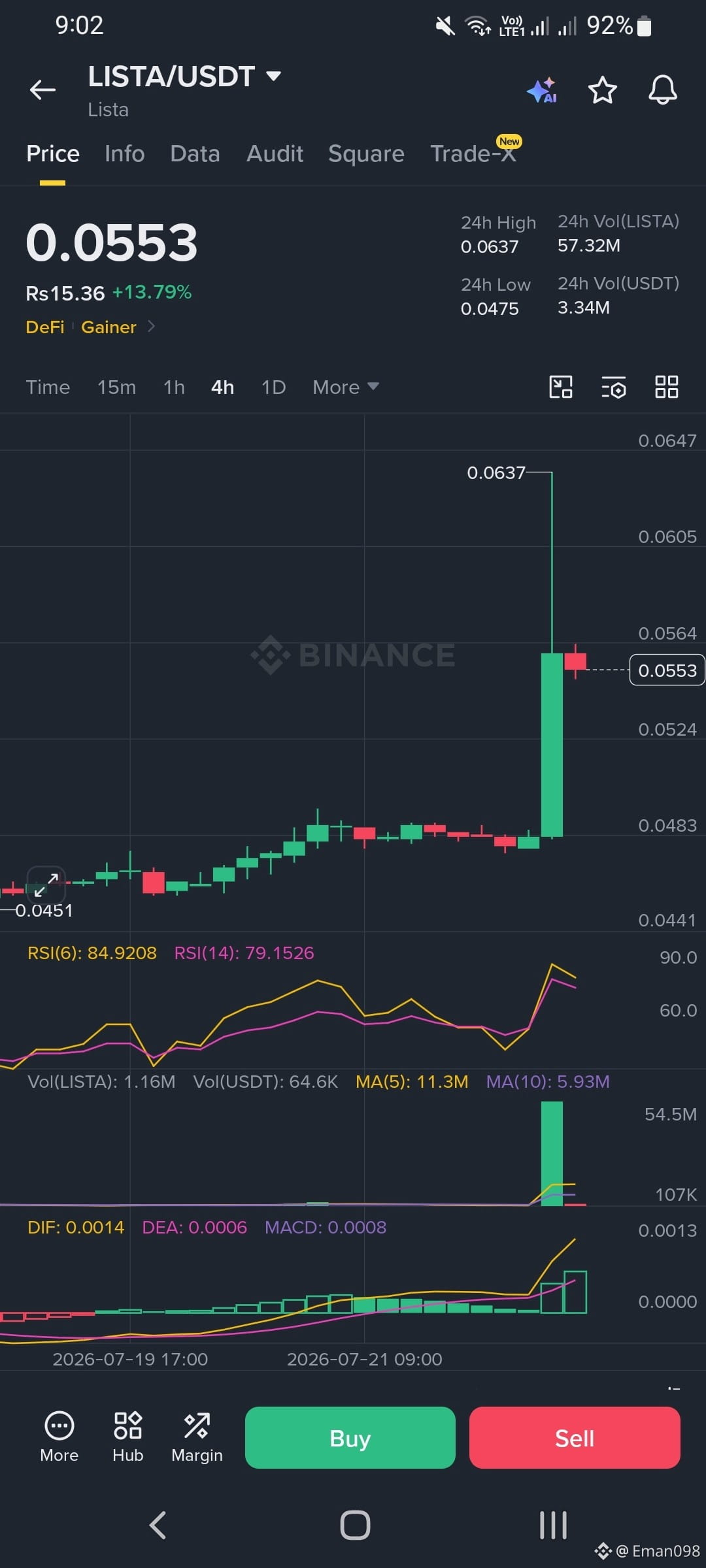
Here's what the chart's actually telling you:
The move itself
Price ripped from around 0.0451 to a high of 0.0637 in a single 4H candle that's a massive volume spike (57M LISTA / ~3.34M USDT in 24h, way above the prior candles). It's now pulled back to 0.0553, so it's given back roughly a third of that spike. That kind of vertical candle on a sudden volume surge is a classic pump likely news, a listing announcement, or a large buyer stepping in, rather than organic grind-up buying.
Momentum indicators
- RSI(6) at 84.9 and RSI(14) at 79.1 both deep in overbought territory (anything above 70 is stretched). This tells you the move happened too fast, not that it has to reverse immediately, but it does mean upside is getting harder to sustain without a cooldown.
- MACD histogram is still positive and DIF is above DEA, so momentum is technically still bullish, but the histogram bars around the last two candles look like they're already shrinking a bit from the peak early sign momentum is decelerating.
Volume
Volume absolutely dwarfs everything before it on this chart. MA(5) at 11.3M vs MA(10) at 5.93M confirms this is a genuine outlier spike, not steady accumulation. Spikes like this often see volume dry up fast once the initial buyers/sellers finish worth watching whether the next few candles hold volume or go quiet.
How this usually plays out
Straight-line moves like this typically consolidate or retrace part of the gain before any continuation the pullback from 0.0637 to 0.0553 could be the start of that, or just a pause before another leg. The 0.0524 and 0.0483 levels below are the more natural support zones to watch if it keeps fading; 0.0637 is the resistance/high to reclaim if bulls want to push again.
Quick note:
I'm not a financial advisor, this is just a read of the chart mechanics not a signal to buy or sell. Overbought conditions can stay overbought longer than expected in a strong trend, so treat this as context, not a prediction.
$LISTA
{future}(LISTAUSDT)
#PresidentialDebate #BitcoinDominanceRisesTo59% #HongKongStorageStocksStrengthen
Here's what the chart's actually telling you:
The move itself
Price ripped from around 0.0451 to a high of 0.0637 in a single 4H candle that's a massive volume spike (57M LISTA / ~3.34M USDT in 24h, way above the prior candles). It's now pulled back to 0.0553, so it's given back roughly a third of that spike. That kind of vertical candle on a sudden volume surge is a classic pump likely news, a listing announcement, or a large buyer stepping in, rather than organic grind-up buying.
Momentum indicators
- RSI(6) at 84.9 and RSI(14) at 79.1 both deep in overbought territory (anything above 70 is stretched). This tells you the move happened too fast, not that it has to reverse immediately, but it does mean upside is getting harder to sustain without a cooldown.
- MACD histogram is still positive and DIF is above DEA, so momentum is technically still bullish, but the histogram bars around the last two candles look like they're already shrinking a bit from the peak early sign momentum is decelerating.
Volume
Volume absolutely dwarfs everything before it on this chart. MA(5) at 11.3M vs MA(10) at 5.93M confirms this is a genuine outlier spike, not steady accumulation. Spikes like this often see volume dry up fast once the initial buyers/sellers finish worth watching whether the next few candles hold volume or go quiet.
How this usually plays out
Straight-line moves like this typically consolidate or retrace part of the gain before any continuation the pullback from 0.0637 to 0.0553 could be the start of that, or just a pause before another leg. The 0.0524 and 0.0483 levels below are the more natural support zones to watch if it keeps fading; 0.0637 is the resistance/high to reclaim if bulls want to push again.
Quick note:
I'm not a financial advisor, this is just a read of the chart mechanics not a signal to buy or sell. Overbought conditions can stay overbought longer than expected in a strong trend, so treat this as context, not a prediction.
$LISTA
#PresidentialDebate #BitcoinDominanceRisesTo59% #HongKongStorageStocksStrengthen
The move itself
Price ripped from around 0.0451 to a high of 0.0637 in a single 4H candle that's a massive volume spike (57M LISTA / ~3.34M USDT in 24h, way above the prior candles). It's now pulled back to 0.0553, so it's given back roughly a third of that spike. That kind of vertical candle on a sudden volume surge is a classic pump likely news, a listing announcement, or a large buyer stepping in, rather than organic grind-up buying.
Momentum indicators
- RSI(6) at 84.9 and RSI(14) at 79.1 both deep in overbought territory (anything above 70 is stretched). This tells you the move happened too fast, not that it has to reverse immediately, but it does mean upside is getting harder to sustain without a cooldown.
- MACD histogram is still positive and DIF is above DEA, so momentum is technically still bullish, but the histogram bars around the last two candles look like they're already shrinking a bit from the peak early sign momentum is decelerating.
Volume
Volume absolutely dwarfs everything before it on this chart. MA(5) at 11.3M vs MA(10) at 5.93M confirms this is a genuine outlier spike, not steady accumulation. Spikes like this often see volume dry up fast once the initial buyers/sellers finish worth watching whether the next few candles hold volume or go quiet.
How this usually plays out
Straight-line moves like this typically consolidate or retrace part of the gain before any continuation the pullback from 0.0637 to 0.0553 could be the start of that, or just a pause before another leg. The 0.0524 and 0.0483 levels below are the more natural support zones to watch if it keeps fading; 0.0637 is the resistance/high to reclaim if bulls want to push again.
Quick note:
I'm not a financial advisor, this is just a read of the chart mechanics not a signal to buy or sell. Overbought conditions can stay overbought longer than expected in a strong trend, so treat this as context, not a prediction.
$LISTA
#PresidentialDebate #BitcoinDominanceRisesTo59% #HongKongStorageStocksStrengthen
8
249
Industry leaders are pouring hundreds of millions into a rescue plan for Aave users after massive crThe response to the DeFi recovery fund has quickly extended beyond Aave, and in some cases began with direct outreach.
The exploit, which rippled into rsETH markets and created risk across lending positions on Aave, has prompted what is shaping up to be one of the most coordinated industry responses to a DeFi incident.
There’s a shared priority around supporting users and restoring normal market conditions,” an Aave Labs spokesperson told CoinDesk. “Many of these participants are deeply connected to DeFi, whether through infrastructure, capital, or user access, and have a direct interest in ensuring markets function as expected.”
At the core of the effort is Aave itself. A governance proposal outlines a plan for the DAO to allocate up to 250,000 ETH as part of the recovery. Founder Stani Kulechov has separately indicated he would donate 5,000 ETH personally. Other contributors within Aave’s orbit are also stepping in, including Aave’s Emilio Frangella (500 ETH), BGD Labs’ Ernesto Boado (100 ETH), BGD Labs (250 ETH), and KPK’s Marcelo Ruiz de Orlano (100 ETH).
But the response has quickly extended beyond Aave, and in some cases began with direct outreach.The firm, alongside its founder Joseph Lubin, agreed to commit up to 30,000 ETH in financial support to help advance the recovery and protect users. Sharplink played a strategic advisory role in those discussions, the spokesperson said.
Following the April 18 bridge hack that impacted rsETH, Kulechov reached out to Consensys and other ecosystem participants early to help coordinate a response, according to a Consensys spokesperson.
The firm, alongside its founder Joseph Lubin, agreed to commit up to 30,000 ETH in financial support to help advance the recovery and protect users. Sharplink played a strategic advisory role in those discussions, the spokesperson said.
The Ethereum ecosystem has always been at its best when it moves together,” Lubin said in a statement. “DeFi United is exactly that, a broad, coordinated response to protect users and strengthen the infrastructure we’ve all helped build. Consensys is proud to contribute alongside other stewards in the ecosystem.”
The effort has also drawn smaller contributions from across the community.
Lido has put forward a proposal to allocate up to 2,500 stETH, while EtherFi is discussing a 5,000 ETH plan aimed at supporting users and limiting bad debt across DeFi. Mantle has proposed a 30,000 ETH credit facility loan, adding to a growing pool of backstop liquidity. Compound also put forward a proposal to give up to 3000 ETH to the fund.
The list of participants continues to grow. Entities that have not publicly specified the size of their commitments include Ethena, LayerZero, Frax Finance, and Ink Foundation, alongside Tyro.
These are long-standing Aave relationships across the ecosystem,” the Aave Labs spokesperson added. “Teams like Consensys, Sharplink, and others have been in close contact throughout.
Not all contributions are structured the same way. Some participants are offering grants, others deposits, and several are extending credit lines, highlighting different approaches to balancing support with risk management.
In parallel, Aave Labs has put forward a proposal asking Arbitrum governance to approve the release of roughly 30,765.67 ETH immobilized by the network’s Security Council into the coordinated remediation effort, with the goal of “making affected rsETH holders whole” and restoring rsETH’s backing.
Much of the capital remains subject to governance approval, and several proposals are still under discussion. Even so, the breadth of participation underscores how widely the exploit's impact has been felt across DeFi.
The Ethereum ecosystem has always been at its best when it moves together,” Lubin said. “DeFi United is exactly that: a broad, coordinated response to protect users and strengthen the infrastructure we’ve all helped build.”
#PresidentialDebate
#orocryptotrends
#IndiaCryptoDreams
#UnicornChannel
#GoogleDocsMagic
Industry leaders are pouring hundreds of millions into a rescue plan for Aave users after massive cr
The response to the DeFi recovery fund has quickly extended beyond Aave, and in some cases began with direct outreach.
The exploit, which rippled into rsETH markets and created risk across lending positions on Aave, has prompted what is shaping up to be one of the most coordinated industry responses to a DeFi incident.
There’s a shared priority around supporting users and restoring normal market conditions,” an Aave Labs spokesperson told CoinDesk. “Many of these participants are deeply connected to DeFi, whether through infrastructure, capital, or user access, and have a direct interest in ensuring markets function as expected.”
At the core of the effort is Aave itself. A governance proposal outlines a plan for the DAO to allocate up to 250,000 ETH as part of the recovery. Founder Stani Kulechov has separately indicated he would donate 5,000 ETH personally. Other contributors within Aave’s orbit are also stepping in, including Aave’s Emilio Frangella (500 ETH), BGD Labs’ Ernesto Boado (100 ETH), BGD Labs (250 ETH), and KPK’s Marcelo Ruiz de Orlano (100 ETH).
But the response has quickly extended beyond Aave, and in some cases began with direct outreach.The firm, alongside its founder Joseph Lubin, agreed to commit up to 30,000 ETH in financial support to help advance the recovery and protect users. Sharplink played a strategic advisory role in those discussions, the spokesperson said.
Following the April 18 bridge hack that impacted rsETH, Kulechov reached out to Consensys and other ecosystem participants early to help coordinate a response, according to a Consensys spokesperson.
The firm, alongside its founder Joseph Lubin, agreed to commit up to 30,000 ETH in financial support to help advance the recovery and protect users. Sharplink played a strategic advisory role in those discussions, the spokesperson said.
The Ethereum ecosystem has always been at its best when it moves together,” Lubin said in a statement. “DeFi United is exactly that, a broad, coordinated response to protect users and strengthen the infrastructure we’ve all helped build. Consensys is proud to contribute alongside other stewards in the ecosystem.”
The effort has also drawn smaller contributions from across the community.
Lido has put forward a proposal to allocate up to 2,500 stETH, while EtherFi is discussing a 5,000 ETH plan aimed at supporting users and limiting bad debt across DeFi. Mantle has proposed a 30,000 ETH credit facility loan, adding to a growing pool of backstop liquidity. Compound also put forward a proposal to give up to 3000 ETH to the fund.
The list of participants continues to grow. Entities that have not publicly specified the size of their commitments include Ethena, LayerZero, Frax Finance, and Ink Foundation, alongside Tyro.
These are long-standing Aave relationships across the ecosystem,” the Aave Labs spokesperson added. “Teams like Consensys, Sharplink, and others have been in close contact throughout.
Not all contributions are structured the same way. Some participants are offering grants, others deposits, and several are extending credit lines, highlighting different approaches to balancing support with risk management.
In parallel, Aave Labs has put forward a proposal asking Arbitrum governance to approve the release of roughly 30,765.67 ETH immobilized by the network’s Security Council into the coordinated remediation effort, with the goal of “making affected rsETH holders whole” and restoring rsETH’s backing.
Much of the capital remains subject to governance approval, and several proposals are still under discussion. Even so, the breadth of participation underscores how widely the exploit's impact has been felt across DeFi.
The Ethereum ecosystem has always been at its best when it moves together,” Lubin said. “DeFi United is exactly that: a broad, coordinated response to protect users and strengthen the infrastructure we’ve all helped build.”
#PresidentialDebate
#orocryptotrends
#IndiaCryptoDreams
#UnicornChannel
#GoogleDocsMagic
The exploit, which rippled into rsETH markets and created risk across lending positions on Aave, has prompted what is shaping up to be one of the most coordinated industry responses to a DeFi incident.
There’s a shared priority around supporting users and restoring normal market conditions,” an Aave Labs spokesperson told CoinDesk. “Many of these participants are deeply connected to DeFi, whether through infrastructure, capital, or user access, and have a direct interest in ensuring markets function as expected.”
At the core of the effort is Aave itself. A governance proposal outlines a plan for the DAO to allocate up to 250,000 ETH as part of the recovery. Founder Stani Kulechov has separately indicated he would donate 5,000 ETH personally. Other contributors within Aave’s orbit are also stepping in, including Aave’s Emilio Frangella (500 ETH), BGD Labs’ Ernesto Boado (100 ETH), BGD Labs (250 ETH), and KPK’s Marcelo Ruiz de Orlano (100 ETH).
But the response has quickly extended beyond Aave, and in some cases began with direct outreach.The firm, alongside its founder Joseph Lubin, agreed to commit up to 30,000 ETH in financial support to help advance the recovery and protect users. Sharplink played a strategic advisory role in those discussions, the spokesperson said.
Following the April 18 bridge hack that impacted rsETH, Kulechov reached out to Consensys and other ecosystem participants early to help coordinate a response, according to a Consensys spokesperson.
The firm, alongside its founder Joseph Lubin, agreed to commit up to 30,000 ETH in financial support to help advance the recovery and protect users. Sharplink played a strategic advisory role in those discussions, the spokesperson said.
The Ethereum ecosystem has always been at its best when it moves together,” Lubin said in a statement. “DeFi United is exactly that, a broad, coordinated response to protect users and strengthen the infrastructure we’ve all helped build. Consensys is proud to contribute alongside other stewards in the ecosystem.”
The effort has also drawn smaller contributions from across the community.
Lido has put forward a proposal to allocate up to 2,500 stETH, while EtherFi is discussing a 5,000 ETH plan aimed at supporting users and limiting bad debt across DeFi. Mantle has proposed a 30,000 ETH credit facility loan, adding to a growing pool of backstop liquidity. Compound also put forward a proposal to give up to 3000 ETH to the fund.
The list of participants continues to grow. Entities that have not publicly specified the size of their commitments include Ethena, LayerZero, Frax Finance, and Ink Foundation, alongside Tyro.
These are long-standing Aave relationships across the ecosystem,” the Aave Labs spokesperson added. “Teams like Consensys, Sharplink, and others have been in close contact throughout.
Not all contributions are structured the same way. Some participants are offering grants, others deposits, and several are extending credit lines, highlighting different approaches to balancing support with risk management.
In parallel, Aave Labs has put forward a proposal asking Arbitrum governance to approve the release of roughly 30,765.67 ETH immobilized by the network’s Security Council into the coordinated remediation effort, with the goal of “making affected rsETH holders whole” and restoring rsETH’s backing.
Much of the capital remains subject to governance approval, and several proposals are still under discussion. Even so, the breadth of participation underscores how widely the exploit's impact has been felt across DeFi.
The Ethereum ecosystem has always been at its best when it moves together,” Lubin said. “DeFi United is exactly that: a broad, coordinated response to protect users and strengthen the infrastructure we’ve all helped build.”
#PresidentialDebate
#orocryptotrends
#IndiaCryptoDreams
#UnicornChannel
#GoogleDocsMagic
72
Beyond the Smart Economy: John Wang on the Civilizational Shift Toward Silicon-Native AgencyThe evolution of the blockchain industry has long been defined by the “Smart Economy”—a world of programmable assets and automated contracts. However, according to John Wang, head of Neo ecosystem growth and managing director of Neo Ecofund, the industry is on the precipice of a more profound shift toward what he calls the “Sentient Economy.”
In a recent discussion regarding the launch of Spoonos, Neo’s new framework for artificial intelligence (AI) agents, Wang detailed a future where the primary participants in the global economy may not be human at all.
While the industry often treats AI and blockchain as separate silos, Wang views their integration as the foundation for a new economic class. The Sentient Economy is defined as an economic system where AI agents—rather than just human operators—can own assets, make autonomous decisions, and interact trustlessly onchain.
Wang emphasizes that this movement is not merely about combining two popular technologies. Instead, it focuses on enabling AI agents to become real participants in the digital economy by ensuring they are verifiable, accountable, and composable. Under this framework, an AI agent is a sovereign economic entity. By living onchain, these agents can prove their identity, execute financial transactions without a human intermediary, and remain accountable through transparent, immutable code.
To turn this vision into reality, Neo has introduced Spoonos. Positioned as the successor to the “Smart Economy” philosophy that Neo has championed since 2017, Spoonos provides the technical scaffolding for building and coordinating these autonomous agents.
The framework currently supports a developer runtime and a unified data layer, allowing for the creation of agents that can reason using AI models while acting via blockchain infrastructure. Wang noted that the concept is already gaining institutional and developmental traction. Through strategic collaborations with industry leaders such as ChainGPT and Morph, Neo is actively cultivating a broader ecosystem where these agents can interact across different platforms and protocols.
Despite the momentum, Wang remains candid about the significant obstacles standing in the way of a fully realized Sentient Economy. He noted that developer tooling remains in its early stages, meaning the kits required to bridge high-level AI reasoning with low-level blockchain execution are still being refined. Furthermore, the mechanisms for value capture by agents are still nascent, as the industry works to determine how agents will generate and retain value autonomously. Finally, the learning curve remains steep, requiring developers to master the complex intersection of AI, blockchain, and decentralized coordination.
For Wang and the Neo ecosystem, this transition represents a natural progression in the utility of decentralized technology. If the last decade focused on making assets “smart” and programmable, the next decade is dedicated to making the economy itself “sentient.” As Wang summarized, the team previously built for programmable assets, but they are now building for “programmable intelligence.”
As AI agents begin to manage portfolios, optimize supply chains and negotiate contracts on-chain, the Sentient Economy may soon transition from a visionary concept to the standard operating procedure of the digital world.
Wang’s vision for the Sentient Economy extends far beyond decentralized finance, focusing instead on the capacity for AI to interpret the physical and digital worlds. During the Scoop AI Global Hackathon—which saw over 500 developers across Silicon Valley and London—Wang observed that the most compelling innovations were those that prioritized “probabilistic intelligence” over simple automation.
One standout application involved using Spoonos to recursively derive mathematical curves from raw data, uncovering hidden causal relationships between unrelated phenomena. For Wang, this represents the true potential of the framework: creating agents that serve as a bridge between raw information and human understanding.
To me, that’s the essence of the Sentient Economy—not just automating transactions, but building agents that perceive, reason and reveal structure in the world,” Wang said.
He believes this shift will occur through quiet integration rather than a sudden technological upheaval. As these tools become more sophisticated, they will begin to fundamentally alter how society processes information and makes decisions.
By the time people realize it’s happening, the Sentient Economy will already be here,” Wang predicted. “It won’t arrive with a big bang. It will quietly embed itself into how we observe, decide and act.”
The Neo Ecofund managing director believes the global Web3 ecosystem is currently undergoing a “civilizational” transformation. He argues that the industry has moved past the era of purely digital property—focused on tokens and consensus—into a new phase defined by programmable cognition.
For Wang, the most exciting shift is that blockchain is no longer just a tool for financial transactions; it has become the “coordination substrate” for autonomous, silicon-native agents. By providing AI with the cryptographic keys to reason, transact and persist on-chain, he suggests the industry is moving from building simple tools to “building minds.”
He describes this transition as the opening of a “trustless civilization of sentient actors,” a shift so profound it transcends the importance of any specific technical token standard. In his view, this evolution from “programmable value” to “programmable intelligence” marks the beginning of a “new social physics” where humans, AI and hybrid intelligences interact in a unified, networked economy.
As carbon-based intelligence gives way to silicon-native agents, we’re no longer just building tools—we’re building minds,” Wang said. “The moment we gave AI the keys to sign, transact, reason and persist—on-chain—we cracked open something far larger than a financial system.”
#PresidentialDebate
#orocryptotrends
#UNIUSDT
#InvestorFocused
#TrumpNFT
Beyond the Smart Economy: John Wang on the Civilizational Shift Toward Silicon-Native Agency
The evolution of the blockchain industry has long been defined by the “Smart Economy”—a world of programmable assets and automated contracts. However, according to John Wang, head of Neo ecosystem growth and managing director of Neo Ecofund, the industry is on the precipice of a more profound shift toward what he calls the “Sentient Economy.”
In a recent discussion regarding the launch of Spoonos, Neo’s new framework for artificial intelligence (AI) agents, Wang detailed a future where the primary participants in the global economy may not be human at all.
While the industry often treats AI and blockchain as separate silos, Wang views their integration as the foundation for a new economic class. The Sentient Economy is defined as an economic system where AI agents—rather than just human operators—can own assets, make autonomous decisions, and interact trustlessly onchain.
Wang emphasizes that this movement is not merely about combining two popular technologies. Instead, it focuses on enabling AI agents to become real participants in the digital economy by ensuring they are verifiable, accountable, and composable. Under this framework, an AI agent is a sovereign economic entity. By living onchain, these agents can prove their identity, execute financial transactions without a human intermediary, and remain accountable through transparent, immutable code.
To turn this vision into reality, Neo has introduced Spoonos. Positioned as the successor to the “Smart Economy” philosophy that Neo has championed since 2017, Spoonos provides the technical scaffolding for building and coordinating these autonomous agents.
The framework currently supports a developer runtime and a unified data layer, allowing for the creation of agents that can reason using AI models while acting via blockchain infrastructure. Wang noted that the concept is already gaining institutional and developmental traction. Through strategic collaborations with industry leaders such as ChainGPT and Morph, Neo is actively cultivating a broader ecosystem where these agents can interact across different platforms and protocols.
Despite the momentum, Wang remains candid about the significant obstacles standing in the way of a fully realized Sentient Economy. He noted that developer tooling remains in its early stages, meaning the kits required to bridge high-level AI reasoning with low-level blockchain execution are still being refined. Furthermore, the mechanisms for value capture by agents are still nascent, as the industry works to determine how agents will generate and retain value autonomously. Finally, the learning curve remains steep, requiring developers to master the complex intersection of AI, blockchain, and decentralized coordination.
For Wang and the Neo ecosystem, this transition represents a natural progression in the utility of decentralized technology. If the last decade focused on making assets “smart” and programmable, the next decade is dedicated to making the economy itself “sentient.” As Wang summarized, the team previously built for programmable assets, but they are now building for “programmable intelligence.”
As AI agents begin to manage portfolios, optimize supply chains and negotiate contracts on-chain, the Sentient Economy may soon transition from a visionary concept to the standard operating procedure of the digital world.
Wang’s vision for the Sentient Economy extends far beyond decentralized finance, focusing instead on the capacity for AI to interpret the physical and digital worlds. During the Scoop AI Global Hackathon—which saw over 500 developers across Silicon Valley and London—Wang observed that the most compelling innovations were those that prioritized “probabilistic intelligence” over simple automation.
One standout application involved using Spoonos to recursively derive mathematical curves from raw data, uncovering hidden causal relationships between unrelated phenomena. For Wang, this represents the true potential of the framework: creating agents that serve as a bridge between raw information and human understanding.
To me, that’s the essence of the Sentient Economy—not just automating transactions, but building agents that perceive, reason and reveal structure in the world,” Wang said.
He believes this shift will occur through quiet integration rather than a sudden technological upheaval. As these tools become more sophisticated, they will begin to fundamentally alter how society processes information and makes decisions.
By the time people realize it’s happening, the Sentient Economy will already be here,” Wang predicted. “It won’t arrive with a big bang. It will quietly embed itself into how we observe, decide and act.”
The Neo Ecofund managing director believes the global Web3 ecosystem is currently undergoing a “civilizational” transformation. He argues that the industry has moved past the era of purely digital property—focused on tokens and consensus—into a new phase defined by programmable cognition.
For Wang, the most exciting shift is that blockchain is no longer just a tool for financial transactions; it has become the “coordination substrate” for autonomous, silicon-native agents. By providing AI with the cryptographic keys to reason, transact and persist on-chain, he suggests the industry is moving from building simple tools to “building minds.”
He describes this transition as the opening of a “trustless civilization of sentient actors,” a shift so profound it transcends the importance of any specific technical token standard. In his view, this evolution from “programmable value” to “programmable intelligence” marks the beginning of a “new social physics” where humans, AI and hybrid intelligences interact in a unified, networked economy.
As carbon-based intelligence gives way to silicon-native agents, we’re no longer just building tools—we’re building minds,” Wang said. “The moment we gave AI the keys to sign, transact, reason and persist—on-chain—we cracked open something far larger than a financial system.”
#PresidentialDebate
#orocryptotrends
#UNIUSDT
#InvestorFocused
#TrumpNFT
In a recent discussion regarding the launch of Spoonos, Neo’s new framework for artificial intelligence (AI) agents, Wang detailed a future where the primary participants in the global economy may not be human at all.
While the industry often treats AI and blockchain as separate silos, Wang views their integration as the foundation for a new economic class. The Sentient Economy is defined as an economic system where AI agents—rather than just human operators—can own assets, make autonomous decisions, and interact trustlessly onchain.
Wang emphasizes that this movement is not merely about combining two popular technologies. Instead, it focuses on enabling AI agents to become real participants in the digital economy by ensuring they are verifiable, accountable, and composable. Under this framework, an AI agent is a sovereign economic entity. By living onchain, these agents can prove their identity, execute financial transactions without a human intermediary, and remain accountable through transparent, immutable code.
To turn this vision into reality, Neo has introduced Spoonos. Positioned as the successor to the “Smart Economy” philosophy that Neo has championed since 2017, Spoonos provides the technical scaffolding for building and coordinating these autonomous agents.
The framework currently supports a developer runtime and a unified data layer, allowing for the creation of agents that can reason using AI models while acting via blockchain infrastructure. Wang noted that the concept is already gaining institutional and developmental traction. Through strategic collaborations with industry leaders such as ChainGPT and Morph, Neo is actively cultivating a broader ecosystem where these agents can interact across different platforms and protocols.
Despite the momentum, Wang remains candid about the significant obstacles standing in the way of a fully realized Sentient Economy. He noted that developer tooling remains in its early stages, meaning the kits required to bridge high-level AI reasoning with low-level blockchain execution are still being refined. Furthermore, the mechanisms for value capture by agents are still nascent, as the industry works to determine how agents will generate and retain value autonomously. Finally, the learning curve remains steep, requiring developers to master the complex intersection of AI, blockchain, and decentralized coordination.
For Wang and the Neo ecosystem, this transition represents a natural progression in the utility of decentralized technology. If the last decade focused on making assets “smart” and programmable, the next decade is dedicated to making the economy itself “sentient.” As Wang summarized, the team previously built for programmable assets, but they are now building for “programmable intelligence.”
As AI agents begin to manage portfolios, optimize supply chains and negotiate contracts on-chain, the Sentient Economy may soon transition from a visionary concept to the standard operating procedure of the digital world.
Wang’s vision for the Sentient Economy extends far beyond decentralized finance, focusing instead on the capacity for AI to interpret the physical and digital worlds. During the Scoop AI Global Hackathon—which saw over 500 developers across Silicon Valley and London—Wang observed that the most compelling innovations were those that prioritized “probabilistic intelligence” over simple automation.
One standout application involved using Spoonos to recursively derive mathematical curves from raw data, uncovering hidden causal relationships between unrelated phenomena. For Wang, this represents the true potential of the framework: creating agents that serve as a bridge between raw information and human understanding.
To me, that’s the essence of the Sentient Economy—not just automating transactions, but building agents that perceive, reason and reveal structure in the world,” Wang said.
He believes this shift will occur through quiet integration rather than a sudden technological upheaval. As these tools become more sophisticated, they will begin to fundamentally alter how society processes information and makes decisions.
By the time people realize it’s happening, the Sentient Economy will already be here,” Wang predicted. “It won’t arrive with a big bang. It will quietly embed itself into how we observe, decide and act.”
The Neo Ecofund managing director believes the global Web3 ecosystem is currently undergoing a “civilizational” transformation. He argues that the industry has moved past the era of purely digital property—focused on tokens and consensus—into a new phase defined by programmable cognition.
For Wang, the most exciting shift is that blockchain is no longer just a tool for financial transactions; it has become the “coordination substrate” for autonomous, silicon-native agents. By providing AI with the cryptographic keys to reason, transact and persist on-chain, he suggests the industry is moving from building simple tools to “building minds.”
He describes this transition as the opening of a “trustless civilization of sentient actors,” a shift so profound it transcends the importance of any specific technical token standard. In his view, this evolution from “programmable value” to “programmable intelligence” marks the beginning of a “new social physics” where humans, AI and hybrid intelligences interact in a unified, networked economy.
As carbon-based intelligence gives way to silicon-native agents, we’re no longer just building tools—we’re building minds,” Wang said. “The moment we gave AI the keys to sign, transact, reason and persist—on-chain—we cracked open something far larger than a financial system.”
#PresidentialDebate
#orocryptotrends
#UNIUSDT
#InvestorFocused
#TrumpNFT
188
American YouTuber guides foreigners around Chinese cars U.S. buyers can't getBEIJING, April 26 (Reuters) - An American YouTuber is giving foreign visitors a first-hand look at the Chinese high-tech cars many U.S. consumers can only see online.
At the Beijing Auto Show, which opened on Friday, 34-year-old Ethan Robertson shepherded more than a dozen people from Australia, New Zealand, the United Arab Emirates and elsewhere through sprawling halls packed with electric SUVs, pickup trucks and futuristic concept cars — offering an up-close look at the vehicles making China's auto industry increasingly hard to ignore
The North Carolina native is the co-founder of Wheelsboy, a YouTube channel specialising in Chinese cars for English-speaking audiences. For many on his tour, the appeal of the vehicles was obvious: low prices, advanced technology and plenty of variety.
At one booth, he showed off a luxury electric SUV from Stellantis (STLAM.MI), opens new tab-backed Leapmotor (9863.HK), opens new tab, which sports wide screens and a fridge in the back seat.
You're looking at a car that's maybe $30,000 and that car is fully equipped," he said. "Whereas $30,000 barely gets you into any electric vehicle or hybrid" in the United States.
That price difference is a big reason why his largely American audience reacts with a mix of fascination and frustration
Our comment section is full of people saying things like, 'I can't believe the government won't allow them to sell this car in my country,'" Robertson told Reuters.
One participant on the tour, New Zealand retiree John Cordell, was drawn to a shiny yellow Deepal S07 midsize crossover.
First of all, I was attracted to the color," the 77-year-old former heating and ventilation engineer, said. But it was more than the paintwork that won him over. He praised the interior, the heads-up display, the screens and the surround-view camera system.
His brother-in-law and his son accompanied him on the two-day, $399 per person tour.
Cordell already owns a Chinese EV back home — a BYD Atto 3 — and said technology was a major selling point. "Everything is very well engineered," he said.
Andrew Pertsoulis, a 62-year-old retired performance coach from Sydney, said what stood out most was how futuristic the cars felt inside. "It's what separates them," he said. The large screens and tech-rich interiors made him feel like he had "stepped into a new generation of vehicle".
Robertson, who lives in China, said the perception of Chinese cars among U.S. viewers has changed in the six years he has been covering the industry. While the cars were seen as low-quality copycats early on, that's given way to recognition that many brands are now pushing the industry forward in areas such as battery performance, software and charging speeds.
Robertson, who started studying Chinese as an undergraduate, said he still sometimes gets accused of working for Chinese companies or the government because of positive coverage on his channel, which has 210,000 subscribers. He doesn't work for either, he said.
Lei Xing is the American co-host of the China EVs & More podcast. Even for him, China's industry - with more than 100 automakers - is huge and complex. "I get lost," Lei said.
More Americans are starting to follow the industry more closely.
While Lei doesn't expect Chinese brands to enter the U.S. market quickly, due to hostile politics, he expects the cars will eventually reach American shores.
It's a matter of time," Lei said. "I know in my life I'm going to be able to buy a Chinese EV."
#PresidentialDebate
#OopsieDaisy
#KEEP_SUPPORT
#Launchpool
#ShootingIncidentAtWhiteHouseCorrespondentsDinner
American YouTuber guides foreigners around Chinese cars U.S. buyers can't get
BEIJING, April 26 (Reuters) - An American YouTuber is giving foreign visitors a first-hand look at the Chinese high-tech cars many U.S. consumers can only see online.
At the Beijing Auto Show, which opened on Friday, 34-year-old Ethan Robertson shepherded more than a dozen people from Australia, New Zealand, the United Arab Emirates and elsewhere through sprawling halls packed with electric SUVs, pickup trucks and futuristic concept cars — offering an up-close look at the vehicles making China's auto industry increasingly hard to ignore
The North Carolina native is the co-founder of Wheelsboy, a YouTube channel specialising in Chinese cars for English-speaking audiences. For many on his tour, the appeal of the vehicles was obvious: low prices, advanced technology and plenty of variety.
At one booth, he showed off a luxury electric SUV from Stellantis (STLAM.MI), opens new tab-backed Leapmotor (9863.HK), opens new tab, which sports wide screens and a fridge in the back seat.
You're looking at a car that's maybe $30,000 and that car is fully equipped," he said. "Whereas $30,000 barely gets you into any electric vehicle or hybrid" in the United States.
That price difference is a big reason why his largely American audience reacts with a mix of fascination and frustration
Our comment section is full of people saying things like, 'I can't believe the government won't allow them to sell this car in my country,'" Robertson told Reuters.
One participant on the tour, New Zealand retiree John Cordell, was drawn to a shiny yellow Deepal S07 midsize crossover.
First of all, I was attracted to the color," the 77-year-old former heating and ventilation engineer, said. But it was more than the paintwork that won him over. He praised the interior, the heads-up display, the screens and the surround-view camera system.
His brother-in-law and his son accompanied him on the two-day, $399 per person tour.
Cordell already owns a Chinese EV back home — a BYD Atto 3 — and said technology was a major selling point. "Everything is very well engineered," he said.
Andrew Pertsoulis, a 62-year-old retired performance coach from Sydney, said what stood out most was how futuristic the cars felt inside. "It's what separates them," he said. The large screens and tech-rich interiors made him feel like he had "stepped into a new generation of vehicle".
Robertson, who lives in China, said the perception of Chinese cars among U.S. viewers has changed in the six years he has been covering the industry. While the cars were seen as low-quality copycats early on, that's given way to recognition that many brands are now pushing the industry forward in areas such as battery performance, software and charging speeds.
Robertson, who started studying Chinese as an undergraduate, said he still sometimes gets accused of working for Chinese companies or the government because of positive coverage on his channel, which has 210,000 subscribers. He doesn't work for either, he said.
Lei Xing is the American co-host of the China EVs & More podcast. Even for him, China's industry - with more than 100 automakers - is huge and complex. "I get lost," Lei said.
More Americans are starting to follow the industry more closely.
While Lei doesn't expect Chinese brands to enter the U.S. market quickly, due to hostile politics, he expects the cars will eventually reach American shores.
It's a matter of time," Lei said. "I know in my life I'm going to be able to buy a Chinese EV."
#PresidentialDebate
#OopsieDaisy
#KEEP_SUPPORT
#Launchpool
#ShootingIncidentAtWhiteHouseCorrespondentsDinner
At the Beijing Auto Show, which opened on Friday, 34-year-old Ethan Robertson shepherded more than a dozen people from Australia, New Zealand, the United Arab Emirates and elsewhere through sprawling halls packed with electric SUVs, pickup trucks and futuristic concept cars — offering an up-close look at the vehicles making China's auto industry increasingly hard to ignore
The North Carolina native is the co-founder of Wheelsboy, a YouTube channel specialising in Chinese cars for English-speaking audiences. For many on his tour, the appeal of the vehicles was obvious: low prices, advanced technology and plenty of variety.
At one booth, he showed off a luxury electric SUV from Stellantis (STLAM.MI), opens new tab-backed Leapmotor (9863.HK), opens new tab, which sports wide screens and a fridge in the back seat.
You're looking at a car that's maybe $30,000 and that car is fully equipped," he said. "Whereas $30,000 barely gets you into any electric vehicle or hybrid" in the United States.
That price difference is a big reason why his largely American audience reacts with a mix of fascination and frustration
Our comment section is full of people saying things like, 'I can't believe the government won't allow them to sell this car in my country,'" Robertson told Reuters.
One participant on the tour, New Zealand retiree John Cordell, was drawn to a shiny yellow Deepal S07 midsize crossover.
First of all, I was attracted to the color," the 77-year-old former heating and ventilation engineer, said. But it was more than the paintwork that won him over. He praised the interior, the heads-up display, the screens and the surround-view camera system.
His brother-in-law and his son accompanied him on the two-day, $399 per person tour.
Cordell already owns a Chinese EV back home — a BYD Atto 3 — and said technology was a major selling point. "Everything is very well engineered," he said.
Andrew Pertsoulis, a 62-year-old retired performance coach from Sydney, said what stood out most was how futuristic the cars felt inside. "It's what separates them," he said. The large screens and tech-rich interiors made him feel like he had "stepped into a new generation of vehicle".
Robertson, who lives in China, said the perception of Chinese cars among U.S. viewers has changed in the six years he has been covering the industry. While the cars were seen as low-quality copycats early on, that's given way to recognition that many brands are now pushing the industry forward in areas such as battery performance, software and charging speeds.
Robertson, who started studying Chinese as an undergraduate, said he still sometimes gets accused of working for Chinese companies or the government because of positive coverage on his channel, which has 210,000 subscribers. He doesn't work for either, he said.
Lei Xing is the American co-host of the China EVs & More podcast. Even for him, China's industry - with more than 100 automakers - is huge and complex. "I get lost," Lei said.
More Americans are starting to follow the industry more closely.
While Lei doesn't expect Chinese brands to enter the U.S. market quickly, due to hostile politics, he expects the cars will eventually reach American shores.
It's a matter of time," Lei said. "I know in my life I'm going to be able to buy a Chinese EV."
#PresidentialDebate
#OopsieDaisy
#KEEP_SUPPORT
#Launchpool
#ShootingIncidentAtWhiteHouseCorrespondentsDinner
138

·
--
Bearish
$BNB
{future}(BNBUSDT)
holding strong — accumulation zone 💰
$LINK
{future}(LINKUSDT)
whales loading quietly 🔗👀
$MATIC bounce incoming — don’t miss it #PresidentialDebate
$BNB
holding strong — accumulation zone 💰
$LINK
whales loading quietly 🔗👀
$MATIC bounce incoming — don’t miss it #PresidentialDebate
holding strong — accumulation zone 💰
$LINK
whales loading quietly 🔗👀
$MATIC bounce incoming — don’t miss it #PresidentialDebate

155

·
--
BREAKING: Marco Rubio is now the odds favorite to win the 2028 Presidency
$BTC
$POL
#PresidentialDebate
#Polymarkat
BREAKING: Marco Rubio is now the odds favorite to win the 2028 Presidency
$BTC
$POL
#PresidentialDebate
#Polymarkat
$BTC
$POL
#PresidentialDebate
#Polymarkat
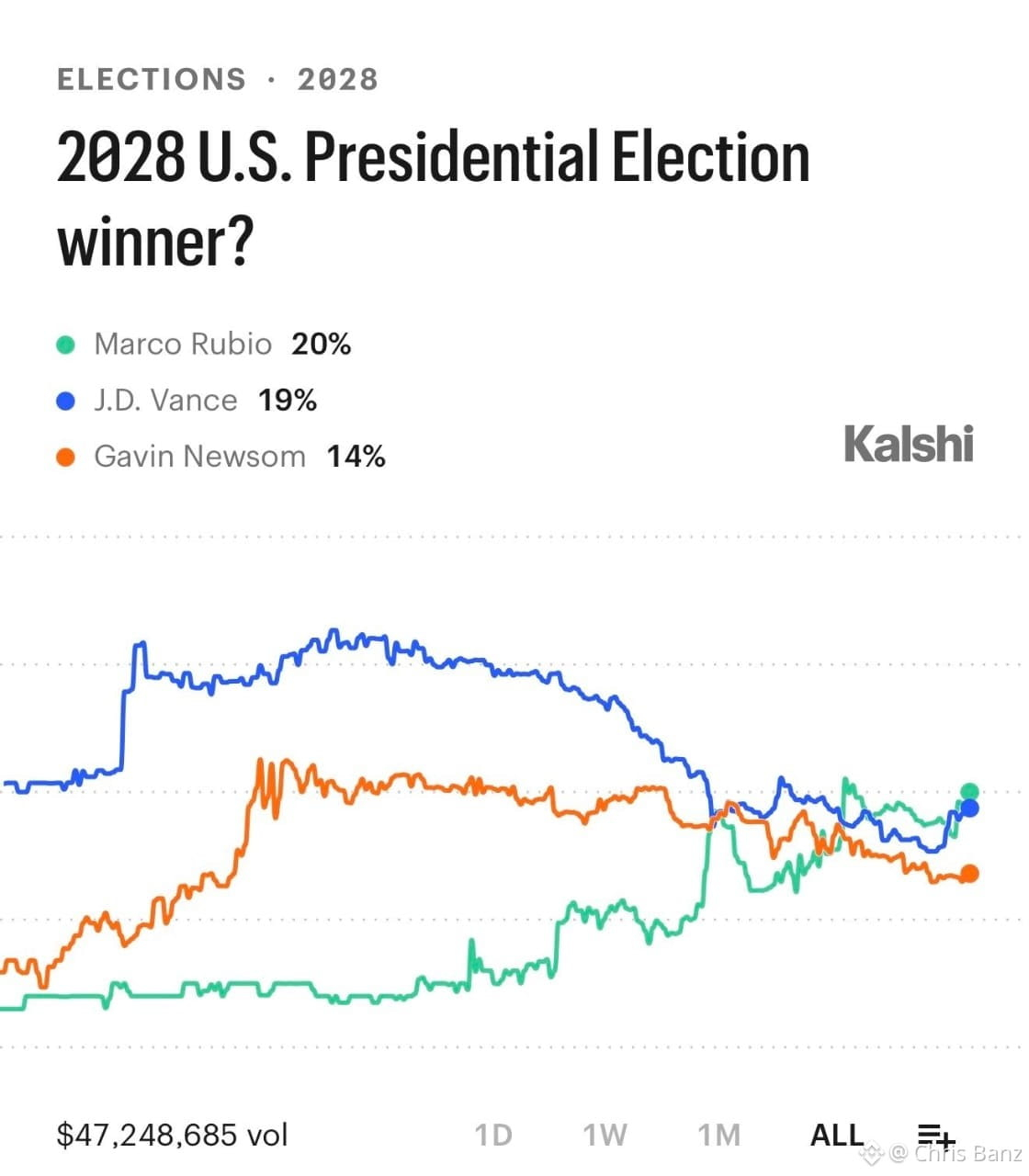
858
Log in to explore more content
Join global crypto users on Binance Square
⚡️ Get latest and useful information about crypto.
💬 Trusted by the world’s largest crypto exchange.
👍 Discover real insights from verified creators.
Email / Phone number
Trending Topics
1
#ZcashETFPostsFirstWeeklyOutflow$93.6M
43,627 views
138 Discussing
2
#GreekPoliceBustCryptoScamRingArrest17
109,205 views
820 Discussing
3
#BitcoinRejectedAt$87K
137,584 views
195 Discussing
4
#FedOctoberRateHikeOddsFallTo17%
136,424 views
1,075 Discussing
5
#NvidiaHitsRecordHighUp2.4%
98,688 views
770 Discussing
6
#CanaryFilesAmendedS1ForPEPEETF
25,310 views
536 Discussing
7
#USRussiaUkraineTalksReportedlyIncludeLukoilOilDeal
37,637 views
511 Discussing
8
#BitcoinParesGainsAfterRallyTo$86.5K
51,129 views
169 Discussing
9
#CerebrasSinksNearly20%OnReportNvidiaToPowerOpenAI
128,149 views
1,153 Discussing
10
#SECProposesCryptoCustodyRules
176,473 views
1,435 Discussing