

#newton
newton
113,446 views
1,315 Discussing
Hot
Latest

·
--
Looking back at the development trajectory of the blockchain industry over the past decade and more: the main battlefield of technical competition has always revolved around performanceFrom the early public chains racing to break through the TPS bottleneck, to various Layer 2 networks continuously compressing gas costs and shortening block confirmation times, all the industry’s technical narratives are built on the same underlying consensus: to reduce as much as possible the obstacles to executing transactions, so that every user-initiated transfer and contract interaction can be carried out smoothly. Having spent a long time working in the B2B deployment of blockchain technology, I’ve witnessed firsthand how many enterprise clients struggle when entering Web3. Traditional financial institutions have spent decades developing risk-control and access-approval rules, yet it’s difficult to translate those rules into decentralized networks. Most DApps can only implement fragmented risk controls at the application layer; they can neither achieve rule reuse across different scenarios nor meet the stringent requirements for end-to-end on-chain traceability and auditability demanded by regulators. This is also the core issue that makes many traditional funds hesitate to embrace on-chain finance at scale.
Looking back at the development trajectory of the blockchain industry over the past decade and more: the main battlefield of technical competition has always revolved around performance
From the early public chains racing to break through the TPS bottleneck, to various Layer 2 networks continuously compressing gas costs and shortening block confirmation times, all the industry’s technical narratives are built on the same underlying consensus: to reduce as much as possible the obstacles to executing transactions, so that every user-initiated transfer and contract interaction can be carried out smoothly. Having spent a long time working in the B2B deployment of blockchain technology, I’ve witnessed firsthand how many enterprise clients struggle when entering Web3. Traditional financial institutions have spent decades developing risk-control and access-approval rules, yet it’s difficult to translate those rules into decentralized networks. Most DApps can only implement fragmented risk controls at the application layer; they can neither achieve rule reuse across different scenarios nor meet the stringent requirements for end-to-end on-chain traceability and auditability demanded by regulators. This is also the core issue that makes many traditional funds hesitate to embrace on-chain finance at scale.
1
65

·
--
#newt $NEWT
I used to think the hardest part of crypto was protecting assets. Lately, I've started wondering if the bigger challenge is making transaction behavior predictable. Markets can handle volatility. What they struggle with is uncertainty around how and why assets move.
That's why Newton Protocol caught my attention from a different perspective.
Most blockchain systems prove that a transaction happened. Newton is exploring whether networks can also prove that a transaction followed predefined rules before it happened. That distinction matters as AI agents, automated wallets, and delegated accounts begin making decisions without constant human involvement.
Predictable execution has economic value.
If applications know that certain authorization standards are consistently enforced, they can build workflows around that certainty. Payment systems, treasury operations, and autonomous agents benefit from infrastructure that behaves the same way every time rather than relying on assumptions about user behavior.
The token economy ultimately depends on whether this predictability becomes useful enough to support ongoing demand. Metrics like circulating supply, unlock schedules, and valuation remain important, but long-term value comes from services that developers and institutions continue using because they reduce operational uncertainty—not because they're temporarily popular.
There are obvious challenges. Security rules must remain reliable without becoming overly restrictive, and verification systems need to resist manipulation while keeping legitimate users productive. If that balance isn't maintained, confidence in the infrastructure weakens regardless of token performance.
From an investment perspective, I'm less interested in short-term announcements than in whether predictable authorization becomes standard infrastructure. The projects that make digital finance more dependable may create their biggest advantage not through faster execution, but through making outcomes consistently reliable.
$NEWT @NewtonProtocol #newton #Newt
#newt $NEWT
I used to think the hardest part of crypto was protecting assets. Lately, I've started wondering if the bigger challenge is making transaction behavior predictable. Markets can handle volatility. What they struggle with is uncertainty around how and why assets move.
That's why Newton Protocol caught my attention from a different perspective.
Most blockchain systems prove that a transaction happened. Newton is exploring whether networks can also prove that a transaction followed predefined rules before it happened. That distinction matters as AI agents, automated wallets, and delegated accounts begin making decisions without constant human involvement.
Predictable execution has economic value.
If applications know that certain authorization standards are consistently enforced, they can build workflows around that certainty. Payment systems, treasury operations, and autonomous agents benefit from infrastructure that behaves the same way every time rather than relying on assumptions about user behavior.
The token economy ultimately depends on whether this predictability becomes useful enough to support ongoing demand. Metrics like circulating supply, unlock schedules, and valuation remain important, but long-term value comes from services that developers and institutions continue using because they reduce operational uncertainty—not because they're temporarily popular.
There are obvious challenges. Security rules must remain reliable without becoming overly restrictive, and verification systems need to resist manipulation while keeping legitimate users productive. If that balance isn't maintained, confidence in the infrastructure weakens regardless of token performance.
From an investment perspective, I'm less interested in short-term announcements than in whether predictable authorization becomes standard infrastructure. The projects that make digital finance more dependable may create their biggest advantage not through faster execution, but through making outcomes consistently reliable.
$NEWT @NewtonProtocol #newton #Newt
I used to think the hardest part of crypto was protecting assets. Lately, I've started wondering if the bigger challenge is making transaction behavior predictable. Markets can handle volatility. What they struggle with is uncertainty around how and why assets move.
That's why Newton Protocol caught my attention from a different perspective.
Most blockchain systems prove that a transaction happened. Newton is exploring whether networks can also prove that a transaction followed predefined rules before it happened. That distinction matters as AI agents, automated wallets, and delegated accounts begin making decisions without constant human involvement.
Predictable execution has economic value.
If applications know that certain authorization standards are consistently enforced, they can build workflows around that certainty. Payment systems, treasury operations, and autonomous agents benefit from infrastructure that behaves the same way every time rather than relying on assumptions about user behavior.
The token economy ultimately depends on whether this predictability becomes useful enough to support ongoing demand. Metrics like circulating supply, unlock schedules, and valuation remain important, but long-term value comes from services that developers and institutions continue using because they reduce operational uncertainty—not because they're temporarily popular.
There are obvious challenges. Security rules must remain reliable without becoming overly restrictive, and verification systems need to resist manipulation while keeping legitimate users productive. If that balance isn't maintained, confidence in the infrastructure weakens regardless of token performance.
From an investment perspective, I'm less interested in short-term announcements than in whether predictable authorization becomes standard infrastructure. The projects that make digital finance more dependable may create their biggest advantage not through faster execution, but through making outcomes consistently reliable.
$NEWT @NewtonProtocol #newton #Newt
Bulliesh 💚
0%
Bearish ❤️
0%
Trust issue (AI Tools)
0%
0 votes • Voting closed
3
1
44

·
--
#newt $NEWT
@NewtonProtocol introduces a powerful pre-transaction authorization layer and policy engine. Instead of handling risks after the damage is done, it evaluates compliance, security, and risk parameters on-chain before execution.
This brings programmable transaction integrity directly to DeFi vaults and AI agents without requiring developers to rewrite their entire stack. Safe, decentralized automation is scaling up! 🔒💡
#newton #NewtonProtocol
$NEWT
{spot}(NEWTUSDT)
#newt $NEWT
@NewtonProtocol introduces a powerful pre-transaction authorization layer and policy engine. Instead of handling risks after the damage is done, it evaluates compliance, security, and risk parameters on-chain before execution.
This brings programmable transaction integrity directly to DeFi vaults and AI agents without requiring developers to rewrite their entire stack. Safe, decentralized automation is scaling up! 🔒💡
#newton #NewtonProtocol
$NEWT
@NewtonProtocol introduces a powerful pre-transaction authorization layer and policy engine. Instead of handling risks after the damage is done, it evaluates compliance, security, and risk parameters on-chain before execution.
This brings programmable transaction integrity directly to DeFi vaults and AI agents without requiring developers to rewrite their entire stack. Safe, decentralized automation is scaling up! 🔒💡
#newton #NewtonProtocol
$NEWT
100

·
--
Newton projectThis coin can become a good project during the time it comes out. Please don’t ignore it, everyone— you can invest a little in your portfolio. This can double or even triple your portfolio. Please don’t ignore it—buy it and keep it. That’s good. Thank you. Or you can buy it, or add it to your wishlist—it will be fine. It will be in everyone’s view. This project #NewToken #newton <t-9/>
Newton project
This coin can become a good project during the time it comes out. Please don’t ignore it, everyone— you can invest a little in your portfolio. This can double or even triple your portfolio. Please don’t ignore it—buy it and keep it. That’s good. Thank you. Or you can buy it, or add it to your wishlist—it will be fine. It will be in everyone’s view. This project #NewToken #newton <t-9/>
15

·
--

Article
Newton Protocol (NEWT)* = Token for "on-chain compliance layer"NEWT = Token for payments
Newton Protocol encodes compliance rules directly into the system. This means every crypto transaction undergoes an automated check before proceeding—screening for factors such as sanctions, identity verification, and risk assessment. Its goal is to help financial institutions, stablecoin issuers, RWA platforms, and AI agents comply with regulations without sacrificing transparency or decentralization. To use an analogy: if the blockchain is a highway, Newton acts as a "toll gate" that checks for a driver's license, tax status, and blacklist records before allowing vehicles to pass.
@NewtonProtocol
#newton
#Newt
#NEWT
Newton Protocol (NEWT)* = Token for "on-chain compliance layer"
NEWT = Token for payments
Newton Protocol encodes compliance rules directly into the system. This means every crypto transaction undergoes an automated check before proceeding—screening for factors such as sanctions, identity verification, and risk assessment. Its goal is to help financial institutions, stablecoin issuers, RWA platforms, and AI agents comply with regulations without sacrificing transparency or decentralization. To use an analogy: if the blockchain is a highway, Newton acts as a "toll gate" that checks for a driver's license, tax status, and blacklist records before allowing vehicles to pass.
@NewtonProtocol
#newton
#Newt
#NEWT
Newton Protocol encodes compliance rules directly into the system. This means every crypto transaction undergoes an automated check before proceeding—screening for factors such as sanctions, identity verification, and risk assessment. Its goal is to help financial institutions, stablecoin issuers, RWA platforms, and AI agents comply with regulations without sacrificing transparency or decentralization. To use an analogy: if the blockchain is a highway, Newton acts as a "toll gate" that checks for a driver's license, tax status, and blacklist records before allowing vehicles to pass.
@NewtonProtocol
#newton
#Newt
#NEWT
75

·
--
Newton Protocol ecosystem.
is redefining the on-chain data verification process. Implementing security measures immediately in smart contracts before settlement helps the Newton Mainnet Beta network. safer
@NewtonProtocol
#Newton $NEWT
Newton Protocol ecosystem.
is redefining the on-chain data verification process. Implementing security measures immediately in smart contracts before settlement helps the Newton Mainnet Beta network. safer
@NewtonProtocol
#Newton $NEWT
is redefining the on-chain data verification process. Implementing security measures immediately in smart contracts before settlement helps the Newton Mainnet Beta network. safer
@NewtonProtocol
#Newton $NEWT
113

·
--
Article
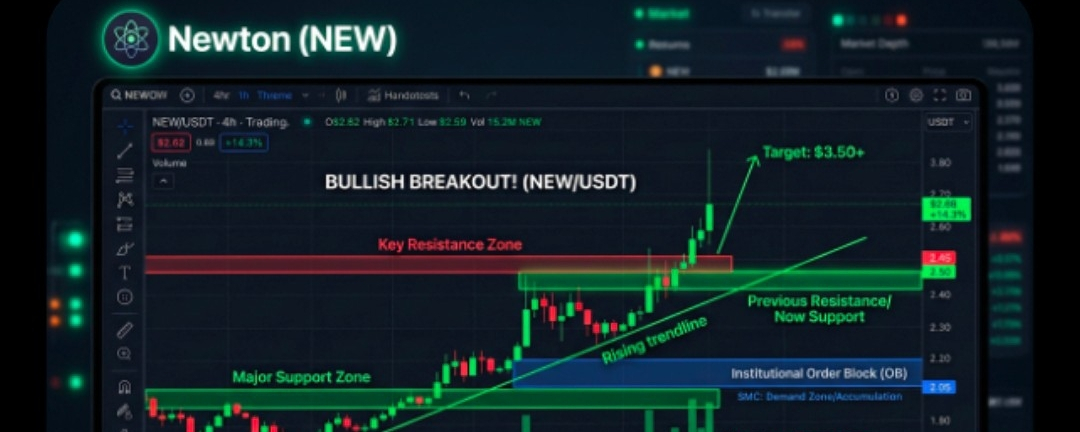
The New Coin#Newton Coin ($NEWT ) Market Analytics
Newton Coin (NEWT) is showing renewed momentum as traders closely monitor its price action alongside improving sentiment across the broader cryptocurrency market. The token has recently defended a key support zone, indicating that buyers remain active despite short-term volatility. Technical indicators suggest that if NEWT maintains its current structure and breaks above the nearest resistance level with strong trading volume, it could target higher price levels in the coming sessions. However, a rejection at resistance may trigger a temporary pullback before another bullish attempt. Investors should also keep an eye on ecosystem developments, exchange activity, and overall Bitcoin market direction, as these factors continue to influence NEWT's short-term performance. As always, proper risk management and independent research are essential before making any investment decisions.#CircleRemovedFromRussellGrowthIndexes #OilPriceFalls #KoreanWonWeakestSince2009
{spot}(NEWTUSDT)
The New Coin
#Newton Coin ($NEWT ) Market Analytics
Newton Coin (NEWT) is showing renewed momentum as traders closely monitor its price action alongside improving sentiment across the broader cryptocurrency market. The token has recently defended a key support zone, indicating that buyers remain active despite short-term volatility. Technical indicators suggest that if NEWT maintains its current structure and breaks above the nearest resistance level with strong trading volume, it could target higher price levels in the coming sessions. However, a rejection at resistance may trigger a temporary pullback before another bullish attempt. Investors should also keep an eye on ecosystem developments, exchange activity, and overall Bitcoin market direction, as these factors continue to influence NEWT's short-term performance. As always, proper risk management and independent research are essential before making any investment decisions.#CircleRemovedFromRussellGrowthIndexes #OilPriceFalls #KoreanWonWeakestSince2009
Newton Coin (NEWT) is showing renewed momentum as traders closely monitor its price action alongside improving sentiment across the broader cryptocurrency market. The token has recently defended a key support zone, indicating that buyers remain active despite short-term volatility. Technical indicators suggest that if NEWT maintains its current structure and breaks above the nearest resistance level with strong trading volume, it could target higher price levels in the coming sessions. However, a rejection at resistance may trigger a temporary pullback before another bullish attempt. Investors should also keep an eye on ecosystem developments, exchange activity, and overall Bitcoin market direction, as these factors continue to influence NEWT's short-term performance. As always, proper risk management and independent research are essential before making any investment decisions.#CircleRemovedFromRussellGrowthIndexes #OilPriceFalls #KoreanWonWeakestSince2009
81

·
--
🚀 Exploring the Future with @NewtonProtocol
The launch of the Newton Mainnet Beta marks an excitin🚀 Exploring the Future with @NewtonProtocol
The launch of the #newton Mainnet Beta marks an exciting milestone for the Web3 ecosystem. @NewtonProtocol is focused on building a decentralized infrastructure that aims to improve efficiency, security, and scalability for blockchain applications. $With the Mainnet Beta now available, developers and community members have an opportunity to experience the network, provide valuable feedback, and help shape its future development.
Projects that encourage community participation during the beta stage often build stronger ecosystems over time. The Newton Mainnet Beta is an important step toward testing real-world performance, improving stability, and preparing for broader adoption. As the network continues to evolve, it could unlock new possibilities for developers, users, and decentralized applications.
I'm looking forward to seeing how the community contributes to the growth of the ecosystem and how the team continues to innovate in the coming months. Wishing the project continued success as it moves toward its long-term vision.
$NEWT #Newt
🚀 Exploring the Future with @NewtonProtocol The launch of the Newton Mainnet Beta marks an excitin
🚀 Exploring the Future with @NewtonProtocol
The launch of the #newton Mainnet Beta marks an exciting milestone for the Web3 ecosystem. @NewtonProtocol is focused on building a decentralized infrastructure that aims to improve efficiency, security, and scalability for blockchain applications. $With the Mainnet Beta now available, developers and community members have an opportunity to experience the network, provide valuable feedback, and help shape its future development.
Projects that encourage community participation during the beta stage often build stronger ecosystems over time. The Newton Mainnet Beta is an important step toward testing real-world performance, improving stability, and preparing for broader adoption. As the network continues to evolve, it could unlock new possibilities for developers, users, and decentralized applications.
I'm looking forward to seeing how the community contributes to the growth of the ecosystem and how the team continues to innovate in the coming months. Wishing the project continued success as it moves toward its long-term vision.
$NEWT #Newt
The launch of the #newton Mainnet Beta marks an exciting milestone for the Web3 ecosystem. @NewtonProtocol is focused on building a decentralized infrastructure that aims to improve efficiency, security, and scalability for blockchain applications. $With the Mainnet Beta now available, developers and community members have an opportunity to experience the network, provide valuable feedback, and help shape its future development.
Projects that encourage community participation during the beta stage often build stronger ecosystems over time. The Newton Mainnet Beta is an important step toward testing real-world performance, improving stability, and preparing for broader adoption. As the network continues to evolve, it could unlock new possibilities for developers, users, and decentralized applications.
I'm looking forward to seeing how the community contributes to the growth of the ecosystem and how the team continues to innovate in the coming months. Wishing the project continued success as it moves toward its long-term vision.
$NEWT #Newt
47

·
--
Welcoming the Newton Mainnet Beta: An Important Step Toward More Ready-to-Use Web3 InfrastructureThe development of the Newton Mainnet Beta into one of the most interesting moments to follow for the blockchain community. Through @NewtonProtocol, this project demonstrates its commitment to building more stable, secure, and efficient infrastructure as a foundation for various decentralized applications in the future. The presence of the Mainnet Beta is not only a testing phase, but also an opportunity to gather input from the community so the network can continue to be refined before entering a more mature stage.
Welcoming the Newton Mainnet Beta: An Important Step Toward More Ready-to-Use Web3 Infrastructure
The development of the Newton Mainnet Beta into one of the most interesting moments to follow for the blockchain community. Through @NewtonProtocol, this project demonstrates its commitment to building more stable, secure, and efficient infrastructure as a foundation for various decentralized applications in the future. The presence of the Mainnet Beta is not only a testing phase, but also an opportunity to gather input from the community so the network can continue to be refined before entering a more mature stage.
76

·
--
Breaking Down the Newton Mainnet Beta: Infrastructure for the Next-Gen Web3 $NEWTCreating truly mass-scale decentralized services is impossible without a reliable and flexible technological foundation. The @NewtonProtocol project actively tackles this challenge by focusing its efforts on the current stage of testing the Newton Mainnet Beta. This release is an important milestone that demonstrates the network’s readiness for high loads and complex smart contracts.
Breaking Down the Newton Mainnet Beta: Infrastructure for the Next-Gen Web3 $NEWT
Creating truly mass-scale decentralized services is impossible without a reliable and flexible technological foundation. The @NewtonProtocol project actively tackles this challenge by focusing its efforts on the current stage of testing the Newton Mainnet Beta. This release is an important milestone that demonstrates the network’s readiness for high loads and complex smart contracts.
54

Why $NEWTON Is Becoming a Project Worth WatchingWhy $NEWTON Is Becoming a Project Worth Watching
The crypto market continues to evolve, and projects with practical utility are starting to attract more attention than short-lived hype. $NEWTON is one of the names gradually appearing on more investors’ watchlists because of its focus on building a scalable and efficient blockchain ecosystem. As market sentiment improves, traders are paying closer attention to projects that combine active development with growing community engagement.
While price volatility remains part of every crypto investment, $NEWTON has shown resilience by maintaining interest during changing market conditions. Continued ecosystem expansion, partnerships, and network activity could become important catalysts if overall market momentum stays positive. Like every digital asset, risk management is essential, and investors should always conduct their own research before making decisions.
For now, $NEWTON remains a project worth monitoring. If development milestones continue to be achieved and adoption grows, it could strengthen its position in the broader crypto market over the coming months.
$NEWT
#NEWTON #Binance1B$inStocks #Web3 #altcoins #DYOR
Why $NEWTON Is Becoming a Project Worth Watching
Why $NEWTON Is Becoming a Project Worth Watching
The crypto market continues to evolve, and projects with practical utility are starting to attract more attention than short-lived hype. $NEWTON is one of the names gradually appearing on more investors’ watchlists because of its focus on building a scalable and efficient blockchain ecosystem. As market sentiment improves, traders are paying closer attention to projects that combine active development with growing community engagement.
While price volatility remains part of every crypto investment, $NEWTON has shown resilience by maintaining interest during changing market conditions. Continued ecosystem expansion, partnerships, and network activity could become important catalysts if overall market momentum stays positive. Like every digital asset, risk management is essential, and investors should always conduct their own research before making decisions.
For now, $NEWTON remains a project worth monitoring. If development milestones continue to be achieved and adoption grows, it could strengthen its position in the broader crypto market over the coming months.
$NEWT
#NEWTON #Binance1B$inStocks #Web3 #altcoins #DYOR
The crypto market continues to evolve, and projects with practical utility are starting to attract more attention than short-lived hype. $NEWTON is one of the names gradually appearing on more investors’ watchlists because of its focus on building a scalable and efficient blockchain ecosystem. As market sentiment improves, traders are paying closer attention to projects that combine active development with growing community engagement.
While price volatility remains part of every crypto investment, $NEWTON has shown resilience by maintaining interest during changing market conditions. Continued ecosystem expansion, partnerships, and network activity could become important catalysts if overall market momentum stays positive. Like every digital asset, risk management is essential, and investors should always conduct their own research before making decisions.
For now, $NEWTON remains a project worth monitoring. If development milestones continue to be achieved and adoption grows, it could strengthen its position in the broader crypto market over the coming months.
$NEWT
#NEWTON #Binance1B$inStocks #Web3 #altcoins #DYOR
1
58

·
--
#newt $NEWT
{future}(NEWTUSDT)
Newton Protocol (NEWT) is building an exciting future for AI-driven blockchain infrastructure. By focusing on secure rollups and scalable technology, Newton aims to create a reliable environment where AI applications can operate efficiently and transparently. What makes this project stand out is its vision of combining artificial intelligence with decentralized systems to improve security, automation, and user experience. As the demand for AI-powered solutions continues to grow, projects like Newton Protocol have the potential to play a key role in shaping the next generation of Web3 innovation. I’m excited to follow Newton’s development journey and see how its technology contributes to a smarter, more efficient, and more decentralized digital ecosystem. As the demand for AI-powered solutions continues to grow, projects like Newton Protocol have the potential to play a key role in shaping the next generation of Web3 innovation.#NewtonProtocol #NEWT #AI #Web3 #Blockchain #newton
#newt $NEWT
Newton Protocol (NEWT) is building an exciting future for AI-driven blockchain infrastructure. By focusing on secure rollups and scalable technology, Newton aims to create a reliable environment where AI applications can operate efficiently and transparently. What makes this project stand out is its vision of combining artificial intelligence with decentralized systems to improve security, automation, and user experience. As the demand for AI-powered solutions continues to grow, projects like Newton Protocol have the potential to play a key role in shaping the next generation of Web3 innovation. I’m excited to follow Newton’s development journey and see how its technology contributes to a smarter, more efficient, and more decentralized digital ecosystem. As the demand for AI-powered solutions continues to grow, projects like Newton Protocol have the potential to play a key role in shaping the next generation of Web3 innovation.#NewtonProtocol #NEWT #AI #Web3 #Blockchain #newton
Newton Protocol (NEWT) is building an exciting future for AI-driven blockchain infrastructure. By focusing on secure rollups and scalable technology, Newton aims to create a reliable environment where AI applications can operate efficiently and transparently. What makes this project stand out is its vision of combining artificial intelligence with decentralized systems to improve security, automation, and user experience. As the demand for AI-powered solutions continues to grow, projects like Newton Protocol have the potential to play a key role in shaping the next generation of Web3 innovation. I’m excited to follow Newton’s development journey and see how its technology contributes to a smarter, more efficient, and more decentralized digital ecosystem. As the demand for AI-powered solutions continues to grow, projects like Newton Protocol have the potential to play a key role in shaping the next generation of Web3 innovation.#NewtonProtocol #NEWT #AI #Web3 #Blockchain #newton
89

Newton($NEWT)AnylsisNewton Protocol ($NEWT) is a decentralized policy layer designed to make on-chain compliance automatic, programmable, and verifiable. It allows builders to define policies—using both on-chain and off-chain data—that automatically approve or block transactions based on factors like sanctions, identity, and risk.
### Project Fundamentals
Core Utility: The protocol aims to replace manual compliance reviews with real-time, enforceable code, which is particularly relevant for stablecoin issuers, RWA (Real World Asset) platforms, and AI agents.
Technical Architecture: It utilizes a decentralized network of operators who evaluate policies within Trusted Execution Environments (TEEs). These operators generate cryptographic proofs of their checks, which can then be verified by anyone via the Newton Explorer.
Tokenomics: $NEWT is the native utility token used for compliance compute fees, rewards for network operators (including delegated staking), and governance voting.
Background: The project was developed by Magic Labs, co-founded by Sean Li and Jaemin Jin.
### Market Context (As of June/July 2026)
Current Performance: As of late June 2026, $NEWT has experienced downward pressure, often attributed to token unlocking schedules and broader market volatility.
Trading Data: Market analysis indicates the price has faced consolidation in a narrow range. Because the asset is categorized as a cryptocurrency, it is subject to high market risk and volatility.
Analyst Sentiment: Technical indicators have shown mixed signals, with some analysts noting oversold conditions and potential for staged rebounds depending on volume and buy-side support.
### Important Distinction
There is a separate Canadian company also named "Newton" (newton.co), which is a regulated cryptocurrency trading platform. These are distinct entities:
Newton Protocol ($NEWT) is the decentralized compliance-as-code project described above.
Newton (newton.co) is a centralized exchange based in Toronto, Canada, that provides a platform for buying/selling various cryptocurrencies#Newton ($NEWT)#SpotSilverRises3%To$60.10 #CircleRemovedFromRussellGrowthIndexes #BitcoinSlidesTo$59250
Newton($NEWT)Anylsis
Newton Protocol ($NEWT) is a decentralized policy layer designed to make on-chain compliance automatic, programmable, and verifiable. It allows builders to define policies—using both on-chain and off-chain data—that automatically approve or block transactions based on factors like sanctions, identity, and risk.
### Project Fundamentals
Core Utility: The protocol aims to replace manual compliance reviews with real-time, enforceable code, which is particularly relevant for stablecoin issuers, RWA (Real World Asset) platforms, and AI agents.
Technical Architecture: It utilizes a decentralized network of operators who evaluate policies within Trusted Execution Environments (TEEs). These operators generate cryptographic proofs of their checks, which can then be verified by anyone via the Newton Explorer.
Tokenomics: $NEWT is the native utility token used for compliance compute fees, rewards for network operators (including delegated staking), and governance voting.
Background: The project was developed by Magic Labs, co-founded by Sean Li and Jaemin Jin.
### Market Context (As of June/July 2026)
Current Performance: As of late June 2026, $NEWT has experienced downward pressure, often attributed to token unlocking schedules and broader market volatility.
Trading Data: Market analysis indicates the price has faced consolidation in a narrow range. Because the asset is categorized as a cryptocurrency, it is subject to high market risk and volatility.
Analyst Sentiment: Technical indicators have shown mixed signals, with some analysts noting oversold conditions and potential for staged rebounds depending on volume and buy-side support.
### Important Distinction
There is a separate Canadian company also named "Newton" (newton.co), which is a regulated cryptocurrency trading platform. These are distinct entities:
Newton Protocol ($NEWT) is the decentralized compliance-as-code project described above.
Newton (newton.co) is a centralized exchange based in Toronto, Canada, that provides a platform for buying/selling various cryptocurrencies#Newton ($NEWT)#SpotSilverRises3%To$60.10 #CircleRemovedFromRussellGrowthIndexes #BitcoinSlidesTo$59250
### Project Fundamentals
Core Utility: The protocol aims to replace manual compliance reviews with real-time, enforceable code, which is particularly relevant for stablecoin issuers, RWA (Real World Asset) platforms, and AI agents.
Technical Architecture: It utilizes a decentralized network of operators who evaluate policies within Trusted Execution Environments (TEEs). These operators generate cryptographic proofs of their checks, which can then be verified by anyone via the Newton Explorer.
Tokenomics: $NEWT is the native utility token used for compliance compute fees, rewards for network operators (including delegated staking), and governance voting.
Background: The project was developed by Magic Labs, co-founded by Sean Li and Jaemin Jin.
### Market Context (As of June/July 2026)
Current Performance: As of late June 2026, $NEWT has experienced downward pressure, often attributed to token unlocking schedules and broader market volatility.
Trading Data: Market analysis indicates the price has faced consolidation in a narrow range. Because the asset is categorized as a cryptocurrency, it is subject to high market risk and volatility.
Analyst Sentiment: Technical indicators have shown mixed signals, with some analysts noting oversold conditions and potential for staged rebounds depending on volume and buy-side support.
### Important Distinction
There is a separate Canadian company also named "Newton" (newton.co), which is a regulated cryptocurrency trading platform. These are distinct entities:
Newton Protocol ($NEWT) is the decentralized compliance-as-code project described above.
Newton (newton.co) is a centralized exchange based in Toronto, Canada, that provides a platform for buying/selling various cryptocurrencies#Newton ($NEWT)#SpotSilverRises3%To$60.10 #CircleRemovedFromRussellGrowthIndexes #BitcoinSlidesTo$59250
102

NEWTNEWT - a promising project that deserves attention
The world of cryptocurrencies continues to rapidly evolve, opening up new opportunities, investors, and developers. Among the many new projects,
NEWT is increasingly being discussed an initiative that is gradually building its own ecosystem and drawing the attention of an active community.
#newton $NEWT
{future}(NEWTUSDT)
NEWT
NEWT - a promising project that deserves attention
The world of cryptocurrencies continues to rapidly evolve, opening up new opportunities, investors, and developers. Among the many new projects,
NEWT is increasingly being discussed an initiative that is gradually building its own ecosystem and drawing the attention of an active community.
#newton $NEWT
The world of cryptocurrencies continues to rapidly evolve, opening up new opportunities, investors, and developers. Among the many new projects,
NEWT is increasingly being discussed an initiative that is gradually building its own ecosystem and drawing the attention of an active community.
#newton $NEWT
2
82

·
--
NEWTONGood Project. Get ready to see the development of this project/coin become PAUS.
Buy and hold—big move soon👀👀👀👀🤑🤑🤑
The support area at 0.0400 becomes the benchmark for big buyers to enter.
Good Project
Good data
Business development
A protocol that will become an important assetThe main role for big coins.Ayoooo, stay motivated, cuan warriors 🤑🤑🤑🤑🤑🤑👀👀👀👀👀👀👀👀 $NEWT #newton @NewtonProtocol
NEWTON
Good Project. Get ready to see the development of this project/coin become PAUS.
Buy and hold—big move soon👀👀👀👀🤑🤑🤑
The support area at 0.0400 becomes the benchmark for big buyers to enter.
Good Project
Good data
Business development
A protocol that will become an important assetThe main role for big coins.Ayoooo, stay motivated, cuan warriors 🤑🤑🤑🤑🤑🤑👀👀👀👀👀👀👀👀 $NEWT #newton @NewtonProtocol
Buy and hold—big move soon👀👀👀👀🤑🤑🤑
The support area at 0.0400 becomes the benchmark for big buyers to enter.
Good Project
Good data
Business development
A protocol that will become an important assetThe main role for big coins.Ayoooo, stay motivated, cuan warriors 🤑🤑🤑🤑🤑🤑👀👀👀👀👀👀👀👀 $NEWT #newton @NewtonProtocol
17

Newton: Building the Future of Web3Newton: Building the Future of Web3
Newton is a blockchain project focused on improving the Web3 experience through practical innovation, scalability, and community participation. As the blockchain industry continues to grow, users increasingly value projects that emphasize usability, efficiency, and real-world applications. Newton aims to contribute to this vision by supporting a decentralized ecosystem where developers and users can interact more effectively. While the crypto market remains dynamic, long-term success often depends on continuous development, strong community engagement, and meaningful adoption. Keeping an eye on projects like Newton can help investors and blockchain enthusiasts better understand emerging trends in decentralized technology. As always, do your own research (DYOR) before making any investment decisions, and focus on projects with clear goals, active development, and sustainable growth potential.
#Newton #Web3 #Blockchain #Crypto #Innovation #Innovation
Newton: Building the Future of Web3
Newton: Building the Future of Web3
Newton is a blockchain project focused on improving the Web3 experience through practical innovation, scalability, and community participation. As the blockchain industry continues to grow, users increasingly value projects that emphasize usability, efficiency, and real-world applications. Newton aims to contribute to this vision by supporting a decentralized ecosystem where developers and users can interact more effectively. While the crypto market remains dynamic, long-term success often depends on continuous development, strong community engagement, and meaningful adoption. Keeping an eye on projects like Newton can help investors and blockchain enthusiasts better understand emerging trends in decentralized technology. As always, do your own research (DYOR) before making any investment decisions, and focus on projects with clear goals, active development, and sustainable growth potential.
#Newton #Web3 #Blockchain #Crypto #Innovation #Innovation
Newton is a blockchain project focused on improving the Web3 experience through practical innovation, scalability, and community participation. As the blockchain industry continues to grow, users increasingly value projects that emphasize usability, efficiency, and real-world applications. Newton aims to contribute to this vision by supporting a decentralized ecosystem where developers and users can interact more effectively. While the crypto market remains dynamic, long-term success often depends on continuous development, strong community engagement, and meaningful adoption. Keeping an eye on projects like Newton can help investors and blockchain enthusiasts better understand emerging trends in decentralized technology. As always, do your own research (DYOR) before making any investment decisions, and focus on projects with clear goals, active development, and sustainable growth potential.
#Newton #Web3 #Blockchain #Crypto #Innovation #Innovation
80

·
--
Newton Mainnet Beta: A Strong Foundation for the Next Stage of Web3 InnovationThe launch of the Newton Mainnet Beta marks an important step in the evolution of decentralized infrastructure. Congratulations to @NewtonProtocol for reaching this milestone and continuing to build a network focused on practical blockchain adoption. Mainnet Beta is more than a technical release—it is an opportunity for developers, validators, and community members to test new features, provide valuable feedback, and contribute to a stronger ecosystem.
I believe the most successful blockchain projects are those that actively involve their communities during key development stages. By opening Mainnet Beta participation, Newton Protocol can gather real-world insights that help improve security, performance, and usability before broader adoption. This collaborative approach benefits both builders and users while encouraging innovation across the ecosystem.
I'm looking forward to seeing how new applications, developer tools, and community initiatives grow around the network in the coming months. Wishing the entire @NewtonProtocol team continued success as the ecosystem expands. $NEWT has the potential to play an important role in supporting this next phase of growth and community participation. #newton
Newton Mainnet Beta: A Strong Foundation for the Next Stage of Web3 Innovation
The launch of the Newton Mainnet Beta marks an important step in the evolution of decentralized infrastructure. Congratulations to @NewtonProtocol for reaching this milestone and continuing to build a network focused on practical blockchain adoption. Mainnet Beta is more than a technical release—it is an opportunity for developers, validators, and community members to test new features, provide valuable feedback, and contribute to a stronger ecosystem.
I believe the most successful blockchain projects are those that actively involve their communities during key development stages. By opening Mainnet Beta participation, Newton Protocol can gather real-world insights that help improve security, performance, and usability before broader adoption. This collaborative approach benefits both builders and users while encouraging innovation across the ecosystem.
I'm looking forward to seeing how new applications, developer tools, and community initiatives grow around the network in the coming months. Wishing the entire @NewtonProtocol team continued success as the ecosystem expands. $NEWT has the potential to play an important role in supporting this next phase of growth and community participation. #newton
I believe the most successful blockchain projects are those that actively involve their communities during key development stages. By opening Mainnet Beta participation, Newton Protocol can gather real-world insights that help improve security, performance, and usability before broader adoption. This collaborative approach benefits both builders and users while encouraging innovation across the ecosystem.
I'm looking forward to seeing how new applications, developer tools, and community initiatives grow around the network in the coming months. Wishing the entire @NewtonProtocol team continued success as the ecosystem expands. $NEWT has the potential to play an important role in supporting this next phase of growth and community participation. #newton
61


Article
@NewtonprotocolThe launch of the Newton Mainnet Beta is an exciting milestone for the decentralized ecosystem. It represents more than just another blockchain release—it is an opportunity to test real infrastructure, improve network performance, and strengthen community participation before full-scale adoption. I appreciate how @NewtonProtocol l is encouraging users and developers to explore the beta, provide feedback, and help refine the network through real-world testing.
The vision behind Newton Protocol focuses on creating a more efficient and accessible decentralized environment where innovation can continue to grow. Community involvement during the Mainnet Beta is especially important because every participant contributes valuable insights that can improve stability, security, and usability.
As the ecosystem develops, I look forward to seeing more applications, integrations, and developer activity built around the network. The success of any blockchain depends on both strong technology and an active community, and Newton Protocol appears to be building both.
If you're interested in following the project's progress, keep an eye on @NewtonProtocol for the latest updates, announcements, and opportunities to participate. I'm excited to watch how the ecosystem evolves and how $NEWT supports the growth of the network.
#newton
@Newtonprotocol
The launch of the Newton Mainnet Beta is an exciting milestone for the decentralized ecosystem. It represents more than just another blockchain release—it is an opportunity to test real infrastructure, improve network performance, and strengthen community participation before full-scale adoption. I appreciate how @NewtonProtocol l is encouraging users and developers to explore the beta, provide feedback, and help refine the network through real-world testing.
The vision behind Newton Protocol focuses on creating a more efficient and accessible decentralized environment where innovation can continue to grow. Community involvement during the Mainnet Beta is especially important because every participant contributes valuable insights that can improve stability, security, and usability.
As the ecosystem develops, I look forward to seeing more applications, integrations, and developer activity built around the network. The success of any blockchain depends on both strong technology and an active community, and Newton Protocol appears to be building both.
If you're interested in following the project's progress, keep an eye on @NewtonProtocol for the latest updates, announcements, and opportunities to participate. I'm excited to watch how the ecosystem evolves and how $NEWT supports the growth of the network.
#newton
The vision behind Newton Protocol focuses on creating a more efficient and accessible decentralized environment where innovation can continue to grow. Community involvement during the Mainnet Beta is especially important because every participant contributes valuable insights that can improve stability, security, and usability.
As the ecosystem develops, I look forward to seeing more applications, integrations, and developer activity built around the network. The success of any blockchain depends on both strong technology and an active community, and Newton Protocol appears to be building both.
If you're interested in following the project's progress, keep an eye on @NewtonProtocol for the latest updates, announcements, and opportunities to participate. I'm excited to watch how the ecosystem evolves and how $NEWT supports the growth of the network.
#newton
36

Article
The Security Signal Most People Ignore Isn't the Data—It's the Time#Newton The deeper I explored Newton Protocol's architecture, the more one idea stood out:
Sometimes the most valuable information isn't hidden in the data itself—it's hidden in how long a system takes to respond.
Latency is usually discussed as a performance metric. Faster execution, lower delays, better user experience.
Newton's documentation reveals another dimension entirely.
It treats timing as part of the protocol's security model.
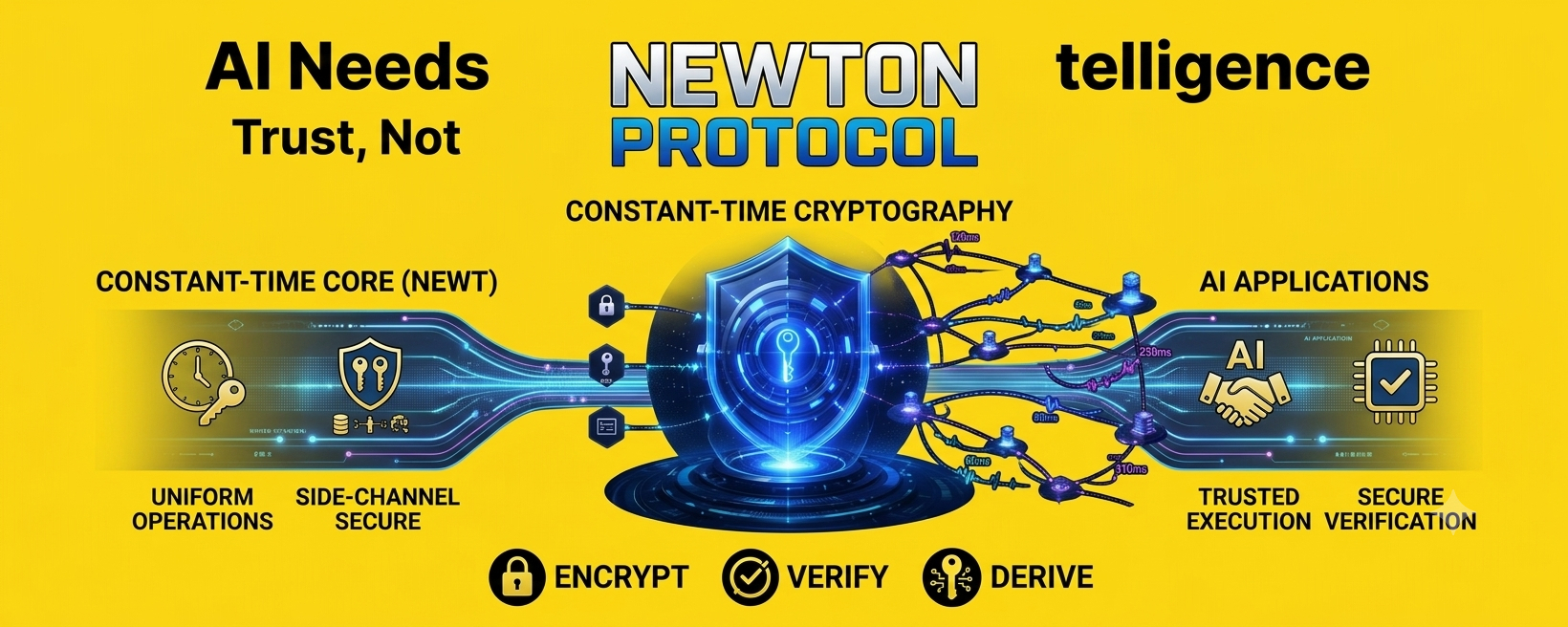
The protocol relies on audited constant-time implementations for cryptographic primitives such as secp256k1, Ed25519, X25519, and HPKE. Their purpose isn't simply efficient execution. Their real objective is to ensure that cryptographic operations don't reveal sensitive key material through measurable timing differences.
That may sound like a subtle engineering detail.
In reality, it's one of the strongest forms of defensive design.
If the execution time of a cryptographic operation changes depending on a secret key, an attacker collecting enough timing samples could gradually extract information that should remain permanently hidden.
Constant-time implementations are specifically designed to eliminate that relationship.
The result is a far stronger security boundary around the protocol's most sensitive operations.
This is where Newton's design philosophy becomes interesting.
Rather than expecting higher-level application logic to compensate for cryptographic weaknesses, the protocol strengthens security at the foundation itself.
But while reading further, another observation became impossible to ignore.
Constant-time cryptography is not the same as constant-time infrastructure.
Newton never suggests otherwise.
Its documentation explains that end-to-end request latency is influenced primarily by policy evaluation, network communication, data retrieval, and workflow complexity. The cryptographic operations themselves typically complete within microseconds or low-millisecond ranges on standard hardware, making them only a small part of the overall execution time.
That distinction changes the conversation.
A timing variation inside a cryptographic algorithm can become a security risk because it may expose secret material.
A timing variation across an application's full execution path is different. It often reflects the amount of computation, policy processing, database access, or coordination required to complete a request.
Those are fundamentally different problems.
One concerns the confidentiality of cryptographic secrets.
The other concerns what an outside observer might infer from system behaviour over time.
That difference deserves far more attention than it receives.
Even with perfectly protected cryptographic operations, applications can still exhibit observable response patterns. Different authorization paths, policy complexity, or backend workloads may naturally require different processing times.
Newton doesn't present these behaviours as vulnerabilities.
Nor should it.
They represent broader architectural considerations that exist across modern distributed systems, not weaknesses unique to Newton.
This is why I believe Newton's security model is both realistic and technically mature.
It focuses on solving the problems cryptography is meant to solve while avoiding exaggerated claims about making every layer of the system indistinguishable.
That's an important distinction.
Strong security isn't about pretending every request behaves identically.
It's about ensuring that the operations responsible for protecting sensitive secrets remain mathematically and operationally resistant to information leakage.
From there, application developers can evaluate whether broader response-time patterns reveal anything meaningful within their own systems.
To me, that's the bigger lesson.
Security isn't achieved through a single mechanism.
It's built by understanding where information can leak, reducing unnecessary exposure at every layer, and recognising that different risks require different defences.
Newton's constant-time cryptography establishes a strong boundary around sensitive key operations.
The next challenge belongs to developers: deciding whether the behaviour of their complete applications reveals more than they intend.
Question for the community:
As AI agents and autonomous financial systems become more common, should developers focus only on protecting cryptographic operations, or will analysing application-level timing behaviour become just as important for building truly trustworthy infrastructure?
🗳️ What's Your Opinion?
$NEWT #Newt @NewtonProtocol
The Security Signal Most People Ignore Isn't the Data—It's the Time
#Newton The deeper I explored Newton Protocol's architecture, the more one idea stood out:
Sometimes the most valuable information isn't hidden in the data itself—it's hidden in how long a system takes to respond.
Latency is usually discussed as a performance metric. Faster execution, lower delays, better user experience.
Newton's documentation reveals another dimension entirely.
It treats timing as part of the protocol's security model.
The protocol relies on audited constant-time implementations for cryptographic primitives such as secp256k1, Ed25519, X25519, and HPKE. Their purpose isn't simply efficient execution. Their real objective is to ensure that cryptographic operations don't reveal sensitive key material through measurable timing differences.
That may sound like a subtle engineering detail.
In reality, it's one of the strongest forms of defensive design.
If the execution time of a cryptographic operation changes depending on a secret key, an attacker collecting enough timing samples could gradually extract information that should remain permanently hidden.
Constant-time implementations are specifically designed to eliminate that relationship.
The result is a far stronger security boundary around the protocol's most sensitive operations.
This is where Newton's design philosophy becomes interesting.
Rather than expecting higher-level application logic to compensate for cryptographic weaknesses, the protocol strengthens security at the foundation itself.
But while reading further, another observation became impossible to ignore.
Constant-time cryptography is not the same as constant-time infrastructure.
Newton never suggests otherwise.
Its documentation explains that end-to-end request latency is influenced primarily by policy evaluation, network communication, data retrieval, and workflow complexity. The cryptographic operations themselves typically complete within microseconds or low-millisecond ranges on standard hardware, making them only a small part of the overall execution time.
That distinction changes the conversation.
A timing variation inside a cryptographic algorithm can become a security risk because it may expose secret material.
A timing variation across an application's full execution path is different. It often reflects the amount of computation, policy processing, database access, or coordination required to complete a request.
Those are fundamentally different problems.
One concerns the confidentiality of cryptographic secrets.
The other concerns what an outside observer might infer from system behaviour over time.
That difference deserves far more attention than it receives.
Even with perfectly protected cryptographic operations, applications can still exhibit observable response patterns. Different authorization paths, policy complexity, or backend workloads may naturally require different processing times.
Newton doesn't present these behaviours as vulnerabilities.
Nor should it.
They represent broader architectural considerations that exist across modern distributed systems, not weaknesses unique to Newton.
This is why I believe Newton's security model is both realistic and technically mature.
It focuses on solving the problems cryptography is meant to solve while avoiding exaggerated claims about making every layer of the system indistinguishable.
That's an important distinction.
Strong security isn't about pretending every request behaves identically.
It's about ensuring that the operations responsible for protecting sensitive secrets remain mathematically and operationally resistant to information leakage.
From there, application developers can evaluate whether broader response-time patterns reveal anything meaningful within their own systems.
To me, that's the bigger lesson.
Security isn't achieved through a single mechanism.
It's built by understanding where information can leak, reducing unnecessary exposure at every layer, and recognising that different risks require different defences.
Newton's constant-time cryptography establishes a strong boundary around sensitive key operations.
The next challenge belongs to developers: deciding whether the behaviour of their complete applications reveals more than they intend.
Question for the community:
As AI agents and autonomous financial systems become more common, should developers focus only on protecting cryptographic operations, or will analysing application-level timing behaviour become just as important for building truly trustworthy infrastructure?
🗳️ What's Your Opinion?
$NEWT #Newt @NewtonProtocol
Sometimes the most valuable information isn't hidden in the data itself—it's hidden in how long a system takes to respond.
Latency is usually discussed as a performance metric. Faster execution, lower delays, better user experience.
Newton's documentation reveals another dimension entirely.
It treats timing as part of the protocol's security model.
The protocol relies on audited constant-time implementations for cryptographic primitives such as secp256k1, Ed25519, X25519, and HPKE. Their purpose isn't simply efficient execution. Their real objective is to ensure that cryptographic operations don't reveal sensitive key material through measurable timing differences.
That may sound like a subtle engineering detail.
In reality, it's one of the strongest forms of defensive design.
If the execution time of a cryptographic operation changes depending on a secret key, an attacker collecting enough timing samples could gradually extract information that should remain permanently hidden.
Constant-time implementations are specifically designed to eliminate that relationship.
The result is a far stronger security boundary around the protocol's most sensitive operations.
This is where Newton's design philosophy becomes interesting.
Rather than expecting higher-level application logic to compensate for cryptographic weaknesses, the protocol strengthens security at the foundation itself.
But while reading further, another observation became impossible to ignore.
Constant-time cryptography is not the same as constant-time infrastructure.
Newton never suggests otherwise.
Its documentation explains that end-to-end request latency is influenced primarily by policy evaluation, network communication, data retrieval, and workflow complexity. The cryptographic operations themselves typically complete within microseconds or low-millisecond ranges on standard hardware, making them only a small part of the overall execution time.
That distinction changes the conversation.
A timing variation inside a cryptographic algorithm can become a security risk because it may expose secret material.
A timing variation across an application's full execution path is different. It often reflects the amount of computation, policy processing, database access, or coordination required to complete a request.
Those are fundamentally different problems.
One concerns the confidentiality of cryptographic secrets.
The other concerns what an outside observer might infer from system behaviour over time.
That difference deserves far more attention than it receives.
Even with perfectly protected cryptographic operations, applications can still exhibit observable response patterns. Different authorization paths, policy complexity, or backend workloads may naturally require different processing times.
Newton doesn't present these behaviours as vulnerabilities.
Nor should it.
They represent broader architectural considerations that exist across modern distributed systems, not weaknesses unique to Newton.
This is why I believe Newton's security model is both realistic and technically mature.
It focuses on solving the problems cryptography is meant to solve while avoiding exaggerated claims about making every layer of the system indistinguishable.
That's an important distinction.
Strong security isn't about pretending every request behaves identically.
It's about ensuring that the operations responsible for protecting sensitive secrets remain mathematically and operationally resistant to information leakage.
From there, application developers can evaluate whether broader response-time patterns reveal anything meaningful within their own systems.
To me, that's the bigger lesson.
Security isn't achieved through a single mechanism.
It's built by understanding where information can leak, reducing unnecessary exposure at every layer, and recognising that different risks require different defences.
Newton's constant-time cryptography establishes a strong boundary around sensitive key operations.
The next challenge belongs to developers: deciding whether the behaviour of their complete applications reveals more than they intend.
Question for the community:
As AI agents and autonomous financial systems become more common, should developers focus only on protecting cryptographic operations, or will analysing application-level timing behaviour become just as important for building truly trustworthy infrastructure?
🗳️ What's Your Opinion?
$NEWT #Newt @NewtonProtocol
20
1
98

·
--
I've become a lot less interested in AI as a narrative and a lot more interested in how capital behaves around it. @NewtonProtocol That's why I've been watching Newton Protocol differently.#Binance
The question isn't whether automated strategies can execute trades. We already know they can. The question is whether serious capital is willing to stay when those strategies are making decisions through volatile markets.#newton
One thing I've learned after a few market cycles is that high transaction counts don't impress me anymore. Automated systems can generate endless activity without creating much real economic value. What matters is whether fees remain healthy, wallets keep returning, and liquidity sticks around after incentives lose their edge.
I also think verification matters more than intelligence. During a bull market, almost every strategy looks smart. It's during sharp drawdowns that trust gets tested. If users understand how decisions are executed and why they happened, they're far more likely to stay engaged instead of pulling capital at the first sign of stress.#Birliktekazanalım
That's the lens I'm using with Newton Protocol. I'm paying less attention to the AI narrative and more attention to the quality of the capital interacting with the protocol. In the long run, sticky liquidity and repeat participation tell a much clearer story than headline activity ever will.
#GillibrandCallsForDigitalAssetEthicsBan #RevolutToDelistUSDT
@NewtonProtocol $NEWT
{future}(NEWTUSDT)
$LAB
{alpha}(560x7ec43cf65f1663f820427c62a5780b8f2e25593a)
$VANRY
{future}(VANRYUSDT)
I've become a lot less interested in AI as a narrative and a lot more interested in how capital behaves around it. @NewtonProtocol That's why I've been watching Newton Protocol differently.#Binance
The question isn't whether automated strategies can execute trades. We already know they can. The question is whether serious capital is willing to stay when those strategies are making decisions through volatile markets.#newton
One thing I've learned after a few market cycles is that high transaction counts don't impress me anymore. Automated systems can generate endless activity without creating much real economic value. What matters is whether fees remain healthy, wallets keep returning, and liquidity sticks around after incentives lose their edge.
I also think verification matters more than intelligence. During a bull market, almost every strategy looks smart. It's during sharp drawdowns that trust gets tested. If users understand how decisions are executed and why they happened, they're far more likely to stay engaged instead of pulling capital at the first sign of stress.#Birliktekazanalım
That's the lens I'm using with Newton Protocol. I'm paying less attention to the AI narrative and more attention to the quality of the capital interacting with the protocol. In the long run, sticky liquidity and repeat participation tell a much clearer story than headline activity ever will.
#GillibrandCallsForDigitalAssetEthicsBan #RevolutToDelistUSDT
@NewtonProtocol $NEWT
$LAB
$VANRY
The question isn't whether automated strategies can execute trades. We already know they can. The question is whether serious capital is willing to stay when those strategies are making decisions through volatile markets.#newton
One thing I've learned after a few market cycles is that high transaction counts don't impress me anymore. Automated systems can generate endless activity without creating much real economic value. What matters is whether fees remain healthy, wallets keep returning, and liquidity sticks around after incentives lose their edge.
I also think verification matters more than intelligence. During a bull market, almost every strategy looks smart. It's during sharp drawdowns that trust gets tested. If users understand how decisions are executed and why they happened, they're far more likely to stay engaged instead of pulling capital at the first sign of stress.#Birliktekazanalım
That's the lens I'm using with Newton Protocol. I'm paying less attention to the AI narrative and more attention to the quality of the capital interacting with the protocol. In the long run, sticky liquidity and repeat participation tell a much clearer story than headline activity ever will.
#GillibrandCallsForDigitalAssetEthicsBan #RevolutToDelistUSDT
@NewtonProtocol $NEWT
$LAB
$VANRY
🔹Supports more policy. design
75%
🔹Hides critical requirements
25%
4 votes • Voting closed
2
193
Log in to explore more content
Join global crypto users on Binance Square
⚡️ Get latest and useful information about crypto.
💬 Trusted by the world’s largest crypto exchange.
👍 Discover real insights from verified creators.
Email / Phone number
Trending Topics
1
#BinanceLaunchesBinanceIntelligence
87,293 views
1,008 Discussing
2
#StriveBuys2000BTCFor$169M
2,026 views
39 Discussing
3
#EvernorthXRPTreasuryCompletesSPACMerger
63,511 views
690 Discussing
4
#ADAGains10%Above$0.27
37,593 views
226 Discussing
5
#ETHUp70%InQ3ButLiquidityFalls
252,743 views
1,760 Discussing
6
#EthStakingExitQueueHits2026High
97,098 views
1,180 Discussing
7
#FedOctoberHoldOdds82.3%
102,002 views
1,134 Discussing
8
#Nikkei225Jumps2.5%ToThreeMonthHigh
104,212 views
1,357 Discussing
9
#CircleMints$2.75BUSDCOnSolanaIn7Days
2,739 views
59 Discussing
10
#DriftHackVictimsBeginClaims
215,663 views
2,007 Discussing