

#ecb
ecb
784,555 views
972 Discussing
Hot
Latest


Article
The ECB Just Launched Pontes: Europe's Answer to StablecoinsCentral bank money now settles tokenized asset trades directly. Here's why this matters even if you've never heard of it.
🌉 While the U.S. debates stablecoin regulation, Europe just quietly launched its own answer. It's called Pontes, Latin for bridges, and that name is exactly the point.
On September 21, the European Central Bank went live with the initial version of Pontes, a system letting tokenized asset trades settle directly in central bank money instead of relying on commercial banks or private stablecoins.
🏦 Here's the actual problem Pontes solves.
When a tokenized bond or security trades on a blockchain-based platform, something still has to settle the cash side of that trade. Until now, that meant using commercial bank money or privately issued tokens, both of which carry credit and liquidity risk the issuer doesn't fully control. Pontes lets that settlement happen in the safest form of money there is, money issued directly by the central bank itself.
⚙️ Here's who's actually plugged in already.
An initial group of operators, including Clearstream, SWIAT, Cashlink, and Axiology, are already registered, with more in the queue. Participants fund Dedicated Cash Wallets from their existing accounts and settle tokenized transactions through the Euro system's DLT platform.
🧠 Why does a central bank building this actually matter for crypto?
This isn't Europe rejecting tokenization, it's Europe trying to make sure it controls the foundation underneath it. A senior ECB official put it directly, tokenized assets are becoming central to a new digital finance ecosystem, and the goal is making sure central bank money stays the anchor of that system rather than private stablecoins filling the gap first.
That's a meaningfully different approach than the U.S., where private stablecoin issuers have led adoption with regulatory frameworks built around them after the fact. The ECB is trying to build the trusted settlement layer before private alternatives become deeply entrenched.
✅ What this means for you
If you're focused on U.S. crypto markets, this might feel distant, but it's a genuine signal about where global tokenization infrastructure is heading. Watching how two different approaches, central-bank-led versus private-stablecoin-led, compete for adoption over the next few years tells you a lot about the future shape of on-chain finance.
If you're interested in tokenized real-world assets, this is directly relevant. Pontes is specifically built for tokenized bonds, deposits, and securities settling on blockchain platforms, the exact category of assets projects like Ondo and others in the RWA space are trying to bring on chain.
If you're trying to understand institutional crypto adoption broadly, this is another data point alongside BlackRock's AI agent comments and Binance's bStocks, major institutions and even central banks are actively building real infrastructure around tokenization, not just talking about it.
🟢 Bullish scenario
Pontes expands smoothly toward its planned 24/7 operation by 2028, more institutions plug in, and it becomes a genuine model for how tokenized markets can scale safely, boosting broader institutional confidence in the space.
🔴 Risk scenario
Adoption stays limited to a handful of European institutions, the system faces the fragmentation, and complexity risks the ECB itself has flagged, and it remains a niche pilot rather than real infrastructure.
👀 Three things to watch
1️⃣ Operator growth
Does the list of registered platforms keep expanding beyond the initial four?
2️⃣ Transaction volume
Does real tokenized asset trading volume actually flow through Pontes, or does it stay mostly experimental?
3️⃣ Global response
Does this push other regions, including the U.S., to reconsider how central banks might engage with tokenization directly?
💡 The key takeaway
This isn't a crypto exchange launching a new product. It's a central bank building settlement infrastructure specifically because it sees tokenization becoming permanent and wants to make sure it isn't left designing the rules after the fact.
The real question is whether Pontes becomes the trusted backbone Europe's tokenized markets actually build on, or whether private stablecoins and alternative rails move faster and capture that role first.
That is the part worth watching.
This post is for informational and educational purposes only and is not financial advice. Crypto markets are volatile. Always conduct your own research before making financial decisions.
#BinanceSquare #ECB #Tokenization #RWA #Crypto
The ECB Just Launched Pontes: Europe's Answer to Stablecoins
Central bank money now settles tokenized asset trades directly. Here's why this matters even if you've never heard of it.
🌉 While the U.S. debates stablecoin regulation, Europe just quietly launched its own answer. It's called Pontes, Latin for bridges, and that name is exactly the point.
On September 21, the European Central Bank went live with the initial version of Pontes, a system letting tokenized asset trades settle directly in central bank money instead of relying on commercial banks or private stablecoins.
🏦 Here's the actual problem Pontes solves.
When a tokenized bond or security trades on a blockchain-based platform, something still has to settle the cash side of that trade. Until now, that meant using commercial bank money or privately issued tokens, both of which carry credit and liquidity risk the issuer doesn't fully control. Pontes lets that settlement happen in the safest form of money there is, money issued directly by the central bank itself.
⚙️ Here's who's actually plugged in already.
An initial group of operators, including Clearstream, SWIAT, Cashlink, and Axiology, are already registered, with more in the queue. Participants fund Dedicated Cash Wallets from their existing accounts and settle tokenized transactions through the Euro system's DLT platform.
🧠 Why does a central bank building this actually matter for crypto?
This isn't Europe rejecting tokenization, it's Europe trying to make sure it controls the foundation underneath it. A senior ECB official put it directly, tokenized assets are becoming central to a new digital finance ecosystem, and the goal is making sure central bank money stays the anchor of that system rather than private stablecoins filling the gap first.
That's a meaningfully different approach than the U.S., where private stablecoin issuers have led adoption with regulatory frameworks built around them after the fact. The ECB is trying to build the trusted settlement layer before private alternatives become deeply entrenched.
✅ What this means for you
If you're focused on U.S. crypto markets, this might feel distant, but it's a genuine signal about where global tokenization infrastructure is heading. Watching how two different approaches, central-bank-led versus private-stablecoin-led, compete for adoption over the next few years tells you a lot about the future shape of on-chain finance.
If you're interested in tokenized real-world assets, this is directly relevant. Pontes is specifically built for tokenized bonds, deposits, and securities settling on blockchain platforms, the exact category of assets projects like Ondo and others in the RWA space are trying to bring on chain.
If you're trying to understand institutional crypto adoption broadly, this is another data point alongside BlackRock's AI agent comments and Binance's bStocks, major institutions and even central banks are actively building real infrastructure around tokenization, not just talking about it.
🟢 Bullish scenario
Pontes expands smoothly toward its planned 24/7 operation by 2028, more institutions plug in, and it becomes a genuine model for how tokenized markets can scale safely, boosting broader institutional confidence in the space.
🔴 Risk scenario
Adoption stays limited to a handful of European institutions, the system faces the fragmentation, and complexity risks the ECB itself has flagged, and it remains a niche pilot rather than real infrastructure.
👀 Three things to watch
1️⃣ Operator growth
Does the list of registered platforms keep expanding beyond the initial four?
2️⃣ Transaction volume
Does real tokenized asset trading volume actually flow through Pontes, or does it stay mostly experimental?
3️⃣ Global response
Does this push other regions, including the U.S., to reconsider how central banks might engage with tokenization directly?
💡 The key takeaway
This isn't a crypto exchange launching a new product. It's a central bank building settlement infrastructure specifically because it sees tokenization becoming permanent and wants to make sure it isn't left designing the rules after the fact.
The real question is whether Pontes becomes the trusted backbone Europe's tokenized markets actually build on, or whether private stablecoins and alternative rails move faster and capture that role first.
That is the part worth watching.
This post is for informational and educational purposes only and is not financial advice. Crypto markets are volatile. Always conduct your own research before making financial decisions.
#BinanceSquare #ECB #Tokenization #RWA #Crypto
🌉 While the U.S. debates stablecoin regulation, Europe just quietly launched its own answer. It's called Pontes, Latin for bridges, and that name is exactly the point.
On September 21, the European Central Bank went live with the initial version of Pontes, a system letting tokenized asset trades settle directly in central bank money instead of relying on commercial banks or private stablecoins.
🏦 Here's the actual problem Pontes solves.
When a tokenized bond or security trades on a blockchain-based platform, something still has to settle the cash side of that trade. Until now, that meant using commercial bank money or privately issued tokens, both of which carry credit and liquidity risk the issuer doesn't fully control. Pontes lets that settlement happen in the safest form of money there is, money issued directly by the central bank itself.
⚙️ Here's who's actually plugged in already.
An initial group of operators, including Clearstream, SWIAT, Cashlink, and Axiology, are already registered, with more in the queue. Participants fund Dedicated Cash Wallets from their existing accounts and settle tokenized transactions through the Euro system's DLT platform.
🧠 Why does a central bank building this actually matter for crypto?
This isn't Europe rejecting tokenization, it's Europe trying to make sure it controls the foundation underneath it. A senior ECB official put it directly, tokenized assets are becoming central to a new digital finance ecosystem, and the goal is making sure central bank money stays the anchor of that system rather than private stablecoins filling the gap first.
That's a meaningfully different approach than the U.S., where private stablecoin issuers have led adoption with regulatory frameworks built around them after the fact. The ECB is trying to build the trusted settlement layer before private alternatives become deeply entrenched.
✅ What this means for you
If you're focused on U.S. crypto markets, this might feel distant, but it's a genuine signal about where global tokenization infrastructure is heading. Watching how two different approaches, central-bank-led versus private-stablecoin-led, compete for adoption over the next few years tells you a lot about the future shape of on-chain finance.
If you're interested in tokenized real-world assets, this is directly relevant. Pontes is specifically built for tokenized bonds, deposits, and securities settling on blockchain platforms, the exact category of assets projects like Ondo and others in the RWA space are trying to bring on chain.
If you're trying to understand institutional crypto adoption broadly, this is another data point alongside BlackRock's AI agent comments and Binance's bStocks, major institutions and even central banks are actively building real infrastructure around tokenization, not just talking about it.
🟢 Bullish scenario
Pontes expands smoothly toward its planned 24/7 operation by 2028, more institutions plug in, and it becomes a genuine model for how tokenized markets can scale safely, boosting broader institutional confidence in the space.
🔴 Risk scenario
Adoption stays limited to a handful of European institutions, the system faces the fragmentation, and complexity risks the ECB itself has flagged, and it remains a niche pilot rather than real infrastructure.
👀 Three things to watch
1️⃣ Operator growth
Does the list of registered platforms keep expanding beyond the initial four?
2️⃣ Transaction volume
Does real tokenized asset trading volume actually flow through Pontes, or does it stay mostly experimental?
3️⃣ Global response
Does this push other regions, including the U.S., to reconsider how central banks might engage with tokenization directly?
💡 The key takeaway
This isn't a crypto exchange launching a new product. It's a central bank building settlement infrastructure specifically because it sees tokenization becoming permanent and wants to make sure it isn't left designing the rules after the fact.
The real question is whether Pontes becomes the trusted backbone Europe's tokenized markets actually build on, or whether private stablecoins and alternative rails move faster and capture that role first.
That is the part worth watching.
This post is for informational and educational purposes only and is not financial advice. Crypto markets are volatile. Always conduct your own research before making financial decisions.
#BinanceSquare #ECB #Tokenization #RWA #Crypto
1
2
105

·
--
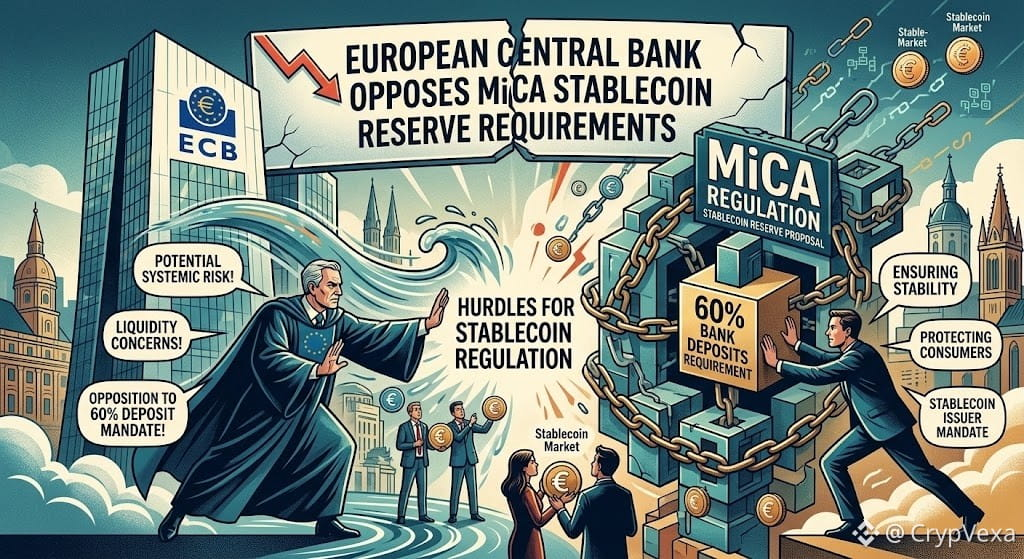
📉 ECB Challenges MiCA Stablecoin Reserve Rule
🏦 The European Central Bank (ECB) and EU national central banks have called for changes to a MiCA requirement that major stablecoin issuers keep 60% of reserves in bank deposits.
⚠️ The central banks argue the rule could create risks for the banking system, particularly if stablecoin reserves move in and out of bank deposits quickly.
🔄 They have proposed using short-maturity assets that can be converted into cash within 1–5 working days instead.
🌐 The debate highlights the challenge of balancing stablecoin liquidity, financial stability, and crypto-market innovation in the EU.
👀 Could changes to MiCA’s reserve rules reshape how stablecoins operate in Europe?
#MiCA #Stablecoins #ECB #CryptoRegulation
📉 ECB Challenges MiCA Stablecoin Reserve Rule
🏦 The European Central Bank (ECB) and EU national central banks have called for changes to a MiCA requirement that major stablecoin issuers keep 60% of reserves in bank deposits.
⚠️ The central banks argue the rule could create risks for the banking system, particularly if stablecoin reserves move in and out of bank deposits quickly.
🔄 They have proposed using short-maturity assets that can be converted into cash within 1–5 working days instead.
🌐 The debate highlights the challenge of balancing stablecoin liquidity, financial stability, and crypto-market innovation in the EU.
👀 Could changes to MiCA’s reserve rules reshape how stablecoins operate in Europe?
#MiCA #Stablecoins #ECB #CryptoRegulation
🏦 The European Central Bank (ECB) and EU national central banks have called for changes to a MiCA requirement that major stablecoin issuers keep 60% of reserves in bank deposits.
⚠️ The central banks argue the rule could create risks for the banking system, particularly if stablecoin reserves move in and out of bank deposits quickly.
🔄 They have proposed using short-maturity assets that can be converted into cash within 1–5 working days instead.
🌐 The debate highlights the challenge of balancing stablecoin liquidity, financial stability, and crypto-market innovation in the EU.
👀 Could changes to MiCA’s reserve rules reshape how stablecoins operate in Europe?
#MiCA #Stablecoins #ECB #CryptoRegulation
1
59

·
--
The ECB’s new Pontes platform uses $LINK as the rails to move central bank assets onto the blockchain.
This shift turns stagnant ledger entries into programmable, instant-settlement assets. Focus on the infrastructure providers capturing this flow rather than just the RWA hype. When central banks write the code, how will your strategy adapt to these new settlement rules?
$ENA $LINK #RWA #ECB #RealWorldAssets
The ECB’s new Pontes platform uses $LINK as the rails to move central bank assets onto the blockchain.
This shift turns stagnant ledger entries into programmable, instant-settlement assets. Focus on the infrastructure providers capturing this flow rather than just the RWA hype. When central banks write the code, how will your strategy adapt to these new settlement rules?
$ENA $LINK #RWA #ECB #RealWorldAssets
This shift turns stagnant ledger entries into programmable, instant-settlement assets. Focus on the infrastructure providers capturing this flow rather than just the RWA hype. When central banks write the code, how will your strategy adapt to these new settlement rules?
$ENA $LINK #RWA #ECB #RealWorldAssets
310

The European Central Bank is diving straight into tokenized assets by using its own funds on the new Pontes DLT network. Instead of just theorizing, the ECB wants hands-on experience settling public-sector securities on-chain. This is a massive institutional validation for distributed ledger technology in traditional finance, signaling that central banks are finally moving from cautious observation to active, on-chain participation. #CryptoNews #Tokenization #ECB
The European Central Bank is diving straight into tokenized assets by using its own funds on the new Pontes DLT network. Instead of just theorizing, the ECB wants hands-on experience settling public-sector securities on-chain. This is a massive institutional validation for distributed ledger technology in traditional finance, signaling that central banks are finally moving from cautious observation to active, on-chain participation. #CryptoNews #Tokenization #ECB


·
--
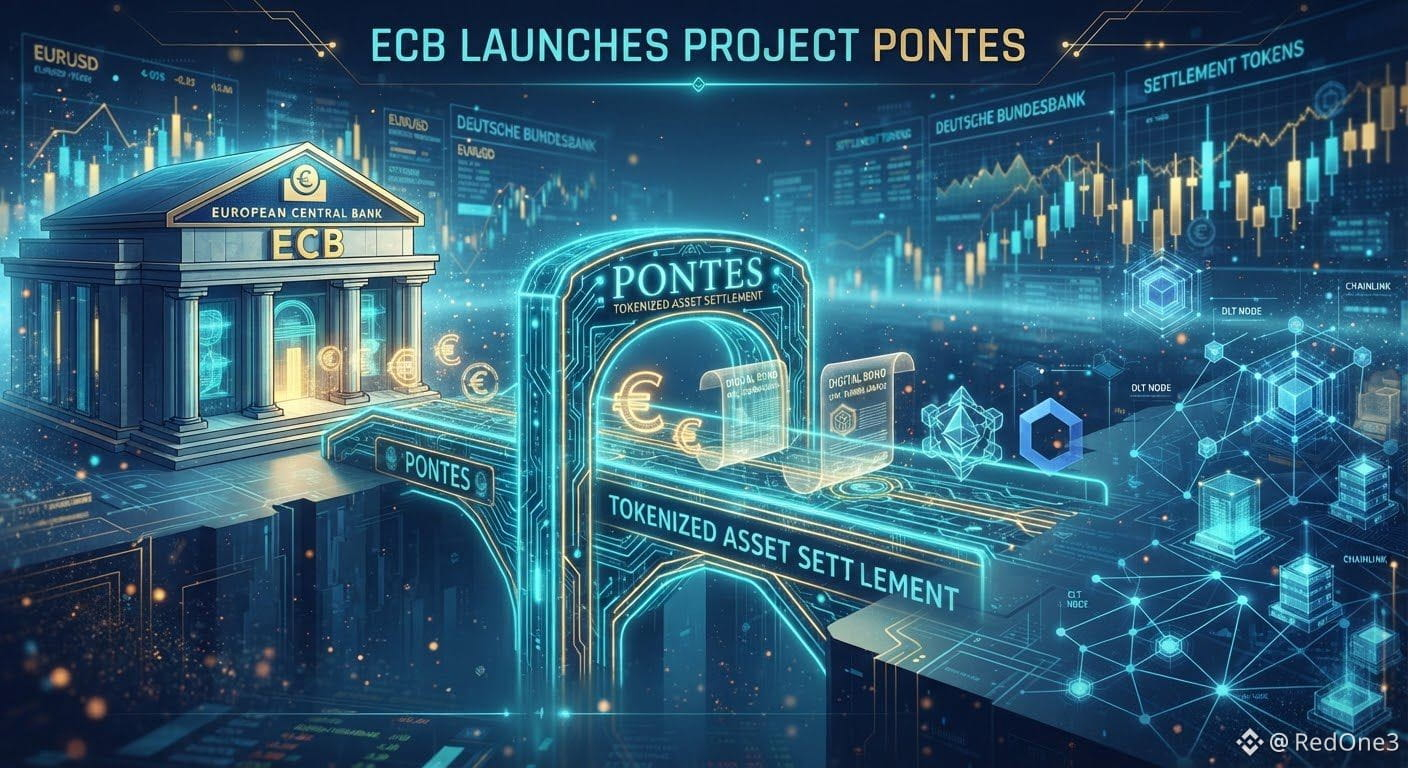
The European Central Bank (ECB) has officially launched Pontes, enabling wholesale tokenized assets to settle directly in central bank money. 🌐
Named after the Latin word for "bridges," Pontes links distributed ledger technology (DLT) platforms with official TARGET settlement rails, eliminating counterparty risk through Delivery-versus-Payment (DvP) mechanisms. 🌉
While this institutional development won't trigger an immediate retail market pump, it provides strong long-term structural validation for Real-World Asset (RWA) tokenization and traditional finance integration. 🏦⚡
How do you see institutional DLT adoption shaping the crypto landscape? 🧠
#ECB #Tokenization #RWA #DeFi .
The European Central Bank (ECB) has officially launched Pontes, enabling wholesale tokenized assets to settle directly in central bank money. 🌐
Named after the Latin word for "bridges," Pontes links distributed ledger technology (DLT) platforms with official TARGET settlement rails, eliminating counterparty risk through Delivery-versus-Payment (DvP) mechanisms. 🌉
While this institutional development won't trigger an immediate retail market pump, it provides strong long-term structural validation for Real-World Asset (RWA) tokenization and traditional finance integration. 🏦⚡
How do you see institutional DLT adoption shaping the crypto landscape? 🧠
#ECB #Tokenization #RWA #DeFi .
Named after the Latin word for "bridges," Pontes links distributed ledger technology (DLT) platforms with official TARGET settlement rails, eliminating counterparty risk through Delivery-versus-Payment (DvP) mechanisms. 🌉
While this institutional development won't trigger an immediate retail market pump, it provides strong long-term structural validation for Real-World Asset (RWA) tokenization and traditional finance integration. 🏦⚡
How do you see institutional DLT adoption shaping the crypto landscape? 🧠
#ECB #Tokenization #RWA #DeFi .
58

·
--
The European Central Bank's launch of Pontes on September 21 marks a genuine institutional milestone: a live wholesale settlement system allowing tokenized assets to settle directly in central bank money, built specifically for financial institutions rather than retail users. This is not a digital euro — the ECB has been explicit that Pontes should not be described as a retail central bank digital currency — but it represents one of the clearest signals yet that a major global central bank is building real infrastructure around blockchain-based settlement rather than treating tokenization purely as a private-sector experiment. The timing is notable: Pontes went live the same day Bitcoin surged past $85,000 to an eight-month high, and just days after the SEC's own September 17 "Innovation Exemption" opened a U.S. pathway for tokenized National Market System stocks to trade on-chain through permissioned automated market makers. Together, these two developments — one from Frankfurt, one from Washington — suggest institutional tokenization infrastructure is advancing on both sides of the Atlantic simultaneously, regardless of stalled comprehensive crypto legislation in the U.S. Congress.
#Tokenization #ECB #RWA #CentralBankInfrastructure
The European Central Bank's launch of Pontes on September 21 marks a genuine institutional milestone: a live wholesale settlement system allowing tokenized assets to settle directly in central bank money, built specifically for financial institutions rather than retail users. This is not a digital euro — the ECB has been explicit that Pontes should not be described as a retail central bank digital currency — but it represents one of the clearest signals yet that a major global central bank is building real infrastructure around blockchain-based settlement rather than treating tokenization purely as a private-sector experiment. The timing is notable: Pontes went live the same day Bitcoin surged past $85,000 to an eight-month high, and just days after the SEC's own September 17 "Innovation Exemption" opened a U.S. pathway for tokenized National Market System stocks to trade on-chain through permissioned automated market makers. Together, these two developments — one from Frankfurt, one from Washington — suggest institutional tokenization infrastructure is advancing on both sides of the Atlantic simultaneously, regardless of stalled comprehensive crypto legislation in the U.S. Congress.
#Tokenization #ECB #RWA #CentralBankInfrastructure
#Tokenization #ECB #RWA #CentralBankInfrastructure

38

Verified
The ECB just started settling euros on blockchain.
A central bank actually using blockchain rails is a pretty big deal.
This shows blockchain tech isn't just a crypto thing anymore.
Do you think more central banks follow this path?
Follow for more.
#ECB #BlockchainEuro #CBDC #CryptoAdoption .
$SYN
{spot}(SYNUSDT)
$NEAR
{spot}(NEARUSDT)
$PHA
{spot}(PHAUSDT)
#ecbstartsblockchaineurosettlement
The ECB just started settling euros on blockchain.
A central bank actually using blockchain rails is a pretty big deal.
This shows blockchain tech isn't just a crypto thing anymore.
Do you think more central banks follow this path?
Follow for more.
#ECB #BlockchainEuro #CBDC #CryptoAdoption .
$SYN
$NEAR
$PHA
#ecbstartsblockchaineurosettlement
A central bank actually using blockchain rails is a pretty big deal.
This shows blockchain tech isn't just a crypto thing anymore.
Do you think more central banks follow this path?
Follow for more.
#ECB #BlockchainEuro #CBDC #CryptoAdoption .
$SYN
$NEAR
$PHA
#ecbstartsblockchaineurosettlement
458

🇪🇺 ECB launches Pontes
Pontes enables financial institutions to settle tokenized assets in central bank money, without private stablecoins. States are building their own token infrastructure. Competition for stables?
#ECB #CBDC #Tokenization #NFA
🇪🇺 ECB launches Pontes
Pontes enables financial institutions to settle tokenized assets in central bank money, without private stablecoins. States are building their own token infrastructure. Competition for stables?
#ECB #CBDC #Tokenization #NFA
Pontes enables financial institutions to settle tokenized assets in central bank money, without private stablecoins. States are building their own token infrastructure. Competition for stables?
#ECB #CBDC #Tokenization #NFA

18
The European Central Bank is making a major power play with the launch of Pontes, a new system designed to settle tokenized assets completely bypassing stablecoins. While traditional finance tries to keep settlement locked within centralized institutional rails, this 2028 roadmap proves tokenization is moving past the experimental phase. It is a clear reminder that global regulators want the efficiency of blockchain technology, but strictly on their own terms and without decentralized assets. #ECB #Tokenization #RWA
The European Central Bank is making a major power play with the launch of Pontes, a new system designed to settle tokenized assets completely bypassing stablecoins. While traditional finance tries to keep settlement locked within centralized institutional rails, this 2028 roadmap proves tokenization is moving past the experimental phase. It is a clear reminder that global regulators want the efficiency of blockchain technology, but strictly on their own terms and without decentralized assets. #ECB #Tokenization #RWA
The European Central Bank just rolled out the Pontes platform to test wholesale tokenized asset settlement using central-bank money. By linking distributed ledger tech straight to traditional payment rails, the ECB is quietly laying the groundwork for institutional crypto adoption. Crucially, this wholesale rail runs entirely separate from the upcoming 2027 retail digital euro pilot. TradFi and tokenization are inching closer together every single day. $EUR #ECB #CryptoRegulations #Tokenization
The European Central Bank just rolled out the Pontes platform to test wholesale tokenized asset settlement using central-bank money. By linking distributed ledger tech straight to traditional payment rails, the ECB is quietly laying the groundwork for institutional crypto adoption. Crucially, this wholesale rail runs entirely separate from the upcoming 2027 retail digital euro pilot. TradFi and tokenization are inching closer together every single day. $EUR #ECB #CryptoRegulations #Tokenization
10

·
--
Bullish
The European Central Bank (#ECB ) has officially launched Pontes, a groundbreaking platform designed for the settlement of tokenized Real-World Assets (#RWA ) and financial instruments using central bank money. 💶⚡
This innovative technical bridge directly connects #blockchain networks with instant settlement systems, eliminating credit risks and driving unprecedented efficiency in institutional banking. 🚀🛡️📈
#LINK
#Chainlink
$LINK
{spot}(LINKUSDT)
$BTC
{spot}(BTCUSDT)
$ZEC
{spot}(ZECUSDT)
The European Central Bank (#ECB ) has officially launched Pontes, a groundbreaking platform designed for the settlement of tokenized Real-World Assets (#RWA ) and financial instruments using central bank money. 💶⚡
This innovative technical bridge directly connects #blockchain networks with instant settlement systems, eliminating credit risks and driving unprecedented efficiency in institutional banking. 🚀🛡️📈
#LINK
#Chainlink
$LINK
$BTC
$ZEC
This innovative technical bridge directly connects #blockchain networks with instant settlement systems, eliminating credit risks and driving unprecedented efficiency in institutional banking. 🚀🛡️📈
#LINK
#Chainlink
$LINK
$BTC
$ZEC


Good luck 🍀
From OnionSam
1
323

#ecbstartsblockchaineurosettlement
The European Central Bank just went live on blockchain.
The ECB has officially launched Pontes, bringing wholesale Euro settlement directly onto distributed ledger technology (DLT) in central bank money.
This is not a sandbox test. It is active market infrastructure bridging TARGET Services with tokenized assets.
Key Takeaways
The Anchor: Real-time Delivery-versus-Payment (DvP) settling in risk-free central bank money, rather than private stablecoins.
Institutional Power: Heavyweights like Deutsche Bank, Santander, and Clearstream are onboarded from day one.
Skin in the Game: The ECB confirmed plans to allocate part of its own €23B fund into tokenized public debt settled on Pontes.
The Real Impact
While retail debates CBDCs, wholesale finance is rewriting its pipes in code. Tokenized bonds, equities, and collateral can now clear instantly with automated smart contracts, cutting settlement counterparty risk to zero.
Trillions in institutional capital just received a direct gateway into on-chain finance.
Is this bullish for real-world asset (RWA) protocols, or will central banks crowd out private settlement? Share your take below.
#ECB #blockchain #Tokenization #euro
$BTC
{future}(BTCUSDT)
$ETH
{future}(ETHUSDT)
$SOL
{future}(SOLUSDT)
#ecbstartsblockchaineurosettlement
The European Central Bank just went live on blockchain.
The ECB has officially launched Pontes, bringing wholesale Euro settlement directly onto distributed ledger technology (DLT) in central bank money.
This is not a sandbox test. It is active market infrastructure bridging TARGET Services with tokenized assets.
Key Takeaways
The Anchor: Real-time Delivery-versus-Payment (DvP) settling in risk-free central bank money, rather than private stablecoins.
Institutional Power: Heavyweights like Deutsche Bank, Santander, and Clearstream are onboarded from day one.
Skin in the Game: The ECB confirmed plans to allocate part of its own €23B fund into tokenized public debt settled on Pontes.
The Real Impact
While retail debates CBDCs, wholesale finance is rewriting its pipes in code. Tokenized bonds, equities, and collateral can now clear instantly with automated smart contracts, cutting settlement counterparty risk to zero.
Trillions in institutional capital just received a direct gateway into on-chain finance.
Is this bullish for real-world asset (RWA) protocols, or will central banks crowd out private settlement? Share your take below.
#ECB #blockchain #Tokenization #euro
$BTC
$ETH
$SOL
The European Central Bank just went live on blockchain.
The ECB has officially launched Pontes, bringing wholesale Euro settlement directly onto distributed ledger technology (DLT) in central bank money.
This is not a sandbox test. It is active market infrastructure bridging TARGET Services with tokenized assets.
Key Takeaways
The Anchor: Real-time Delivery-versus-Payment (DvP) settling in risk-free central bank money, rather than private stablecoins.
Institutional Power: Heavyweights like Deutsche Bank, Santander, and Clearstream are onboarded from day one.
Skin in the Game: The ECB confirmed plans to allocate part of its own €23B fund into tokenized public debt settled on Pontes.
The Real Impact
While retail debates CBDCs, wholesale finance is rewriting its pipes in code. Tokenized bonds, equities, and collateral can now clear instantly with automated smart contracts, cutting settlement counterparty risk to zero.
Trillions in institutional capital just received a direct gateway into on-chain finance.
Is this bullish for real-world asset (RWA) protocols, or will central banks crowd out private settlement? Share your take below.
#ECB #blockchain #Tokenization #euro
$BTC
$ETH
$SOL
1
11

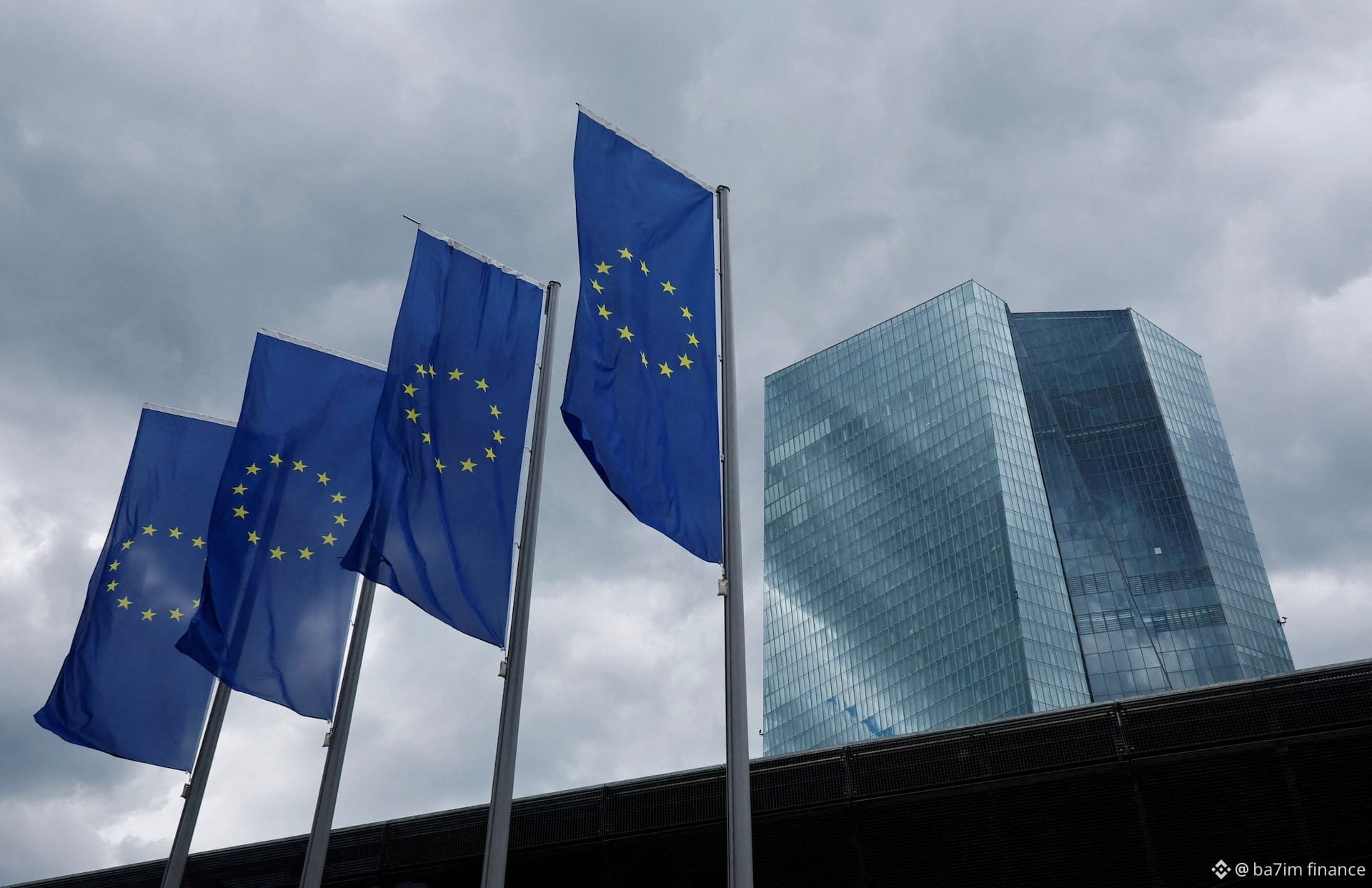

ECB will purchase tokenized securities via the new DLT platform Pontes
- The ECB will buy tokenized public securities
- Trading via the DLT Pontes platform
- Purpose: to directly experience the DLT market
#BinanceSquare #CryptoNews #ECB #Tokenization #DLT
$btc $eth
vlikevn Titanbot
Source: CoinTelegraph
ECB will purchase tokenized securities via the new DLT platform Pontes
- The ECB will buy tokenized public securities
- Trading via the DLT Pontes platform
- Purpose: to directly experience the DLT market
#BinanceSquare #CryptoNews #ECB #Tokenization #DLT
$btc $eth
vlikevn Titanbot
Source: CoinTelegraph
- The ECB will buy tokenized public securities
- Trading via the DLT Pontes platform
- Purpose: to directly experience the DLT market
#BinanceSquare #CryptoNews #ECB #Tokenization #DLT
$btc $eth
vlikevn Titanbot
Source: CoinTelegraph
1
141

·
--
The European central bank is also getting into the game: it has set aside 23 billion in its own funds to buy tokenized securities, starting with euro-zone government bonds and institutional bonds. The central bank itself is touching on-chain assets—this is way more than what those ETF inflows amount to. But don’t rush into FOMO. They emphasized it’s a “small proportion” and denominated in euros. For now, they’ve just passed the first cigarette to the RWA narrative; real money still needs to wait until they’ve tested the waters.
$BTC $ETH #ECB #RWA
The European central bank is also getting into the game: it has set aside 23 billion in its own funds to buy tokenized securities, starting with euro-zone government bonds and institutional bonds. The central bank itself is touching on-chain assets—this is way more than what those ETF inflows amount to. But don’t rush into FOMO. They emphasized it’s a “small proportion” and denominated in euros. For now, they’ve just passed the first cigarette to the RWA narrative; real money still needs to wait until they’ve tested the waters.
$BTC $ETH #ECB #RWA
$BTC $ETH #ECB #RWA

143
The ECB will buy tokenized bonds using a dedicated fund
- The ECB will roll out a new system linking payments with the blockchain-based financial markets
- Use a dedicated fund to buy tokenized bonds
- Goal: increase liquidity and integrate blockchain into EU finance #BinanceSquare #CryptoNews #ECB #TokenizedBonds
$btc $eth
#vlikevn Titanbot
Source: CoinDesk
The ECB will buy tokenized bonds using a dedicated fund
- The ECB will roll out a new system linking payments with the blockchain-based financial markets
- Use a dedicated fund to buy tokenized bonds
- Goal: increase liquidity and integrate blockchain into EU finance #BinanceSquare #CryptoNews #ECB #TokenizedBonds
$btc $eth
#vlikevn Titanbot
Source: CoinDesk
- The ECB will roll out a new system linking payments with the blockchain-based financial markets
- Use a dedicated fund to buy tokenized bonds
- Goal: increase liquidity and integrate blockchain into EU finance #BinanceSquare #CryptoNews #ECB #TokenizedBonds
$btc $eth
#vlikevn Titanbot
Source: CoinDesk
215

·
--
The ECB enters the blockchain race by allowing European banks to settle tokenized transactions in central bank money. Meanwhile, BTC smashes 85 870 $ (+5,9%) and ETH follows at 2 740 $ (+4,3%), driven by a wave of short liquidations rather than by genuine spot demand. Europe is institutionalizing what Washington can’t manage to legislate: a clear framework for tokenization. The SEC did publish its Innovation Exemption 48 hours after the failure of the Clarity Act, but an exemption isn’t a law, and the next administration could undo everything. Is Europe taking a decisive regulatory lead that the United States will no longer be able to catch up with? #ECB #Tokenisation
The ECB enters the blockchain race by allowing European banks to settle tokenized transactions in central bank money. Meanwhile, BTC smashes 85 870 $ (+5,9%) and ETH follows at 2 740 $ (+4,3%), driven by a wave of short liquidations rather than by genuine spot demand. Europe is institutionalizing what Washington can’t manage to legislate: a clear framework for tokenization. The SEC did publish its Innovation Exemption 48 hours after the failure of the Clarity Act, but an exemption isn’t a law, and the next administration could undo everything. Is Europe taking a decisive regulatory lead that the United States will no longer be able to catch up with? #ECB #Tokenisation
21

·
--
🎯 ECB puts itself on the line to buy bond market tokens
📰 The ECB launches the Pontes platform, directly connecting its own payment system to the blockchain financial market, and also plans to use its own reserves to directly buy tokenized bonds
💬 The central bank is acting as the buyer itself—this is more aggressive than any ETF, essentially stamping an official seal on RWA. Traditional finance is no longer waiting on the sidelines for blockchain; it’s moving in directly. After reading this, you’ll be stunned for two seconds—the speed is a bit beyond expectations
🏷️ #ECB #RWA #代币化债券 #链上美债 #stablecoin
🎯 ECB puts itself on the line to buy bond market tokens
📰 The ECB launches the Pontes platform, directly connecting its own payment system to the blockchain financial market, and also plans to use its own reserves to directly buy tokenized bonds
💬 The central bank is acting as the buyer itself—this is more aggressive than any ETF, essentially stamping an official seal on RWA. Traditional finance is no longer waiting on the sidelines for blockchain; it’s moving in directly. After reading this, you’ll be stunned for two seconds—the speed is a bit beyond expectations
🏷️ #ECB #RWA #代币化债券 #链上美债 #stablecoin
📰 The ECB launches the Pontes platform, directly connecting its own payment system to the blockchain financial market, and also plans to use its own reserves to directly buy tokenized bonds
💬 The central bank is acting as the buyer itself—this is more aggressive than any ETF, essentially stamping an official seal on RWA. Traditional finance is no longer waiting on the sidelines for blockchain; it’s moving in directly. After reading this, you’ll be stunned for two seconds—the speed is a bit beyond expectations
🏷️ #ECB #RWA #代币化债券 #链上美债 #stablecoin
5

·
--
Bullish
#ECBStartsBlockchainEuroSettlement
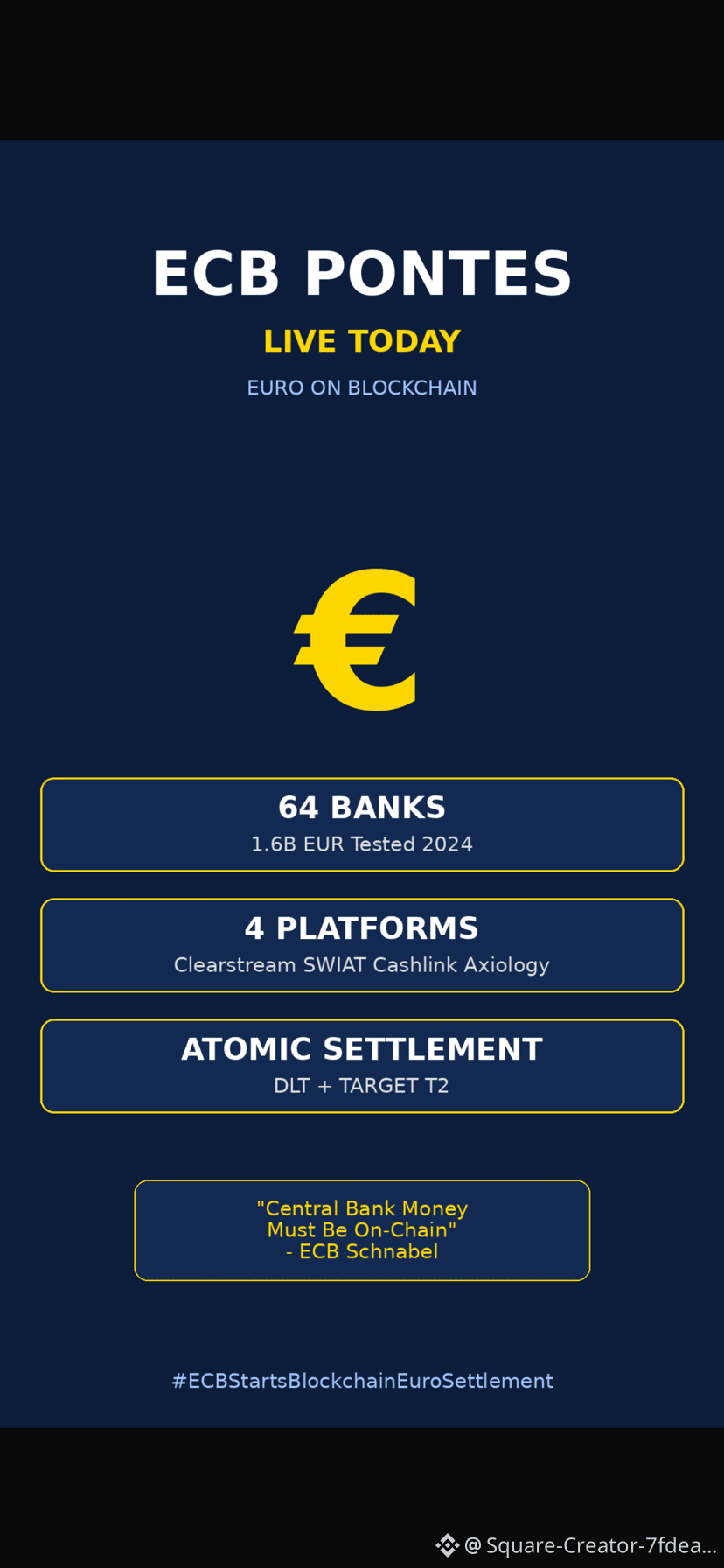
🚨 Urgent: Europe puts Central Bank money on the blockchain! 🚨
#ecbstartsblockchaineurosettlement
Imagine waking up to find that the funds used by Europe’s central banking system can now settle transactions linked to blockchain markets ⚡️🇪🇺
What happened today?
The European Central Bank (ECB) officially launched the PONTES project today, September 21, 2026!
🔹 What is Pontes?
A bridge that connects banks’ private blockchain platforms (DLT) directly to the TARGET system, which processes €180 trillion per year
🔹 How does it work?
- You have a special Tokenized Bond on the blockchain
- Before: you would sell the bond on the blockchain, but the money would go through the old system = a two-day risk
- Now: the sale and the money happen at the same time via Atomic Settlement using real central bank money!
🔹 Why is it important?
64 banks tested the system in 2024 and completed €1.6 billion in settlement
The problem was: banks don’t want to settle on the blockchain if the settlement is in ordinary commercial bank money
Now the ECB said: come settle with our money = 100% security
🔹 4 companies started today:
- Clearstream
- SWIAT
- Cashlink
- Axiology (uses XRP Ledger technology! 👀)
Fees: €2,500 per participant and €15,000 for the operator—no commission on each transaction at the beginning
Goal: running 09:00–16:00 now; it will become 24/7 in 2028
💥 Statement by Isabel Schnabel, ECB board member:
$XRP $INJ $APT $STRK #ECB #blockchain #Pontes #CryptoNews #BinanceSquare
#ECBStartsBlockchainEuroSettlement
🚨 Urgent: Europe puts Central Bank money on the blockchain! 🚨
#ecbstartsblockchaineurosettlement
Imagine waking up to find that the funds used by Europe’s central banking system can now settle transactions linked to blockchain markets ⚡️🇪🇺
What happened today?
The European Central Bank (ECB) officially launched the PONTES project today, September 21, 2026!
🔹 What is Pontes?
A bridge that connects banks’ private blockchain platforms (DLT) directly to the TARGET system, which processes €180 trillion per year
🔹 How does it work?
- You have a special Tokenized Bond on the blockchain
- Before: you would sell the bond on the blockchain, but the money would go through the old system = a two-day risk
- Now: the sale and the money happen at the same time via Atomic Settlement using real central bank money!
🔹 Why is it important?
64 banks tested the system in 2024 and completed €1.6 billion in settlement
The problem was: banks don’t want to settle on the blockchain if the settlement is in ordinary commercial bank money
Now the ECB said: come settle with our money = 100% security
🔹 4 companies started today:
- Clearstream
- SWIAT
- Cashlink
- Axiology (uses XRP Ledger technology! 👀)
Fees: €2,500 per participant and €15,000 for the operator—no commission on each transaction at the beginning
Goal: running 09:00–16:00 now; it will become 24/7 in 2028
💥 Statement by Isabel Schnabel, ECB board member:
$XRP $INJ $APT $STRK #ECB #blockchain #Pontes #CryptoNews #BinanceSquare
🚨 Urgent: Europe puts Central Bank money on the blockchain! 🚨
#ecbstartsblockchaineurosettlement
Imagine waking up to find that the funds used by Europe’s central banking system can now settle transactions linked to blockchain markets ⚡️🇪🇺
What happened today?
The European Central Bank (ECB) officially launched the PONTES project today, September 21, 2026!
🔹 What is Pontes?
A bridge that connects banks’ private blockchain platforms (DLT) directly to the TARGET system, which processes €180 trillion per year
🔹 How does it work?
- You have a special Tokenized Bond on the blockchain
- Before: you would sell the bond on the blockchain, but the money would go through the old system = a two-day risk
- Now: the sale and the money happen at the same time via Atomic Settlement using real central bank money!
🔹 Why is it important?
64 banks tested the system in 2024 and completed €1.6 billion in settlement
The problem was: banks don’t want to settle on the blockchain if the settlement is in ordinary commercial bank money
Now the ECB said: come settle with our money = 100% security
🔹 4 companies started today:
- Clearstream
- SWIAT
- Cashlink
- Axiology (uses XRP Ledger technology! 👀)
Fees: €2,500 per participant and €15,000 for the operator—no commission on each transaction at the beginning
Goal: running 09:00–16:00 now; it will become 24/7 in 2028
💥 Statement by Isabel Schnabel, ECB board member:
$XRP $INJ $APT $STRK #ECB #blockchain #Pontes #CryptoNews #BinanceSquare
4
519
·
--
Bullish
Verified
#ECBStartsBlockchainEuroSettlement
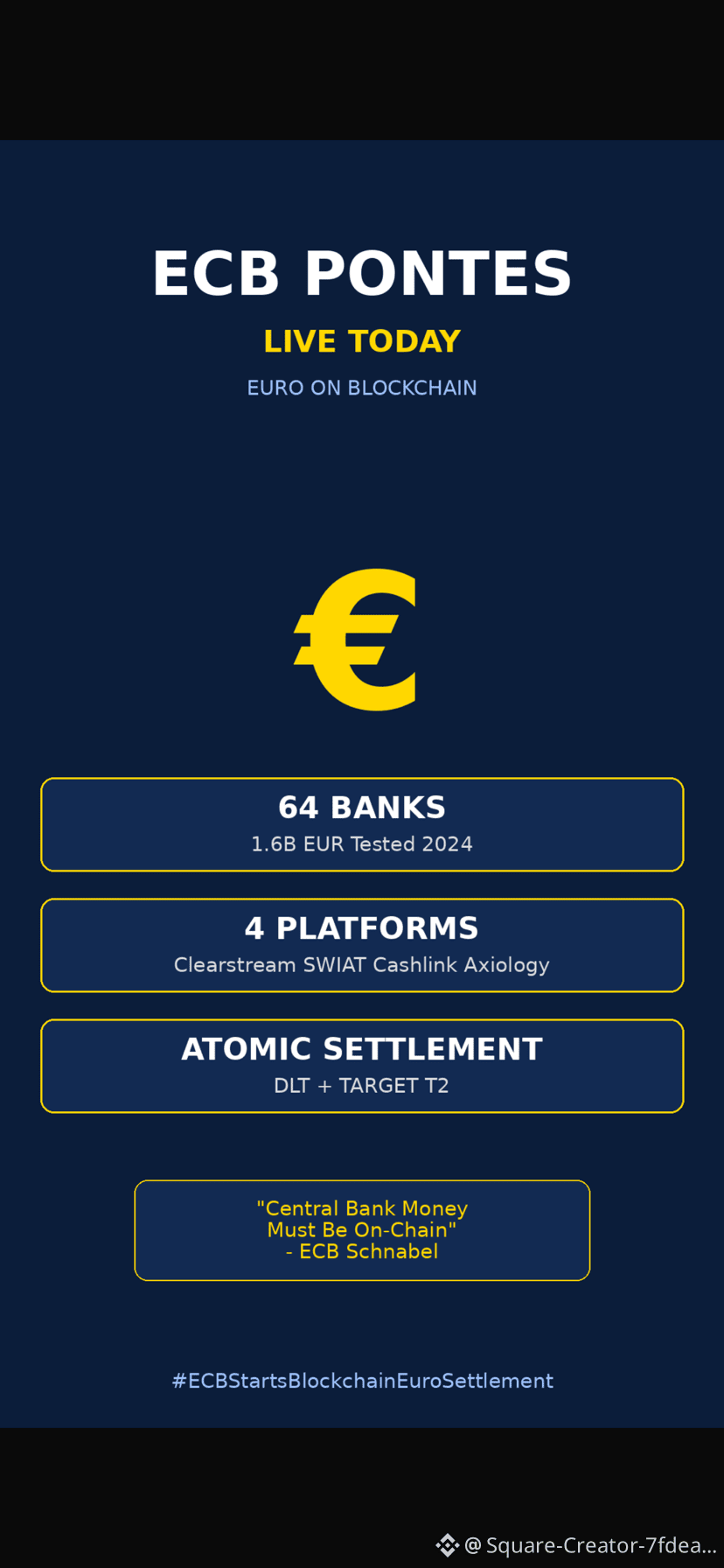
🇪🇺 ECB PONTES LIVE TODAY!
Europe put central bank funds on the blockchain 🔥
#ECBStartsBlockchainEuroSettlement
- 64 banks tested 1.6B euros in 2024
- 4 platforms live today: Clearstream, SWIAT, Cashlink, Axiology
- Instant Atomic Settlement
"Central Bank Money Must Be On-Chain" - ECB
Europe won’t let the dollar control the blockchain
#ECB $XRP $INJ $APT $STRK #BinanceSquare
{future}(XRPUSDT)
{future}(INJUSDT)
{future}(APTUSDT)
#ECBStartsBlockchainEuroSettlement
🇪🇺 ECB PONTES LIVE TODAY!
Europe put central bank funds on the blockchain 🔥
#ECBStartsBlockchainEuroSettlement
- 64 banks tested 1.6B euros in 2024
- 4 platforms live today: Clearstream, SWIAT, Cashlink, Axiology
- Instant Atomic Settlement
"Central Bank Money Must Be On-Chain" - ECB
Europe won’t let the dollar control the blockchain
#ECB $XRP $INJ $APT $STRK #BinanceSquare
🇪🇺 ECB PONTES LIVE TODAY!
Europe put central bank funds on the blockchain 🔥
#ECBStartsBlockchainEuroSettlement
- 64 banks tested 1.6B euros in 2024
- 4 platforms live today: Clearstream, SWIAT, Cashlink, Axiology
- Instant Atomic Settlement
"Central Bank Money Must Be On-Chain" - ECB
Europe won’t let the dollar control the blockchain
#ECB $XRP $INJ $APT $STRK #BinanceSquare
4
483
Log in to explore more content
Join global crypto users on Binance Square
⚡️ Get latest and useful information about crypto.
💬 Trusted by the world’s largest crypto exchange.
👍 Discover real insights from verified creators.
Email / Phone number
Trending Topics
1
#CFTCUpdatesGuidanceOnTokenizedAssets
1,010 views
84 Discussing
2
#BitgetSays$352MAffectedInHack
78 views
5 Discussing
3
#NYAndPolymarketSueEachOther
179 views
15 Discussing
4
#BinanceWillListHyperliquid(HYPE)
158,429 views
2,651 Discussing
5
#BrazilOrdersReportingOf$10KSelfCustodyTransfers
384 views
14 Discussing
6
#FedProposesRulesForBankIssuedStablecoins
2,844 views
121 Discussing
7
#OndoFinanceSoughtSaleAfterFoundersDeath
2,222 views
86 Discussing
8
#FedOctoberRateHikeOddsRiseTo69.7%
56,081 views
1,103 Discussing
9
#BitcoinFallsBelow$83,000
4,407 views
20 Discussing
10
#BitcoinFallsToAround$84,600ThisWeek
0 views
0 Discussing