

#cbdc
cbdc
35.7M views
154,664 Discussing
Hot
Latest

Article
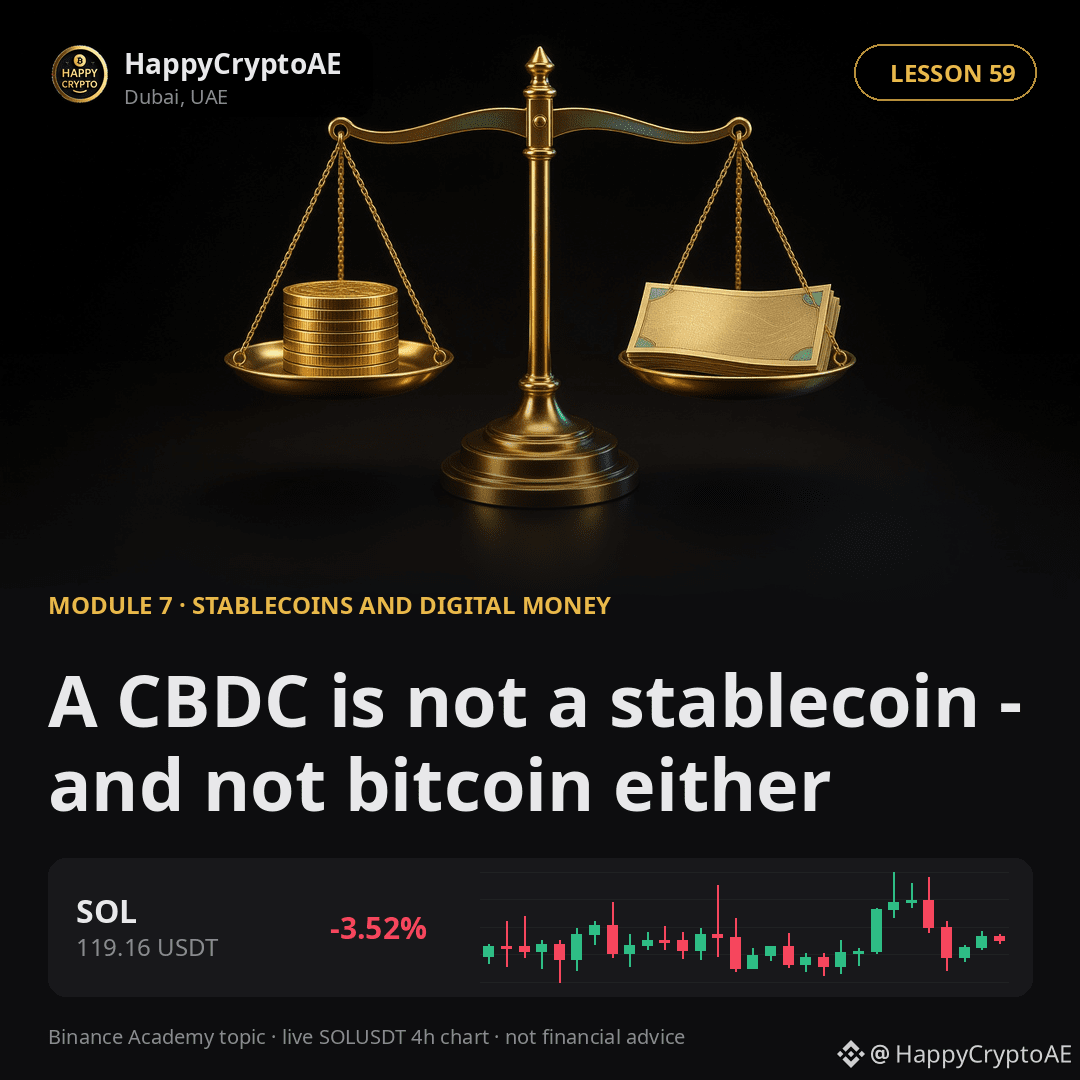
A CBDC is not a stablecoin - and not bitcoin eitherA central bank digital currency is a digital form of a country's own money, issued directly by its central bank. Many central banks are researching or piloting one, and the UAE has its own digital dirham project.
The easy mistake is to lump CBDCs in with crypto. They share the digital format and little else. A CBDC is a direct liability of the central bank, with rules set by the issuer. A stablecoin is issued by a private company and backed by reserves it manages. Bitcoin has no issuer at all. Three different trust models - and knowing which one you hold tells you exactly who you are relying on.
💬 Would you rather hold a CBDC, a stablecoin, or neither - and why?
Binance Academy covers this in more depth: https://www.binance.com/en/academy/glossary/central-bank-digital-currency-cbdc
Next lesson: Wrapped tokens: the same asset in a different jacket
Trading crypto from Dubai since 2019.
$USDT $BTC $SOL
#CBDC #DigitalMoney #CryptoEducation
A CBDC is not a stablecoin - and not bitcoin either
A central bank digital currency is a digital form of a country's own money, issued directly by its central bank. Many central banks are researching or piloting one, and the UAE has its own digital dirham project.
The easy mistake is to lump CBDCs in with crypto. They share the digital format and little else. A CBDC is a direct liability of the central bank, with rules set by the issuer. A stablecoin is issued by a private company and backed by reserves it manages. Bitcoin has no issuer at all. Three different trust models - and knowing which one you hold tells you exactly who you are relying on.
💬 Would you rather hold a CBDC, a stablecoin, or neither - and why?
Binance Academy covers this in more depth: https://www.binance.com/en/academy/glossary/central-bank-digital-currency-cbdc
Next lesson: Wrapped tokens: the same asset in a different jacket
Trading crypto from Dubai since 2019.
$USDT $BTC $SOL
#CBDC #DigitalMoney #CryptoEducation
The easy mistake is to lump CBDCs in with crypto. They share the digital format and little else. A CBDC is a direct liability of the central bank, with rules set by the issuer. A stablecoin is issued by a private company and backed by reserves it manages. Bitcoin has no issuer at all. Three different trust models - and knowing which one you hold tells you exactly who you are relying on.
💬 Would you rather hold a CBDC, a stablecoin, or neither - and why?
Binance Academy covers this in more depth: https://www.binance.com/en/academy/glossary/central-bank-digital-currency-cbdc
Next lesson: Wrapped tokens: the same asset in a different jacket
Trading crypto from Dubai since 2019.
$USDT $BTC $SOL
#CBDC #DigitalMoney #CryptoEducation
93

#ECBToTestAIAgentsInDigitalEuroPayments
BCE opens applications to test AI agents with the Digital Euro.
What it is: exploration of AI-enabled payments, micropayments, and machine-to-machine interactions with a future digital euro.
Timeline:
- Applications: until 9 November 2026
- Experimentation: January to June 2027
- Workshops in Frankfurt: early 2027
The prototypes will cover e-receipts, conditional payments, and multi-party transactions, with a privacy focus from the design stage.
This is separate from the main digital euro pilot, which starts in the second half of 2027 with 36 providers, including Deutsche Bank, Revolut, Stripe and Adyen.
Any launch depends on EU legislation. First possible issuance in 2029.
AI agents paying €0.01 for data, APIs, or content. Agentic economy.
Will CBDC + AI be the future?
$OCEAN $FET $LINK
#CBDC #CryptoNews
{spot}(FETUSDT)
{spot}(LINKUSDT)
#ECBToTestAIAgentsInDigitalEuroPayments
BCE opens applications to test AI agents with the Digital Euro.
What it is: exploration of AI-enabled payments, micropayments, and machine-to-machine interactions with a future digital euro.
Timeline:
- Applications: until 9 November 2026
- Experimentation: January to June 2027
- Workshops in Frankfurt: early 2027
The prototypes will cover e-receipts, conditional payments, and multi-party transactions, with a privacy focus from the design stage.
This is separate from the main digital euro pilot, which starts in the second half of 2027 with 36 providers, including Deutsche Bank, Revolut, Stripe and Adyen.
Any launch depends on EU legislation. First possible issuance in 2029.
AI agents paying €0.01 for data, APIs, or content. Agentic economy.
Will CBDC + AI be the future?
$OCEAN $FET $LINK
#CBDC #CryptoNews
BCE opens applications to test AI agents with the Digital Euro.
What it is: exploration of AI-enabled payments, micropayments, and machine-to-machine interactions with a future digital euro.
Timeline:
- Applications: until 9 November 2026
- Experimentation: January to June 2027
- Workshops in Frankfurt: early 2027
The prototypes will cover e-receipts, conditional payments, and multi-party transactions, with a privacy focus from the design stage.
This is separate from the main digital euro pilot, which starts in the second half of 2027 with 36 providers, including Deutsche Bank, Revolut, Stripe and Adyen.
Any launch depends on EU legislation. First possible issuance in 2029.
AI agents paying €0.01 for data, APIs, or content. Agentic economy.
Will CBDC + AI be the future?
$OCEAN $FET $LINK
#CBDC #CryptoNews

صقر صنعاء:
خبر قوي جدا للتبني 🔥 دخول وكلاء الذكاء الاصطناعي في مدفوعات اليورو الرقمي يفتح باب اقتصاد الوكلاء والمدفوعات المشروطة والميكرو. الجدول الزمني واضح: تجريب حتى يونيو 2027 وورش في فرانكفورت بداية 2027 مع Revolut و Stripe و Deutsche Bank. لو نجح الاختبار، اصدار 2029 بيكون نقطة تحول للكريبتو والمدفوعات الرقمية.
1
2
97

·
--
The ECB has gone crazy! It’s exploring an AI agent + digital euro payment system, with a 2027 pilot planned. Are machine-to-machine automated payments coming? The era of central bank digital currency is closer than we think!
#DigitalEuro #CBDC $EUR
The ECB has gone crazy! It’s exploring an AI agent + digital euro payment system, with a 2027 pilot planned. Are machine-to-machine automated payments coming? The era of central bank digital currency is closer than we think!
#DigitalEuro #CBDC $EUR
#DigitalEuro #CBDC $EUR
54

·
--
🔴 Bearish
🚨 China's Digital Yuan Expands Pilot to Major Cities
Breaking news from the East! China is rapidly expanding its digital yuan pilot program to several Tier 1 cities, signaling a stronger push towards a cashless society.
📊 Market Impact: Short-term bearish pressure on privacy coins and a general 'risk-off' sentiment as state-backed digital currencies gain traction. Traders are watching for central bank reactions.
#CBDC #MarketNews
🔴 Bearish
🚨 China's Digital Yuan Expands Pilot to Major Cities
Breaking news from the East! China is rapidly expanding its digital yuan pilot program to several Tier 1 cities, signaling a stronger push towards a cashless society.
📊 Market Impact: Short-term bearish pressure on privacy coins and a general 'risk-off' sentiment as state-backed digital currencies gain traction. Traders are watching for central bank reactions.
#CBDC #MarketNews
🚨 China's Digital Yuan Expands Pilot to Major Cities
Breaking news from the East! China is rapidly expanding its digital yuan pilot program to several Tier 1 cities, signaling a stronger push towards a cashless society.
📊 Market Impact: Short-term bearish pressure on privacy coins and a general 'risk-off' sentiment as state-backed digital currencies gain traction. Traders are watching for central bank reactions.
#CBDC #MarketNews
53


🇪🇺 ECB launches Pontes
Pontes enables financial institutions to settle tokenized assets in central bank money, without private stablecoins. States are building their own token infrastructure. Competition for stables?
#ECB #CBDC #Tokenization #NFA
🇪🇺 ECB launches Pontes
Pontes enables financial institutions to settle tokenized assets in central bank money, without private stablecoins. States are building their own token infrastructure. Competition for stables?
#ECB #CBDC #Tokenization #NFA
Pontes enables financial institutions to settle tokenized assets in central bank money, without private stablecoins. States are building their own token infrastructure. Competition for stables?
#ECB #CBDC #Tokenization #NFA

29

·
--

Article
DIGITAL EURO: THE MONEY OF THE FUTURE OR THE NEW GREAT MONETARY EXPERIMENT?There is a silent transformation happening in the global financial system.
While millions of people talk about Bitcoin, stablecoins, DeFi, and asset tokenization, central banks are developing another piece of the new monetary system: CBDCs, digital currencies issued directly by central banks.
And Europe is moving forward with one of the most important projects: the digital euro.
But there is a question that deserves much more attention:
What would really change if some of the money we use today in cash could also exist as digital money issued by the central bank?
DIGITAL EURO: THE MONEY OF THE FUTURE OR THE NEW GREAT MONETARY EXPERIMENT?
There is a silent transformation happening in the global financial system.
While millions of people talk about Bitcoin, stablecoins, DeFi, and asset tokenization, central banks are developing another piece of the new monetary system: CBDCs, digital currencies issued directly by central banks.
And Europe is moving forward with one of the most important projects: the digital euro.
But there is a question that deserves much more attention:
What would really change if some of the money we use today in cash could also exist as digital money issued by the central bank?
While millions of people talk about Bitcoin, stablecoins, DeFi, and asset tokenization, central banks are developing another piece of the new monetary system: CBDCs, digital currencies issued directly by central banks.
And Europe is moving forward with one of the most important projects: the digital euro.
But there is a question that deserves much more attention:
What would really change if some of the money we use today in cash could also exist as digital money issued by the central bank?
105
·
--
Canada’s top 6 banks are teaming up for a digital dollar network! RBC, TD, BMO and others exploring tokenized deposits, starting with interbank transfers. Traditional finance is finally going digital! #CBDC #Banking $CAD
Canada's top 6 banks are teaming up for a digital dollar network! RBC, TD, BMO and others exploring tokenized deposits, starting with interbank transfers. Traditional finance is finally going digital! #CBDC #Banking $CAD
Canada’s top 6 banks are teaming up for a digital dollar network! RBC, TD, BMO and others exploring tokenized deposits, starting with interbank transfers. Traditional finance is finally going digital! #CBDC #Banking $CAD
Canada's top 6 banks are teaming up for a digital dollar network! RBC, TD, BMO and others exploring tokenized deposits, starting with interbank transfers. Traditional finance is finally going digital! #CBDC #Banking $CAD
Canada's top 6 banks are teaming up for a digital dollar network! RBC, TD, BMO and others exploring tokenized deposits, starting with interbank transfers. Traditional finance is finally going digital! #CBDC #Banking $CAD
7

Europe is making a massive leap into blockchain infrastructure. The ECB just rolled out its wholesale digital euro settlement system and is gearing up to purchase tokenized public bonds. This isn't just about testing; it's a foundational shift. Traditional finance is steadily building the rails for digital assets, proving that tokenization is the inevitable future of global debt markets. Watch how legacy banking adapts. $EUR #CryptoNews #Tokenization #CBDC
Europe is making a massive leap into blockchain infrastructure. The ECB just rolled out its wholesale digital euro settlement system and is gearing up to purchase tokenized public bonds. This isn't just about testing; it's a foundational shift. Traditional finance is steadily building the rails for digital assets, proving that tokenization is the inevitable future of global debt markets. Watch how legacy banking adapts. $EUR #CryptoNews #Tokenization #CBDC
7
Saudi Arabia's departure from the China-backed mBridge CBDC initiative highlights the escalating geopolitical friction surrounding digital currencies. As Washington increases its scrutiny over alternative payment systems, nations are caught balancing innovation with global alliances. This pivot could reshape how cross-border CBDC development unfolds, steering focus away from multilateral blocks and toward fractured regulatory landscapes. #CBDC #Geopolitics #CryptoNews
Saudi Arabia's departure from the China-backed mBridge CBDC initiative highlights the escalating geopolitical friction surrounding digital currencies. As Washington increases its scrutiny over alternative payment systems, nations are caught balancing innovation with global alliances. This pivot could reshape how cross-border CBDC development unfolds, steering focus away from multilateral blocks and toward fractured regulatory landscapes. #CBDC #Geopolitics #CryptoNews
5

Saudi Arabia withdraws from China-backed CBDC mBridge project
- Financial Times: Saudi Arabia has left mBridge, a cross-border CBDC platform.
- The project has drawn oversight from U.S. policymakers.
- RSS has not stated the reason or timing for Saudi Arabia's withdrawal.
#BinanceSquare #CryptoNews #CBDC #mBridge
$btc $eth
#vlikevn Titanbot
Source: CoinTelegraph
Saudi Arabia withdraws from China-backed CBDC mBridge project
- Financial Times: Saudi Arabia has left mBridge, a cross-border CBDC platform.
- The project has drawn oversight from U.S. policymakers.
- RSS has not stated the reason or timing for Saudi Arabia's withdrawal.
#BinanceSquare #CryptoNews #CBDC #mBridge
$btc $eth
#vlikevn Titanbot
Source: CoinTelegraph
- Financial Times: Saudi Arabia has left mBridge, a cross-border CBDC platform.
- The project has drawn oversight from U.S. policymakers.
- RSS has not stated the reason or timing for Saudi Arabia's withdrawal.
#BinanceSquare #CryptoNews #CBDC #mBridge
$btc $eth
#vlikevn Titanbot
Source: CoinTelegraph
132

·
--
🔍 Saudi quietly withdrew from a group. After it was done, nobody said anything.
On September 20, the Financial Times brought the matter to light. Saudi Arabia’s central bank (SAMA) is no longer listed as a member of mBridge.
mBridge is a wholesale-type CBDC cross-border settlement channel jointly built by several central banks from China, Hong Kong, Thailand, and the UAE. It has recently been preparing to go commercial. Macau joined this year, and it has already been running since June. Saudi is bowing out.
SAMA’s response is that it was supposed to withdraw anyway. It joined in 2023 as an observer, became a full member in 2024, and participated in developing the minimum viable product. On May 13, 2025, it completed verification—then the effort ended. The original wording was: “Successfully completed verification according to plan.”
Scale data doesn’t leave much room for the “toy project” explanation. According to statistics from the Atlantic Council, mBridge had run a total of 4,047 transactions and $54.99 billion by November 2025. The figures for October 2022 were 160 transactions and $22 million. In just a little over three years, the number of transactions rose 25-fold, while the amount jumped 2,500-fold. On the platform in 2025, 95% of the volume is digital yuan.
On the political pressure angle, nobody admits it. A source cited by the FT said that broad inference from SAMA’s decision is “inaccurate,” because its level of involvement was already limited. Another person said SAMA simply didn’t want to appear publicly again, but was still in private talks. The backdrop is there: Trump has warned that anyone who tries to create an alternative to the U.S. dollar in settlement would face a 100% tariff.
Saudi’s alternative move is worth watching more. Jeel, the innovation unit at Riyadh Bank, signed an agreement with Ripple this January to cover payment corridors, digital asset custody, and tokenization. It also plans to run verification in a regulatory sandbox. SAMA itself had already partnered with Ripple in 2018 on xCurrent. A Saudi/UK bank later used it for remittances to India. But neither Jeel nor SAMA mentioned XRP or RLUSD—never a word. In official talking points, those two assets don’t exist.
My view is that central-bank-level bridges are afraid of politics, but the rails that commercial banks set up themselves aren’t. In October 2024, the BIS described a “graduation exit.” Saudi is now following suit—on stage, only China, Hong Kong, Thailand, the UAE, and Macau remain.
Prices don’t care about this kind of news at all. While I’m writing this, five quote sources put BTC between 86,473 and 86,498, up 6.6% over 24 hours. ETH at 2,782, up 5.6%. This rally has nothing to do with Saudi.
Watch two things. When mBridge officially goes live, whether the member countries list becomes shortened again. And when the Jeel sandbox verification produces results, which asset will be used for settlement.
$BTC $ETH
#中本聪国际社区Baoluo币商资本 #Bitcoin #CBDC
🔍 Saudi quietly withdrew from a group. After it was done, nobody said anything.
On September 20, the Financial Times brought the matter to light. Saudi Arabia’s central bank (SAMA) is no longer listed as a member of mBridge.
mBridge is a wholesale-type CBDC cross-border settlement channel jointly built by several central banks from China, Hong Kong, Thailand, and the UAE. It has recently been preparing to go commercial. Macau joined this year, and it has already been running since June. Saudi is bowing out.
SAMA’s response is that it was supposed to withdraw anyway. It joined in 2023 as an observer, became a full member in 2024, and participated in developing the minimum viable product. On May 13, 2025, it completed verification—then the effort ended. The original wording was: “Successfully completed verification according to plan.”
Scale data doesn’t leave much room for the “toy project” explanation. According to statistics from the Atlantic Council, mBridge had run a total of 4,047 transactions and $54.99 billion by November 2025. The figures for October 2022 were 160 transactions and $22 million. In just a little over three years, the number of transactions rose 25-fold, while the amount jumped 2,500-fold. On the platform in 2025, 95% of the volume is digital yuan.
On the political pressure angle, nobody admits it. A source cited by the FT said that broad inference from SAMA’s decision is “inaccurate,” because its level of involvement was already limited. Another person said SAMA simply didn’t want to appear publicly again, but was still in private talks. The backdrop is there: Trump has warned that anyone who tries to create an alternative to the U.S. dollar in settlement would face a 100% tariff.
Saudi’s alternative move is worth watching more. Jeel, the innovation unit at Riyadh Bank, signed an agreement with Ripple this January to cover payment corridors, digital asset custody, and tokenization. It also plans to run verification in a regulatory sandbox. SAMA itself had already partnered with Ripple in 2018 on xCurrent. A Saudi/UK bank later used it for remittances to India. But neither Jeel nor SAMA mentioned XRP or RLUSD—never a word. In official talking points, those two assets don’t exist.
My view is that central-bank-level bridges are afraid of politics, but the rails that commercial banks set up themselves aren’t. In October 2024, the BIS described a “graduation exit.” Saudi is now following suit—on stage, only China, Hong Kong, Thailand, the UAE, and Macau remain.
Prices don’t care about this kind of news at all. While I’m writing this, five quote sources put BTC between 86,473 and 86,498, up 6.6% over 24 hours. ETH at 2,782, up 5.6%. This rally has nothing to do with Saudi.
Watch two things. When mBridge officially goes live, whether the member countries list becomes shortened again. And when the Jeel sandbox verification produces results, which asset will be used for settlement.
$BTC $ETH
#中本聪国际社区Baoluo币商资本 #Bitcoin #CBDC
On September 20, the Financial Times brought the matter to light. Saudi Arabia’s central bank (SAMA) is no longer listed as a member of mBridge.
mBridge is a wholesale-type CBDC cross-border settlement channel jointly built by several central banks from China, Hong Kong, Thailand, and the UAE. It has recently been preparing to go commercial. Macau joined this year, and it has already been running since June. Saudi is bowing out.
SAMA’s response is that it was supposed to withdraw anyway. It joined in 2023 as an observer, became a full member in 2024, and participated in developing the minimum viable product. On May 13, 2025, it completed verification—then the effort ended. The original wording was: “Successfully completed verification according to plan.”
Scale data doesn’t leave much room for the “toy project” explanation. According to statistics from the Atlantic Council, mBridge had run a total of 4,047 transactions and $54.99 billion by November 2025. The figures for October 2022 were 160 transactions and $22 million. In just a little over three years, the number of transactions rose 25-fold, while the amount jumped 2,500-fold. On the platform in 2025, 95% of the volume is digital yuan.
On the political pressure angle, nobody admits it. A source cited by the FT said that broad inference from SAMA’s decision is “inaccurate,” because its level of involvement was already limited. Another person said SAMA simply didn’t want to appear publicly again, but was still in private talks. The backdrop is there: Trump has warned that anyone who tries to create an alternative to the U.S. dollar in settlement would face a 100% tariff.
Saudi’s alternative move is worth watching more. Jeel, the innovation unit at Riyadh Bank, signed an agreement with Ripple this January to cover payment corridors, digital asset custody, and tokenization. It also plans to run verification in a regulatory sandbox. SAMA itself had already partnered with Ripple in 2018 on xCurrent. A Saudi/UK bank later used it for remittances to India. But neither Jeel nor SAMA mentioned XRP or RLUSD—never a word. In official talking points, those two assets don’t exist.
My view is that central-bank-level bridges are afraid of politics, but the rails that commercial banks set up themselves aren’t. In October 2024, the BIS described a “graduation exit.” Saudi is now following suit—on stage, only China, Hong Kong, Thailand, the UAE, and Macau remain.
Prices don’t care about this kind of news at all. While I’m writing this, five quote sources put BTC between 86,473 and 86,498, up 6.6% over 24 hours. ETH at 2,782, up 5.6%. This rally has nothing to do with Saudi.
Watch two things. When mBridge officially goes live, whether the member countries list becomes shortened again. And when the Jeel sandbox verification produces results, which asset will be used for settlement.
$BTC $ETH
#中本聪国际社区Baoluo币商资本 #Bitcoin #CBDC

272

·
--
🚨 Not every piece of news about cryptocurrencies means an immediate move in the crypto market… and Saudi Arabia’s exit from mBridge is a clear example.
Saudi Arabia’s central bank has concluded its participation in the mBridge project after completing the proof-of-concept phase on May 13, 2025, confirming that the step was in line with the original plan for involvement.
The project tests the use of central bank digital currencies and distributed ledger technology to speed up payments and cross-border settlements.
As for the crypto market, the direct impact on liquidity or coin prices appears limited; we are talking about institutional infrastructure for CBDCs, not fresh flows into crypto assets.
But the news opens a bigger discussion: does the slowdown in a country the size of Saudi Arabia participating in a project like this indicate caution toward new digital payment systems, or is it simply the end of a specific experiment without any change in the direction toward digitization? 🌐
📊 The smart trader doesn’t chase the price based on the headline alone; they watch whether the news will actually translate into changes in trading volumes or in the narrative surrounding digital payments projects.
What do you think: is Saudi Arabia’s exit from mBridge an important signal for the future of central bank digital currencies, or will the market treat it as just a limited-impact technical event?
#mBridge #CBDC #Crypto
$BTC
{spot}(BTCUSDT)
🚨 Not every piece of news about cryptocurrencies means an immediate move in the crypto market… and Saudi Arabia’s exit from mBridge is a clear example.
Saudi Arabia’s central bank has concluded its participation in the mBridge project after completing the proof-of-concept phase on May 13, 2025, confirming that the step was in line with the original plan for involvement.
The project tests the use of central bank digital currencies and distributed ledger technology to speed up payments and cross-border settlements.
As for the crypto market, the direct impact on liquidity or coin prices appears limited; we are talking about institutional infrastructure for CBDCs, not fresh flows into crypto assets.
But the news opens a bigger discussion: does the slowdown in a country the size of Saudi Arabia participating in a project like this indicate caution toward new digital payment systems, or is it simply the end of a specific experiment without any change in the direction toward digitization? 🌐
📊 The smart trader doesn’t chase the price based on the headline alone; they watch whether the news will actually translate into changes in trading volumes or in the narrative surrounding digital payments projects.
What do you think: is Saudi Arabia’s exit from mBridge an important signal for the future of central bank digital currencies, or will the market treat it as just a limited-impact technical event?
#mBridge #CBDC #Crypto
$BTC
Saudi Arabia’s central bank has concluded its participation in the mBridge project after completing the proof-of-concept phase on May 13, 2025, confirming that the step was in line with the original plan for involvement.
The project tests the use of central bank digital currencies and distributed ledger technology to speed up payments and cross-border settlements.
As for the crypto market, the direct impact on liquidity or coin prices appears limited; we are talking about institutional infrastructure for CBDCs, not fresh flows into crypto assets.
But the news opens a bigger discussion: does the slowdown in a country the size of Saudi Arabia participating in a project like this indicate caution toward new digital payment systems, or is it simply the end of a specific experiment without any change in the direction toward digitization? 🌐
📊 The smart trader doesn’t chase the price based on the headline alone; they watch whether the news will actually translate into changes in trading volumes or in the narrative surrounding digital payments projects.
What do you think: is Saudi Arabia’s exit from mBridge an important signal for the future of central bank digital currencies, or will the market treat it as just a limited-impact technical event?
#mBridge #CBDC #Crypto
$BTC

149
·
--
The ECB Is Doing Something Big! It’s directly using its own funds to buy tokenized bonds, and it’s also connecting the traditional payment system with blockchain-based financial markets. Central bank bigwigs are finally starting to embrace blockchain—this is absolutely a historic step! #CBDC #DeFi $CBDC $STBL
Big news from the ECB! The central bank is now buying tokenized bonds with its own funds and linking its payment system to blockchain-based markets. This is huge validation for the crypto space! #CBDC #DeFi $CBDC $STBL
The ECB Is Doing Something Big! It’s directly using its own funds to buy tokenized bonds, and it’s also connecting the traditional payment system with blockchain-based financial markets. Central bank bigwigs are finally starting to embrace blockchain—this is absolutely a historic step! #CBDC #DeFi $CBDC $STBL
Big news from the ECB! The central bank is now buying tokenized bonds with its own funds and linking its payment system to blockchain-based markets. This is huge validation for the crypto space! #CBDC #DeFi $CBDC $STBL
Big news from the ECB! The central bank is now buying tokenized bonds with its own funds and linking its payment system to blockchain-based markets. This is huge validation for the crypto space! #CBDC #DeFi $CBDC $STBL
131

On Monday, the European Central Bank (ECB) officially launched “Pontes,” an interbank tokenized settlement system, marking the first formal connection of the wholesale digital euro to institutional financial markets. The platform is directly led and operated by the ECB, enabling licensed banks to use central bank money to conduct final settlement of tokenized assets traded on a private distributed ledger technology (DLT). Meanwhile, the retail digital euro for individuals and merchants is also being accelerated.
The ECB’s core intent is clear: to establish the status of an official settlement asset amid the wave of tokenized finance, to hedge against the risks of dollar stablecoins’ penetration into Europe’s digital economy, and to defend monetary sovereignty in the euro area.
From the perspective of the evolution of institutional infrastructure, the significance of this rollout is extraordinary. Traditional financial settlement relies on multiple layers of intermediaries, with long clearing cycles and high friction costs, whereas the launch of the “Pontes” platform directly removes the barriers between central bank legal liquidity and on-chain ledgers. ECB economists have emphasized that if dollar-denominated private stablecoins are allowed to dominate on-chain clearing, the ECB would face the risk of monetary-policy transmission failing. By stepping in to build the underlying tokenized settlement network itself, the world’s leading central banks have moved from early theoretical research on “blockchain/tokenization technology” to architecture-level deployment on a mainnet.
At the macro-financial level, the launch of the wholesale digital euro will greatly enhance the tokenized issuance and instant settlement efficiency of European bond markets and large-scale assets. As tokenization of assets in traditional capital markets (RWA) enters a substantive execution phase, European capital that had previously been stuck in traditional liquidity pools will gain faster on-chain circulation channels. This not only reinforces the settlement role of the euro, but also sets a clear paradigm for the coexistence and competition of global sovereign-credit money within on-chain ecosystems, which in the long run can help reduce systemic frictions across different currencies’ settlement.
For the broader crypto market, this is undoubtedly a major long-term structural positive. The routine operation of central-bank-level tokenization infrastructure is, in essence, the highest-tier endorsement of the security of distributed ledger technology, completely eliminating regulatory and technical concerns for large traditional institutions moving into the Web3 ecosystem. With institutional-grade on-chain liquidity pathways fully opened, $BTC , along with major crypto assets as the most liquid on-chain native assets, is expected to capture broader incremental institutional allocations within a more mature tokenized-finance framework, and the valuation center of risk assets as a whole may be poised to rise further.📊
#ECB #DigitalEuro #CBDC
On Monday, the European Central Bank (ECB) officially launched “Pontes,” an interbank tokenized settlement system, marking the first formal connection of the wholesale digital euro to institutional financial markets. The platform is directly led and operated by the ECB, enabling licensed banks to use central bank money to conduct final settlement of tokenized assets traded on a private distributed ledger technology (DLT). Meanwhile, the retail digital euro for individuals and merchants is also being accelerated.
The ECB’s core intent is clear: to establish the status of an official settlement asset amid the wave of tokenized finance, to hedge against the risks of dollar stablecoins’ penetration into Europe’s digital economy, and to defend monetary sovereignty in the euro area.
From the perspective of the evolution of institutional infrastructure, the significance of this rollout is extraordinary. Traditional financial settlement relies on multiple layers of intermediaries, with long clearing cycles and high friction costs, whereas the launch of the “Pontes” platform directly removes the barriers between central bank legal liquidity and on-chain ledgers. ECB economists have emphasized that if dollar-denominated private stablecoins are allowed to dominate on-chain clearing, the ECB would face the risk of monetary-policy transmission failing. By stepping in to build the underlying tokenized settlement network itself, the world’s leading central banks have moved from early theoretical research on “blockchain/tokenization technology” to architecture-level deployment on a mainnet.
At the macro-financial level, the launch of the wholesale digital euro will greatly enhance the tokenized issuance and instant settlement efficiency of European bond markets and large-scale assets. As tokenization of assets in traditional capital markets (RWA) enters a substantive execution phase, European capital that had previously been stuck in traditional liquidity pools will gain faster on-chain circulation channels. This not only reinforces the settlement role of the euro, but also sets a clear paradigm for the coexistence and competition of global sovereign-credit money within on-chain ecosystems, which in the long run can help reduce systemic frictions across different currencies’ settlement.
For the broader crypto market, this is undoubtedly a major long-term structural positive. The routine operation of central-bank-level tokenization infrastructure is, in essence, the highest-tier endorsement of the security of distributed ledger technology, completely eliminating regulatory and technical concerns for large traditional institutions moving into the Web3 ecosystem. With institutional-grade on-chain liquidity pathways fully opened, $BTC , along with major crypto assets as the most liquid on-chain native assets, is expected to capture broader incremental institutional allocations within a more mature tokenized-finance framework, and the valuation center of risk assets as a whole may be poised to rise further.📊
#ECB #DigitalEuro #CBDC
The ECB’s core intent is clear: to establish the status of an official settlement asset amid the wave of tokenized finance, to hedge against the risks of dollar stablecoins’ penetration into Europe’s digital economy, and to defend monetary sovereignty in the euro area.
From the perspective of the evolution of institutional infrastructure, the significance of this rollout is extraordinary. Traditional financial settlement relies on multiple layers of intermediaries, with long clearing cycles and high friction costs, whereas the launch of the “Pontes” platform directly removes the barriers between central bank legal liquidity and on-chain ledgers. ECB economists have emphasized that if dollar-denominated private stablecoins are allowed to dominate on-chain clearing, the ECB would face the risk of monetary-policy transmission failing. By stepping in to build the underlying tokenized settlement network itself, the world’s leading central banks have moved from early theoretical research on “blockchain/tokenization technology” to architecture-level deployment on a mainnet.
At the macro-financial level, the launch of the wholesale digital euro will greatly enhance the tokenized issuance and instant settlement efficiency of European bond markets and large-scale assets. As tokenization of assets in traditional capital markets (RWA) enters a substantive execution phase, European capital that had previously been stuck in traditional liquidity pools will gain faster on-chain circulation channels. This not only reinforces the settlement role of the euro, but also sets a clear paradigm for the coexistence and competition of global sovereign-credit money within on-chain ecosystems, which in the long run can help reduce systemic frictions across different currencies’ settlement.
For the broader crypto market, this is undoubtedly a major long-term structural positive. The routine operation of central-bank-level tokenization infrastructure is, in essence, the highest-tier endorsement of the security of distributed ledger technology, completely eliminating regulatory and technical concerns for large traditional institutions moving into the Web3 ecosystem. With institutional-grade on-chain liquidity pathways fully opened, $BTC , along with major crypto assets as the most liquid on-chain native assets, is expected to capture broader incremental institutional allocations within a more mature tokenized-finance framework, and the valuation center of risk assets as a whole may be poised to rise further.📊
#ECB #DigitalEuro #CBDC
26


Partly True
《Financial Times》: Saudi Arabia has withdrawn from a China-led cross-border central bank digital currency platform, and the Middle East's effort to de-dollarize faces setbacks
September 21 report: According to the Financial Times, the Saudi Central Bank withdrew last year from a China-led cross-border central bank digital currency (CBDC) platform project, the multi-CBDC bridge (mBridge).
The project aimed to build an international payment system to replace the U.S. dollar, and was an important initiative by Beijing to diversify the international financial system. This change represents a substantive setback to Beijing’s efforts to build a system that would replace the U.S. dollar.
The report says that the Saudi Central Bank’s exit occurred last year. The mBridge project was originally seen as a key part of China’s push to de-dollarize cross-border payments and to establish an alternative international settlement network.
Saudi Arabia’s departure means that this experimental platform, intended to bypass the traditional U.S. dollar clearing system, has encountered major obstacles in attracting participation from key oil-producing countries.
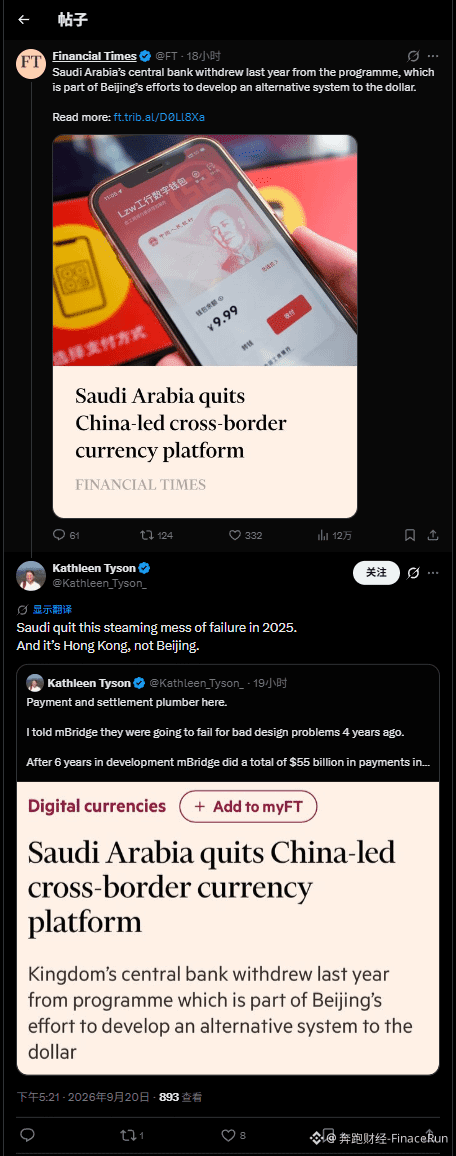
The report also sparked heated debate on social media. Noted cryptocurrency commentator Kathleen Tyson said bluntly that Saudi Arabia had already exited this “failed mess” in 2025, and clearly pointed out that the project’s lead party was Hong Kong, not Beijing.
Tyson also revealed that she had warned the mBridge team as far back as four years ago about serious architectural design problems, and that after six years of development, the project’s total payment and settlement volume was only $55 billion, far from its grand goals.
Overall, Saudi Arabia’s withdrawal, along with industry doubts about the mBridge project’s slow progress, together reveal a reality: although de-dollarization is drawing attention from many countries, the deployment of cross-border CBDC platforms still faces multiple tests in terms of technology, governance, and commercial sustainability.
#CBDC
《Financial Times》: Saudi Arabia has withdrawn from a China-led cross-border central bank digital currency platform, and the Middle East's effort to de-dollarize faces setbacks
September 21 report: According to the Financial Times, the Saudi Central Bank withdrew last year from a China-led cross-border central bank digital currency (CBDC) platform project, the multi-CBDC bridge (mBridge).
The project aimed to build an international payment system to replace the U.S. dollar, and was an important initiative by Beijing to diversify the international financial system. This change represents a substantive setback to Beijing’s efforts to build a system that would replace the U.S. dollar.
The report says that the Saudi Central Bank’s exit occurred last year. The mBridge project was originally seen as a key part of China’s push to de-dollarize cross-border payments and to establish an alternative international settlement network.
Saudi Arabia’s departure means that this experimental platform, intended to bypass the traditional U.S. dollar clearing system, has encountered major obstacles in attracting participation from key oil-producing countries.
The report also sparked heated debate on social media. Noted cryptocurrency commentator Kathleen Tyson said bluntly that Saudi Arabia had already exited this “failed mess” in 2025, and clearly pointed out that the project’s lead party was Hong Kong, not Beijing.
Tyson also revealed that she had warned the mBridge team as far back as four years ago about serious architectural design problems, and that after six years of development, the project’s total payment and settlement volume was only $55 billion, far from its grand goals.
Overall, Saudi Arabia’s withdrawal, along with industry doubts about the mBridge project’s slow progress, together reveal a reality: although de-dollarization is drawing attention from many countries, the deployment of cross-border CBDC platforms still faces multiple tests in terms of technology, governance, and commercial sustainability.
#CBDC
September 21 report: According to the Financial Times, the Saudi Central Bank withdrew last year from a China-led cross-border central bank digital currency (CBDC) platform project, the multi-CBDC bridge (mBridge).
The project aimed to build an international payment system to replace the U.S. dollar, and was an important initiative by Beijing to diversify the international financial system. This change represents a substantive setback to Beijing’s efforts to build a system that would replace the U.S. dollar.
The report says that the Saudi Central Bank’s exit occurred last year. The mBridge project was originally seen as a key part of China’s push to de-dollarize cross-border payments and to establish an alternative international settlement network.
Saudi Arabia’s departure means that this experimental platform, intended to bypass the traditional U.S. dollar clearing system, has encountered major obstacles in attracting participation from key oil-producing countries.
The report also sparked heated debate on social media. Noted cryptocurrency commentator Kathleen Tyson said bluntly that Saudi Arabia had already exited this “failed mess” in 2025, and clearly pointed out that the project’s lead party was Hong Kong, not Beijing.
Tyson also revealed that she had warned the mBridge team as far back as four years ago about serious architectural design problems, and that after six years of development, the project’s total payment and settlement volume was only $55 billion, far from its grand goals.
Overall, Saudi Arabia’s withdrawal, along with industry doubts about the mBridge project’s slow progress, together reveal a reality: although de-dollarization is drawing attention from many countries, the deployment of cross-border CBDC platforms still faces multiple tests in terms of technology, governance, and commercial sustainability.
#CBDC
9
1
4.9k

·
--
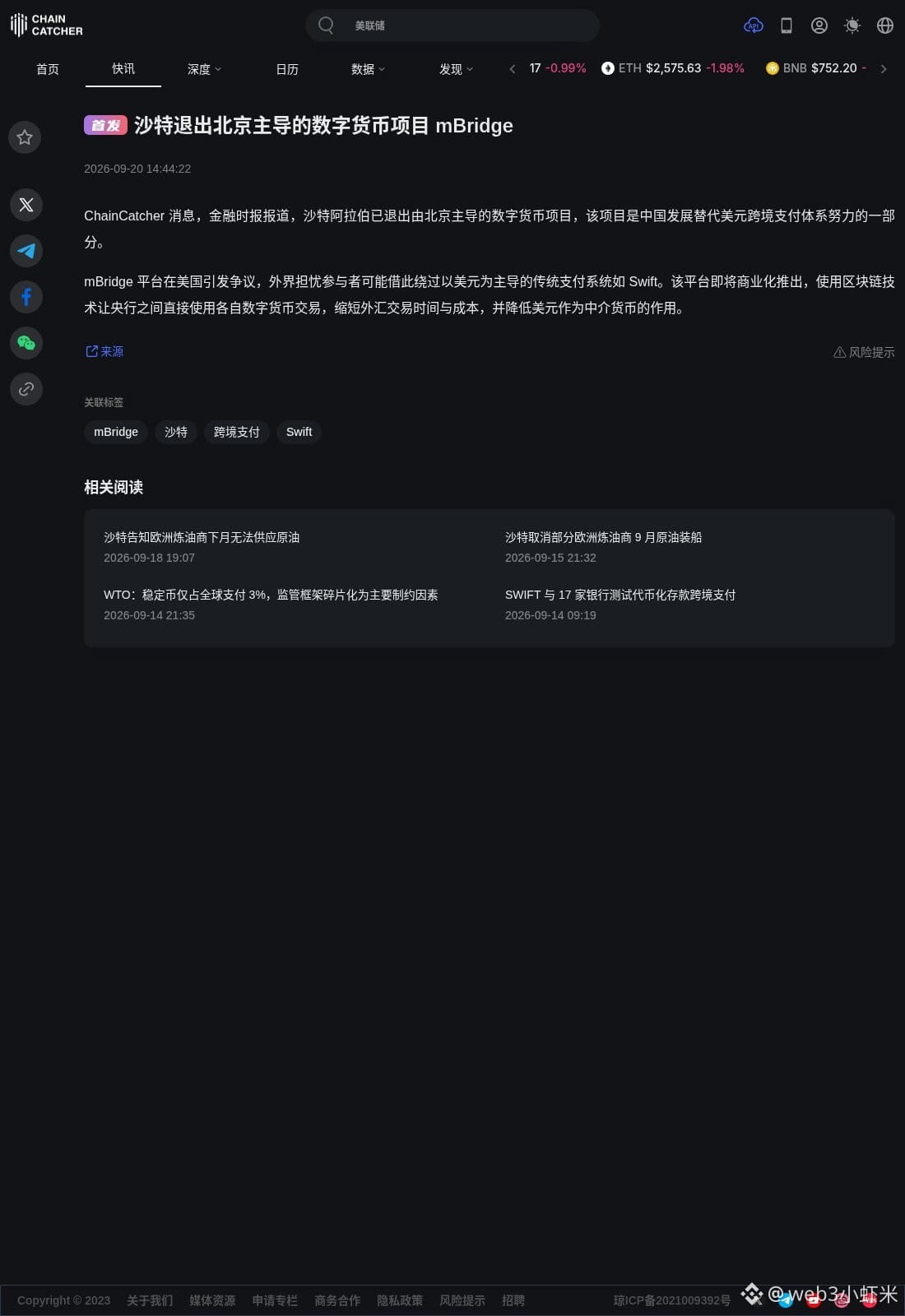
Scanned ChainCatcher (Financial Times): Saudi Arabia withdrew from Beijing-led cross-border digital currency project mBridge—this was a plan to use blockchain so that each country's central banks could settle directly using their own digital currencies, shortening foreign-exchange routes and reducing the U.S. dollar's intermediary role.
The report says the platform is nearing commercialization, and there has been substantial controversy in the U.S.: outsiders worry that participating parties may use it to bypass traditional cross-border payments dominated by the U.S. dollar (such as Swift). In June 2024, the Saudi Central Bank joined the project with a wholesale CBDC verification effort, and said that on May 13, 2025, it had completed a concept proof; after that, it was no longer a formal member.
With one major Gulf participant missing, can the CBDC cross-border bridge still take shape? Beyond the technology, geopolitical tensions and the strain within the U.S. dollar system have always been there.#CBDC #Cross-border payments
Scanned ChainCatcher (Financial Times): Saudi Arabia withdrew from Beijing-led cross-border digital currency project mBridge—this was a plan to use blockchain so that each country's central banks could settle directly using their own digital currencies, shortening foreign-exchange routes and reducing the U.S. dollar's intermediary role.
The report says the platform is nearing commercialization, and there has been substantial controversy in the U.S.: outsiders worry that participating parties may use it to bypass traditional cross-border payments dominated by the U.S. dollar (such as Swift). In June 2024, the Saudi Central Bank joined the project with a wholesale CBDC verification effort, and said that on May 13, 2025, it had completed a concept proof; after that, it was no longer a formal member.
With one major Gulf participant missing, can the CBDC cross-border bridge still take shape? Beyond the technology, geopolitical tensions and the strain within the U.S. dollar system have always been there.#CBDC #Cross-border payments
The report says the platform is nearing commercialization, and there has been substantial controversy in the U.S.: outsiders worry that participating parties may use it to bypass traditional cross-border payments dominated by the U.S. dollar (such as Swift). In June 2024, the Saudi Central Bank joined the project with a wholesale CBDC verification effort, and said that on May 13, 2025, it had completed a concept proof; after that, it was no longer a formal member.
With one major Gulf participant missing, can the CBDC cross-border bridge still take shape? Beyond the technology, geopolitical tensions and the strain within the U.S. dollar system have always been there.#CBDC #Cross-border payments
82

·
--
Bullish
#hkmaplanswholesalecbdcbyyearend
🚨 HONG KONG COULD TAKE CBDCs TO THE NEXT LEVEL! 🇭🇰🔥
Hong Kong plans to move toward wholesale CBDC use by year-end, putting digital currency infrastructure back in the spotlight.
💰 Why this matters:
• Wholesale CBDCs can improve institutional settlement
• Faster and more efficient transactions could become possible
• It could strengthen Hong Kong’s role in digital-asset innovation
• More government-backed digital currency infrastructure may increase attention toward the crypto sector
This is another major signal that blockchain-based financial infrastructure is moving closer to traditional markets. 👀
The big question: Could Hong Kong’s CBDC push accelerate wider institutional adoption of digital assets?
Watch this space closely. 🚀
DYOR before taking any trade.
#hkmaplanswholesalecbdcbyyearend #CBDC #crypto
#hkmaplanswholesalecbdcbyyearend
🚨 HONG KONG COULD TAKE CBDCs TO THE NEXT LEVEL! 🇭🇰🔥
Hong Kong plans to move toward wholesale CBDC use by year-end, putting digital currency infrastructure back in the spotlight.
💰 Why this matters:
• Wholesale CBDCs can improve institutional settlement
• Faster and more efficient transactions could become possible
• It could strengthen Hong Kong’s role in digital-asset innovation
• More government-backed digital currency infrastructure may increase attention toward the crypto sector
This is another major signal that blockchain-based financial infrastructure is moving closer to traditional markets. 👀
The big question: Could Hong Kong’s CBDC push accelerate wider institutional adoption of digital assets?
Watch this space closely. 🚀
DYOR before taking any trade.
#hkmaplanswholesalecbdcbyyearend #CBDC #crypto
🚨 HONG KONG COULD TAKE CBDCs TO THE NEXT LEVEL! 🇭🇰🔥
Hong Kong plans to move toward wholesale CBDC use by year-end, putting digital currency infrastructure back in the spotlight.
💰 Why this matters:
• Wholesale CBDCs can improve institutional settlement
• Faster and more efficient transactions could become possible
• It could strengthen Hong Kong’s role in digital-asset innovation
• More government-backed digital currency infrastructure may increase attention toward the crypto sector
This is another major signal that blockchain-based financial infrastructure is moving closer to traditional markets. 👀
The big question: Could Hong Kong’s CBDC push accelerate wider institutional adoption of digital assets?
Watch this space closely. 🚀
DYOR before taking any trade.
#hkmaplanswholesalecbdcbyyearend #CBDC #crypto
34

·
--
#HKMAPlansWholesaleCBDCByYearEnd
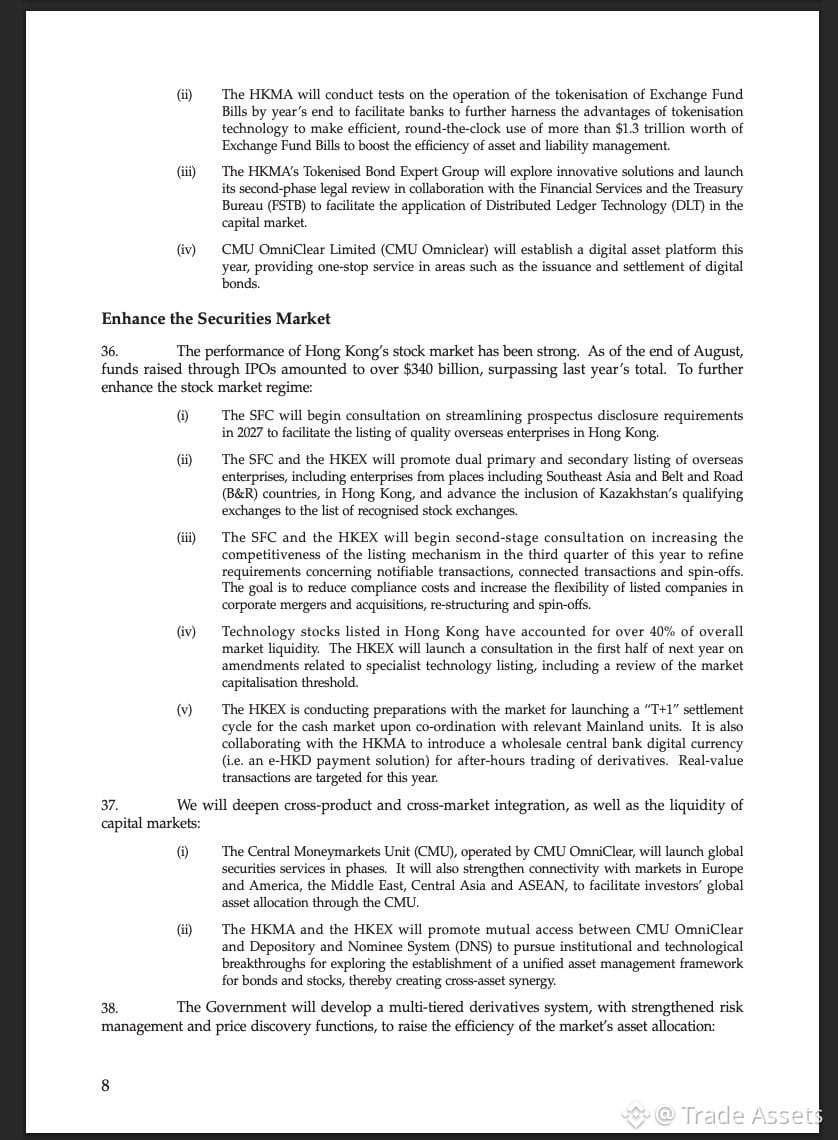
🇭🇰 BREAKING: The Hong Kong government has laid out a sweeping roadmap to bring financial markets onchain, including HK$1.3T in Exchange Fund Bills, tokenized funds, stablecoin settlement and 24/7 CBDC infrastructure.
Its new 117-page Policy Address includes:
• Testing tokenization of more than HK$1.3T in Exchange Fund Bills for round-the-clock use by banks
• Regularizing digital bond issuance, including settlement with digital currencies
• Launching a CMU OmniClear digital-asset platform for digital bond issuance and settlement
• Introducing wholesale e-HKD for after-hours derivatives trading, with real-value transactions targeted this year
• Enabling tokenized gold and other real-world assets on licensed platforms
• Promoting regulated stablecoins for settlement of tokenized money-market funds
• Implementing CBDC settlement and 24/7 operations under EnsembleTX by around year-end
• Expanding tokenized-deposit use cases
• Building an HKEX blockchain-backed, multi-asset tokenization platform for carbon credits and commodity warehouse receipts
Hong Kong also says digital bonds issued there captured nearly 50% of the global market between 2025 and the first half of 2026.
This is one of the broadest government-backed tokenization roadmaps yet from a major financial center.
#CBDC
#HKMAPlansWholesaleCBDCByYearEnd
🇭🇰 BREAKING: The Hong Kong government has laid out a sweeping roadmap to bring financial markets onchain, including HK$1.3T in Exchange Fund Bills, tokenized funds, stablecoin settlement and 24/7 CBDC infrastructure.
Its new 117-page Policy Address includes:
• Testing tokenization of more than HK$1.3T in Exchange Fund Bills for round-the-clock use by banks
• Regularizing digital bond issuance, including settlement with digital currencies
• Launching a CMU OmniClear digital-asset platform for digital bond issuance and settlement
• Introducing wholesale e-HKD for after-hours derivatives trading, with real-value transactions targeted this year
• Enabling tokenized gold and other real-world assets on licensed platforms
• Promoting regulated stablecoins for settlement of tokenized money-market funds
• Implementing CBDC settlement and 24/7 operations under EnsembleTX by around year-end
• Expanding tokenized-deposit use cases
• Building an HKEX blockchain-backed, multi-asset tokenization platform for carbon credits and commodity warehouse receipts
Hong Kong also says digital bonds issued there captured nearly 50% of the global market between 2025 and the first half of 2026.
This is one of the broadest government-backed tokenization roadmaps yet from a major financial center.
#CBDC
🇭🇰 BREAKING: The Hong Kong government has laid out a sweeping roadmap to bring financial markets onchain, including HK$1.3T in Exchange Fund Bills, tokenized funds, stablecoin settlement and 24/7 CBDC infrastructure.
Its new 117-page Policy Address includes:
• Testing tokenization of more than HK$1.3T in Exchange Fund Bills for round-the-clock use by banks
• Regularizing digital bond issuance, including settlement with digital currencies
• Launching a CMU OmniClear digital-asset platform for digital bond issuance and settlement
• Introducing wholesale e-HKD for after-hours derivatives trading, with real-value transactions targeted this year
• Enabling tokenized gold and other real-world assets on licensed platforms
• Promoting regulated stablecoins for settlement of tokenized money-market funds
• Implementing CBDC settlement and 24/7 operations under EnsembleTX by around year-end
• Expanding tokenized-deposit use cases
• Building an HKEX blockchain-backed, multi-asset tokenization platform for carbon credits and commodity warehouse receipts
Hong Kong also says digital bonds issued there captured nearly 50% of the global market between 2025 and the first half of 2026.
This is one of the broadest government-backed tokenization roadmaps yet from a major financial center.
#CBDC

3
116

#HKMAPlansWholesaleCBDCByYearEnd
🚨 Hong Kong to enable institutional crypto settlement 24/7 🏦🔥
Hong Kong is taking encrypted funding to the next phase.
The Hong Kong Monetary Authority (HKMA) says its EnsembleTX project will run throughout 2026, and the testing environment will be enhanced to support 24/7 settlement using the central bank’s encrypted funds.
⚡ Why this matters:
🏦 CBDC transaction settlement
⏱️ The ability to settle 24/7
🔗 Tokenized deposits + tokenized assets
🌐 Stronger infrastructure for traditional finance (TradFi) + blockchain
📈 More momentum behind tokenizing real-world assets (RWA)
This is not a consumer CBDC story. It’s about institutional financial infrastructure.
And if tokenized assets can be settled around the clock, the picture gets bigger and clearer:
Traditional finance moves deeper into blockchain rails. 👀
Watch the RWA + DeFi space closely.
🔥 Will 24/7 institutional settlement be the next main catalyst for tokenization?
Please follow for updates
$G $UNI $NEAR
#CBDC #UNI #Near #Grok
#HKMAPlansWholesaleCBDCByYearEnd
🚨 Hong Kong to enable institutional crypto settlement 24/7 🏦🔥
Hong Kong is taking encrypted funding to the next phase.
The Hong Kong Monetary Authority (HKMA) says its EnsembleTX project will run throughout 2026, and the testing environment will be enhanced to support 24/7 settlement using the central bank’s encrypted funds.
⚡ Why this matters:
🏦 CBDC transaction settlement
⏱️ The ability to settle 24/7
🔗 Tokenized deposits + tokenized assets
🌐 Stronger infrastructure for traditional finance (TradFi) + blockchain
📈 More momentum behind tokenizing real-world assets (RWA)
This is not a consumer CBDC story. It’s about institutional financial infrastructure.
And if tokenized assets can be settled around the clock, the picture gets bigger and clearer:
Traditional finance moves deeper into blockchain rails. 👀
Watch the RWA + DeFi space closely.
🔥 Will 24/7 institutional settlement be the next main catalyst for tokenization?
Please follow for updates
$G $UNI $NEAR
#CBDC #UNI #Near #Grok
🚨 Hong Kong to enable institutional crypto settlement 24/7 🏦🔥
Hong Kong is taking encrypted funding to the next phase.
The Hong Kong Monetary Authority (HKMA) says its EnsembleTX project will run throughout 2026, and the testing environment will be enhanced to support 24/7 settlement using the central bank’s encrypted funds.
⚡ Why this matters:
🏦 CBDC transaction settlement
⏱️ The ability to settle 24/7
🔗 Tokenized deposits + tokenized assets
🌐 Stronger infrastructure for traditional finance (TradFi) + blockchain
📈 More momentum behind tokenizing real-world assets (RWA)
This is not a consumer CBDC story. It’s about institutional financial infrastructure.
And if tokenized assets can be settled around the clock, the picture gets bigger and clearer:
Traditional finance moves deeper into blockchain rails. 👀
Watch the RWA + DeFi space closely.
🔥 Will 24/7 institutional settlement be the next main catalyst for tokenization?
Please follow for updates
$G $UNI $NEAR
#CBDC #UNI #Near #Grok

1
117
Log in to explore more content
Join global crypto users on Binance Square
⚡️ Get latest and useful information about crypto.
💬 Trusted by the world’s largest crypto exchange.
👍 Discover real insights from verified creators.
Email / Phone number
Trending Topics
1
#BitcoinRejectedAt$87K
27,546 views
60 Discussing
2
#FedOctoberRateHikeOddsFallTo17%
18,342 views
318 Discussing
3
#NvidiaHitsRecordHighUp2.4%
5,066 views
202 Discussing
4
#CanaryFilesAmendedS1ForPEPEETF
2,319 views
143 Discussing
5
#USRussiaUkraineTalksReportedlyIncludeLukoilOilDeal
11,488 views
225 Discussing
6
#BitcoinParesGainsAfterRallyTo$86.5K
37,295 views
141 Discussing
7
#CerebrasSinksNearly20%OnReportNvidiaToPowerOpenAI
80,225 views
803 Discussing
8
#SECProposesCryptoCustodyRules
104,452 views
1,012 Discussing
9
#SECApproves3xLongCryptoCommodityETPs
66,585 views
692 Discussing
10
#MASKHitsRecordMarketCapAbove$35M
4,207 views
36 Discussing