
#zktls
zktls
1,492 views
13 Discussing
Hot
Latest

Primus × Cournot’s collaboration: I’m not knocking the technology itself; what I’m knocking is the timing.
I took a look at the discussion on X, and most of it was replies tagged with Kaito: "Very massive collaboration""seems very promising now""revolutionizing onchain finance"… Ten different ways of saying the same thing, with views ranging from single digits to a few dozen. The most-viewed original post got 2,115 views and 32 replies. If you know, you know: that’s yap points at work, not people who actually understand what’s going on.
Now, to the point. zkTLS can prove that this data really came from a particular website or API, and that no one tampered with it along the way. That’s all. It can’t prove that the website itself is telling the truth. If the source reported something wrong, what you get is "cryptographically authenticated incorrect data."
The real arguments in prediction markets aren’t about whether "the data was scraped from the official site." They’re about how to interpret the rules: what counts as "happening," which point in time to use, and whose judgment to follow when the wording is ambiguous. Cournot says it uses AI to reason over verified evidence and produce auditable outcomes. That raises the question: if the AI gets it wrong, who takes responsibility, and who has the authority to overturn its decision? Even their own summary of X news says this system hasn’t fully resolved accuracy issues or disputes over rules.
Breaking down data sources and using AI to interpret them is a clean approach. But no one can even answer how many real users are testing it right now (someone asked exactly that below, and got no reply). Watch the product, not the replies.
#zkTLS #prediction markets
43
I’m not entirely sold on the way the Primus × Cournot partnership is being pitched.
The core selling point is that Primus uses zkTLS to prove data really came from a particular website or API, then Cournot uses AI to judge outcomes based on that evidence. The focus is on settling prediction markets and on-chain credit. @alex_atoms’s post put it most dramatically: imagine losing your position because someone doctored a screenshot of a tweet.
But are doctored images really why people argue about prediction markets? Most of the disputes I’ve seen are about vague rules, ambiguity over what counts as an outcome, or arbitrators or voters having positions of their own. zkTLS can prove “this page looked like this at the time”; it can’t prove that what the page says is true. If the source is some fly-by-night news site that makes things up, you can use all the cryptography you want—you’re just proving an error with precision.
And then there’s Cournot’s AI judgment. The evidence may be verifiable, but who verifies the logic behind the judgment? How the model interprets the words “officially announced” still comes down to the dispute-resolution mechanism. Neither company has explained this part clearly.
Also, the replies are full of lines like “primus verifies the source, cournot turns it into usable judgment,” with single-digit views, while long posts in Korean are directly plugging Kaito. The technology may be the real deal, but most of this buzz is driven by people farming points. Don’t mistake it for market consensus.
I’m bullish on zkTLS as a direction. It really is useful for things like checking exchange transaction histories without handing over your entire account. Just don’t let a straw-man story about “doctored images” lead you astray.
#预测市场 #zkTLS
30

·
--
Verified
In prediction markets, people care most about the odds. But what ultimately determines who gets the money is how the outcome is judged.
The collaboration between Primus and Cournot Protocol points to one key idea: handle evidence sources and outcome judgments separately.
Primus uses zkTLS to help verify whether webpage or API data comes from its claimed source, while reducing unnecessary disclosure of private information. Cournot, meanwhile, interprets evidence according to market rules and provides a judgment process that can be reviewed.
For example:
Will a certain product launch before the end of the month?
Does a launch announcement count? What if it’s available only in some regions? Does a beta version qualify?
Even if you have a genuine announcement from the official website, you can’t skip these definitions and settle the market. Conversely, no matter how fluently AI explains its reasoning, if it cites a forged webpage or outdated material, its conclusion is just as unreliable.
Verify where the evidence comes from, then check whether it supports the settlement conclusion. If a dispute arises, participants can at least trace the specific sources and steps behind the judgment, rather than simply accept a “YES / NO.”
At the same time, the limits need to be clear: zkTLS can verify a source, but that doesn’t mean the source is always correct; reviewable reasoning doesn’t mean a judgment can never be wrong. Time windows, evidence completeness, and ambiguous rules still need to be addressed.
An application may need to verify a financial condition without needing to make all of a user’s underlying records public. This is a direction worth exploring, but it shouldn’t be treated as a mature, proven solution prematurely.
What I’d most like to see next are real settlement cases: how conflicts in evidence are handled, how users can challenge outcomes, and whether verification costs can support more small-scale, long-tail markets.
This article is for analysis only and does not constitute investment advice. DYOR
#Primus #Cournot #zkTLS
1
1.9k
·
--
It’s getting easier to place orders with AI Agents, but if one says a trade has gone through, would you just take its word for it?
One angle worth watching with Primus Labs is its effort to make Agents’ execution results verifiable.
For example, you ask an Agent to buy an asset. In the end, it gives you a text description or a screenshot. That may show what it claims to have done, but it may not be enough to verify what actually happened. And when execution takes place in off-chain systems such as exchanges, on-chain records alone aren’t enough either.
Primus’s zkTLS approach generates verifiable credentials for data from websites or APIs. This lets applications check where the data came from and whether it meets agreed conditions, while minimizing unnecessary disclosure. The team has listed verifiable AI Agent execution as an application scenario.
More concretely, Primus has publicly released tools such as Binance Verifiable Skills, which bring some Binance API calls into a zkTLS verification workflow. The repository also includes integration guides for credential generation, local verification, and on-chain verification.
This points to a more practical way to use Agents: after carrying out a task, they return the result along with a credential that can be independently checked. Customers don’t have to rely solely on the Agent’s own explanation; other programs can verify it too.
Of course, the limits should be clear: proving what an API returned doesn’t prove that a trading strategy was sound, nor does it guarantee a profit. You still need to check which account the credential refers to, when it was issued, which fields it covers, and whether it covers the entire task.
To see whether these tools can be adopted in real-world business, watch how costly verification is, how easily developers can integrate them, and whether errors and failures are recorded.
As Agents begin handling money and business tasks on people’s behalf, the ability to verify what they’ve done will directly affect how much authority people are willing to give them.
This article is for analysis only and does not constitute investment advice. DYOR
#Primus #zkTLS #AIAgent
68
Primus Labs has been getting a lot of buzz on X over the past couple of days, but after looking around, I’d say about 80% of it is probably being pumped by Kaito farming accounts.
"Zktls primus good"
"primus shaping the future of zktls"
"fhe and zktls is huge for primus"
Replies like these get single-digit views, some only 3 to 6. Vietnamese long-form posts even end with "Bắt đầu tại @KaitoAI," and people conveniently add the Primus Points rewards link too. That’s not community consensus; that’s the rewards quest zone going live.
To be fair, the technology itself isn’t nonsense. zkTLS is used to prove off-chain data, like a balance on a certain website, without exposing the details. In the summaries on X, they say they’ve already verified more than $59 million in reserves for projects like Unitas, and there’s also a confidential vault running on BNB Chain.
But there are two things not to get misled about:
First, zkTLS proves that "a certain webpage showed this number at a certain time." A reserve proof only verifies the asset side; who verifies the liabilities? FTX was never short on screenshots of assets.
Second, when it’s tied to Kaito as a "reputation tool," it’s basically just adding another layer of verification to a yap leaderboard. You’re verifying how many posts I made, not whether what I said is right.
Infrastructure can be watched over time, but all those good, huge, and we’re early posts on the timeline are just check-ins for an airdrop. They have nothing to do with whether the project is actually valuable. Anyone treating those replies as a signal will most likely end up being the one left holding the bag for the points crowd.
#zkTLS #PrimusLabs
3
🔐 A new approach to on-chain privacy: hide the amounts, not the truth? Primus Labs raises $6.5 million
An old problem with public blockchains: a fund’s positions and moves are all out in the open. A few transfers can be enough for others to reverse-engineer its strategy. But hide everything, and counterparties can’t verify that anything is real.
Primus Labs is aiming for a middle ground: “confidentiality,” not “anonymity.”
🔹 Funding: $6.5 million combined across Pre-Seed and Seed rounds, led by Dispersion Capital, Symbolic Capital, and VanEck, with participation from Samsung Next, Alchemy, and others
🔹 zkTLS: Proves that data from a website or API is genuine (such as an exchange account balance) without revealing the exact figures
🔹 Confidential Vault: Now live on BNB Chain. Using FHE (fully homomorphic encryption), users can convert U into encrypted eU to make confidential transfers or earn yield, while balances remain encrypted during use. The launch announcement cited an APY of around 9.69%, plus a $10,000 joint incentive with Unitas Labs
🔹 Important distinction: The FHE feature is live; zkFHE is still at the research-paper stage
🔹 Also built ZKredit with BNB Chain and Brevis, aiming to make DeFi lending depend on more than just collateral
My take: One major reason institutions hesitate to deploy large amounts of capital is that “full transparency = running around naked.” This is the right direction; both proof of reserves and private transactions can benefit from it. But keep two things in mind: First, the community has also pointed out that proof speed and integration difficulty remain hurdles. Second, many recent posts about it on X are campaign-task posts; hype doesn’t equal usage. The APY figure reflects the rate at launch, so check the current yield and smart contract risks before depositing.
Would you swap your stablecoins for encrypted versions to hide your balance? Or do you think on-chain transparency is what makes you feel secure? Let’s discuss in the comments 👇
#隐私计算 #BNBChain #zkTLS #PrimusLabs
48
Today, X added “Privacy + selective proofs, helping institutional funds move on-chain” to its crypto trends. The star of the show is Primus Labs. I was curious how this buzz got started, so I looked into it.
Over the past six and a half days, there were 189,723 tweets mentioning @primus_labs, including 32,334 in a single day on October 27.
I grabbed the latest 25 replies at random and scrolled through them in under two minutes. Each had 0 to 7 views, and they looked like this:
“Primus makes crypto so easy.”
“Strong communities build strong projects”
“Gm bro let's connect fb”
Some even casually tagged @KaitoAI.
That’s not community consensus; that’s a points farm punching the clock. Trend algorithms feed on volume, yap rankings feed on volume, and in the end even X’s own “news summary” is generated from these replies. zkTLS isn’t vaporware, but the “buzz” you see on your timeline is basically something the project team bought with points.
If you really want to do your research, look at who’s paying to use it and whether there’s any revenue. Don’t count how many people in the replies are shouting “breakthrough.” The curve has already started falling from 32,000 a day. Once the rewards stop, these accounts will be farming the next project tomorrow.
#Kaito #zkTLS
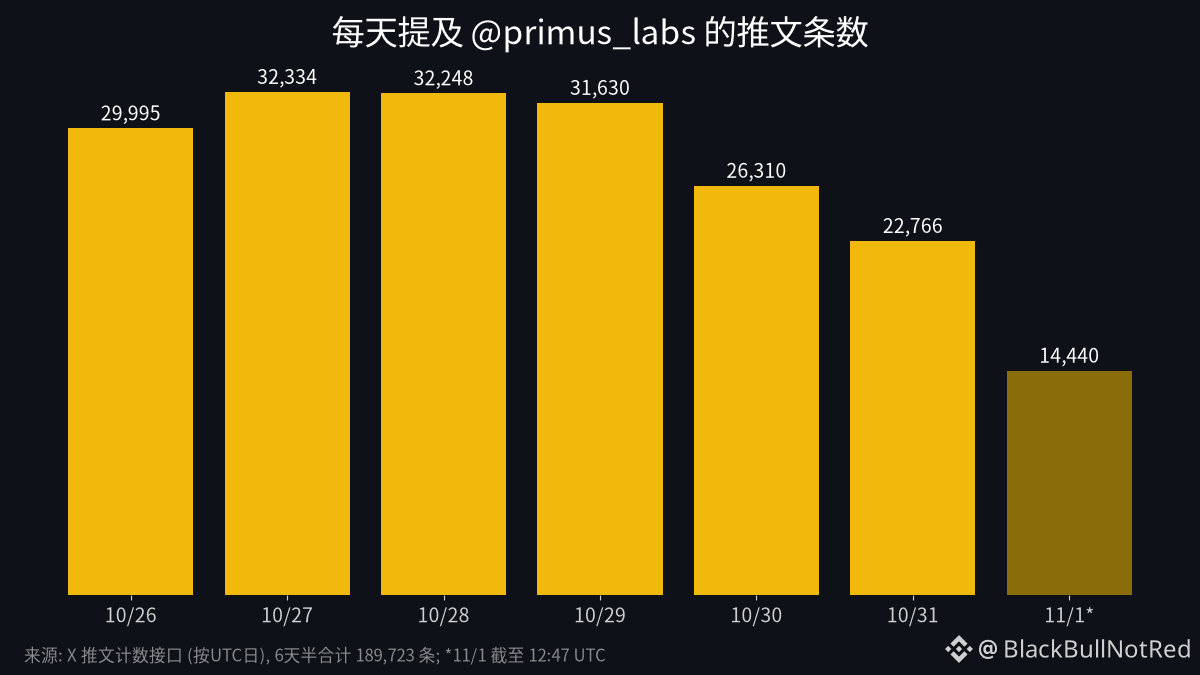
387

·
--
What Primus is doing with Cournot Protocol this time is pretty practical.
Prediction markets ultimately need to reach a resolution.
On-chain data is relatively straightforward; the tricky part is that a lot of real-world data lives on websites, in APIs, and behind account dashboards.
You can’t rely on screenshots to decide who wins in the end.
Cournot now uses Primus’s zkTLS to first verify whether this data comes from the original website or API, then uses the verified results to make a decision.
There’s no need to make all the raw data public, either.
The same goes for private credit and RWA.
A lot of the information is already off-chain, but the blockchain still needs to know whether it’s genuine.
zkTLS used to sound pretty technical.
Now it’s finally starting to do things ordinary people can understand.
#Primus #zkTLS #预测市场 #Cournot #RWA
74
Log in to explore more content
Join global crypto users on Binance Square
⚡️ Get latest and useful information about crypto.
💬 Trusted by the world’s largest crypto exchange.
👍 Discover real insights from verified creators.
Email / Phone number
Trending Topics
1
#NvidiaEarningsTonight:AIStocks’NextMove?
56,327 views
847 Discussing
2
#A Packed Week of Earnings and Data Tests Markets
119,310 views
600 Discussing
3
#AnthropicIPOTestsInvestorAppetiteForAI
261,411 views
2,568 Discussing
4
#NvidiaBoardNotConsideringHuang’sReturnasCEO
72,579 views
744 Discussing
5
#KOSPIFalls2.59%ToLowestCloseSinceFebruary
10,830 views
163 Discussing
6
#AnthropicClearedToListOnNasdaqAsANT
12,820 views
155 Discussing
7
#WhatInvestmentSignalsDo13FFilingsReveal?
41,919 views
543 Discussing
8
#TetherCapitalMakesStrategicInvestmentInStables
3,596 views
42 Discussing
9
#EvernorthRecords$505MImpairmentOnPreListingXRP
1,125 views
17 Discussing
10
#GoldmanSachsReports$1.22BInEtherETFHoldings
886 views
15 Discussing