
#binancep2pantoan
binancep2pantoan
1.8M views
8,344 Discussing
Hot
Latest
·
--
Article
7 "Blood and Sweat" Rules for Safe Binance P2P Trading and Never Losing MoneyP2P (Peer-to-Peer) trading on Binance is currently the most popular and convenient channel for depositing/withdrawing fiat currency (VND). However, convenience also comes with many risks, such as getting involved with "dirty money," which can lead to bank account freezes, or being scammed by malicious opponents.
Whether you are a newbie or a long-time investor, mastering the safety rules when trading P2P is a must to protect your own assets.
7 "Blood and Sweat" Rules for Safe Binance P2P Trading and Never Losing Money
P2P (Peer-to-Peer) trading on Binance is currently the most popular and convenient channel for depositing/withdrawing fiat currency (VND). However, convenience also comes with many risks, such as getting involved with "dirty money," which can lead to bank account freezes, or being scammed by malicious opponents.
Whether you are a newbie or a long-time investor, mastering the safety rules when trading P2P is a must to protect your own assets.
Whether you are a newbie or a long-time investor, mastering the safety rules when trading P2P is a must to protect your own assets.
1
149
💡 Dealing with Binance P2P Transaction Issues: What Should You Do?
When trading P2P, if you encounter unexpected situations, stay calm and handle them according to the safe instructions below:
❓ Situation 1: The buyer has clicked “Paid”, but your bank hasn’t reported receiving the funds?
👉 How to handle: Under no circumstances should you release the coins. Message the buyer to request a screenshot of the transaction receipt. Check your banking app carefully. If the countdown time passes and you still haven’t received the money, click Appeal and submit evidence for Binance to investigate.
❓ Situation 2: You transferred too much/too little, or you entered the transfer content incorrectly?
👉 How to handle: Message your counterparty directly through the chat box in the Binance app to agree on a solution. If the counterparty doesn’t cooperate for a refund or doesn’t release the coins, click Appeal and upload the bank transfer invoice.
🔒 Always trade 100% on the Binance app and follow the safety guidelines from @Bi
#BinanceP2PAnToan
@Binance_Vietnam
💡 Dealing with Binance P2P Transaction Issues: What Should You Do?
When trading P2P, if you encounter unexpected situations, stay calm and handle them according to the safe instructions below:
❓ Situation 1: The buyer has clicked “Paid”, but your bank hasn’t reported receiving the funds?
👉 How to handle: Under no circumstances should you release the coins. Message the buyer to request a screenshot of the transaction receipt. Check your banking app carefully. If the countdown time passes and you still haven’t received the money, click Appeal and submit evidence for Binance to investigate.
❓ Situation 2: You transferred too much/too little, or you entered the transfer content incorrectly?
👉 How to handle: Message your counterparty directly through the chat box in the Binance app to agree on a solution. If the counterparty doesn’t cooperate for a refund or doesn’t release the coins, click Appeal and upload the bank transfer invoice.
🔒 Always trade 100% on the Binance app and follow the safety guidelines from @Bi
#BinanceP2PAnToan
@Binance Vietnam
When trading P2P, if you encounter unexpected situations, stay calm and handle them according to the safe instructions below:
❓ Situation 1: The buyer has clicked “Paid”, but your bank hasn’t reported receiving the funds?
👉 How to handle: Under no circumstances should you release the coins. Message the buyer to request a screenshot of the transaction receipt. Check your banking app carefully. If the countdown time passes and you still haven’t received the money, click Appeal and submit evidence for Binance to investigate.
❓ Situation 2: You transferred too much/too little, or you entered the transfer content incorrectly?
👉 How to handle: Message your counterparty directly through the chat box in the Binance app to agree on a solution. If the counterparty doesn’t cooperate for a refund or doesn’t release the coins, click Appeal and upload the bank transfer invoice.
🔒 Always trade 100% on the Binance app and follow the safety guidelines from @Bi
#BinanceP2PAnToan
@Binance Vietnam
106

#binancep2pantoan @Binance_Vietnam
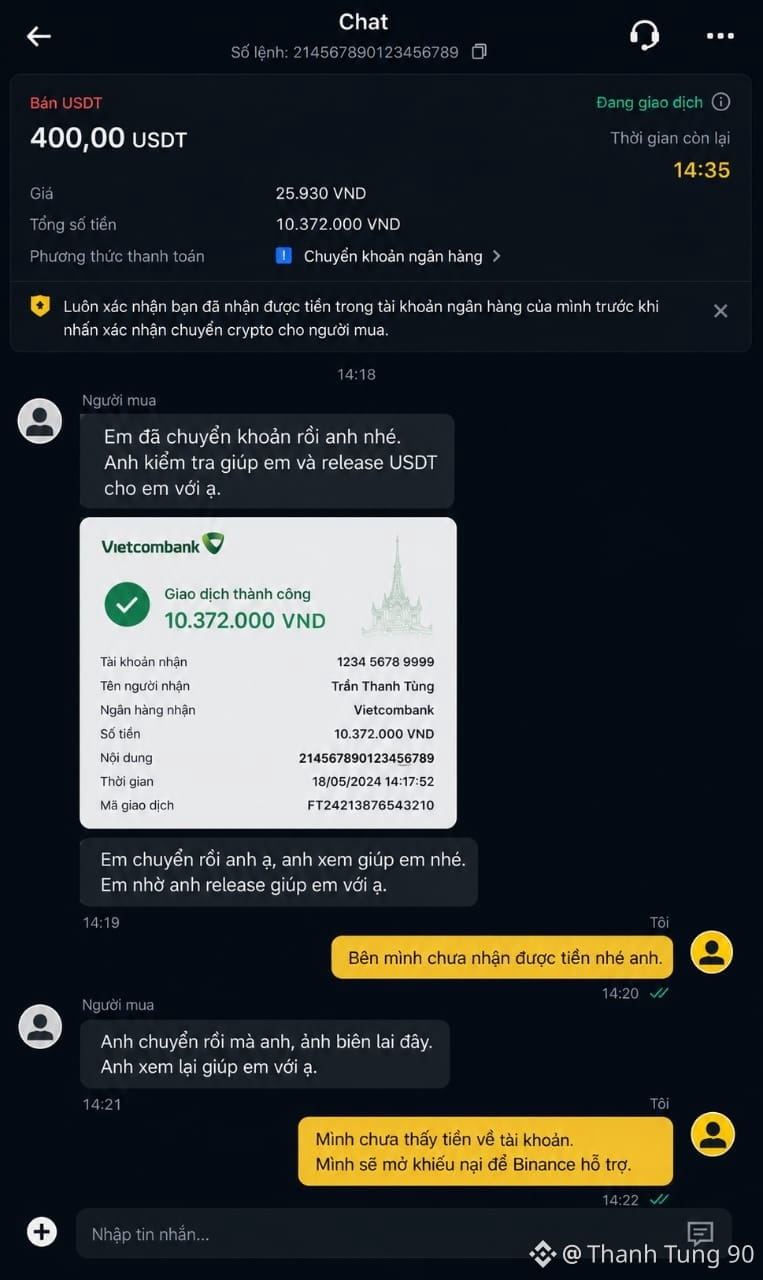
There was a time when I sold 400 USDT on P2P. The buyer just marked it as “Paid” and immediately sent me a receipt image.
At first glance, I didn’t suspect anything. The buyer’s picture had the full recipient name, amount, transaction time, transaction ID… it looked exactly like a photo taken from a real banking app.
The buyer also messaged me:
“Please check for me. I’ve transferred the money—release the USDT for me.”
Honestly, at that moment I was also a bit careless. But before I released, I still opened my banking app to check.
There was nothing.
I refreshed a few more times, checked the transaction history, the balance… I still couldn’t find that payment.
So I messaged again:
“We haven’t received the money yet, okay?”
The other side immediately sent the image again and said:
“I already transferred it—please check again.”
Only then did I notice: the picture looked very real, but it still didn’t prove that the money had actually arrived in my account.
After that, the buyer kept bargaining, insisting it was a mistake, and asked me to add Zalo to continue the transaction. Especially, the buyer even promised that transacting via Zalo would be higher-priced than P2P trading on Binance.
I didn’t release the USDT and I didn’t cancel the order right away. I kept the entire chat log and opened a dispute for Binance to handle.
If you ever run into a case where a buyer sends a fake transfer screenshot on Binance P2P, remember these points:
🔴 Don’t release USDT just because the buyer sent a transfer image.
🔴 If the money hasn’t entered your account, absolutely don’t release.
🔴 Don’t click strange links or provide banking information.
🟢 Save the image, the chat log, and the transaction ID.
🟢 If there are any signs of abnormality, open a dispute so Binance support can help.
🟢 Only trade P2P on Binance.
#binancep2pantoan @Binance Vietnam
There was a time when I sold 400 USDT on P2P. The buyer just marked it as “Paid” and immediately sent me a receipt image.
At first glance, I didn’t suspect anything. The buyer’s picture had the full recipient name, amount, transaction time, transaction ID… it looked exactly like a photo taken from a real banking app.
The buyer also messaged me:
“Please check for me. I’ve transferred the money—release the USDT for me.”
Honestly, at that moment I was also a bit careless. But before I released, I still opened my banking app to check.
There was nothing.
I refreshed a few more times, checked the transaction history, the balance… I still couldn’t find that payment.
So I messaged again:
“We haven’t received the money yet, okay?”
The other side immediately sent the image again and said:
“I already transferred it—please check again.”
Only then did I notice: the picture looked very real, but it still didn’t prove that the money had actually arrived in my account.
After that, the buyer kept bargaining, insisting it was a mistake, and asked me to add Zalo to continue the transaction. Especially, the buyer even promised that transacting via Zalo would be higher-priced than P2P trading on Binance.
I didn’t release the USDT and I didn’t cancel the order right away. I kept the entire chat log and opened a dispute for Binance to handle.
If you ever run into a case where a buyer sends a fake transfer screenshot on Binance P2P, remember these points:
🔴 Don’t release USDT just because the buyer sent a transfer image.
🔴 If the money hasn’t entered your account, absolutely don’t release.
🔴 Don’t click strange links or provide banking information.
🟢 Save the image, the chat log, and the transaction ID.
🟢 If there are any signs of abnormality, open a dispute so Binance support can help.
🟢 Only trade P2P on Binance.
There was a time when I sold 400 USDT on P2P. The buyer just marked it as “Paid” and immediately sent me a receipt image.
At first glance, I didn’t suspect anything. The buyer’s picture had the full recipient name, amount, transaction time, transaction ID… it looked exactly like a photo taken from a real banking app.
The buyer also messaged me:
“Please check for me. I’ve transferred the money—release the USDT for me.”
Honestly, at that moment I was also a bit careless. But before I released, I still opened my banking app to check.
There was nothing.
I refreshed a few more times, checked the transaction history, the balance… I still couldn’t find that payment.
So I messaged again:
“We haven’t received the money yet, okay?”
The other side immediately sent the image again and said:
“I already transferred it—please check again.”
Only then did I notice: the picture looked very real, but it still didn’t prove that the money had actually arrived in my account.
After that, the buyer kept bargaining, insisting it was a mistake, and asked me to add Zalo to continue the transaction. Especially, the buyer even promised that transacting via Zalo would be higher-priced than P2P trading on Binance.
I didn’t release the USDT and I didn’t cancel the order right away. I kept the entire chat log and opened a dispute for Binance to handle.
If you ever run into a case where a buyer sends a fake transfer screenshot on Binance P2P, remember these points:
🔴 Don’t release USDT just because the buyer sent a transfer image.
🔴 If the money hasn’t entered your account, absolutely don’t release.
🔴 Don’t click strange links or provide banking information.
🟢 Save the image, the chat log, and the transaction ID.
🟢 If there are any signs of abnormality, open a dispute so Binance support can help.
🟢 Only trade P2P on Binance.
6
15
15.6k

·
--
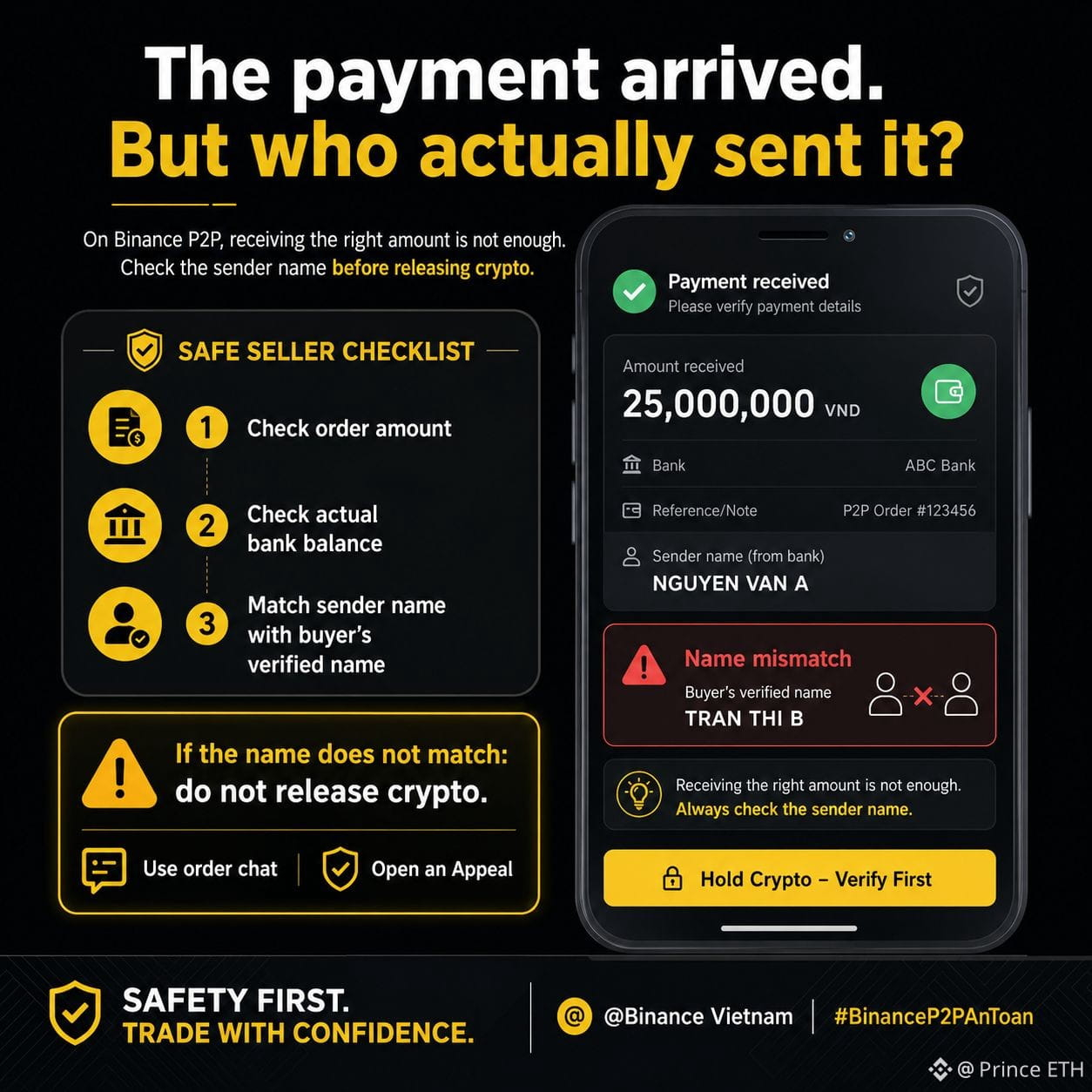
One Binance P2P rule deserves more attention because it separates two checks that sellers often treat as the same thing: “Did the money arrive?” and “Did it come from the verified buyer?”
For non-CNY P2P trades, Binance’s appeal rules say that if the name on the buyer’s payment account does not match the verified name on Binance P2P, the crypto should not be released. The seller is asked to refund the full amount, and the order is canceled after refund evidence is submitted and the buyer confirms receipt.
That detail matters because receiving the correct amount is only proof of payment. It is not proof that the payer identity matches the person on the order.
A name mismatch does not automatically prove fraud. There can be innocent explanations: a buyer may use another family member’s bank account, a business account, or simply ignore the payment-name requirement. But from the seller’s side, the practical decision is the same: do not “solve” the mismatch by releasing first and asking questions later.
Before Confirm Release, compare three things:
the order amount,
the actual bank balance,
and the sender name against the buyer’s verified name shown in the order.
If the amount is correct but the name is not, keep the crypto locked, use the order chat, and open an Appeal on that order rather than handling it off-platform.
The useful distinction is simple: payment verification answers “was money received?” Identity verification answers “who paid?” On Binance P2P, safe release requires both questions to make sense together.
@Binance_Vietnam #BinanceP2PAnToan $BTC $ETH $SOL
One Binance P2P rule deserves more attention because it separates two checks that sellers often treat as the same thing: “Did the money arrive?” and “Did it come from the verified buyer?”
For non-CNY P2P trades, Binance’s appeal rules say that if the name on the buyer’s payment account does not match the verified name on Binance P2P, the crypto should not be released. The seller is asked to refund the full amount, and the order is canceled after refund evidence is submitted and the buyer confirms receipt.
That detail matters because receiving the correct amount is only proof of payment. It is not proof that the payer identity matches the person on the order.
A name mismatch does not automatically prove fraud. There can be innocent explanations: a buyer may use another family member’s bank account, a business account, or simply ignore the payment-name requirement. But from the seller’s side, the practical decision is the same: do not “solve” the mismatch by releasing first and asking questions later.
Before Confirm Release, compare three things:
the order amount,
the actual bank balance,
and the sender name against the buyer’s verified name shown in the order.
If the amount is correct but the name is not, keep the crypto locked, use the order chat, and open an Appeal on that order rather than handling it off-platform.
The useful distinction is simple: payment verification answers “was money received?” Identity verification answers “who paid?” On Binance P2P, safe release requires both questions to make sense together.
@Binance Vietnam #BinanceP2PAnToan $BTC $ETH $SOL
For non-CNY P2P trades, Binance’s appeal rules say that if the name on the buyer’s payment account does not match the verified name on Binance P2P, the crypto should not be released. The seller is asked to refund the full amount, and the order is canceled after refund evidence is submitted and the buyer confirms receipt.
That detail matters because receiving the correct amount is only proof of payment. It is not proof that the payer identity matches the person on the order.
A name mismatch does not automatically prove fraud. There can be innocent explanations: a buyer may use another family member’s bank account, a business account, or simply ignore the payment-name requirement. But from the seller’s side, the practical decision is the same: do not “solve” the mismatch by releasing first and asking questions later.
Before Confirm Release, compare three things:
the order amount,
the actual bank balance,
and the sender name against the buyer’s verified name shown in the order.
If the amount is correct but the name is not, keep the crypto locked, use the order chat, and open an Appeal on that order rather than handling it off-platform.
The useful distinction is simple: payment verification answers “was money received?” Identity verification answers “who paid?” On Binance P2P, safe release requires both questions to make sense together.
@Binance Vietnam #BinanceP2PAnToan $BTC $ETH $SOL
1
1
542

·
--
Bullish
You could lose your entire USDT position because of one seemingly harmless action: “I’ve received the payment.”
The interesting part is that P2P risk doesn’t always come from a buyer who is obviously suspicious. Sometimes, it comes from the seller moving too quickly.
Imagine this situation:
You sell USDT → the buyer sends a payment screenshot → they keep saying “I’ve already paid” → the amount looks correct → you release the crypto.
My P2P safety checklist before releasing crypto:
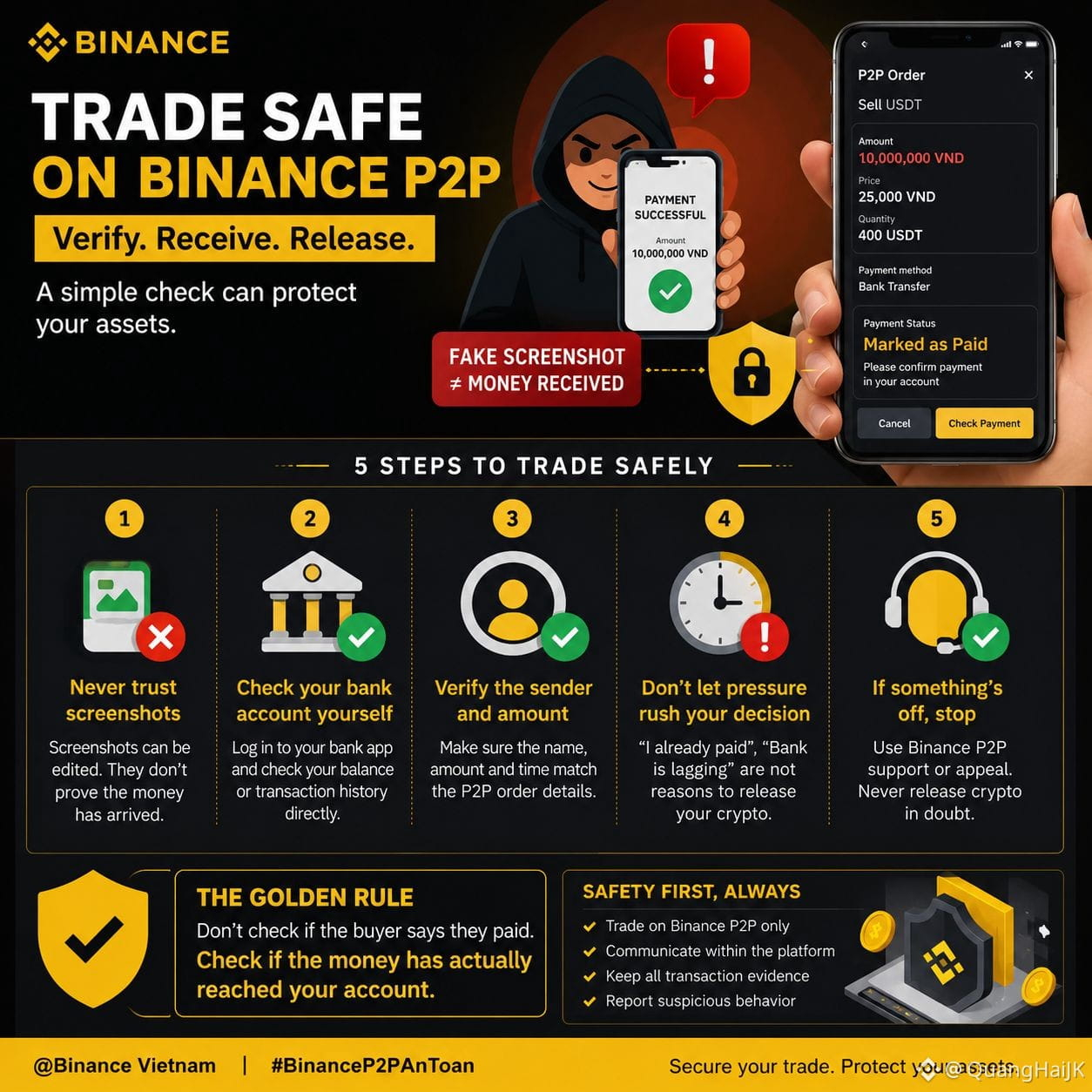
1. Never rely on a payment screenshot
A screenshot only shows what is displayed on someone’s screen. It does not prove that the money has actually been credited to your account.
2. Check your bank account yourself
Open your banking app directly and verify your transaction history or balance. Do not rely on screenshots, messages, or notifications provided by the counterparty.
3. Verify the sender and exact amount
The sender information, payment amount, and transaction timing should make sense in relation to the P2P order. Even if the amount is correct, unexpected payment details deserve attention.
4. Don’t let time pressure make the decision for you
“Please release the coins.”
“I already paid.”
“The bank is delayed.”
None of these statements replace one simple verification: Has the money actually arrived in my account?
5. If something doesn’t match, stop
If the payment has not arrived or the transaction details look unusual, do not release your crypto simply to avoid a dispute. Keep the transaction intact and use Binance P2P’s support/appeal process when necessary.
The most important principle is simple:
In P2P trading, don’t verify whether the buyer says they paid. Verify whether the money has actually reached your account.
A single skipped verification can turn a transaction that should take minutes into a problem that is much harder to resolve.#binancep2pantoan @Binance_Vietnam
$ACE $LA $ALPINE
{future}(ALPINEUSDT)
{future}(LAUSDT)
{future}(ACEUSDT)
You could lose your entire USDT position because of one seemingly harmless action: “I’ve received the payment.”
The interesting part is that P2P risk doesn’t always come from a buyer who is obviously suspicious. Sometimes, it comes from the seller moving too quickly.
Imagine this situation:
You sell USDT → the buyer sends a payment screenshot → they keep saying “I’ve already paid” → the amount looks correct → you release the crypto.
My P2P safety checklist before releasing crypto:
1. Never rely on a payment screenshot
A screenshot only shows what is displayed on someone’s screen. It does not prove that the money has actually been credited to your account.
2. Check your bank account yourself
Open your banking app directly and verify your transaction history or balance. Do not rely on screenshots, messages, or notifications provided by the counterparty.
3. Verify the sender and exact amount
The sender information, payment amount, and transaction timing should make sense in relation to the P2P order. Even if the amount is correct, unexpected payment details deserve attention.
4. Don’t let time pressure make the decision for you
“Please release the coins.”
“I already paid.”
“The bank is delayed.”
None of these statements replace one simple verification: Has the money actually arrived in my account?
5. If something doesn’t match, stop
If the payment has not arrived or the transaction details look unusual, do not release your crypto simply to avoid a dispute. Keep the transaction intact and use Binance P2P’s support/appeal process when necessary.
The most important principle is simple:
In P2P trading, don’t verify whether the buyer says they paid. Verify whether the money has actually reached your account.
A single skipped verification can turn a transaction that should take minutes into a problem that is much harder to resolve.#binancep2pantoan @Binance Vietnam
$ACE $LA $ALPINE
The interesting part is that P2P risk doesn’t always come from a buyer who is obviously suspicious. Sometimes, it comes from the seller moving too quickly.
Imagine this situation:
You sell USDT → the buyer sends a payment screenshot → they keep saying “I’ve already paid” → the amount looks correct → you release the crypto.
My P2P safety checklist before releasing crypto:
1. Never rely on a payment screenshot
A screenshot only shows what is displayed on someone’s screen. It does not prove that the money has actually been credited to your account.
2. Check your bank account yourself
Open your banking app directly and verify your transaction history or balance. Do not rely on screenshots, messages, or notifications provided by the counterparty.
3. Verify the sender and exact amount
The sender information, payment amount, and transaction timing should make sense in relation to the P2P order. Even if the amount is correct, unexpected payment details deserve attention.
4. Don’t let time pressure make the decision for you
“Please release the coins.”
“I already paid.”
“The bank is delayed.”
None of these statements replace one simple verification: Has the money actually arrived in my account?
5. If something doesn’t match, stop
If the payment has not arrived or the transaction details look unusual, do not release your crypto simply to avoid a dispute. Keep the transaction intact and use Binance P2P’s support/appeal process when necessary.
The most important principle is simple:
In P2P trading, don’t verify whether the buyer says they paid. Verify whether the money has actually reached your account.
A single skipped verification can turn a transaction that should take minutes into a problem that is much harder to resolve.#binancep2pantoan @Binance Vietnam
$ACE $LA $ALPINE
3
1.1k
#binancep2pantoan @Binance_Vietnam
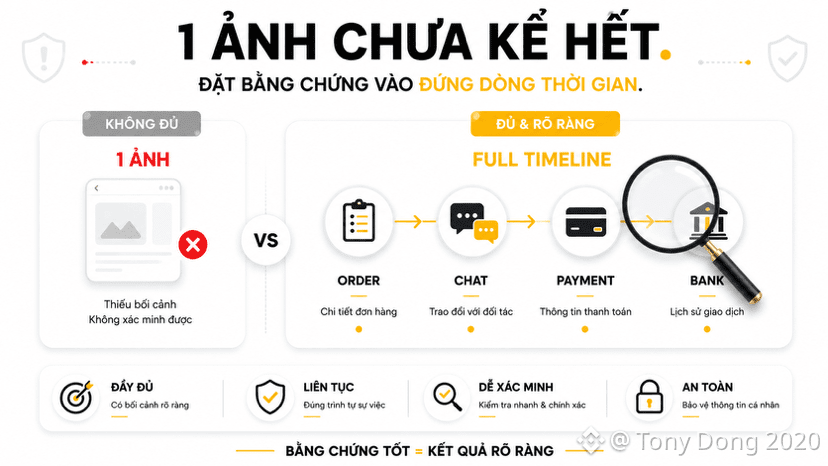
HOW TO RECORD EVIDENCE VIDEO SO SUPPORT CAN UNDERSTAND THE ISSUE EASILY???
If I have to record evidence, I won’t record it “for show.” I record it so viewers don’t have to guess.
I prioritize 3 criteria:
1. CONTINUOUS
Don’t cut too many segments so viewers don’t know what happened between steps.
2. CLEAR SOURCE
Show that you’re in the correct Order and you’re checking the correct related account.
3. HAS A COMPARISON POINT
Example:
Order: amount X
↓
Payment: amount Y
↓
Bank: received X/Y
↓
Conclusion: matches or does not match.
If an Appeal is needed, I want the handler to be able to watch the video and understand the situation without me having to explain it 10 more times.
But remember one very important thing:
Only conceal sensitive information if it’s not necessary.
Don’t reveal passwords, OTPs, full account numbers, or unrelated personal data.
Binance confirms that keeping payment records is useful when an Appeal is needed.
Record clearly. Record fully. Record safely.
Save the evidence in case it’s needed.
#binancep2pantoan @Binance Vietnam
HOW TO RECORD EVIDENCE VIDEO SO SUPPORT CAN UNDERSTAND THE ISSUE EASILY???
If I have to record evidence, I won’t record it “for show.” I record it so viewers don’t have to guess.
I prioritize 3 criteria:
1. CONTINUOUS
Don’t cut too many segments so viewers don’t know what happened between steps.
2. CLEAR SOURCE
Show that you’re in the correct Order and you’re checking the correct related account.
3. HAS A COMPARISON POINT
Example:
Order: amount X
↓
Payment: amount Y
↓
Bank: received X/Y
↓
Conclusion: matches or does not match.
If an Appeal is needed, I want the handler to be able to watch the video and understand the situation without me having to explain it 10 more times.
But remember one very important thing:
Only conceal sensitive information if it’s not necessary.
Don’t reveal passwords, OTPs, full account numbers, or unrelated personal data.
Binance confirms that keeping payment records is useful when an Appeal is needed.
Record clearly. Record fully. Record safely.
Save the evidence in case it’s needed.
HOW TO RECORD EVIDENCE VIDEO SO SUPPORT CAN UNDERSTAND THE ISSUE EASILY???
If I have to record evidence, I won’t record it “for show.” I record it so viewers don’t have to guess.
I prioritize 3 criteria:
1. CONTINUOUS
Don’t cut too many segments so viewers don’t know what happened between steps.
2. CLEAR SOURCE
Show that you’re in the correct Order and you’re checking the correct related account.
3. HAS A COMPARISON POINT
Example:
Order: amount X
↓
Payment: amount Y
↓
Bank: received X/Y
↓
Conclusion: matches or does not match.
If an Appeal is needed, I want the handler to be able to watch the video and understand the situation without me having to explain it 10 more times.
But remember one very important thing:
Only conceal sensitive information if it’s not necessary.
Don’t reveal passwords, OTPs, full account numbers, or unrelated personal data.
Binance confirms that keeping payment records is useful when an Appeal is needed.
Record clearly. Record fully. Record safely.
Save the evidence in case it’s needed.
4
3
163

#binancep2pantoan @Binance_Vietnam
An impostor posing as Binance support appeared at exactly the right time—just after I finished a P2P order
I had just tapped the button to complete the transaction when an unfamiliar account messaged me: “Hello, I’m a Binance support staff member. The transaction you just made was flagged by the system as suspicious for money laundering. You need to verify it by transferring that USDT to this secure wallet.”
They even sent the official logo, a fake employee ID, and a link that looked extremely professional. Because I’d just finished placing the order and I was mentally relaxed, I almost believed it. Luckily, I opened the correct Binance app and checked the official Support section—there was no such notice.
I blocked them immediately and filed a report. Later I learned this is a very common tactic, targeting precisely people who have just completed a big transaction, when their guard is at its lowest. Scammers don’t attack when you’re stressed—they attack when you’ve just exhaled.
Are you sure you won’t be thrown off if an impostor support account appears at the exact moment you’ve just completed a large order?
#binancep2pantoan @Binance Vietnam
An impostor posing as Binance support appeared at exactly the right time—just after I finished a P2P order
I had just tapped the button to complete the transaction when an unfamiliar account messaged me: “Hello, I’m a Binance support staff member. The transaction you just made was flagged by the system as suspicious for money laundering. You need to verify it by transferring that USDT to this secure wallet.”
They even sent the official logo, a fake employee ID, and a link that looked extremely professional. Because I’d just finished placing the order and I was mentally relaxed, I almost believed it. Luckily, I opened the correct Binance app and checked the official Support section—there was no such notice.
I blocked them immediately and filed a report. Later I learned this is a very common tactic, targeting precisely people who have just completed a big transaction, when their guard is at its lowest. Scammers don’t attack when you’re stressed—they attack when you’ve just exhaled.
Are you sure you won’t be thrown off if an impostor support account appears at the exact moment you’ve just completed a large order?
An impostor posing as Binance support appeared at exactly the right time—just after I finished a P2P order
I had just tapped the button to complete the transaction when an unfamiliar account messaged me: “Hello, I’m a Binance support staff member. The transaction you just made was flagged by the system as suspicious for money laundering. You need to verify it by transferring that USDT to this secure wallet.”
They even sent the official logo, a fake employee ID, and a link that looked extremely professional. Because I’d just finished placing the order and I was mentally relaxed, I almost believed it. Luckily, I opened the correct Binance app and checked the official Support section—there was no such notice.
I blocked them immediately and filed a report. Later I learned this is a very common tactic, targeting precisely people who have just completed a big transaction, when their guard is at its lowest. Scammers don’t attack when you’re stressed—they attack when you’ve just exhaled.
Are you sure you won’t be thrown off if an impostor support account appears at the exact moment you’ve just completed a large order?
1
69

#binancep2pantoan @Binance_Vietnam
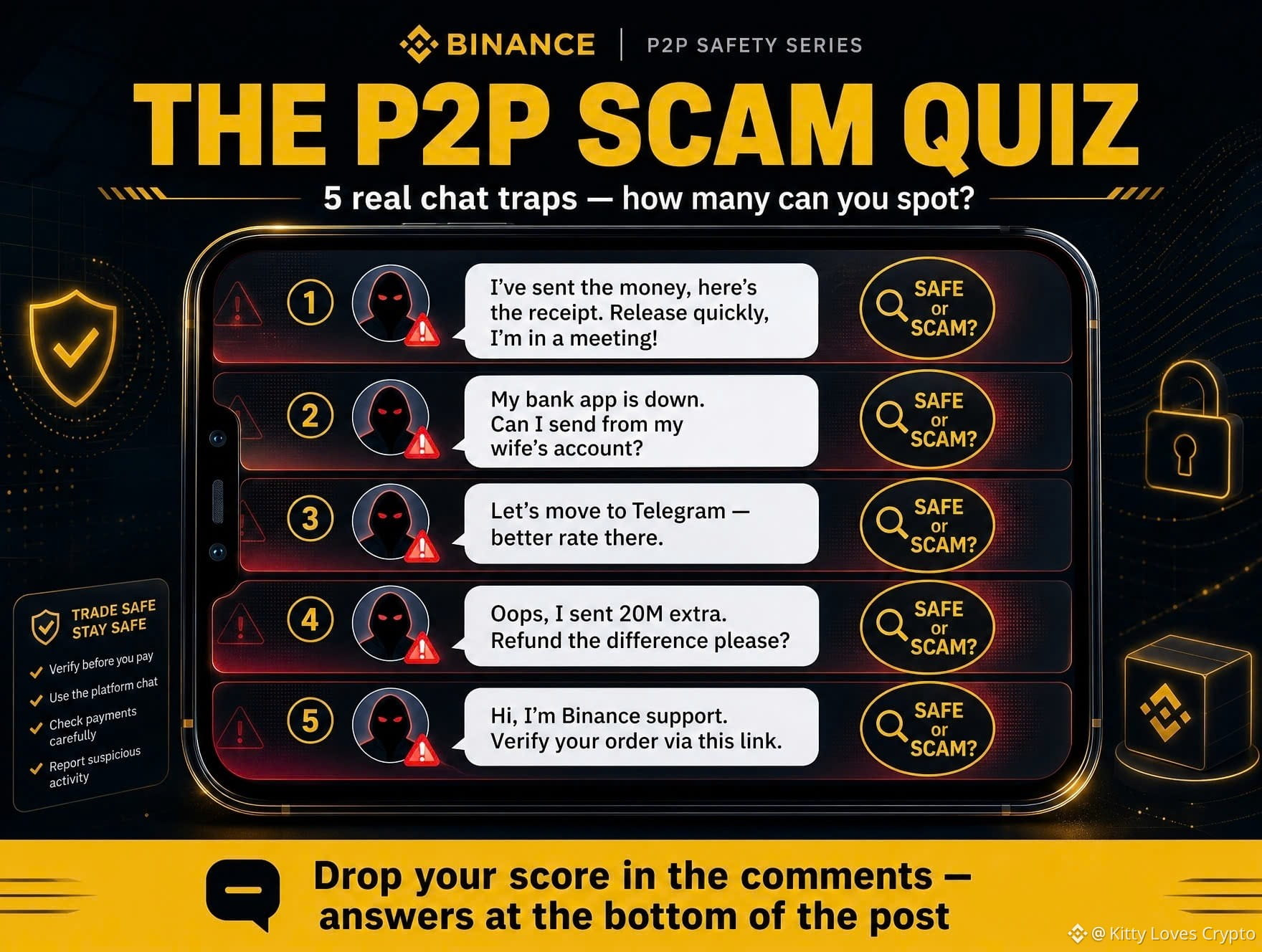
Spot the Scam: 5 Real P2P Chat Traps — How Many Would You Catch?
Twelve days of theory are over. Today we test your instincts with 5 real messages pulled straight from actual P2P scam cases (details anonymized). Read each one and decide: SAFE or SCAM? Drop your score in the comments — answers at the bottom.
💬 Trap #1: "I've sent the money, here's the receipt. Release quickly, I'm in a meeting!"
💬 Trap #2: "My bank app is down. Can I send from my wife's account instead?"
💬 Trap #3: "Let's move to Telegram — I can give you a better rate there."
💬 Trap #4: "Oops, I sent 20M extra by mistake. Please refund the difference to my other account."
💬 Trap #5: "Hi, I'm Binance support. Your order is flagged — verify via this link."
Take 30 seconds. Lock in your answers.
✅ THE ANSWERS:
#1 — SCAM. Classic fake receipt + time pressure combo. Your only source of truth is your own banking app. Real balance up? Then release. Not up? Not releasing. (Lesson from Day 4)
#2 — SCAM. Third-party payment. The name doesn't match, and the "wife's account" money could be stolen funds that later freeze YOUR bank account. Cancel and appeal. (Days 3 & 11)
#3 — SCAM. Leaving the platform kills your escrow protection AND deletes your evidence trail. 90% of P2P losses start with this exact sentence. (Day 2)
#4 — SCAM. The "accidental overpayment" trap of 2026. The original transfer is dirty money. Never refund directly — report to Binance AND your bank. (Day 10)
#5 — SCAM. Binance staff NEVER message you inside a P2P order or send links. Block and report immediately. (Day 5)
How'd you score? 5/5 — you're officially scam-proof 🛡️ 3–4 — solid, review the days you missed 0–2 — re-read this series before your next trade
Golden rule #13: Scammers don't hack platforms — they hack your urgency. Pause is your superpower.
📌 Tomorrow (20/08): Graduation Day — the 12 Golden Rules in one screenshot-worthy checklist.
👉 Comment your score below. Tag a friend who'd fall for Trap #4.
#binancep2pantoan @Binance Vietnam
Spot the Scam: 5 Real P2P Chat Traps — How Many Would You Catch?
Twelve days of theory are over. Today we test your instincts with 5 real messages pulled straight from actual P2P scam cases (details anonymized). Read each one and decide: SAFE or SCAM? Drop your score in the comments — answers at the bottom.
💬 Trap #1: "I've sent the money, here's the receipt. Release quickly, I'm in a meeting!"
💬 Trap #2: "My bank app is down. Can I send from my wife's account instead?"
💬 Trap #3: "Let's move to Telegram — I can give you a better rate there."
💬 Trap #4: "Oops, I sent 20M extra by mistake. Please refund the difference to my other account."
💬 Trap #5: "Hi, I'm Binance support. Your order is flagged — verify via this link."
Take 30 seconds. Lock in your answers.
✅ THE ANSWERS:
#1 — SCAM. Classic fake receipt + time pressure combo. Your only source of truth is your own banking app. Real balance up? Then release. Not up? Not releasing. (Lesson from Day 4)
#2 — SCAM. Third-party payment. The name doesn't match, and the "wife's account" money could be stolen funds that later freeze YOUR bank account. Cancel and appeal. (Days 3 & 11)
#3 — SCAM. Leaving the platform kills your escrow protection AND deletes your evidence trail. 90% of P2P losses start with this exact sentence. (Day 2)
#4 — SCAM. The "accidental overpayment" trap of 2026. The original transfer is dirty money. Never refund directly — report to Binance AND your bank. (Day 10)
#5 — SCAM. Binance staff NEVER message you inside a P2P order or send links. Block and report immediately. (Day 5)
How'd you score? 5/5 — you're officially scam-proof 🛡️ 3–4 — solid, review the days you missed 0–2 — re-read this series before your next trade
Golden rule #13: Scammers don't hack platforms — they hack your urgency. Pause is your superpower.
📌 Tomorrow (20/08): Graduation Day — the 12 Golden Rules in one screenshot-worthy checklist.
👉 Comment your score below. Tag a friend who'd fall for Trap #4.
Spot the Scam: 5 Real P2P Chat Traps — How Many Would You Catch?
Twelve days of theory are over. Today we test your instincts with 5 real messages pulled straight from actual P2P scam cases (details anonymized). Read each one and decide: SAFE or SCAM? Drop your score in the comments — answers at the bottom.
💬 Trap #1: "I've sent the money, here's the receipt. Release quickly, I'm in a meeting!"
💬 Trap #2: "My bank app is down. Can I send from my wife's account instead?"
💬 Trap #3: "Let's move to Telegram — I can give you a better rate there."
💬 Trap #4: "Oops, I sent 20M extra by mistake. Please refund the difference to my other account."
💬 Trap #5: "Hi, I'm Binance support. Your order is flagged — verify via this link."
Take 30 seconds. Lock in your answers.
✅ THE ANSWERS:
#1 — SCAM. Classic fake receipt + time pressure combo. Your only source of truth is your own banking app. Real balance up? Then release. Not up? Not releasing. (Lesson from Day 4)
#2 — SCAM. Third-party payment. The name doesn't match, and the "wife's account" money could be stolen funds that later freeze YOUR bank account. Cancel and appeal. (Days 3 & 11)
#3 — SCAM. Leaving the platform kills your escrow protection AND deletes your evidence trail. 90% of P2P losses start with this exact sentence. (Day 2)
#4 — SCAM. The "accidental overpayment" trap of 2026. The original transfer is dirty money. Never refund directly — report to Binance AND your bank. (Day 10)
#5 — SCAM. Binance staff NEVER message you inside a P2P order or send links. Block and report immediately. (Day 5)
How'd you score? 5/5 — you're officially scam-proof 🛡️ 3–4 — solid, review the days you missed 0–2 — re-read this series before your next trade
Golden rule #13: Scammers don't hack platforms — they hack your urgency. Pause is your superpower.
📌 Tomorrow (20/08): Graduation Day — the 12 Golden Rules in one screenshot-worthy checklist.
👉 Comment your score below. Tag a friend who'd fall for Trap #4.
109

#binancep2pantoan
Lure into the "Bank Maintenance" trap: A scheme to force cancellations and steal Fiat!
Many Vietnamese traders lose money on P2P not because they were hacked, but because they fell into a psychological manipulation trap right within the exchange’s Chat interface.
Case Study: You successfully transferred Fiat, but the Merchant intentionally refuses to release USDT. They keep messaging with excuses like "The bank is under maintenance; the money hasn’t been credited to the app yet" and pressure you to click the Cancel Order button so they can get you to transfer the money back. The moment you hit Cancel, the Escrow immediately releases the USDT to the Merchant’s wallet. On the other side, they block communication and disappear with your funds.
Checklist to avoid the Escrow removal trap:
Absolutely DO NOT CANCEL AN ORDER: Once your Fiat has left your bank account, NEVER press the Cancel Order button for any reason.
Open a Dispute immediately: After the waiting period ends, click the Dispute (Claim) button. Upload the correct Transaction History/Transfer Bill so Binance customer support can intervene and force the release of the coins.
Will you patiently open a Dispute and wait for CSKH to handle it, or believe the stranger Merchant’s promise to refund you off-platform?
Tag: @Binance_Vietnam
#binancep2pantoan
Lure into the "Bank Maintenance" trap: A scheme to force cancellations and steal Fiat!
Many Vietnamese traders lose money on P2P not because they were hacked, but because they fell into a psychological manipulation trap right within the exchange’s Chat interface.
Case Study: You successfully transferred Fiat, but the Merchant intentionally refuses to release USDT. They keep messaging with excuses like "The bank is under maintenance; the money hasn’t been credited to the app yet" and pressure you to click the Cancel Order button so they can get you to transfer the money back. The moment you hit Cancel, the Escrow immediately releases the USDT to the Merchant’s wallet. On the other side, they block communication and disappear with your funds.
Checklist to avoid the Escrow removal trap:
Absolutely DO NOT CANCEL AN ORDER: Once your Fiat has left your bank account, NEVER press the Cancel Order button for any reason.
Open a Dispute immediately: After the waiting period ends, click the Dispute (Claim) button. Upload the correct Transaction History/Transfer Bill so Binance customer support can intervene and force the release of the coins.
Will you patiently open a Dispute and wait for CSKH to handle it, or believe the stranger Merchant’s promise to refund you off-platform?
Tag: @Binance Vietnam
Lure into the "Bank Maintenance" trap: A scheme to force cancellations and steal Fiat!
Many Vietnamese traders lose money on P2P not because they were hacked, but because they fell into a psychological manipulation trap right within the exchange’s Chat interface.
Case Study: You successfully transferred Fiat, but the Merchant intentionally refuses to release USDT. They keep messaging with excuses like "The bank is under maintenance; the money hasn’t been credited to the app yet" and pressure you to click the Cancel Order button so they can get you to transfer the money back. The moment you hit Cancel, the Escrow immediately releases the USDT to the Merchant’s wallet. On the other side, they block communication and disappear with your funds.
Checklist to avoid the Escrow removal trap:
Absolutely DO NOT CANCEL AN ORDER: Once your Fiat has left your bank account, NEVER press the Cancel Order button for any reason.
Open a Dispute immediately: After the waiting period ends, click the Dispute (Claim) button. Upload the correct Transaction History/Transfer Bill so Binance customer support can intervene and force the release of the coins.
Will you patiently open a Dispute and wait for CSKH to handle it, or believe the stranger Merchant’s promise to refund you off-platform?
Tag: @Binance Vietnam
74

·
--
#binancep2pantoan @Binance_Vietnam Check the actual balance: If you are a seller, only unlock crypto (release) when you open the banking app and see that the money has arrived in your actual wallet. Don’t trust any transfer receipt images (or screenshots), as editing technology or AI today can create very sophisticated forgeries
#binancep2pantoan @Binance Vietnam Check the actual balance: If you are a seller, only unlock crypto (release) when you open the banking app and see that the money has arrived in your actual wallet. Don’t trust any transfer receipt images (or screenshots), as editing technology or AI today can create very sophisticated forgeries
74

·
--
🔐 5 KEYWORDS – 5 LAYERS OF PROTECTION WHEN TRADING ON BINANCE P2P
I used to think that P2P trading was simply: place an order → receive money → release USDT.
Until one time, I got a message saying the buyer had paid—and right after that, a receipt screenshot.
“Your money has been transferred already—please release it for me!”
I almost hit Release.
But I stopped and remembered 5 keywords that I always remind myself of before every trade:
1️⃣ PLATFORM — THE RIGHT PLATFORM
I keep the entire transaction on Binance P2P and never move it to Telegram, WhatsApp, or any other platform.
Because once you leave the platform, you can lose important protection layers and evidence in case a dispute happens.
2️⃣ VERIFY — THE RIGHT PERSON
I check the buyer’s profile: transaction history, completion rate, ratings, and especially verifying the payment account name.
Does the name not match or are there any unusual requests?
👉 Stop and verify.
3️⃣ CONFIRM — THE RIGHT AMOUNT
This is the most important rule.
I don’t trust screenshots.
I open my bank account myself and check the actual transaction.
No money received in my account = no crypto release.
A screenshot can be edited, but my account balance is what needs to be confirmed.
4️⃣ ALERT — THE RIGHT RISK
The buyer keeps催.
Sending receipt photos.
Wanting to move to another app.
Payment details have unusual points.
5️⃣ RECORD & SUPPORT — THE RIGHT EVIDENCE
I always save the order ID, chat history, payment information, and my bank transactions.
If a dispute occurs, this evidence can help make the Appeal/Support process clearer.
#binancep2pantoan @Binance_Vietnam $BTC
{future}(BTCUSDT)
🔐 5 KEYWORDS – 5 LAYERS OF PROTECTION WHEN TRADING ON BINANCE P2P
I used to think that P2P trading was simply: place an order → receive money → release USDT.
Until one time, I got a message saying the buyer had paid—and right after that, a receipt screenshot.
“Your money has been transferred already—please release it for me!”
I almost hit Release.
But I stopped and remembered 5 keywords that I always remind myself of before every trade:
1️⃣ PLATFORM — THE RIGHT PLATFORM
I keep the entire transaction on Binance P2P and never move it to Telegram, WhatsApp, or any other platform.
Because once you leave the platform, you can lose important protection layers and evidence in case a dispute happens.
2️⃣ VERIFY — THE RIGHT PERSON
I check the buyer’s profile: transaction history, completion rate, ratings, and especially verifying the payment account name.
Does the name not match or are there any unusual requests?
👉 Stop and verify.
3️⃣ CONFIRM — THE RIGHT AMOUNT
This is the most important rule.
I don’t trust screenshots.
I open my bank account myself and check the actual transaction.
No money received in my account = no crypto release.
A screenshot can be edited, but my account balance is what needs to be confirmed.
4️⃣ ALERT — THE RIGHT RISK
The buyer keeps催.
Sending receipt photos.
Wanting to move to another app.
Payment details have unusual points.
5️⃣ RECORD & SUPPORT — THE RIGHT EVIDENCE
I always save the order ID, chat history, payment information, and my bank transactions.
If a dispute occurs, this evidence can help make the Appeal/Support process clearer.
#binancep2pantoan @Binance Vietnam $BTC
I used to think that P2P trading was simply: place an order → receive money → release USDT.
Until one time, I got a message saying the buyer had paid—and right after that, a receipt screenshot.
“Your money has been transferred already—please release it for me!”
I almost hit Release.
But I stopped and remembered 5 keywords that I always remind myself of before every trade:
1️⃣ PLATFORM — THE RIGHT PLATFORM
I keep the entire transaction on Binance P2P and never move it to Telegram, WhatsApp, or any other platform.
Because once you leave the platform, you can lose important protection layers and evidence in case a dispute happens.
2️⃣ VERIFY — THE RIGHT PERSON
I check the buyer’s profile: transaction history, completion rate, ratings, and especially verifying the payment account name.
Does the name not match or are there any unusual requests?
👉 Stop and verify.
3️⃣ CONFIRM — THE RIGHT AMOUNT
This is the most important rule.
I don’t trust screenshots.
I open my bank account myself and check the actual transaction.
No money received in my account = no crypto release.
A screenshot can be edited, but my account balance is what needs to be confirmed.
4️⃣ ALERT — THE RIGHT RISK
The buyer keeps催.
Sending receipt photos.
Wanting to move to another app.
Payment details have unusual points.
5️⃣ RECORD & SUPPORT — THE RIGHT EVIDENCE
I always save the order ID, chat history, payment information, and my bank transactions.
If a dispute occurs, this evidence can help make the Appeal/Support process clearer.
#binancep2pantoan @Binance Vietnam $BTC
107

The Math Every Trader Learns The Hard Way
3 minutes checking a counterparty's profile, or 3 days stuck in an appeal chasing your own money. That's not a rhetorical question. That's the actual trade you're making every time you rush a P2P deal. I've watched newbies lose hours, sometimes their whole weekend, because they wouldn't spend the time upfront. Let me break down the arithmetic nobody teaches you.
Verifying a counterparty costs you almost nothing. Glance at their completion rate. Look at trade volume, are they a ghost account or someone with history. Check if the name on the bank transfer actually matches their verified ID. That's maybe ninety seconds of your life. Skip it, and you're gambling with counterparty risk blind.
Payment verification is the same story. Open your actual bank app. Confirm the funds landed, real balance, not a fake slip, not a doctored screenshot somebody rushed you into believing. Panic release under pressure is how people get cleaned out in under a minute. That minute of checking your real balance is the cheapest insurance you'll ever buy in this game.
Now flip the equation. Skip verification, hit release on a fake payment, and you're not looking at minutes anymore. You're filing an Appeal, dumping your chat logs and transaction screenshots into escrow's dispute system, and waiting on Binance Support to untangle what happened. That's hours bleeding into days. Documentation you didn't bother saving becomes the difference between winning that appeal and eating the loss.
Escrow exists to protect you, but it protects the prepared. The trader who screenshots everything, keeps live chat records, matches every name and bank detail before clicking confirm, that trader recovers fast when something goes sideways. The one who skipped the math pays for it in stress and lost time.
Front-load the caution. It's always cheaper than the cleanup. And when something feels off, don't gamble on being right. Pause and hit Binance Support immediately.
@Binance_Vietnam #BinanceP2PAnToan
The Math Every Trader Learns The Hard Way
3 minutes checking a counterparty's profile, or 3 days stuck in an appeal chasing your own money. That's not a rhetorical question. That's the actual trade you're making every time you rush a P2P deal. I've watched newbies lose hours, sometimes their whole weekend, because they wouldn't spend the time upfront. Let me break down the arithmetic nobody teaches you.
Verifying a counterparty costs you almost nothing. Glance at their completion rate. Look at trade volume, are they a ghost account or someone with history. Check if the name on the bank transfer actually matches their verified ID. That's maybe ninety seconds of your life. Skip it, and you're gambling with counterparty risk blind.
Payment verification is the same story. Open your actual bank app. Confirm the funds landed, real balance, not a fake slip, not a doctored screenshot somebody rushed you into believing. Panic release under pressure is how people get cleaned out in under a minute. That minute of checking your real balance is the cheapest insurance you'll ever buy in this game.
Now flip the equation. Skip verification, hit release on a fake payment, and you're not looking at minutes anymore. You're filing an Appeal, dumping your chat logs and transaction screenshots into escrow's dispute system, and waiting on Binance Support to untangle what happened. That's hours bleeding into days. Documentation you didn't bother saving becomes the difference between winning that appeal and eating the loss.
Escrow exists to protect you, but it protects the prepared. The trader who screenshots everything, keeps live chat records, matches every name and bank detail before clicking confirm, that trader recovers fast when something goes sideways. The one who skipped the math pays for it in stress and lost time.
Front-load the caution. It's always cheaper than the cleanup. And when something feels off, don't gamble on being right. Pause and hit Binance Support immediately.
@Binance Vietnam #BinanceP2PAnToan
3 minutes checking a counterparty's profile, or 3 days stuck in an appeal chasing your own money. That's not a rhetorical question. That's the actual trade you're making every time you rush a P2P deal. I've watched newbies lose hours, sometimes their whole weekend, because they wouldn't spend the time upfront. Let me break down the arithmetic nobody teaches you.
Verifying a counterparty costs you almost nothing. Glance at their completion rate. Look at trade volume, are they a ghost account or someone with history. Check if the name on the bank transfer actually matches their verified ID. That's maybe ninety seconds of your life. Skip it, and you're gambling with counterparty risk blind.
Payment verification is the same story. Open your actual bank app. Confirm the funds landed, real balance, not a fake slip, not a doctored screenshot somebody rushed you into believing. Panic release under pressure is how people get cleaned out in under a minute. That minute of checking your real balance is the cheapest insurance you'll ever buy in this game.
Now flip the equation. Skip verification, hit release on a fake payment, and you're not looking at minutes anymore. You're filing an Appeal, dumping your chat logs and transaction screenshots into escrow's dispute system, and waiting on Binance Support to untangle what happened. That's hours bleeding into days. Documentation you didn't bother saving becomes the difference between winning that appeal and eating the loss.
Escrow exists to protect you, but it protects the prepared. The trader who screenshots everything, keeps live chat records, matches every name and bank detail before clicking confirm, that trader recovers fast when something goes sideways. The one who skipped the math pays for it in stress and lost time.
Front-load the caution. It's always cheaper than the cleanup. And when something feels off, don't gamble on being right. Pause and hit Binance Support immediately.
@Binance Vietnam #BinanceP2PAnToan
75

#binancep2pantoan @Binance_Vietnam
🚨 WARNING: DON’T LOSE MONEY IN ONE MINUTE OF CARELESSNESS ON P2P! 🚨
The arbitrage spread may look small and the price may seem cheaper for a moment, but the result can be “gone in the blink of an eye”—your bank account could be wiped out or you could lose your coins completely. This story isn’t unique to anyone!
P2P transactions safely with @Binance Vietnam—brothers, remember these 3 unbreakable rules:
1. If you haven’t seen the account balance update = ABSOLUTELY DO NOT tap to release coins. Ignore all kinds of transfer bills with screenshots or SMS notifications, because they’re extremely easy to fake.
2. Wrong bank account holder name = CANCEL THE ORDER IMMEDIATELY. Only trade with the verified account whose name matches 100% with the name on your Binance account.
3. All exchanges must stay in the P2P Chat section: don’t move to Zalo/Telegram to “get help,” so you have proof in case a dispute arises.
Have any of you encountered scam tactics that are really sophisticated on P2P? Share them below so we can prevent them together! 👇
#binancep2pantoan @Binance Vietnam
🚨 WARNING: DON’T LOSE MONEY IN ONE MINUTE OF CARELESSNESS ON P2P! 🚨
The arbitrage spread may look small and the price may seem cheaper for a moment, but the result can be “gone in the blink of an eye”—your bank account could be wiped out or you could lose your coins completely. This story isn’t unique to anyone!
P2P transactions safely with @Binance Vietnam—brothers, remember these 3 unbreakable rules:
1. If you haven’t seen the account balance update = ABSOLUTELY DO NOT tap to release coins. Ignore all kinds of transfer bills with screenshots or SMS notifications, because they’re extremely easy to fake.
2. Wrong bank account holder name = CANCEL THE ORDER IMMEDIATELY. Only trade with the verified account whose name matches 100% with the name on your Binance account.
3. All exchanges must stay in the P2P Chat section: don’t move to Zalo/Telegram to “get help,” so you have proof in case a dispute arises.
Have any of you encountered scam tactics that are really sophisticated on P2P? Share them below so we can prevent them together! 👇
🚨 WARNING: DON’T LOSE MONEY IN ONE MINUTE OF CARELESSNESS ON P2P! 🚨
The arbitrage spread may look small and the price may seem cheaper for a moment, but the result can be “gone in the blink of an eye”—your bank account could be wiped out or you could lose your coins completely. This story isn’t unique to anyone!
P2P transactions safely with @Binance Vietnam—brothers, remember these 3 unbreakable rules:
1. If you haven’t seen the account balance update = ABSOLUTELY DO NOT tap to release coins. Ignore all kinds of transfer bills with screenshots or SMS notifications, because they’re extremely easy to fake.
2. Wrong bank account holder name = CANCEL THE ORDER IMMEDIATELY. Only trade with the verified account whose name matches 100% with the name on your Binance account.
3. All exchanges must stay in the P2P Chat section: don’t move to Zalo/Telegram to “get help,” so you have proof in case a dispute arises.
Have any of you encountered scam tactics that are really sophisticated on P2P? Share them below so we can prevent them together! 👇
70
#binancep2pantoan @Binance_Vietnam How to prevent:Unchanging rules: Only trade official/owner accounts.Before clicking transfer money or releasing coins, cross-check the name on the bank account and the verified name (KYC) shown on Binance.If you find that these two names are different (regardless of the counterparty's reason, such as "transferring on behalf", "using the spouse’s bank account number"...), click Appeal immediately to request cancellation of the order.
#binancep2pantoan @Binance Vietnam How to prevent:Unchanging rules: Only trade official/owner accounts.Before clicking transfer money or releasing coins, cross-check the name on the bank account and the verified name (KYC) shown on Binance.If you find that these two names are different (regardless of the counterparty's reason, such as "transferring on behalf", "using the spouse’s bank account number"...), click Appeal immediately to request cancellation of the order.
68
·
--
Brothers, when playing P2P, remember one simple thing:
If the other party keeps asking to cancel the order, then switches to a private transaction outside Binance, don’t follow them.
They may say:
“Trade outside for faster.”
“It’s easier to chat on Zalo.”
“You don’t need to go through the exchange.”
👉 Just refuse and keep the transaction on Binance.
If you notice any unusual signs, click Dispute/Report, and send the chat screenshots and related evidence so Binance can review.
Don’t put yourself at risk just to trade faster.
@Binance_Vietnam
#binancep2pantoan
Brothers, when playing P2P, remember one simple thing:
If the other party keeps asking to cancel the order, then switches to a private transaction outside Binance, don’t follow them.
They may say:
“Trade outside for faster.”
“It’s easier to chat on Zalo.”
“You don’t need to go through the exchange.”
👉 Just refuse and keep the transaction on Binance.
If you notice any unusual signs, click Dispute/Report, and send the chat screenshots and related evidence so Binance can review.
Don’t put yourself at risk just to trade faster.
@Binance Vietnam
#binancep2pantoan
If the other party keeps asking to cancel the order, then switches to a private transaction outside Binance, don’t follow them.
They may say:
“Trade outside for faster.”
“It’s easier to chat on Zalo.”
“You don’t need to go through the exchange.”
👉 Just refuse and keep the transaction on Binance.
If you notice any unusual signs, click Dispute/Report, and send the chat screenshots and related evidence so Binance can review.
Don’t put yourself at risk just to trade faster.
@Binance Vietnam
#binancep2pantoan
70
·
--
🚀 Secrets to Optimize P2P Transaction Speed: Fast, Smooth & Safe
Do you want your crypto buy/sell orders on Binance P2P to be completed within just a few minutes while still ensuring absolute safety? Apply the optimization tips below right away:
1. Prepare your payment method in advance:
Link your official, in-your-name bank accounts that support fast transfer features 24/7 (NAPAS). This helps money transfer instantly, without getting stuck due to network congestion or delays on weekends/peak hours.
2. Choose the right time and trading window:
Prioritize trading during office hours or when the banking system is operating most stably. Avoid your bank’s regular maintenance windows (often late at night) so your funds won’t get stuck midway.
3. Maintain your connection and respond quickly via chat:
Once the order is matched, focus on completing the transaction within the allowed time (usually 15 minutes). Responding to messages promptly with your trading partner will help both sides proceed smoothly and avoid wasting each other’s time.
4. Complete advanced identity verification (Plus KYC):
Make sure your Binance account has finished the advanced identity verification steps to unlock full trading limits and gain higher trust from the community.
Smart trading is not only about safety—it’s also about knowing how to save yourself the most time!
#binancep2pantoan @Binance_Vietnam
🚀 Secrets to Optimize P2P Transaction Speed: Fast, Smooth & Safe
Do you want your crypto buy/sell orders on Binance P2P to be completed within just a few minutes while still ensuring absolute safety? Apply the optimization tips below right away:
1. Prepare your payment method in advance:
Link your official, in-your-name bank accounts that support fast transfer features 24/7 (NAPAS). This helps money transfer instantly, without getting stuck due to network congestion or delays on weekends/peak hours.
2. Choose the right time and trading window:
Prioritize trading during office hours or when the banking system is operating most stably. Avoid your bank’s regular maintenance windows (often late at night) so your funds won’t get stuck midway.
3. Maintain your connection and respond quickly via chat:
Once the order is matched, focus on completing the transaction within the allowed time (usually 15 minutes). Responding to messages promptly with your trading partner will help both sides proceed smoothly and avoid wasting each other’s time.
4. Complete advanced identity verification (Plus KYC):
Make sure your Binance account has finished the advanced identity verification steps to unlock full trading limits and gain higher trust from the community.
Smart trading is not only about safety—it’s also about knowing how to save yourself the most time!
#binancep2pantoan @Binance Vietnam
Do you want your crypto buy/sell orders on Binance P2P to be completed within just a few minutes while still ensuring absolute safety? Apply the optimization tips below right away:
1. Prepare your payment method in advance:
Link your official, in-your-name bank accounts that support fast transfer features 24/7 (NAPAS). This helps money transfer instantly, without getting stuck due to network congestion or delays on weekends/peak hours.
2. Choose the right time and trading window:
Prioritize trading during office hours or when the banking system is operating most stably. Avoid your bank’s regular maintenance windows (often late at night) so your funds won’t get stuck midway.
3. Maintain your connection and respond quickly via chat:
Once the order is matched, focus on completing the transaction within the allowed time (usually 15 minutes). Responding to messages promptly with your trading partner will help both sides proceed smoothly and avoid wasting each other’s time.
4. Complete advanced identity verification (Plus KYC):
Make sure your Binance account has finished the advanced identity verification steps to unlock full trading limits and gain higher trust from the community.
Smart trading is not only about safety—it’s also about knowing how to save yourself the most time!
#binancep2pantoan @Binance Vietnam
2

·
--
#binancep2pantoan @Binance_Vietnam
💡 How Binance P2P worksThe platform operates based on a secured margin (escrow) mechanism:Place an order: You choose a suitable buy or sell advertisement on the Binance P2P Marketplace.Lock the coins: Binance’s system automatically locks the seller’s crypto amount.Payment: The buyer transfers money via a bank account or e-wallet to the seller.Release coins: After the seller confirms that they have received the full payment, the system unlocks and sends the coins to the buyer’s wallet.🛡️ Common risks and how to avoid them (Latest update)Even with a margin protection system, scams are becoming more and more sophisticated. You should be aware of the following tricks:AI-generated fake receipts: Bad actors send images or screenshots of a supposed transfer. Solution: Only click the confirm button when your bank account balance has truly increased.Chargeback scams: The buyer makes a real payment, receives the coins, then reports to the bank that they were scammed to reclaim the money. Solution: Only trade with merchants who have very high credibility.Off-app transactions: Scammers entice you with “transfer separately to be faster.” Solution: Absolutely only chat and operate within the Binance app.
#binancep2pantoan @Binance Vietnam
💡 How Binance P2P worksThe platform operates based on a secured margin (escrow) mechanism:Place an order: You choose a suitable buy or sell advertisement on the Binance P2P Marketplace.Lock the coins: Binance’s system automatically locks the seller’s crypto amount.Payment: The buyer transfers money via a bank account or e-wallet to the seller.Release coins: After the seller confirms that they have received the full payment, the system unlocks and sends the coins to the buyer’s wallet.🛡️ Common risks and how to avoid them (Latest update)Even with a margin protection system, scams are becoming more and more sophisticated. You should be aware of the following tricks:AI-generated fake receipts: Bad actors send images or screenshots of a supposed transfer. Solution: Only click the confirm button when your bank account balance has truly increased.Chargeback scams: The buyer makes a real payment, receives the coins, then reports to the bank that they were scammed to reclaim the money. Solution: Only trade with merchants who have very high credibility.Off-app transactions: Scammers entice you with “transfer separately to be faster.” Solution: Absolutely only chat and operate within the Binance app.
💡 How Binance P2P worksThe platform operates based on a secured margin (escrow) mechanism:Place an order: You choose a suitable buy or sell advertisement on the Binance P2P Marketplace.Lock the coins: Binance’s system automatically locks the seller’s crypto amount.Payment: The buyer transfers money via a bank account or e-wallet to the seller.Release coins: After the seller confirms that they have received the full payment, the system unlocks and sends the coins to the buyer’s wallet.🛡️ Common risks and how to avoid them (Latest update)Even with a margin protection system, scams are becoming more and more sophisticated. You should be aware of the following tricks:AI-generated fake receipts: Bad actors send images or screenshots of a supposed transfer. Solution: Only click the confirm button when your bank account balance has truly increased.Chargeback scams: The buyer makes a real payment, receives the coins, then reports to the bank that they were scammed to reclaim the money. Solution: Only trade with merchants who have very high credibility.Off-app transactions: Scammers entice you with “transfer separately to be faster.” Solution: Absolutely only chat and operate within the Binance app.
77

#binancep2pantoan @Binance_Vietnam P2P If the price deal is so sweet that you shouldn’t get “smitten” like you’ve just met your crush 😂 Check the trader carefully, the amount, and the receiving account; the money must truly land in the account before you confirm. If someone invites you to “go outside Binance to make it faster,” be quick… avoid it! 😎 The best part of P2P is when you finish the transaction with your money and trust still intact—and you don’t have to call a detective 🔎😂
#binancep2pantoan @Binance Vietnam P2P If the price deal is so sweet that you shouldn’t get “smitten” like you’ve just met your crush 😂 Check the trader carefully, the amount, and the receiving account; the money must truly land in the account before you confirm. If someone invites you to “go outside Binance to make it faster,” be quick… avoid it! 😎 The best part of P2P is when you finish the transaction with your money and trust still intact—and you don’t have to call a detective 🔎😂
66

BINANCE P2P TRADING SAFETY GUIDE FOR EVERY TRADER
P2P trading is extremely fast and convenient, but to protect your account absolutely, always remember these 3 golden rules:
1️⃣ Trade only from your own account: The bank account name MUST match 100% with the KYC-verified name on Binance. Absolutely do not transfer to or receive money from any third party!
2️⃣ Check your actual balance: Log directly into your Bank App to see whether the money has arrived in your account before clicking "Release USDT". Absolutely DO NOT rely on screenshots or SMS notifications that money has been received.
3️⃣ Use the correct transfer details: Only enter the correct Order ID. Avoid writing sensitive terms like "Crypto", "USDT", "BTC" or "Binance".
Be proactive in improving your security knowledge so you can trade with peace of mind. Let’s learn more useful lessons from @Binance Vietnam!
#BinanceP2PAnToan
@Binance_Vietnam
BINANCE P2P TRADING SAFETY GUIDE FOR EVERY TRADER
P2P trading is extremely fast and convenient, but to protect your account absolutely, always remember these 3 golden rules:
1️⃣ Trade only from your own account: The bank account name MUST match 100% with the KYC-verified name on Binance. Absolutely do not transfer to or receive money from any third party!
2️⃣ Check your actual balance: Log directly into your Bank App to see whether the money has arrived in your account before clicking "Release USDT". Absolutely DO NOT rely on screenshots or SMS notifications that money has been received.
3️⃣ Use the correct transfer details: Only enter the correct Order ID. Avoid writing sensitive terms like "Crypto", "USDT", "BTC" or "Binance".
Be proactive in improving your security knowledge so you can trade with peace of mind. Let’s learn more useful lessons from @Binance Vietnam!
#BinanceP2PAnToan
@Binance Vietnam
P2P trading is extremely fast and convenient, but to protect your account absolutely, always remember these 3 golden rules:
1️⃣ Trade only from your own account: The bank account name MUST match 100% with the KYC-verified name on Binance. Absolutely do not transfer to or receive money from any third party!
2️⃣ Check your actual balance: Log directly into your Bank App to see whether the money has arrived in your account before clicking "Release USDT". Absolutely DO NOT rely on screenshots or SMS notifications that money has been received.
3️⃣ Use the correct transfer details: Only enter the correct Order ID. Avoid writing sensitive terms like "Crypto", "USDT", "BTC" or "Binance".
Be proactive in improving your security knowledge so you can trade with peace of mind. Let’s learn more useful lessons from @Binance Vietnam!
#BinanceP2PAnToan
@Binance Vietnam
1
74
·
--
#binancep2pantoan @Binance_Vietnam
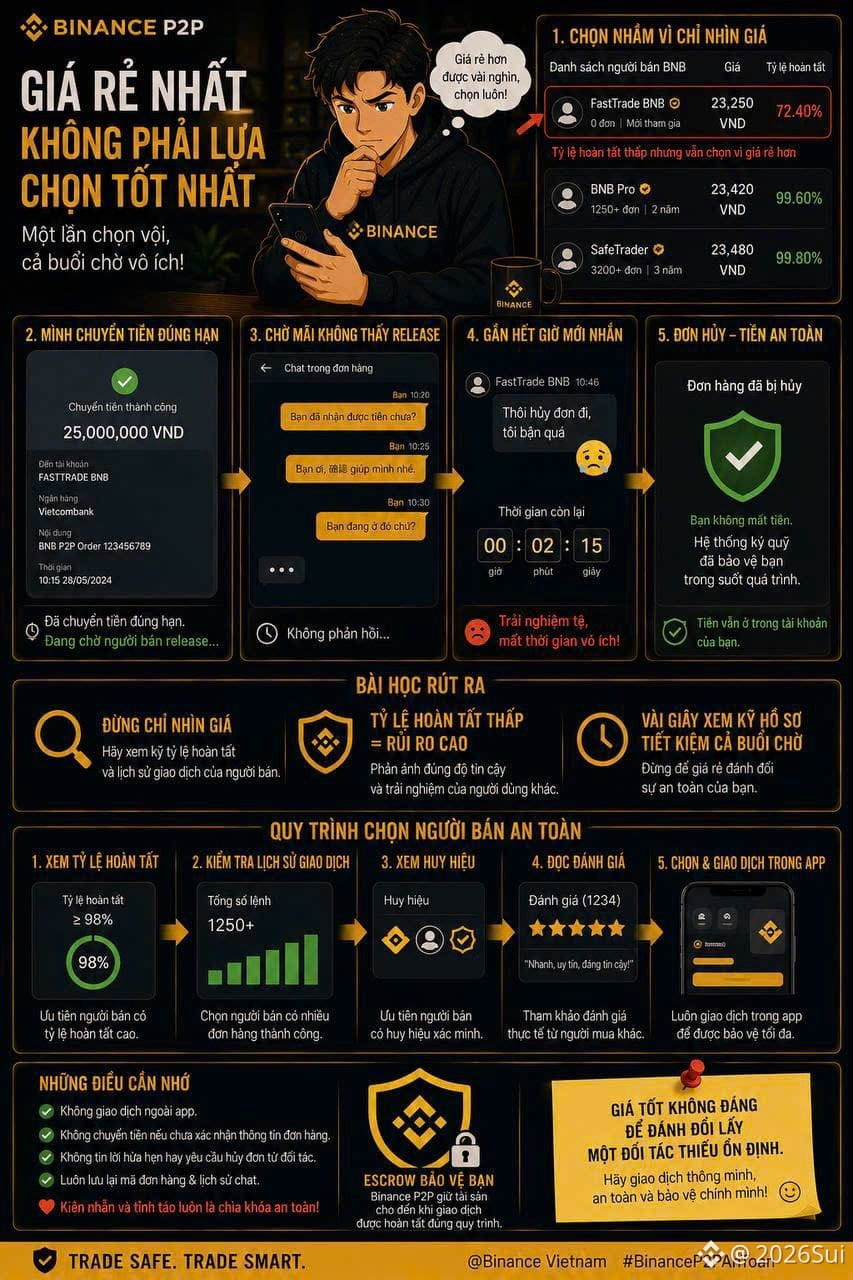
There was a time when I chose the wrong seller just because I saw a lower price and forgot to check the order completion rate.
That day, I urgently needed to buy a certain amount of BNB. I found a seller with a lower price than a few others, so I picked them right away. I only glanced at the badge and didn’t notice that their completion rate was quite low compared to the general average. After placing the order, I transferred the payment on time, but then I waited and waited and still didn’t see the release. I also messaged them, but they didn’t respond. With the allowed time almost up, this person finally messaged: "Cancel the order, I’m too busy"—with no further explanation.
That’s when I realized the low completion rate wasn’t meaningless numbers—it reflected exactly what I just went through. Luckily, I kept the transaction within the platform and never transferred money through any other channel. So when the order was canceled, my money never left my account, because nothing had been confirmed as incorrect—the margin system protected me throughout the entire waiting period.
I saved the whole chat history and the order ID out of habit, even though this time I didn’t end up needing them. After learning my lesson, the next time, I always check both the completion rate and the badge before choosing a partner—not just the price.
The lesson I took away: a good price isn’t worth trading away for an unstable partner. A few seconds spent reviewing the profile more carefully helped me avoid an entire pointless wait.
#binancep2pantoan @Binance Vietnam
There was a time when I chose the wrong seller just because I saw a lower price and forgot to check the order completion rate.
That day, I urgently needed to buy a certain amount of BNB. I found a seller with a lower price than a few others, so I picked them right away. I only glanced at the badge and didn’t notice that their completion rate was quite low compared to the general average. After placing the order, I transferred the payment on time, but then I waited and waited and still didn’t see the release. I also messaged them, but they didn’t respond. With the allowed time almost up, this person finally messaged: "Cancel the order, I’m too busy"—with no further explanation.
That’s when I realized the low completion rate wasn’t meaningless numbers—it reflected exactly what I just went through. Luckily, I kept the transaction within the platform and never transferred money through any other channel. So when the order was canceled, my money never left my account, because nothing had been confirmed as incorrect—the margin system protected me throughout the entire waiting period.
I saved the whole chat history and the order ID out of habit, even though this time I didn’t end up needing them. After learning my lesson, the next time, I always check both the completion rate and the badge before choosing a partner—not just the price.
The lesson I took away: a good price isn’t worth trading away for an unstable partner. A few seconds spent reviewing the profile more carefully helped me avoid an entire pointless wait.
There was a time when I chose the wrong seller just because I saw a lower price and forgot to check the order completion rate.
That day, I urgently needed to buy a certain amount of BNB. I found a seller with a lower price than a few others, so I picked them right away. I only glanced at the badge and didn’t notice that their completion rate was quite low compared to the general average. After placing the order, I transferred the payment on time, but then I waited and waited and still didn’t see the release. I also messaged them, but they didn’t respond. With the allowed time almost up, this person finally messaged: "Cancel the order, I’m too busy"—with no further explanation.
That’s when I realized the low completion rate wasn’t meaningless numbers—it reflected exactly what I just went through. Luckily, I kept the transaction within the platform and never transferred money through any other channel. So when the order was canceled, my money never left my account, because nothing had been confirmed as incorrect—the margin system protected me throughout the entire waiting period.
I saved the whole chat history and the order ID out of habit, even though this time I didn’t end up needing them. After learning my lesson, the next time, I always check both the completion rate and the badge before choosing a partner—not just the price.
The lesson I took away: a good price isn’t worth trading away for an unstable partner. A few seconds spent reviewing the profile more carefully helped me avoid an entire pointless wait.
123
Log in to explore more content
Join global crypto users on Binance Square
⚡️ Get latest and useful information about crypto.
💬 Trusted by the world’s largest crypto exchange.
👍 Discover real insights from verified creators.
Email / Phone number
Trending Topics
1
#AIStocksWhatNext
233,044 views
2,414 Discussing
2
#BitcoinBreaksAboveMayHighNears$86K
8,170 views
138 Discussing
3
#DogecoinRises15%
20,652 views
730 Discussing
4
#$14BBitcoinOptionsExpireFriday
1,398 views
64 Discussing
5
#BNBMarketCapPassesBNYMellon
14,188 views
553 Discussing
6
#CryptoMarketCapReclaims$3Trillion
1,904 views
55 Discussing
7
#MuseOvertakesChatGPTAsTopFreeIOSApp
9,882 views
434 Discussing
8
#TokenizedStockPlatformsCouldLaunchNextQuarter
15,354 views
499 Discussing
9
#StrategyAdds950Bitcoin
20,486 views
557 Discussing
10
#CardanoAddedToX402KitForADAPayments
21,660 views
604 Discussing