
#verify1to1binancereserves
verify1to1binancereserves
Hot
Latest


·
--
Article
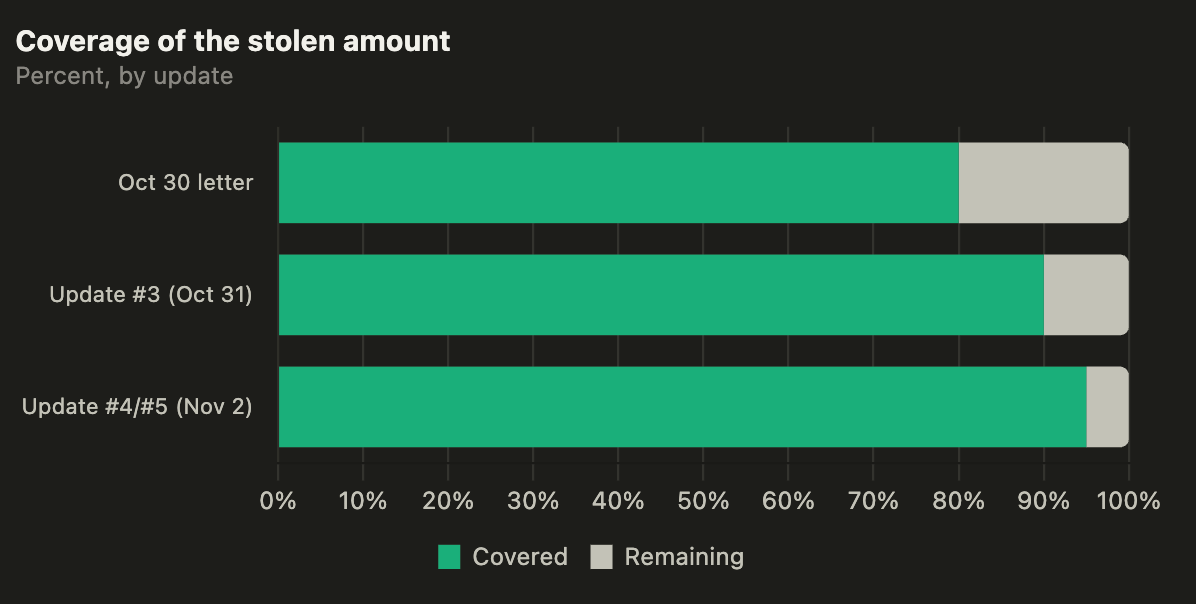
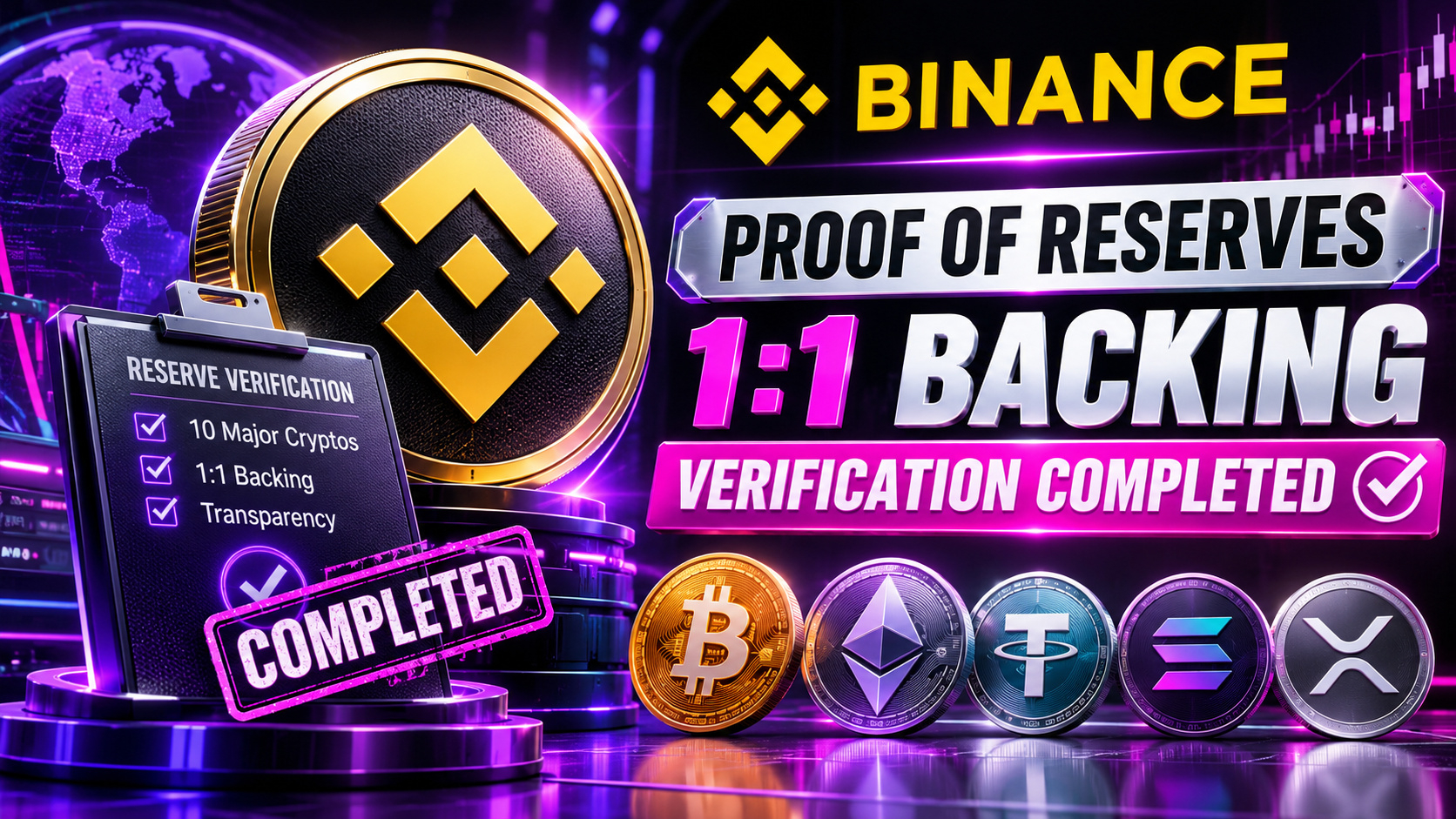
Binance Users Can Now Verify 1:1 Backing of BTC, ETH, USDT and Seven Other Tokens as Zero-Knowledge Proof Is Completed; 95% of Loss CoveredBinance users can now independently verify that their balances in ten major tokens are backed at least 1:1, after the exchange completed the full zero-knowledge proof for its latest Proof of Reserves snapshot. In its fifth recovery update on Monday, November 2, Binance said the proof for the snapshot taken at 00:00 UTC on October 31 was finished within its estimated timeframe.“With the generated proof, the backed portion of that commitment is now publicly verifiable,” the exchange said.Ten Tokens Now VerifiableThe proof covers the ten tokens Binance has fully backed since its security incident: BTC, ETH, USDT, BNB, SOL, USDC, XRP, USD1, RLUSD and ZEC. Users holding any of them can confirm their balances are backed at least 1:1 using the verification tool on Binance’s Proof of Reserves website.How to VerifyTo run the check, users log in to their Binance account through the official website and download the verifier tool from the Proof of Reserves page to their own computer. Running it on their own device means users carry out the check themselves rather than relying on Binance’s word. The verifier is open source, published on GitHub and has been independently audited.Binance’s Proof of Reserves combines two cryptographic tools. A Merkle tree lets each user confirm that their own account assets are included in the snapshot. A zk-SNARK, a type of zero-knowledge proof, shows that reserves cover user balances at least 1:1 without revealing any individual’s balance.95% of the Loss Now CoveredBinance said it has covered about 95% of the stolen amount, up from 90% on October 31. The remaining 5% is made up of less liquid tokens outside the top ten, which take longer to buy at the required scale, and Binance is working with industry partners to complete those purchases.More Tokens and Withdrawals This WeekBinance plans to take another snapshot covering more tokens on Wednesday, November 4, followed by a new full zero-knowledge proof that will take about 40 to 50 hours to generate. The next phase of withdrawals for additional networks and assets is planned for Tuesday, November 3, as a progressive rollout. “Binance will absorb the financial impact of the stolen funds, not our users,” the exchange said.Binance reminded users to access only its official website for verification, never share login details, and avoid untrusted devices.
Binance Users Can Now Verify 1:1 Backing of BTC, ETH, USDT and Seven Other Tokens as Zero-Knowledge Proof Is Completed; 95% of Loss Covered
Binance users can now independently verify that their balances in ten major tokens are backed at least 1:1, after the exchange completed the full zero-knowledge proof for its latest Proof of Reserves snapshot. In its fifth recovery update on Monday, November 2, Binance said the proof for the snapshot taken at 00:00 UTC on October 31 was finished within its estimated timeframe.“With the generated proof, the backed portion of that commitment is now publicly verifiable,” the exchange said.Ten Tokens Now VerifiableThe proof covers the ten tokens Binance has fully backed since its security incident: BTC, ETH, USDT, BNB, SOL, USDC, XRP, USD1, RLUSD and ZEC. Users holding any of them can confirm their balances are backed at least 1:1 using the verification tool on Binance’s Proof of Reserves website.How to VerifyTo run the check, users log in to their Binance account through the official website and download the verifier tool from the Proof of Reserves page to their own computer. Running it on their own device means users carry out the check themselves rather than relying on Binance’s word. The verifier is open source, published on GitHub and has been independently audited.Binance’s Proof of Reserves combines two cryptographic tools. A Merkle tree lets each user confirm that their own account assets are included in the snapshot. A zk-SNARK, a type of zero-knowledge proof, shows that reserves cover user balances at least 1:1 without revealing any individual’s balance.95% of the Loss Now CoveredBinance said it has covered about 95% of the stolen amount, up from 90% on October 31. The remaining 5% is made up of less liquid tokens outside the top ten, which take longer to buy at the required scale, and Binance is working with industry partners to complete those purchases.More Tokens and Withdrawals This WeekBinance plans to take another snapshot covering more tokens on Wednesday, November 4, followed by a new full zero-knowledge proof that will take about 40 to 50 hours to generate. The next phase of withdrawals for additional networks and assets is planned for Tuesday, November 3, as a progressive rollout. “Binance will absorb the financial impact of the stolen funds, not our users,” the exchange said.Binance reminded users to access only its official website for verification, never share login details, and avoid untrusted devices.
Ardelia Corns Ht7W:
what is next ?
14
6
49
22.8k
📊 Proof of Reserves Matters
Crypto users should understand how exchanges demonstrate their financial backing. Merkle Tree verification can help users independently check whether their balances are included in a published reserve snapshot.
$BTC $ETH $SOL
#verify1to1binancereserves
📊 Proof of Reserves Matters
Crypto users should understand how exchanges demonstrate their financial backing. Merkle Tree verification can help users independently check whether their balances are included in a published reserve snapshot.
$BTC $ETH $SOL
#verify1to1binancereserves
Crypto users should understand how exchanges demonstrate their financial backing. Merkle Tree verification can help users independently check whether their balances are included in a published reserve snapshot.
$BTC $ETH $SOL
#verify1to1binancereserves
92

·
--
Bearish
Verified
#verify1to1binancereserves
🚨 BINANCE PROOF OF RESERVES: 1:1 BACKING VERIFICATION COMPLETED
🔎 What Happened?
Binance has completed its latest Proof of Reserves verification for 10 major cryptocurrencies, allowing users to check whether their account balances are backed by sufficient assets.
The update follows Binance's recent security incident and its efforts to replenish affected assets.
📊 Why It Matters
Proof of Reserves helps users verify exchange transparency instead of relying only on official statements.
However, reserve verification does not guarantee that an exchange is completely risk-free or that every operational issue has been resolved.
📈 Market Perspective
This development could help improve confidence in Binance, especially among users concerned about exchange security and fund availability.
For the broader crypto market, the impact is more about trust and transparency than an immediate bullish or bearish signal.
Traders should also monitor withdrawal reliability, recovery progress, and future reserve updates before drawing stronger conclusions.
💡 My Take
Proof of Reserves is an important step toward accountability, but consistent execution matters more than a single snapshot.
The real question is whether Binance can maintain transparency and reliable services over time.
Trust is not rebuilt through one announcement. It is rebuilt through consistent results.
#Binance #ProofOfReserves #CryptoNews
$BNB $ETH $BTC
{future}(BTCUSDT)
{future}(ETHUSDT)
{future}(BNBUSDT)
#verify1to1binancereserves
🚨 BINANCE PROOF OF RESERVES: 1:1 BACKING VERIFICATION COMPLETED
🔎 What Happened?
Binance has completed its latest Proof of Reserves verification for 10 major cryptocurrencies, allowing users to check whether their account balances are backed by sufficient assets.
The update follows Binance's recent security incident and its efforts to replenish affected assets.
📊 Why It Matters
Proof of Reserves helps users verify exchange transparency instead of relying only on official statements.
However, reserve verification does not guarantee that an exchange is completely risk-free or that every operational issue has been resolved.
📈 Market Perspective
This development could help improve confidence in Binance, especially among users concerned about exchange security and fund availability.
For the broader crypto market, the impact is more about trust and transparency than an immediate bullish or bearish signal.
Traders should also monitor withdrawal reliability, recovery progress, and future reserve updates before drawing stronger conclusions.
💡 My Take
Proof of Reserves is an important step toward accountability, but consistent execution matters more than a single snapshot.
The real question is whether Binance can maintain transparency and reliable services over time.
Trust is not rebuilt through one announcement. It is rebuilt through consistent results.
#Binance #ProofOfReserves #CryptoNews
$BNB $ETH $BTC
Jonathanr3:
724843154 ID
1
5
3.6k
·
--
Article
🚀 Binance Faces a Critical Moment as Recovery Progress Continues!Today's Binance update brings a major development for the crypto community. Following the recent $6.3 billion security incident, Binance says it has covered approximately 95% of the affected assets and generated a new Zero-Knowledge Proof, allowing users to independently verify 1:1 backing for ten major cryptocurrencies.
Withdrawals are gradually returning, while the exchange continues working to restore confidence and strengthen security.
This situation highlights one important lesson for the entire crypto industry: Trust is built through transparency, security, and action — not just promises. 🔐
#Verify1to1BinanceReserves #ETH #BTC #BNB
🚀 Binance Faces a Critical Moment as Recovery Progress Continues!
Today's Binance update brings a major development for the crypto community. Following the recent $6.3 billion security incident, Binance says it has covered approximately 95% of the affected assets and generated a new Zero-Knowledge Proof, allowing users to independently verify 1:1 backing for ten major cryptocurrencies.
Withdrawals are gradually returning, while the exchange continues working to restore confidence and strengthen security.
This situation highlights one important lesson for the entire crypto industry: Trust is built through transparency, security, and action — not just promises. 🔐
#Verify1to1BinanceReserves #ETH #BTC #BNB
9
1k
🛡️ Your Assets, Verifiable Reserves
A 1:1 reserve ratio means an exchange holds at least one unit of reserve assets for every unit of customer assets included in the report. Transparency matters more than promises.
$BTC $USDT $BNB
#verify1to1binancereserves
🛡️ Your Assets, Verifiable Reserves
A 1:1 reserve ratio means an exchange holds at least one unit of reserve assets for every unit of customer assets included in the report. Transparency matters more than promises.
$BTC $USDT $BNB
#verify1to1binancereserves
A 1:1 reserve ratio means an exchange holds at least one unit of reserve assets for every unit of customer assets included in the report. Transparency matters more than promises.
$BTC $USDT $BNB
#verify1to1binancereserves
47

·
--
Verified
🚨 Binance Recovery Update #5: Proof of Reserves Now Fully Verifiable Through Zero-Knowledge Technology
Date: November 2, 2026
Binance has announced another major milestone in its security incident recovery process, confirming that its latest Proof of Reserves (PoR) snapshot is now fully verifiable by users through Zero-Knowledge (ZK) proof technology.
According to Binance's official announcement, the affected assets have been replenished using Binance's own funds. The exchange states that BTC, ETH, USDT, BNB, SOL, USDC, XRP, USD1, RLUSD, and ZEC are now backed at 100%.
🔍 Latest Recovery Highlights
100% Asset Backing: Binance confirms that the listed assets are fully backed.
Updated PoR Snapshot: A new snapshot was taken on October 31, 2026, at 00:00 UTC.
Zero-Knowledge Proof Completed: The latest verification proof has been successfully generated.
Independent User Verification: Eligible users can independently verify their balances through Binance's Proof of Reserves website.
Minimum 1:1 Backing: Binance states that user balances are backed at a minimum ratio of 1:1.
📊 Why This Update Matters
This announcement is an important development for Binance's recovery efforts and transparency commitments.
Zero-Knowledge Proof technology allows users to verify important financial information while protecting sensitive account details.
The latest update also reinforces Binance's stated commitment to restoring confidence and maintaining transparency following the security incident.
#BinanceRestores28FiatWithdrawals #ETHFalls16.1%InOctober #RecordBreakingStaking #Verify1to1BinanceReserves
$BTC
$ETH
$BNB
{spot}(ETHUSDT)
{future}(BNBUSDT)
🚨 Binance Recovery Update #5: Proof of Reserves Now Fully Verifiable Through Zero-Knowledge Technology
Date: November 2, 2026
Binance has announced another major milestone in its security incident recovery process, confirming that its latest Proof of Reserves (PoR) snapshot is now fully verifiable by users through Zero-Knowledge (ZK) proof technology.
According to Binance's official announcement, the affected assets have been replenished using Binance's own funds. The exchange states that BTC, ETH, USDT, BNB, SOL, USDC, XRP, USD1, RLUSD, and ZEC are now backed at 100%.
🔍 Latest Recovery Highlights
100% Asset Backing: Binance confirms that the listed assets are fully backed.
Updated PoR Snapshot: A new snapshot was taken on October 31, 2026, at 00:00 UTC.
Zero-Knowledge Proof Completed: The latest verification proof has been successfully generated.
Independent User Verification: Eligible users can independently verify their balances through Binance's Proof of Reserves website.
Minimum 1:1 Backing: Binance states that user balances are backed at a minimum ratio of 1:1.
📊 Why This Update Matters
This announcement is an important development for Binance's recovery efforts and transparency commitments.
Zero-Knowledge Proof technology allows users to verify important financial information while protecting sensitive account details.
The latest update also reinforces Binance's stated commitment to restoring confidence and maintaining transparency following the security incident.
#BinanceRestores28FiatWithdrawals #ETHFalls16.1%InOctober #RecordBreakingStaking #Verify1to1BinanceReserves
$BTC
$ETH
$BNB

Charly323232:
si
5
3
793

#Verify1to1BinanceReserves 🚨 BINANCE COMPLETES ZK PROOF: USERS CAN NOW VERIFY 1:1 RESERVES FOR 10 MAJOR CRYPTO ASSETS
Binance has announced the completion of its Zero-Knowledge (ZK) Proof generation for the October 31, 2026 Proof of Reserves snapshot, allowing users to independently verify their account balances.
🛡️ KEY SECURITY UPDATES
1. 10 Major Cryptocurrencies Binance reports at least 1:1 reserve backing for:
BTC
ETH
USDT
BNB
SOL
USDC
XRP
USD1
RLUSD
ZEC
2. Recovery Progress Binance reportedly covered approximately 95% of the impacted funds, with the remaining 5% involving less-liquid altcoins.
3. Withdrawal Activity According to CNBC, Binance experienced approximately $3.64 billion in net outflows following the restoration of withdrawal services.
4. Independent Verification Users can access Binance Proof of Reserves and download the verification tool and personal snapshot files.
The system uses:
Merkle Trees to verify account inclusion.
zk-SNARKs to support privacy-preserving reserve verification.
📌 WHY THIS MATTERS
Independent verification can improve transparency, strengthen user confidence, and help customers understand how exchange reserves compare with customer balances.
⚠️ IMPORTANT SECURITY NOTE
Proof of Reserves is not a complete audit of an exchange's financial health or proof of overall solvency. The reported recovery figures should also be distinguished from independently verified results.
Always download verification tools from the official Binance website. Never share passwords, private keys, or API credentials.
Sources:
Binance Proof of Reserves: https://www.binance.com/en/proof-of-reserves
Binance Official Announcement: https://www.binance.com/en/support/announcement/185bd9a4717f44088b3be70287b8237f
CNBC: https://www.cnbc.com/2026/11/02/binance-outflow-hack-bitcoin.html
#Binance #ProofOfReserves #ZKProof #CryptoSecurity #CryptoNews #Verify1to1BinanceReserves
Educational purposes only. Not financial advice. Always verify information through official sources before making financial decisions.
178

·
--
Binance is facing increased scrutiny regarding the transparency of its reserves, with the hashtag #Verify1to1BinanceReserves gaining traction. This highlights a growing demand from the community for clear and verifiable proof of asset backing for all liabilities.
The push for 1:1 reserve verification is crucial for building trust in centralized exchanges. Users want assurance that their funds are safe and readily available. While Binance has made efforts towards transparency, the community's call for "1 to 1" implies a desire for a more direct and auditable link between deposits and holdings. This ongoing discussion impacts market sentiment and could influence user decisions regarding fund custody. The focus on reserves underscores the importance of robust proof-of-reserves mechanisms in the crypto space.
Users are encouraged to stay informed about Binance's updates on this matter.
58

·
--
Verified
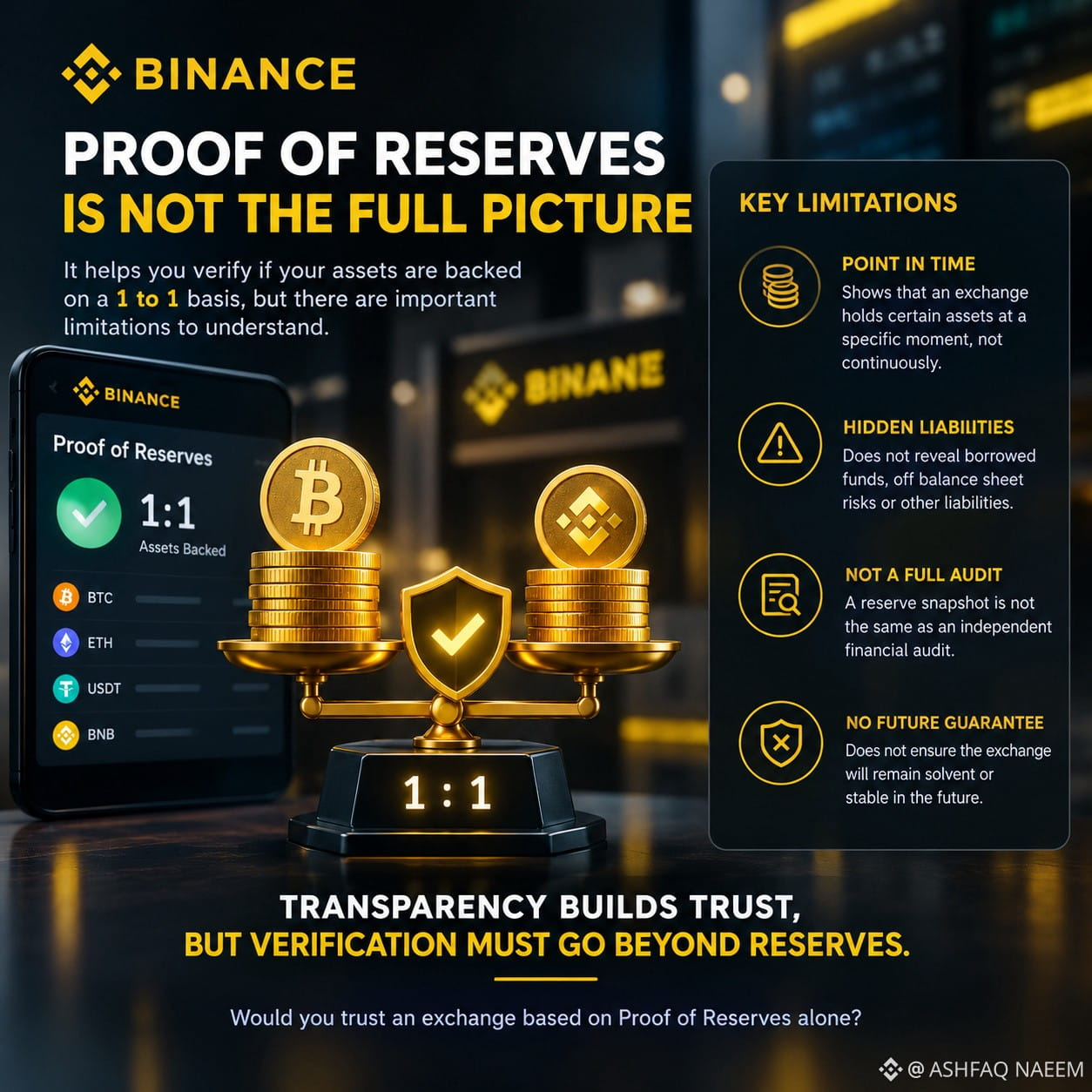
PROOF OF RESERVES IS NOT THE FULL PICTURE 🔍
Binance Proof of Reserves helps users verify whether their assets are backed on a 1 to 1 basis but there is an important limitation investors should understand
Proof of Reserves can show that an exchange holds certain assets at a specific point in time but it does not automatically prove that the exchange has no hidden liabilities borrowed funds or financial risks
A reserve snapshot is not the same as a complete independent financial audit and it cannot guarantee that an exchange will remain solvent in the future
Transparency is a powerful step toward trust but verification must go beyond reserves
Would you trust an exchange based on Proof of Reserves alone
#verify1to1binancereserves $BTC $BNB $ETH
{spot}(ETHUSDT)
{spot}(BNBUSDT)
{spot}(BTCUSDT)
PROOF OF RESERVES IS NOT THE FULL PICTURE 🔍
Binance Proof of Reserves helps users verify whether their assets are backed on a 1 to 1 basis but there is an important limitation investors should understand
Proof of Reserves can show that an exchange holds certain assets at a specific point in time but it does not automatically prove that the exchange has no hidden liabilities borrowed funds or financial risks
A reserve snapshot is not the same as a complete independent financial audit and it cannot guarantee that an exchange will remain solvent in the future
Transparency is a powerful step toward trust but verification must go beyond reserves
Would you trust an exchange based on Proof of Reserves alone
#verify1to1binancereserves $BTC $BNB $ETH
Natali FvL5:
mis activos aún no me los reponen 😭
2
5
4.8k

BINANCE COMPLETES ZERO-KNOWLEDGE PROOF — 10 CRYPTO ASSETS NOW VERIFIABLE AT 1:1!Binance has reached another major milestone in its recovery process! 🔐
On November 2, 2026, the exchange announced that its latest Proof of Reserves (PoR) zero-knowledge proof had been successfully generated.
This means users holding 10 major cryptocurrencies can now independently verify whether their Binance account balances are backed by reserves of at least 1:1.
🧮 THE 10 CRYPTO ASSETS COVERED
Binance confirms full 1:1 reserve backing for:
₿ BTC — BitcoinΞ ETH — Ethereum💵 USDT — Tether🟡 BNB — BNB◎ SOL — Solana💲 USDC — USD CoinXRP — XRPUSD1RLUSDZEC — Zcash
🔍 HOW DOES THE VERIFICATION WORK?
Binance combines two cryptographic technologies:
1️⃣ Merkle Tree
Allows individual users to check whether their account assets are included in the published Proof of Reserves snapshot.
2️⃣ zk-SNARK Technology
Provides cryptographic evidence that reserves cover user balances at a minimum 1:1 ratio without exposing individual account balances.
The latest snapshot was taken on October 31, 2026, at 00:00 UTC.
📊 RECOVERY PROGRESS: 95% COVERED
Binance also reported that approximately 95% of the impacted amount has been replenished using company resources.
The remaining 5% involves less-liquid tokens outside the ten major assets listed above. Binance says it is working with industry partners to acquire the outstanding assets.
📅 WHAT HAPPENS NEXT?
November 3: Next phase of withdrawals for additional networks and assets is planned.November 4: Binance plans another Proof of Reserves snapshot covering more tokens.40–50 hours: Estimated time to generate the next full zero-knowledge proof.
⚠️ IMPORTANT: WHAT USERS SHOULD KNOW
Proof of Reserves is an important transparency tool, but it is not a complete independent audit of an exchange's financial health or a guarantee against every possible risk.
Users can visit Binance's official Proof of Reserves website, download the verification tool and perform their own checks.
Always use the official Binance website. Never share your login details or download verification software from unknown sources.
🔥 MY TAKE
This is meaningful progress for Binance. Completing the ZK proof gives users a way to verify reserve backing instead of relying only on exchange statements.
But the recovery isn't finished yet. The remaining 5%, additional withdrawal restoration and continued security improvements are still important milestones.
Transparency builds confidence. Consistent execution earns it.
👇 Do you think independent 1:1 verification will significantly strengthen user confidence in Binance?
$BTC $ETH $BNB
#Verify1to1BinanceReserves
#BinanceRestores28FiatWithdrawals
#ETHFalls16.1%InOctober
#RecordBreakingStaking
{spot}(BNBUSDT)
{spot}(ETHUSDT)
{spot}(BTCUSDT)
BINANCE COMPLETES ZERO-KNOWLEDGE PROOF — 10 CRYPTO ASSETS NOW VERIFIABLE AT 1:1!
Binance has reached another major milestone in its recovery process! 🔐
On November 2, 2026, the exchange announced that its latest Proof of Reserves (PoR) zero-knowledge proof had been successfully generated.
This means users holding 10 major cryptocurrencies can now independently verify whether their Binance account balances are backed by reserves of at least 1:1.
🧮 THE 10 CRYPTO ASSETS COVERED
Binance confirms full 1:1 reserve backing for:
₿ BTC — BitcoinΞ ETH — Ethereum💵 USDT — Tether🟡 BNB — BNB◎ SOL — Solana💲 USDC — USD CoinXRP — XRPUSD1RLUSDZEC — Zcash
🔍 HOW DOES THE VERIFICATION WORK?
Binance combines two cryptographic technologies:
1️⃣ Merkle Tree
Allows individual users to check whether their account assets are included in the published Proof of Reserves snapshot.
2️⃣ zk-SNARK Technology
Provides cryptographic evidence that reserves cover user balances at a minimum 1:1 ratio without exposing individual account balances.
The latest snapshot was taken on October 31, 2026, at 00:00 UTC.
📊 RECOVERY PROGRESS: 95% COVERED
Binance also reported that approximately 95% of the impacted amount has been replenished using company resources.
The remaining 5% involves less-liquid tokens outside the ten major assets listed above. Binance says it is working with industry partners to acquire the outstanding assets.
📅 WHAT HAPPENS NEXT?
November 3: Next phase of withdrawals for additional networks and assets is planned.November 4: Binance plans another Proof of Reserves snapshot covering more tokens.40–50 hours: Estimated time to generate the next full zero-knowledge proof.
⚠️ IMPORTANT: WHAT USERS SHOULD KNOW
Proof of Reserves is an important transparency tool, but it is not a complete independent audit of an exchange's financial health or a guarantee against every possible risk.
Users can visit Binance's official Proof of Reserves website, download the verification tool and perform their own checks.
Always use the official Binance website. Never share your login details or download verification software from unknown sources.
🔥 MY TAKE
This is meaningful progress for Binance. Completing the ZK proof gives users a way to verify reserve backing instead of relying only on exchange statements.
But the recovery isn't finished yet. The remaining 5%, additional withdrawal restoration and continued security improvements are still important milestones.
Transparency builds confidence. Consistent execution earns it.
👇 Do you think independent 1:1 verification will significantly strengthen user confidence in Binance?
$BTC $ETH $BNB
#Verify1to1BinanceReserves
#BinanceRestores28FiatWithdrawals
#ETHFalls16.1%InOctober
#RecordBreakingStaking
112

#Verify1to1BinanceReserves
Following recent security incident, Binance has generated the zero-knowledge proof for its October 31 Proof of Reserves snapshot. Users holding BTC, ETH, USDT, BNB, SOL, USDC, XRP, USD1, RLUSD and ZEC can now independently verify their 1:1 reserve backing.
Transparency becomes meaningful when users can verify claims themselves rather than simply trusting an exchange. This is an important step for building confidence in the crypto industry. #Mahanadi
{future}(BNBUSDT)
{future}(BTCUSDT)
{future}(SOLUSDT)
#Verify1to1BinanceReserves
Following recent security incident, Binance has generated the zero-knowledge proof for its October 31 Proof of Reserves snapshot. Users holding BTC, ETH, USDT, BNB, SOL, USDC, XRP, USD1, RLUSD and ZEC can now independently verify their 1:1 reserve backing.
Transparency becomes meaningful when users can verify claims themselves rather than simply trusting an exchange. This is an important step for building confidence in the crypto industry. #Mahanadi

Transparency 🫡
From Digital Mahanadi
1
114

·
--
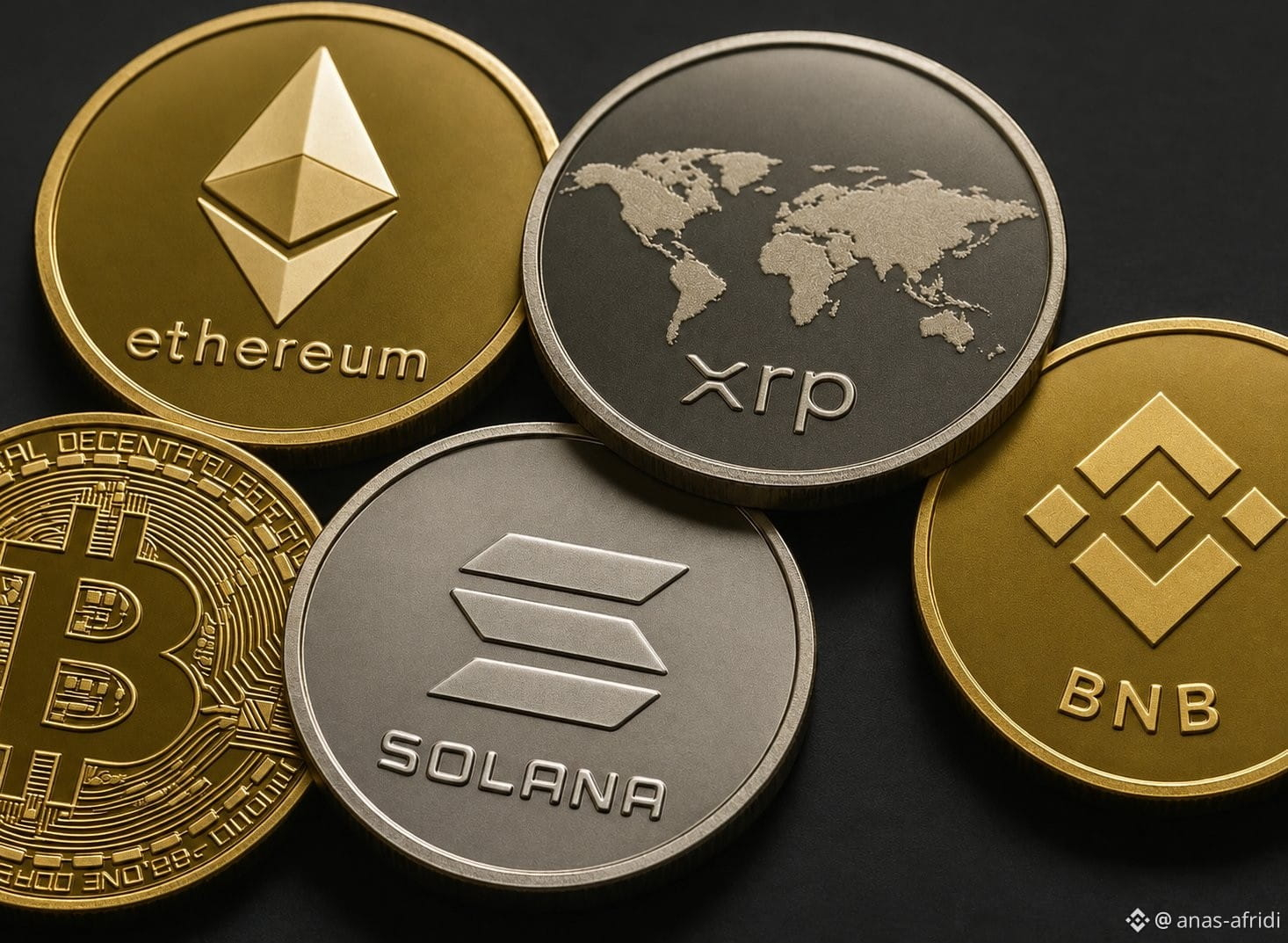
#Verify1to1BinanceReserves 🚨JUST IN: Binance says its October 31 Proof of Reserves snapshot is now FULLY VERIFIABLE following the $6.3B hack.
The exchange says users can independently verify that their $BTC, $ETH, $XRP, $BNB, $SOL, $USDT and other major token balances are backed at least 1:1.
Binance has also replenished 95% of affected assets, with another reserve snapshot planned for November 4 📸$ETH
{future}(ETHUSDT)
$BTC
{future}(BTCUSDT)
#Verify1to1BinanceReserves 🚨JUST IN: Binance says its October 31 Proof of Reserves snapshot is now FULLY VERIFIABLE following the $6.3B hack.
The exchange says users can independently verify that their $BTC , $ETH , $XRP, $BNB, $SOL, $USDT and other major token balances are backed at least 1:1.
Binance has also replenished 95% of affected assets, with another reserve snapshot planned for November 4 📸$ETH
$BTC
The exchange says users can independently verify that their $BTC , $ETH , $XRP, $BNB, $SOL, $USDT and other major token balances are backed at least 1:1.
Binance has also replenished 95% of affected assets, with another reserve snapshot planned for November 4 📸$ETH
$BTC

1
93

·
--
#Verify1to1BinanceReserves
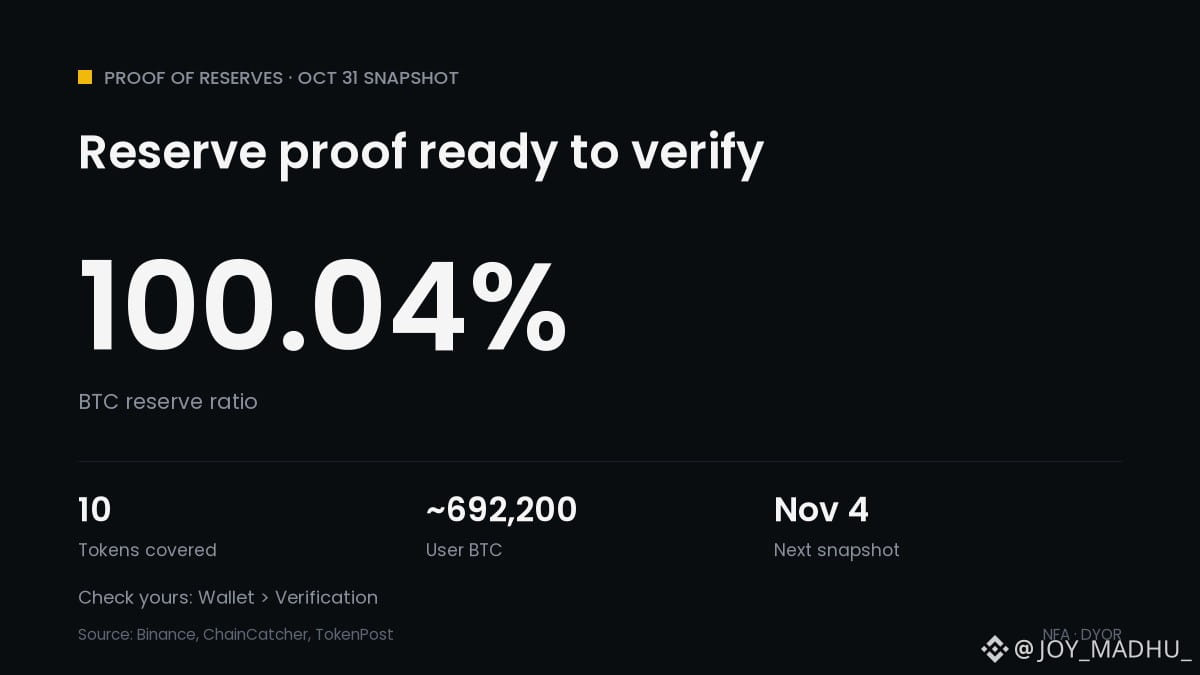
🔍 Binance's Oct 31 Reserve Proof Is Ready to Check
📅 The full zero-knowledge proof for the Oct 31 snapshot is now complete
🪙 10 tokens covered: BTC, ETH, USDT, BNB, SOL, USDC, XRP, USD1, RLUSD and ZEC
📊 Published ratios: BTC 100.04%, ETH and USDT 100.00%
📈 User BTC balances: about 692,200, up 3,614 BTC since Oct 1
📉 USDT balances: about 29.48B, down 2.55B over the same period
⏭️ Next snapshot planned for Nov 4, covering more tokens
⚠️ About 95% of affected assets replenished; the rest are low-liquidity tokens still being bought
What it means for crypto: users can now check their own balance is in the tree (Wallet > Verification). It is a one-day snapshot, not a live guarantee or a full audit of liabilities.
Have you verified your own Record ID yet? 👇
$BTC $BNB $USDT
#CryptoNews #ProofOfReserves #Binance #Verify1to1BinanceReserves
31

#Verify1to1BinanceReserves
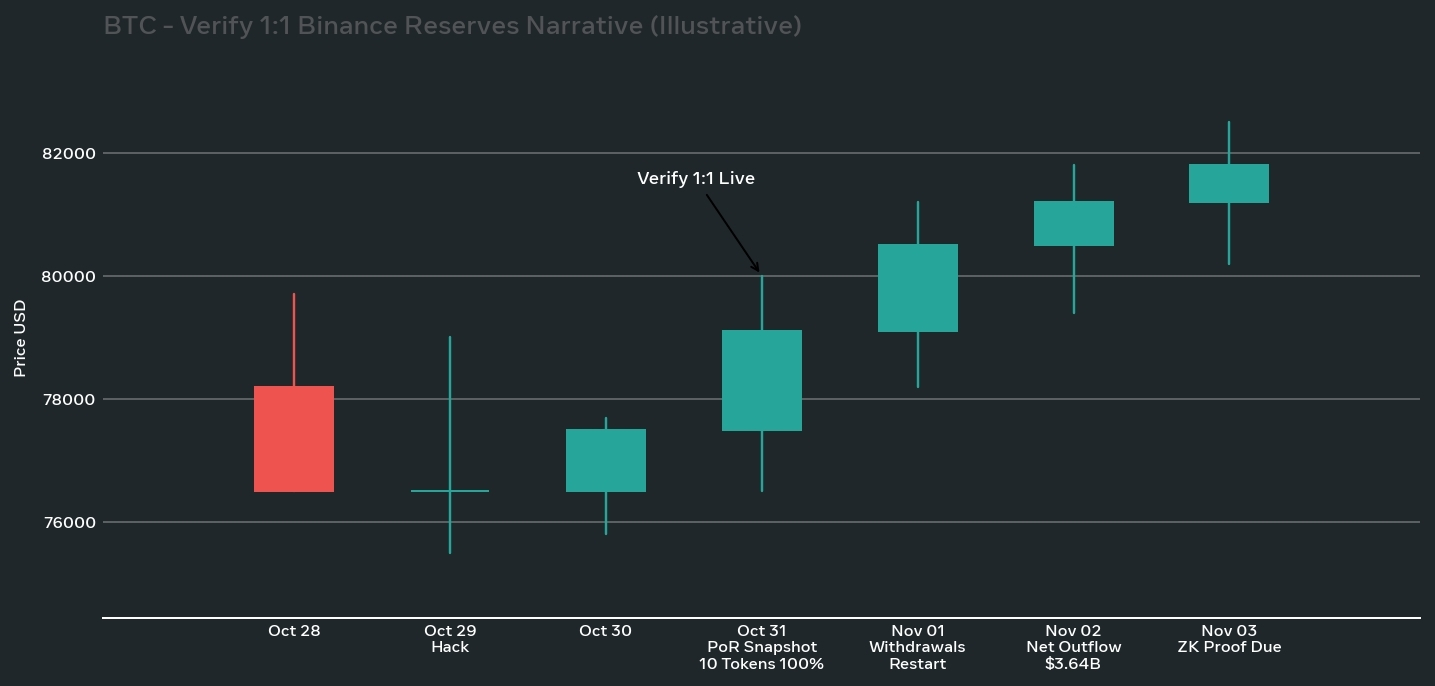
Binance confirmed Oct 31 00:00 UTC snapshot: *10 major assets are 100%+ backed 1:1* — $BTC , ETH, USDT, BNB, SOL, USDC, XRP, USD1, RLUSD, ZEC. 80cf
- Snapshot live on http://cf-workers-proxy-cyt.pages.dev/proof-of-reserves, new secure wallets deployed post $6.3B hack
- Full zk-SNARKs Merkle proof takes 40-50h compute, due *Nov 3* — then you can self-verify your individual balance is counted without exposing data
- How to verify: Go to PoR portal → Connect → Enter your account hash → System proves inclusion in aggregate reserves at that block
- Nov 1: Withdrawals restarted in phases ($ETH , BSC first), net outflow ∼$3.64B = 2.1% of $171B AUM in 9.5h — healthy stress test
- Company says 90-95% of stolen assets replaced from corporate treasury + SAFU + Futures Fund, remaining low-liquidity alts via OTC 80cf
*Interpretation:* 1:1 means reserves >= user liabilities at that timestamp. It does NOT audit other corporate liabilities or future risk. But for #Verify1to1, the mechanism is sound — this is the first time since hack you can mathematically prove your $BTC is there.
Illustrative price reaction:
93

·
--
#Verify1to1BinanceReserves
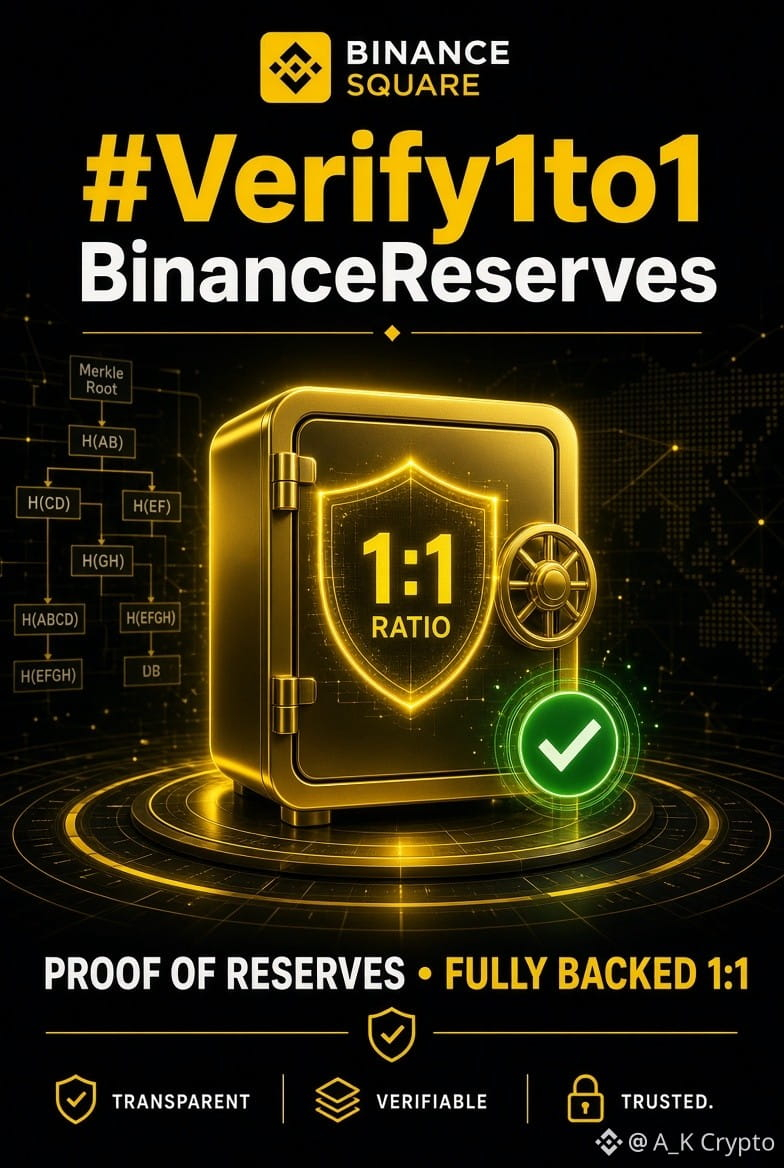
Transparency builds trust. Binance’s Proof of Reserves lets every user independently verify that their assets are fully backed 1:1 through Merkle Tree + zk-SNARK technology — no blind faith required.
In an industry where trust is everything, giving users the tools to verify reserves themselves is the right standard. It strengthens confidence, raises the bar for the entire ecosystem, and shows real commitment to keeping funds SAFU.
Verify yours today on the official PoR page.
#verify #Binance #reserve #Crypto
52

Verified
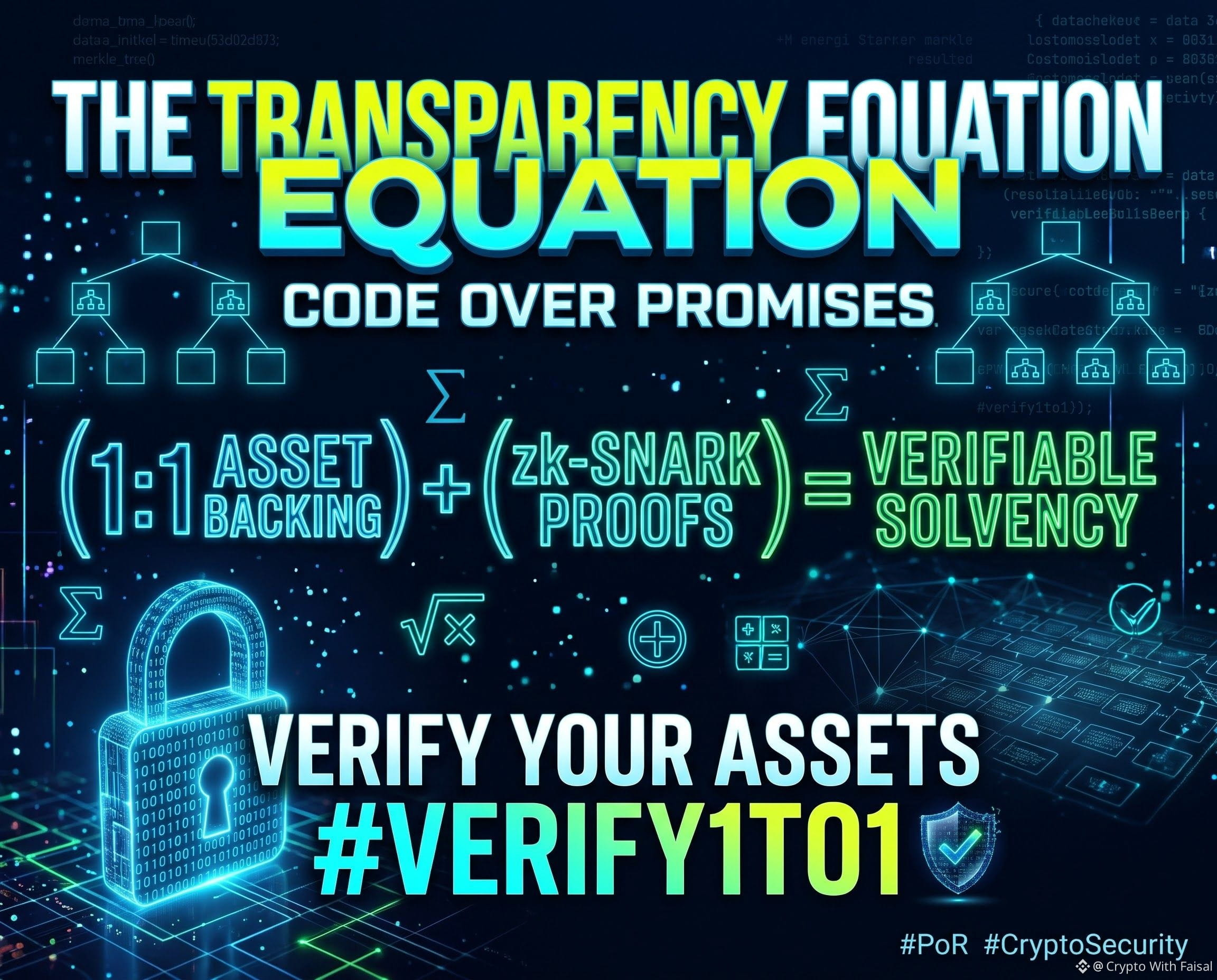
🚨 THE TRANSPARENCY EQUATION: Code Over Promises 🚨
#verify1to1binancereserves In Web3, trust isn't given—it’s calculated. Let's break down absolute asset security using pure math 🧮👇
(1:1 Asset Backing) + (zk-SNARK Proofs) = Verifiable Solvency 🛡️
The Asset Input:
(The Standard) = Centralized platforms must prove your funds are safe. Binance’s Proof of Reserves (PoR) guarantees every user asset is backed at a minimum 1:1 ratio. No fractional reserves, just hard data.
The Key Deliverable:
(The Tech) ➔ Using Merkle Tree cryptography, you can independently verify your exact account balance against the exchange's on-chain liabilities, all without exposing private data.
The Breakdown:
Talk is cheap; code is absolute. By maintaining overcollateralized reserves and allowing direct user auditing, the standard has permanently shifted from "trust us" to "verify it yourself."
Have you run the cryptographic check on your own portfolio yet, or are you still trading on blind faith? ❓👇💬
$BTC
{future}(BTCUSDT)
$SOL
{future}(SOLUSDT)
$ETH
{future}(ETHUSDT)
#Binance #PoR #Binance
🚨 THE TRANSPARENCY EQUATION: Code Over Promises 🚨
#verify1to1binancereserves In Web3, trust isn't given—it’s calculated. Let's break down absolute asset security using pure math 🧮👇
(1:1 Asset Backing) + (zk-SNARK Proofs) = Verifiable Solvency 🛡️
The Asset Input:
(The Standard) = Centralized platforms must prove your funds are safe. Binance’s Proof of Reserves (PoR) guarantees every user asset is backed at a minimum 1:1 ratio. No fractional reserves, just hard data.
The Key Deliverable:
(The Tech) ➔ Using Merkle Tree cryptography, you can independently verify your exact account balance against the exchange's on-chain liabilities, all without exposing private data.
The Breakdown:
Talk is cheap; code is absolute. By maintaining overcollateralized reserves and allowing direct user auditing, the standard has permanently shifted from "trust us" to "verify it yourself."
Have you run the cryptographic check on your own portfolio yet, or are you still trading on blind faith? ❓👇💬
$BTC
$SOL
$ETH
#Binance #PoR #Binance
FEDAT - sport digital assets marketplace:
Да,Друг! 🤝👍🤝
4
1
1.1k
#verify1to1binancereserves
Seeing balances on the blockchain is a good start, but it isn’t definitive proof of financial health.
Binance’s proof of reserves shows that the assets are there at that exact moment. The problem is what it doesn’t show. It doesn’t reveal hidden liabilities, loans, or long-term financial risks.
A simple snapshot of reserves is no substitute for a full independent audit. Transparency is essential, but future solvency requires much deeper analysis.
Would you feel safe using an exchange based solely on its proof of reserves?
#verify1to1binancereserves
$HOT
$ARIA
$TEM
{spot}(HOTUSDT)
{future}(ARIAUSDT)
{future}(TEMUSDT)
#verify1to1binancereserves
Seeing balances on the blockchain is a good start, but it isn’t definitive proof of financial health.
Binance’s proof of reserves shows that the assets are there at that exact moment. The problem is what it doesn’t show. It doesn’t reveal hidden liabilities, loans, or long-term financial risks.
A simple snapshot of reserves is no substitute for a full independent audit. Transparency is essential, but future solvency requires much deeper analysis.
Would you feel safe using an exchange based solely on its proof of reserves?
#verify1to1binancereserves
$HOT
$ARIA
$TEM
2
3k

Verified
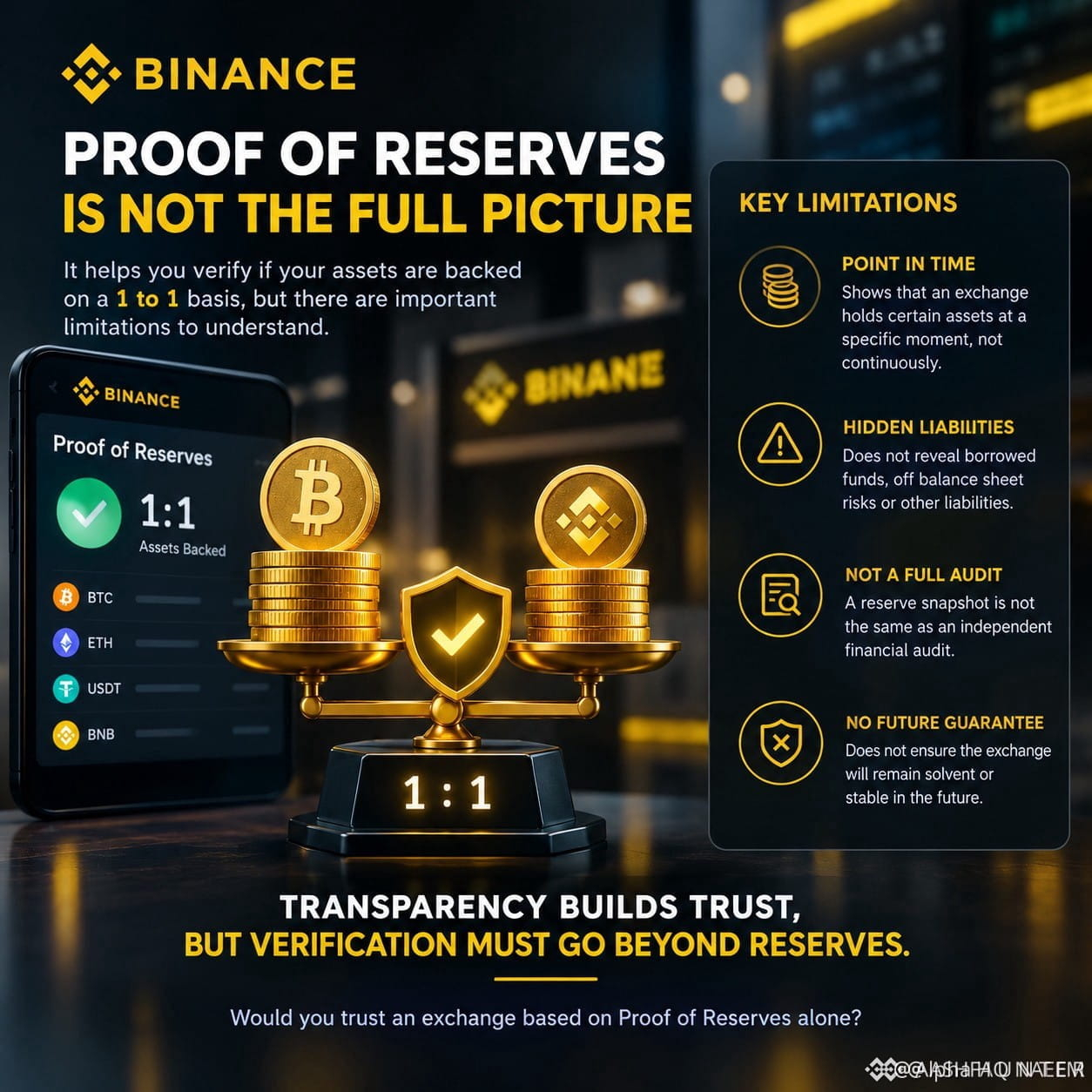
PROOF OF RESERVES DOESN’T TELL THE WHOLE STORY 🔍
Binance’s proof of reserves helps users verify whether their assets are fully backed, but it has an important limitation that investors should understand.
Proof of reserves can show that an exchange holds certain assets at a specific point in time, but it does not automatically prove that the exchange has no hidden liabilities, borrowed funds, or financial risks.
A snapshot of reserves is not the same as a full independent financial audit and cannot guarantee that an exchange will remain solvent in the future.
Transparency is an important step toward building trust, but verification must go beyond reserves.
Would you trust an exchange based solely on its proof of reserves?
#verify1to1binancereserves
$HOT
{future}(HOTUSDT)
$ARIA
{future}(ARIAUSDT)
$TEM
{future}(TEMUSDT)
PROOF OF RESERVES DOESN’T TELL THE WHOLE STORY 🔍
Binance’s proof of reserves helps users verify whether their assets are fully backed, but it has an important limitation that investors should understand.
Proof of reserves can show that an exchange holds certain assets at a specific point in time, but it does not automatically prove that the exchange has no hidden liabilities, borrowed funds, or financial risks.
A snapshot of reserves is not the same as a full independent financial audit and cannot guarantee that an exchange will remain solvent in the future.
Transparency is an important step toward building trust, but verification must go beyond reserves.
Would you trust an exchange based solely on its proof of reserves?
#verify1to1binancereserves
$HOT
$ARIA
$TEM
1
3.5k

Article
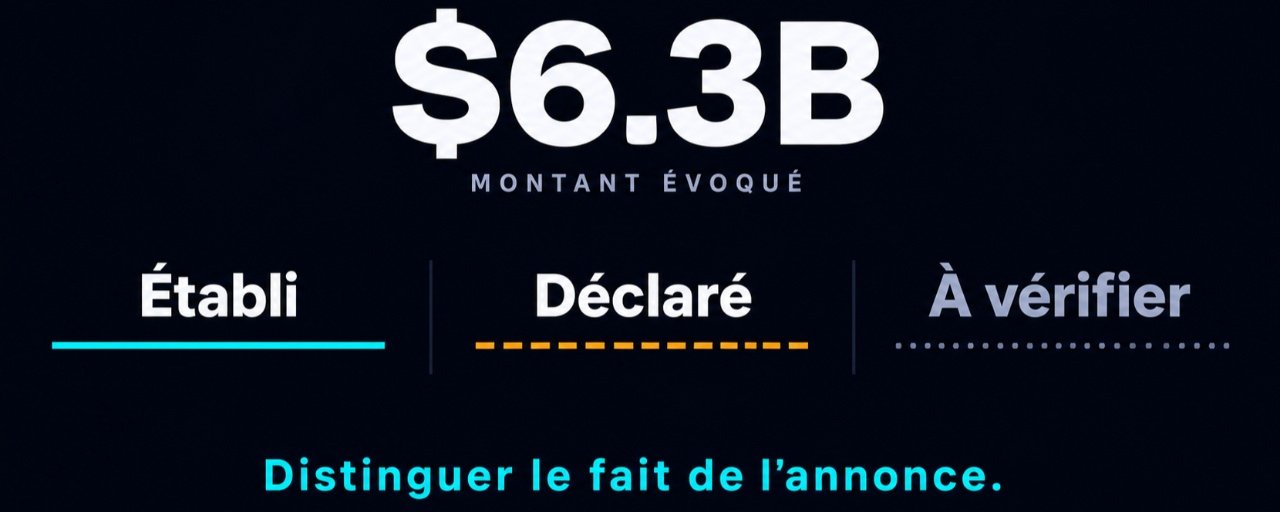
Binance had $6.3B stolen. How to check your funds.On October 29, attackers drained Binance hot wallets.
About $6.3 billion was stolen. Five days later, the question on your mind is simple: are my funds covered?
Here’s what’s established, what Binance says, and what you can verify for yourself.
📌 What’s established
The FBI attributes the theft to the North Korean group TraderTraitor. Most of the funds were moved out within about 20 minutes. Binance says the attack may have come through a compromised computer belonging to a DevOps engineer.
Binance had $6.3B stolen. How to check your funds.
On October 29, attackers drained Binance hot wallets.
About $6.3 billion was stolen. Five days later, the question on your mind is simple: are my funds covered?
Here’s what’s established, what Binance says, and what you can verify for yourself.
📌 What’s established
The FBI attributes the theft to the North Korean group TraderTraitor. Most of the funds were moved out within about 20 minutes. Binance says the attack may have come through a compromised computer belonging to a DevOps engineer.
1
226
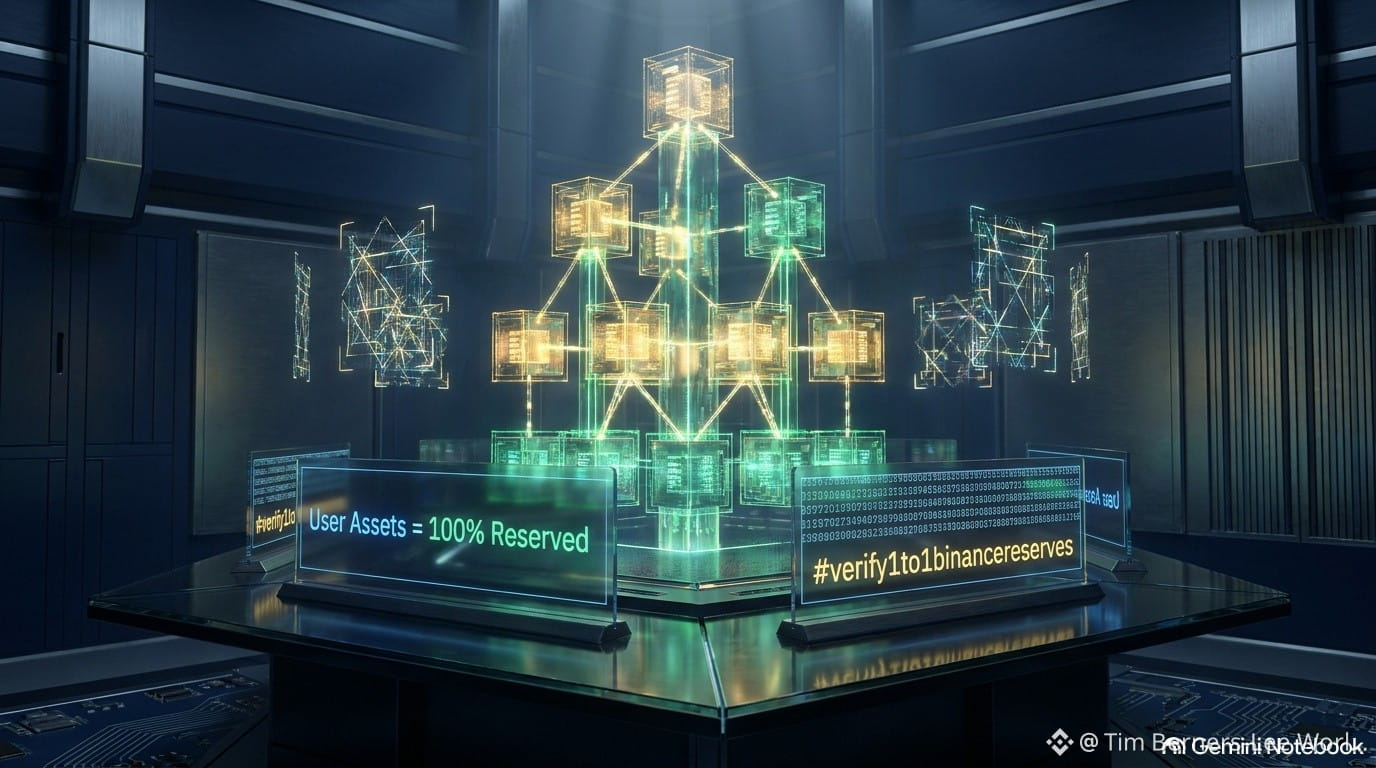
#verify1to1binancereserves The 1:1 proof-of-reserves system is a fundamental pillar of the financial governance and transparency architecture of contemporary digital custody, responding to market demand for continuous, immutable solvency audits. In a microstructure environment marked by sensitivity to liquidity shocks, the ability of users and institutional investors to verify in real time that deposited assets are backed at an exact one-to-one ratio (1:1) is crucial for mitigating counterparty risk. This methodology goes beyond traditional quarterly accounting audit frameworks, establishing an open computational protocol that ensures platforms maintain reserves equal to or greater than their total customer liabilities, without engaging in fractional reserve practices. From the perspective of technical infrastructure and applied cryptography, the proof-of-reserves protocol combines the data structure known as **Merkle Trees** (*Merkle Trees*) with **zero-knowledge proof** systems (*zk-SNARKs*). This logically segregated architecture makes it possible to condense millions of individual balances into a single immutable root hash, enabling each participant to privately and independently audit the inclusion of their balance without revealing personal identifiers or exposing the total volume of the accounting balance. The implementation of *zk-SNARKs* algorithms strengthens privacy by mathematically certifying that the sum of all customer balances is strictly less than or equal to the holdings confirmed in the entity’s public wallets, ensuring 100% coverage free from data manipulation or duplication of active records.$BNB
{future}(BNBUSDT)
#verify1to1binancereserves The 1:1 proof-of-reserves system is a fundamental pillar of the financial governance and transparency architecture of contemporary digital custody, responding to market demand for continuous, immutable solvency audits. In a microstructure environment marked by sensitivity to liquidity shocks, the ability of users and institutional investors to verify in real time that deposited assets are backed at an exact one-to-one ratio (1:1) is crucial for mitigating counterparty risk. This methodology goes beyond traditional quarterly accounting audit frameworks, establishing an open computational protocol that ensures platforms maintain reserves equal to or greater than their total customer liabilities, without engaging in fractional reserve practices. From the perspective of technical infrastructure and applied cryptography, the proof-of-reserves protocol combines the data structure known as **Merkle Trees** (*Merkle Trees*) with **zero-knowledge proof** systems (*zk-SNARKs*). This logically segregated architecture makes it possible to condense millions of individual balances into a single immutable root hash, enabling each participant to privately and independently audit the inclusion of their balance without revealing personal identifiers or exposing the total volume of the accounting balance. The implementation of *zk-SNARKs* algorithms strengthens privacy by mathematically certifying that the sum of all customer balances is strictly less than or equal to the holdings confirmed in the entity’s public wallets, ensuring 100% coverage free from data manipulation or duplication of active records.$BNB
34

·
--
BTC proof of reserves can be checked independently|October 31 snapshot completed|Wait for confirmation near $76,857
My stance is cautiously bullish, but I’m not chasing prices right now. Binance Square’s trending topics are discussing #Verify1to1BinanceReserves. What matters more to me is exactly what this proof covers and whether it can change BTC’s short-term trading conditions. Improved transparency is a good thing, but a snapshot should not be interpreted as a guarantee of unconditional withdrawals at any time in the future.
Here are the verifiable facts: Binance’s fifth recovery announcement on November 2 said it had completed a zero-knowledge proof for the asset snapshot taken at 00:00 UTC on October 31, showing 1:1 reserve coverage for user balances of ten tokens, including BTC, at that point in time. Binance’s official news account also posted the same update. The announcement said the next snapshot is scheduled for November 4, with proof generation estimated to take 40 to 50 hours. The planned new snapshot and the already-completed old snapshot must be kept distinct; the latter should not be described prematurely as continuous, real-time proof. The announcement also said about 95% of the affected assets had been replenished, while the remaining 5% involved low-liquidity assets, which also indicates that the recovery process is not yet complete.
Checking for yourself is more useful than forwarding screenshots: log in through Binance’s official website, go to Proof of Reserves and Verification in your wallet, select the date corresponding to October 31, check your record number, Merkle leaf, and balance, then download the verification tool and cross-check them according to the official instructions. Do this only on official domains and trusted devices. Never provide passwords, verification codes, or purported verification transfers to anyone contacting you privately. Having your account included in a snapshot of liabilities and the exchange having zero overall risk are two different things. I’ll continue watching to see whether the November 4 snapshot is completed on schedule, whether withdrawals remain stable, and whether third parties can independently reproduce the results.
The market reaction so far has not been one-sided applause. Checking BTC spot prices on Kraken, BTC was around $76,857, with a rolling 24-hour range of about $76,427 to $78,345. The price was near the bottom of that range, suggesting the announcement had not immediately driven a breakout. The U.S. Federal Reserve kept its target interest-rate range unchanged at its last meeting, so funding costs remain a constraint. The ETF data page for the day was still being updated, so I won’t treat an incomplete flow table as a definitive picture of capital flows. For trading, transparency news reduces one type of concern about the exchange, but it cannot automatically create buying pressure. $78,345 is the level to confirm a move above the range, and $76,427 is short-term support. If price breaks below it and fails to reclaim it on a rebound, the bullish outlook should be withdrawn.
If I were trading this myself, I’d choose to stay out for now. My only directional bias would be a small spot long, with no high leverage. I’d only use at most 5% of my total capital to test an entry if BTC gets back above $78,345, holds on a retest, and withdrawal progress hasn’t reversed. The first target would be $79,500, followed by $80,500. I’d take half off at the first target and move the stop loss up on the remaining position. The initial stop loss would be below $77,500. If BTC falls below $76,427, or if there is a materially negative change in the new snapshot or withdrawal announcements, I’d close the position regardless of the price. If the conditions never trigger, I’ll remain flat rather than present a plan as a completed trade.
#Verify1to1BinanceReserves #BTC
The above is only my personal market observation and does not constitute investment advice.

2
Log in to explore more content
Join global crypto users on Binance Square
⚡️ Get latest and useful information about crypto.
💬 Trusted by the world’s largest crypto exchange.
👍 Discover real insights from verified creators.
Email / Phone number
Trending Topics
1
#BinanceReopensWithdrawalsForMoreAssets
17,668 views
541 Discussing
2
#AppleReportsMixedResults
11,900 views
414 Discussing
3
#BinanceHourlyDepositsExceedWithdrawals
1,436 views
101 Discussing
4
#PalantirSlides3PercentOn$2BRevenue
0 views
1 Discussing
5
#USMidtermElections
706,510 views
3,820 Discussing
6
#USOctoberNFP-AreRateCutsStillPossible
103,733 views
889 Discussing
7
#Verify1to1BinanceReserves
94,296 views
657 Discussing
8
#SBIFirstHalfCryptoRevenueFalls30.1%
396 views
14 Discussing
9
#NEARVoteApprovesCutInMaxAnnualIssuanceTo1.6%
2,751 views
30 Discussing
10
#BinanceRestores28FiatWithdrawals
242,810 views
1,326 Discussing