
#tradingtips
tradingtips
10.1M views
25,692 Discussing
Hot
Latest

·
--
Your $AVAX stop is at some random percentage and that is why you get wicked out
Put your stop below the level that proves your idea was actually wrong
If you enter long here you look at the 24h low of 8.1340 dollars
The 1h ATR shows a normal hourly swing of 0.5 percent of the price
A tight stop inside that range gets hit by market noise alone
Put your stop under the key level plus one hourly swing to give it room
Where do you usually put your stops
Tap $AVAX and check the hourly chart yourself
#AVAX #TradingTips
·
--
$ZRO volume is 0.3x its weekly average. Here is why that low number is a trap
Most traders buy a dip without checking the fuel gauge and wonder why it stalls
Look at $ZRO today sitting at 1.6030 down 1.9 percent near the low of its range
The 24h volume is only 1.9M which is 0.3x the 7 day average
That means 1.9 divided by the average is less than half normal participation
Price moving on low volume is just air not accumulation
Open your exchange tap indicators type volume look at the 20 period moving average bar
If today is way below that line the move lacks institutional hands
Never trust a bounce when the volume ratio stays under one
What is your cutoff for a low volume fakeout
#ZRO #TradingTips
1

·
--
Quiet charts are where accounts quietly get wrecked.
$BTC traded inside a range of under 0.9% over the last 24 hours (roughly 75.6k to 76.2k). Three days ago the same coin swung about 7.5% high to low in a single daily candle. Same asset, same week, very different risk.
Why it matters: when price goes flat, a lot of traders size up or add leverage because "nothing is happening". Then volatility comes back, and it rarely sends a calendar invite first.
A simple risk framework I like:
1. Decide the loss first. Many traders cap risk at 1–2% of the account per trade. On a $10,000 account, 1% is $100.
2. Let the stop set the size. If your stop is 3% away, position size = $100 / 0.03 ≈ $3,333. Stop 1% away? About $10,000. The risk stays $100 either way.
3. Plan for the range, not the current calm. Place stops based on recent volatility. A stop that survives a 0.9% day can get swept on a 7% day.
4. Cap total exposure. BTC, $ETH and $SOL often move together, so three "separate" 1% trades can behave like one 3% bet.
Calm markets don't lower your risk. They just hide it.
How do you size positions when volatility drops?
Not financial advice.
#RiskManagement #TradingTips #Bitcoin
1
·
--
Your stop on $ONDO at $0.35920 is just guessing if you ignore the math
Most traders drop a random percentage below price and wonder why it keeps getting wicked out
Right now $ONDO trades at $0.36020 down 2.0 percent on the day sitting near the bottom of the $0.35920 to $0.37140 range
The 1h ATR is 0.6 percent which means normal hourly noise swings right through any tight percentage risk you pick
If you put your stop closer than that hourly range the market takes you out by accident before the direction even matters
A real stop belongs below the structure that proves your thesis dead wrong not at an arbitrary number that sounds neat
Put your stop past the noise floor every single time 📈
Where do you normally measure your risk
#ONDO #TradingTips
3
·
--
$AAVE is up 2 percent. Ask yourself who is selling to you at this price
Most traders chase green candles without checking where the price actually sits in the daily range
Right now $AAVE trades at 131.7800 dollars which puts it at 68 percent of its daily move
The range spans from 129.2500 dollars up to 132.9800 dollars so you are buying near the top of today already
Volume is thin at 0.4 times the average and RSI sits right in the middle at 53
That means passive sellers are dumping into your market order while smart money sits on their hands
Wait for the pullback to the range low instead of paying the impatient tax
What trigger do you wait for before buying a green candle
#AAVE #TradingTips
·
--
Article
Position Sizing: Explained Simply📘 What is position sizing?
Position sizing means deciding how big a trade should be BEFORE you enter. Not "how much do I feel like buying", but "how much can I lose if I'm wrong".
The most common rule is simple: never risk more than 1-2% of your account on one trade. Lose 10 trades in a row and you still have about 80-90% of your money. Risk 20% per trade and three bad trades can cut your account in half.
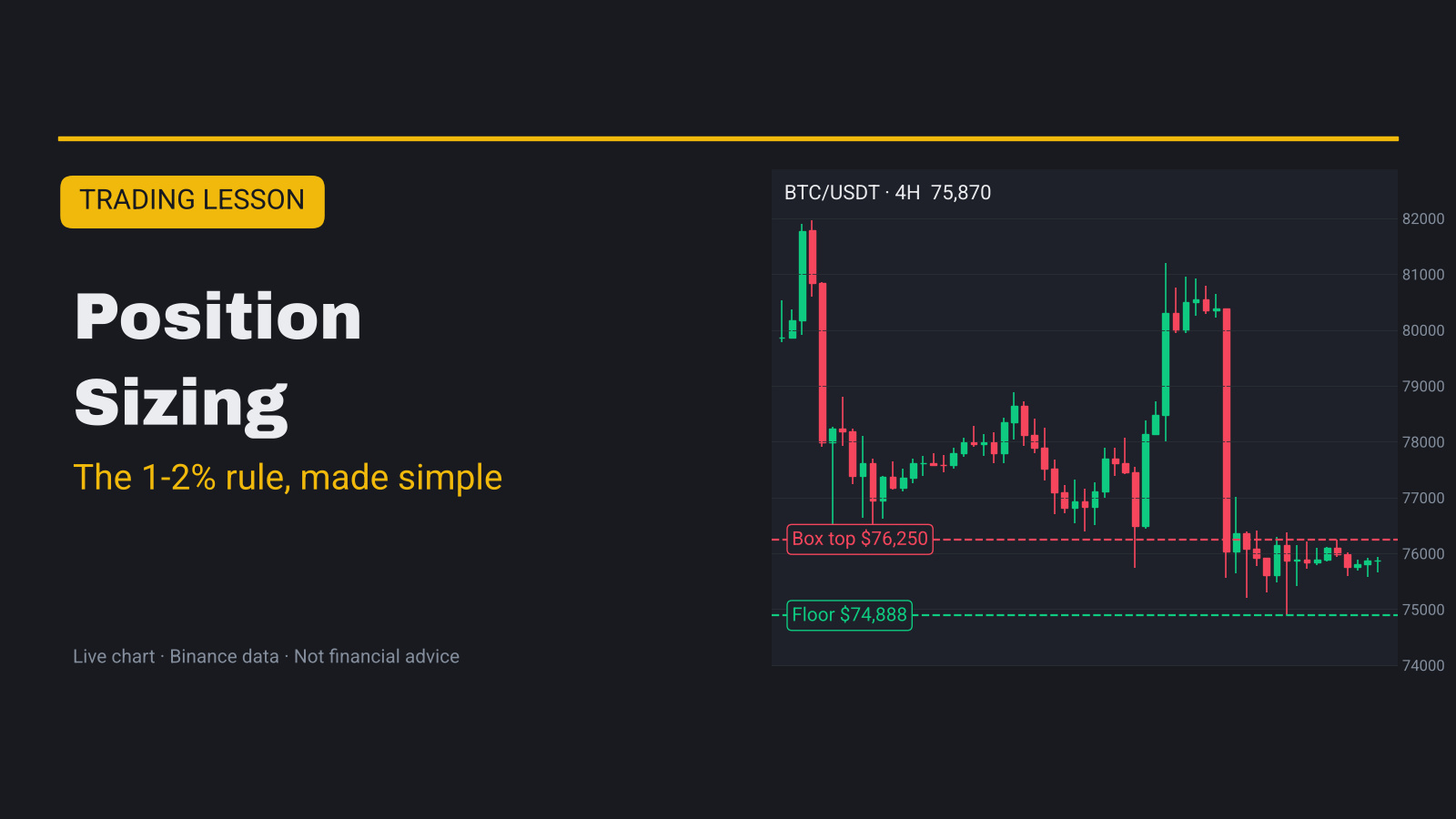
📊 Live chart in the cover and in the image post below.
🔍 How to work it out
• Step 1: pick your stop-loss from the chart (where your idea is proven wrong). Last week's lesson covered this
• Step 2: measure the stop distance in %. Entry $100, stop $95 = 5%
• Step 3: decide your risk in dollars. $1,000 account x 1% = $10
• Step 4: position size = risk $ / stop distance %. $10 / 5% = $200
• That's it. The stop decides the size, not your mood
📈 How traders use it
• Wide stop = smaller position. Tight stop = bigger position. The dollar risk stays the same
• Volatile coins get smaller positions than BTC, because their stops need more room
• Leverage does NOT change your risk if the stop is set. A $555 position with 5x needs only $111 margin, but the stop still costs $10. Leverage just lets you put up less cash
• Without a stop, leverage is dangerous: a 10x long loses about 60% of its margin on a 6% drop
• Keep the same % on every trade so one loss never undoes a week of wins
🧪 Live example: $BTC right now
• Nov 5 showed why size matters: BTC fell from $80,390 to $75,568 in a single 4H candle (12:00 UTC), about -6%. A 10x long with no stop lost roughly 60% of its margin in four hours
• Since then BTC has been stuck in a tight box: floor $74,888 (Nov 6 low, the first dip under $75K since August), top $76,250 (Nov 7 high). Today it sits near $75,870
• Example long here: the idea is wrong if BTC breaks the $74,888 floor. Stop with a buffer: about $74,500, which is 1.8% away
• $1,000 account, 1% risk ($10): position ≈ $10 / 1.8% ≈ $555
• $5,000 account, 1% risk ($50): position ≈ $2,770
• If you want a tighter stop, the position can be bigger. If you want more room, it must be smaller
⚠️ Common mistakes
• Choosing the size first ("I'll buy $1,000"), then guessing a stop
• Going bigger after a loss to "win it back" (revenge sizing)
• Thinking 10x leverage means 10x the risk. The risk is set by size x stop distance
• Opening several trades on coins that move together (BTC, ETH, SOL) and counting each as a separate 1%
✅ Quick checklist
• Stop first, from the chart
• Stop distance in %
• Risk = 1-2% of the account in dollars
• Size = risk $ / stop distance %
• Check total risk across all open trades
💬 How much do you risk per trade: 1%, 2%, or "it depends"? 👇
Not financial advice. DYOR.
#TradingTips #RiskManagement #Bitcoin
Position Sizing: Explained Simply
📘 What is position sizing?
Position sizing means deciding how big a trade should be BEFORE you enter. Not "how much do I feel like buying", but "how much can I lose if I'm wrong".
The most common rule is simple: never risk more than 1-2% of your account on one trade. Lose 10 trades in a row and you still have about 80-90% of your money. Risk 20% per trade and three bad trades can cut your account in half.
📊 Live chart in the cover and in the image post below.
🔍 How to work it out
• Step 1: pick your stop-loss from the chart (where your idea is proven wrong). Last week's lesson covered this
• Step 2: measure the stop distance in %. Entry $100, stop $95 = 5%
• Step 3: decide your risk in dollars. $1,000 account x 1% = $10
• Step 4: position size = risk $ / stop distance %. $10 / 5% = $200
• That's it. The stop decides the size, not your mood
📈 How traders use it
• Wide stop = smaller position. Tight stop = bigger position. The dollar risk stays the same
• Volatile coins get smaller positions than BTC, because their stops need more room
• Leverage does NOT change your risk if the stop is set. A $555 position with 5x needs only $111 margin, but the stop still costs $10. Leverage just lets you put up less cash
• Without a stop, leverage is dangerous: a 10x long loses about 60% of its margin on a 6% drop
• Keep the same % on every trade so one loss never undoes a week of wins
🧪 Live example: $BTC right now
• Nov 5 showed why size matters: BTC fell from $80,390 to $75,568 in a single 4H candle (12:00 UTC), about -6%. A 10x long with no stop lost roughly 60% of its margin in four hours
• Since then BTC has been stuck in a tight box: floor $74,888 (Nov 6 low, the first dip under $75K since August), top $76,250 (Nov 7 high). Today it sits near $75,870
• Example long here: the idea is wrong if BTC breaks the $74,888 floor. Stop with a buffer: about $74,500, which is 1.8% away
• $1,000 account, 1% risk ($10): position ≈ $10 / 1.8% ≈ $555
• $5,000 account, 1% risk ($50): position ≈ $2,770
• If you want a tighter stop, the position can be bigger. If you want more room, it must be smaller
⚠️ Common mistakes
• Choosing the size first ("I'll buy $1,000"), then guessing a stop
• Going bigger after a loss to "win it back" (revenge sizing)
• Thinking 10x leverage means 10x the risk. The risk is set by size x stop distance
• Opening several trades on coins that move together (BTC, ETH, SOL) and counting each as a separate 1%
✅ Quick checklist
• Stop first, from the chart
• Stop distance in %
• Risk = 1-2% of the account in dollars
• Size = risk $ / stop distance %
• Check total risk across all open trades
💬 How much do you risk per trade: 1%, 2%, or "it depends"? 👇
Not financial advice. DYOR.
#TradingTips #RiskManagement #Bitcoin
120
·
--
Your $INJ stop at five percent is why you keep getting hunted. Here is where it actually belongs
Most traders pick a random percentage for $INJ and wonder why the wick takes them out before the move starts
The hourly ATR on $INJ sits at 1.1 percent of price which is just normal noise during any quiet session
If you put your stop closer than that 1.1 percent swing you are paying the market for no reason
The last swing low on $INJ is 8.0680 dollars which is the exact spot that proves the buyers failed
A proper stop goes just below that 8.0680 level because if that breaks the whole idea is dead
Let the chart tell you where to exit instead of a round number in your head
Where do you normally place your stops
#INJ #TradingTips
4
·
--
Your stop on $PYTH at 0.06320 is closer than the hourly noise
Most traders pick a random three percent loss and wonder why they get wicked out
The market swings 0.9 percent every hour on average so a tight stop is just paying fees to luck
Price is sitting right near the bottom of today's range at 0.06326 down 3.7 percent
That low at 0.06320 is the line that actually proves the trade thesis dead
Open $PYTH and set an alert at that level
Put the protection past the normal hourly swing instead of a round number
Where do you normally set yours before looking at the chart candles
#PYTH #TradingTips
4
·
--
Your stop on $MET at $0.27570 is what keeps you honest
Most traders drop stops at random round percentages like five percent down
That just hands money to market makers who hunt obvious spots
Look at $MET sitting at $0.32050 after running up 14.7 percent today
The 1h ATR shows normal hourly noise moves 3.1 percent of the price right now
If you put your stop closer than that normal swing you get stopped out by pure static
A proper stop belongs below the level that actually breaks the entire chart thesis
For $MET the 24h swing low down at $0.27570 is the spot that proves the buyers lost control
Put your stop past the noise or expect to get wicked out before the real move happens
Where do you normally drop your stop loss on a volatile alt like this
#MET #TradingTips
1
·
--
Most stops on $STX are sitting at random percentages and getting clipped by noise
Put your stop below the actual level that proves your idea is dead wrong
Look at $STX right now sitting around 0.33980 dollars
The 24 hour swing low sits at 0.32080
The hourly ATR is running at 1.7 percent of price
That means normal market breathing room eats up a tight stop instantly
If you put your risk inside that 1.7 percent hourly swing the noise will take you out before the move even starts
The stop goes below the 0.32080 swing low because breaking that level invalidates the whole picture
Put your stop past the noise or do not take the trade
Where do you normally set your risk distance
#STX #TradingTips
61

·
--
Fear & Greed are your worst enemies ⚔️
Stick to your plan. Don't let FOMO push you into bad trades.
Don't let FUD make you sell at the bottom.
Discipline is currency in this market.
Manage your risk, manage your emotions.
Trade smart, not hard.
#TradingTips #Mindset
Fear & Greed are your worst enemies ⚔️
Stick to your plan. Don't let FOMO push you into bad trades.
Don't let FUD make you sell at the bottom.
Discipline is currency in this market.
Manage your risk, manage your emotions.
Trade smart, not hard.
#TradingTips #Mindset
Stick to your plan. Don't let FOMO push you into bad trades.
Don't let FUD make you sell at the bottom.
Discipline is currency in this market.
Manage your risk, manage your emotions.
Trade smart, not hard.
#TradingTips #Mindset
81
·
--
Your $ADA stop at $0.17930 is already getting tested because random noise is half a percent every hour
Most traders drop stops at random percentages like two or three percent below entry
That is just guessing where the market will stop caring
Look at $ADA right now at $0.18100 sitting just above the 24h swing low of $0.17930
The 1h ATR shows normal hourly swings of 0.5 percent on $ADA
If you put your stop closer than that normal swing the noise alone takes you out before the level even breaks
A proper stop belongs right under the swing low that invalidates the whole idea
Put it where the chart tells you the trade is dead not where your math feels safe
Where do you normally set your risk
#ADA #TradingTips
7
·
--
$ONE moves 6.7 percent an hour and most traders blow up by guessing their size
with a 1000 dollar account and a 6.7 percent hourly swing a normal stop is roughly 0.00016 dollars away
if you risk 1 percent of your capital that means 10 dollars total risk
divide 10 dollars by that exact stop distance to find your exact coin amount
do not eyeball the slider just do the simple math before every trade
whats your maximum risk per trade right now
Do not take my word for it, tap $ONE and look at the candles
#ONE #TradingTips
·
--
$LINK moves 0.6 percent an hour and people still guess their size
Volatility dictates math not your gut feelings
Imagine a thousand dollar account on your screen
One hour average range sits at 0.6 percent of price
That means the hourly swing on $LINK is 0.064 dollars away
Risking one percent of that capital means ten dollars total
Divide that ten dollar risk by the hourly move size
You get a position capped at one hundred fifty six dollars
Anything bigger turns a standard hourly chop into an account leak
How do you calculate your size before entering the chart
#LINK #TradingTips
2
·
--
Don't chase green candles. 🚀
FOMO is a trader's worst enemy.
Always wait for your entry, validate your setup.
Impatience leads to poor decisions.
Let the market come to you.
Protect your capital first, profits second.
Trade smart, not emotionally.
#TradingTips #MarketWisdom
Don't chase green candles. 🚀
FOMO is a trader's worst enemy.
Always wait for your entry, validate your setup.
Impatience leads to poor decisions.
Let the market come to you.
Protect your capital first, profits second.
Trade smart, not emotionally.
#TradingTips #MarketWisdom
FOMO is a trader's worst enemy.
Always wait for your entry, validate your setup.
Impatience leads to poor decisions.
Let the market come to you.
Protect your capital first, profits second.
Trade smart, not emotionally.
#TradingTips #MarketWisdom

·
--
Hedging is a way to protect your portfolio from downside risk. It involves taking a position that offsets potential losses. Think of it like insurance for your investments. You can use various strategies, such as options or futures contracts, to hedge your bets. The goal is to reduce potential losses, not to make a profit. By hedging, you can limit your exposure to market volatility and protect your capital. It's a key concept in risk management. #RiskManagement #Portfolio #TradingTips
Hedging is a way to protect your portfolio from downside risk. It involves taking a position that offsets potential losses. Think of it like insurance for your investments. You can use various strategies, such as options or futures contracts, to hedge your bets. The goal is to reduce potential losses, not to make a profit. By hedging, you can limit your exposure to market volatility and protect your capital. It's a key concept in risk management. #RiskManagement #Portfolio #TradingTips

·
--
I'm a Beginner in Crypto Trading – Share Your Advice!
I'm still at the beginning of my trading journey on Binance. I've started learning about the market, exploring trading tools, and understanding how to manage risks.
I know that becoming a successful trader takes time, patience, and experience.
I'd love to hear from experienced traders in this community:
💡 What is the most important advice you would give to a beginner?
📊 Which trading mistakes should I avoid?
📈 What skills should I focus on learning first?
Your advice and experience could help me and many other beginners.
Let's learn and grow together! 🤝
#Binance #CryptoTrading #Beginners #TradingTips
1
34
·
--
liquidity is the air in this market. choke on it and you die. think of it like a fish market. busy place, you grab the tuna, nobody notices, cost stays flat. instant execution. zero impact. now picture a basement sale. three guys, ten apples. you need five. you buy them. everyone panics because the supply just vanished. the remaining five jump way up. that is low liquidity. one move swings the whole ship. in crypto, thin books mean your buy order pushes the ask up before it even fills. you pay more than the ticker. it is called slippage. real money gone. check the order book first. if the walls are paper thin, you are not trading. you are exit liquidity for someone else. stay away from illiquid pairs unless you know exactly what you are doing. know your entry. Liquidity #TradingTips #RiskManagement #CryptoEducation
liquidity is the air in this market. choke on it and you die. think of it like a fish market. busy place, you grab the tuna, nobody notices, cost stays flat. instant execution. zero impact. now picture a basement sale. three guys, ten apples. you need five. you buy them. everyone panics because the supply just vanished. the remaining five jump way up. that is low liquidity. one move swings the whole ship. in crypto, thin books mean your buy order pushes the ask up before it even fills. you pay more than the ticker. it is called slippage. real money gone. check the order book first. if the walls are paper thin, you are not trading. you are exit liquidity for someone else. stay away from illiquid pairs unless you know exactly what you are doing. know your entry. Liquidity #TradingTips #RiskManagement #CryptoEducation
5
·
--
$SHIB is down 2.8 percent. Ask yourself who is selling it to you right now
Tap $SHIB and check the hourly chart yourself
Chasing the top gainer always feels smart when everyone is loud
Instead you get stuck buying a coin sitting at 6 percent of its daily range
Look at the math before you click buy on a red candle
Volume is dead at 0.6x the weekly average
That means nobody new is stepping in to save your bag
The hourly RSI sits at 30 showing pure exhaustion
When you buy the dip on low volume you are just exit liquidity for someone else
Wait for real demand to show up instead of guessing the bottom
#SHIB #TradingTips
6

·
--
$BTC moved less than 1% today. That's exactly when weekend traders get hurt.
Saturday's range on Binance spot: roughly $75,600 to $76,250. Tight.
Volume tells the real story. BTC/USDT has done about $298M so far today. On Nov 5, the same pair did around $2.0B.
Thin books plus a tight range is a classic setup for a fake breakout. A few large orders can push price through a level, trigger stops, and then snap right back once Monday liquidity returns.
What I'm watching:
- $76.4K above: a weekend push through here needs real volume to mean anything
- $74.9K below: Nov 6's low, where stops are likely stacked
- $ETH near $2,237 and $SOL near $89.6 are drifting with BTC, not leading
My rule for quiet weekends: smaller size, wider stops or no trade at all. Missing a weekend move costs nothing. Getting wicked out on low volume costs real money.
The breakout that matters usually shows up when the volume does.
Do you trade weekends, or sit out until Monday? Drop your rule below.
#BinanceSquare #Bitcoin #TradingTips #CryptoMarket
Not financial advice.
30
Log in to explore more content
Join global crypto users on Binance Square
⚡️ Get latest and useful information about crypto.
💬 Trusted by the world’s largest crypto exchange.
👍 Discover real insights from verified creators.
Email / Phone number
Trending Topics
1
#KeplrAdvisesSocialLoginUsersToTransferAssets
872 views
54 Discussing
2
#TetherPlans€28.8MForJuventusCapitalIncrease
850 views
54 Discussing
3
#JobsReportRaisesHikeOdds
630,917 views
3,899 Discussing
4
#CPITestsDecemberRateOutlook
214,437 views
1,509 Discussing
5
#US Data Center Rules May Constrain AI Expansion
88,605 views
245 Discussing
6
#ARKPlans14ThematicETFsCoveringAIAndTokenizedMarkets
5,580 views
79 Discussing
7
#WillAnthropicListOnTime
199,571 views
1,652 Discussing
8
#WillUS-IranTensionsBoostSafe-HavenDemand?
104,828 views
722 Discussing
9
#BitcoinETFsSee$412MNetOutflows
19,453 views
84 Discussing
10
#HKSFCPlansToRestrictCryptoAndExchangeTerms
82,768 views
693 Discussing