
#tradingquant
tradingquant
233 views
7 Discussing
Hot
Latest

·
--
🚨 $ETH
Going long at current levels of 1,933 USDT presents an unfavorable mathematical expectancy (EV-). The institutional structure on higher timeframes shows a clear distribution phase following the rejection at 1,946 USDT. There is a massive liquidity pool (retail Stop Loss orders) resting below the relative lows of 1,911 USDT. The quantitative edge (EV+) suggests waiting for a retracement into our premium supply zone to position short and target the extraction of that liquidity. 🧠📉
🛒 Entry Zone (Limit Sell / Short): 1,940.00 - 1,946.00 USDT
🛑 Stop Loss (Strict): 1,952.00 USDT
🎯 Take Profit 1 (Secure capital): 1,911.00 USDT
🚀 Take Profit 2 (Inefficiency fill): 1,872.00 USDT
⚠️ Disclaimer: This publication does not constitute an investment recommendation or financial advice. It strictly corresponds to an example of operational modeling and probabilistic risk management based on current market conditions.
#TradingQuant #OrderFlow #BinanceSquare #EtherApproaches2000
🚨 $ETH
Going long at current levels of 1,933 USDT presents an unfavorable mathematical expectancy (EV-). The institutional structure on higher timeframes shows a clear distribution phase following the rejection at 1,946 USDT. There is a massive liquidity pool (retail Stop Loss orders) resting below the relative lows of 1,911 USDT. The quantitative edge (EV+) suggests waiting for a retracement into our premium supply zone to position short and target the extraction of that liquidity. 🧠📉
🛒 Entry Zone (Limit Sell / Short): 1,940.00 - 1,946.00 USDT
🛑 Stop Loss (Strict): 1,952.00 USDT
🎯 Take Profit 1 (Secure capital): 1,911.00 USDT
🚀 Take Profit 2 (Inefficiency fill): 1,872.00 USDT
⚠️ Disclaimer: This publication does not constitute an investment recommendation or financial advice. It strictly corresponds to an example of operational modeling and probabilistic risk management based on current market conditions.
#TradingQuant #OrderFlow #BinanceSquare #EtherApproaches2000
Going long at current levels of 1,933 USDT presents an unfavorable mathematical expectancy (EV-). The institutional structure on higher timeframes shows a clear distribution phase following the rejection at 1,946 USDT. There is a massive liquidity pool (retail Stop Loss orders) resting below the relative lows of 1,911 USDT. The quantitative edge (EV+) suggests waiting for a retracement into our premium supply zone to position short and target the extraction of that liquidity. 🧠📉
🛒 Entry Zone (Limit Sell / Short): 1,940.00 - 1,946.00 USDT
🛑 Stop Loss (Strict): 1,952.00 USDT
🎯 Take Profit 1 (Secure capital): 1,911.00 USDT
🚀 Take Profit 2 (Inefficiency fill): 1,872.00 USDT
⚠️ Disclaimer: This publication does not constitute an investment recommendation or financial advice. It strictly corresponds to an example of operational modeling and probabilistic risk management based on current market conditions.
#TradingQuant #OrderFlow #BinanceSquare #EtherApproaches2000

61
·
--
🚨 $SNDK Going long at 1,444 just because a lagging indicator like the RSI looks "healthy" is a classic retail trap. The structure shows clear exhaustion in a premium supply zone. Institutional algorithms are likely setting up a trap to absorb the retail stop-losses resting right below the 1,411 local lows.
The most statistically sound strategy (Risk/Reward) right now is to position short on the bounces, aiming directly for that liquidity sweep. 🧠📉
🛒 Entry Zone (Limit Sell / Short): 1,446.00 - 1,454.00 USDT
🛑 Stop Loss (Strict): 1,462.00 USDT
🎯 Take Profit 1 (Secure capital): 1,411.00 USDT
🚀 Take Profit 2 (Let it run): 1,380.00 USDT
⚠️ Disclaimer: This publication does not constitute an investment recommendation or financial advice. It strictly corresponds to an example of operational modeling and probabilistic risk management based on current market conditions.
$SNDK #TradingQuant #OrderFlow #BinanceSquare #SNDK
🚨 $SNDK Going long at 1,444 just because a lagging indicator like the RSI looks "healthy" is a classic retail trap. The structure shows clear exhaustion in a premium supply zone. Institutional algorithms are likely setting up a trap to absorb the retail stop-losses resting right below the 1,411 local lows.
The most statistically sound strategy (Risk/Reward) right now is to position short on the bounces, aiming directly for that liquidity sweep. 🧠📉
🛒 Entry Zone (Limit Sell / Short): 1,446.00 - 1,454.00 USDT
🛑 Stop Loss (Strict): 1,462.00 USDT
🎯 Take Profit 1 (Secure capital): 1,411.00 USDT
🚀 Take Profit 2 (Let it run): 1,380.00 USDT
⚠️ Disclaimer: This publication does not constitute an investment recommendation or financial advice. It strictly corresponds to an example of operational modeling and probabilistic risk management based on current market conditions.
$SNDK #TradingQuant #OrderFlow #BinanceSquare #SNDK
The most statistically sound strategy (Risk/Reward) right now is to position short on the bounces, aiming directly for that liquidity sweep. 🧠📉
🛒 Entry Zone (Limit Sell / Short): 1,446.00 - 1,454.00 USDT
🛑 Stop Loss (Strict): 1,462.00 USDT
🎯 Take Profit 1 (Secure capital): 1,411.00 USDT
🚀 Take Profit 2 (Let it run): 1,380.00 USDT
⚠️ Disclaimer: This publication does not constitute an investment recommendation or financial advice. It strictly corresponds to an example of operational modeling and probabilistic risk management based on current market conditions.
$SNDK #TradingQuant #OrderFlow #BinanceSquare #SNDK
76

From +2.43% to zero: Why moving the Stop to Breakeven saved this futures trade in $XRP
80% of traders give back their profits over the weekend due to the same mistake: not locking in gains during the expansion and allowing a winning position to turn into a loss.
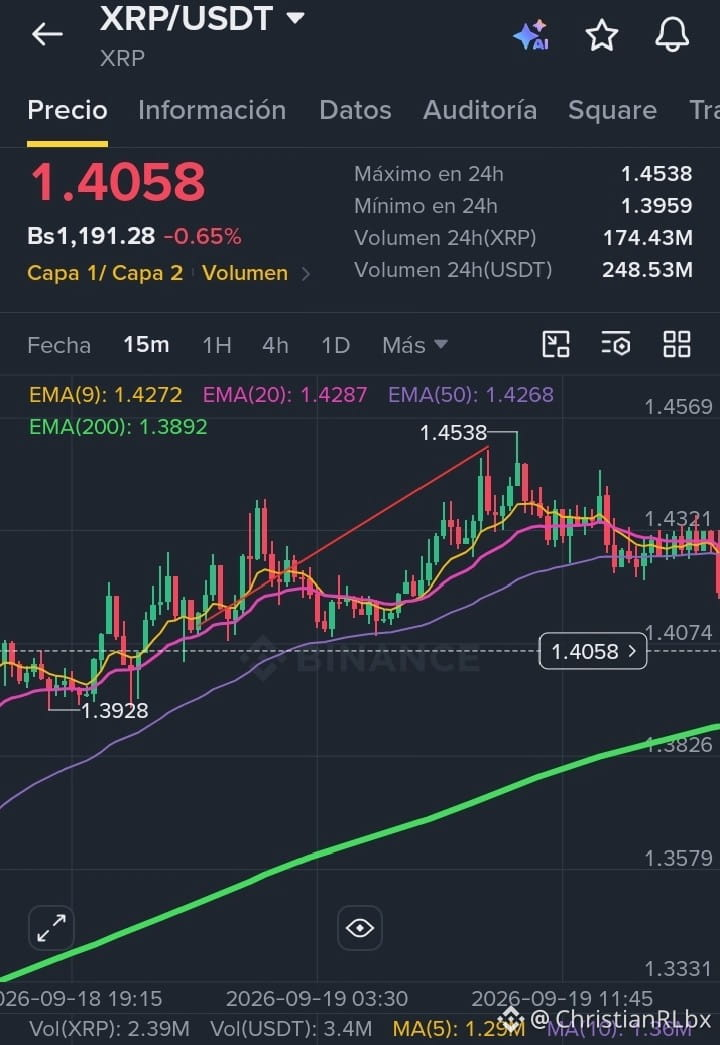
Yesterday we saw the perfect example in the perpetual futures of $XRP :📊 Quantitative Execution Breakdown:
• Setup: Long $XRPUSDT Perp (Dynamic M15 pullback + Bullish H1 bias)
• Entry: 1.4115 USDT
• Initial Stop Loss: 1.3944 USDT (-1.21% / 2.0x ATR)
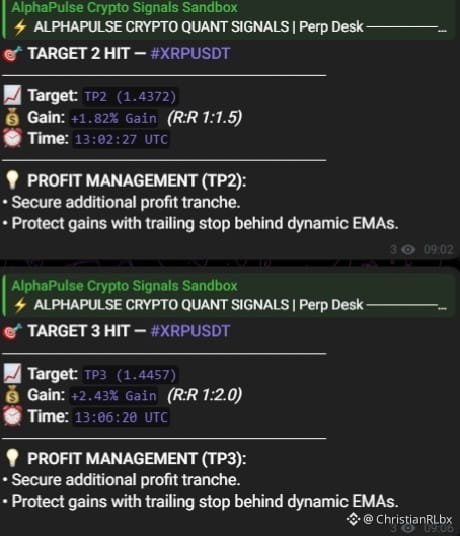
• Target 1 (1.4286): ✅ Hit (+1.21%) ➔ Take 50% and move Stop to Breakeven.
• Target 2 (1.4372): ✅ Hit (+1.82%)
• Target 3 (1.4457): ✅ Hit (+2.43% / R:R 1:2.0) ➔ Additional profits secured. 📉 What happened next:
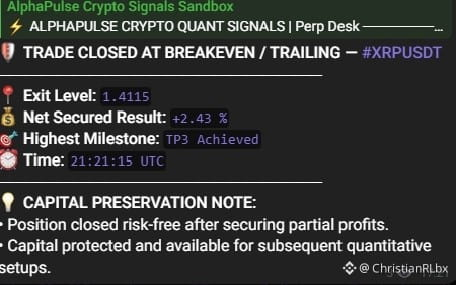
After reaching the TP3 target at 13:06 UTC, buy volume ran out and the market started a correction lasting more than 8 hours, which ended up sweeping through the entry price. What’s the result for a retail trader without algorithmic management? A trade that had accumulated more than 2.4% profit ends up touching the original Stop Loss or closing in panic with a red balance. What’s the result of the quantitative engine? Automatic closure at Breakeven at 21:21 UTC with a protected net result of +2.43% on the account. 💡 The Mathematical Rule:
In derivatives markets, your statistical advantage (edge) lies in removing the desk risk after the first impulse. Securing partials and moving the Stop Loss to the entry price turns the trade into a risk-free asset (risk-free). If the market continues to TP5, you maximize profits; if it reverses due to lack of liquidity, your capital remains intact. 💬 Question for the community:When trading futures, do you prefer taking fixed partials in R:R ratios 1:1 and 1:2, or do you let the full position run, assuming the risk that it will come back to the entry? I read you in the comments.
👇#TradingQuant #XRP #RiskManagement #Quantitativetrading #TradingSignals
{future}(XRPUSDT)
From +2.43% to zero: Why moving the Stop to Breakeven saved this futures trade in $XRP
80% of traders give back their profits over the weekend due to the same mistake: not locking in gains during the expansion and allowing a winning position to turn into a loss.
Yesterday we saw the perfect example in the perpetual futures of $XRP :📊 Quantitative Execution Breakdown:
• Setup: Long $XRPUSDT Perp (Dynamic M15 pullback + Bullish H1 bias)
• Entry: 1.4115 USDT
• Initial Stop Loss: 1.3944 USDT (-1.21% / 2.0x ATR)
• Target 1 (1.4286): ✅ Hit (+1.21%) ➔ Take 50% and move Stop to Breakeven.
• Target 2 (1.4372): ✅ Hit (+1.82%)
• Target 3 (1.4457): ✅ Hit (+2.43% / R:R 1:2.0) ➔ Additional profits secured. 📉 What happened next:
After reaching the TP3 target at 13:06 UTC, buy volume ran out and the market started a correction lasting more than 8 hours, which ended up sweeping through the entry price. What’s the result for a retail trader without algorithmic management? A trade that had accumulated more than 2.4% profit ends up touching the original Stop Loss or closing in panic with a red balance. What’s the result of the quantitative engine? Automatic closure at Breakeven at 21:21 UTC with a protected net result of +2.43% on the account. 💡 The Mathematical Rule:
In derivatives markets, your statistical advantage (edge) lies in removing the desk risk after the first impulse. Securing partials and moving the Stop Loss to the entry price turns the trade into a risk-free asset (risk-free). If the market continues to TP5, you maximize profits; if it reverses due to lack of liquidity, your capital remains intact. 💬 Question for the community:When trading futures, do you prefer taking fixed partials in R:R ratios 1:1 and 1:2, or do you let the full position run, assuming the risk that it will come back to the entry? I read you in the comments.
👇#TradingQuant #XRP #RiskManagement #Quantitativetrading #TradingSignals
80% of traders give back their profits over the weekend due to the same mistake: not locking in gains during the expansion and allowing a winning position to turn into a loss.
Yesterday we saw the perfect example in the perpetual futures of $XRP :📊 Quantitative Execution Breakdown:
• Setup: Long $XRPUSDT Perp (Dynamic M15 pullback + Bullish H1 bias)
• Entry: 1.4115 USDT
• Initial Stop Loss: 1.3944 USDT (-1.21% / 2.0x ATR)
• Target 1 (1.4286): ✅ Hit (+1.21%) ➔ Take 50% and move Stop to Breakeven.
• Target 2 (1.4372): ✅ Hit (+1.82%)
• Target 3 (1.4457): ✅ Hit (+2.43% / R:R 1:2.0) ➔ Additional profits secured. 📉 What happened next:
After reaching the TP3 target at 13:06 UTC, buy volume ran out and the market started a correction lasting more than 8 hours, which ended up sweeping through the entry price. What’s the result for a retail trader without algorithmic management? A trade that had accumulated more than 2.4% profit ends up touching the original Stop Loss or closing in panic with a red balance. What’s the result of the quantitative engine? Automatic closure at Breakeven at 21:21 UTC with a protected net result of +2.43% on the account. 💡 The Mathematical Rule:
In derivatives markets, your statistical advantage (edge) lies in removing the desk risk after the first impulse. Securing partials and moving the Stop Loss to the entry price turns the trade into a risk-free asset (risk-free). If the market continues to TP5, you maximize profits; if it reverses due to lack of liquidity, your capital remains intact. 💬 Question for the community:When trading futures, do you prefer taking fixed partials in R:R ratios 1:1 and 1:2, or do you let the full position run, assuming the risk that it will come back to the entry? I read you in the comments.
👇#TradingQuant #XRP #RiskManagement #Quantitativetrading #TradingSignals
1
284
Log in to explore more content
Join global crypto users on Binance Square
⚡️ Get latest and useful information about crypto.
💬 Trusted by the world’s largest crypto exchange.
👍 Discover real insights from verified creators.
Email / Phone number
Trending Topics
1
#SaylorHintsStrategyBitcoinBuy
2.3M views
12,418 Discussing
2
#BOJRaisesRatesTo31YearHigh
253,297 views
3,271 Discussing
3
#BuffettStepsDownAsBerkshireChairman
123,446 views
1,749 Discussing
4
#XRPExchangeReservesHitSevenYearLow
134,836 views
1,539 Discussing
5
#HKCompletesFirstHKDStablecoinUseCase
155,893 views
1,905 Discussing
6
#VietnamPlansFirstCryptoLicensesIn2026
97,760 views
1,290 Discussing
7
#BTCBreaks80K
539,741 views
5,778 Discussing
8
#BitcoinMarketCapTopsTesla
133,301 views
1,424 Discussing
9
#SOLJumpsAbout10%
132,951 views
1,278 Discussing
10
#EthereumReclaims$2600
12,127 views
140 Discussing