
#regulamentacao
regulamentacao
37,397 views
59 Discussing
Hot
Latest

·
--
Foxbit files crypto license application as DTVM advances at Central BankFoxbit confirmed that it filed its application for authorization with the Central Bank on October 29 to operate as a virtual asset service provider (VASP), and revealed that its Securities Distributor (DTVM) structure is in the final stage of approval by the regulator.
Foxbit’s application is part of a broader industry trend. The Central Bank published an official list of 120 applications for authorization to operate with crypto assets in Brazil, 119 of which are still under review and one of which was denied.
Foxbit files crypto license application as DTVM advances at Central Bank
Foxbit confirmed that it filed its application for authorization with the Central Bank on October 29 to operate as a virtual asset service provider (VASP), and revealed that its Securities Distributor (DTVM) structure is in the final stage of approval by the regulator.
Foxbit’s application is part of a broader industry trend. The Central Bank published an official list of 120 applications for authorization to operate with crypto assets in Brazil, 119 of which are still under review and one of which was denied.
Foxbit’s application is part of a broader industry trend. The Central Bank published an official list of 120 applications for authorization to operate with crypto assets in Brazil, 119 of which are still under review and one of which was denied.
782
·
--
Binance Brasil receives foreign exchange license from the Central BankBinance Brasil received authorization from the Central Bank of Brazil to operate in the foreign exchange market, becoming the first native virtual asset platform to obtain this type of license in the country.
The license was granted to Binance Brasil Corretora, the company’s legal name, formerly known as Sim;paul. With it, the broker now holds three regulatory authorizations in Brazil: the foreign exchange license, along with the previously obtained licenses as a securities broker and electronic money issuer.
The most immediate practical effect is on international transfer limits. Foreign exchange brokers authorized to provide virtual asset services allow users to make international transfers of up to US$500,000, compared with a US$100,000 limit for clients of institutions without this authorization.
Binance Brasil receives foreign exchange license from the Central Bank
Binance Brasil received authorization from the Central Bank of Brazil to operate in the foreign exchange market, becoming the first native virtual asset platform to obtain this type of license in the country.
The license was granted to Binance Brasil Corretora, the company’s legal name, formerly known as Sim;paul. With it, the broker now holds three regulatory authorizations in Brazil: the foreign exchange license, along with the previously obtained licenses as a securities broker and electronic money issuer.
The most immediate practical effect is on international transfer limits. Foreign exchange brokers authorized to provide virtual asset services allow users to make international transfers of up to US$500,000, compared with a US$100,000 limit for clients of institutions without this authorization.
Priyanshu_01:
Big step for Binance in Brazil 🇧🇷 Does this mean BRL deposits and withdrawals get easier for users there?
1
12
5.9k
·
--
Lumx brings together 100 stablecoin market leaders in São PauloLumx is holding the third edition of Lumx Connference in São Paulo on December 3, a closed-door gathering bringing together 100 decision-makers from the stablecoin market as the sector digests the end of the deadline for submitting authorization applications to the Central Bank.
The deadline for virtual asset companies already operating in Brazil to file an application for authorization with the Central Bank ended on October 30. The framework was established by BCB Resolutions No. 519, 520 and 521, published in November 2025.
Lumx brings together 100 stablecoin market leaders in São Paulo
Lumx is holding the third edition of Lumx Connference in São Paulo on December 3, a closed-door gathering bringing together 100 decision-makers from the stablecoin market as the sector digests the end of the deadline for submitting authorization applications to the Central Bank.
The deadline for virtual asset companies already operating in Brazil to file an application for authorization with the Central Bank ended on October 30. The framework was established by BCB Resolutions No. 519, 520 and 521, published in November 2025.
The deadline for virtual asset companies already operating in Brazil to file an application for authorization with the Central Bank ended on October 30. The framework was established by BCB Resolutions No. 519, 520 and 521, published in November 2025.
2
1.1k
·
--
Betting Law bans cryptocurrencies at licensed betting houses in BrazilThe Betting Law excluded cryptocurrencies from all payment methods accepted by licensed betting houses in Brazil, making it illegal for operators, funders, and intermediaries to process deposits or withdrawals in digital assets.
The ban does not stem from an isolated ordinance. The legislation establishing the regulatory framework for sports betting in Brazil classified cryptocurrencies under the broad term “virtual assets,” prohibiting their use as a means of payment on platforms authorized by the Ministry of Finance’s Secretariat of Prizes and Betting.
Betting Law bans cryptocurrencies at licensed betting houses in Brazil
The Betting Law excluded cryptocurrencies from all payment methods accepted by licensed betting houses in Brazil, making it illegal for operators, funders, and intermediaries to process deposits or withdrawals in digital assets.
The ban does not stem from an isolated ordinance. The legislation establishing the regulatory framework for sports betting in Brazil classified cryptocurrencies under the broad term “virtual assets,” prohibiting their use as a means of payment on platforms authorized by the Ministry of Finance’s Secretariat of Prizes and Betting.
The ban does not stem from an isolated ordinance. The legislation establishing the regulatory framework for sports betting in Brazil classified cryptocurrencies under the broad term “virtual assets,” prohibiting their use as a means of payment on platforms authorized by the Ministry of Finance’s Secretariat of Prizes and Betting.
160
·
--
CVM incorporates tokenization pilot into its 2026 Regulatory AgendaThe Brazilian Securities and Exchange Commission (CVM) has incorporated the CVM DLT Pilot Program into its 2026 Regulatory Agenda, formalizing the experimental environment created to test the tokenization of shares, debentures, receivables certificates and investment fund units on distributed ledger networks.
The pilot began on October 14, 2026, and operates without real investors: all transactions use fictitious assets and funds.
The CVM, however, monitors participating networks in real time, overseeing the issuance, offering, distribution, trading, book-entry recording, custody, central deposit and settlement of securities using DLT, of which blockchain is one part.
CVM incorporates tokenization pilot into its 2026 Regulatory Agenda
The Brazilian Securities and Exchange Commission (CVM) has incorporated the CVM DLT Pilot Program into its 2026 Regulatory Agenda, formalizing the experimental environment created to test the tokenization of shares, debentures, receivables certificates and investment fund units on distributed ledger networks.
The pilot began on October 14, 2026, and operates without real investors: all transactions use fictitious assets and funds.
The CVM, however, monitors participating networks in real time, overseeing the issuance, offering, distribution, trading, book-entry recording, custody, central deposit and settlement of securities using DLT, of which blockchain is one part.
335
·
--
Government approves package to combat money laundering involving cryptocurrenciesThe Ministry of Justice and Public Security is coordinating a set of proposals to strengthen the fight against money laundering in Brazil, with cryptocurrencies explicitly included in financial investigations and in identifying the ultimate beneficiaries of suspicious transactions.
The Ministry of Justice and Public Security is drafting proposals to be sent to the National Congress with the aim of toughening legislation against organized crime.
Among the key points is the explicit inclusion of crypto assets in money laundering investigations, covering everything from the analysis of blockchain transactions to identifying the ultimate beneficiaries of wallets and transactions.
Government approves package to combat money laundering involving cryptocurrencies
The Ministry of Justice and Public Security is coordinating a set of proposals to strengthen the fight against money laundering in Brazil, with cryptocurrencies explicitly included in financial investigations and in identifying the ultimate beneficiaries of suspicious transactions.
The Ministry of Justice and Public Security is drafting proposals to be sent to the National Congress with the aim of toughening legislation against organized crime.
Among the key points is the explicit inclusion of crypto assets in money laundering investigations, covering everything from the analysis of blockchain transactions to identifying the ultimate beneficiaries of wallets and transactions.
1
2.3k
·
--
CoinFlip ordered to refund US$4.8 million to scam victims in the USCoinFlip, an operator that describes itself as the world’s largest bitcoin ATM network by transaction volume, was ordered by California’s financial regulator to refund more than US$4.8 million to scam victims and pay more than US$350,000 in penalties for illegal fees.
The California Department of Financial Protection and Innovation (DFPI) filed an administrative action against CoinFlip and ordered it to refund more than US$4.8 million, equivalent to about R$26 million, directly to victims who suffered losses in scams involving the company’s ATMs.
CoinFlip ordered to refund US$4.8 million to scam victims in the US
CoinFlip, an operator that describes itself as the world’s largest bitcoin ATM network by transaction volume, was ordered by California’s financial regulator to refund more than US$4.8 million to scam victims and pay more than US$350,000 in penalties for illegal fees.
The California Department of Financial Protection and Innovation (DFPI) filed an administrative action against CoinFlip and ordered it to refund more than US$4.8 million, equivalent to about R$26 million, directly to victims who suffered losses in scams involving the company’s ATMs.
The California Department of Financial Protection and Innovation (DFPI) filed an administrative action against CoinFlip and ordered it to refund more than US$4.8 million, equivalent to about R$26 million, directly to victims who suffered losses in scams involving the company’s ATMs.
1
149
·
--
Brazilian bill seeks to block cryptocurrencies in deepfake fraudFederal Deputy José Medeiros (PL-MT) introduced Bill 5,729/2026, dubbed the Deepfake Anti-Crime Act, which establishes a national emergency protocol to block cryptoassets used in fraud involving deepfakes or voice cloning.
The bill was submitted to the Chamber of Deputies on November 3, 2026. The proposal requires Virtual Asset Service Providers (VASPs), banks, and payment institutions to provide detailed information about suspicious transactions upon receipt of a substantiated request or court order.
Brazilian bill seeks to block cryptocurrencies in deepfake fraud
Federal Deputy José Medeiros (PL-MT) introduced Bill 5,729/2026, dubbed the Deepfake Anti-Crime Act, which establishes a national emergency protocol to block cryptoassets used in fraud involving deepfakes or voice cloning.
The bill was submitted to the Chamber of Deputies on November 3, 2026. The proposal requires Virtual Asset Service Providers (VASPs), banks, and payment institutions to provide detailed information about suspicious transactions upon receipt of a substantiated request or court order.
The bill was submitted to the Chamber of Deputies on November 3, 2026. The proposal requires Virtual Asset Service Providers (VASPs), banks, and payment institutions to provide detailed information about suspicious transactions upon receipt of a substantiated request or court order.
3
4.5k
·
--
Brazil’s crypto market enters a new regulatory phase under the Central BankBrazil’s cryptoasset market entered a more regulated phase in late October, with the Central Bank taking on the role of supervisor for companies that broker, custody, or trade crypto in the country.
The key deadline in this transition was October 30: by that date, companies already operating in the country had to apply to the Central Bank for authorization to operate as Virtual Asset Service Providers (VASPs).
Those that did not apply for a license and wish to continue operating must notify the Central Bank in advance and comply with the same rules that apply to the sector.
Brazil’s crypto market enters a new regulatory phase under the Central Bank
Brazil’s cryptoasset market entered a more regulated phase in late October, with the Central Bank taking on the role of supervisor for companies that broker, custody, or trade crypto in the country.
The key deadline in this transition was October 30: by that date, companies already operating in the country had to apply to the Central Bank for authorization to operate as Virtual Asset Service Providers (VASPs).
Those that did not apply for a license and wish to continue operating must notify the Central Bank in advance and comply with the same rules that apply to the sector.
5
11.4k
·
--
Binance assures that Brazilians’ crypto assets are segregated and safeBinance said that Brazilian customers’ crypto assets are segregated across separate entities, stored in cold wallets, and beyond the reach of the wallets compromised in the largest-ever hack of an exchange.
Binance’s operational restructuring in Brazil was designed to comply with BCB Resolution No. 520, dated November 10, 2025, which requires the assets of customers and the company to be kept separate. The deadline for completing the restructuring was October 29.
Binance assures that Brazilians’ crypto assets are segregated and safe
Binance said that Brazilian customers’ crypto assets are segregated across separate entities, stored in cold wallets, and beyond the reach of the wallets compromised in the largest-ever hack of an exchange.
Binance’s operational restructuring in Brazil was designed to comply with BCB Resolution No. 520, dated November 10, 2025, which requires the assets of customers and the company to be kept separate. The deadline for completing the restructuring was October 29.
Binance’s operational restructuring in Brazil was designed to comply with BCB Resolution No. 520, dated November 10, 2025, which requires the assets of customers and the company to be kept separate. The deadline for completing the restructuring was October 29.
1
1.7k
·
--
Cainvest launches crypto licensing monitor for the Central BankCainvest Group launched the SPSAV Monitor, a platform that tracks in real time companies’ applications for authorization to operate in the cryptoasset sector with the Central Bank of Brazil, two days before the deadline to comply with the sector’s new regulatory framework.
Cainvest SPSAV Monitor is a public tracker that consolidates information on institutions that have filed applications with the Central Bank for authorization to operate as Virtual Asset Service Providers (VASPs).
As of October 29, 2026, the monitor listed 38 institutions with pending applications. Of these, three were on the monetary authority’s decision agenda, two were under review by the Central Bank, and another two were awaiting the submission of documents or responses from applicants.
Cainvest launches crypto licensing monitor for the Central Bank
Cainvest Group launched the SPSAV Monitor, a platform that tracks in real time companies’ applications for authorization to operate in the cryptoasset sector with the Central Bank of Brazil, two days before the deadline to comply with the sector’s new regulatory framework.
Cainvest SPSAV Monitor is a public tracker that consolidates information on institutions that have filed applications with the Central Bank for authorization to operate as Virtual Asset Service Providers (VASPs).
As of October 29, 2026, the monitor listed 38 institutions with pending applications. Of these, three were on the monetary authority’s decision agenda, two were under review by the Central Bank, and another two were awaiting the submission of documents or responses from applicants.
146
·
--
Central Bank identifies 33 companies in the race for crypto license in BrazilCoinbase, Nubank, Binance, Ripple, Itaú, Inter, Braza Bank, and Mercado Bitcoin are among the 33 companies and financial institutions identified in the process of adapting to the new licensing regime for virtual asset service providers (VASPs) in Brazil.
The survey cross-referenced public databases of proceedings and protocols from the Central Bank of Brazil with corporate records and direct confirmations from market participants.
Each company is listed with its CNPJ and the specific process number opened with the regulator. Among the identified examples are Transfero (process 315453), Mazzera (process 315286), and PFPay (process 314610).
Central Bank identifies 33 companies in the race for crypto license in Brazil
Coinbase, Nubank, Binance, Ripple, Itaú, Inter, Braza Bank, and Mercado Bitcoin are among the 33 companies and financial institutions identified in the process of adapting to the new licensing regime for virtual asset service providers (VASPs) in Brazil.
The survey cross-referenced public databases of proceedings and protocols from the Central Bank of Brazil with corporate records and direct confirmations from market participants.
Each company is listed with its CNPJ and the specific process number opened with the regulator. Among the identified examples are Transfero (process 315453), Mazzera (process 315286), and PFPay (process 314610).
1
2
1.6k

·
--
Here is a post in the style of Binance Square:
🌍 Governments are starting to trust cryptocurrencies... and this could change the market forever.
For years, many countries viewed cryptocurrencies with suspicion. Today, the landscape is shifting: more and more governments are creating regulations, studying strategic reserves in digital assets, and developing policies to integrate blockchain technology into the economy. This can increase legal certainty, attract large investors, and accelerate global adoption.
A balanced regulation also helps combat fraud without stifling innovation, making the market more mature and reliable for companies and investors. For those following the sector, this move could represent one of the biggest drivers of the next phase of the crypto market.
Institutional trust doesn’t eliminate risks, but it strengthens the ecosystem and opens up new opportunities for solid projects. Do you believe government adoption will be one of the main factors driving market growth over the coming years? Share your opinion!
#Criptomoedas
{spot}(BTCUSDT)
#Blockchain #MercadoCripto #Regulamentacao #BinanceSquare
$BTC $SOL $LINK
Here is a post in the style of Binance Square:
🌍 Governments are starting to trust cryptocurrencies... and this could change the market forever.
For years, many countries viewed cryptocurrencies with suspicion. Today, the landscape is shifting: more and more governments are creating regulations, studying strategic reserves in digital assets, and developing policies to integrate blockchain technology into the economy. This can increase legal certainty, attract large investors, and accelerate global adoption.
A balanced regulation also helps combat fraud without stifling innovation, making the market more mature and reliable for companies and investors. For those following the sector, this move could represent one of the biggest drivers of the next phase of the crypto market.
Institutional trust doesn’t eliminate risks, but it strengthens the ecosystem and opens up new opportunities for solid projects. Do you believe government adoption will be one of the main factors driving market growth over the coming years? Share your opinion!
#Criptomoedas
#Blockchain #MercadoCripto #Regulamentacao #BinanceSquare
$BTC $SOL $LINK

1
121
·
--
Central Bank Creates Risk Classification for Crypto AbroadThe Central Bank’s new rule creates a specific code to identify financial adjustments in cryptoasset transactions with foreign institutions, with capital requirements varying by risk category.
The Central Bank has proposed a four-category risk classification for cryptoasset transactions conducted with foreign institutions. The scale ranges from “tokenized traditional assets (1A)” to “high-risk cryptoassets (2B),” with specific capital requirements and liquidity controls for each category.
Central Bank Creates Risk Classification for Crypto Abroad
The Central Bank’s new rule creates a specific code to identify financial adjustments in cryptoasset transactions with foreign institutions, with capital requirements varying by risk category.
The Central Bank has proposed a four-category risk classification for cryptoasset transactions conducted with foreign institutions. The scale ranges from “tokenized traditional assets (1A)” to “high-risk cryptoassets (2B),” with specific capital requirements and liquidity controls for each category.
The Central Bank has proposed a four-category risk classification for cryptoasset transactions conducted with foreign institutions. The scale ranges from “tokenized traditional assets (1A)” to “high-risk cryptoassets (2B),” with specific capital requirements and liquidity controls for each category.
149
·
--
Bill allows crypto exchanges to check Federal Revenue Service data in real timeBill 5,645/2026, introduced by Representative Fernando Monteiro (PSD-PE), authorizes cryptocurrency exchanges and payment institutions to access Federal Revenue Service registration data in real time using an individual taxpayer ID (CPF) or corporate taxpayer ID (CNPJ).
The measure does not disclose financial information and therefore does not violate investors’ tax confidentiality. The bill also includes virtual asset service providers (VASPs) among those eligible to access the data.
The proposal comes in response to a series of digital fraud schemes, money laundering cases, and the systematic use of money mule accounts in the cryptoasset market. A hacker attack that caused losses of R$800 million is also among the incidents that prompted the legislative initiative.
Bill allows crypto exchanges to check Federal Revenue Service data in real time
Bill 5,645/2026, introduced by Representative Fernando Monteiro (PSD-PE), authorizes cryptocurrency exchanges and payment institutions to access Federal Revenue Service registration data in real time using an individual taxpayer ID (CPF) or corporate taxpayer ID (CNPJ).
The measure does not disclose financial information and therefore does not violate investors’ tax confidentiality. The bill also includes virtual asset service providers (VASPs) among those eligible to access the data.
The proposal comes in response to a series of digital fraud schemes, money laundering cases, and the systematic use of money mule accounts in the cryptoasset market. A hacker attack that caused losses of R$800 million is also among the incidents that prompted the legislative initiative.
76

·
--
Bearish
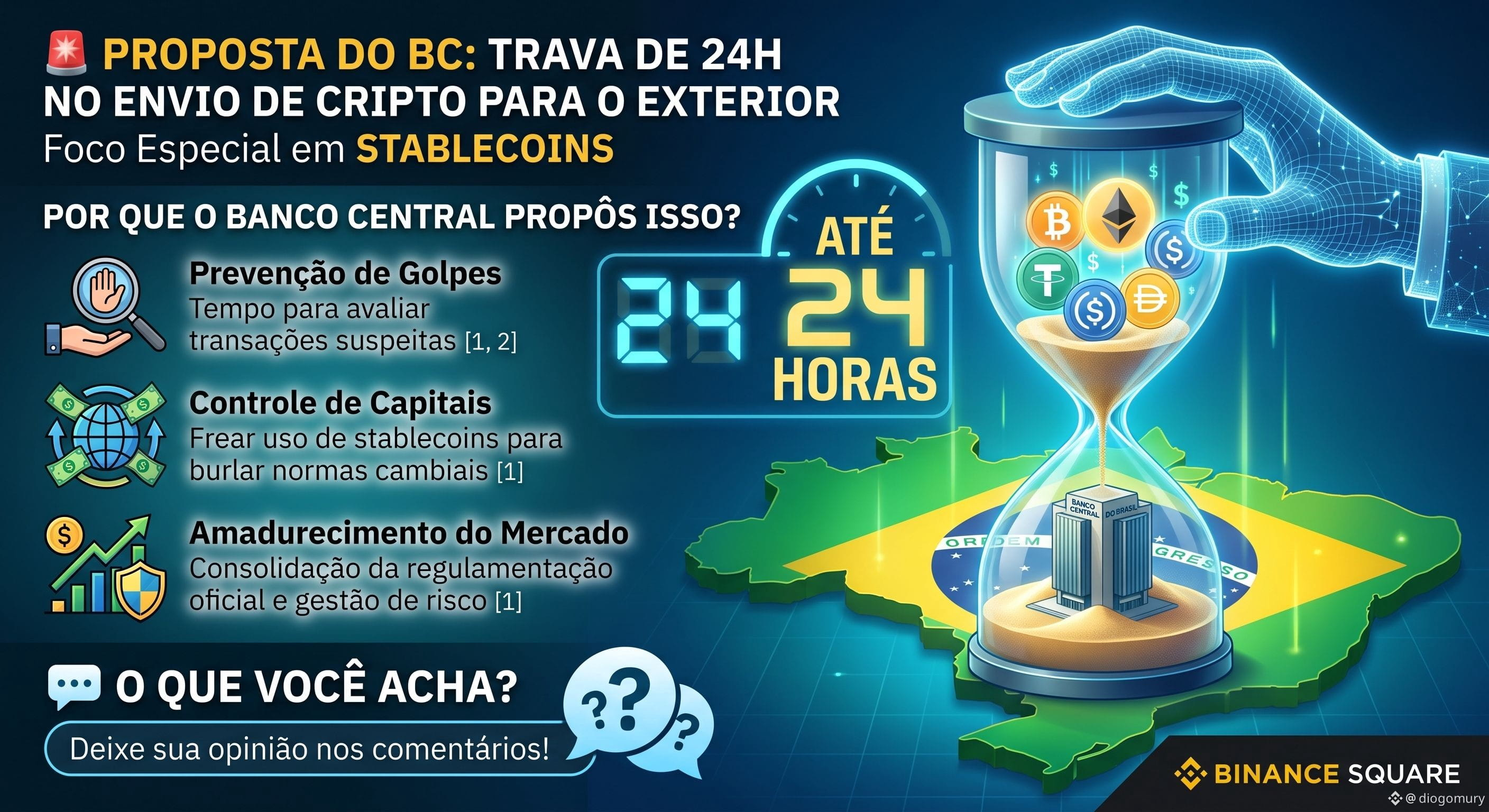
URGENT: Brazil’s Central Bank proposes a 24-hour “lock” on sending crypto abroad!
The Central Bank of Brazil has just proposed a measure that promises to shake up the crypto market here. The idea is that brokers and financial institutions may hold (lock) for up to 24 hours orders to send cryptocurrencies out of the country, with a very strong focus on stablecoins.
If you’re used to moving funds from local platforms to wallets or global exchanges, it’s worth understanding the reasons behind it:
🛡️ Brake on Scams and Fraud: This 24-hour window acts as a “breathing space” so that suspicious transactions can be assessed and traced before the money disappears on the blockchain.
💵 Currency and Capital Controls: The Central Bank is watching the growing use of stablecoins (tied to the dollar) for undeclared international remittances or to bypass traditional exchange rules.
📊 Stricter Regulation: This is part of the evolution of crypto rules in Brazil. Brokers will have to invest heavily in risk management and compliance structures.
⚠️ What does that mean in practice? Less immediate liquidity for international arbitrage or fast stablecoin transfers between jurisdictions.
💬 And what do you think about this Central Bank proposal? Do you think it will help protect investors or will it get in the way of freedom and day-to-day operational speed?
Leave your opinion in the comments! 👇
#Brazil #Regulamentacao #Stablecoins
150
·
--
Onda Finance is the first crypto company in the formal process with the Central BankOnda Finance appeared this Monday (21) in Communiqué No. 45,986 from the Central Bank. The document identifies the company as a Virtual Assets Service Provider Company (SPSAV) “in the process of authorization.” The fintech operates with international payments, settlement in stablecoins, and crypto custody.
This is not a granted license. The communiqué opens a 15-day period for public objections to the appointed directors. Even so, it is the first public sign of an SPSAV advancing in the process, 39 days before the sector’s final deadline.
Onda Finance is the first crypto company in the formal process with the Central Bank
Onda Finance appeared this Monday (21) in Communiqué No. 45,986 from the Central Bank. The document identifies the company as a Virtual Assets Service Provider Company (SPSAV) “in the process of authorization.” The fintech operates with international payments, settlement in stablecoins, and crypto custody.
This is not a granted license. The communiqué opens a 15-day period for public objections to the appointed directors. Even so, it is the first public sign of an SPSAV advancing in the process, 39 days before the sector’s final deadline.
This is not a granted license. The communiqué opens a 15-day period for public objections to the appointed directors. Even so, it is the first public sign of an SPSAV advancing in the process, 39 days before the sector’s final deadline.
2
279
·
--
Binance removes cryptocurrencies and products for Brazilian usersExchange scales back its asset and product offerings in the country following changes that had already removed futures contracts from its Brazilian catalog.
Binance, the world’s largest cryptocurrency exchange, published an article this Thursday (8) announcing changes to the platform for Brazilian users. According to the exchange, the goal is to comply with the country’s regulations.
The move is not an isolated one. Binance had already stopped offering futures contracts to Brazilian users as part of the same compliance process, after being alerted by the Securities and Exchange Commission of Brazil (CVM) as early as July 2020. The newly announced removal of cryptocurrencies and products adds to this series of adjustments.
Binance removes cryptocurrencies and products for Brazilian users
Exchange scales back its asset and product offerings in the country following changes that had already removed futures contracts from its Brazilian catalog.
Binance, the world’s largest cryptocurrency exchange, published an article this Thursday (8) announcing changes to the platform for Brazilian users. According to the exchange, the goal is to comply with the country’s regulations.
The move is not an isolated one. Binance had already stopped offering futures contracts to Brazilian users as part of the same compliance process, after being alerted by the Securities and Exchange Commission of Brazil (CVM) as early as July 2020. The newly announced removal of cryptocurrencies and products adds to this series of adjustments.
1
1
5
2.2k
·
--
Paraná court orders Rental Coins partners to pay for pump-and-dump scamThe Paraná Court of Justice voided Rental Coins’ crypto-asset leasing contract. The company is bankrupt, and its partners, Francisley Valdevino and Claudete Chagas, were ordered to return the money they received from investors.
The ruling found that the defendants carried out a pump-and-dump scam, a type of fraud in which the price of a digital asset is artificially inflated before it is sold at its peak, leaving buyers with losses.
The case involves a cryptocurrency rental contract offered by Rental Coins to investors in Curitiba. The model promised returns from leasing digital assets, but the court concluded that the token marketed by the company had no real monetary value. According to the court ruling, the asset was created as a way to attract capital and carry out the scam.
Paraná court orders Rental Coins partners to pay for pump-and-dump scam
The Paraná Court of Justice voided Rental Coins’ crypto-asset leasing contract. The company is bankrupt, and its partners, Francisley Valdevino and Claudete Chagas, were ordered to return the money they received from investors.
The ruling found that the defendants carried out a pump-and-dump scam, a type of fraud in which the price of a digital asset is artificially inflated before it is sold at its peak, leaving buyers with losses.
The case involves a cryptocurrency rental contract offered by Rental Coins to investors in Curitiba. The model promised returns from leasing digital assets, but the court concluded that the token marketed by the company had no real monetary value. According to the court ruling, the asset was created as a way to attract capital and carry out the scam.
219
·
--
Website trades cryptocurrencies for pro-Flávio Bolsonaro promotionA website launched this week pays in cryptocurrency anyone who publishes content asking for a vote for Flávio Bolsonaro. The counterpart is a post on social media. The presidential runoff is in 17 days.
The asset is Brazil 22 Token (B22), a memecoin: a cryptocurrency without technical utility, driven by narrative. It was launched on Tuesday, October 6.
Whoever publishes that they participate in the “B22 community” receives tokens, according to the project’s website. Videos that circulate with the token’s brand ask for a vote for number 22, the one from the PL.
Website trades cryptocurrencies for pro-Flávio Bolsonaro promotion
A website launched this week pays in cryptocurrency anyone who publishes content asking for a vote for Flávio Bolsonaro. The counterpart is a post on social media. The presidential runoff is in 17 days.
The asset is Brazil 22 Token (B22), a memecoin: a cryptocurrency without technical utility, driven by narrative. It was launched on Tuesday, October 6.
Whoever publishes that they participate in the “B22 community” receives tokens, according to the project’s website. Videos that circulate with the token’s brand ask for a vote for number 22, the one from the PL.
2
144
Log in to explore more content
Join global crypto users on Binance Square
⚡️ Get latest and useful information about crypto.
💬 Trusted by the world’s largest crypto exchange.
👍 Discover real insights from verified creators.
Email / Phone number
Trending Topics
1
#CanMarketsReboundAfterThanksgiving?
75,153 views
1,077 Discussing
2
#CouldSpaceX’sOrbitalDataCentersBoostAIChipDemand?
37,528 views
666 Discussing
3
#EvolveAtBinanceBlockchainWeek
722,616 views
8,567 Discussing
4
#KoreaFSCSeeksPowerToSuspendCryptoListings
772 views
37 Discussing
5
#SouthKoreaPlansToRequireTetherCircleLocalReserves
568 views
22 Discussing
6
#UKFCAReportedlyPlansDeFiAuthorizationRules
957 views
22 Discussing
7
#ZcashDevelopersUrgeZECMoveToIronwood
1,002 views
14 Discussing
8
#TetherGoldFaces$2.55BUnrealizedLoss
363 views
6 Discussing
9
#CorePCEBeatLiftsFedHikeOdds
228,649 views
1,625 Discussing
10
#BitcoinAndStocksSlipAgainAmidTrump’sTariffPlans
259,663 views
2,378 Discussing