
#pumpfun
pumpfun
2.1M views
3,504 Discussing
Hot
Latest

·
--
Partly True
💮 PUMP'S BUYBACK MACHINE Is Still Running!
Pump.fun is continuing to reduce PUMP's circulating supply.
🔥 What's confirmed?
- Official data shows 175.29 billion PUMP removed from supply.
- Daily buybacks and burns continued through November 7.
- Pump.fun is preparing Token-2022 and Mayhem Mode for November 12.
- Its app is expanding beyond Solana with additional ecosystem trading support.
Why it matters: Continued buybacks and platform expansion could strengthen PUMP's long-term ecosystem.
Watch next: November 12 upgrade and official burn updates.
$PUMP
{future}(PUMPUSDT)
.
.
.
#PumpFun #Crypto
Not financial advice. DYOR.
💮 PUMP'S BUYBACK MACHINE Is Still Running!
Pump.fun is continuing to reduce PUMP's circulating supply.
🔥 What's confirmed?
- Official data shows 175.29 billion PUMP removed from supply.
- Daily buybacks and burns continued through November 7.
- Pump.fun is preparing Token-2022 and Mayhem Mode for November 12.
- Its app is expanding beyond Solana with additional ecosystem trading support.
Why it matters: Continued buybacks and platform expansion could strengthen PUMP's long-term ecosystem.
Watch next: November 12 upgrade and official burn updates.
$PUMP
.
.
.
#PumpFun #Crypto
Not financial advice. DYOR.
3
780

·
--
Pump.fun is selling again: 76,111 SOL sent to Kraken.
Facts (COINOTAG):
• Pump.fun resumed its Solana treasury sales
• 76,111 SOL, about $6.85M, moved to Kraken
• $PUMP was the steepest faller in the top 100 today, -6.88% (CoinMarketCap)
• $SOL sits near $89, below $90
A treasury moving coins to an exchange often signals selling, but $6.85M is small next to SOL's daily volume. The bigger question is whether these sales keep repeating.
Do project treasury sales weigh on price for you, or is it noise?
Not financial advice.
#PumpFun #Solana #CryptoNews
4
·
--
Partly True
PUMP Is Expanding Beyond Meme Launches!🧜🏻♂️
Pump.fun is making a major push toward becoming a broader trading platform.
🔥 Latest developments:
- Hyperliquid perpetual trading has been added to the app.
- New Token-2022 creation standard is planned for November 12.
- Mayhem Mode is also scheduled for the same update.
Why it matters: Pump.fun is expanding its platform beyond its original token-launch model.
Watch next: Adoption of the new features and official implementation updates.
$PUMP
{future}(PUMPUSDT)
.
.
.
#PumpFun #Crypto
Not financial advice. DYOR.
PUMP Is Expanding Beyond Meme Launches!🧜🏻♂️
Pump.fun is making a major push toward becoming a broader trading platform.
🔥 Latest developments:
- Hyperliquid perpetual trading has been added to the app.
- New Token-2022 creation standard is planned for November 12.
- Mayhem Mode is also scheduled for the same update.
Why it matters: Pump.fun is expanding its platform beyond its original token-launch model.
Watch next: Adoption of the new features and official implementation updates.
$PUMP
.
.
.
#PumpFun #Crypto
Not financial advice. DYOR.
3
1.1k
·
--
Verified
🚨 PUMP Just Entered Sweden’s ETP Market — Bigger Exposure Ahead?
Pump.fun’s native token $PUMP has gained a new traditional-finance access point.
CONFIRMED: On November 5, Valour launched a SEK-denominated PUMP exchange-traded product on Sweden’s Spotlight Stock Market.
Why it matters: It gives eligible investors another way to gain exposure to PUMP without directly holding the token.
Another key factor: Pump.fun reported $62.43M in October revenue, its highest monthly total of 2026.
Watch next: Platform activity, token supply unlocks, and whether the new ETP attracts meaningful demand.
Takeaway: More exposure is possible, but sustained adoption matters more than headlines.
$PUMP
{future}(PUMPUSDT)
.
.
.
#PumpFun #crypto
Not financial advice. DYOR.
🚨 PUMP Just Entered Sweden’s ETP Market — Bigger Exposure Ahead?
Pump.fun’s native token $PUMP has gained a new traditional-finance access point.
CONFIRMED: On November 5, Valour launched a SEK-denominated PUMP exchange-traded product on Sweden’s Spotlight Stock Market.
Why it matters: It gives eligible investors another way to gain exposure to PUMP without directly holding the token.
Another key factor: Pump.fun reported $62.43M in October revenue, its highest monthly total of 2026.
Watch next: Platform activity, token supply unlocks, and whether the new ETP attracts meaningful demand.
Takeaway: More exposure is possible, but sustained adoption matters more than headlines.
$PUMP
.
.
.
#PumpFun #crypto
Not financial advice. DYOR.
639

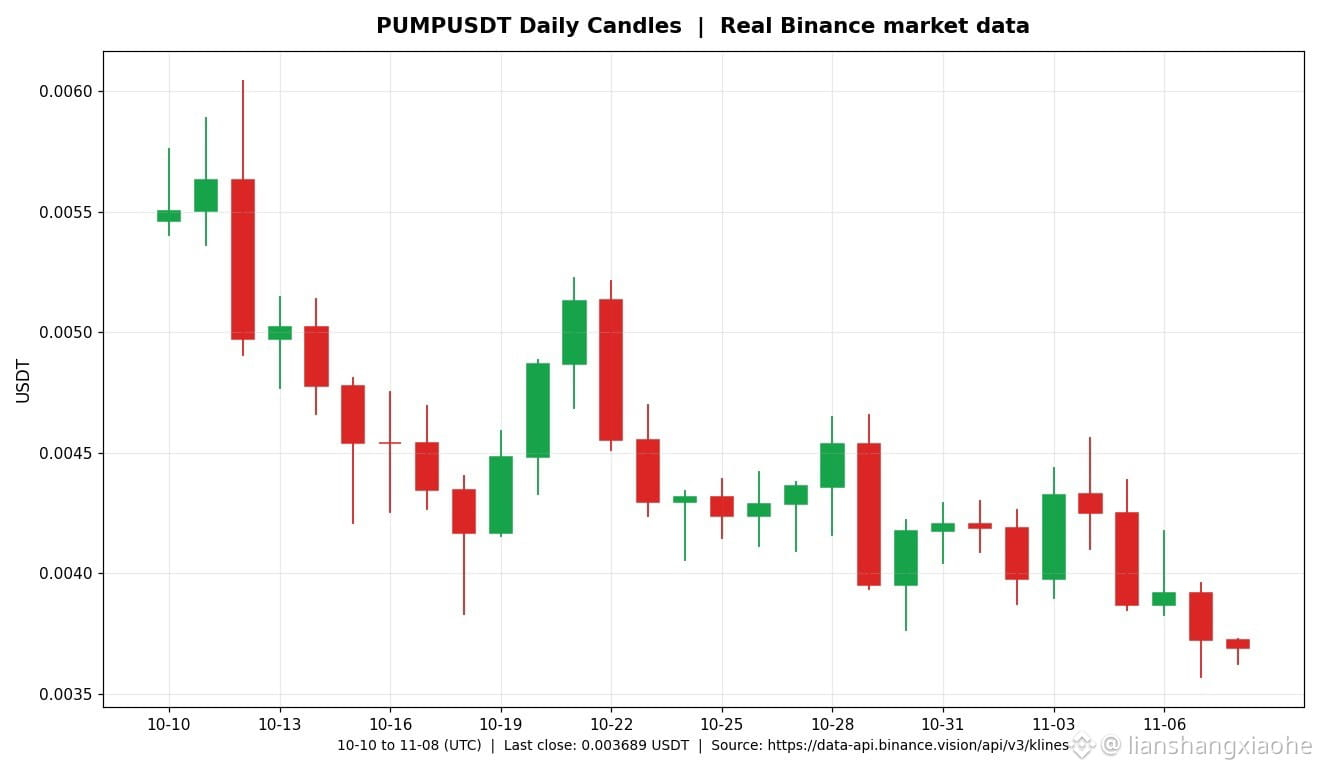
The biggest loser among the top 100 coins today is $PUMP.
It’s currently at $0.00368, down 6.67% in 24 hours, 14% in 7 days, and 35.8% in 30 days. Its market cap is down to just $1.68 billion, a 59% drop from its peak of $0.008994. Someone who bought $10,000 worth at the November 6 closing price of $0.003917 is now left with just $9,418, losing $582 in two days. Those who bought a week ago are worse off: their $10,000 is now worth only about $8,600. Liquidations totaled $3.23 million over 24 hours, with longs accounting for nearly all of them.
Pump.fun just launched its experimental Diamond rewards algorithm yesterday and renamed the original system Degen, but the good news couldn’t prop up the price. The chart shows a steady decline over the past 30 days. This candlestick tells you that no matter how hot the narrative gets, meme platform tokens can’t withstand the broader market draining liquidity. Those who bought at the top are lining up to cut their losses.
#Pumpfun #meme coin
The biggest loser among the top 100 coins today is $PUMP .
It’s currently at $0.00368, down 6.67% in 24 hours, 14% in 7 days, and 35.8% in 30 days. Its market cap is down to just $1.68 billion, a 59% drop from its peak of $0.008994. Someone who bought $10,000 worth at the November 6 closing price of $0.003917 is now left with just $9,418, losing $582 in two days. Those who bought a week ago are worse off: their $10,000 is now worth only about $8,600. Liquidations totaled $3.23 million over 24 hours, with longs accounting for nearly all of them.
Pump.fun just launched its experimental Diamond rewards algorithm yesterday and renamed the original system Degen, but the good news couldn’t prop up the price. The chart shows a steady decline over the past 30 days. This candlestick tells you that no matter how hot the narrative gets, meme platform tokens can’t withstand the broader market draining liquidity. Those who bought at the top are lining up to cut their losses.
#Pumpfun #meme coin
1
75

$PUMP
{spot}(PUMPUSDT)
🚀 PUMP BREAKOUT: Momentum Builds as Token Reclaims Key Levels!
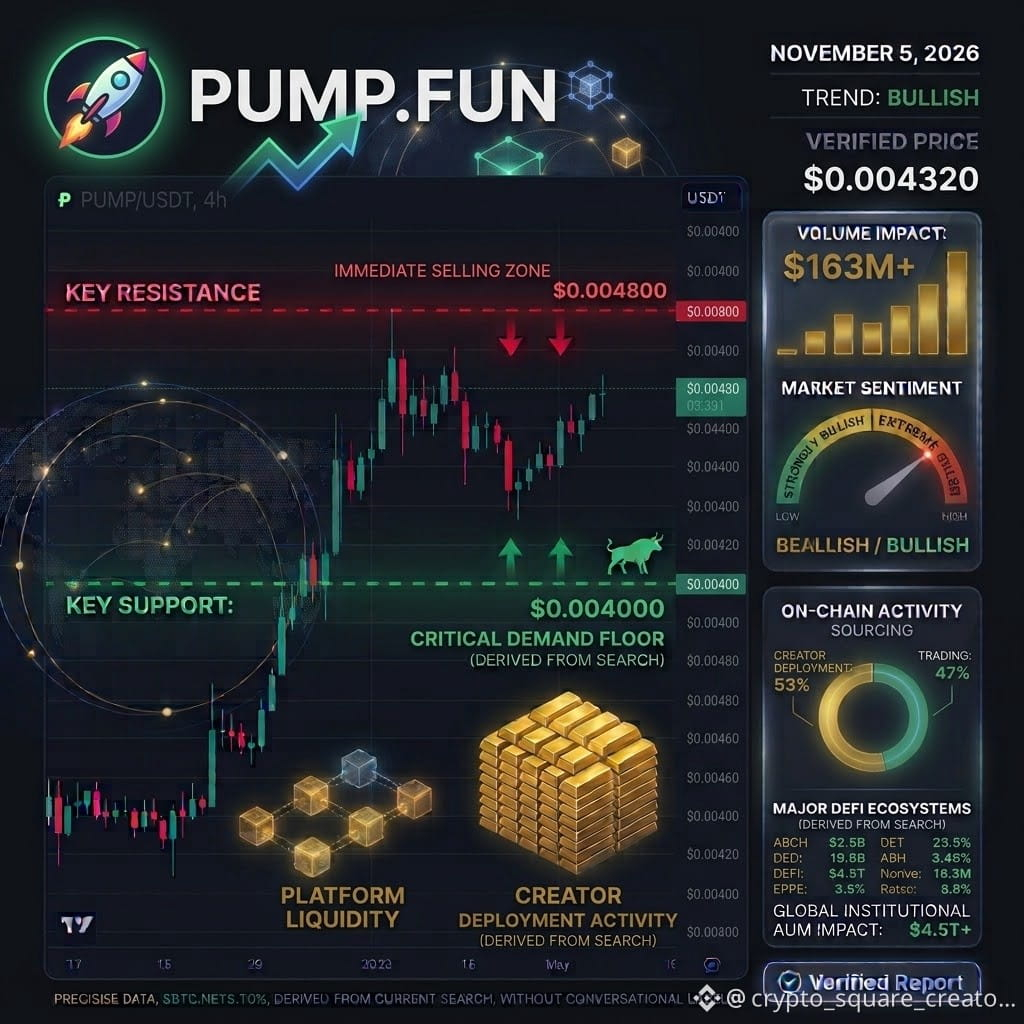
Pump.fun ($PUMP) is showing impressive upward momentum, currently trading at a verified live price of $0.004320 with solid 24-hour gains. The short-term market trend is firmly BULLISH.
Key Resistance: $0.004800
Key Support: $0.004000
Why It Moves: Renewed platform activity and strong daily volume ($163M+) are driving aggressive buyer accumulation across spot and perpetual markets.
Can $PUMP break past $0.0048 to test higher highs this week? Drop your thoughts below! 👇
#pumpfun #pump #cryptotrading #altcoins #BinanceSquare #CryptoNews #Bullish
Not financial advice.
$PUMP
🚀 PUMP BREAKOUT: Momentum Builds as Token Reclaims Key Levels!
Pump.fun ($PUMP ) is showing impressive upward momentum, currently trading at a verified live price of $0.004320 with solid 24-hour gains. The short-term market trend is firmly BULLISH.
Key Resistance: $0.004800
Key Support: $0.004000
Why It Moves: Renewed platform activity and strong daily volume ($163M+) are driving aggressive buyer accumulation across spot and perpetual markets.
Can $PUMP break past $0.0048 to test higher highs this week? Drop your thoughts below! 👇
#pumpfun #pump #cryptotrading #altcoins #BinanceSquare #CryptoNews #Bullish
Not financial advice.
274

·
--
Pump.fun is sending SOL to exchanges again, breaking 15 days of silence 🐸➡️🏦
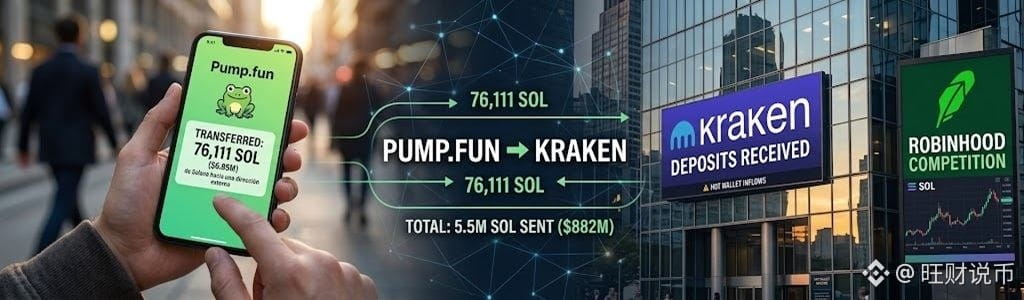
📌 Lookonchain data: On November 6, Pump.fun’s fee account deposited 76,111 SOL (about $6.85 million) into Kraken.
📊 It has sold a total of 5,553,833 SOL (about $882 million), at an average price of $158.88.
📉 SOL is now worth only about $90, far below its average selling price.
⚠️ To be clear: transferring tokens to an exchange doesn’t mean they’ve been sold, but historically, transfers like these have mostly been used to convert to stablecoins and fund operations.
🥊 The community is still criticizing its fee model, and some are naming Robinhood as a potential new competitor.
👉 A single $6.85 million transfer isn’t that big. The real question is whether selling pressure will continue. SOL remains below the EMA50 (around $94.75) on the 4-hour chart, with key support at $87.8.
Do you think Pump.fun’s continued selling will cap SOL’s rebound, or has the market already priced it in? Share your thoughts in the comments 👇
$SOL $BTC $ETH
#Solana #Pumpfun #OnChainData
Personal opinion only; not investment advice
2

So-called fair launches are often decided before trading even begins.
Researchers from EPFL, ETH Zurich, and Carnegie Mellon analyzed about 15.2 million coins launched on Pump.fun during its first two years: the top 1% of creator addresses accounted for about 39%. When addresses were grouped into clusters based on their funding sources, the top 1% of clusters accounted for 53% to 59%. Roughly one in ten coins was a copy with a new coat of paint—its name, symbol, image, and description all copied.
A million new tickers don’t mean a million independent operators. Factory wallets cultivate the attention first, then retail traders come in to take the baton. The platform earns launch and trading fees; it doesn’t care which factory’s assembly line you’re buying into.
Next time you hear “anyone can launch a coin,” ask one thing first: who’s launching them in bulk?
#Pumpfun #MEME
3

Pump.fun held back for 15 days, then dumped 76,111 $SOL on Kraken in one go this morning, worth $6.85 million.
It has sold 5.55 million tokens in total, cashing out $880 million at an average price of $158.9—now $SOL is only a little over $90, so it’s still selling at rock-bottom prices.
They talk about buying back $PUMP, but keep selling the fees they collect all the same. Traders are already betting that Robinhood will move in and steal its business.
A: It’s only natural for a platform to sell tokens. $90 SOL is a perfect bargain.
B: Even the insiders are dumping—how dare you try to catch a falling knife?
$SOL $PUMP
#Pumpfun #Solana
Pump.fun held back for 15 days, then dumped 76,111 $SOL on Kraken in one go this morning, worth $6.85 million.
It has sold 5.55 million tokens in total, cashing out $880 million at an average price of $158.9—now $SOL is only a little over $90, so it’s still selling at rock-bottom prices.
They talk about buying back $PUMP , but keep selling the fees they collect all the same. Traders are already betting that Robinhood will move in and steal its business.
A: It’s only natural for a platform to sell tokens. $90 SOL is a perfect bargain.
B: Even the insiders are dumping—how dare you try to catch a falling knife?
$SOL $PUMP
#Pumpfun #Solana
64
Lookonchain spotted it: Pump.fun went quiet for 15 days, then sent another 76,111 SOL to Kraken, worth about $6.85 million.
They’ve sold over 5.55 million SOL in total, worth about $882.4 million, at an average price of $158.88. Spot is now hovering around $90. Their selling cost basis is still hanging over your head.
On one hand, they’re shouting “faith pays off” in Diamond callouts; on the other, they’re dumping the SOL they got from fees into exchanges. The platform profits from token launches and trading volume—not your conviction. The token-launch machine itself is the biggest bear.
#SOL #Pumpfun
233
Pump came up with another Diamond callout, saying it rewards people who buy and hold without selling. A bunch of accounts in the community immediately started shouting, “Faith finally pays off.”
Cut the crap. The rewards still come from the fee pool, and whoever calls the shots gets the kickbacks. The Degen tier pushes you to churn through short-term trades; the Diamond tier pushes you to lock in for longer so copy traders hold on for a few more days. The platform wants volume, not your diamond hands.
Even more ridiculous: the moment the icon appeared, a shitcoin with the same name, DIAMOND, popped up 14 seconds later. The narrative hadn’t even landed, and the meme was already feeding off it.
Rewarding faith? No, it rewards mouths that bring in volume.
#Pumpfun #Solana
3

·
--
From 00:00 to 08:00, 307 newly launched Pump.fun tokens graduated.
This time, I pulled up the creator wallets to compare them:
32 wallets graduated 2 or more tokens in a single night, for a total of 109 tokens.
So far, 102 of those 109 have fallen below a $5,000 market cap.
The most hardworking wallet launched 10 tokens between 00:10 and 07:24, going from Microsoft, SpaceX, and OpenAI all the way to BMW. It even used the name Grok twice.
Of the 10, only the last one, SpaceX, is still above $50,000.
Don’t get excited when you see a token graduate—open the creator wallet and check how many they launched last night 🫠
NFA|DYOR
#排雷 #Solana #PumpFun $SOL
176
·
--
🔥 PUMP’s Biggest Strength? Its Buyback and Burn!
Pump.fun is continuing to remove PUMP tokens from circulation.
CONFIRMED: According to Pump.fun’s official dashboard, approximately 175.29 billion PUMP tokens have been bought back and burned. Its November 3 record shows another 166.5 million tokens burned, worth around $688,000.
WHY IT MATTERS: Fewer tokens in circulation can affect supply dynamics, but it does not guarantee price growth.
WATCH NEXT: Platform revenue, buyback activity, and token unlocks.
Takeaway: PUMP’s burn mechanism is worth watching—but sustainable platform activity matters most.
Click the $PUMP widget below and check the latest developments.
$PUMP
{future}(PUMPUSDT)
.
.
.
#PumpFun #Crypto
Not financial advice. DYOR.
🔥 PUMP’s Biggest Strength? Its Buyback and Burn!
Pump.fun is continuing to remove PUMP tokens from circulation.
CONFIRMED: According to Pump.fun’s official dashboard, approximately 175.29 billion PUMP tokens have been bought back and burned. Its November 3 record shows another 166.5 million tokens burned, worth around $688,000.
WHY IT MATTERS: Fewer tokens in circulation can affect supply dynamics, but it does not guarantee price growth.
WATCH NEXT: Platform revenue, buyback activity, and token unlocks.
Takeaway: PUMP’s burn mechanism is worth watching—but sustainable platform activity matters most.
Click the $PUMP widget below and check the latest developments.
$PUMP
.
.
.
#PumpFun #Crypto
Not financial advice. DYOR.
498
·
--
Verified
🚨 Pump.fun Is Expanding Beyond Memecoins — What’s Next for PUMP?
Pump.fun is turning its app into a broader multi-chain trading platform.
CONFIRMED: On October 28, Pump.fun announced:
- Hyperliquid-powered perpetual futures are live in its app.
- Elysium trading is scheduled to begin November 9.
The platform also added Arbitrum token trading using USDC.
Why it matters: These integrations expand Pump.fun beyond its original Solana launchpad model.
The big question: Will these new features bring enough users and activity to strengthen the PUMP ecosystem?
Takeaway: Expansion is happening, but adoption is what matters next.
Click the $PUMP widget below and check the latest developments.
$PUMP
{future}(PUMPUSDT)
.
.
.
#PumpFun #Crypto
Not financial advice. DYOR.
🚨 Pump.fun Is Expanding Beyond Memecoins — What’s Next for PUMP?
Pump.fun is turning its app into a broader multi-chain trading platform.
CONFIRMED: On October 28, Pump.fun announced:
- Hyperliquid-powered perpetual futures are live in its app.
- Elysium trading is scheduled to begin November 9.
The platform also added Arbitrum token trading using USDC.
Why it matters: These integrations expand Pump.fun beyond its original Solana launchpad model.
The big question: Will these new features bring enough users and activity to strengthen the PUMP ecosystem?
Takeaway: Expansion is happening, but adoption is what matters next.
Click the $PUMP widget below and check the latest developments.
$PUMP
.
.
.
#PumpFun #Crypto
Not financial advice. DYOR.
2
661
Rebates aren’t insurance. They’re just the trading fees you paid making a round trip back to you.
Alon posted on the evening of November 2, saying Rewards were designed for traders trying to survive markets like these, with the goal of “protecting traders in the ecosystem from market volatility.” More than 90,000 views and over 500 replies.
I really can’t stomach hearing this. Pump.fun keeps saying it distributes 100% of platform revenue, but where does that revenue come from? The fees on every trade into shitcoins. You lose part of your principal, and the platform gives you back a little in fees—is that protection? That’s handing out painkillers. The take from X News was even more blunt: top callout accounts make hundreds of thousands, while ordinary traders take home around $0.13 a day.
Even more interesting was what he said in a reply: as long as someone follows your callout, you can earn no matter how many followers you have; other platforms require thousands of subscribers plus watch time. A low barrier to entry sounds fair, but in shitcoin markets it’s another story: promote your own low-cap coin, collect the rewards, then dump it ten minutes later. Someone in his replies already called it out in those exact words.
The data is there too: @tokens said meme coin trading volume on Solana hit $20.8 billion in October, with Pump.fun accounting for $14.6 billion. The volume is huge, sure—but that proves the platform is doing great business, not that the people following the trades are making money.
This incentive system rewards the people who get others on board, not the ones who are still standing when it’s time to get off. Before you claim your rewards, take a look at your net worth this month.
#Pumpfun #Meme
103
Pump.fun wants everyone to paste their private keys into a webpage. No matter how the company explains it, my first reaction is: don’t.
Here’s the situation: after November 30, browser wallet logins like Phantom and Solflare will all be discontinued and replaced with email, Google, Apple, and GitHub logins, powered by Privy. Existing users who want to link a new login method have to import their private key in a pop-up on their profile page. The company says it’s end-to-end encrypted, only requested during the session, wallets remain non-custodial, and funds won’t be affected.
I understand the rationale. Product managers love creating a unified account that works across the website and app. But for years, the whole industry has taught users that “any page asking you to enter your private key is a phishing site.” Now they’ve built a pop-up that asks you to enter your private key. What happens when phishing sites copy that UI? Will newcomers be able to tell which one is real?
Some people say this feature has been around for ages and is standard practice. Standard doesn’t mean sensible. To be clear, there’s currently no evidence that anyone has been hacked. But what really bothers me is a platform that’s made enormous fees off memes shifting the security burden onto its users.
My approach is simple: if you want to keep using it, create a new, small wallet just for trading shitcoins, and never let your main wallet’s private key leave your hardware wallet. Don’t risk your entire net worth testing someone else’s encryption scheme.
#Pumpfun #WalletSecurity
10

·
--
【Pump.fun wants your private key! If you don’t hand it over, after November 30 you’ll have to switch to a new account】
The Pump.fun website will stop supporting logins via external wallets such as Phantom, Solflare, and Ledger starting at 11 p.m. Beijing time on November 30. To keep your existing account, you’ll need to paste your wallet’s private key under “Link email & socials” in your profile and switch to logging in with an email or social account. Wallets like Ledger, which can’t export private keys, will have to create a new account and transfer their funds. The team says it only asks for private keys at this one entry point; anyone asking for your private key via DM, email, or X is a scammer.
$SOL
#PumpFun #私钥 #WalletSecurity
365
The caller sent $800 to someone who was arguing on his behalf. Let that sink in.
Chairman_DN, one of the top callout accounts on Pump.fun, called a low-float coin with about 1% of its supply circulating a couple of days ago. He called it at a $70 million market cap; it ran to $200 million, then got dumped hard. His version of events: he saw the dump and several tracked wallets selling, so he cut his losses and said so on TG right away: “I didn’t call the top, and I didn’t secretly sell.”
Fine, I believe half of that. The real issue isn’t whether he sold that one position.
Someone counted 123 coins he’d called over the past month, eight of them in the last 24 hours. He replied: “Just four in four days. Updates don’t count as new calls”—“though they do count in the new PF stats.” Even the platform’s own way of counting doesn’t match his. Then he posted again: from now on, just one call a day, and there’s almost always a seven-figure runner every day.
Then someone called coolDad came out and told his critics they had a skill issue. Chairman publicly said he’d sent him $800, and even asked him for his Pump profile.
I’m not saying this is paying people to defend his calls. But when someone who earns platform USDC rewards for making calls pays people to back him up, then tells followers to “do your own research,” the incentives are all skewed in one direction.
With 1% circulating, called at a $70 million market cap, who provides the liquidity? The followers. What do callout rewards depend on? How much trading you bring in. The more you call, the more you earn; whether the coin dies barely matters to the caller.
dtrain22k, one of his critics, put it best: the trenches have always been rotten, and in the end it always comes back to incentives.
#Pumpfun #Meme
5
Pump.fun says it will “continue giving 100% of platform revenue back to users.” Sounds like charity, but break it down and it’s just a marketing budget.
On November 1, the official account announced that the limited-time 4x referral bonus was ending and being reduced to 1.5x. That means 37.5% of the fees paid by people you refer goes to you. The remaining 62.5% goes toward callout rewards and in-app incentives.
Pay attention to who these “users” are. The people getting paid are the referrers and the ones calling out trades; the ones paying are the people who got referred and came in to click buttons. That friend in your feed who’s always posting “Trade using my link”? More than 30% of every fee you pay goes to him. That’s not giving back to the community; it’s paying referral commissions per head.
Now pair that with the figures from the X news report the other day: the platform has collected over $1 billion in fees, users have paid a total of about $2.34 billion in fees, and only about 0.4% of wallets have made more than $10,000. It’s pretty clear where the money comes from and where it goes.
Once the 4x bonus was pulled, one callout account even said it themselves: now you can see who was farming multipliers and who was actually bringing people in to trade. In other words, a big chunk of the “hype” before was built on subsidies.
I’m not saying don’t use it. If you want to ape into shitcoins, that’s your choice. But next time someone enthusiastically recommends a platform, ask first: do they get a cut of your fees? Most of the time, the answer is yes.
#Pumpfun #Meme
352
Put bluntly, this Pump.fun airdrop is just an end-of-year bonus for "the insiders."
Data compiled on X: the platform earned over $1 billion in fees, retail users collectively paid around $2.34 billion in fees, and only about 0.4% of wallets made more than $10,000 on-chain. So who got the lion's share of the airdrop? Bundled wallets, shill accounts, and early investors. Ordinary users who paid fees with their own money came last.
Someone summed it up perfectly: if you farmed or bundled, congratulations—you hit the jackpot. The other 99% can pay their tuition and leave.
One thing worth mentioning: two sets of figures don't add up. One says the platform made over $1 billion in fees; the other says users paid $2.34 billion. Nobody has clearly explained where the difference went, and the people reposting the figures don't care either.
Even more ironically, a small account dug up the old numbers: 24 million tokens, with 312 still alive; buybacks burned around $498 million, yet PUMP's price is still hovering near its ICO price. After all that money spent on buybacks, the token price hasn't recovered, and the airdrop didn't go to users. So who exactly did this whole "giving back to the community" thing give back to?
The defense is that it's "high-risk entertainment, and participation is voluntary." Fair enough—the guy running a ring-toss booth at a night market says the same thing. The problem is charging retail users fees while designing the rewards so that whoever farms the hardest gets the most, and then calling it a community.
People are already calling for a boycott. I don't expect it to change anything. Just a reminder: next time a platform says "the more you use it, the bigger your airdrop," think about whether you're a user or just fuel.
#PumpFun #Airdrop
406
Log in to explore more content
Join global crypto users on Binance Square
⚡️ Get latest and useful information about crypto.
💬 Trusted by the world’s largest crypto exchange.
👍 Discover real insights from verified creators.
Email / Phone number
Trending Topics
1
#BinanceReopensWithdrawalsForHYPE&APT
80,602 views
939 Discussing
2
#SouthKoreaDraftLawTargets15To20%ShareholderCap
80,620 views
622 Discussing
3
#TradFiForBeginners
178,372 views
1,819 Discussing
4
#KeplrAdvisesSocialLoginUsersToTransferAssets
44,283 views
503 Discussing
5
#TetherPlans€28.8MForJuventusCapitalIncrease
31,402 views
388 Discussing
6
#JobsReportRaisesHikeOdds
852,204 views
4,427 Discussing
7
#CPITestsDecemberRateOutlook
345,600 views
1,869 Discussing
8
#US Data Center Rules May Constrain AI Expansion
128,393 views
258 Discussing
9
#ARKPlans14ThematicETFsCoveringAIAndTokenizedMarkets
9,273 views
89 Discussing
10
#WillAnthropicListOnTime
268,950 views
1,879 Discussing