
#payfi
payfi
271,022 views
1,688 Discussing
Hot
Latest

·
--
Bullish
😂 Everyone talks about making money in crypto but Huma Finance is making me check my wallet like it's my full time job Me believe in the future of PayFi! 🚀 My wallet: Bro first believe in your balance! 🤣 Huma Finance is bringing real world payments and decentralized finance together The future looks interesting but my portfolio needs some good news! 😂 📈 @humafinance #HumaFinance $HUMA #HUMA #PayFi #DEFİ #Crypto
{spot}(HUMAUSDT)
😂 Everyone talks about making money in crypto but Huma Finance is making me check my wallet like it's my full time job Me believe in the future of PayFi! 🚀 My wallet: Bro first believe in your balance! 🤣 Huma Finance is bringing real world payments and decentralized finance together The future looks interesting but my portfolio needs some good news! 😂 📈 @Huma Finance 🟣 #HumaFinance $HUMA #HUMA #PayFi #DEFİ #Crypto

77

·
--
🚀 Altcoin Divergence Amid Extreme Fear: PayFi and Perpetual DEXs Rebound on Two Fronts
With the broader market under pressure, funds are focusing on oversold assets showing unusual moves. $HUMA 24-hour surge of 51.78% to $0.00979 (trading volume: $12.25M), following the team's clarification that the LP wallet theft incident had occurred and that the foundation had made no sales. This, combined with speculation ahead of the on-chain governance and token unlock milestones approaching on November 26, has fueled trading activity. The price is now nearing the 24-hour high resistance at $0.01055. Support is around $0.0080–$0.0085; watch for profit-taking amid unlock expectations.
$ASTER staged a strong recovery, gaining 16.57% to $0.5727 (trading volume: $25.55M) after a wick down to $0.4894 amid a malicious liquidation shock. The CEO's launch of an internal investigation has lifted short-term sentiment. Resistance is at $0.58–$0.62, with support at $0.49–$0.52.
#Altcoins #PayFi #CryptoMarket
For market observation only; this is not investment advice.
236

·
--
At Solana Breakpoint, payments have been a major topic these past two days, and one project that’s actually been integrated into an on-chain product is Huma’s PST.
PST is Huma’s PayFi strategy token, with returns generated from short-term payment financing. At 00:11 Beijing time on 11/17, the team posted that PST had been added to Jupiter’s 4USD+ yield basket, and could also be used as collateral to borrow JupUSD on Jupiter Earn, with a limit of 8.1 million.
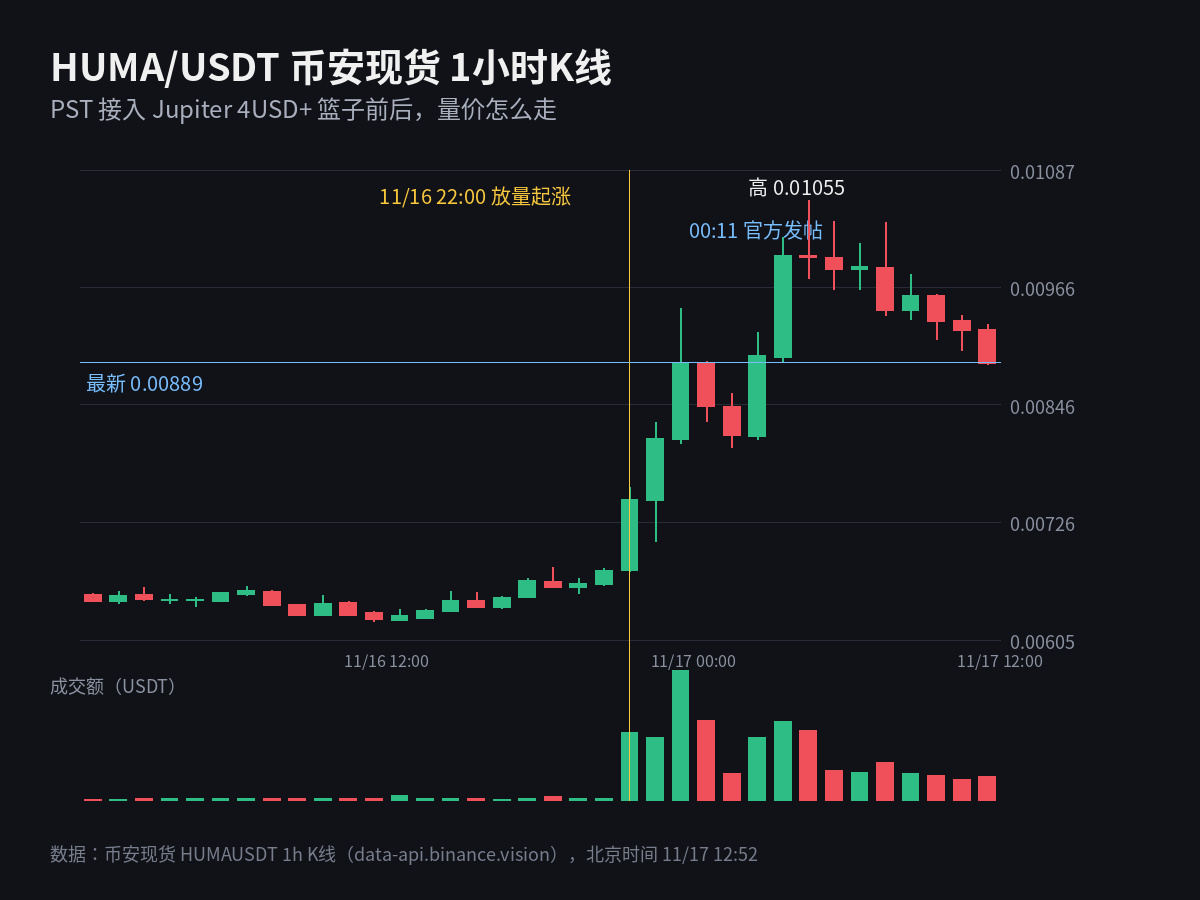
This is about PST, not $HUMA, though the market is still trading them together. On Binance spot, the hourly candle at 22:00 on 11/16 saw about 1.23 million U in volume, compared with just tens of thousands per hour before that. The price peaked at 0.01055 at 5 a.m. today. The rally started about two hours before the official post; people were already discussing the basket news in the afternoon, so it’s unclear what exactly sparked the move.
Checked at 12:52: spot was around 0.0089, up 42% over 24 hours and about 15% off its high. Perpetual futures volume was around 170 million U, more than ten times spot volume. Open interest rose from around 4.1 million U last night to roughly 8 million, and is now around 7.5 million.
I see this as a rally with a clear narrative: PayFi is a main theme at Breakpoint, and the Jupiter integration is tangible progress. After several hours of pullback, open interest has only edged down, so the disagreement is still playing out in the market. If open interest keeps falling and spot volume also dries up, this run is over. The team hasn’t explained how PST’s value accrues to HUMA, so for now, that’s a question mark.
#HumaFinance #PayFi $HUMA
{future}(HUMAUSDT)
At Solana Breakpoint, payments have been a major topic these past two days, and one project that’s actually been integrated into an on-chain product is Huma’s PST.
PST is Huma’s PayFi strategy token, with returns generated from short-term payment financing. At 00:11 Beijing time on 11/17, the team posted that PST had been added to Jupiter’s 4USD+ yield basket, and could also be used as collateral to borrow JupUSD on Jupiter Earn, with a limit of 8.1 million.
This is about PST, not $HUMA , though the market is still trading them together. On Binance spot, the hourly candle at 22:00 on 11/16 saw about 1.23 million U in volume, compared with just tens of thousands per hour before that. The price peaked at 0.01055 at 5 a.m. today. The rally started about two hours before the official post; people were already discussing the basket news in the afternoon, so it’s unclear what exactly sparked the move.
Checked at 12:52: spot was around 0.0089, up 42% over 24 hours and about 15% off its high. Perpetual futures volume was around 170 million U, more than ten times spot volume. Open interest rose from around 4.1 million U last night to roughly 8 million, and is now around 7.5 million.
I see this as a rally with a clear narrative: PayFi is a main theme at Breakpoint, and the Jupiter integration is tangible progress. After several hours of pullback, open interest has only edged down, so the disagreement is still playing out in the market. If open interest keeps falling and spot volume also dries up, this run is over. The team hasn’t explained how PST’s value accrues to HUMA, so for now, that’s a question mark.
#HumaFinance #PayFi $HUMA
220

·
--
Bullish
A bigger picture of instant payment adoption… What does Huma Finance’s selection as a leading case study mean?
The blockchain payments sector (PayFi) saw significant developments this week. Chief among them was the selection of Huma Finance, alongside (PST) solutions, as a leading global case study in onchain financing for real-world business payments (Onchain Payment Financing), with funding and support from major networks such as Arf. The platform was also featured in major institutional reports.
Direct impact on the HUMA token:
Strengthening core utility: These achievements and ongoing reports confirm the pivotal role of the Huma Protocol in leading the PayFi market and onchain liquidity.
Institutional adoption: Highlighting the platform as a leading model boosts institutional investors’ confidence and supports long-term liquidity within the token’s ecosystem.
Price implications: In the medium term, this positive momentum and growing adoption of the network infrastructure support actual demand for the HUMA token, which is tied to the protocol’s governance and operation.
#payfi #HumaFinanceLaunch #Huma #CryptoAnalysis #DAB3_1997 $HUMA
{spot}(HUMAUSDT)
A bigger picture of instant payment adoption… What does Huma Finance’s selection as a leading case study mean?
The blockchain payments sector (PayFi) saw significant developments this week. Chief among them was the selection of Huma Finance, alongside (PST) solutions, as a leading global case study in onchain financing for real-world business payments (Onchain Payment Financing), with funding and support from major networks such as Arf. The platform was also featured in major institutional reports.
Direct impact on the HUMA token:
Strengthening core utility: These achievements and ongoing reports confirm the pivotal role of the Huma Protocol in leading the PayFi market and onchain liquidity.
Institutional adoption: Highlighting the platform as a leading model boosts institutional investors’ confidence and supports long-term liquidity within the token’s ecosystem.
Price implications: In the medium term, this positive momentum and growing adoption of the network infrastructure support actual demand for the HUMA token, which is tied to the protocol’s governance and operation.
#payfi #HumaFinanceLaunch #Huma #CryptoAnalysis #DAB3_1997 $HUMA
2
1
60

·
--
$ULTIMA surged 33.88% in a single day, making it the biggest gainer in the PayFi sector.
The sector rose 6.36% over 24 hours, leading the entire market. $XMR followed with an 8.74% gain, while $TWT rose 7.01%—the whole sector is moving up. This rally in $ULTIMA isn’t a solo act; money is flowing into the sector as a whole.
That said, let’s be clear: a gain of over 30% in a single day, especially on the first day of a rebound like this, means even bigger swings. Chasing the rally or trying to buy the dip is no easy task.
Do you think this PayFi rally is part of a sector rotation, or will it only last a couple of days?
#币种分析 #PayFi
4

Bitcoin has climbed back from 62,000 to 65,000, and everyone’s still arguing over whether this is the bottom or just halfway up. But the real money today wasn’t in Bitcoin at all—PayFi led the pack with a 6.36% gain in 24 hours, ULTIMA surged 33.88% in a day, Monero rose 8.74%, and TWT gained 7.01%, leaving DeFi and RWA in the dust.
Those buying the dip in Bitcoin are still waiting to break even, while those watching sector rotation are already cashing in. When the Fear Index drops to 10, money always flows first to the corners with the biggest gains.
A If you’re buying the dip, buy the leading sector—whatever it’s called
B Until Bitcoin holds above 65,000, every rebound is a bull trap
$BTC $TWT
#PayFi #反弹 #SectorRotation
2


·
--
🔥 Huma just announced its launch on Kamino tonight. $HUMA has risen for 3 straight days, up nearly +29% in total and closing in on 0.03!
Just now, the Sentora Huma PST market officially launched on Solana’s Kamino, where you can use PST as collateral to borrow PYUSD. Combined with Huma’s cumulative payment volume surpassing $20 billion, the PayFi narrative is heating up again 👇
▪️ Current price: 0.02929, 24h +10.1%, intraday high: 0.03004
▪️ Three consecutive daily gains: 0.02274 → 0.02587 → 0.02718 → 0.0293
▪️ Trading volume on launch day was about 15.8 million USDT, nearly 20 times the previous day’s
▪️ Cumulative payment volume: $20 billion+, nearly 3x year over year (about $7 billion last year)
I’m personally very bullish on this move: real business metrics + a new DeFi integration going live, and it’s still gaining on rising volume against a weak broader market. As long as it holds above 0.0272, I’m looking for a push toward the 0.03 mark next!
Do you think $HUMA can break through 0.03 in one go? Let me know in the comments 👇
#HUMA #PayFi #BinanceSquare
98

The broader market is still hovering around the $80,000 mark, but the PayFi sector quietly led the way today. In SoSoValue’s sector snapshot for October 27, PayFi was up 2.06% over 24 hours, with Telcoin (TEL) leading the sector at 8.99%. Several market-tracking sites also showed a 24-hour gain in the 8%–9% range that day, with the price at around $0.0015 and market cap at about $140 million. Note that this isn’t a story about a new coin making people rich overnight: TEL is still down over the past month, and today’s move looks more like an older coin catching fire amid sector rotation. Those who didn’t get in yesterday may feel bad seeing it rise today, while those chasing the rally may feel just as bad tomorrow. When volatility is high, check your position before your emotions, and don’t let a single day’s gains lead you around. #PayFi #CryptoMarket
The broader market is still hovering around the $80,000 mark, but the PayFi sector quietly led the way today. In SoSoValue’s sector snapshot for October 27, PayFi was up 2.06% over 24 hours, with Telcoin (TEL) leading the sector at 8.99%. Several market-tracking sites also showed a 24-hour gain in the 8%–9% range that day, with the price at around $0.0015 and market cap at about $140 million. Note that this isn’t a story about a new coin making people rich overnight: TEL is still down over the past month, and today’s move looks more like an older coin catching fire amid sector rotation. Those who didn’t get in yesterday may feel bad seeing it rise today, while those chasing the rally may feel just as bad tomorrow. When volatility is high, check your position before your emotions, and don’t let a single day’s gains lead you around. #PayFi #CryptoMarket

37


·
--
Lately, I’ve increasingly felt that AI, payments, and RWA shouldn’t be treated as three completely separate narratives.
Here’s a very practical example:
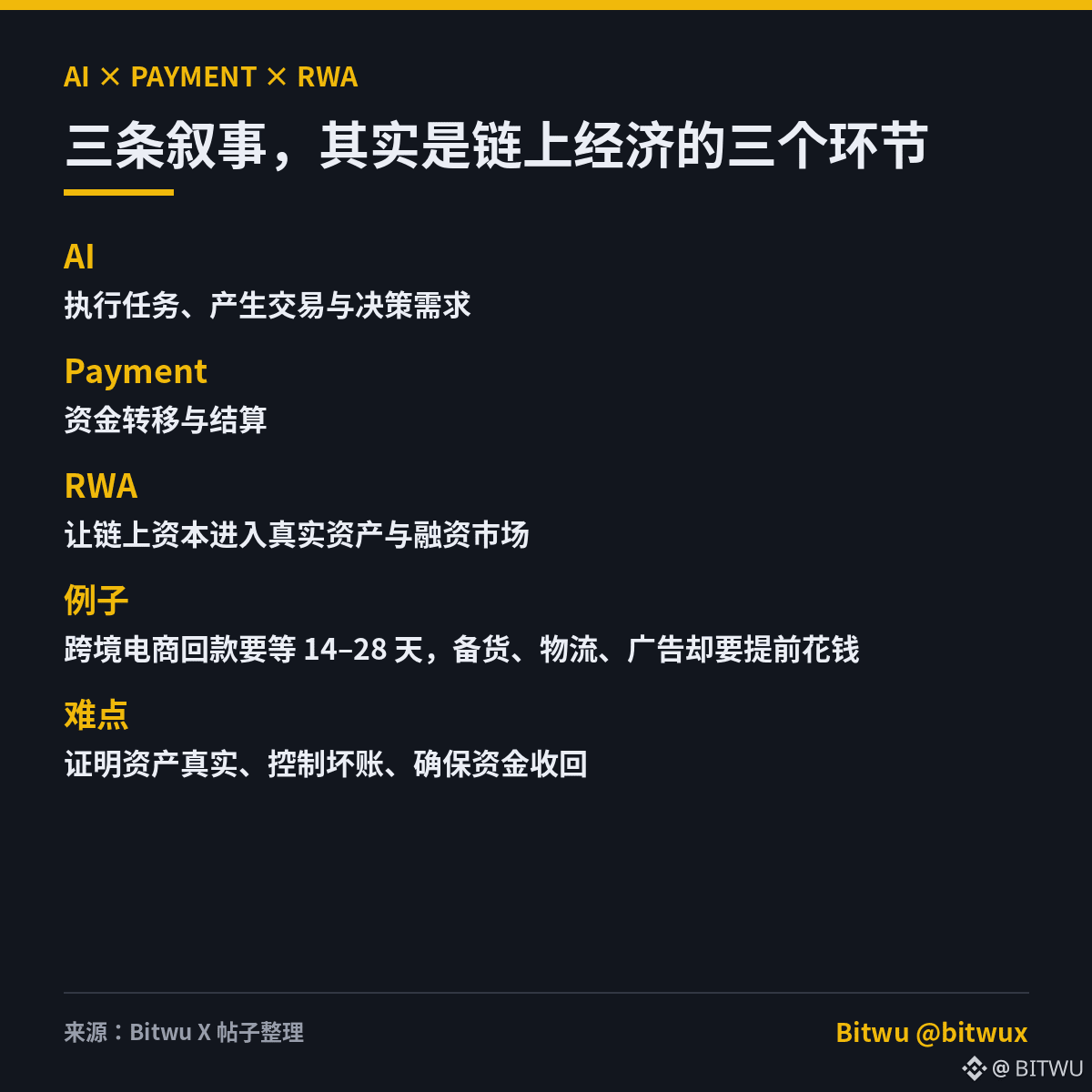
A cross-border e-commerce seller has already sold their goods, but it may still take 14–28 days for the platform to pay out. Meanwhile, inventory, logistics, and advertising all require upfront spending.
Stablecoins can improve the efficiency of fund settlement, but they can’t directly solve one problem: who’s willing to provide funding upfront, and what reason do they have to believe the merchant will repay on time? Could this process be automated, perhaps even handled seamlessly by AI?
These three areas look more like three parts of an on-chain economy:
1️⃣ AI: carries out tasks and creates demand for transactions and decisions;
2️⃣ Payment: handles fund transfers and settlement;
3️⃣ RWA: gives on-chain capital a chance to enter real-world asset and financing markets.
That’s also why I’ve recently become interested in DowProtocol. It’s not simply exploring how to tokenize assets; it’s trying to connect the financing needs of real merchants with on-chain capital by using operational data from e-commerce platforms, accounts receivable, and repayment mechanisms.
But I do have a question: putting assets on-chain is easy. The real challenge is proving that the assets are genuine, managing bad debt, and ensuring the funds can be recovered. These problems don’t automatically disappear just because blockchain is involved.
So I think that if the competition between public blockchains remains focused on TPS, TVL, and the number of assets issued, it may still be too narrowly defined.
Rather than asking how much money is on-chain, perhaps the most exciting next step for RWA is whether that money can flow into real commercial activity and create a verifiable, sustainable cycle of capital.
#RWA #稳定币 #PayFi #AI
402

·
--
The latest numbers for Huma @humafinance’s PST are pretty impressive
The latest figures from the official account:
It took just 19 days to grow from $300M to $400M
Net inflows of $168M in 30 days
Now the largest yield-bearing asset on Solana
What is PST? A PayFi yield token
Backed by financing for real-world payment receivables
For short-term funding needs like export payments and cross-border transactions
Yield comes from real payment flows, not leveraged staking loops
Verifiable on-chain
This expansion has been fast, too:
Chainlink CCIP Vault Adapters integration lets users deposit across 80+ chains in one click
Upshift’s Gamma USDC vault added the PST market to its initial allocation (on Kamino)
Institutions like RockawayX and Bitwise are among the partners
The official Q4 target is for PST to surpass $500M
I’m waiting in the car for solana:HUMA1821qVDKta3u2ovmfDQeW2fSQouSKE8fkF44wvGw to catch up with this pace
#Huma #PayFi #RWA
34

🦈 SMART MONEY DIVERSIFIES FROM $SOL AND $TAO AS NEW PAYFI MOMENTUM BUILDS 💥
Entry: 0.21 ⚡
Target: 0.46 🚀
📌 Heavyweight assets like $SOL at $117.66 and $TAO at $305 deliver clear sector exposure, yet open-market valuations already reflect much of their structural success. 📊 Capital is quietly shifting toward early-stage PayFi infrastructure where real-world bank settlement rails pair directly with deep perps liquidity.
💡 Balancing established market leaders with pre-market asymmetry allows traders to front-run broader liquidity expansion before discovery events unfold. 💬 Are you sticking strictly to mature mega-caps or building exposure in emerging payment rails? 👇
⚠️ Not financial advice. Always manage your risk. 🛡️
🏷️ #SOL #TAO #PayFi #Altcoins #Crypto
🔥 ⚡
16

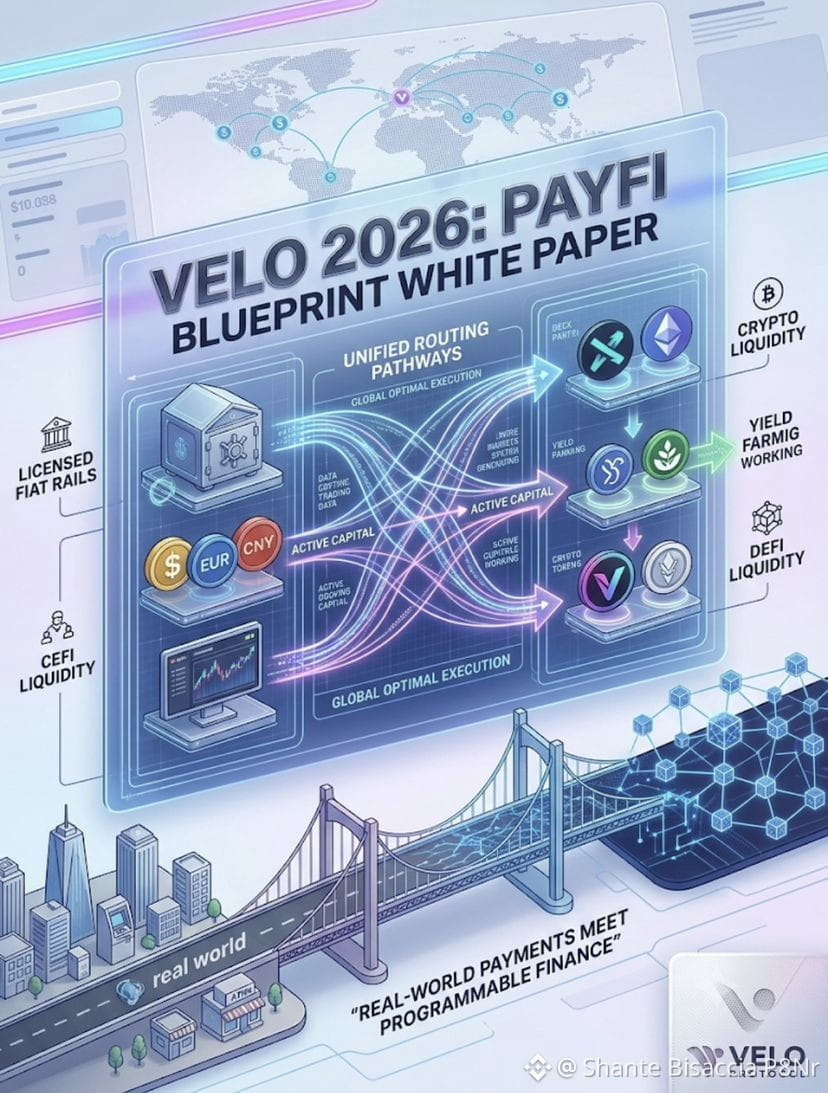
🚀 Velo Protocol presents its “2026 Blueprint Whitepaper”: What is the full-stack PayFi network?
Velo Protocol has shared the foundations of its strategic vision for the coming years through its new “Velo 2026 Blueprint Whitepaper.” The project strengthens the PayFi (Payment Finance) narrative, aiming to build a definitive bridge between traditional banking and the crypto ecosystem.
Key points:
• Fiat rails with License + Crypto Liquidity:
Velo focuses on combining regulated financial infrastructures with commercial licenses, along with native liquidity from the crypto ecosystem.
• Unifying CeFi + DeFi: Its ecosystem seeks to integrate liquidity from centralized finance (exchanges, OTC desks) and decentralized finance into a single execution layer.
• Global Intelligent Routing: Implementation of routing engines that automatically look for the best transaction path at the global level, optimizing costs, speed, and fees.
• Productive Capital (Time-Value of Money): Unlike traditional payments where funds remain idle or are held for days, Velo’s architecture allows capital in transit or treasury capital to generate returns while it works on the network.
Conclusion: Velo is strongly aiming at becoming a massive infrastructure layer for Asia and global markets, transforming cross-border payments from a slow and costly process into a real-time programmable system.
$VELO #PayFi #Web3 #CryptoNews
1
90

·
--
PayFi Leads the Pack
On September 15, SoSoValue data shows that most crypto sectors ended higher. The payments and finance sector (PayFi) rose by about 5.55% over 24 hours, making it the most conspicuous among all sectors. In the subcategories, $XLM was up by about 8.81%, and XRP and TEL also moved higher within the same grouping. In the same period, $BTC briefly climbed to around $79,000 before pulling back, yet the overall market capitalization across the network still recorded a rebound on the order of about 1%.
PayFi plays into the narrative of “transfer, settlement, and stablecoin transfer channels,” which is not the same ballgame as pure memetics or pure compute power. The CLARITY programmatic voting brings the commodity/securities boundary back to the forefront. Payment-related assets are more likely to be treated as high-volatility targets, so capital will first flow into names in the basket that are relatively thinner and thus more elastic.
A sector leading in one day should not be extrapolated into the idea that the payment network suddenly sees a surge in volume. First, look for whether there is sustained trading activity; then, after regulatory vote outcomes are implemented, check whether this beta is still there.
$XLM
{spot}(XLMUSDT)
#PayFi #板块轮动
Does not constitute investment advice
PayFi Leads the Pack
On September 15, SoSoValue data shows that most crypto sectors ended higher. The payments and finance sector (PayFi) rose by about 5.55% over 24 hours, making it the most conspicuous among all sectors. In the subcategories, $XLM was up by about 8.81%, and XRP and TEL also moved higher within the same grouping. In the same period, $BTC briefly climbed to around $79,000 before pulling back, yet the overall market capitalization across the network still recorded a rebound on the order of about 1%.
PayFi plays into the narrative of “transfer, settlement, and stablecoin transfer channels,” which is not the same ballgame as pure memetics or pure compute power. The CLARITY programmatic voting brings the commodity/securities boundary back to the forefront. Payment-related assets are more likely to be treated as high-volatility targets, so capital will first flow into names in the basket that are relatively thinner and thus more elastic.
A sector leading in one day should not be extrapolated into the idea that the payment network suddenly sees a surge in volume. First, look for whether there is sustained trading activity; then, after regulatory vote outcomes are implemented, check whether this beta is still there.
$XLM
#PayFi #板块轮动
Does not constitute investment advice

266

·
--
Bullish
THE NEW ROUTES OF MONEY: VELO LABS KEEPS THE ASIAN FLOW
While Western spotlights get distracted by daily regulatory noise, one of the region’s heaviest and most real payment infrastructure plays has just been consolidated in Southeast Asia. Velo Labs stopped being a lab project and became pure institutional plumbing.
At the core of its traction is the deployment of its federated credit exchange network—an architecture engineered specifically to devour the costs and timelines of cross-border transfer and settlement in Asia’s most dynamic markets.
The project has just validated its commercial viability after securing a second round of strategic investment from UOB Venture Management, the investment arm of the United Overseas Bank (one of the region’s undisputed banking giants).
They’re not limiting themselves to retail remittances; they’ve already launched operational initiatives to process tokenized short-term treasury funds, putting heavy corporate money directly onto their digital rails.
By partnering with traditional banking like the United Overseas Bank and connecting Southeast Asia’s treasury funds, Velo isn’t competing for popularity on social networks; it’s building the exclusive channels through which the capital of tomorrow will travel.
Pipes keep connecting in silence. While the crowd watches the screen, smart money controls the ports.
#VeloLabs $VELO #PayFi #RWA
3
176

·
--
Bullish
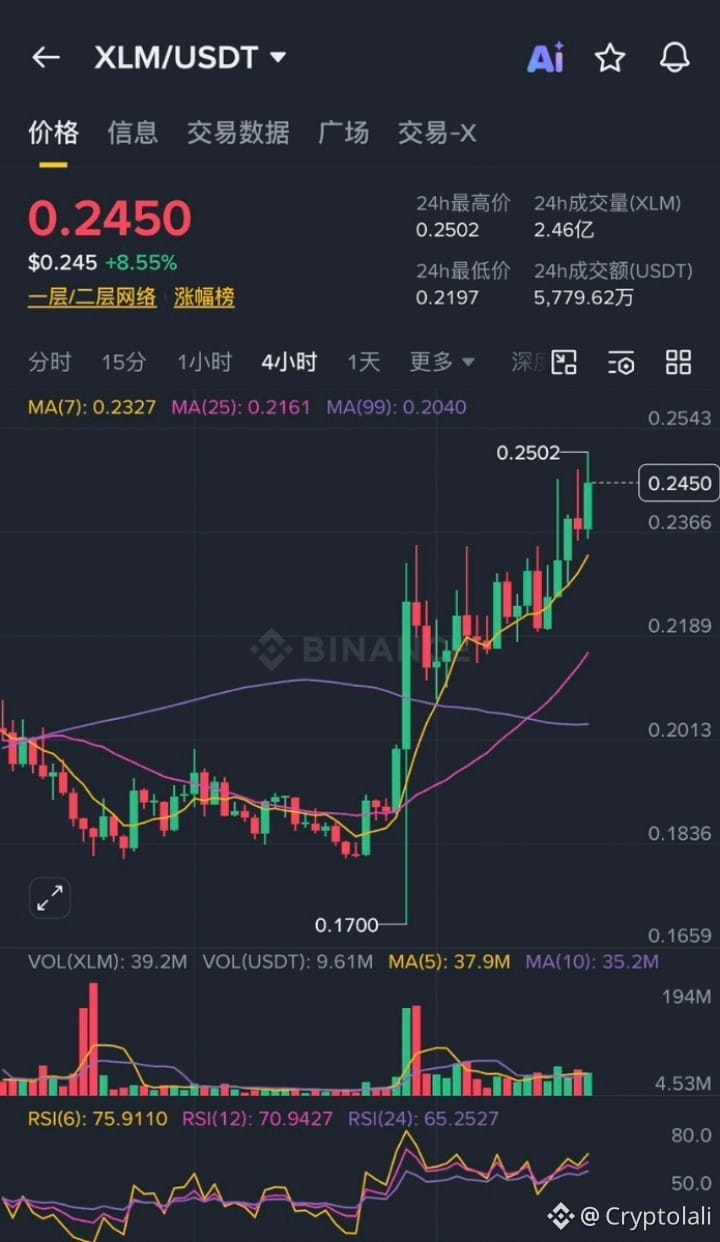
🚨 $XLM
{spot}(XLMUSDT)
SHORTS GETTING OBLITERATED — THIS IS NOT A DRILL 🚨
The battlefield is brutal right now… and the bears?
They’re getting wiped out in the tall grass. 🌿💀
is on a mission — and it’s not slowing down.
🔥 WHY XLM IS PUMPING (IT’S NOT RANDOM)
This move comes down to REAL USAGE — not hype.
💸 PayFi is kicking in hard:
MoneyGram is running stablecoin rails on Stellar
Zebec enabling instant payroll for businesses
👉 This is real-world adoption, not vaporware.
🏦 RWA TOKENIZATION EXPLODING:
Over $2 BILLION+ already tokenized
Giants like DTCC and Franklin Templeton are involved
👉 Translation: Institutional money is entering the game.
📊 MARKET STRUCTURE — THIS IS WHERE IT GETS SPICY
📈 Price = UP ONLY
🔴 Funding Rates = NEGATIVE
🐻 Bears = STILL SHORTING
💥 That combo = SHORT SQUEEZE FUEL
Every short opened right now?
👉 Basically paying the bulls to stay long.
🎯 TRADE SETUP (HIGH-CONVICTION)
🟢 Entry Zone: $0.20 – $0.22 (buy the dip)
🎯 Target: $0.26
🛑 Stop Loss: $0.18
⚡ Current: ~$0.247 (+9.44%) — already heating up
⚠️ FINAL WARNING TO SHORTS
You’re not fighting hype…
You’re fighting adoption + institutions + liquidity dynamics
And right now?
👉 That’s a losing battle.
🚀 ISN’T JUST PUMPING — IT’S BEING USED
Still thinking about shorting?
Good luck… you’ll need it. 😏
#XLM #Altcoins #Stellar #RWA #PayFi
🚨 $XLM
SHORTS GETTING OBLITERATED — THIS IS NOT A DRILL 🚨
The battlefield is brutal right now… and the bears?
They’re getting wiped out in the tall grass. 🌿💀
is on a mission — and it’s not slowing down.
🔥 WHY XLM IS PUMPING (IT’S NOT RANDOM)
This move comes down to REAL USAGE — not hype.
💸 PayFi is kicking in hard:
MoneyGram is running stablecoin rails on Stellar
Zebec enabling instant payroll for businesses
👉 This is real-world adoption, not vaporware.
🏦 RWA TOKENIZATION EXPLODING:
Over $2 BILLION+ already tokenized
Giants like DTCC and Franklin Templeton are involved
👉 Translation: Institutional money is entering the game.
📊 MARKET STRUCTURE — THIS IS WHERE IT GETS SPICY
📈 Price = UP ONLY
🔴 Funding Rates = NEGATIVE
🐻 Bears = STILL SHORTING
💥 That combo = SHORT SQUEEZE FUEL
Every short opened right now?
👉 Basically paying the bulls to stay long.
🎯 TRADE SETUP (HIGH-CONVICTION)
🟢 Entry Zone: $0.20 – $0.22 (buy the dip)
🎯 Target: $0.26
🛑 Stop Loss: $0.18
⚡ Current: ~$0.247 (+9.44%) — already heating up
⚠️ FINAL WARNING TO SHORTS
You’re not fighting hype…
You’re fighting adoption + institutions + liquidity dynamics
And right now?
👉 That’s a losing battle.
🚀 ISN’T JUST PUMPING — IT’S BEING USED
Still thinking about shorting?
Good luck… you’ll need it. 😏
#XLM #Altcoins #Stellar #RWA #PayFi
156

·
--
Bullish
Is Huma Finance ($HUMA) built for the long haul, or will token supply hold it back?
Beyond the chart, Huma is operating as a core fintech infrastructure provider in the PayFi (Payment Finance) space.
Here is where the business actually stands today:
- Current Health & Traction
• $380M+ TVL across Solana, Stellar & Ethereum
• $5.7B+ volume processed with zero reported defaults
• $3M–$5M+ quarterly revenue driven by real B2B demand, not inflation
- Real-World Utility & IT Contracts
Instead of speculative farming, Huma’s API links directly into enterprise ERPs, payrolls, and cross-border payment networks (like Arf) to instantly fund receivables and liquidity without waiting days for SWIFT.
- The 2-Year Outlook (2026–2028)
Business Side: Solid fundamentals. Organic revenue from transaction discount fees gives them real corporate solvency independent of market hype.
Token Side: Continuous supply releases and token unlocks create short-term price friction that requires high volume growth to absorb.
👇 What’s your take?
Is $HUMA’s real-world revenue model enough to win in the long run, or are you waiting for token unlocks to settle? Let’s talk below!
@humafinance #PayFi #CryptoAnalysis #BinanceSquare #RWA
$HUMA
Is Huma Finance ($HUMA ) built for the long haul, or will token supply hold it back?
Beyond the chart, Huma is operating as a core fintech infrastructure provider in the PayFi (Payment Finance) space.
Here is where the business actually stands today:
- Current Health & Traction
• $380M+ TVL across Solana, Stellar & Ethereum
• $5.7B+ volume processed with zero reported defaults
• $3M–$5M+ quarterly revenue driven by real B2B demand, not inflation
- Real-World Utility & IT Contracts
Instead of speculative farming, Huma’s API links directly into enterprise ERPs, payrolls, and cross-border payment networks (like Arf) to instantly fund receivables and liquidity without waiting days for SWIFT.
- The 2-Year Outlook (2026–2028)
Business Side: Solid fundamentals. Organic revenue from transaction discount fees gives them real corporate solvency independent of market hype.
Token Side: Continuous supply releases and token unlocks create short-term price friction that requires high volume growth to absorb.
👇 What’s your take?
Is $HUMA ’s real-world revenue model enough to win in the long run, or are you waiting for token unlocks to settle? Let’s talk below!
@Huma Finance 🟣 #PayFi #CryptoAnalysis #BinanceSquare #RWA
$HUMA
264
·
--
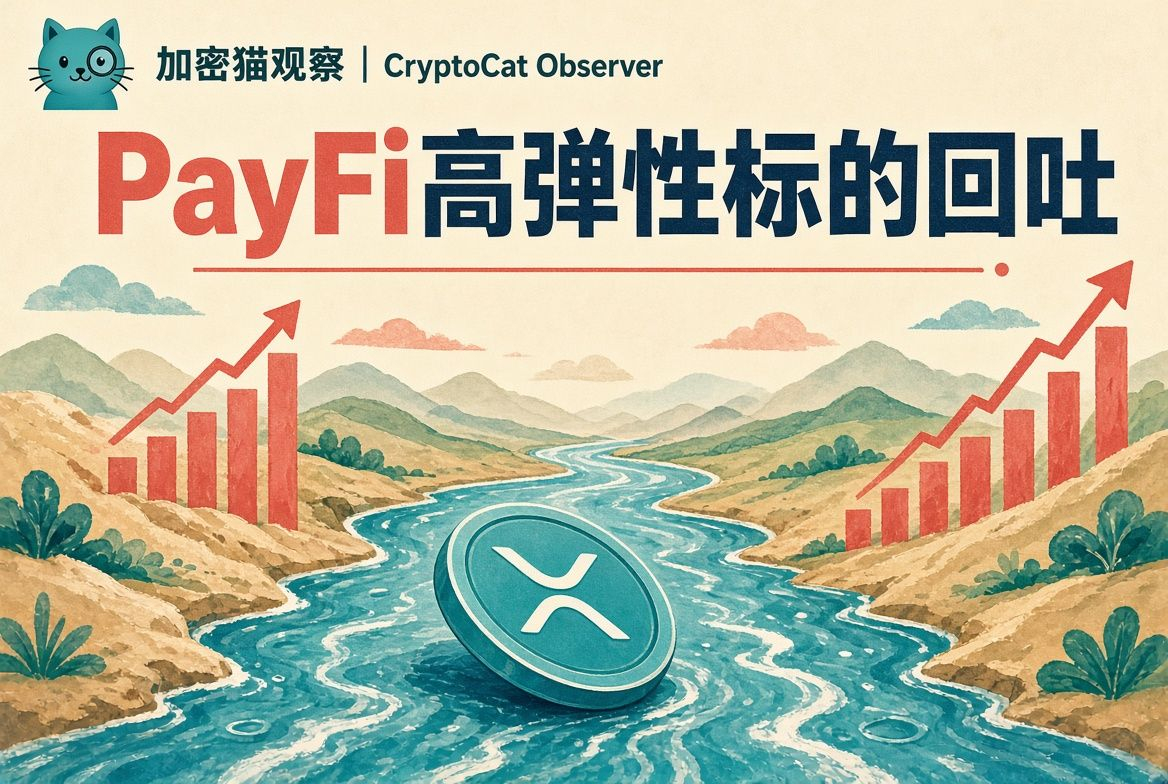
PayFi High-Elasticity Targets Give Back
On September 16, SoSoValue data showed that the Payments Finance (PayFi) sector fell by about 8.4% over the past 24 hours. Among them, $XRP saw a drawdown of roughly a tenth, and Stellar also moved lower in tandem. This lines up exactly with the “regulatory clarity” trade from September 14–15 being unwound: when the procedural votes failed to pass, the payment narrative with the greatest elasticity was cut first.
Over the past two days, XRP has been driven by the market’s expectations of structure—not by a sudden doubling in settlement volume. ETF and derivatives positioning amplify volatility; when the voting outcome falls below expectations, the pullback tends to happen faster than in Bitcoin. The sector index dropping at the same time indicates it wasn’t an isolated liquidity incident tied to a single stock.
This leg down in the payments sector is effectively extracting the “clarity premium” from the price—not because cross-border transfers suddenly broke down. The portion where XRP underperformed the broader market more than the rest corresponds to the regulatory elasticity that existed before the vote. With that premium gone, positions will first revert to their own liquidity center rather than immediately hunting for the next legislative theme. If afterward there’s only reconsideration, with no new bipartisan sources of votes, PayFi is more suitable to be treated as a high-volatility trading instrument—not as a discounted stack for “the bill will pass eventually.”
$XRP
{spot}(XRPUSDT)
#PayFi #监管
Not investment advice
PayFi High-Elasticity Targets Give Back
On September 16, SoSoValue data showed that the Payments Finance (PayFi) sector fell by about 8.4% over the past 24 hours. Among them, $XRP saw a drawdown of roughly a tenth, and Stellar also moved lower in tandem. This lines up exactly with the “regulatory clarity” trade from September 14–15 being unwound: when the procedural votes failed to pass, the payment narrative with the greatest elasticity was cut first.
Over the past two days, XRP has been driven by the market’s expectations of structure—not by a sudden doubling in settlement volume. ETF and derivatives positioning amplify volatility; when the voting outcome falls below expectations, the pullback tends to happen faster than in Bitcoin. The sector index dropping at the same time indicates it wasn’t an isolated liquidity incident tied to a single stock.
This leg down in the payments sector is effectively extracting the “clarity premium” from the price—not because cross-border transfers suddenly broke down. The portion where XRP underperformed the broader market more than the rest corresponds to the regulatory elasticity that existed before the vote. With that premium gone, positions will first revert to their own liquidity center rather than immediately hunting for the next legislative theme. If afterward there’s only reconsideration, with no new bipartisan sources of votes, PayFi is more suitable to be treated as a high-volatility trading instrument—not as a discounted stack for “the bill will pass eventually.”
$XRP
#PayFi #监管
Not investment advice
100

·
--
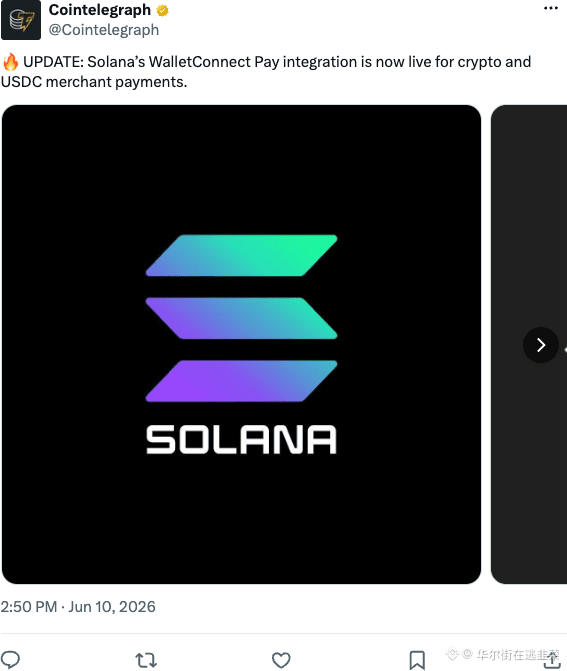
Wallet scanning to buy coffee can finally be done directly with USDC. Solana's latest WalletConnect Pay is definitely aiming for point-of-sale transactions. The payment narrative has been hyped up and is now three feet high, but for low-friction settlements, SOL can definitely handle the job. It all depends on whether merchants can truly roll it out; don’t get too eager to shout 'mass adoption' before we see any growth. #PayFi $SOL
{future}(SOLUSDT)
Wallet scanning to buy coffee can finally be done directly with USDC. Solana's latest WalletConnect Pay is definitely aiming for point-of-sale transactions. The payment narrative has been hyped up and is now three feet high, but for low-friction settlements, SOL can definitely handle the job. It all depends on whether merchants can truly roll it out; don’t get too eager to shout 'mass adoption' before we see any growth. #PayFi $SOL
136

I started following the HUMA Finance project recently, and its unique idea caught my attention compared to other coins.
The project focuses on PayFi—meaning connecting real payments to decentralized finance, not just a coin for speculation.
Here are the points I liked:
1. Backed by major investors and available on strong networks
2. Has real use in payment transfers, not just a Meme
3. Its community is very active on X and Discord
Of course, any new project involves risk, and everyone should do their own research before taking any step.
What do you think about HUMA? Do you see it having a future in the payments space?
#HUMA #BinanceSquare #PayFi
#Binance

155
Log in to explore more content
Join global crypto users on Binance Square
⚡️ Get latest and useful information about crypto.
💬 Trusted by the world’s largest crypto exchange.
👍 Discover real insights from verified creators.
Email / Phone number
Trending Topics
1
#A Packed Week of Earnings and Data Tests Markets
82,717 views
490 Discussing
2
#AnthropicIPOTestsInvestorAppetiteForAI
163,546 views
1,754 Discussing
3
#NvidiaBoardNotConsideringHuang’sReturnasCEO
16,607 views
243 Discussing
4
#WhatInvestmentSignalsDo13FFilingsReveal?
10,481 views
177 Discussing
5
#GoldmanSachsAndMillenniumEachHeldOver$1.2BInBitcoinETFs
0 views
1 Discussing
6
#InvescoStablecoinReservesFundLaunchesOnEthereum
4,230 views
97 Discussing
7
#CypherpunkReports$306MQ3NetProfit
808 views
16 Discussing
8
#OPTIMJACKAttackInfectsAtLeast186Websites
7,567 views
124 Discussing
9
#StrategySells2.09MMSTRSharesFor$244.7M
2,255 views
19 Discussing
10
#StablecoinMarketShrinksAtFastestPaceSinceTerraLuna
8,884 views
87 Discussing