

#newtcoin
newtcoin
16,627 views
35 Discussing
Hot
Latest

·
--
Newton Protocol (NEWT): Building the Future of Secure On-Chain AutomationNewton Protocol ($NEWT )
As blockchain technology evolves, automation and artificial intelligence are becoming essential components of the decentralized economy. Newton Protocol (NEWT) is positioning itself at the center of this transformation by creating a secure, verifiable automation layer for Web3. Rather than competing as another DeFi application, Newton Protocol aims to become the infrastructure that enables AI agents and automated financial operations to execute safely on-chain.
Current Market Outlook
$NEWT is currently trading around $0.048, showing signs of stabilization after recent volatility. While technical momentum has improved, the market remains cautious following a significant token unlock in late June, which increased circulating supply and introduced temporary selling pressure. Investors are now watching whether demand can absorb the additional tokens over the coming weeks.
Why Investors Are Watching $NEWT
Several factors continue to attract attention:
A strong focus on AI-powered on-chain automation.
- Infrastructure designed for secure, verifiable execution of blockchain transactions.
- Growing visibility within the Binance ecosystem through community campaigns and increased awareness.
- Long-term potential as institutional and enterprise adoption of blockchain automation expands.
Technical Perspective
The current price structure suggests consolidation. If buyers maintain support near recent lows, NEWT could attempt another move toward higher resistance levels. However, traders should remain aware that increased token supply and broader crypto market sentiment may continue to create short-term volatility. Risk management remains essential.
Final Thoughts
Newton Protocol is more than another cryptocurrency—it is an infrastructure project aiming to power the next generation of intelligent, automated Web3 applications. Although short-term price fluctuations are expected, the project's long-term value will ultimately depend on ecosystem growth, developer adoption, and continued technological progress.
For investors who believe AI and blockchain automation will define the future of decentralized finance, NEWT is a project worth keeping on the watchlist. As always, conduct your own research and never invest more than you can afford to lose.
#Newt #NewtBinance #Newtcoin
{spot}(NEWTUSDT)
Newton Protocol (NEWT): Building the Future of Secure On-Chain Automation
Newton Protocol ($NEWT )
As blockchain technology evolves, automation and artificial intelligence are becoming essential components of the decentralized economy. Newton Protocol (NEWT) is positioning itself at the center of this transformation by creating a secure, verifiable automation layer for Web3. Rather than competing as another DeFi application, Newton Protocol aims to become the infrastructure that enables AI agents and automated financial operations to execute safely on-chain.
Current Market Outlook
$NEWT is currently trading around $0.048, showing signs of stabilization after recent volatility. While technical momentum has improved, the market remains cautious following a significant token unlock in late June, which increased circulating supply and introduced temporary selling pressure. Investors are now watching whether demand can absorb the additional tokens over the coming weeks.
Why Investors Are Watching $NEWT
Several factors continue to attract attention:
A strong focus on AI-powered on-chain automation.
- Infrastructure designed for secure, verifiable execution of blockchain transactions.
- Growing visibility within the Binance ecosystem through community campaigns and increased awareness.
- Long-term potential as institutional and enterprise adoption of blockchain automation expands.
Technical Perspective
The current price structure suggests consolidation. If buyers maintain support near recent lows, NEWT could attempt another move toward higher resistance levels. However, traders should remain aware that increased token supply and broader crypto market sentiment may continue to create short-term volatility. Risk management remains essential.
Final Thoughts
Newton Protocol is more than another cryptocurrency—it is an infrastructure project aiming to power the next generation of intelligent, automated Web3 applications. Although short-term price fluctuations are expected, the project's long-term value will ultimately depend on ecosystem growth, developer adoption, and continued technological progress.
For investors who believe AI and blockchain automation will define the future of decentralized finance, NEWT is a project worth keeping on the watchlist. As always, conduct your own research and never invest more than you can afford to lose.
#Newt #NewtBinance #Newtcoin
As blockchain technology evolves, automation and artificial intelligence are becoming essential components of the decentralized economy. Newton Protocol (NEWT) is positioning itself at the center of this transformation by creating a secure, verifiable automation layer for Web3. Rather than competing as another DeFi application, Newton Protocol aims to become the infrastructure that enables AI agents and automated financial operations to execute safely on-chain.
Current Market Outlook
$NEWT is currently trading around $0.048, showing signs of stabilization after recent volatility. While technical momentum has improved, the market remains cautious following a significant token unlock in late June, which increased circulating supply and introduced temporary selling pressure. Investors are now watching whether demand can absorb the additional tokens over the coming weeks.
Why Investors Are Watching $NEWT
Several factors continue to attract attention:
A strong focus on AI-powered on-chain automation.
- Infrastructure designed for secure, verifiable execution of blockchain transactions.
- Growing visibility within the Binance ecosystem through community campaigns and increased awareness.
- Long-term potential as institutional and enterprise adoption of blockchain automation expands.
Technical Perspective
The current price structure suggests consolidation. If buyers maintain support near recent lows, NEWT could attempt another move toward higher resistance levels. However, traders should remain aware that increased token supply and broader crypto market sentiment may continue to create short-term volatility. Risk management remains essential.
Final Thoughts
Newton Protocol is more than another cryptocurrency—it is an infrastructure project aiming to power the next generation of intelligent, automated Web3 applications. Although short-term price fluctuations are expected, the project's long-term value will ultimately depend on ecosystem growth, developer adoption, and continued technological progress.
For investors who believe AI and blockchain automation will define the future of decentralized finance, NEWT is a project worth keeping on the watchlist. As always, conduct your own research and never invest more than you can afford to lose.
#Newt #NewtBinance #Newtcoin
71

newt#Newt #Newtcoin #Newtcoin #Newtciting #Newtcrypto
Newt is an amazing token. This token will let you be free of your problems. With every task completed in this campaign you could get further. This is really great opportunity for me and you and possibly your family. Newt is the way to go. Although it sounds like a small animal. It has big rewards. For all I know this isn’t even 500 characters long. But this could be the one. I’m going to copy and paste to see how much I have typed. If there is no further response then I have neared successfully
newt
#Newt #Newtcoin #Newtcoin #Newtciting #Newtcrypto
Newt is an amazing token. This token will let you be free of your problems. With every task completed in this campaign you could get further. This is really great opportunity for me and you and possibly your family. Newt is the way to go. Although it sounds like a small animal. It has big rewards. For all I know this isn’t even 500 characters long. But this could be the one. I’m going to copy and paste to see how much I have typed. If there is no further response then I have neared successfully
Newt is an amazing token. This token will let you be free of your problems. With every task completed in this campaign you could get further. This is really great opportunity for me and you and possibly your family. Newt is the way to go. Although it sounds like a small animal. It has big rewards. For all I know this isn’t even 500 characters long. But this could be the one. I’m going to copy and paste to see how much I have typed. If there is no further response then I have neared successfully
34

·
--
NEWT 💸The Blueprint of Success: How Newton Protocol ($NEWT) Captured the Market
The cryptocurrency landscape is notoriously fast-paced, where projects often rise and fall based on temporary hype. Yet, as highlighted in the CreatorPad dashboard from Newton Protocol ($NEWT) has broken through the noise to establish a thriving ecosystem. Its breakout success is not an accident; it is the result of a masterfully executed blueprint combining groundbreaking technology with highly effective community incentives.
Here is how Newton Protocol built its path to success.
#newtrend #Newt #NewToken #Newtcoin
NEWT 💸
The Blueprint of Success: How Newton Protocol ($NEWT) Captured the Market
The cryptocurrency landscape is notoriously fast-paced, where projects often rise and fall based on temporary hype. Yet, as highlighted in the CreatorPad dashboard from Newton Protocol ($NEWT) has broken through the noise to establish a thriving ecosystem. Its breakout success is not an accident; it is the result of a masterfully executed blueprint combining groundbreaking technology with highly effective community incentives.
Here is how Newton Protocol built its path to success.
#newtrend #Newt #NewToken #Newtcoin
The cryptocurrency landscape is notoriously fast-paced, where projects often rise and fall based on temporary hype. Yet, as highlighted in the CreatorPad dashboard from Newton Protocol ($NEWT) has broken through the noise to establish a thriving ecosystem. Its breakout success is not an accident; it is the result of a masterfully executed blueprint combining groundbreaking technology with highly effective community incentives.
Here is how Newton Protocol built its path to success.
#newtrend #Newt #NewToken #Newtcoin
85

Article
Visa for Crypto Transactions—but Does Anyone Actually Need That?@NewtonProtocol says it can fix that, by making every transaction pass a live risk check before it settles. Visa does this for cards. #Newt does it for wallets.
What that actually means:
· Real-time, not retrospective. Most protocols check rules after the fact (or not at all). Newton runs authorization in the mempool before state changes.
· Policy packs plug in. Curators write rules: spend caps, jurisdiction blocks, collateral ratios, sanctions screening. No custom smart contract rewrites.
· Signed proof on exit. Each decision produces an on-chain pass/fail attestation. That’s auditable, not just a black box.
· VaultKit is the hook. One SDK integration. They claim mainnet beta is already live.
Numbers I’d want to verify before trusting this:
· Latency: They say sub‑second. I haven’t seen independent benchmarks under load.
· Coverage: Which chains? EVM first, likely. Not all.
· Pricing: Not public yet. That matters because if it’s per‑tx, high‑frequency users get crushed.
Fact vs. my opinion:
· Fact: Mainnet beta is live. VaultKit is released. Partners include RedStone (oracle) and Credora (risk).
· Opinion: This is more valuable for institutional flows than retail. Retail doesn’t care about authorization latency. Treasuries and lenders do.
· Opinion: The real moat isn’t tech—it’s policy curation. Who writes the good rules? That’s the network effect.
Risks I’d flag (not FUD, just real):
· Smart contract risk in the authorization module itself, if that breaks, transactions can get stuck or falsely rejected.
· Centralization of policy authors. If only a few curators dominate, that’s a permissioned feel under a permissionless hood.
· Oracle dependency. Price‑based policies fail if RedStone lags. That’s not Newton’s fault, but it’s their problem.
What I’d check before using it:
· Can APY or fee structure change without notice?
· Who pays for the authorization gas—user or protocol?
· Is there a fallback if the authorization oracle goes down?
· Audits, who did them, and are they public?
· Can you export your policy pack if you leave?
Why I’m watching anyway:
Most “risk” layers are checkboxes. This one actually signs a verdict. That’s different. Not revolutionary but different enough to matter for onchain lending, payroll, or any flow where a bad tx costs more than a delayed one.
The tension I keep coming back to: speed vs. safety. Newton leans hard into safety. But if authorization adds 200ms and 5% failure rate on borderline txs, users will bypass it. Curators will then loosen policies until they’re meaningless. That’s the cycle I’ve seen before.
They’ve built the racecar. Now we watch if anyone drives it aggressively or if it just sits in the garage with perfect specs.
$NEWT $ETH $CL #NEWTUSDT #NEWTtoken #Newtcoin
Visa for Crypto Transactions—but Does Anyone Actually Need That?
@NewtonProtocol says it can fix that, by making every transaction pass a live risk check before it settles. Visa does this for cards. #Newt does it for wallets.
What that actually means:
· Real-time, not retrospective. Most protocols check rules after the fact (or not at all). Newton runs authorization in the mempool before state changes.
· Policy packs plug in. Curators write rules: spend caps, jurisdiction blocks, collateral ratios, sanctions screening. No custom smart contract rewrites.
· Signed proof on exit. Each decision produces an on-chain pass/fail attestation. That’s auditable, not just a black box.
· VaultKit is the hook. One SDK integration. They claim mainnet beta is already live.
Numbers I’d want to verify before trusting this:
· Latency: They say sub‑second. I haven’t seen independent benchmarks under load.
· Coverage: Which chains? EVM first, likely. Not all.
· Pricing: Not public yet. That matters because if it’s per‑tx, high‑frequency users get crushed.
Fact vs. my opinion:
· Fact: Mainnet beta is live. VaultKit is released. Partners include RedStone (oracle) and Credora (risk).
· Opinion: This is more valuable for institutional flows than retail. Retail doesn’t care about authorization latency. Treasuries and lenders do.
· Opinion: The real moat isn’t tech—it’s policy curation. Who writes the good rules? That’s the network effect.
Risks I’d flag (not FUD, just real):
· Smart contract risk in the authorization module itself, if that breaks, transactions can get stuck or falsely rejected.
· Centralization of policy authors. If only a few curators dominate, that’s a permissioned feel under a permissionless hood.
· Oracle dependency. Price‑based policies fail if RedStone lags. That’s not Newton’s fault, but it’s their problem.
What I’d check before using it:
· Can APY or fee structure change without notice?
· Who pays for the authorization gas—user or protocol?
· Is there a fallback if the authorization oracle goes down?
· Audits, who did them, and are they public?
· Can you export your policy pack if you leave?
Why I’m watching anyway:
Most “risk” layers are checkboxes. This one actually signs a verdict. That’s different. Not revolutionary but different enough to matter for onchain lending, payroll, or any flow where a bad tx costs more than a delayed one.
The tension I keep coming back to: speed vs. safety. Newton leans hard into safety. But if authorization adds 200ms and 5% failure rate on borderline txs, users will bypass it. Curators will then loosen policies until they’re meaningless. That’s the cycle I’ve seen before.
They’ve built the racecar. Now we watch if anyone drives it aggressively or if it just sits in the garage with perfect specs.
$NEWT $ETH $CL #NEWTUSDT #NEWTtoken #Newtcoin
What that actually means:
· Real-time, not retrospective. Most protocols check rules after the fact (or not at all). Newton runs authorization in the mempool before state changes.
· Policy packs plug in. Curators write rules: spend caps, jurisdiction blocks, collateral ratios, sanctions screening. No custom smart contract rewrites.
· Signed proof on exit. Each decision produces an on-chain pass/fail attestation. That’s auditable, not just a black box.
· VaultKit is the hook. One SDK integration. They claim mainnet beta is already live.
Numbers I’d want to verify before trusting this:
· Latency: They say sub‑second. I haven’t seen independent benchmarks under load.
· Coverage: Which chains? EVM first, likely. Not all.
· Pricing: Not public yet. That matters because if it’s per‑tx, high‑frequency users get crushed.
Fact vs. my opinion:
· Fact: Mainnet beta is live. VaultKit is released. Partners include RedStone (oracle) and Credora (risk).
· Opinion: This is more valuable for institutional flows than retail. Retail doesn’t care about authorization latency. Treasuries and lenders do.
· Opinion: The real moat isn’t tech—it’s policy curation. Who writes the good rules? That’s the network effect.
Risks I’d flag (not FUD, just real):
· Smart contract risk in the authorization module itself, if that breaks, transactions can get stuck or falsely rejected.
· Centralization of policy authors. If only a few curators dominate, that’s a permissioned feel under a permissionless hood.
· Oracle dependency. Price‑based policies fail if RedStone lags. That’s not Newton’s fault, but it’s their problem.
What I’d check before using it:
· Can APY or fee structure change without notice?
· Who pays for the authorization gas—user or protocol?
· Is there a fallback if the authorization oracle goes down?
· Audits, who did them, and are they public?
· Can you export your policy pack if you leave?
Why I’m watching anyway:
Most “risk” layers are checkboxes. This one actually signs a verdict. That’s different. Not revolutionary but different enough to matter for onchain lending, payroll, or any flow where a bad tx costs more than a delayed one.
The tension I keep coming back to: speed vs. safety. Newton leans hard into safety. But if authorization adds 200ms and 5% failure rate on borderline txs, users will bypass it. Curators will then loosen policies until they’re meaningless. That’s the cycle I’ve seen before.
They’ve built the racecar. Now we watch if anyone drives it aggressively or if it just sits in the garage with perfect specs.
$NEWT $ETH $CL #NEWTUSDT #NEWTtoken #Newtcoin
1
175


Article
Newton Says The Market Is Finally Ready For It. I'm Not so Sure The Market Asked.@NewtonProtocol pitches itself as the "authorization layer" onchain finance has been missing, the compliance and policy layer that sits between public liquidity and private execution. That's the claim. Three forces, according to the whitepaper: regulation just got specific, institutional money is already here, and AI agents are about to start transacting on their own. #Newt says it's built for exactly that moment.
Worth noting upfront: this isn't a yield product. No APY, no lock period, no payout schedule to check. This is infrastructure, so the risk questions are different, but they're not lighter.
What $NEWT actually claims (fact, from the whitepaper):
Cites the $GENIUS Act, Hong Kong's Stablecoin Ordinance, MiCA, and FATF guidance as proof regulatory frameworks have "crystallized", meaning institutions now know the rules, they just lack tooling to comply at the transaction level.
States stablecoin supply has crossed $298 billion and tokenized assets have exceeded $19 billion, as evidence institutional onchain demand is real.
Describes a "Public Liquidity, Private Execution" model, liquidity stays on public chains, but compliance checks, identity checks, and risk evaluation happen in a private layer before a transaction settles.
Lists its technical stack: EigenLayer for economic security, OPA/Rego for policy logic, BLS signature aggregation, zero-knowledge VMs for dispute resolution, NATS for messaging, and HPKE-based encryption designed to migrate to post-quantum cryptography later.
That's a lot of pieces. Individually each one is a real, established technology. EigenLayer is a restaking framework, it lets staked crypto be reused to secure other systems, not just one blockchain. OPA/Rego is a widely used enterprise policy language, the kind banks and cloud providers already run. So the ingredients aren't vapor. The question is whether stitching them together actually produces what the paper says it produces.
My opinion, not fact: the "why now" argument is doing a lot of work that the paper itself hasn't earned yet.
Saying regulation crystallized doesn't mean Newton is the thing regulators will accept as proof of compliance. Saying institutional demand exists doesn't mean institutions will route that demand through Newton specifically. The whitepaper is arguing timing, not adoption. Those are different claims, and only one of them is Newton's to prove.
What I'd actually verify before taking any of this seriously:
Who audits Newton's policy evaluation engine, and has that audit happened yet — or is it planned.
Whether any regulator or compliance body has actually recognized Newton's "audit evidence" as satisfying a real framework, or if that's aspirational language.
Who runs the nodes doing policy evaluation, and what stops them from being a single point of failure or censorship.
Whether "Public Liquidity, Private Execution" means anything concrete yet, or if it's still a design thesis with no live implementation.
How Newton makes money, and whether that incentive lines up with strict compliance or with maximizing transaction throughput.
None of that is answered in the two pages I read. Might be answered elsewhere in the paper. But a "why now" section is exactly the kind of writing that should come with proof, and instead it comes with adjacent facts, real stablecoin numbers, real regulatory acronyms, stitched next to a product that hasn't shown its own numbers yet.
Risk framing, since infrastructure has its own version of smart contract risk:
Composability risk, Newton wants to be the layer everything else builds on top of. If it has a flaw or gets forked around, its entire pitch of "no walled gardens" comes with a paradox: something has to gatekeep who can bypass Newton's rules, or it's not actually enforcing anything.
Regulatory risk, inverted; Newton is betting regulation stays "crystallized" in a form its architecture can serve. Rules change. If the next iteration of MiCA or FATF guidance wants something Newton's model can't do, the whole "why now" argument ages badly, fast.
The AI agent argument is the part I keep coming back to. "Machine-speed transactions require machine-speed authorization" sounds right. But machine-speed authorization also means machine-speed mistakes, and the paper doesn't spend much time on what happens when a policy engine approves something it shouldn't at scale, in milliseconds, before any human notices.
Newton isn't claiming to be a blockchain. Isn't claiming to be a wallet. It's claiming to be the layer everyone routes through, which is either a genuinely smart bet on where onchain finance is headed, or the classic infrastructure-of-everything pitch that every cycle produces two or three of, and most quietly disappear.
The technical stack is credible. The timing argument is plausible. What's missing from what I've seen so far is proof that anyone with actual compliance obligations has chosen Newton over building their own stack or using something already in production. Until that shows up, "why now" is a thesis, not a track record.
Newt's whitepaper reads like it was written for regulators and institutions as the target audience, which is a fair strategy if that's genuinely who's evaluating it. But it also means the retail-facing story, why should anyone using Newton, or building on it, trust the authorization layer over the alternative of just... not needing one, isn't really addressed yet.
Takeaway: Newton's pitch is timing plus infrastructure, not traction, worth watching, not worth trusting yet.
Still haven't found anything that tells me who's actually running policy checks through this today, if anyone is.
$ETH #NEWTtoken #NEWTUSDT #Newtcoin
Newton Says The Market Is Finally Ready For It. I'm Not so Sure The Market Asked.
@NewtonProtocol pitches itself as the "authorization layer" onchain finance has been missing, the compliance and policy layer that sits between public liquidity and private execution. That's the claim. Three forces, according to the whitepaper: regulation just got specific, institutional money is already here, and AI agents are about to start transacting on their own. #Newt says it's built for exactly that moment.
Worth noting upfront: this isn't a yield product. No APY, no lock period, no payout schedule to check. This is infrastructure, so the risk questions are different, but they're not lighter.
What $NEWT actually claims (fact, from the whitepaper):
Cites the $GENIUS Act, Hong Kong's Stablecoin Ordinance, MiCA, and FATF guidance as proof regulatory frameworks have "crystallized", meaning institutions now know the rules, they just lack tooling to comply at the transaction level.
States stablecoin supply has crossed $298 billion and tokenized assets have exceeded $19 billion, as evidence institutional onchain demand is real.
Describes a "Public Liquidity, Private Execution" model, liquidity stays on public chains, but compliance checks, identity checks, and risk evaluation happen in a private layer before a transaction settles.
Lists its technical stack: EigenLayer for economic security, OPA/Rego for policy logic, BLS signature aggregation, zero-knowledge VMs for dispute resolution, NATS for messaging, and HPKE-based encryption designed to migrate to post-quantum cryptography later.
That's a lot of pieces. Individually each one is a real, established technology. EigenLayer is a restaking framework, it lets staked crypto be reused to secure other systems, not just one blockchain. OPA/Rego is a widely used enterprise policy language, the kind banks and cloud providers already run. So the ingredients aren't vapor. The question is whether stitching them together actually produces what the paper says it produces.
My opinion, not fact: the "why now" argument is doing a lot of work that the paper itself hasn't earned yet.
Saying regulation crystallized doesn't mean Newton is the thing regulators will accept as proof of compliance. Saying institutional demand exists doesn't mean institutions will route that demand through Newton specifically. The whitepaper is arguing timing, not adoption. Those are different claims, and only one of them is Newton's to prove.
What I'd actually verify before taking any of this seriously:
Who audits Newton's policy evaluation engine, and has that audit happened yet — or is it planned.
Whether any regulator or compliance body has actually recognized Newton's "audit evidence" as satisfying a real framework, or if that's aspirational language.
Who runs the nodes doing policy evaluation, and what stops them from being a single point of failure or censorship.
Whether "Public Liquidity, Private Execution" means anything concrete yet, or if it's still a design thesis with no live implementation.
How Newton makes money, and whether that incentive lines up with strict compliance or with maximizing transaction throughput.
None of that is answered in the two pages I read. Might be answered elsewhere in the paper. But a "why now" section is exactly the kind of writing that should come with proof, and instead it comes with adjacent facts, real stablecoin numbers, real regulatory acronyms, stitched next to a product that hasn't shown its own numbers yet.
Risk framing, since infrastructure has its own version of smart contract risk:
Composability risk, Newton wants to be the layer everything else builds on top of. If it has a flaw or gets forked around, its entire pitch of "no walled gardens" comes with a paradox: something has to gatekeep who can bypass Newton's rules, or it's not actually enforcing anything.
Regulatory risk, inverted; Newton is betting regulation stays "crystallized" in a form its architecture can serve. Rules change. If the next iteration of MiCA or FATF guidance wants something Newton's model can't do, the whole "why now" argument ages badly, fast.
The AI agent argument is the part I keep coming back to. "Machine-speed transactions require machine-speed authorization" sounds right. But machine-speed authorization also means machine-speed mistakes, and the paper doesn't spend much time on what happens when a policy engine approves something it shouldn't at scale, in milliseconds, before any human notices.
Newton isn't claiming to be a blockchain. Isn't claiming to be a wallet. It's claiming to be the layer everyone routes through, which is either a genuinely smart bet on where onchain finance is headed, or the classic infrastructure-of-everything pitch that every cycle produces two or three of, and most quietly disappear.
The technical stack is credible. The timing argument is plausible. What's missing from what I've seen so far is proof that anyone with actual compliance obligations has chosen Newton over building their own stack or using something already in production. Until that shows up, "why now" is a thesis, not a track record.
Newt's whitepaper reads like it was written for regulators and institutions as the target audience, which is a fair strategy if that's genuinely who's evaluating it. But it also means the retail-facing story, why should anyone using Newton, or building on it, trust the authorization layer over the alternative of just... not needing one, isn't really addressed yet.
Takeaway: Newton's pitch is timing plus infrastructure, not traction, worth watching, not worth trusting yet.
Still haven't found anything that tells me who's actually running policy checks through this today, if anyone is.
$ETH #NEWTtoken #NEWTUSDT #Newtcoin
Worth noting upfront: this isn't a yield product. No APY, no lock period, no payout schedule to check. This is infrastructure, so the risk questions are different, but they're not lighter.
What $NEWT actually claims (fact, from the whitepaper):
Cites the $GENIUS Act, Hong Kong's Stablecoin Ordinance, MiCA, and FATF guidance as proof regulatory frameworks have "crystallized", meaning institutions now know the rules, they just lack tooling to comply at the transaction level.
States stablecoin supply has crossed $298 billion and tokenized assets have exceeded $19 billion, as evidence institutional onchain demand is real.
Describes a "Public Liquidity, Private Execution" model, liquidity stays on public chains, but compliance checks, identity checks, and risk evaluation happen in a private layer before a transaction settles.
Lists its technical stack: EigenLayer for economic security, OPA/Rego for policy logic, BLS signature aggregation, zero-knowledge VMs for dispute resolution, NATS for messaging, and HPKE-based encryption designed to migrate to post-quantum cryptography later.
That's a lot of pieces. Individually each one is a real, established technology. EigenLayer is a restaking framework, it lets staked crypto be reused to secure other systems, not just one blockchain. OPA/Rego is a widely used enterprise policy language, the kind banks and cloud providers already run. So the ingredients aren't vapor. The question is whether stitching them together actually produces what the paper says it produces.
My opinion, not fact: the "why now" argument is doing a lot of work that the paper itself hasn't earned yet.
Saying regulation crystallized doesn't mean Newton is the thing regulators will accept as proof of compliance. Saying institutional demand exists doesn't mean institutions will route that demand through Newton specifically. The whitepaper is arguing timing, not adoption. Those are different claims, and only one of them is Newton's to prove.
What I'd actually verify before taking any of this seriously:
Who audits Newton's policy evaluation engine, and has that audit happened yet — or is it planned.
Whether any regulator or compliance body has actually recognized Newton's "audit evidence" as satisfying a real framework, or if that's aspirational language.
Who runs the nodes doing policy evaluation, and what stops them from being a single point of failure or censorship.
Whether "Public Liquidity, Private Execution" means anything concrete yet, or if it's still a design thesis with no live implementation.
How Newton makes money, and whether that incentive lines up with strict compliance or with maximizing transaction throughput.
None of that is answered in the two pages I read. Might be answered elsewhere in the paper. But a "why now" section is exactly the kind of writing that should come with proof, and instead it comes with adjacent facts, real stablecoin numbers, real regulatory acronyms, stitched next to a product that hasn't shown its own numbers yet.
Risk framing, since infrastructure has its own version of smart contract risk:
Composability risk, Newton wants to be the layer everything else builds on top of. If it has a flaw or gets forked around, its entire pitch of "no walled gardens" comes with a paradox: something has to gatekeep who can bypass Newton's rules, or it's not actually enforcing anything.
Regulatory risk, inverted; Newton is betting regulation stays "crystallized" in a form its architecture can serve. Rules change. If the next iteration of MiCA or FATF guidance wants something Newton's model can't do, the whole "why now" argument ages badly, fast.
The AI agent argument is the part I keep coming back to. "Machine-speed transactions require machine-speed authorization" sounds right. But machine-speed authorization also means machine-speed mistakes, and the paper doesn't spend much time on what happens when a policy engine approves something it shouldn't at scale, in milliseconds, before any human notices.
Newton isn't claiming to be a blockchain. Isn't claiming to be a wallet. It's claiming to be the layer everyone routes through, which is either a genuinely smart bet on where onchain finance is headed, or the classic infrastructure-of-everything pitch that every cycle produces two or three of, and most quietly disappear.
The technical stack is credible. The timing argument is plausible. What's missing from what I've seen so far is proof that anyone with actual compliance obligations has chosen Newton over building their own stack or using something already in production. Until that shows up, "why now" is a thesis, not a track record.
Newt's whitepaper reads like it was written for regulators and institutions as the target audience, which is a fair strategy if that's genuinely who's evaluating it. But it also means the retail-facing story, why should anyone using Newton, or building on it, trust the authorization layer over the alternative of just... not needing one, isn't really addressed yet.
Takeaway: Newton's pitch is timing plus infrastructure, not traction, worth watching, not worth trusting yet.
Still haven't found anything that tells me who's actually running policy checks through this today, if anyone is.
$ETH #NEWTtoken #NEWTUSDT #Newtcoin
37
31
491

Verified

Article
Why Newton’s “Policy Engine” Is More Interesting Than the Hype Around AgentsI keep seeing @NewtonProtocol described as “verifiable automation” or “intelligent agents,” but honestly? The policy engine piece specifically the Rego integration is what actually makes this project worth paying attention to. #Newt
Here’s the thing: most automation projects either give operators too much control (risky) or lock everything on-chain (too expensive). Newton’s betting on something different: letting you write fine-grained rules in a language that’s been used in traditional finance for years, then enforcing them with EigenLayer security.
The Boring (Important) Part: Rego
Rego is the policy language that powers Open Policy Agent (OPA). It’s been battle-tested at places like Goldman Sachs and Capital One for authorization logic.
Newton just… brought it on-chain. Same language, new rails.
· They’ve forked Regorus (a Rust-based Rego interpreter) and added crypto extensions for on-chain verification
· The policy evaluation happens off-chain, but the proof is verified on-chain via the Newton AVS
· This means your transaction authorization logic can be as complex as you need without paying EVM gas for every condition check
What I actually like: You’re not learning a new language. If you’ve written OPA policies for Kubernetes or API gateways, you can write policies for Newton. That’s more practical than most crypto-native approaches.
How The Policy Flow Works (In Practice)
Here’s what actually happens when you use this :
1. You write a Policy in Rego defining spend limits, allowlists, time windows, whatever
2. The Policy gets stored on IPFS with a CID reference
3. Users submit Intents (standard EVM tx fields: from, to, value, calldata, chain_id)
4. Newton operators evaluate the Intent against your Policy
5. They produce a BLS aggregate signature (Attestation) if the policy passes
6. Your smart contract verifies the proof before executing
Two validation methods:
· _validateAttestation, uses registry lookup, more gas but automatic config resolution
· _validateAttestation, Direct lower gas but you manage policy refs yourself
What This Actually Enables
Not “AI agents” or whatever hype term is floating around. Real, practical things:
· Cross-chain transaction policies, one policy governing activity across multiple chains
· Time-bound permissions, a session key that expires after 24 hours or X transactions
· Conditional spending, approve tx only if token price > some threshold (via PolicyData oracles)
· Compliance guardrails, sanction list checks before any transfer
The separation between data.params (config set by contract owner) and data.wasm (runtime data from oracles) is actually smart lets you update spending limits without changing the core policy logic.
What Gives Me Slight Skepticism
Operator economics. Newton needs enough operators running the AVS to have meaningful quorum. If the operator set is small, the “decentralized” part feels thin. The dPoS staking model with $NEWT is supposed to solve this, but that only works if the token has real utility beyond speculation .
Real-time data dependency. Some policies depend on offchain data via WASM oracles. If those oracles are slow or fail, your transaction evaluation stalls. Newton’s architecture handles this, but it’s a potential failure point that pure on-chain logic doesn’t have.
Rego learning curve. Yes, it’s a standard, but it’s still a specialized language. Most devs will need to ramp up on Rego syntax and the specific Newton extensions.
What I’d Verify Before Using It
· Audit status has the policy evaluation logic and contract verification path been audited?
· Operator count, how many active operators, what’s the quorum threshold?
· Slashing conditions, what happens if operators misbehave? How is that detected?
· Gas costs, how much does the on-chain proof verification actually add to each transaction?
· PolicyData reliability, who runs the oracles, what’s their uptime guarantee?
Bottom Line
Newton isn’t reinventing “automation.” It’s solving a specific problem: how do you authorize complex transactions without trusting a centralized bot or paying EVM-level gas for every condition? The Rego + AVS combo is a sensible answer, even if the execution details still need to play out. The technology is there. The network effects are the open question.
#NEWTtoken #NEWTUSDT #Newtcoin $ETH $DYDX
Why Newton’s “Policy Engine” Is More Interesting Than the Hype Around Agents
I keep seeing @NewtonProtocol described as “verifiable automation” or “intelligent agents,” but honestly? The policy engine piece specifically the Rego integration is what actually makes this project worth paying attention to. #Newt
Here’s the thing: most automation projects either give operators too much control (risky) or lock everything on-chain (too expensive). Newton’s betting on something different: letting you write fine-grained rules in a language that’s been used in traditional finance for years, then enforcing them with EigenLayer security.
The Boring (Important) Part: Rego
Rego is the policy language that powers Open Policy Agent (OPA). It’s been battle-tested at places like Goldman Sachs and Capital One for authorization logic.
Newton just… brought it on-chain. Same language, new rails.
· They’ve forked Regorus (a Rust-based Rego interpreter) and added crypto extensions for on-chain verification
· The policy evaluation happens off-chain, but the proof is verified on-chain via the Newton AVS
· This means your transaction authorization logic can be as complex as you need without paying EVM gas for every condition check
What I actually like: You’re not learning a new language. If you’ve written OPA policies for Kubernetes or API gateways, you can write policies for Newton. That’s more practical than most crypto-native approaches.
How The Policy Flow Works (In Practice)
Here’s what actually happens when you use this :
1. You write a Policy in Rego defining spend limits, allowlists, time windows, whatever
2. The Policy gets stored on IPFS with a CID reference
3. Users submit Intents (standard EVM tx fields: from, to, value, calldata, chain_id)
4. Newton operators evaluate the Intent against your Policy
5. They produce a BLS aggregate signature (Attestation) if the policy passes
6. Your smart contract verifies the proof before executing
Two validation methods:
· _validateAttestation, uses registry lookup, more gas but automatic config resolution
· _validateAttestation, Direct lower gas but you manage policy refs yourself
What This Actually Enables
Not “AI agents” or whatever hype term is floating around. Real, practical things:
· Cross-chain transaction policies, one policy governing activity across multiple chains
· Time-bound permissions, a session key that expires after 24 hours or X transactions
· Conditional spending, approve tx only if token price > some threshold (via PolicyData oracles)
· Compliance guardrails, sanction list checks before any transfer
The separation between data.params (config set by contract owner) and data.wasm (runtime data from oracles) is actually smart lets you update spending limits without changing the core policy logic.
What Gives Me Slight Skepticism
Operator economics. Newton needs enough operators running the AVS to have meaningful quorum. If the operator set is small, the “decentralized” part feels thin. The dPoS staking model with $NEWT is supposed to solve this, but that only works if the token has real utility beyond speculation .
Real-time data dependency. Some policies depend on offchain data via WASM oracles. If those oracles are slow or fail, your transaction evaluation stalls. Newton’s architecture handles this, but it’s a potential failure point that pure on-chain logic doesn’t have.
Rego learning curve. Yes, it’s a standard, but it’s still a specialized language. Most devs will need to ramp up on Rego syntax and the specific Newton extensions.
What I’d Verify Before Using It
· Audit status has the policy evaluation logic and contract verification path been audited?
· Operator count, how many active operators, what’s the quorum threshold?
· Slashing conditions, what happens if operators misbehave? How is that detected?
· Gas costs, how much does the on-chain proof verification actually add to each transaction?
· PolicyData reliability, who runs the oracles, what’s their uptime guarantee?
Bottom Line
Newton isn’t reinventing “automation.” It’s solving a specific problem: how do you authorize complex transactions without trusting a centralized bot or paying EVM-level gas for every condition? The Rego + AVS combo is a sensible answer, even if the execution details still need to play out. The technology is there. The network effects are the open question.
#NEWTtoken #NEWTUSDT #Newtcoin $ETH $DYDX
Here’s the thing: most automation projects either give operators too much control (risky) or lock everything on-chain (too expensive). Newton’s betting on something different: letting you write fine-grained rules in a language that’s been used in traditional finance for years, then enforcing them with EigenLayer security.
The Boring (Important) Part: Rego
Rego is the policy language that powers Open Policy Agent (OPA). It’s been battle-tested at places like Goldman Sachs and Capital One for authorization logic.
Newton just… brought it on-chain. Same language, new rails.
· They’ve forked Regorus (a Rust-based Rego interpreter) and added crypto extensions for on-chain verification
· The policy evaluation happens off-chain, but the proof is verified on-chain via the Newton AVS
· This means your transaction authorization logic can be as complex as you need without paying EVM gas for every condition check
What I actually like: You’re not learning a new language. If you’ve written OPA policies for Kubernetes or API gateways, you can write policies for Newton. That’s more practical than most crypto-native approaches.
How The Policy Flow Works (In Practice)
Here’s what actually happens when you use this :
1. You write a Policy in Rego defining spend limits, allowlists, time windows, whatever
2. The Policy gets stored on IPFS with a CID reference
3. Users submit Intents (standard EVM tx fields: from, to, value, calldata, chain_id)
4. Newton operators evaluate the Intent against your Policy
5. They produce a BLS aggregate signature (Attestation) if the policy passes
6. Your smart contract verifies the proof before executing
Two validation methods:
· _validateAttestation, uses registry lookup, more gas but automatic config resolution
· _validateAttestation, Direct lower gas but you manage policy refs yourself
What This Actually Enables
Not “AI agents” or whatever hype term is floating around. Real, practical things:
· Cross-chain transaction policies, one policy governing activity across multiple chains
· Time-bound permissions, a session key that expires after 24 hours or X transactions
· Conditional spending, approve tx only if token price > some threshold (via PolicyData oracles)
· Compliance guardrails, sanction list checks before any transfer
The separation between data.params (config set by contract owner) and data.wasm (runtime data from oracles) is actually smart lets you update spending limits without changing the core policy logic.
What Gives Me Slight Skepticism
Operator economics. Newton needs enough operators running the AVS to have meaningful quorum. If the operator set is small, the “decentralized” part feels thin. The dPoS staking model with $NEWT is supposed to solve this, but that only works if the token has real utility beyond speculation .
Real-time data dependency. Some policies depend on offchain data via WASM oracles. If those oracles are slow or fail, your transaction evaluation stalls. Newton’s architecture handles this, but it’s a potential failure point that pure on-chain logic doesn’t have.
Rego learning curve. Yes, it’s a standard, but it’s still a specialized language. Most devs will need to ramp up on Rego syntax and the specific Newton extensions.
What I’d Verify Before Using It
· Audit status has the policy evaluation logic and contract verification path been audited?
· Operator count, how many active operators, what’s the quorum threshold?
· Slashing conditions, what happens if operators misbehave? How is that detected?
· Gas costs, how much does the on-chain proof verification actually add to each transaction?
· PolicyData reliability, who runs the oracles, what’s their uptime guarantee?
Bottom Line
Newton isn’t reinventing “automation.” It’s solving a specific problem: how do you authorize complex transactions without trusting a centralized bot or paying EVM-level gas for every condition? The Rego + AVS combo is a sensible answer, even if the execution details still need to play out. The technology is there. The network effects are the open question.
#NEWTtoken #NEWTUSDT #Newtcoin $ETH $DYDX
156
70
1.4k

·
--
#newt $NEWT
🚀 NEWT Coin – The Future Starts Here! 🌍
NEWT Coin is getting a lot of attention in the crypto community. 📈 If the project continues to grow and delivers on its roadmap, it could become one to watch.
✅ Do your own research (DYOR)
✅ Never invest more than you can afford to lose
✅ Stay updated with official announcements
What do you think about NEWT Coin? Bullish or Bearish? 👇
#NEWT #NewtCoin #Crypto #Blockchain #Web3 #CryptoNews
#newt $NEWT
🚀 NEWT Coin – The Future Starts Here! 🌍
NEWT Coin is getting a lot of attention in the crypto community. 📈 If the project continues to grow and delivers on its roadmap, it could become one to watch.
✅ Do your own research (DYOR)
✅ Never invest more than you can afford to lose
✅ Stay updated with official announcements
What do you think about NEWT Coin? Bullish or Bearish? 👇
#NEWT #NewtCoin #Crypto #Blockchain #Web3 #CryptoNews
🚀 NEWT Coin – The Future Starts Here! 🌍
NEWT Coin is getting a lot of attention in the crypto community. 📈 If the project continues to grow and delivers on its roadmap, it could become one to watch.
✅ Do your own research (DYOR)
✅ Never invest more than you can afford to lose
✅ Stay updated with official announcements
What do you think about NEWT Coin? Bullish or Bearish? 👇
#NEWT #NewtCoin #Crypto #Blockchain #Web3 #CryptoNews
88

·
--
Bullish
$SAHARA $NEWT $TRUMP
🚨 TRIPLE THREAT UNLOCKED 🚨
🔥 Newt Coin – The meme revolution with unstoppable momentum!
🏜️ Sahara Coin – Born from the desert, built for the future of DeFi!
🗝️ Trump Key – The political wildcard with MASSIVE utility waves!
💥 The crypto world is watching as $NEWT, $SAHARA, and $TRUMPKEY rise together – meme energy + utility + hype = EXPLOSION incoming!
🚀 Early holders are locking in positions before the next big pump!
#NewtCoin #SaharaCoin #TrumpKey #MemeCoinSeason #CryptoNews
$SAHARA $NEWT $TRUMP
🚨 TRIPLE THREAT UNLOCKED 🚨
🔥 Newt Coin – The meme revolution with unstoppable momentum!
🏜️ Sahara Coin – Born from the desert, built for the future of DeFi!
🗝️ Trump Key – The political wildcard with MASSIVE utility waves!
💥 The crypto world is watching as $NEWT , $SAHARA , and $TRUMPKEY rise together – meme energy + utility + hype = EXPLOSION incoming!
🚀 Early holders are locking in positions before the next big pump!
#NewtCoin #SaharaCoin #TrumpKey #MemeCoinSeason #CryptoNews
🚨 TRIPLE THREAT UNLOCKED 🚨
🔥 Newt Coin – The meme revolution with unstoppable momentum!
🏜️ Sahara Coin – Born from the desert, built for the future of DeFi!
🗝️ Trump Key – The political wildcard with MASSIVE utility waves!
💥 The crypto world is watching as $NEWT , $SAHARA , and $TRUMPKEY rise together – meme energy + utility + hype = EXPLOSION incoming!
🚀 Early holders are locking in positions before the next big pump!
#NewtCoin #SaharaCoin #TrumpKey #MemeCoinSeason #CryptoNews
835

Verified
Article
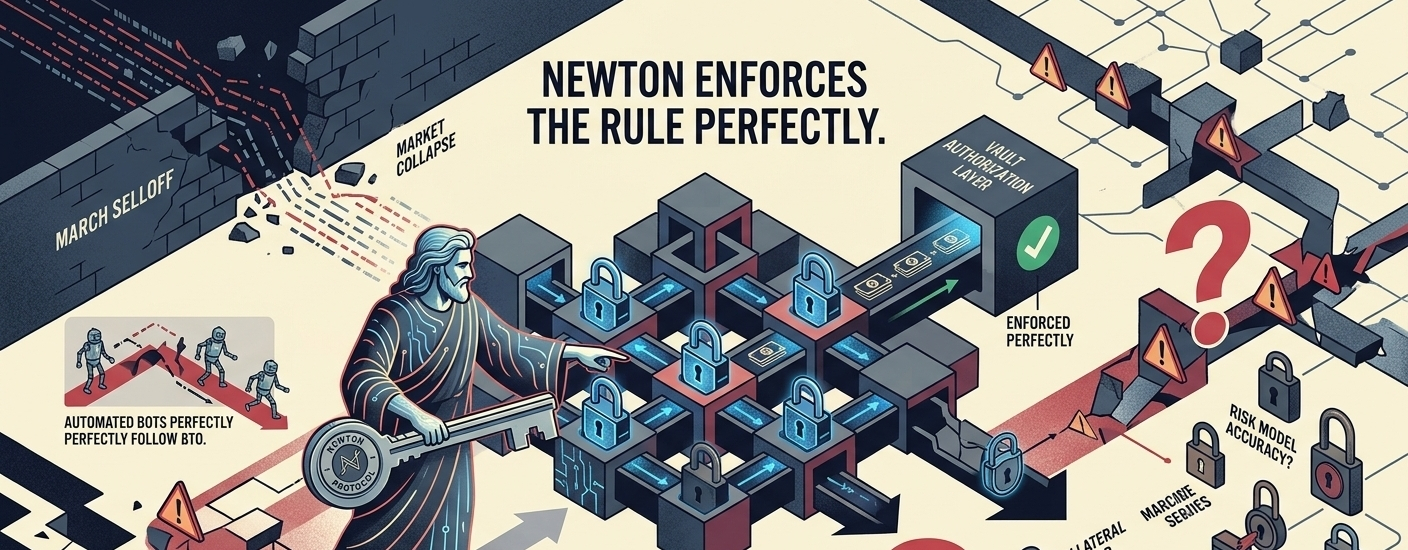
Newton Enforces the Rule Perfectly. Nobody Checks If the Rule Was Good.Newton's own launch materials include a small, telling detail. Explaining why the authorization layer exists, Magic Labs' co-founder pointed to a March market selloff where automated allocation bots kept feeding capital into a collapsing position — not because the bots malfunctioned, but because they executed exactly the rules they'd been given. That's the problem Newton solves: once a curator writes a rule, Newton makes sure it's actually followed, every time, before a transaction settles.
It's a real problem. It's also only half of one.
VaultKit — the SDK curators use to wire Newton's policy checks into a vault — is explicitly built to be neutral about the rules themselves. Any data provider, risk firm, or compliance vendor can publish a policy pack, and curators pick which ones to trust. Newton isn't in the business of judging whether a curator's collateral floor is set sensibly, whether a counterparty list is complete, or whether a risk model accounts for a move like the one in March. It checks whether the rule was followed. It says nothing about whether the rule was any good.
This isn't a problem Newton invented — it's the same one building across curated DeFi vaults generally, on Morpho, Euler, and elsewhere, where curator networks now concentrate the decisions that actually matter while the base protocol just guarantees the plumbing underneath works. Researchers tracking this shift have flagged the same worry: a small set of curators making similar calls creates exactly the kind of concentrated, correlated risk traditional finance spent decades building oversight around.
What Newton changes is subtle but real: it moves the failure mode from "the rule got bypassed" to "the rule was followed perfectly and was still wrong." A cryptographic receipt proving a policy ran exactly as written is genuinely useful to hand a regulator. It's a much less useful thing to hand a depositor trying to judge whether the curator behind their vault actually knew what they were doing.
Depositors are still underwriting a curator's judgment. Newton just makes sure that judgment, good or bad, gets carried out to the letter.
@NewtonProtocol $NEWT #Newt #newt #Newtcoin #NewtonProtocol #newton
Newton Enforces the Rule Perfectly. Nobody Checks If the Rule Was Good.
Newton's own launch materials include a small, telling detail. Explaining why the authorization layer exists, Magic Labs' co-founder pointed to a March market selloff where automated allocation bots kept feeding capital into a collapsing position — not because the bots malfunctioned, but because they executed exactly the rules they'd been given. That's the problem Newton solves: once a curator writes a rule, Newton makes sure it's actually followed, every time, before a transaction settles.
It's a real problem. It's also only half of one.
VaultKit — the SDK curators use to wire Newton's policy checks into a vault — is explicitly built to be neutral about the rules themselves. Any data provider, risk firm, or compliance vendor can publish a policy pack, and curators pick which ones to trust. Newton isn't in the business of judging whether a curator's collateral floor is set sensibly, whether a counterparty list is complete, or whether a risk model accounts for a move like the one in March. It checks whether the rule was followed. It says nothing about whether the rule was any good.
This isn't a problem Newton invented — it's the same one building across curated DeFi vaults generally, on Morpho, Euler, and elsewhere, where curator networks now concentrate the decisions that actually matter while the base protocol just guarantees the plumbing underneath works. Researchers tracking this shift have flagged the same worry: a small set of curators making similar calls creates exactly the kind of concentrated, correlated risk traditional finance spent decades building oversight around.
What Newton changes is subtle but real: it moves the failure mode from "the rule got bypassed" to "the rule was followed perfectly and was still wrong." A cryptographic receipt proving a policy ran exactly as written is genuinely useful to hand a regulator. It's a much less useful thing to hand a depositor trying to judge whether the curator behind their vault actually knew what they were doing.
Depositors are still underwriting a curator's judgment. Newton just makes sure that judgment, good or bad, gets carried out to the letter.
@NewtonProtocol $NEWT #Newt #newt #Newtcoin #NewtonProtocol #newton
It's a real problem. It's also only half of one.
VaultKit — the SDK curators use to wire Newton's policy checks into a vault — is explicitly built to be neutral about the rules themselves. Any data provider, risk firm, or compliance vendor can publish a policy pack, and curators pick which ones to trust. Newton isn't in the business of judging whether a curator's collateral floor is set sensibly, whether a counterparty list is complete, or whether a risk model accounts for a move like the one in March. It checks whether the rule was followed. It says nothing about whether the rule was any good.
This isn't a problem Newton invented — it's the same one building across curated DeFi vaults generally, on Morpho, Euler, and elsewhere, where curator networks now concentrate the decisions that actually matter while the base protocol just guarantees the plumbing underneath works. Researchers tracking this shift have flagged the same worry: a small set of curators making similar calls creates exactly the kind of concentrated, correlated risk traditional finance spent decades building oversight around.
What Newton changes is subtle but real: it moves the failure mode from "the rule got bypassed" to "the rule was followed perfectly and was still wrong." A cryptographic receipt proving a policy ran exactly as written is genuinely useful to hand a regulator. It's a much less useful thing to hand a depositor trying to judge whether the curator behind their vault actually knew what they were doing.
Depositors are still underwriting a curator's judgment. Newton just makes sure that judgment, good or bad, gets carried out to the letter.
@NewtonProtocol $NEWT #Newt #newt #Newtcoin #NewtonProtocol #newton
10
2
105
Log in to explore more content
Join global crypto users on Binance Square
⚡️ Get latest and useful information about crypto.
💬 Trusted by the world’s largest crypto exchange.
👍 Discover real insights from verified creators.
Email / Phone number
Trending Topics
1
#KoreaProposesTokenizingStocksAndBonds
8,683 views
203 Discussing
2
#MetaMaskExitsLidoValidatorsAfterSecurityIncident
73,483 views
944 Discussing
3
#MicronBeatsEarningsLiftsGuidance
43,671 views
718 Discussing
4
#CFTCSubmitsTwoEventContractRulesToWhiteHouse
30,328 views
595 Discussing
5
#BitcoinClears$85200
37,177 views
360 Discussing
6
#AltcoinSeasonIndexHoldsAbove60For5Days
177,408 views
2,177 Discussing
7
#USADPAdds90000JobsInSeptember
83,637 views
1,240 Discussing
8
#USCorePCEEasesTo3%InAugust
59,213 views
808 Discussing
9
#KospiPostsWorstQuarterSince2020
30,961 views
631 Discussing
10
#SECToClarifyOnChainFundraisingRules
75,179 views
871 Discussing