
#nexusatlas
nexusatlas
723 views
4 Discussing
Hot
Latest

·
--

Article
ICP: THE INTERNET’S NEXT INFRASTRUCTURE BET?NEXUS ATLAS | Institutional Intelligence
Beyond Markets. Into the Future.
What if the next major blockchain opportunity isn’t about processing transactions — but about running the internet itself?
That is the bigger question behind Internet Computer (ICP).
1. Beyond Another Layer-1
ICP is pursuing something different: decentralized computing.
Its architecture aims to let developers host applications, data, and backend systems directly on-chain through its unique canisters.
The ambition is significant: move beyond decentralized finance and build infrastructure for complete digital services.
That puts ICP in a different competitive arena — not only against Ethereum and Solana, but potentially against traditional cloud platforms.
2. AI Could Change the Equation
ICP’s Caffeine initiative introduces an intriguing possibility: using AI to create and deploy applications with far less traditional coding.
If AI-generated software becomes mainstream, the demand for infrastructure capable of hosting autonomous applications could expand dramatically.
But one distinction matters:
Creating applications is not the same as creating an economy.
Real users, recurring activity, and sustained computing demand will determine whether this becomes an investment catalyst.
3. The Cross-Chain Advantage
Through Chain Fusion, ICP is developing ways for applications to interact with networks such as Bitcoin, Ethereum, and Solana.
This could position ICP as a coordination and computing layer across multiple blockchain ecosystems — rather than simply another competitor fighting for users.
The opportunity is real, but meaningful economic activity matters more than technical integrations alone.
4. The Metric That Matters: Token Economics
ICP has a usage-based mechanism: developers convert ICP into Cycles to pay for computation and storage, burning the corresponding ICP.
However, the network also mints tokens for rewards.
Therefore, the important question is not simply whether adoption grows.
It is whether real network consumption can increasingly offset new token issuance.
Mission 70, DFINITY’s proposed effort to reduce ICP inflation, makes this an especially important area to monitor. Its actual impact must be judged through implemented changes and supply data.
5. Three Things That Could Change ICP’s Future
AI adoption: Are applications being built, used, and maintained?Economic activity: Is Cycle consumption growing relative to ICP issuance?Cross-chain usage: Are integrations generating real transactions and demand?
These indicators matter more than headlines, hype, or short-term price movements.
6. The Risks
ICP faces serious challenges: competition from established cloud providers, limited adoption, token inflation, governance concerns, and the difficulty of turning complex technology into products people actually use.
Even technological success does not guarantee token appreciation.
The NEXUS ATLAS Perspective
ICP is a high-risk infrastructure thesis with an unusually ambitious vision.
Its opportunity is not simply to become another successful blockchain. It is to become part of the computing foundation for AI-powered applications and decentralized digital services.
But the investment case depends on one decisive transition:
From technological capability to recurring economic demand.
If that transition happens, ICP’s role could become much more significant.
If it doesn’t, even impressive technology may struggle to justify its valuation.
The next internet race may not be about who processes the most transactions.
It may be about who powers the applications of tomorrow.
That is the real ICP thesis.
NEXUS ATLAS — Beyond Markets. Into the Future.
Disclaimer: Independent research for educational purposes only. Not financial advice. Cryptocurrency investments carry substantial risk.
#icp #InternetComputer #DFINITY #Web3 #AI #Blockchain #CryptoResearch #NEXUSATLAS $ICP
{spot}(ICPUSDT)
ICP: THE INTERNET’S NEXT INFRASTRUCTURE BET?
NEXUS ATLAS | Institutional Intelligence
Beyond Markets. Into the Future.
What if the next major blockchain opportunity isn’t about processing transactions — but about running the internet itself?
That is the bigger question behind Internet Computer (ICP).
1. Beyond Another Layer-1
ICP is pursuing something different: decentralized computing.
Its architecture aims to let developers host applications, data, and backend systems directly on-chain through its unique canisters.
The ambition is significant: move beyond decentralized finance and build infrastructure for complete digital services.
That puts ICP in a different competitive arena — not only against Ethereum and Solana, but potentially against traditional cloud platforms.
2. AI Could Change the Equation
ICP’s Caffeine initiative introduces an intriguing possibility: using AI to create and deploy applications with far less traditional coding.
If AI-generated software becomes mainstream, the demand for infrastructure capable of hosting autonomous applications could expand dramatically.
But one distinction matters:
Creating applications is not the same as creating an economy.
Real users, recurring activity, and sustained computing demand will determine whether this becomes an investment catalyst.
3. The Cross-Chain Advantage
Through Chain Fusion, ICP is developing ways for applications to interact with networks such as Bitcoin, Ethereum, and Solana.
This could position ICP as a coordination and computing layer across multiple blockchain ecosystems — rather than simply another competitor fighting for users.
The opportunity is real, but meaningful economic activity matters more than technical integrations alone.
4. The Metric That Matters: Token Economics
ICP has a usage-based mechanism: developers convert ICP into Cycles to pay for computation and storage, burning the corresponding ICP.
However, the network also mints tokens for rewards.
Therefore, the important question is not simply whether adoption grows.
It is whether real network consumption can increasingly offset new token issuance.
Mission 70, DFINITY’s proposed effort to reduce ICP inflation, makes this an especially important area to monitor. Its actual impact must be judged through implemented changes and supply data.
5. Three Things That Could Change ICP’s Future
AI adoption: Are applications being built, used, and maintained?Economic activity: Is Cycle consumption growing relative to ICP issuance?Cross-chain usage: Are integrations generating real transactions and demand?
These indicators matter more than headlines, hype, or short-term price movements.
6. The Risks
ICP faces serious challenges: competition from established cloud providers, limited adoption, token inflation, governance concerns, and the difficulty of turning complex technology into products people actually use.
Even technological success does not guarantee token appreciation.
The NEXUS ATLAS Perspective
ICP is a high-risk infrastructure thesis with an unusually ambitious vision.
Its opportunity is not simply to become another successful blockchain. It is to become part of the computing foundation for AI-powered applications and decentralized digital services.
But the investment case depends on one decisive transition:
From technological capability to recurring economic demand.
If that transition happens, ICP’s role could become much more significant.
If it doesn’t, even impressive technology may struggle to justify its valuation.
The next internet race may not be about who processes the most transactions.
It may be about who powers the applications of tomorrow.
That is the real ICP thesis.
NEXUS ATLAS — Beyond Markets. Into the Future.
Disclaimer: Independent research for educational purposes only. Not financial advice. Cryptocurrency investments carry substantial risk.
#icp #InternetComputer #DFINITY #Web3 #AI #Blockchain #CryptoResearch #NEXUSATLAS $ICP
1
243
·
--
Verified
Article
NEXUS ATLAS — Edition 001$DOT
POLKADOT (DOT): The Hidden Economic Challenge Behind Its Next Evolution
Can JAM turn Polkadot from a blockchain security provider into a decentralized computing economy?
Most discussions about Polkadot focus on interoperability, parachains, staking, and its upcoming JAM architecture.
But there is a more important question that deserves attention:
Can Polkadot generate enough economic demand for its infrastructure to make DOT valuable beyond its monetary and governance functions?
1. The Problem Behind the Technology
Polkadot was designed to connect independent blockchains through shared security and cross-chain communication.
Its architecture is technically ambitious. However, providing infrastructure to other blockchains does not automatically mean capturing the economic value generated by those networks.
In a June 2026 technical essay, Polkadot founder Gavin Wood explored this exact problem. His argument was that selling access to network resources must generate enough economic value to cover the cost of maintaining the infrastructure.
This is a much more important question than simply counting connected chains.
2. JAM: A Different Economic Opportunity
The Join-Accumulate Machine (JAM) represents a major evolution in Polkadot’s architecture.
Rather than limiting the network primarily to securing connected blockchains, JAM is designed as a decentralized computing environment.
Its architecture separates computation into two stages:
* Refinement: Work is processed independently and in parallel.
* Accumulation: Verified results are incorporated into shared network state.
The October 2026 technical explanation describes an architecture with 341 computational cores operating in parallel.
This could allow developers to build services beyond conventional blockchain applications, including general-purpose computation and interconnected digital services.
The important distinction is that JAM is not simply another scalability upgrade. It aims to expand what Polkadot’s infrastructure can actually provide.
3. The DOT Question Nobody Should Ignore
Here is where the analysis becomes particularly interesting.
In another June 2026 essay, Gavin Wood explored a specialized resource-access concept called JAMKB.
The proposal addressed a specific technical challenge: how to account for the limited shared state resources consumed by services running on JAM.
He argued that DOT might not be the ideal token for this particular function because DOT already serves several other purposes.
This is not an approved replacement for DOT, nor a confirmed new token launch.
However, it reveals an important distinction:
A network can become more technologically advanced without every new resource or service automatically creating additional value for its existing token.
For DOT holders, token value capture remains a question that deserves independent examination.
4. Tokenomics: A Meaningful Change
Polkadot introduced a major monetary reform in March 2026.
The new framework established a maximum supply of 2.1 billion DOT and changed the issuance schedule.
Instead of the previous fixed annual issuance model, new issuance is scheduled to decline in steps every two years.
The reform also introduced the Dynamic Allocation Pool (DAP), designed to collect issuance and protocol revenue for governance-directed allocation.
This improves the predictability of DOT’s long-term supply.
However, a supply cap alone does not create economic demand.
The real test is whether network usage, coretime purchases, and services generate enough sustainable demand to justify the token’s economic role.
5. What Does Real Adoption Tell Us?
Polkadot’s ecosystem is not empty.
The November 18, 2026 Polkadot Ecosystem Observatory reported:
* More than 65 active parachains.
* Approximately $75.1 million in ecosystem DeFi TVL.
* Around 4.82 million lifetime XCM messages.
* Approximately 50.8% of DOT supply staked.
These figures demonstrate an operating ecosystem and meaningful cross-chain infrastructure.
But they also expose a challenge: technical capacity and ecosystem activity are not the same as broad economic adoption.
The available TVL and transaction figures should be monitored over time, rather than treated as proof of strong future demand.
6. The Risks
There are four major issues to watch:
1. Execution risk: JAM still requires production engineering, integration, testing, and security work before the full transition can be considered complete.
2. Economic risk: More computational capacity does not guarantee enough paying customers.
3. Token value capture: The relationship between JAM resource consumption, coretime demand, protocol revenue, and DOT must become demonstrably stronger.
4. Competition: Ethereum, modular blockchain networks, and other decentralized computing projects are competing for developers and applications.
7. What Could Change the Investment Thesis?
We would look for five measurable developments:
* JAM reaching production readiness and completing its network transition.
* Sustained growth in actual coretime purchases.
* Increasing applications and services with real users.
* Stronger economic activity across the ecosystem.
* Clear evidence that network growth translates into meaningful demand for DOT.
Without these developments, the technology may advance while the investment thesis remains incomplete.
NEXUS ATLAS CONCLUSION
Polkadot deserves attention not because it promises another blockchain revolution, but because it is attempting to solve a difficult infrastructure problem: turning decentralized computing capacity into a sustainable economy.
Its technological direction is ambitious, and its monetary reform addresses an important historical weakness.
Yet the central question remains unanswered:
Will JAM create an economy that generates meaningful demand for DOT, or will it simply create a more capable network?
That distinction could define Polkadot’s long-term relevance.
NEXUS ATLAS investigates digital assets with credible potential to contribute to future industries, infrastructure, and financial systems. We prioritize long-term relevance, independent research, diversification, and risk-aware exposure.
Technology creates possibilities. Adoption creates evidence. Economics determines whether token holders actually benefit.
Research edition | NEXUS ATLAS
#BinanceSquare #Write2Earn #NEXUSATLAS
NEXUS ATLAS — Edition 001
$DOT
POLKADOT (DOT): The Hidden Economic Challenge Behind Its Next Evolution
Can JAM turn Polkadot from a blockchain security provider into a decentralized computing economy?
Most discussions about Polkadot focus on interoperability, parachains, staking, and its upcoming JAM architecture.
But there is a more important question that deserves attention:
Can Polkadot generate enough economic demand for its infrastructure to make DOT valuable beyond its monetary and governance functions?
1. The Problem Behind the Technology
Polkadot was designed to connect independent blockchains through shared security and cross-chain communication.
Its architecture is technically ambitious. However, providing infrastructure to other blockchains does not automatically mean capturing the economic value generated by those networks.
In a June 2026 technical essay, Polkadot founder Gavin Wood explored this exact problem. His argument was that selling access to network resources must generate enough economic value to cover the cost of maintaining the infrastructure.
This is a much more important question than simply counting connected chains.
2. JAM: A Different Economic Opportunity
The Join-Accumulate Machine (JAM) represents a major evolution in Polkadot’s architecture.
Rather than limiting the network primarily to securing connected blockchains, JAM is designed as a decentralized computing environment.
Its architecture separates computation into two stages:
* Refinement: Work is processed independently and in parallel.
* Accumulation: Verified results are incorporated into shared network state.
The October 2026 technical explanation describes an architecture with 341 computational cores operating in parallel.
This could allow developers to build services beyond conventional blockchain applications, including general-purpose computation and interconnected digital services.
The important distinction is that JAM is not simply another scalability upgrade. It aims to expand what Polkadot’s infrastructure can actually provide.
3. The DOT Question Nobody Should Ignore
Here is where the analysis becomes particularly interesting.
In another June 2026 essay, Gavin Wood explored a specialized resource-access concept called JAMKB.
The proposal addressed a specific technical challenge: how to account for the limited shared state resources consumed by services running on JAM.
He argued that DOT might not be the ideal token for this particular function because DOT already serves several other purposes.
This is not an approved replacement for DOT, nor a confirmed new token launch.
However, it reveals an important distinction:
A network can become more technologically advanced without every new resource or service automatically creating additional value for its existing token.
For DOT holders, token value capture remains a question that deserves independent examination.
4. Tokenomics: A Meaningful Change
Polkadot introduced a major monetary reform in March 2026.
The new framework established a maximum supply of 2.1 billion DOT and changed the issuance schedule.
Instead of the previous fixed annual issuance model, new issuance is scheduled to decline in steps every two years.
The reform also introduced the Dynamic Allocation Pool (DAP), designed to collect issuance and protocol revenue for governance-directed allocation.
This improves the predictability of DOT’s long-term supply.
However, a supply cap alone does not create economic demand.
The real test is whether network usage, coretime purchases, and services generate enough sustainable demand to justify the token’s economic role.
5. What Does Real Adoption Tell Us?
Polkadot’s ecosystem is not empty.
The November 18, 2026 Polkadot Ecosystem Observatory reported:
* More than 65 active parachains.
* Approximately $75.1 million in ecosystem DeFi TVL.
* Around 4.82 million lifetime XCM messages.
* Approximately 50.8% of DOT supply staked.
These figures demonstrate an operating ecosystem and meaningful cross-chain infrastructure.
But they also expose a challenge: technical capacity and ecosystem activity are not the same as broad economic adoption.
The available TVL and transaction figures should be monitored over time, rather than treated as proof of strong future demand.
6. The Risks
There are four major issues to watch:
1. Execution risk: JAM still requires production engineering, integration, testing, and security work before the full transition can be considered complete.
2. Economic risk: More computational capacity does not guarantee enough paying customers.
3. Token value capture: The relationship between JAM resource consumption, coretime demand, protocol revenue, and DOT must become demonstrably stronger.
4. Competition: Ethereum, modular blockchain networks, and other decentralized computing projects are competing for developers and applications.
7. What Could Change the Investment Thesis?
We would look for five measurable developments:
* JAM reaching production readiness and completing its network transition.
* Sustained growth in actual coretime purchases.
* Increasing applications and services with real users.
* Stronger economic activity across the ecosystem.
* Clear evidence that network growth translates into meaningful demand for DOT.
Without these developments, the technology may advance while the investment thesis remains incomplete.
NEXUS ATLAS CONCLUSION
Polkadot deserves attention not because it promises another blockchain revolution, but because it is attempting to solve a difficult infrastructure problem: turning decentralized computing capacity into a sustainable economy.
Its technological direction is ambitious, and its monetary reform addresses an important historical weakness.
Yet the central question remains unanswered:
Will JAM create an economy that generates meaningful demand for DOT, or will it simply create a more capable network?
That distinction could define Polkadot’s long-term relevance.
NEXUS ATLAS investigates digital assets with credible potential to contribute to future industries, infrastructure, and financial systems. We prioritize long-term relevance, independent research, diversification, and risk-aware exposure.
Technology creates possibilities. Adoption creates evidence. Economics determines whether token holders actually benefit.
Research edition | NEXUS ATLAS
#BinanceSquare #Write2Earn #NEXUSATLAS
3
1.2k
·
--
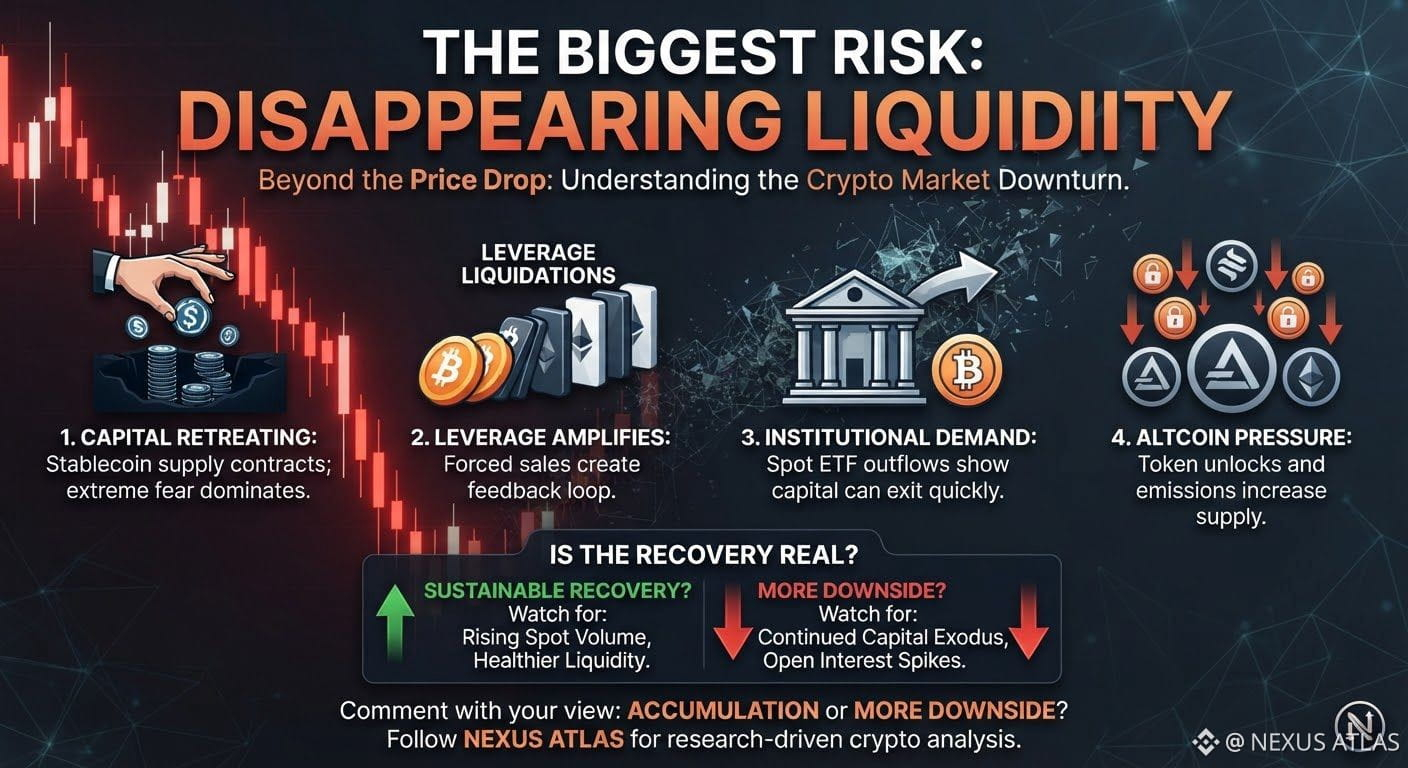
🚨 CRYPTO MARKET WARNING: THE BIGGEST RISK MAY NOT BE THE PRICE DROP. IT MAY BE THE DISAPPEARING LIQUIDITY.
Bitcoin is falling. Altcoins are suffering even more. But what is actually happening beneath the charts?
Let’s look beyond the red candles. 👇
1️⃣ CAPITAL IS RETREATING
Recent market data showed crypto sentiment near extreme fear, while stablecoin supply contracted. This matters because stablecoins are a major source of trading liquidity. Less available capital can mean weaker buying pressure.
2️⃣ LEVERAGE IS AMPLIFYING THE CRASH
When prices fall, leveraged long positions get liquidated. Those forced sales push prices lower, trigger more liquidations, and create a dangerous feedback loop.
3️⃣ INSTITUTIONAL DEMAND IS NOT GUARANTEED
Spot Bitcoin ETF outflows have shown that institutional capital can move out just as quickly as it moves in. ETF demand must be monitored, not assumed.
4️⃣ ALTCOINS FACE AN EXTRA PROBLEM
Many projects face token unlocks, insider allocations, and ongoing emissions. Even a promising technology can struggle when new supply enters a market with weak demand.
5️⃣ WHAT COULD SIGNAL A REAL RECOVERY?
Watch these five indicators:
* Rising spot buying volume.
* Improving stablecoin liquidity.
* Falling open interest without a new price collapse.
* Funding rates returning to healthy levels.
* Stronger accumulation and improving market breadth.
⚠️ THE KEY DISTINCTION:
A short-term price bounce is not the same as a market reversal.
A sustainable recovery needs real demand, healthier liquidity, and confirmation from spot markets — not just short squeezes.
NOW THE BIG QUESTION:
Are we approaching a major accumulation opportunity, or is the market preparing for another leg down?
👇 Comment with your view:
ACCUMULATION or MORE DOWNSIDE?
Follow NEXUS ATLAS for research-driven crypto analysis beyond price hype.
#bitcoin #CryptoMarket #CryptoAnalysis #Blockchain #NexusAtlas $BTC $ETH $NVDAB
188
Log in to explore more content
Join global crypto users on Binance Square
⚡️ Get latest and useful information about crypto.
💬 Trusted by the world’s largest crypto exchange.
👍 Discover real insights from verified creators.
Email / Phone number
Trending Topics
1
#IsAnthropic’s$1.5TMarketCapJustified?
45,734 views
224 Discussing
2
#BTCBelow$62KAmidHikeFearsAndShiftToAnthropic
7,224 views
60 Discussing
3
#NvidiaBoardReportedlySplitOverHuang’sReturn
201,553 views
1,658 Discussing
4
#CanGTA6'sLaunchLiftTTWOShares?
161,781 views
1,193 Discussing
5
#BlackRockBitcoinETFRecordsLargestDailyOutflow
0 views
0 Discussing
6
#LedgerProbesTamperedWalletsInBerlinAndDubai
13,130 views
193 Discussing
7
#13FInstitutionsBitcoinSpotETPHoldingsHitRecord
25,960 views
266 Discussing
8
#BTCRemainsUnderPressureAfterHawkishFOMCMinutes
372,154 views
2,493 Discussing
9
#StrategySTRCPreferredSlips3.65%Below$100Par
12,797 views
98 Discussing
10
#MASToUpgradeSGDTestnetToSGDigitalLedger
49,099 views
454 Discussing