

#bedrockcoin
bedrockcoin
5,085 views
456 Discussing
Hot
Latest

#bedrock $BR Here are 5 original Binance Square post ideas (each over 100 characters) that mention @Bedrock $BR, and #Bedrock:
Writing
Exploring Bedrock 2.0 and its vision for the future of liquid restaking. The focus on capital efficiency and broader utility for staked assets makes an interesting project to watch. Looking forward to seeing how the ecosystem evolves. #Bedrock
Writing
Bedrock 2.0 aims to unlock new opportunities for users by enhancing liquidity and staking flexibility. Innovation in restaking infrastructure could play a major role in the next phase of DeFi growth. Following and $BR closely. #Bedrock
Writing
As DeFi continues to mature, projects that improve asset efficiency stand out. Bedrock 2.0 is working toward a more connected staking ecosystem with expanded utility and user participation. Excited to learn more from and the community. #BedrockCoin
You can post any of these individually on Binance Square to meet the task requirements.
#bedrock $BR Here are 5 original Binance Square post ideas (each over 100 characters) that mention @Bedrock $BR , and #Bedrock:
Writing
Exploring Bedrock 2.0 and its vision for the future of liquid restaking. The focus on capital efficiency and broader utility for staked assets makes an interesting project to watch. Looking forward to seeing how the ecosystem evolves. #Bedrock
Writing
Bedrock 2.0 aims to unlock new opportunities for users by enhancing liquidity and staking flexibility. Innovation in restaking infrastructure could play a major role in the next phase of DeFi growth. Following and $BR closely. #Bedrock
Writing
As DeFi continues to mature, projects that improve asset efficiency stand out. Bedrock 2.0 is working toward a more connected staking ecosystem with expanded utility and user participation. Excited to learn more from and the community. #BedrockCoin
You can post any of these individually on Binance Square to meet the task requirements.
Writing
Exploring Bedrock 2.0 and its vision for the future of liquid restaking. The focus on capital efficiency and broader utility for staked assets makes an interesting project to watch. Looking forward to seeing how the ecosystem evolves. #Bedrock
Writing
Bedrock 2.0 aims to unlock new opportunities for users by enhancing liquidity and staking flexibility. Innovation in restaking infrastructure could play a major role in the next phase of DeFi growth. Following and $BR closely. #Bedrock
Writing
As DeFi continues to mature, projects that improve asset efficiency stand out. Bedrock 2.0 is working toward a more connected staking ecosystem with expanded utility and user participation. Excited to learn more from and the community. #BedrockCoin
You can post any of these individually on Binance Square to meet the task requirements.
1
10

#bedrock $BR @Bedrock 2.0 is no longer just a restaking protocol—it's now an Intelligent Yield Engine for Bitcoin Capital. With the shift to dynamic asset routing via $BR and uniBTC, Bedrock is bringing institutional-grade, market-neutral strategies to everyday holders.
From Delta-Neutral Vaults to the AI on-chain analyst BRclaw (now in beta), this is how you make BTC productive without the noise.
Explore the new homepage and get ready for the modular vault rollout. #BedrockCoin
#bedrock $BR @Bedrock 2.0 is no longer just a restaking protocol—it's now an Intelligent Yield Engine for Bitcoin Capital. With the shift to dynamic asset routing via $BR and uniBTC, Bedrock is bringing institutional-grade, market-neutral strategies to everyday holders.
From Delta-Neutral Vaults to the AI on-chain analyst BRclaw (now in beta), this is how you make BTC productive without the noise.
Explore the new homepage and get ready for the modular vault rollout. #BedrockCoin
From Delta-Neutral Vaults to the AI on-chain analyst BRclaw (now in beta), this is how you make BTC productive without the noise.
Explore the new homepage and get ready for the modular vault rollout. #BedrockCoin
84

·
--
#bedrock $BR The vision behind Bedrock 2.0 is impressive. By enhancing staking efficiency and unlocking new possibilities for decentralized finance, @Bedrock is building a foundation for sustainable ecosystem growth. Watching how $BR supports this expanding network will be exciting in the months ahead. #BedrockCoin
#bedrock $BR The vision behind Bedrock 2.0 is impressive. By enhancing staking efficiency and unlocking new possibilities for decentralized finance, @Bedrock is building a foundation for sustainable ecosystem growth. Watching how $BR supports this expanding network will be exciting in the months ahead. #BedrockCoin
68

·
--
#bedrock $BR @BiBi what should people know about @Bedrock and what benefit of following the official account , specify the overall benefit on post their activities b, advertising an even marketing the brand
$USDC
#BedrockCoin $BR
{alpha}(560xff7d6a96ae471bbcd7713af9cb1feeb16cf56b41)
most people don't know why are trending the future billionaire will invest in #BR .
#bedrock $BR @Binance BiBi what should people know about @Bedrock and what benefit of following the official account , specify the overall benefit on post their activities b, advertising an even marketing the brand
$USDC
#BedrockCoin $BR
most people don't know why are trending the future billionaire will invest in #BR .
$USDC
#BedrockCoin $BR
most people don't know why are trending the future billionaire will invest in #BR .
15

·
--
#bedrock $BR Good morning, dear friends! Hope you're all having a great day. This campaign offers a ton of perks, profits, and guarantees in the $BR area with solid storage strategies. I encourage everyone to participate as widely as possible to rake in a lot of $BR #BedrockCoin coins through staking, mining, and other tokens presented in this post from the project account @Bedrock (https://www.binance.com/en/square/profile/bedrock). Check out the official project site. Thank you so much, dear friends! Please share this widely so that more people can benefit from this project #BedrockDAO , which focuses on permanent storage and the profits from staking. Thanks a lot!
#bedrock $BR Good morning, dear friends! Hope you're all having a great day. This campaign offers a ton of perks, profits, and guarantees in the $BR area with solid storage strategies. I encourage everyone to participate as widely as possible to rake in a lot of $BR #BedrockCoin coins through staking, mining, and other tokens presented in this post from the project account @Bedrock (https://www.binance.com/en/square/profile/bedrock). Check out the official project site. Thank you so much, dear friends! Please share this widely so that more people can benefit from this project #BedrockDAO , which focuses on permanent storage and the profits from staking. Thanks a lot!

25

·
--
The evolution of decentralized staking is entering a new phase with @Bedrock #MRVLSoarsOnNVDATrillionDollarOutlook #BitcoinFearGaugeSurgesNearly20% and the vision behind Bedrock 2.0. By focusing on liquidity, interoperability, and capital efficiency, Bedrock is helping users unlock more value from their staked assets while remaining active across the DeFi ecosystem.
What stands out about Bedrock 2.0 is its commitment to creating a more connected and productive staking experience, where assets can work across multiple protocols instead of remaining idle. As DeFi continues to mature, projects that improve utility and accessibility will play a key role in driving adoption.
I'm excited to follow the growth of the Bedrock ecosystem and see how it continues to innovate in the liquid staking space. $BR has the potential to become an important part of this journey.
#BedrockCoin $BR #bedrock $BR
The evolution of decentralized staking is entering a new phase with @Bedrock #MRVLSoarsOnNVDATrillionDollarOutlook #BitcoinFearGaugeSurgesNearly20% and the vision behind Bedrock 2.0. By focusing on liquidity, interoperability, and capital efficiency, Bedrock is helping users unlock more value from their staked assets while remaining active across the DeFi ecosystem.
What stands out about Bedrock 2.0 is its commitment to creating a more connected and productive staking experience, where assets can work across multiple protocols instead of remaining idle. As DeFi continues to mature, projects that improve utility and accessibility will play a key role in driving adoption.
I'm excited to follow the growth of the Bedrock ecosystem and see how it continues to innovate in the liquid staking space. $BR has the potential to become an important part of this journey.
#BedrockCoin $BR #bedrock $BR
What stands out about Bedrock 2.0 is its commitment to creating a more connected and productive staking experience, where assets can work across multiple protocols instead of remaining idle. As DeFi continues to mature, projects that improve utility and accessibility will play a key role in driving adoption.
I'm excited to follow the growth of the Bedrock ecosystem and see how it continues to innovate in the liquid staking space. $BR has the potential to become an important part of this journey.
#BedrockCoin $BR #bedrock $BR
85

·
--
#bedrock $BR If you are holding Bitcoin across cycles, capital efficiency matters just as much as security. With Bedrock 2.0, the framework moves past simple single-channel restaking protocols. Using uniBTC as an institutional-grade smart router, @Bedrock efficiently navigates global market liquidity without forcing users to risk manual cross-chain swaps. Keeping an eye on $BR as the ecosystem redefines sustainable BTC yield generation. ⚓ #BedrockCoin
#bedrock $BR If you are holding Bitcoin across cycles, capital efficiency matters just as much as security. With Bedrock 2.0, the framework moves past simple single-channel restaking protocols. Using uniBTC as an institutional-grade smart router, @Bedrock efficiently navigates global market liquidity without forcing users to risk manual cross-chain swaps. Keeping an eye on $BR as the ecosystem redefines sustainable BTC yield generation. ⚓ #BedrockCoin
108
#bedrock $BR Bedrock is redefining the landscape of BTCFi with its innovative approach to liquid restaking. By launching Bedrock 2.0 and introducing brB$TC, the protocol is seamlessly bridging Bitcoin's immense value into the broader DeFi ecosystem, offering users new ways to optimize their holdings across chains like Ethereum and BNB Chain.
The transition to a non-rebasing model for its liquid restaking tokens is a significant step forward, prioritizing simplicity and utility for holders while maintaining robust security standards. With the $BR token at the core of this ecosystem, @Bedrock is building a more sustainable and productive infrastructure for Bitcoin-backed assets. It is truly impressive to watch how the team is scaling these solutions to make decentralized finance more accessible and efficient for everyone involved. $BR
{alpha}(560xff7d6a96ae471bbcd7713af9cb1feeb16cf56b41)
#BedrockCoin
#bedrock $BR Bedrock is redefining the landscape of BTCFi with its innovative approach to liquid restaking. By launching Bedrock 2.0 and introducing brB$TC, the protocol is seamlessly bridging Bitcoin's immense value into the broader DeFi ecosystem, offering users new ways to optimize their holdings across chains like Ethereum and BNB Chain.
The transition to a non-rebasing model for its liquid restaking tokens is a significant step forward, prioritizing simplicity and utility for holders while maintaining robust security standards. With the $BR token at the core of this ecosystem, @Bedrock is building a more sustainable and productive infrastructure for Bitcoin-backed assets. It is truly impressive to watch how the team is scaling these solutions to make decentralized finance more accessible and efficient for everyone involved. $BR
#BedrockCoin
The transition to a non-rebasing model for its liquid restaking tokens is a significant step forward, prioritizing simplicity and utility for holders while maintaining robust security standards. With the $BR token at the core of this ecosystem, @Bedrock is building a more sustainable and productive infrastructure for Bitcoin-backed assets. It is truly impressive to watch how the team is scaling these solutions to make decentralized finance more accessible and efficient for everyone involved. $BR
#BedrockCoin
77

·
--
🚀 Bedrock 2.0 is pushing Bitcoin staking to the next level! By enhancing liquidity and expanding DeFi opportunities, @Bedrock is building a stronger ecosystem for users and builders alike. Excited to see how $BR grows with innovation and community support. 🔥
#BedrockCoin
🚀 Bedrock 2.0 is pushing Bitcoin staking to the next level! By enhancing liquidity and expanding DeFi opportunities, @Bedrock is building a stronger ecosystem for users and builders alike. Excited to see how $BR grows with innovation and community support. 🔥
#BedrockCoin
#BedrockCoin
69

·
--
#bedrock $BR The launch of @Bedrock and the vision behind Bedrock 2.0 represent a new phase of innovation in decentralized finance. I appreciate the project’s focus on improving capital efficiency, expanding staking opportunities, and building sustainable long-term value for users. As the ecosystem continues to grow, I am excited to follow the development of $BR and the new possibilities that Bedrock 2.0 can bring to the broader blockchain community. #BedrockCoin
{future}(BRUSDT)
#bedrock $BR The launch of @Bedrock and the vision behind Bedrock 2.0 represent a new phase of innovation in decentralized finance. I appreciate the project’s focus on improving capital efficiency, expanding staking opportunities, and building sustainable long-term value for users. As the ecosystem continues to grow, I am excited to follow the development of $BR and the new possibilities that Bedrock 2.0 can bring to the broader blockchain community. #BedrockCoin
47
#bedrock $BR
Bedrock 2.0 is on my radar because upgrades usually reveal the real product direction. If execution matches the vision, $BR could benefit from stronger utility and demand. @Bedrock #BedrockCoin @Bedrock
{alpha}(560xff7d6a96ae471bbcd7713af9cb1feeb16cf56b41)
#bedrock $BR
Bedrock 2.0 is on my radar because upgrades usually reveal the real product direction. If execution matches the vision, $BR could benefit from stronger utility and demand. @Bedrock #BedrockCoin @Bedrock
Bedrock 2.0 is on my radar because upgrades usually reveal the real product direction. If execution matches the vision, $BR could benefit from stronger utility and demand. @Bedrock #BedrockCoin @Bedrock
87

·
--
#bedrock $BR
{future}(BRUSDT)
The evolution of Bitcoin staking is getting more exciting with Bedrock 2.0. By focusing on efficiency, liquidity, and broader ecosystem participation, @Bedrock is creating new opportunities for users who want to maximize the value of their assets. $BR is definitely a token to watch as the ecosystem grows. #BedrockCoin
#bedrock $BR
The evolution of Bitcoin staking is getting more exciting with Bedrock 2.0. By focusing on efficiency, liquidity, and broader ecosystem participation, @Bedrock is creating new opportunities for users who want to maximize the value of their assets. $BR is definitely a token to watch as the ecosystem grows. #BedrockCoin
The evolution of Bitcoin staking is getting more exciting with Bedrock 2.0. By focusing on efficiency, liquidity, and broader ecosystem participation, @Bedrock is creating new opportunities for users who want to maximize the value of their assets. $BR is definitely a token to watch as the ecosystem grows. #BedrockCoin
79

·
--
#bedrock $BR $BR is positioning itself as an important infrastructure project within the liquid staking and Bitcoin DeFi ecosystem. Through innovative staking solutions, Bedrock aims to unlock additional utility for digital assets while maintaining liquidity for users. As the demand for restaking, yield generation, and cross-chain opportunities grows, @Bedrock Bedrock's ecosystem could attract more adoption. Investors should watch ecosystem expansion, TVL growth, partnerships, and product development as key indicators of long-term potential. @Bedrock #BedrockCoin
#bedrock $BR $BR is positioning itself as an important infrastructure project within the liquid staking and Bitcoin DeFi ecosystem. Through innovative staking solutions, Bedrock aims to unlock additional utility for digital assets while maintaining liquidity for users. As the demand for restaking, yield generation, and cross-chain opportunities grows, @Bedrock Bedrock's ecosystem could attract more adoption. Investors should watch ecosystem expansion, TVL growth, partnerships, and product development as key indicators of long-term potential. @Bedrock #BedrockCoin
61

·
--
Bullish
#bedrock $BR
#Bedrock标签
$BR
Investing in the future of decentralized finance with @Bedrock is an amazing journey. The innovative features of Bedrock 2.0 make it a very strong project in the crypto space. Don't miss out on the potential of the $BR token! #BedrockCoin
#bedrock $BR
#Bedrock标签
$BR
Investing in the future of decentralized finance with @Bedrock is an amazing journey. The innovative features of Bedrock 2.0 make it a very strong project in the crypto space. Don't miss out on the potential of the $BR token! #BedrockCoin
#Bedrock标签
$BR
Investing in the future of decentralized finance with @Bedrock is an amazing journey. The innovative features of Bedrock 2.0 make it a very strong project in the crypto space. Don't miss out on the potential of the $BR token! #BedrockCoin
24

·
--
Unpopular opinion:
The future winners in DeFi won’t be the protocols offering the highest yields.
They’ll be the protocols making capital work smarter.
For years, users had to choose between staking rewards and liquidity. That tradeoff is exactly what many next-generation protocols are trying to solve.
That’s one reason I’ve been researching @Bedrock and the ecosystem around $BR.
Bedrock 2.0 is focused on unlocking more utility from staked assets while maintaining efficiency and flexibility for users.
Higher yield gets attention.
Better capital efficiency changes the game.
Which do you think matters more for the future of DeFi?
#BedrockCoin
#bedrock $BR
Unpopular opinion:
The future winners in DeFi won’t be the protocols offering the highest yields.
They’ll be the protocols making capital work smarter.
For years, users had to choose between staking rewards and liquidity. That tradeoff is exactly what many next-generation protocols are trying to solve.
That’s one reason I’ve been researching @Bedrock and the ecosystem around $BR .
Bedrock 2.0 is focused on unlocking more utility from staked assets while maintaining efficiency and flexibility for users.
Higher yield gets attention.
Better capital efficiency changes the game.
Which do you think matters more for the future of DeFi?
#BedrockCoin
#bedrock $BR
The future winners in DeFi won’t be the protocols offering the highest yields.
They’ll be the protocols making capital work smarter.
For years, users had to choose between staking rewards and liquidity. That tradeoff is exactly what many next-generation protocols are trying to solve.
That’s one reason I’ve been researching @Bedrock and the ecosystem around $BR .
Bedrock 2.0 is focused on unlocking more utility from staked assets while maintaining efficiency and flexibility for users.
Higher yield gets attention.
Better capital efficiency changes the game.
Which do you think matters more for the future of DeFi?
#BedrockCoin
#bedrock $BR
18

·
--
Bearish
While many projects focus only on staking rewards, @Bedrock is pushing the concept further with Bedrock 2.0. The goal is not just to stake assets, but to unlock additional utility and capital efficiency across the DeFi landscape.
As the ecosystem grows, the importance of sustainable tokenomics and real use cases becomes increasingly clear. That's why I'm paying attention to how $BR supports participation, governance, and ecosystem expansion.
Bedrock 2.0 represents an interesting step toward a more flexible and productive staking experience. Projects that successfully combine security, liquidity, and utility are likely to attract long-term users in the next crypto cycle.
#BedrockCoin
#bedrock $BR
{future}(BRUSDT)
While many projects focus only on staking rewards, @Bedrock is pushing the concept further with Bedrock 2.0. The goal is not just to stake assets, but to unlock additional utility and capital efficiency across the DeFi landscape.
As the ecosystem grows, the importance of sustainable tokenomics and real use cases becomes increasingly clear. That's why I'm paying attention to how $BR supports participation, governance, and ecosystem expansion.
Bedrock 2.0 represents an interesting step toward a more flexible and productive staking experience. Projects that successfully combine security, liquidity, and utility are likely to attract long-term users in the next crypto cycle.
#BedrockCoin
#bedrock $BR
As the ecosystem grows, the importance of sustainable tokenomics and real use cases becomes increasingly clear. That's why I'm paying attention to how $BR supports participation, governance, and ecosystem expansion.
Bedrock 2.0 represents an interesting step toward a more flexible and productive staking experience. Projects that successfully combine security, liquidity, and utility are likely to attract long-term users in the next crypto cycle.
#BedrockCoin
#bedrock $BR
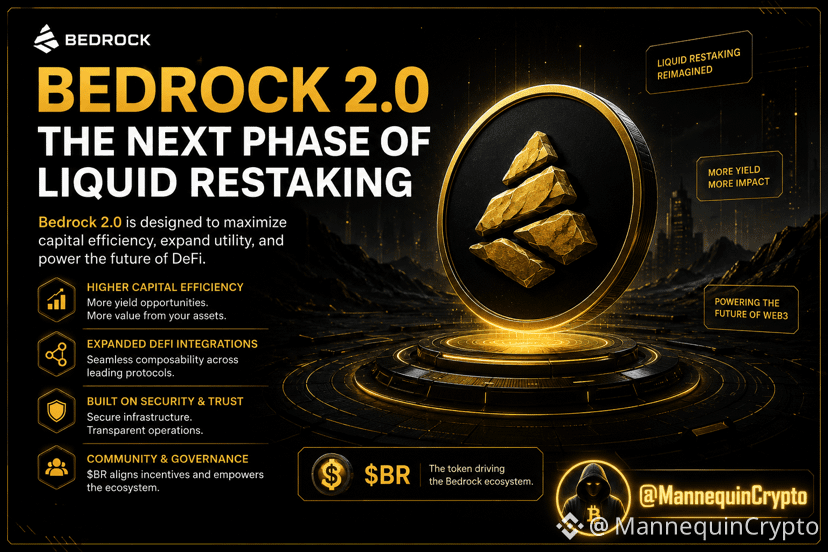
87

·
--
Bullish
$BR Excited to see the progress of @Bedrock and Bedrock 2.0! The ecosystem is growing fast with innovative staking solutions and strong community support. Looking forward to the future development of $BR and the opportunities it can bring to users. #BedrockCoin
This Coin Is growing very impressive and this coin is reach to 0.5$ in this week so why are you waiting for Go A Head and check out This.
$BR Excited to see the progress of @Bedrock and Bedrock 2.0! The ecosystem is growing fast with innovative staking solutions and strong community support. Looking forward to the future development of $BR and the opportunities it can bring to users. #BedrockCoin
This Coin Is growing very impressive and this coin is reach to 0.5$ in this week so why are you waiting for Go A Head and check out This.
This Coin Is growing very impressive and this coin is reach to 0.5$ in this week so why are you waiting for Go A Head and check out This.
10

·
--
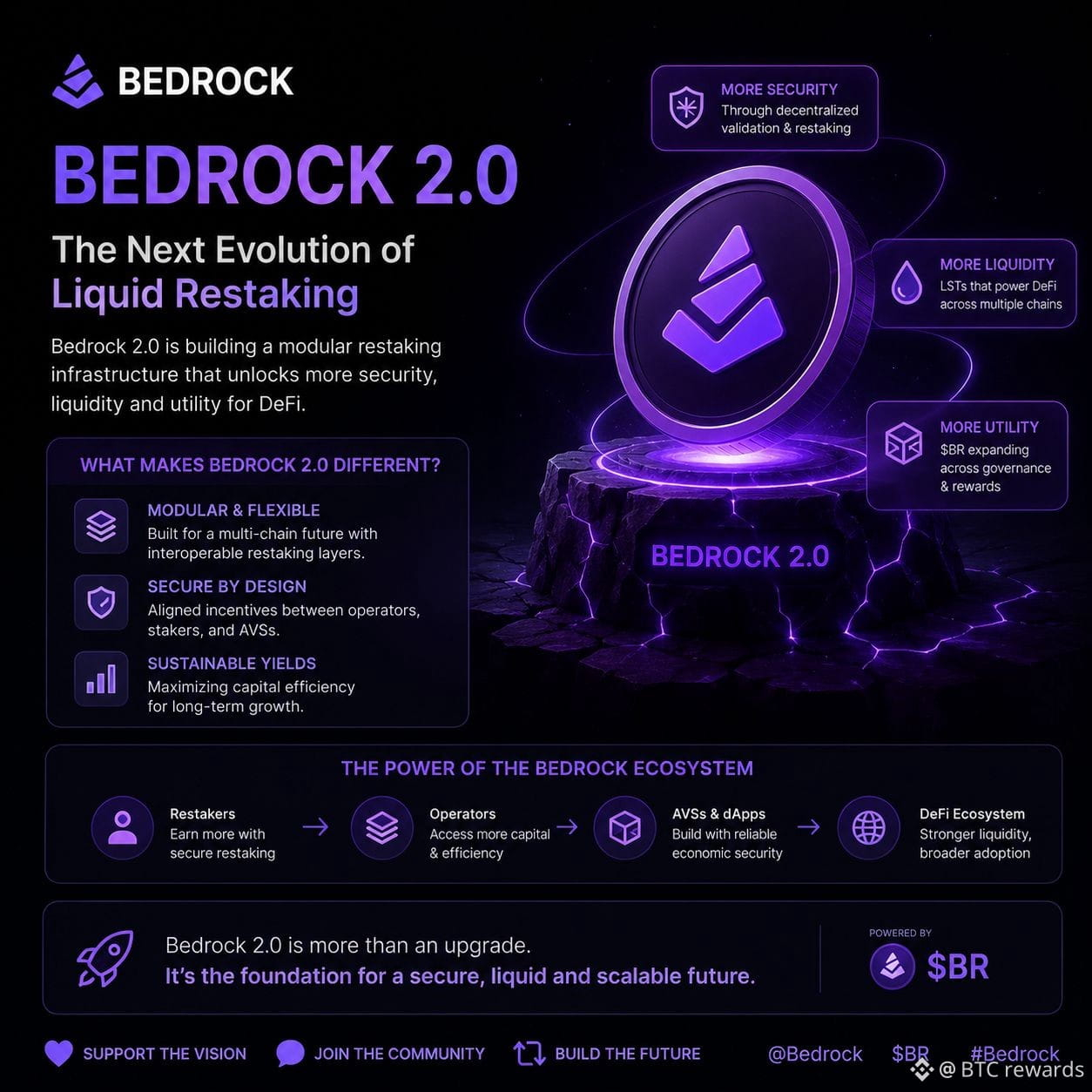
#bedrock $BR @Bedrock
Bedrock 2.0 is pushing modular restaking infrastructure forward, aiming to improve liquidity and security across DeFi. Excited to see how @Bedrock evolves its ecosystem with $BR utility expanding in governance and staking rewards. The progress around cross-chain integration and scalable yield opportunities makes it one of the most interesting narratives to watch in Web3 right now. $BR #BedrockCoin
{future}(BRUSDT)
#bedrock $BR @Bedrock
Bedrock 2.0 is pushing modular restaking infrastructure forward, aiming to improve liquidity and security across DeFi. Excited to see how @Bedrock evolves its ecosystem with $BR utility expanding in governance and staking rewards. The progress around cross-chain integration and scalable yield opportunities makes it one of the most interesting narratives to watch in Web3 right now. $BR #BedrockCoin
Bedrock 2.0 is pushing modular restaking infrastructure forward, aiming to improve liquidity and security across DeFi. Excited to see how @Bedrock evolves its ecosystem with $BR utility expanding in governance and staking rewards. The progress around cross-chain integration and scalable yield opportunities makes it one of the most interesting narratives to watch in Web3 right now. $BR #BedrockCoin
2
77

·
--
#bedrock $BR 🚀 Excited to see the evolution of @Bedrock with Bedrock 2.0! The project is taking liquid staking and Bitcoin DeFi to the next level by improving capital efficiency, security, and real yield opportunities for users. As the ecosystem grows, $BR continues to play an important role in governance and community participation. Looking forward to more innovation and adoption in the Bedrock ecosystem. 🔥
$BR #BedrockCoin
#bedrock $BR 🚀 Excited to see the evolution of @Bedrock with Bedrock 2.0! The project is taking liquid staking and Bitcoin DeFi to the next level by improving capital efficiency, security, and real yield opportunities for users. As the ecosystem grows, $BR continues to play an important role in governance and community participation. Looking forward to more innovation and adoption in the Bedrock ecosystem. 🔥
$BR #BedrockCoin
$BR #BedrockCoin
80

#bedrock $BR Bedrock 2.0 is pushing BTCFi innovation to the next level by improving liquidity efficiency and expanding staking opportunities. Following @Bedrock 2.0 is pushing BTCFi innovation to the next level by improving liquidity efficiency and expanding staking opportunities. Following @Bedrock, I’m excited to see how $BR strengthens the ecosystem and creates more utility for users across DeFi. #Bedrock $BR, I’m excited to see howstrengthens the ecosystem and creates more utility for users across DeFi. #BedrockCoin $BR
#bedrock $BR Bedrock 2.0 is pushing BTCFi innovation to the next level by improving liquidity efficiency and expanding staking opportunities. Following @Bedrock 2.0 is pushing BTCFi innovation to the next level by improving liquidity efficiency and expanding staking opportunities. Following @Bedrock, I’m excited to see how $BR strengthens the ecosystem and creates more utility for users across DeFi. #Bedrock $BR , I’m excited to see howstrengthens the ecosystem and creates more utility for users across DeFi. #BedrockCoin $BR
77
Log in to explore more content
Join global crypto users on Binance Square
⚡️ Get latest and useful information about crypto.
💬 Trusted by the world’s largest crypto exchange.
👍 Discover real insights from verified creators.
Email / Phone number
Trending Topics
1
#BTCFallsBelow$83000
3,747 views
66 Discussing
2
#BitgetDetailsSecurityIncidentTimeline
0 views
8 Discussing
3
#BitcoinSpotETFs$2.39BWeeklyNetInflow
242 views
10 Discussing
4
#FedProposesPaymentStablecoinRules
16,733 views
386 Discussing
5
#ChinaMayLetAlibabaByteDanceBuyNvidiaChips
18,918 views
418 Discussing
6
#USChinaRelease$30BTariffCutProductLists
2,719 views
45 Discussing
7
#SKoreaFSCConsidersVirtualAssetMarketMaker
13,539 views
325 Discussing
8
#ChinaIndustrialProfitGrowthSlowsFourthMonth
13,151 views
318 Discussing
9
#BitwiseFilesFinalNEARSpotETFProspectus
132,183 views
1,909 Discussing
10
#BitgetHackerMoves$83MStolenXRP
42,087 views
184 Discussing