📌 Why the Federal Reserve quietly drained purchasing power — and why Bitcoin is challenging the system
Most people believe inflation is accidental.
It isn’t.
It’s a feature of the modern monetary system.
🎯 Core Idea
The U.S. monetary system, built around the Federal Reserve, runs on elastic money.
While it solved short-term liquidity crises, it systematically eroded purchasing power and concentrated wealth at the top.
Bitcoin proposes a radically different alternative.
🕰️ A century of erosion
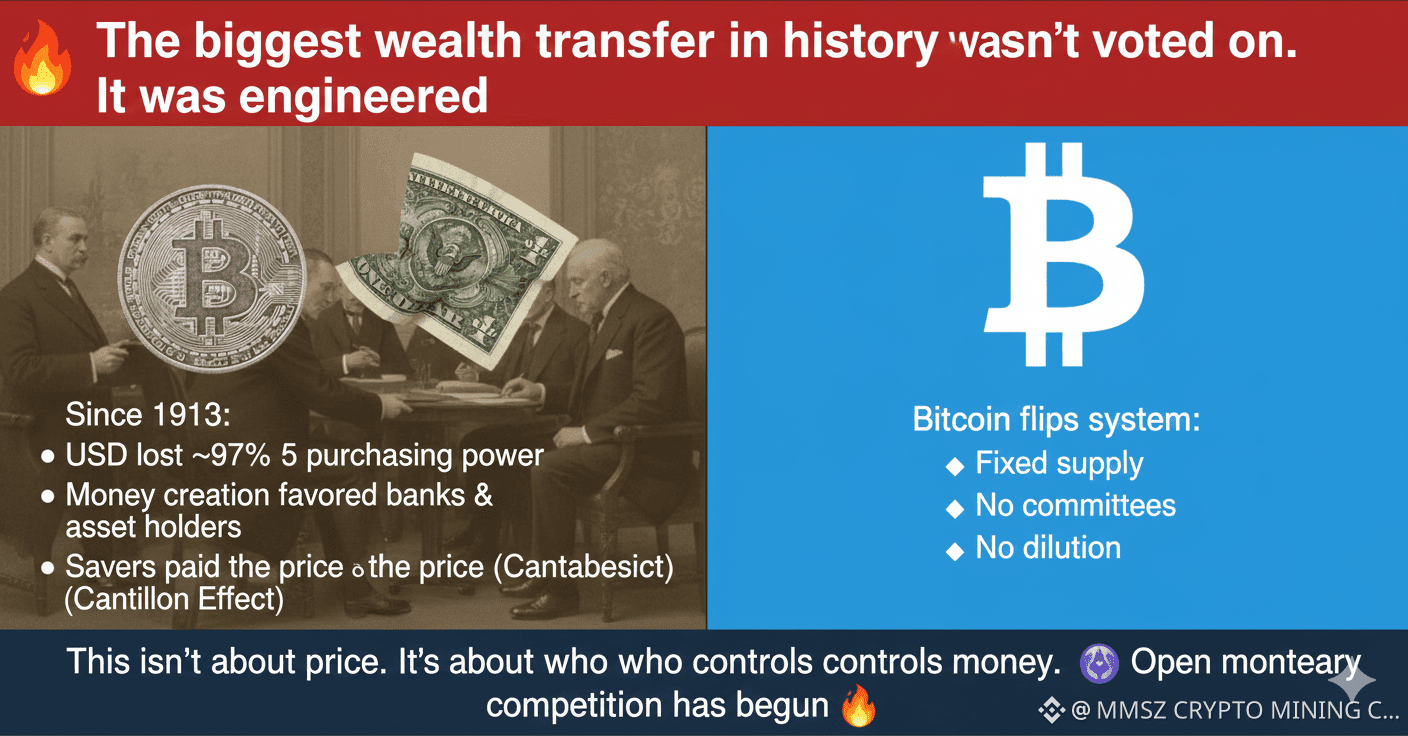
💵 Since 1913, the U.S. dollar has lost ~97% of its purchasing power
📈 Money supply and the Fed’s balance sheet expanded at historic, compounding rates
📉 Savings lost value faster than wages could keep up
🕵️ The hidden origins
🚆 In 1910, elite bankers and policymakers met privately on Jekyll Island
🎭 Central banking was sold as protection from Wall Street
🏦 In practice, it centralized monetary power closer to it
⚙️ The elastic money dilemma
🌾 Flexible money was justified for seasonal economic needs
🖨️ Temporary expansion became permanent money creation
🔗 The gold constraint was eventually abandoned
📉 Scarcity was removed — but discipline wasn’t replaced
🔁 The unequal impact (Cantillon Effect)
🏛️ Banks, governments, and asset holders receive new money first
👨👩👧 Workers and savers receive it last
📉 Prices rise before wages adjust
➡️ This is the silent wealth transfer no one teaches in school.
🟠 Bitcoin’s alternative
🔒 Fixed supply — no committees, no bailouts
✂️ Infinitely divisible (satoshis)
⚡ Fast, global, permissionless settlement
🌍 Accessible without dilution or favoritism
Bitcoin doesn’t promise stability.
It promises rules.
⏳ Perspective check
🏦 Federal Reserve: 112 years old
🟠 Bitcoin: ~17 years old
🚀 Bitcoin reached multi-trillion-dollar relevance in ~15% of the time, despite constant resistance.
🧠 Bottom line
🎁 The Federal Reserve represents discretionary money, framed as stability
⚖️ Bitcoin represents rule-based money, enforced by math
🔹 Gold constraint abandoned → unlimited fiat expansion
🔹 Bitcoin → digital scarcity without centralized control
🔮 The coming decades won’t be about regulation.
They’ll be about which money survives open competition.