
yx9mio
150 Posts

yx9mio
Report
Block User
0 Following
1 Followers
6 Liked
Posts
All
Videos
·
--
The roughly $6.3 billion Binance hack is being downplayed by major financial firms in the US. That’s a market perspective.
TD Cowen, Cantor Fitzgerald and Compass Point see the weak price action as a buying opportunity. This view belongs to the three firms; it is not a recommendation for investors.
Bitwise Chief Investment Officer Matt Hougan forecasts that the market will recover within a week; this is his forecast, not a guaranteed timeline or a definitive conclusion about what will actually happen.
I’d still be cautious about treating that assessment as something that has already happened.
6
·
--
The CLARITY Act, a U.S. bill on regulating the digital asset market, has drawn attention again following the Binance hack, involving approximately $6.3 billion in unauthorized withdrawals. However, no specific timeline or voting schedule has been announced for the bill.
Senator Lummis and CFTC Chair Selig have also commented on the regulatory approach. The CFTC is the U.S. agency that regulates commodity and derivatives markets.
No specific timeline has been announced for the bill, and there is no voting schedule yet. The next step remains unclear.
I’ll follow how discussions on the regulatory approach develop and when the first timeline is announced. Based on the information available, I’m not rushing to predict what will happen to the bill.
$BNB #Binance
73
·
--
Binance is buying back tokens stolen in an unauthorized withdrawal; here are the latest developments in the case.
The unauthorized withdrawal on 29/10/2026 amounted to approximately $6.3 billion.
On 31/10/2026, Ethena transferred 128.63 million ENA, worth approximately $24 million, to Binance; the two figures describe the same transfer in terms of token quantity and estimated value.
Both developments involve Binance. There is no confirmed information that ENA was among the stolen tokens or that Binance is buying back ENA.
I will monitor the recovery of the tokens.
I will keep an eye on further developments regarding the ENA transfer. There is still much to watch.
$ENA $BNB #Binance
5
740
·
--
The Binance hack brought selling pressure to AAVE: the token was sold off, while Aave froze the market, temporarily locking related trading activity on the protocol.
The unauthorized withdrawals totaled 167,464 ETH.
As the market digests the shock, an AMBCrypto analysis identified $113 as a support level for AAVE—a price at which, according to the analysis, buying pressure could emerge to support the price—and advised traders to watch that level.
The shock has spread to the protocol as well. I’ll be watching developments around the level cited by AMBCrypto and Aave’s next move after freezing the market; there isn’t yet enough evidence to conclude what will happen next.
$AAVE $ETH #Aave
219
·
--
A laptop — and the figure of $6.3 billion
Binance announced that the point of entry was a systems engineer’s laptop. About $3 billion has been frozen; the $6.01–6.4 billion figure is an estimate from other sources — these are not the same figures.
The video explains why a laptop can be a major weak point, what “frozen” means, and the three questions that remain open. Based solely on the exchange’s official announcement. No buy or sell recommendations, and no investment advice. $BTC
6.2k
·
--
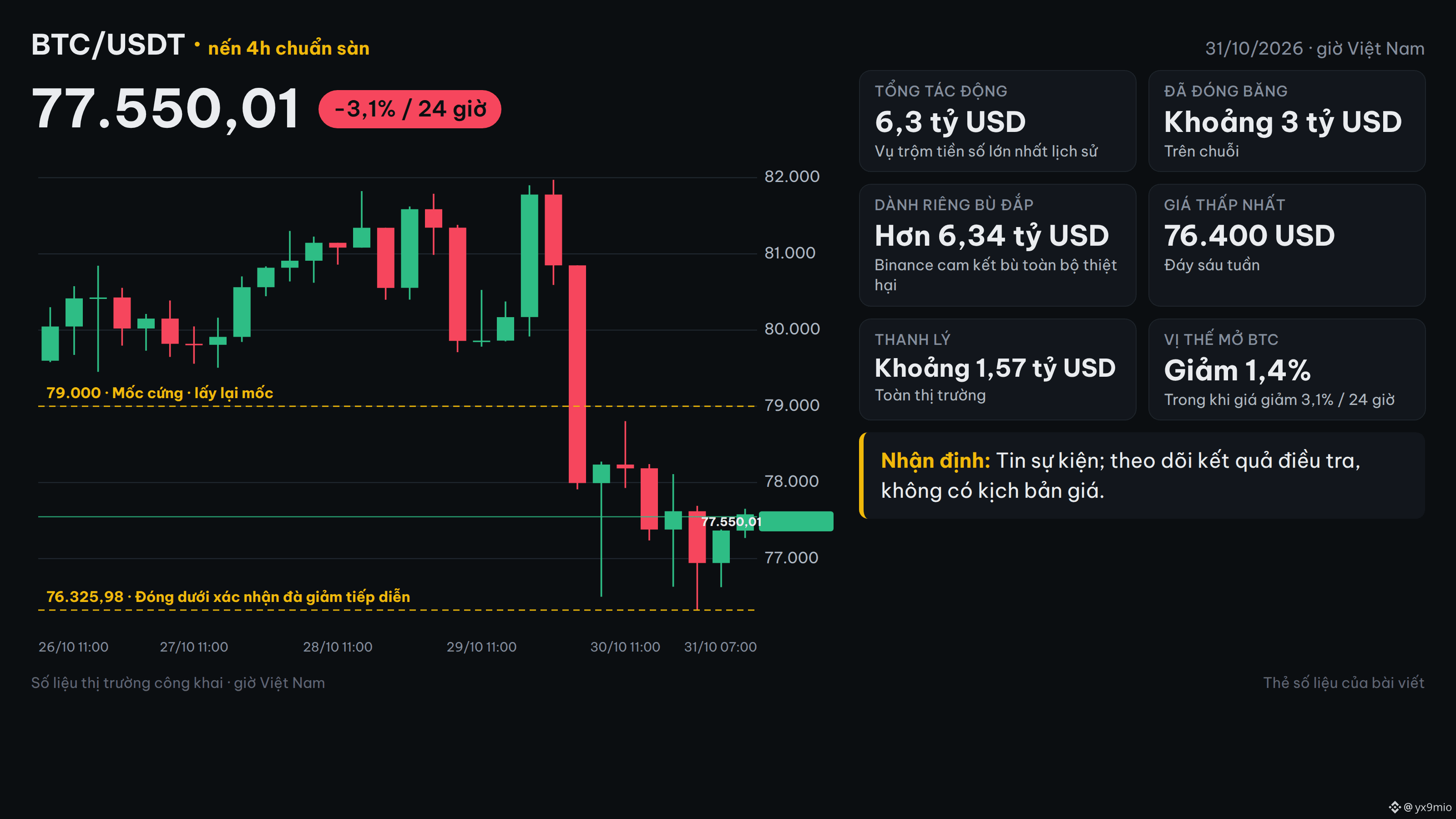
The biggest cryptocurrency theft in history, but BTC fell only about 4% in a day before stabilizing. The impact was around $6.3 billion, four times the $1.5 billion Bybit hack in February 2025.
BTC hit a six-week low of $76,400, then hovered around $77,065 on Friday afternoon, October 30, U.S. time. The sell-off was relatively contained given the scale of the incident.
Binance pledged to cover all the losses, setting aside more than $6.34 billion in company funds.
Around $3 billion has been frozen on-chain (locked on the public ledger so the funds cannot be transferred).
Over 24 hours, BTC's price fell 3.1%, but open interest—the bets that are still being held—fell by only 1.4%, suggesting that funds have not been withdrawn from positions as they were in previous collapses.
The swift pledge and the funds set aside helped ease concerns; freezing the funds also reassured users. A Fundstrat expert said they saw no risk of the exchange becoming insolvent.
BTC's current price is $77,550.01 at 07:51 on October 31, Vietnam time.
There is no final conclusion yet. I’ll wait for the investigation results before rushing to conclude that the price must collapse.
$BTC #Binance
230
·
--
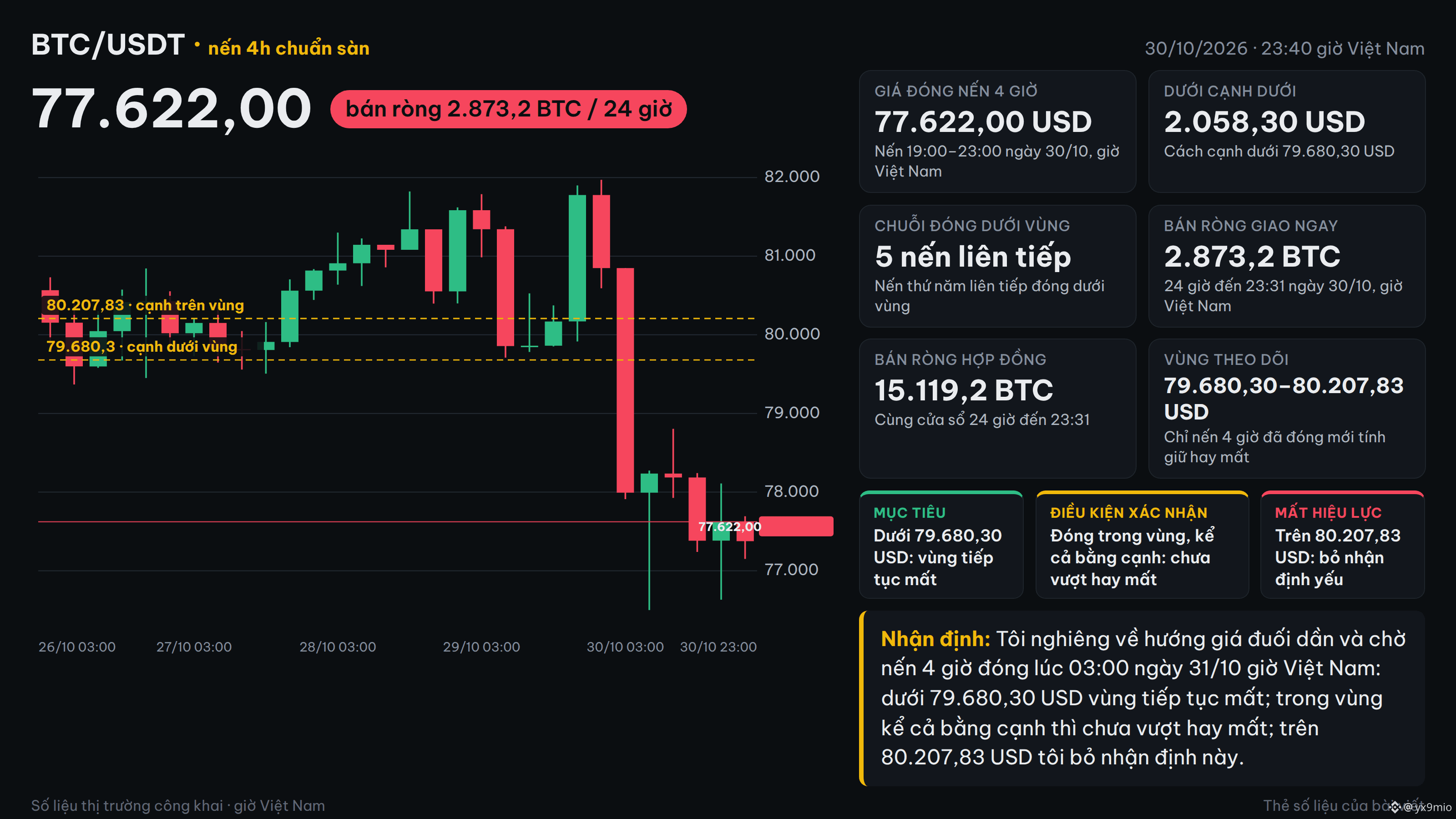
Many people saw the green candle close at 23:00 on October 30, Vietnam time, and quickly assumed the support zone had been reclaimed.
That’s not actually the case. The 4-hour candle from 19:00–23:00 on October 30, Vietnam time, closed at USD 77,622.00—exactly USD 2,058.30 below the lower edge of the key support zone at USD 79,680.30–80,207.83. It was the fifth consecutive candle to close below this zone. Although it bounced from USD 76,632.00 and closed USD 239.99 higher than the previous candle, this is still just a short-term technical rebound.
The shorter time frames tell the same story: both the 1-hour candle from 22:00–23:00 and the 15-minute candle from 22:45–23:00 on October 30, Vietnam time, closed at USD 77,622.00. Sellers are still applying pressure: in the 24 hours up to 23:31 on October 30, Vietnam time, aggressive order flow showed net selling of 2,873.2 BTC on the spot market and 15,119.2 BTC in futures.
I’m leaning toward prices gradually losing momentum, because only a closed 4-hour candle can determine whether the zone holds or fails. We’ll know more about the support move after the 4-hour candle closes at 03:00 on October 31, Vietnam time. If it closes above the upper edge at USD 80,207.83, I’ll drop this view.
$BTC #Market
986
·
--
Binance pledges to cover all losses in its first official update on the same unauthorized withdrawal incident reported at 04:41 a.m. on October 30, 2026, Vietnam time.
A preliminary investigation suggests that a DevOps engineer’s laptop was compromised, allowing the attacker to submit an unauthorized withdrawal request. This is not yet a final conclusion.
Binance says it has found no evidence that wallet keys were leaked.
The total impact is approximately $6.3 billion.
About $3 billion has been frozen on-chain (the funds are locked on the public ledger and can no longer be transferred).
Binance has not yet published a detailed technical post-incident analysis.
The timing for resuming deposits and withdrawals has also not been announced.
I think the compensation pledge should be followed up on: we should wait for the detailed technical analysis and the announcement about resuming deposits and withdrawals.
#Binance
119
·
--
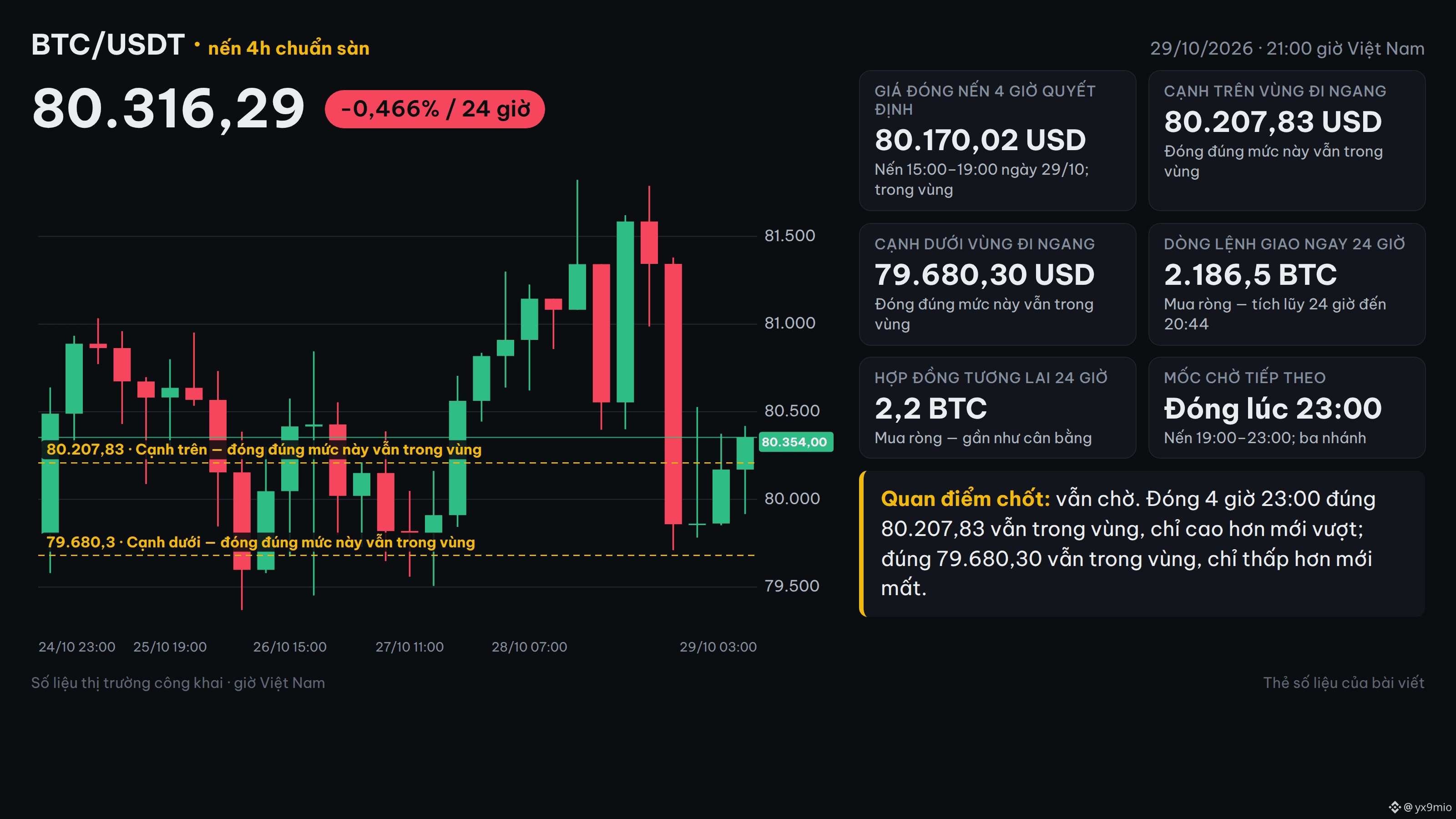
BTC is within the range. The $79,680.30–$80,207.83 range is where buyers and sellers are locked in a battle; only a closed 4-hour candle can determine whether the range still holds or has been lost. The 4-hour candle from 15:00 to 19:00 on October 29, Vietnam time, closed at $80,170.02, still within the range.
Over the 24 hours up to 20:44 on October 29, Vietnam time, cumulative taker flow showed net spot buying of 2,186.5 BTC and net futures buying of 2.2 BTC. Price remains within the range: spot buying indicates buying pressure, while futures are nearly balanced. The two sides have not jointly confirmed a direction; spot buying alone is not enough to conclude that the range has been broken, so I’m waiting for the 4-hour candle to close.
I’m waiting for the 4-hour candle from 19:00 to 23:00 on October 29, Vietnam time, to close at 23:00. A close exactly at $80,207.83 would still be within the range; only a close above it would count as a breakout. A close exactly at $79,680.30 would also remain within the range; only a close below it would mean the range has been lost. $BTC #Market
62
·
--
I'm still waiting. The decision candle closed inside the range.
I haven't changed my mind.
Since 26/10, BTC has been moving sideways in the 79.680,30–80.207,83 USD range; the two edges mark whether price is still inside the range or has broken out, and only a 4-hour candle close determines that. The 4-hour candle from 11:00–15:00 closed at 79.861,89 USD, inside the range. Before that, two 1-hour candles closed above the upper edge, then the next two 1-hour candles closed back inside the range.
If the 4-hour candle closes at 19:00 above 80.207,83 USD, I'll change my mind because the range has been broken; if it closes inside the range, I'll keep waiting; if it closes below 79.680,30 USD, I'll abandon my view that the range is still holding price.
$BTC #thitruongtaichinh
174
·
--
The market is waiting for major news, so the overall sentiment is cautious, with no rush to make strong moves.
BTC is now around 79.910, down 0.63% today.
During the day, the price hit a high of 80.844,7 and a low of 79.451,35.
The trend in recent days has been moving downward.
On 21/10, the closing price was 84.085, and by 26/10 it was 80.017, meaning it fell nearly 5% in 5 days.
Today, the price continued to move below 80.000.
Why is the market cautious?
On 29/10, the Fed will make a decision, along with additional inflation data and reports from major tech companies.
When major news has not yet been released, many people choose to stay on the sidelines and wait for clearer signals rather than guess in advance.
General view: the short-term trend is still downward, and only when clear news arrives can sentiment potentially reverse.
This is only a market assessment, not buy or sell advice. $BTC #PhanTich
4
275
·
--
After closing below the lower boundary, the price has returned to the $79,680.30–$80,207.83 range, as it did this morning, but the range is not yet secure. The 13:00–14:00 1-hour candle closed at $79,669.99, $10.31 below the lower boundary. After that, the 14:00–14:15 and 14:30–14:45 15-minute candles closed at $79,606.19 and $79,664.01, respectively, $74.11 and $16.29 below the lower boundary; even so, the 14:00–15:00 1-hour candle closed inside the range at $79,806.72. This morning, the 11:30–11:45 15-minute candle also closed below the range, followed by the 11:00–12:00 1-hour candle closing inside it at $79,759.26. But the past does not guarantee a repeat: the 13:00–14:00 candle closed below the lower boundary. By 16:00, all four 15-minute candles in the 15:00–16:00 hour had closed inside the range; the 1-hour candle closed at $79,871.15, with its low $47.70 above the lower boundary. The 15:00–16:00 hour kept its low inside the range, but the price remains within the range, with no confirmed direction yet. Wait for the 4-hour candle to close at 19:00: only a close below $79,680.30 would count as losing the range; only a close above $80,207.83 would count as reclaiming it; a close within the range still would not confirm a direction. $BTC #Market
After closing below the lower boundary, the price has returned to the $79,680.30–$80,207.83 range, as it did this morning, but the range is not yet secure. The 13:00–14:00 1-hour candle closed at $79,669.99, $10.31 below the lower boundary. After that, the 14:00–14:15 and 14:30–14:45 15-minute candles closed at $79,606.19 and $79,664.01, respectively, $74.11 and $16.29 below the lower boundary; even so, the 14:00–15:00 1-hour candle closed inside the range at $79,806.72. This morning, the 11:30–11:45 15-minute candle also closed below the range, followed by the 11:00–12:00 1-hour candle closing inside it at $79,759.26. But the past does not guarantee a repeat: the 13:00–14:00 candle closed below the lower boundary. By 16:00, all four 15-minute candles in the 15:00–16:00 hour had closed inside the range; the 1-hour candle closed at $79,871.15, with its low $47.70 above the lower boundary. The 15:00–16:00 hour kept its low inside the range, but the price remains within the range, with no confirmed direction yet. Wait for the 4-hour candle to close at 19:00: only a close below $79,680.30 would count as losing the range; only a close above $80,207.83 would count as reclaiming it; a close within the range still would not confirm a direction. $BTC #Market
97
·
--
BTC just formed a 4-hour bearish candle with a wider range than the previous candle. The range is the distance between the candle’s high and low; it shows how far the price moved, not just the direction in which it closed.
The 07:00–11:00 candle on October 27, Vietnam time, closed at $79,819.56. Its range was $740.37: a high of $80,388.37 minus a low of $79,648.00. The candle’s closing price was $331.00 below its opening price, while the range reflects the full price movement over the four hours.
The 03:00–07:00 candle on October 27 had a range of $482.90; the candle from 23:00 on October 26 to 03:00 on October 27 had a range of $758.39. The candle that just closed had a wider range than the one immediately before it, but a narrower range than the candle before that. The range alone does not indicate what will happen next.
The 11:00–15:00 candle on October 27 is still open; its full range can only be compared once it closes. The range of the candle that just closed shows that the price moved considerably over four hours, but that alone is not enough to conclude that a new trend has begun.
$BTC #Market
260
·
--
TRX closed a 4-hour candle below the old low of $0.3293, a level that had previously supported the price.
The 07:00–11:00 Vietnam time candle on 27/10 closed at $0.3291, exactly $0.0002 below that level. Based on the 07:00–11:00 candle close on 27/10, TRX has lost this level.
The reference price at 11:04 Vietnam time was $0.3291; this is the price when the data was collected, not the candle’s closing price. The 11:00–15:00 Vietnam time candle is still open, so it has not provided further confirmation.
I lean toward weakness after the close just below the level. The 4-hour candle closing at 15:00 will show whether the price stays below $0.3293 or moves back above it; if it closes above the level, I’ll change my view.
91
·
--
BTC’s recent rebound was smaller than the rise the day before, so I see it as a rebound worth watching—not yet a confirmed reversal.
The standard exchange 4-hour candle from 23:00 on 26/10 to 03:00 on 27/10 (Vietnam time) closed at USD 80,020.01. The next candle, from 03:00 to 07:00, closed at USD 80,150.56, up USD 130.55. The range—the distance from the low to the high—narrowed from USD 758.39 to USD 482.90.
The most recent instance of a smaller rise following a down candle was on 26/10: the 07:00–11:00 candle closed down USD 556.07, then the 11:00–15:00 candle closed up USD 448.69; their ranges were USD 1,017.34 and USD 719.99, respectively. The latest rise is clearly smaller, though the range is also narrower.
I’m inclined to view the current move as a weak rebound until the next 4-hour candle provides further confirmation. Past performance does not guarantee future results.
$BTC #Market
168
·
--
The range between BTC’s four hourly closes was just $57.02, which makes me cautious when reading the candle.
In the exchange-standard 4-hour candle from 07:00 to 11:00 on 25/10/2026, the four hourly closes were $80,877.25 → $80,902.01 → $80,920.00 → $80,862.98. Subtracting the lowest from the highest gives $57.02.
That is only the range of the four hourly closing prices, while the full candle spanned $80,771.72–$81,033.69, a range of $261.97. Looking only at closing prices misses the moves that went further and then reversed during the hour.
This candle’s volume was 936.70 BTC, or 44.82% of the average for the previous five 4-hour candles. That is not enough to call it accumulation or guess which way it will break.
The candle closed at 11:00 at $80,862.98. By 13:11, the price was recorded at $80,585.99, below that candle’s low; the 4-hour candle ending at 15:00 was still in progress. All times are Vietnam time, on 25/10.
I think the four closely grouped closing prices conceal the intrahour fluctuations. I’m still cautious, have not concluded which side is winning, and won’t set a new price target ahead of the Fed on 29/10.
$BTC #Market
211
·
--
Liquidations of long positions don’t mean the market is about to reverse upward.
Liquidation is the forced closure of a leveraged position when the price moves against it and the account no longer has enough margin—not deliberate buying. A liquidation sweep can happen near the end of a downtrend, or it can simply occur midway through one. Short positions are subject to the same mechanism.
BTCUSDT perpetual futures: The 24-hour window through 12:35 on 25/10 recorded liquidations of 720.7 BTC on the long side and 81.5 BTC on the short side (the last liquidation occurred at 12:34). At 12:34, the contract price was 80,691.40 USD (-0.025% over 24 hours), with open interest at 93,472.391 BTC; the 8-hour funding rate settled at 07:00 was +0.009409%. All times are Vietnam time, 25/10/2026.
The standard exchange 4-hour spot candle closed at 11:00 at 80,862.98 USD, below its 07:00 close of 80,888.16 USD; this is only a comparison of closing prices and does not confirm a reversal.
To call it a reversal, we need to see whether the price holds after the sweep through the close of the candle, whether aggressive order flow changes direction, whether open interest contracts or builds again, and whether volume dries up. I don’t try to call a bottom based on a single liquidation figure.
$BTC #DigitalAssets
154
·
--
BTC closed the 4-hour candle within the support zone; the candle high edged above the upper boundary while the low stayed above the lower boundary, so the wicks alone do not determine whether the zone is still holding or has been lost.
The exchange-standard 4-hour candle for 03:00–07:00 on 27/10 closed at USD 80,150.56, still within the support zone of USD 79,680.30–80,207.83. The high exceeded the upper boundary by USD 3.64, while the low was just USD 48.27 above the lower boundary. Neither test was a closing price.
In the final hour, the 1-hour candle for 06:00–07:00 closed at USD 80,150.56. The four 15-minute candles during that hour closed at USD 79,882.01, 80,074.00, 80,142.82, and 80,150.56, respectively: closing prices rose progressively within the zone. These are the prices at which each candle ended.
The zone therefore remains undecided. An exchange-standard 4-hour candle closing at 11:00 above USD 80,207.83 would confirm a close above the upper boundary; a close below USD 79,680.30 would invalidate the view that price remains within the zone.
296
·
--
In an announcement on October 26, Keystone said it will destroy 18,835 hardware wallets in its inventory because they contain a stolen device authentication key that cannot be replaced.
According to Bitcoin.com News, the key is used to verify that a wallet is genuine. Since it is hardwired during manufacturing, it cannot be erased or rewritten; attackers could use it to make counterfeit wallets that pass the authentication check.
As a result, Keystone has halted shipments and is accepting only preorders until it manufactures a new batch with replacement keys. Destroying the entire batch shows that the exposed key directly affects the ability to distinguish genuine wallets from counterfeits. Keystone said that the recovery phrase — a sequence of words used to restore a wallet — and the private keys were not exposed.
Anyone who received a wallet after October 20, 2026, should contact support to verify their device.
34
·
--
According to Decrypt at 00:41 on 27/10, Electrum patched a vulnerability that allowed a malicious server to swap out a pending Bitcoin transaction and trick users into signing a transaction that sent funds directly to the attacker’s address.
A developer confirmed that servers had exploited the vulnerability and that two reports had been received. One user lost funds after increasing the fee for a fake transaction. The vulnerability affected all Electrum versions earlier than 4.8.3.
The patch, released on 24/10, adds a digital signature check for unconfirmed transactions that the wallet itself spends from—in other words, it checks whether the transaction was actually signed by the wallet owner. Transactions receiving funds from external addresses are not covered by this patch.
This is a bug in how the wallet handles unconfirmed transactions, not evidence that the Bitcoin network was compromised. Electrum users should update to the latest version and carefully check the recipient address and amount before signing.
9
Log in to explore more content
Join global crypto users on Binance Square
⚡️ Get latest and useful information about crypto.
💬 Trusted by the world’s largest crypto exchange.
👍 Discover real insights from verified creators.
Email / Phone number
Trending Topics
JobsReportRaisesHikeOdds
445,325 views
3,083 Discussing
TradFi News | US Adds 165,000 Jobs in October, More Than Double the 65,000 Forecast, as Unemployment Falls to 4.1%
Binance News
·41 Likes
·23.9k views
CPITestsDecemberRateOutlook
114,572 views
969 Discussing
BitcoinRebounds$75KAsChipsLead
38,582 views
324 Discussing