
远山洞见
465 Posts

远山洞见
Report
Block User
永远持有BTC | 专注投研分析 | 相信周期轮动,看好加密未来。
Frequent Trader
5.7 Years
24 Following
5.9K+ Followers
5.3K+ Liked
Posts
All
Quotes
·
--
Verified
Broke $100 billion in trading volume in 125 days—what's the story behind this chain?
Robinhood Chain may be the fastest chain to reach $100 billion in cumulative trading volume on the Uniswap Protocol.
It achieved in under six months what took other chains one or two years, showing that demand for onchain trading among U.S. stock traders is far greater than expected.
Meanwhile, UNI is gaining traction at the protocol level:
- Aggregator Hooks launched, using fees from external liquidity to buy back and burn UNI
- TJAR launched, helping apps automatically swap fees collected in various tokens into a designated token; it processed $15.3 million last month
The protocol has revenue, burns, and growth—and UNI's fundamentals are indeed changing.
$PONS $UNI
{spot}(UNIUSDT)
Broke $100 billion in trading volume in 125 days—what's the story behind this chain?
Robinhood Chain may be the fastest chain to reach $100 billion in cumulative trading volume on the Uniswap Protocol.
It achieved in under six months what took other chains one or two years, showing that demand for onchain trading among U.S. stock traders is far greater than expected.
Meanwhile, UNI is gaining traction at the protocol level:
- Aggregator Hooks launched, using fees from external liquidity to buy back and burn UNI
- TJAR launched, helping apps automatically swap fees collected in various tokens into a designated token; it processed $15.3 million last month
The protocol has revenue, burns, and growth—and UNI's fundamentals are indeed changing.
$PONS $UNI
2
1.5k
·
--
Verified
Uniswap did something wild: it siphoned liquidity from its competitors
On October 22, Aggregator Hooks officially launched on Ethereum, Base, and Robinhood Chain, integrating its first 7 external liquidity sources, including Curve, Fluid, and PancakeSwap
Put simply, when users trade on Uniswap, the router automatically checks prices on competitors’ platforms and routes the trade wherever it’s cheapest
The most ruthless part: external trades routed through Uniswap are also subject to a protocol fee, and that money goes straight toward buying back and burning UNI
So Uniswap didn’t just steal business from others—it made their business help drive up the price of its own token
That’s just downright unsportsmanlike 🤣 $UNI
2
5
2.7k
·
--
Verified
99% of people didn't realize it, $ZEC has risen two to three times this year
Zcash has climbed from over 400 bucks in mid-year to above 1300, outperforming BTC and a bunch of altcoins, yet there has been almost no discussion in the Chinese-speaking community
There are only two core catalysts:
1/ Grayscale spot ZEC ETF continues to attract capital, with net inflows of 41 million bucks in the past week and AUM nearing 700 million
2/ The NU7 upgrade is activated today, block time has been cut from 75 seconds to 25 seconds, and the community vote passed with 99.9%
A privacy coin that is being continuously bought by Wall Street money and has just completed a major technical upgrade—is it worth paying attention to?
1
1.4k
·
--
Partly True
99% of buybacks in the industry are all talk99% of buybacks in the industry are all talk
A project that has truly put 100% of its protocol revenue toward buying its own token on the secondary market, never selling, and buying continuously for 16 months—$DBR is one
A cross-chain protocol with cumulative trading volume that just surpassed $25 billion
Monthly trading volume has risen for three consecutive months, with protocol revenue exceeding $680,000 in September alone
That’s incredibly rare in the industry
❚ Let’s start with the growth, because $25 billion is why I’m writing about it this time
Cumulative trading volume: surpassed $25 billion on October 19 (official @debridge)
Monthly trading volume has grown for three consecutive months: $487 million in July, $631 million in August, and $800 million in September—a 64% increase from July to September
99% of buybacks in the industry are all talk
99% of buybacks in the industry are all talk
A project that has truly put 100% of its protocol revenue toward buying its own token on the secondary market, never selling, and buying continuously for 16 months—$DBR is one
A cross-chain protocol with cumulative trading volume that just surpassed $25 billion
Monthly trading volume has risen for three consecutive months, with protocol revenue exceeding $680,000 in September alone
That’s incredibly rare in the industry
❚ Let’s start with the growth, because $25 billion is why I’m writing about it this time
Cumulative trading volume: surpassed $25 billion on October 19 (official @debridge)
Monthly trading volume has grown for three consecutive months: $487 million in July, $631 million in August, and $800 million in September—a 64% increase from July to September
1
3.7k
·
--
BSC's big plays always follow the same script
Binance picks one direction and pushes it hard, and inevitably an asset in that sector takes off
Mars, $牛来 , $币安人生 , Four, White Cloth—all of them
Which one is next?
BSC's big plays always follow the same script
Binance picks one direction and pushes it hard, and inevitably an asset in that sector takes off
Mars, $牛来 , $币安人生 , Four, White Cloth—all of them
Which one is next?
Binance picks one direction and pushes it hard, and inevitably an asset in that sector takes off
Mars, $牛来 , $币安人生 , Four, White Cloth—all of them
Which one is next?
1
181
·
--
If good fortune hadn’t come Zhu Yuanzhang’s way, he’d have been nothing more than a beggar.
“A gentleman keeps his tools ready, waiting for the right moment to act.” Sharpen your blade and wait for your tailwind.
Dog coins, weird coins, memes—people have struck it rich in every niche, and every niche charges tuition.
I’ve been down exactly the same road. Looking back, most of my losses came from stubbornly holding on in areas I wasn’t good at.
It took losing money for me to finally understand: finding your own sweet spot is ten thousand times more important than learning ten new skills.
Being able to hold on, confidently take large positions, and not having to watch the charts every moment—that’s the game that’s right for you.
May great fortune come first 🙏
$BNCB
1
2
961
·
--
deBridge has delivered another impressive report!
I’ve always thought cross-chain infrastructure was a sector where you quietly make a fortune.
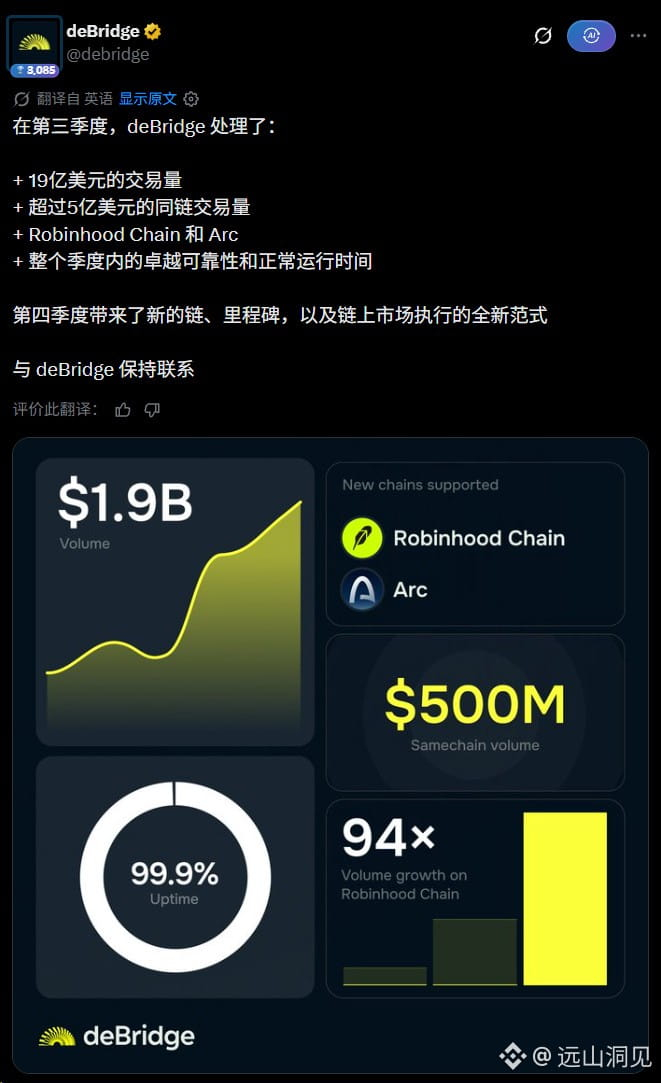
We’ve talked about deBridge’s 0-TVL architecture many times before, so I won’t go into it again. Here’s a quick look at its Q3 report.
The $1.9B in volume isn’t surprising. What is surprising is that $500M+ came from same-chain meta-aggregation, automatically comparing multiple aggregators to find the best price.
Users are starting to use it for more than just cross-chain transfers.
Just as Meituan evolved from food delivery into a gateway to local services, deBridge is moving from being a “bridge” to becoming the “best execution layer on-chain.”
Robinhood Chain’s volume grew 94x in three months, and deBridge has benefited every time a new chain takes off.
$25B+ in cumulative volume with no security incidents. A clean track record, and a project I’ve always believed in—getting stronger with every step.
They teased a “brand-new paradigm” for Q4. Definitely one to watch. I’m ready to look for an opportunity to buy a bit more DBR. It never disappoints with its reports.
1
219
·
--
It’s come true for the third time:
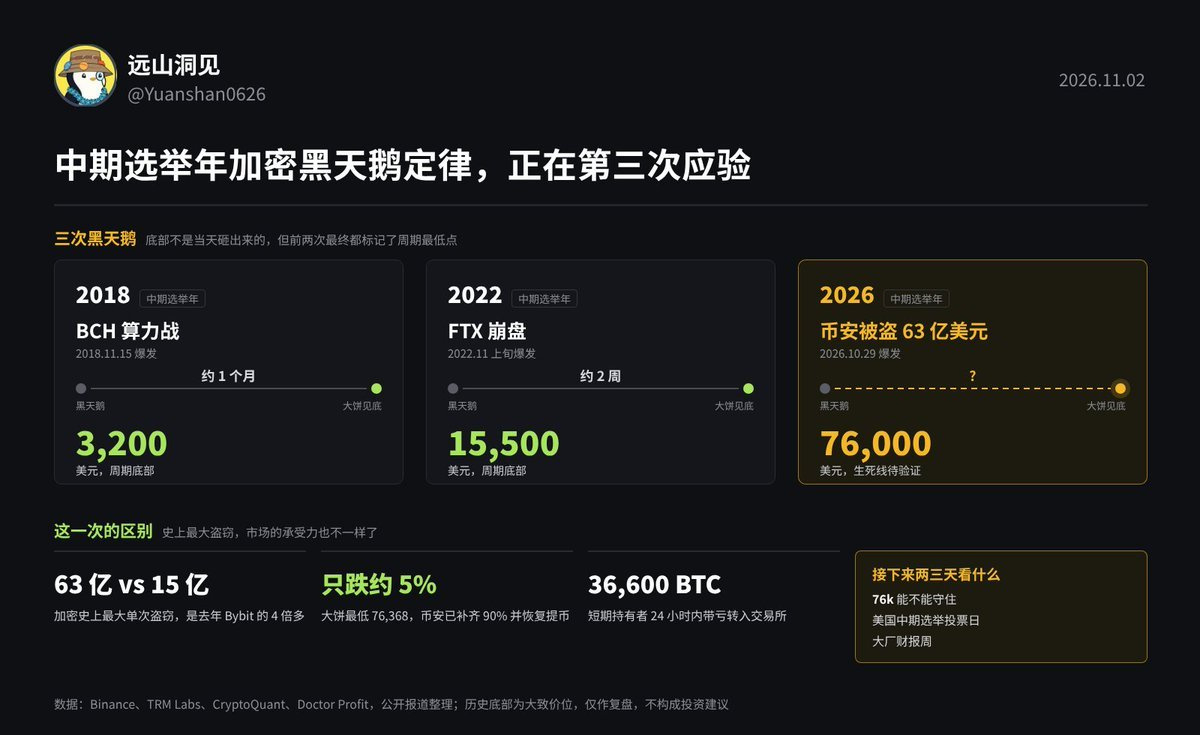
The crypto black swan rule in U.S. midterm election years
2018: BCH’s hashrate war; about a month later, Bitcoin bottomed at $3,200
2022: FTX collapsed; about two weeks later, Bitcoin bottomed at $15,500
2026: Binance was hacked for $6.3 billion. What happens next?
History doesn’t repeat itself exactly, but it rhymes with astonishing frequency.
The bottom doesn’t form in a single day,
but both previous black swan events ultimately marked the cycle lows.
Here’s what’s different this time: Bybit was hacked for $1.5 billion last year; this time, the amount is more than four times larger—the biggest single theft in crypto history—yet Bitcoin has only fallen about 5%.
On-chain data shows short-term holders have sent 36,600 BTC to exchanges at a loss. The panic is unmistakable.
Doctor Profit has set $76K as the make-or-break level. If it holds, this will be the third time Bitcoin has bottomed in a U.S. midterm election year.
With Election Day and a big-tech earnings week coming up, give $76K another two or three days to prove itself, and we’ll know 🤔
$BTC
{future}(BTCUSDT)
It’s come true for the third time:
The crypto black swan rule in U.S. midterm election years
2018: BCH’s hashrate war; about a month later, Bitcoin bottomed at $3,200
2022: FTX collapsed; about two weeks later, Bitcoin bottomed at $15,500
2026: Binance was hacked for $6.3 billion. What happens next?
History doesn’t repeat itself exactly, but it rhymes with astonishing frequency.
The bottom doesn’t form in a single day,
but both previous black swan events ultimately marked the cycle lows.
Here’s what’s different this time: Bybit was hacked for $1.5 billion last year; this time, the amount is more than four times larger—the biggest single theft in crypto history—yet Bitcoin has only fallen about 5%.
On-chain data shows short-term holders have sent 36,600 BTC to exchanges at a loss. The panic is unmistakable.
Doctor Profit has set $76K as the make-or-break level. If it holds, this will be the third time Bitcoin has bottomed in a U.S. midterm election year.
With Election Day and a big-tech earnings week coming up, give $76K another two or three days to prove itself, and we’ll know 🤔
$BTC
1
3
6.9k
·
--
I suddenly started wondering: why are meme coin names so important?
Two Chinese memes that emerged on BSC are called $币安人生 and $牛来 .
Binance Life = What happens after you go all in on Binance? Bull Is Coming = When will the bull market arrive?
The two names happen to capture the two deepest anxieties of crypto retail investors.
When a name embodies the hopes of the entire market, it’s no longer just a token—it becomes a banner.
Every time someone says “Bull is coming,” whether they mean the coin or the bull market, they’re helping spread the word.
Of course, a good name doesn’t guarantee a price increase. But a meme with a bad name definitely won’t take off, because the cost of spreading it is too high.
The essence of a good name is zero cost of propagation.
2
4
6k
·
--
LOL. Reposted from a community:
If AI isn't a bubble, you'll lose your job. If AI is a bubble, you'll lose your savings.
Most likely, AI is currently in a financial bubble, but the technology is still on an exponential improvement curve, so you'll lose your savings first, then your job.
Good luck.
LOL. Reposted from a community:
If AI isn't a bubble, you'll lose your job. If AI is a bubble, you'll lose your savings.
Most likely, AI is currently in a financial bubble, but the technology is still on an exponential improvement curve, so you'll lose your savings first, then your job.
Good luck.
If AI isn't a bubble, you'll lose your job. If AI is a bubble, you'll lose your savings.
Most likely, AI is currently in a financial bubble, but the technology is still on an exponential improvement curve, so you'll lose your savings first, then your job.
Good luck.
1
274
·
--
When will crypto get its own Pang Dong Lai?
You say this progress—does it include me?
There’s an answer on Zhihu with 8,000 upvotes that compares CATL and Pang Dong Lai
CATL became the world’s biggest and made a fortune, but ordinary employees didn’t share in the benefits
Pang Dong Lai never became the world’s biggest, and hasn’t even expanded beyond Xuchang, yet every employee can live with dignity and self-respect
The original quote: “CATL dogs are everywhere, but you’d be hard-pressed to find a few Pang Dong Lais”
It’s exactly the same in crypto
Exchanges bring in billions of dollars a year, executives earn millions a month, and public blockchains raise hundreds of millions at a time
And retail investors? They give back everything they made in the bull market during the bear market. If they’re unlucky, hackers drain their entire principal
BTC going from a few thousand to 100,000 is progress for the industry
But if your account goes from A7 to having pockets cleaner than your face, whose progress is that?
Might as well buy $BNCB
2
844
·
--
Verified
Is nobody interested in Ethereum anymore...?
Tom Lee just revealed Bitmine’s latest holdings, and after reading them, I was left speechless.
- 6.04 million ETH held, accounting for 4.9% of the total supply
- 5.07 million of those ETH are staked, generating $309 million in annualized revenue
- Added another 12,500 ETH over the past week. They look like they have no plans to stop.
One company has gobbled up one-twentieth of the world’s circulating ETH.
Just from staking rewards, it can generate $300 million in cash flow a year.
By now, everyone knows Tom Lee is Ethereum’s biggest bull.
So, once he hits that agreed-upon 5% target, what happens next? Does he turn into a vampire?
Follow me for more quality content~
3
9
6.4k
·
--
Verified
October 25, $XPL , could be more serious than most people think
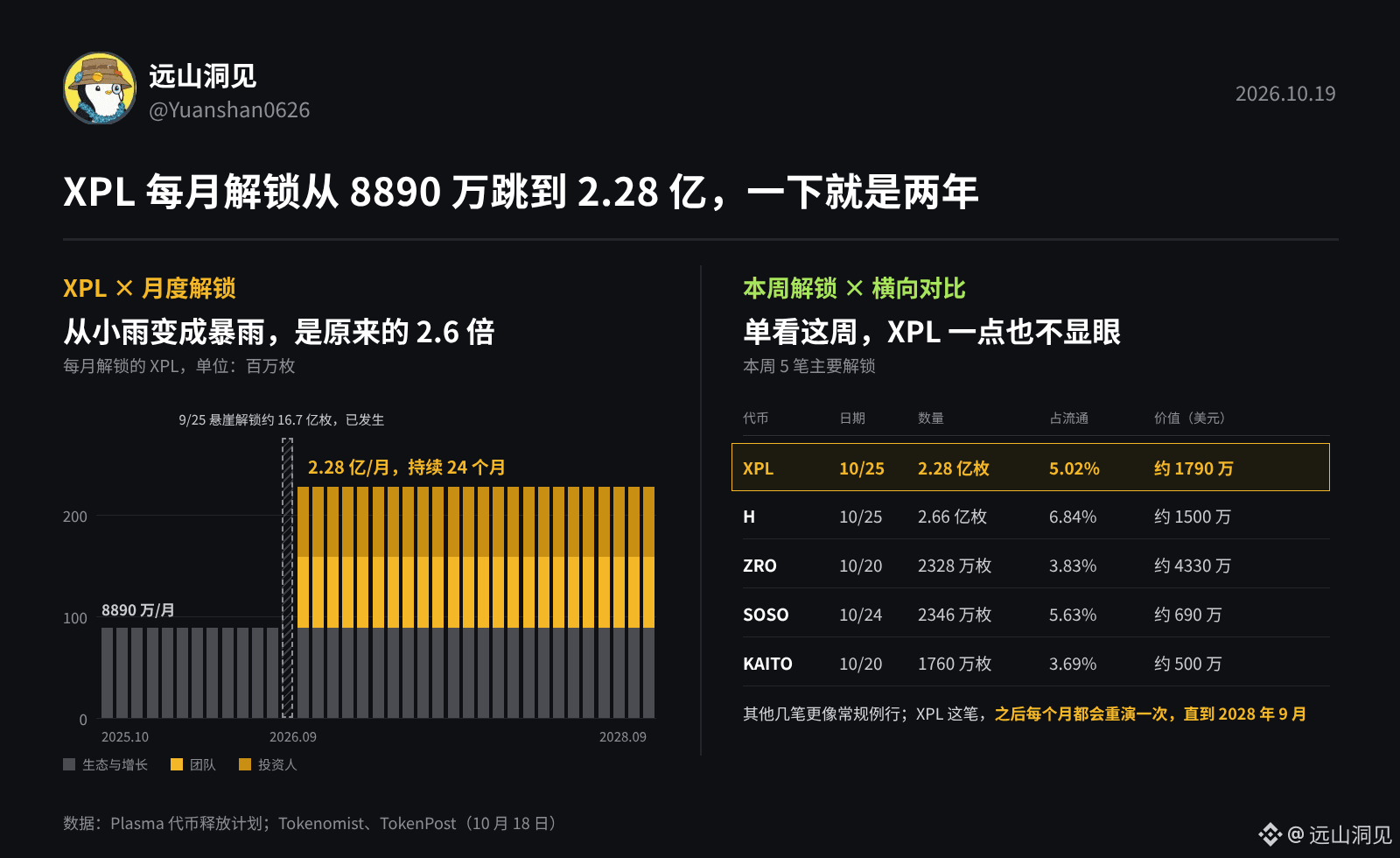
A whole bunch of tokens—ZRO, KAITO, SOSO, H, XPL—are unlocking this week. On the surface, XPL’s 227 million tokens are worth just $17.9 million,
which doesn’t look scary.
But hear me out ⬇️
Previously, 88.9 million XPL tokens unlocked each month, all from the ecosystem pool.
A steady pace.
Starting October 25, tokens from the team, investors, and public sale will all start unlocking at once, bringing the monthly total to 227 million—2.6 times more.
And this pace will continue through September 2028, nonstop for a full 24 months.
XPL is going from “a light drizzle every month” to “a torrential downpour every month”—and it’ll last for two years.
The other token unlocks this week look more like routine events.
If you’re holding XPL, I’d suggest giving this some serious thought.
1
1.8k
·
--
Verified
Why Has STRK Rallied So Much? Everything You Want to Know Is Here.A friend said: If you still haven’t figured out $STRK this October
If you don’t know why it suddenly surged 203%, then your information sources are total garbage.
But there’s more behind that 203% than just “speculating on expectations.”
This article connects the dots across three STRK themes: quantum resistance, privacy, and unlock pressure.
At least after reading this, you won’t blindly buy into some mystery bag at the top (key point).
According to CoinGecko, STRK is up 203% over the past 30 days and 64% over the past 7 days.
CoinGlass shows it briefly surged to 0.119 on the evening of 10/11, with a 7-day gain of up to 117%.
Among October’s large-cap tokens, few can match its gains.
Why Has STRK Rallied So Much? Everything You Want to Know Is Here.
A friend said: If you still haven’t figured out $STRK this October
If you don’t know why it suddenly surged 203%, then your information sources are total garbage.
But there’s more behind that 203% than just “speculating on expectations.”
This article connects the dots across three STRK themes: quantum resistance, privacy, and unlock pressure.
At least after reading this, you won’t blindly buy into some mystery bag at the top (key point).
According to CoinGecko, STRK is up 203% over the past 30 days and 64% over the past 7 days.
CoinGlass shows it briefly surged to 0.119 on the evening of 10/11, with a 7-day gain of up to 117%.
Among October’s large-cap tokens, few can match its gains.
1.8k
·
--
U.S. stocks: A peak in 0 to 9 months
The Big Short is sounding the crash alarm again. Could he be right this time? Who still believes him?
Let’s take a look back
In 2019, Burry said “index funds are the new CDOs.” The S&P 500 went on to rise 281%.
In 2021, he called for “the biggest crash in history.” Even though the market really did fall in 2022, it first rose 84% from the level where he made the call.
In January 2023, he posted one word: “Sell.” In March, he took it back.
He was even long Microsoft this April.
A foreign outlet came up with this headline just for him: “Burry has predicted 12 of the last 3 crashes” 🤣
This time, he’s consolidated his individual-stock shorts into put options on the Nasdaq 100 and SMH.
The options expire in April and June 2027, with strike prices 20% below the prices at the time.
He’s calling for a market peak in 0 to 9 months.
Will he really be right?
1
1
513
·
--
The Ledger situation is no longer a black swan—it’s a whole flock of black swans.
In addition to the incidents we mentioned earlier, here’s what has emerged so far:
- Two tampered devices at MediaMarkt in Europe; all Ledger products pulled from shelves across Europe
- A Ledger Flex at Metapod, Changi Airport, Singapore, confirmed to have been tampered with
One distributor having an incident could be a fluke. When multiple channels around the world are affected at the same time, it’s no longer just a distributor issue.
3
18
21.5k
·
--
The heads of two major exchanges are tearing into each other on Twitter. Which side should VIPs caught in the middle take?
I’m a VIP at both Binance and OKX. I pay tens of thousands of U in fees across the two
I’ve watched the drama all day. Honestly, I can’t take a side—and I don’t want to
It all started with CZ saying “$800 million in voluntary compensation”
Star posted “Who’s the Yue Buqun of crypto?”—230,000 views in 10 hours
He Yi jumped in, escalating from “picking a fight for followers” to the other person’s family, “eunuchs in the harem,” and “the Northern Jiangsu customer service center”
CZ never named anyone directly, just tossed out: “Being overly focused on your competitors is the fastest way to make a mediocre version of them”
1.02 million views—the highest of this round
Honestly, I came away with just two thoughts
1/ When the leaders of the industry’s biggest exchanges are trading insults on X like this, what will people outside the crypto world think of our industry?
2/ Top KOL Dayu’s line, “Every time he attacks her, it shows he still loves her”
was the most spot-on take on this whole affair
There’s only one group that’s really getting hurt:
retail investors who use both platforms and have money in both
Any teachers following the drama? Which side are you on?
1
367
·
--
On the first anniversary of 10/10, the thing most worth reviewing has become the leaders’ public feud
One year ago today,
BTC plunged from 122,000 to 101,000. The market saw $19 billion in liquidations, and USDe briefly depegged.
Countless retail traders were wiped out overnight—including me.
I lost 50,000 U holding a losing position that day. I still remember that night.
What should we be talking about today, a year later?
- Have liquidation mechanisms changed?
- Can high-yield stablecoins like USDe really be used as collateral?
- Have oracle price-feed systems become more robust?
- How can retail traders protect themselves next time a black swan hits?
But then I opened X.
Star posted, “Who’s the Yue Buqun of crypto?”
CZ reposted, “Spending money to FUD your rival is the best way to destroy trust in your own company.”
He Yi fired off 20 posts in a day, going from “picking a fight” to “harem” to “Northern Jiangsu customer service center.”
Both sides accused the other of acting irresponsibly, but all day long, nobody talked about “how to help retail traders lose less next time.”
That’s the most absurd part.
The tens of billions retail traders lost in liquidations were real.
The leaders arguing on Twitter over “who has the moral high ground” is all an act.
As someone who lived through that night, I just hope that before the next 10/10,
both companies put their energy into risk management—not Twitter.
1
301
·
--
Partly True
$PONS Is another wave coming?
Just now, Robinhood CEO Vlad Tenev replied on X to a community question about the RH Chain.
The gist of what he said:
“Robinhood Chain is a top priority for us. We never left.”
“Builders who showed up early are important to us.”
“We want the best builders on the chain, and we’re investing to make that happen.”
“More details are coming soon.”
Those lines may not seem like much on their own, but the timing changes things.
Launchpad revenue over the past 30 days (data from Blockworks):
- Pump.fun: $41.77 million
- StonkFun: $23.2 million
- Pons: $9.86 million
- BONK.fun: $5.04 million
As the flagship of RH Chain, PONS brought in just 24% of Pump.fun’s 30-day revenue.
Overall activity on on-chain launchpads has fallen by an order of magnitude from its September peak.
At a moment like this, the CEO is speaking up personally, with hooks like “increased investment” and “more details.”
This probably isn’t just casual chatter.
2
4.1k
·
--
You bought a hardware wallet. If your funds are stolen, how much can you actually get back?
- This is sure to change how beginners think
- Compiled after talking with friends in the industry
Here’s roughly how compensation caps work in the user agreements of major wallets:
- Coinbase Wallet / Trust Wallet / Phantom / Uniswap Wallet: capped at $100
- Ledger / Trezor: generally capped at the price of the device
- SafePal / Tangem: compensation is generally excluded
- OneKey’s new agreement: device price / 12 months of fees / $100, whichever is highest
Put simply:
Whether you’re storing $10 or $10m,
if something goes wrong, getting the cost of the hardware back from the manufacturer is already generous.
In most cases, they won’t even reimburse you for the hardware.
The manufacturers’ reasoning isn’t hard to understand.
Self-custody means the private keys aren’t in the manufacturer’s hands. They can neither freeze your assets nor reverse on-chain transactions.
So they can’t offer insurance in the true sense of the word, and low compensation caps are standard in the industry.
This logic is mathematically consistent.
But it’s completely at odds with what most retail investors expect when they buy a hardware wallet.
1
319
Log in to explore more content
Join global crypto users on Binance Square
⚡️ Get latest and useful information about crypto.
💬 Trusted by the world’s largest crypto exchange.
👍 Discover real insights from verified creators.
Email / Phone number
Trending Topics
CryptoSelloffTriggersMultipleWhaleLiquidations
222,121 views
1,959 Discussing
Crypto Liquidations Top $2B in 24 Hours as 329,000 Traders Are Wiped Out
Binance News
·40 Likes
·59.7k views
USSpotXRPETFsSeeLargestWeeklyOutflowIn8Months
188,143 views
1,642 Discussing
WillFOMCMinutesReinforceRateHikeExpectations?
63,679 views
816 Discussing