

web3空投姐
210 Posts

web3空投姐
 Square Verified
Report
Block User
看到机会会心动,规则不懂会停下。以前不懂不敢说,现在不会会去查。聊聊活动、收益、规则,少交学费。文章只限个人分享,不做投资建议。
16 Following
1.5K+ Followers
452 Liked
Posts
All
Quotes
·
--
Bullish
Good evening, ladies!
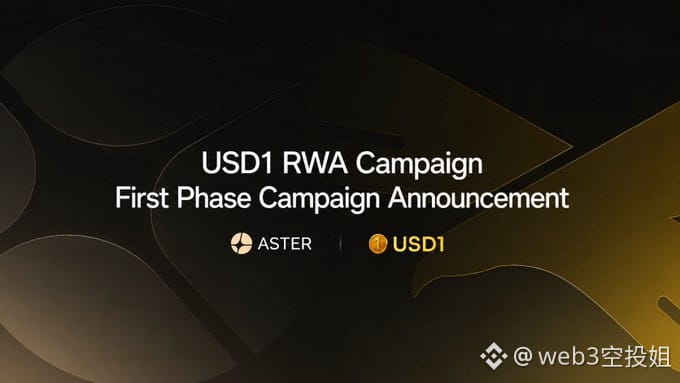
Just finished reading the full rules for the Aster USD1 RWA event. Honestly, don’t just look at the numbers in the prize pool.
In the first phase, the two pools are settled separately: 125M $WLFI for qualified OI, and 6.25M $USD1 for qualified trading volume. If you meet the criteria, your trades can “win on both ends.”
The real difference in reward outcomes comes from the collateral method. For RWA perpetuals like SPCXUSD1, CLUSD1, and XAUUSD1—if you use USD1 as collateral, the OI reward weight is directly doubled. If you’re using a multi-asset mode, pay extra attention to the snapshots: it checks whether, over a period of time, the average share of USD1 in the collateral exceeds 50%. Don’t think it’s safe just because you open positions to “hit the number.”
The logic of these rules is actually pretty solid: the USD1 pool drives trading volume, while the WLFI pool holds positions. A 2x weight is basically guiding everyone to put their margin into USD1. In plain terms, they want USD1 to stay in the perpetual account for circulation—not to be used and then withdrawn right after the trading is done.
Oh, and don’t rush to open positions yet. The event runs until December 31, but the official prize calculation time hasn’t been announced. The snapshot frequency, how shares are calculated, and when rewards are distributed—these details still haven’t been fully released.
What you should do now is decide which market you’re going to trade and which collateral method you’ll use. It’s not too late to enter once everything is clear. Rewards won’t run away—just don’t let your positions race ahead.
Good evening, ladies!
Just finished reading the full rules for the Aster USD1 RWA event. Honestly, don’t just look at the numbers in the prize pool.
In the first phase, the two pools are settled separately: 125M $WLFI for qualified OI, and 6.25M $USD1 for qualified trading volume. If you meet the criteria, your trades can “win on both ends.”
The real difference in reward outcomes comes from the collateral method. For RWA perpetuals like SPCXUSD1, CLUSD1, and XAUUSD1—if you use USD1 as collateral, the OI reward weight is directly doubled. If you’re using a multi-asset mode, pay extra attention to the snapshots: it checks whether, over a period of time, the average share of USD1 in the collateral exceeds 50%. Don’t think it’s safe just because you open positions to “hit the number.”
The logic of these rules is actually pretty solid: the USD1 pool drives trading volume, while the WLFI pool holds positions. A 2x weight is basically guiding everyone to put their margin into USD1. In plain terms, they want USD1 to stay in the perpetual account for circulation—not to be used and then withdrawn right after the trading is done.
Oh, and don’t rush to open positions yet. The event runs until December 31, but the official prize calculation time hasn’t been announced. The snapshot frequency, how shares are calculated, and when rewards are distributed—these details still haven’t been fully released.
What you should do now is decide which market you’re going to trade and which collateral method you’ll use. It’s not too late to enter once everything is clear. Rewards won’t run away—just don’t let your positions race ahead.
Just finished reading the full rules for the Aster USD1 RWA event. Honestly, don’t just look at the numbers in the prize pool.
In the first phase, the two pools are settled separately: 125M $WLFI for qualified OI, and 6.25M $USD1 for qualified trading volume. If you meet the criteria, your trades can “win on both ends.”
The real difference in reward outcomes comes from the collateral method. For RWA perpetuals like SPCXUSD1, CLUSD1, and XAUUSD1—if you use USD1 as collateral, the OI reward weight is directly doubled. If you’re using a multi-asset mode, pay extra attention to the snapshots: it checks whether, over a period of time, the average share of USD1 in the collateral exceeds 50%. Don’t think it’s safe just because you open positions to “hit the number.”
The logic of these rules is actually pretty solid: the USD1 pool drives trading volume, while the WLFI pool holds positions. A 2x weight is basically guiding everyone to put their margin into USD1. In plain terms, they want USD1 to stay in the perpetual account for circulation—not to be used and then withdrawn right after the trading is done.
Oh, and don’t rush to open positions yet. The event runs until December 31, but the official prize calculation time hasn’t been announced. The snapshot frequency, how shares are calculated, and when rewards are distributed—these details still haven’t been fully released.
What you should do now is decide which market you’re going to trade and which collateral method you’ll use. It’s not too late to enter once everything is clear. Rewards won’t run away—just don’t let your positions race ahead.
3
718
·
--
Girls, happy Qixi Festival🌹
Today I saw that M’s USD1 futures #USD1 funding fee subsidy (up to 1000 USD1 per day). There are quite a few exchange ecosystem activities like this happening on Binance as well.
From August 15 to September 13, the total prize pool is 100,000 USD1. The activity rules are: you get back 50% of the funding fee you actually pay. Each person can receive up to 1000 per day. Settled once per week. 1000 is the cap, not a guaranteed minimum.
Only USD1-M futures count. Remember to use USD1 as margin. The funding fee you receive does not count, and hedging positions also do not count. If multiple UIDs are involved, they are combined for calculation. Also, it’s first-come, first-served—when the prize pool runs out or the activity ends (whichever comes first), it stops. They haven’t published real-time remaining amounts yet, so if you’re interested, you can participate.
If you were already running USD1-M contracts, this activity is pretty solid—it’s like the platform helps you cover half of the funding fee cost you would have paid anyway. But if you don’t normally trade contracts, don’t temporarily open positions just to get the 50% back. The subsidy is meant to reduce your existing costs, not to give you a reason to trade. Don’t create a whole extra batch of costs just to save half.
Girls, happy Qixi Festival🌹
Today I saw that M’s USD1 futures #USD1 funding fee subsidy (up to 1000 USD1 per day). There are quite a few exchange ecosystem activities like this happening on Binance as well.
From August 15 to September 13, the total prize pool is 100,000 USD1. The activity rules are: you get back 50% of the funding fee you actually pay. Each person can receive up to 1000 per day. Settled once per week. 1000 is the cap, not a guaranteed minimum.
Only USD1-M futures count. Remember to use USD1 as margin. The funding fee you receive does not count, and hedging positions also do not count. If multiple UIDs are involved, they are combined for calculation. Also, it’s first-come, first-served—when the prize pool runs out or the activity ends (whichever comes first), it stops. They haven’t published real-time remaining amounts yet, so if you’re interested, you can participate.
If you were already running USD1-M contracts, this activity is pretty solid—it’s like the platform helps you cover half of the funding fee cost you would have paid anyway. But if you don’t normally trade contracts, don’t temporarily open positions just to get the 50% back. The subsidy is meant to reduce your existing costs, not to give you a reason to trade. Don’t create a whole extra batch of costs just to save half.
Today I saw that M’s USD1 futures #USD1 funding fee subsidy (up to 1000 USD1 per day). There are quite a few exchange ecosystem activities like this happening on Binance as well.
From August 15 to September 13, the total prize pool is 100,000 USD1. The activity rules are: you get back 50% of the funding fee you actually pay. Each person can receive up to 1000 per day. Settled once per week. 1000 is the cap, not a guaranteed minimum.
Only USD1-M futures count. Remember to use USD1 as margin. The funding fee you receive does not count, and hedging positions also do not count. If multiple UIDs are involved, they are combined for calculation. Also, it’s first-come, first-served—when the prize pool runs out or the activity ends (whichever comes first), it stops. They haven’t published real-time remaining amounts yet, so if you’re interested, you can participate.
If you were already running USD1-M contracts, this activity is pretty solid—it’s like the platform helps you cover half of the funding fee cost you would have paid anyway. But if you don’t normally trade contracts, don’t temporarily open positions just to get the 50% back. The subsidy is meant to reduce your existing costs, not to give you a reason to trade. Don’t create a whole extra batch of costs just to save half.
2
173
·
--
Good afternoon, ladies!
When I saw the words “National Trust Bank,” I almost thought—would USD1 be turning into a bank deposit?
But after reading the OCC documents carefully, I realized that the most easily misread part this time is exactly the two characters: “bank.”
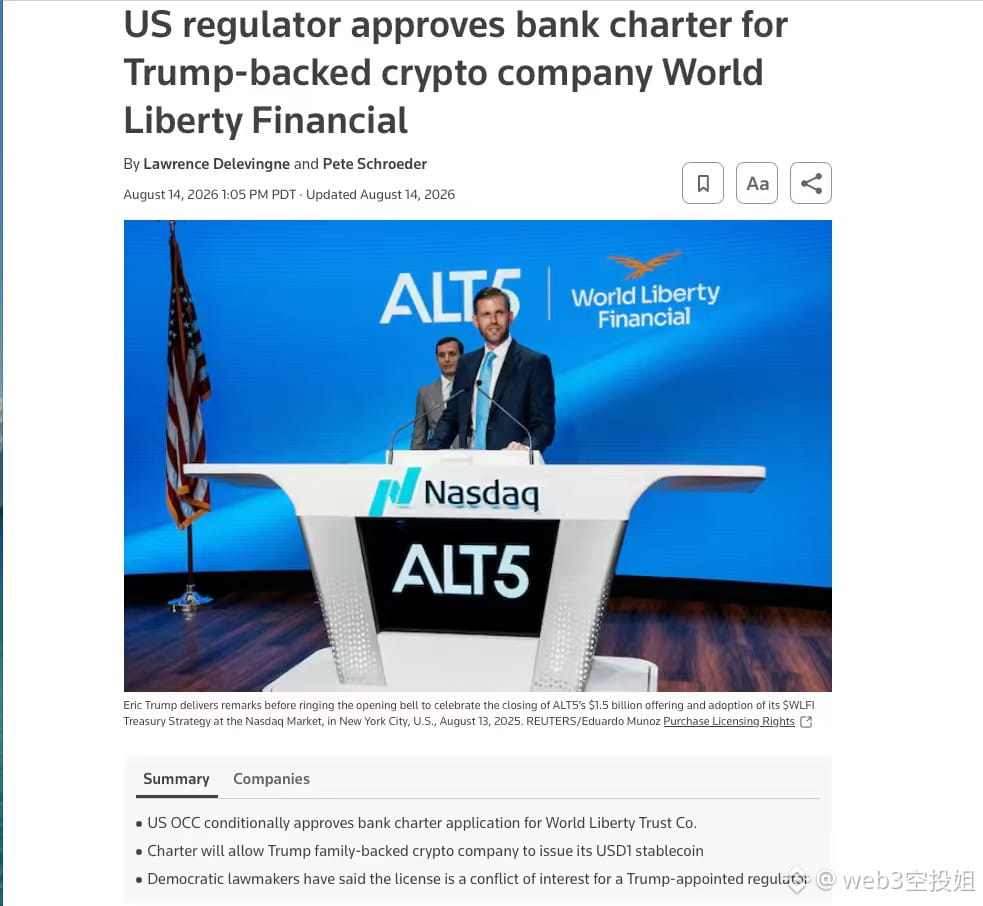
On August 14, the OCC conditionally granted World Liberty Trust Company, N.A. preliminary approval. This is certainly an important development, but there’s still a way to go before正式开业 (official opening), including pre-opening conditions such as minimum $20 million in Tier 1 capital, internal audit requirements, and more—ultimately also waiting for the OCC’s final approval.
As for ordinary USD1 holders, what’s practical right now hasn’t changed.
USD1 is still issued and custody-managed by BitGo. World Liberty Trust Company will only plan to take over USD1’s issuance, redemption, and reserve management after it officially opens.
You can celebrate this—however, preliminary approval does not mean the company has already opened, and USD1 is not an FDIC-insured deposit. What it received this time is a clearer federal regulatory pathway, not a kind of “bank deposit” insurance where someone steps in if something goes wrong.
Honestly, I think this is the real part of the news worth paying attention to.
What WLFI is doing isn’t suddenly giving USD1 a more prestigious identity. It’s moving the most basic components—issuance, custody, and redemption—step by step into a more clearly defined regulatory framework.
For institutions, these matters may be far more important than any single compliance buzzword. The clearer the responsibilities—who issues, who holds custody, who handles redemptions, and who to contact if something goes wrong—the more confident capital becomes.
Next, keep an eye on when the OCC grants final approval, and when the formal handover from BitGo to World Liberty Trust Company begins. Once these two things truly land, we can see exactly which door USD1 has crossed.
@worldlibertyfi #USDT #WLFI
Good afternoon, ladies!
When I saw the words “National Trust Bank,” I almost thought—would USD1 be turning into a bank deposit?
But after reading the OCC documents carefully, I realized that the most easily misread part this time is exactly the two characters: “bank.”
On August 14, the OCC conditionally granted World Liberty Trust Company, N.A. preliminary approval. This is certainly an important development, but there’s still a way to go before正式开业 (official opening), including pre-opening conditions such as minimum $20 million in Tier 1 capital, internal audit requirements, and more—ultimately also waiting for the OCC’s final approval.
As for ordinary USD1 holders, what’s practical right now hasn’t changed.
USD1 is still issued and custody-managed by BitGo. World Liberty Trust Company will only plan to take over USD1’s issuance, redemption, and reserve management after it officially opens.
You can celebrate this—however, preliminary approval does not mean the company has already opened, and USD1 is not an FDIC-insured deposit. What it received this time is a clearer federal regulatory pathway, not a kind of “bank deposit” insurance where someone steps in if something goes wrong.
Honestly, I think this is the real part of the news worth paying attention to.
What WLFI is doing isn’t suddenly giving USD1 a more prestigious identity. It’s moving the most basic components—issuance, custody, and redemption—step by step into a more clearly defined regulatory framework.
For institutions, these matters may be far more important than any single compliance buzzword. The clearer the responsibilities—who issues, who holds custody, who handles redemptions, and who to contact if something goes wrong—the more confident capital becomes.
Next, keep an eye on when the OCC grants final approval, and when the formal handover from BitGo to World Liberty Trust Company begins. Once these two things truly land, we can see exactly which door USD1 has crossed.
@worldlibertyfi #USDT #WLFI
When I saw the words “National Trust Bank,” I almost thought—would USD1 be turning into a bank deposit?
But after reading the OCC documents carefully, I realized that the most easily misread part this time is exactly the two characters: “bank.”
On August 14, the OCC conditionally granted World Liberty Trust Company, N.A. preliminary approval. This is certainly an important development, but there’s still a way to go before正式开业 (official opening), including pre-opening conditions such as minimum $20 million in Tier 1 capital, internal audit requirements, and more—ultimately also waiting for the OCC’s final approval.
As for ordinary USD1 holders, what’s practical right now hasn’t changed.
USD1 is still issued and custody-managed by BitGo. World Liberty Trust Company will only plan to take over USD1’s issuance, redemption, and reserve management after it officially opens.
You can celebrate this—however, preliminary approval does not mean the company has already opened, and USD1 is not an FDIC-insured deposit. What it received this time is a clearer federal regulatory pathway, not a kind of “bank deposit” insurance where someone steps in if something goes wrong.
Honestly, I think this is the real part of the news worth paying attention to.
What WLFI is doing isn’t suddenly giving USD1 a more prestigious identity. It’s moving the most basic components—issuance, custody, and redemption—step by step into a more clearly defined regulatory framework.
For institutions, these matters may be far more important than any single compliance buzzword. The clearer the responsibilities—who issues, who holds custody, who handles redemptions, and who to contact if something goes wrong—the more confident capital becomes.
Next, keep an eye on when the OCC grants final approval, and when the formal handover from BitGo to World Liberty Trust Company begins. Once these two things truly land, we can see exactly which door USD1 has crossed.
@worldlibertyfi #USDT #WLFI
1
256
·
--
Good afternoon, ladies!
I just saw that the OCC yesterday granted a conditional preliminary approval to World Liberty Trust Company, so I went to check the document details right away.
This time, it has indeed moved forward by a step, but it’s still not ready for official opening yet—the capital must be in place, along with other preconditions like internal audits. And in the end, we still have to wait for the final approval to be issued.
For us ordinary holders of USD 1, what’s more practical now is the issue and custody process—whether BitGo is still handling it. The OCC documents are very clear: BitGo Bank & Trust remains the exclusive issuer and custodian. World Liberty will only take over issuance, redemptions, and reserve management after the company is actually opened.
So the redemption path users are taking now won’t change immediately just because of this single preliminary approval. Zach Witkoff himself also said this is just a milestone in a multi-step process. The OCC also requires at least $20 million in Tier 1 capital—the threshold is right there.
The direction is right: pass through one regulatory gate after another. But it’s still not time to celebrate early. Next, we’ll see when the final approval is actually finalized, and when the transition arrangements between BitGo and World Liberty are officially announced. Once those two pieces are truly in place, it’ll be more reassuring to discuss what it means for holders.
@worldlibertyfi #USD1 #WLFI
Good afternoon, ladies!
I just saw that the OCC yesterday granted a conditional preliminary approval to World Liberty Trust Company, so I went to check the document details right away.
This time, it has indeed moved forward by a step, but it’s still not ready for official opening yet—the capital must be in place, along with other preconditions like internal audits. And in the end, we still have to wait for the final approval to be issued.
For us ordinary holders of USD 1, what’s more practical now is the issue and custody process—whether BitGo is still handling it. The OCC documents are very clear: BitGo Bank & Trust remains the exclusive issuer and custodian. World Liberty will only take over issuance, redemptions, and reserve management after the company is actually opened.
So the redemption path users are taking now won’t change immediately just because of this single preliminary approval. Zach Witkoff himself also said this is just a milestone in a multi-step process. The OCC also requires at least $20 million in Tier 1 capital—the threshold is right there.
The direction is right: pass through one regulatory gate after another. But it’s still not time to celebrate early. Next, we’ll see when the final approval is actually finalized, and when the transition arrangements between BitGo and World Liberty are officially announced. Once those two pieces are truly in place, it’ll be more reassuring to discuss what it means for holders.
@worldlibertyfi #USD1 #WLFI
I just saw that the OCC yesterday granted a conditional preliminary approval to World Liberty Trust Company, so I went to check the document details right away.
This time, it has indeed moved forward by a step, but it’s still not ready for official opening yet—the capital must be in place, along with other preconditions like internal audits. And in the end, we still have to wait for the final approval to be issued.
For us ordinary holders of USD 1, what’s more practical now is the issue and custody process—whether BitGo is still handling it. The OCC documents are very clear: BitGo Bank & Trust remains the exclusive issuer and custodian. World Liberty will only take over issuance, redemptions, and reserve management after the company is actually opened.
So the redemption path users are taking now won’t change immediately just because of this single preliminary approval. Zach Witkoff himself also said this is just a milestone in a multi-step process. The OCC also requires at least $20 million in Tier 1 capital—the threshold is right there.
The direction is right: pass through one regulatory gate after another. But it’s still not time to celebrate early. Next, we’ll see when the final approval is actually finalized, and when the transition arrangements between BitGo and World Liberty are officially announced. Once those two pieces are truly in place, it’ll be more reassuring to discuss what it means for holders.
@worldlibertyfi #USD1 #WLFI

1
228
·
--
Bullish
1.7 billion US$1 tokens in the prize pool ($WLFI ) does not mean you will receive rewards based on whatever amount you have in your account ($USD1 ).
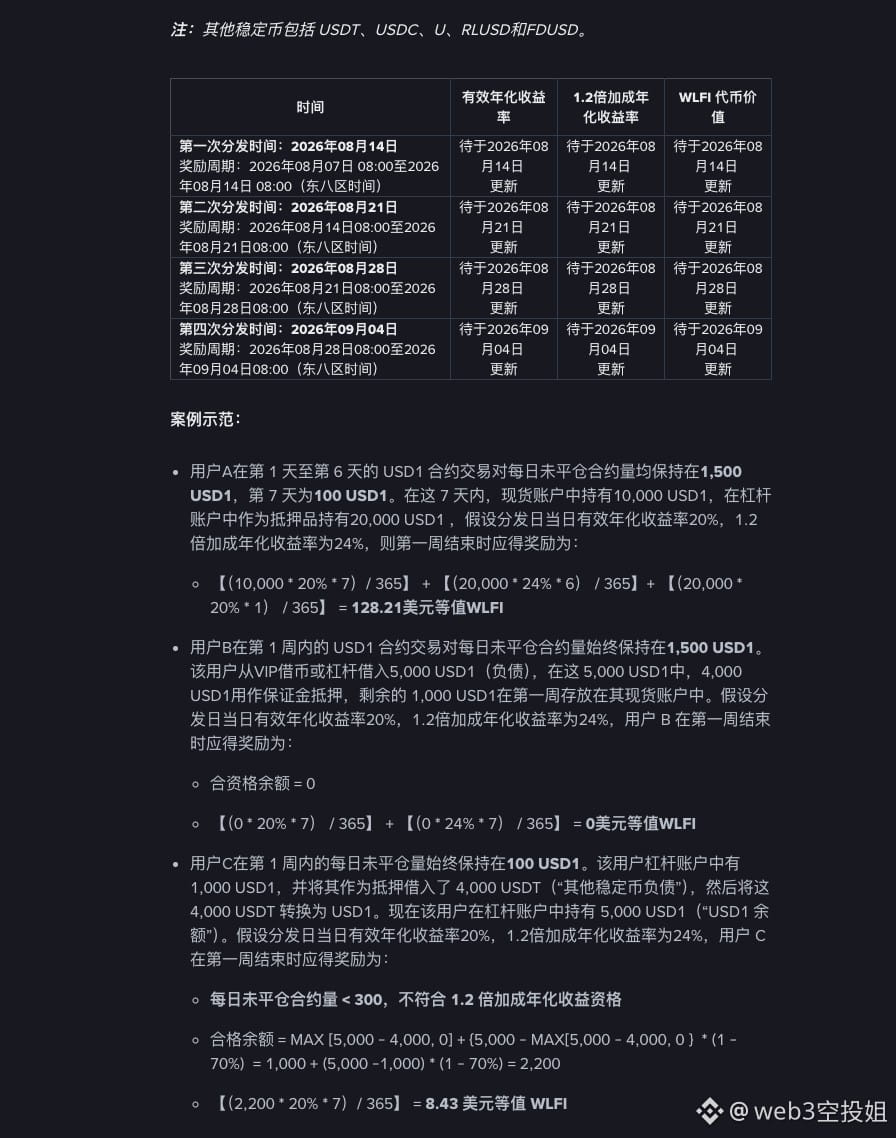
According to Binance’s announcement on August 7, this campaign will run until September 4 at 00:00 (UTC). The three things people are most likely to miscalculate are:
1. The daily qualifying balance uses the lowest USD1 balance from that day’s hourly snapshot—not the peak value.
2. Being at 1.2x does not mean holding 300 USD1 automatically. Instead, the daily minimum OI of the USD1 contract trading pair must be ≥ 300 USD1; otherwise, it’s calculated at 1x for that day.
3. Directly borrowed USD1 liabilities are not included. For the leveraged portion where you borrow other stablecoins and then exchange them for USD1, a 70% haircut is applied.
As for APR: don’t use data from the previous round to calculate this round’s玩法. As of now, the official page still shows that the Base APR, 1.2x Boosted APR, and WLFI Token Value for the first period from August 7 to 14 will be updated on August 14. Before participating, just double-check your account type, your daily minimum balance, the minimum OI, and your source of funds.
These are Binance’s distribution rules for this USD1 phase. They are not fixed native USD1 yield. Final eligibility and distribution by region are determined by the platform records and the latest announcements.
1.7 billion US$1 tokens in the prize pool ($WLFI ) does not mean you will receive rewards based on whatever amount you have in your account ($USD1 ).
According to Binance’s announcement on August 7, this campaign will run until September 4 at 00:00 (UTC). The three things people are most likely to miscalculate are:
1. The daily qualifying balance uses the lowest USD1 balance from that day’s hourly snapshot—not the peak value.
2. Being at 1.2x does not mean holding 300 USD1 automatically. Instead, the daily minimum OI of the USD1 contract trading pair must be ≥ 300 USD1; otherwise, it’s calculated at 1x for that day.
3. Directly borrowed USD1 liabilities are not included. For the leveraged portion where you borrow other stablecoins and then exchange them for USD1, a 70% haircut is applied.
As for APR: don’t use data from the previous round to calculate this round’s玩法. As of now, the official page still shows that the Base APR, 1.2x Boosted APR, and WLFI Token Value for the first period from August 7 to 14 will be updated on August 14. Before participating, just double-check your account type, your daily minimum balance, the minimum OI, and your source of funds.
These are Binance’s distribution rules for this USD1 phase. They are not fixed native USD1 yield. Final eligibility and distribution by region are determined by the platform records and the latest announcements.
According to Binance’s announcement on August 7, this campaign will run until September 4 at 00:00 (UTC). The three things people are most likely to miscalculate are:
1. The daily qualifying balance uses the lowest USD1 balance from that day’s hourly snapshot—not the peak value.
2. Being at 1.2x does not mean holding 300 USD1 automatically. Instead, the daily minimum OI of the USD1 contract trading pair must be ≥ 300 USD1; otherwise, it’s calculated at 1x for that day.
3. Directly borrowed USD1 liabilities are not included. For the leveraged portion where you borrow other stablecoins and then exchange them for USD1, a 70% haircut is applied.
As for APR: don’t use data from the previous round to calculate this round’s玩法. As of now, the official page still shows that the Base APR, 1.2x Boosted APR, and WLFI Token Value for the first period from August 7 to 14 will be updated on August 14. Before participating, just double-check your account type, your daily minimum balance, the minimum OI, and your source of funds.
These are Binance’s distribution rules for this USD1 phase. They are not fixed native USD1 yield. Final eligibility and distribution by region are determined by the platform records and the latest announcements.
1
327
·
--
Today, @velvet_capital has added StableChain to the terminal.Today, @velvet_capital has added StableChain to the terminal.
After reading it, my first reaction wasn’t that there was another chain—it was thinking about something more practical: once I enter a new market, do I need to relearn how to read it?
Switching to a new ecosystem isn’t just about changing the network. You have to figure out where to find new assets, where to see trading activity, where to look at price moves—how to quickly get a grasp on what’s happening in the market. In many cases, you end up having to search all over again. When the chain changes, the way you view and monitor the market habits changes too.
But after StableChain was connected to Velvet, I found that the terminal’s way of reading the market basically didn’t change. It’s still Trending, Volume, Gainers, New Pairs, All Chains—and under each asset it’s still familiar fields like Price, 24H, MCap, Volume, Txn.
Today, @velvet_capital has added StableChain to the terminal.
Today, @velvet_capital has added StableChain to the terminal.
After reading it, my first reaction wasn’t that there was another chain—it was thinking about something more practical: once I enter a new market, do I need to relearn how to read it?
Switching to a new ecosystem isn’t just about changing the network. You have to figure out where to find new assets, where to see trading activity, where to look at price moves—how to quickly get a grasp on what’s happening in the market. In many cases, you end up having to search all over again. When the chain changes, the way you view and monitor the market habits changes too.
But after StableChain was connected to Velvet, I found that the terminal’s way of reading the market basically didn’t change. It’s still Trending, Volume, Gainers, New Pairs, All Chains—and under each asset it’s still familiar fields like Price, 24H, MCap, Volume, Txn.
After reading it, my first reaction wasn’t that there was another chain—it was thinking about something more practical: once I enter a new market, do I need to relearn how to read it?
Switching to a new ecosystem isn’t just about changing the network. You have to figure out where to find new assets, where to see trading activity, where to look at price moves—how to quickly get a grasp on what’s happening in the market. In many cases, you end up having to search all over again. When the chain changes, the way you view and monitor the market habits changes too.
But after StableChain was connected to Velvet, I found that the terminal’s way of reading the market basically didn’t change. It’s still Trending, Volume, Gainers, New Pairs, All Chains—and under each asset it’s still familiar fields like Price, 24H, MCap, Volume, Txn.
107
·
--
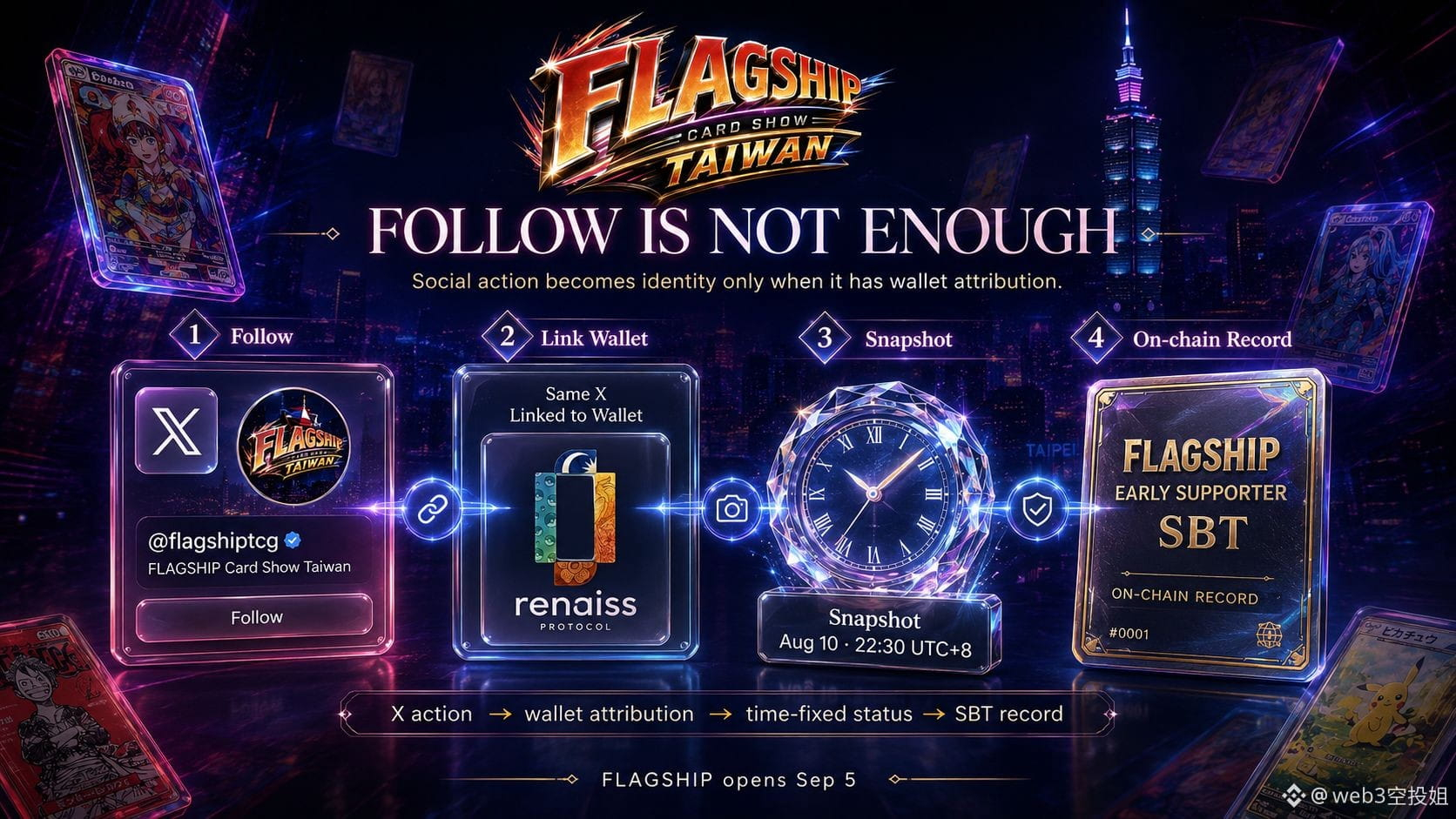
. @flagshiptcg ’s event officially opens only on September 5, but @renaissxyz did something interesting ahead of time. Being an Early Supporter isn’t just about following an account—you also need to match the same X account with the Renaiss wallet.
After I read the rules, the first question I had was: why isn’t following enough? Then as I followed the mechanism further, I understood it. Following just shows that this X account took some action, but once the wallet is linked, this support truly gains an on-chain sense of belonging.
After that comes the snapshot at 10:30 PM on August 10 (UTC+8). Put together, it all makes perfect sense: your X posts record what you did, the wallet ties that action to a specific address, and the snapshot locks in the state at that time. With the three steps combined, I actually feel it’s more worth looking at than the SBT itself.
Renaiss has always used X Linker. This FLAGSHIP continues using the same logic, which also indicates this isn’t just a temporary extra hurdle. It’s more like gradually mapping the community identities inside the ecosystem to the wallet identity that will truly hold assets later—onto the same coordinate. On-chain identity doesn’t necessarily have to start from the first time you buy cards, top up, or transact. A real community action that can be clearly attributed to a specific wallet address can itself become part of the records for that address.
Of course, there are still some details the official hasn’t specified yet—for example, how the exact binding status is confirmed, when the SBT is issued, and whether canceling the follow or changing wallets after the snapshot would affect eligibility—so I won’t draw conclusions for the project in advance. Before the snapshot, I’ll only first confirm whether the X account currently linked to my Renaiss wallet is the same account as the one I follow, @flagshiptcg.
This time, what truly made me remember the Early Supporter SBT isn’t what you can get by following early, but the fact that Renaiss is trying to turn a very light, simple social action into a record with wallet attribution and a time coordinate. First make sure it belongs to whom, then leave it there—that idea is something I really like.
. @flagshiptcg ’s event officially opens only on September 5, but @renaissxyz did something interesting ahead of time. Being an Early Supporter isn’t just about following an account—you also need to match the same X account with the Renaiss wallet.
After I read the rules, the first question I had was: why isn’t following enough? Then as I followed the mechanism further, I understood it. Following just shows that this X account took some action, but once the wallet is linked, this support truly gains an on-chain sense of belonging.
After that comes the snapshot at 10:30 PM on August 10 (UTC+8). Put together, it all makes perfect sense: your X posts record what you did, the wallet ties that action to a specific address, and the snapshot locks in the state at that time. With the three steps combined, I actually feel it’s more worth looking at than the SBT itself.
Renaiss has always used X Linker. This FLAGSHIP continues using the same logic, which also indicates this isn’t just a temporary extra hurdle. It’s more like gradually mapping the community identities inside the ecosystem to the wallet identity that will truly hold assets later—onto the same coordinate. On-chain identity doesn’t necessarily have to start from the first time you buy cards, top up, or transact. A real community action that can be clearly attributed to a specific wallet address can itself become part of the records for that address.
Of course, there are still some details the official hasn’t specified yet—for example, how the exact binding status is confirmed, when the SBT is issued, and whether canceling the follow or changing wallets after the snapshot would affect eligibility—so I won’t draw conclusions for the project in advance. Before the snapshot, I’ll only first confirm whether the X account currently linked to my Renaiss wallet is the same account as the one I follow, @flagshiptcg.
This time, what truly made me remember the Early Supporter SBT isn’t what you can get by following early, but the fact that Renaiss is trying to turn a very light, simple social action into a record with wallet attribution and a time coordinate. First make sure it belongs to whom, then leave it there—that idea is something I really like.
After I read the rules, the first question I had was: why isn’t following enough? Then as I followed the mechanism further, I understood it. Following just shows that this X account took some action, but once the wallet is linked, this support truly gains an on-chain sense of belonging.
After that comes the snapshot at 10:30 PM on August 10 (UTC+8). Put together, it all makes perfect sense: your X posts record what you did, the wallet ties that action to a specific address, and the snapshot locks in the state at that time. With the three steps combined, I actually feel it’s more worth looking at than the SBT itself.
Renaiss has always used X Linker. This FLAGSHIP continues using the same logic, which also indicates this isn’t just a temporary extra hurdle. It’s more like gradually mapping the community identities inside the ecosystem to the wallet identity that will truly hold assets later—onto the same coordinate. On-chain identity doesn’t necessarily have to start from the first time you buy cards, top up, or transact. A real community action that can be clearly attributed to a specific wallet address can itself become part of the records for that address.
Of course, there are still some details the official hasn’t specified yet—for example, how the exact binding status is confirmed, when the SBT is issued, and whether canceling the follow or changing wallets after the snapshot would affect eligibility—so I won’t draw conclusions for the project in advance. Before the snapshot, I’ll only first confirm whether the X account currently linked to my Renaiss wallet is the same account as the one I follow, @flagshiptcg.
This time, what truly made me remember the Early Supporter SBT isn’t what you can get by following early, but the fact that Renaiss is trying to turn a very light, simple social action into a record with wallet attribution and a time coordinate. First make sure it belongs to whom, then leave it there—that idea is something I really like.
1
124
·
--
Vault has Earnings—why when I went to the Trade page of HertzFlow by @Hertzflow_xyz to Claim, I couldn’t find the same amount of money?
I read through Beginner’s Guide #2 and only then realized it’s not that the earnings haven’t arrived; it’s that we can easily look in the wrong place at the start. The official materials even specifically lists “Confusing yield with Claim” as a common beginner mistake.
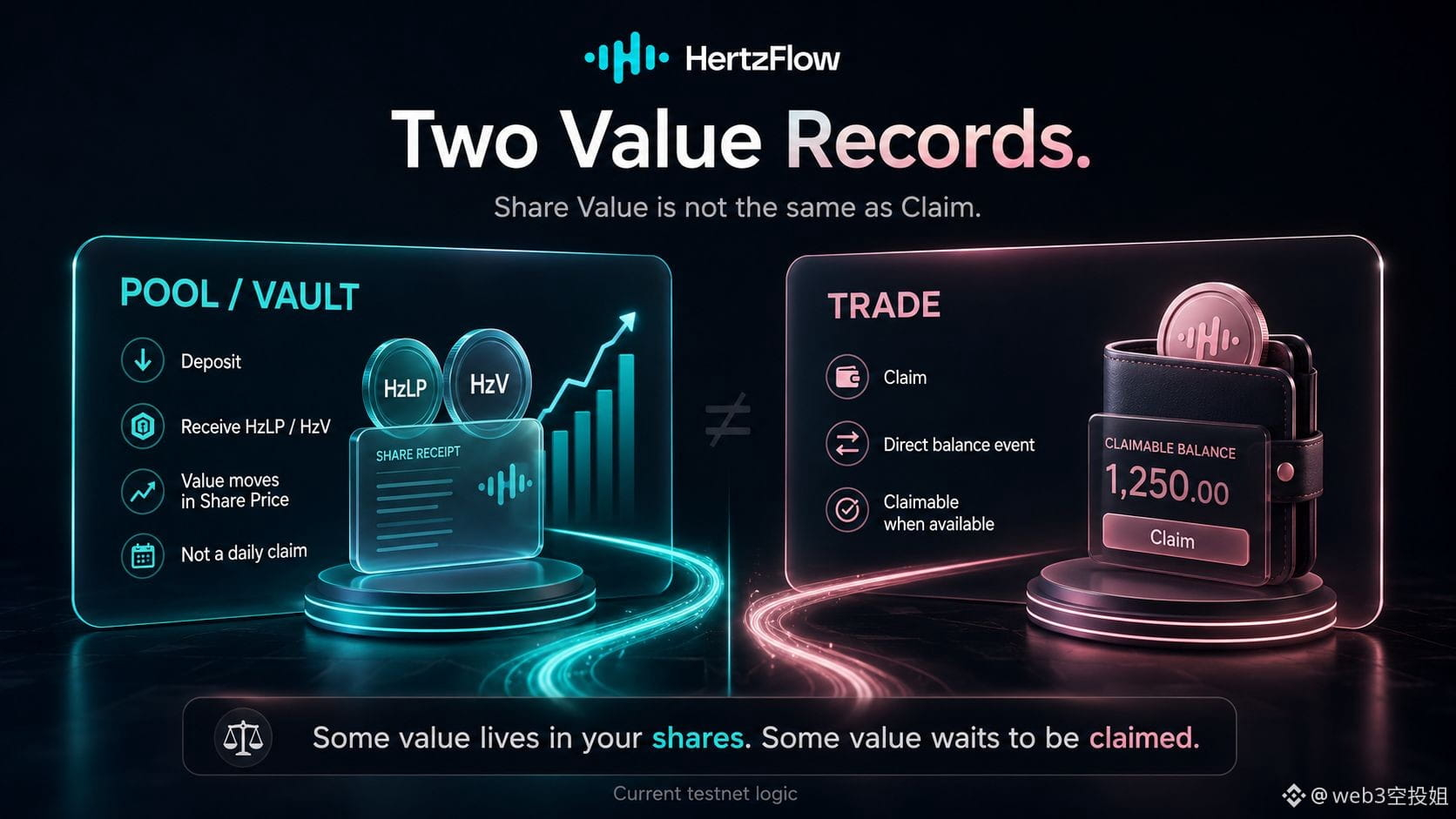
When you deposit into a Pool, you receive HzLP; when you deposit into a Vault, you receive HzV. Changes in the value of the LP side are usually reflected directly in the share value. Fees and net trader PnL affect AUM, so even if your number of shares hasn’t changed, the corresponding value can still move—of course it may also go down.
The Claim on the Trade page follows a different logic. It corresponds to items that can be directly moved into your balance and then are waiting to be claimed. The exact source still depends on what you see on the current page. Earnings and Claim can look like the same “yield,” but they’re actually recorded in two different ledgers.
Some value is already written into the shares you hold.
Some balance is what you need to Claim.
I stared at the word “Claim” for a few seconds and it actually feels like this is where ordinary users are most likely to be confused. I really hope HertzFlow will separate Share Value and Claimable Balance more clearly in the future, and add one more sentence explaining where this value comes from. That way, people wouldn’t need to dig through documentation, and they also wouldn’t mistakenly assume there’s no LP value change just because there are no numbers under Claim.
So going forward, when I look at a Pool or Vault, I’ll first check share value. When I see Claim, I’ll confirm which kind of balance it corresponds to. This is still the testnet mechanism for now; after the mainnet launches, we’ll go by the official page and official rules.
Vault has Earnings—why when I went to the Trade page of HertzFlow by @Hertzflow_xyz to Claim, I couldn’t find the same amount of money?
I read through Beginner’s Guide #2 and only then realized it’s not that the earnings haven’t arrived; it’s that we can easily look in the wrong place at the start. The official materials even specifically lists “Confusing yield with Claim” as a common beginner mistake.
When you deposit into a Pool, you receive HzLP; when you deposit into a Vault, you receive HzV. Changes in the value of the LP side are usually reflected directly in the share value. Fees and net trader PnL affect AUM, so even if your number of shares hasn’t changed, the corresponding value can still move—of course it may also go down.
The Claim on the Trade page follows a different logic. It corresponds to items that can be directly moved into your balance and then are waiting to be claimed. The exact source still depends on what you see on the current page. Earnings and Claim can look like the same “yield,” but they’re actually recorded in two different ledgers.
Some value is already written into the shares you hold.
Some balance is what you need to Claim.
I stared at the word “Claim” for a few seconds and it actually feels like this is where ordinary users are most likely to be confused. I really hope HertzFlow will separate Share Value and Claimable Balance more clearly in the future, and add one more sentence explaining where this value comes from. That way, people wouldn’t need to dig through documentation, and they also wouldn’t mistakenly assume there’s no LP value change just because there are no numbers under Claim.
So going forward, when I look at a Pool or Vault, I’ll first check share value. When I see Claim, I’ll confirm which kind of balance it corresponds to. This is still the testnet mechanism for now; after the mainnet launches, we’ll go by the official page and official rules.
I read through Beginner’s Guide #2 and only then realized it’s not that the earnings haven’t arrived; it’s that we can easily look in the wrong place at the start. The official materials even specifically lists “Confusing yield with Claim” as a common beginner mistake.
When you deposit into a Pool, you receive HzLP; when you deposit into a Vault, you receive HzV. Changes in the value of the LP side are usually reflected directly in the share value. Fees and net trader PnL affect AUM, so even if your number of shares hasn’t changed, the corresponding value can still move—of course it may also go down.
The Claim on the Trade page follows a different logic. It corresponds to items that can be directly moved into your balance and then are waiting to be claimed. The exact source still depends on what you see on the current page. Earnings and Claim can look like the same “yield,” but they’re actually recorded in two different ledgers.
Some value is already written into the shares you hold.
Some balance is what you need to Claim.
I stared at the word “Claim” for a few seconds and it actually feels like this is where ordinary users are most likely to be confused. I really hope HertzFlow will separate Share Value and Claimable Balance more clearly in the future, and add one more sentence explaining where this value comes from. That way, people wouldn’t need to dig through documentation, and they also wouldn’t mistakenly assume there’s no LP value change just because there are no numbers under Claim.
So going forward, when I look at a Pool or Vault, I’ll first check share value. When I see Claim, I’ll confirm which kind of balance it corresponds to. This is still the testnet mechanism for now; after the mainnet launches, we’ll go by the official page and official rules.
1
145
·
--
Recently I’ve noticed everyone is paying attention to @velvet_capital’s Perps competition—75 million Gems, with the deadline on August 9.
Once the hype heats up, people tend to search for the Token first, then think about how they should act.
But after studying Velvet’s product structure several times, I realized the first question shouldn’t be which one to buy—it should be what this money is going to do right now.
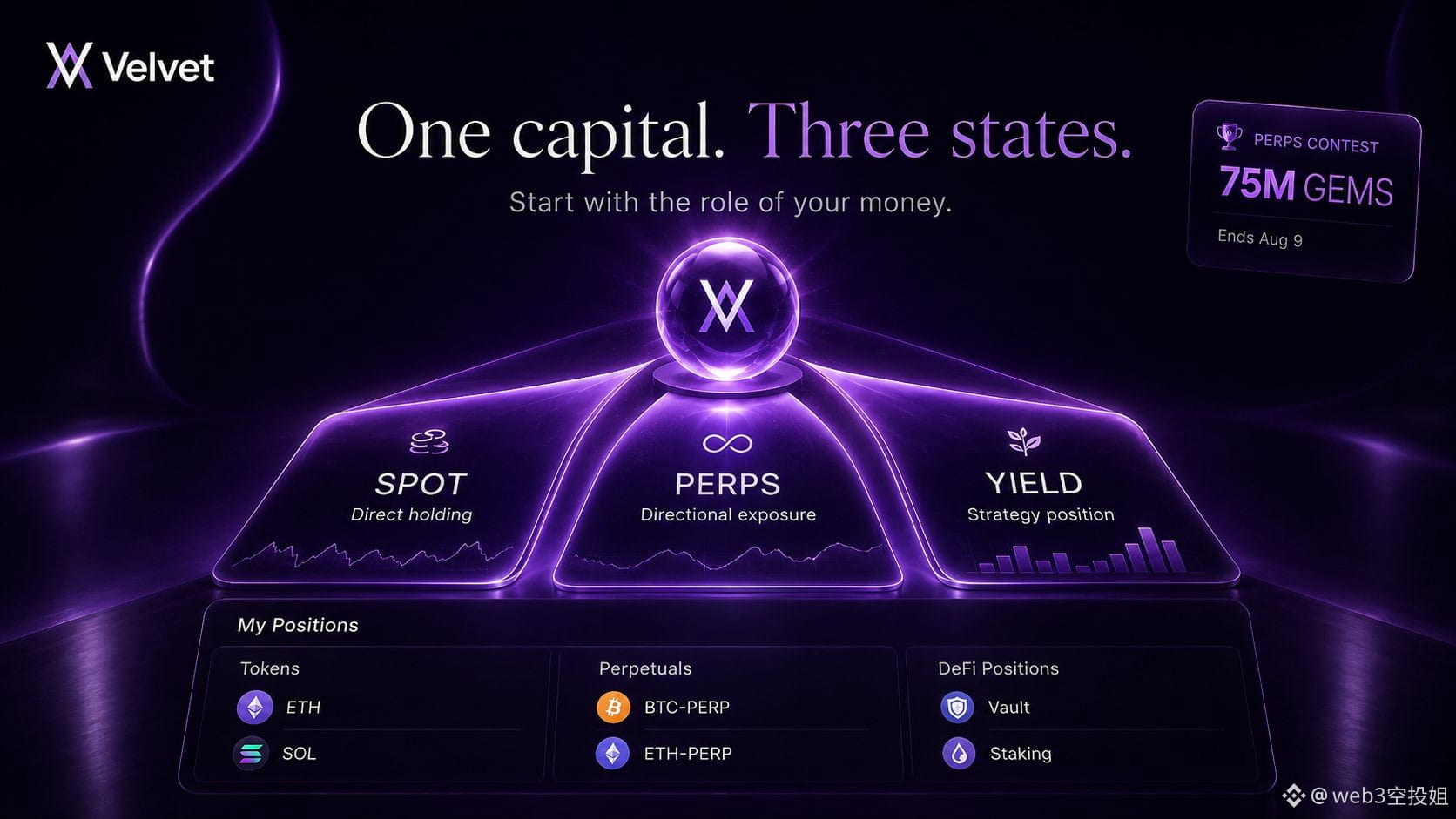
If you want to directly own an asset, that corresponds to Spot. If you want to express a directional view over a period of time, that corresponds to Perps—you’re getting exposure, not spot holdings. If you want to place an asset into a yield strategy, that’s when Yield comes into play, and you also need to consider where the returns come from, when you can exit, and what risks the underlying positions must bear.
When I saw My Positions showing tokens, perpetual positions, and DeFi positions all together, I thought about it. What Velvet has aggregated isn’t just a bunch of Tokens anymore—it puts the different possible states that the same pool of capital could be in into a single product so users can see it.
This idea is actually more important than a lot of the features. A typical aggregator solves “where should I buy.” Velvet takes a step further and gets users to think through first what this money is meant to play: holding, expressing a direction, or entering a strategy.
Of course, a unified Portfolio doesn’t mean the funds are completely shared. Perps still has its own deposits and execution path, and Yield’s real-time returns, fees, and exit conditions also need to be brought back into the product to be confirmed again.
So often, the most common mistake with a piece of money isn’t failing to catch a trending Token—it’s not even thinking through what you intend for it to do. That’s why next time I open one of these full-stack terminals, I’ll ask first what role this money should play today. If the answer isn’t decided yet, don’t rush to search for Tokens first.
Recently I’ve noticed everyone is paying attention to @velvet_capital’s Perps competition—75 million Gems, with the deadline on August 9.
Once the hype heats up, people tend to search for the Token first, then think about how they should act.
But after studying Velvet’s product structure several times, I realized the first question shouldn’t be which one to buy—it should be what this money is going to do right now.
If you want to directly own an asset, that corresponds to Spot. If you want to express a directional view over a period of time, that corresponds to Perps—you’re getting exposure, not spot holdings. If you want to place an asset into a yield strategy, that’s when Yield comes into play, and you also need to consider where the returns come from, when you can exit, and what risks the underlying positions must bear.
When I saw My Positions showing tokens, perpetual positions, and DeFi positions all together, I thought about it. What Velvet has aggregated isn’t just a bunch of Tokens anymore—it puts the different possible states that the same pool of capital could be in into a single product so users can see it.
This idea is actually more important than a lot of the features. A typical aggregator solves “where should I buy.” Velvet takes a step further and gets users to think through first what this money is meant to play: holding, expressing a direction, or entering a strategy.
Of course, a unified Portfolio doesn’t mean the funds are completely shared. Perps still has its own deposits and execution path, and Yield’s real-time returns, fees, and exit conditions also need to be brought back into the product to be confirmed again.
So often, the most common mistake with a piece of money isn’t failing to catch a trending Token—it’s not even thinking through what you intend for it to do. That’s why next time I open one of these full-stack terminals, I’ll ask first what role this money should play today. If the answer isn’t decided yet, don’t rush to search for Tokens first.
Once the hype heats up, people tend to search for the Token first, then think about how they should act.
But after studying Velvet’s product structure several times, I realized the first question shouldn’t be which one to buy—it should be what this money is going to do right now.
If you want to directly own an asset, that corresponds to Spot. If you want to express a directional view over a period of time, that corresponds to Perps—you’re getting exposure, not spot holdings. If you want to place an asset into a yield strategy, that’s when Yield comes into play, and you also need to consider where the returns come from, when you can exit, and what risks the underlying positions must bear.
When I saw My Positions showing tokens, perpetual positions, and DeFi positions all together, I thought about it. What Velvet has aggregated isn’t just a bunch of Tokens anymore—it puts the different possible states that the same pool of capital could be in into a single product so users can see it.
This idea is actually more important than a lot of the features. A typical aggregator solves “where should I buy.” Velvet takes a step further and gets users to think through first what this money is meant to play: holding, expressing a direction, or entering a strategy.
Of course, a unified Portfolio doesn’t mean the funds are completely shared. Perps still has its own deposits and execution path, and Yield’s real-time returns, fees, and exit conditions also need to be brought back into the product to be confirmed again.
So often, the most common mistake with a piece of money isn’t failing to catch a trending Token—it’s not even thinking through what you intend for it to do. That’s why next time I open one of these full-stack terminals, I’ll ask first what role this money should play today. If the answer isn’t decided yet, don’t rush to search for Tokens first.
219
·
--
Bullish
Renaiss @renaissxyz just announced the third round of community ambassador elections: China, Taiwan, and Vietnam will all participate, and the role rotates every two months.
When I saw this news, the first thing that came to mind wasn’t who would be elected—it was the unfinished issues from the previous term. Would they also be handed over and change along with the new cycle?
For ordinary users, the real trouble often isn’t big matters. It might just be that they didn’t understand the Chinese explanation, the event time doesn’t match, or they’re unsure who to ask about saving/withdrawing.
Having an ambassador reply in the group once doesn’t mean the problem is truly solved. If there’s no record, no status update, and no handover, then once the person changes, users may have to explain everything from scratch again. The early official definition of Community Supporter already included answering members’ questions and helping newcomers integrate—and that’s also what I think is most valuable about this whole mechanism.
I’d rather think of community ambassadors as a kind of regional help desk. We collect the local users’ language, scenarios, and real friction points for the project, then bring the project’s responses back to the community. People can rotate, but the problems shouldn’t reset back to zero.
At the moment, the official hasn’t published a fixed feedback channel, a way to check progress, or a formal handover process. So we can’t yet treat these as existing mechanisms. Once the nomination rules are out, I’ll first look at where issues can be submitted, whether people can check processing progress, and whether there’s a list of unfinished items at the time of the term change.
In a good ambassador system, what remains at the end shouldn’t be only a new name. It should also include those issues that have already been heard, are currently being handled, and have someone continuing to follow up.
Renaiss @renaissxyz just announced the third round of community ambassador elections: China, Taiwan, and Vietnam will all participate, and the role rotates every two months.
When I saw this news, the first thing that came to mind wasn’t who would be elected—it was the unfinished issues from the previous term. Would they also be handed over and change along with the new cycle?
For ordinary users, the real trouble often isn’t big matters. It might just be that they didn’t understand the Chinese explanation, the event time doesn’t match, or they’re unsure who to ask about saving/withdrawing.
Having an ambassador reply in the group once doesn’t mean the problem is truly solved. If there’s no record, no status update, and no handover, then once the person changes, users may have to explain everything from scratch again. The early official definition of Community Supporter already included answering members’ questions and helping newcomers integrate—and that’s also what I think is most valuable about this whole mechanism.
I’d rather think of community ambassadors as a kind of regional help desk. We collect the local users’ language, scenarios, and real friction points for the project, then bring the project’s responses back to the community. People can rotate, but the problems shouldn’t reset back to zero.
At the moment, the official hasn’t published a fixed feedback channel, a way to check progress, or a formal handover process. So we can’t yet treat these as existing mechanisms. Once the nomination rules are out, I’ll first look at where issues can be submitted, whether people can check processing progress, and whether there’s a list of unfinished items at the time of the term change.
In a good ambassador system, what remains at the end shouldn’t be only a new name. It should also include those issues that have already been heard, are currently being handled, and have someone continuing to follow up.
When I saw this news, the first thing that came to mind wasn’t who would be elected—it was the unfinished issues from the previous term. Would they also be handed over and change along with the new cycle?
For ordinary users, the real trouble often isn’t big matters. It might just be that they didn’t understand the Chinese explanation, the event time doesn’t match, or they’re unsure who to ask about saving/withdrawing.
Having an ambassador reply in the group once doesn’t mean the problem is truly solved. If there’s no record, no status update, and no handover, then once the person changes, users may have to explain everything from scratch again. The early official definition of Community Supporter already included answering members’ questions and helping newcomers integrate—and that’s also what I think is most valuable about this whole mechanism.
I’d rather think of community ambassadors as a kind of regional help desk. We collect the local users’ language, scenarios, and real friction points for the project, then bring the project’s responses back to the community. People can rotate, but the problems shouldn’t reset back to zero.
At the moment, the official hasn’t published a fixed feedback channel, a way to check progress, or a formal handover process. So we can’t yet treat these as existing mechanisms. Once the nomination rules are out, I’ll first look at where issues can be submitted, whether people can check processing progress, and whether there’s a list of unfinished items at the time of the term change.
In a good ambassador system, what remains at the end shouldn’t be only a new name. It should also include those issues that have already been heard, are currently being handled, and have someone continuing to follow up.

130
·
--
Bullish
I casually tied a Referral Code earlier—can I change it now?
In HertzFlow’s latest Beginner’s Guide #3, @Hertzflow_xyz says it very directly: yes. Under the current testnet rules, even codes that have already been bound can still be changed, and there’s no limit on the number of times.
Skipping the pop-up prompt the first time you connect doesn’t mean you won’t have any chances later. After that, you can still go to the Referral page to bind it manually. If you’ve already bound a code, you can also replace it with a new one.
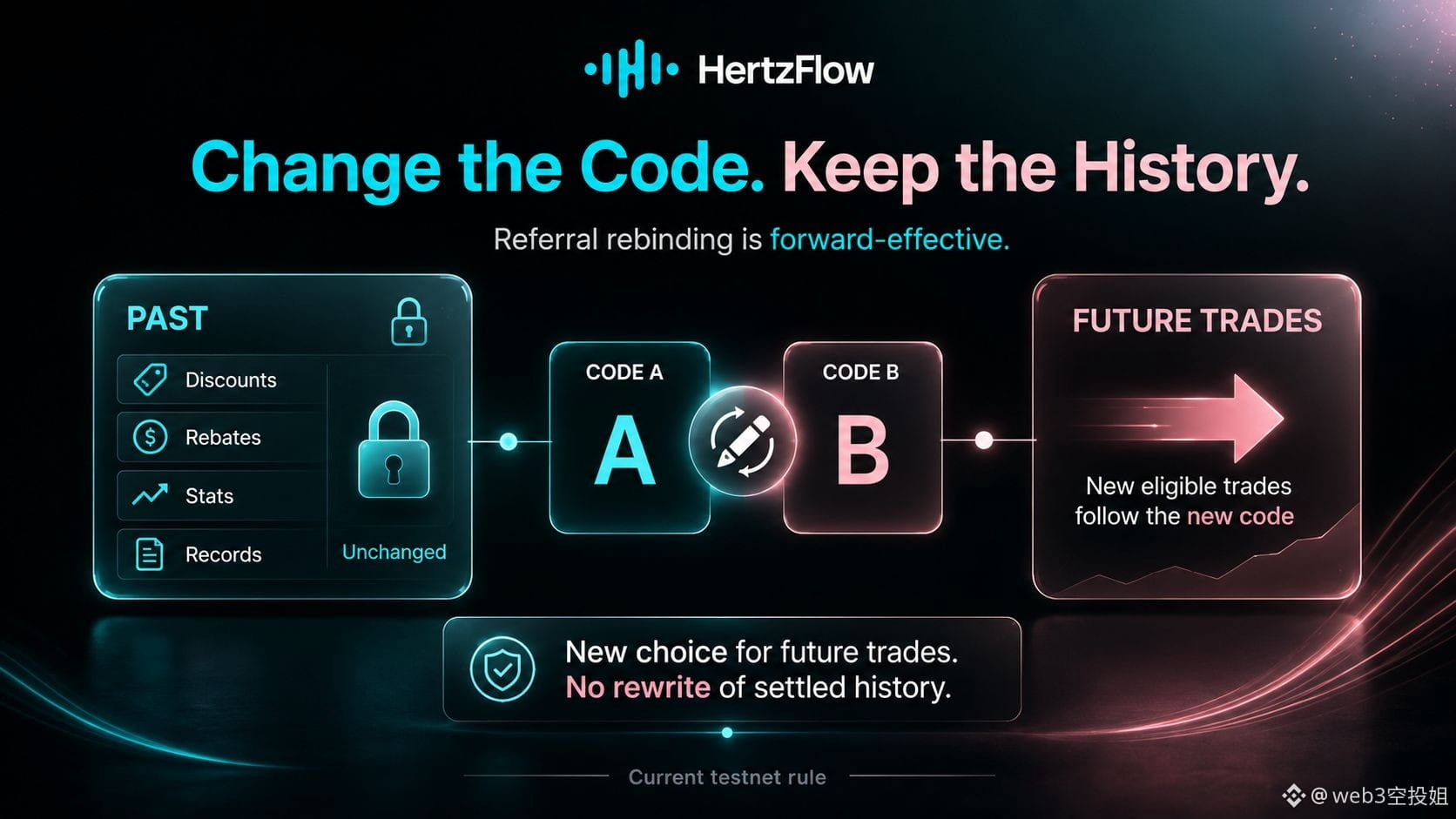
What truly matters is how things are calculated after you change it. The new code only affects qualifying transactions that happen after the change. Discounts, commissions, and statistics that were generated before won’t be recalculated, and they won’t be reassigned into other referral relationships.
When I read this rule, what I cared about most wasn’t whether you can change it—it was what would change after you do, and what would not. The invitation code is more like a signpost that starts taking effect from now on, not something to erase past accounts with.
When the testnet was reset on July 29, the official also kept all referral records. Taken together, HertzFlow’s logic is very clear: users can change their future choices, but historical records that have already been created won’t drift along.
I hope future pages put the current code, the time of the change, when it will take effect in the future, and what history remains unchanged on the same confirmation card. Before a user signs, they can glance once and immediately know what was changed this time—and what wasn’t.
Before you proceed, you should still verify the operations on hertzflow.xyz, the current network, and what you’ve done in your wallet. These are the current testnet rules; whether the mainnet will continue to follow the same approach depends on the official page and documentation.
I casually tied a Referral Code earlier—can I change it now?
In HertzFlow’s latest Beginner’s Guide #3, @Hertzflow_xyz says it very directly: yes. Under the current testnet rules, even codes that have already been bound can still be changed, and there’s no limit on the number of times.
Skipping the pop-up prompt the first time you connect doesn’t mean you won’t have any chances later. After that, you can still go to the Referral page to bind it manually. If you’ve already bound a code, you can also replace it with a new one.
What truly matters is how things are calculated after you change it. The new code only affects qualifying transactions that happen after the change. Discounts, commissions, and statistics that were generated before won’t be recalculated, and they won’t be reassigned into other referral relationships.
When I read this rule, what I cared about most wasn’t whether you can change it—it was what would change after you do, and what would not. The invitation code is more like a signpost that starts taking effect from now on, not something to erase past accounts with.
When the testnet was reset on July 29, the official also kept all referral records. Taken together, HertzFlow’s logic is very clear: users can change their future choices, but historical records that have already been created won’t drift along.
I hope future pages put the current code, the time of the change, when it will take effect in the future, and what history remains unchanged on the same confirmation card. Before a user signs, they can glance once and immediately know what was changed this time—and what wasn’t.
Before you proceed, you should still verify the operations on hertzflow.xyz, the current network, and what you’ve done in your wallet. These are the current testnet rules; whether the mainnet will continue to follow the same approach depends on the official page and documentation.
In HertzFlow’s latest Beginner’s Guide #3, @Hertzflow_xyz says it very directly: yes. Under the current testnet rules, even codes that have already been bound can still be changed, and there’s no limit on the number of times.
Skipping the pop-up prompt the first time you connect doesn’t mean you won’t have any chances later. After that, you can still go to the Referral page to bind it manually. If you’ve already bound a code, you can also replace it with a new one.
What truly matters is how things are calculated after you change it. The new code only affects qualifying transactions that happen after the change. Discounts, commissions, and statistics that were generated before won’t be recalculated, and they won’t be reassigned into other referral relationships.
When I read this rule, what I cared about most wasn’t whether you can change it—it was what would change after you do, and what would not. The invitation code is more like a signpost that starts taking effect from now on, not something to erase past accounts with.
When the testnet was reset on July 29, the official also kept all referral records. Taken together, HertzFlow’s logic is very clear: users can change their future choices, but historical records that have already been created won’t drift along.
I hope future pages put the current code, the time of the change, when it will take effect in the future, and what history remains unchanged on the same confirmation card. Before a user signs, they can glance once and immediately know what was changed this time—and what wasn’t.
Before you proceed, you should still verify the operations on hertzflow.xyz, the current network, and what you’ve done in your wallet. These are the current testnet rules; whether the mainnet will continue to follow the same approach depends on the official page and documentation.
112
·
--
The market is promising, and you clearly have BNB Meme in your wallet—but somehow you don’t have BNB. When you try to sell, you can’t even get as far as submitting the transaction. Being stuck like this is even more frustrating than expensive Gas.
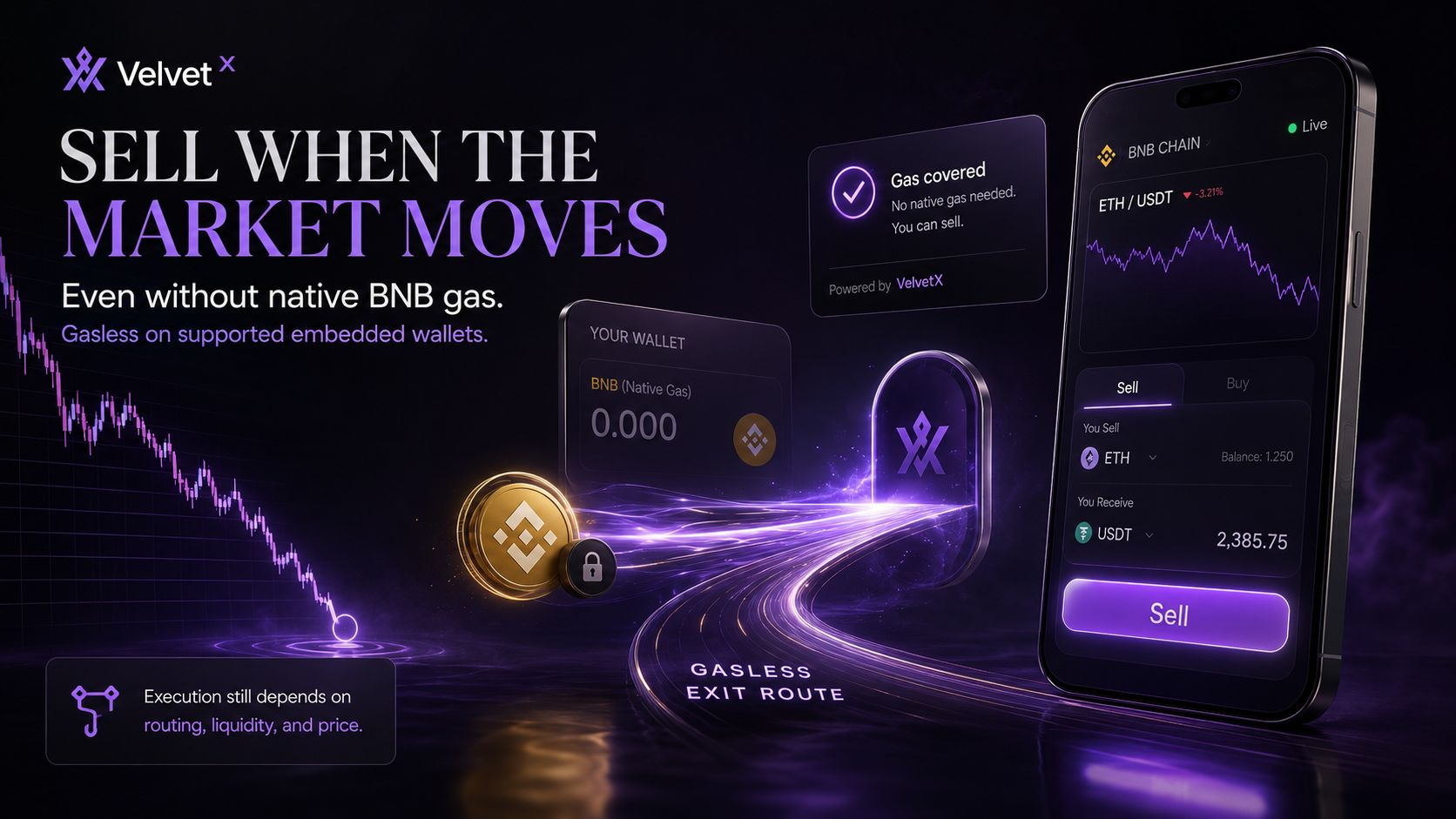
On July 29, @velvet_capital launched Gasless Trading. The very next day, it opened BNB Chain scenarios. When using an embedded wallet with Email or X login, if the native Gas is insufficient, VelvetX will handle the Gas for that transaction.
And if a user buys cross-chain and then plans to sell, as long as the wallet doesn’t have the target chain’s native asset, they don’t need to first exit the app, find a bridge, top up Gas, then come back to chase the price. After seeing this scenario, I genuinely felt relieved—when you’re stuck at the time of buying, you can wait. But when you’re stuck at the time of selling, the price won’t wait for you.
However, Gasless only ensures that the transaction can be sent out. Whether the route can be completed, whether liquidity is sufficient, whether slippage is acceptable, and whether the price changes—all of that still affects the final order outcome.
So it doesn’t guarantee a fill, and it doesn’t mean trades are truly free.
What it really removes is a very clumsy, yet critical, failure point: the asset is already in your hands, but the sell button becomes ineffective because you’re missing a native coin. For a trading product, it’s definitely important that users can enter smoothly. And when market conditions change, it’s even more telling whether the product can still send the exit action normally—this shows whether it has considered real-world usage scenarios.
Gasless is currently available for embedded wallets logged in via Email or X. External wallets still need to have Gas on hand. Public materials also haven’t clearly explained the subsidy limits, the page state after a failed transaction, or the retry path.
When facing a fast-moving market, you can first confirm what type of wallet you’re using, whether the current quote and slippage are still acceptable, and whether the order status provides clear feedback.
The market is promising, and you clearly have BNB Meme in your wallet—but somehow you don’t have BNB. When you try to sell, you can’t even get as far as submitting the transaction. Being stuck like this is even more frustrating than expensive Gas.
On July 29, @velvet_capital launched Gasless Trading. The very next day, it opened BNB Chain scenarios. When using an embedded wallet with Email or X login, if the native Gas is insufficient, VelvetX will handle the Gas for that transaction.
And if a user buys cross-chain and then plans to sell, as long as the wallet doesn’t have the target chain’s native asset, they don’t need to first exit the app, find a bridge, top up Gas, then come back to chase the price. After seeing this scenario, I genuinely felt relieved—when you’re stuck at the time of buying, you can wait. But when you’re stuck at the time of selling, the price won’t wait for you.
However, Gasless only ensures that the transaction can be sent out. Whether the route can be completed, whether liquidity is sufficient, whether slippage is acceptable, and whether the price changes—all of that still affects the final order outcome.
So it doesn’t guarantee a fill, and it doesn’t mean trades are truly free.
What it really removes is a very clumsy, yet critical, failure point: the asset is already in your hands, but the sell button becomes ineffective because you’re missing a native coin. For a trading product, it’s definitely important that users can enter smoothly. And when market conditions change, it’s even more telling whether the product can still send the exit action normally—this shows whether it has considered real-world usage scenarios.
Gasless is currently available for embedded wallets logged in via Email or X. External wallets still need to have Gas on hand. Public materials also haven’t clearly explained the subsidy limits, the page state after a failed transaction, or the retry path.
When facing a fast-moving market, you can first confirm what type of wallet you’re using, whether the current quote and slippage are still acceptable, and whether the order status provides clear feedback.
On July 29, @velvet_capital launched Gasless Trading. The very next day, it opened BNB Chain scenarios. When using an embedded wallet with Email or X login, if the native Gas is insufficient, VelvetX will handle the Gas for that transaction.
And if a user buys cross-chain and then plans to sell, as long as the wallet doesn’t have the target chain’s native asset, they don’t need to first exit the app, find a bridge, top up Gas, then come back to chase the price. After seeing this scenario, I genuinely felt relieved—when you’re stuck at the time of buying, you can wait. But when you’re stuck at the time of selling, the price won’t wait for you.
However, Gasless only ensures that the transaction can be sent out. Whether the route can be completed, whether liquidity is sufficient, whether slippage is acceptable, and whether the price changes—all of that still affects the final order outcome.
So it doesn’t guarantee a fill, and it doesn’t mean trades are truly free.
What it really removes is a very clumsy, yet critical, failure point: the asset is already in your hands, but the sell button becomes ineffective because you’re missing a native coin. For a trading product, it’s definitely important that users can enter smoothly. And when market conditions change, it’s even more telling whether the product can still send the exit action normally—this shows whether it has considered real-world usage scenarios.
Gasless is currently available for embedded wallets logged in via Email or X. External wallets still need to have Gas on hand. Public materials also haven’t clearly explained the subsidy limits, the page state after a failed transaction, or the retry path.
When facing a fast-moving market, you can first confirm what type of wallet you’re using, whether the current quote and slippage are still acceptable, and whether the order status provides clear feedback.
207
·
--
Over these past six months, USD1 has continued to improve steadily, and I’ve gradually learned to stay calm and composed.
At the start of the year, everyone was still waiting for a show from a certain actor.
By August, though, it was still low-level consolidation, with capital flowing out, and the platform shutting down. The hardest part wasn’t a sudden drop on a particular day—it was that my account stayed in the red the entire time. My income never came back, while the market kept urging me to make decisions every day.
During the same period, USD1 traced another curve. At the beginning of the year, they kept explaining reserves, redemptions, and trust. Later, they moved into multi-chain, WLFI Markets, and platforms like Binance and Gate, and slowly stepped into trading and settlement scenarios involving BTC, ETH, and SPCX.
Before, people asked whether this stablecoin is actually stable. Now more people are starting to ask where it can still be used, and where holding it can generate yield.
USD1’s path has kept widening, but my life during that time became more and more exhausting. With no income, the coins in my hands have fallen by several times. When I open my account, there’s basically no good news.
But every Friday, when I see $WLFI arrive on Binance, my heart still gets a little happy.
That money can’t really be said to change my life, but it truly feels like a small paycheck. At least in that moment, I know there’s still one more thing that will happen on time this week.
Later, I realized USD1’s biggest help for me wasn’t just earning a bit more. It allowed me—when I most wanted to act impulsively—to wait a little longer. Fewer times chasing热点, fewer emotionally-driven trades, and less turning anxiety into new losses.
Sometimes in the market, the hardest thing isn’t seizing an opportunity—it’s whether I can avoid proving myself with the next trade without rushing.
So when I saw @mscryptojiayi姐 bringing USD1 × WLFI back to the Binance Square, I was really happy. This companion that’s been with me for more than half a year is still going.
From August 4th to 8th—5 consecutive days—sending 20,000 $USD1 and 600,000 $WLFI. The live room will randomly give out rewards, the chat will drop red envelopes, and in quoted posts you can write about your USD1 experience, then tag @ZachWitkoff or @zakfolkman. And there’s a chance to get 1,000 WLFI too.
In the end, I actually don’t remember which round had the highest APR, but every Friday when the rewards land, the thought in my head is: this week too, I managed to get through it.
Over these six months, USD1 has slowly moved from a stablecoin that needed to be explained into more and more real-world scenarios. And I’ve gone from always thinking I could turn the tide by the market—gradually learning to first hold onto my own pace.
Over these past six months, USD1 has continued to improve steadily, and I’ve gradually learned to stay calm and composed.
At the start of the year, everyone was still waiting for a show from a certain actor.
By August, though, it was still low-level consolidation, with capital flowing out, and the platform shutting down. The hardest part wasn’t a sudden drop on a particular day—it was that my account stayed in the red the entire time. My income never came back, while the market kept urging me to make decisions every day.
During the same period, USD1 traced another curve. At the beginning of the year, they kept explaining reserves, redemptions, and trust. Later, they moved into multi-chain, WLFI Markets, and platforms like Binance and Gate, and slowly stepped into trading and settlement scenarios involving BTC, ETH, and SPCX.
Before, people asked whether this stablecoin is actually stable. Now more people are starting to ask where it can still be used, and where holding it can generate yield.
USD1’s path has kept widening, but my life during that time became more and more exhausting. With no income, the coins in my hands have fallen by several times. When I open my account, there’s basically no good news.
But every Friday, when I see $WLFI arrive on Binance, my heart still gets a little happy.
That money can’t really be said to change my life, but it truly feels like a small paycheck. At least in that moment, I know there’s still one more thing that will happen on time this week.
Later, I realized USD1’s biggest help for me wasn’t just earning a bit more. It allowed me—when I most wanted to act impulsively—to wait a little longer. Fewer times chasing热点, fewer emotionally-driven trades, and less turning anxiety into new losses.
Sometimes in the market, the hardest thing isn’t seizing an opportunity—it’s whether I can avoid proving myself with the next trade without rushing.
So when I saw @mscryptojiayi姐 bringing USD1 × WLFI back to the Binance Square, I was really happy. This companion that’s been with me for more than half a year is still going.
From August 4th to 8th—5 consecutive days—sending 20,000 $USD1 and 600,000 $WLFI. The live room will randomly give out rewards, the chat will drop red envelopes, and in quoted posts you can write about your USD1 experience, then tag @ZachWitkoff or @zakfolkman. And there’s a chance to get 1,000 WLFI too.
In the end, I actually don’t remember which round had the highest APR, but every Friday when the rewards land, the thought in my head is: this week too, I managed to get through it.
Over these six months, USD1 has slowly moved from a stablecoin that needed to be explained into more and more real-world scenarios. And I’ve gone from always thinking I could turn the tide by the market—gradually learning to first hold onto my own pace.
At the start of the year, everyone was still waiting for a show from a certain actor.
By August, though, it was still low-level consolidation, with capital flowing out, and the platform shutting down. The hardest part wasn’t a sudden drop on a particular day—it was that my account stayed in the red the entire time. My income never came back, while the market kept urging me to make decisions every day.
During the same period, USD1 traced another curve. At the beginning of the year, they kept explaining reserves, redemptions, and trust. Later, they moved into multi-chain, WLFI Markets, and platforms like Binance and Gate, and slowly stepped into trading and settlement scenarios involving BTC, ETH, and SPCX.
Before, people asked whether this stablecoin is actually stable. Now more people are starting to ask where it can still be used, and where holding it can generate yield.
USD1’s path has kept widening, but my life during that time became more and more exhausting. With no income, the coins in my hands have fallen by several times. When I open my account, there’s basically no good news.
But every Friday, when I see $WLFI arrive on Binance, my heart still gets a little happy.
That money can’t really be said to change my life, but it truly feels like a small paycheck. At least in that moment, I know there’s still one more thing that will happen on time this week.
Later, I realized USD1’s biggest help for me wasn’t just earning a bit more. It allowed me—when I most wanted to act impulsively—to wait a little longer. Fewer times chasing热点, fewer emotionally-driven trades, and less turning anxiety into new losses.
Sometimes in the market, the hardest thing isn’t seizing an opportunity—it’s whether I can avoid proving myself with the next trade without rushing.
So when I saw @mscryptojiayi姐 bringing USD1 × WLFI back to the Binance Square, I was really happy. This companion that’s been with me for more than half a year is still going.
From August 4th to 8th—5 consecutive days—sending 20,000 $USD1 and 600,000 $WLFI. The live room will randomly give out rewards, the chat will drop red envelopes, and in quoted posts you can write about your USD1 experience, then tag @ZachWitkoff or @zakfolkman. And there’s a chance to get 1,000 WLFI too.
In the end, I actually don’t remember which round had the highest APR, but every Friday when the rewards land, the thought in my head is: this week too, I managed to get through it.
Over these six months, USD1 has slowly moved from a stablecoin that needed to be explained into more and more real-world scenarios. And I’ve gone from always thinking I could turn the tide by the market—gradually learning to first hold onto my own pace.
1
206
·
--
The day before yesterday, @renaissxyz opened Full Redemption to all users, and both the SBT and the phased-entry thresholds were removed.
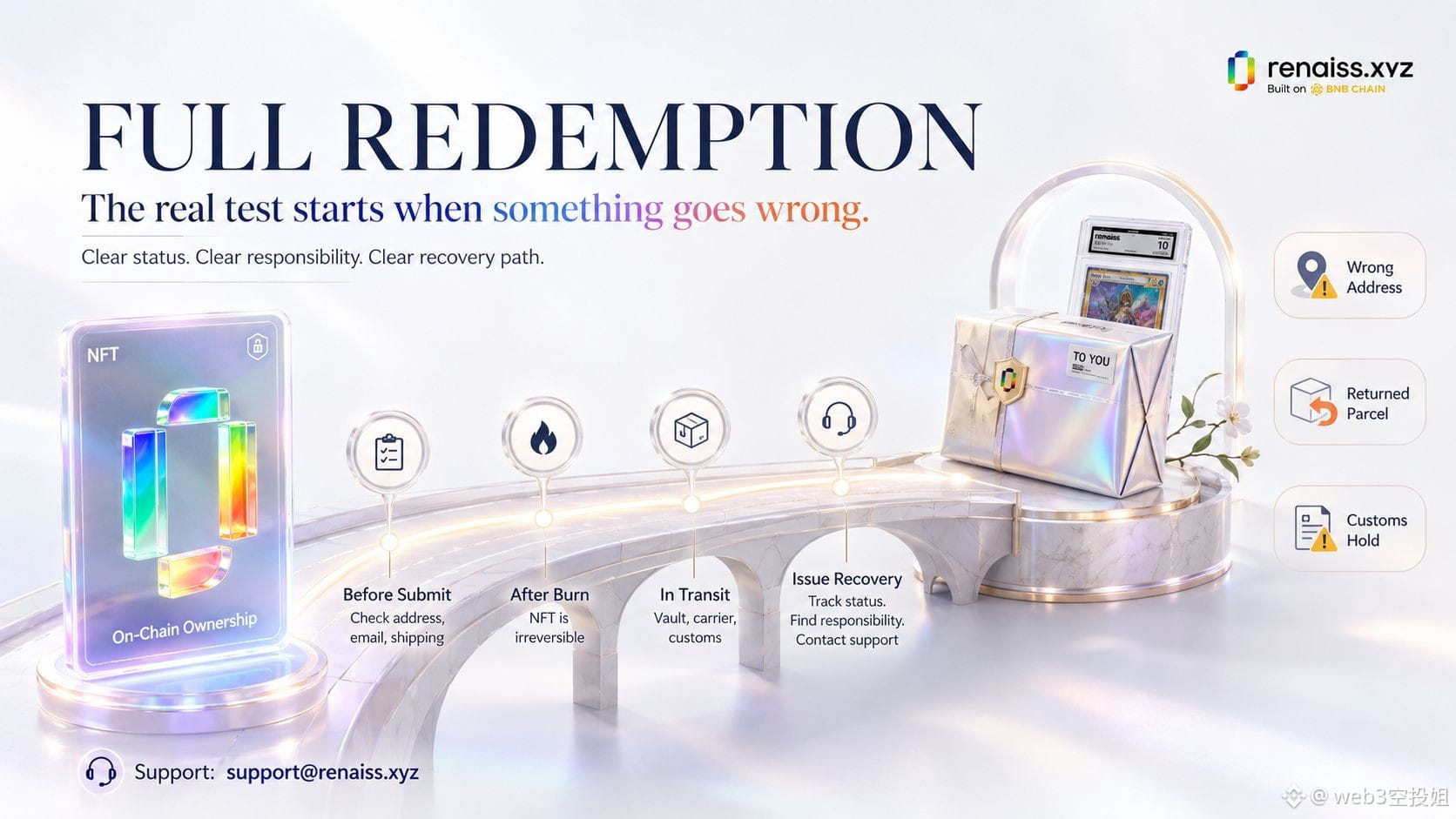
I read through the official guidelines and terms side by side, and what I care about most is not how smoothly a normal redemption goes, but whether—after an address is entered incorrectly, a package is returned, or it gets stuck at customs—this asset can still be clearly received and handled.
Before submitting, the English address, email, phone number, and shipping options can all be double-checked repeatedly. But once you sign and confirm that the NFT will be permanently destroyed, the on-chain status has already moved forward; in the real world, the cards may not even be out of the warehouse yet, and at that point it’s hard to resolve everything with a single “withdraw.”
After that, the cards enter the vault and carrier processing workflow. The official terms are very direct: risks like an incorrect address, failed delivery attempts, customs delays, and so on are mainly borne by the user. Insurance provides only limited coverage and does not guarantee that all value will be covered.
When I got to this part, my heart really sank. Tight rules can be understood, but when something abnormal happens, what users most need to know is where the asset is now, who they should contact, and what to do next. And this responsibility map—based on currently public information—still isn’t complete enough.
What Renaiss is doing now is more like building a bridge between on-chain ownership and the real-world cards. If the bridge can run smoothly, it shows the functionality works. But when it gets blocked, returned, or lost, users should still be able to find the asset and the party responsible—that’s what shows the system can truly catch ordinary people.
So next, I’ll check whether the address can be changed after a few submissions, where to find order and logistics status, whether returned parcels should be handled by the vault or the carrier, and where to file an appeal when on-chain status and logistics status are out of sync.
The publicly supported contact email is support@renaiss.xyz. Once these abnormal scenarios and paths are explained clearly first, users will feel much more at ease before submitting for Full Redemption.
The day before yesterday, @renaissxyz opened Full Redemption to all users, and both the SBT and the phased-entry thresholds were removed.
I read through the official guidelines and terms side by side, and what I care about most is not how smoothly a normal redemption goes, but whether—after an address is entered incorrectly, a package is returned, or it gets stuck at customs—this asset can still be clearly received and handled.
Before submitting, the English address, email, phone number, and shipping options can all be double-checked repeatedly. But once you sign and confirm that the NFT will be permanently destroyed, the on-chain status has already moved forward; in the real world, the cards may not even be out of the warehouse yet, and at that point it’s hard to resolve everything with a single “withdraw.”
After that, the cards enter the vault and carrier processing workflow. The official terms are very direct: risks like an incorrect address, failed delivery attempts, customs delays, and so on are mainly borne by the user. Insurance provides only limited coverage and does not guarantee that all value will be covered.
When I got to this part, my heart really sank. Tight rules can be understood, but when something abnormal happens, what users most need to know is where the asset is now, who they should contact, and what to do next. And this responsibility map—based on currently public information—still isn’t complete enough.
What Renaiss is doing now is more like building a bridge between on-chain ownership and the real-world cards. If the bridge can run smoothly, it shows the functionality works. But when it gets blocked, returned, or lost, users should still be able to find the asset and the party responsible—that’s what shows the system can truly catch ordinary people.
So next, I’ll check whether the address can be changed after a few submissions, where to find order and logistics status, whether returned parcels should be handled by the vault or the carrier, and where to file an appeal when on-chain status and logistics status are out of sync.
The publicly supported contact email is support@renaiss.xyz. Once these abnormal scenarios and paths are explained clearly first, users will feel much more at ease before submitting for Full Redemption.
I read through the official guidelines and terms side by side, and what I care about most is not how smoothly a normal redemption goes, but whether—after an address is entered incorrectly, a package is returned, or it gets stuck at customs—this asset can still be clearly received and handled.
Before submitting, the English address, email, phone number, and shipping options can all be double-checked repeatedly. But once you sign and confirm that the NFT will be permanently destroyed, the on-chain status has already moved forward; in the real world, the cards may not even be out of the warehouse yet, and at that point it’s hard to resolve everything with a single “withdraw.”
After that, the cards enter the vault and carrier processing workflow. The official terms are very direct: risks like an incorrect address, failed delivery attempts, customs delays, and so on are mainly borne by the user. Insurance provides only limited coverage and does not guarantee that all value will be covered.
When I got to this part, my heart really sank. Tight rules can be understood, but when something abnormal happens, what users most need to know is where the asset is now, who they should contact, and what to do next. And this responsibility map—based on currently public information—still isn’t complete enough.
What Renaiss is doing now is more like building a bridge between on-chain ownership and the real-world cards. If the bridge can run smoothly, it shows the functionality works. But when it gets blocked, returned, or lost, users should still be able to find the asset and the party responsible—that’s what shows the system can truly catch ordinary people.
So next, I’ll check whether the address can be changed after a few submissions, where to find order and logistics status, whether returned parcels should be handled by the vault or the carrier, and where to file an appeal when on-chain status and logistics status are out of sync.
The publicly supported contact email is support@renaiss.xyz. Once these abnormal scenarios and paths are explained clearly first, users will feel much more at ease before submitting for Full Redemption.
109
·
--
Good morning, sisters!
Lately there hasn’t been much going on in the market. But the USD1 earning campaign is worth checking out.
If you don’t chase pumps or panic-sell, you can choose based on your own preferences.
For now, the G activity is relatively low-effort and convenient.
It offers up to around 8% APR—no need to apply or lock funds to participate with 1 USD1. The spot contract account uses hourly snapshots, and rewards are paid out daily. If you have idle USD1 sitting around, you can just put it in and participate.
Since the funds are on Binance, you can also join the Binance USD1 activity.
It has now been extended to August 7th, with about 5.56% APR. Also, there is a pool of 165 million $WLFI to be shared. As long as the daily USD1 contract OI stays above 300+, the reward weight is multiplied by 1.2x.
If you were already trading contracts, you can take the extra bonus along the way. If you don’t usually touch contracts, there’s no need to open a position temporarily just for the 1.2x multiplier.
If you want to keep it on-chain, you can check out WLFI Markets.
Currently it shows USD1 supply APY on Dolomite at about 7.69%, borrowing APR at about 3.48%, and a utilization rate of 53.35%. By depositing through WLFI Markets, you can also accumulate USD1 Points.
But on-chain isn’t as simple as clicking once and you’re done.
You’ll need to prepare a wallet and ETH gas, and you also have to bear risks related to smart contracts, liquidity, and interest-rate changes. WLFI Markets allows you to withdraw at any time, but it still depends on available liquidity in the pool. Also, the minimum USD1 Points supply requirement is 1,000 USD1.
So my suggestion is: for the sake of convenience and smaller amounts, put it in G. If your funds are already on Binance, just continue to hold and take the campaign rewards. If you’re familiar with on-chain and want to manage your funds yourself, then go to WLFI Markets.
Higher returns aren’t necessarily always better. You know best where your money is—and if something goes wrong, you’ll know how to get it back. That’s what really matters.
Interest rates will change dynamically. Before you participate, remember to take another look at the live page.
@worldlibertyfi @Binance #WLFI #USD1
Good morning, sisters!
Lately there hasn’t been much going on in the market. But the USD1 earning campaign is worth checking out.
If you don’t chase pumps or panic-sell, you can choose based on your own preferences.
For now, the G activity is relatively low-effort and convenient.
It offers up to around 8% APR—no need to apply or lock funds to participate with 1 USD1. The spot contract account uses hourly snapshots, and rewards are paid out daily. If you have idle USD1 sitting around, you can just put it in and participate.
Since the funds are on Binance, you can also join the Binance USD1 activity.
It has now been extended to August 7th, with about 5.56% APR. Also, there is a pool of 165 million $WLFI to be shared. As long as the daily USD1 contract OI stays above 300+, the reward weight is multiplied by 1.2x.
If you were already trading contracts, you can take the extra bonus along the way. If you don’t usually touch contracts, there’s no need to open a position temporarily just for the 1.2x multiplier.
If you want to keep it on-chain, you can check out WLFI Markets.
Currently it shows USD1 supply APY on Dolomite at about 7.69%, borrowing APR at about 3.48%, and a utilization rate of 53.35%. By depositing through WLFI Markets, you can also accumulate USD1 Points.
But on-chain isn’t as simple as clicking once and you’re done.
You’ll need to prepare a wallet and ETH gas, and you also have to bear risks related to smart contracts, liquidity, and interest-rate changes. WLFI Markets allows you to withdraw at any time, but it still depends on available liquidity in the pool. Also, the minimum USD1 Points supply requirement is 1,000 USD1.
So my suggestion is: for the sake of convenience and smaller amounts, put it in G. If your funds are already on Binance, just continue to hold and take the campaign rewards. If you’re familiar with on-chain and want to manage your funds yourself, then go to WLFI Markets.
Higher returns aren’t necessarily always better. You know best where your money is—and if something goes wrong, you’ll know how to get it back. That’s what really matters.
Interest rates will change dynamically. Before you participate, remember to take another look at the live page.
@worldlibertyfi @Binance #WLFI #USD1
Lately there hasn’t been much going on in the market. But the USD1 earning campaign is worth checking out.
If you don’t chase pumps or panic-sell, you can choose based on your own preferences.
For now, the G activity is relatively low-effort and convenient.
It offers up to around 8% APR—no need to apply or lock funds to participate with 1 USD1. The spot contract account uses hourly snapshots, and rewards are paid out daily. If you have idle USD1 sitting around, you can just put it in and participate.
Since the funds are on Binance, you can also join the Binance USD1 activity.
It has now been extended to August 7th, with about 5.56% APR. Also, there is a pool of 165 million $WLFI to be shared. As long as the daily USD1 contract OI stays above 300+, the reward weight is multiplied by 1.2x.
If you were already trading contracts, you can take the extra bonus along the way. If you don’t usually touch contracts, there’s no need to open a position temporarily just for the 1.2x multiplier.
If you want to keep it on-chain, you can check out WLFI Markets.
Currently it shows USD1 supply APY on Dolomite at about 7.69%, borrowing APR at about 3.48%, and a utilization rate of 53.35%. By depositing through WLFI Markets, you can also accumulate USD1 Points.
But on-chain isn’t as simple as clicking once and you’re done.
You’ll need to prepare a wallet and ETH gas, and you also have to bear risks related to smart contracts, liquidity, and interest-rate changes. WLFI Markets allows you to withdraw at any time, but it still depends on available liquidity in the pool. Also, the minimum USD1 Points supply requirement is 1,000 USD1.
So my suggestion is: for the sake of convenience and smaller amounts, put it in G. If your funds are already on Binance, just continue to hold and take the campaign rewards. If you’re familiar with on-chain and want to manage your funds yourself, then go to WLFI Markets.
Higher returns aren’t necessarily always better. You know best where your money is—and if something goes wrong, you’ll know how to get it back. That’s what really matters.
Interest rates will change dynamically. Before you participate, remember to take another look at the live page.
@worldlibertyfi @Binance #WLFI #USD1
1
198
·
--
Bullish
If you’re doing another asset long the same way, why do you have to choose Normal or Hyper again in HertzFlow @Hertzflow_xyz?
The latest Beginner’s Guide #3 explains this clearly. At first glance, it looks like just two buttons—but behind them are two completely different payment models.
After looking at the fee schedule for a while, I was definitely tempted by Hyper’s 0% open/close position fee on the first look. But if you scroll further, you’ll see that what you really need to compare isn’t only whether this fee exists. You also need to look at when the costs show up, and how the final result is calculated.
In the current testnet, Normal’s open/close position fee is 4–6 bps of the position’s notional value. There’s also a 5% discount on eligible fees via effective Referral—but it only applies to this portion of eligible fees. It’s more like putting the price tag out early: the fee appears sooner, and users can more easily estimate it in advance.
Hyper doesn’t charge the corresponding open/close position fee. However, after a profitable close, it allocates profits based on the ROI rules; if you close at a loss, it doesn’t take that profit share. But Funding, Borrow, and Gas still exist. So a “0% open/close position fee” only means that specific line item is zero—it doesn’t mean the entire position has no costs.
I’m glad Guide #3 clarifies the boundaries of Referral. If we can go one step further, I hope the order confirmation page will directly show a “cost card” that puts the open/close position fee, profit share, Funding, Borrow, Gas, and discount range all in one place. That way, users won’t be lured in by a single “0,” only to go elsewhere to complete the rest of the bill.
Before placing an order, check your trading frequency, holding time, and profit expectations—then decide whether you’re more comfortable paying upfront or splitting after profits. The above is still based on the current testnet rules; the mainnet will follow the page at the time and the official documentation.
If you’re doing another asset long the same way, why do you have to choose Normal or Hyper again in HertzFlow @Hertzflow_xyz?
The latest Beginner’s Guide #3 explains this clearly. At first glance, it looks like just two buttons—but behind them are two completely different payment models.
After looking at the fee schedule for a while, I was definitely tempted by Hyper’s 0% open/close position fee on the first look. But if you scroll further, you’ll see that what you really need to compare isn’t only whether this fee exists. You also need to look at when the costs show up, and how the final result is calculated.
In the current testnet, Normal’s open/close position fee is 4–6 bps of the position’s notional value. There’s also a 5% discount on eligible fees via effective Referral—but it only applies to this portion of eligible fees. It’s more like putting the price tag out early: the fee appears sooner, and users can more easily estimate it in advance.
Hyper doesn’t charge the corresponding open/close position fee. However, after a profitable close, it allocates profits based on the ROI rules; if you close at a loss, it doesn’t take that profit share. But Funding, Borrow, and Gas still exist. So a “0% open/close position fee” only means that specific line item is zero—it doesn’t mean the entire position has no costs.
I’m glad Guide #3 clarifies the boundaries of Referral. If we can go one step further, I hope the order confirmation page will directly show a “cost card” that puts the open/close position fee, profit share, Funding, Borrow, Gas, and discount range all in one place. That way, users won’t be lured in by a single “0,” only to go elsewhere to complete the rest of the bill.
Before placing an order, check your trading frequency, holding time, and profit expectations—then decide whether you’re more comfortable paying upfront or splitting after profits. The above is still based on the current testnet rules; the mainnet will follow the page at the time and the official documentation.
The latest Beginner’s Guide #3 explains this clearly. At first glance, it looks like just two buttons—but behind them are two completely different payment models.
After looking at the fee schedule for a while, I was definitely tempted by Hyper’s 0% open/close position fee on the first look. But if you scroll further, you’ll see that what you really need to compare isn’t only whether this fee exists. You also need to look at when the costs show up, and how the final result is calculated.
In the current testnet, Normal’s open/close position fee is 4–6 bps of the position’s notional value. There’s also a 5% discount on eligible fees via effective Referral—but it only applies to this portion of eligible fees. It’s more like putting the price tag out early: the fee appears sooner, and users can more easily estimate it in advance.
Hyper doesn’t charge the corresponding open/close position fee. However, after a profitable close, it allocates profits based on the ROI rules; if you close at a loss, it doesn’t take that profit share. But Funding, Borrow, and Gas still exist. So a “0% open/close position fee” only means that specific line item is zero—it doesn’t mean the entire position has no costs.
I’m glad Guide #3 clarifies the boundaries of Referral. If we can go one step further, I hope the order confirmation page will directly show a “cost card” that puts the open/close position fee, profit share, Funding, Borrow, Gas, and discount range all in one place. That way, users won’t be lured in by a single “0,” only to go elsewhere to complete the rest of the bill.
Before placing an order, check your trading frequency, holding time, and profit expectations—then decide whether you’re more comfortable paying upfront or splitting after profits. The above is still based on the current testnet rules; the mainnet will follow the page at the time and the official documentation.
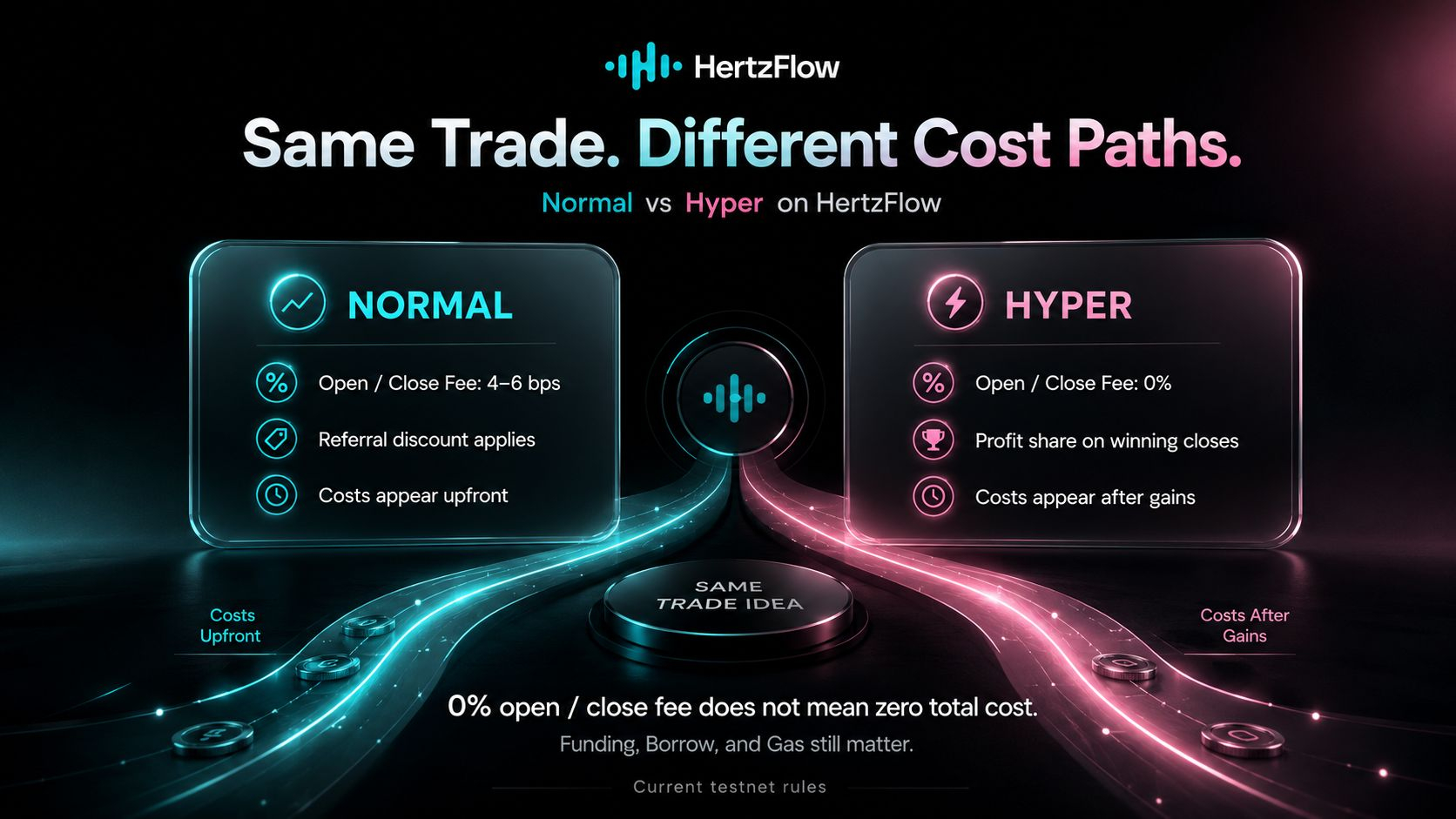
177
·
--
After logging in by email, is the wallet still really yours?
On July 29, @velvet_capital opened up Gasless transactions on the Robinhood Chain for embedded wallets using email or X login.
I believe VelvetX hasn’t taken the wallet away—it has simply moved it from the first onboarding lesson to behind the account.
In the past, for on-chain products you’d first download a wallet, back up your seed phrase, find the network, and get some gas. Before you even saw the product, half your attention had already been consumed by the tools. Now you log into your account first. Turnkey generates a non-custodial wallet in the background, and the gas in the supported scenarios is also handled by the product.
Email login is just the entry point. The assets are still executed from the user’s wallet. The team can’t directly use them. The key actions still require your authorization and signatures.
The account gets you in. The wallet ensures the assets still belong to you.
After reading this official path, the most exciting part for me is that users can finally understand what they want to do first, and then gradually understand how the wallet works. VelvetX is more like a trading room that hides complicated equipment inside the wall—clean desktop, and no control is secretly taken away.
#Gasless only applies to embedded wallets and supported scenarios. External wallets still need to supply their own gas. For product flows like recovery, changing devices, and exporting keys, there also needs to be clearer public documentation.
Before using it, I’ll only confirm whether I’m using an embedded wallet or an external one—and, when signing, exactly what I’m authorizing.
After logging in by email, is the wallet still really yours?
On July 29, @velvet_capital opened up Gasless transactions on the Robinhood Chain for embedded wallets using email or X login.
I believe VelvetX hasn’t taken the wallet away—it has simply moved it from the first onboarding lesson to behind the account.
In the past, for on-chain products you’d first download a wallet, back up your seed phrase, find the network, and get some gas. Before you even saw the product, half your attention had already been consumed by the tools. Now you log into your account first. Turnkey generates a non-custodial wallet in the background, and the gas in the supported scenarios is also handled by the product.
Email login is just the entry point. The assets are still executed from the user’s wallet. The team can’t directly use them. The key actions still require your authorization and signatures.
The account gets you in. The wallet ensures the assets still belong to you.
After reading this official path, the most exciting part for me is that users can finally understand what they want to do first, and then gradually understand how the wallet works. VelvetX is more like a trading room that hides complicated equipment inside the wall—clean desktop, and no control is secretly taken away.
#Gasless only applies to embedded wallets and supported scenarios. External wallets still need to supply their own gas. For product flows like recovery, changing devices, and exporting keys, there also needs to be clearer public documentation.
Before using it, I’ll only confirm whether I’m using an embedded wallet or an external one—and, when signing, exactly what I’m authorizing.
On July 29, @velvet_capital opened up Gasless transactions on the Robinhood Chain for embedded wallets using email or X login.
I believe VelvetX hasn’t taken the wallet away—it has simply moved it from the first onboarding lesson to behind the account.
In the past, for on-chain products you’d first download a wallet, back up your seed phrase, find the network, and get some gas. Before you even saw the product, half your attention had already been consumed by the tools. Now you log into your account first. Turnkey generates a non-custodial wallet in the background, and the gas in the supported scenarios is also handled by the product.
Email login is just the entry point. The assets are still executed from the user’s wallet. The team can’t directly use them. The key actions still require your authorization and signatures.
The account gets you in. The wallet ensures the assets still belong to you.
After reading this official path, the most exciting part for me is that users can finally understand what they want to do first, and then gradually understand how the wallet works. VelvetX is more like a trading room that hides complicated equipment inside the wall—clean desktop, and no control is secretly taken away.
#Gasless only applies to embedded wallets and supported scenarios. External wallets still need to supply their own gas. For product flows like recovery, changing devices, and exporting keys, there also needs to be clearer public documentation.
Before using it, I’ll only confirm whether I’m using an embedded wallet or an external one—and, when signing, exactly what I’m authorizing.
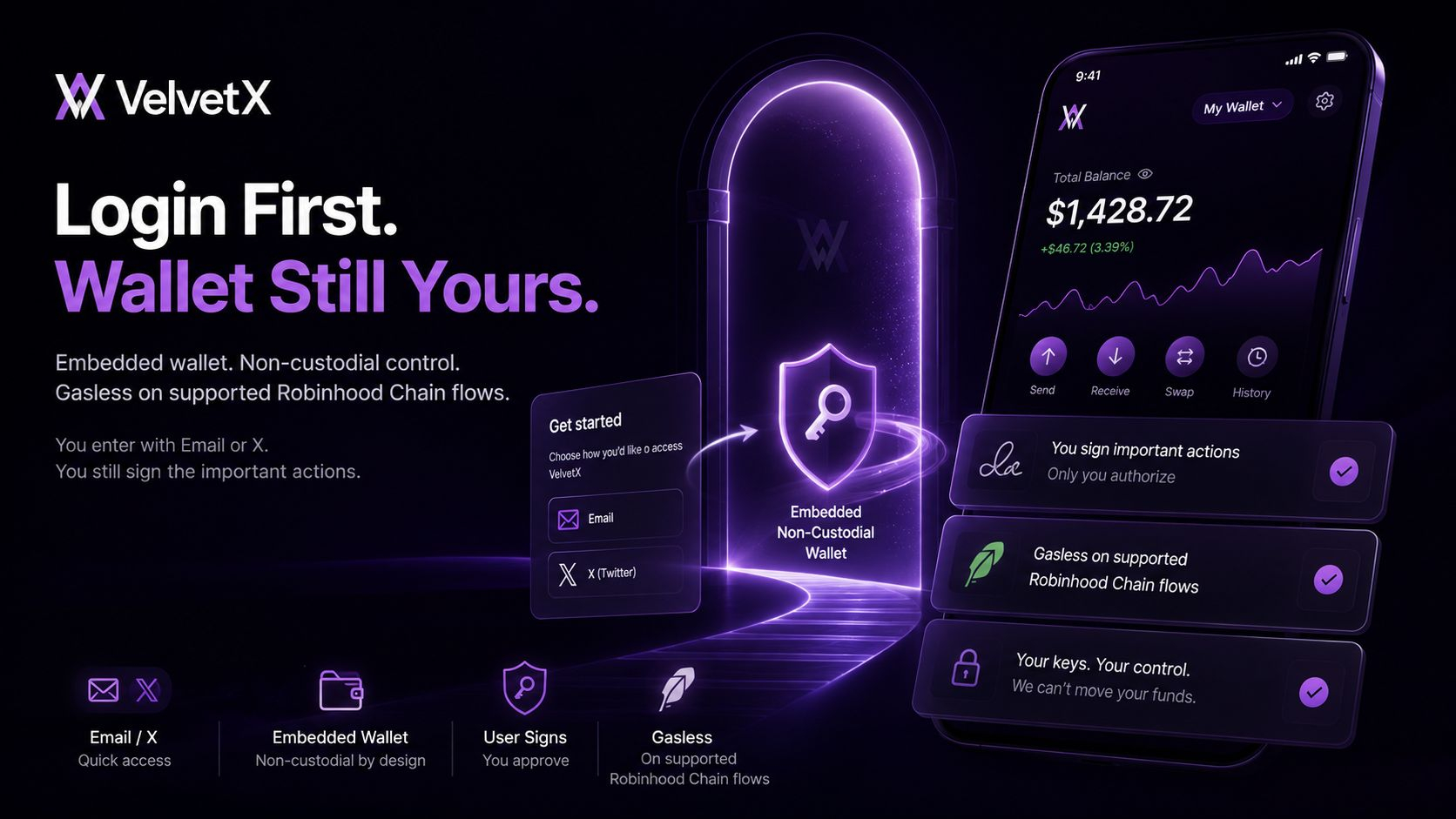
166
·
--
renaiss @renaissxyz This time, turning Trainer into 1–3: my first reaction wasn’t that the levels have increased—it was that ordinary contributors can finally ask one fewer question. I’ve done all this… so where exactly am I now?
That official line, “This is not a reset. Every contribution still matters,” is especially warm—like you’re speaking to old OGs: the things you认真做过 last month are still there. The first Questline cycle had just ended, and they immediately made the path LV1→LV2→LV3, putting scattered contributions back into a monthly map you can actually see.
I really like the phrase “Build Consistency.” It doesn’t mean a sprint overnight—it means coming back every month and slowly doing what you should do well. What the community fears most about contributions isn’t the hard work. It’s having no coordinates once you’re done.
Right now, the public information hasn’t yet spelled out the full thresholds for each Level, where the entry points are shown, or how old contributions map over. The complete details still have to be checked on Discord. So don’t rush to treat Trainer 1–3 as rankings, rewards, or an airdrop clue. At the moment, its most certain value is simply to make the contribution path clearer: newcomers know where to start, and veteran contributors know where to go next.
Next, I’ll first verify how each Level is leveled up, where to view your current status, and how old contributions correspond.
renaiss @renaissxyz This time, turning Trainer into 1–3: my first reaction wasn’t that the levels have increased—it was that ordinary contributors can finally ask one fewer question. I’ve done all this… so where exactly am I now?
That official line, “This is not a reset. Every contribution still matters,” is especially warm—like you’re speaking to old OGs: the things you认真做过 last month are still there. The first Questline cycle had just ended, and they immediately made the path LV1→LV2→LV3, putting scattered contributions back into a monthly map you can actually see.
I really like the phrase “Build Consistency.” It doesn’t mean a sprint overnight—it means coming back every month and slowly doing what you should do well. What the community fears most about contributions isn’t the hard work. It’s having no coordinates once you’re done.
Right now, the public information hasn’t yet spelled out the full thresholds for each Level, where the entry points are shown, or how old contributions map over. The complete details still have to be checked on Discord. So don’t rush to treat Trainer 1–3 as rankings, rewards, or an airdrop clue. At the moment, its most certain value is simply to make the contribution path clearer: newcomers know where to start, and veteran contributors know where to go next.
Next, I’ll first verify how each Level is leveled up, where to view your current status, and how old contributions correspond.
That official line, “This is not a reset. Every contribution still matters,” is especially warm—like you’re speaking to old OGs: the things you认真做过 last month are still there. The first Questline cycle had just ended, and they immediately made the path LV1→LV2→LV3, putting scattered contributions back into a monthly map you can actually see.
I really like the phrase “Build Consistency.” It doesn’t mean a sprint overnight—it means coming back every month and slowly doing what you should do well. What the community fears most about contributions isn’t the hard work. It’s having no coordinates once you’re done.
Right now, the public information hasn’t yet spelled out the full thresholds for each Level, where the entry points are shown, or how old contributions map over. The complete details still have to be checked on Discord. So don’t rush to treat Trainer 1–3 as rankings, rewards, or an airdrop clue. At the moment, its most certain value is simply to make the contribution path clearer: newcomers know where to start, and veteran contributors know where to go next.
Next, I’ll first verify how each Level is leveled up, where to view your current status, and how old contributions correspond.
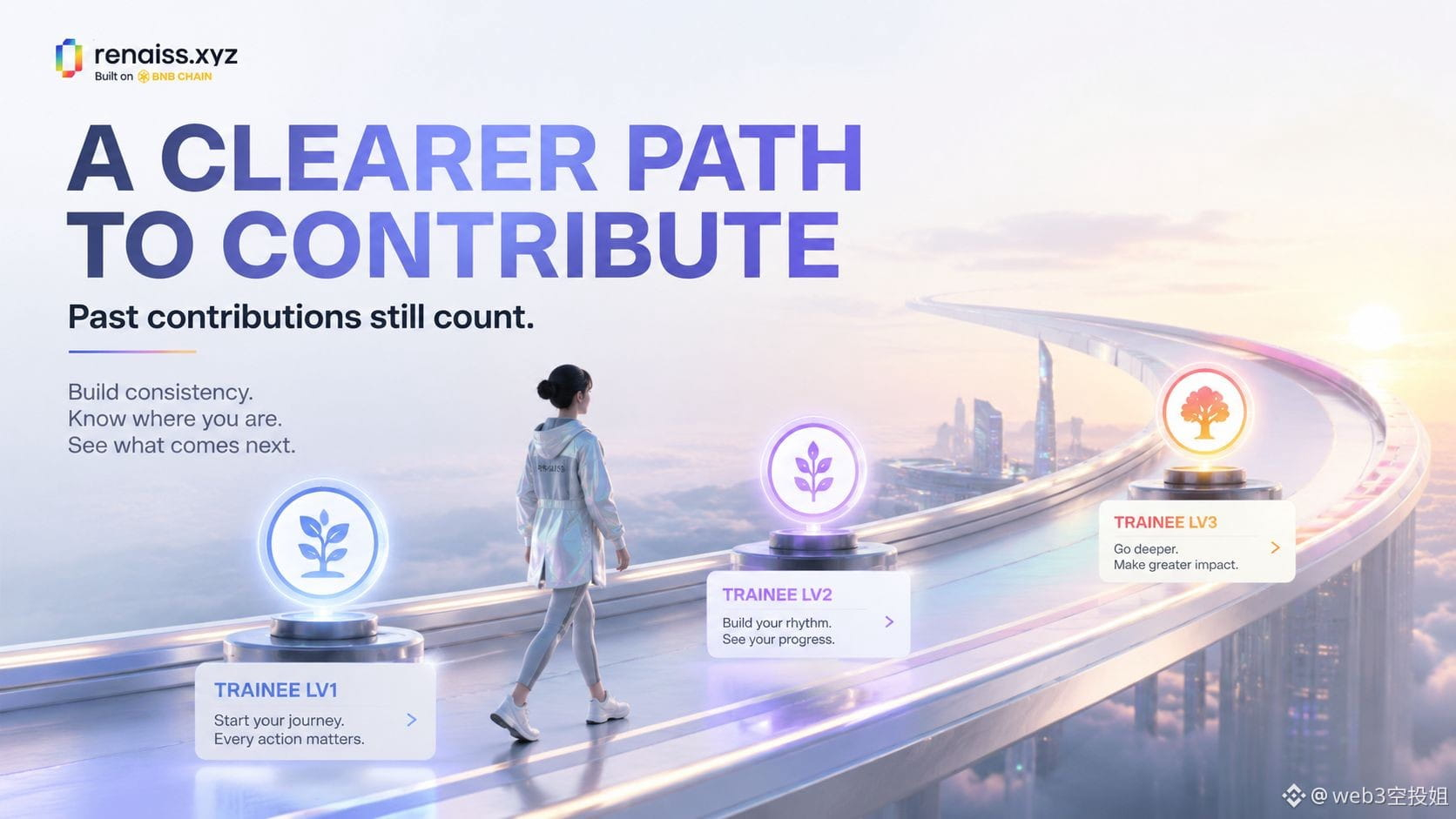
137
·
--
Good afternoon, sisters!
When I was looking at the HertzFlow @Hertzflow_xyz testnet, my first reaction wasn’t to click Trade, Pool, or Vault.
I couldn’t help asking myself: what kind of risk am I actually prepared to take?
Trade, Pool, and Vault look like three entry points, but they’re really three different identities. If you click Trade, you’re taking on the role of a trader—you choose the market, the direction, the leverage, and the timing of your exit. Whether your judgment is right or wrong, it all comes back to your position.
If you enter the Pool, you become a single-pool LP. You pick a specific market, provide counterparty capital, and receive HzLP. The upside is that your choice is clearer; the trade-off is that the risks are also more concentrated.
If you enter the Vault, you become a strategy-based LP. You receive HzV, and your funds enter a basket of multi-pool strategies, with the Curator handling allocation and rebalancing. It removes some manual selection, but also gives up a portion of the underlying control.
An entry is just a button—the role determines the responsibility.
So I hope they turn the HertzFlow beginner page into a role-selection card: clarify direction and risk for Trade, clarify single-market risk for Pool, and clarify strategy dependency and share fluctuation for Vault. Newcomers aren’t afraid of complex rules—they’re afraid of being placed in the wrong position from the start.
And don’t treat APY as fixed interest. HzLP and HzV are both share receipts—value will change with AUM, fees, and net traders’ PnL. A Vault may reduce single-market concentration, but that doesn’t mean it’s automatically safer.
#HertzFlow feels more like a market system where trading decisions, single-pool liquidity, and strategy capital flow together. Before you jump in, don’t rush to click the button.
Choose your identity first, then look at the path.
Good afternoon, sisters!
When I was looking at the HertzFlow @Hertzflow_xyz testnet, my first reaction wasn’t to click Trade, Pool, or Vault.
I couldn’t help asking myself: what kind of risk am I actually prepared to take?
Trade, Pool, and Vault look like three entry points, but they’re really three different identities. If you click Trade, you’re taking on the role of a trader—you choose the market, the direction, the leverage, and the timing of your exit. Whether your judgment is right or wrong, it all comes back to your position.
If you enter the Pool, you become a single-pool LP. You pick a specific market, provide counterparty capital, and receive HzLP. The upside is that your choice is clearer; the trade-off is that the risks are also more concentrated.
If you enter the Vault, you become a strategy-based LP. You receive HzV, and your funds enter a basket of multi-pool strategies, with the Curator handling allocation and rebalancing. It removes some manual selection, but also gives up a portion of the underlying control.
An entry is just a button—the role determines the responsibility.
So I hope they turn the HertzFlow beginner page into a role-selection card: clarify direction and risk for Trade, clarify single-market risk for Pool, and clarify strategy dependency and share fluctuation for Vault. Newcomers aren’t afraid of complex rules—they’re afraid of being placed in the wrong position from the start.
And don’t treat APY as fixed interest. HzLP and HzV are both share receipts—value will change with AUM, fees, and net traders’ PnL. A Vault may reduce single-market concentration, but that doesn’t mean it’s automatically safer.
#HertzFlow feels more like a market system where trading decisions, single-pool liquidity, and strategy capital flow together. Before you jump in, don’t rush to click the button.
Choose your identity first, then look at the path.
When I was looking at the HertzFlow @Hertzflow_xyz testnet, my first reaction wasn’t to click Trade, Pool, or Vault.
I couldn’t help asking myself: what kind of risk am I actually prepared to take?
Trade, Pool, and Vault look like three entry points, but they’re really three different identities. If you click Trade, you’re taking on the role of a trader—you choose the market, the direction, the leverage, and the timing of your exit. Whether your judgment is right or wrong, it all comes back to your position.
If you enter the Pool, you become a single-pool LP. You pick a specific market, provide counterparty capital, and receive HzLP. The upside is that your choice is clearer; the trade-off is that the risks are also more concentrated.
If you enter the Vault, you become a strategy-based LP. You receive HzV, and your funds enter a basket of multi-pool strategies, with the Curator handling allocation and rebalancing. It removes some manual selection, but also gives up a portion of the underlying control.
An entry is just a button—the role determines the responsibility.
So I hope they turn the HertzFlow beginner page into a role-selection card: clarify direction and risk for Trade, clarify single-market risk for Pool, and clarify strategy dependency and share fluctuation for Vault. Newcomers aren’t afraid of complex rules—they’re afraid of being placed in the wrong position from the start.
And don’t treat APY as fixed interest. HzLP and HzV are both share receipts—value will change with AUM, fees, and net traders’ PnL. A Vault may reduce single-market concentration, but that doesn’t mean it’s automatically safer.
#HertzFlow feels more like a market system where trading decisions, single-pool liquidity, and strategy capital flow together. Before you jump in, don’t rush to click the button.
Choose your identity first, then look at the path.
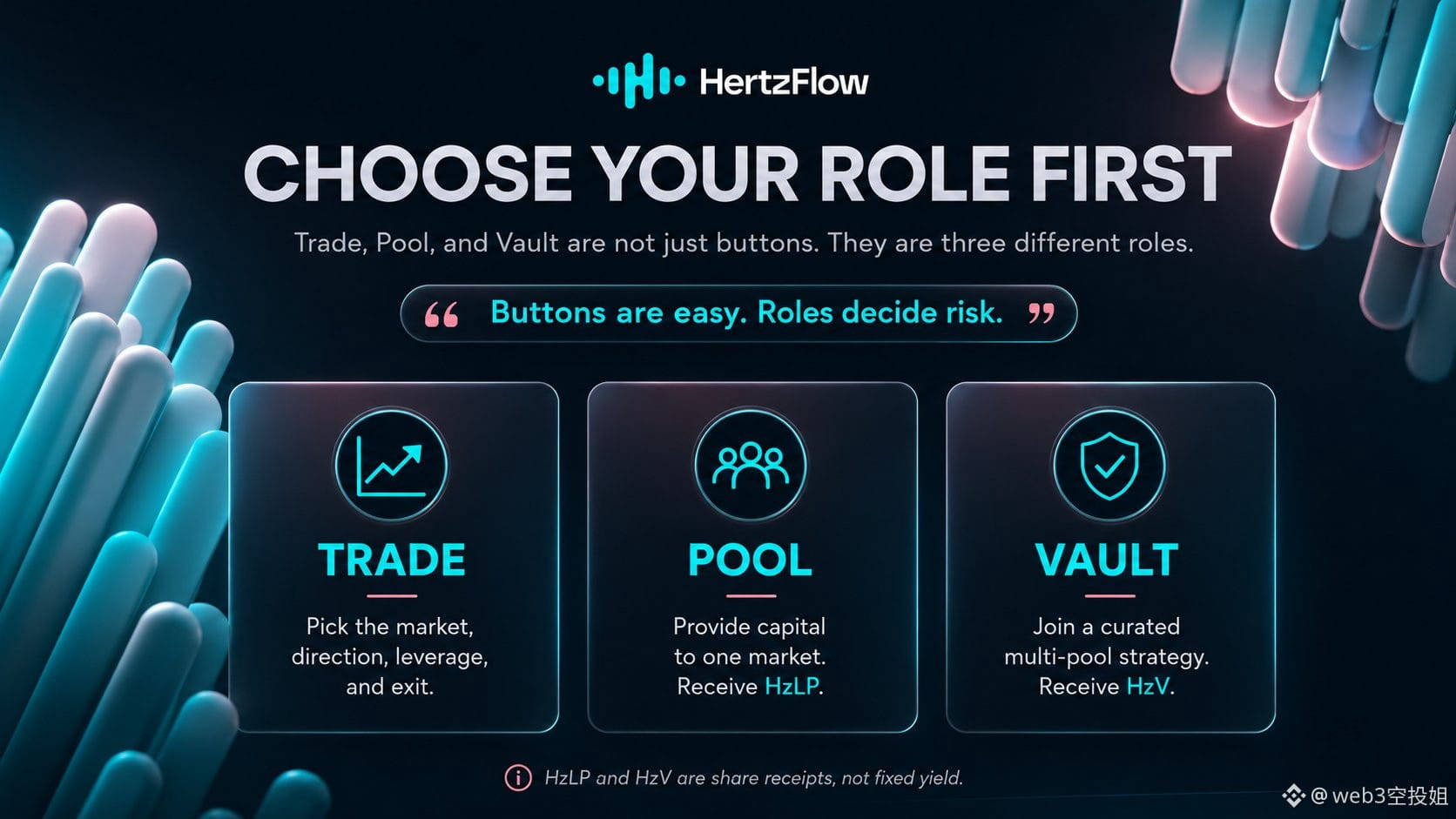
121
·
--
When the money is on Base, but the opportunity is on Solana.
What I hate isn’t slow bridges—it’s having to think things through yourself first: which chain to put the money on, whether you have enough gas, which bridge to use, and whether you’ll miss the moment.
Velvet @Velvet_Capital With this cross-chain update, it goes live on July 14. Users only need to specify what to sell and what to buy; the backend Meta Aggregator automatically handles routing, bridging, wrapping, and swapping—turning it into a single transaction.
In the July 15 update, it’s clearly stated that you can use assets on one chain to buy tokens on another chain, with gasless bridging completed entirely in the backend.
By July 21, Arbitrum spot is also added. You can cross directly from Solana, Base, BNB Chain, Ethereum, and Robinhood Chain.
The chains are still there, and costs and liquidity haven’t disappeared—but purchasing power is no longer being split. It feels like sitting back down at the same trading table. The best part about a product is how it makes you ask one less question: where do I need to be on which chain, first?
Going forward, I’ll pay closer attention to whether it’s possible to buy smoothly, whether costs are transparent enough, and whether there’s an early warning before a failure. If these three parts are made clear, it’s not just a matter of making bridging easier—it becomes a place where assets and opportunities can flow again.
When the money is on Base, but the opportunity is on Solana.
What I hate isn’t slow bridges—it’s having to think things through yourself first: which chain to put the money on, whether you have enough gas, which bridge to use, and whether you’ll miss the moment.
Velvet @Velvet_Capital With this cross-chain update, it goes live on July 14. Users only need to specify what to sell and what to buy; the backend Meta Aggregator automatically handles routing, bridging, wrapping, and swapping—turning it into a single transaction.
In the July 15 update, it’s clearly stated that you can use assets on one chain to buy tokens on another chain, with gasless bridging completed entirely in the backend.
By July 21, Arbitrum spot is also added. You can cross directly from Solana, Base, BNB Chain, Ethereum, and Robinhood Chain.
The chains are still there, and costs and liquidity haven’t disappeared—but purchasing power is no longer being split. It feels like sitting back down at the same trading table. The best part about a product is how it makes you ask one less question: where do I need to be on which chain, first?
Going forward, I’ll pay closer attention to whether it’s possible to buy smoothly, whether costs are transparent enough, and whether there’s an early warning before a failure. If these three parts are made clear, it’s not just a matter of making bridging easier—it becomes a place where assets and opportunities can flow again.
What I hate isn’t slow bridges—it’s having to think things through yourself first: which chain to put the money on, whether you have enough gas, which bridge to use, and whether you’ll miss the moment.
Velvet @Velvet_Capital With this cross-chain update, it goes live on July 14. Users only need to specify what to sell and what to buy; the backend Meta Aggregator automatically handles routing, bridging, wrapping, and swapping—turning it into a single transaction.
In the July 15 update, it’s clearly stated that you can use assets on one chain to buy tokens on another chain, with gasless bridging completed entirely in the backend.
By July 21, Arbitrum spot is also added. You can cross directly from Solana, Base, BNB Chain, Ethereum, and Robinhood Chain.
The chains are still there, and costs and liquidity haven’t disappeared—but purchasing power is no longer being split. It feels like sitting back down at the same trading table. The best part about a product is how it makes you ask one less question: where do I need to be on which chain, first?
Going forward, I’ll pay closer attention to whether it’s possible to buy smoothly, whether costs are transparent enough, and whether there’s an early warning before a failure. If these three parts are made clear, it’s not just a matter of making bridging easier—it becomes a place where assets and opportunities can flow again.
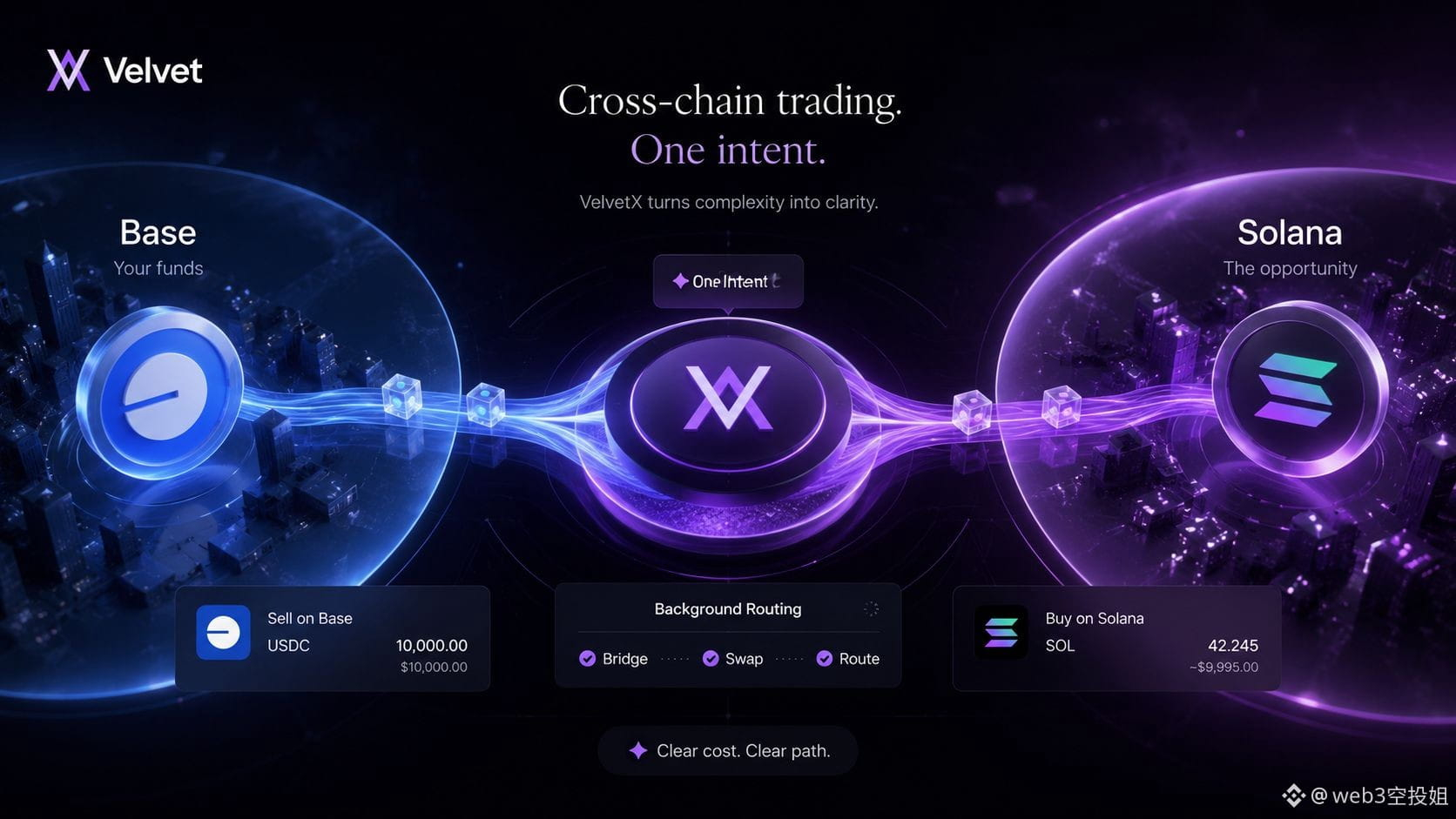
199
Log in to explore more content
Join global crypto users on Binance Square
⚡️ Get latest and useful information about crypto.
💬 Trusted by the world’s largest crypto exchange.
👍 Discover real insights from verified creators.
Email / Phone number