
CryptoLearnZA
41 Posts

CryptoLearnZA
Report
Block User
making crypto simple for everyone . Bitcoin. Blockchain. Crypto security 📚 learn smart. Research first . Avoid hype. building crypto knowledge , 1 post at a 🕘
4 Following
0 Followers
7 Liked
Posts
All
Quotes
CryptoLearnZA | Binance SquareWednesday Evening Lesson
Today's topic: What Are Blockchain Confirmations?
⛓️ **CRYPTO EDUCATION: What Are Blockchain Confirmations?**
Have you ever sent cryptocurrency and wondered why your transaction needs confirmations?
Let's break it down!
### 🔍 WHAT IS A BLOCKCHAIN CONFIRMATION?
A confirmation happens when a transaction is included in a block that gets added to the blockchain.
As more blocks are added after that block, the transaction receives more confirmations.
### 💡 WHY ARE CONFIRMATIONS IMPORTANT?
1️⃣ **Transaction Verification:** They show that a transaction has been included in the blockchain.
2️⃣ **Network Security:** Additional confirmations make it increasingly difficult to reverse a transaction.
3️⃣ **Exchange Deposits:** Some exchanges require a specific number of confirmations before crediting a deposit.
### 📌 SIMPLE EXAMPLE
If your transaction has 1 confirmation, it has been included in one block.
If it has 6 confirmations, six blocks have been added at or after the block containing your transaction.
Remember: Confirmation requirements vary between networks and exchanges.
### 🧠 TONIGHT'S QUIZ
What happens when a blockchain transaction receives more confirmations?
A. It becomes a new cryptocurrency.
B. It generally becomes harder to reverse.
C. Its transaction fee disappears.
D. It automatically becomes private.
👇 Drop your answer in the comments!
**CryptoLearnZA — Understand Crypto. Learn with Confidence.** 🖤💛
#CryptoLearnZA #BlockchainEducation
55
🔐 CRYPTO EDUCATION: HOT WALLETS VS COLD WALLETS — WHAT'S THE DIFFERENCE?
Did you know that crypto wallets can be classified according to how they connect to the internet?
Let's understand the two main types!
1️⃣ HOT WALLETS
Hot wallets are cryptocurrency wallets connected to the internet.
Examples include:
- Mobile crypto wallets
- Desktop wallets
- Browser wallets
Advantage: Convenient for regular transactions.
Risk: Online exposure can increase security risks.
2️⃣ COLD WALLETS
Cold wallets keep private keys offline.
Examples include:
- Hardware wallets
- Paper wallets
Advantage: Reduce exposure to online attacks.
Risk: They can still be lost, damaged or compromised through poor key management.
💡 WHAT'S THE MAIN DIFFERENCE?
Hot wallets prioritize convenient online access, while cold wallets prioritize keeping private keys offline.
Neither is automatically risk-free. Always protect your recovery phrase and verify transactions.
🧠 TONIGHT'S QUIZ
Which type of wallet keeps private keys offline?
A. Hot Wallet
B. Cold Wallet
C. Exchange Account
D. Browser Wallet
👇 Share your answer in the comments!
CryptoLearnZA — Understand Crypto. Learn with Confidence. 🖤💛
#CryptoLearnZA #CryptoSecurity
74
🔐 CRYPTO BASICS: What Is a Multisignature Wallet?
Did you know that some crypto wallets require approval from more than one person before a transaction can be completed?
This is called MULTISIGNATURE (MULTISIG)! 👇
📚 1. WHAT IS MULTISIG?
A multisignature wallet is a cryptocurrency wallet that requires multiple digital signatures to authorize a transaction.
⚙️ 2. HOW DOES IT WORK?
For example:
• A wallet may have 3 authorized signers.
• At least 2 signatures may be required.
• A transaction cannot proceed until the required approvals are received.
🛡️ 3. WHY IS IT USEFUL?
• Reduces dependence on one person's approval.
• Supports shared control of funds.
• Adds an extra layer of authorization.
💡 4. WHERE IS IT USED?
Multisig wallets can be useful for businesses, organizations and groups managing shared cryptocurrency funds.
⚠️ REMEMBER:
Multisig improves transaction control, but it does not eliminate every security risk. Proper setup and secure key management remain important.
🧠 TEST YOUR KNOWLEDGE:
In a 2-of-3 multisig wallet, how many signatures are required?
A. One
B. Two
C. Three
Drop your answer in the comments! 👇
Follow CryptoLearnZA for simple, practical crypto lessons.
#CryptoSecurity #CryptoEducation
CryptoLearnZA — Learn Today. Understand Tomorrow.
60
📚 CRYPTO LESSON: WHAT IS MARKET CAPITALIZATION (MARKET CAP)?
Have you ever wondered how people determine the overall size of a cryptocurrency?
One important metric they use is called Market Capitalization (Market Cap).
🔹 What is Market Cap?
Market capitalization is the total value of a cryptocurrency's circulating supply.
🔹 How is it calculated?
Market Cap = Current Coin Price × Circulating Supply
Example:
Imagine a cryptocurrency has:
Current price: $2
Circulating supply: 10 million coins
Market Cap = $2 × 10,000,000
Market Cap = $20 million
🔹 Why Does Market Cap Matter?
It helps investors understand the relative size of a cryptocurrency.
It allows comparisons between different cryptocurrencies.
It provides more context than looking at the price of a single coin.
It helps explain why a coin with a low price isn't necessarily cheap.
⚠️ Important Lesson:
A cryptocurrency priced at $0.01 is not automatically a better opportunity than one priced at $100.
Always consider market capitalization, circulating supply, demand and risks.
💡 Remember: A coin's price tells you how much one unit costs. Market cap tells you the total market value of its circulating supply.
Learn before you invest. Knowledge builds confidence.
What do you think matters more when evaluating a cryptocurrency: its price or its market capitalization?
#CryptoLearnZA #CryptoEducation #MarketCap #Cryptocurrency #Blockchain
56
🔄 CRYPTO EDUCATION: What Is a Decentralized Exchange (DEX)?
Have you ever wondered how people exchange cryptocurrencies without relying on a traditional central company to manage the exchange?
Let's learn about Decentralized Exchanges (DEXs)!
A DEX is a cryptocurrency exchange that allows users to trade directly through blockchain-based smart contracts.
🔍 HOW DOES A DEX WORK?
1. Connect Your Wallet: Users connect a compatible crypto wallet.
2. Choose Tokens: Select the cryptocurrencies they want to exchange.
3. Confirm the Transaction: Approve the transaction through the wallet.
4. Blockchain Processing: Smart contracts execute the exchange according to the platform's rules.
💡 DEX VS CENTRALIZED EXCHANGE
- DEX: Users generally retain control of their own wallets.
- CEX: A centralized company operates the exchange and may hold customer assets.
EXAMPLES OF DEX PLATFORMS
- Uniswap
- PancakeSwap
- Curve Finance
⚠️ IMPORTANT
DEXs also carry risks, including smart contract vulnerabilities, scams, token impersonation and transaction fees.
Always research a platform before interacting with it.
🧠 TODAY'S QUIZ
What does DEX stand for?
A. Digital Exchange System
B. Decentralized Exchange
C. Direct Electronic Transfer
D. Distributed External Service
👇 Share your answer in the comments!
CryptoLearnZA — Understand Crypto. Learn with Confidence. 🖤💛
#CryptoLearnZA #DeFi
59
🚀 CRYPTO EDUCATION: What Is Layer 2 in Blockchain Technology?
Have you ever wondered how blockchain networks can become faster and handle more transactions?
Let's talk about Layer 2 (L2)!
Layer 2 is a technology built on top of an existing blockchain (Layer 1) to help improve its scalability and transaction efficiency.
🔍 HOW DOES LAYER 2 WORK?
1. Layer 1: The main blockchain that provides the underlying security and settlement.
2. Layer 2: Processes transactions using additional systems built on top of the main blockchain.
3. Final Settlement: Depending on the design, transaction information or results are submitted to the main blockchain.
💡 WHY IS LAYER 2 IMPORTANT?
- Helps increase transaction capacity.
- Can reduce transaction costs.
- Can improve transaction speed.
- Helps blockchain networks support more users.
EXAMPLES OF LAYER 2 NETWORKS
- Arbitrum
- Optimism
- Base
Remember: Not every Layer 2 works the same way. Each network has its own technology, security assumptions and risks.
🧠 TODAY'S QUIZ
What is the main purpose of Layer 2 technology?
A. To replace all cryptocurrencies.
B. To improve blockchain scalability and efficiency.
C. To eliminate blockchain security.
D. To create unlimited Bitcoin.
👇 Drop your answer in the comments!
CryptoLearnZA — Understand Crypto. Learn with Confidence. 🖤💛
#CryptoLearnZA #BlockchainEducation
53
🔎 CRYPTO EDUCATION: What Is a Blockchain Explorer?
Did you know you can view and verify cryptocurrency transactions without accessing someone's wallet?
That's what a Blockchain Explorer allows you to do!
A blockchain explorer is a tool that lets users search and view publicly available blockchain information.
🔍 What Can You Find?
1. Transactions: Check transaction details and confirmation status.
2. Wallet Addresses: View publicly recorded transaction activity.
3. Blocks: Explore blocks added to the blockchain.
4. Network Activity: See how transactions are processed.
💡 Why Is It Important?
Blockchain explorers promote transparency by allowing users to independently verify publicly recorded transactions.
Remember: Public transaction information does not automatically reveal the real-world identity of a wallet owner.
🧠 TODAY'S QUIZ
What is the main purpose of a blockchain explorer?
A. To create cryptocurrency.
B. To view and verify blockchain information.
C. To recover forgotten passwords.
D. To guarantee profits.
👇 Share your answer in the comments!
CryptoLearnZA — Understand Crypto. Learn with Confidence. 🖤💛
#CryptoLearnZA #BlockchainEducation
81
🌐 CRYPTO EDUCATION: What Does Decentralization Mean?
Have you ever wondered why blockchain is described as decentralized?
Let's break it down!
Decentralization means that control and decision-making are distributed across multiple participants instead of being held by one central authority.
🔍 HOW DOES IT WORK?
1. Multiple Participants: Different computers (nodes) help maintain the blockchain network.
2. Shared Records: Participants can independently verify blockchain transactions.
3. No Single Controller: Public decentralized networks do not depend on one organization to control the entire system.
💡 WHY IS IT IMPORTANT?
Decentralization can improve transparency, reduce reliance on a single authority, and make networks more resilient.
However, not every cryptocurrency project is equally decentralized.
🧠 TONIGHT'S QUIZ:
What is the main idea behind decentralization?
A. One company controls everything.
B. Control is distributed among multiple participants.
C. Only banks can verify transactions.
D. All transactions are private.
👇 Drop your answer in the comments!
CryptoLearnZA — Understand Crypto. Learn with Confidence. 🖤💛
#CryptoLearnZA #BlockchainEducation
63
📚 CRYPTO BASICS: What Are Smart Contracts?
Did you know that some blockchain agreements can execute automatically without a middleman?
Let's understand Smart Contracts! 👇
🔹 1. WHAT ARE SMART CONTRACTS?
Smart contracts are programs stored on a blockchain that automatically execute when specific conditions are met.
🔹 2. HOW DO THEY WORK?
- Rules are written into computer code.
- The contract checks whether the required conditions are met.
- Once satisfied, the programmed action is executed.
🔹 3. WHERE ARE THEY USED?
Smart contracts are used in:
- Decentralized Finance (DeFi).
- NFT marketplaces.
- Blockchain-based applications.
- Digital agreements and services.
⚠️ 4. IMPORTANT TO KNOW
Smart contracts can contain coding errors or security weaknesses. Always research a project's security before interacting with it.
🧠 TEST YOUR KNOWLEDGE:
What makes a smart contract special?
A. It executes programmed actions when conditions are met.
B. It guarantees profits.
C. It replaces every traditional contract.
Drop your answer in the comments! 👇
Follow CryptoLearnZA for simple, practical cryptocurrency lessons.
#CryptoEducation #SmartContracts
CryptoLearnZA — Learn Today. Understand Tomorrow.
59
⚙️ CRYPTO EDUCATION: Proof of Work vs Proof of Stake — What's the Difference?
Did you know that blockchains use different methods to agree on which transactions are valid?
Two popular methods are Proof of Work (PoW) and Proof of Stake (PoS).
🔹 1. Proof of Work (PoW)
- Uses computational power to validate transactions.
- Miners compete to solve mathematical puzzles.
- Bitcoin uses this consensus mechanism.
🔹 2. Proof of Stake (PoS)
- Uses validators who stake cryptocurrency.
- Validators help propose and confirm blocks.
- Ethereum uses Proof of Stake.
💡 KEY DIFFERENCE:
Proof of Work relies on computational work, while Proof of Stake relies on staked assets and validator participation.
Both help blockchain networks reach agreement and maintain security.
🧠 TONIGHT'S QUIZ:
Which consensus mechanism does Bitcoin use?
A. Proof of Stake
B. Proof of Work
C. Both equally
D. Neither
👇 Drop your answer in the comments!
CryptoLearnZA — Understand Crypto. Learn with Confidence. 🖤💛
#CryptoLearnZA #BlockchainEducation
60
🔎 CRYPTO BASICS: What Is a Blockchain Explorer?
Did you know you can check cryptocurrency transactions without accessing someone's wallet?
That's possible through a Blockchain Explorer!
📚 1. WHAT IS A BLOCKCHAIN EXPLORER?
A blockchain explorer is an online tool that allows users to view publicly available blockchain information.
🔍 2. WHAT CAN YOU CHECK?
A blockchain explorer allows you to:
- View cryptocurrency transactions.
- Check wallet addresses and their publicly visible activity.
- Explore blocks recorded on the blockchain.
- Check transaction confirmations.
⚙️ 3. WHAT IS A TRANSACTION HASH?
A transaction hash (TXID) is a unique identifier assigned to a blockchain transaction. It helps you locate and track that transaction.
🛡️ 4. WHY IS IT USEFUL?
Blockchain explorers help users verify transaction information instead of relying only on screenshots or messages from other people.
⚠️ IMPORTANT TIP:
A transaction marked as pending has not yet received the required confirmation status. Always verify the transaction on the correct blockchain network.
🧠 TEST YOUR KNOWLEDGE:
What is the main purpose of a blockchain explorer?
A. To create cryptocurrency.
B. To view and track blockchain activity.
C. To predict crypto prices.
Drop your answer in the comments! 👇
Follow CryptoLearnZA for simple, practical cryptocurrency lessons.
#CryptoEducation #Blockchain
CryptoLearnZA — Learn Today. Understand Tomorrow.
70
🔎 CRYPTO EDUCATION: What Is a Transaction Hash (TXID)?
Have you ever sent cryptocurrency and wondered how you can track your transaction?
The answer is a Transaction Hash, also known as a TXID!
A transaction hash is a unique combination of letters and numbers assigned to a blockchain transaction.
💡 What Can You Do With It?
Track Transactions: Check whether a transaction is pending, confirmed or failed.
Verify Transfers: View transaction details on a blockchain explorer.
Check Details: See information such as the amount transferred, transaction time and wallet addresses.
🔐 Important to Remember
A transaction hash is public information. Sharing it does not give someone control over your cryptocurrency.
However, never share your private keys or seed phrase.
🧠 TONIGHT'S QUIZ
What is the main purpose of a transaction hash?
A. To recover a lost wallet.
B. To track and identify a blockchain transaction.
C. To create a private key.
D. To guarantee transaction profits.
👇 Drop your answer in the comments!
CryptoLearnZA — Understand Crypto. Learn with Confidence. 🖤💛
#CryptoLearnZA #BlockchainEducation
60
🔐 CRYPTO EDUCATION: What Is the Difference Between a Public Key and a Private Key?
If you use cryptocurrency, understanding these two terms is essential!
Let's make it simple.
1. Public Key
A public key is a cryptographic key that can be shared with others. It helps people verify information or derive a wallet address, depending on the blockchain.
2. Private Key
A private key is a secret cryptographic key that gives control over the associated crypto assets.
Never share your private key with anyone!
💡 Remember:
- Public key = Can be shared.
- Private key = Must remain secret.
Both are important parts of cryptocurrency security.
🧠 TONIGHT'S QUIZ
Which key must always remain private?
A. Public key
B. Private key
C. Both can be shared
D. Neither is important
👇 Drop your answer in the comments!
CryptoLearnZA — Understand Crypto. Learn with Confidence. 🖤💛
#CryptoLearnZA #CryptoSecurity
53
📚 CRYPTO BASICS: What Is a Public Key vs a Private Key?
Ever wondered how cryptocurrency wallets send and receive digital assets securely?
The answer starts with understanding two important terms: Public Keys and Private Keys.
🔑 1. WHAT IS A PUBLIC KEY?
A public key is a cryptographic key used in cryptocurrency systems to support functions such as verifying digital signatures.
It is associated with your wallet's public address.
🔐 2. WHAT IS A PRIVATE KEY?
A private key is a secret cryptographic key that gives control over the ability to authorize transactions from a wallet.
Anyone who obtains your private key may gain control over your funds.
⚡ 3. WHAT IS THE DIFFERENCE?
• Public key: Used in public cryptographic operations.
• Private key: Must remain secret and is used to authorize transactions.
🛡️ 4. IMPORTANT SECURITY RULES
- Never share your private key.
- Never send it to strangers claiming to offer support.
- Be careful with suspicious links and websites.
- Always protect your wallet recovery information.
💡 REMEMBER:
Your public information helps others interact with your wallet, but your private key must stay private.
🧠 TEST YOUR KNOWLEDGE:
Which key must NEVER be shared with anyone?
A. Public Key
B. Private Key
C. Both
Drop your answer in the comments! 👇
Follow CryptoLearnZA for simple, practical cryptocurrency lessons.
#CryptoEducation #CryptoSecurity
CryptoLearnZA — Learn Today. Understand Tomorrow.
69
🤖 WHAT IF AN AGREEMENT COULD EXECUTE ITSELF?
Welcome to the world of SMART CONTRACTS! ⛓️
A smart contract is a program stored on a blockchain that automatically executes when its programmed conditions are met.
Here's what you should know:
🔹 They can automate transactions.
🔹 They can power decentralized applications.
🔹 They're used in DeFi and NFT ecosystems.
🔹 Their execution follows programmed rules.
💡 Remember: Smart contracts aren't automatically safe. Coding errors and vulnerabilities can create serious risks.
The future of blockchain is about more than digital currencies. It's also about programmable technology!
📚 Follow CryptoLearnZA to understand crypto one lesson at a time.
#CryptoLearnZA #SmartContracts #Blockchain #DeFi #CryptoEducation
46
📚 CRYPTO BASICS: What Is Proof of Work vs Proof of Stake?
Ever wondered how a blockchain decides which transactions are valid without relying on a central authority?
Two important mechanisms help make this possible: Proof of Work (PoW) and Proof of Stake (PoS).
Let's understand the difference. 👇
1️⃣ Proof of Work (PoW)
* Uses computational power to help validate transactions.
* Miners compete to solve computational puzzles.
* Bitcoin uses Proof of Work.
* It requires significant computing resources.
2️⃣ Proof of Stake (PoS)
* Uses validators who lock up cryptocurrency as a stake.
* Validators help verify transactions and secure the network.
* Ethereum uses Proof of Stake.
* Validators can face penalties for certain forms of misconduct.
3️⃣ What's the Main Difference?
PoW relies on computational work, while PoS relies on staked assets and validator participation.
Both aim to help blockchain networks reach agreement, but they have different security models, costs and trade-offs.
⚠️ BEGINNER TIP
Proof of Work and Proof of Stake are not cryptocurrencies. They are blockchain consensus mechanisms.
🧠 TEST YOUR KNOWLEDGE
Which consensus mechanism does Bitcoin use?
A. Proof of Stake
B. Proof of Work
C. Smart Contract
Drop your answer in the comments! 👇
Follow CryptoLearnZA for simple, practical cryptocurrency lessons.
#CryptoEducation #Blockchain
CryptoLearnZA — Learn Today. Understand Tomorrow. 🚀
95
🔐 CRYPTO EDUCATION: What Is a Seed Phrase?
Your cryptocurrency wallet has something extremely important: a seed phrase.
But what exactly is it, and why should you protect it?
A seed phrase is a sequence of 12 or 24 words that can help you recover access to your crypto wallet.
3 Important Things to Know:
1. Wallet Recovery: Your seed phrase can restore access to a compatible wallet.
2. Keep It Private: Anyone who obtains your seed phrase may be able to access your funds.
3. Avoid Digital Exposure: Never share it through messages, emails or suspicious websites.
Remember: Your wallet password and seed phrase are not the same thing. Your password may unlock an app, while your seed phrase can provide access to the wallet itself.
🧠 TONIGHT'S QUIZ
What should you do if someone asks you to send them your wallet's seed phrase?
A. Send it immediately.
B. Share only half of it.
C. Never share it.
D. Post it online for safekeeping.
👇 Drop your answer in the comments!
CryptoLearnZA — Understand Crypto. Learn with Confidence. 🖤💛
#CryptoLearnZA #CryptoSecurity
61
Article
understanding how platforms work and what stable coins are🏦 WHAT IS A CRYPTO EXCHANGE? UNDERSTANDING HOW PLATFORMS LIKE BINANCE WORK
Have you ever wondered where people actually buy and sell cryptocurrencies?
The answer is often a cryptocurrency exchange.
A crypto exchange is a digital platform that allows users to buy, sell and trade cryptocurrencies.
Platforms such as Binance provide tools that make accessing cryptocurrency markets easier.
Let's understand how they work.
1. Buying cryptocurrency
Imagine you want to purchase Bitcoin (BTC).
You can use a supported payment method or trade another cryptocurrency for Bitcoin, depending on the platform's available services and your location.
The exchange facilitates the transaction.
2. Selling cryptocurrency
An exchange also allows users to sell their cryptocurrency.
For example, someone holding Ethereum (ETH) may place a sell order in exchange for another supported asset.
The final price depends on the available market and the order execution.
3. Understanding trading pairs
A trading pair shows which two assets are being exchanged.
Examples include:
- BTC/USDT
- ETH/USDT
- BNB/USDT
For example, BTC/USDT represents trading Bitcoin against Tether (USDT).
4. What are trading fees?
Crypto exchanges may charge fees for certain activities, including trading and withdrawals.
These fees can differ depending on the platform, transaction type and account conditions.
Always check the applicable fees before confirming a transaction.
5. Are crypto exchanges the same as wallets?
No. Although exchanges may provide wallet services, they are not exactly the same.
An exchange primarily facilitates buying, selling and trading.
A cryptocurrency wallet helps users manage access to their digital assets.
Some wallets provide self-custody, meaning users control their private keys.
6. Important risks to understand
Before using a cryptocurrency exchange, remember:
- Prices can change rapidly.
- Exchanges can experience technical problems.
- Platforms can face security risks.
- Withdrawal restrictions may apply.
- Not every cryptocurrency is available in every country.
Always research a platform before trusting it with your funds.
💡 FINAL LESSON
A cryptocurrency exchange is one of the important entry points into the crypto ecosystem.
But understanding how an exchange works is just as important as knowing how to trade.
Don't rush into cryptocurrency because of trends.
Learn the fundamentals first.
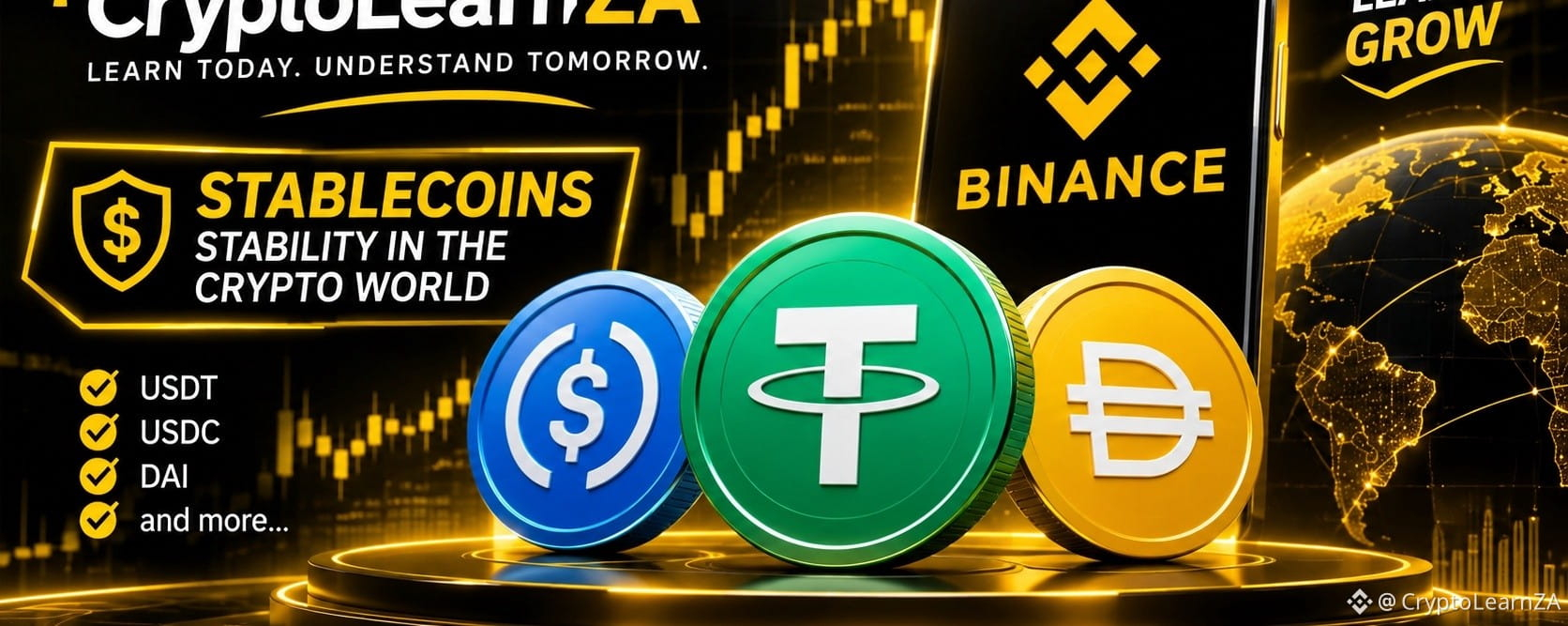
#CryptoLearnZA TABLECOINS MATTER IN CRYPTO?
Not every cryptocurrency is designed to experience the same price movements.
Meet STABLECOINS. 👇
Stablecoins are cryptocurrencies designed to maintain a relatively stable value, often by tracking a traditional currency like the US dollar.
Examples:
🔹 USDT (Tether)
🔹 USDC (USD Coin)
🔹 DAI
Why are they useful?
✅ Moving value within crypto markets.
✅ Making crypto payments.
✅ Providing a dollar-linked unit of account.
✅ Transferring funds between supported platforms.
⚠️ Important: Stablecoins are NOT risk-free. Their value, reserves, redemption arrangements and issuing structures matter.
📚 Don't just learn crypto prices. Understand the technology behind them.
Follow CryptoLearnZA for daily crypto education
understanding how platforms work and what stable coins are
🏦 WHAT IS A CRYPTO EXCHANGE? UNDERSTANDING HOW PLATFORMS LIKE BINANCE WORK
Have you ever wondered where people actually buy and sell cryptocurrencies?
The answer is often a cryptocurrency exchange.
A crypto exchange is a digital platform that allows users to buy, sell and trade cryptocurrencies.
Platforms such as Binance provide tools that make accessing cryptocurrency markets easier.
Let's understand how they work.
1. Buying cryptocurrency
Imagine you want to purchase Bitcoin (BTC).
You can use a supported payment method or trade another cryptocurrency for Bitcoin, depending on the platform's available services and your location.
The exchange facilitates the transaction.
2. Selling cryptocurrency
An exchange also allows users to sell their cryptocurrency.
For example, someone holding Ethereum (ETH) may place a sell order in exchange for another supported asset.
The final price depends on the available market and the order execution.
3. Understanding trading pairs
A trading pair shows which two assets are being exchanged.
Examples include:
- BTC/USDT
- ETH/USDT
- BNB/USDT
For example, BTC/USDT represents trading Bitcoin against Tether (USDT).
4. What are trading fees?
Crypto exchanges may charge fees for certain activities, including trading and withdrawals.
These fees can differ depending on the platform, transaction type and account conditions.
Always check the applicable fees before confirming a transaction.
5. Are crypto exchanges the same as wallets?
No. Although exchanges may provide wallet services, they are not exactly the same.
An exchange primarily facilitates buying, selling and trading.
A cryptocurrency wallet helps users manage access to their digital assets.
Some wallets provide self-custody, meaning users control their private keys.
6. Important risks to understand
Before using a cryptocurrency exchange, remember:
- Prices can change rapidly.
- Exchanges can experience technical problems.
- Platforms can face security risks.
- Withdrawal restrictions may apply.
- Not every cryptocurrency is available in every country.
Always research a platform before trusting it with your funds.
💡 FINAL LESSON
A cryptocurrency exchange is one of the important entry points into the crypto ecosystem.
But understanding how an exchange works is just as important as knowing how to trade.
Don't rush into cryptocurrency because of trends.
Learn the fundamentals first.
#CryptoLearnZA TABLECOINS MATTER IN CRYPTO?
Not every cryptocurrency is designed to experience the same price movements.
Meet STABLECOINS. 👇
Stablecoins are cryptocurrencies designed to maintain a relatively stable value, often by tracking a traditional currency like the US dollar.
Examples:
🔹 USDT (Tether)
🔹 USDC (USD Coin)
🔹 DAI
Why are they useful?
✅ Moving value within crypto markets.
✅ Making crypto payments.
✅ Providing a dollar-linked unit of account.
✅ Transferring funds between supported platforms.
⚠️ Important: Stablecoins are NOT risk-free. Their value, reserves, redemption arrangements and issuing structures matter.
📚 Don't just learn crypto prices. Understand the technology behind them.
Follow CryptoLearnZA for daily crypto education
2
🧠 CRYPTO MYTH VS FACT: Is Every Crypto Project Legitimate?
Not everything labelled cryptocurrency is trustworthy.
Before believing a crypto project or its promises, learn to investigate it.
Here are 4 things to check:
1. The Team: Is the development team identifiable and credible?
2. The Whitepaper: Does the project clearly explain its purpose and technology?
3. The Website: Are its claims transparent and verifiable?
4. Independent Research: What do reliable sources say about the project?
Remember: A professional-looking website, large online following or confident promises do not prove legitimacy.
Today's Question:
Which should you do before trusting a new crypto project?
A. Follow the hype.
B. Believe every advertisement.
C. Research the project independently.
D. Trust whoever promotes it.
👇 Drop your answer in the comments!
CryptoLearnZA — Understand Crypto. Learn with Confidence. 🖤💛
#CryptoLearnZA #CryptoEducation
1
48
CRYPTO EDUCATION: What Is Blockchain Technology, and Why Does It Matter? 🔗
Many people hear the word blockchain when discussing Bitcoin, Ethereum and other cryptocurrencies. But what exactly is blockchain?
Let's break it down.
1. Understanding blockchain
A blockchain is a digital record-keeping system that stores information in groups called blocks.
These blocks are connected in chronological order, forming a chain.
Each block generally contains:
- Transaction information.
- A timestamp or other block metadata.
- A cryptographic reference connecting it to the previous block.
2. How does it work?
Imagine Alice sends cryptocurrency to Bob.
1. Alice initiates a transaction.
2. The network checks whether the transaction is valid.
3. A valid transaction is included in a block.
4. The block is added to the blockchain through the network's consensus process.
5. The transaction becomes part of the blockchain's historical record.
3. Why is blockchain important?
Transparency: Public blockchains allow people to inspect transaction records.
Security: Cryptographic techniques help protect the integrity of records.
Decentralisation: Some blockchains operate across many independent participants rather than relying on one central administrator.
Traceability: Transactions can be followed through the blockchain.
4. Is blockchain the same as Bitcoin?
No!
Bitcoin is a cryptocurrency that uses blockchain technology.
Blockchain is the underlying technology, while Bitcoin is one application of it.
🧠 Today's knowledge test
Which statement best describes blockchain?
A. A digital currency used only for online shopping.
B. A connected sequence of blocks containing recorded information.
C. A bank account for storing cryptocurrency.
D. A trading application.
Drop your answer in the comments!
Let's build crypto knowledge one lesson at a time.
CryptoLearnZA — Understand Crypto. Learn with Confidence.
#CryptoLearnZA #Blockchain #CryptoEducation #BTC #Bitcoin #ETH #Ethereum
66
Log in to explore more content
Join global crypto users on Binance Square
⚡️ Get latest and useful information about crypto.
💬 Trusted by the world’s largest crypto exchange.
👍 Discover real insights from verified creators.
Email / Phone number
Trending Topics
BTCRemainsUnderPressureAfterHawkishFOMCMinutes
49,918 views
654 Discussing
FOMC Minutes | Fed Minutes Show Almost All Officials Expect More Rate Hikes, With Some Open to a Larger December Move
Binance News
·47 Likes
·56.8k views
AnthropicToDebutAfter$83IPOPricing
13,054 views
68 Discussing
NvidiaBoardReportedlySplitOverHuang’sReturn
16,403 views
269 Discussing