
数字春秋
631 Posts
 LIVE
LIVE数字春秋
Report
Block User
策略,交流;公众号:有亮星球
32 Following
1.9K+ Followers
440 Liked
Posts
All
Live
·
--
Cardano has plugged ADA into x402, hoping AI will foot the bill
Cardano has been moving fast these past few days. On one hand, it connected tens of thousands of Mastercard networks; on the other, it stuffed ADA into x402’s SDK—so once an AI agent is authorized, it can complete small payments directly.🤖
“x402” might still be unfamiliar, but the direction is easy to understand—it was originally designed as a protocol for “automated settlement between programs.” In the past, on-chain payments required human confirmation; now the goal is to let software settle the accounts on its own.
The backdrop is also interesting: the U.S. piece of crypto legislation is still stuck in the Senate, so this chain outright sidesteps regulatory uncertainty and instead finds a landing spot on the payments track first.
So here’s my question: when the one paying shifts from humans to AI agents, in this payments track, do you think it will genuinely take off in scenarios like this—or will it just stall at the concept stage again?
[👉 关注我,点击进入聊天室,学习更多策略](https://app.binance.com/uni-qr/Cgzj78Eq)
Cardano has plugged ADA into x402, hoping AI will foot the bill
Cardano has been moving fast these past few days. On one hand, it connected tens of thousands of Mastercard networks; on the other, it stuffed ADA into x402’s SDK—so once an AI agent is authorized, it can complete small payments directly.🤖
“x402” might still be unfamiliar, but the direction is easy to understand—it was originally designed as a protocol for “automated settlement between programs.” In the past, on-chain payments required human confirmation; now the goal is to let software settle the accounts on its own.
The backdrop is also interesting: the U.S. piece of crypto legislation is still stuck in the Senate, so this chain outright sidesteps regulatory uncertainty and instead finds a landing spot on the payments track first.
So here’s my question: when the one paying shifts from humans to AI agents, in this payments track, do you think it will genuinely take off in scenarios like this—or will it just stall at the concept stage again?
👉 关注我,点击进入聊天室,学习更多策略
Cardano has been moving fast these past few days. On one hand, it connected tens of thousands of Mastercard networks; on the other, it stuffed ADA into x402’s SDK—so once an AI agent is authorized, it can complete small payments directly.🤖
“x402” might still be unfamiliar, but the direction is easy to understand—it was originally designed as a protocol for “automated settlement between programs.” In the past, on-chain payments required human confirmation; now the goal is to let software settle the accounts on its own.
The backdrop is also interesting: the U.S. piece of crypto legislation is still stuck in the Senate, so this chain outright sidesteps regulatory uncertainty and instead finds a landing spot on the payments track first.
So here’s my question: when the one paying shifts from humans to AI agents, in this payments track, do you think it will genuinely take off in scenarios like this—or will it just stall at the concept stage again?
👉 关注我,点击进入聊天室,学习更多策略

103
·
--
Bitcoin has completely reclaimed the $80,000 mark
This round has pushed Bitcoin all the way up to $87,000 in one go, leaving the $80,000 threshold decisively behind, and it’s also basically marked new highs over the past eight months. 😮
What fell first wasn’t retail traders—it was the short sellers. Roughly $800 million worth of short positions were forcibly liquidated. Even more telling: the higher the price goes, the more leverage-built shorts are piled up around the $90,000 area, suggesting that a sizable portion of this upward momentum is coming from leverage.
Here’s another detail: before this move, Bitcoin spent some time consolidating below $80,000. Many buyers of spot funds were still sitting at an unrealized loss. Only this time did they finally get back above their cost basis.
So I keep thinking about one question: in this move—where $80,000 is first firmly stamped back underfoot, and then Bitcoin surges to $87,000—do you think fresh spot buying is really stepping in, or is this rally being blown up by leverage?
[👉 关注我,点击进入聊天室,学习更多策略](https://app.binance.com/uni-qr/Cgzj78Eq)
#比特币突破8万美元大关
Bitcoin has completely reclaimed the $80,000 mark
This round has pushed Bitcoin all the way up to $87,000 in one go, leaving the $80,000 threshold decisively behind, and it’s also basically marked new highs over the past eight months. 😮
What fell first wasn’t retail traders—it was the short sellers. Roughly $800 million worth of short positions were forcibly liquidated. Even more telling: the higher the price goes, the more leverage-built shorts are piled up around the $90,000 area, suggesting that a sizable portion of this upward momentum is coming from leverage.
Here’s another detail: before this move, Bitcoin spent some time consolidating below $80,000. Many buyers of spot funds were still sitting at an unrealized loss. Only this time did they finally get back above their cost basis.
So I keep thinking about one question: in this move—where $80,000 is first firmly stamped back underfoot, and then Bitcoin surges to $87,000—do you think fresh spot buying is really stepping in, or is this rally being blown up by leverage?
👉 关注我,点击进入聊天室,学习更多策略
#比特币突破8万美元大关
This round has pushed Bitcoin all the way up to $87,000 in one go, leaving the $80,000 threshold decisively behind, and it’s also basically marked new highs over the past eight months. 😮
What fell first wasn’t retail traders—it was the short sellers. Roughly $800 million worth of short positions were forcibly liquidated. Even more telling: the higher the price goes, the more leverage-built shorts are piled up around the $90,000 area, suggesting that a sizable portion of this upward momentum is coming from leverage.
Here’s another detail: before this move, Bitcoin spent some time consolidating below $80,000. Many buyers of spot funds were still sitting at an unrealized loss. Only this time did they finally get back above their cost basis.
So I keep thinking about one question: in this move—where $80,000 is first firmly stamped back underfoot, and then Bitcoin surges to $87,000—do you think fresh spot buying is really stepping in, or is this rally being blown up by leverage?
👉 关注我,点击进入聊天室,学习更多策略
#比特币突破8万美元大关

1.1k
·
--
After Circle, another one is trying to get institutions to “hold the coins and borrow money”
A few days ago, I wrote about Circle letting institutions use Bitcoin as collateral to borrow USDC.
Today I ran into GalaxyOne launching a multi-asset credit line: deposit the coins into custody and you don’t have to move them—you can borrow cash against the limit. 💸
When you connect these two things, the direction is actually very clear. It’s not about having large holders sell the coins they have. Instead, it’s about letting them keep holding the coins while getting the money in hand.
For the group that hoards coins long-term and leaves them untouched, this solves exactly the most awkward problem: they need cash urgently but don’t want to cut losses by selling at a low point.
What I care about more is the pace. Since the beginning of this year, these “borrow cash against coins” products have been popping up one after another, which shows that the demand to borrow is real. The channels for lending are also opening wider and wider. As for whether this is a good thing or a hidden risk, we probably won’t be able to tell until the next round of sharp volatility.
So let me ask this: as this “borrow money against coins” route keeps getting broader, do you think it’s quietly adding leverage to the market—or giving long-term holders more exit options?
[👉 关注我,点击进入聊天室,学习更多策略](https://app.binance.com/uni-qr/Cgzj78Eq)
#circle推出机构比特币抵押借贷
After Circle, another one is trying to get institutions to “hold the coins and borrow money”
A few days ago, I wrote about Circle letting institutions use Bitcoin as collateral to borrow USDC.
Today I ran into GalaxyOne launching a multi-asset credit line: deposit the coins into custody and you don’t have to move them—you can borrow cash against the limit. 💸
When you connect these two things, the direction is actually very clear. It’s not about having large holders sell the coins they have. Instead, it’s about letting them keep holding the coins while getting the money in hand.
For the group that hoards coins long-term and leaves them untouched, this solves exactly the most awkward problem: they need cash urgently but don’t want to cut losses by selling at a low point.
What I care about more is the pace. Since the beginning of this year, these “borrow cash against coins” products have been popping up one after another, which shows that the demand to borrow is real. The channels for lending are also opening wider and wider. As for whether this is a good thing or a hidden risk, we probably won’t be able to tell until the next round of sharp volatility.
So let me ask this: as this “borrow money against coins” route keeps getting broader, do you think it’s quietly adding leverage to the market—or giving long-term holders more exit options?
👉 关注我,点击进入聊天室,学习更多策略
#circle推出机构比特币抵押借贷
A few days ago, I wrote about Circle letting institutions use Bitcoin as collateral to borrow USDC.
Today I ran into GalaxyOne launching a multi-asset credit line: deposit the coins into custody and you don’t have to move them—you can borrow cash against the limit. 💸
When you connect these two things, the direction is actually very clear. It’s not about having large holders sell the coins they have. Instead, it’s about letting them keep holding the coins while getting the money in hand.
For the group that hoards coins long-term and leaves them untouched, this solves exactly the most awkward problem: they need cash urgently but don’t want to cut losses by selling at a low point.
What I care about more is the pace. Since the beginning of this year, these “borrow cash against coins” products have been popping up one after another, which shows that the demand to borrow is real. The channels for lending are also opening wider and wider. As for whether this is a good thing or a hidden risk, we probably won’t be able to tell until the next round of sharp volatility.
So let me ask this: as this “borrow money against coins” route keeps getting broader, do you think it’s quietly adding leverage to the market—or giving long-term holders more exit options?
👉 关注我,点击进入聊天室,学习更多策略
#circle推出机构比特币抵押借贷

286
·
--
A public blockchain was hacked. The plan is to roll the ledger back to before the attack.
I saw a MultiversX announcement, and my first reaction was: the mainnet is down.
The reason is that the attacker targeted an “atomicity” vulnerability in the virtual machine, writing a batch of states onto the chain that shouldn’t exist. Instead of just patching and rebooting, the team is preparing to carry out a “coordinated hard fork”—restart the chain from a checkpoint that has been confirmed safe. In effect, it’s rolling the ledger back by a segment. 🧐
Current progress: internal testing is done, the mainnet checkpoint is also ready. Next, they still need to bring validators and exchanges together to conduct testnet drills. The announcement repeatedly reminds users: the mainnet is still down—don’t broadcast transactions, and don’t use exchanges or cross-chain bridges for deposits/withdrawals.
Fixing the code and recording the rollback are two different things. The patch addresses how it should run going forward; the rollback concerns the segment that has already been written to the ledger. The former is an engineering issue, while the latter is more like setting rules for the chain.
So I want to ask: when it comes to this kind of “rewind” done to recover losses, would you rather treat it as an emergency measure, or as a precedent that shouldn’t be set?
[👉 关注我,点击进入聊天室,学习更多策略](https://app.binance.com/uni-qr/Cgzj78Eq)
#multiversx计划协调硬分叉恢复
A public blockchain was hacked. The plan is to roll the ledger back to before the attack.
I saw a MultiversX announcement, and my first reaction was: the mainnet is down.
The reason is that the attacker targeted an “atomicity” vulnerability in the virtual machine, writing a batch of states onto the chain that shouldn’t exist. Instead of just patching and rebooting, the team is preparing to carry out a “coordinated hard fork”—restart the chain from a checkpoint that has been confirmed safe. In effect, it’s rolling the ledger back by a segment. 🧐
Current progress: internal testing is done, the mainnet checkpoint is also ready. Next, they still need to bring validators and exchanges together to conduct testnet drills. The announcement repeatedly reminds users: the mainnet is still down—don’t broadcast transactions, and don’t use exchanges or cross-chain bridges for deposits/withdrawals.
Fixing the code and recording the rollback are two different things. The patch addresses how it should run going forward; the rollback concerns the segment that has already been written to the ledger. The former is an engineering issue, while the latter is more like setting rules for the chain.
So I want to ask: when it comes to this kind of “rewind” done to recover losses, would you rather treat it as an emergency measure, or as a precedent that shouldn’t be set?
👉 关注我,点击进入聊天室,学习更多策略
#multiversx计划协调硬分叉恢复
I saw a MultiversX announcement, and my first reaction was: the mainnet is down.
The reason is that the attacker targeted an “atomicity” vulnerability in the virtual machine, writing a batch of states onto the chain that shouldn’t exist. Instead of just patching and rebooting, the team is preparing to carry out a “coordinated hard fork”—restart the chain from a checkpoint that has been confirmed safe. In effect, it’s rolling the ledger back by a segment. 🧐
Current progress: internal testing is done, the mainnet checkpoint is also ready. Next, they still need to bring validators and exchanges together to conduct testnet drills. The announcement repeatedly reminds users: the mainnet is still down—don’t broadcast transactions, and don’t use exchanges or cross-chain bridges for deposits/withdrawals.
Fixing the code and recording the rollback are two different things. The patch addresses how it should run going forward; the rollback concerns the segment that has already been written to the ledger. The former is an engineering issue, while the latter is more like setting rules for the chain.
So I want to ask: when it comes to this kind of “rewind” done to recover losses, would you rather treat it as an emergency measure, or as a precedent that shouldn’t be set?
👉 关注我,点击进入聊天室,学习更多策略
#multiversx计划协调硬分叉恢复

869
·
--
Solana didn’t shout slogans, yet its ranking jumped from 62 to 7
There’s a rather quiet signal: in an industry ranking list, Solana moved from #62 to #7. The reason wasn’t price—it was "technology upgrades + institutional use".
Viewed together, its moves over the past few weeks have indeed been intensive: it has pushed the block production target all the way down to 250 milliseconds, and renewed attention from spot ETF fund inflows is also on the rise. When the price rockets, nobody talks about these—but what actually props up the ranking is exactly this 📈
I’m curious: when a chain climbs because it’s "used by institutions" rather than "hyped by retail investors," is this kind of climb the same as one that surges purely on sentiment?
[👉 关注我,点击进入聊天室,学习更多策略](https://app.binance.com/uni-qr/Cgzj78Eq)
#solana目标出块时间降至250毫秒
Solana didn’t shout slogans, yet its ranking jumped from 62 to 7
There’s a rather quiet signal: in an industry ranking list, Solana moved from #62 to #7. The reason wasn’t price—it was "technology upgrades + institutional use".
Viewed together, its moves over the past few weeks have indeed been intensive: it has pushed the block production target all the way down to 250 milliseconds, and renewed attention from spot ETF fund inflows is also on the rise. When the price rockets, nobody talks about these—but what actually props up the ranking is exactly this 📈
I’m curious: when a chain climbs because it’s "used by institutions" rather than "hyped by retail investors," is this kind of climb the same as one that surges purely on sentiment?
👉 关注我,点击进入聊天室,学习更多策略
#solana目标出块时间降至250毫秒
There’s a rather quiet signal: in an industry ranking list, Solana moved from #62 to #7. The reason wasn’t price—it was "technology upgrades + institutional use".
Viewed together, its moves over the past few weeks have indeed been intensive: it has pushed the block production target all the way down to 250 milliseconds, and renewed attention from spot ETF fund inflows is also on the rise. When the price rockets, nobody talks about these—but what actually props up the ranking is exactly this 📈
I’m curious: when a chain climbs because it’s "used by institutions" rather than "hyped by retail investors," is this kind of climb the same as one that surges purely on sentiment?
👉 关注我,点击进入聊天室,学习更多策略
#solana目标出块时间降至250毫秒

2
3.3k
·
--
Ether has just cleared 2700. Two giant whales moved money in on the same day
As the price just broke above 2700, two wallets appeared on-chain, and at nearly the same time, they together moved in $106 million.
Notice: this isn’t buying crypto—it’s directly transferring money into the network. Two large transfers land at the same time point; it’s hard to say it’s a coincidence 🐋
What I’m curious about is: as soon as the price started to rise, the big money was "already there"—who saw something early, or is this another round of the collective getting on after guessing the top?
[👉 关注我,点击进入聊天室,学习更多策略](https://app.binance.com/uni-qr/Cgzj78Eq)
#以太坊突破2700美元
Ether has just cleared 2700. Two giant whales moved money in on the same day
As the price just broke above 2700, two wallets appeared on-chain, and at nearly the same time, they together moved in $106 million.
Notice: this isn’t buying crypto—it’s directly transferring money into the network. Two large transfers land at the same time point; it’s hard to say it’s a coincidence 🐋
What I’m curious about is: as soon as the price started to rise, the big money was "already there"—who saw something early, or is this another round of the collective getting on after guessing the top?
👉 关注我,点击进入聊天室,学习更多策略
#以太坊突破2700美元
As the price just broke above 2700, two wallets appeared on-chain, and at nearly the same time, they together moved in $106 million.
Notice: this isn’t buying crypto—it’s directly transferring money into the network. Two large transfers land at the same time point; it’s hard to say it’s a coincidence 🐋
What I’m curious about is: as soon as the price started to rise, the big money was "already there"—who saw something early, or is this another round of the collective getting on after guessing the top?
👉 关注我,点击进入聊天室,学习更多策略
#以太坊突破2700美元
5.9k
·
--
Verified
The central bank is preparing to step in and start buying tokenized bonds on the chain
There’s a detail that’s easy to overlook: Europe is saying that next, it will use its own money to buy tokenized bonds through the newly launched settlement system.
This isn’t the same thing as “building a matching settlement channel.” The people laying the road now have to get in the car and drive it themselves—effectively putting the central bank’s money directly into the pool of on-chain assets. And this workflow has nothing to do with the digital euro regular people use; it’s purely an institutional track 🏦
What I’m curious about is: when a central bank shifts from being a “provider of the pipeline” to a “buyer inside the pipeline,” can the future prices of these on-chain bonds still be determined only by the market?
[👉 关注我,点击进入聊天室,学习更多策略](https://app.binance.com/uni-qr/Cgzj78Eq)
#欧洲央行启动区块链欧元结算
The central bank is preparing to step in and start buying tokenized bonds on the chain
There’s a detail that’s easy to overlook: Europe is saying that next, it will use its own money to buy tokenized bonds through the newly launched settlement system.
This isn’t the same thing as “building a matching settlement channel.” The people laying the road now have to get in the car and drive it themselves—effectively putting the central bank’s money directly into the pool of on-chain assets. And this workflow has nothing to do with the digital euro regular people use; it’s purely an institutional track 🏦
What I’m curious about is: when a central bank shifts from being a “provider of the pipeline” to a “buyer inside the pipeline,” can the future prices of these on-chain bonds still be determined only by the market?
👉 关注我,点击进入聊天室,学习更多策略
#欧洲央行启动区块链欧元结算
There’s a detail that’s easy to overlook: Europe is saying that next, it will use its own money to buy tokenized bonds through the newly launched settlement system.
This isn’t the same thing as “building a matching settlement channel.” The people laying the road now have to get in the car and drive it themselves—effectively putting the central bank’s money directly into the pool of on-chain assets. And this workflow has nothing to do with the digital euro regular people use; it’s purely an institutional track 🏦
What I’m curious about is: when a central bank shifts from being a “provider of the pipeline” to a “buyer inside the pipeline,” can the future prices of these on-chain bonds still be determined only by the market?
👉 关注我,点击进入聊天室,学习更多策略
#欧洲央行启动区块链欧元结算

1.1k
·
--
Big Pancake Head climbed back to 85,000 the first time; this time it was moved up by institutions, step by step
Today it has returned above 85,000—first time since January. The price isn’t exactly fresh; where the money comes from is the key. Over there in the U.S., a few whales that buy crypto saw a net inflow of $435 million on the day, and one of them accounted for $310 million.
The last time it reached this level was in January. This time, the driving force has changed—it’s been pushed up through incremental limit orders being submitted one by one 📈
What I’m curious about is: when the price keeps getting propped up day by day by these daily subscription orders, on the day it truly tops out, who will run first—the people watching the candlestick chart, or the people watching the inflow table?
[👉 关注我,点击进入聊天室,学习更多策略](https://app.binance.com/uni-qr/Cgzj78Eq)
#比特币突破8.5万美元
Big Pancake Head climbed back to 85,000 the first time; this time it was moved up by institutions, step by step
Today it has returned above 85,000—first time since January. The price isn’t exactly fresh; where the money comes from is the key. Over there in the U.S., a few whales that buy crypto saw a net inflow of $435 million on the day, and one of them accounted for $310 million.
The last time it reached this level was in January. This time, the driving force has changed—it’s been pushed up through incremental limit orders being submitted one by one 📈
What I’m curious about is: when the price keeps getting propped up day by day by these daily subscription orders, on the day it truly tops out, who will run first—the people watching the candlestick chart, or the people watching the inflow table?
👉 关注我,点击进入聊天室,学习更多策略
#比特币突破8.5万美元
Today it has returned above 85,000—first time since January. The price isn’t exactly fresh; where the money comes from is the key. Over there in the U.S., a few whales that buy crypto saw a net inflow of $435 million on the day, and one of them accounted for $310 million.
The last time it reached this level was in January. This time, the driving force has changed—it’s been pushed up through incremental limit orders being submitted one by one 📈
What I’m curious about is: when the price keeps getting propped up day by day by these daily subscription orders, on the day it truly tops out, who will run first—the people watching the candlestick chart, or the people watching the inflow table?
👉 关注我,点击进入聊天室,学习更多策略
#比特币突破8.5万美元
3.1k
·
--
Strategy bought and swept 950 large pancakes, but what I bought the most aggressively today isn’t it
Strategy paused for two weeks. Today it came back and bought 950 coins, about $76 million, bringing its holdings to 846,000 coins. On paper, this is its home game.
At the same time, Strive bought 1,355 in a single order—about $108 million—more than Strategy. The stock price rose 6% that day. Put the two together, and in one day they poured roughly $183 million in. It’s exactly while the pancake is reclaiming 85,000 🏦
What I’m curious about is: as “who buys more” slowly overtakes “who buys earlier,” in this coin-hoarding competition, are they competing on belief—or on who’s more afraid of missing out?
[👉 关注我,点击进入聊天室,学习更多策略](https://app.binance.com/uni-qr/Cgzj78Eq)
#michaelsaylor暗示增持btc
Strategy bought and swept 950 large pancakes, but what I bought the most aggressively today isn’t it
Strategy paused for two weeks. Today it came back and bought 950 coins, about $76 million, bringing its holdings to 846,000 coins. On paper, this is its home game.
At the same time, Strive bought 1,355 in a single order—about $108 million—more than Strategy. The stock price rose 6% that day. Put the two together, and in one day they poured roughly $183 million in. It’s exactly while the pancake is reclaiming 85,000 🏦
What I’m curious about is: as “who buys more” slowly overtakes “who buys earlier,” in this coin-hoarding competition, are they competing on belief—or on who’s more afraid of missing out?
👉 关注我,点击进入聊天室,学习更多策略
#michaelsaylor暗示增持btc
Strategy paused for two weeks. Today it came back and bought 950 coins, about $76 million, bringing its holdings to 846,000 coins. On paper, this is its home game.
At the same time, Strive bought 1,355 in a single order—about $108 million—more than Strategy. The stock price rose 6% that day. Put the two together, and in one day they poured roughly $183 million in. It’s exactly while the pancake is reclaiming 85,000 🏦
What I’m curious about is: as “who buys more” slowly overtakes “who buys earlier,” in this coin-hoarding competition, are they competing on belief—or on who’s more afraid of missing out?
👉 关注我,点击进入聊天室,学习更多策略
#michaelsaylor暗示增持btc

145
·
--
Verified
99.4% of people voted to shut their own mainchain
The ZetaChain community just made a pretty tough decision. Proposal 68 passed with 99.4%: native ZETA migrates to Solana as an SPL token, and it begins shutting down its own Layer 1. Voter turnout was 58%, with only 0.3% voting against 🚪
It’s not common in crypto for a project to personally shut down its own mainchain. The reasons aren’t hard to guess either: maintaining an L1 is expensive, and liquidity is too fragmented—so it’s better to move assets directly to where there are more users. But this vote only sets the “direction.” How the migration will be carried out, and when the chain will actually stop, will need another round of voting.
What I’m curious about is: once “shutting down your own chain and moving to someone else’s place” becomes an option, who will be next?
[👉 关注我,点击进入聊天室,学习更多策略](https://app.binance.com/uni-qr/Cgzj78Eq)
#zetachain投票批准zeta迁移至solana
99.4% of people voted to shut their own mainchain
The ZetaChain community just made a pretty tough decision. Proposal 68 passed with 99.4%: native ZETA migrates to Solana as an SPL token, and it begins shutting down its own Layer 1. Voter turnout was 58%, with only 0.3% voting against 🚪
It’s not common in crypto for a project to personally shut down its own mainchain. The reasons aren’t hard to guess either: maintaining an L1 is expensive, and liquidity is too fragmented—so it’s better to move assets directly to where there are more users. But this vote only sets the “direction.” How the migration will be carried out, and when the chain will actually stop, will need another round of voting.
What I’m curious about is: once “shutting down your own chain and moving to someone else’s place” becomes an option, who will be next?
👉 关注我,点击进入聊天室,学习更多策略
#zetachain投票批准zeta迁移至solana
The ZetaChain community just made a pretty tough decision. Proposal 68 passed with 99.4%: native ZETA migrates to Solana as an SPL token, and it begins shutting down its own Layer 1. Voter turnout was 58%, with only 0.3% voting against 🚪
It’s not common in crypto for a project to personally shut down its own mainchain. The reasons aren’t hard to guess either: maintaining an L1 is expensive, and liquidity is too fragmented—so it’s better to move assets directly to where there are more users. But this vote only sets the “direction.” How the migration will be carried out, and when the chain will actually stop, will need another round of voting.
What I’m curious about is: once “shutting down your own chain and moving to someone else’s place” becomes an option, who will be next?
👉 关注我,点击进入聊天室,学习更多策略
#zetachain投票批准zeta迁移至solana

1
3.3k
·
--
Verified
NEAR has surged nearly 80% in a week—this time it’s not just following the BTC (big coin) run
Tonight I checked the market—NEAR is already around $4.3. In seven days it’s close to +80%, and in 24 hours it’s up 22%, far stronger than the benchmark index’s 6%. At first I thought this was just another broad-market rally. Then I looked into the reasons.
Last week, near.com made deposits and withdrawals for perpetual contracts the default privacy setting, so it’s now hard to match on-chain activity to any specific trading account. On the other side, total trading volume on NEAR Intents has also reached about $29.3 billion.
So what’s really being bought is the layer on top of it—the business of cross-chain transfers while also wiping away traces of trades. The narrative is definitely easy to sell, and it feels a bit familiar 👀
What I’m curious about is this: when “untraceable trading” becomes the default setting, is this a genuine demand this time—or just another story packaged for retail investors?
[👉 关注我,点击进入聊天室,学习更多策略](https://app.binance.com/uni-qr/Cgzj78Eq)
#near一周涨近80%
NEAR has surged nearly 80% in a week—this time it’s not just following the BTC (big coin) run
Tonight I checked the market—NEAR is already around $4.3. In seven days it’s close to +80%, and in 24 hours it’s up 22%, far stronger than the benchmark index’s 6%. At first I thought this was just another broad-market rally. Then I looked into the reasons.
Last week, near.com made deposits and withdrawals for perpetual contracts the default privacy setting, so it’s now hard to match on-chain activity to any specific trading account. On the other side, total trading volume on NEAR Intents has also reached about $29.3 billion.
So what’s really being bought is the layer on top of it—the business of cross-chain transfers while also wiping away traces of trades. The narrative is definitely easy to sell, and it feels a bit familiar 👀
What I’m curious about is this: when “untraceable trading” becomes the default setting, is this a genuine demand this time—or just another story packaged for retail investors?
👉 关注我,点击进入聊天室,学习更多策略
#near一周涨近80%
Tonight I checked the market—NEAR is already around $4.3. In seven days it’s close to +80%, and in 24 hours it’s up 22%, far stronger than the benchmark index’s 6%. At first I thought this was just another broad-market rally. Then I looked into the reasons.
Last week, near.com made deposits and withdrawals for perpetual contracts the default privacy setting, so it’s now hard to match on-chain activity to any specific trading account. On the other side, total trading volume on NEAR Intents has also reached about $29.3 billion.
So what’s really being bought is the layer on top of it—the business of cross-chain transfers while also wiping away traces of trades. The narrative is definitely easy to sell, and it feels a bit familiar 👀
What I’m curious about is this: when “untraceable trading” becomes the default setting, is this a genuine demand this time—or just another story packaged for retail investors?
👉 关注我,点击进入聊天室,学习更多策略
#near一周涨近80%

3.9k
·
--
Verified
Institutions can now get loans using big-slice pancakes as collateral without having to sell.
Today, Circle launched a new service: institutions can use Bitcoin as collateral to borrow USDC. The process isn’t complicated—first, swap BTC for its own cirBTC (1:1 wrapping), then stake it as collateral. The loan is handled by lending protocols like Morpho, and afterward it will also connect to Aave. Custody is handled by Circle National Trust, and the chain used is its own Arc along with Ethereum.
My first reaction: this is basically opening another door for institutions that don’t want to sell their coins. Previously, if they needed cash, they had to sell; now they can borrow while keeping the coins by pledging them as collateral. With today’s BTC price topping 85,000 and everyone rushing to buy, the timing feels especially delicate 🏦
What I’m curious about is: when “borrowing money while holding coins” becomes a standard operation, will market sell-pressure truly decrease, or will it just push leverage a few months further out?
[👉 关注我,点击进入聊天室,学习更多策略](https://app.binance.com/uni-qr/Cgzj78Eq)
#circle推出机构比特币抵押借贷
Institutions can now get loans using big-slice pancakes as collateral without having to sell.
Today, Circle launched a new service: institutions can use Bitcoin as collateral to borrow USDC. The process isn’t complicated—first, swap BTC for its own cirBTC (1:1 wrapping), then stake it as collateral. The loan is handled by lending protocols like Morpho, and afterward it will also connect to Aave. Custody is handled by Circle National Trust, and the chain used is its own Arc along with Ethereum.
My first reaction: this is basically opening another door for institutions that don’t want to sell their coins. Previously, if they needed cash, they had to sell; now they can borrow while keeping the coins by pledging them as collateral. With today’s BTC price topping 85,000 and everyone rushing to buy, the timing feels especially delicate 🏦
What I’m curious about is: when “borrowing money while holding coins” becomes a standard operation, will market sell-pressure truly decrease, or will it just push leverage a few months further out?
👉 关注我,点击进入聊天室,学习更多策略
#circle推出机构比特币抵押借贷
Today, Circle launched a new service: institutions can use Bitcoin as collateral to borrow USDC. The process isn’t complicated—first, swap BTC for its own cirBTC (1:1 wrapping), then stake it as collateral. The loan is handled by lending protocols like Morpho, and afterward it will also connect to Aave. Custody is handled by Circle National Trust, and the chain used is its own Arc along with Ethereum.
My first reaction: this is basically opening another door for institutions that don’t want to sell their coins. Previously, if they needed cash, they had to sell; now they can borrow while keeping the coins by pledging them as collateral. With today’s BTC price topping 85,000 and everyone rushing to buy, the timing feels especially delicate 🏦
What I’m curious about is: when “borrowing money while holding coins” becomes a standard operation, will market sell-pressure truly decrease, or will it just push leverage a few months further out?
👉 关注我,点击进入聊天室,学习更多策略
#circle推出机构比特币抵押借贷
4.3k
·
--
Verified
The European Central Bank has launched a settlement platform today—this time, it didn’t go through stablecoins
The European Central Bank (9/21) officially launched a platform called Pontes, which allows eligible institutions to settle tokenized assets directly using “central bank money.” It integrates a distributed ledger into the euro system’s TARGET settlement system. The positioning is stated very clearly: in addition to adding stablecoins for wholesale settlement, it provides another option.
The other track is the retail version of the digital euro, which won’t start piloting until the second half of 2027. So what’s being rolled out first is not a wallet for ordinary people, but a pipeline for institutions 🏦
What I’m curious about is this: once the central bank itself holds onto the settlement channel, how much room remains for a business model that “earns by taking the settlement spread” by using stablecoins afterward?
[👉 关注我,点击进入聊天室,学习更多策略](https://app.binance.com/uni-qr/Cgzj78Eq)
#欧洲央行启动区块链欧元结算
The European Central Bank has launched a settlement platform today—this time, it didn’t go through stablecoins
The European Central Bank (9/21) officially launched a platform called Pontes, which allows eligible institutions to settle tokenized assets directly using “central bank money.” It integrates a distributed ledger into the euro system’s TARGET settlement system. The positioning is stated very clearly: in addition to adding stablecoins for wholesale settlement, it provides another option.
The other track is the retail version of the digital euro, which won’t start piloting until the second half of 2027. So what’s being rolled out first is not a wallet for ordinary people, but a pipeline for institutions 🏦
What I’m curious about is this: once the central bank itself holds onto the settlement channel, how much room remains for a business model that “earns by taking the settlement spread” by using stablecoins afterward?
👉 关注我,点击进入聊天室,学习更多策略
#欧洲央行启动区块链欧元结算
The European Central Bank (9/21) officially launched a platform called Pontes, which allows eligible institutions to settle tokenized assets directly using “central bank money.” It integrates a distributed ledger into the euro system’s TARGET settlement system. The positioning is stated very clearly: in addition to adding stablecoins for wholesale settlement, it provides another option.
The other track is the retail version of the digital euro, which won’t start piloting until the second half of 2027. So what’s being rolled out first is not a wallet for ordinary people, but a pipeline for institutions 🏦
What I’m curious about is this: once the central bank itself holds onto the settlement channel, how much room remains for a business model that “earns by taking the settlement spread” by using stablecoins afterward?
👉 关注我,点击进入聊天室,学习更多策略
#欧洲央行启动区块链欧元结算

1
2.3k
·
--
The Big Pie is back at 85,000, but I went to check 86,000 first
On Monday, the Big Pie surged all the way to $85,248 in one go—first time since the end of January. That’s an eight-month high. The weekend weekly chart also closed at $81,120. In the past 24 hours, shorts were wiped out for more than $600 million—plenty of action on the screen 👀
But what really made me pause wasn’t 85,000—it was 86,000. The average cost basis line of holders of U.S. spot ETFs sits roughly around there. If the price creeps up a bit more, it won’t be the shorts who are first to breathe easier. It will be the batch of people who bought the dip at the high level a few months back—those who are only just now getting back to breakeven.
So I’m curious: when it truly reaches that line, who will hit the sell button first—the shorts, or this group of just-breakeven buyers?
[👉 关注我,点击进入聊天室,学习更多策略](https://app.binance.com/uni-qr/Cgzj78Eq)
#比特币突破8.5万美元
The Big Pie is back at 85,000, but I went to check 86,000 first
On Monday, the Big Pie surged all the way to $85,248 in one go—first time since the end of January. That’s an eight-month high. The weekend weekly chart also closed at $81,120. In the past 24 hours, shorts were wiped out for more than $600 million—plenty of action on the screen 👀
But what really made me pause wasn’t 85,000—it was 86,000. The average cost basis line of holders of U.S. spot ETFs sits roughly around there. If the price creeps up a bit more, it won’t be the shorts who are first to breathe easier. It will be the batch of people who bought the dip at the high level a few months back—those who are only just now getting back to breakeven.
So I’m curious: when it truly reaches that line, who will hit the sell button first—the shorts, or this group of just-breakeven buyers?
👉 关注我,点击进入聊天室,学习更多策略
#比特币突破8.5万美元
On Monday, the Big Pie surged all the way to $85,248 in one go—first time since the end of January. That’s an eight-month high. The weekend weekly chart also closed at $81,120. In the past 24 hours, shorts were wiped out for more than $600 million—plenty of action on the screen 👀
But what really made me pause wasn’t 85,000—it was 86,000. The average cost basis line of holders of U.S. spot ETFs sits roughly around there. If the price creeps up a bit more, it won’t be the shorts who are first to breathe easier. It will be the batch of people who bought the dip at the high level a few months back—those who are only just now getting back to breakeven.
So I’m curious: when it truly reaches that line, who will hit the sell button first—the shorts, or this group of just-breakeven buyers?
👉 关注我,点击进入聊天室,学习更多策略
#比特币突破8.5万美元

2
1
13.9k
·
--
There’s an unknown giant whale that swapped all the big-bread (BTC) into Ether—instantly locked it up.
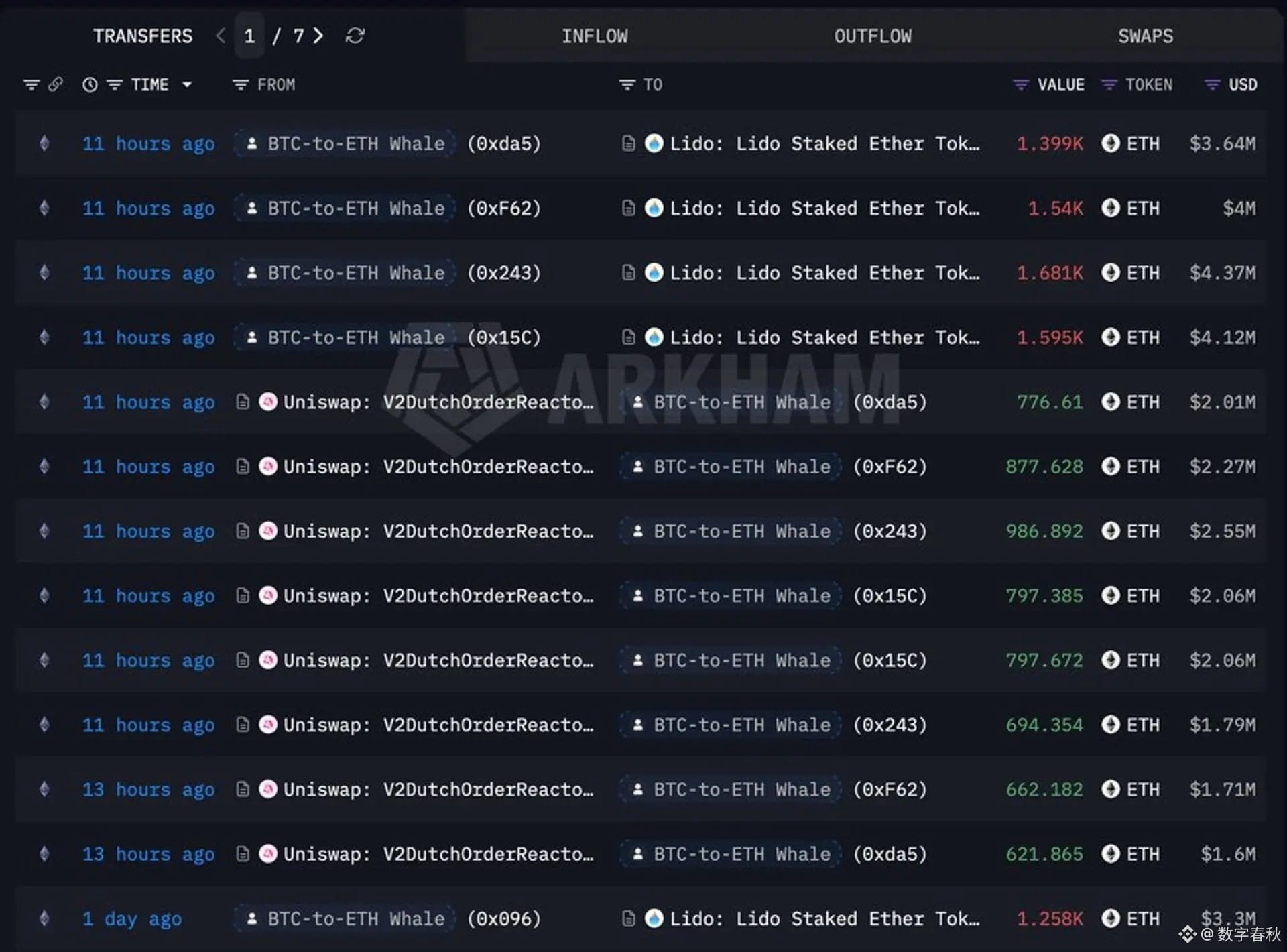
I came across some interesting on-chain data: over the past five days, an anonymous address sold 1,107 BTC (about $87 million), swapped it for 34,422 ETH, and then staked almost all of it.
What really caught my attention is the nature of the action—selling BTC for ETH can be understood as repositioning. But “just stake everything” isn’t something you do casually. Staking means locking funds for a period of time so you can’t withdraw them; it’s essentially handing over liquidity on purpose.
Capital willing to do this usually isn’t aiming for one or two days—it’s watching for Ether’s relative strength over the coming period.
Of course, that anonymous whale could also be a fund reorganizing its holdings—or even part of a pre-designed narrative. With a single piece of on-chain data, never treat it as the only evidence.
Question for you: with this “sell BTC, buy ETH, and fully stake” move, do you think it’s genuinely bullish on ETH—or is it just another position performance staged for the market? 🤔
[👉 关注我,点击进入聊天室,学习更多策略](https://app.binance.com/uni-qr/Cgzj78Eq)
There’s an unknown giant whale that swapped all the big-bread (BTC) into Ether—instantly locked it up.
I came across some interesting on-chain data: over the past five days, an anonymous address sold 1,107 BTC (about $87 million), swapped it for 34,422 ETH, and then staked almost all of it.
What really caught my attention is the nature of the action—selling BTC for ETH can be understood as repositioning. But “just stake everything” isn’t something you do casually. Staking means locking funds for a period of time so you can’t withdraw them; it’s essentially handing over liquidity on purpose.
Capital willing to do this usually isn’t aiming for one or two days—it’s watching for Ether’s relative strength over the coming period.
Of course, that anonymous whale could also be a fund reorganizing its holdings—or even part of a pre-designed narrative. With a single piece of on-chain data, never treat it as the only evidence.
Question for you: with this “sell BTC, buy ETH, and fully stake” move, do you think it’s genuinely bullish on ETH—or is it just another position performance staged for the market? 🤔
👉 关注我,点击进入聊天室,学习更多策略
I came across some interesting on-chain data: over the past five days, an anonymous address sold 1,107 BTC (about $87 million), swapped it for 34,422 ETH, and then staked almost all of it.
What really caught my attention is the nature of the action—selling BTC for ETH can be understood as repositioning. But “just stake everything” isn’t something you do casually. Staking means locking funds for a period of time so you can’t withdraw them; it’s essentially handing over liquidity on purpose.
Capital willing to do this usually isn’t aiming for one or two days—it’s watching for Ether’s relative strength over the coming period.
Of course, that anonymous whale could also be a fund reorganizing its holdings—or even part of a pre-designed narrative. With a single piece of on-chain data, never treat it as the only evidence.
Question for you: with this “sell BTC, buy ETH, and fully stake” move, do you think it’s genuinely bullish on ETH—or is it just another position performance staged for the market? 🤔
👉 关注我,点击进入聊天室,学习更多策略
2.1k
·
--
Verified
Rate hikes to a 31-year high—but the yen is falling instead, down to a level that may need to be "rescued"
Last Friday, the Bank of Japan raised its policy rate to 1.25%, the highest level in 31 years. In the old script, the yen should get a breather.
Instead, over the past few days it has been hovering above 157— not only has it not risen, concerns about intervention have resurfaced.
I think there’s a crucial mismatch here: the market has already priced in this rate hike, and what’s really weighing on the yen is the thick wall of interest-rate differentials between the US and Japan. As long as carry trades remain profitable, the yen lacks an engine that can self-correct.
For anyone trading risk assets, this isn’t just an FX issue—once the yen is forced to a point where the central bank truly has to act, the kind of "sudden liquidity withdrawal" stampede often spills over into the entire market.
Question for you: with this round of the yen saying “hike and still not up,” do you think it’s only temporarily blunted—or that carry trades really are reaching the moment they need to wrap up?🤔
[👉 关注我,点击进入聊天室,学习更多策略](https://app.binance.com/uni-qr/Cgzj78Eq)
#日本央行加息至31年高位
Rate hikes to a 31-year high—but the yen is falling instead, down to a level that may need to be "rescued"
Last Friday, the Bank of Japan raised its policy rate to 1.25%, the highest level in 31 years. In the old script, the yen should get a breather.
Instead, over the past few days it has been hovering above 157— not only has it not risen, concerns about intervention have resurfaced.
I think there’s a crucial mismatch here: the market has already priced in this rate hike, and what’s really weighing on the yen is the thick wall of interest-rate differentials between the US and Japan. As long as carry trades remain profitable, the yen lacks an engine that can self-correct.
For anyone trading risk assets, this isn’t just an FX issue—once the yen is forced to a point where the central bank truly has to act, the kind of "sudden liquidity withdrawal" stampede often spills over into the entire market.
Question for you: with this round of the yen saying “hike and still not up,” do you think it’s only temporarily blunted—or that carry trades really are reaching the moment they need to wrap up?🤔
👉 关注我,点击进入聊天室,学习更多策略
#日本央行加息至31年高位
Last Friday, the Bank of Japan raised its policy rate to 1.25%, the highest level in 31 years. In the old script, the yen should get a breather.
Instead, over the past few days it has been hovering above 157— not only has it not risen, concerns about intervention have resurfaced.
I think there’s a crucial mismatch here: the market has already priced in this rate hike, and what’s really weighing on the yen is the thick wall of interest-rate differentials between the US and Japan. As long as carry trades remain profitable, the yen lacks an engine that can self-correct.
For anyone trading risk assets, this isn’t just an FX issue—once the yen is forced to a point where the central bank truly has to act, the kind of "sudden liquidity withdrawal" stampede often spills over into the entire market.
Question for you: with this round of the yen saying “hike and still not up,” do you think it’s only temporarily blunted—or that carry trades really are reaching the moment they need to wrap up?🤔
👉 关注我,点击进入聊天室,学习更多策略
#日本央行加息至31年高位
1.8k
·
--
South Africa puts crypto under foreign exchange controls, pausing investments of more than 2 billion rand
I saw a post: South Africa plans to directly bring crypto assets into its foreign exchange control framework, and even in the draft it wants to limit companies from making cross-border stablecoin transfers. In plain terms, from now on, any such cross-border actions will have to clear an extra hurdle of foreign exchange rules first.
The impact is already here—local exchange VALR says that investments of about more than 2 billion rand have been put on hold specifically because of these proposed rules. Luno and VALR have both publicly warned that if things are regulated this way, business, jobs, and even tax revenue could end up being pushed overseas.
My take is that in many emerging markets, attitudes toward crypto are shifting from “whether to regulate” to “how to regulate it using the existing old tools.” Foreign exchange controls are a heavy-handed force. Once they’re put on, crypto’s “easy cross-border move at the drop of a hat” attribute is essentially taken away by half.
For local exchanges and companies doing cross-border business, this is probably the hardest kind of regulation to deal with: it doesn’t outright ban you—it makes every step slower and more expensive.
Question for you: If emerging markets use foreign exchange controls to manage crypto, do you think it’s a necessary line of defense—or will it instead push users toward gray channels that are even harder to regulate? 🧊
[👉 关注我,点击进入聊天室,学习更多策略](https://app.binance.com/uni-qr/Cgzj78Eq)
#南非拟将加密纳入外汇管制
South Africa puts crypto under foreign exchange controls, pausing investments of more than 2 billion rand
I saw a post: South Africa plans to directly bring crypto assets into its foreign exchange control framework, and even in the draft it wants to limit companies from making cross-border stablecoin transfers. In plain terms, from now on, any such cross-border actions will have to clear an extra hurdle of foreign exchange rules first.
The impact is already here—local exchange VALR says that investments of about more than 2 billion rand have been put on hold specifically because of these proposed rules. Luno and VALR have both publicly warned that if things are regulated this way, business, jobs, and even tax revenue could end up being pushed overseas.
My take is that in many emerging markets, attitudes toward crypto are shifting from “whether to regulate” to “how to regulate it using the existing old tools.” Foreign exchange controls are a heavy-handed force. Once they’re put on, crypto’s “easy cross-border move at the drop of a hat” attribute is essentially taken away by half.
For local exchanges and companies doing cross-border business, this is probably the hardest kind of regulation to deal with: it doesn’t outright ban you—it makes every step slower and more expensive.
Question for you: If emerging markets use foreign exchange controls to manage crypto, do you think it’s a necessary line of defense—or will it instead push users toward gray channels that are even harder to regulate? 🧊
👉 关注我,点击进入聊天室,学习更多策略
#南非拟将加密纳入外汇管制
I saw a post: South Africa plans to directly bring crypto assets into its foreign exchange control framework, and even in the draft it wants to limit companies from making cross-border stablecoin transfers. In plain terms, from now on, any such cross-border actions will have to clear an extra hurdle of foreign exchange rules first.
The impact is already here—local exchange VALR says that investments of about more than 2 billion rand have been put on hold specifically because of these proposed rules. Luno and VALR have both publicly warned that if things are regulated this way, business, jobs, and even tax revenue could end up being pushed overseas.
My take is that in many emerging markets, attitudes toward crypto are shifting from “whether to regulate” to “how to regulate it using the existing old tools.” Foreign exchange controls are a heavy-handed force. Once they’re put on, crypto’s “easy cross-border move at the drop of a hat” attribute is essentially taken away by half.
For local exchanges and companies doing cross-border business, this is probably the hardest kind of regulation to deal with: it doesn’t outright ban you—it makes every step slower and more expensive.
Question for you: If emerging markets use foreign exchange controls to manage crypto, do you think it’s a necessary line of defense—or will it instead push users toward gray channels that are even harder to regulate? 🧊
👉 关注我,点击进入聊天室,学习更多策略
#南非拟将加密纳入外汇管制

2.4k
·
--
Verified
Solana sped up the heartbeat by 17%, but some people are worried it might start to jitter
I came across a post: Solana reduced its target block production time from 300 milliseconds to 250 milliseconds—meaning its “heartbeat” is 17% faster, and it doesn’t plan to use this to expand capacity.
The official explanation is that it’s to help the network update faster and deliver a smoother experience. But some analysts are pouring cold water: the faster blocks are produced, the less buffer there is for nodes to sync and verify, and in extreme market conditions it could actually be more prone to jitter—possibly even brief instability.
As for price, things are heating up first. SOL pushed above $114 today, up nearly 6% over the past 24 hours, and hit a 7-month high.
My take: this kind of “speed-up” is definitely a selling point in the short term; long term, we have to see whether those extra few dozen milliseconds are truly absorbed by real demand—or just show up as numbers on a performance leaderboard.
Question for you: with this reduction in Solana’s block time, do you think it’s a real, tangible experience upgrade—or just another marketing move trading speed for a story? 🤔
[👉 关注我,点击进入聊天室,学习更多策略](https://app.binance.com/uni-qr/Cgzj78Eq)
#solana目标出块时间降至250毫秒
Solana sped up the heartbeat by 17%, but some people are worried it might start to jitter
I came across a post: Solana reduced its target block production time from 300 milliseconds to 250 milliseconds—meaning its “heartbeat” is 17% faster, and it doesn’t plan to use this to expand capacity.
The official explanation is that it’s to help the network update faster and deliver a smoother experience. But some analysts are pouring cold water: the faster blocks are produced, the less buffer there is for nodes to sync and verify, and in extreme market conditions it could actually be more prone to jitter—possibly even brief instability.
As for price, things are heating up first. SOL pushed above $114 today, up nearly 6% over the past 24 hours, and hit a 7-month high.
My take: this kind of “speed-up” is definitely a selling point in the short term; long term, we have to see whether those extra few dozen milliseconds are truly absorbed by real demand—or just show up as numbers on a performance leaderboard.
Question for you: with this reduction in Solana’s block time, do you think it’s a real, tangible experience upgrade—or just another marketing move trading speed for a story? 🤔
👉 关注我,点击进入聊天室,学习更多策略
#solana目标出块时间降至250毫秒
I came across a post: Solana reduced its target block production time from 300 milliseconds to 250 milliseconds—meaning its “heartbeat” is 17% faster, and it doesn’t plan to use this to expand capacity.
The official explanation is that it’s to help the network update faster and deliver a smoother experience. But some analysts are pouring cold water: the faster blocks are produced, the less buffer there is for nodes to sync and verify, and in extreme market conditions it could actually be more prone to jitter—possibly even brief instability.
As for price, things are heating up first. SOL pushed above $114 today, up nearly 6% over the past 24 hours, and hit a 7-month high.
My take: this kind of “speed-up” is definitely a selling point in the short term; long term, we have to see whether those extra few dozen milliseconds are truly absorbed by real demand—or just show up as numbers on a performance leaderboard.
Question for you: with this reduction in Solana’s block time, do you think it’s a real, tangible experience upgrade—or just another marketing move trading speed for a story? 🤔
👉 关注我,点击进入聊天室,学习更多策略
#solana目标出块时间降至250毫秒
1
1
3
9.2k
·
--
Big PoC weekly chart: for the first time in ten months, it has crossed a key moving average line
I saw one touch point: the PoC’s weekly chart has closed above the 50-week moving average for the first time in ten months. In plain language—after more than a year of downward trend, this is the first time it’s been genuinely broken through.
The data is pretty interesting. Someone went back and reviewed every time since 2011 that it “regained the 50-week moving average.” There have been 13 times in total; in 11 of those cases, after the market moved, it never made a new low again. In bear markets, this line is more like a ceiling. And once price truly gets above it, it often marks the beginning of a trend reversal.
Right now, PoC is hovering around $81,700. It’s up nearly 6% for the week, and the 50-week moving average is roughly around $78,000.
Of course, history isn’t a guarantee. The last time this line misled people was those two times from late 2021 to early 2022—the moment it went above, it slid back down after just a few days.
Here’s the question for you: this time it’s back above the 50-week moving average—do you think the bear market is really over, or is it another “looks very convincing” false signal? 🤔
[👉 关注我,点击进入聊天室,学习更多策略](https://app.binance.com/uni-qr/Cgzj78Eq)
Big PoC weekly chart: for the first time in ten months, it has crossed a key moving average line
I saw one touch point: the PoC’s weekly chart has closed above the 50-week moving average for the first time in ten months. In plain language—after more than a year of downward trend, this is the first time it’s been genuinely broken through.
The data is pretty interesting. Someone went back and reviewed every time since 2011 that it “regained the 50-week moving average.” There have been 13 times in total; in 11 of those cases, after the market moved, it never made a new low again. In bear markets, this line is more like a ceiling. And once price truly gets above it, it often marks the beginning of a trend reversal.
Right now, PoC is hovering around $81,700. It’s up nearly 6% for the week, and the 50-week moving average is roughly around $78,000.
Of course, history isn’t a guarantee. The last time this line misled people was those two times from late 2021 to early 2022—the moment it went above, it slid back down after just a few days.
Here’s the question for you: this time it’s back above the 50-week moving average—do you think the bear market is really over, or is it another “looks very convincing” false signal? 🤔
👉 关注我,点击进入聊天室,学习更多策略
I saw one touch point: the PoC’s weekly chart has closed above the 50-week moving average for the first time in ten months. In plain language—after more than a year of downward trend, this is the first time it’s been genuinely broken through.
The data is pretty interesting. Someone went back and reviewed every time since 2011 that it “regained the 50-week moving average.” There have been 13 times in total; in 11 of those cases, after the market moved, it never made a new low again. In bear markets, this line is more like a ceiling. And once price truly gets above it, it often marks the beginning of a trend reversal.
Right now, PoC is hovering around $81,700. It’s up nearly 6% for the week, and the 50-week moving average is roughly around $78,000.
Of course, history isn’t a guarantee. The last time this line misled people was those two times from late 2021 to early 2022—the moment it went above, it slid back down after just a few days.
Here’s the question for you: this time it’s back above the 50-week moving average—do you think the bear market is really over, or is it another “looks very convincing” false signal? 🤔
👉 关注我,点击进入聊天室,学习更多策略
1
2.1k
Log in to explore more content
Join global crypto users on Binance Square
⚡️ Get latest and useful information about crypto.
💬 Trusted by the world’s largest crypto exchange.
👍 Discover real insights from verified creators.
Email / Phone number
Trending Topics
NEARRisesNearly80%InAWeek
26,833 views
744 Discussing
#nearrisesnearly80%inaweek
🚨 NEAR RALLIES NEARLY 80% IN ONE WEEK
NEAR Protocol’s native token has delivered a major weekly move, gaining roughly 78% over the past seven days and trading around $4.29 on September 21, according to reported CoinGecko data.
📊 WHAT’S DRIVING THE ATTENTION?
• NEAR climbed from roughly $2.20 to above $4.20 within about a week
• NEAR Intents cumulative volume is approaching $30B
• Recent activity around confidential perpetual-futures trading has added another major narrative around the ecosystem
• NEAR’s weekly performance has significantly outpaced the broader crypto market, which gained around 6% over the same period
🔎 WHY IT MATTERS
The rally puts renewed focus on NEAR’s cross-chain liquidity infrastructure, Intents ecosystem and privacy-focused trading developments.
But after such a rapid move, volatility and profit-taking are also important risks to watch. A strong weekly gain does not guarantee that momentum will continue.
📌 WATCH NEXT
Traders may be watching whether NEAR can maintain the recent breakout and whether network activity continues to support the market narrative.
NEAR’s price move is strong — but the next test is whether ecosystem activity can keep pace with the speculation.
$MUBARAK $PHA $NIL
顾清妍
·2 Likes
·1.6k views
MultiversXPlansHardForkRecovery
24,086 views
566 Discussing
CircleLaunchesInstitutionalBTCBackedBorrowing
24,039 views
685 Discussing