

Shyline
901 Posts

Shyline
Report
Block User
觀察各種數據
Open Trade
Frequent Trader
5.7 Years
88 Following
170 Followers
385 Liked
Posts
Portfolio
All
Quotes
PINNED
·
--
Bearish
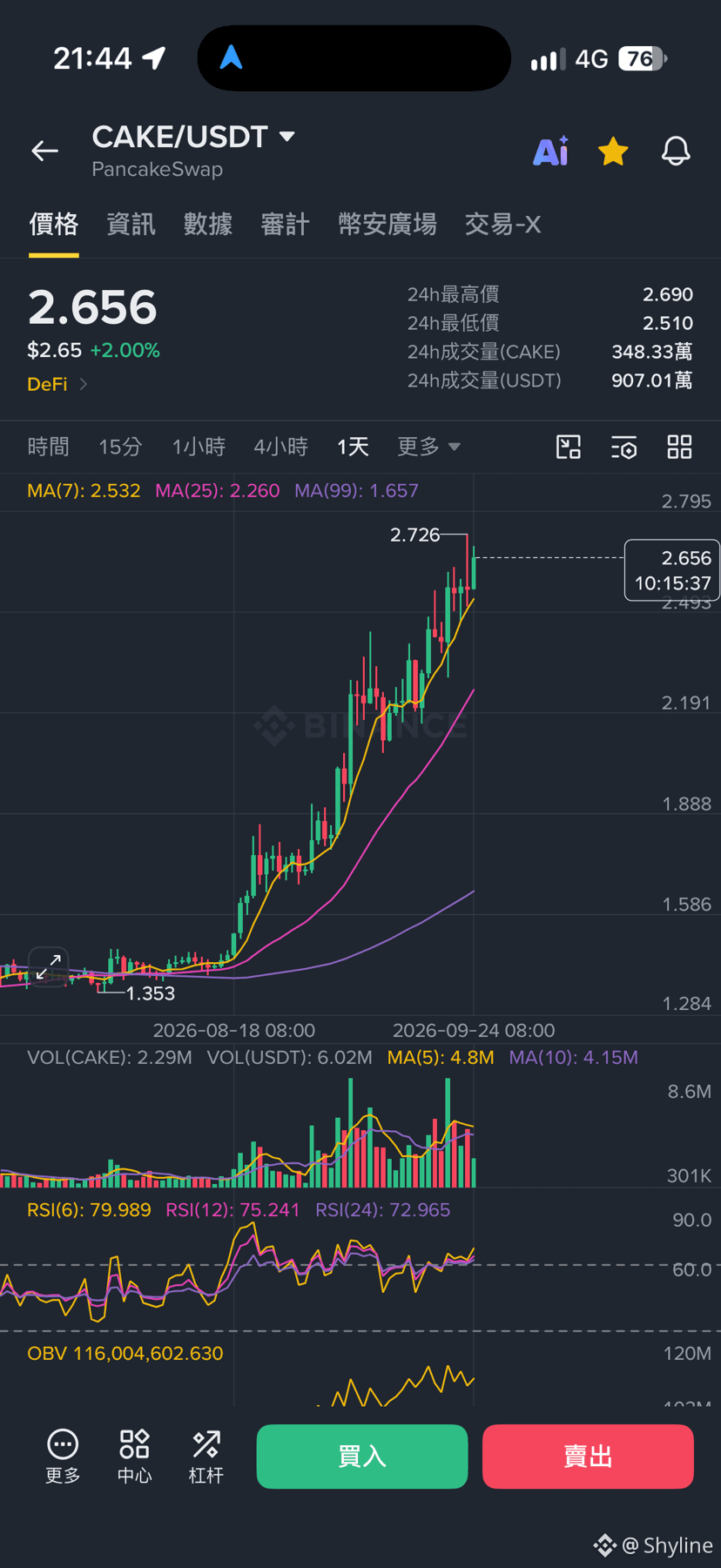
$CAKE Once it breaks below the ma25, you can start shorting.
This wave has been following the rise $UNI .
It is predicted that future liquidity on Binance Chain will gradually move to Uniswap.
$CAKE Once it breaks below the ma25, you can start shorting.
This wave has been following the rise $UNI .
It is predicted that future liquidity on Binance Chain will gradually move to Uniswap.
This wave has been following the rise $UNI .
It is predicted that future liquidity on Binance Chain will gradually move to Uniswap.
2
1
1.7k
·
--
Bullish
$BTC The wind is rising
If you wait too long, you'll definitely get blown out —
Those who didn’t get on the train, buy in now
$BTC The wind is rising
If you wait too long, you'll definitely get blown out —
Those who didn’t get on the train, buy in now
If you wait too long, you'll definitely get blown out —
Those who didn’t get on the train, buy in now
123
·
--
Bullish
$QNT High-level sideways consolidation is still very strong
$QNT High-level sideways consolidation is still very strong
419
·
--
Bullish
$HYPE Destroying is kind of intense
This is totally going head-to-head with Binance
Buy a little to protect yourself
$HYPE Destroying is kind of intense
This is totally going head-to-head with Binance
Buy a little to protect yourself
This is totally going head-to-head with Binance
Buy a little to protect yourself
166
·
--
Bearish
$MOVR Monitor the abnormal coins sector
Before removal, seize the timing and ride a wave
Look for a place to keep it
$MOVR Monitor the abnormal coins sector
Before removal, seize the timing and ride a wave
Look for a place to keep it
Before removal, seize the timing and ride a wave
Look for a place to keep it
263
·
--
Bullish
Behind $WLD is OpenAI
The airdropped coins are still there
Waiting to go up
Behind $WLD is OpenAI
The airdropped coins are still there
Waiting to go up
The airdropped coins are still there
Waiting to go up
180
·
--
Bullish
$BNB 每天打卡DAY44(2026/10/01)
#直到BNB10000U
#幣安用戶數目標3B
Binance user count: 332M 143859 (+67.35w)
Total BNB tokens: 133M 159440(-466)
BNB Chain on-chain RWA market cap: 5.682B
BINANCE user assets: 177.83B
Average 7-day burn: 74
BNB price: 770.5
$BNB 每天打卡DAY44(2026/10/01)
#直到BNB10000U
#幣安用戶數目標3B
Binance user count: 332M 143859 (+67.35w)
Total BNB tokens: 133M 159440(-466)
BNB Chain on-chain RWA market cap: 5.682B
BINANCE user assets: 177.83B
Average 7-day burn: 74
BNB price: 770.5
#直到BNB10000U
#幣安用戶數目標3B
Binance user count: 332M 143859 (+67.35w)
Total BNB tokens: 133M 159440(-466)
BNB Chain on-chain RWA market cap: 5.682B
BINANCE user assets: 177.83B
Average 7-day burn: 74
BNB price: 770.5
119
·
--
Bullish
Verified
$BNB @richardteng @CZ
Today, Binance announced that payments have been connected in Japan
You can make payments via HIVEX
At locations that support Japan's PayPay
Binance users will grow rapidly in the future
Stay bullish—through payment users will grow quickly
$BNB @Richard Teng @CZ
Today, Binance announced that payments have been connected in Japan
You can make payments via HIVEX
At locations that support Japan's PayPay
Binance users will grow rapidly in the future
Stay bullish—through payment users will grow quickly
Today, Binance announced that payments have been connected in Japan
You can make payments via HIVEX
At locations that support Japan's PayPay
Binance users will grow rapidly in the future
Stay bullish—through payment users will grow quickly
1
157
·
--
Bullish
$LTC stockpiling goods
$LTC stockpiling goods


Binance News
·
--
Lite Strategy discloses fiscal year performance, holding 832,716 LTC
According to ChainCatcher, Litecoin Treasury Company Lite Strategy (Nasdaq: LITS) released its fiscal year results for the period ended June 30, 2026. The company said that fiscal year 2026 was its first full fiscal year after implementing its LTC treasury strategy. It invested $100 million to purchase more than 900,000 LTC and held 832,716 LTC as of June 30, accounting for over 1% of the total LTC mined to date.
The company also stated that, under the share repurchase program, it had cumulatively repurchased approximately 4.4 million LITS shares, representing about 12% of the outstanding shares. As of September 22, it had cumulatively repurchased approximately 6.4 million shares, representing about 17% of the outstanding shares. In addition, since the launch of its LTC covered call option strategy, it has generated approximately $9.3 million in option premium income as of September 22.
The company also stated that, under the share repurchase program, it had cumulatively repurchased approximately 4.4 million LITS shares, representing about 12% of the outstanding shares. As of September 22, it had cumulatively repurchased approximately 6.4 million shares, representing about 17% of the outstanding shares. In addition, since the launch of its LTC covered call option strategy, it has generated approximately $9.3 million in option premium income as of September 22.
1
418
·
--
$LINK is worth a billion-dollar valuation's infrastructure
$LINK is worth a billion-dollar valuation's infrastructure
236
·
--
Meme Coin Issuance Entry Point🚀 There are tons of meme coins, but how many projects truly control the “meme coin issuance entry point”?
Recently, I took another look at $PUMP (Pump.fun), and I think the truly noteworthy part of it isn’t just treating it as a single Meme Coin.
It’s more like—
Pump.fun itself is already doing the “infrastructure business” for Meme Coins.
🔥 Why did I start paying attention to $PUMP?
Pump.fun has made the act of “issuing a coin” extremely simple.
In the past, to create a token, you had to deal with a whole bunch of issues like contracts, liquidity, DEX listings, and so on.
Now, through Pump.fun, ordinary users can quickly create their own tokens.
Meme Coin Issuance Entry Point
🚀 There are tons of meme coins, but how many projects truly control the “meme coin issuance entry point”?
Recently, I took another look at $PUMP (Pump.fun), and I think the truly noteworthy part of it isn’t just treating it as a single Meme Coin.
It’s more like—
Pump.fun itself is already doing the “infrastructure business” for Meme Coins.
🔥 Why did I start paying attention to $PUMP ?
Pump.fun has made the act of “issuing a coin” extremely simple.
In the past, to create a token, you had to deal with a whole bunch of issues like contracts, liquidity, DEX listings, and so on.
Now, through Pump.fun, ordinary users can quickly create their own tokens.
Recently, I took another look at $PUMP (Pump.fun), and I think the truly noteworthy part of it isn’t just treating it as a single Meme Coin.
It’s more like—
Pump.fun itself is already doing the “infrastructure business” for Meme Coins.
🔥 Why did I start paying attention to $PUMP ?
Pump.fun has made the act of “issuing a coin” extremely simple.
In the past, to create a token, you had to deal with a whole bunch of issues like contracts, liquidity, DEX listings, and so on.
Now, through Pump.fun, ordinary users can quickly create their own tokens.
185
·
--
Wall Street Capital’s Inbound Targets to Consider👀 After QNT, who will be the next project to truly break into Wall Street’s financial infrastructure?
Recently, $QNT because market attention has been highly focused on TCH-related partnership themes, it has once again proven something:
A narrative worth watching in the next phase of the crypto space may not be “who is partnering with banks again,” but rather who has truly entered the core systems for settlement, custody, cross-border payments, and asset tokenization.
But there’s a very important difference here:
👉 When institutions adopt a project’s technology, it doesn’t necessarily mean they will create demand for the token.
So what I care about more is whether “TradFi adoption” and “Token Value Capture” can both hold true at the same time.
Wall Street Capital’s Inbound Targets to Consider
👀 After QNT, who will be the next project to truly break into Wall Street’s financial infrastructure?
Recently, $QNT because market attention has been highly focused on TCH-related partnership themes, it has once again proven something:
A narrative worth watching in the next phase of the crypto space may not be “who is partnering with banks again,” but rather who has truly entered the core systems for settlement, custody, cross-border payments, and asset tokenization.
But there’s a very important difference here:
👉 When institutions adopt a project’s technology, it doesn’t necessarily mean they will create demand for the token.
So what I care about more is whether “TradFi adoption” and “Token Value Capture” can both hold true at the same time.
Recently, $QNT because market attention has been highly focused on TCH-related partnership themes, it has once again proven something:
A narrative worth watching in the next phase of the crypto space may not be “who is partnering with banks again,” but rather who has truly entered the core systems for settlement, custody, cross-border payments, and asset tokenization.
But there’s a very important difference here:
👉 When institutions adopt a project’s technology, it doesn’t necessarily mean they will create demand for the token.
So what I care about more is whether “TradFi adoption” and “Token Value Capture” can both hold true at the same time.
909
·
--
Bullish
$QNT direct government benefits
buying more high
$QNT direct government benefits
buying more high
buying more high
217
·
--
Bullish
$UNI supports continue to hold steady, don’t break below
enter directly without waiting for a pullback
directly aim for 100U
Standard Chartered Bank, look for 100U
$UNI supports continue to hold steady, don’t break below
enter directly without waiting for a pullback
directly aim for 100U
Standard Chartered Bank, look for 100U
enter directly without waiting for a pullback
directly aim for 100U
Standard Chartered Bank, look for 100U
3
484
·
--
Bearish
Pump up then drop back to 0.6
Pump up then drop back to 0.6
Binance News
·
--
Filecoin: New FIL supply could fall by 75% after October
According to a report by ChainCatcher, in a post the Filecoin Foundation official said that once the ownership of Protocol Labs and the Filecoin Foundation concludes in October this year, the expected amount of new FIL supply will drop by 75%. After that, block rewards will become the only source of new supply, while token burning and collateral locking will determine how matters develop next.
61
·
--
Bullish
$UNI If there is a pullback to around MA25 7.5,
that is a very good entry opportunity
$UNI If there is a pullback to around MA25 7.5,
that is a very good entry opportunity
that is a very good entry opportunity
1
380
·
--
Bullish
$LINK The link mentioned a few days ago has started blasting too.
The last chance for those who didn’t get on the train.
$LINK The link mentioned a few days ago has started blasting too.
The last chance for those who didn’t get on the train.
The last chance for those who didn’t get on the train.
113
·
--
Bullish
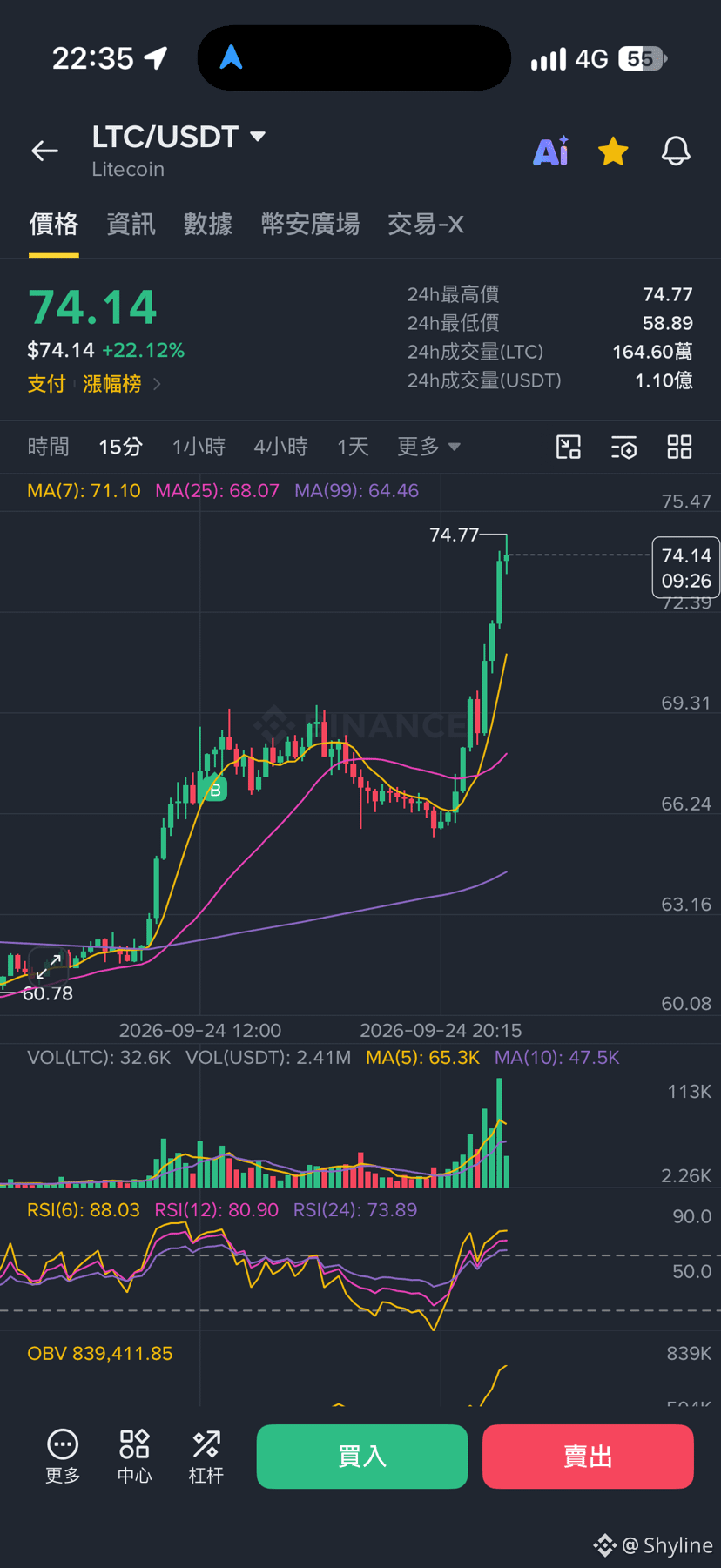
Bought it in $LTC —better to buy early than late
Highest capital efficiency
Bought it in $LTC —better to buy early than late
Highest capital efficiency
Highest capital efficiency
1
295
·
--
Bullish
There’s a big whale on the blockchain
He bought $BNB $UNI $LTC
Now #LTC📈 has started moving
Next, it should switch to the other two
There’s a big whale on the blockchain
He bought $BNB $UNI $LTC
Now #LTC📈 has started moving
Next, it should switch to the other two
He bought $BNB $UNI $LTC
Now #LTC📈 has started moving
Next, it should switch to the other two
1
753
·
--
Bullish
Crypto funds begin to rotate
BTC > L1 > old-school altcoins (LTC ETC)
⚡ $LTC is an old PoW chain that the market forgot—does it really have no future?
Right now, nearly all the market’s attention is on BTC, ETH, SOL, and all kinds of new narratives. But I’ve started paying attention to Litecoin (LTC) again.
The reason is simple: LTC isn’t a coin that suddenly appeared due to a single wave of narrative. It’s an established PoW asset that has been alive since 2011.
Many coins from the same era have already disappeared, yet LTC keeps operating.
🔥 A few reasons I’m paying attention to LTC:
① The maximum supply is only 84,000,000 coins
Like BTC, LTC has a fixed maximum supply, and it also has a block reward halving mechanism.
② PoW mining mechanism
LTC uses Scrypt PoW—it doesn’t generate new coins through staking. Even more special: Litecoin can mine together with Dogecoin via Merged Mining, forming a unique relationship between the LTC and DOGE miner ecosystems.
③ It has gone through multiple bull-and-bear cycles
Since its launch in 2011, LTC has experienced many market cycles—exchange shutdowns, ICOs, DeFi, NFTs, the FTX era, the ETF era, and more—yet it has still managed to keep running.
④ The ETF / traditional finance narrative is worth continued observation
As the crypto market gradually shifts toward regulated financial products, people are starting to focus not only on BTC and ETH. Assets like LTC—with long history, PoW, and clear supply rules—at least have positioning worth watching.
⑤ The biggest upside is actually that “the market isn’t paying much attention to it right now”
The biggest problem with popular coins is—everyone already knows they’re popular.
At this stage, LTC’s market discussion level is clearly much lower than BTC, ETH, and SOL.
This doesn’t necessarily mean it will surge to catch up. But if in the future market funds start searching again for old-school PoW, fair issuance, fixed supply, and ETF / institutional themes, then LTC could return to the market’s spotlight.
Crypto funds begin to rotate
BTC > L1 > old-school altcoins (LTC ETC)
⚡ $LTC is an old PoW chain that the market forgot—does it really have no future?
Right now, nearly all the market’s attention is on BTC, ETH, SOL, and all kinds of new narratives. But I’ve started paying attention to Litecoin (LTC) again.
The reason is simple: LTC isn’t a coin that suddenly appeared due to a single wave of narrative. It’s an established PoW asset that has been alive since 2011.
Many coins from the same era have already disappeared, yet LTC keeps operating.
🔥 A few reasons I’m paying attention to LTC:
① The maximum supply is only 84,000,000 coins
Like BTC, LTC has a fixed maximum supply, and it also has a block reward halving mechanism.
② PoW mining mechanism
LTC uses Scrypt PoW—it doesn’t generate new coins through staking. Even more special: Litecoin can mine together with Dogecoin via Merged Mining, forming a unique relationship between the LTC and DOGE miner ecosystems.
③ It has gone through multiple bull-and-bear cycles
Since its launch in 2011, LTC has experienced many market cycles—exchange shutdowns, ICOs, DeFi, NFTs, the FTX era, the ETF era, and more—yet it has still managed to keep running.
④ The ETF / traditional finance narrative is worth continued observation
As the crypto market gradually shifts toward regulated financial products, people are starting to focus not only on BTC and ETH. Assets like LTC—with long history, PoW, and clear supply rules—at least have positioning worth watching.
⑤ The biggest upside is actually that “the market isn’t paying much attention to it right now”
The biggest problem with popular coins is—everyone already knows they’re popular.
At this stage, LTC’s market discussion level is clearly much lower than BTC, ETH, and SOL.
This doesn’t necessarily mean it will surge to catch up. But if in the future market funds start searching again for old-school PoW, fair issuance, fixed supply, and ETF / institutional themes, then LTC could return to the market’s spotlight.
BTC > L1 > old-school altcoins (LTC ETC)
⚡ $LTC is an old PoW chain that the market forgot—does it really have no future?
Right now, nearly all the market’s attention is on BTC, ETH, SOL, and all kinds of new narratives. But I’ve started paying attention to Litecoin (LTC) again.
The reason is simple: LTC isn’t a coin that suddenly appeared due to a single wave of narrative. It’s an established PoW asset that has been alive since 2011.
Many coins from the same era have already disappeared, yet LTC keeps operating.
🔥 A few reasons I’m paying attention to LTC:
① The maximum supply is only 84,000,000 coins
Like BTC, LTC has a fixed maximum supply, and it also has a block reward halving mechanism.
② PoW mining mechanism
LTC uses Scrypt PoW—it doesn’t generate new coins through staking. Even more special: Litecoin can mine together with Dogecoin via Merged Mining, forming a unique relationship between the LTC and DOGE miner ecosystems.
③ It has gone through multiple bull-and-bear cycles
Since its launch in 2011, LTC has experienced many market cycles—exchange shutdowns, ICOs, DeFi, NFTs, the FTX era, the ETF era, and more—yet it has still managed to keep running.
④ The ETF / traditional finance narrative is worth continued observation
As the crypto market gradually shifts toward regulated financial products, people are starting to focus not only on BTC and ETH. Assets like LTC—with long history, PoW, and clear supply rules—at least have positioning worth watching.
⑤ The biggest upside is actually that “the market isn’t paying much attention to it right now”
The biggest problem with popular coins is—everyone already knows they’re popular.
At this stage, LTC’s market discussion level is clearly much lower than BTC, ETH, and SOL.
This doesn’t necessarily mean it will surge to catch up. But if in the future market funds start searching again for old-school PoW, fair issuance, fixed supply, and ETF / institutional themes, then LTC could return to the market’s spotlight.
1
914
Log in to explore more content
Join global crypto users on Binance Square
⚡️ Get latest and useful information about crypto.
💬 Trusted by the world’s largest crypto exchange.
👍 Discover real insights from verified creators.
Email / Phone number