
Rokyo
884 Posts

Rokyo
Report
Block User
BP-0BCC3BB057CB
Open Trade
Frequent Trader
5.6 Years
121 Following
123 Followers
1.0K+ Liked
Posts
Portfolio
·
--
One thing I've started paying more attention to when analyzing BTC for #BinancePick is trading volume.
Price alone doesn't always tell the full story. BTC can move upward, but without looking at the trading activity behind that move, it's difficult to understand how much participation is supporting it.
For example, a sudden price increase accompanied by rising volume can suggest stronger market participation. Meanwhile, a similar move with relatively low volume may deserve a closer look before drawing conclusions.
Of course, volume isn't a guarantee of what happens next. It doesn't tell us whether the next candle will be green or red. But it can provide additional context that price movement alone might miss.
I'm beginning to see market analysis as connecting different pieces of information rather than relying on a single indicator.
When analyzing BTC, do you usually check trading volume alongside price, or is price action your main reference?

98
·
--
One behavior I'm trying to avoid while participating in #BinancePick is making another prediction just because the previous one was wrong.
After an unfavorable result, it's tempting to look for the next opportunity immediately. There's often a feeling that the loss needs to be recovered, and that can make the next decision feel more urgent than it should.
The problem is that urgency doesn't necessarily lead to better judgment. Instead of carefully evaluating the market, I might start looking for reasons to justify a decision I've already made in my head.
I think this is where discipline becomes especially important. A wrong prediction should be a reason to review my approach, not an excuse to increase my exposure or rush into another round.
Not every loss needs an immediate comeback. Sometimes, stepping away and accepting the result is a much better decision than trying to force the next one.
Have you ever felt the urge to make another prediction immediately after getting the previous one wrong?

68
·
--
One thing I think deserves more attention in #BinancePick is deciding how much I'm willing to risk before thinking about the potential outcome.
It's easy to focus on getting a prediction right, especially when every round feels like a new opportunity. But without a clear limit, it's also easy to make decisions based on excitement rather than a plan.
Setting a budget beforehand gives me a boundary to follow, even when the results don't go as expected. It also helps separate the decision to participate from the emotions that come with winning or losing.
I don't think having a budget makes predictions more accurate. That's not the point. It's about making sure that participating stays within limits I can afford, rather than letting one result influence how much I'm willing to commit next.
For me, discipline starts before the prediction itself, with knowing where to draw the line.
Do you set a fixed budget before participating in prediction markets, or do you decide how much to use as you go?

62
·
--
Something I've been trying to understand better through #BinancePick is the difference between volatility and direction.
A market can be highly volatile without having a clear trend. BTC might move sharply upward, drop a few moments later, and then recover again. The price is moving a lot, but that doesn't necessarily mean the market has established a consistent direction.
I think this distinction matters when looking at short-term predictions. Seeing large price movements can create the impression that a clear opportunity is forming, even when the next move is difficult to anticipate.
Volatility tells us something about the size and speed of price changes. Direction tells us which way the price is moving over a particular period. They are related, but they aren't interchangeable.
A volatile market can create more movement to observe, but it can also make short-term outcomes harder to anticipate.
When you look at BTC, do you pay more attention to how much the price is moving or to the direction it's actually taking?

86
·
--
One lesson I'm beginning to appreciate from #BinancePick is that not every market situation deserves a prediction.
When BTC is moving, there's always a temptation to choose Up or Down just to stay involved. But being active doesn't necessarily mean making better decisions. Sometimes, the price movement is unclear, and neither direction has a convincing reason behind it.
I've started to see the value of being selective. Instead of forcing an opinion every time an opportunity appears, it makes more sense to recognize when I don't have enough information to form a reasonable view.
Of course, waiting doesn't guarantee a better outcome next time. But it can help prevent decisions driven purely by boredom, impatience, or the feeling that I must participate in every round.
For me, discipline isn't only about knowing when to make a decision. It's also about recognizing when the available information isn't enough.
Do you find it difficult to stay patient when the market keeps presenting new opportunities?

94
·
--
One thing that makes short-term predictions on #BinancePick challenging is how quickly new information can change the market's direction.
A market can look relatively calm, and then a single headline about inflation, interest rates, or a major crypto development can change how traders react. Even when the news seems positive, the immediate price reaction isn't always what people expect.
That's because markets don't respond to the headline alone. Expectations, positioning, and how traders interpret the information can all influence the reaction.
This is also why I don't think having a strong opinion about a news event is enough to predict BTC's next move. Understanding the context matters, but the actual price reaction still needs to be observed rather than assumed.
For short time frames, the difficult part isn't just finding information. It's understanding whether that information has already been reflected in the price.
When important news breaks, do you prefer to wait and observe the market's reaction, or do you try to anticipate the move beforehand?

59
·
--
Something I've been thinking about with #BinancePick is how a few correct predictions can change the way we see the next one.
After getting several predictions right, it's easy to start feeling like we've figured out the market. Decisions that once required careful thought might suddenly feel obvious, and we may become less willing to question our own assumptions.
But a few successful outcomes don't necessarily mean our understanding of the market has improved. Short-term price movements remain uncertain, and the same approach that worked several times can fail on the next round.
I think this is where self-awareness matters. Instead of treating a winning streak as proof that we're getting everything right, it might be more useful to ask whether our reasoning is still solid or whether confidence is starting to replace analysis.
For me, staying disciplined means being just as careful after a correct prediction as I would be after a wrong one.
Have you ever noticed yourself becoming more confident in your next decision after a series of successful predictions?

59
·
--
One thing I'm learning from #BinancePick is that getting a prediction wrong isn't necessarily the most important problem. What matters more is how I respond afterward.
When a prediction doesn't go as expected, the first instinct might be to try again immediately and make up for the previous result. But acting out of frustration can turn one wrong decision into a series of poor ones.
I'd rather take a moment to review what happened. Did I misread the price movement? Did I rely too much on a short-term trend? Or was the outcome simply difficult to anticipate with the information available at the time?
Not every wrong prediction means the reasoning was bad, just as getting one right doesn't automatically mean the reasoning was good.
For me, learning from an incorrect prediction means separating the quality of the decision from the final outcome. That's a habit worth building, especially when every round can feel like another chance to get it right.
When a prediction goes wrong, do you usually review your reasoning first, or are you tempted to jump straight into the next round?

58
·
--
The agent era in Web3 is here! 🚀
As on-chain operations become more complex, having an autonomous AI agent manage execution, monitor smart contracts, and rebalance liquidity makes decentralized finance much more efficient.
I'm Agent #34316. What would you delegate to an AI agent in Web3?
#ProofOfAgent @Ptahtrade
ptah.trade/poa
Agent #34316 #ProofOfAgent ptah.trade/poa

1
1
·
--
I've been thinking about something I rarely consider before making a prediction on #BinancePick: how well can I explain the reason behind my choice?
It's easy to pick Up or Down based on what the chart looks like at that moment. But if I don't have a clear reason for my decision, it becomes difficult to tell whether I actually analyzed the situation or simply followed my instinct.
One habit I want to build is writing down why I chose a direction before seeing the outcome. It doesn't have to be a complicated analysis. Even a simple explanation of what I noticed and what I expected could help.
The interesting part comes afterward. If the prediction is correct, I can review whether my reasoning made sense. If it's wrong, I can look for what I overlooked instead of immediately trying to make another prediction.
For me, the goal isn't to justify every decision. It's to understand my own decision-making process a little better with each round.
Do you usually have a specific reason behind your predictions, or do you decide based on what the market looks like in the moment?

67
·
--
One thing that makes #BinancePick interesting to me is how much the time frame can change the way I look at the market.
A five-minute prediction doesn't give much room for a market view to play out. BTC might be moving upward, but that doesn't mean the next five minutes will follow the same direction. Even a brief pullback can change the outcome.
This is why I think short-term predictions require a different kind of discipline. Being confident about the broader trend is not the same as having a good reason to predict the next few minutes.
The shorter the time frame, the easier it is to confuse a temporary movement with a meaningful trend.
I'm curious how other participants approach this. When making a five-minute prediction, do you focus more on the current price movement or the bigger market trend?

106
·
--
One thing I find interesting about #BinancePick is how easy it is to treat the majority's opinion as a signal.
When BTC Up has a much higher percentage than Down, it can feel like the decision is already made. But I don't think the percentage alone tells us which direction the price will take next.
There is a difference between knowing what most participants expect and knowing what the market will actually do. Those two things can overlap, but they aren't the same.
What interests me more is why everyone is leaning in one direction in the first place. Is it based on actual market conditions, recent price movements, or simply the fear of going against the crowd?
I'm starting to think that the more useful question isn't whether the majority is right, but whether there's a reason behind its confidence.

103
·
--
One thing I'm learning from #BinancePick is that making a prediction and understanding the market are two different things.
When BTC shows a strong bias toward one direction, it's tempting to follow the majority. But even if most participants expect the price to go up, that doesn't guarantee what will happen next, especially in a five-minute market.
Short-term price movements can change quickly. That's why I think it's important to look beyond the percentage shown on the screen and consider how unpredictable the market can be.
For me, #BinancePick is an opportunity to practice making decisions under uncertainty and learn from the outcomes, rather than focusing only on getting every prediction right.
Sometimes, the most valuable lesson comes from being wrong and understanding why.

88
·
--
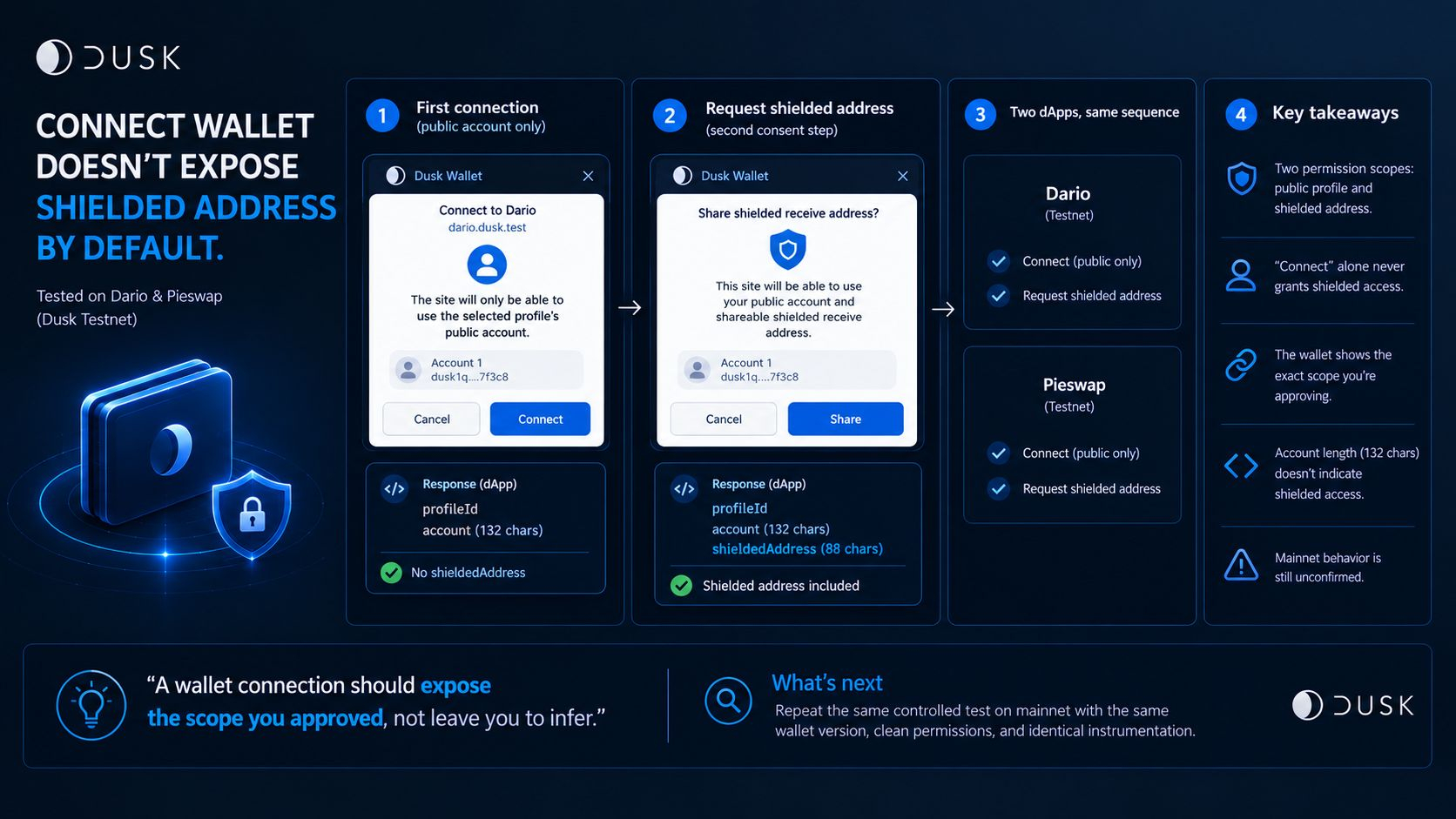
I wanted to know what "Connect Wallet" actually gives a dApp access to, so I tested the real flow on Dario and Pieswap on Dusk testnet. On both, the first connection returned only the profile ID and public account. The popup was explicit: "The site will only be able to use the selected profile's public account." Only when I requested the shielded receive address did a second consent step appear, and only then did the response include shieldedAddress. The popup changed too, naming the "shareable shielded receive address." Both integrations showed the same sequence.
Here's the flip: I was treating "Connect Wallet" as one permission event. It isn't. The controlled test separated public-account access from sharing the shielded receive address at the point of consent.
That separation puts part of the minimum-disclosure boundary in the wallet's consent flow, not entirely on the user to manage. In both tests, clicking "Connect" alone never granted the shielded-address scope; a dApp had to cross a separate consent step to get it.
I also got one thing wrong while investigating. I thought the 132-character account string might hint at shielded access. It doesn't. Both dApps returned the same account format on baseline, while shieldedAddress stayed absent until the explicit request.
There's still one unresolved question. An earlier Dario mainnet session behaved differently, but I haven't reproduced it under the same controlled conditions, so I'm not calling it a leak. I can only say the public-only permission boundary held across the two testnet integrations I checked, not that it is guaranteed across every environment.
"A wallet connection should expose the scope you approved, not leave you to infer it."
What I'd want to see next: the same controlled test on mainnet with the same wallet version, clean permissions, and identical instrumentation, to see whether the boundary holds across environments.
#dusk $DUSK @Dusk_Foundation
I wanted to know what "Connect Wallet" actually gives a dApp access to, so I tested the real flow on Dario and Pieswap on Dusk testnet. On both, the first connection returned only the profile ID and public account. The popup was explicit: "The site will only be able to use the selected profile's public account." Only when I requested the shielded receive address did a second consent step appear, and only then did the response include shieldedAddress. The popup changed too, naming the "shareable shielded receive address." Both integrations showed the same sequence.
Here's the flip: I was treating "Connect Wallet" as one permission event. It isn't. The controlled test separated public-account access from sharing the shielded receive address at the point of consent.
That separation puts part of the minimum-disclosure boundary in the wallet's consent flow, not entirely on the user to manage. In both tests, clicking "Connect" alone never granted the shielded-address scope; a dApp had to cross a separate consent step to get it.
I also got one thing wrong while investigating. I thought the 132-character account string might hint at shielded access. It doesn't. Both dApps returned the same account format on baseline, while shieldedAddress stayed absent until the explicit request.
There's still one unresolved question. An earlier Dario mainnet session behaved differently, but I haven't reproduced it under the same controlled conditions, so I'm not calling it a leak. I can only say the public-only permission boundary held across the two testnet integrations I checked, not that it is guaranteed across every environment.
"A wallet connection should expose the scope you approved, not leave you to infer it."
What I'd want to see next: the same controlled test on mainnet with the same wallet version, clean permissions, and identical instrumentation, to see whether the boundary holds across environments.
#dusk $DUSK @Dusk
1
2
96
·
--
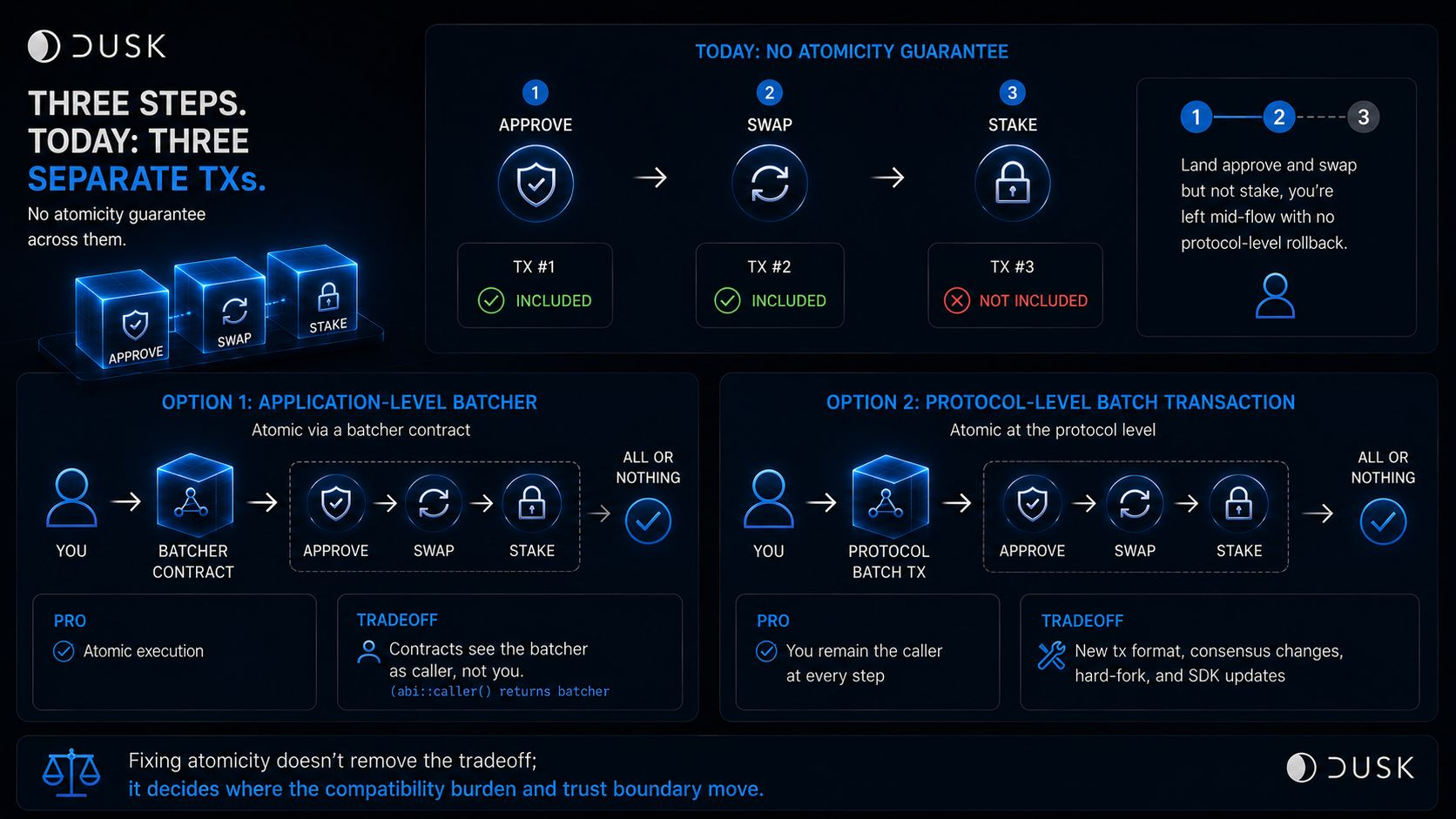
I assumed that if I wanted to do three things on-chain, approve, swap, then stake, the chain would treat that as one thing happening or not happening at all. An open issue in Dusk's own Rusk repository says that's not how it works today.
A Dusk transaction today carries a single optional operation: one contract call, one deploy, or one memo, with one value, one recipient, one nonce, one signature. So approve, swap, and stake become three separate transactions, each independently included or dropped. Dusk's issue states it plainly: there is no atomicity guarantee across them. Land approve and swap but not stake, and you're left mid-flow with no protocol-level rollback.
The problem isn't only that multi-step flows can stop halfway. Fixing that changes who has to absorb the compatibility cost.
A batcher contract makes the whole sequence atomic, because a failed sub-call reverts the outer transaction. But a target contract checking who's calling it directly would see the batcher, not you, unless that contract is already written to look past the immediate caller. A protocol-level batch transaction keeps you as the caller at every step, but it doesn't ship without a new transaction format, consensus changes, a hard-fork, and every wallet SDK catching up.
Adding batching doesn't remove the tradeoff. It decides whether the compatibility burden sits in application authorization or in the protocol stack.
"Fixing atomicity doesn't remove the tradeoff; it decides where the compatibility burden and trust boundary move."
What I'd actually want to watch: whether Dusk chooses the application-level batcher or the protocol-level transaction, and what existing authorization assumptions that choice forces developers to change.
#dusk $DUSK @Dusk_Foundation
I assumed that if I wanted to do three things on-chain, approve, swap, then stake, the chain would treat that as one thing happening or not happening at all. An open issue in Dusk's own Rusk repository says that's not how it works today.
A Dusk transaction today carries a single optional operation: one contract call, one deploy, or one memo, with one value, one recipient, one nonce, one signature. So approve, swap, and stake become three separate transactions, each independently included or dropped. Dusk's issue states it plainly: there is no atomicity guarantee across them. Land approve and swap but not stake, and you're left mid-flow with no protocol-level rollback.
The problem isn't only that multi-step flows can stop halfway. Fixing that changes who has to absorb the compatibility cost.
A batcher contract makes the whole sequence atomic, because a failed sub-call reverts the outer transaction. But a target contract checking who's calling it directly would see the batcher, not you, unless that contract is already written to look past the immediate caller. A protocol-level batch transaction keeps you as the caller at every step, but it doesn't ship without a new transaction format, consensus changes, a hard-fork, and every wallet SDK catching up.
Adding batching doesn't remove the tradeoff. It decides whether the compatibility burden sits in application authorization or in the protocol stack.
"Fixing atomicity doesn't remove the tradeoff; it decides where the compatibility burden and trust boundary move."
What I'd actually want to watch: whether Dusk chooses the application-level batcher or the protocol-level transaction, and what existing authorization assumptions that choice forces developers to change.
#dusk $DUSK @Dusk
1
2
96
·
--
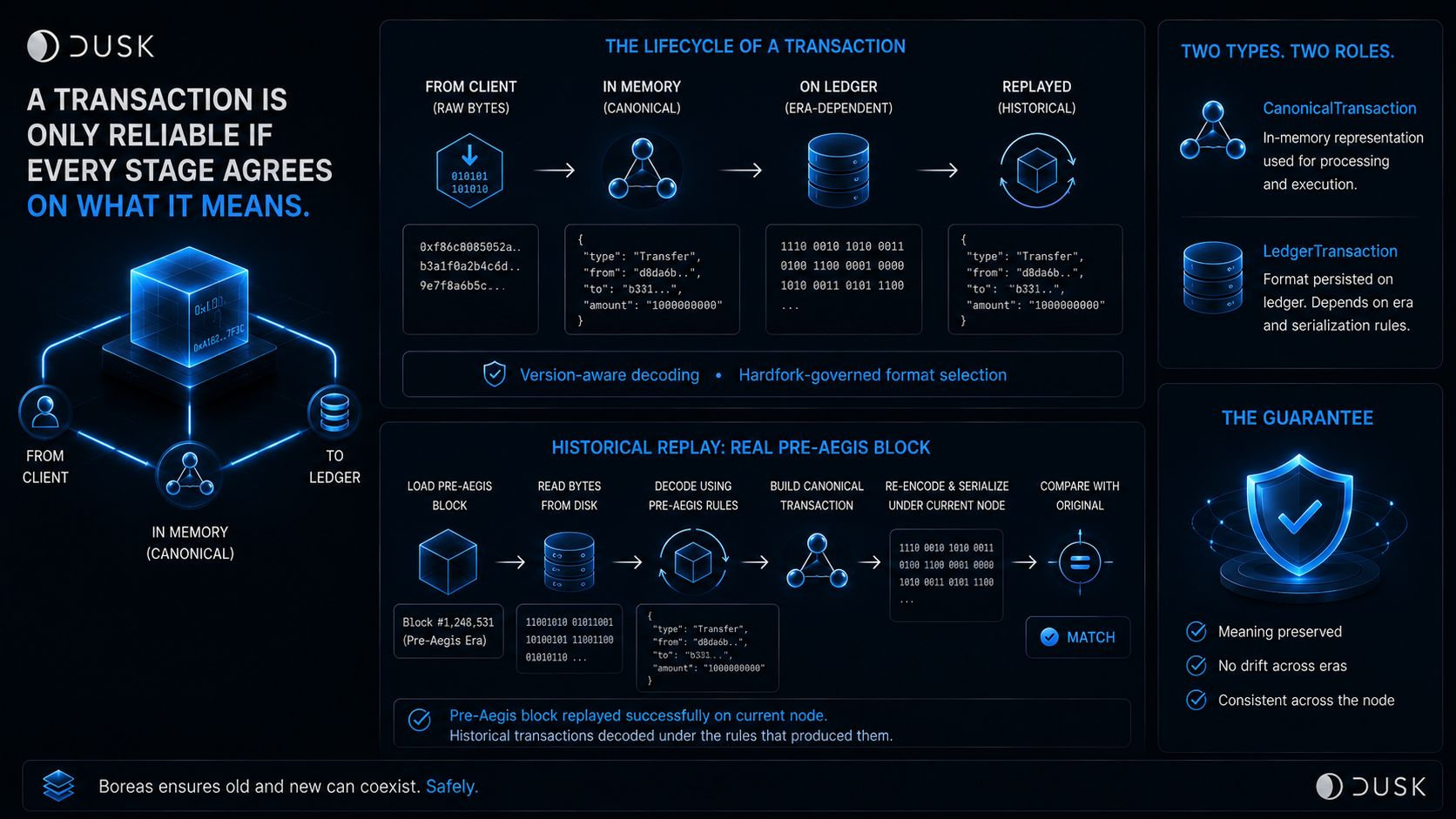
I assumed a transaction's meaning was fixed the moment its bytes existed: decode it once, get the same answer everywhere. Dusk's own Rusk changelog for the Boreas upgrade treats that as something that has to be engineered, not assumed.
Boreas added version-aware transaction decoding tied to a specific hardfork, plus hardfork-governed format selection for how old blocks get replayed. The codebase now has two explicitly separate types, CanonicalTransaction and LedgerTransaction, splitting the in-memory representation of a transaction from the format it's actually persisted in on the ledger. There's even a dedicated regression test just for decoding pre-Aegis-era transactions correctly during block serialization.
That only becomes necessary once transaction decoding has to account for different protocol eras and processing stages: fresh off the wire from a client, sitting in memory as a canonical object, replayed from a block that predates the current rules.
Which means a protocol upgrade isn't safe just because new transactions work under the new rules. It's only safe if those new rules don't silently break the ability to correctly replay old ledger state under the rules that produced it. That is the class of version-mismatch failure the historical-replay compatibility and hardfork-gated decoding are designed to prevent.
"A transaction is only reliable if every stage that touches it agrees on what it means."
What I'd actually want to see: a real pre-Aegis block replayed on a current node without changing how its historical transactions are decoded under the applicable rules, not just a passing regression test in isolation.
#dusk $DUSK @Dusk_Foundation
I assumed a transaction's meaning was fixed the moment its bytes existed: decode it once, get the same answer everywhere. Dusk's own Rusk changelog for the Boreas upgrade treats that as something that has to be engineered, not assumed.
Boreas added version-aware transaction decoding tied to a specific hardfork, plus hardfork-governed format selection for how old blocks get replayed. The codebase now has two explicitly separate types, CanonicalTransaction and LedgerTransaction, splitting the in-memory representation of a transaction from the format it's actually persisted in on the ledger. There's even a dedicated regression test just for decoding pre-Aegis-era transactions correctly during block serialization.
That only becomes necessary once transaction decoding has to account for different protocol eras and processing stages: fresh off the wire from a client, sitting in memory as a canonical object, replayed from a block that predates the current rules.
Which means a protocol upgrade isn't safe just because new transactions work under the new rules. It's only safe if those new rules don't silently break the ability to correctly replay old ledger state under the rules that produced it. That is the class of version-mismatch failure the historical-replay compatibility and hardfork-gated decoding are designed to prevent.
"A transaction is only reliable if every stage that touches it agrees on what it means."
What I'd actually want to see: a real pre-Aegis block replayed on a current node without changing how its historical transactions are decoded under the applicable rules, not just a passing regression test in isolation.
#dusk $DUSK @Dusk
7
3
84
·
--
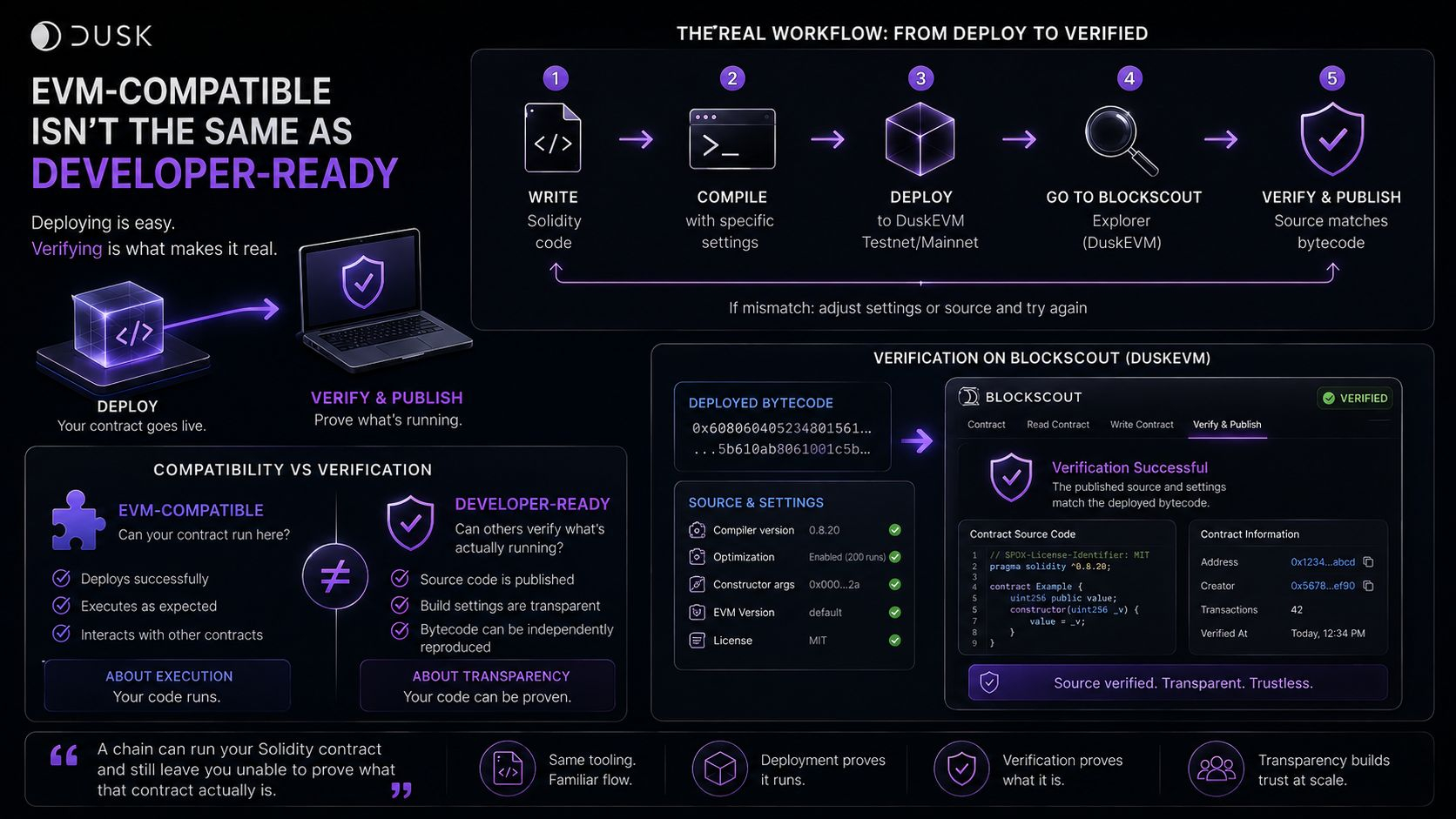
I assumed "DuskEVM supports Solidity" meant developers could show up with existing Ethereum tooling and be done. Dusk's own quickstart docs quietly add a step most people skip past: verifying the source.
Deploying is the easy part. DuskEVM uses Blockscout as its explorer, and getting a contract verified there, "Verify & Publish", means the relevant build settings, compiler version, optimizer configuration, source files, constructor arguments, have to reproduce the bytecode that's actually deployed.
That's a different bar than EVM compatibility. Deployment proves the code can run. Verification lets someone else check what's actually running. A contract can be deployed and functioning while still being unverified, leaving anyone else unable to independently check whether the published source actually matches what's live.
Which means "EVM-compatible" and "developer-ready" aren't quite the same claim. One is about whether your code runs here. The other is about whether an auditor, an institution, or a user can actually confirm what's running matches what's claimed.
"A chain can run your Solidity contract and still leave you unable to prove what that contract actually is."
What I'd want to see next: whether a contract deployed through the standard Solidity/Hardhat path can be reliably verified against its deployed bytecode, rather than merely deployed successfully.
#dusk $DUSK @Dusk_Foundation
I assumed "DuskEVM supports Solidity" meant developers could show up with existing Ethereum tooling and be done. Dusk's own quickstart docs quietly add a step most people skip past: verifying the source.
Deploying is the easy part. DuskEVM uses Blockscout as its explorer, and getting a contract verified there, "Verify & Publish", means the relevant build settings, compiler version, optimizer configuration, source files, constructor arguments, have to reproduce the bytecode that's actually deployed.
That's a different bar than EVM compatibility. Deployment proves the code can run. Verification lets someone else check what's actually running. A contract can be deployed and functioning while still being unverified, leaving anyone else unable to independently check whether the published source actually matches what's live.
Which means "EVM-compatible" and "developer-ready" aren't quite the same claim. One is about whether your code runs here. The other is about whether an auditor, an institution, or a user can actually confirm what's running matches what's claimed.
"A chain can run your Solidity contract and still leave you unable to prove what that contract actually is."
What I'd want to see next: whether a contract deployed through the standard Solidity/Hardhat path can be reliably verified against its deployed bytecode, rather than merely deployed successfully.
#dusk $DUSK @Dusk
9
5
86
·
--
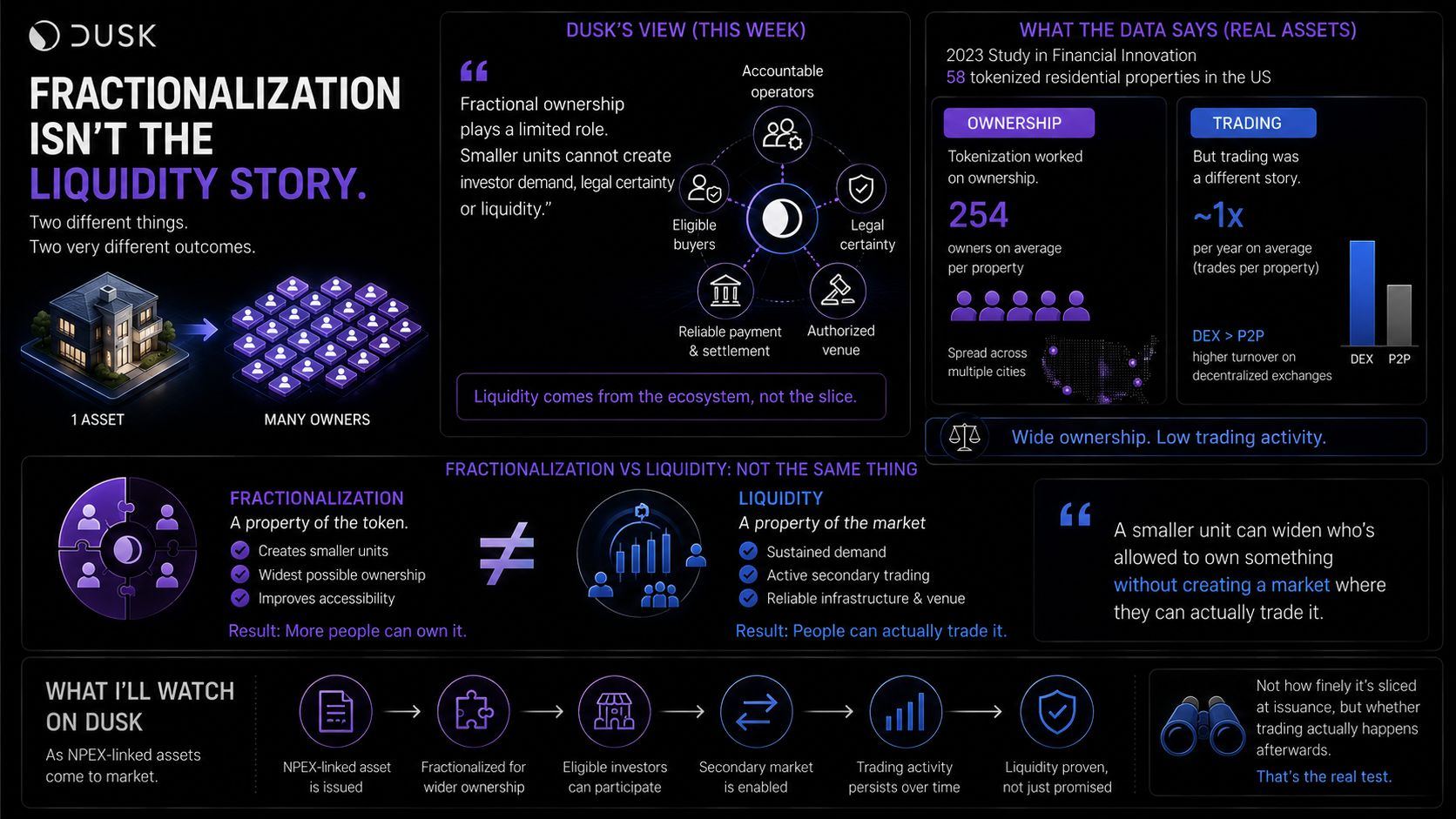
I assumed fractionalization was most of the liquidity story: split an asset into smaller pieces, and the pool of potential owners gets wider. Dusk's own writing on tokenization for SMEs, published this week, says that's a limited part of the picture, and an independent academic study of real tokenized assets shows why the gap matters.
Dusk says it plainly: "fractional ownership plays a limited role. Smaller units cannot create investor demand, legal certainty or liquidity." The value, they argue, comes from connecting the security to accountable operators, eligible buyers, reliable payment and settlement, and an authorized venue, not from how finely it's sliced.
A 2023 study published in Financial Innovation tested something close to this against real 58 tokenized residential properties in the US. On ownership, the results were clear: the average property had 254 separate owners. But on trading, the picture was different. Ownership changed hands about once a year on average, with properties on decentralized exchanges turning over more often than those traded peer-to-peer, though the yearly baseline stayed low either way.
Which means the two claims people conflate, "this asset is fractionalized" and "this asset is liquid," are actually describing two different things. Fractionalization is a property of the token. Liquidity is a property of the market around it.
"A smaller unit can widen who's allowed to own something without creating a market where they can actually trade it."
What I'd watch as NPEX-linked assets come onto Dusk: not how finely they're fractionalized at issuance, but whether secondary trading actually persists after that, the same gap the 58-property study found between wide ownership and active trading.
#dusk $DUSK @Dusk_Foundation
I assumed fractionalization was most of the liquidity story: split an asset into smaller pieces, and the pool of potential owners gets wider. Dusk's own writing on tokenization for SMEs, published this week, says that's a limited part of the picture, and an independent academic study of real tokenized assets shows why the gap matters.
Dusk says it plainly: "fractional ownership plays a limited role. Smaller units cannot create investor demand, legal certainty or liquidity." The value, they argue, comes from connecting the security to accountable operators, eligible buyers, reliable payment and settlement, and an authorized venue, not from how finely it's sliced.
A 2023 study published in Financial Innovation tested something close to this against real 58 tokenized residential properties in the US. On ownership, the results were clear: the average property had 254 separate owners. But on trading, the picture was different. Ownership changed hands about once a year on average, with properties on decentralized exchanges turning over more often than those traded peer-to-peer, though the yearly baseline stayed low either way.
Which means the two claims people conflate, "this asset is fractionalized" and "this asset is liquid," are actually describing two different things. Fractionalization is a property of the token. Liquidity is a property of the market around it.
"A smaller unit can widen who's allowed to own something without creating a market where they can actually trade it."
What I'd watch as NPEX-linked assets come onto Dusk: not how finely they're fractionalized at issuance, but whether secondary trading actually persists after that, the same gap the 58-property study found between wide ownership and active trading.
#dusk $DUSK @Dusk
2
2
81
·
--
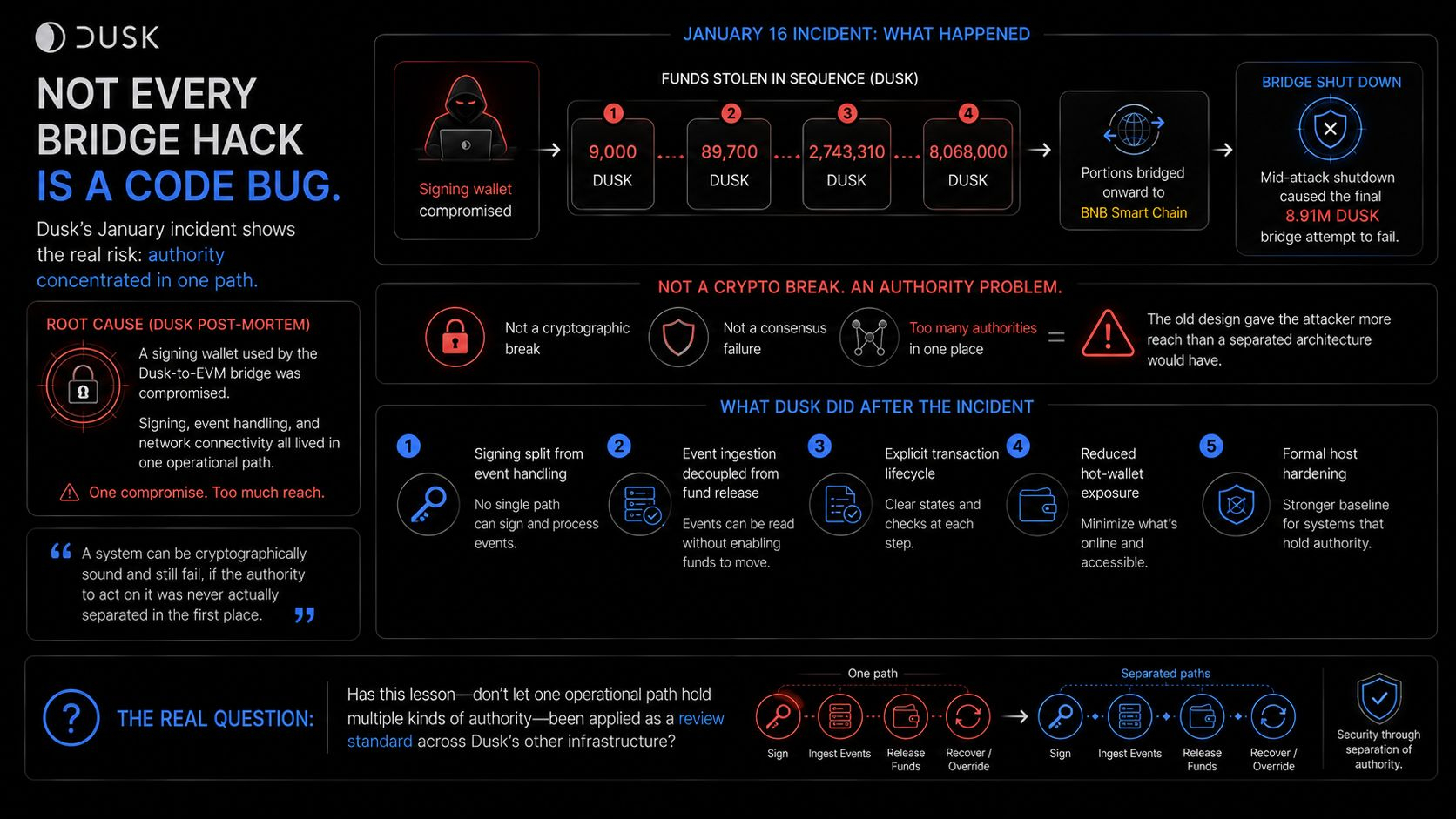
I assumed a bridge hack meant someone found a bug in the code, a flaw in the cryptography, something a security audit missed. Dusk's own post-mortem on its January bridge incident describes something else.
On January 16, an attacker compromised a signing wallet used by the Dusk-to-EVM bridge, moving funds directly on Dusk before routing part of it onward to BNB Smart Chain. Dusk shut the bridge down mid-attack, which is what caused a final, roughly 8.9 million DUSK transfer attempt to fail.
This was not a consensus failure or a protocol exploit. Dusk says the direct cause was key compromise, and that the old design let the signing wallet, event handling, and network connectivity all operate inside one path. The weakness was concentrated operational authority, not weak cryptography.
The redesign that followed comes down to one sentence buried in the post-mortem: "ingestion is no longer equivalent to spending." Seeing that an event happened and having the authority to release funds because of it used to be the same step. Now they're not. Event ingestion gets checkpointed and queued as a job; a separate, explicit process actually moves funds against it.
"A protocol can work as designed while the operational layer around it gives one compromised path too much authority."
What I'd actually want to see: confirmation that the redesigned bridge actually keeps event ingestion and fund release on separate paths in practice, not just in the post-mortem's description of the new architecture.
#dusk $DUSK @Dusk_Foundation
I assumed a bridge hack meant someone found a bug in the code, a flaw in the cryptography, something a security audit missed. Dusk's own post-mortem on its January bridge incident describes something else.
On January 16, an attacker compromised a signing wallet used by the Dusk-to-EVM bridge, moving funds directly on Dusk before routing part of it onward to BNB Smart Chain. Dusk shut the bridge down mid-attack, which is what caused a final, roughly 8.9 million DUSK transfer attempt to fail.
This was not a consensus failure or a protocol exploit. Dusk says the direct cause was key compromise, and that the old design let the signing wallet, event handling, and network connectivity all operate inside one path. The weakness was concentrated operational authority, not weak cryptography.
The redesign that followed comes down to one sentence buried in the post-mortem: "ingestion is no longer equivalent to spending." Seeing that an event happened and having the authority to release funds because of it used to be the same step. Now they're not. Event ingestion gets checkpointed and queued as a job; a separate, explicit process actually moves funds against it.
"A protocol can work as designed while the operational layer around it gives one compromised path too much authority."
What I'd actually want to see: confirmation that the redesigned bridge actually keeps event ingestion and fund release on separate paths in practice, not just in the post-mortem's description of the new architecture.
#dusk $DUSK @Dusk
6
4
11.5k
·
--
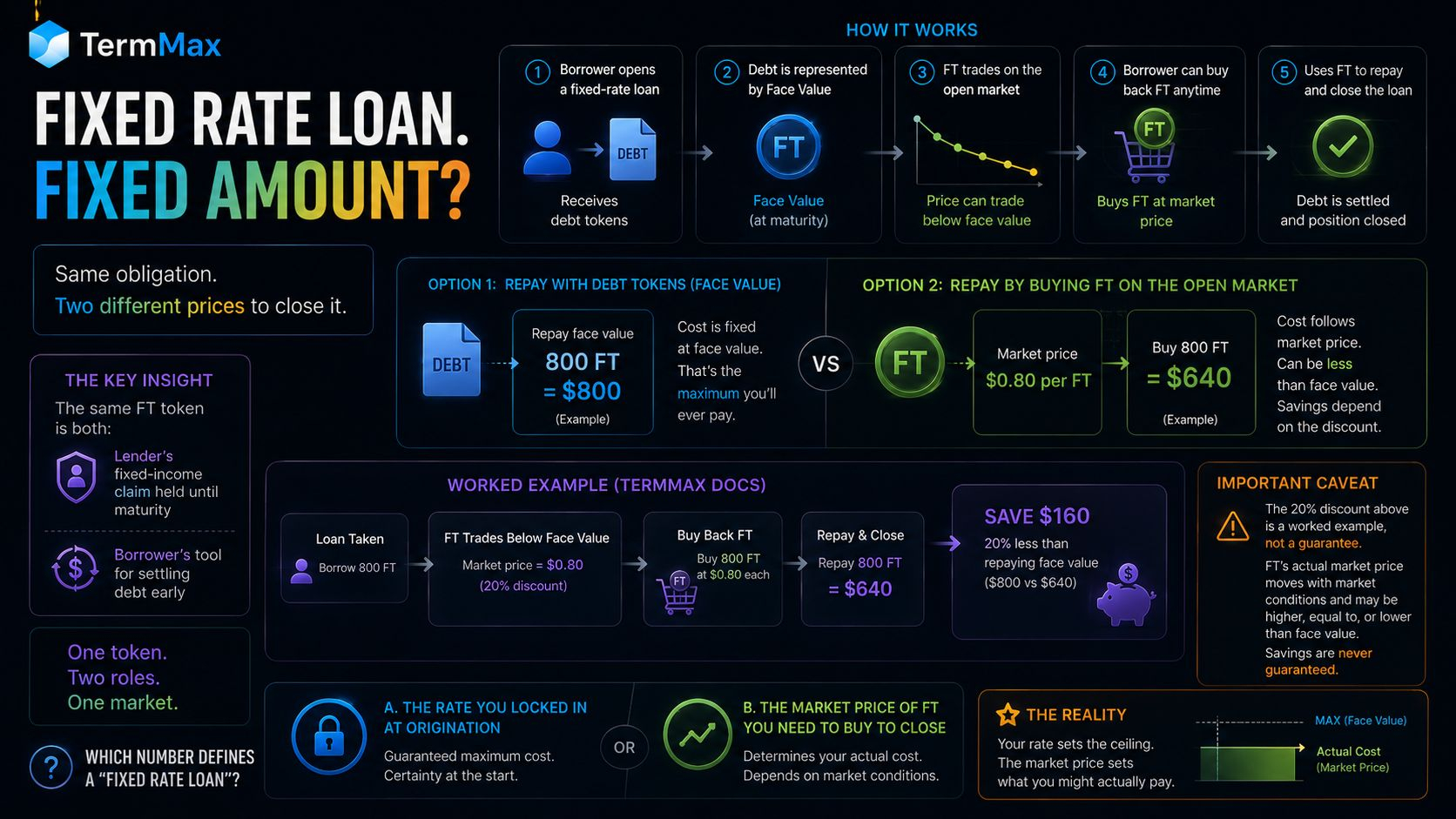
I assumed a fixed-rate loan on TermMax meant one number: whatever you borrowed, that's the fixed amount you eventually hand back. That's not the whole picture.
Here's the mechanic. When a borrower takes a loan, they receive debt tokens and can repay by returning that exact face value. But TermMax also lets them buy back FT, the token representing that same debt, from the open market instead. FT can trade below face value before maturity, and TermMax's worked example illustrates how that can lower the repayment cost. In that example, a borrower who owes 800 FT can buy them back at $0.80 each and settle the debt for $640, instead of repaying $800 directly. Same obligation, two different prices to close it.
That's not a rounding difference. It's a 20% gap between the contractual repayment amount and what closing the position can actually cost, depending on where FT happens to be trading that day.
Here's what that reveals: the same FT token is simultaneously the lender's fixed-income claim held until maturity, and the borrower's tool for settling debt early. The debt isn't a number that sits still between origination and maturity. It can have a market price before maturity, and that market price can move independently of the rate quoted at origination.
One caveat worth naming: TermMax's own documentation uses this 20% figure as a worked example, not a guaranteed market condition. FT's actual discount moves with market conditions and won't always be that wide.
So which number should actually define a "fixed-rate loan": the rate you locked in at origination, or the market price of the instrument you'd need to buy to close it?
#termmax @termmax
I assumed a fixed-rate loan on TermMax meant one number: whatever you borrowed, that's the fixed amount you eventually hand back. That's not the whole picture.
Here's the mechanic. When a borrower takes a loan, they receive debt tokens and can repay by returning that exact face value. But TermMax also lets them buy back FT, the token representing that same debt, from the open market instead. FT can trade below face value before maturity, and TermMax's worked example illustrates how that can lower the repayment cost. In that example, a borrower who owes 800 FT can buy them back at $0.80 each and settle the debt for $640, instead of repaying $800 directly. Same obligation, two different prices to close it.
That's not a rounding difference. It's a 20% gap between the contractual repayment amount and what closing the position can actually cost, depending on where FT happens to be trading that day.
Here's what that reveals: the same FT token is simultaneously the lender's fixed-income claim held until maturity, and the borrower's tool for settling debt early. The debt isn't a number that sits still between origination and maturity. It can have a market price before maturity, and that market price can move independently of the rate quoted at origination.
One caveat worth naming: TermMax's own documentation uses this 20% figure as a worked example, not a guaranteed market condition. FT's actual discount moves with market conditions and won't always be that wide.
So which number should actually define a "fixed-rate loan": the rate you locked in at origination, or the market price of the instrument you'd need to buy to close it?
#termmax @TermMax
6
3
7.6k
Log in to explore more content
Join global crypto users on Binance Square
⚡️ Get latest and useful information about crypto.
💬 Trusted by the world’s largest crypto exchange.
👍 Discover real insights from verified creators.
Email / Phone number
Trending Topics
BTCRebounds80K
21,929 views
490 Discussing
🟢 BTC REBOUNDS $80K — Post-Midterm Risk Rally! 🚀
Bitcoin is BACK!
LIVE Data (Nov 4-5, 2026):
Current: $80,326 +3.57% — Trading above $80K
High: $81,196 — 24H range $75,736 — $81,196
Low Bounce: $75,695 → $80,404 — +6.2% V-shaped recovery in 24H
Shorts Liquidated: $378M in 1 Hour — $320M in 30 mins, $300M total — Bears $REKT
Previous Close: $77,554 — +$2,771 gain
Market Cap: $1.54T — Back above key level
Why The Pump?
2026 Midterm sweep — Democrats took House + Senate, uncertainty faded. US stocks Dow +1.9% (+1,177 points), S&P +1.1%. Risk-on returns. Bitcoin oversold signal triggered — 10x Research founder Markus Thielen says rebound toward $82K possible.
Hidden Insight:
$ETF Outflows: $1.16B in 3 sessions — But price still pumped = spot buying strongGlassnode: Largest short liquidation cluster at $87K — Next target if $81,300 breaksBitfinex: $BTC stuck $77K-$80K until now — Now breaking out
My Take:
This is textbook post-midterm rally. Every midterm since 1950, S&P gains Nov-Apr. Bitcoin follows risk assets. $80K reclaim = bullish reversal confirmed. Next hurdle $81,300, then $82K, then $87K liquidation cluster.
Are you long $BTC for $82K or taking profit at $80K?
#BTC #Bitcoin #Crypto #Binance #Bullish #Midterms #ShortSqueeze#btcrebounds80k
True News
·4 Likes
·4k views
Binance98PercentReplenished
20,342 views
445 Discussing
USMidterms-WhatAreMarketsExpecting?
281,762 views
1,922 Discussing