

Bilal crypto 7
5.5k Posts

Bilal crypto 7
Report
Block User
330 Following
25.3K+ Followers
9.1K+ Liked
Posts
All
Live
·
--
Bearish
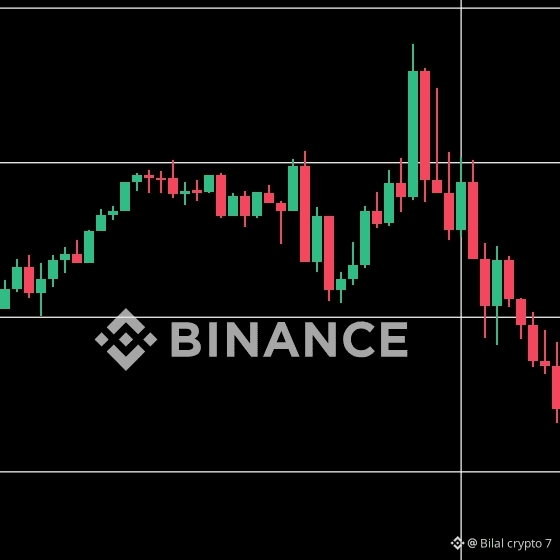
$BNB is showing a clear cooling phase: the chart has slipped to $758.86, down 2.17%, after failing to hold higher levels. Recent Binance updates also point toward broader ecosystem expansion, including USDT gas payments across four networks and its $100M Circle investment.
The key takeaway: price structure still matters more than headlines.
#QNTFallsOver40%FromMorningHigh #BitgetDetailsSecurityIncidentTimeline #FedProposesPaymentStablecoinRules
$BNB is showing a clear cooling phase: the chart has slipped to $758.86, down 2.17%, after failing to hold higher levels. Recent Binance updates also point toward broader ecosystem expansion, including USDT gas payments across four networks and its $100M Circle investment.
The key takeaway: price structure still matters more than headlines.
#QNTFallsOver40%FromMorningHigh #BitgetDetailsSecurityIncidentTimeline #FedProposesPaymentStablecoinRules
The key takeaway: price structure still matters more than headlines.
#QNTFallsOver40%FromMorningHigh #BitgetDetailsSecurityIncidentTimeline #FedProposesPaymentStablecoinRules
96
$SOL
{spot}(SOLUSDT)
Solana's ecosystem is still attracting strong attention from traders. Volatility is high, so it is important to watch the risk along with the momentum.
#BitcoinETFsBiggestDailyInflowSinceJanuary #ZECHitsANewAllTimeHigh #LululemonTumbles20%OnWeakGuidance
$SOL
Solana's ecosystem is still attracting strong attention from traders. Volatility is high, so it is important to watch the risk along with the momentum.
#BitcoinETFsBiggestDailyInflowSinceJanuary #ZECHitsANewAllTimeHigh #LululemonTumbles20%OnWeakGuidance
Solana's ecosystem is still attracting strong attention from traders. Volatility is high, so it is important to watch the risk along with the momentum.
#BitcoinETFsBiggestDailyInflowSinceJanuary #ZECHitsANewAllTimeHigh #LululemonTumbles20%OnWeakGuidance
1
186
$ETH
Ethereum mein strength sirf price chart ki baat nahi. Network activity aur liquidity ka trend zyada important hai. ETH ko closely watch kar raha hoon
#USAugustJobGrowthNearlyTriplesForecast #BitcoinETFsBiggestDailyInflowSinceJanuary #BitcoinETFsBiggestDailyInflowSinceJanuary
$ETH
Ethereum mein strength sirf price chart ki baat nahi. Network activity aur liquidity ka trend zyada important hai. ETH ko closely watch kar raha hoon
#USAugustJobGrowthNearlyTriplesForecast #BitcoinETFsBiggestDailyInflowSinceJanuary #BitcoinETFsBiggestDailyInflowSinceJanuary
Ethereum mein strength sirf price chart ki baat nahi. Network activity aur liquidity ka trend zyada important hai. ETH ko closely watch kar raha hoon
#USAugustJobGrowthNearlyTriplesForecast #BitcoinETFsBiggestDailyInflowSinceJanuary #BitcoinETFsBiggestDailyInflowSinceJanuary
101
$DOGE
{spot}(DOGEUSDT)
DOGE moves aksar sentiment-driven hote hain. Jab market mein risk appetite wapas aati hai, meme coins sabse pehle attention capture kar sakte hain.
#USAugustJobGrowthNearlyTriplesForecast #LululemonTumbles20%OnWeakGuidance #USAugustNonfarmPayrollsDueToday
$DOGE
DOGE moves aksar sentiment-driven hote hain. Jab market mein risk appetite wapas aati hai, meme coins sabse pehle attention capture kar sakte hain.
#USAugustJobGrowthNearlyTriplesForecast #LululemonTumbles20%OnWeakGuidance #USAugustNonfarmPayrollsDueToday
DOGE moves aksar sentiment-driven hote hain. Jab market mein risk appetite wapas aati hai, meme coins sabse pehle attention capture kar sakte hain.
#USAugustJobGrowthNearlyTriplesForecast #LululemonTumbles20%OnWeakGuidance #USAugustNonfarmPayrollsDueToday
134
$LINK
I find Chainlink's real-world utility angle interesting. Oracles are quietly becoming an important layer of blockchain infrastructure
#USAugustJobGrowthNearlyTriplesForecast #USAugustJobGrowthNearlyTriplesForecast .
$LINK
I find Chainlink's real-world utility angle interesting. Oracles are quietly becoming an important layer of blockchain infrastructure
#USAugustJobGrowthNearlyTriplesForecast #USAugustJobGrowthNearlyTriplesForecast .
I find Chainlink's real-world utility angle interesting. Oracles are quietly becoming an important layer of blockchain infrastructure
#USAugustJobGrowthNearlyTriplesForecast #USAugustJobGrowthNearlyTriplesForecast .
116
$BTC
Bitcoin's move still defines the overall market sentiment. If BTC remains stable, altcoins may get some breathing room. 👀
#BitcoinETFsBiggestDailyInflowSinceJanuary #BitcoinETFsBiggestDailyInflowSinceJanuary #USAugustAvgHourlyEarningsRise3.1%
$BTC
Bitcoin's move still defines the overall market sentiment. If BTC remains stable, altcoins may get some breathing room. 👀
#BitcoinETFsBiggestDailyInflowSinceJanuary #BitcoinETFsBiggestDailyInflowSinceJanuary #USAugustAvgHourlyEarningsRise3.1%
Bitcoin's move still defines the overall market sentiment. If BTC remains stable, altcoins may get some breathing room. 👀
#BitcoinETFsBiggestDailyInflowSinceJanuary #BitcoinETFsBiggestDailyInflowSinceJanuary #USAugustAvgHourlyEarningsRise3.1%
124
·
--
Bearish
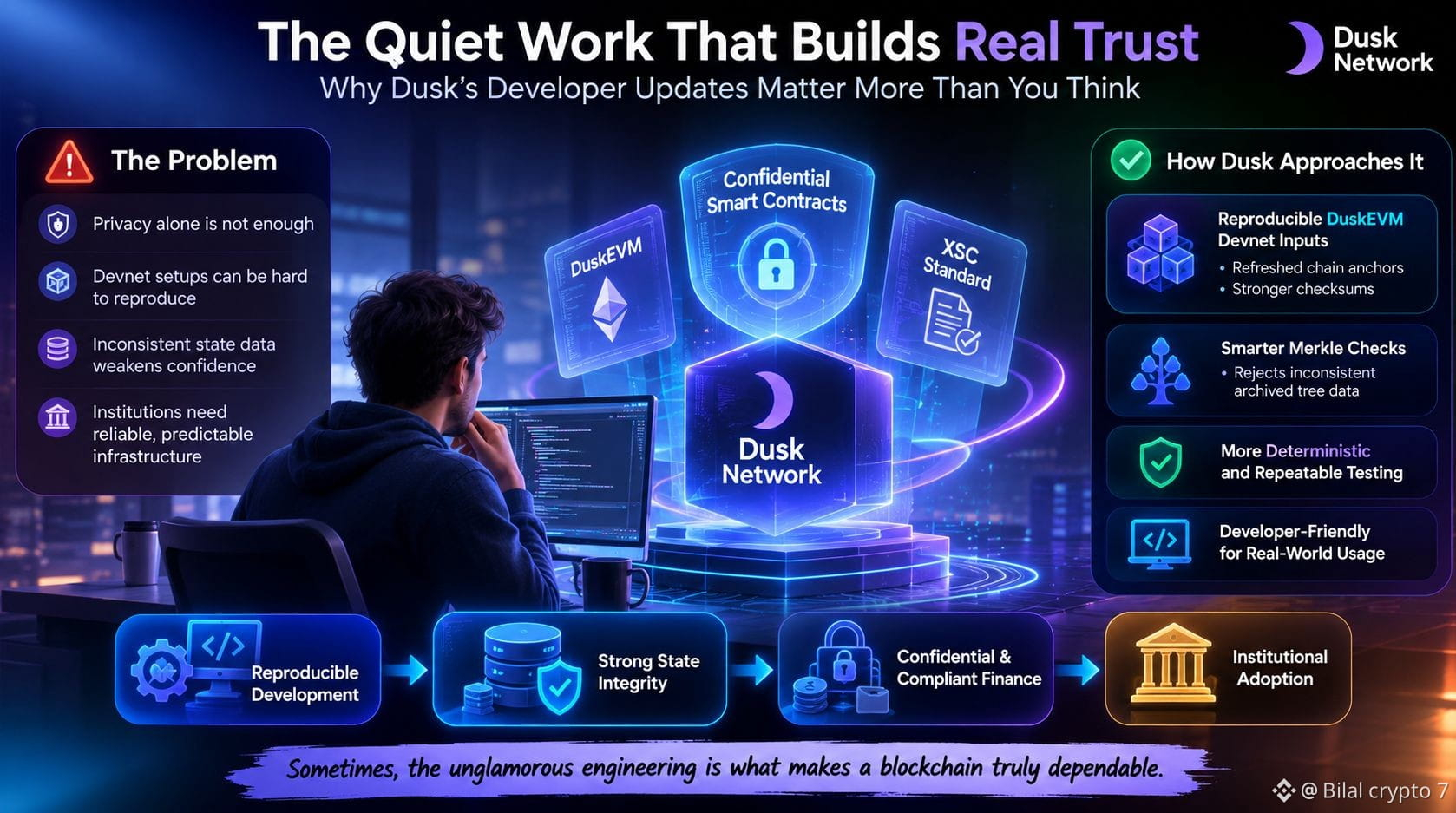
One thing I noticed in Dusk’s recent developer updates wasn’t a flashy feature. It was the quieter work around reproducibility and keeping blockchain state consistent.
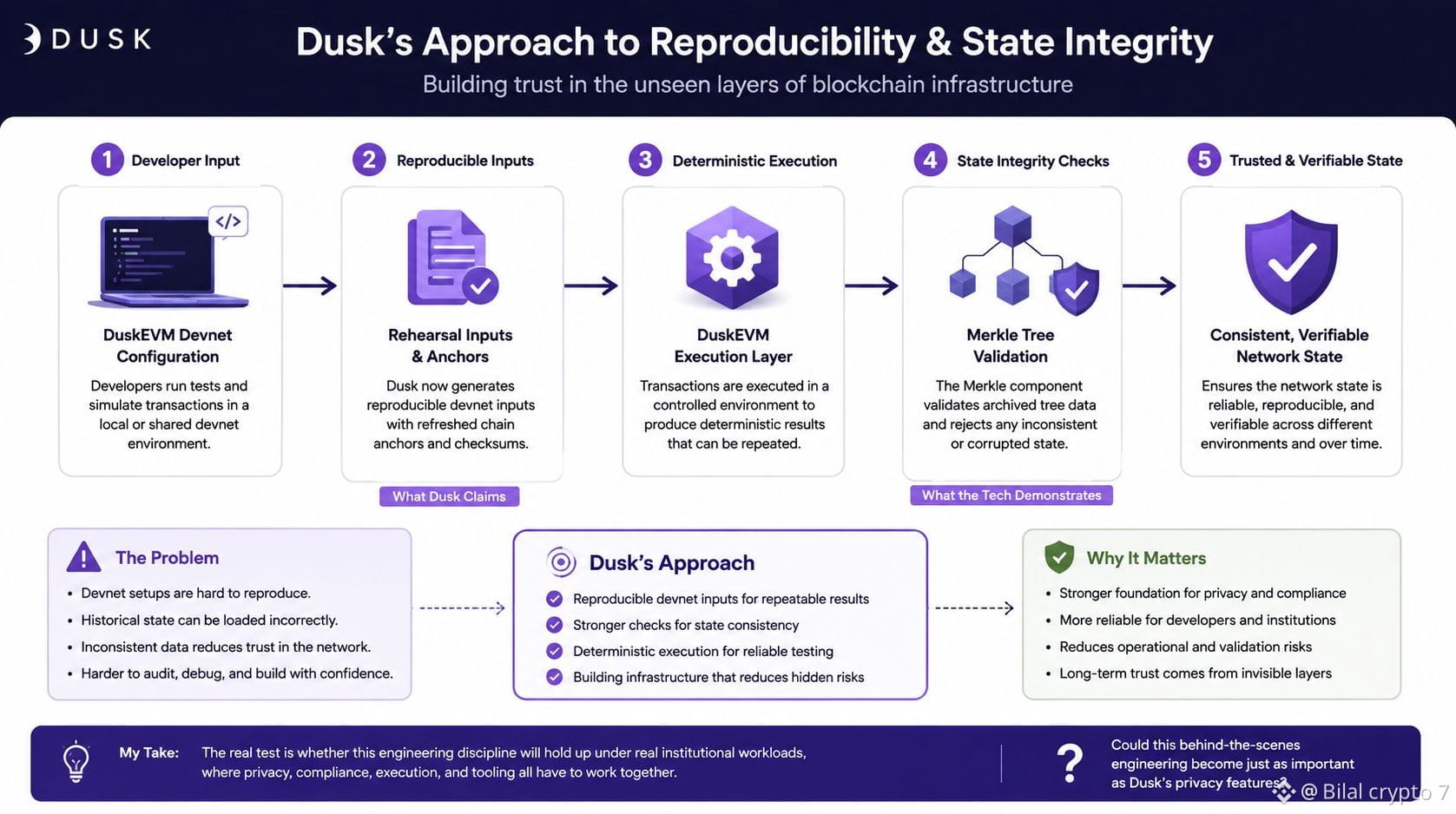
That matters because privacy alone doesn’t make infrastructure trustworthy. If developers can’t reliably reproduce a devnet setup, or old state can be loaded incorrectly, even good technology becomes harder to depend on.
Dusk has been working on reproducible DuskEVM devnet inputs, including refreshed chain anchors and checksums. Its Merkle work also adds checks to reject inconsistent archived tree data.
I actually find this more interesting than another big feature announcement. It shows attention to the small engineering problems that can become painful later.
Still, I have some doubt. Passing these technical checks is one thing; proving the system stays dependable under real workloads is another.
Could this kind of behind-the-scenes engineering end up being just as important as Dusk’s privacy features?
@Dusk_Foundation #dusk $DUSK
{spot}(DUSKUSDT)
One thing I noticed in Dusk’s recent developer updates wasn’t a flashy feature. It was the quieter work around reproducibility and keeping blockchain state consistent.
That matters because privacy alone doesn’t make infrastructure trustworthy. If developers can’t reliably reproduce a devnet setup, or old state can be loaded incorrectly, even good technology becomes harder to depend on.
Dusk has been working on reproducible DuskEVM devnet inputs, including refreshed chain anchors and checksums. Its Merkle work also adds checks to reject inconsistent archived tree data.
I actually find this more interesting than another big feature announcement. It shows attention to the small engineering problems that can become painful later.
Still, I have some doubt. Passing these technical checks is one thing; proving the system stays dependable under real workloads is another.
Could this kind of behind-the-scenes engineering end up being just as important as Dusk’s privacy features?
@Dusk #dusk $DUSK
That matters because privacy alone doesn’t make infrastructure trustworthy. If developers can’t reliably reproduce a devnet setup, or old state can be loaded incorrectly, even good technology becomes harder to depend on.
Dusk has been working on reproducible DuskEVM devnet inputs, including refreshed chain anchors and checksums. Its Merkle work also adds checks to reject inconsistent archived tree data.
I actually find this more interesting than another big feature announcement. It shows attention to the small engineering problems that can become painful later.
Still, I have some doubt. Passing these technical checks is one thing; proving the system stays dependable under real workloads is another.
Could this kind of behind-the-scenes engineering end up being just as important as Dusk’s privacy features?
@Dusk #dusk $DUSK
5
5
189
·
--
Bearish
I’ve noticed that new blockchains often face a simple problem: developers don’t want to relearn everything just to try another network.
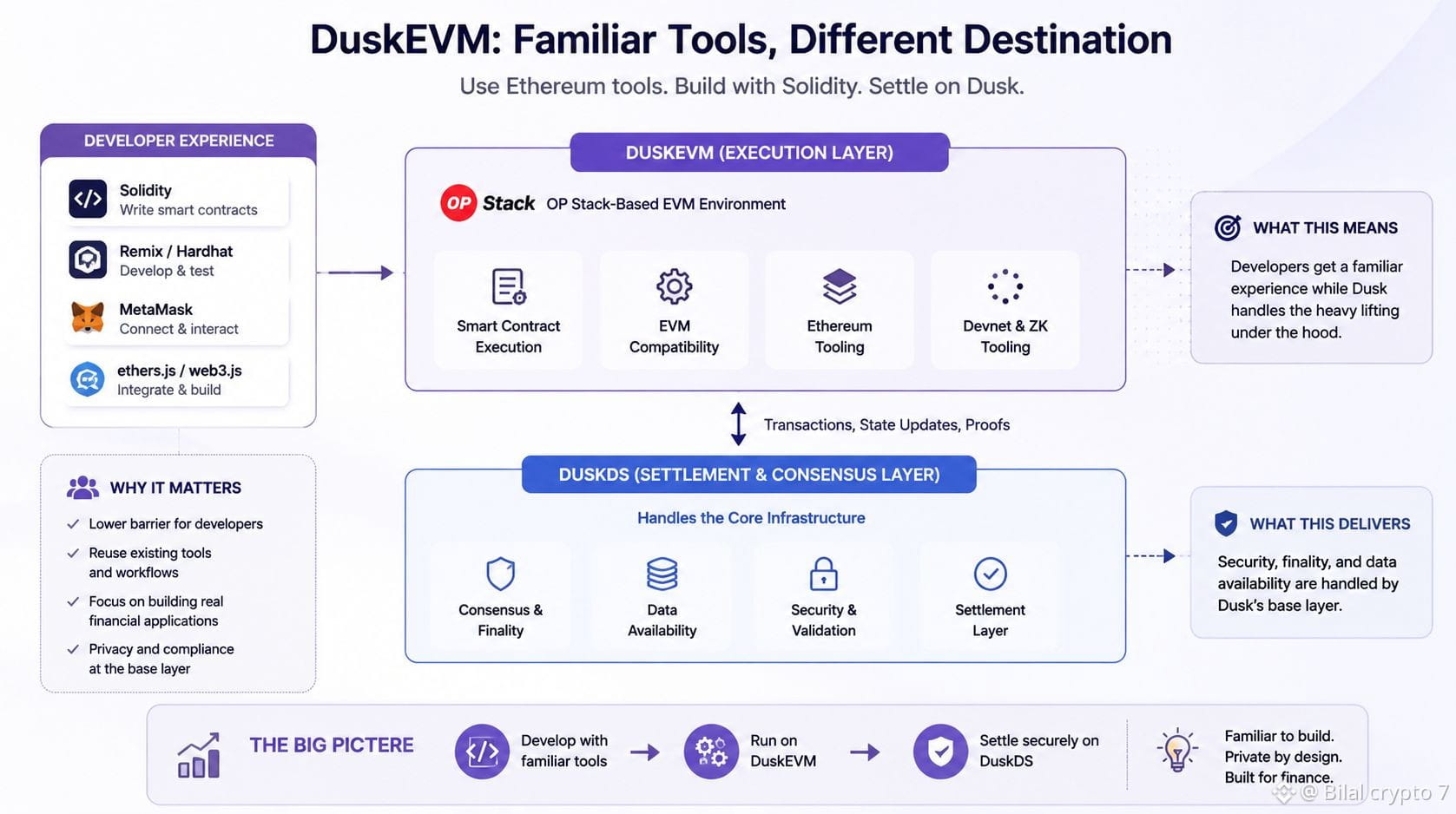
That’s where DuskEVM makes sense to me. Dusk is bringing an EVM environment to its network, allowing developers to work with Solidity and familiar Ethereum tooling while using Dusk’s underlying infrastructure for consensus, finality, and data availability.
I like this approach because lowering the technical barrier matters. If I were a developer, being able to reuse tools and knowledge I already have would make experimenting with Dusk much easier.
But I’m still skeptical about what comes next.
I’ve seen EVM compatibility become almost a checkbox across crypto. It can make deployment easier, but it doesn’t automatically bring users, liquidity, or developers who actually want to stay.
For me, the interesting part is whether DuskEVM can connect that familiar developer experience with Dusk’s focus on privacy and financial applications. That’s a much harder problem than simply supporting Solidity.
So I’m watching adoption more than the feature list.
Can DuskEVM turn familiar Ethereum tooling into a genuinely different reason for developers to build on Dusk?
@Dusk_Foundation #dusk $DUSK
{spot}(DUSKUSDT)
I’ve noticed that new blockchains often face a simple problem: developers don’t want to relearn everything just to try another network.
That’s where DuskEVM makes sense to me. Dusk is bringing an EVM environment to its network, allowing developers to work with Solidity and familiar Ethereum tooling while using Dusk’s underlying infrastructure for consensus, finality, and data availability.
I like this approach because lowering the technical barrier matters. If I were a developer, being able to reuse tools and knowledge I already have would make experimenting with Dusk much easier.
But I’m still skeptical about what comes next.
I’ve seen EVM compatibility become almost a checkbox across crypto. It can make deployment easier, but it doesn’t automatically bring users, liquidity, or developers who actually want to stay.
For me, the interesting part is whether DuskEVM can connect that familiar developer experience with Dusk’s focus on privacy and financial applications. That’s a much harder problem than simply supporting Solidity.
So I’m watching adoption more than the feature list.
Can DuskEVM turn familiar Ethereum tooling into a genuinely different reason for developers to build on Dusk?
@Dusk #dusk $DUSK
That’s where DuskEVM makes sense to me. Dusk is bringing an EVM environment to its network, allowing developers to work with Solidity and familiar Ethereum tooling while using Dusk’s underlying infrastructure for consensus, finality, and data availability.
I like this approach because lowering the technical barrier matters. If I were a developer, being able to reuse tools and knowledge I already have would make experimenting with Dusk much easier.
But I’m still skeptical about what comes next.
I’ve seen EVM compatibility become almost a checkbox across crypto. It can make deployment easier, but it doesn’t automatically bring users, liquidity, or developers who actually want to stay.
For me, the interesting part is whether DuskEVM can connect that familiar developer experience with Dusk’s focus on privacy and financial applications. That’s a much harder problem than simply supporting Solidity.
So I’m watching adoption more than the feature list.
Can DuskEVM turn familiar Ethereum tooling into a genuinely different reason for developers to build on Dusk?
@Dusk #dusk $DUSK
2
1
189
·
--
Bearish
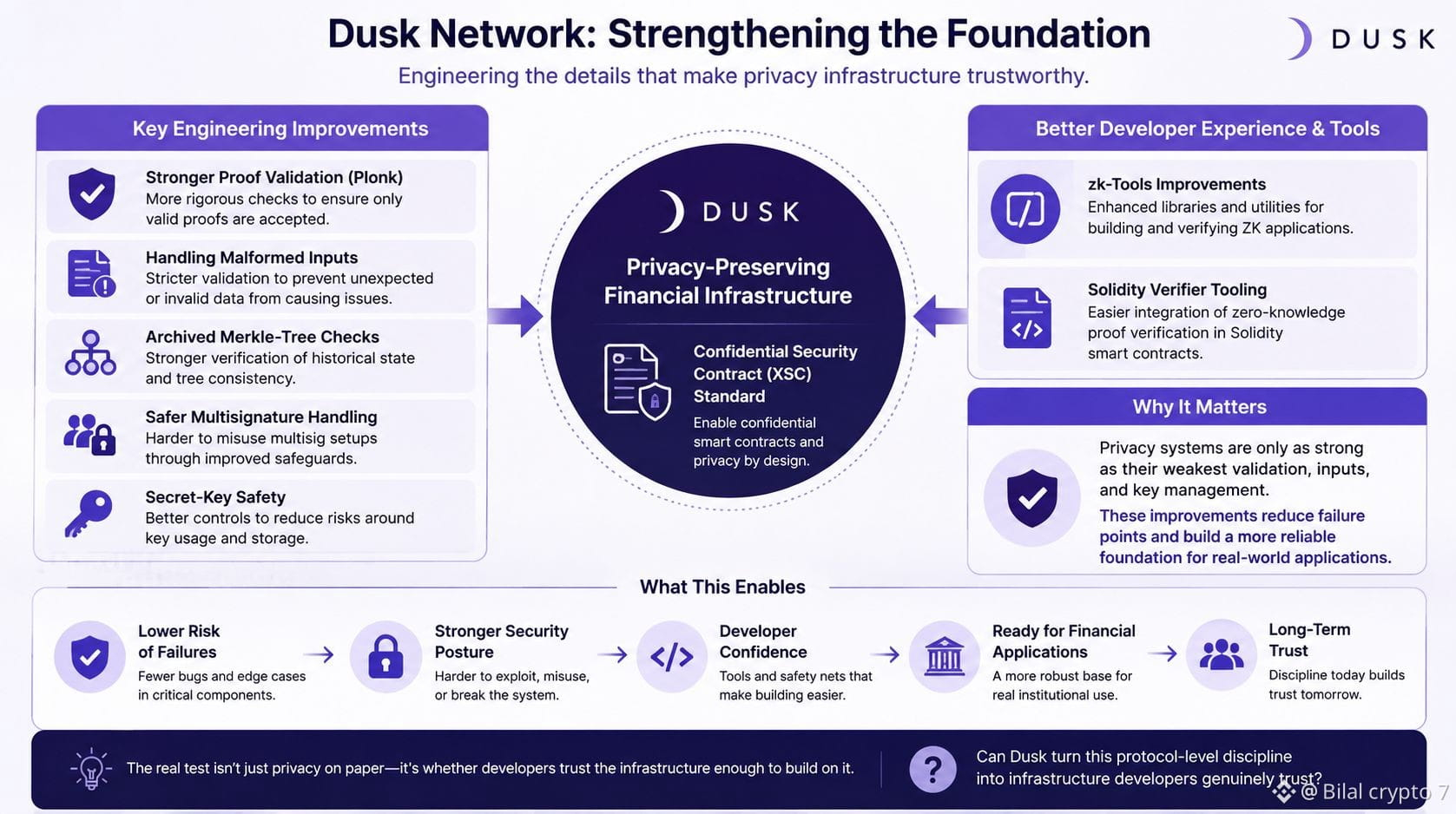
I’ve been digging into Dusk again, and I keep coming back to something that doesn’t get much attention: the boring engineering work underneath the privacy story.
What caught my eye is the recent focus on proof validation, malformed inputs, Merkle-tree checks, multisig handling, and secret-key safety. Dusk has also been improving its zk-tools with Solidity verifier tooling.
I actually like seeing this side of the project. I’ve watched plenty of crypto projects make big claims about privacy while the less exciting security details get pushed into the background.
Of course, better validation doesn’t prove that Dusk will achieve institutional adoption. It doesn’t magically remove security risks either. But I think reducing small failure points matters, especially when financial applications are involved.
For me, the interesting question isn’t whether Dusk can make privacy sound impressive. It’s whether developers will eventually trust the underlying infrastructure enough to build serious applications on it.
I’m watching that part closely.
@Dusk_Foundation #dusk $DUSK
{spot}(DUSKUSDT)
I’ve been digging into Dusk again, and I keep coming back to something that doesn’t get much attention: the boring engineering work underneath the privacy story.
What caught my eye is the recent focus on proof validation, malformed inputs, Merkle-tree checks, multisig handling, and secret-key safety. Dusk has also been improving its zk-tools with Solidity verifier tooling.
I actually like seeing this side of the project. I’ve watched plenty of crypto projects make big claims about privacy while the less exciting security details get pushed into the background.
Of course, better validation doesn’t prove that Dusk will achieve institutional adoption. It doesn’t magically remove security risks either. But I think reducing small failure points matters, especially when financial applications are involved.
For me, the interesting question isn’t whether Dusk can make privacy sound impressive. It’s whether developers will eventually trust the underlying infrastructure enough to build serious applications on it.
I’m watching that part closely.
@Dusk #dusk $DUSK
What caught my eye is the recent focus on proof validation, malformed inputs, Merkle-tree checks, multisig handling, and secret-key safety. Dusk has also been improving its zk-tools with Solidity verifier tooling.
I actually like seeing this side of the project. I’ve watched plenty of crypto projects make big claims about privacy while the less exciting security details get pushed into the background.
Of course, better validation doesn’t prove that Dusk will achieve institutional adoption. It doesn’t magically remove security risks either. But I think reducing small failure points matters, especially when financial applications are involved.
For me, the interesting question isn’t whether Dusk can make privacy sound impressive. It’s whether developers will eventually trust the underlying infrastructure enough to build serious applications on it.
I’m watching that part closely.
@Dusk #dusk $DUSK
3
3
266
·
--
Bullish
Verified
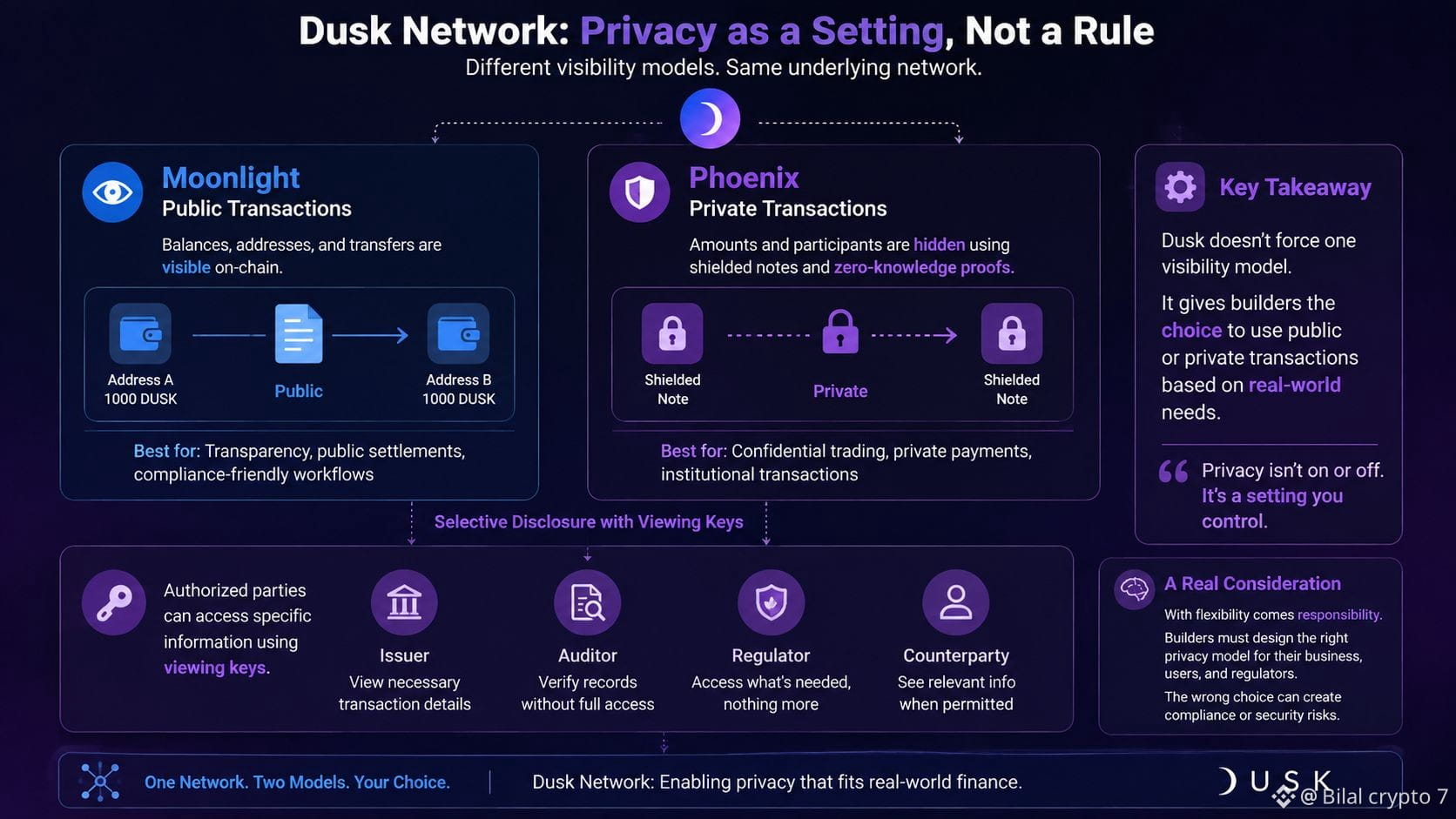
I keep thinking about how Dusk treats privacy as a setting, not a blanket rule.
The problem is that financial markets rarely fit neatly into everything public or everything private. A transaction may need confidentiality from the market while still requiring evidence for an issuer, auditor, or regulator.
Dusk approaches this with two native transaction models. Moonlight keeps balances and transfers public, while Phoenix uses shielded notes and zero-knowledge proofs to hide transferred amounts and participants. Dusk also describes selective disclosure through viewing keys when authorized parties need specific information.
That distinction matters. Dusk’s claim is not that every transaction should be private; its architecture demonstrates that different visibility models can settle on the same underlying network. Its docs explicitly frame privacy as something builders can choose depending on the workflow.
I do wonder, though, whether flexibility creates another challenge: developers must make the privacy model correctly match the business and regulatory requirements.
If privacy becomes configurable infrastructure, does that make blockchain more practical for finance—or more complicated to build correctly?
@Dusk_Foundation #dusk $DUSK
{spot}(DUSKUSDT)
I keep thinking about how Dusk treats privacy as a setting, not a blanket rule.
The problem is that financial markets rarely fit neatly into everything public or everything private. A transaction may need confidentiality from the market while still requiring evidence for an issuer, auditor, or regulator.
Dusk approaches this with two native transaction models. Moonlight keeps balances and transfers public, while Phoenix uses shielded notes and zero-knowledge proofs to hide transferred amounts and participants. Dusk also describes selective disclosure through viewing keys when authorized parties need specific information.
That distinction matters. Dusk’s claim is not that every transaction should be private; its architecture demonstrates that different visibility models can settle on the same underlying network. Its docs explicitly frame privacy as something builders can choose depending on the workflow.
I do wonder, though, whether flexibility creates another challenge: developers must make the privacy model correctly match the business and regulatory requirements.
If privacy becomes configurable infrastructure, does that make blockchain more practical for finance—or more complicated to build correctly?
@Dusk #dusk $DUSK
The problem is that financial markets rarely fit neatly into everything public or everything private. A transaction may need confidentiality from the market while still requiring evidence for an issuer, auditor, or regulator.
Dusk approaches this with two native transaction models. Moonlight keeps balances and transfers public, while Phoenix uses shielded notes and zero-knowledge proofs to hide transferred amounts and participants. Dusk also describes selective disclosure through viewing keys when authorized parties need specific information.
That distinction matters. Dusk’s claim is not that every transaction should be private; its architecture demonstrates that different visibility models can settle on the same underlying network. Its docs explicitly frame privacy as something builders can choose depending on the workflow.
I do wonder, though, whether flexibility creates another challenge: developers must make the privacy model correctly match the business and regulatory requirements.
If privacy becomes configurable infrastructure, does that make blockchain more practical for finance—or more complicated to build correctly?
@Dusk #dusk $DUSK
2
2
1.4k
·
--
Bearish
Verified
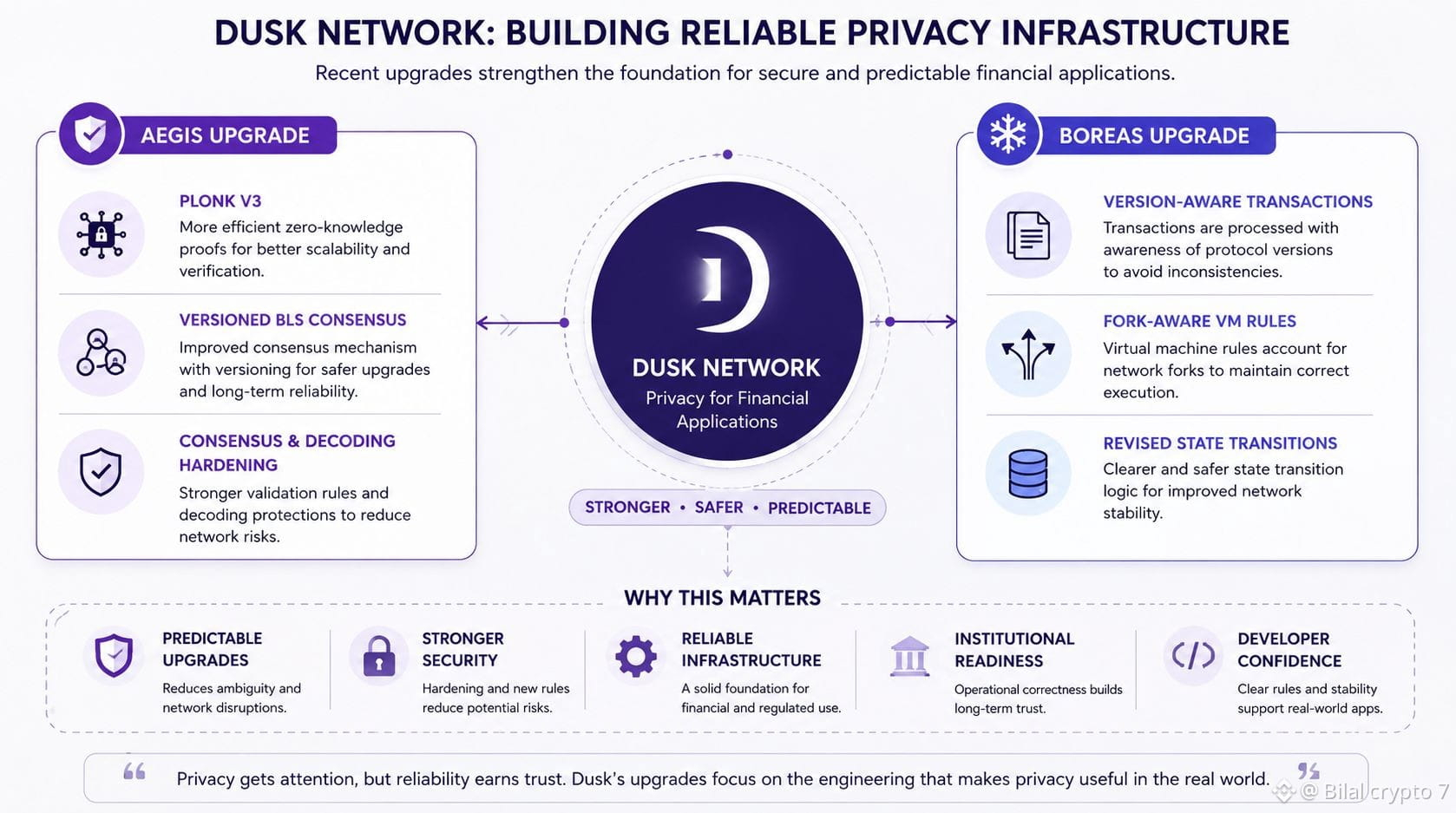
I’ve been looking at Dusk from a slightly different angle lately: not just its privacy technology, but how the network handles the boring engineering work underneath it.
Recent upgrades like Aegis and Boreas caught my attention because they focus on things such as consensus changes, transaction handling, VM rules and network hardening. It’s not the kind of update that creates much excitement, but I think it matters if Dusk wants to support serious financial applications.
I see privacy as only one piece of the puzzle. If the underlying network can’t evolve safely and predictably, privacy alone won’t solve much.
At the same time, I’m still cautious. Reading about protocol improvements is very different from watching them perform during heavy usage, unexpected failures or complex applications.
What I find interesting about Dusk is that the team seems to be spending time on those less visible layers of infrastructure.
I’m curious whether that careful engineering can eventually become one of Dusk’s strongest advantages.
@Dusk_Foundation #dusk $DUSK
{spot}(DUSKUSDT)
I’ve been looking at Dusk from a slightly different angle lately: not just its privacy technology, but how the network handles the boring engineering work underneath it.
Recent upgrades like Aegis and Boreas caught my attention because they focus on things such as consensus changes, transaction handling, VM rules and network hardening. It’s not the kind of update that creates much excitement, but I think it matters if Dusk wants to support serious financial applications.
I see privacy as only one piece of the puzzle. If the underlying network can’t evolve safely and predictably, privacy alone won’t solve much.
At the same time, I’m still cautious. Reading about protocol improvements is very different from watching them perform during heavy usage, unexpected failures or complex applications.
What I find interesting about Dusk is that the team seems to be spending time on those less visible layers of infrastructure.
I’m curious whether that careful engineering can eventually become one of Dusk’s strongest advantages.
@Dusk #dusk $DUSK
Recent upgrades like Aegis and Boreas caught my attention because they focus on things such as consensus changes, transaction handling, VM rules and network hardening. It’s not the kind of update that creates much excitement, but I think it matters if Dusk wants to support serious financial applications.
I see privacy as only one piece of the puzzle. If the underlying network can’t evolve safely and predictably, privacy alone won’t solve much.
At the same time, I’m still cautious. Reading about protocol improvements is very different from watching them perform during heavy usage, unexpected failures or complex applications.
What I find interesting about Dusk is that the team seems to be spending time on those less visible layers of infrastructure.
I’m curious whether that careful engineering can eventually become one of Dusk’s strongest advantages.
@Dusk #dusk $DUSK
4
5
1.5k
·
--
Bullish
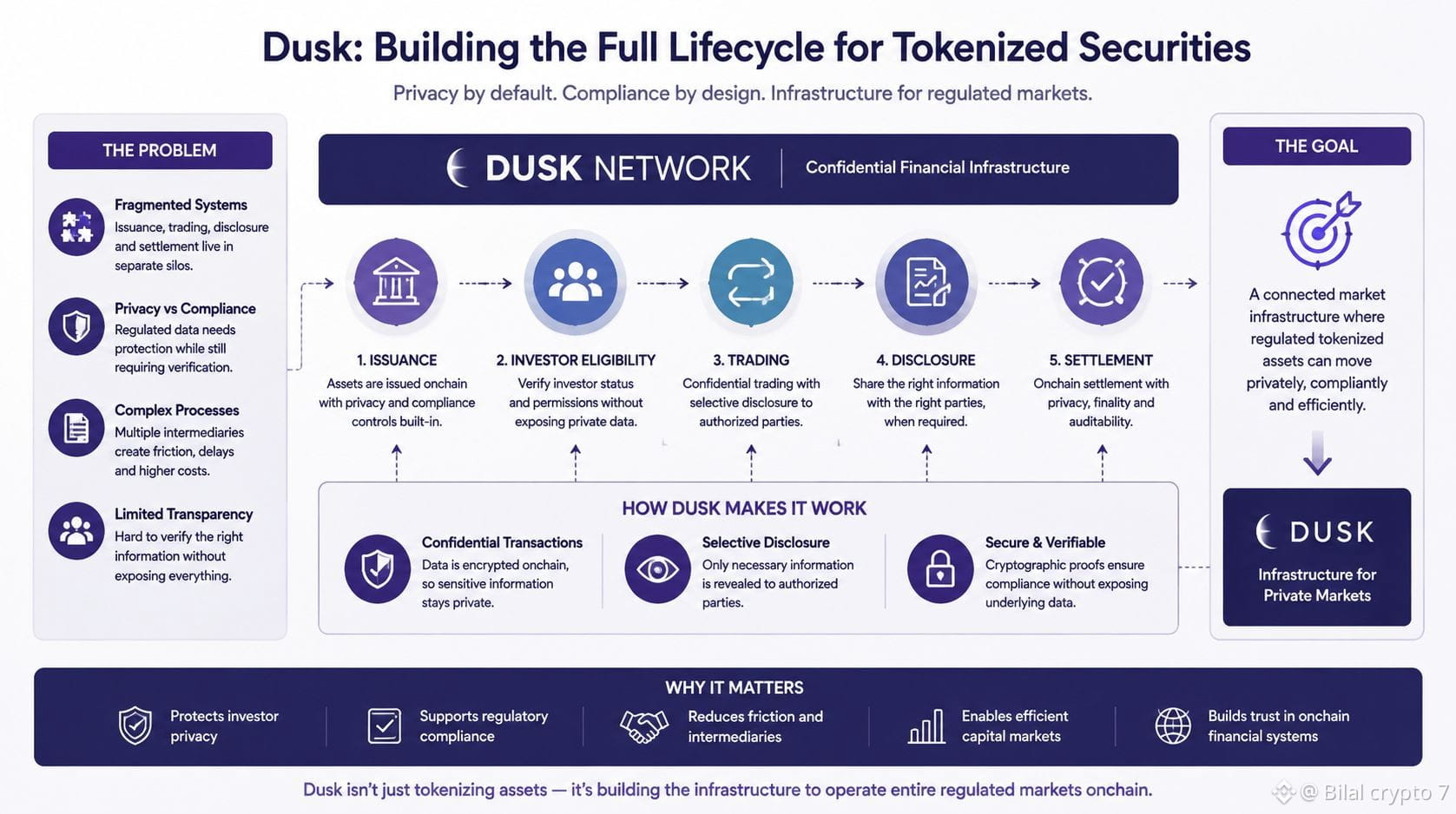
I’ve noticed that a lot of tokenization discussions focus on the asset itself. Put a bond or security onchain, and it sounds like the hard part is done.
I don’t think it’s that simple.
For me, the real challenge is everything around the asset: who is allowed to hold it, what information must be shared, how transfers are checked, and how settlement happens without exposing more data than necessary.
That’s one reason I find Dusk interesting. Its approach combines confidential transactions with ways to prove or disclose specific information when required. In theory, that could give regulated financial markets something blockchains have often struggled with: privacy without completely losing compliance.
But I’m still cautious.
Technology can solve a lot of the infrastructure problem, but it can’t magically create liquidity, institutional demand, or clear legal responsibility. Those are adoption questions, not cryptography questions.
I think Dusk becomes much more interesting if it can make regulated markets feel simpler rather than just putting existing processes onchain.
Can privacy actually reduce friction in financial markets, or will the regulatory complexity simply show up somewhere else?
@Dusk_Foundation $DUSK #dusk
{spot}(DUSKUSDT)
I’ve noticed that a lot of tokenization discussions focus on the asset itself. Put a bond or security onchain, and it sounds like the hard part is done.
I don’t think it’s that simple.
For me, the real challenge is everything around the asset: who is allowed to hold it, what information must be shared, how transfers are checked, and how settlement happens without exposing more data than necessary.
That’s one reason I find Dusk interesting. Its approach combines confidential transactions with ways to prove or disclose specific information when required. In theory, that could give regulated financial markets something blockchains have often struggled with: privacy without completely losing compliance.
But I’m still cautious.
Technology can solve a lot of the infrastructure problem, but it can’t magically create liquidity, institutional demand, or clear legal responsibility. Those are adoption questions, not cryptography questions.
I think Dusk becomes much more interesting if it can make regulated markets feel simpler rather than just putting existing processes onchain.
Can privacy actually reduce friction in financial markets, or will the regulatory complexity simply show up somewhere else?
@Dusk $DUSK #dusk
I don’t think it’s that simple.
For me, the real challenge is everything around the asset: who is allowed to hold it, what information must be shared, how transfers are checked, and how settlement happens without exposing more data than necessary.
That’s one reason I find Dusk interesting. Its approach combines confidential transactions with ways to prove or disclose specific information when required. In theory, that could give regulated financial markets something blockchains have often struggled with: privacy without completely losing compliance.
But I’m still cautious.
Technology can solve a lot of the infrastructure problem, but it can’t magically create liquidity, institutional demand, or clear legal responsibility. Those are adoption questions, not cryptography questions.
I think Dusk becomes much more interesting if it can make regulated markets feel simpler rather than just putting existing processes onchain.
Can privacy actually reduce friction in financial markets, or will the regulatory complexity simply show up somewhere else?
@Dusk $DUSK #dusk
11
8
1.3k
·
--
Bullish
One thing I keep coming back to with Dusk Network is security.
Privacy gets most of the attention, but I think the boring stuff underneath matters just as much for a financial blockchain. If the execution layer has a weakness, fancy cryptography doesn’t mean much.
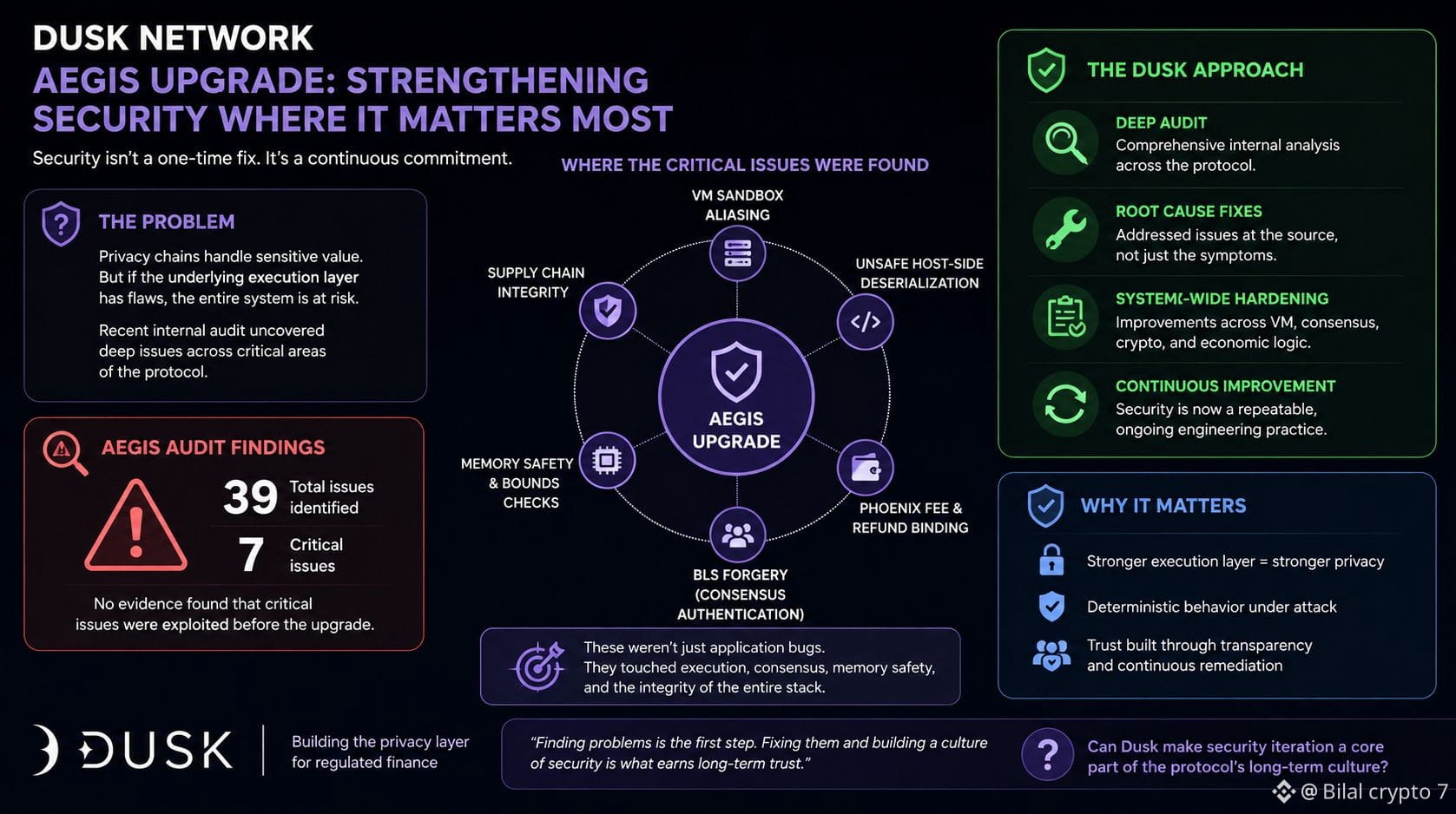
Dusk’s AEGIS upgrade caught my attention because it wasn’t just about polishing the edges. Dusk says the audit uncovered 39 issues, including seven critical ones, involving areas like VM sandboxing, deserialization, fee handling, and BLS signatures.
What I find interesting is that these problems weren’t all sitting in one corner of the stack. They touched execution, security and how the network handles transactions.
I’ve watched enough projects to know that an audit itself doesn’t prove much. Finding problems is useful, but I care more about what happens afterward. Are the fixes properly tested? Does the team keep looking for weaknesses? Does security become part of the development process?
That’s where I’m still a little cautious with Dusk. Good remediation is encouraging, but it has to become a habit.
I’m curious whether Dusk can make that security discipline part of the protocol’s long-term culture.
@Dusk_Foundation #dusk $DUSK
{spot}(DUSKUSDT)
One thing I keep coming back to with Dusk Network is security.
Privacy gets most of the attention, but I think the boring stuff underneath matters just as much for a financial blockchain. If the execution layer has a weakness, fancy cryptography doesn’t mean much.
Dusk’s AEGIS upgrade caught my attention because it wasn’t just about polishing the edges. Dusk says the audit uncovered 39 issues, including seven critical ones, involving areas like VM sandboxing, deserialization, fee handling, and BLS signatures.
What I find interesting is that these problems weren’t all sitting in one corner of the stack. They touched execution, security and how the network handles transactions.
I’ve watched enough projects to know that an audit itself doesn’t prove much. Finding problems is useful, but I care more about what happens afterward. Are the fixes properly tested? Does the team keep looking for weaknesses? Does security become part of the development process?
That’s where I’m still a little cautious with Dusk. Good remediation is encouraging, but it has to become a habit.
I’m curious whether Dusk can make that security discipline part of the protocol’s long-term culture.
@Dusk #dusk $DUSK
Privacy gets most of the attention, but I think the boring stuff underneath matters just as much for a financial blockchain. If the execution layer has a weakness, fancy cryptography doesn’t mean much.
Dusk’s AEGIS upgrade caught my attention because it wasn’t just about polishing the edges. Dusk says the audit uncovered 39 issues, including seven critical ones, involving areas like VM sandboxing, deserialization, fee handling, and BLS signatures.
What I find interesting is that these problems weren’t all sitting in one corner of the stack. They touched execution, security and how the network handles transactions.
I’ve watched enough projects to know that an audit itself doesn’t prove much. Finding problems is useful, but I care more about what happens afterward. Are the fixes properly tested? Does the team keep looking for weaknesses? Does security become part of the development process?
That’s where I’m still a little cautious with Dusk. Good remediation is encouraging, but it has to become a habit.
I’m curious whether Dusk can make that security discipline part of the protocol’s long-term culture.
@Dusk #dusk $DUSK
8
8
355
·
--
Bullish
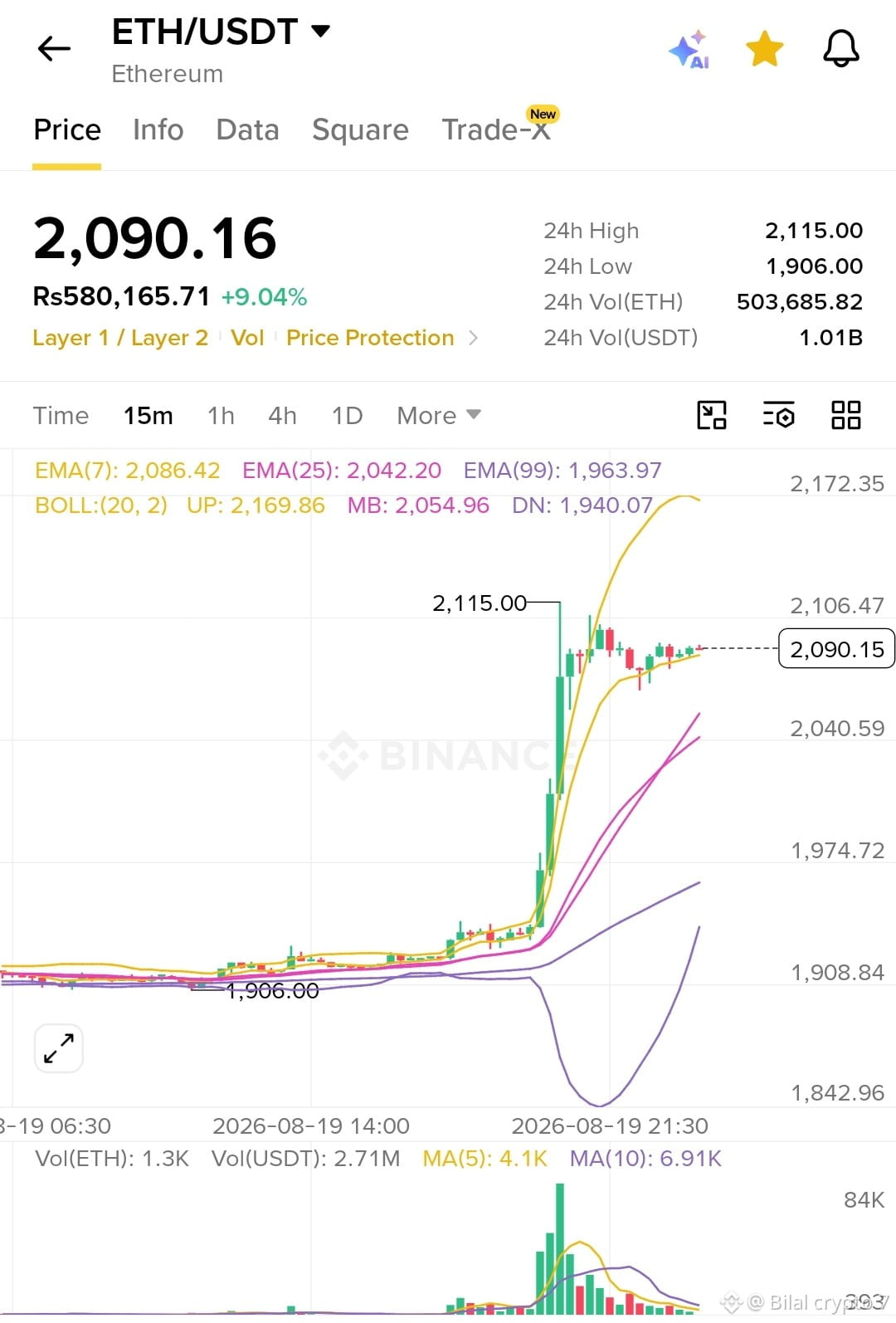
$ETH Ethereum is showing a strong move today, trading around $2,090 after pushing from the $1,906 low. The 24h gain is above 9%, but I’m more interested in what happens next than the percentage itself.
On the 15-minute chart, ETH is holding above the EMA(7) near $2,086 and remains comfortably above the EMA(25) around $2,042 and EMA(99) near $1,964. That tells me short-term momentum is still positive.
The bigger question is resistance. ETH already tested the $2,115 area, while the Bollinger upper band sits near $2,170. If buyers can break and hold above $2,115, the next move could become more interesting. But if price gets rejected again, a pullback toward $2,055–$2,040 wouldn’t surprise me.
Volume is also significant, with more than $1B in 24h USDT volume.
I wouldn’t chase this candle. I’d rather watch whether ETH can turn resistance into support. That’s where the real strength will become clearer.
#WyomingMovesFRNTToChainlinkCCIP #ColdcardTheftInvestigationAdvances
#UAESaysItDetectedTwoIranianBallisticMissiles
{spot}(ETHUSDT)
$ETH Ethereum is showing a strong move today, trading around $2,090 after pushing from the $1,906 low. The 24h gain is above 9%, but I’m more interested in what happens next than the percentage itself.
On the 15-minute chart, ETH is holding above the EMA(7) near $2,086 and remains comfortably above the EMA(25) around $2,042 and EMA(99) near $1,964. That tells me short-term momentum is still positive.
The bigger question is resistance. ETH already tested the $2,115 area, while the Bollinger upper band sits near $2,170. If buyers can break and hold above $2,115, the next move could become more interesting. But if price gets rejected again, a pullback toward $2,055–$2,040 wouldn’t surprise me.
Volume is also significant, with more than $1B in 24h USDT volume.
I wouldn’t chase this candle. I’d rather watch whether ETH can turn resistance into support. That’s where the real strength will become clearer.
#WyomingMovesFRNTToChainlinkCCIP #ColdcardTheftInvestigationAdvances
#UAESaysItDetectedTwoIranianBallisticMissiles
On the 15-minute chart, ETH is holding above the EMA(7) near $2,086 and remains comfortably above the EMA(25) around $2,042 and EMA(99) near $1,964. That tells me short-term momentum is still positive.
The bigger question is resistance. ETH already tested the $2,115 area, while the Bollinger upper band sits near $2,170. If buyers can break and hold above $2,115, the next move could become more interesting. But if price gets rejected again, a pullback toward $2,055–$2,040 wouldn’t surprise me.
Volume is also significant, with more than $1B in 24h USDT volume.
I wouldn’t chase this candle. I’d rather watch whether ETH can turn resistance into support. That’s where the real strength will become clearer.
#WyomingMovesFRNTToChainlinkCCIP #ColdcardTheftInvestigationAdvances
#UAESaysItDetectedTwoIranianBallisticMissiles
1
166
·
--
Bullish
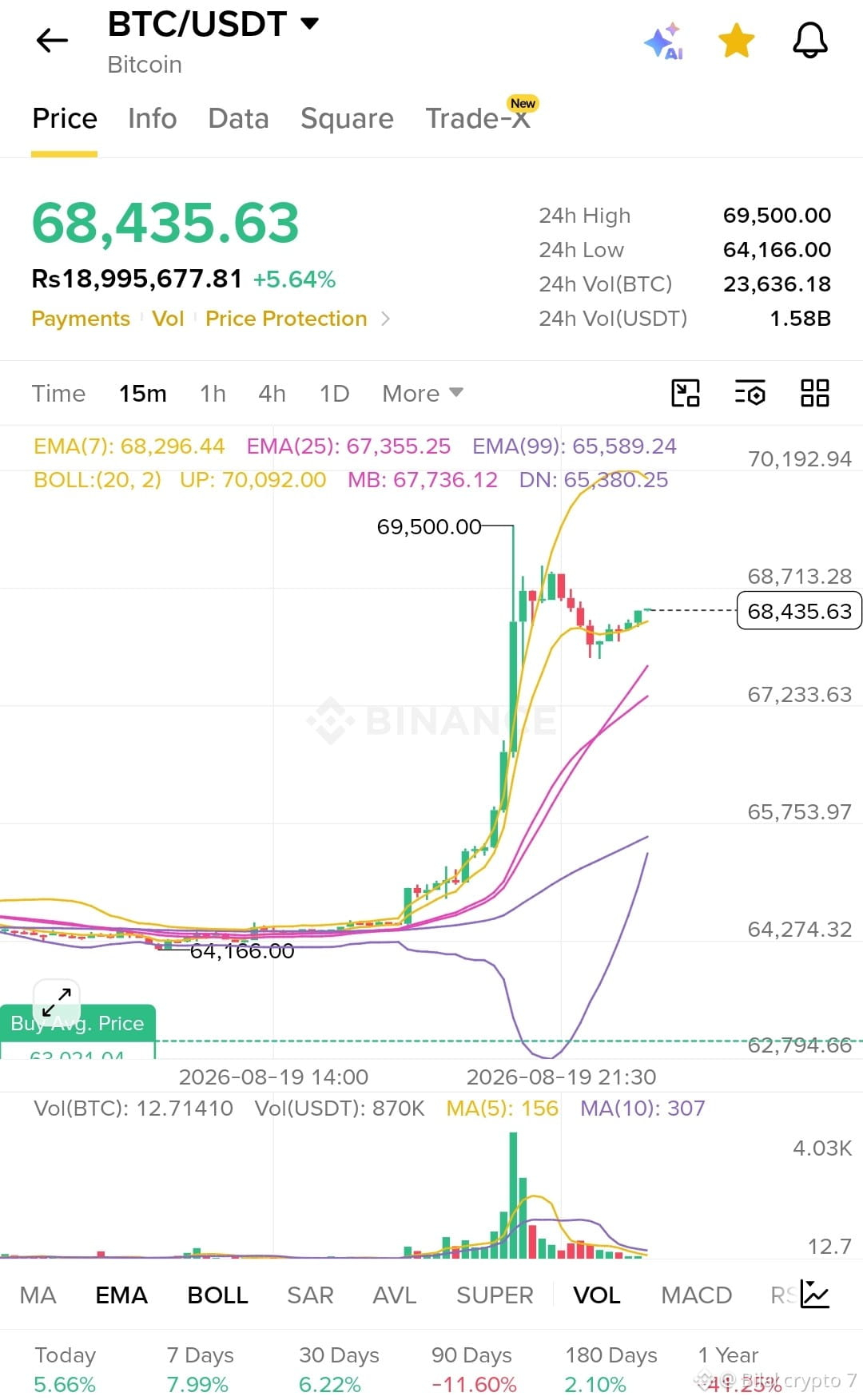
$BTC is showing strong momentum after reclaiming $68K. The 15m chart has price above EMA(7), EMA(25), and EMA(99), while volume spiked during the breakout. I’m watching $69.5K as the key resistance and $67.7K as the near-term support zone. If buyers hold above support, momentum could stay strong.
$BTC
#ColdcardTheftInvestigationAdvances #CryptoRally #ToyotaFinanceLaunchesTokenizedBondForRetail
$BTC is showing strong momentum after reclaiming $68K. The 15m chart has price above EMA(7), EMA(25), and EMA(99), while volume spiked during the breakout. I’m watching $69.5K as the key resistance and $67.7K as the near-term support zone. If buyers hold above support, momentum could stay strong.
$BTC
#ColdcardTheftInvestigationAdvances #CryptoRally #ToyotaFinanceLaunchesTokenizedBondForRetail
$BTC
#ColdcardTheftInvestigationAdvances #CryptoRally #ToyotaFinanceLaunchesTokenizedBondForRetail
141
·
--
Bullish
$BNB
{spot}(BNBUSDT)
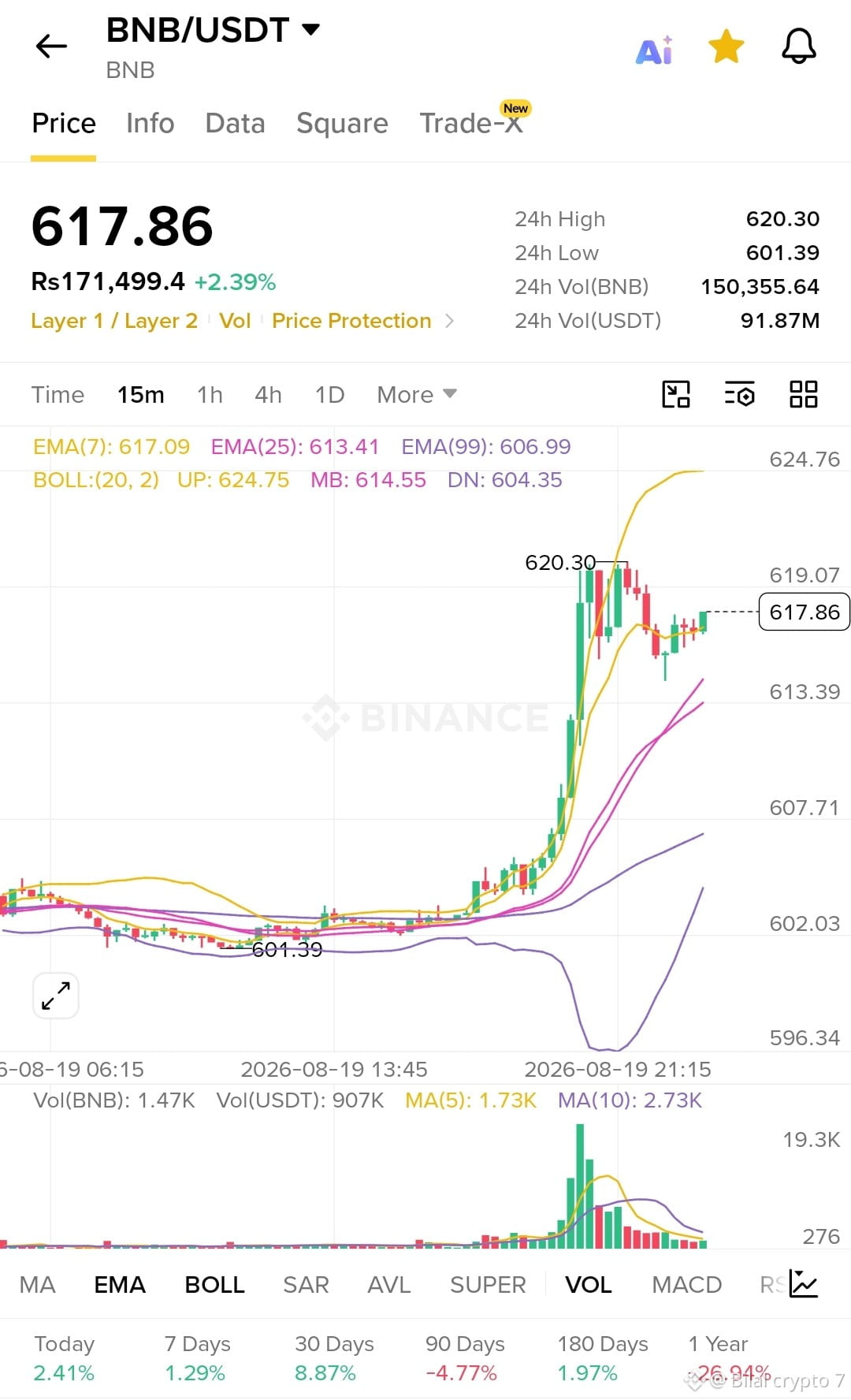
USDT — $617.86 (+2.39%)**
Sharp move off $601.39 to a 24h high of $620.30, now holding steady above $617. Volume spiked hard on the breakout, then eased as price settled into the new range.
What's actually behind it:
📊 BNB ranked #2 in the new S&P/Pantera Digital Asset Index — screened purely on protocol revenue
👥 BNB Chain averaging ~4.5M daily active users this year
🔧 Network upgrade scheduled Aug 25 (some exchanges will pause deposits/withdrawals)
⚠️ BNB Chain also pursuing legal action over an unauthorized token launched via an old employee wallet
7D: +1.29% | 30D: +8.87% | 1Y: -26.94%
**Takeaway:** This isn't just a chart spike — it's usage and scarcity data lining up with price at the same time.
#BNB #Binance #crypto
#WyomingMovesFRNTToChainlinkCCIP #FOMCWatch
$BNB
USDT — $617.86 (+2.39%)**
Sharp move off $601.39 to a 24h high of $620.30, now holding steady above $617. Volume spiked hard on the breakout, then eased as price settled into the new range.
What's actually behind it:
📊 BNB ranked #2 in the new S&P/Pantera Digital Asset Index — screened purely on protocol revenue
👥 BNB Chain averaging ~4.5M daily active users this year
🔧 Network upgrade scheduled Aug 25 (some exchanges will pause deposits/withdrawals)
⚠️ BNB Chain also pursuing legal action over an unauthorized token launched via an old employee wallet
7D: +1.29% | 30D: +8.87% | 1Y: -26.94%
**Takeaway:** This isn't just a chart spike — it's usage and scarcity data lining up with price at the same time.
#BNB #Binance #crypto
#WyomingMovesFRNTToChainlinkCCIP #FOMCWatch
USDT — $617.86 (+2.39%)**
Sharp move off $601.39 to a 24h high of $620.30, now holding steady above $617. Volume spiked hard on the breakout, then eased as price settled into the new range.
What's actually behind it:
📊 BNB ranked #2 in the new S&P/Pantera Digital Asset Index — screened purely on protocol revenue
👥 BNB Chain averaging ~4.5M daily active users this year
🔧 Network upgrade scheduled Aug 25 (some exchanges will pause deposits/withdrawals)
⚠️ BNB Chain also pursuing legal action over an unauthorized token launched via an old employee wallet
7D: +1.29% | 30D: +8.87% | 1Y: -26.94%
**Takeaway:** This isn't just a chart spike — it's usage and scarcity data lining up with price at the same time.
#BNB #Binance #crypto
#WyomingMovesFRNTToChainlinkCCIP #FOMCWatch
184
·
--
Bullish
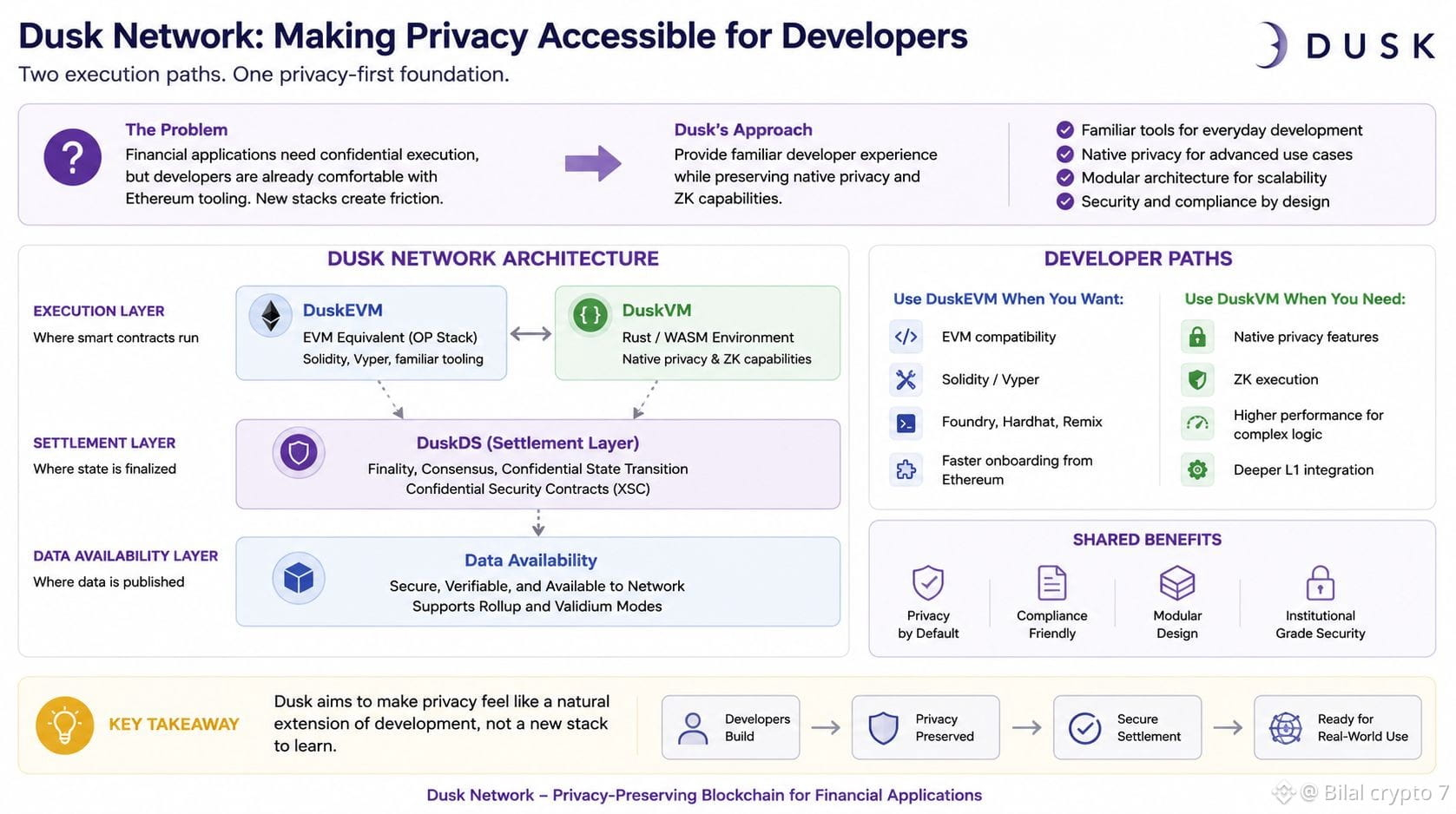
I keep coming back to one thing with Dusk: good privacy tech means very little if developers don’t actually want to build with it.
The problem feels pretty simple to me. Financial apps may need confidential execution, but most developers already know Ethereum, Solidity, Foundry, Hardhat, and the usual EVM tooling. Asking them to learn a completely different environment can become a barrier on its own.
What I find interesting about Dusk is how it approaches that problem. DuskEVM gives developers a more familiar EVM environment, while DuskDS handles settlement and data availability. Developers who want deeper access to Dusk’s native capabilities can use DuskVM, built around Rust/WASM with support for privacy and ZK execution.
I like the direction, but I’m still not completely convinced.
Supporting different execution environments sounds useful, but it also gives developers more things to understand. For me, the real test isn’t whether Dusk can support them. It’s whether developers actually choose to build there.
I think that distinction matters.
Can Dusk make private blockchain development feel normal, or will developers only care about privacy when they absolutely need it?
@Dusk_Foundation #dusk $DUSK
{spot}(DUSKUSDT)
I keep coming back to one thing with Dusk: good privacy tech means very little if developers don’t actually want to build with it.
The problem feels pretty simple to me. Financial apps may need confidential execution, but most developers already know Ethereum, Solidity, Foundry, Hardhat, and the usual EVM tooling. Asking them to learn a completely different environment can become a barrier on its own.
What I find interesting about Dusk is how it approaches that problem. DuskEVM gives developers a more familiar EVM environment, while DuskDS handles settlement and data availability. Developers who want deeper access to Dusk’s native capabilities can use DuskVM, built around Rust/WASM with support for privacy and ZK execution.
I like the direction, but I’m still not completely convinced.
Supporting different execution environments sounds useful, but it also gives developers more things to understand. For me, the real test isn’t whether Dusk can support them. It’s whether developers actually choose to build there.
I think that distinction matters.
Can Dusk make private blockchain development feel normal, or will developers only care about privacy when they absolutely need it?
@Dusk #dusk $DUSK
The problem feels pretty simple to me. Financial apps may need confidential execution, but most developers already know Ethereum, Solidity, Foundry, Hardhat, and the usual EVM tooling. Asking them to learn a completely different environment can become a barrier on its own.
What I find interesting about Dusk is how it approaches that problem. DuskEVM gives developers a more familiar EVM environment, while DuskDS handles settlement and data availability. Developers who want deeper access to Dusk’s native capabilities can use DuskVM, built around Rust/WASM with support for privacy and ZK execution.
I like the direction, but I’m still not completely convinced.
Supporting different execution environments sounds useful, but it also gives developers more things to understand. For me, the real test isn’t whether Dusk can support them. It’s whether developers actually choose to build there.
I think that distinction matters.
Can Dusk make private blockchain development feel normal, or will developers only care about privacy when they absolutely need it?
@Dusk #dusk $DUSK
12
10
133
·
--
Bullish
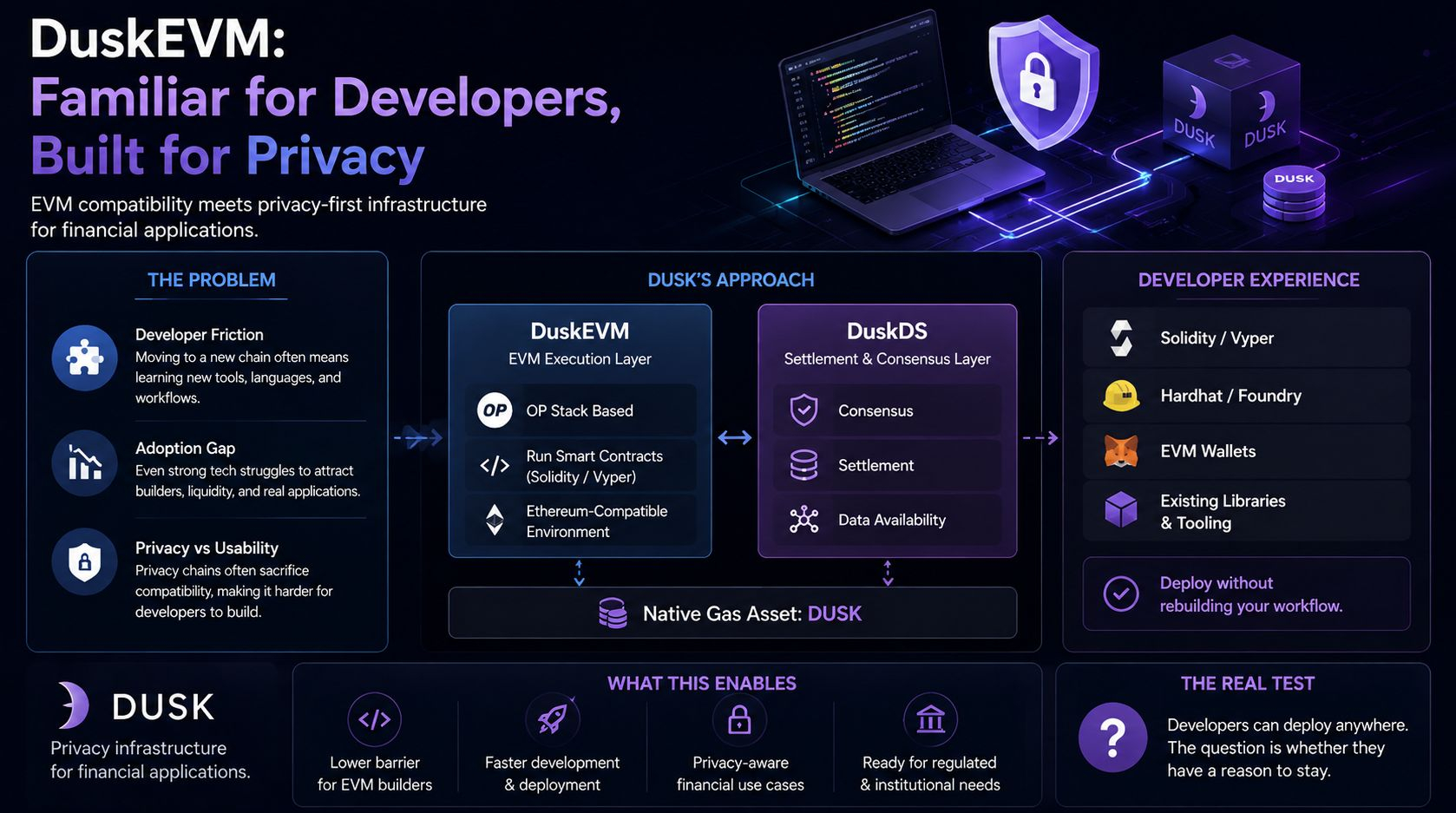
I keep coming back to one simple problem with privacy blockchains: good technology doesn’t mean much if developers find it difficult to use.
When I looked closer at Dusk, the part that caught my attention was its approach to developer access. DuskEVM supports Solidity, Vyper, and familiar Ethereum tooling, while DuskVM gives developers a native Rust/WASM environment for applications that need deeper access to Dusk’s architecture, privacy features, and zero-knowledge capabilities.
I see this as a practical balance. I can imagine a developer starting with tools they already understand, while still having a path toward features that are more specific to Dusk.
But I’m still cautious about it.
Supporting familiar tools can lower the entry barrier, but it doesn’t automatically create a strong developer ecosystem. I’ve seen plenty of projects make integration easy and still struggle to attract builders who stay for the long term.
For me, the more interesting question is not whether Dusk can support developers, but whether its privacy architecture gives them a reason to choose Dusk over the EVM environments they already know.
I’m curious: what would actually make a developer stay on Dusk after the initial experiment?
@Dusk_Foundation #dusk $DUSK
{spot}(DUSKUSDT)
I keep coming back to one simple problem with privacy blockchains: good technology doesn’t mean much if developers find it difficult to use.
When I looked closer at Dusk, the part that caught my attention was its approach to developer access. DuskEVM supports Solidity, Vyper, and familiar Ethereum tooling, while DuskVM gives developers a native Rust/WASM environment for applications that need deeper access to Dusk’s architecture, privacy features, and zero-knowledge capabilities.
I see this as a practical balance. I can imagine a developer starting with tools they already understand, while still having a path toward features that are more specific to Dusk.
But I’m still cautious about it.
Supporting familiar tools can lower the entry barrier, but it doesn’t automatically create a strong developer ecosystem. I’ve seen plenty of projects make integration easy and still struggle to attract builders who stay for the long term.
For me, the more interesting question is not whether Dusk can support developers, but whether its privacy architecture gives them a reason to choose Dusk over the EVM environments they already know.
I’m curious: what would actually make a developer stay on Dusk after the initial experiment?
@Dusk #dusk $DUSK
When I looked closer at Dusk, the part that caught my attention was its approach to developer access. DuskEVM supports Solidity, Vyper, and familiar Ethereum tooling, while DuskVM gives developers a native Rust/WASM environment for applications that need deeper access to Dusk’s architecture, privacy features, and zero-knowledge capabilities.
I see this as a practical balance. I can imagine a developer starting with tools they already understand, while still having a path toward features that are more specific to Dusk.
But I’m still cautious about it.
Supporting familiar tools can lower the entry barrier, but it doesn’t automatically create a strong developer ecosystem. I’ve seen plenty of projects make integration easy and still struggle to attract builders who stay for the long term.
For me, the more interesting question is not whether Dusk can support developers, but whether its privacy architecture gives them a reason to choose Dusk over the EVM environments they already know.
I’m curious: what would actually make a developer stay on Dusk after the initial experiment?
@Dusk #dusk $DUSK
5
12
555
·
--
Bearish
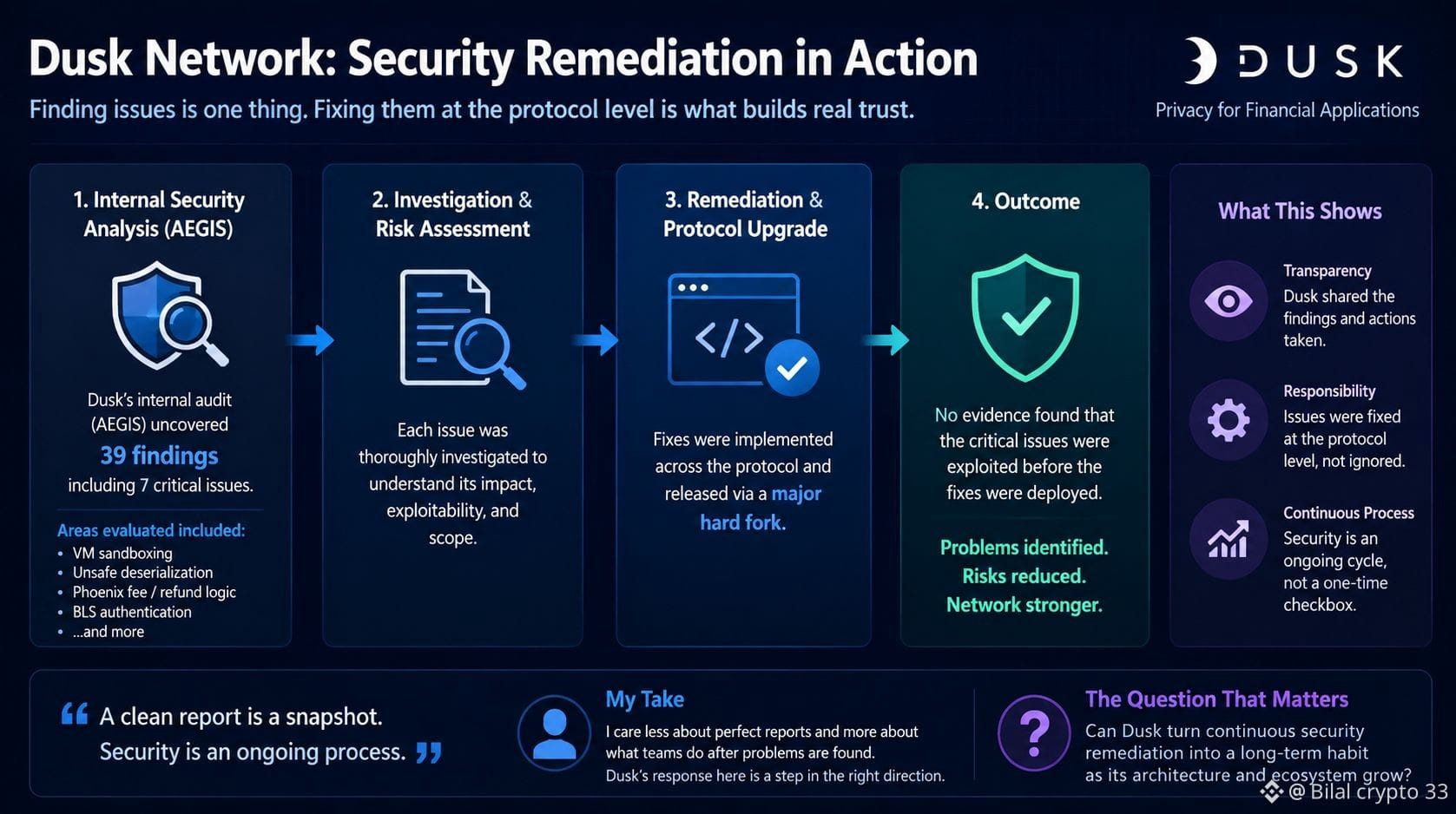
I’ve become pretty skeptical of crypto projects when they talk about security. An audit can look great on paper, but I care much more about what happens when someone actually finds a problem.
That’s what made Dusk’s recent security work interesting to me.
In its AEGIS security analysis, Dusk reported 39 findings, including seven classified as critical. The issues involved areas such as VM sandboxing, unsafe deserialization, fee and refund logic, and BLS authentication. Dusk says the problems were addressed through a major hard fork, and that there was no evidence the critical issues had been exploited beforehand.
I wouldn’t take that as proof that Dusk is simply “secure.” I think that conclusion would be too easy.
What I see instead is a more useful signal: issues were found, investigated, and converted into protocol-level fixes.
I’ve watched enough crypto cycles to know that security isn’t a one-time achievement. It gets harder as the system grows, especially when more developers and applications start depending on it.
So I’m more interested in what Dusk does after the next audit than how good the current report looks.
Can Dusk turn continuous security remediation into a long-term habit?
@Dusk_Foundation #dusk $DUSK
{spot}(DUSKUSDT)
I’ve become pretty skeptical of crypto projects when they talk about security. An audit can look great on paper, but I care much more about what happens when someone actually finds a problem.
That’s what made Dusk’s recent security work interesting to me.
In its AEGIS security analysis, Dusk reported 39 findings, including seven classified as critical. The issues involved areas such as VM sandboxing, unsafe deserialization, fee and refund logic, and BLS authentication. Dusk says the problems were addressed through a major hard fork, and that there was no evidence the critical issues had been exploited beforehand.
I wouldn’t take that as proof that Dusk is simply “secure.” I think that conclusion would be too easy.
What I see instead is a more useful signal: issues were found, investigated, and converted into protocol-level fixes.
I’ve watched enough crypto cycles to know that security isn’t a one-time achievement. It gets harder as the system grows, especially when more developers and applications start depending on it.
So I’m more interested in what Dusk does after the next audit than how good the current report looks.
Can Dusk turn continuous security remediation into a long-term habit?
@Dusk #dusk $DUSK
That’s what made Dusk’s recent security work interesting to me.
In its AEGIS security analysis, Dusk reported 39 findings, including seven classified as critical. The issues involved areas such as VM sandboxing, unsafe deserialization, fee and refund logic, and BLS authentication. Dusk says the problems were addressed through a major hard fork, and that there was no evidence the critical issues had been exploited beforehand.
I wouldn’t take that as proof that Dusk is simply “secure.” I think that conclusion would be too easy.
What I see instead is a more useful signal: issues were found, investigated, and converted into protocol-level fixes.
I’ve watched enough crypto cycles to know that security isn’t a one-time achievement. It gets harder as the system grows, especially when more developers and applications start depending on it.
So I’m more interested in what Dusk does after the next audit than how good the current report looks.
Can Dusk turn continuous security remediation into a long-term habit?
@Dusk #dusk $DUSK
15
15
334
·
--
Bullish
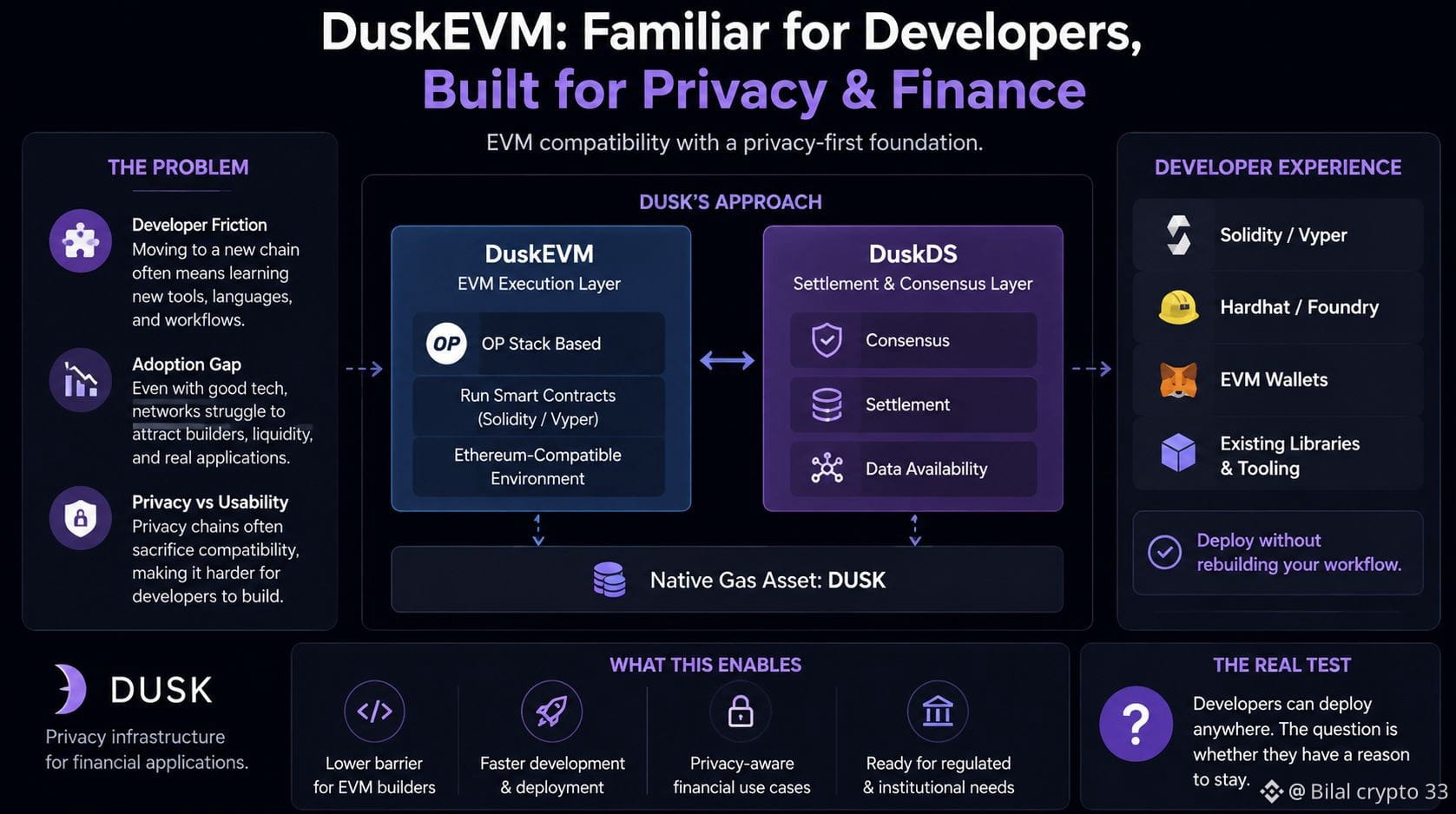
$DUSK I’ve been digging into DuskEVM, and I think the interesting part isn’t simply that it’s EVM-compatible.
I’ve seen that label used plenty of times in crypto. The real question for me is whether a developer can actually move over without feeling like they have to learn an entirely new world first.
Dusk is taking a pretty practical approach here. DuskEVM uses the OP Stack, while DuskDS handles consensus, settlement, and data availability. Developers can use familiar tools like Solidity, Vyper, Hardhat, and Foundry instead of rebuilding their workflow from scratch.
I like that idea, but I’m still cautious.
Familiar tooling can reduce friction, but it doesn’t magically create users, liquidity, or applications that people actually need. I’ve watched plenty of technically solid networks struggle with that part.
What I find interesting about Dusk is the attempt to keep the developer experience familiar while building infrastructure around privacy-sensitive financial use cases.
For me, the real test isn’t whether developers can deploy on DuskEVM.
It’s whether they eventually find a reason to stay there.
@Dusk_Foundation #dusk $DUSK
{spot}(DUSKUSDT)
$DUSK I’ve been digging into DuskEVM, and I think the interesting part isn’t simply that it’s EVM-compatible.
I’ve seen that label used plenty of times in crypto. The real question for me is whether a developer can actually move over without feeling like they have to learn an entirely new world first.
Dusk is taking a pretty practical approach here. DuskEVM uses the OP Stack, while DuskDS handles consensus, settlement, and data availability. Developers can use familiar tools like Solidity, Vyper, Hardhat, and Foundry instead of rebuilding their workflow from scratch.
I like that idea, but I’m still cautious.
Familiar tooling can reduce friction, but it doesn’t magically create users, liquidity, or applications that people actually need. I’ve watched plenty of technically solid networks struggle with that part.
What I find interesting about Dusk is the attempt to keep the developer experience familiar while building infrastructure around privacy-sensitive financial use cases.
For me, the real test isn’t whether developers can deploy on DuskEVM.
It’s whether they eventually find a reason to stay there.
@Dusk #dusk $DUSK
I’ve seen that label used plenty of times in crypto. The real question for me is whether a developer can actually move over without feeling like they have to learn an entirely new world first.
Dusk is taking a pretty practical approach here. DuskEVM uses the OP Stack, while DuskDS handles consensus, settlement, and data availability. Developers can use familiar tools like Solidity, Vyper, Hardhat, and Foundry instead of rebuilding their workflow from scratch.
I like that idea, but I’m still cautious.
Familiar tooling can reduce friction, but it doesn’t magically create users, liquidity, or applications that people actually need. I’ve watched plenty of technically solid networks struggle with that part.
What I find interesting about Dusk is the attempt to keep the developer experience familiar while building infrastructure around privacy-sensitive financial use cases.
For me, the real test isn’t whether developers can deploy on DuskEVM.
It’s whether they eventually find a reason to stay there.
@Dusk #dusk $DUSK
13
10
188
Log in to explore more content
Join global crypto users on Binance Square
⚡️ Get latest and useful information about crypto.
💬 Trusted by the world’s largest crypto exchange.
👍 Discover real insights from verified creators.
Email / Phone number
Trending Topics
BinanceLaunchesBinanceIntelligence
667,443 views
4,134 Discussing
#binancelaunchesbinanceintelligence 🚨 WHAT IF THE NEXT BIG EXCHANGE BATTLE ISN’T ABOUT FEES? 👀
Binance just made a bigger move than adding another AI chatbot.
With Binance Intelligence, AI is moving deeper into the exchange — from understanding market data to building trading workflows. 🤖⚡
The real question is:
Who has the best liquidity?
Or who has the smartest AI layer?
If users can research, test ideas and manage trading workflows without switching between different tools, the exchange itself could become a financial assistant.
That could be a much bigger shift than it looks today.
If Binance Intelligence drives more users, more strategies and more trading activity, $BNB could become one of the tokens to watch. 👀
Is Binance building the future of AI-powered finance?
$BNB
#binancelaunchesbinanceintelligence #BinanceAI #CryptoAI #AITrading
Suleman Khan Haqqani
·9 Likes
·15.5k views
BTCFallsBelow$84K
14,805 views
62 Discussing
DubaiVARAIssuesReserveAssetAuditCircular
818 views
128 Discussing